PYCHOMETRIC INSTRUMENT
600 LEVEL
MOHAMMED, A. Hauwa
Sunday, December 28, 2025
Definition
• Psychometric instruments are tools used to measure psychological
constructs, such as personality traits, intelligence, or aptitude.
• Common examples include the Myers-Briggs Type Indicator (MBTI) for
personality, the Wechsler Intelligence Scales for intelligence, and the
Beck Depression Inventory for assessing depressive symptoms
Sunday, December 28, 2025
Psychometric properties of Instrument
Reliability
The consistency and stability of the instrument over
time. High reliability indicates that the instrument
produces consistent results.
Sunday, December 28, 2025
Types
• Test-Retest Reliability: Measures the consistency of scores when the
same individuals are tested at different times.
• Internal Consistency: Assesses the extent to which items within the
instrument are correlated, indicating how well they measure the
same underlying construct.
• Inter-Rater Reliability: Relevant when multiple raters are involved,
ensuring consistency in their judgments.
Sunday, December 28, 2025
•Validity
The extent to which the instrument measures what it is
intended to measure. Validity assesses the accuracy
and meaningfulness of the instrument's results.
Sunday, December 28, 2025
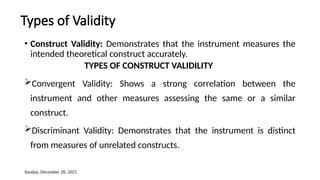
Types of Validity
• Construct Validity: Demonstrates that the instrument measures the
intended theoretical construct accurately.
TYPES OF CONSTRUCT VALIDILITY
Convergent Validity: Shows a strong correlation between the
instrument and other measures assessing the same or a similar
construct.
Discriminant Validity: Demonstrates that the instrument is distinct
from measures of unrelated constructs.
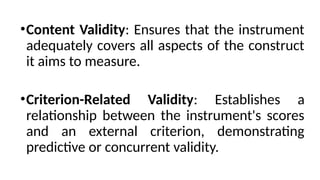
•Content Validity: Ensures that the instrument
adequately covers all aspects of the construct
it aims to measure.
•Criterion-Related Validity: Establishes a
relationship between the instrument's scores
and an external criterion, demonstrating
predictive or concurrent validity.
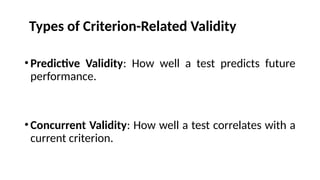
•Predictive Validity: How well a test predicts future
performance.
•Concurrent Validity: How well a test correlates with a
current criterion.
Types of Criterion-Related Validity
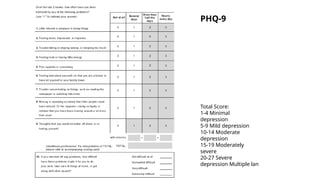
PHQ-9
Total Score:
1-4 Minimal
depression
5-9 Mild depression
10-14 Moderate
depression
15-19 Moderately
severe
20-27 Severe
depression Multiple lan
SLEEP DISORDER SCALE
Dissociative Symptoms Scale (DSS)
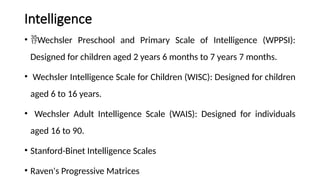
Intelligence
• Wechsler Preschool and Primary Scale of Intelligence (WPPSI):
Designed for children aged 2 years 6 months to 7 years 7 months.
• Wechsler Intelligence Scale for Children (WISC): Designed for children
aged 6 to 16 years.
• Wechsler Adult Intelligence Scale (WAIS): Designed for individuals
aged 16 to 90.
• Stanford-Binet Intelligence Scales
• Raven's Progressive Matrices
Personality
 Minnesota Multiphasic Personality Inventory
(MMPI)
 NEO Personality Inventory-Revised (NEO-PI-R)
 Myers-Briggs Type Indicator (MBTI)

PYCHOMETRIC INSTRUMENT and how to use.pptx

  • 1.
  • 2.
    Sunday, December 28,2025 Definition • Psychometric instruments are tools used to measure psychological constructs, such as personality traits, intelligence, or aptitude. • Common examples include the Myers-Briggs Type Indicator (MBTI) for personality, the Wechsler Intelligence Scales for intelligence, and the Beck Depression Inventory for assessing depressive symptoms
  • 3.
    Sunday, December 28,2025 Psychometric properties of Instrument Reliability The consistency and stability of the instrument over time. High reliability indicates that the instrument produces consistent results.
  • 4.
    Sunday, December 28,2025 Types • Test-Retest Reliability: Measures the consistency of scores when the same individuals are tested at different times. • Internal Consistency: Assesses the extent to which items within the instrument are correlated, indicating how well they measure the same underlying construct. • Inter-Rater Reliability: Relevant when multiple raters are involved, ensuring consistency in their judgments.
  • 5.
    Sunday, December 28,2025 •Validity The extent to which the instrument measures what it is intended to measure. Validity assesses the accuracy and meaningfulness of the instrument's results.
  • 6.
    Sunday, December 28,2025 Types of Validity • Construct Validity: Demonstrates that the instrument measures the intended theoretical construct accurately. TYPES OF CONSTRUCT VALIDILITY Convergent Validity: Shows a strong correlation between the instrument and other measures assessing the same or a similar construct. Discriminant Validity: Demonstrates that the instrument is distinct from measures of unrelated constructs.
  • 7.
    •Content Validity: Ensuresthat the instrument adequately covers all aspects of the construct it aims to measure. •Criterion-Related Validity: Establishes a relationship between the instrument's scores and an external criterion, demonstrating predictive or concurrent validity.
  • 8.
    •Predictive Validity: Howwell a test predicts future performance. •Concurrent Validity: How well a test correlates with a current criterion. Types of Criterion-Related Validity
  • 13.
    PHQ-9 Total Score: 1-4 Minimal depression 5-9Mild depression 10-14 Moderate depression 15-19 Moderately severe 20-27 Severe depression Multiple lan
  • 19.
  • 20.
  • 21.
    Intelligence • Wechsler Preschooland Primary Scale of Intelligence (WPPSI): Designed for children aged 2 years 6 months to 7 years 7 months. • Wechsler Intelligence Scale for Children (WISC): Designed for children aged 6 to 16 years. • Wechsler Adult Intelligence Scale (WAIS): Designed for individuals aged 16 to 90. • Stanford-Binet Intelligence Scales • Raven's Progressive Matrices
  • 22.
    Personality  Minnesota MultiphasicPersonality Inventory (MMPI)  NEO Personality Inventory-Revised (NEO-PI-R)  Myers-Briggs Type Indicator (MBTI)