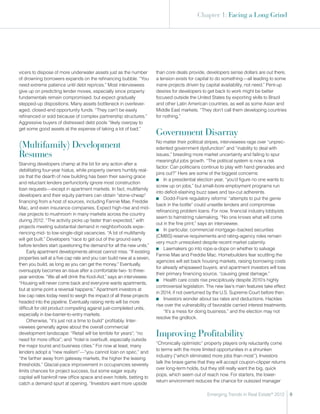
Emerging
     Trends

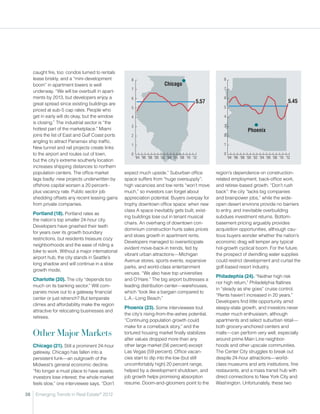
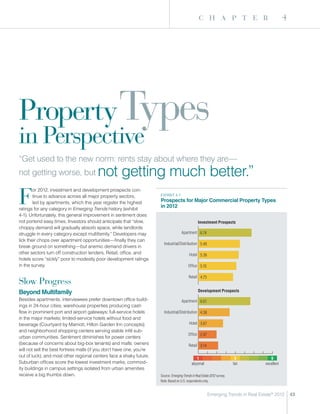
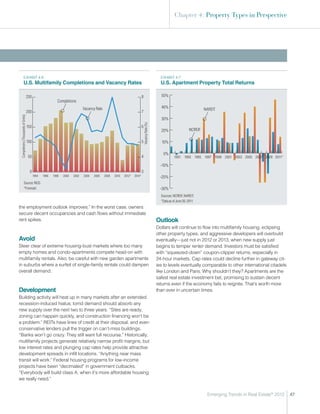
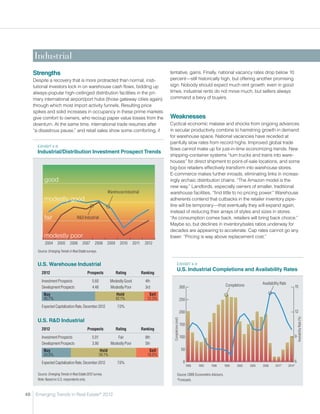
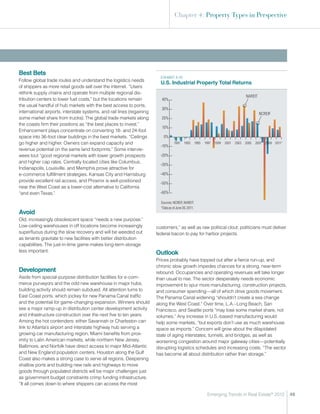
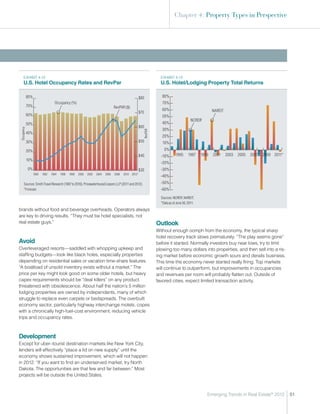
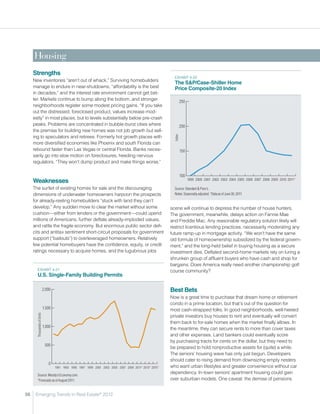
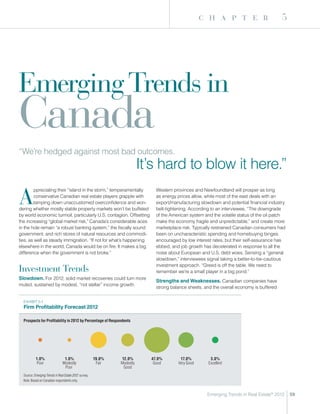
     20
     in Real Estate
                  ®


15
12
     12
 9
 6
 3
 0
-3
Emerging Trends in Real Estate® 2012
A publication from:
Emerging
Trends                                                                 20
in Real Estate
                                                                       12
                                                         ®


Contents
 1   Executive Summary

 2   Chapter 1 Facing a Long Grind
 4   Where Is Demand?
 6   “Too Many Jobs Headwinds”
 7   Low Interest Rate Medicine, Cap Rate Caution, Inflation Bailout
 7   Ebbing Return Expectations
 8   Transaction Markets Regear
 9   (Multifamily) Development Resumes
 9   Government Disarray
 9   Improving Profitability
11   Best Bets 2012

14   Chapter 2 Real Estate Capital Flows
18   Banks
18   Insurers
19   CMBS
22   Mezzanine Debt and Preferred Equity
22   Wall Street Opportunity Funds
22   REITs
23   Pension Funds
23   Nontraded REITs, High-Net-Worth Investors, Local Operators
24   Foreign Investors

26   Chapter 3 Markets to Watch
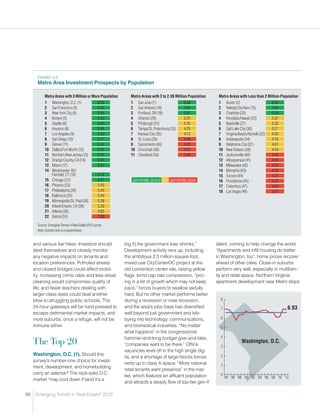
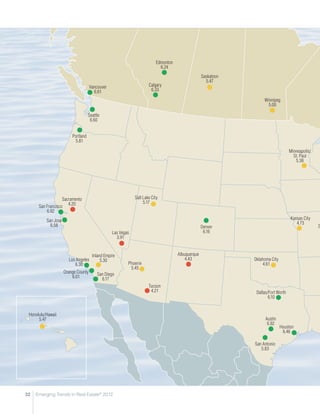
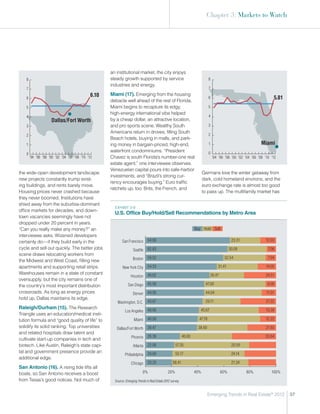
30   The Top 20
38   Other Major Markets
40   Other Market Prospects

42   Chapter 4 Property Types in Perspective
43   Slow Progress
46   Apartments
48   Industrial
50   Hotels
52   Office
54   Retail
56   Housing

58   Chapter 5 Emerging Trends in Canada
59   Investment Trends
62   Capital Markets
64   Markets to Watch
68   Property Types in Perspective
73   Best Bets

74   Chapter 6 Emerging Trends in Latin America
75   Brazil Arrives
76   Mexico No Go
77   Other Markets: Colombia Draws Interest

78   Interviewees
                                                                       Emerging Trends in Real Estate® 2012   i
Editorial Leadership Team
     Emerging Trends Chairs                                                       PwC Advisers and Researchers
     Mitchell M. Roschelle, PwC                                                   Adam E. Harvey                        Ken Griffin
     Patrick L. Phillips, Urban Land Institute                                    Aleem F. Bandali                      Kevin Bennett
                                                                                  Amanda Brown                          Lois McCarron-McGuire
     Author                                                                       Ami J. Patel                          Lori-Ann Beausoleil
     Jonathan D. Miller                                                           Amy E. Olson                          Marc Normand
                                                                                  Andrew Alperstein                     Maridel Gonzalez Gutierrez
     Principal Researchers and Advisers                                           Andrew Popert                         Matt Lopez
     Stephen Blank, Urban Land Institute                                          Arthur Chippin                        Michael Chung
     Charles J. DiRocco, Jr., PwC                                                 Brandon Bush                          Miriam Gurza
     Dean Schwanke, Urban Land Institute                                          Brian Robertson                       Molly Caccamo
                                                                                  Chris Vangou                          Nadja Ibrahim
     Senior Advisers                                                              Christine Lattanzio                   Natalie R. Cheng
     Christopher J. Potter, PwC, Canada                                           Claude Gilbert                        Nelson P. Da Silva
     Susan M. Smith, PwC                                                          Daniel Cadoret                        Patricia Perruzza
                                                                                  Daniel D’Archivio                     Paul F. Bradley
                                                                                  Dave Chucko                           Paul Ryan
                                                                                  David E. Khan                         Reginald Dean Barnett
                                                                                  David M. Yee                          Richard Deslauriers
                                                                                  David Swerling                        Rob Sciaudone
                                                                                  David Voss                            Robin Madigan
                                                                                  Dennis Johnson                        Ron J. Walsh
                                                                                  Dominique Fortier                     Roxanna Bevilacqua
                                                                                  Donald M. Flinn                       Russell Sugar
     Emerging Trends in Real Estate® is a trademark of PwC and is regis-
                                                                                  Doug Purdie                           Sammi Ha
     tered in the United States and other countries. All rights reserved.
                                                                                  Doug Struckman                        Scott Heal
     “PwC” is the brand under which member firms of Pricewaterhouse-              Frank Magliocco                       Scott H. McDonald
     Coopers International Limited (PwCIL) operate and provide services.          Fred Cassano                          Scott Tornberg
     Together, these firms form the PwC network. Each firm in the network         Hugo Domingues                        Seth Promisel
     is a separate legal entity and does not act as agent of PwCIL or any         Issa Habash                           Stephen Shulman
     other member firm. PwCIL does not provide any services to clients.           Jag Patel                             Steve J. Hollinger
     PwCIL is not responsible or liable for the acts or omissions of any of its   James A. Oswald                       Steve Tyler
     member firms nor can it control the exercise of their professional judg-     Jasen F. Kwong                        Steven Weisenburger
     ment or bind them in anyway. This document is for general information        Jeffrey Nasser                        Susan Farina
     purposes only, and should not be used as a substitute for consultation
                                                                                  John Gottfried                        Susan Smith
     with professional advisers.
                                                                                  Jonathan Jacobs                       Tim Conlon
                                                                                  Joshua J. Mowbray                     Tom Kirtland
     © October 2011 by PwC and the Urban Land Institute.
                                                                                  Katherine M. Billings                 Warren Marr
     Printed in the United States of America. All rights reserved. No part of
     this book may be reproduced in any form or by any means, electronic          ULI Editorial and Production Staff
     or mechanical, including photocopying and recording, or by any infor-        James A. Mulligan, Managing Editor/Manuscript Editor
     mation storage and retrieval system, without written permission of the       Betsy VanBuskirk, Creative Director
     publisher.                                                                   Anne Morgan, Cover Design
                                                                                  Deanna Pineda, Muse Advertising Design, Designer
     Recommended bibliographic listing:
                                                                                  Craig Chapman, Senior Director of Publishing Operations
     PwC and the Urban Land Institute. Emerging Trends in Real Estate®
                                                                                  Sarah Nemecek, Research Associate
     2012. Washington, D.C.: PwC and the Urban Land Institute, 2011.

     ULI Catalog Number: E44                                                      About the Author
     ISBN: 978-87420-165-9                                                        Jonathan D. Miller is a real estate forecaster who has written the annual
                                                                                  Emerging Trends in Real Estate report since 1992.


ii    Emerging Trends in Real Estate® 2012
Executive Summary
F
        or 2012, U.S. real estate players must resign        sentiment declines as selling interest increases.              related markets scoring well include San Jose,
        themselves to a slowing, grind-it-out recov-         Investors who bought at or near market bottom in               Denver, and Raleigh-Durham.
        ery following a period of mostly sporadic            2009 and 2010 consider cashing in some gains.                       Among property sectors, everybody wants
growth, confined largely to “wealth island” real             Many players back off from bidding on trophy                   apartments. Living smaller, closer to work, and
estate markets—the primary 24-hour gateways                  properties in better markets, fearing that pricing is          preferably near mass transit holds increasingly
located along global pathways. A handful of cities           outpacing the potential for recovery in net operat-            appeal as more people look to manage expenses
also should continue to benefit from expansion               ing incomes. Cap rate compression has ended; a                 wisely. Interest cools on offices, especially sub-
in locally based technology- and energy-related              leveling off is expected, with possible upticks for            urban office parks: more companies concentrate
industries. Otherwise, most commercial markets               some property sectors in certain markets.                      in urban districts where sought-after generation-Y
have stabilized, but will find marked improve-                     Most developers and homebuilders will                    talent wants to locate in 24-hour environments.
ment in occupancies and rents relatively elusive.            twiddle their thumbs in ongoing extended hiatus;               Investors continue to place bets on high-ceiling
Despite some stepped-up bargain hunting,                     without evident demand drivers, construction                   warehouses in the gateway ports and around
capital generally will continue to avoid commodity           lenders hold back funding on most projects,                    international hub airports. And East Coast and
real estate in most secondary and tertiary cities.           except for multifamily development. Expect a                   Gulf Coast ports vie to attract the most new ship-
Among the property sectors, only apartments will             ramp-up in apartment development across many                   ping traffic coming through a widened Panama
score especially well: demographic trends and the            markets justified by plunging vacancies and                    Canal in 2014. Winning cities could transform into
aftermath of the housing bloodbath combine to                continuing rent increases. When the odd new                    major distribution sites. Shopping center owners
increase and sustain demand for multifamily units.           office building goes forward, developers likely                continue to face incursions from internet retailing:
     Enduring economic doldrums and the                      will employ green technologies and concepts;                   fortress malls and infill grocery-anchored centers
absence of dynamic jobs generators hamstring                 tenants begin to insist on cost-saving, energy-                consolidate business at the same time that older
overall demand, weighing on real estate markets.             efficient systems.                                             regional malls and fringe strip centers appear to
While the nation’s lackluster employment outlook                   Shaken by stock market declines and anemic               lose ground. The hotel recovery begins to flag:
delays filling office space, the related drag in             bond yields, investors gravitate toward equity real            good news concentrates in the prime business
consumer spending compromises growth in                      estate, but grow somewhat unsettled in the face of             traveler/tourist gateways and in middle-market
retail and industrial occupancies and rents.                 limited property investment opportunities. “Face               brands without food and beverage.
Interviewees uniformly struggle to identify new              it: real estate doesn’t offer enough growth poten-                  Canadian real estate markets remain the
employment engines: competition from overseas                tial to satisfy” the demand, says an interviewee.              most stable in North America. Institutions hold
markets, technology gains, government and                    Although debt capital remains undersupplied,                   on to the best properties and avoid boom/bust
personal debt loads, an aging population, and                lenders and government regulators work hard to                 frenzies over pricing, while conservative fiscal
global financial breakdowns all combine to stanch            avoid a refinancing crisis with hundreds of billions           policies discourage lax underwriting and licen-
wage growth and hiring. As a result, businesses              in commercial mortgages maturing over the next                 tious lending. A resource-rich economy does not
that are focused on squeezing profitability out              three to four years. Well-capitalized borrowers and            hurt either. Interviewees expect these markets to
of productivity gains and families forced into               solid, revenue-generating properties have no trou-             weather world economic turmoil, particularly U.S.
belt-tightening use less square footage. “The Era            ble obtaining financing, while lenders and special             contagion, but anticipate a slowdown in 2012 as
of Less” forecast in last year’s Emerging Trends             servicers will continue to extend and pretend as               consumers and homebuyers back off a recent
takes firm hold. Housing markets continue to                 long as borrowers on less-stable assets can pay                wave of uncharacteristic splurging. Eastern prov-
founder in widespread borrower distress. Many                something out of cash flows. Foreclosures will                 inces tied to U.S.-related manufacturing could
cash-strapped, prospective buyers can meet                   increase, but at a relatively restrained rate given            be affected more than western regions, living off
neither stricter credit requirements nor higher              the number of still-troubled properties.                       energy stores and other commodities. Toronto
equity hurdles. Casting a further pall on respon-                  The top investment markets remain the usual              and Vancouver stake claims as top markets; their
dent outlooks, U.S. government disarray breeds               suspects, led by the 24-hour global gateways—                  gateway status attracts business and a surge in
uncertainty about policy affecting business and              Washington, D.C., San Francisco, New York City,                Asian investors parking capital in condo projects,
investment decision making.                                  Boston, and Seattle. Austin, the moderately sized              which spring up in all directions. The two largest
     Return expectations continue to ebb, although           Texas capital, sneaks into the number-two spot                 Latin American real estate markets head in differ-
well-leased core real estate in leading markets will         on the survey, benefiting from dynamics created                ent directions. Brazil matures into more of a core
continue to produce solid single-digit income-               by its large university, the local tech industry,              play, especially in Rio de Janeiro and São Paulo,
oriented returns. Opportunistic investors ratchet            government jobs, and regional energy-based                     where vacancies in top properties barely register
down forecasts; even projections of returns in the           economy. Houston and Dallas also solidify rank-                and condo prices compete with New York City’s
midteens look like a stretch as risk increases from          ings off their oil and gas businesses and relatively           best residential districts. Investors shy away from
squirrely supply/demand fundamentals. Buying                 strong jobs advances. Other tech- and/or energy-               Mexico as drug violence takes an unfortunate toll.


Notice to Readers
Emerging Trends in Real Estate® is a trends and forecast publication now in its 33rd       Private Property Company Investor or Developer            39.9%
edition, and is one of the most highly regarded and widely read forecast reports in the    Real Estate Service Firm                                  20.3%
real estate industry. Emerging Trends in Real Estate® 2012, undertaken jointly by PwC
and the Urban Land Institute, provides an outlook on real estate investment and devel-     Institutional/Equity Investor or Investment Manager       16.6%
opment trends, real estate finance and capital markets, property sectors, metropolitan     Other                                                      8.9%
areas, and other real estate issues throughout the United States, Canada, and
Latin America.                                                                             Bank, Lender, or Securitized Lender                        5.9%
                                                                                           Publicly Listed Property Company or Equity REIT            5.0%
Emerging Trends in Real Estate 2012 reflects the views of over 950 individuals who
                               ®

completed surveys or were interviewed as a part of the research process for this report.   Homebuilder or Residential Land Developer                  3.4%
The views expressed herein, including all comments appearing in quotes, are obtained
                                                                                           Throughout the publication, the views of interviewees and/or survey respondents have
exclusively from these surveys and interviews, and do not express the opinions of either
                                                                                           been presented as direct quotations from the participant without attribution to any par-
PwC or ULI. Interviewees and survey participants represent a wide range of industry
                                                                                           ticular participant. A list of the interview participants in this year’s study appears at the
experts, including, investors, fund managers, developers, property companies,
                                                                                           end of this report. To all who helped, the Urban Land Institute and PwC extend sincere
lenders, brokers, advisers, and consultants. ULI and PwC researchers personally
                                                                                           thanks for sharing valuable time and expertise. Without the involvement of these many
interviewed more than 275 individuals and survey responses were received from 675
                                                                                           individuals, this report would not have been possible.
individuals, whose company affiliations are broken down below.


                                                                                                                               Emerging Trends in Real Estate® 2012                        1
c h a p t e r                            1


Facing a
                    Long Grind
“Don’t let availability of capital cloud judgments. Demand drivers
don’t exist, and fundamentals                        need to catch up.”

S
        ome real estate players take comfort watching ample         new supply will be added, “any improvement in demand can be
        capital pour into U.S. property markets, escaping from a    amplified.” But even in the wealth islands, expect “a slow-going
        world of troubles plaguing other asset classes. “We are     grind” where stubbornly high unemployment delays the filling of
back to spread investing, with no place else to put money for       office space, while the consumer drag hurts shopping centers
a current return,” one Emerging Trends interviewee says. But        and industrial space. “Face it: real estate doesn’t offer enough
the seemingly intractable economic and political vicissitudes       growth potential to satisfy all the capital demand. People had
undercutting stocks and bonds eventually catch up to real           been living and feeling large,” mostly off borrowed money.
estate investors. Absent increasing occupancies and rents,          “That’s gone. We’re living smaller,” says an interviewee.
capital flows inevitably retreat, with sometimes dire conse-            Indeed, the “Era of Less” heralded in last year’s Emerging
quences. For 2012, everyone must worry about leasing in soft        Trends report, appears to have taken hold of real estate funda-
markets where chronic economic malaise and technological            mentals. During the past decade, the leverage-induced housing
productivity enhancements combine to dampen demand for              and private equity booms numbed impacts from stagnating
space. The hard reality is businesses have learned they can         wages and declining worker benefits across most income strata.
increase profits using less, while people just cannot afford to     Now, massive ongoing government and personal deleverag-
live in more.                                                       ing erodes spending, as well as individual financial security. In
     Most of the investment action concentrates in a handful        general, people have less money or feel less inclined to spend
of property-wealth islands—notably the diversified 24-hour          what they have.
gateways located along global trade routes, and the reliable            Even more unsettling, unprecedented government impair-
multifamily sector, buoyed by the after-effects of the housing      ment gridlocks policy makers and roadblocks decisions that
market collapse. Following the money, investors secure capital      might encourage business expansion and hiring. Concern
in the safe-bet cities where the nation does most of its business   grows that any concrete political action awaits the outcome of
and the affluent settle, supporting local economies. With some      next November’s presidential election. In the meantime, the
overlap, markets generating jobs in resurgent tech and energy       future of health care depends on a looming U.S. Supreme Court
businesses also gain adherents. Apartments, meanwhile, score        decision; what happens to Fannie Mae and Freddie Mac is any-
just about anywhere because not as many regular folks can           body’s guess; needed reforms to tax policy remain up in the air;
afford to own homes and need to rent.                               and Dodd-Frank banking regulations are entangled in lobbying
     Otherwise capital generally avoids the surrounding sea of      machinations. “With all this uncertainty, nobody wants to make a
mostly commodity real estate. Local owners grapple in a ten-        move,” spawning additional risk.
ants’ market to lease space and secure cash flows without the           For real estate investors, the big question—where are we in
benefit of cap rate compression to increase values. Because         the cycle?—proves tough to answer. Almost three years after the
most commercial developers cannot obtain financing and little       economy hit bottom, recovery appears nearly stalled. Trophy


                                                                                             Emerging Trends in Real Estate® 2012       3
“playing with existing inventory.” Class A properties lease up
      ExHIBIT 1-1                                                                             at the expense of Bs and increasingly obsolescent Cs. The
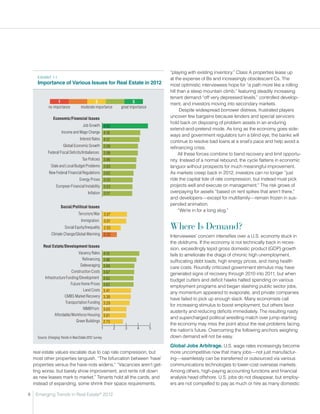
      Importance of Various Issues for Real Estate in 2012                                    most optimistic interviewees hope for “a path more like a rolling
                                                                                              hill than a steep mountain climb,” featuring steadily increasing
                                                                                              tenant demand “off very depressed levels,” controlled develop-
                    1                            3                             5
                                                                                              ment, and investors moving into secondary markets.
              no importance             moderate importance            great importance
                                                                                                     Despite widespread borrower distress, frustrated players
                  Economic/Financial Issues                                                   uncover few bargains because lenders and special servicers
                                                                                              hold back on disposing of problem assets in an enduring
                                     Job Growth 4.82
                                                                                              extend-and-pretend mode. As long as the economy goes side-
                        Income and Wage Change 4.18
                                                                                              ways and government regulators turn a blind eye, the banks will
                                   Interest Rates 4.12
                                                                                              continue to resolve bad loans at a snail’s pace and help avoid a
                          Global Economic Growth 3.99
                                                                                              refinancing crisis.
              Federal Fiscal Deficits/Imbalances  3.98                                               All these forces combine to bend recovery and limit opportu-
                                    Tax Policies 3.86                                         nity. Instead of a normal rebound, the cycle flattens in economic
                State and Local Budget Problems 3.83                                          languor without prospects for much meaningful improvement.
              New Federal Financial Regulations 3.62                                          As markets creep back in 2012, investors can no longer “just
                                 Energy Prices 3.55                                           ride the capital tide of rate compression, but instead must pick
                    European Financial Instability 3.53                                       projects well and execute on management.” The risk grows of
                                             Inflation 3.51                                    overpaying for assets “based on rent spikes that aren’t there,”
                                                                                              and developers—except for multifamily—remain frozen in sus-
                                                                                              pended animation.
                        Social/Political Issues
                                                                                                    “We’re in for a long slog.”
                                     Terrorism/War 3.07
                                       Immigration 3.01
                         Social Equity/Inequality 2.55                                        Where Is Demand?
                Climate Change/Global Warming 2.22
                                                                                              Interviewees’ concern intensifies over a U.S. economy stuck in
                                                                                              the doldrums. If the economy is not technically back in reces-
          Real Estate/Development Issues
                                                                                              sion, exceedingly tepid gross domestic product (GDP) growth
                                  Vacancy Rates             4.10                              fails to ameliorate the drags of chronic high unemployment,
                                     Refinancing             3.86                              suffocating debt loads, high energy prices, and rising health
                                   Deleveraging             3.69                              care costs. Roundly criticized government stimulus may have
                             Construction Costs             3.67                              generated signs of recovery through 2010 into 2011, but when
           Infrastructure Funding/Development               3.62                              budget cutters and deficit hawks halted spending on various
                             Future Home Prices             3.62                              employment programs and began slashing public sector jobs,
                                     Land Costs             3.41                              any momentum appeared to evaporate, and private companies
                         CMBS Market Recovery               3.39                              have failed to pick up enough slack. Many economists call
                         Transportation Funding             3.29                              for increasing stimulus to boost employment, but others favor
                                     NIMBYism               3.03
                                                                                              austerity and reducing deficits immediately. The resulting nasty
                  Affordable/Workforce Housing              3.01
                                                                                              and supercharged political wrestling match over jump-starting
                                Green Buildings             2.73
                                                                                              the economy may miss the point about the real problems facing
                                                        1          2     3       4        5
                                                                                              the nation’s future. Overcoming the following anchors weighing
      Source: Emerging Trends in Real Estate 2012 survey.                                     down demand will not be easy.

                                                                                              Global Jobs Arbitrage. U.S. wage rates increasingly become
    real estate values escalate due to cap rate compression, but                              more uncompetitive now that many jobs—not just manufactur-
    most other properties languish. “The bifurcation between ‘have’                           ing—seamlessly can be transferred or outsourced via various
    properties versus the have-nots widens.” “Vacancies aren’t get-                           communications technologies to lower-cost overseas markets.
    ting worse, but barely show improvement, and rents roll down                              Among others, high-paying accounting functions and financial
    as new leases mark to market.” Tenants hold all the cards, and                            analysis head offshore. U.S. jobs do not disappear, but employ-
    instead of expanding, some shrink their space requirements,                               ers are not compelled to pay as much or hire as many domestic

4    Emerging Trends in Real Estate® 2012
Chapter 1: Facing a Long Grind


workers. No wonder many Americans take pay cuts in new
jobs. The corporate pension turns into a dinosaur, and employ-        ExHIBIT 1-2

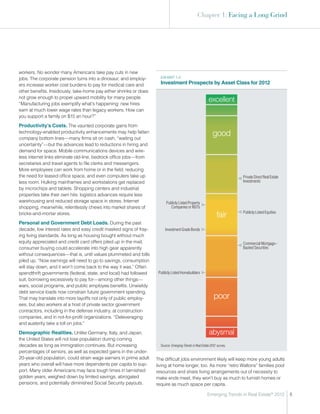
ers increase worker cost burdens to pay for medical care and          Investment Prospects by Asset Class for 2012
other benefits. Insidiously, take-home pay either shrinks or does
not grow enough to propel upward mobility for many people.
“Manufacturing jobs exemplify what’s happening: new hires
                                                                                                           excellent
earn at much lower wage rates than legacy workers. How can
you support a family on $15 an hour?”

Productivity’s Costs. The vaunted corporate gains from
technology-enabled productivity enhancements may help fatten
company bottom lines—many firms sit on cash, “waiting out
                                                                                                              good
uncertainty”—but the advances lead to reductions in hiring and
demand for space. Mobile communications devices and wire-
less internet links eliminate old-line, bedrock office jobs—from
secretaries and travel agents to file clerks and messengers.
More employees can work from home or in the field, reducing
the need for leased office space, and even computers take up                                                                Private Direct Real Estate
less room. Hulking mainframes and workstations get replaced                                                                 Investments
by microchips and tablets. Shopping centers and industrial
properties take their own hits: logistics advances require less
warehousing and reduced storage space in stores. Internet                 Publicly Listed Property
shopping, meanwhile, relentlessly chews into market shares of                Companies or REITs
bricks-and-mortar stores.                                                                                        fair       Publicly Listed Equities

Personal and Government Debt Loads. During the past
decade, low interest rates and easy credit masked signs of fray-         Investment Grade Bonds
ing living standards. As long as housing bought without much
equity appreciated and credit card offers piled up in the mail,                                                             Commercial Mortgage–
consumer buying could accelerate into high gear apparently                                                                  Backed Securities
without consequences—that is, until values plummeted and bills
piled up. “Now earnings will need to go to savings, consumption
will stay down, and it won’t come back to the way it was.” Often
spendthrift governments (federal, state, and local) had followed     Publicly Listed Homebuilders
suit, borrowing excessively to pay for—among other things—
wars, social programs, and public employee benefits. Unwieldy
debt service loads now constrain future government spending.
That may translate into more layoffs not only of public employ-                                                poor
ees, but also workers at a host of private sector government
contractors, including in the defense industry, at construction
companies, and in not-for-profit organizations. “Deleveraging
and austerity take a toll on jobs.”

Demographic Realities. Unlike Germany, Italy, and Japan,                                                  abysmal
the United States will not lose population during coming
decades as long as immigration continues. But increasing              Source: Emerging Trends in Real Estate 2012 survey.
percentages of seniors, as well as expected gains in the under-
20-year-old population, could strain wage earners in prime adult    The difficult jobs environment likely will keep more young adults
years who overall will have more dependents per capita to sup-      living at home longer, too. As more “retro Waltons” families pool
port. Many older Americans may face tough times in tarnished        resources and share living arrangements out of necessity to
golden years, weighed down by limited savings, abrogated            make ends meet, they won’t buy as much to furnish homes or
pensions, and potentially diminished Social Security payouts.       require as much space per capita.

                                                                                                          Emerging Trends in Real Estate® 2012           5
facilitators—lawyers, appraisers, brokers, and accountants—
      ExHIBIT 1-3                                                                      also feel the chill. Reality takes hold: the economy, including the
      Index Returns: Real Estate vs. Stocks/Bonds                                     real estate world, cannot sustain so many highly paid middle-
                                                                                       men engaged in taking real profits out of deals without providing
      40%                                               FTSE NAREIT Composite          long-term economic benefits.

      30%                                                           NCREIF

       20%
                                                                                       “Too Many Jobs Headwinds”
                                                                                       “All these structural economic changes can’t be good for real
       10%                                                                             estate”; they augur “a long period of adjustment and ratchet-
        0%                                                                             ing down,” featuring “a weak hiring environment” until declining
             1997       1999       2001        2003     2005     2007    2009   2011   labor and business costs reach a point where the United States
      -10%                                                                             can compete again. Interviewees lament this “slow crawl” of
      -20%                                                                             dismal jobs growth, which barely keeps pace with young people
                                               Barclays Capital                        entering the workforce (4.5 million Americans turn 21 annually)
      -30%               SP 500               Government Bond Index
                                                                                       and struggles to make up the nearly 9 million jobs lost during the
      -40%                                                                             recession (only a fraction have been recovered). “Real estate
                                                                                       health simply depends on jobs, but there’s no significant uptick.”
      Sources: NCREIF, NAREIT, SP, Barclays Group.                                         Pockets of hiring occur in certain industries and parts of
      *2011 data annualized from second-quarter 2010.
                                                                                       the country:
                                                                                       ■■ The strong energy sector, driven by current high oil prices,
    Construction Slowdown. Slipping demand for space across                           helps Texas cities and some out-of-the-way places like North
    all sectors means developers and building companies will have                      Dakota (“not exactly a happening real estate market,” says
    less to do, slowing any rebound in construction jobs, a once-                      an interviewee).
    reliable employment bulwark. Population growth—forecast at 3                       ■■ Technology boosts northern California, the Seattle area,
    million–plus annually—will fuel the need for more housing, but                     Boston, and smaller high-tech markets like Austin and Raleigh-
    not necessarily create as many construction-related jobs as                        Durham.
    homeowners and renters economize. The construction industry                        ■■ Health care expands everywhere. The steadily graying
    could have plenty of work rebuilding the nation’s increasingly                     population needs more medical attention, but work skews
    deficient infrastructure, but government deficits and political                    to lower-paid aides or highly skilled doctors, nurses, and
    wrangling could continue to short-circuit a ramp-up in public                      technicians.
    sector projects and resulting jobs.                                                     The country also experiences a shortage of engineers and
                                                                                       specialized manufacturing artisans. “The economy produces
    Global Financial Morass. Massive deleveraging extends
                                                                                       service jobs at the low end and very high-skilled jobs at the
    well beyond U.S. borders. “America is merely wounded; Europe
                                                                                       other extreme.” People either don’t make as much money as
    risks death,” and China depends on selling goods into Western
                                                                                       they used to in manufacturing and services or need special skill
    economies, which lose at least some buying power. “The global
                                                                                       sets and talent to make more, and many find themselves cast
    economy really slows down” as the complexities of intercon-
                                                                                       aside. Unfortunately, the nation’s education system, particu-
    nected economies and banking systems complicate finding
                                                                                       larly its public schools, lags in producing enough trained and
    national or regional solutions. When Greece, let alone Italy or
                                                                                       accomplished workers despite still boasting the world’s premier
    Spain, “spins toward economic Armageddon,” the entire global
                                                                                       colleges and universities. Some attention-getting, new-age
    banking system shudders into a crisis state, and fragile stock
                                                                                       industries like social media and digital communications “either
    and bond markets crater, wiping out more wealth, says an
                                                                                       aren’t mass employers or reduce more jobs than they pro-
    interviewee.
                                                                                       duce through automation and tech efficiencies.” Under these
    Financial Industry Recalibration. America’s once highly                           circumstances, how can office building absorption accelerate
    profitable and jobs-creating financial services industry struggles                 or consumers ramp up spending in malls? It likely won’t happen
    to regain its footing in these compromised markets. Most banks                     in 2012.
    make money, just a lot less. Without escalating values and easy
    credit to boost returns, the transaction arcade quiets down,
    fee volumes diminish, and bottom lines erode. Deal-maker

6    Emerging Trends in Real Estate® 2012
Chapter 1: Facing a Long Grind


Low Interest Rate Medicine,                                                                               ExHIBIT 1-5

Cap Rate Caution, Inflation Bailout                                                                       Inflation and Interest Rate Changes

Essentially admitting the economy and housing market need                                                            Increase5
further intensive care, the Federal Reserve reaches deep into its                                                substantially
bag of tricks and holds down interest rates about as low as they
                                                                                                                                                                     Next
can go. “The policy looks increasingly ‘Japan-y,’ where rates                                                                                                      five years
stay at extremely low levels and government budgets don’t allow                                                     Increase
                                                                                                                           4
                                                                                                                  moderately
spending,” says an interviewee. In the real estate world, the low
rate environment and resulting extremely favorable spreads
over other investments ignite buying of prime properties at rich                                                                                                2012
prices, while weak fundamentals should be forcing down return                                                  Remain stable 3
expectations. If not yet a new bubble, investors may need to                                                 at current levels
dial back to prevent creating one. Capitalization rates fall to
pre-crash 2006–2007 levels; they “reach absurd numbers” on
core assets “with crazy values.” Low interest rates perversely
                                                                                                                              2
“encourage investors into taking greater risk since they can’t                                                                      Inflation        Short-term Long-term Commercial
                                                                                                                                                   rates (1-year rates (10-year mortgage
make money in bonds or money markets.”                                                                                                              treasuries)    treasuries)   rates
    Despite Fed assurances about keeping rates at present
                                                                                                          Source: Emerging Trends in Real Estate 2012 survey.
levels past the election cycle, “people delude themselves if                                              Note: Based on U.S. respondents only.
they think rates couldn’t go up. Circumstances change, exog-
enous shocks happen, and the Fed may need to act.” Investors
                                                                                                        1-5), possibly signaling good news if dictated by a resurgence
should plan defensively for possible rate spikes. “Don’t get
                                                                                                        in economic growth. Respondents also predict heightened infla-
caught with floating-rate debt, and instead try to lock in long-
                                                                                                        tionary pressures: goods from Asia will cost more as Chinese
term fixed rates while the going is good.” Keeping financing
                                                                                                        wages increase, pricey gasoline could continue to raise trans-
costs down over the investment holding period “can be as valu-
                                                                                                        portation and food expenditures, and apartment rents continue
able an asset as the building itself, creating future gains when
                                                                                                        to advance. But higher costs for goods would crimp already
rates go up.”
                                                                                                        hard-pressed consumers in possible stagflation, and then what
    Survey respondents continue to forecast inevitable hikes:
                                                                                                        happens if the Fed decides to raise interest rates to tamp down
“Eventually interest rates must revert toward the mean” (exhibit
                                                                                                        raging prices?
                                                                                                            Some interviewees continue to tout inflation as “the only way
  ExHIBIT 1-4                                                                                           out” of the current morass of deflated values and overborrow-
  NCREIF Cap Rates vs. U.S. Ten-Year Treasury Yields                                                 ing. If inflation returns after nearly three decades in remission,
                                                                                                        the impacts may be lost on a new generation of office landlords
               10-Year Treasury*                                                                        who no longer insist on consumer price index bumps in leases.
  10%                                     Cap Rate
                                                                                                        Without these clauses, real estate loses its attractive hedging
   8%
                                                                                                        characteristics in a high-inflation environment. “Fixed increases
                                                                                                        can be a disaster, and owners need to be careful.”
   6%

   4%
                           Spread
                                                                                                        Ebbing Return Expectations
   2%
                                                                                                        The return landscape for 2012 presents a mixed bag, and all
                                                                                                        depends on where and when investors bought, the amount
   0%                                                                                                   of property leverage employed, and asset quality. Institutional
        1990        1993         1996         1999        2002         2005        2008         2011
                                                                                                        investors in wealth-island core properties have enjoyed recent
  -2%                                                                                                   handsome annualized performance gains ranging from the
                                                                                                        low to high teens. “Appraisers overcorrected on the downside”;
  -4%
                                                                                                        now they overcorrect on the upside, taking cues from “surplus
  Sources: NCREIF, Moody’s Economy.com, Federal Reserve Board, PricewaterhouseCoopers LLP.
  *Ten-year treasury yields based on average of the quarter; 2011Q2 average is as of August 31, 2011.   capital” compressing cap rates. Anybody who bought in the


                                                                                                                                               Emerging Trends in Real Estate® 2012        7
gateway cities at or near market bottom should now “take some
    nice chips off the table.” More recent core buyers should be sat-                                        ExHIBIT 1-7

    isfied with reliable, income-oriented returns without much, if any,                                      Emerging Trends Barometer 2012
    appreciation. “Slow demand means no further lift. They need to
    hold long term.”
                                                                                                                  excellent
         For 2012, Emerging Trends survey respondents reasonably                                                                                 Sell
    predict an 8 percent return for the institutional-quality NCREIF
    index—just slightly lower than their forecast for real estate                                                                                           Hold
    investment trust (REIT) stocks (exhibit 1-6), which also focus
    on holding better-quality properties. “Real estate shouldn’t be                                                                           Buy
    considered a screaming buy, but where else can you get a                                                      fair
    high-single-digit return? Cash flow should be the investment
    rationale.”
         Commodity property owners will fare considerably worse,
    especially in secondary and tertiary locations, which so far miss
    out on the capital wave. They hope investors, facing gateway                                                  abysmal
    sticker shock, shift attention to their markets, bidding up dor-                                              2004      2005      2006      2007      2008     2009   2010   2011   2012
    mant prices still at rock bottom. But buyers in these places take
                                                                                                             Source: Emerging Trends in Real Estate 2012 survey.
    higher risk, given subdued leasing velocity. Rents and occu-
                                                                                                             Note: Based on U.S. respondents only.
    pancies may not move and could get worse. “Cap rates won’t
    compress in these markets,” says an interviewee.
         Opportunistic fund managers keep lowering their return                                            more risk, and securing construction loans remains extremely
    expectations: “15 percent now may be a stretch.” They can’t                                            problematic, except for apartment builders. “If you think you’re
    make a quick buck at steep prices without more demand for                                              going into real estate today for a two-times return, you’re in for a
    space. Rents have done nothing, and leverage won’t work its                                            long wait.”
    up-cycle magic today. Development strategies mean taking

                                                                                                           Transaction Markets Regear
      ExHIBIT 1-6                                                                                          Brokers and deal makers pull their hair out. Transaction activ-
      U.S. Real Estate Returns and Economic Growth                                                       ity pauses in a handful of major markets like New York City and
                                                                                                           Washington, D.C., where hard-won, bidding-war acquisitions
                                       Total Expected Returns in 2012                                      now look “priced to disappoint.” After “underwriting aggressive
                                       NCREIF Total Return (core, unleveraged return) 7.88%                rent spikes in a recovery, we need to wait for recovery to actually
                                                     FTSE NAREIT Composite                                 happen before buying again.” “No one priced risk adequately,”
      40%                                                                                                  one interviewee says. “Everybody became too optimistic too
                      NCREIF                                                                               quickly.” Some buyers will step up activity and poke around in
      30%
                                     GDP                                                                   secondary markets or off locations in primary cities, hunting
      20%                                                                                                  for higher-cap-rate bargains. Not enough deals have occurred
                                                                                                           in smaller markets to get a bead on values. Some capital may
      10%
                                                                                                           seek to grab from a thin selection of A-quality properties in these
       0%                                                                                                  cities, but “these investors move up the risk spectrum, possibly
             1997       1999       2001       2003        2005       2007       2009       2011* 2012*
                                                                                                           taking exaggerated gambles.”
      -10%
                                                                                                                 Interviewees expect pricing to level off in the top markets—
     -20%                                                                                                  “it’ll be scary if it doesn’t”—and the Emerging Trends barometer
     -30%
                                                                                 NAREIT Total Return       highlights how overall “buy” sentiment for 2012 will ebb, selling
                                                                                   Index 8.29%
                                                                                                           appetites will increase, and more owners will hold until the
     -40%                                                                                                  economy untracks (exhibit 1-7). The relative convergence in
      Sources: NCREIF, NAREIT, World Economic Outlook database.                                            ratings for different strategic approaches only underscores the
      *GDP forecasts are from World Economic Outlook. NCREIF/NAREIT data for 2011 are annualized           rising uncertainty in ambiguous markets.
      from second-quarter 2010, and the forecast for 2012 is based on the Emerging Trends in Real Estate
      2012 survey.                                                                                               Buyers continue their tedious vigil for banks and special ser-


8    Emerging Trends in Real Estate® 2012
Chapter 1: Facing a Long Grind


vicers to dispose of more underwater assets just as the number         than core deals provide, developers sense dollars are out there,
of drowning borrowers expands on the refinancing bubble. “You          a tension exists for capital to do something—all leading to some
need extreme patience until debt reprices.” Most interviewees          inane projects driven by capital availability, not need.” Pent-up
give up on predicting lender moves, especially since property          desires for developers to get back to work might be better
fundamentals remain compromised, but expect gradually                  focused outside the United States by exporting skills to Brazil
stepped-up dispositions. Many assets bottleneck in overlever-          and other Latin American countries, as well as some Asian and
aged, closed-end opportunity funds. “They can’t be easily              Middle East markets. “They don’t call them developing countries
refinanced or sold because of complex partnership structures.”         for nothing.”
Aggressive buyers of distressed debt pools “likely overpay to
get some good assets at the expense of taking a lot of bad.”
                                                                       Government Disarray
(Multifamily) Development                                              No matter their political stripes, interviewees rage over “unprec-
                                                                       edented government dysfunction” and “inability to deal with
Resumes                                                                issues,” breeding more market uncertainty and failing to spur
                                                                       meaningful jobs growth. “The political system is now a risk
Starving developers champ at the bit for any action after a
                                                                       factor: Can politicians continue to play with hand grenades and
debilitating four-year hiatus, while property owners humbly real-
                                                                       pins out?” Here are some of the biggest concerns:
ize that the dearth of new building has been their saving grace
                                                                       ■■ In a presidential election year, “you’d figure no one wants to
and reluctant lenders perfunctorily ignore most construction
                                                                       screw up on jobs,” but small-bore employment programs run
loan requests—except in apartment markets. In fact, multifamily
                                                                       into deficit-slashing buzz saws and tax-cut adherents.
developers and their equity partners can obtain “stone-cheap”
                                                                       ■■ Dodd-Frank regulatory reforms’ “attempts to put the genie
financing from a host of sources, including Fannie Mae, Freddie
                                                                       back in the bottle” could unsettle lenders and compromise
Mac, and even insurance companies. Expect high-rise and mid-
                                                                       refinancing problem loans. For now, financial industry lobbyists
rise projects to mushroom in many markets across the country
                                                                       seem to hamstring rulemaking. “No one knows what will come
during 2012. “The activity picks up faster than expected,” with
                                                                       out in the fine print,” says an interviewee.
projects meeting substantial demand in neighborhoods expe-
                                                                       ■■ In particular, commercial mortgage–backed securities
riencing mid- to low-single-digit vacancies. “A lot of multifamily
                                                                       (CMBS) reserve requirements and rating-agency roles remain
will get built.” Developers “race to get out of the ground early
                                                                       very much unresolved despite recent market calamity.
before lenders start questioning the demand for all the new units.”
                                                                       ■■ Lawmakers go into rope-a-dope on whether to salvage
     Early apartment developments almost cannot miss. “If existing
                                                                       Fannie Mae and Freddie Mac. Homebuilders fear scuttling the
properties sell at a five cap rate and you can build new at a seven,
                                                                       agencies will set back housing markets, raising borrowing costs
then you build, as long as you can get the money.” Eventually,
                                                                       for already whipsawed buyers, and apartment investors will lose
oversupply becomes an issue after a comfortable two- to three-
                                                                       their primary financing source, “causing great damage.”
year window. “We all will drink the Kool-Aid,” says an interviewee.
                                                                       ■■ Health care costs rise precipitously despite 2010’s highly
“Housing will never come back and everyone wants apartments,
                                                                       controversial legislation. The new law’s main features take effect
but at some point a reversal happens.” Apartment investors at
                                                                       in 2014, if not overturned by the U.S. Supreme Court before then.
low cap rates today need to weigh the impact of all these projects
                                                                       ■■ Investors wonder about tax rates and deductions. Hackles
headed into the pipeline. Eventually raising rents will be more
                                                                       rise over the vulnerability of favorable carried interest treatments.
difficult for old product competing against just-completed units,
                                                                           “It’s a mess for doing business,” and the election may not
especially in low-barrier-to-entry markets.
                                                                       resolve the gridlock.
     Otherwise, “it’s just not a time to build” profitably. Inter-
viewees generally agree about the overall commercial
development landscape: “Retail will be terrible for years”; “no
need for more office”; and “hotel is overbuilt, especially outside
                                                                       Improving Profitability
                                                                       “Chronically optimistic” property players only reluctantly come
the major tourist and business cities.” For now at least, many
                                                                       to terms with the more limited opportunities in a shrunken
lenders adopt a “new realism”—“you cannot loan on spec,” and
                                                                       industry (“which eliminated more jobs than most”). Investors
“the farther away from gateway markets, the higher the leasing
                                                                       talk the brave game that they will accept coupon-clipper returns
thresholds.” Glacial-pace improvement in occupancies severely
                                                                       over long-term holds, but they still really want the big, quick
limits chances for project success, but some eager equity
                                                                       pops, which seem out of reach now. For starters, the lower-
capital will bankroll new office space and even hotels, betting to
                                                                       return environment reduces the chance for outsized manager
catch a demand spurt at opening. “Investors want more upside

                                                                                                 Emerging Trends in Real Estate® 2012          9
ExHIBIT 1-8
     Firm Profitability Forecast 2012

     Prospects for Profitability in 2012 by Percentage of Respondents


           1.6%              1.3%               4.7%        6.1%      23.5%      20.8%       26.0%       11.0%       4.9%
          Abysmal           Very Poor           Poor       Modestly    Fair      Modestly     Good      Very Good   Excellent
                                                            Poor                  Good

     Source: Emerging Trends in Real Estate 2012 survey.
     Note: Based on U.S. respondents only.


                                                                                       promotes. Developers cannot make as much, even if they stay
                                                                                       in business. For brokers, the buy-and-flip game is over, reduc-
     ExHIBIT 1-9                                                                       ing transactions and attendant fees, “although they have been
     Real Estate Business Prospects for 2012                                           doing better.” Despite the angst, survey respondents hopefully
                                                                                       expect their firms to record decent profits in 2012: 87 percent
                                                                                       forecast fair or better results, and 42 percent expect to register
                             REITs 5.88                                                good to excellent bottom lines by year end (exhibit 1-8). REITs,
                                                                                       multifamily developers, and fund managers should have at least
             Insurance Company 5.79                                                    a “modestly good” year; while this is no surprise, homebuilders
              Real Estate Lenders                                                      and architects gasp to hang on (exhibit 1-9).
       Commercial/Multifamily 5.66                                                         To keep profits up, “companies go through a lot of leader-
                 Developers                                                            ship change and try to do more with less, “pushing people as
                                                                                       hard as they can.” CEOs and senior leaders require “different
          Real Estate Investment 5.43
                       Managers                                                        people skills.” It isn’t about deploying capital at all costs, but
                                                                                       more about managing operations, assets, and expenses. “Top
             Real Estate Brokers       5.31                                            executives need to show prudent management abilities,” take
                                                                                       care of investors, and “motivate teams in a slow-growth envi-
               Private Local Real 5.11                                                 ronment where you can’t make as much money or do as many
                Estate Operators
                                                                                       deals.” Hiring is confined to companies that “have capital or
       Bank Real Estate Lenders 4.97                                                   access to capital”—primarily REITs and investment managers.
                                                                                       The fund managers pare back on deal makers and bulk up on
        Real Estate Consultants 4.80                                                   asset managers. They also need client-facing executives to
                                                                                       play defense, do mea culpas over legacy portfolios, and, most
                                                                                       important, raise new money. In line with keeping lean opera-
         CMBS Lenders/Issuers 4.39
                                                                                       tions, businesses show more interest in lower-paid young talent
                                                                                       with potential and jettison more experienced senior workers who
           Architects/Designers 3.76
                                                                                       are higher on the pay scale.

      Homebuilders/Residential 2.98
             Land Developers

                                   1                        5               9
                                abysmal                    fair          excellent

     Source: Emerging Trends in Real Estate 2012 survey.
     Note: Based on U.S. respondents only.


10   Emerging Trends in Real Estate® 2012
Chapter 1: Facing a Long Grind


Best Bets 2012                                                       Value-Add Plays. Instead of trying to justify “jaw-dropping”
                                                                     prices for core quality assets, look for class B properties in good
Except for multifamily, no markets or property sectors offer         infill markets “that haven’t been shown any love” over the past
sure-shot opportunities for big gains in 2012. Owners can feel       five years. Apartments usually fit the bill, but certain well-located
relatively secure in leading gateway cities, and buyers should       offices and hotels could profit from renovations and reposition-
focus on the few markets generating jobs—typically where             ing in anticipation of eventual market recovery. The availability
technology and energy companies concentrate. Market-timing           of low-cost debt can help fund improvements and buttress
buyers at the 2009 rock bottom can pocket modest upside,             eventual returns.
selling into what’s left of the capital wave. Commercial develop-
                                                                     Fixed-Rate Debt. Owners should lock in long-term fixed-rate
ers and construction lenders should best remain in hibernation
                                                                     financing on assets while they can. Interest rates could eas-
outside of undertaking the odd project in a 24-hour bastion. The
                                                                     ily track up again during expected holding periods without
usual-suspect best-bet sector performers—fortress malls, infill
                                                                     offsetting gains from fundamentals. Believe those crying “It’s
neighborhood centers, gateway industrials, and business center
                                                                     just a matter of time.” If rates increase, floating-rate debt could
hotels—should do relatively well. Investors can continue to
                                                                     dramatically cut into net operating revenues, while relatively low-
capture attractive stakes by recapitalizing select assets in need
                                                                     interest, fixed-rate debt would help cash flows and boost future
of refinancing. But nobody should argue with anyone sitting on
                                                                     investment returns.
cash until the economy shows real signs of resuscitation.
                                                                     Recap Troubled Equity. The number of borrowers needing
                                                                     refinancing only grows as troubled loans from the market lend-
Investment                                                           ing peak reach terms. Many decent assets remain structurally
                                                                     impaired and need cash infusions to remain competitive in bid-
Caution Still Rules. “It’s not the time to be all in; investors
                                                                     ding for tenants, who command pricey concession packages.
should maintain liquidity” and focus on demand trends. Stop
                                                                     More motivated borrowers, working with senior lenders, will
following the lemmings on capital moves. Instead, concentrate
                                                                     strike favorable deals on mezzanine debt and preferred equity
on the few markets showing hiring and leasing gains; steer clear
                                                                     to stabilize assets and salvage something. At low interest rates,
of places with compromised longer-term growth prospects; and
                                                                     investors can achieve especially favorable risk/return spreads.
don’t count on typical recovery tracks materializing the way they
have after past recessions. “If you haven’t figured it out by now,   Distressed Debt. Banks and special servicers will continue
this time is different.”                                             to dribble out loan pools with various embedded gems. The
                                                                     hard part is figuring out if the good assets in offerings are worth
Blue-Chip Gateways. These relatively safe harbors all have
                                                                     acquiring given all the accompanying dreck. Some buyers of
issues: a Wall Street slowdown could hurt New York City,
                                                                     similar Resolution Trust Corporation (RTC) debt made out well in
Washington confronts possible government cuts, and San
                                                                     the 1990s, but rode a sharp market upturn to riches. This time it
Francisco is always volatile—but over time, assets in 24-hour
                                                                     may not be so easy.
markets dependably outperform because they lie on important
global commercial routes and attract money from all over the         Land Holds. Cash buyers can fetch entitled single-family lots
world. The value of their barriers to entry also should never be     for cents on the dollar. “These are real steals.” But purchasers
underestimated. “Prices may be outrageous in the bigger cities,      may sit a long time before the homebuilding market comes back.
but do you have confidence investing elsewhere?” For 2012,           The farther out on the metropolitan fringe, the longer the wait.
holders and sellers may do better than buyers.

Job Centers. If real estate is “all about jobs,” then head to the   Development
few cities where employment growth actually occurs. Besides
the gateways, the current front-runners rely on energy, high tech,   Apartment Boom. Existing apartment stock in many markets
and health care–related industries, as well as universities and      cannot meet demand for units from surging numbers of gen-
government offices. Austin becomes a current favorite because        Yers, housing-bust refugees, and immigrants. If the economy
it claims all these attributes. Bigger Texas cities—Houston and      picks up, renter interest could intensify further from people dou-
Dallas—also sustain investor interest because of their energy        bling up or young adults living at home but looking for their own
backbones. High tech spurs Seattle and San Jose. Denver also         space. Developers have little trouble convincing construction
offers a dose of energy and technology. But investors beware: the    lenders, given the demographic evidence, and they can negoti-
current high flyers tend to boom/bust, and some of these markets     ate favorable deals with builders and contractors, who need
are susceptible to overbuilding. Don’t take your eye off the ball.   the work. Commercial sectors offer very few opportunities, like

                                                                                               Emerging Trends in Real Estate® 2012          11
occasional build-to-suits, the odd class A office building or hotel   chains and attract more shoppers away from their weakening
     in a 24-hour market, and possibly shopping centers in burgeon-        competition—centers situated near older or more commodity-
     ing Hispanic areas adapted to attract retailers who specialize in     class housing districts. Grocery store–anchored centers with
     serving Latin American populations.                                   leading supermarket and drug store chains still command
                                                                           plenty of traffic from necessity shoppers, and investors love the
     Go Green. Tenants want energy-saving technologies simply
                                                                           steady cash flows.
     to reduce costs. “It’s not about tree hugging; it’s about bottom
     lines,” says a developer. The modest extra upfront project costs      Coastal Port Industrial Space. Global trade will power
     can produce long-term operating savings, which help improve           export activity around the nation’s primary seaboard ports,
     building values and ensure competitiveness over time.                 where traditional big-box warehouse distribution assets rebound
                                                                           after experiencing uncomfortably high vacancies. All eyes focus
                                                                           on which East Coast cities can position themselves to capture
     Property Sectors                                                      Pacific container-ship traffic slated to come through a widened
                                                                           Panama Canal in 2014. Some winners will turn into new indus-
     Multifamily Any Way You Like It. It almost doesn’t matter
                                                                           trial hubs, but first need to dredge harbor channels to handle
     what part of the country is concerned, interviewees go totally
                                                                           deep-hulled vessels. Miami, Charleston, Savannah, and Norfolk
     gaga over apartments: buy class A, value-enhance class B,
                                                                           look like prime contenders, and New York/New Jersey will not
     develop from scratch, purchase in infill areas, acquire in gate-
                                                                           be left out. Houston should pick up business along the Gulf
     way cities, or hold in lower-growth markets. “Even buy class C
                                                                           Coast.
     and upgrade, spend a little more, hold a little longer—demand
     will be there.” The only caveat: avoid severely affected hous-        Business Center Hotels. “It’s the point in the cycle where
     ing markets where a surfeit of empty single-family homes will         lodging makes sense.” But only the major 24-hour cities attract
     compete as rentals.                                                   consistently strong combinations of business and tourist travel-
                                                                           ers to sustain occupancies and advance room rates during the
     Fortress Malls, Infill Shopping Centers. Location and
                                                                           week, as well as into weekends. Middle-market hotels without
     retailer quality gain importance in the shopping center world,
                                                                           food and beverage service lure budget-conscious travelers
     fighting against e-commerce incursions. Aptly named fortress
                                                                           without outsized operation overheads, enhancing bottom-line
     malls, near upscale suburban neighborhoods and strategic
                                                                           results.
     highway intersections, continue to concentrate the top brand


12    Emerging Trends in Real Estate® 2012
Chapter 1: Facing a Long Grind


Trophy and Medical Offices. Gateway class A office space
always commands attention, but interest flags elsewhere, espe-
cially in the suburbs. Expect slim pickings when dipping into
second-tier cities, and forget about office parks. Niche-sector,
medical office space gains favor: “The tenants are recession-
proof,” and “the health care act will help spur demand as more
hospital procedures move into doctors’ offices.” Over the longer
term, a bulging senior citizen population promises to expand
needs for various outpatient facilities and clinics.

Housing Buys. The battered housing sector offers the best
generational buying opportunities for oceanfront condos or
dream suburban homes. Prices edge up off nadirs in better
markets after unprecedented declines and mortgage rates
remain highly attractive, if purchasers can muster enough
equity and adequate credit scores. Oversupply of existing
stock deflates homebuilder hopes, and 25 percent of borrowers
remain underwater. Housing for seniors and student housing
remain demographic plays, and manufactured-home sites could
do well in the down economy: operators can earn income wait-
ing for future land development opportunities.


                                                                      Emerging Trends in Real Estate® 2012   13
c h a p t e r                                                2


Real Estate
Capital Flows
“It’s a real estate market with
too many dollars for too few opportunities.”

T
        he stock market bounces around producing a decade-                                                 estate landscape mostly misses out. When institutional investors
        long goose egg, and bonds throw off tiny yields. By                                                talk up the property markets today, they really mean a handful
        default, capital turns to real estate: its cash-flowing                                            of big cities, the best suburban fortress malls, and their latest
returns, lease structures, and inflation-hedging characteristics                                           apartment purchases. They have no interest in most assets in
command attention. “When treasuries return next to nothing, a                                              second-tier cities or outer suburban rings, many owned by bor-
6 percent coupon on a piece of real estate is not so bad,” says                                            rowers whose mortgage balances outstrip values, which have
an interviewee. But in today’s problematic market, always-fickle                                           fallen into the pits. And why should they when the economy
capital also proves “highly selective” and “concentrated.” It’s                                            stays in the dumps and prospects appear so limited for any
interested in real estate, but only in a relatively narrow segment                                         occupancy or rent growth?
of the property markets, bidding up prices on the best com-                                                     For 2012, the purveyors of capital will struggle with whether to
mercial assets in the more secure wealth islands and racing into                                           cool it in the popular gateways, take a breather on apartments, or
the attractive multifamily sector. The rest of the underwater real                                         take a flyer on ferreting out true bargains among mostly commod-


  ExHIBIT 2-1
  Moody’s/REAL Commercial Property Price Index

     2.0            All Properties—National Index
     1.9
     1.8
     1.7
     1.6
     1.5
     1.4
     1.3
     1.2
     1.1
     1.0
     0.9
           2001              2002              2003               2004              2005               2006              2007              2008               2009              2010               2011
  Source: Moody’s, Real Estate Analytics LLC, MIT Center for Real Estate, Real Capital Analytics.
  Note: This index is a periodic same-property round-trip investment price change index of the U.S. commercial investment property market. The index is based on the Real Capital Analytics database,
  which attempts to collect price information for every commercial property transaction in the United States over $2.5 million in value.


                                                                                                                                                    Emerging Trends in Real Estate® 2012                      15
ity properties in off-the-beaten-path markets. Big pension plan
     sponsors still must extricate themselves from various failed limited                      ExHIBIT 2-3

     partnerships and tally up more losses from fund investments                               Change in Availability of Capital for Real Estate
     gone belly-up. For all the PR about restored balance sheets,
                                                                                               in 2012
     money center banks dribble out dispositions of distressed assets,
     and many regional bankers remain basket cases, weighed down                                     Equity Capital from
     by bad loans on properties no one wants almost at any price.
                                                                                                          Foreign Investors 6.23
     Real estate may look better than other asset classes, but that
     does not mean the property sector has much to offer.                                      Private Equity/Opportunity/ 6.00
                                                                                                             Hedge Funds
     Too Much Equity. Respondents to the Emerging Trends
     surveys anticipate saturated equity capital demand: 56 percent                                 Institutional Investors/ 5.95
                                                                                                             Pension Funds
     of respondents say the market in 2012 will be moderately to
     substantially oversupplied, given the opportunities—similar to                                        Nontraded REITs 5.65
     results posted in 2011’s report (exhibit 2-2). “It’s mind-blowing
     how everyone seems to have a real estate fund.” Foreign inves-                                 Private Local Investors 5.60
     tors, taking advantage of attractive currency exchange rates,
     head the list of active acquirers, followed by private equity firms,                               Public Equity REITs 5.56
     pension funds, private investors, and REITs. “A tremendous
     amount of capital sits waiting to be deployed.”                                                   Debt Capital from
     Debt Shortage. Respondents also continue to forecast a lack                                    Insurance Companies 5.98
     of critically needed debt capital as hundreds of billions of trou-
                                                                                                                  Nonbank 5.76
                                                                                                      Financial Institutions

       ExHIBIT 2-2                                                                                      Commercial Banks 5.65


        +7+23+14+39+17
       Real Estate Capital Market Balance Forecast for 2012
                                                                                                        Mezzanine Lenders 5.61

        Equity Capital for Investing                                                                  Securitized Lenders/ 5.48
                                                                                                                   CMBS

                                                                                                            Mortgage REITs 5.37
             7.3%         22.5%                   14.0%         39.1%          17.2%
          Substantially Moderately               In balance    Moderately    Substantially        Government-Sponsored 4.42
                                                                                                                Entities


         +20+43+23+13+1
         undersupplied undersupplied                          oversupplied   oversupplied
                                                                                                                             1                              5             9
        Debt Capital for Acquisitions                                                                                    very large                  stay the same   very large
                                                                                                                          decline                                     increase

                                                                                               Source: Emerging Trends in Real Estate 2012 survey.
                                                                                               Note: Based on U.S. respondents only.

            20.3%         43.1%                   22.9%         12.5%           1.4%
          Substantially Moderately               In balance    Moderately    Substantially
                                                                                             bled mortgages reach their terms and require refinancing. Led


          +17+42+31+9+1
         undersupplied undersupplied                          oversupplied   oversupplied
                                                                                             by insurance companies, which focus on core properties, all the
        Debt Capital for Refinancing
                                                                                             major debt suppliers should be active in the lending market in
                                                                                             2012 (exhibit 2-3), but they will be unable or unwilling to meet all
                                                                                             the financing demand. Nearly 63 percent of respondents project
                                                                                             that the debt markets will be moderately to substantially under-
                                                                                             supplied during the year, blaming the spotty CMBS recovery
            16.5%         42.4%                   31.2%          9.2%           0.8%
          Substantially Moderately               In balance    Moderately    Substantially   and bankers’ reluctance to lend when interest rates are so low.
         undersupplied undersupplied                          oversupplied   oversupplied    In fact, “low rates may have the unfortunate effect of delaying
                                                                                             resolution of some of the refinancing problems.” Lenders’ also
       Source: Emerging Trends in Real Estate 2012 survey.
       Note: Based on U.S. respondents only.                                                 will continue their preferred strategy of extending many loans


16    Emerging Trends in Real Estate® 2012
Chapter 2: Capital Flows


                                                                                             prudently take less for granted in recovery scenarios. “Real
  ExHIBIT 2-4                                                                                estate is a tough asset class. It’s easy to get money out quickly
  Maturing Loans: Preferred Strategy for Lenders                                             to plenty of guys who will take it, but much harder to get con-
                                                                                             sistent returns.” The summer 2011 hiccup in CMBS issuance
                             Extend without                                                  underscored the need for vigilance after “frothy underwriting”
                       mortgage modification                                                  raised eyebrows among bond buyers. “Once again we had
                                     6.3%               Foreclose and dispose
                                                        14.8%
                                                                                             gotten ahead of ourselves, when you’d think recent experience
                                                                                             would have kept that from happening.”
         Extend with
mortgage modification                                                                         Follow the Money. Indeed, important lessons from past
             53.5%                                                                           investing snafus, including circa 2005–2007, highlight how
                                                                                             buyers and lenders should retreat anytime capital rushes
                                                                     Sell to a third party   into real estate markets. A good barometer may be cap rates
                                                                     25.4%
                                                                                             plunging below 5 percent. In the 1980s, too many dollars fueled
                                                                                             overdevelopment and overpaying for prime assets just as a
                                                                                             flood of cheap credit precipitated the recent hemorrhage. Easy
                                                                                             capital availability can overwhelm property markets and blinds
                                                                                             industry players to realities of supply/demand trends, as well as
                                                                                             changing tenant behaviors. Even if one assumes the economy
  Source: Emerging Trends in Real Estate 2012 survey.                                        is in an early-stage recovery, these market indicators require
  Note: Based on U.S. respondents only.                                                      greater scrutiny today when the economy takes such a bumpy
                                                                                             and potentially uncertain path. Fund investors also should know
with modifications rather than refinancing or disposing of them;                             by now “they cannot rely on manager discipline” to keep them
they wait for more propitious opportunities and avoid balance-
sheet issues until space markets improve. “The fundamentals
aren’t bailing them out yet” (exhibit 2-4). “We’re only at the end                             ExHIBIT 2-5
of the beginning of market clearing as deleveraging continues.”                                Equity Underwriting Standards Forecast


                                                                                                  +30+47+23
Special servicers “aren’t geared to handle large volumes from                                  for the United States
all the CMBS deals coming due, and the presumption is the
loans will get extended as long as borrowers make pay downs
and pay fees.”

No Emergency. This gamesmanship, abetted by nervous
regulators, probably will avert a feared “refinancing crisis.”                                             30.5%                          46.7%             22.8%
Good-credit tenants with well-leased real estate “can get                                                More rigorous             Will remain the same   Less rigorous
money”; lenders just “put off as long as necessary dealing with                                Source: Emerging Trends in Real Estate 2012 survey.
assets in bad shape.” Some borrowers could get forced into a                                   Note: Based on U.S. respondents only.
box: buying time pushes their eventual refinancing into a poten-
tially higher-cost, higher-interest-rate environment. Stronger
financial institutions will be more proactive about taking neces-
                                                                                               ExHIBIT 2-6
sary haircuts and undertaking dispositions in a stepped-up but
                                                                                               Debt Underwriting Standards Forecast


                                                                                                  +33+35+32
measured sales process. And make no mistake, “borrowers                                        for the United States
who overpaid for properties and overleveraged see their equity
basically wiped out.” They may manage to recoup a fraction of
their original investment—maybe a management contract or a
chance at some future upside as a minority partner.

Needed Scrutiny. A majority of respondents forecast that                                                  33.0%                          35.1%             31.9%
underwriting standards will remain the same or become even                                               More rigorous             Will remain the same   Less rigorous
more rigorous—both on debt and especially on equity transac-
                                                                                               Source: Emerging Trends in Real Estate 2012 survey.
tions in 2012 (exhibits 2-5 and 2-6). They anticipate renewed
                                                                                               Note: Based on U.S. respondents only.
attention paid to supply/demand issues in markets as players

                                                                                                                                   Emerging Trends in Real Estate® 2012   17
government bonds.” But lending by banks picks up, especially
               ExHIBIT 2-7                                                                              to creditworthy institutional clients and REITs—“where they feel
               Sales of Large Commercial Properties                                                     confident about getting a return”—on longer-term, recourse
                                                                                                        loans with higher reserves. Bankers also structure syndica-
                      $120
                                                                                                        tions for reducing risk, while construction lending concentrates
                                       Latin America                                                    on multifamily. “Spec projects need not apply,” and borrowers
                      $100                                                                              must fork over “at least 20 percent cash equity” to qualify. Some
                                                                                                        borrowers point to “schizoid” bank approaches where well-cap-
                                           Canada
                                                                                                        italized opportunity funds can score “ample leverage” on up to
                           $80                                                                          75 percent loan-to-value ratios from mortgage officers eager to
                                           United States                                                pitch business, while the workout group across the hall refuses
     Billions of Dollars


                                                                                                        to talk to the same client about an existing problem deal on their
                           $60
                                                                                                        books.” Weaker regional and local banks may have less wiggle
                                                                                                        room on workouts and sales, “hurting prospects for quicker
                           $40
                                                                                                        resolution of problems” in some second- and third-tier markets.

                                                                                                          ExHIBIT 2-8
                           $20                                                                            Bank Real Estate Loan Delinquency Rates

                                                                                                         20%
                            $0                                                                                         Construction and Development Loans
                                 07 07 07 07 08 08 08 08 09 09 09 09 10 10 10 10 11 11                                 Noncurrent Rate
                                 Q1 Q2 Q3 Q4 Q1 Q2 Q3 Q4 Q1 Q2 Q3 Q4 Q1 Q2 Q3 Q4 Q1 Q2
               Source: Real Capital Analytics.                                                           15%
               Note: For properties $10 million or greater; closed sales, commercial real estate only
               (office, retail, industrial).                                                                                   Multifamily Mortgages
                                                                                                                               Noncurrent Rate
                                                                                                         10%
     out of trouble. “The advisers make money by constantly deploy-
     ing dollars. If they don’t invest or must return commitments,
                                                                                                                                                            Commercial Mortgages
     they’re out of business.”                                                                                                                              Noncurrent Rate
                                                                                                          5%
         Simply put, when capital looks like it’s out of control, it’s
     definitely time to start worrying.
                                                                                                          0%

     Banks                                                                                                     1991   1993     1995     1997     1999    2001     2003     2005     2007    2009     2011*

                                                                                                          Notes: Delinquent loans are defined here as those that are noncurrent—either 90 days or more
     Still in “no rush to sell distressed assets and take losses,”                                        past due or in nonaccrual status. As of Q2 2011.
     banks deliberately “square away problem loans one by one.”                                           Source: FDIC.
     It begs the question about the strength of “recovered balance
     sheets” and whether regulators “fear letting the market clear too
     quickly.” This leisurely wind-down process could “take at least                                    Insurers
     three more years.” In 2012, anticipate more recapitalizations
                                                                                                        After years pushed to the commercial mortgage market periph-
     and sales, and distressed debt will remain difficult to refinance.
                                                                                                        ery, life insurance companies stand out as “lending all-stars,
     “It’s the same game plan,” says a bank executive. “Our aim is
                                                                                                        “showing how discipline can pay off in preserving capital”
     to hit a lot of singles and not do something stupid.” In dealing
                                                                                                        and limiting downsides. “Back at full capacity without as many
     with defaults and handling foreclosures, banks are “not in the
                                                                                                        residual problems,” they have “a ton of cash” to dole out to
     business of holding and owning.” “They don’t want to take back
                                                                                                        “best-breed borrowers who own class-A properties, and land
     hotels, may be able to get good pricing on apartments, and kick
                                                                                                        excellent opportunities to “make decent loans” near market bot-
     the rest down the road. Foreclosures also take time, delaying
                                                                                                        tom. They can underwrite at “values well below past peaks with
     deals coming to market.”
                                                                                                        reasonable loan-to-values and good debt-service coverage,
          Money center banks appear to be “awash in cash. “They
                                                                                                        while solid NOIs [net operating incomes] from core properties
     have little reason to lend when they can make profitable spreads
                                                                                                        give cushion.” Uncharacteristically, the life companies also
     off borrowing from the Fed for next to nothing to purchase

18      Emerging Trends in Real Estate® 2012
Chapter 2: Capital Flows


     ExHIBIT 2-9                                                                                 ExHIBIT 2-10
     U.S. Life Insurance Company Mortgage Delinquency                                          U.S. CMBS Issuance
     and In-Foreclosure Rates
                                                                                                                            $250
              8

              7                                                                                                             $200
              6                 Delinquency


                                                                                              Total (Millions of Dollars)
              5                                                                                                             $150
 Percentage


              4                     In Foreclosure

              3                                                                                                             $100

              2
                                                                                                                            $50
              1

              0
                  1990   1993     1996        1999       2002           2005   2008   2011                                    $0
                                                                                                                                   1997    1999     2001     2003      2005      2007    2009   2011*
     Sources: Moody’s Economy.com, American Council of Life Insurers.
                                                                                                 Source: Commercial Mortgage Alert.
                                                                                                 *Issuance total through August 30, 2011.
“jump with both feet into apartments,” picking up slack from the
pullback of Fannie and Freddie. “We’ll consider construction                                 because “nothing has happened in regulation or rating agency
to permanent loans” in moving up the risk scale, an insurance                                oversight to prevent a recurrence” of a meltdown sometime in
executive says. “The spread against treasuries gets a little more                            the future, says an interviewee. “The breakdown last time hap-
juice.” But no one expects insurers to expand lending beyond                                 pened when the B-piece buyers could resecuritize and pull out
their comfort range of about $40 billion to $50 billion annually.                            their money. That’s not happening yet.”
Given the hundreds of billions of dollars in loans coming to term,                               Interviewees expect a major consolidation among the
most borrowers must still count on banks and conduits.                                       approximately 25 conduit lenders back in the market. “CMBS


CMBS                                                                                             ExHIBIT 2-11
                                                                                                 CMBS Loan Delinquency Rates
Teams handling CMBS deals watered down loan terms to
get money out. Underwriting standards weakened, providing
generous loan-to-value ratios and allowing even interest-only                                 10%
structures—“anything to build their volumes and fees.” We’re
talking 2006 and 2007, right? No. This conduit lending behavior                                      8%
occurred in 2011, just 24 months after the CMBS market had
been left for dead, drowning in bad debt. Fortunately, wary bond                                                                                  Delinquency Rate, Monthly
                                                                                                     6%
buyers rejected the loan packaging, and CMBS proponents
now brush off the “disruption” as a “net market positive” and a
                                                                                                     4%                                            Delinquency Rate Average
“bump in the road,” “keeping the industry honest.” Though prob-                                                                                    Since 1999
ably only a reset, the events give pause, especially since CMBS
lenders “must get traction”—at about a $50 billion to $100 billion                                   2%
clip in annual origination—to help refinance starved-for-credit
commodity real estate. “They are viewed as the salvation for
                                                                                                     0%
the middle market,” particularly secondary cities and suburban                                                               1999         2001      2003        2005          2007      2009    2011
properties. “Clearly lessons have not been learned and bad
                                                                                                 Source: Trepp LLC.
practices can return quickly,” says an interviewee. The demand
                                                                                                 Note: Through August 2011.
side (particularly B-piece bond buyers) must police the system

                                                                                                                                                       Emerging Trends in Real Estate® 2012             19
ExHIBIT 2-12
     U.S. Real Estate Capital Flows, 1998–2011


      Equity                                   $600


                                               $500

                                                                 Private Investors (Larger Properties)
                                               $400
                                                                                                                                                      REITs (Equity and Hybrid)


                                               $300


                                                                                                                         Pension Funds
                                               $200


                                                                                               Foreign Investors        Private Financial                     Public Untraded Funds
                                               $100
                                                             Life Insurance Companies                                   Institutions (REO)


                                                  $0
                                                         1998      1999      2000       2001      2002      2003       2004      2005      2006       2007      2008      2009    2010   2011
                                                                                                                                                                                          H1


      Debt                                   $2,000


                                             $1,500
                                                                      Banks, SLs,
                                                                      Mutual Savings Banks                                              Commercial Mortgage Securities


                                             $1,000                                                                                            Public Untraded Funds

                                                                                                      REIT Unsecured Debt

                                                                Life Insurance Companies                                                       Government
                                               $500
                                                                                                                                               Credit Agencies         Pension Funds
                                                                            Mortgage REITs


                                                  $0
                                                         1998      1999      2000       2001      2002      2003       2004      2005      2006       2007      2008      2009    2010   2011
                                                                                                                                                                                          H1


     Sources: Roulac Global Places, from various sources, including American Council of Life Insurers, CMSA/Trepp Database, Commercial Mortgage Alert, Federal Reserve Board,
     FannieMae.com, IREI, NAREIT, PwC, Real Capital Analytics, and Robert A. Stanger  Co.
     Note: Excludes corporate, nonprofit, and government equity real estate holdings, as well as single-family and owner-occupied residences.


20   Emerging Trends in Real Estate® 2012
Chapter 2: Capital Flows


ExHIBIT 2-13
U.S. Real Estate Capital Sources


                                                                                           Private Equity

                                         Public Debt
U.S. Real Estate Capital                                                                                Public Equity
$3,928.6 Billion


                                    Private Debt


                                                                                                                                                  Commercial Mortgage Securities
                                                                                                            Pension Funds
                                                                                       REIT Unsecured Debt
                                                                                                                                        P u bli
                                                                       Life Insurance Companies                                                   c
                                                                                                                                                                 Government Credit Agencies
                                                                                                                               t                  De
                               Debt Capital                                                                               eb                          bt          Mortgage REITs
                                                                                                               D


                               $2,776.0 Billion                                                                                                                   Public Untraded Funds
                                                                                                         Private


                                                                               Banks, SLs,
                                                                       Mutual Savings Banks


                                                                                                                                                  REITs (Equity and Hybrid)

                                                                                   Private Financial
                                                                                  Institutions (REO)                               P u b li c E
                                                                                                                                              qu


                                                                    Life Insurance Companies
                                                                                                                                                  it y


                                                                                                                                                                Public Untraded Funds
                                                                                                         te E q u i t y


                               Equity Capital                              Foreign Investors
                               $1,152.6 Billion
                                                                                                            va


                                                                                                                      i
                                                                                                                          Pr
                                                                                 Pension Funds


                                                                                                 Private Investors
                                                                                               (Larger Properties)


Sources: Roulac Global Places, from various sources, including American Council of Life Insurers, CMSA/Trepp Database, Commercial Mortgage Alert, Federal Reserve Board, FannieMae.com,
IREI, NAREIT, PwC, Real Capital Analytics, and Robert A. Stanger  Co.
Note: Excludes corporate, nonprofit, and government equity real estate holdings, as well as single-family and owner-occupied residences.
*2011 figures are as of second quarter, or in some cases projected through second quarter.


                                                                                                                                                      Emerging Trends in Real Estate® 2012    21
over your destiny.” Following the overall investment crowd, these
       ExHIBIT 2-14                                                                                           players prefer multifamily over other sectors and have particular
       CMBS Mortgage Maturities                                                                               concerns about office: “It’s harder to exit.” For now, running
                                                                                                              scared seems sensible after watching positions evaporate in the
                                              $150                                                            market collapse.


                                              $120                                                            Wall Street Opportunity Funds
       Loans Maturing (Billions of Dollars)


                                                                                                              Husbanding loads of dry powder, frustrated opportunity funds
                                              $90                                                             and private equity managers so far come up empty ferreting
                                                                                                              out compelling, high-octane transactions, and 2012 promises
                                                                                                              more of the same. “It’s mostly a squirrel and rabbit game, not
                                              $60                                                             going after big scores.” Core buyers have driven down yields to
                                                                                                              unappetizing levels in the best markets, while lenders and bor-
                                                                                                              rowers get another free pass from resolving their problems and
                                              $30
                                                                                                              disgorging assets. “The available deals involve really bad stuff.”
                                                                                                              Performance expectations dive: sales teams strain credibility
                                                $0                                                            in promising 15 percent annualized returns to client prospects,
                                                     2011 2012 2013 2014 2015 2016 2017 2018 2019 2020 2021   who wonder about using uncomfortable amounts of leverage
       Source: Trepp, LLC                                                                                     in low-growth markets. “Everybody says they can do off-market
       Note: For the public conduit universe, including multifamily-directed, non-multifamily-directed, and   transactions, but not many are happening.”
       fully defeased loans, as of September 2011.
                                                                                                                   Ironically, a large array of potential target properties remains
                                                                                                              out of reach in last-generation closed-end opportunity funds,
     is a low-margin business and the conduits with high cost of
                                                                                                              tangled in knots and suffering losses. Limited partners refuse to
     capital [investment banks, specialist finance companies] can’t
                                                                                                              inject more capital to keep overleveraged assets afloat, but delay
     make their bogeys on a consistent basis.” “Only teams that can
                                                                                                              taking write-offs. General partners continue to manage the funds
     drive volumes will be profitable.” Smaller, undercapitalized firms,
                                                                                                              without a chance for promotes, and property conditions dete-
     meanwhile, lack the warehousing capability and resources to
                                                                                                              riorate without maintenance infusions. Complicated deals and
     survive. The consensus view expects CMBS lending to increase
                                                                                                              conflicted parties delay workouts and resolutions, dragging down
     to over $50 billion annually in the next few years. “If we get over
                                                                                                              managers and bottlenecking transaction activity. Investment
     $100 billion, then it’s time to watch out.” For 2012, these lend-
                                                                                                              bankers may take some funds public to raise capital and resolve
     ers could “have trouble finding decent product and need to be
                                                                                                              debt issues, “the way they did with developers in the 1990s.”
     careful. There is no penalty for not making a loan. No one is
                                                                                                                   In the meantime, the manager lineup morphs. Legacy prob-
     staffing up; investment banks hold back and feed fewer mouths
                                                                                                              lems sink many investment teams, and new or reconstituted
     after adjusting expectations. If the market gets out of control
                                                                                                              firms try to pick up business but struggle without track records.
     again, it won’t be in 2012 or 2013.”
                                                                                                              Established asset managers with gold-plated brands attract the
                                                                                                              “really big bucks” from institutional and high-net-worth investors,
     Mezzanine Debt and Preferred                                                                             who crave some semblance of security. “The big guys can more

     Equity                                                                                                   believably sell their access to capital and deals: the capital
                                                                                                              helps attract deals, which helps attract more capital.” More
     The “mispricing of interest rates” provides significant spreads                                          investment banks may ankle the business. Executive suites
     for mezzanine and preferred equity investors, who make deals                                             don’t see the point after recent losses, the poor outlook to score
     with “motivated” borrowers in need of refinancing capital and                                            large performance fees, and potential new onerous reserve
     their senior lenders. Under the circumstances, they succeed in                                           requirements.
     pushing hard bargains for projected “equity-like returns” at 15
     percent and up. Burned by recent experience, these lenders
     orient more to preferred equity positions “to participate in what                                        REITs
     happens to properties and have more control over exiting.”                                               Over the past 15 years, public REITs have strategically accu-
     Some insist on sales options. “We couldn’t get out in 2006 and                                           mulated holdings of premier real estate assets across all
     2007, and got killed. The lesson learned is take more control                                            property sectors, employing top-drawer management teams

22    Emerging Trends in Real Estate® 2012
Chapter 2: Capital Flows


and deleveraging balance sheets. “They dominate the best real              and consider B markets. “They need some big hits” to fix pay-
estate in the best markets,” and look to weed out lesser per-              out problems. “Under tremendous pressure,” pension officers
formers in second-tier locations if capital demand materializes.           “say they like real estate for the income, but they shoot for more,
Whipsawed from time to time in volatile stock market pricing,              and in the end the returns from real estate won’t deliver,” says
they maintain strong dividends and dominate acquisition mar-               an interviewee. Other plan sponsors just play it safe and keep
kets, using low-cost-of-capital credit lines. “Private buyers have         investing in core anyway because it should deliver the mid- to
trouble competing against them.” “In tall cotton with their cash           high-single-digit returns they need to meet actuarial require-
flows,” REITs in general have raised sufficient equity and debt            ments. But core fund managers now have trouble finding
to skirt choppy markets and have reserves to withstand any tur-            reasonable deals in their favored markets: cap rate compres-
bulence. Apartment sector companies will lead the charge into              sion makes for unappealing transactions. Adding complication
multifamily development. Stock market investors during 2011                to carefully calibrated asset allocations, the falling stock market
noticed their solid positioning and once-again advanced share              revives the denominator problem, possibly stalling out, at least
prices reaching toward perfection zeniths. “The best approach              temporarily, plan-sponsor commitments to the property sector.
is to buy and hold the best companies through market ups and               Existing holdings suddenly increase real estate shares above
downs, collect the dividends, and buy more on dips. Over time,             manager targets. “Pension funds operate on a six-month tape-
the model works.”                                                          delay basis, worrying about allocations versus worrying about
                                                                           today. Many go into delay mode,” frustrating advisers trying to
  ExHIBIT 2-15                                                             raise money.
  Prospects by Investment Category/Strategy

                                                                           Nontraded REITs, High-Net-
  Opportunistic Investments         6.05                                   Worth Investors, Local Operators
                                                                           Nontraded REITs will be “active buyers,” and despite high
   Value-Added Investments          5.98
                                                                           front-end loads, should continue to attract capital from individual
                                                                           investors looking for alternatives to a disappointing stock market
        Distressed Properties 5.79
                                                                           and lackluster bonds. “With money markets earning next to
                                                                           nothing, they’re ready to come into real estate for 5–6 percent
               Distressed Debt 5.72
                                                                             ExHIBIT 2-16
      Core-Plus Investments         5.71                                     Percentage of Your Real Estate Global Portfolio
                                                                             in World Regions in 2012 and 2017
             Core Investments 5.44

                                                                                                                                          2017
                  Development 4.44                                             United States/Canada
                                                                                                                                          2012
                                1                        5        9
                             abysmal                    fair   excellent                        Europe
  Source: Emerging Trends in Real Estate 2012 survey.

                                                                                           Asia Pacific

Pension Funds
The plan sponsor world goes topsy-turvy. Growing liabili-                                Latin America
ties (arguably increasingly unsustainable) and recent losses
(particularly in the stock market) force these temperamentally
                                                                                                  Other
conservative players “to gun for higher and riskier returns.”
Richly priced, core property funds (already bulging with unin-
vested capital) cannot deliver outsized performance, so some                                            0%         20%        40%   60%   80%    100%
pension teams pump more dollars into opportunity investments                 Source: Emerging Trends in Real Estate 2012 survey.


                                                                                                                 Emerging Trends in Real Estate® 2012   23
active bidding on deals. Southern California retains its significant
           ExHIBIT 2-17                                                                                                                                                                                           allure, and Miami picks up considerable attention from Latin
           Foreign Net Real Estate Investment in the                                                                                                                                                              American investors. Foreign banks, long established in core
           United States                                                                                                                                                                                          markets, lend almost exclusively on trophy assets. “Based on
                                                                                                                                                                                                                  purchases and lending activity, size of deals does not seem
                             $2,000                                                                                                                                                                               to matter.”
                                                                                                                                                                                                                       The following is a rundown of interviewee views on foreign
                                 $0
                                                                                                                                                                                                                  investor appetites:
                                                                                                                                                                                                                  ■■ Canadian institutions cannot find strong yields in their rela-
                                       Middle East

                                                     Canada


                                                                                                                              Other
                                                                                                 Americas, excluding Canada


                                                                                                                                      United Kingdom


                                                                                                                                                                                            Germany

                                                                                                                                                                                                      Australia
                                                              Asia Pacific, excluding Australia


                                                                                                                                                       Europe, excluding Germany and U.K.
                                                                                                                                                                                                                  tively closed markets and actively look for opportunities south of
                            -$2,000                                                                                                                                                                               the border.
      Millions of Dollars


                                                                                                                                                                                                                  ■■ German institutions stay neutral to slightly positive about the
                            -$4,000                                                                                                                                                                               United States. “They read about all the housing problems and
                                                                                                                                                                                                                  extrapolate to commercial markets. Their interest is not what it
                            -$6,000
                                                                                                                                                                                                                  used to be.” Expect “continued focus on office and some retail.”
                                                                                                                                                                                                                  Apartments and industrial space do not fit with their domestic
                                                                                                                                                                                                                  investment models.
                            -$8,000
                                                                                                                                                                                                                  ■■ “Pick any Asian sovereign wealth fund: they are all out
                                                                                                                                                                                                                  there with huge allocations. Korea and Singapore have tons
                            -$10,000                                                                                                                                                                              of money.” In addition to Chinese capital, “they provide a lot of
                                                                                                                                                                                                                  firepower, looking at the biggest deals.”
           Source: Real Capital Analytics.                                                                                                                                                                        ■■ The Brazil boom and Venezuela’s political instability propel
           Note: Net capital flows from third-quarter 2010 through second-quarter 2011.
           All dollars in millions.                                                                                                                                                                               more Latin American investment capital toward the United
                                                                                                                                                                                                                  States. Bargain hunters make Miami condominiums favorite
                                                                                                                                                                                                                  targets.
     returns.” But well-positioned local operators and investors turn
                                                                                                                                                                                                                  ■■ Australian and Irish investors—“the buy-high-and-sell-low
     more cautious: their on-the-ground soundings send signals
                                                                                                                                                                                                                  crowd before the crash”—continue to lick wounds and “stay in
     about tenuous tenant demand and leasing prospects. “We’re
                                                                                                                                                                                                                  full retreat.”
     taking a hard look about trying not to put in as much of our own
                                                                                                                                                                                                                  ■■ The biggest surprise is Israel: “They’re the new kid on the
     capital and laying off any exposure on partnerships with pension
                                                                                                                                                                                                                  block.” Middle East turmoil pushes more wealthy Israelis into
     funds and other institutions.” Savvy private offices of high-net-
                                                                                                                                                                                                                  U.S. transactions markets, following the longtime lead of Arab
     worth investors also turn more tentative; “they can be disciplined
                                                                                                                                                                                                                  government funds and oil potentates, who remain active but
     about pulling back since, unlike pension funds, they are not
                                                                                                                                                                                                                  very discreet players.
     allocators, evaluating each purchase more absolutely.”
                                                                                                                                                                                                                  ■■ Russian oligarchs “aren’t evident, but you know they are
                                                                                                                                                                                                                  out there.”
     Foreign Investors
     Because Europe is melting down in financial distress and
     inscrutable Asian markets have not met expectations, the United
     States still looks like a good parking spot for offshore capital,
     despite anemic prospects. Thanks to the favorable currency
     exchange rate, foreign players can maximize purchasing power
     and enjoy further upside if and when the dollar strengthens.
     “The big European pension funds see more risk in their local
     markets. The U.S. just seems safer.” Investments, as usual,
     concentrate in the familiar gateway cities, especially along the
     coasts. “These are the most accessible markets—the ones
     along global pathways that they know and visit, and are most
     comfortable about.” Central business districts in Washington,
     D.C., New York City, and San Francisco remain the favorites;
     offshore buyers have helped pressure down cap rates with their

24    Emerging Trends in Real Estate® 2012
Chapter 2: Capital Flows


ExHIBIT 2-18
Foreign Net Real Estate Investments in the U.S. by Property Type

                                     $600
                                             Middle East     Canada      Asia Pacific,    Americas,               Other               United               Europe,        Germany       Australia
                                                                          excluding      excluding                                  Kingdom              excluding
                                                                          Australia       Canada                                                         Germany
                                     $400                                                                                                                 and U.K.


                                     $200
       Total (Millions of Dollars)


                                       $0
                                             Apartment
                                              Industrial
                                                 Office
                                                  Retail
                                                  Hotel

                                                           Apartment
                                                            Industrial
                                                               Office
                                                                Retail
                                                                Hotel

                                                                         Apartment
                                                                          Industrial
                                                                             Office
                                                                              Retail
                                                                              Hotel

                                                                                        Apartment
                                                                                         Industrial
                                                                                            Office
                                                                                             Retail
                                                                                             Hotel

                                                                                                           Apartment
                                                                                                            Industrial
                                                                                                               Office
                                                                                                                Retail
                                                                                                                Hotel

                                                                                                                                 Apartment
                                                                                                                                  Industrial
                                                                                                                                     Office
                                                                                                                                      Retail
                                                                                                                                      Hotel

                                                                                                                                                      Apartment
                                                                                                                                                       Industrial
                                                                                                                                                          Office
                                                                                                                                                           Retail
                                                                                                                                                           Hotel

                                                                                                                                                                        Apartment
                                                                                                                                                                         Industrial
                                                                                                                                                                            Office
                                                                                                                                                                             Retail
                                                                                                                                                                             Hotel

                                                                                                                                                                                      Apartment
                                                                                                                                                                                       Industrial
                                                                                                                                                                                          Office
                                                                                                                                                                                           Retail
                                                                                                                                                                                           Hotel
                                     -$200


                                     -$400


                                     -$600
Source: Real Capital Analytics.
Note: Net capital flows from Q3 2010 through Q2 2011. All dollars in millions.                                                                                                            -$9,869
Includes properties of $2.5M+, closed sales, all types of properties (office, retail, industrial, apartment, hotel), U.S. property deals with foreign buyers/sellers.


ExHIBIT 2-19
U.S. Buyers and Sellers: Net Capital Flows by Source and Property Sector


Source: Real Capital Analytics.
Note: For properties of $2.5M+, closed sales, for the period 2010 Q3 to 2011 Q2.


                                                                                                                                                           Emerging Trends in Real Estate® 2012     25
c h a p t e r                              3


Markets toWatch
“Capital will search for yields beyond the overbought gateways and the few
jobs-growth markets, taking on                            considerably more risk.”

D
          espite “tenuous” economic outlooks, only one of the           on to the fifth position; and Seattle, also a software and internet
          51 U.S. cities surveyed for Emerging Trends failed to         hotbed, stays at number six. Each of these cities is experiencing
          improve its investment score over last year’s report.         potentially unsustainable cap rate compression.
More than 60 percent now rate as fair or better prospects,
                                                                        Jobs Centers. Significantly, energy region markets, enjoying
compared with only 40 percent in 2011. “Most markets have
                                                                        better-than-average jobs growth, further solidify favored posi-
stopped deteriorating, but most haven’t really improved,” one
                                                                        tions—Austin (number two) with an additional boost from local
interviewee says. A surge of funding into the few favored cities
                                                                        high-tech businesses and Houston (number eight) lead Texas oil
showing better supply/demand fundamentals creates “capital
                                                                        patch cities. Not to be counted out because of their state’s fiscal
markets pricing distortion.” History “will repeat itself: investments
                                                                        morass, San Jose (number seven) and the two largest southern
will trickle down to higher-risk secondary and tertiary markets as
                                                                        California markets, Los Angeles (number nine) and San Diego
capital reaches the crazy point of driving down cap rates in the
                                                                        (number ten), round out the survey’s top ten.
best places.” Employing a “pure timing play,” the trick will be “to
                                                                              Denver and Dallas follow: the relatively robust energy and
find the best assets in these [smaller] cities and get good cur-
                                                                        technology sectors help these Sunbelt markets, too. Miami
rent yields. You can’t just keep putting money down on 48th and
                                                                        notably records the biggest ratings gain among major markets,
Park Avenue.” But many interviewees warn about “dabbling too
                                                                        improving from a mediocre 4.49 in 2011 to a modestly good
much” in secondary markets. “Buyer beware” about the “array
                                                                        5.81 for 2012; this gateway to Latin America is breaking out of
of possible ten cap deals” when “high vacancies may not come
                                                                        the housing funk that continues to plague other Florida markets.
down and rent growth will be very challenging.” Especially in the
                                                                        Respondents also signal a warmup for Phoenix, which is starting
current slow growth environment, opportunities in the second
                                                                        to overcome significant housing and overdevelopment woes.
and third tier “will be thin at best.”
                                                                        Chicago, a less-vibrant 24-hour market and Midwest gateway,
Usual Suspects. Highlighting investor angst, Washington,               continues to outrank the region’s other struggling cities, while
D.C., the number-one city for the third consecutive year, suf-          still regionally dominant but congenitally overbuilt Atlanta loses
fered a slight downtick from 7.01 to 6.93 on the Emerging Trends        luster in the Southeast. Smaller markets Raleigh-Durham,
1 (abysmal) to 9 (excellent) ratings scale. Interviewees wonder         Charlotte, and Nashville score better ratings.
if the market has become too dear in light of all the political talk
                                                                        “Cool Towns.” Employers wanting to lure the best generation-
about federal cutbacks. Not surprisingly, the rest of the rankings
                                                                        Y brainpower are paying careful attention to where this bulging
also look very familiar, dominated by the always highly rated
                                                                        group of young adults wants to settle. “That’s where companies
24-hour coastal gateways, which become steadily more strate-
                                                                        want to be.” “High-quality-of-life places do better”: echo boom-
gic as international financial, commercial, and political centers.
                                                                        ers want plenty of stimulation from entertainment and nightlife
Just behind Washington, San Francisco leapfrogs New York
                                                                        attractions convenient to work and residences. Many wouldn’t
City to number three, buoyed by high-tech hiring; Boston holds

                                                                                                  Emerging Trends in Real Estate® 2012        27
ExHIBIT 3-1                                           ExHIBIT 3-2                                           ExHIBIT 3-3
     Investment Prospects for                              Development Prospects                                 For-Sale Homebuilding
     Commercial/Multifamily                                for Commercial/Multifamily                            Prospects
     Properties by Market                                  Properties by Market
                                                                                                                      generally good fair generally poor
          generally good fair generally poor                    generally good fair generally poor
        1     Washington, D.C.                      6.93      1     Washington, D.C.                      6.41      1     Washington, D.C.                      5.99
        2     Austin                                6.92      2     New York City                         6.16      2     Austin                                5.76
        3     San Francisco                         6.92      3     San Francisco                         6.16      3     New York City                         5.51
        4     New York City                         6.85      4     Austin                                6.04      4     San Francisco                         5.40
        5     Boston                                6.60      5     San Jose                              5.86      5     Houston                               5.31
        6     Seattle                               6.60      6     Houston                               5.81      6     San Jose                              5.27
        7     San Jose                              6.58      7     Seattle                               5.81      7     Seattle                               5.21
        8     Houston                               6.46      8     Boston                                5.68      8     Dallas/Fort Worth                     5.19
        9     Los Angeles                           6.30      9     Dallas/Fort Worth                     5.42      9     San Antonio                           5.14
        10    San Diego                             6.17      10    Los Angeles                           5.27      10    Boston                                5.05
        11    Denver                                6.16      11    Denver                                5.23      11    Westchester, NY/Fairfield, CT         4.91
        12    Dallas/Fort Worth                     6.10      12    Westchester, NY/Fairfield, CT         5.19      12    Northern New Jersey                   4.68
        13    Northern New Jersey                   6.10      13    San Diego                             5.18      13    San Diego                             4.64
        14    Orange County, CA                     6.01      14    San Antonio                           5.09      14    Orange County, CA                     4.58
        15    Raleigh/Durham                        5.96      15    Raleigh/Durham                        5.07      15    Raleigh/Durham                        4.54
        16    San Antonio                           5.83      16    Northern New Jersey                   5.01      16    Denver                                4.51
        17    Miami                                 5.81      17    Orange County, CA                     4.92      17    Los Angeles                           4.50
        18    Portland, OR                          5.81      18    Nashville                             4.91      18    Portland, OR                          4.41
        19    Westchester, NY/Fairfield, CT         5.74      19    Portland, OR                          4.87      19    Salt Lake City                        4.37
        20    Charlotte                             5.58      20    Salt Lake City                        4.71      20    Nashville                             4.29
        21    Chicago                               5.57      21    Charlotte                             4.66      21    Honolulu/Hawaii                       4.29
        22    Honolulu/Hawaii                       5.47      22    Baltimore                             4.54      22    Baltimore                             3.99
        23    Phoenix                               5.45      23    Minneapolis/St. Paul                  4.54      23    Philadelphia                          3.96
        24    Philadelphia                          5.44      24    Honolulu/Hawaii                       4.39      24    Charlotte                             3.92
        25    Baltimore                             5.44      25    Chicago                               4.31      25    Orlando                               3.87
        26    Minneapolis/St. Paul                  5.38      26    Miami                                 4.22      26    Minneapolis/St. Paul                  3.87
        27    Nashville                             5.32      27    Inland Empire, CA                     4.22      27    Oklahoma City                         3.86
        28    Inland Empire, CA                     5.30      28    Philadelphia                          4.21      28    Chicago                               3.75
        29    Orlando                               5.19      29    Pittsburgh                            4.15      29    Miami                                 3.75
        30    Salt Lake City                        5.17      30    Orlando                               4.08      30    Pittsburgh                            3.73
        31    Pittsburgh                            5.16      31    Virginia Beach/Norfolk                4.04      31    Virginia Beach/Norfolk                3.61
        32    Virginia Beach/Norfolk                4.93      32    Oklahoma City                         3.92      32    Indianapolis                          3.53
        33    Tampa/St. Petersburg                  4.79      33    Indianapolis                          3.91      33    Kansas City                           3.49
        34    Indianapolis                          4.76      34    Albuquerque                           3.90      34    Providence                            3.37
        35    Kansas City                           4.73      35    Tampa/St. Petersburg                  3.86      35    Milwaukee                             3.35
        36    Atlanta                               4.65      36    Kansas City                           3.80      36    Inland Empire, CA                     3.35
        37    Oklahoma City                         4.61      37    New Orleans                           3.65      37    Jacksonville                          3.34
        38    New Orleans                           4.54      38    Milwaukee                             3.62      38    Memphis                               3.32
        39    St. Louis                             4.48      39    Memphis                               3.58      39    St. Louis                             3.27
        40    Jacksonville                          4.48      40    Providence                            3.49      40    Tampa/St. Petersburg                  3.26
        41    Albuquerque                           4.43      41    Jacksonville                          3.48      41    Albuquerque                           3.24
        42    Milwaukee                             4.33      42    Tucson                                3.40      42    Tucson                                3.19
        43    Memphis                               4.22      43    Phoenix                               3.39      43    New Orleans                           3.17
        44    Tucson                                4.21      44    St. Louis                             3.31      44    Phoenix                               3.03
        45    Providence                            4.20      45    Atlanta                               3.30      45    Cincinnati                            3.00
        46    Sacramento                            4.20      46    Columbus                              3.26      46    Columbus                              2.94
        47    Columbus                              4.03      47    Cincinnati                            3.20      47    Atlanta                               2.93
        48    Cincinnati                            3.97      48    Sacramento                            3.08      48    Sacramento                            2.69
        49    Las Vegas                             3.91      49    Cleveland                             2.77      49    Cleveland                             2.46
        50    Cleveland                             3.48      50    Las Vegas                             2.48      50    Las Vegas                             2.37
        51    Detroit                               2.88      51    Detroit                               2.26      51    Detroit                               2.02
     Source: Emerging Trends in Real Estate 2012 survey.   Source: Emerging Trends in Real Estate 2012 survey.   Source: Emerging Trends in Real Estate 2012 survey.


28   Emerging Trends in Real Estate® 2012
Chapter 3: Markets to Watch


be caught dead living at the end of a suburban cul-de-sac,
dependent on cars to get around. Besides the usual bright-               ExHIBIT 3-4

lights, big-city 24-hour markets, “cool places like Austin, Seattle,     City Walkability Scores for Top 20 Cities
and Portland attract more than their share” of overachieving
young people. Denver’s revived downtown, full of restaurants
                                                                                       Washington, D.C. 73.1
and sports attractions, fits the bill, too. More apartments,
catering to this demographic, go up in and around infill neigh-                                      Austin 46.7
borhoods in these cities, broadening their urban envelopes. In                             San Francisco 84.9
a continuing trend, aging baby boomers also gravitate to city
                                                                                            New York City 85.3
lifestyles, appreciating greater convenience and proximity to
stores, doctors, and cultural institutions, not to mention their                                    Boston 79.2
now-adult children.                                                                                 Seattle 73.7
Perennial Choices. Since emerging from the depths of the                                        San Jose 54.5
early-1990s market cataclysm, five of the top six markets on the
                                                                                                  Houston 49.8
2012 leader board—Washington, San Francisco, New York City,
Boston, and Seattle—not coincidentally also entrench them-                                    Los Angeles 65.9
selves as investor favorites over the past nearly 20-year market                                San Diego 55.7
cycle (exhibit 3-1). Their established 24-hour characteristics,
                                                                                                    Denver 60.4
diversified economies, and prominent locations with geographic
barriers along global pathways combine to offer relative stabil-                                     Dallas 46.9
ity: values tend to appreciate more in up markets and rebound                                   Fort Worth 36.1
more quickly after downturns. It is no coincidence that these top
markets also tend to score the highest in walkability among the                    Northern New Jersey NA
nation’s cities: increasingly convenience counts as more people                      Orange County, CA NA
shy away from car-dependent places (exhibit 3-4). By attract-
                                                                                                   Raleigh 41.4
ing businesses, talent, and upper-income residents in outsized
proportions, they exist as veritable wealth-island magnets for                                     Durham 37.2
investors, including offshore capital.                                                        San Antonio 40.8

Enduring Strength. Southern California’s suburban agglom-                                           Miami 72.5
eration—prominently L.A. and San Diego—also stands the test                                  Portland, OR 66.3
of time, benefiting from the state’s enduring and still substantial
                                                                         Westchester, NY/Fairfield, CT NA
economic clout, as well as an appealing climate for which many
people are willing to pay a premium. Chicago’s heyday may                                        Charlotte 34.3
be over—its ratings have slipped more than any other 24-hour
                                                                                                             0          20           40          60          80          100
market over the past decade—but the city retains formidable
global trade connections. Until recent energy industry gains, hot        Source: Walkability data provided by Walk Score®, www.walkscore.com.
growth cities Dallas and Houston consistently registered lagging         Notes: Scores are on a scale of 0 (car dependent) to 100 (walker’s paradise). NA = not available.
investment ratings. As long as oil and gas prices remain high,
these markets will continue to make survey inroads, but inves-
                                                                       for homebuilders, although hints of recovery appear around the
tors should remain wary of historic volatility resulting from a lack
                                                                       prominent gateways and jobs-rich Texas cities, which sustained
of geographic and zoning barriers to restrain development.
                                                                       only modest value losses in the housing bust (exhibit 3-3).
Development and Homebuilding. For 2012, expected ramp-
                                                                       Potential Distress. Fiscal shortfalls batter most local govern-
ups in apartment projects spur improvement in development
                                                                       ments, forcing service cutbacks and retrenchment in needed
prospects. Sixteen markets score a rating of 5.0 (fair) or higher,
                                                                       infrastructure projects. Local authorities no longer can depend
compared with only one last year (exhibit 3-2). Again, 24-hour
                                                                       on the federal government to help fill funding gaps. Governors
cities or markets with energy/tech-related hiring will fare consid-
                                                                       and mayors battle unions over increasingly untenable public
erably better than the rest of the pack. Ironically, “expect more
                                                                       pension liabilities and shed government workers while strain-
commercial development in supply-constrained markets than in
                                                                       ing mightily and often unsuccessfully to hold the line on taxes
non-supply-constrained markets.” Sentiment remains lackluster

                                                                                                                 Emerging Trends in Real Estate® 2012                          29
ExHIBIT 3-5
       Metro Area Investment Prospects by Population

            Metro Areas with 3 Million or More Population       Metro Areas with 2 to 2.99 Million Population    Metro Areas with Less than 2 Million Population
            1 Washington, D.C. (1)           6.93               1 San Jose (7)                   6.58            1 Austin (2)                   6.92
            2 San Francisco (3)              6.92               2 San Antonio (16)               5.83            2 Raleigh/Durham (15)          5.96
            3 New York City (4)              6.85               3 Portland, OR (18)              5.81            3 Charlotte (20)               5.58
            4 Boston (5)                     6.60               4 Orlando (29)                   5.19            4 Honolulu/Hawaii (22)         5.47
            5 Seattle (6)                    6.60               5 Pittsburgh (31)                5.16            5 Nashville (27)               5.32
            6 Houston (8)                    6.46               6 Tampa/St. Petersburg (33)      4.79            6 Salt Lake City (30)          5.17
            7 Los Angeles (9)                6.30               7 Kansas City (35)               4.73            7 Virginia Beach/Norfolk (32)  4.93
            8 San Diego (10)                 6.17               8 St. Louis (39)                 4.48            8 Indianapolis (34)            4.76
            9 Denver (11)                    6.16               9 Sacramento (46)                4.20            9 Oklahoma City (37)           4.61
            10 Dallas/Fort Worth (12)        6.10               10 Cincinnati (48)               3.97            10 New Orleans (38)            4.54
            11 Northern New Jersey (13)      6.10               11 Cleveland (50)                3.48            11 Jacksonville (40)           4.48
            12 Orange County, CA (14)        6.01                                                                12 Albuquerque (41)            4.43
            13 Miami (17)                    5.81                                                                13 Milwaukee (42)              4.33
            14 Westchester, NY/                                                                                  14 Memphis (43)                4.22
                Fairfield, CT (19)           5.74                                                                15 Tucson (44)                 4.21
            15 Chicago (21)                  5.57                generally good fair generally poor              16 Providence (45)             4.20
            16 Phoenix (23)                  5.45                                                                17 Columbus (47)               4.03
            17 Philadelphia (24)             5.44                                                                18 Las Vegas (49)              3.91
            18 Baltimore (25)                5.44
            19 Minneapolis/St. Paul (26)     5.38
            20 Inland Empire, CA (28)        5.30
            21 Atlanta (36)                  4.65
            22 Detroit (51)                  2.88
       Source: Emerging Trends in Real Estate 2012 survey.
       Source: Emerging Trends in Real Estate 2012 survey.
       Note: Overall rank is in parentheses.


     and various fee hikes. Investors should                 big if) the government ever shrinks.”              talent, coming to help change the world.
     steel themselves and closely monitor                    Development activity revs up, including            “Apartments and infill housing do better
     any negative impacts on tenants and                     the ambitious 2.5 million-square-foot,             in Washington, too”; home prices recover
     location preferences. Potholed streets                  mixed-use CityCenterDC project at the              ahead of other cities. Close-in suburbs
     and closed bridges could affect mobil-                  old convention center site, raising yellow         perform very well, especially in multifam-
     ity; increasing crime rates and less street             flags: torrid cap rate compression, “pric-         ily and retail space. Northern Virginia
     cleaning would compromise quality of                    ing in a lot of growth which may not keep          apartment development near Metro stops
     life; and fewer teachers dealing with                   pace,” forces buyers to swallow awfully
     larger class sizes could deal another                   hard. But no other market performs better
     blow to struggling public schools. The                  during a recession or near recession,                8
     24-hour gateways will be hard pressed to                and the area’s jobs base has diversified             7                                         6.93
     escape detrimental market impacts, and                  well beyond just government and lob-
     most suburbs, once a refuge, will not be                bying into technology, communications,               6
     immune either.                                          and biomedical industries. “No matter                5
                                                             what happens” in the congressional
                                                             hammer-and-tong budget give-and-take,                4
     The Top 20                                              “companies want to be there.” Office                 3
                                                                                                                                Washington, D.C.
                                                             vacancies level off in the high single dig-
     Washington, D.C. (1). Should this                                                                         2
                                                             its, and a shortage of large blocks forces
     survey’s number-one choice for invest-
                                                             rents up in class A space. “More national            1
     ment, development, and homebuilding
                                                             retail tenants want presence” in the mar-
     carry an asterisk? The rock-solid D.C.                                                                       0
                                                             ket, which features an affluent population               '94 '96 '98 '00 '02 '04 '06 '08 '10 '12
     market “may cool down if (and it’s a
                                                             and attracts a steady flow of top-tier gen-Y

30    Emerging Trends in Real Estate® 2012
Chapter 3: Markets to Watch


                                                                                                        winds from economizing at less-profitable
   8                                                   8                                                investment banks and other financial
                                             6.92                                                       institutions—the backbone of the city’s
   7                                                   7                                         6.85
                                                                                                        economy. Under any circumstances, a
   6                                                   6                                                transaction pause seems in order. “The
   5                                                                                                    only way to justify office prices assumes
                                                       5
                                                                                                        rents skyrocketing to unlikely heights,”
   4            San Francisco                          4                                                and “broker happy talk doesn’t hide most
   3                                                                                                    employers’ reluctance to add bodies.”
                                                       3
                                                                                                        Vacancies actually drop to among the
   2                                                                       New York
                                                       2                                                lowest levels in the country and rents
   1                                                                                                    increase ahead of other markets, helped
                                                       1
                                                                                                        by a lack of new supply. The city shows
   0                                                   0                                                “remarkable resilience” buttressed by
       '94 '96 '98 '00 '02 '04 '06 '08 '10 '12             '94 '96 '98 '00 '02 '04 '06 '08 '10 '12
                                                                                                        one of the world’s best-educated, not to
                                                                                                        mention highest-paid, workforces. Given
warrants best bet status.” Farther out in           San Francisco (3). “It’s back”—near the            enduring stability, office investors “can
the burbs, markets weaken over typical              top—and rates as the survey’s best buy              be content with 4 to 5 percent cap rates.”
sprawl and congestion issues.                       for office and apartments. “Bullish market          The nation’s best hotel market flour-
                                                    timers bet on room for big future office            ishes in a sea of offshore tourist traffic:
Austin (2). Although one step removed
                                                    rent increases, pushing purchase pric-              museums and Broadway shows flood
from global pathways, Austin notably reg-
                                                    ing way ahead of fundamentals.” Empty               with accents from the four corners of the
isters significant interest on investor radar
                                                    buildings counterintuitively look most              earth. Visitors take advantage of favorable
screens. This moderately sized city fea-
                                                    attractive to some buyers: “They see so             currency exchange rates, which temper
tures all the other ingredients needed for
                                                    much upside in rents.” In fact, the South of        lofty lodging, restaurant, and entertain-
a local economy to deal successfully with
                                                    Market district “catches fire”—reminiscent          ment outlays. Highest-in-the-country
the nation’s early-21st-century realities.
                                                    of pre-tech-bubble-burst days in 2000.              apartment occupancies could vault
State government provides an economic
                                                    Computing and internet firms expand to              rental rates to record levels as co-op/
buffer, while the giant University of Texas
                                                    satisfy young tech-savvy hires who want             condominium values edge up again after
campus attracts both energetic young
                                                    to work and live in the midst of 24-hour            generally holding their own in the down-
brainpower and top professorial talent. The
                                                    city amenities and action. Unlike tenta-            turn. Investors lose perspective if they
rich academic environment helps incubate
                                                    tive tenants in most other markets, Bay             spend too much time here: it’s hardly a
and support burgeoning tech companies,
                                                    Area tech companies readily lease large             proxy for other parts of the country.” New
as well as other higher-paying businesses
                                                    blocks of space for future expansion. But           York City’s suburbs—including northern
offering cutting-edge career paths. In
                                                    overall market vacancies still register in          New Jersey (13), Westchester, New
addition, the big university medical center
                                                    the mid- to low teens, and demand in this           York/Fairfield, Connecticut, counties
provides health care underpinnings, and
                                                    Pacific gateway can fall suddenly. Cap              (19)—lag Manhattan, but gain from their
Texas’s energy industry helps buttress the
                                                    rates on “bulletproof” apartments cannot            proximity to the city.
entire region. Unlike Dallas and Houston,
                                                    drop much lower, and house prices show
the city also develops a 24-hour core,                                                                  Boston (5). Despite relatively high office
                                                    the biggest nationwide gains after some
featuring pedestrian-friendly, in-town                                                                  vacancy rates, Boston retains plenty of
                                                    precipitous declines. Hotel occupan-
apartment neighborhoods with plenty of                                                                  adherents who value “an exceptionally
                                                    cies recover smartly; several high-profile
restaurants and nightlife attractions. Now, if                                                          well-educated workforce” drawn from
                                                    lodging properties list for sale to take
only the city could plop Dallas/Fort Worth                                                              numerous local colleges and universi-
                                                    advantage of the upswing. Institutional
International Airport on its outskirts, the                                                             ties, including Harvard and MIT. Some
                                                    investor ardor never wanes for the expen-
market would turn into a major player. The                                                              anxious investors look for and cannot
                                                    sive warehouse market serving one of the
size issue limits investor opportunities,                                                               find “the next knowledge-based indus-
                                                    country’s largest ports.
but the diversity of educational, medical,                                                              try market driver to push demand, but
and government jobs, backed by high                 New York City (4). “Vastly different from          they need to keep the faith. One always
tech, insulates the market from boom/bust           the rest of the universe,” Manhattan sees           comes along whether defense, technol-
scenarios.                                          its “over-the skies” resurgence face head-          ogy or bio-med.” Subdued outlooks

                                                                                                          Emerging Trends in Real Estate® 2012        31
Edmonton
                                                                            6.24
                                                                                                   Saskatoon
                                                                                                     5.47
                                     Vancouver                       Calgary
                                       6.61                           6.33

                                                                                                                    Winnipeg
                                                                                                                      5.00

                                    Seattle
                                     6.60


                         Portland
                          5.81

                                                                                                                                    Minneapolis/
                                                                                                                                      St. Paul
                                                                                                                                       5.38


                   Sacramento                                Salt Lake City
                      4.20                                        5.17
      San Francisco
          6.92

          San Jose                                                                                                                  Kansas City
            6.58                                                                                                                       4.73
                                                                                                   Denver                                          S
                                                 Las Vegas                                          6.16
                                                   3.91


                                      Inland Empire                                  Albuquerque
                       Los Angeles         5.30                                          4.43                  Oklahoma City
                          6.30                           Phoenix                                                    4.61
                                                          5.45
                     Orange County       San Diego
                         6.01              6.17
                                                                     Tucson
                                                                      4.21                                      Dallas/Fort Worth
                                                                                                                       6.10


 Honolulu/Hawaii
      5.47                                                                                                           Austin
                                                                                                                      6.92
                                                                                                                               Houston
                                                                                                                                6.46

                                                                                                               San Antonio
                                                                                                                  5.83


32   Emerging Trends in Real Estate® 2012
Chapter 3: Markets to Watch


                                                                                                                               Halifax
                                                                                 Montreal                                       5.02
                                                                                  5.28
                                                                      Ottawa
                                                                       6.00

                                                                                                         Boston
                                                  Toronto                                                 6.60
                                                   6.70                                                        Providence
                                                                                                                  4.20
       Milwaukee
          4.33                  Detroit                                      Northern                Westchester, NY/Fairfield, CT
                                 2.88                                       New Jersey                           5.74
                                                                               6.10               New York City
                                      Cleveland                                                       6.85
            Chicago                                         Pittsburgh
                                        3.48                    5.16                          Philadelphia
             5.57
                      Indianapolis                                                                5.44
                          4.76            Columbus                                          Baltimore
                                            4.03                                              5.44
St. Louis                                                                                   Washington, D.C.
                                     Cincinnati                                                   6.93
  4.48                                  3.97
                                                                                             Virginia Beach/Norfolk
                                                                                                       4.93
                            Nashville                                Raleigh/Durham
                              5.32                   Charlotte
                                                       5.58                5.96
             Memphis
              4.22
                                                                                                                      ExHIBIT 3-6
                                             Atlanta                                                                  Leading U.S./Canadian Cities
                                              4.65

                                                                                                                                Investment Prospects

                                                                                                                                    Generally Good
                                                                 Jacksonville                                                       Fair
                                                                    4.48
                                                                                                                                    Generally Poor
   New Orleans
      4.54                                                          Orlando
                                                                     5.19

                                                  Tampa/
                                              St. Petersburg
                                                   4.79                 Miami
                                                                        5.81


                                                                                                                                Emerging Trends in Real Estate® 2012   33
operations. Most other office projects stay
          8                                                             on drawing boards without greater leas-                8
                                                                        ing velocity, and development “proves
          7                                                                                                                    7
                                                             6.60       difficult anyway because of barriers to                                                          6.60
          6                                                             entry.” Any new building activity will con-            6
                                                                        centrate around the seaport and Fan Pier
          5                                                                                                                    5
                               Boston                                   along the harbor. The apartment market
          4                                                             performs exceptionally well, and condo                 4               Seattle
                                                                        prices have remained surprisingly buoy-
          3                                                                                                                    3
                                                                        ant. New multifamily residences being
          2                                                             built near Fenway Park between the Back                2
                                                                        Bay and Longwood Medical Center along
          1                                                                                                                    1
                                                                        Boylston Street cater to doctors and
          0                                                             medical personnel. The corridor steadily               0
              '94 '96 '98 '00 '02 '04 '06 '08 '10 '12                                                                              '94 '96 '98 '00 '02 '04 '06 '08 '10 '12
                                                                        evolves from semi-suburban to urban
                                                                        density. Housing prices increase again
     for mutual fund firms and other asset                              after suffering only modest declines in             largest in the Northeast upon opening
     managers spark concern in the Financial                            the downturn. Following the lead of other           just seven years ago, but still too small to
     District, whereas the Back Bay outper-                             cities looking to ramp up their economies,          attract big-league meetings.
     forms: Liberty Mutual erects a new tax                             local leaders push a $2 billion expan-
                                                                                                                            Seattle (6). “Starting to fire on all cylin-
     break–subsidized building to expand                                sion of the convention center, already the
                                                                                                                            ders,” Seattle bounces back thanks to
                                                                                                                            its diversified new age corporate base,
       ExHIBIT 3-7                                                                                                          including Amazon, Microsoft, and Google,
       U.S. Apartment Buy/Hold/Sell Recommendations by Metro Area                                                         as well as other formidable employers like
                                                                                                                            Boeing, Costco, and Nordstrom. Even
                                                                    Buy Hold Sell                                           Facebook and Sales Force move into
                                                                                                                            town, tapping a wellspring of local brain-
              San Francisco 77.78                                                                         11.11   11.11     power drawn to the attractive Northwest
                Los Angeles 70.92                                                                 19.86            9.22     gateway for high-paying tech jobs.
                                                                                                                            Landlords gain confidence: some job
                     Seattle 70.64                                                                20.64            8.73
                                                                                                                            growth resumes, office absorption ramps
                  San Diego 70.00                                                                 21.67            8.33     up, and institutional investor appetites for
                                                                                                                            multifamily and office space appear “insa-
                     Boston 67.72                                                               19.69             12.60
                                                                                                                            tiable.” New office buildings, delivered
              New York City 67.54                                                               17.54             14.91     during the dismal 2008 and 2009 period,
         Washington, D.C. 61.18                                                         15.79                     23.03     lease up; in 2012, the downtown vacancy
                                                                                                                            rate could drop into the low teens, and
                     Denver 60.98                                                       24.39                     14.63
                                                                                                                            rents probably will increase. “It’s a com-
                    Houston 60.36                                                       26.13                     13.51     plete turnaround. Institutions may pull the
                                                                                                                            trigger on new office development soon.
         Dallas/Fort Worth 54.76                                                    26.98                         18.25
                                                                                                                            The window is open.” Apartment vacan-
                      Miami 54.21                                                   36.45                          9.35     cies sink below 5 percent in and around
                    Phoenix 45.90                                           31.97                                 22.13     downtown, and work begins on new high-
                                                                                                                            rise and mid-rise projects. Developers
                    Chicago 45.22                                           37.39                                 17.39
                                                                                                                            can achieve higher rents in these 24-
                     Atlanta 36.30                                  37.67                                         26.03     hour, close-in districts. The always-tight
                                                                                                                            industrial market—the survey’s number-
                Philadelphia 35.42                                  51.04                                         13.54
                                                                                                                            one buy for warehouses—remains
                             0%                  20%                40%              60%                80%          100%   “steady-eddy” in low-yield, low-volatility
       Source: Emerging Trends in Real Estate 2012 survey.
                                                                                                                            suspension. Some big-box retail centers

34    Emerging Trends in Real Estate® 2012
Chapter 3: Markets to Watch


took some hits, and empty store sites               wages can buy. Developers prepare to                affluence that supports service industries
have been hard to fill. Suburbs fare less           restart after an unaccustomed hiatus in             and the retail sector? Should investors
well, too, especially farther away from the         an ever-expanding metropolis. After the             shy away from southern California and
Seattle core: “They’re off investor and ten-        crash, local construction lenders doused            Los Angeles? Most Emerging Trends
ant radar screens.” Bellevue holds up, but          development. As a result, constrained               respondents firmly reject the critics. “It will
its velocity of recovery lags downtown. By          building activity and the influx of popu-           come back,” one says, and, notably, the
2016, a $2 billion tunnel under the city—           lation combine to tighten residential               metropolitan area ranks as the nation’s
“the Big Dig West,” one of the nation’s             markets. For 2012, single-family housing            number-two apartment and industrial
most ambitious infrastructure projects—             “actually shows signs of life” thanks to low        investment market in this year’s survey.
will replace a rusting harborside viaduct.          interest rates, and apartment developers            Relatively sky-high housing costs (even
The project promises to transform the               will “vie to get projects out of the ground.”       after major declines) keep apartments full
downtown waterfront with parks and hous-            Exxon Mobil shakes up the office market,            and rents up: regional multifamily invest-
ing, as well as new vistas of Puget Sound           announcing plans to consolidate opera-              ments rate perennial best-bet status.
and surrounding mountains from existing             tions in a new suburban campus. “They               L.A.–Long Beach industrial spaces,
office and apartment buildings. This city           will leave a void downtown, but in Texas            which handle one-third of U.S. container
gets better and better.                             we can grow out of any problems.”                   traffic, “have recovered nicely”; cap
                                                    Panama Canal expansion should help                  rates return to 2006–2007 levels. Inland
San Jose (7). Just south of the San
                                                    increase port traffic and buoy warehouse            Empire warehouses should continue to
Francisco gateway, San Jose does not
                                                    demand. Houston’s Gulf Coast location               rebound, too—as long as new construc-
skip a beat despite competition from the
                                                    provides access to population centers to            tion remains tamped down. Even if Asian
City by the Bay’s downtown tech surge.
                                                    the east, north, and west, but the harbor           shippers divert more goods through
The elite of microchips and digital worlds
                                                    will require dredging and new dock facili-          the Panama Canal—eating into West
continues to congregate in and around
                                                    ties to accommodate deep-hulled ships.              Coast market shares—port volumes
Silicon Valley’s research and develop-
                                                                                                        should continue to increase because
ment bastion. “That’s one place in the              Los Angeles (9). Despite fashionable,
                                                                                                        of overall anticipated growth in import/
country where office parks still work.”             “in-high-gear” California bashing—dys-
                                                                                                        export activity. Business center hotels
                                                    functional state government, broken tax
Houston (8). The U.S. energy capital                                                                   also do well, and housing prices start to
                                                    structure, overblown business regula-
profits from lasting high oil prices and                                                                climb back after precipitous declines: the
                                                    tion, and outrageous cost of living—can
expands off a Texas-sized service-sector                                                                closer to the coast, the better for value
                                                    you bet against a huge self-sustaining
employment engine. It is one place                                                                      upticks. The bad news is concentrated in
                                                    economy that has high-paying indus-
where work-starved Americans have                                                                       the office sector, where markets remain
                                                    tries like entertainment, aerospace,
a better-than-decent chance to find a                                                                   exceedingly soft. Vacancies range from
                                                    and financial services, as well as the
job, and a modest cost of living, includ-                                                               the mid- to high teens in a tenant’s market
                                                    nation’s largest port? Do you ignore the
ing inexpensive housing, stretches what                                                                 featuring rich concession packages.
                                                    attractive quality of life and embedded
                                                                                                        Companies show no signs of stepping up
                                                                                                        hiring enough to improve occupancies
   8                                                   8                                                significantly during 2012, although lack
                                                                                                        of new construction will help absorption
   7                                                   7                                                trends. Devastated by the mortgage
                                             6.46                                                6.30
   6                                                   6                                                industry breakdown, Orange County (14)
                                                                                                        regroups, buttressed by its position just
   5                                                   5                                                south of the L.A.–Long Beach gateway.
   4                                                   4                                                San Diego (10). The increasingly
   3                                                   3                                                suburbia-oriented office market goes off
                           Houston                                                                      many investors’ radar screens. Mid-teens
   2                                                   2       Los Angeles                              vacancy rates across most submarkets
   1                                                   1                                                and soft rents favor tenants, who actively
                                                                                                        engage in trading up to better space at
   0                                                   0
       '94 '96 '98 '00 '02 '04 '06 '08 '10 '12             '94 '96 '98 '00 '02 '04 '06 '08 '10 '12      cheaper lease terms. The city’s hard-to-
                                                                                                        get-to, off-global-pathway status deters

                                                                                                          Emerging Trends in Real Estate® 2012            35
LoDo (Lower Downtown) entertainment                                   suburban station stops. “Denver feels
        8                                                district is being built out, surrounded                               good. We have the draw of good-paying
                                                         by sustainable office development and                                 clean-tech, energy industry jobs with a
        7
                                                         boutique apartment projects: 4,000 units                              reasonable cost of living and improv-
                                                  6.17
        6                                                begin to come off the drawing boards,                                 ing transportation.” Although the office
                                                         promising “significant changes ahead.”                                market moves sideways, housing side-
        5
                                                         First, new restaurants and a sports                                   stepped the boom/bust debacle. Better
        4                                                stadium attracted nightlife; now develop-                             days definitely seem to be ahead.
                                                         ers cater to echo boomer residents with
        3                                                                                                                      Dallas (12). Having “mostly dodged a
                                                         social amenities like landscaped roof
                                                                                                                               bullet,” Dallas benefits from the “Texas is
        2                                                decks, gyms, and community rooms.
                                                                                                                               good for business/low taxes” storyline.
                                                         “We’re gradually becoming a 24-hour
        1                San Diego                                                                                             Companies continue to move data
                                                         city,” an interviewee says. Union Station
                                                                                                                               processing, sales, and administrative
        0                                                redevelops into a full-blown light-rail,
            '94 '96 '98 '00 '02 '04 '06 '08 '10 '12                                                                            back-office operations to the Metroplex
                                                         bus, and train transportation complex,
                                                                                                                               to take advantage of “low-cost labor, the
                                                         serving rising numbers of suburban
                                                                                                                               great airport [D/FW], and central U.S.
     a major corporate presence, and limited             commuters who now have alternatives to
                                                                                                                               location.” Recent discoveries of huge
     mass transit options mean businesses                driving on congested highways. Transit-
                                                                                                                               natural gas fields also buttress prospects.
     cluster to avoid traffic congestion near            oriented development pops up along new
                                                                                                                               But investors always hesitate because of
     prime bedroom communities, mostly
     north of downtown. Apartment investors
                                                           ExHIBIT 3-8
     always do well, hotel outlooks continue
                                                           U.S. Industrial/Distribution Buy/Hold/Sell Recommendations
     to improve, and housing prices revive
                                                           by Metro Area
     before those in most national markets.
     San Diego’s formidable ace in the hole
     remains near-perfect year-round weather,                                                                            Buy Hold Sell
     which helps attract talent pools to local
                                                                         Seattle     66.99                                                              28.16          4.85
     biotech companies, as well as a steady
     stream of upscale retirees. The large U.S.                    Los Angeles       63.93                                                         27.87              8.20
     Navy base doesn’t hurt either, undergird-                                       61.18                                                       32.94                 5.88
                                                                          Miami
     ing the local economy.
                                                                 San Francisco       59.32                                                      33.90                  6.78
     Denver (11). Downtown steadily remakes
                                                                       Houston       51.55                                              36.08                         12.37
     itself as an enticing, highly desirable
     21st-century city center. The acclaimed                Dallas/Fort Worth        44.76                                       38.10                                17.14

                                                                     San Diego       43.30                                      46.39                                 10.31
        8                                                    Washington, D.C.        42.02                                     45.38                                  12.61

        7                                                        New York City       39.79                                53.76                                        6.45

        6                                        6.16                   Phoenix      38.68                                35.85                                       25.47

        5                                                                Denver      37.50                               45.83                                        16.67

        4                                                              Chicago       37.14                               45.71                                        17.14

        3
                                Denver                                   Boston      29.91                       51.40                                                18.69

                                                                   Philadelphia      29.11                       59.49                                                11.39
        2
                                                                         Atlanta     28.33                       54.17                                                17.50
        1
                                                                                 0%                  20%                 40%               60%                  80%      100%
        0
            '94 '96 '98 '00 '02 '04 '06 '08 '10 '12
                                                           Source: Emerging Trends in Real Estate 2012 survey.


36    Emerging Trends in Real Estate® 2012
Chapter 3: Markets to Watch


                                                    an institutional market, the city enjoys
    8                                               steady growth supported by service                                        8
                                                    industries and energy.
    7                                                                                                                         7
                                             6.10   Miami (17). Emerging from the housing
    6
                                                    debacle well ahead of the rest of Florida,
                                                                                                                              6                                        5.81
    5                                               Miami begins to recapture its edgy,                                       5
                                                    high-energy international vibe helped
    4                                                                                                                         4
                     Dallas/Fort Worth              by a cheap dollar, an attractive location,
    3                                               and pro sports scene. Wealthy South                                       3
                                                    Americans return in droves, filling South
    2                                                                                                                         2
                                                    Beach hotels, buying in malls, and park-
    1                                               ing money in bargain-priced, high-end,                                    1                                 Miami
                                                    waterfront condominiums. “President                                       0
    0
        '94 '96 '98 '00 '02 '04 '06 '08 '10 '12     Chavez is south Florida’s number-one real                                     '94 '96 '98 '00 '02 '04 '06 '08 '10 '12
                                                    estate agent,” one interviewee observes.
                                                    Venezuelan capital pours into safe-harbor
the wide-open development landscape:                                                                                      Germans love the winter getaway from
                                                    investments, and “Brazil’s strong cur-
new projects constantly trump exist-                                                                                      dark, cold homeland environs, and the
                                                    rency encourages buying.” Euro traffic
ing buildings, and rents barely move.                                                                                     euro exchange rate is almost too good
                                                    ratchets up, too: Brits, the French, and
Housing prices never crashed because                                                                                      to pass up. The multifamily market has
they never boomed. Institutions have
shied away from the suburbia-dominant
                                                      ExHIBIT 3-9
office markets for decades, and down-
                                                      U.S. Office Buy/Hold/Sell Recommendations by Metro Area
town vacancies seemingly have not
dropped under 20 percent in years.
“Can you really make any money?” an                                                                                 Buy Hold Sell
interviewee asks. Wizened developers
certainly do—if they build early in the                    San Francisco       64.66                                                             23.31            12.03
cycle and sell out quickly. The better jobs                         Seattle    62.83                                                            30.09               7.08
scene draws relocating workers from
                                                                    Boston     59.52                                                       32.54                    7.94
the Midwest and West Coast, filling new
apartments and supporting retail strips.                    New York City      54.55                                                  31.41                        14.05
Warehouses remain in a state of constant                                       49.02                                              26.47                            24.51
                                                                  Houston
oversupply, but the city remains one of
the country’s most important distribution                       San Diego      45.00                                       47.00                                    8.00
crossroads. As long as energy prices                                Denver     44.95                                       44.04                                   11.01
hold up, Dallas maintains its edge.
                                                       Washington, D.C.        43.67                                       29.11                                   27.22
Raleigh/Durham (15). The Research                                             40.95                                   45.67                                      13.39
                                                             Los Angeles
Triangle uses an education/medical insti-
tution formula and “good quality of life” to                        Miami      40.00                                  47.78                                       12.22
solidify its solid ranking. Top universities           Dallas/Fort Worth       39.47                                 38.60                                         21.93
and related hospitals draw talent and
                                                                  Phoenix      26.36                        40.00                                                 33.64
cultivate start-up companies in tech and
biotech. Like Austin, Raleigh’s state capi-                         Atlanta    22.06                 57.35                                       20.59
tal and government presence provide an                                         20.69                 55.17                                       24.14
                                                             Philadelphia
additional edge.
                                                                  Chicago      20.35               58.41                                         21.24
San Antonio (16). A rising tide lifts all
boats, so San Antonio receives a boost                                     0%                  20%                  40%                   60%            80%          100%
from Texas’s good notices. Not much of                Source: Emerging Trends in Real Estate 2012 survey.


                                                                                                                             Emerging Trends in Real Estate® 2012             37
caught fire, too: condos turned to rentals
     lease briskly, and a “mini-development           8                                                    8
     boom” in apartment towers is well                                      Chicago
                                                      7                                                    7
     underway. “We will be overbuilt in apart-
     ments by 2013, but developers enjoy a            6                                                    6
     great spread since existing buildings are                                                  5.57                                                5.45
                                                      5                                                    5
     priced at sub-5 cap rates. People who
     get in early will do okay, but the window        4                                                    4
     is closing.” The industrial sector is “the
                                                      3                                                    3
     hottest part of the marketplace.” Miami                                                                               Phoenix
     joins the list of East and Gulf Coast ports      2                                                    2
     angling to attract Panamax ship traffic.
                                                      1                                                    1
     New tunnel and rail projects create links
     to the airport and routes out of town,           0                                                    0
                                                          '94 '96 '98 '00 '02 '04 '06 '08 '10 '12              '94 '96 '98 '00 '02 '04 '06 '08 '10 '12
     but the city’s extreme southerly location
     increases shipping distances to northern
     population centers. The office market         expect much upside.” Suburban office                region’s dependence on construction-
     lags badly: new projects underwritten by      space suffers from “huge oversupply”;               related employment, back-office work,
     offshore capital worsen a 20 percent–         high vacancies and low rents “won’t move            and retiree-based growth. “Don’t rush
     plus vacancy rate. Public sector job          much,” so investors can forget about                back”: the city “lacks big companies
     shedding offsets any recent leasing gains     appreciation potential. Buyers overpay for          and brainpower jobs,” while the wide-
     from private companies.                       trophy downtown office space: when new              open desert environs provide no barriers
                                                   class A space inevitably gets built, exist-         to entry, and inevitable overbuilding
     Portland (18). Portland rates as
                                                   ing buildings lose out in tenant musical            subdues investment returns. Bottom-
     the nation’s top smaller 24-hour city.
                                                   chairs. An overhang of downtown con-                basement pricing arguably provides
     Developers have gnashed their teeth
                                                   dominium construction hurts sales prices            acquisition opportunities, although cau-
     for years over its growth boundary
                                                   and slows growth in apartment rents.                tious buyers wonder whether the nation’s
     restrictions, but residents treasure cozy
                                                   Developers managed to overanticipate                economic drag will temper any typical
     neighborhoods and the ease of riding a
                                                   evident move-back-in trends, fed by                 hot-growth cyclical boom. For the future,
     bike to work. Without a major international
                                                   vibrant urban attractions—Michigan                  the prospect of dwindling water supplies
     airport hub, the city stands in Seattle’s
                                                   Avenue stores, sports events, expansive             could restrict development and curtail the
     long shadow and will continue in a slow
                                                   parks, and world-class entertainment                golf-based resort industry.
     growth mode.
                                                   venues. “We also have top universities
                                                                                                       Philadephia (24). “Neither high risk
     Charlotte (20). The city “depends too        and O’Hare.” The big airport buttresses a
                                                                                                       nor high return,” Philadelphia flatlines
     much on its banking sector.” Will com-        leading distribution center—warehouses,
                                                                                                       in “steady as she goes” cruise control.
     panies move out to a gateway financial        which “look like a bargain compared to
                                                                                                       “Rents haven’t increased in 20 years.”
     center or just retrench? But temperate        L.A.–Long Beach.”
                                                                                                       Developers find little opportunity amid
     climes and affordability make the region
                                                   Phoenix (23). Some interviewees tout               sleepy-state growth, and investors never
     attractive for relocating businesses and
                                                   the city’s rising-from-the-ashes potential.         muster much enthusiasm, although
     retirees.
                                                   “Continuing population growth could                 apartments and select suburban retail—
                                                   make for a comeback story,” and the                 both grocery-anchored centers and
     Other Major Markets                           tortured housing market finally stabilizes
                                                   after values dropped more than any
                                                                                                       malls—can perform very well, especially
                                                                                                       around prime Main Line neighbor-
     Chicago (21). Still a prominent 24-hour      other large market (56 percent) except              hoods and other upscale communities.
     gateway, Chicago has fallen into a            Las Vegas (59 percent). Office vacan-               The Center City struggles to break out
     persistent funk—an outgrowth of the           cies start to dip into the low (but still           despite 24-hour attractions—world-
     Midwest’s general economic decline.           uncomfortably high) 20 percent range,               class museums and arts institutions, fine
     “No longer a must place to have assets;       helped by a development shutdown, and               restaurants, and a mass transit hub with
     investors lose interest; the whole market     job growth helps promising absorption               direct connections to New York City and
     feels slow,” one interviewee says. “Don’t     resume. Doom-and-gloomers point to the              Washington. Unfortunately, these two

38    Emerging Trends in Real Estate® 2012
Chapter 3: Markets to Watch


                                                       ExHIBIT 3-10
   8
                                                       U.S. Retail Buy/Hold/Sell Recommendations by Metro Area
   7

   6                                                                                                                 Buy Hold Sell
                                              5.44
   5
                                                                    Seattle     58.42                                                        36.63            4.95
   4                                                                            55.17                                                     37.07               7.76
                                                            San Francisco
   3                                                                            53.54                                                    38.38                8.08
                          Philadelphia                      New York City
   2                                                                Boston      53.47                                                    36.63                9.90

   1                                                    Washington, D.C.        50.81                                               36.29                    12.90

   0                                                            San Diego       49.44                                               42.70                     7.87
       '94 '96 '98 '00 '02 '04 '06 '08 '10 '12
                                                              Los Angeles       45.22                                            46.96                        7.83

gateways continue to sap attention and                             Houston      38.04                                    43.48                               18.48
energy: most Amtrak Acela riders just                                Miami      36.47                               54.12                                     9.41
pass through after the train stop at the
                                                                   Chicago      33.33                             55.91                                      10.75
30th Street station. For the longer term,
Philadelphia offers a lower-cost location               Dallas/Fort Worth       31.68                            48.52                                       19.80
to house satellite operations of New York                                       31.25                            53.13                                       15.63
                                                                    Denver
City–based businesses.
                                                                   Phoenix      24.77                    42.20                                              33.03
Atlanta (36). A classic buy-low, sell-
                                                              Philadelphia      19.48              64.94                                                     15.58
high market, Atlanta once again may
be ripe for investment. “There may be                               Atlanta     19.13              61.74                                                     19.13
no better time than right now” because
                                                                            0%                  20%                 40%                     60%      80%        100%
real estate markets have been in the
dumps. “We’re a development town                       Source: Emerging Trends in Real Estate 2012 survey.
with no development.” Absent housing
construction to feed a high growth–based             advantage of an exceedingly soft office                                just added an impressive international
consumer economy, the market stalls.                 scene, deflated by a spurt of pre-2008                                 terminal, and the city’s status as an inter-
“It could take five years to get back to             projects centered in uptown Buckhead.                                  state highway hub provide an exceptional
a decent place.” Tenants readily take                The new developments attract occu-                                     distribution platform to support either
                                                     pancy with sweetened tenant-concession                                 port. For the future, the city will continue
                                                     deals, robbing from existing buildings                                 building up its urbanizing spine between
    8                                                whose cash-flow outlooks tank. “There’s                                downtown and Buckhead, attracting
    7                                                not much net absorption.” Condos in                                    more gen-Yers and empty nesters look-
                                                     Midtown and Buckhead high rises begin                                  ing for hipper, more convenient in-town
    6            Atlanta                             to sell again, but at 40 percent off original                          lifestyles. Once vacant apartments fill up,
    5                                                asking prices. Widespread “mom-and-                                    developers will build more mixed-use
                                              4.65   pop distress” hurts retail space along                                 residential and retail space on Peachtree
    4                                                the never-ending roadway strips; hotels                                Road near upscale residential areas. “A
    3                                                “improve to not-particularly-strong levels”;                           critical mass has been established that
                                                     and multifamily rent projections “head                                 won’t be reversed.” Smart money also
    2                                                off the charts, but aren’t realistic.” The                             accumulates sites west of Georgia Tech,
    1                                                large warehouse market keeps its fingers                               anticipating a future development zone
                                                     crossed that Savannah or Charleston can                                for extending the evolving urban core.
    0
        '94 '96 '98 '00 '02 '04 '06 '08 '10 '12      snag a large share of Panamax shipping                                 An upcoming sales tax referendum for
                                                     traffic. Atlanta’s strategic airport, which                            expanding mass transit could determine

                                                                                                                                  Emerging Trends in Real Estate® 2012     39
the urban growth track for the next gen-
     eration. “It’s a potential game changer for   ExHIBIT 3-11

     promoting transit-oriented development        U.S. Hotel Buy/Hold/Sell Recommendations by Metro Area
     and overcoming congestion.” Will antitax
     sentiment derail the city’s bid to fund                                                                     Buy Hold Sell
     necessary infrastructure? Stay tuned.
                                                         New York City      55.56                                                 30.56         13.89

     Other Market                                       San Francisco       50.00                                             34.88             15.12

     Prospects                                            Los Angeles       44.71                                       41.18                   14.12

                                                    Washington, D.C.        41.67                                     47.92                     10.42
     Frustrated hotel developers line up to
     start projects in Honolulu (22) and other                   Boston     40.74                                    48.15                      11.11
     parts of Hawaii, “but only a few make                                  38.67                                   53.33                        8.00
                                                             San Diego
     sense.” Stiff vacation travel tabs from
                                                                 Seattle    38.16                                   56.58                        5.26
     the U.S. mainland damp hotel business,
     and Japanese tourists haven’t been in a                     Miami      31.43                           55.71                               12.86
     spending mood either. . . . Baltimore (25)
                                                               Chicago      30.14                          53.43                                16.44
     can work as a cheaper back office option
     for Washington, and its industrial market      Dallas/Fort Worth       27.63                        50.00                                  22.37
     remains an important distribution point for               Phoenix      22.50                  52.50                                        25.00
     the Mid-Atlantic states. . . . Minneapolis
                                                                 Denver     21.43                 60.00                                         18.57
     (26) and Nashville (27) play second
     banana to Chicago and Atlanta; respec-                    Houston      20.00               55.71                                           24.29
     tively: they lack gateway international
                                                          Philadelphia      18.18             63.64                                             18.18
     airports, and only so many can serve
     any region. The Twin Cities suffer from                     Atlanta    15.22          50.00                                                34.78
     high office vacancies but will outperform                          0%                  20%                  40%              60%     80%      100%
     other Midwest markets. . . . The Inland
     Empire (28) fell hard when housing            Source: Emerging Trends in Real Estate 2012 survey.

     collapsed; warehouses recover, but


40    Emerging Trends in Real Estate® 2012
Chapter 3: Markets to Watch


single-family home prices will take much         boost in the survey, emerging from the
longer to rebound and probably need a            dark Katrina days. . . . California’s govern-
heavy dose of inflation. . . . Orlando (29),     ment gridlock and fiscal austerity hurt
Tampa (33), and Jacksonville (40) strug-         Sacramento (46). . . . Las Vegas (49)
gle to decouple from Florida’s housing           sits on foreclosure crisis ground zero: the
woes. Jacksonville’s port looks like a long      city’s fortunes ebb further as gambling
shot in the competition for Panama Canal         and tourist traffic hits the skids at recently
traffic. . . . Salt Lake City (30) offers lim-   expanded hotel complexes. In the Era of
ited opportunities but an attractive quality     Less, people just have less to blow at the
of life. . . . Investors tout Pittsburgh (31),   roulette wheel. . . . Cleveland (50) and
the biggest mover in the survey, for its         Detroit (51) cannot escape the vagaries
Industrial Belt renaissance, relying on          of industrial decline.
universities, hospitals, and government.
Well-leased buildings at low rents sell
for huge discounts to replacement cost.
. . . Virginia Beach/Norfolk (32) has a
good chance to expand market share
in the hunt for potential business from
future Panama Canal traffic. . . . From a
mortgage lender’s perspective, prop-
erly underwritten properties in generally
less-favored Midwest markets—including
Indianapolis (34), Kansas City (35), St.
Louis (39), and Cincinnati (48)—“will do
okay.” Institutional investors leave these
cities mostly to local owners. Housing
“is so cheap, people don’t need apart-
ments.” . . . Oklahoma City (37) quietly
benefits from energy sector performance.
. . . New Orleans (38) shows a notable


                                                                                                  Emerging Trends in Real Estate® 2012   41
c h a p t e r                                 4


Property Types
in Perspective
“Get used to the new norm: rents stay about where they are—
not getting worse, but                   not getting much better.”
F
        or 2012, investment and development prospects con-
        tinue to advance across all major property sectors,            ExHIBIT 4-1

        led by apartments, which this year register the highest        Prospects for Major Commercial Property Types
ratings for any category in Emerging Trends history (exhibit
                                                                       in 2012
4-1). Unfortunately, this general improvement in sentiment does
not portend easy times. Investors should anticipate that “slow,                                     Investment Prospects
choppy demand will gradually absorb space, while landlords
struggle in every category except multifamily.” Developers may                         Apartment 6.74
lick their chops over apartment opportunities—finally they can
                                                                         Industrial/Distribution 5.49
break ground on something—but anemic demand drivers in
other sectors turn off construction lenders. Retail, office, and                             Hotel 5.36
hotels score “sickly” poor to modestly poor development ratings
in the survey.                                                                              Office 5.10

                                                                                             Retail 4.75
Slow Progress
Beyond Multifamily                                                                                  Development Prospects

Besides apartments, interviewees prefer downtown office build-                         Apartment 6.61
ings in 24-hour cities, warehouse properties producing cash
flow in prominent port and airport gateways; full-service hotels         Industrial/Distribution 4.38
in the major markets; limited-service hotels without food and
beverage (Courtyard by Marriott, Hilton Garden Inn concepts);                                Hotel 3.67
and neighborhood shopping centers serving stable infill sub-
                                                                                            Office 2.97
urban communities. Sentiment diminishes for power centers
(because of concerns about big-box tenants) and malls: owners                                Retail 3.14
will not sell the best fortress malls (if you don’t have one, you’re
out of luck), and most other regional centers face a shaky future.
                                                                                                  1                           5          9
Suburban offices score the lowest investment marks; commod-                                    abysmal                       fair     excellent
ity buildings in campus settings isolated from urban amenities
receive a big thumbs down.                                             Source: Emerging Trends in Real Estate 2012 survey.
                                                                       Note: Based on U.S. respondents only.


                                                                                                           Emerging Trends in Real Estate® 2012       43
Tenants’ Market
     ExHIBIT 4-2
                                                                               “Tenants in all property types operate lean and mean,” one
     Prospects for Commercial/Multifamily Subsectors
     in 2012                                                                   interviewee says. “Corporate profits derive from using fewer
                                                                               people more productively in office and reducing space needs in
                                                                               the supply chain, affecting industrial and retail.” Well-capitalized
                                       Investment Prospects
                                                                               assets, meanwhile, secure distinct advantages against proper-
                      Apartment:
                 Moderate Income 6.60                                          ties in refinancing limbo. “Rocky underpinnings work against
                      Apartment:                                               owners”: tenants “with plenty of choices” can trade up in quality,
                    High Income 6.35                                           favoring “recapitalized landlords who appear better positioned
                Central City Office 5.61                                        to deliver on rich concession packages” without snafus and
                                                                               uncertainty. “Tenants will avoid anything with a whiff of trouble.”
            Warehouse Industrial         5.60
                                                                               This tenants’ market dynamic could finally force more lenders
          Limited-Service Hotels         5.41                                  and special servicers to resolve problem loans and revalue
                                                                               assets to stem deteriorating leasing prospects and stabilize
               Full-Service Hotels 5.32
                                                                               building revenues. Under the circumstances, “predicting large
      Neighborhood/Community
             Shopping Centers 5.28                                             rent increases would be foolhardy, even in top markets.”
                    RD Industrial       5.01

                     Power Centers 4.39                                        Stabilizing Cap Rates
                    Regional Malls 4.26                                        In marked contrast with last year’s survey, which correctly
                                                                               predicted a trend toward compressing cap rates, respondents
                   Suburban Office 4.23                                         forecast flattening cap rates across all property sectors during
                                                                               2012 (exhibit 4-3). They even signal slight upticks for regional
                                       Development Prospects                   malls, full-service hotels, central business district office space,
                      Apartment:                                               and high-income apartments. These outlooks underscore
                 Moderate Income 6.23                                          interviewee concerns about overeager capital bidding up pric-
                      Apartment:                                               ing on highly sought-after trophy assets without enough actual
                    High Income 6.29
                                                                               pop coming in occupancies and rent growth. While low apart-
                Central City Office 3.60
                                                                               ment cap rates appear more sustainable given strong leasing
            Warehouse Industrial         4.48                                  demand and revenue gains, other sectors could reverse course
                                                                               without noticeable increases in net operating incomes. “At this
          Limited-Service Hotels         3.94
                                                                               point, purchasers will need a burst of new cash flow to keep up.”
               Full-Service Hotels 3.46
      Neighborhood/Community
             Shopping Centers 3.77                                             “Green: No Longer a Development Frill”
                    RD Industrial       3.90                                  Sustainable office design is gaining traction, pushed by new
                     Power Centers 2.79                                        municipal laws and tenant preferences for more energy-efficient
                                                                               buildings. “It’s almost a fait accompli for developers of class
                    Regional Malls 2.40                                        A space.” Major cities take the lead, enacting laws to help
                   Suburban Office 2.46                                         control increases in power demand and related carbon emis-
                                                                               sions. At the same time “most major commercial tenants” and
                                     1                       5        9        many government offices make sustainability a “checklist item”
                                  abysmal                   fair   excellent   for choosing space: they want to bring down operating costs.
                                                                               “Energy will continue getting more expensive; new buildings will
      Source: Emerging Trends in Real Estate 2012 survey.
      Note: Based on U.S. respondents only.
                                                                               be around for 50 or 60 years. It just makes good business sense
                                                                               to develop green.”
                                                                                   Some companies find a recruiting advantage in attracting
                                                                               brainiac echo boomers when they can showcase their offices
                                                                               in healthier buildings with new-age systems that can fetch
                                                                               high LEED ratings. “At the very least, a building better have

44   Emerging Trends in Real Estate® 2012
Chapter 4: Property Types in Perspective


  ExHIBIT 4-3                                                                        ExHIBIT 4-4
  Prospects for Capitalization Rates                                                 Prospects for Niche and Multiuse Property Types
                                                                                     in 2012
                                                        Expected      Expected
                                           Cap. Rate    Cap. Rate     Cap. Rate
                                          August 2011 December 2012     Shift                                           Investment Prospects
  Property Type                            (Percent)    (Percent)   (Basis Points)
                                                                                                      Medical Office 5.98
  Apartment: High Income                       5.51        5.62           11
  Apartment: Moderate Income                   6.14        6.17            3
                                                                                     Urban Mixed-Use Properties 5.35
  Central City Office                          6.32        6.43           11
  Regional Malls                               6.66        6.79           13                            Data Centers 5.34
  Warehouse Industrial                         7.02        7.05           3
  Neighborhood/Community                       7.12        7.13           1                            Infrastructure 5.22
  Shopping Centers
  Power Centers                                7.43        7.46            3                 Self-Storage Facilities 5.02
  RD Industrial                               7.59        7.61            2
  Full-Service Hotels                          7.58        7.68           10              Mixed-Use Town Centers 4.83
  Suburban Office                              7.77        7.82            5
  Limited-Service Hotels                       7.86        7.88           2          Lifestyle/Entertainment Retail 4.34

  Source: Emerging Trends in Real Estate 2012 survey.                                                  Resort Hotels 3.98
  Note: Based on U.S. respondents only.
                                                                                     Master-Planned Communities 3.71

                                                                                           Master-Planned Resorts 3.41
a sustainability story and strategy. It may be enough that the
property recycles, monitors and controls energy settings, and
uses energy-saving light bulbs.” Owners and buyers of older                                                             Development Prospects
buildings should consider retrofitting to stay competitive. Timing
                                                                                                      Medical Office 5.29
works best when tenants roll over leases. Owners can incor-
porate costs into concession packages and factor renovations                         Urban Mixed-Use Properties 4.46
into financing agreements when buildings change hands. Other
owners will continue to game the LEED rating system—sticking                                            Data Centers 4.86
bike racks in basements in markets where everybody drives
to work. “Prospective tenants should pay less attention to the                                         Infrastructure 4.87
ratings and examine closely the bottom-line impacts to their
                                                                                             Self-Storage Facilities 4.25
operations.” Many owners like the expense savings, too, but
claim “the jury is still out over whether sustainability strategies                       Mixed-Use Town Centers 3.82
lead to higher rents.” In the current market, green initiatives may
be worthwhile to help hold vacillating tenants.                                      Lifestyle/Entertainment Retail 3.27
     Green technologies also will be a coming attraction for
industrial owners and some shopping centers. Solar panels                                              Resort Hotels 2.57
fit perfectly on large, flat roofs, providing potential for energy
savings that can be passed on to tenants. “Right now it’s not                        Master-Planned Communities 2.68
economically viable.” Other new roof systems can absorb heat
                                                                                           Master-Planned Resorts 2.34
in summer to lower cooling costs and help insulate buildings
in winter to reduce heating bills. Some of these roof technolo-
gies also can capture rainwater for use in building systems.                                                          1                     5            9
                                                                                                                   abysmal                 fair       excellent
Water recycling becomes more essential (if not mandated) in
drought-challenged areas, especially out west. Cisterns make a                       Source: Emerging Trends in Real Estate 2012 survey.
comeback, too.                                                                       Note: Based on U.S. respondents only.


                                                                                                                         Emerging Trends in Real Estate® 2012     45
Apartments
     Strengths                                                                                     sions. Convenience trends and rising auto-related costs orient
     “The stars all align” to propel the apartment sector—strong                                   lifestyles to 24-hour infill locations, especially toward apart-
     demographics-based tenant demand, years of underdevelop-                                      ments near mass transit stops, while tech-related advances
     ment, declining vacancies, rising rents, and plenty of available                              in productivity affect “multifamily less than any other property
     financing, not only from the troubled government-sponsored                                    type.” After “an astonishing recovery,” prices “already reflect”
     enterprises, but also banks and even insurers. “Everybody’s                                   the heady rebound. “It’s no secret multifamily is the best place
     on the bandwagon.” The housing bust and economic pes-                                         to be for investors.” In addition, a significant rent-growth cushion
     simism usher more would-be homebuyers and foreclosed                                          from short-term lease structures “can capture further expected
     owners into renting. Smaller, efficient apartment units closer to                             demand from increasing numbers of post–college age echo
     work look like better values than big houses in remote subdivi-                               boomers, as well as their downsizing baby boomer parents.
                                                                                                   Fervor from core investors only builds, sparked by historical
                                                                                                   performance: steady apartment cash flows have provided
       ExHIBIT 4-5                                                                                 higher income-oriented returns with less volatility than any other
       U.S. Apartment Investment Prospect Trends                                                 property type, and buyer demand always provides a ready exit
                                                                                                   strategy.


           good                                                                                    Weaknesses
                                                 Apartment Rental: Moderate Income                 A “little too overheated,” apartment markets turn “brutally com-
                                                                                                   petitive,” even in secondary locations where buyers head up
           modestly good                                                                           the risk curve to secure assets. Stepped-up development could
                                                                                                   impinge on anticipated rent growth, “raising concerns when
                                                                                                   you’re purchasing at sub–5 percent cap rates. Supply will come
           fair                                                                                    back quicker than we think.” Fundamentals may have improved
                              Apartment Rental: High Income                                        “to the point where room is limited to push rents to meet pric-
                                                                                                   ing expectations.” Though high unemployment may temper
           modestly poor                                                                           homebuying in favor of renting, it also forces doubling up and
            2004      2005      2006      2007      2008     2009     2010       2011     2012     move-back-in trends among people who would otherwise lease
       Source: Emerging Trends in Real Estate surveys.                                             units on their own. Not all renters want apartments: multifam-
                                                                                                   ily owners can expect “plenty of competition from unoccupied
                                                                                                   single-family homes,” especially in hard-hit housing markets.
       U.S. High-Income Apartments
                                                                                                   Multigenerational families and nontraditional households cluster
          2012                                Prospects             Rating              Ranking    in larger single-family rentals, pooling resources. “Typically,
          Investment Prospects                    6.60              Good                  1st      about 25 percent of single-family homes are rented. That could
          Development Prospects                   6.23           Modestly Good            2nd      increase above 30 percent.”
           Buy                                           Hold                               Sell
           40.5%                                         26.0%                             33.5%
          Expected Capitalization Rate, December 2012                5.6%                          Best Bets
                                                                                                   Apartment players enjoy an array of options. Existing owners
       U.S. Moderate-Income Apartments                                                           seem best positioned: they can continue to reap solid income
                                                                                                   flows and hold assets long term with relatively little downside
          2012                                Prospects             Rating              Ranking
                                                                                                   risk, or they can cull portfolios of weaker properties by sell-
          Investment Prospects                    6.35           Modestly Good            2nd      ing into the buying wave. Patient money may swallow hard on
          Development Prospects                   6.29           Modestly Good            1st      pricing in high-barrier-to-entry gateway markets, “but that’s
           Buy                                                     Hold                     Sell   where you want to be. The trick is getting in, and once there,
           54.0%                                                   24.9%                   21.0%
                                                                                                   you stay.” Investors looking for better deals should do well with
          Expected Capitalization Rate, December 2012                6.2%                          select, value-added purchases for mismanaged or lower-grade
                                                                                                   properties where new operators can boost revenues and rents
       Source: Emerging Trends in Real Estate 2012 survey.
                                                                                                   with fix-up strategies—and maybe take advantage of a bet-
       Note: Based on U.S. respondents only.
                                                                                                   ter jobs picture in the future. “There can be plenty of upside if

46    Emerging Trends in Real Estate® 2012
Chapter 4: Property Types in Perspective


                ExHIBIT 4-6                                                                                                                        ExHIBIT 4-7
                U.S. Multifamily Completions and Vacancy Rates                                                                                   U.S. Apartment Property Total Returns

                                    250                                                                                   8                        50%
                                                           Completions
                                                                             Vacancy Rate                                                          40%
                                                                                                                                                                                 NAREIT
                                    200                                                                                   7
 Completions (Thousands of Units)


                                                                                                                                                   30%


                                                                                                                              Vacancy Rate (%)
                                    150                                                                                   6
                                                                                                                                                   20%                  NCREIF

                                    100                                                                                   5                        10%

                                                                                                                                                    0%
                                     50                                                                                   4                                  1991 1993 1995 1997 1999 2001 2003 2005 2007 2009 2011*

                                                                                                                                                   -10%
                                      0                                                                                   3
                                          1994   1996   1998   2000   2002   2004   2006    2008   2010   2012*   2014*                            -20%
                  Source: REIS.
                  *Forecast.                                                                                                                       -30%
                                                                                                                                                   Sources: NCREIF, NAREIT.
                                                                                                                                                   *Data as of June 30, 2011.
the employment outlook improves.” In the worst case, owners
secure decent occupancies and cash flows without immediate
rent spikes.                                                                                                                                     Outlook
                                                                                                                                                 Dollars will continue to flow into multifamily housing, eclipsing
                                                                                                                                                 other property types, and aggressive developers will overbuild
Avoid                                                                                                                                            eventually—just not in 2012 or 2013, when new supply just
Steer clear of extreme housing-bust markets where too many                                                                                       begins to temper renter demand. Investors must be satisfied
empty homes and condo-apartments compete head-on with                                                                                            with “squeezed-down” coupon-clipper returns, especially in
multifamily rentals. Also, be careful with new garden apartments                                                                                 24-hour markets. Cap rates could decline further in gateway cit-
in suburbs where a surfeit of single-family rentals could dampen                                                                                 ies to levels eventually comparable to other international citadels
overall demand.                                                                                                                                  like London and Paris. Why shouldn’t they? Apartments are the
                                                                                                                                                 safest real estate investment bet, promising to sustain decent
                                                                                                                                                 returns even if the economy fails to reignite. That’s worth more
Development                                                                                                                                      than ever in uncertain times.
Building activity will heat up in many markets after an extended
recession-induced hiatus; torrid demand should absorb any
new supply over the next two to three years. “Sites are ready,
zoning can happen quickly, and construction financing won’t be
a problem.” REITs have lines of credit at their disposal, and even
conservative lenders pull the trigger on can’t-miss buildings.
“Banks won’t go crazy. They still want full recourse.” Historically,
multifamily projects generate relatively narrow profit margins, but
low interest rates and plunging cap rates help provide attractive
development spreads in infill locations. “Anything near mass
transit will work.” Federal housing programs for low-income
projects have been “decimated” in government cutbacks.
“Everybody will build class A, when it’s more affordable housing
we really need.”


                                                                                                                                                                                  Emerging Trends in Real Estate® 2012   47
Industrial
     Strengths                                                                                     tentative, gains. Finally, national vacancy rates drop below 10
     Despite a recovery that is more protracted than normal, insti-                                percent—still historically high, but offering another promising
     tutional investors lock in on warehouse cash flows, bidding up                                sign. Nobody should expect much rent growth: even in good
     always-popular high-ceilinged distribution facilities in the pri-                             times, industrial rents do not move much, but sellers always
     mary international airport/port hubs (those gateway cities again)                             command a bevy of buyers.
     through which most import activity funnels. Resulting price
     spikes and solid increases in occupancy in these prime markets
     give comfort to owners, who recoup paper value losses from the                                Weaknesses
     downturn. At the same time, international trade resumes after                                 Cyclical economic malaise and shocks from ongoing advances
     “a disastrous pause,” and retail sales show some comforting, if                               in secular productivity combine to hamstring growth in demand
                                                                                                   for warehouse space. National vacancies have receded at
                                                                                                   painfully slow rates from record highs. Improved global trade
       ExHIBIT 4-8
                                                                                                   flows cannot make up for just-in-time economizing trends. New
       Industrial/Distribution Investment Prospect Trends
                                                                                                   shipping-container systems “turn trucks and trains into ware-
                                                                                                   houses” for direct shipment to point-of-sale locations, and some
                                                                                                   big-box retailers effectively transform into warehouse stores.
                                                                                                   E-commerce makes further inroads, eliminating links in increas-
            good                                                                                   ingly archaic distribution chains. “The Amazon model is the
                                                                                                   new way.” Landlords, especially owners of smaller, traditional
                                                             Warehouse Industrial                  warehouse facilities, “find little to no pricing power.” Warehouse
            modestly good                                                                          adherents contend that cutbacks in the retailer inventory pipe-
                                                                                                   line will be temporary—that eventually they will expand again,
                                                                                                   instead of reducing their arrays of styles and sizes in stores.
            fair                      RD Industrial                                               “As consumption comes back, retailers will bring back choice.”
                                                                                                   Maybe so, but declines in inventory/sales ratios underway for
                                                                                                   decades are appearing to accelerate. Cap rates cannot go any
            modestly poor                                                                          lower: “Pricing is way above replacement cost.”
            2004      2005      2006      2007      2008     2009     2010       2011     2012
       Source: Emerging Trends in Real Estate surveys.


       U.S. Warehouse Industrial                                                                            ExHIBIT 4-9
                                                                                                              U.S. Industrial Completions and Availability Rates
          2012                                Prospects             Rating              Ranking
          Investment Prospects                    5.60           Modestly Good            4th
                                                                                                                                                    Completions          Availability Rate
          Development Prospects                   4.48           Modestly Poor            3rd                            300                                                                     15
           Buy                                                      Hold                    Sell
           45.7%                                                    42.1%                  12.3%                         250
          Expected Capitalization Rate, December 2012                7.0%
                                                                                                                         200                                                                     12
                                                                                                                                                                                                     Availability Rate (%)


       U.S. RD Industrial
                                                                                                     Completions (msf)


                                                                                                                         150
          2012                                Prospects             Rating              Ranking
          Investment Prospects                    5.01               Fair                 8th                            100                                                                     9
          Development Prospects                   3.90           Modestly Poor            5th
           Buy                                           Hold                               Sell                          50
           24.9%                                         56.1%                             19.0%
          Expected Capitalization Rate, December 2012                7.6%                                                  0                                                                     6
                                                                                                                               1990   1993   1996   1999   2002   2005   2008     2011*      2014*

       Source: Emerging Trends in Real Estate 2012 survey.                                                     Source: CBRE Econometric Advisors.
       Note: Based on U.S. respondents only.                                                                   *Forecasts.


48    Emerging Trends in Real Estate® 2012
Chapter 4: Property Types in Perspective


Best Bets
                                                                          ExHIBIT 4-10
Follow global trade routes and understand the logistics needs
                                                                          U.S. Industrial Property Total Returns
of shippers as more retail goods sell over the internet. “Users
rethink supply chains and operate from multiple regional dis-
                                                                                                                                          NAREIT
tribution centers to lower fuel costs,” but the locations remain           40%
the usual handful of hub markets with the best access to ports,
                                                                           30%
international airports, interstate systems, and rail lines (regaining                                                                              NCREIF
some market share from trucks). The global trade markets along             20%
the coasts firm their positions as “the best places to invest.”
                                                                           10%
Enhancement plays concentrate on converting 18- and 24-foot
space into 36-foot clear buildings in the best markets. “Ceilings           0%
go higher and higher. Owners can expand capacity and                                1991    1993       1995   1997   1999   2001   2003   2005   2007   2009 2011*
                                                                          -10%
revenue potential on the same land footprints.” Some intervie-
wees tout “good regional markets with lower growth prospects              -20%
and higher cap rates. Centrally located cities like Columbus,
                                                                          -30%
Indianapolis, Louisville, and Memphis prove attractive for
e-commerce fulfillment strategies. Kansas City and Harrisburg             -40%
provide excellent rail access, and Phoenix is well-positioned
                                                                          -50%
near the West Coast as a lower-cost alternative to California
“and even Texas.”                                                         -60%

                                                                          Sources: NCREIF, NAREIT.
                                                                          *Data as of June 30, 2011.
Avoid
Old, increasingly obsolescent space “needs a new purpose.”
Low-ceiling warehouses in off locations become increasingly             customers,” as well as raw political clout: politicians must deliver
superfluous during the slow recovery and will be weeded out             federal bacon to pay for harbor projects.
as tenants gravitate to new facilities with better distribution
capabilities. The just-in-time game makes long-term storage
less important.                                                         Outlook
                                                                        Prices probably have topped out after a fierce run-up, and
                                                                        chronic slow growth impedes chances for a strong, near-term
Development                                                             rebound. Occupancies and operating revenues will take longer
Aside from special-purpose distribution facilities for e-com-           than usual to rise. The sector desperately needs economic
merce purveyors and the odd new warehouse in major hubs,                improvement to spur more manufacturing, construction projects,
building activity should remain subdued. All attention turns to         and consumer spending—all of which drive goods movement.
East Coast ports, which jockey for new Panama Canal traffic             The Panama Canal widening “shouldn’t create a sea change
and the potential for game-changing expansion. Winners should           along the West Coast.” Over time, L.A.–Long Beach, San
see a major ramp-up in distribution center development activity         Francisco, and Seattle ports “may lose some market share, not
and infrastructure construction over the next five to ten years.        volumes.” Any increase in U.S.-based manufacturing would
Among the hot contenders: either Savannah or Charleston can             help some markets, “but exports don’t use as much warehouse
link to Atlanta’s airport and interstate highway hub serving a          space as imports.” Concern will grow about the dilapidated
growing car manufacturing region, Miami benefits from prox-             state of aging interstates, tunnels, and bridges, as well as
imity to Latin American markets, while northern New Jersey,             worsening congestion around major gateway cities—potentially
Baltimore, and Norfolk have direct access to major Mid-Atlantic         disrupting logistics schedules and increasing costs. “The sector
and New England population centers. Houston along the Gulf              has become all about distribution rather than storage.”
Coast also makes a strong case to serve all regions. Deepening
shallow ports and building new rails and highways to move
goods through populated districts will be major challenges just
as government budget constraints crimp funding infrastructure.
“It all comes down to where shippers can access the most

                                                                                                               Emerging Trends in Real Estate® 2012                  49
Hotels
     Strengths                                                                                     meeting the needs of travelers’ no-frills mindset. Reasonably
     Occupancies recover to more normalized levels near ten-year                                   leveraged properties rebound off good cash flows: owners
     averages for most lodging segments. “Demand is definitely                                     can invest in overdue upgrades to gain greater advantage over
     back.” Increased corporate travel—“the return of the weekday                                  highly leveraged competition. Some local governments in tourist
     business warrior has had the most impact”—combined with a                                     areas offer tax breaks and incentives to owners and developers
     weak dollar drawing offshore tourists, helps boost revenues in                                to upgrade and build new properties, hoping to jump-start more
     major gateway markets. New York City, Boston, San Francisco,                                  convention business, create jobs, and expand the tax base—
     Chicago, and Miami all do well. Overall, leisure travel holds fairly                          anything to reinforce otherwise flagging economies.
     steady, but tourists stay price-conscious. Midscale segments
     without food and beverage show the best bottom-line results,
                                                                                                   Weaknesses
                                                                                                   Returning demand fails to translate into pricing power: “Room
       ExHIBIT 4-11
                                                                                                   rates are a big industry issue.” Industry yields suffer from greater
       Hotel Investment Prospect Trends
                                                                                                   reliance on discounting programs and third-party, internet dis-
                                                                                                   tribution channels—Expedia, Priceline, etc. These new related
                                                                                                   commission structures gnaw at bottom lines. “The old call center
                                                                                                   booking model has become a dinosaur since people become
           good
                                                                                                   comfortable booking online.” More penny-pinching corporations
                                                         Limited-Service Hotels                    also push to negotiate favorable bulk purchase agreements
           modestly good                                                                           on room nights with business center hotels. Food and bever-
                                                             Full-Service Hotels                   age profits, meanwhile, have been slashed. “Companies meet
           fair                                                                                    again, but don’t spend as much on ancillaries,” and they have
                                                                                                   no compulsion to coddle employees or provide entertainment
                                                                                                   budgets: “That’s not coming back anytime soon.” Wedding and
           modestly poor                                                                           party business also remains constrained—most folks lose their
                                                                                                   appetite for fancy bashes—while spa and hotel stores also take
           poor                                                                                    a hit. Given extremely high fixed costs to maintain these opera-
            2004      2005      2006      2007      2008      2009     2010      2011     2012     tions, “any declines can crush bottom lines.” Weekend business
       Source: Emerging Trends in Real Estate surveys.                                             remains extremely feeble—“you can roll a bowling ball down the
                                                                                                   halls”—especially in secondary and suburban markets where
                                                                                                   developers engaged in pre-crash overbuilding. A disconnect
       U.S. Hotels: Limited Service
                                                                                                   in pricing expectations keeps transactions at a trickle despite
          2012                                Prospects              Rating             Ranking    significant distress among owners who overborrowed at or near
          Investment Prospects                    5.41               Fair                 5th      market highs. Banks and special servicers keep the extend-
          Development Prospects                   3.94           Modestly Poor            4th      and-pretend game going: they do not have the expertise to
           Buy                                             Hold                             Sell   operate lodging properties and hold out as long as possible
           32.3%                                          46.2%                            21.6%   to avoid writedowns. Struggling borrowers on floating-rate
          Expected Capitalization Rate, December 2012                7.9%                          mortgages get a reprieve from the Federal Reserve; they remain
                                                                                                   extremely vulnerable if interest rates ever advance.
       U.S. Hotels: Full Service
          2012                                Prospects              Rating             Ranking
                                                                                                   Best Bets
          Investment Prospects                    5.32                Fair                6th      Concentrate on major flags in the familiar 24-hour cities.
          Development Prospects                   3.46                Poor                8th      Investors should follow guest traffic and enhanced perfor-
           Buy                                           Hold                               Sell   mance “to the better seaboard markets, across all price points.”
           29.7%                                         46.9%                             23.4%
                                                                                                   Refinancing opportunities abound—especially mezzanine
          Expected Capitalization Rate, December 2012                7.7%                          debt and bank equity. Banks will let go of these management-
                                                                                                   intensive assets as more workouts occur: “They certainly don’t
       Source: Emerging Trends in Real Estate 2012 survey.
                                                                                                   want them in REO [real estate owned] portfolios.” In the current
       Note: Based on U.S. respondents only.
                                                                                                   market, profits are generated by rooms, so focus on midscale

50    Emerging Trends in Real Estate® 2012
Chapter 4: Property Types in Perspective


      ExHIBIT 4-12                                                                                                   ExHIBIT 4-13
      U.S. Hotel Occupancy Rates and RevPar                                                                        U.S. Hotel/Lodging Property Total Returns

             80%                                                                                        $80           80%
                                   Occupancy (%)                                                                      70%
             70%                                                                  RevPAR ($)
                                                                                                                      60%                                NAREIT
                                                                                                        $70
             60%                                                                                                      50%
                                                                                                                                            NCREIF
             50%                                                                                                      40%
                                                                                                        $60
 Occupancy


                                                                                                                      30%


                                                                                                          RevPAR
             40%
                                                                                                                      20%
             30%                                                                                        $50           10%
             20%                                                                                                       0%
                                                                                                        $40          -10%       1995      1997    1999   2001     2003   2005   2007   2009 2011*
             10%
                                                                                                                     -20%
             0%                                                                                         $30          -30%
                   1990   1992   1994   1996   1998   2000   2002   2004   2006   2008   2010   2012*
                                                                                                                     -40%
      Sources: Smith Travel Research (1987 to 2010), PricewaterhouseCoopers LLP (2011 and 2012).                     -50%
      *Forecast.                                                                                                     -60%
                                                                                                                     Sources: NCREIF, NAREIT.
                                                                                                                     *Data as of June 30, 2011.
brands without food and beverage overheads. Operators always
are key to driving results. “They must be hotel specialists, not
real estate guys.”                                                                                                 Outlook
                                                                                                                   Without enough oomph from the economy, the typical sharp
                                                                                                                   hotel recovery track slows prematurely. “The play seems gone”
Avoid                                                                                                              before it started. Normally investors buy near lows, try to limit
Overleveraged resorts—saddled with whopping upkeep and                                                             plowing too many dollars into properties, and then sell into a ris-
staffing budgets—look like black holes, especially properties                                                      ing market before economic growth sours and derails business.
depending on residential sales or vacation time-share features.                                                    This time the economy never started really firing. Top markets
“A boatload of unsold inventory exists without a market.” The                                                      will continue to outperform, but improvements in occupancies
price per key might look good on some older hotels, but heavy                                                      and revenues per room will probably flatten out. Outside of
capex requirements should be “deal killers” on any product                                                         favored cities, expect limited transaction activity.
threatened with obsolescence. About half the nation’s 5 million
lodging properties are owned by independents, many of which
struggle to replace even carpets or bedspreads. The overbuilt
economy sector, particularly highway interchange motels, copes
with a chronically high-fuel-cost environment, reducing vehicle
trips and occupancy rates.


Development
Except for uber–tourist destination markets like New York City,
lenders will effectively “place a lid on new supply” until the
economy shows sustained improvement, which will not happen
in 2012. “If you want to find an underserved market, try North
Dakota. The opportunities are that few and far between.” Most
projects will be outside the United States.


                                                                                                                                                     Emerging Trends in Real Estate® 2012           51
Office
     Strengths                                                                                    tion timing plays to stabilize well-located properties and ride a
     Despite “some crazy low cap rates and “a lot of capital chas-                                cyclical recovery, if the economy ever kicks into gear. Moribund
     ing deals,” trophy properties in 24-hour gateway markets make                                development activity improves chances for absorbing existing
     sense. They can attract tenants and hold values as well as any                               high vacancies. “You need to play your cards right—know when
     property niche. Corporate headquarters and satellite or support                              to double down or walk away—but understand it’s hard to make
     businesses—such as lawyers, accountants, and media—                                          money holding on to most office buildings.”
     increasingly congregate in a few key cities to interface with major
     companies and clients, operating along global pathways. Tenants                              Weaknesses
     overwhelmingly favor buildings with solid, institutional ownership                           Talk about the need to time transactions right! “Inflation-adjusted
     and avoid properties encumbered by financial turmoil. Low rents                              rental rates show no growth in any major U.S. office market over
     in many markets offer opportunities for acquisition or recapitaliza-                         the past three decades, and many markets register zero nominal
                                                                                                  rent growth over the past 15 years.” Some assets see revenues
                                                                                                  and values yo-yo, while others just wallow in static-state torpor.
       ExHIBIT 4-14
                                                                                                  “It’s scary not seeing job growth to fill the space,” and some
       Office Investment Prospect Trends
                                                                                                  industries with the best prospects for job creation—health care,
                                                                                                  transportation infrastructure, and energy—do not necessarily
                                                                                                  populate traditional office space with a splurge of hires. Tenants
                                                                                                  now readily take advantage of “historically low rents and histori-
           good
                                                                                                  cally high concessions,” playing musical chairs, upgrading from
                                                         Suburban Office
                                                                                                  B to A space without absorbing much vacancy. Absent enough
           modestly good                                                                          demand, this capex-intensive process fails to move the needle
                                                                   Central City Office             much on net effective rents. Many owners stay on an unprofitable
           fair                                                                                   merry-go-round, “throwing out perfectly good drywall every few
                                                                                                  years to keep or attract tenants. It boggles the mind. You can’t get
                                                                                                  appreciation to justify the costs.” Thawing lease-signing activity
           modestly poor                                                                          “doesn’t mean tenants take more space.” The average company
                                                                                                  “realizes they probably need only 80 percent of what they cur-
           poor                                                                                   rently lease. They move people around, change configurations,
            2004      2005      2006      2007      2008      2009     2010     2011     2012     and force more productivity out of every square foot. The more
       Source: Emerging Trends in Real Estate surveys.                                            unusual the floor plate or less flexible the layout, the less likely

       U.S. Central City Office
                                                                                                             ExHIBIT 4-15
          2012                                Prospects              Rating            Ranking
                                                                                                             U.S. Office New Supply and Net Absorption
          Investment Prospects                    5.61          Modestly Good            3rd
          Development Prospects                   3.60          Modestly Poor            7th                   120                                                                              120
                                                                                                                                      Net Absorption
           Buy                                             Hold                            Sell                                                           Completions                           100
           34.5%                                           43.9%                          21.7%
                                                                                                              100                                                                               80
          Expected Capitalization Rate, December 2012                6.4%
                                                                                                                                                                                                60
                                                                                                                      80
                                                                                                                                                                                                      Net Absorption (msf)


                                                                                                                                                                                                40
                                                                                                  Completions (msf)


       U.S. Suburban Office                                                                                                                                                                   20
          2012                                Prospects              Rating            Ranking                        60
                                                                                                                                                                                                0
          Investment Prospects                    4.23          Modestly Poor           11th                                                                                                    -20
                                                                                                                      40
          Development Prospects                   2.46           Very Poor              10th                                                                                                    -40
           Buy                              Hold                                           Sell                       20                                                                        -60
           16.4%                            50.6%                                         33.0%
                                                                                                                                                                                                -80
          Expected Capitalization Rate, December 2012                7.8%                                              0                                                                        -100
                                                                                                                           1990 1992 1994 1996 1998 2000 2002 2004 2006 2008 2010 2012* 2014*
       Source: Emerging Trends in Real Estate 2012 survey.                                                    Source: CBRE Econometric Advisors.
       Note: Based on U.S. respondents only.                                                                  *Forecast.


52    Emerging Trends in Real Estate® 2012
Chapter 4: Property Types in Perspective


                                                                               ExHIBIT 4-17
                                                                               U.S. Office Property Total Returns

buildings make their cut.” Even administration-intensive law firms              60%
eliminate secretarial bays and slice support staff. “Downsizing                 50%                                              NAREIT
                                                                                40%                                                                     NCREIF
space realizes immediate savings for businesses with bottom-line
impact,” and landlords must grin and bear it.                                   30%
                                                                                20%
Best Bets                                                                       10%
Institutional-quality, core office buildings in 24-hour cities remain            0%
blue-chip-portfolio keepers for investors satisfied with solid                 -10%      1991    1993       1995   1997   1999   2001   2003   2005   2007   2009 2011*

income-oriented returns; otherwise, owners should sell out into                -20%
the capital rush. Recapitalizations of overleveraged trophies may              -30%
offer chances to gain attractive equity positions at somewhat                  -40%
better pricing. In general, owners need to diversify tenant bases              -50%
as much as possible and avoid dependence on large space                        Sources: NCREIF, NAREIT.
users, which have plenty of options and can always coerce major                *Data as of June 30, 2011.
concession deals. “Signing big tenants means writing big checks
just to keep NOIs stable.” Health care trends—rising older demo-             burgeoning suburban nodes. “It’s tough to make the suburban
graphics and skyrocketing costs—make medical office space a                  case with vacancies so high—20 percent or more. Demand
logical play, but this niche sector with limited opportunities invest-       doesn’t work to bring up puny rents, and these properties need
ing in smaller buildings could easily be overwhelmed by capital.             costly makeovers to compete.” Not only does younger employee
                                                                             talent gravitate to urban action, but “they also want to work in
Avoid                                                                        newer buildings with sustainable features, and more companies
During early recovery phases when often-sluggish markets cope                want green space to attract them.” Some languishing “B and C
with high vacancies, interviewees traditionally raise red flags              office will be torn down,” following the unfortunate “path to oblivion
“about whether older buildings burdened by obsolescent features              of many lower-quality suburban shopping malls.”
will ever lease.” Typically, cyclical demand improves enough and
lower-quality office space can be filled—albeit at comparatively             Development
low rates. But what about now, when tenants orient to “less is               No surprise: office builders struggle to find work, and new con-
more” strategies, want greater flexibility, and crave convenient             struction limps along at the lowest level in five decades. Other than
locations to attract employees? In the new world order, it appears           a one-off tower in a major gateway city or a build-to-suit campus
many commodity office parks will struggle for survival away from             for a large corporation, “you won’t see new building.” Developers
                                                                             orient projects to provide efficient floor plates and more contigu-
  ExHIBIT 4-16                                                               ous space with sustainable, energy-saving features employing
  U.S. Office Vacancy Rates                                                natural light and under-floor air systems for better air quality. LEED
                                                                             ratings—the higher the better—become the necessary standard.
  25%                                                                        Despite higher asking rents, these new buildings will offer enough
                                                                             advantages to lure top-tier tenants out of last-generation office
                                              Suburban                       product and hasten the decline of low-end dinosaurs.
  20%
                                                                             Outlook
                                                                             Vacancy rates will continue to edge down in 2012, but not enough
  15%
                                                                             to restore much landlord pricing power, except for prime space
                                                                             in the most sought-after gateway city locations. “The further you
                                                                             drive out of town, the more risks investors take.” In addition to
  10%
                                                                             the lackluster economy, secular changes in corporate workforce
                                           Downtown
                                                                             deployments, staffing needs, and use of office space will mitigate
                                                                             chances for a robust sector recovery. Executives in cubicles and
   5%
        1990 1992 1994 1996 1998 2000 2002 2004 2006 2008 2010 2012* 2014*   work-at-home options appear to be here to stay. “I’m sharing an
                                                                             office,” says a top honcho. “The message is get used to it.” That
  Sources: CBRE Econometric Advisors.
                                                                             tough love advice also applies to investors and developers: “Office
  *CBRE Econometric Advisors.
                                                                             ain’t what it used to be.”

                                                                                                                    Emerging Trends in Real Estate® 2012                  53
Retail
                                                                                                Strengths
     ExHIBIT 4-18
                                                                                                It’s all relative: in view of the depths of the housing crisis and con-
     Retail Investment Prospect Trends
                                                                                                sumer distress, the shopping center sector “hasn’t done badly.”
                                                                                                Fortress mall occupancies and rents tick up. Owners will not sell
                                                                                                these “irreplaceable,” “almost priceless” assets where retailers
          good                                                                                  cluster and shoppers concentrate. Store chains look for space in
                                                                                                the strongest gateway markets where a shortage exists in prime
                                                        Power Centers                           locations, and some European brands take advantage of the weak
          modestly good                                                                         dollar and expand U.S. footprints. “Nothing new has been built
                                                              Neighborhod/Community             in several years, creating undersupply in these few select areas.”
                                                              Shopping Centers
          fair                                                                                  The recession alters buying habits: shopping centers need to
                                                                                                focus on “consumers’ value-driven orientation, delivering product
                                                                                                more cheaply and conveniently without frills.” Infill “necessity retail”
          modestly poor
                                                                                                will do fine near neighborhoods that sidestepped housing woes,
                                           Regional Malls                                       and investors bid up prices to borderline nosebleed levels, trying
          poor                                                                                  to capture steady, highly reliable revenue flows.
           2004      2005      2006     2007      2008      2009      2010    2011    2012

      Source: Emerging Trends in Real Estate surveys.                                           Weaknesses
                                                                                                Away from wealth islands, the retail world undergoes stressful
     U.S. Neighborhood/Community Centers                                                      transformation. “Essentially, people don’t have as many dollars
                                                                                                to spend,” and e-commerce continues to “compound its market
         2012                                Prospects              Rating           Ranking
                                                                                                share,” now heading for 10 percent. “The web starts to be a big
         Investment Prospects                    5.28             Fair                 7th      deal” beyond just the loss of book and record stores and cre-
         Development Prospects                   3.77         Modestly Poor            6th      ates uncertainty over which merchandise sector will be next to
          Buy                                               Hold                         Sell   fall. “What I don’t know or anticipate scares me,” says an inves-
          38.0%                                             41.9%                       20.2%
                                                                                                tor. More retailers shift to smaller store-as-showroom models
         Expected Capitalization Rate, December 2012                 7.1%                       with less merchandise, encouraging customers to buy off the
                                                                                                internet for wider selections. They also aim to use less backroom
     U.S. Power Centers                                                                       space for storage, reducing real estate bills further. Prospects
                                                                                                for overall space needs shrink: “One-third of regional malls
         2012                                Prospects              Rating           Ranking
                                                                                                should be bulldozed. We don’t need new retail.” At midlevel
         Investment Prospects                    4.39         Modestly Poor            9th      centers, store chains aggressively “negotiate down lease terms.”
         Development Prospects                   2.79            Poor                  9th      “They play ‘take my terms or I’ll close down my store.’” The big
          Buy                          Hold                                              Sell   problem remains the wobbly consumer in the midst of delever-
          10.0%                       53.2%                                             36.8%
                                                                                                aging who cannot sustain buying off paychecks that don’t grow
         Expected Capitalization Rate, December 2012                7.5%                        much. “Many big-box brands look vulnerable,” and the vener-
                                                                                                able department store format remains under siege. “A lot of
     U.S. Regional Malls                                                                      marginal retail product will limp along indefinitely.”
         2012                                Prospects              Rating           Ranking
                                                                                                Best Bets
         Investment Prospects                    4.26         Modestly Poor           10th
                                                                                                Retail real estate developers and investors must think outside
         Development Prospects                   2.40          Very Poor              11th
                                                                                                the box. “The major players begin to look at retail very differ-
          Buy                               Hold                                         Sell
          12.2%                             60.9%                                       26.9%   ently” and consider greater integration of e-commerce and
                                                                                                bricks-and-mortar merchandising. The recession aftermath,
         Expected Capitalization Rate, December 2012                6.8%
                                                                                                consumer gloom, and internet incursions push existing malls
                                                                                                more toward different formats—either upscale social gathering
      Source: Emerging Trends in Real Estate 2012 survey.                                       spots or merchandise distribution hubs. Fortress malls could
      Note: Based on U.S. respondents only.
                                                                                                evolve into centers of “well-ambienced, high-touch, smaller
                                                                                                stores with visual appeal, which retailers use for brand recogni-
                                                                                                tion.” Food and entertainment become even more important for

54   Emerging Trends in Real Estate® 2012
Chapter 4: Property Types in Perspective


driving traffic and sales. The mass distribution centers would
provide greater convenience for shoppers who order online.                                                                    ExHIBIT 4-20

“They can pick items up for more instant gratification or return                                                              U.S. Retail Property Total Returns
them easily without the hassle of waiting in lines.” Many tired
                                                                                                                              50%
malls selling commodity merchandise should be adapted to
                                                                                                                                                           NAREIT
serve as multifaceted town centers with education, community,                                                                 40%
or medical facilities, taking advantage of their often pivotal com-
                                                                                                                              30%
munity locations.
     For 2012, the fortress centers and well-situated grocery-                                                                20%
anchored retail—“like buying a bond”—will do well. “Neighborhood                                                                                 NCREIF
                                                                                                                              10%
center buyers must be extremely selective about locations,
targeting assets with the top local supermarket chains and high-                                                               0%
est sales-per-square-foot numbers.” Major opportunities exist in                                                                       1991 1993 1995 1997 1999 2001 2003 2005 2007 2009 2011*
                                                                                                                             -10%
burgeoning underserved or unserved Hispanic markets, espe-
cially in the Southwest and on the West Coast. “Population and                                                               -20%
income in these communities grow ahead of national trends. The
                                                                                                                             -30%
opportunity exists to stake out centers in neighborhoods, which
can evolve with their demographics.”                                                                                         -40%

                                                                                                                             -50%
Avoid
                                                                                                                              Sources: NCREIF, NAREIT.
REITs strategically winnow portfolios, “selling cats and dogs.”                                                               *Data as of June 30, 2011.
Buyers should think twice before making deals. “If the big mall
companies couldn’t make them work, why should anybody else
                                                                                                                            Development
have a chance?” Be very careful about upgrading strategies for
                                                                                                                            The United States simply does not need additional shopping
older malls—“they probably require a different use”—and worry
                                                                                                                            center square footage, especially in old formats. Space per
even more about power centers with lineups of too many com-
                                                                                                                            capita will undergo a major squeeze-down for the foresee-
modity retailers, which may be vulnerable.
                                                                                                                            able future, but plenty of opportunity exists for redevelopment
                                                                                                                            and redesign. Construction lending will be bifurcated: smaller
                                                                                                                            players will have trouble scrounging financing from local and
                                                                                                                            regional banks, whereas REITs and institutional owners can
           ExHIBIT 4-19                                                                                                     access credit lines from money-center institutions. Malls can
           U.S. Retail Completions and Vacancy Rates                                                                      reinvent themselves quickly, so expect local operators with
                                                                                                                            reuse ideas to work with local governments on converting class
                    35                                                                                                      C and D malls and attempt to turn around tax-base drains.
                                                                                                            15%
                                       Completions                                                                          “Some properties won’t make it.” “Luddites can build more
                    30                                                                                                      traditional centers outside North America” in underserved,
                                                                                                                            developing regions. Brazil is calling.
                    25                                                                   Vacancy Rate
                                                                                                            12%
                                                                                                                            Outlook
Completions (msf)


                    20
                                                                                                             Vacancy Rate


                                                                                                                            “Very profound structural challenges” (online retailing competi-
                    15                                                                                                      tion) will continue to push “transformative, not cataclysmic”
                                                                                                            9%              change in the shopping center world. “Outside of A/B+ malls
                    10
                                                                                                                            [controlled by a REIT oligopoly] and select cash-cow neigh-
                     5
                                                                                                                            borhood strip centers,” the “environment looks very rugged.”
                                                                                                                            Although the recession claimed surprisingly few casualties,
                     0                                                                                      6%              players “require clear-eyed realism” to recognize and capitalize
                         1992   1994    1996   1998   2000   2002   2004   2006   2008   2010 2012* 2014*                   on changes, or they could lose ground quickly.
           Source: REIS.
           *Forecast.


                                                                                                                                                            Emerging Trends in Real Estate® 2012   55
Housing
     Strengths
                                                                                                            ExHIBIT 4-22
     New inventories “aren’t out of whack.” Surviving homebuilders
                                                                                                            The SP/Case-Shiller Home
     manage to endure in near-shutdowns, “affordability is the best                                         Price Composite-20 Index
     in decades,” and the interest rate environment cannot get bet-
     ter. Markets continue to bump along the bottom, and stronger                                                   250
     neighborhoods register some modest pricing gains. “If you take
     out the distressed, foreclosed product, values increase mod-
     estly” in most places, but to levels substantially below pre-crash
     peaks. Problems are concentrated in bubble-burst cities where                                                  200
     the premise for building new homes was not job growth but sell-
     ing to speculators and retirees. Formerly hot growth places with


                                                                                                            Index
     more diversified economies like Phoenix and south Florida can
     rebound faster than Las Vegas or central Florida. Banks neces-                                                 150
     sarily go into slow motion on foreclosures, heeding nervous
     regulators. “They won’t dump product and make things worse.”

                                                                                                                    100
     Weaknesses                                                                                                           1999 2000 2001 2002 2003 2004 2005 2006 2007 2008 2009 2010 2011*

     The surfeit of existing homes for sale and the discouraging                                            Source: Standard  Poor’s.
     dimensions of underwater homeowners harpoon the prospects                                              Notes: Seasonally adjusted. *Data as of June 30, 2011.
     for already-reeling homebuilders “stuck with land they can’t
     develop.” Any sudden move to clear the market without some                                           scene will continue to depress the number of house hunters.
     cushion—either from lenders or the government—could upend                                            The government, meanwhile, delays action on Fannie Mae
     millions of Americans, further deflate already-imploded values,                                      and Freddie Mac. Any reasonable regulatory solution likely will
     and rattle the fragile economy. But enormous public sector defi-                                     restrict licentious lending practices, necessarily moderating any
     cits and antitax sentiment short-circuit proposals for government                                    future ramp-up in mortgage activity. “We won’t have the same
     support (“bailouts”) to overleveraged homeowners. Relatively                                         old formula of homeownership subsidized by the federal govern-
     few potential homebuyers have the confidence, equity, or credit                                      ment,” and the long-held belief in buying housing as a secure
     ratings necessary to acquire homes, and the lugubrious jobs                                          investment dies. Deflated second-home markets rely on luring a
                                                                                                          shrunken group of affluent buyers who have cash and shop for
                                                                                                          bargains. Does America really need another championship golf
        ExHIBIT 4-21                                                                                      course community?
        U.S. Single-Family Building Permits

                            2,000                                                                         Best Bets
                                                                                                          Now is a great time to purchase that dream home or retirement
                                                                                                          condo in a prime location, but that’s out of the question for
                            1,500                                                                         most cash-strapped folks. In good neighborhoods, well-heeled
       Thousands of Units


                                                                                                          private investors buy houses to rent and eventually will convert
                                                                                                          them back to for-sale homes when the market finally allows. In
                            1,000
                                                                                                          the meantime, they can secure rents to more than cover taxes
                                                                                                          and other expenses. Land bankers could eventually score
                                                                                                          by purchasing tracts for cents on the dollar, but they need to
                             500
                                                                                                          be prepared to hold nonproductive assets for (quite) a while.
                                                                                                          The seniors’ housing wave has only just begun. Developers
                                                                                                          should cater to rising demand from downsizing empty nesters
                               0
                                    1991 1993 1995 1997 1999 2001 2003 2005 2007 2009 2011* 2013* 2015*   who want urban lifestyles and greater convenience without car
        Source: Moody’s Economy.com.
                                                                                                          dependency. In-town seniors’ apartment housing could gain
        *Forecasts as of August 2011.                                                                     over suburban models. One caveat: the demise of pensions


56    Emerging Trends in Real Estate® 2012
Chapter 4: Property Types in Perspective


and recent stock market losses leave many aging Americans,
and particularly baby boomers, in problematic financial straits.       ExHIBIT 4-23

Larger percentages may not be able to afford seniors’ housing          Prospects for Residential Property Types in 2012
product, living instead with children and grandchildren to pool
resources, or staying in existing homes as long as possible.                                             Investment Prospects
Student housing still has legs. The bulging generation-Y tail has
                                                                                   Seniors’ Housing 5.88
about six or seven years to run, “but after that, the pig will have
moved.” Investors need to monitor impacts of reduced student                        Student Housing 5.63
aid on admission trends.
                                                                          Infill and Intown Housing 5.39


Avoid                                                                            Affordable Housing 5.08

Commodity subdivisions look sketchy, especially in areas with                        Single-Family: 4.21
high default and foreclosure rates. Flagging living standards                      Moderate Income
spell ongoing trouble for workforce housing neighborhoods;                         Manufactured- 4.08
pricing could be chronically impaired. Oversized homes in                       Home Communities
fringe areas look like white elephants: on top of plunging values,                    Single-Family: 3.89
                                                                                        High Income
who wants to pay the heating and maintenance bills? Many
foreclosed or near-foreclosed assets exist in a wasting mode:           Multifamily Condominiums 3.79
nobody wants them and nobody maintains them. “It’s ugly.”
                                                                       Second and Leisure Homes 3.22

                                                                         Golf Course Communities 2.89
Development
Here’s a news bulletin: don’t expect any large-scale homebuild-
ing activity “for quite a while.” About “3 percent of existing stock                                     Development Prospects
sits empty,” while residential developers concentrate on the                       Seniors’ Housing 5.44
multifamily sector. Infill and in-town projects have much better
prospects than greenfield subdivisions.                                             Student Housing 5.30

                                                                          Infill and Intown Housing 4.93

Outlook                                                                          Affordable Housing 4.73
Broken homeowners’ psyches will take a long time to fix, and
more Americans come up empty: they just cannot afford to buy                         Single-Family: 2.90
                                                                                   Moderate Income
in the Era of Less. Expect three to four more years of bottom
slogging until the employment outlook improves enough to                           Manufactured- 3.60
                                                                                Home Communities
buttress buyer self-assurance and pocketbooks. Wealth-island
                                                                                      Single-Family: 2.88
neighborhoods will begin to strengthen and many infill markets                          High Income
have overcorrected, but any pricing rebounds will be measured,
                                                                        Multifamily Condominiums 2.89
damped by anemic demand. The boom/bust’s legacy may be
generational tepid growth.                                             Second and Leisure Homes 2.19

                                                                         Golf Course Communities 1.97


                                                                                                       1                      5           9
                                                                                                    abysmal                  fair      excellent

                                                                       Source: Emerging Trends in Real Estate 2012 survey.
                                                                       Note: Based on U.S. respondents only.


                                                                                                           Emerging Trends in Real Estate® 2012    57
c h a p t e r                          5


Emerging Trends in
Canada
“We’re hedged against most bad outcomes.
                                                                           It’s hard to blow it here.”

A
        ppreciating their “island in the storm,” temperamentally               Western provinces and Newfoundland will prosper as long
        conservative Canadian real estate players grapple with                 as energy prices allow, while most of the east deals with an
        tamping down unaccustomed overconfidence and won-                      export/manufacturing slowdown and potential financial industry
dering whether mostly stable property markets won’t be buffeted                belt-tightening. According to an interviewee, “The downgrade
by world economic turmoil, particularly U.S. contagion. Offsetting             of the American system and the volatile status of the oil patch
the increasing “global market risk,” Canada’s considerable aces                make the economy fragile and unpredictable,” and create more
in the hole remain “a robust banking system,” the fiscally sound               marketplace risk. Typically restrained Canadian consumers had
government, and rich stores of natural resources and commodi-                  been on uncharacteristic spending and homebuying binges
ties, as well as steady immigration. “If not for what’s happening              encouraged by low interest rates, but their self-assurance has
elsewhere in the world, Canada would be on fire. It makes a big                ebbed, and job growth has decelerated in response to all the
difference when the government is not broke.”                                  noise about European and U.S. debt woes. Sensing a “general
                                                                               slowdown,” interviewees signal taking a better-to-be-cautious
                                                                               investment approach. “Greed is off the table. We need to
Investment Trends                                                              remember we’re a small player in a big pond.”
Slowdown. For 2012, solid market recoveries could turn more
                                                                               Strengths and Weaknesses. Canadian companies have
muted, sustained by modest, “not stellar” income growth.
                                                                               strong balance sheets, and the overall economy is buffered


  ExHIBIT 5-1
  Firm Profitability Forecast 2012

  Prospects for Profitability in 2012 by Percentage of Respondents


           1.0%                  1.0%                   19.0%   12.0%        47.0%        17.0%          3.0%
            Poor                Modestly                 Fair   Modestly      Good       Very Good      Excellent
                                 Poor                            Good
  Source: Emerging Trends in Real Estate 2012 survey.
  Note: Based on Canadian respondents only.


                                                                                                       Emerging Trends in Real Estate® 2012      59
by exports of oil from Alberta oil sands, hydropower, potash
     fertilizers, and many minerals, including precious metals and             ExHIBIT 5-2

     industrial materials. The resource industry seeps into other sec-         Real Estate Business Prospects for 2012
     tors and helps support finance, accounting firms, and lawyers.
     Manufacturing concentrated in Ontario and Quebec “has
                                                                                                       REITs 6.11
     become more problematic,” hobbled by reduced U.S. imports
     and the strong Canadian dollar. “If Asia gets hurt by a consumer
     pullback in Europe and the U.S., then Canada won’t escape                   Commercial/Multifamily 6.04
     pain” from further slippage in export demand. Banks “turn the                         Developers
     screws” on lending to typically frugal Canadian consumers—
     average household debt suddenly eclipses U.S. levels—and,                  Bank Real Estate Lenders 5.93
     consequently, spending will subside. Economists cannot figure
     out why Canada’s productivity badly lags that of the United
                                                                                            Private Local 5.92
     States. “Maybe because the economy has more mom-and-                           Real Estate Operators
     pop, smaller companies, which haven’t caught up to employing
     Fortune 500 efficiencies,” one person interviewed speculates.
                                                                                      Real Estate Brokers       5.89
     While interviewees expect flat to slight growth in 2012, “we’re
     more immune from shocks and less tied to the U.S. hip than
     ever before.”                                                                           Real Estate 5.86
                                                                                    Investment Managers
     More Tentative Jobs Outlook. Canada’s unemployment
     rate manages to stay nearly 2 percentage points below that                       Insurance Company 5.81
     of the more troubled United States, helped by the country’s                       Real Estate Lenders
     various resource industries. In Alberta, oil sands workers can
     easily make $100,000 a year, and both Newfoundland and the                   Real Estate Consultants 5.71
     Maritime Provinces show signs of life thanks to recent offshore
     energy activity. Still, interviewees overall see “little jobs growth”
     and point to trends similar to those that constrict employment            Homebuilders/Residential 5.53
                                                                                      Land Developers
     gains in the States. Formerly high-paying blue-collar manu-
     facturing work declines, the victim of global competition, and
                                                                                     Architects/Designers 5.32
     office jobs requiring a financial skill set could be stymied by
     retrenchment in banking and investment-related businesses.
     “We need to develop more high-skilled manufacturing industries               CMBS Lenders/Issuers 5.10
     like Germany.” If energy and commodity prices ever drop in a
     global economic recession, those high-paying energy sector
     jobs would be in peril, too, and the expected consumer pullback                                        1                         5        9
                                                                                                         abysmal                     fair   excellent
     could hurt service sector businesses, including retailers. The
     employment scene looks “extremely flat without any apparent               Source: Emerging Trends in Real Estate 2012 survey.
     kick start,” and “the fizz could easily go out of the market.”            Note: Based on Canadian respondents only.

     Lots of Money, No Product. Canada’s resilient property
     sectors appear ready to weather any potential problems without          a result, substantial sidelined capital attracted to a safe haven
     severe distress. Occupancies of 90 percent and higher persist           finds slim pickings; partnering with local developers may be
     in a near steady-state equilibrium across most commercial               the only way for frustrated investors to break into closed office
     markets from coast to coast. Stringent lending practices and            markets. But disciplined banks temper construction lending on
     mortgage regulation keep the housing sector healthy, and                speculative projects, limiting those opportunities and stanching
     condominium developers prosper in further densifying 24-hour            potential overbuilding. By keeping capital at bay, Canada’s real
     cores. Canadian pension fund owners and REITs seem well                 estate performs as advertised—providing steady cash flows
     satisfied clipping coupons on most of the country’s iconic office       and modest appreciation without much volatility.
     buildings and fortress malls. “It doesn’t make sense to sell when       Credit Culture. The country’s “conservative credit culture”
     you already have the best income-producing properties.” As              remains the foundation for relative stability, helping short-circuit

60    Emerging Trends in Real Estate® 2012
Chapter 5: Emerging Trends in Canada


the chance for boom/bust cycles that now routinely devastate                            residential properties. Chinese capitalists with newfound wealth
U.S. real estate investors. Influenced by an immigrant ethos for                        actively park cash in Vancouver and Toronto apartment units,
building wealth off savings, Canada applies a heavy hand of                             leading to a wave of new construction. The transformation of
regulation to its banking and investment sector. Borrowers need                         skylines in other Canadian cities, including Montreal, Calgary,
substantial equity or must take out loan insurance to get home                          Ottawa, and St. John’s, also begins with new high-rise, glass-
mortgages; exotic CMBS and other security structures never                              and-steel box residential profiles as some local governments
found footing; and most business is financed by well-capitalized                        put growth boundaries into effect to discourage further sub-
national institutions. “Any potential contagion would be con-                           urban sprawl. Investors readily turn units into rentals to cover
tained within our borders.” Now, a big problem for the country’s                        expenses, tapping intense demand from young professionals
sturdy banks and large public pension funds is where to invest                          and empty nesters looking for urban action and greater lifestyle
capital in the face of limited domestic opportunities. Some of                          convenience. Retailers want to expand downtown footprints, too,
their biggest investment snafus come outside the borders in                             and work with developers on “Eurostyle” mixed-use projects
less-regulated markets, including notably the United States.                            incorporating apartments on upper stories and stores along
Canada’s solidity attracts a continuing influx of immigrants who                        streetscapes and lower levels. Companies also rethink subur-
undergird growth in burgeoning 24-hour cities and help sustain                          ban office strategies, following gen Y talent back into the cores.
“an edge for the economy.” They view Canada as a “safe place                            Local governments, meanwhile, take advantage of in-town
to come,” where “ethnic groups not only feel comfortable at                             building activity. In Vancouver, Toronto (inside the 905 belt), and
universities, but also stay after graduation.”                                          increasingly in Calgary, they saddle developers and home-
                                                                                        builders with “onerous” development fees to raise revenues in
Unbound Urbanization. Noninstitutional offshore money can
                                                                                        lieu of higher property taxes. Not surprisingly, infill land costs
find a home in 24-hour-city condominium towers and upscale
                                                                                        skyrocket: low-rise and even mid-rise projects become more
                                                                                        uneconomical on small sites, so 50- and 60-story condo towers
  ExHIBIT 5-3                                                                           rise up in Greater Toronto. At some point, back-to-the-city trends
  Real Estate Capital Market Balance Forecast


   +5+24+22+35+14
                                                                                        may stall out due to escalating living costs: “It’s becoming very
  for 2012
                                                                                        expensive.” Antisprawl laws also increase values on existing
  Equity Capital for Investing                                                          single-family homes within growth boundaries: they become
                                                                                        more precious commodities, especially for families outgrowing
                                                                                        all those cramped apartments.

       4.76%        23.81%                   22.62%       34.52%          14.29%
                                                                                        Development. Commercial construction remains pretty tepid.
     Substantially Moderately               In balance    Moderately    Substantially   Don’t expect much office development in many markets; manu-
    undersupplied undersupplied                          oversupplied   oversupplied    facturing weakness holds back most warehouse construction;


    +2+35+36+25+2
                                                                                        and retail projects focus on infill developments tied to condo-
  Debt Capital for Acquisitions                                                         miniums. Concerns increase about all the high-rise residential
                                                                                        projects springing up in major cities, particularly Toronto and
                                                                                        Montreal. “It’s pretty scary when planners push density at
                                                                                        developers, who start building 60-story condo towers and get
       2.38%        34.52%                   35.71%        25.00%         2.38%         20 to 25 percent margins. They’ll just keep building until it’s just
     Substantially Moderately               In balance    Moderately    Substantially   a matter of time [before] too many get built.” Banks will become
    undersupplied undersupplied                          oversupplied   oversupplied


     +2+27+50+16+5
                                                                                        more nervous about lending standards for these projects. “You
                                                                                        see a lot of apartments not sold on top floors of upscale build-
  Debt Capital for Refinancing                                                          ings, which suggests a lack of depth in the market.” Buyers in
                                                                                        Vancouver and Toronto skew toward Asian investors and specu-
                                                                                        lators, who rent most of the units. “This activity is unsustainable.”
                                                                                        Pure rental apartment developers cannot price out product
       2.41%        26.51%                   50.60%        15.66%         4.82%         against the condo competition, so they join in on the action. But
     Substantially Moderately               In balance    Moderately    Substantially   many interviewees contend the condo wave can continue, sup-
    undersupplied undersupplied                          oversupplied   oversupplied
                                                                                        ported by urbanization move-back-in trends and large numbers
                                                                                        of immigrant renters. Minuscule residential vacancy rates sup-
  Source: Emerging Trends in Real Estate 2012 survey.
  Note: Based on Canadian respondents only.
                                                                                        port their views.
                                                                                            Some developer sector specialists work together in tight infill

                                                                                                                   Emerging Trends in Real Estate® 2012         61
markets to build synergistic residential, retail, and office projects       estate industry (exhibits 5-3, 5-4, 5-5, and 5-6), accompanied
     that combine uses at constrained sites. “Local government                   by increasing levels of lender scrutiny and vigilance. “Banks
     intensification policies force them to look at new forms and con-           aggressively price mortgages, but lend cautiously,” exercis-
     cepts to lower costs,” and create more attractive projects that             ing greater due diligence. As usual, their high-credit, blue-chip
     feature convenient amenities. Toronto adopts more streetscape               clients with good track records have ready access to funds, while
     retail, á la Manhattan.                                                     marginal players face much higher financing hurdles. “Debt may
          Developers in Toronto, Vancouver, and Calgary grumble                  not even be available to suspect credit or new builders.” Bankers
     about staff cutbacks at planning agencies and lengthier govern-             also go through “more internal processes before extending loans”
     ment approval processes, not to mention skyrocketing fees and
     surcharges. Other significant developer gripes mentioned by
                                                                                   ExhIBIT 5-6
     interviewees include higher infill land costs, parkland setasides
                                                                                   Change in Availability of Capital for Real Estate
     in the Toronto 905, parking requirements in the Toronto 416,
                                                                                   in 2012
     and infrastructure funding shortfalls. Municipal regions clash
     over agendas and lack coordination in planning infrastructure
     and future housing needs, interviewees claim. Tenant demand                         Equity Capital from
     for more sustainable projects focuses developers on LEED certi-                    Institutional Investors/ 6.14
     fications: “It’s become a significant leasing prerequisite,” but                            Pension Funds
     hasn’t translated into higher rents yet.
                                                                                              Foreign Investors 6.04

     Capital Markets                                                               Private Equity/Opportunity/ 5.83
                                                                                                 Hedge Funds
     For 2012, Emerging Trends respondents forecast a continu-
     ing ready supply of both equity and debt capital for the real                            Nontraded REITs 5.60


                                                                                       Private Local Investors 5.57
       ExhIBIT 5-4


          +42+51+7
       Equity Underwriting Standards Forecast for Canada
                                                                                           Public Equity REITs 5.51


                                                                                           Debt Capital from

                                                                                           Mezzanine Lenders 5.89

                  42.22%                         51.11%             6.67%                            Nonbank 5.82
                More Rigorous             Will Remain the Same   Less Rigorous           Financial Institutions

       Source: Emerging Trends in Real Estate 2012 survey.                                     Mortgage REITs 5.58
       Note: Based on Canadian respondents only.

                                                                                        Insurance Companies 5.41

       ExhIBIT 5-5                                                                          Commercial Banks 5.25


          +59+34+7
       Debt Underwriting Standards Forecast for Canada
                                                                                          Securitized Lenders/ 5.24
                                                                                                       CMBS

                                                                                      Government-Sponsored 4.69
                                                                                                    Entities

                                                                                                                 1                              5             9
                  59.34%                        34.07%              6.59%                                    very large                  stay the same   very large
                More Rigorous             Will Remain the Same   Less Rigorous                                decline                                     increase

       Source: Emerging Trends in Real Estate 2012 survey.                         Source: Emerging Trends in Real Estate 2012 survey.
       Note: Based on Canadian respondents only.                                   Note: Based on Canadian respondents only.


62    Emerging Trends in Real Estate® 2012
Chapter 5: Emerging Trends in Canada


and require greater equity contributions from borrowers (exhibit
5-7). “The U.S. effect [debt crisis] influences policy and makes                                      ExHIBIT 5-8

them even more disciplined. In Canada, bankers will always find                                       Emerging Trends Barometer 2012
something to pick on, no matter what point in the cycle.” But who
can argue with the approach. “Not a single mortgage over $10
million has defaulted.”
     Fed up with disappointing stocks and low-yielding bonds,                                             good                                                            Hold
investors sit on “lots of funds,” “looking for long-term cash-flow-                                                                                         Buy
ing assets like real estate,” but “have trouble placing the monies
they have.” Pension funds and other institutions “feel pressures
                                                                                                          modestly good
to put dollars out” and condition themselves to accept lower
domestic returns or go overseas to “chase higher yields.” REITs                                           fair                                              Sell
using “cheap” bank lines of credit have been more aggressive
than institutional investors, pushing up pricing to potentially dis-                                      modestly poor
comfiting levels. Some interviewees have raised a concern that
some of the REITs may not have been as rigorous in their under-
writing, and projected cash flows may not pan out. Their lower                                            poor
cost of capital and easy access to credit allows them to take the                                              2008              2009              2010            2011      2012
lead on new development as well. To foreign investors, Canada
looks like a reliable bet compared with most other regions, as                                        Source: Emerging Trends in Real Estate 2012 survey.
                                                                                                      Note: Based on Canadian respondents only.
well as a highly ethical and transparent country “where it is easy
to do business.” But entrenched REITs and pension funds that
hold on to assets “easily squeeze” offshore institutions out of                                     2012, an outlook reinforced by the Emerging Trends buy/hold/
markets. The majority of foreign activity concentrates in Asian                                     sell barometer (exhibit 5-8). Buying sentiment declines from
flight capital targeting condominiums in the gateway cities.                                        2011’s apparent cyclical pinnacle while selling interest spikes
                                                                                                    sharply: owners realize they should strike before capital turns
Transactions. Ample capital scouring markets dominated by
                                                                                                    tail. “The smart money takes chips off the table, selling into the
long-term holders signals diminishing prospects for buyers in
                                                                                                    peak, but holds off reinvesting and counts gains.” This portends
                                                                                                    a continuing sluggish transactions market where relatively few
                                                                                                    deals trade at high (if not outrageous) prices, with most play-
  ExHIBIT 5-7
                                                                                                    ers backing off and contentedly holding on to what they have.
  Maturing Loans: Preferred Strategy for Lenders
  by Mid-2012                                                                                       “Institutions will continue to complain they have nothing to buy,
                                                                                                    but won’t sell because it’s too hard to replace.”

                                Extend without                                                      Cap Rates and Values. The low-trading, core-oriented real
                          mortgage modification          Foreclose and dispose                       estate market compresses capitalization rates back toward 2007
                                       3.53%            7.06%
                                                                                                    lows. Some interviewees predict “a permanent shift downward
                                                                                                    closer to European levels” based on enduring supply/demand
          Extend with                                                       Sell to a third party
                                                                            20.00%
                                                                                                    equilibrium and ownership dominated by institutions. “The days
 mortgage modification
             69.41%                                                                                 of 8 percent to 10 percent yields are gone.” But a majority of
                                                                                                    interviewees counter that the prospect for higher interest rates
                                                                                                    eventually will push cap rates up absent growth in rents, which
                                                                                                    historically stay relatively flat. They suggest a leveling to slight
                                                                                                    increase in rates for 2012, led by suburban office and power
                                                                                                    centers (exhibit 5-9). Under any circumstances, investors should
                                                                                                    prepare for lower returns over time, including a modest correc-
                                                                                                    tion in commercial values for properties in secondary markets.
                                                                                                    Institutional-quality property probably registers modest value
                                                                                                    gains in 2012.
  Source: Emerging Trends in Real Estate 2012 survey.
  Note: Based on Canadian respondents only.


                                                                                                                                          Emerging Trends in Real Estate® 2012      63
dream of marrying and raising children in a house and yard.
       ExHIBIT 5-9
       Prospects for Capitalization Rates                                                 Toronto (1). Canada’s preeminent global gateway, Toronto
                                                                                          dominates the country’s business landscape, concentrating
                                                             Expected      Expected       financial services and industrial activity. “It’s where people
                                                Cap. Rate    Cap. Rate     Cap. Rate      want to be: the bulk of immigration heads there.” In a “close to
                                               August 2011 December 2012     Shift
       Property Type                            (Percent)    (Percent)   (Basis Points)   bulletproof” office market, rents have firmed just as the impor-
                                                                                          tant banking sector starts to cut back, “putting a cap on office
       Apartment: High Income                       5.40        5.43            3
                                                                                          development.” Institutions own 75 percent of downtown build-
       Apartment: Moderate Income                   5.75        5.69           (6)
                                                                                          ings: “They effectively work in concert to keep vacancies low
       Regional Malls                               5.92        5.94            3
                                                                                          and avoid shooting themselves in the foot.” “Spotty” suburban
       Central City Office                          6.14        6.15            2
                                                                                          office space suffers from move-back-in trends favoring down-
       Warehouse Industrial                         6.65        6.60           (6)
                                                                                          town locations. Commercial nodes situated near mass transit
       Power Centers                                6.55        6.67           12
                                                                                          stations perform better. About half the nation’s industrial space
       RD Industrial                               7.00        6.95           (5)
       Neighborhood/Community                       6.98        6.95           (3)
                                                                                          is located in the Greater Toronto area (GTA); the manufacturing
       Shopping Centers                                                                   dip hits older warehouses harder, but new higher-ceiling space
       Suburban Office                               7.02       7.16           13
       Full-Service Hotels                           7.60       7.66            6
                                                                                            ExHIBIT 5-10
       Limited-Service Hotels                        7.81       7.88           8
                                                                                            Canadian Markets to Watch: Prospects for
       Source: Emerging Trends in Real Estate 2012 survey.                                  Commercial/Multifamily Investment and Development
       Note: Based on Canadian respondents only.

                                                                                                                   Investment Prospects

     Markets to Watch                                                                                    Toronto 6.70
                                                                                                      Vancouver 6.61
     Toronto and Vancouver retain their top survey rankings, boosted
                                                                                                         Calgary 6.33
     by international gateway status and diversified economies.
     Calgary and Edmonton rebound with recent energy market                                           Edmonton 6.24
     gains, while Ottawa benefits from its large and sustaining gov-                                      Ottawa 6.00
     ernment jobs base. Montreal holds steady, and Halifax shows                                      Saskatoon 5.47
     new strength from ramped-up energy exploration activity off                                        Montreal 5.28
     the East Coast. In general, major metropolitan areas actively                                        Halifax 5.02
     encourage development of downtown residential space and try
                                                                                                       Winnipeg 5.00
     to discourage suburban sprawl, creating growth boundaries.
     They look to control costs on building and maintaining expen-                                                 Development Prospects
     sive transportation, sewage, and water infrastructure to outlying                                   Toronto 5.92
     districts, and to relieve increasing traffic congestion. These
                                                                                                      Vancouver 6.43
     moves should enhance already-attractive 24-hour environments
                                                                                                         Calgary 5.64
     in these cities and position them to deal with expanding popula-
     tions over coming decades. Local planners may need to pay                                        Edmonton 5.47
     greater attention to providing parks and other recreational space                                    Ottawa 5.26
     in and around new condominium corridors located near center                                      Saskatoon 5.42
     cities. Especially in Toronto, the proliferation of new apartment                                  Montreal 4.57
     towers leaves residents without immediate access to playing                                          Halifax 4.32
     fields or nearby green environs. The accommodations may work
                                                                                                       Winnipeg 4.58
     for young professionals more interested in the local bar and
     restaurant scene, but do not accommodate the needs of fami-                                                 1                                 5        9
     lies with children. Limitations on single-family housing projects,                                       abysmal                             fair   excellent
     meanwhile, increase values on highly coveted suburban homes
     located in inner rings. Some interviewees wonder whether                               Source: Emerging Trends in Real Estate 2012 survey.
                                                                                            Note: Based on Canadian respondents only.
     prices will become unaffordable for many families, killing the

64    Emerging Trends in Real Estate® 2012
Chapter 5: Emerging Trends in Canada


leases up. High land costs will restrain new industrial building
and help tighten vacancies. Most attention focuses on residen-           ExHIBIT 5-12

tial space. “We’re the hottest housing market in North America,          Canadian Apartment Buy/Hold/Sell
and probably the hottest condo market in the world.” Despite
                                                                         Recommendations by Metropolitan Area
more than a decade of seemingly nonstop high-rise construc-
tion concentrated in the city’s core, relentless renter demand             Apartment                               Buy Hold Sell
from immigration and in-migration from other provinces and the
countryside absorbs about 40,000 units annually and keeps                      Calgary 50.94%                                    35.85%         13.21%
inventories low. “Lender presale requirements, including hefty
buyer downpayments, protect against unbridled speculative
                                                                              Montreal 32.00%                     46.00%                        22.00%
development,” and Asian investors keep purchasing units to rent
out. Developers figure “let’s ride the wave as long as we can”—
more than 70 projects head skyward—“but it can’t continue like                 Toronto 50.00%                                   28.13%          21.88%
it’s been going.” Government intensification mandates escalate
land prices in suburban nodes like Mississauga, where devel-
opers cannot make money without going the high-rise route.                  Vancouver 46.77%                                   33.87%           19.36%
Nosebleed land prices and development restrictions inside
                                                                                       0%            20%            40%           60%     80%       100%
the greenbelt also hobble homebuilders’ entitlement efforts,
so existing single-family home prices spike on average above             Source: Emerging Trends in Real Estate 2012 survey.
$500,000. Outside the greenbelt, home prices are lower, but the          Note: Based on Canadian respondents only.
trade-off is much longer commutes. Homebuilders fare poorly in
these 905 suburbs, too, because sizable government devel-              markets. Chinese and other Pacific Rim–nation buyers willingly
opment charges—up to $60,000 per house—cut into profits.               pay multimillions of dollars for penthouses in new high-rise
Toronto rapidly transforms into a vertical world.                      projects, which have taken over the city’s core, as well as sub-
                                                                       urban manses. Local players talk confidently about maintained
Vancouver (2). Canada’s beautiful Pacific-facing gateway,
                                                                       demand but realize any change in China’s political environment
Vancouver experiences ongoing real estate spikes precipi-
                                                                       would mean “slippage” or at least leveling off in what some
tated by a surge of Asian flight capital flooding into residential
                                                                       interviewees term the “overpriced” condo market. Separately,
                                                                       a repeal of housing sales taxes and delayed imposition of new
  ExHIBIT 5-11                                                         provincial tax policy could freeze transaction activity until pricing
  Canadian Markets to Watch:                                           implications become more certain. Under any circumstances,
  Prospects for For-Sale Homebuilding                                  geographic barriers-to-entry—mountains, ocean, and bays—
                                                                       restrict new development opportunities and help sustain real
                                                                       estate values. Commercial trade, regional commodity markets,
   Vancouver 6.50                                                      energy companies, and financial services all expand, firming up
      Toronto 6.29                                                     occupancies and rents. Downtown is mostly built out. Enough
      Calgary 5.92
                                                                       pent-up demand exists to absorb space in two recently com-
                                                                       pleted boutique office projects, keeping vacancies comfortably
   Edmonton 5.64
                                                                       in the mid- to high single digits. Several other modest projects
       Ottawa 5.55                                                     totaling about 600,000 square feet will not be completed until
   Saskatoon 5.44                                                      2014 or 2015. Developers concentrate residential and com-
                                                                       mercial projects around stations near the city’s popular and
     Montreal 5.12
                                                                       expanding Skytrain mass transit network. The availability of
    Winnipeg 5.03                                                      reliable train service coupled with Vancouver’s carbon tax has
       Halifax 4.54                                                    changed commuting patterns and reduced driving into down-
                                                                       town. Interviewees complain about “extortionist” development
              1                                      5        9        fees and call for a long-term, regional strategy for planning resi-
           abysmal                                  fair   excellent   dential areas, commercial districts, and green space to serve an
  Source: Emerging Trends in Real Estate 2012 survey.                  expanding population and protect highly desirable, but increas-
  Note: Based on Canadian respondents only.                            ingly crowded environs.


                                                                                                             Emerging Trends in Real Estate® 2012          65
ExHIBIT 5-13                                                                       ExHIBIT 5-14
       Canadian Office Buy/Hold/Sell                                                      Canadian Retail Buy/Hold/Sell Recommendations
       Recommendations by Metropolitan Area                                               by Metropolitan Area

         Office                                   Buy Hold Sell                            Retail                                   Buy Hold Sell

             Calgary 40.00%                           45.00%                 15.00%             Calgary 41.18%                           50.98%                7.84%


            Montreal 18.87%            52.83%                                28.30%           Montreal 27.66%                  59.57%                         12.77%


             Toronto 47.22%                                  37.50%          15.28%             Toronto 38.71%                          45.16%                16.13%


          Vancouver 51.35%                                    33.78%         14.87%         Vancouver 40.63%                             45.31%               14.06%

                     0%            20%            40%           60%    80%       100%                   0%            20%            40%          60%   80%       100%

       Source: Emerging Trends in Real Estate 2012 survey.                                Source: Emerging Trends in Real Estate 2012 survey.
       Note: Based on Canadian respondents only.                                          Note: Based on Canadian respondents only.


     Calgary (3). Canada’s hot growth mecca, Calgary can boom                          steady—not so volatile—but the city still is driven by the health
     and bust suddenly. Down last year in the midst of a too-much-                      of the energy industry. Locals wonder if heightened government
     new-development “train wreck,” the city rebounds overnight in                      budget discipline might temper demand and soften the market.
     concert with resurging regional energy companies. “Calgary                         Commercial development activity remains relatively restrained,
     is quite independent from the rest of the country. The market                      and local leaders aim to push residential construction closer to
     depends entirely on demand for oil and gas.” Office vacancies                      the city core where new contemporarily designed arts center
     recently in the midteens quickly decline into single-digit territory               and museum buildings provide the sleepy, 1980s-style down-
     again. “The new construction digested quickly, so more will                        town with a shot of pizzazz. The industrial market tightens to
     be on the way with oil companies back in expansion mode.”                          almost microscopic vacancies; warehouse and distribution
     The market’s big question for the future is whether the United                     centers service the extraction activity due north of the city. Retail
     States approves a new oil sands pipeline through Alberta into                      also does well: workers earn big bucks in oil sands country and
     the States in the face of environmental challenges. “All eyes turn                 spend in local malls and power centers, including one of the
     to D.C.” A go signal could rev up the market to another level.                     world’s largest in west Edmonton. Homebuilders do extremely
     More sprawling than other Canadian cities, Calgary sees local                      well throughout Alberta: ample salaries support large homebuy-
     leaders take steps to densify the downtown and discourage                          ing appetites. Local governments take advantage by hiking
     unfettered suburban expansion. Mass transit development gets                       development assessments. “It’s good political optics versus
     into gear, and condo projects begin to form more of a residential                  raising property taxes.”
     footprint in and around downtown. Green and sustainability ini-
                                                                                        Ottawa (5). The nation’s capital throws off returns like a reliable
     tiatives gain less traction in Big Oil country. If you want to gauge
                                                                                        bond: high occupancies and steady rents generate decent yields
     Calgary’s prospects, just keep tabs on energy prices.
                                                                                        with the opportunity for “mild growth.” New product rarely trades,
     Edmonton (4). Another oil sands market and the gateway to                         and landlords cannot find a more creditworthy tenant than the fed-
     the north (both for oil sands and for mining industries in the                     eral government, which leases most of the market’s space. But will
     Northwest Territories), Edmonton quietly prospers in less of a                     government budget paring lead to rising vacancies? Although lease
     seesaw mode, historically cushioned by the presence of the                         terms shorten for government deals, the public sector “has never
     provincial government. Construction costs (labor) are escalat-                     stopped growing.” Any reversal would send shockwaves through
     ing in Alberta for 2012, and there is some carryforward of 2011                    both commercial and traditionally stable residential markets. New
     backlog projects into next year. “The commercial tenancy                           laws mandate green measures and access for the handicapped
     differs from Calgary, featuring more stable engineering com-                       in government-tenanted properties, requiring renovations for older
     panies and not so many wildcatters.” Absorption is slower and                      buildings to stay competitive. As in other cities, residential devel-

66    Emerging Trends in Real Estate® 2012
Chapter 5: Emerging Trends in Canada


  ExHIBIT 5-15                                                                   ExHIBIT 5-16
  Canadian Industrial/Distribution Buy/Hold/Sell                                 Canadian Hotel Buy/Hold/Sell Recommendations
  Recommendations by Metropolitan Area                                           by Metropolitan Area

   Industrial/Distribution                  Buy Hold Sell                         Hotel                                    Buy Hold Sell

       Calgary 43.40%                              41.51%           15.09%            Calgary 14.63% 60.98%                                         24.39%


      Montreal 15.22% 58.70%                                        26.09%           Montreal 18.92%            51.35%                              29.73%


       Toronto 36.77%                         48.53%                14.71%            Toronto 30.19%                    49.06%                      20.76%


    Vancouver 36.77%                          57.35%                 5.88%         Vancouver 39.62%                            47.17%               13.21%

               0%            20%            40%         60%   80%       100%                  0%            20%            40%          60%   80%       100%

  Source: Emerging Trends in Real Estate 2012 survey.                            Source: Emerging Trends in Real Estate 2012 survey.
  Note: Based on Canadian respondents only.                                      Note: Based on Canadian respondents only.


opment features high-rise construction, and population growth                  Halifax (9) and the Maritimes. Halifax and other Maritime
concentrates within urban boundaries. Old hotels charge “shock-                cities draw more investor and developer attention now that
ingly low” room rates despite higher-than-average occupancies;                 energy companies are moving into the region to exploit newly
developers come up empty for financing new lodging product.                    discovered offshore oil and gas reserves. A venerable govern-
                                                                               ment/military/university town, Halifax has lagged other Canadian
Montreal (7). One of North America’s most attractive cities,
                                                                               cities in urbanizing trends. Residential and office develop-
Montreal transforms itself, converting from old manufacturing to
                                                                               ment concentrates in easy-to-build peripheral areas away
new-economy industries, including high tech, health care, elec-
                                                                               from the ”hollowed-out” downtown, where preservation-related
tronics, and web design. Two new hospital complexes are under
                                                                               restrictions and lack of forward-thinking planning for swaths
construction, and major universities like McGill and the University
                                                                               of government-owned land have sidelined builders for years,
of Montreal lure 200,000 students into the city, helping energize
                                                                               interviewees say. Low downtown office rents also stymie any
the new direction. “Quebec is ahead of other provinces in using
                                                                               case for new projects. With Halifax not being much of a condo-
education as a business catalyst.” Younger workers want to live
                                                                               minium market, apartment developers find a more open playing
downtown, which features an array of cultural, entertainment, and
                                                                               field there than in other Canadian cities. “You see lots of cranes
sports attractions, and eager developers jump-start condo con-
                                                                               in the burbs.”
struction, now second only to Houston in North America. Plenty
of available sites along the St. Lawrence River offer outstanding              Other Markets. In Quebec City, the provincial government
views of the cityscape. Land is cheaper than in either Toronto or              undergirds a mature market always in the shadow of Montreal.
Vancouver, and most units sell to owner-occupiers, not specula-                Apartments, as well as office, retail, and industrial space, all
tors. Bell Canada’s move to a new suburban office complex has                  show high occupancies, providing steady returns. Office and
softened downtown Class A space and mothballed construc-                       industrial properties offer best development opportunities.
tion for years. However, two or three multiuse projects, including             Condo construction will slow as demand softens. . . . Small but
residential and retail elements, finally may come off the drawing              booming, St. John’s, Newfoundland’s biggest city, catches
board to meet renewed urbanizing demand. The industrial sector                 fire from the sudden energy boom. “No commercial space is
presents a weak spot: the strong Canadian dollar and U.S. prob-                available; there’s zero vacancy.” The scramble by energy com-
lems dim the important manufacturing sector. The same issues                   panies and related businesses to glom onto the offshore action
hurt hotel businesses: travel from the States remains extremely                “pushes hotel and office rates up to Toronto levels.” Left off radar
lackluster. But the city regains its footing, leaving behind past              screens for years, the town needs new building and upgrades
political turmoil over language and secession, which scared                    to outmoded facilities. “We need new everything”—condos,
away business and limited growth.                                              hotels, offices—but limited numbers of sites, high union costs,

                                                                                                                     Emerging Trends in Real Estate® 2012      67
and environmental regulations will complicate development
     initiatives and increase costs. For now, “institutions have nothing        ExHIBIT 5-18

     to buy.” . . . In New Brunswick, Fredericton and Moncton could             Prospects for Commercial/Multifamily Subsectors
     also be development plays. Local families make very strong
                                                                                in 2012
     returns. . . . The prairie outpost of Saskatoon (6) benefits from
     oil patch spillover and a favorable commodity cycle, including
                                                                                                                 Investment Prospects
     flush potash prices. Investors cannot find much to buy because
                                                                                                Apartment: 6.31
     there is not much to trade. “Local owners are holders.” The                           Moderate Income
     market “could be a development play. It’s a place to watch for
                                                                                          Central City Office 6.28
     the future.” . . . Winnipeg (9) boasts some of the nation’s low-
     est office, retail, and industrial vacancy rates, but offers limited       Neighborhood/Community 5.83
                                                                                       Shopping Centers
     investment opportunities.
                                                                                      Warehouse Industrial        5.71


     Property Types in Perspective                                                 Apartment: High Income 5.71

     In 2012, Canada’s property sectors, except hotels, should                                Power Centers 5.67
     bathe in a comfortable equilibrium of high occupancies, steady
                                                                                              Regional Malls 5.54

       ExHIBIT 5-17                                                                           RD Industrial      5.38
       Prospects for Major Commercial/Multifamily
       Property Types in 2012                                                               Suburban Office 5.22

                                                                                    Limited-Service Hotels        4.97
                                    Investment Prospects
                                                                                         Full-Service Hotels 4.58
                       Apartment 6.06

                                                                                                                 Development Prospects
                             Office 5.87
                                                                                                Apartment: 5.33
                                                                                           Moderate Income
          Industrial/Distribution 5.67
                                                                                          Central City Office 5.33

                             Retail 5.65                                        Neighborhood/Community 5.13
                                                                                       Shopping Centers

                              Hotel 4.79                                              Warehouse Industrial        5.41

                                                                                   Apartment: High Income 5.07
                                    Development Prospects
                                                                                              Power Centers 5.00
                       Apartment 5.57
                                                                                              Regional Malls 4.53

                             Office 5.03                                                       RD Industrial      5.15

          Industrial/Distribution 5.23                                                      Suburban Office 4.43

                                                                                    Limited-Service Hotels        4.76
                             Retail 5.24
                                                                                         Full-Service Hotels 3.95
                              Hotel 4.16
                                                                                                              1                        5        9
                                   1                          5        9                                   abysmal                    fair   excellent
                                abysmal                      fair   excellent
       Source: Emerging Trends in Real Estate 2012 survey.                      Source: Emerging Trends in Real Estate 2012 survey.
       Note: Based on Canadian respondents only.                                Note: Based on Canadian respondents only.


68    Emerging Trends in Real Estate® 2012
Chapter 5: Emerging Trends in Canada


                                                                         rents, and level demand. Vacancy rates settle in the mid- to
ExHIBIT 5-19                                                             high single digits across office and industrial markets, and even
Prospects for Niche and Multiuse Property Types                          lower in retail and apartments. Development remains controlled
in 2012                                                                  without the threat of overbuilding unless buyer demand for
                                                                         condominiums declines dramatically in Toronto, Vancouver, and
                                   Investment Prospects                  Montreal. For investment, survey respondents favor apartments,
                                                                         downtown offices, and neighborhood shopping centers over
 Urban Mixed-Use Properties 6.46
                                                                         suburban office space and hotels (exhibit 5-18). On the develop-
                                                                         ment front, “everything looks stable; rents are about the same as
                  Infrastructure 6.35
                                                                         ten years ago, and all the caution about the world debt crisis will
     Mixed-Use Town Centers 6.33                                         keep construction under control. It’s more of the same.”

                                                                         Apartments. The multifamily residential sector will stay tight as
                 Medical Office 5.92
                                                                         continuing immigrant flows sustain demand in the major cities.
        Self-Storage Facilities 5.41                                     Even if job growth declines and homebuying cools, apartments
                                                                         should be “a safe haven.” When people have less, they rent.
Master-Planned Communities 5.25                                          Increasing numbers of younger adults delay buying houses; they
                                                                         simply cannot afford them after recent price spikes. Aging demo-
                   Data Centers 5.03                                     graphics also favor more apartment demand: empty nesters and
                                                                         seniors move out of suburban homes into smaller, easier-to-main-
Lifestyle/Entertainment Retail 5.00
                                                                         tain units with urban conveniences. Apartment developers can
                                                                         readily obtain construction financing, but thin margins dampen
      Master-Planned Resorts 4.03
                                                                         interest: renters look for higher-finish condo-quality buildings,
                  Resort Hotels 3.84

                                                                           ExHIBIT 5-20
                                   Development Prospects                   Canadian Apartments—Moderate Income
 Urban Mixed-Use Properties 6.64
                                                                            2012                                Prospects            Rating      Ranking
                  Infrastructure 6.58                                       Investment Prospects                    6.31         Modestly Good     1st
                                                                            Development Prospects                   5.33             Fair          3rd
     Mixed-Use Town Centers 6.29
                                                                              Buy                                                       Hold         Sell
                                                                              51.7%                                                     39.7%        8.6%
                 Medical Office 5.83
                                                                            Expected Capitalization Rate, December 2012              5.7%
        Self-Storage Facilities 5.56
                                                                           Source: Emerging Trends in Real Estate 2012 survey.
                                                                           Note: Based on Canadian respondents only.
Master-Planned Communities 5.09

                   Data Centers 4.91
                                                                           ExHIBIT 5-21
Lifestyle/Entertainment Retail 4.88                                        Canadian Apartments—High Income

      Master-Planned Resorts 3.55
                                                                            2012                                Prospects            Rating      Ranking

                  Resort Hotels 3.52                                        Investment Prospects                    5.71         Modestly Good     5th
                                                                            Development Prospects                   5.07             Fair          6th
                                 1                     5        9             Buy                                            Hold                    Sell
                              abysmal                 fair   excellent        29.8%                                          52.6%                  17.5%
                                                                            Expected Capitalization Rate, December 2012              5.4%
Source: Emerging Trends in Real Estate 2012 survey.
                                                                           Source: Emerging Trends in Real Estate 2012 survey.
Note: Based on Canadian respondents only.
                                                                           Note: Based on Canadian respondents only.


                                                                                                               Emerging Trends in Real Estate® 2012         69
conditioned by all the condo units for rent. Until the market turns,               leveling cash flows and minor vacancy increases from low- to
     developers do better building condos instead. Investors “can                       mid-single-digit levels. Some U.S. retailer bankruptcies actu-
     never get their hands on enough apartments. And everybody has                      ally open up space for new U.S. chains previously shut out of
     the same idea. When you get some, hold onto them.”                                 markets. REITs and pension fund owners work “cozily” with
                                                                                        tenants in “an oligopoly” to avoid overbuilding and maximize
     Retail. Unlike the United States, Canada has not overbuilt
                                                                                        sales in existing malls. Neighborhood shopping centers in prime
     stores, and many burgeoning residential districts in downtowns
                                                                                        suburban areas do well, too: planning controls on sprawl limit
     are underserved. Expected declines in consumer spending
                                                                                        competition from too much commodity development. Most of
     should not precipitate major problems: landlords anticipate
                                                                                        the new construction activity will concentrate in cities as part of
                                                                                        high-rise residential projects. Retail and condo developers join
       ExHIBIT 5-22                                                                     forces to meet growing urban demand for stores and provide
       Canadian Neighborhood/Community Centers                                          better amenities for projects in a win-win collaboration. “Urban
                                                                                        retail is where it’s at—not only mixed use, but also low-rise sites
        2012                                Prospects           Rating       Ranking    and street-level forms.” Internet impacts “feel more like a con-
                                                                                        tinuum and evolution” because bricks-and-mortar sites are not
        Investment Prospects                    5.83         Modestly Good     3rd
                                                                                        oversupplied. Some retailers carry less inventory and use less
        Development Prospects                   5.13             Fair          5th
                                                                                        storage space.
          Buy                                       Hold                         Sell
          30.6%                                     41.9%                       27.4%   Industrial. The lingering U.S. export malaise continues to
        Expected Capitalization Rate, December 2012              7.0%                   dampen outlooks for Ontario industrial markets, especially
                                                                                        for owners of older, low-ceiling space, which is threatened by
       Source: Emerging Trends in Real Estate 2012 survey.
                                                                                        obsolescence. Investors follow tenants, who gravitate to newer
       Note: Based on Canadian respondents only.
                                                                                        big-box distribution product. Excellent absorption of these high-


       ExHIBIT 5-23                                                                       ExHIBIT 5-25
       Canadian Power Centers                                                             Canadian Warehouse Industrial

        2012                                Prospects           Rating       Ranking       2012                                Prospects             Rating       Ranking
        Investment Prospects                    5.67         Modestly Good     6th         Investment Prospects                    5.71           Modestly Good     4th
        Development Prospects                   5.00             Fair          7th         Development Prospects                   5.41               Fair          1st
          Buy                                  Hold                              Sell        Buy                                                    Hold              Sell
          15.3%                                61.0%                            23.7%        46.6%                                                 37.9%            15.5%
        Expected Capitalization Rate, December 2012              6.7%                      Expected Capitalization Rate, December 2012                  6.6%

       Source: Emerging Trends in Real Estate 2012 survey.                                Source: Emerging Trends in Real Estate 2012 survey.
       Note: Based on Canadian respondents only.                                          Note: Based on Canadian respondents only.


       ExHIBIT 5-24                                                                       ExHIBIT 5-26
       Canadian Regional Malls                                                            Canadian RD Industrial

        2012                                Prospects           Rating       Ranking       2012                                Prospects             Rating       Ranking
        Investment Prospects                    5.54         Modestly Good     7th         Investment Prospects                    5.38                 Fair        8th
        Development Prospects                   4.53             Fair          9th         Development Prospects                   5.15                 Fair        4th
          Buy                                                Hold                Sell        Buy                                                 Hold                 Sell
          33.9%                                              54.2%              11.9%        32.7%                                              50.9%               16.4%
        Expected Capitalization Rate, December 2012              5.9%                      Expected Capitalization Rate, December 2012                  6.9%

       Source: Emerging Trends in Real Estate 2012 survey.                                Source: Emerging Trends in Real Estate 2012 survey.
       Note: Based on Canadian respondents only.                                          Note: Based on Canadian respondents only.


70    Emerging Trends in Real Estate® 2012
Chapter 5: Emerging Trends in Canada


ceiling facilities offers opportunities for developers to replace
old warehouses on well-located sites. Interviewees wonder if car                     ExHIBIT 5-29

manufacturing will ever recover because automakers shift facili-                     Canada: Downtown Office Vacancy—Class A Space
ties to cheaper plants in right-to-work states south of the border.
“They won’t be building new plants in Canada.” The near-par                          15%              Vancouver
exchange rate also hurts the industrial sector: Canadian goods                                               Toronto
no longer look as cheap to U.S. buyers. But demand intensifies                       12%                                                    Calgary
for new data centers: companies outgrow old space and need                                                               Montreal
to accommodate new technology for backing up systems and
                                                                                      9%
disaster recovery. “The cloud needs to go somewhere.”

Office. Institutional investors and REITs cuddle their class A
                                                                                      6%
downtown towers in the primary 24-hour cities. They have no
intention of letting go of these cash-flowing babies in markets
stuck in near-perpetual supply/demand balance. “Any supply                            3%
bulge from the 2009 recessionary blip has been absorbed,”
but owners need to keep close tabs on decisions from Bay                              0%
Street executive suites in Toronto and government budget                                   2001 2002 2003 2004 2005 2006 2007 2008 2009 2010 2011 2011 2011
                                                                                                                                              1Q 2Q 3Q
hawks in Ottawa and Edmonton. Will workforces in these cities
                                                                                     Source: CBRE
be slimmed down? At the very least, interviewees have trouble
identifying sources of new job growth to create pressure on
rental rates, except in energy markets as long as oil prices and                   phy buildings may register slight upticks, while class B buildings
demand stay up. On average, “don’t expect any increases”; tro-                     may get nicked. “It looks like a flat market for 2012.” Investors
                                                                                   grow more leery about suburban locations: traffic congestion
                                                                                   and move-back-in trends work against them. “Without barriers
  ExHIBIT 5-27                                                                     to entry, suburban nodes don’t hold value as well.” Investors
  Canadian Central City Office                                                     must be “more agile” and market-time quick exits. “The chal-
                                                                                   lenge for larger suburban commercial districts is how to turn into
   2012                                Prospects           Rating       Ranking    full-fledged cities” by building the proper transit infrastructure.
                                                                                   Companies and their workers “want greater convenience and
   Investment Prospects                    6.28         Modestly Good     2nd
                                                                                   avoid car dependency.” Tenants show signs of following the
   Development Prospects                   5.33             Fair          2nd
                                                                                   lead of U.S. companies, “jamming more people into less space.
     Buy                                                    Hold            Sell
     43.9%                                                  47%             9.1%   It may never go back to the old ways.” They also want to man-
                                                                                   age energy costs and pay attention to LEED ratings. “Their issue
   Expected Capitalization Rate, December 2012              6.2%
                                                                                   is expenses, not environmental consciousness. They still ask for
  Source: Emerging Trends in Real Estate 2012 survey.                              more parking spaces.”
  Note: Based on Canadian respondents only.
                                                                                   Hotels. The lodging sector hobbles along. A weak U.S. dollar
                                                                                   continues to discourage cross-border visits. At least, “liquid-
                                                                                   ity is back and the better stuff trades,” though significant yield
  ExHIBIT 5-28
                                                                                   spreads separate “trophy and trash.” This gap is “not nearly as
  Canadian Suburban Office
                                                                                   wide in other sectors.” Financing for acquisitions or new projects
                                                                                   remains “very difficult” compared with “unavailable” several
   2012                                Prospects           Rating       Ranking
                                                                                   years ago. Established business center hotels in Toronto and
   Investment Prospects                    5.22             Fair         9th       Vancouver hold their own without new competition and can
   Development Prospects                   4.43         Modestly Poor    10th      score high occupancies during the workweek. Resort and vaca-
     Buy                             Hold                                   Sell   tion destination properties suffer from restrained tourist demand,
     14.3%                           50.8%                                 34.9%   while suburban and limited-service hotels struggle to raise room
   Expected Capitalization Rate, December 2012              7.2%                   rates. Many properties bought at or near market peaks look
                                                                                   a little ragged around the edges as struggling owners delay
  Source: Emerging Trends in Real Estate 2012 survey.
                                                                                   capital upgrades. On a bright note, in St John’s the revved-up
  Note: Based on Canadian respondents only.


                                                                                                                  Emerging Trends in Real Estate® 2012        71
resources business leads to new development. Room rates
     have rocketed at the limited number of existing hotels.                            ExHIBIT 5-32
                                                                                        Prospects for Residential Property Types in 2012


       ExHIBIT 5-30
                                                                                                                          Investment Prospects
       Canadian Hotels—Limited Service
                                                                                           Infill and Intown Housing 6.26
        2012                                Prospects           Rating       Ranking
                                                                                              Senior Elderly Housing 6.03
        Investment Prospects                    4.97             Fair         10th
        Development Prospects                   4.76             Fair          8th       Multifamily Condominiums 5.88
          Buy                                Hold                                Sell
          18.8%                             50.0%                              31.3%                  Single-Family: 5.36
                                                                                                    Moderate Income
        Expected Capitalization Rate, December 2012              7.9%
                                                                                                       Single-Family: 5.28
                                                                                                         High Income
       Source: Emerging Trends in Real Estate 2012 survey.
       Note: Based on Canadian respondents only.                                                     Student Housing 4.97

                                                                                                     Manufactured 4.94
                                                                                                 Home Communities
       ExHIBIT 5-31
                                                                                                  Affordable Housing 4.80
       Canadian Hotels—Full Service
                                                                                        Second and Leisure Homes 4.09
        2012                                Prospects           Rating       Ranking
                                                                                          Golf Course Communities 3.97
        Investment Prospects                    4.58             Fair         11th
        Development Prospects                   3.95         Modestly Poor    11th
          Buy                              Hold                                  Sell                                     Development Prospects
          14.6%                           54.2%                                31.3%
                                                                                           Infill and Intown Housing 6.46
        Expected Capitalization Rate, December 2012              7.7%

       Source: Emerging Trends in Real Estate 2012 survey.                                    Senior Elderly Housing 5.94
       Note: Based on Canadian respondents only.
                                                                                         Multifamily Condominiums 5.87

                                                                                                      Single-Family: 5.05
                                                                                                    Moderate Income
     Housing. Tightening credit standards in the wake of consumer
     splurging puts a wet blanket on Canadians’ recent homebuying                                      Single-Family: 5.23
                                                                                                         High Income
     bender. “Low interest rates caused distortion in housing and
                                                                                                     Student Housing 4.79
     consumption. People didn’t know where to put capital; hous-
     ing seemed like the best place to go.” Interviewees expect an                                   Manufactured 4.91
     ongoing “pullback from the golden mean” as the economy                                      Home Communities
     levels off and when “interest rates inevitably tick up.” Any cor-                            Affordable Housing 4.73
     rection should be mild compared with that in the United States.
     Mortgage borrowers must put down significant equity stakes to                      Second and Leisure Homes 3.67
     obtain loans and take out insurance in case of default. The Asian
     investment boom in “frothy” gateway-city condominiums—“the                           Golf Course Communities 3.56
     first thing you do in China when you make money is invest in
     Canadian real estate”—likely will run out of gas, but maybe not                                                    1                      5        9
     in 2012. Developers need to read the Asian market tea leaves                                                    abysmal                  fair   excellent
     carefully. “The party can continue as long as these investors
     don’t see opportunities elsewhere” or don’t face a reversal of
     fortunes back home. In the meantime, condo inventories sit at                      Source: Emerging Trends in Real Estate 2012 survey.
                                                                                        Note: Based on Canadian respondents only.
     historic lows, helping drive up prices, and projects cannot obtain

72    Emerging Trends in Real Estate® 2012
Chapter 5: Emerging Trends in Canada


financing without significant presales and substantial (15 to 25      thing looks too good to be true, it usually is. The investor wave
percent equity) deposits. “Developers also have the right to sue      could give out, and pricing may need to take a breather.
for specific performance on the entire sales price if buyers try to
                                                                      Be Selective. Other sectors offer few opportunities beyond
back out.” Affected by government intensification policies and
                                                                      a choice office building in certain 24-hour downtowns like
European-inspired greenbelts, infill land costs escalate to eye-
                                                                      Vancouver or even Montreal. Mixed use gets a boost across all
popping numbers in site-restricted 24-hour-city neighborhoods,
                                                                      major markets: retail developers work on infill projects aligned
especially around Toronto and Vancouver. Land bankers can
                                                                      with condo construction. New apartments make sense in mar-
score grand slams on projects thanks to their lower basis or jam
                                                                      kets where condo construction is muted; demand will always be
through hard bargains partnering with developers looking for
                                                                      there. Hotels go nowhere.
sites. “In core areas around the GTA, developers’ margins get
squeezed on land costs. That’s why they start building more big
towers.” Homebuilders get clobbered by the inflated land costs,
                                                                      Property Sectors
too, especially within intensification zones, and are forced out to   Buy or Hold Apartments. Continuing immigration will fire
the fringes. Everyone complains about municipal development           steady demand.
charges—upwards of $60,000 a unit in some places. Looking to
limit unpopular property tax hikes, governments hit developers,       Buy or Hold Class A Offices. These are irreplaceable assets
who pass on costs to homebuyers or eat some of the expenses.          in the downtown cores.
Increasing bureaucratic hassles and approval delays also raise        Buy or Hold Fortress Malls and Grocery-Anchored
blood pressure levels.                                                Retail. In prime suburban districts with barriers to entry, these
                                                                      properties will continue to excel.

Best Bets                                                             Buy or Hold Big-Box Industrial Properties in the Toronto
                                                                      Area. The tenant market gravitates to new distribution proper-
Investment                                                            ties over old-school storage space. Development opportunities
                                                                      exist for converting well-located low-ceiling warehouses into
Hold Those Trophies. That’s the Canadian way. Husband                big-box formats.
cash flows, astutely manage properties to control costs and
                                                                      Hold Hotels. It’s no time to sell.
retain tenants, and consider retrofitting with energy-saving
technologies to ensure future competitiveness. “In the low-
interest-rate environment, clipping coupons makes sense.”

Buy or Hold Infill Land. Intensification policies will continue
to propel land values in the gateway cities: available sites look
like gold. Prices may appear “crazy” today, but could seem like
bargains tomorrow. “You won’t be able to replicate these oppor-
tunities in the GTA or Vancouver.” Move-back-in trends work
against outer suburbs and disconnected suburban nodes.

Don’t Take Chances. Equilibrium markets provide limited
opportunity to score big investment gains, and the economy
enters a slower growth mode. For more opportunistic returns,
investors could partner with hands-on operators to take under-
used class B–/C apartment buildings and improve NOIs. Old,
well-located warehouse space in prime GTA locations could
be ripe for conversion or redevelopment into condominium or
mixed-use space.


Development
Turn More Wary. The big-city condo surge looks unstoppable,
but maybe it’s time to turn a bit more cautious. Whenever some-

                                                                                                 Emerging Trends in Real Estate® 2012      73
c h a p t e r                              6


Emerging Trends in
Latin America
                emerging market;
“Brazil looks less like an
Mexico struggles with drug violence.”


L
        ed by Brazil, more Latin American countries rapidly                             Santiago evolve into more dynamic, diversified, and cosmo-
        shed vestiges of Third World backwardness and banana                            politan global gateways, and many secondary cities remain
        republic dictators, and transform into reliable economic                        ripe for development—especially housing and retail catering to
engines; middle classes expand and property markets score                               burgeoning consumer classes. Offshore players must navigate
gains. The investor world takes notice because the region man-                          a host of familiar emerging-market obstacles—heavy-handed
aged to circumvent most downsides from the global credit crisis;                        bureaucracies, graft, favoritism for connected local entre-
GDP forecasts predict above-average growth for Latin America,                           preneurs, and arcane laws. Brazil remains South America’s
well ahead of that for the United States and Europe, and many                           lodestar, understandably concentrating investor attention. Drug
governments boast relatively healthy fiscal balance sheets from                         wars temporarily consume Mexico, but Colombia shows signs of
disciplined monetary policies. Brimming with natural resources                          blossoming and Peru may be next.
and rich stores of commodities, some countries have become
major Chinese trading partners, feeding the Asian juggernaut’s
manufacturing sector with lucrative export deals. Major cities                          Brazil Arrives
like São Paulo, Rio De Janeiro, Mexico City, Buenos Aires, and                          Just as most developed countries sputter in the global mar-
                                                                                        ketplace, Brazil’s economy “fully emerges,” and its primary
  ExHIBIT 6-1
                                                                                        real estate markets rapidly transform from opportunistic to
  Latin America General Indicators                                                      more core-oriented risk/return profiles. “You need to accept
                                                                                        more pedestrian performance.” A “self-sufficient” nation, Brazil
                                                                                        benefits from a wealth of natural resources and agricultural
                                           Unemployment (%)             Inflation (%)
                                                                                        commodities and a burgeoning manufacturing base, as well
       Argentina                                     9.0                     10.2       as internal demand driven by an emerging middle class. “The
       Brazil                                        6.7                      6.3       potential has been met.” The country is even a net creditor to
       Chile                                          7.2                     3.6       the International Monetary Fund. In light of significant ben-
       Colombia                                      11.5                     3.6       efits, offshore players downplay acknowledged investment
       Ecuador                                        7.3                     3.5       downsides—corruption favoring locals, “a ton of bureaucratic
       Mexico                                        4.5                      3.6       red tape,” social stratification issues, and education shortfalls.
       Peru                                           7.5                     2.7       Deficient infrastructure also could hamper growth: half the
       Uruguay                                       6.9                      7.2       nation’s roads remain unpaved, including sections of highways
       Venezuela                                      8.1                    29.8       between large cities, and mass transit is limited.
                                                                                             São Paulo and Rio de Janeiro register “insane” property
  Sources: International Monetary Fund, World Economic Outlook database, April 2011;
  Moody’s Economy.com.                                                                  pricing. “Growth has already been factored” into real estate


                                                                                                                  Emerging Trends in Real Estate® 2012       75
values. Over the past five years, cap rates have dropped from
     low double digits down to the mid-singles. “Price per pound
                                                                                               Mexico No Go
     for office and apartment condos actually exceeds New York                                 Foreign money simply turns tail on Mexico after talking up
     and Washington, D.C.; the cat is out of the bag.” With the Rio                            significant potential for years. “The country looks out of con-
     Summer Olympic Games approaching in 2016, investors                                       trol,” says an active investor in Latin America. “I wouldn’t go
     don’t expect a correction, but markets need to take a breather:                           anywhere near there until they figure out their drug problems.”
     “Returns will flatten out.” Supply constraints in both cities will                        The U.S. economic funk doesn’t help either, stanching demand
     help support residential and office prices, but the chance                                for Mexican border factory locations and tourist hotels. The
     clearly passes for outsized year-over-year gains, and acquisition                         pullback comes as the Mexican economy kicks back into “low
     opportunities remain scarce.                                                              gear” and domestic consumer buying advances from a growing
         Significant development opportunity exists in the under-                              middle class.
     served, “blowing-and-going” retail sector, with only 400                                       While the government euphemistically characterizes drug-
     shopping centers in a country of 200 million people generating                            related violence in northern border cities as “security issues,”
     nearly 10 percent annualized sales growth. “Rio and São Paulo                             once-sanguine real estate players now steer entirely clear. “It’s
     are spoken for—local developers and their partners control the                            downright grotesque and extremely dangerous.” Juárez and
     most attractive retail sites—but 18 secondary and tertiary cities                         Reynosa have been epicenters of violence; “no one goes there.”
     with million-plus populations offer major investment plays. “Malls                        Monterrey is “less impacted,” and Tijuana remains unsettled.
     and strips don’t exist there yet,” and workforce housing is also                               Property pricing along the borders declines, “but not as
     undersupplied in these markets.                                                           much as you’d think since many U.S. companies continue to
         Do you know foreign real estate investors who have come                               operate factories and facilities on long-term leases.” Although
     out ahead in China, India or Russia? “Brazil is the only one of the                       most development and new investment goes into limbo, rising
     BRIC [Brazil, Russia, India, and China] countries so far to really                        manufacturing costs in China could eventually bring back more
     deliver on its promise.”                                                                  factories to Mexico. “U.S. companies will stay active, especially
                                                                                               in medical products, auto parts, and electronics. Tijuana is the
                                                                                               TV set production capital of the world.” Mexican factory sites
            ExHIBIT 6-2
                                                                                               also retain a significant edge over Asian countries for manu-
            Brazil: Foreign Direct Real Estate Investment                                      facturing heavy industrial machinery headed for U.S. markets,
                                                                                               which cost more to ship from overseas.
                                                                                                    Border turmoil issues recede in “the relatively stable environ-
                                                                                               ment around Mexico City,” one of the world’s biggest urban
                                 $4,000
                                                                                               centers, which prospers from “significant internal demand
                                                                                               drivers.” The border may be “messed up,” but the national
                                 $3,500
                                                                                               capital and gateway “remains viable” and “values have held
                                                                                               up; it gets a bum rap.” Institutional investors in general back off
                                 $3,000
                                                                                               even here. “They feel they have too much in Mexico under the
      Millions of U.S. Dollars


                                 $2,500                                                        circumstances.” New capital development certificates (CKDs),
                                                                                               which encourage pension funds to invest in real estate projects
                                 $2,000                                                        and new infrastructure, “may pick up the investment slack.”
                                                                                               Several major investment managers from the States move in
                                 $1,500                                                        to manage some of these funds. “The idea is to allow plan
                                                                                               sponsors to diversify and get better rates of return than from
                                 $1,000                                                        low-yielding government bonds.” CKDs essentially invest in the
                                                                                               country, improving real estate stock, roads, transit, and water/
                                  $500                                                         sewer systems while putting more people to work.” Developers
                                                                                               certainly applaud the initiative as they struggle to emerge from a
                                    $0                                                         postcrash limbo.
                                          2002 2003 2004 2005 2006 2007 2008 2009 2010 2011*
                                                                                                    Even in the best of times, outsider investors hit obstacles
                                                                                               breaking into Mexican markets. “Locals own to hold, keeping
            Source: Central Bank of Brazil (compiled by Altus Group Latin America, Inc.)       properties in families for generations.” This behavior shows no
            *Projection by Altus Group Latin America, Inc.                                     prospect for changing.


76    Emerging Trends in Real Estate® 2012
Chapter 6: Latin America


                                                                                             feeling grows that the country could bust out like Brazil did five
  ExHIBIT 6-3                                                                                years ago.” For starters, Colombia needs shopping centers and
  Latin America Economic Growth                                                              housing projects. Early investors have a chance to score big
                                                                                             returns, but with an ample dose of emerging country risk.
                             2007 2008 2009 2010* 2011* 2012* 2013* 2014*                        Mature South American economies—Chile and
  Argentina                    8.7     6.8      0.8    9.2      6.0     4.6      4.2   4.0
                                                                                             Argentina—have lower growth prospects, so offshore players
  Brazil                       5.7     5.1     -0.6     7.5     4.5     4.1      4.1   4.2   looking for opportunistic returns can’t get too excited. Santiago
  Chile                        4.7     3.7     -1.7    5.3      5.9     4.9      4.5   4.4   office vacancies barely register, pushing up rents and prices,
  Colombia                     7.5     2.4      1.5    4.3      4.6     4.5      4.5   4.5   but local owners dominate and transaction activity is limited,
  Ecuador                      2.5     7.2      0.4    3.2      3.2     2.8      2.5   2.4   so “why bother.” Concerns linger about inflationary pressures
  Mexico                       3.3     1.5     -6.1    5.5      4.6     4.0      3.4   3.2   in Argentina. Vacancy rates trend higher in Buenos Aires,
  Peru                         8.9     9.8      0.9    8.8      7.5     5.8      5.7   5.7   and unsettled politics compromise attempts at needed fiscal
  Uruguay                      7.6     8.5      2.6    8.5      5.0     4.2      4.0   4.0   reforms. . . . Peru starts to catch on and bears watching, benefit-
  Venezuela                    8.4     4.8     -3.3    -1.9     1.8     1.6      1.3   1.6   ing from renewed political stability and new trade deals with
                                                                                             Asian markets. “It could be another Colombia.” . . . Panama City
  Sources: International Monetary Fund, World Economic Outlook Database, April 2010.
                                                                                             should gain from the canal widening. . . . Venezuela remains
  * Projections.
                                                                                             hands-off as long as the ailing Hugo Chávez stays in power.


Other Markets: Colombia
Draws Interest
Mexico’s drug problems flared once Colombia’s full-scale
assault on traffickers and rebel supporters gained some trac-
tion, largely pushing smuggling operations north into Central
America. Now Colombia suddenly catches investors’ attention.
This country of 45 million looks like a potential junior version
of Brazil, helped by the discovery of offshore oil fields. “A ton
of dollars pours in.” Bogotá, Calle, and other primary cities
transform into secure places. “Colombia now is one of the safest
Latin American countries.” The “business-friendly” govern-
ment offers tax advantages and gains an investment-grade
rating. Hopes run high that the U.S. Congress will ratify a free
trade agreement, which could open up new markets for natural
resources, including oil and precious metals, and spur manu-
facturing businesses. “People start to pull out of poverty. The


                                                                                                                       Emerging Trends in Real Estate® 2012        77
Interviewees
     Acadia Realty Trust                     Basis Investment Group, LLC              Carey Watermark Investors Inc.
     Jon Grisham                             Mark Bhasin                              Michael Medizgain
     The Ackman-Ziff Real Estate Group LLC   The Beedie Group                         Carttera Private Equities Inc.
     Gerald Cohen                            Jim Bogusz                               Dean Cutting
     Patrick Hanlon                          Todd Yuen                                T. James Tadeson
     Shawn Rosenthal
     Simon Ziff                              Benenson Capital Partners, LLC           CBL  Associates Properties
                                             Richard Kessler                          Keith Honnold
     AEW Capital Management, L.P.
     Michael J. Acton                        Bentall Kennedy                          CB Richard Ellis Limited
     Marc L. Davidson                        Douglas Poutasse                         Ricky Hernden
     Pamela J. Herbst                                                                 John O’Bryan
                                             Bentall Kennedy (Canada) LP              Raymond Wong
     Alcion Ventures                         Paul Zemla                               William C. Yowell III
     Mary Cerio
     David L. Ferrero                        Berkshire Group                          Cedar Shopping Centers
                                             Frank P. Apeseche                        Michael Winters
     Allied Properties REIT                  Larry Ellman
     Michael Emory                                                                    Chaffin Light Management
                                             Bio-logical Capital LLC                  Christopher Chaffin
     The Alterra Group of Companies          Todd W. Mansfield
     Robert Cooper                                                                    Champion Partners
                                             BioMed Realty Trust                      Jeff Swope
     AM Connell Associates, LLC              Greg Lubushkin
     Alice Connell                                                                    Citizens Bank of Canada
                                             BlackRock                                Stuart Leslie
     Angelo, Gordon  Co.                    Floris van Dijkum
     Frank Stadelmaier                       Roger Flather                            City of Montreal
                                             John Lamb                                Arnold Beaudin
     APG Asset Management US Inc.            John F. Loehr                            Guy DeRepentigny
     Steven Hason                            Kathy Malitz                             Martine Primeau
                                             Elysia Tse
     Apollo Global Management, LLC                                                    Claridge Homes
     Joseph Azrack                           Blackstone Real Estate Advisors          Neil Malhotra
                                             Frank Cohen
     ARA Finance                                                                      Clarion Partners
     Thomas MacManus                         Boston Properties                        David Lynn
                                             Michael LaBelle
     AREA Property Partners                                                           Colliers International
     Steve Wolf                              BPG Properties, Ltd.                     Ross Moore
                                             Arthur P. Pasquarella                    Ted A. Murray
     ARES Capital Management
     Bruce Cohen                             BRE Properties                           Cominar Real Estate Investment Trust
                                             Constance B. Moore                       Michel Dallaire
     Arnon Corporation
     Gilad A. Vered                          Brookfield Asset Management, Inc.        Condor Properties Ltd.
                                             Dennis Friedrich
     Artemis Advisors, LLC                                                            Conundrum Capital Corporation
     Dale Anne Reiss                         Building Industry and Land Development   Mike McKenzie
                                             Association (BILD)
     Aspac Developments Ltd                  Stephen Dupuis                           Cornerstone Real Estate Advisors
     Gary Wong                                                                        Jim Clayton
                                             Buzz McCoy Associates, Inc.              David J. Reilly
     Aspen Properties Ltd.                   Bowen H. “Buzz” McCoy
     Greg Guatto                                                                      Corporate Office Properties Trust
     R. Scott Hutcheson                      Cadence Capital Group, LLC               Roger A. Waesche, Jr.
                                             Robert J. Meulmeester
     Aviva Investors                                                                  CRL Senior Living
     Steve Felix                             The Cadillac Fairview Corporation Ltd.   Douglas H. Cameron
                                             Cathal O’Connor
     AXA Equitable                                                                    Crombie REIT
     Timothy Welch                           Calloway Real Estate Investment Trust    Don Clow
                                             Al Mawani
     Ayer Capital                                                                     Crown Realty Partners
     V. Raja                                 Cameron Development Corporation          Michael A. Pittana
                                             Tina Naqvi-Rota
     Bank of America Merrill Lynch                                                    Cushman  Wakefield
     Jeffrey D. Horowitz                     Camrost Felcorp Inc.                     James Carpenter
                                             David Feldman                            Bruce Ficke
     Barclays Capital                                                                 Glenn Rufrano
     P. Sheridan Schechner                   Canadian Apartment Properties REIT
     Ross Smotrich                           Thomas Schwartz                          Cushman  Wakefield Sonnenblick-Goldman
                                                                                      Steven Kohn
     Baruch College                          Capright Property Advisors LLC
     David Shulman                           Jay Marling                              The Daniels Corporation
                                                                                      Mitchell Cohen


78    Emerging Trends in Real Estate® 2012
DLC Management Corp.                    Ginkgo Residential                         The Hynes Group
Adam Ifshin                             Philip Payne                               Daniel Gomes
DLJ Real Estate Capital Partners        Glenborough Realty Trust                   Institutional Real Estate, Inc.
Clayton “Chip” Andrews                  Alan Shapiro                               Geoffrey Dohrmann
Dorsay Development Corporation          Glimcher Realty Trust                      International Council of Shopping Centers
Geoffrey Grayhurst                      Marshall Loeb                              Michael Kercheval
DRA Advisors                            GLL Partners                               Intracorp Projects Ltd.
Paul McEvoy, Jr.                        Dietmar Georg                              Don Forsgren
                                        Hugh McWhinnie                             Steve Sammut
Dundee Realty Corporation/Dundee REIT
Michael Cooper                          Goldman Sachs                              iStar Financial
                                        Edward Siskind                             David M. DiStaso
Dune Capital                                                                       George Puskar
Cornelia Buckley                        Graywood Developments Ltd.
                                                                                   ITC Construction Group
Emigrant Bank                           GreenOak Real Estate
Patricia Goldstein                      Sonny Kalsi                                Ivanhoe Cambridge
                                                                                   William Tresham
Emory University                        Greenpark Group of Companies
Jim Grissett                            Carlo Baldassarra                          Jameson Developments Corporation
                                                                                   Anthony (Tony) Pappajohn
Empire Communities                      Grosvenor Investment Management US, Inc.
Paul Golini, Jr.                        Douglas S. Callantine                      The John Buck Company
Andrew Guizzetti                        Michael McPaul                             Charlie Beaver
Daniel Guizzetti                                                                   Steven Shiltz
                                        Guggenheim Partners
Epic Realty Partners Inc.               Kieran Quinn                               Kevric Real Estate Corporation
Gordon D. Thompson                                                                 Richard Hylands
                                        GWL Realty Advisers
Equity Group Investments, LLC           Paul Finkbeiner                            Kimco Realty Corporation
Sam Zell                                                                           Michael V. Pappagallo
                                        Harbor Group International
Exeter Property Group                   Lane Shea                                  KingSett Capital Inc.
Ward Fitzgerald                                                                    Jon Love
                                        Harvard Management Company
FinanceBoston                           Daniel Cummings                            Korpacz Realty Advisors
Michael Mulcahy                                                                    Peter Korpacz
                                        Hawkeye Partners, LP
Firm Capital Corporation                Bret Wilkerson                             Lachman Associates
Eli Dadouch                                                                        Leanne Lachman
                                        Heitman
First Capital Realty Inc.               Richard Kateley                            Ladder Capital Finance LLC
Dori Segal                              Mary Ludgin                                Marc Fox
                                                                                   Greta Guggenheim
Flagler Real Estate Services            Henderson Global Investors
Jack Lowell                             Edward Pierzak                             Landmark Group of Builders
                                                                                   Reza Nasseri
Florida State Board of Administration   Hersha Hospitality Trust
Douglas Bennett                         Ashish Parikh                              LaSalle Investment Management
                                        Jay Shah                                   Zelick Altman
Forest City Commercial Group                                                       William J. Maher
James Ratner                            Hilton Worldwide                           Lynn Thurber
                                        Christopher Nassetta
Form Retail Advisors Inc.                                                          Ledcor Properties Inc.
Jon Buckley                             Hines                                      Chris Bourassa
                                        Kurt Hartman
Fortis Properties                       Ken Hubbard                                LEM Mezzanine LLP
Nora Duke                                                                          Herb Miller
                                        HomeFed Corporation
FPL Advisory                            Paul Boland                                Liberty Property Trust
William Ferguson                                                                   Michael T. Hagan
                                        Hopewell Residential Communities
Fremont Realty Capital                  Lesley Conway                              Lighthouse Real Estate Ventures, LLC
Matthew J. Reidy                                                                   Paul Cooper
Claude J. Zinngrabe                     Hospitals of Ontario Pension Plan
                                        Michael Catford                            Lubert-Adler Partners
GE Real Estate                                                                     David Solis-Cohen
Thomas Curtin                           HSBC Bank Canada
Michael Jordan                          Bruce Clarke                               Macdonald Development Corporation
                                                                                   Donal O’Callaghan
GID Investment Advisers LLC             Hunt Companies
Robert E. DeWitt                        Chris Hunt                                 Madison Homes
William H. Roberts                                                                 Miguel Singer
                                        Hyde Street Holdings, LLC
                                        Patricia R. Healy


                                                                                      Emerging Trends in Real Estate® 2012     79
Manulife Financial                               Orr Development Corp.                       Real Property Association of Canada
     Tino Argimon                                     Alex Orr                                    Michael Brooks
     Ted Willcocks                                    Bruce Orr
                                                      Robert Orr                                  Realty Income, Inc.
     Marcus  Millichap                               Tim Orr                                     Greg Fahey
     Hassam Nadji
                                                      Oxford Properties Group                     Reardon Construction  Development Ltd.
     Martek Morgan Finch                              Blake Hutcheson                             Gary Reardon
     Charlie Oliver
                                                      Pan-Canadian Mortgage Group Inc.            Regency Centers
     Mattamy Homes                                    Joel McLean                                 Hap Stein
     Peter E. Gilgan
                                                      Partners Group Real Estate, LLC             Regent Partners
     Melcor Developments Ltd.                         Marc Weiss                                  David Allman
     Ralph B. Young
                                                      Patterson Real Estate Advisory Group        The Related Companies
     Metrus Properties Ltd.                           Lance Patterson                             Michael J. Brenner
     Robert DeGasperis
                                                      Pearlmark Real Estate Partners              Retrocom Mid-Market REIT
     Midway Companies                                 Stephen R. Quazzo                           Richard Michaeloff
     Brad Freels                                                                                  Teresa Neto
                                                      Pennsylvania Real Estate Investment Trust
     Minto Communities                                Jeffrey A. Linn                             Riocan Real Estate Investment Trust
     Michael Waters                                                                               Edward Sonshine
                                                      Pinnacle International Group of Companies   Frederic Waks
     Monarch Corporation                              Michael DeCotiis
     Brian Johnston                                                                               RiverOak Investment Corp., LLC
                                                      PM Realty Group                             Stephen DeNardo
     Monarch Investment Funds                         John S. Dailey                              Mark Kelly
     Steven J. Paull                                                                              Lianne Merchant
                                                      PNC Real Estate Finance
     Moody’s Investors Service                        William G. Lashbrook                        Robert W. Baird  Co.
     Merrie Frankel                                                                               Chris Lucas
                                                      Portfolio Advisors, LLC
     Morgan Stanley                                   Harry Pierandri                             Rockcastle Inc.
     Scott Brown                                                                                  Paul Morassutti
     John Klopp                                       Post Properties, Inc.
                                                      Dave Stockert                               Rockefeller Group Investment Management Corp.
     Morguard Investments                                                                         John D. Bottomley
     Keith Reading                                    Praedium Group                              Dennis R. Irvin
                                                      Russ Appel
     Muzzo Brothers Group Inc.                                                                    Rosen Consulting Group
     Marc Muzzo                                       Principal Financial Group                   Arthur Margon
                                                      Warren Andy                                 Kenneth Rosen
     National Association of Real Estate Investment
     Trusts                                           ProLogis                                    Royal Host Inc.
     Steven Wechsler                                  Guy Jaquier                                 John Carnella
                                                      Hamid Moghadam
     New Boston Fund                                                                              RREEF
     Michael J. Buckley                               Prudential Real Estate Investors            Scott Koenig
     Michael J. Doherty                               J. Allen Smith                              Kurt W. Roeloffs
     New Tower Trust Company                          Public Sector Pension Investment Board      Sabra Health Care REIT, Inc.
     Patrick O. Mayberry                              Neil Cunningham                             Harold Andrews, Jr.
     Brent Palmer                                                                                 Talya Nevo-Hacohen
                                                      Pure Industrial Real Estate Trust
     New York University, Schack Institute of Real    Francis Tam                                 Sares•Regis Group
     Estate                                                                                       John S. Hagestad
     Carl Weisbrod                                    Rabina Properties                           Geoffrey L. Stack
                                                      Mickey Rabina
     Northmarq Capital                                                                            Sentinel Real Estate
     Ed Padilla                                       RAIT Financial Trust                        David Weiner
                                                      Jack Salmon
     NorthStar Realty Finance                                                                     Seven Hills Properties
     Debra Hess                                       RBC Capital Markets                         Luis A. Belmonte
                                                      Carolyn Blair
     Northwestern Mutual                              Douglas McGregor                            Silverpeak Real Estate Partners
     David Clark                                      Gary Morassutti                             Rodolpho Amboss
                                                                                                  Kevin Dinnie
     Northwest Healthcare Properties REIT             Real Capital Analytics
     Peter Riggin                                     Robert White                                Slate Properties Inc.
                                                                                                  Brady Welch
     NSB Associates, Inc.                             The Real Estate Roundtable
     Lawrence N. Field                                Jeffrey DeBoer                              Slemon Park Corporation
                                                                                                  Shawn McCarvill
     Ontario Infrastructure and Lands Corporation     RealNet Canada Inc.
     Toni Rossi                                       George Carras                               Sonnenblick-Eichner Company
                                                                                                  David Sonnenblick

80    Emerging Trends in Real Estate® 2012
The Sorbara Group                              Verde Realty
Edward Sorbara                                 Jeannette Rice
Paul Sorbara
                                               Virginia Retirement System
Southwest Properties Ltd.                      Field Griffith
Gordon Laing
Jim Spatz                                      Vornado Realty Trust
                                               Michael D. Fascitelli
Square Mile Capital Management LLC             David Greenbaum
Jeffrey Citrin
                                               Washington Real Estate Investment Trust
Stag Industrial                                Thomas Regnell
Gregory W. Sullivan
                                               Watson Land Company
Starwood Capital Group                         Bruce A. Choate
Jerry Silvey
                                               Wells Fargo
Sun Life Financial                             Wayne Brandt
Phil Gillin                                    Charles H. “Chip” Fedalen, Jr.
TA Associates Realty                           Westbank Group
Nicole Dutra Grinnell                          Ian Gillespie
Randy J. Parker                                Judy Leung
Thibault Messier Savard  Associés             Westbrook Partners
Martin Galarneau                               Sush Torgalkar
Bernard Thibault
                                               Westfield Capital Partners
Timbercreek Asset Management Inc.              Rich McClintock
Ugo Bizzarri
                                               Whiterock Real Estate Investment Trust
Trademark Property Group                       Jason Underwood
Terry Montesi
                                               W.P. Carey  Co. LLC
Transwestern Commercial Services               Trevor P. Bond
Bruce Ford                                     Mark J. DeCesaris
Trecap Partners                                Wright Runstad  Company
Michael McNamara                               Gregory Johnson
Douglas Tibbetts
T.R. Engel Group, LLC
Thomas Engel
Trepp LLC
Matthew Anderson
Tricon Capital Group Inc.
David Berman
Gary Berman
Trilyn LLC
Mark Antoncic
Trimont Real Estate Advisors
Brian Pittard
Trinity Real Estate
Richard Leider
The Tuckerman Group
Paul Behar
UBS Global Asset Management (Americas) Inc.
Lee S. Saltzman
UBS Realty Investors LLC
Matthew Lynch
University of Denver, Dividend Capital Group
Glenn Mueller
Urban America
Tom Kennedy
USAA Real Estate Company
T. Patrick Duncan


                                                                                         Emerging Trends in Real Estate® 2012   81
Sponsoring Organizations

     PwC real estate practice assists real estate investment advisers, real     The mission of the Urban Land Institute is to provide leadership in the
     estate investment trusts, public and private real estate investors, cor-   responsible use of land and in creating and sustaining thriving com-
     porations, and real estate management funds in developing real estate      munities worldwide. ULI is committed to
     strategies; evaluating acquisitions and dispositions; and appraising and   ■■ Bringing together leaders from across the fields of real estate and
     valuing real estate. Its global network of dedicated real estate profes-   land use policy to exchange best practices and serve community
     sionals enables it to assemble for its clients the most qualified and      needs;
     appropriate team of specialists in the areas of capital markets, systems   ■■ Fostering collaboration within and beyond ULI’s membership through
     analysis and implementation, research, accounting, and tax.                mentoring, dialogue, and problem solving;
                                                                                ■■ Exploring issues of urbanization, conservation, regeneration, land

     Global Real Estate Leadership Team                                         use, capital formation, and sustainable development;
                                                                                ■■ Advancing land use policies and design practices that respect the
     Kees Hage                                                                  uniqueness of both built and natural environments;
     Global Real Estate Leader
                                                                                ■■ Sharing knowledge through education, applied research, publishing,
     Luxembourg, Luxembourg
                                                                                and electronic media; and
     Uwe Stoschek                                                               ■■ Sustaining a diverse global network of local practice and advisory
     Global Real Estate Tax Leader
                                                                                efforts that address current and future challenges.
     European, Middle East  Africa Real Estate Leader
     Berlin, Germany                                                                Established in 1936, the Institute today has nearly 30,000 members
                                                                                worldwide, representing the entire spectrum of the land use and devel-
     Timothy Conlon
                                                                                opment disciplines. ULI relies heavily on the experience of its members.
     United States Real Estate Leader
     New York, New York, U.S.A.                                                 It is through member involvement and information resources that ULI
                                                                                has been able to set standards of excellence in development practice.
     Paul Ryan
                                                                                The Institute has long been recognized as one of the world’s most
     United States Real Estate Tax Leader
     New York, New York, U.S.A.                                                 respected and widely quoted sources of objective information on urban
                                                                                planning, growth, and development.
     Mitchell M. Roschelle
     United States Real Estate Advisory Leader
     New York, New York, U.S.A.                                                 Patrick L. Phillips
                                                                                Chief Executive Officer, Urban Land Institute
     K.K. So
     Asia Pacific Real Estate Tax Leader
     Hong Kong, China

                                                                                ULI Center for Capital Markets and Real Estate
     www.pwc.com
                                                                                Dean Schwanke
                                                                                Senior Vice President and Executive Director
                                                                                www.uli.org/capitalmarketscenter


                                                                                Urban Land Institute
                                                                                1025 Thomas Jefferson Street, NW
                                                                                Suite 500 West
                                                                                Washington, DC 20007
                                                                                202-624-7000
                                                                                www.uli.org


82    Emerging Trends in Real Estate® 2012
Emerging Trends in Real Estate® 2012                        Highlights
What are the best bets for investment and develop-          n Tells you what to expect and where the best opportu-
ment in 2012? Based on personal interviews with and           nities are.
surveys from more than 950 of the most influential
leaders in the real estate industry, this forecast will     n Elaborates on trends in the capital markets, including
give you a heads-up on where to invest, what sectors          sources and flows of equity and debt capital.
and markets offer the best prospects, and trends in
the capital markets that will affect real estate. A joint   n Indicates which property sectors offer opportunities
undertaking of PwC and the Urban Land Institute,              and which ones to avoid.
this 33rd edition of Emerging Trends is the forecast
you can count on for no-nonsense, expert insight.           n Provides rankings and assessments of a variety of
                                                              specialty property types.

                                                            n Reports how the economy and concerns about credit
                                                              issues are affecting real estate.

                                                            n Discusses which metropolitan areas offer the most
                                                              and least potential.

                                                            n Describes the impact of social and political trends
                                                              on real estate.

                                                            n Explains how locational preferences are changing.


ULI Order Number: E44
ISBN: 978-87420-165-9

 I S B N 978-0-87420-165-9
                             90000


 9   780874 201659


                                                                                                        www.pwc.com
           www.uli.org

PWC Emerging Trends in Real Estate 2012

  • 1.
    Emerging Trends 20 in Real Estate ® 15 12 12 9 6 3 0 -3
  • 2.
    Emerging Trends inReal Estate® 2012 A publication from:
  • 3.
    Emerging Trends 20 in Real Estate 12 ® Contents 1 Executive Summary 2 Chapter 1 Facing a Long Grind 4 Where Is Demand? 6 “Too Many Jobs Headwinds” 7 Low Interest Rate Medicine, Cap Rate Caution, Inflation Bailout 7 Ebbing Return Expectations 8 Transaction Markets Regear 9 (Multifamily) Development Resumes 9 Government Disarray 9 Improving Profitability 11 Best Bets 2012 14 Chapter 2 Real Estate Capital Flows 18 Banks 18 Insurers 19 CMBS 22 Mezzanine Debt and Preferred Equity 22 Wall Street Opportunity Funds 22 REITs 23 Pension Funds 23 Nontraded REITs, High-Net-Worth Investors, Local Operators 24 Foreign Investors 26 Chapter 3 Markets to Watch 30 The Top 20 38 Other Major Markets 40 Other Market Prospects 42 Chapter 4 Property Types in Perspective 43 Slow Progress 46 Apartments 48 Industrial 50 Hotels 52 Office 54 Retail 56 Housing 58 Chapter 5 Emerging Trends in Canada 59 Investment Trends 62 Capital Markets 64 Markets to Watch 68 Property Types in Perspective 73 Best Bets 74 Chapter 6 Emerging Trends in Latin America 75 Brazil Arrives 76 Mexico No Go 77 Other Markets: Colombia Draws Interest 78 Interviewees Emerging Trends in Real Estate® 2012 i
  • 4.
    Editorial Leadership Team Emerging Trends Chairs PwC Advisers and Researchers Mitchell M. Roschelle, PwC Adam E. Harvey Ken Griffin Patrick L. Phillips, Urban Land Institute Aleem F. Bandali Kevin Bennett Amanda Brown Lois McCarron-McGuire Author Ami J. Patel Lori-Ann Beausoleil Jonathan D. Miller Amy E. Olson Marc Normand Andrew Alperstein Maridel Gonzalez Gutierrez Principal Researchers and Advisers Andrew Popert Matt Lopez Stephen Blank, Urban Land Institute Arthur Chippin Michael Chung Charles J. DiRocco, Jr., PwC Brandon Bush Miriam Gurza Dean Schwanke, Urban Land Institute Brian Robertson Molly Caccamo Chris Vangou Nadja Ibrahim Senior Advisers Christine Lattanzio Natalie R. Cheng Christopher J. Potter, PwC, Canada Claude Gilbert Nelson P. Da Silva Susan M. Smith, PwC Daniel Cadoret Patricia Perruzza Daniel D’Archivio Paul F. Bradley Dave Chucko Paul Ryan David E. Khan Reginald Dean Barnett David M. Yee Richard Deslauriers David Swerling Rob Sciaudone David Voss Robin Madigan Dennis Johnson Ron J. Walsh Dominique Fortier Roxanna Bevilacqua Donald M. Flinn Russell Sugar Emerging Trends in Real Estate® is a trademark of PwC and is regis- Doug Purdie Sammi Ha tered in the United States and other countries. All rights reserved. Doug Struckman Scott Heal “PwC” is the brand under which member firms of Pricewaterhouse- Frank Magliocco Scott H. McDonald Coopers International Limited (PwCIL) operate and provide services. Fred Cassano Scott Tornberg Together, these firms form the PwC network. Each firm in the network Hugo Domingues Seth Promisel is a separate legal entity and does not act as agent of PwCIL or any Issa Habash Stephen Shulman other member firm. PwCIL does not provide any services to clients. Jag Patel Steve J. Hollinger PwCIL is not responsible or liable for the acts or omissions of any of its James A. Oswald Steve Tyler member firms nor can it control the exercise of their professional judg- Jasen F. Kwong Steven Weisenburger ment or bind them in anyway. This document is for general information Jeffrey Nasser Susan Farina purposes only, and should not be used as a substitute for consultation John Gottfried Susan Smith with professional advisers. Jonathan Jacobs Tim Conlon Joshua J. Mowbray Tom Kirtland © October 2011 by PwC and the Urban Land Institute. Katherine M. Billings Warren Marr Printed in the United States of America. All rights reserved. No part of this book may be reproduced in any form or by any means, electronic ULI Editorial and Production Staff or mechanical, including photocopying and recording, or by any infor- James A. Mulligan, Managing Editor/Manuscript Editor mation storage and retrieval system, without written permission of the Betsy VanBuskirk, Creative Director publisher. Anne Morgan, Cover Design Deanna Pineda, Muse Advertising Design, Designer Recommended bibliographic listing: Craig Chapman, Senior Director of Publishing Operations PwC and the Urban Land Institute. Emerging Trends in Real Estate® Sarah Nemecek, Research Associate 2012. Washington, D.C.: PwC and the Urban Land Institute, 2011. ULI Catalog Number: E44 About the Author ISBN: 978-87420-165-9 Jonathan D. Miller is a real estate forecaster who has written the annual Emerging Trends in Real Estate report since 1992. ii Emerging Trends in Real Estate® 2012
  • 5.
    Executive Summary F or 2012, U.S. real estate players must resign sentiment declines as selling interest increases. related markets scoring well include San Jose, themselves to a slowing, grind-it-out recov- Investors who bought at or near market bottom in Denver, and Raleigh-Durham. ery following a period of mostly sporadic 2009 and 2010 consider cashing in some gains. Among property sectors, everybody wants growth, confined largely to “wealth island” real Many players back off from bidding on trophy apartments. Living smaller, closer to work, and estate markets—the primary 24-hour gateways properties in better markets, fearing that pricing is preferably near mass transit holds increasingly located along global pathways. A handful of cities outpacing the potential for recovery in net operat- appeal as more people look to manage expenses also should continue to benefit from expansion ing incomes. Cap rate compression has ended; a wisely. Interest cools on offices, especially sub- in locally based technology- and energy-related leveling off is expected, with possible upticks for urban office parks: more companies concentrate industries. Otherwise, most commercial markets some property sectors in certain markets. in urban districts where sought-after generation-Y have stabilized, but will find marked improve- Most developers and homebuilders will talent wants to locate in 24-hour environments. ment in occupancies and rents relatively elusive. twiddle their thumbs in ongoing extended hiatus; Investors continue to place bets on high-ceiling Despite some stepped-up bargain hunting, without evident demand drivers, construction warehouses in the gateway ports and around capital generally will continue to avoid commodity lenders hold back funding on most projects, international hub airports. And East Coast and real estate in most secondary and tertiary cities. except for multifamily development. Expect a Gulf Coast ports vie to attract the most new ship- Among the property sectors, only apartments will ramp-up in apartment development across many ping traffic coming through a widened Panama score especially well: demographic trends and the markets justified by plunging vacancies and Canal in 2014. Winning cities could transform into aftermath of the housing bloodbath combine to continuing rent increases. When the odd new major distribution sites. Shopping center owners increase and sustain demand for multifamily units. office building goes forward, developers likely continue to face incursions from internet retailing: Enduring economic doldrums and the will employ green technologies and concepts; fortress malls and infill grocery-anchored centers absence of dynamic jobs generators hamstring tenants begin to insist on cost-saving, energy- consolidate business at the same time that older overall demand, weighing on real estate markets. efficient systems. regional malls and fringe strip centers appear to While the nation’s lackluster employment outlook Shaken by stock market declines and anemic lose ground. The hotel recovery begins to flag: delays filling office space, the related drag in bond yields, investors gravitate toward equity real good news concentrates in the prime business consumer spending compromises growth in estate, but grow somewhat unsettled in the face of traveler/tourist gateways and in middle-market retail and industrial occupancies and rents. limited property investment opportunities. “Face brands without food and beverage. Interviewees uniformly struggle to identify new it: real estate doesn’t offer enough growth poten- Canadian real estate markets remain the employment engines: competition from overseas tial to satisfy” the demand, says an interviewee. most stable in North America. Institutions hold markets, technology gains, government and Although debt capital remains undersupplied, on to the best properties and avoid boom/bust personal debt loads, an aging population, and lenders and government regulators work hard to frenzies over pricing, while conservative fiscal global financial breakdowns all combine to stanch avoid a refinancing crisis with hundreds of billions policies discourage lax underwriting and licen- wage growth and hiring. As a result, businesses in commercial mortgages maturing over the next tious lending. A resource-rich economy does not that are focused on squeezing profitability out three to four years. Well-capitalized borrowers and hurt either. Interviewees expect these markets to of productivity gains and families forced into solid, revenue-generating properties have no trou- weather world economic turmoil, particularly U.S. belt-tightening use less square footage. “The Era ble obtaining financing, while lenders and special contagion, but anticipate a slowdown in 2012 as of Less” forecast in last year’s Emerging Trends servicers will continue to extend and pretend as consumers and homebuyers back off a recent takes firm hold. Housing markets continue to long as borrowers on less-stable assets can pay wave of uncharacteristic splurging. Eastern prov- founder in widespread borrower distress. Many something out of cash flows. Foreclosures will inces tied to U.S.-related manufacturing could cash-strapped, prospective buyers can meet increase, but at a relatively restrained rate given be affected more than western regions, living off neither stricter credit requirements nor higher the number of still-troubled properties. energy stores and other commodities. Toronto equity hurdles. Casting a further pall on respon- The top investment markets remain the usual and Vancouver stake claims as top markets; their dent outlooks, U.S. government disarray breeds suspects, led by the 24-hour global gateways— gateway status attracts business and a surge in uncertainty about policy affecting business and Washington, D.C., San Francisco, New York City, Asian investors parking capital in condo projects, investment decision making. Boston, and Seattle. Austin, the moderately sized which spring up in all directions. The two largest Return expectations continue to ebb, although Texas capital, sneaks into the number-two spot Latin American real estate markets head in differ- well-leased core real estate in leading markets will on the survey, benefiting from dynamics created ent directions. Brazil matures into more of a core continue to produce solid single-digit income- by its large university, the local tech industry, play, especially in Rio de Janeiro and São Paulo, oriented returns. Opportunistic investors ratchet government jobs, and regional energy-based where vacancies in top properties barely register down forecasts; even projections of returns in the economy. Houston and Dallas also solidify rank- and condo prices compete with New York City’s midteens look like a stretch as risk increases from ings off their oil and gas businesses and relatively best residential districts. Investors shy away from squirrely supply/demand fundamentals. Buying strong jobs advances. Other tech- and/or energy- Mexico as drug violence takes an unfortunate toll. Notice to Readers Emerging Trends in Real Estate® is a trends and forecast publication now in its 33rd Private Property Company Investor or Developer 39.9% edition, and is one of the most highly regarded and widely read forecast reports in the Real Estate Service Firm 20.3% real estate industry. Emerging Trends in Real Estate® 2012, undertaken jointly by PwC and the Urban Land Institute, provides an outlook on real estate investment and devel- Institutional/Equity Investor or Investment Manager 16.6% opment trends, real estate finance and capital markets, property sectors, metropolitan Other 8.9% areas, and other real estate issues throughout the United States, Canada, and Latin America. Bank, Lender, or Securitized Lender 5.9% Publicly Listed Property Company or Equity REIT 5.0% Emerging Trends in Real Estate 2012 reflects the views of over 950 individuals who ® completed surveys or were interviewed as a part of the research process for this report. Homebuilder or Residential Land Developer 3.4% The views expressed herein, including all comments appearing in quotes, are obtained Throughout the publication, the views of interviewees and/or survey respondents have exclusively from these surveys and interviews, and do not express the opinions of either been presented as direct quotations from the participant without attribution to any par- PwC or ULI. Interviewees and survey participants represent a wide range of industry ticular participant. A list of the interview participants in this year’s study appears at the experts, including, investors, fund managers, developers, property companies, end of this report. To all who helped, the Urban Land Institute and PwC extend sincere lenders, brokers, advisers, and consultants. ULI and PwC researchers personally thanks for sharing valuable time and expertise. Without the involvement of these many interviewed more than 275 individuals and survey responses were received from 675 individuals, this report would not have been possible. individuals, whose company affiliations are broken down below. Emerging Trends in Real Estate® 2012 1
  • 7.
    c h ap t e r 1 Facing a Long Grind “Don’t let availability of capital cloud judgments. Demand drivers don’t exist, and fundamentals need to catch up.” S ome real estate players take comfort watching ample new supply will be added, “any improvement in demand can be capital pour into U.S. property markets, escaping from a amplified.” But even in the wealth islands, expect “a slow-going world of troubles plaguing other asset classes. “We are grind” where stubbornly high unemployment delays the filling of back to spread investing, with no place else to put money for office space, while the consumer drag hurts shopping centers a current return,” one Emerging Trends interviewee says. But and industrial space. “Face it: real estate doesn’t offer enough the seemingly intractable economic and political vicissitudes growth potential to satisfy all the capital demand. People had undercutting stocks and bonds eventually catch up to real been living and feeling large,” mostly off borrowed money. estate investors. Absent increasing occupancies and rents, “That’s gone. We’re living smaller,” says an interviewee. capital flows inevitably retreat, with sometimes dire conse- Indeed, the “Era of Less” heralded in last year’s Emerging quences. For 2012, everyone must worry about leasing in soft Trends report, appears to have taken hold of real estate funda- markets where chronic economic malaise and technological mentals. During the past decade, the leverage-induced housing productivity enhancements combine to dampen demand for and private equity booms numbed impacts from stagnating space. The hard reality is businesses have learned they can wages and declining worker benefits across most income strata. increase profits using less, while people just cannot afford to Now, massive ongoing government and personal deleverag- live in more. ing erodes spending, as well as individual financial security. In Most of the investment action concentrates in a handful general, people have less money or feel less inclined to spend of property-wealth islands—notably the diversified 24-hour what they have. gateways located along global trade routes, and the reliable Even more unsettling, unprecedented government impair- multifamily sector, buoyed by the after-effects of the housing ment gridlocks policy makers and roadblocks decisions that market collapse. Following the money, investors secure capital might encourage business expansion and hiring. Concern in the safe-bet cities where the nation does most of its business grows that any concrete political action awaits the outcome of and the affluent settle, supporting local economies. With some next November’s presidential election. In the meantime, the overlap, markets generating jobs in resurgent tech and energy future of health care depends on a looming U.S. Supreme Court businesses also gain adherents. Apartments, meanwhile, score decision; what happens to Fannie Mae and Freddie Mac is any- just about anywhere because not as many regular folks can body’s guess; needed reforms to tax policy remain up in the air; afford to own homes and need to rent. and Dodd-Frank banking regulations are entangled in lobbying Otherwise capital generally avoids the surrounding sea of machinations. “With all this uncertainty, nobody wants to make a mostly commodity real estate. Local owners grapple in a ten- move,” spawning additional risk. ants’ market to lease space and secure cash flows without the For real estate investors, the big question—where are we in benefit of cap rate compression to increase values. Because the cycle?—proves tough to answer. Almost three years after the most commercial developers cannot obtain financing and little economy hit bottom, recovery appears nearly stalled. Trophy Emerging Trends in Real Estate® 2012 3
  • 8.
    “playing with existinginventory.” Class A properties lease up ExHIBIT 1-1 at the expense of Bs and increasingly obsolescent Cs. The Importance of Various Issues for Real Estate in 2012 most optimistic interviewees hope for “a path more like a rolling hill than a steep mountain climb,” featuring steadily increasing tenant demand “off very depressed levels,” controlled develop- 1 3 5 ment, and investors moving into secondary markets. no importance moderate importance great importance Despite widespread borrower distress, frustrated players Economic/Financial Issues uncover few bargains because lenders and special servicers hold back on disposing of problem assets in an enduring Job Growth 4.82 extend-and-pretend mode. As long as the economy goes side- Income and Wage Change 4.18 ways and government regulators turn a blind eye, the banks will Interest Rates 4.12 continue to resolve bad loans at a snail’s pace and help avoid a Global Economic Growth 3.99 refinancing crisis. Federal Fiscal Deficits/Imbalances 3.98 All these forces combine to bend recovery and limit opportu- Tax Policies 3.86 nity. Instead of a normal rebound, the cycle flattens in economic State and Local Budget Problems 3.83 languor without prospects for much meaningful improvement. New Federal Financial Regulations 3.62 As markets creep back in 2012, investors can no longer “just Energy Prices 3.55 ride the capital tide of rate compression, but instead must pick European Financial Instability 3.53 projects well and execute on management.” The risk grows of Inflation 3.51 overpaying for assets “based on rent spikes that aren’t there,” and developers—except for multifamily—remain frozen in sus- pended animation. Social/Political Issues “We’re in for a long slog.” Terrorism/War 3.07 Immigration 3.01 Social Equity/Inequality 2.55 Where Is Demand? Climate Change/Global Warming 2.22 Interviewees’ concern intensifies over a U.S. economy stuck in the doldrums. If the economy is not technically back in reces- Real Estate/Development Issues sion, exceedingly tepid gross domestic product (GDP) growth Vacancy Rates 4.10 fails to ameliorate the drags of chronic high unemployment, Refinancing 3.86 suffocating debt loads, high energy prices, and rising health Deleveraging 3.69 care costs. Roundly criticized government stimulus may have Construction Costs 3.67 generated signs of recovery through 2010 into 2011, but when Infrastructure Funding/Development 3.62 budget cutters and deficit hawks halted spending on various Future Home Prices 3.62 employment programs and began slashing public sector jobs, Land Costs 3.41 any momentum appeared to evaporate, and private companies CMBS Market Recovery 3.39 have failed to pick up enough slack. Many economists call Transportation Funding 3.29 for increasing stimulus to boost employment, but others favor NIMBYism 3.03 austerity and reducing deficits immediately. The resulting nasty Affordable/Workforce Housing 3.01 and supercharged political wrestling match over jump-starting Green Buildings 2.73 the economy may miss the point about the real problems facing 1 2 3 4 5 the nation’s future. Overcoming the following anchors weighing Source: Emerging Trends in Real Estate 2012 survey. down demand will not be easy. Global Jobs Arbitrage. U.S. wage rates increasingly become real estate values escalate due to cap rate compression, but more uncompetitive now that many jobs—not just manufactur- most other properties languish. “The bifurcation between ‘have’ ing—seamlessly can be transferred or outsourced via various properties versus the have-nots widens.” “Vacancies aren’t get- communications technologies to lower-cost overseas markets. ting worse, but barely show improvement, and rents roll down Among others, high-paying accounting functions and financial as new leases mark to market.” Tenants hold all the cards, and analysis head offshore. U.S. jobs do not disappear, but employ- instead of expanding, some shrink their space requirements, ers are not compelled to pay as much or hire as many domestic 4 Emerging Trends in Real Estate® 2012
  • 9.
    Chapter 1: Facinga Long Grind workers. No wonder many Americans take pay cuts in new jobs. The corporate pension turns into a dinosaur, and employ- ExHIBIT 1-2 ers increase worker cost burdens to pay for medical care and Investment Prospects by Asset Class for 2012 other benefits. Insidiously, take-home pay either shrinks or does not grow enough to propel upward mobility for many people. “Manufacturing jobs exemplify what’s happening: new hires excellent earn at much lower wage rates than legacy workers. How can you support a family on $15 an hour?” Productivity’s Costs. The vaunted corporate gains from technology-enabled productivity enhancements may help fatten company bottom lines—many firms sit on cash, “waiting out good uncertainty”—but the advances lead to reductions in hiring and demand for space. Mobile communications devices and wire- less internet links eliminate old-line, bedrock office jobs—from secretaries and travel agents to file clerks and messengers. More employees can work from home or in the field, reducing the need for leased office space, and even computers take up Private Direct Real Estate less room. Hulking mainframes and workstations get replaced Investments by microchips and tablets. Shopping centers and industrial properties take their own hits: logistics advances require less warehousing and reduced storage space in stores. Internet Publicly Listed Property shopping, meanwhile, relentlessly chews into market shares of Companies or REITs bricks-and-mortar stores. fair Publicly Listed Equities Personal and Government Debt Loads. During the past decade, low interest rates and easy credit masked signs of fray- Investment Grade Bonds ing living standards. As long as housing bought without much equity appreciated and credit card offers piled up in the mail, Commercial Mortgage– consumer buying could accelerate into high gear apparently Backed Securities without consequences—that is, until values plummeted and bills piled up. “Now earnings will need to go to savings, consumption will stay down, and it won’t come back to the way it was.” Often spendthrift governments (federal, state, and local) had followed Publicly Listed Homebuilders suit, borrowing excessively to pay for—among other things— wars, social programs, and public employee benefits. Unwieldy debt service loads now constrain future government spending. That may translate into more layoffs not only of public employ- poor ees, but also workers at a host of private sector government contractors, including in the defense industry, at construction companies, and in not-for-profit organizations. “Deleveraging and austerity take a toll on jobs.” Demographic Realities. Unlike Germany, Italy, and Japan, abysmal the United States will not lose population during coming decades as long as immigration continues. But increasing Source: Emerging Trends in Real Estate 2012 survey. percentages of seniors, as well as expected gains in the under- 20-year-old population, could strain wage earners in prime adult The difficult jobs environment likely will keep more young adults years who overall will have more dependents per capita to sup- living at home longer, too. As more “retro Waltons” families pool port. Many older Americans may face tough times in tarnished resources and share living arrangements out of necessity to golden years, weighed down by limited savings, abrogated make ends meet, they won’t buy as much to furnish homes or pensions, and potentially diminished Social Security payouts. require as much space per capita. Emerging Trends in Real Estate® 2012 5
  • 10.
    facilitators—lawyers, appraisers, brokers,and accountants— ExHIBIT 1-3 also feel the chill. Reality takes hold: the economy, including the Index Returns: Real Estate vs. Stocks/Bonds real estate world, cannot sustain so many highly paid middle- men engaged in taking real profits out of deals without providing 40% FTSE NAREIT Composite long-term economic benefits. 30% NCREIF 20% “Too Many Jobs Headwinds” “All these structural economic changes can’t be good for real 10% estate”; they augur “a long period of adjustment and ratchet- 0% ing down,” featuring “a weak hiring environment” until declining 1997 1999 2001 2003 2005 2007 2009 2011 labor and business costs reach a point where the United States -10% can compete again. Interviewees lament this “slow crawl” of -20% dismal jobs growth, which barely keeps pace with young people Barclays Capital entering the workforce (4.5 million Americans turn 21 annually) -30% SP 500 Government Bond Index and struggles to make up the nearly 9 million jobs lost during the -40% recession (only a fraction have been recovered). “Real estate health simply depends on jobs, but there’s no significant uptick.” Sources: NCREIF, NAREIT, SP, Barclays Group. Pockets of hiring occur in certain industries and parts of *2011 data annualized from second-quarter 2010. the country: ■■ The strong energy sector, driven by current high oil prices, Construction Slowdown. Slipping demand for space across helps Texas cities and some out-of-the-way places like North all sectors means developers and building companies will have Dakota (“not exactly a happening real estate market,” says less to do, slowing any rebound in construction jobs, a once- an interviewee). reliable employment bulwark. Population growth—forecast at 3 ■■ Technology boosts northern California, the Seattle area, million–plus annually—will fuel the need for more housing, but Boston, and smaller high-tech markets like Austin and Raleigh- not necessarily create as many construction-related jobs as Durham. homeowners and renters economize. The construction industry ■■ Health care expands everywhere. The steadily graying could have plenty of work rebuilding the nation’s increasingly population needs more medical attention, but work skews deficient infrastructure, but government deficits and political to lower-paid aides or highly skilled doctors, nurses, and wrangling could continue to short-circuit a ramp-up in public technicians. sector projects and resulting jobs. The country also experiences a shortage of engineers and specialized manufacturing artisans. “The economy produces Global Financial Morass. Massive deleveraging extends service jobs at the low end and very high-skilled jobs at the well beyond U.S. borders. “America is merely wounded; Europe other extreme.” People either don’t make as much money as risks death,” and China depends on selling goods into Western they used to in manufacturing and services or need special skill economies, which lose at least some buying power. “The global sets and talent to make more, and many find themselves cast economy really slows down” as the complexities of intercon- aside. Unfortunately, the nation’s education system, particu- nected economies and banking systems complicate finding larly its public schools, lags in producing enough trained and national or regional solutions. When Greece, let alone Italy or accomplished workers despite still boasting the world’s premier Spain, “spins toward economic Armageddon,” the entire global colleges and universities. Some attention-getting, new-age banking system shudders into a crisis state, and fragile stock industries like social media and digital communications “either and bond markets crater, wiping out more wealth, says an aren’t mass employers or reduce more jobs than they pro- interviewee. duce through automation and tech efficiencies.” Under these Financial Industry Recalibration. America’s once highly circumstances, how can office building absorption accelerate profitable and jobs-creating financial services industry struggles or consumers ramp up spending in malls? It likely won’t happen to regain its footing in these compromised markets. Most banks in 2012. make money, just a lot less. Without escalating values and easy credit to boost returns, the transaction arcade quiets down, fee volumes diminish, and bottom lines erode. Deal-maker 6 Emerging Trends in Real Estate® 2012
  • 11.
    Chapter 1: Facinga Long Grind Low Interest Rate Medicine, ExHIBIT 1-5 Cap Rate Caution, Inflation Bailout Inflation and Interest Rate Changes Essentially admitting the economy and housing market need Increase5 further intensive care, the Federal Reserve reaches deep into its substantially bag of tricks and holds down interest rates about as low as they Next can go. “The policy looks increasingly ‘Japan-y,’ where rates five years stay at extremely low levels and government budgets don’t allow Increase 4 moderately spending,” says an interviewee. In the real estate world, the low rate environment and resulting extremely favorable spreads over other investments ignite buying of prime properties at rich 2012 prices, while weak fundamentals should be forcing down return Remain stable 3 expectations. If not yet a new bubble, investors may need to at current levels dial back to prevent creating one. Capitalization rates fall to pre-crash 2006–2007 levels; they “reach absurd numbers” on core assets “with crazy values.” Low interest rates perversely 2 “encourage investors into taking greater risk since they can’t Inflation Short-term Long-term Commercial rates (1-year rates (10-year mortgage make money in bonds or money markets.” treasuries) treasuries) rates Despite Fed assurances about keeping rates at present Source: Emerging Trends in Real Estate 2012 survey. levels past the election cycle, “people delude themselves if Note: Based on U.S. respondents only. they think rates couldn’t go up. Circumstances change, exog- enous shocks happen, and the Fed may need to act.” Investors 1-5), possibly signaling good news if dictated by a resurgence should plan defensively for possible rate spikes. “Don’t get in economic growth. Respondents also predict heightened infla- caught with floating-rate debt, and instead try to lock in long- tionary pressures: goods from Asia will cost more as Chinese term fixed rates while the going is good.” Keeping financing wages increase, pricey gasoline could continue to raise trans- costs down over the investment holding period “can be as valu- portation and food expenditures, and apartment rents continue able an asset as the building itself, creating future gains when to advance. But higher costs for goods would crimp already rates go up.” hard-pressed consumers in possible stagflation, and then what Survey respondents continue to forecast inevitable hikes: happens if the Fed decides to raise interest rates to tamp down “Eventually interest rates must revert toward the mean” (exhibit raging prices? Some interviewees continue to tout inflation as “the only way ExHIBIT 1-4 out” of the current morass of deflated values and overborrow- NCREIF Cap Rates vs. U.S. Ten-Year Treasury Yields ing. If inflation returns after nearly three decades in remission, the impacts may be lost on a new generation of office landlords 10-Year Treasury* who no longer insist on consumer price index bumps in leases. 10% Cap Rate Without these clauses, real estate loses its attractive hedging 8% characteristics in a high-inflation environment. “Fixed increases can be a disaster, and owners need to be careful.” 6% 4% Spread Ebbing Return Expectations 2% The return landscape for 2012 presents a mixed bag, and all depends on where and when investors bought, the amount 0% of property leverage employed, and asset quality. Institutional 1990 1993 1996 1999 2002 2005 2008 2011 investors in wealth-island core properties have enjoyed recent -2% handsome annualized performance gains ranging from the low to high teens. “Appraisers overcorrected on the downside”; -4% now they overcorrect on the upside, taking cues from “surplus Sources: NCREIF, Moody’s Economy.com, Federal Reserve Board, PricewaterhouseCoopers LLP. *Ten-year treasury yields based on average of the quarter; 2011Q2 average is as of August 31, 2011. capital” compressing cap rates. Anybody who bought in the Emerging Trends in Real Estate® 2012 7
  • 12.
    gateway cities ator near market bottom should now “take some nice chips off the table.” More recent core buyers should be sat- ExHIBIT 1-7 isfied with reliable, income-oriented returns without much, if any, Emerging Trends Barometer 2012 appreciation. “Slow demand means no further lift. They need to hold long term.” excellent For 2012, Emerging Trends survey respondents reasonably Sell predict an 8 percent return for the institutional-quality NCREIF index—just slightly lower than their forecast for real estate Hold investment trust (REIT) stocks (exhibit 1-6), which also focus on holding better-quality properties. “Real estate shouldn’t be Buy considered a screaming buy, but where else can you get a fair high-single-digit return? Cash flow should be the investment rationale.” Commodity property owners will fare considerably worse, especially in secondary and tertiary locations, which so far miss out on the capital wave. They hope investors, facing gateway abysmal sticker shock, shift attention to their markets, bidding up dor- 2004 2005 2006 2007 2008 2009 2010 2011 2012 mant prices still at rock bottom. But buyers in these places take Source: Emerging Trends in Real Estate 2012 survey. higher risk, given subdued leasing velocity. Rents and occu- Note: Based on U.S. respondents only. pancies may not move and could get worse. “Cap rates won’t compress in these markets,” says an interviewee. Opportunistic fund managers keep lowering their return more risk, and securing construction loans remains extremely expectations: “15 percent now may be a stretch.” They can’t problematic, except for apartment builders. “If you think you’re make a quick buck at steep prices without more demand for going into real estate today for a two-times return, you’re in for a space. Rents have done nothing, and leverage won’t work its long wait.” up-cycle magic today. Development strategies mean taking Transaction Markets Regear ExHIBIT 1-6 Brokers and deal makers pull their hair out. Transaction activ- U.S. Real Estate Returns and Economic Growth ity pauses in a handful of major markets like New York City and Washington, D.C., where hard-won, bidding-war acquisitions Total Expected Returns in 2012 now look “priced to disappoint.” After “underwriting aggressive NCREIF Total Return (core, unleveraged return) 7.88% rent spikes in a recovery, we need to wait for recovery to actually FTSE NAREIT Composite happen before buying again.” “No one priced risk adequately,” 40% one interviewee says. “Everybody became too optimistic too NCREIF quickly.” Some buyers will step up activity and poke around in 30% GDP secondary markets or off locations in primary cities, hunting 20% for higher-cap-rate bargains. Not enough deals have occurred in smaller markets to get a bead on values. Some capital may 10% seek to grab from a thin selection of A-quality properties in these 0% cities, but “these investors move up the risk spectrum, possibly 1997 1999 2001 2003 2005 2007 2009 2011* 2012* taking exaggerated gambles.” -10% Interviewees expect pricing to level off in the top markets— -20% “it’ll be scary if it doesn’t”—and the Emerging Trends barometer -30% NAREIT Total Return highlights how overall “buy” sentiment for 2012 will ebb, selling Index 8.29% appetites will increase, and more owners will hold until the -40% economy untracks (exhibit 1-7). The relative convergence in Sources: NCREIF, NAREIT, World Economic Outlook database. ratings for different strategic approaches only underscores the *GDP forecasts are from World Economic Outlook. NCREIF/NAREIT data for 2011 are annualized rising uncertainty in ambiguous markets. from second-quarter 2010, and the forecast for 2012 is based on the Emerging Trends in Real Estate 2012 survey. Buyers continue their tedious vigil for banks and special ser- 8 Emerging Trends in Real Estate® 2012
  • 13.
    Chapter 1: Facinga Long Grind vicers to dispose of more underwater assets just as the number than core deals provide, developers sense dollars are out there, of drowning borrowers expands on the refinancing bubble. “You a tension exists for capital to do something—all leading to some need extreme patience until debt reprices.” Most interviewees inane projects driven by capital availability, not need.” Pent-up give up on predicting lender moves, especially since property desires for developers to get back to work might be better fundamentals remain compromised, but expect gradually focused outside the United States by exporting skills to Brazil stepped-up dispositions. Many assets bottleneck in overlever- and other Latin American countries, as well as some Asian and aged, closed-end opportunity funds. “They can’t be easily Middle East markets. “They don’t call them developing countries refinanced or sold because of complex partnership structures.” for nothing.” Aggressive buyers of distressed debt pools “likely overpay to get some good assets at the expense of taking a lot of bad.” Government Disarray (Multifamily) Development No matter their political stripes, interviewees rage over “unprec- edented government dysfunction” and “inability to deal with Resumes issues,” breeding more market uncertainty and failing to spur meaningful jobs growth. “The political system is now a risk Starving developers champ at the bit for any action after a factor: Can politicians continue to play with hand grenades and debilitating four-year hiatus, while property owners humbly real- pins out?” Here are some of the biggest concerns: ize that the dearth of new building has been their saving grace ■■ In a presidential election year, “you’d figure no one wants to and reluctant lenders perfunctorily ignore most construction screw up on jobs,” but small-bore employment programs run loan requests—except in apartment markets. In fact, multifamily into deficit-slashing buzz saws and tax-cut adherents. developers and their equity partners can obtain “stone-cheap” ■■ Dodd-Frank regulatory reforms’ “attempts to put the genie financing from a host of sources, including Fannie Mae, Freddie back in the bottle” could unsettle lenders and compromise Mac, and even insurance companies. Expect high-rise and mid- refinancing problem loans. For now, financial industry lobbyists rise projects to mushroom in many markets across the country seem to hamstring rulemaking. “No one knows what will come during 2012. “The activity picks up faster than expected,” with out in the fine print,” says an interviewee. projects meeting substantial demand in neighborhoods expe- ■■ In particular, commercial mortgage–backed securities riencing mid- to low-single-digit vacancies. “A lot of multifamily (CMBS) reserve requirements and rating-agency roles remain will get built.” Developers “race to get out of the ground early very much unresolved despite recent market calamity. before lenders start questioning the demand for all the new units.” ■■ Lawmakers go into rope-a-dope on whether to salvage Early apartment developments almost cannot miss. “If existing Fannie Mae and Freddie Mac. Homebuilders fear scuttling the properties sell at a five cap rate and you can build new at a seven, agencies will set back housing markets, raising borrowing costs then you build, as long as you can get the money.” Eventually, for already whipsawed buyers, and apartment investors will lose oversupply becomes an issue after a comfortable two- to three- their primary financing source, “causing great damage.” year window. “We all will drink the Kool-Aid,” says an interviewee. ■■ Health care costs rise precipitously despite 2010’s highly “Housing will never come back and everyone wants apartments, controversial legislation. The new law’s main features take effect but at some point a reversal happens.” Apartment investors at in 2014, if not overturned by the U.S. Supreme Court before then. low cap rates today need to weigh the impact of all these projects ■■ Investors wonder about tax rates and deductions. Hackles headed into the pipeline. Eventually raising rents will be more rise over the vulnerability of favorable carried interest treatments. difficult for old product competing against just-completed units, “It’s a mess for doing business,” and the election may not especially in low-barrier-to-entry markets. resolve the gridlock. Otherwise, “it’s just not a time to build” profitably. Inter- viewees generally agree about the overall commercial development landscape: “Retail will be terrible for years”; “no need for more office”; and “hotel is overbuilt, especially outside Improving Profitability “Chronically optimistic” property players only reluctantly come the major tourist and business cities.” For now at least, many to terms with the more limited opportunities in a shrunken lenders adopt a “new realism”—“you cannot loan on spec,” and industry (“which eliminated more jobs than most”). Investors “the farther away from gateway markets, the higher the leasing talk the brave game that they will accept coupon-clipper returns thresholds.” Glacial-pace improvement in occupancies severely over long-term holds, but they still really want the big, quick limits chances for project success, but some eager equity pops, which seem out of reach now. For starters, the lower- capital will bankroll new office space and even hotels, betting to return environment reduces the chance for outsized manager catch a demand spurt at opening. “Investors want more upside Emerging Trends in Real Estate® 2012 9
  • 14.
    ExHIBIT 1-8 Firm Profitability Forecast 2012 Prospects for Profitability in 2012 by Percentage of Respondents 1.6% 1.3% 4.7% 6.1% 23.5% 20.8% 26.0% 11.0% 4.9% Abysmal Very Poor Poor Modestly Fair Modestly Good Very Good Excellent Poor Good Source: Emerging Trends in Real Estate 2012 survey. Note: Based on U.S. respondents only. promotes. Developers cannot make as much, even if they stay in business. For brokers, the buy-and-flip game is over, reduc- ExHIBIT 1-9 ing transactions and attendant fees, “although they have been Real Estate Business Prospects for 2012 doing better.” Despite the angst, survey respondents hopefully expect their firms to record decent profits in 2012: 87 percent forecast fair or better results, and 42 percent expect to register REITs 5.88 good to excellent bottom lines by year end (exhibit 1-8). REITs, multifamily developers, and fund managers should have at least Insurance Company 5.79 a “modestly good” year; while this is no surprise, homebuilders Real Estate Lenders and architects gasp to hang on (exhibit 1-9). Commercial/Multifamily 5.66 To keep profits up, “companies go through a lot of leader- Developers ship change and try to do more with less, “pushing people as hard as they can.” CEOs and senior leaders require “different Real Estate Investment 5.43 Managers people skills.” It isn’t about deploying capital at all costs, but more about managing operations, assets, and expenses. “Top Real Estate Brokers 5.31 executives need to show prudent management abilities,” take care of investors, and “motivate teams in a slow-growth envi- Private Local Real 5.11 ronment where you can’t make as much money or do as many Estate Operators deals.” Hiring is confined to companies that “have capital or Bank Real Estate Lenders 4.97 access to capital”—primarily REITs and investment managers. The fund managers pare back on deal makers and bulk up on Real Estate Consultants 4.80 asset managers. They also need client-facing executives to play defense, do mea culpas over legacy portfolios, and, most important, raise new money. In line with keeping lean opera- CMBS Lenders/Issuers 4.39 tions, businesses show more interest in lower-paid young talent with potential and jettison more experienced senior workers who Architects/Designers 3.76 are higher on the pay scale. Homebuilders/Residential 2.98 Land Developers 1 5 9 abysmal fair excellent Source: Emerging Trends in Real Estate 2012 survey. Note: Based on U.S. respondents only. 10 Emerging Trends in Real Estate® 2012
  • 15.
    Chapter 1: Facinga Long Grind Best Bets 2012 Value-Add Plays. Instead of trying to justify “jaw-dropping” prices for core quality assets, look for class B properties in good Except for multifamily, no markets or property sectors offer infill markets “that haven’t been shown any love” over the past sure-shot opportunities for big gains in 2012. Owners can feel five years. Apartments usually fit the bill, but certain well-located relatively secure in leading gateway cities, and buyers should offices and hotels could profit from renovations and reposition- focus on the few markets generating jobs—typically where ing in anticipation of eventual market recovery. The availability technology and energy companies concentrate. Market-timing of low-cost debt can help fund improvements and buttress buyers at the 2009 rock bottom can pocket modest upside, eventual returns. selling into what’s left of the capital wave. Commercial develop- Fixed-Rate Debt. Owners should lock in long-term fixed-rate ers and construction lenders should best remain in hibernation financing on assets while they can. Interest rates could eas- outside of undertaking the odd project in a 24-hour bastion. The ily track up again during expected holding periods without usual-suspect best-bet sector performers—fortress malls, infill offsetting gains from fundamentals. Believe those crying “It’s neighborhood centers, gateway industrials, and business center just a matter of time.” If rates increase, floating-rate debt could hotels—should do relatively well. Investors can continue to dramatically cut into net operating revenues, while relatively low- capture attractive stakes by recapitalizing select assets in need interest, fixed-rate debt would help cash flows and boost future of refinancing. But nobody should argue with anyone sitting on investment returns. cash until the economy shows real signs of resuscitation. Recap Troubled Equity. The number of borrowers needing refinancing only grows as troubled loans from the market lend- Investment ing peak reach terms. Many decent assets remain structurally impaired and need cash infusions to remain competitive in bid- Caution Still Rules. “It’s not the time to be all in; investors ding for tenants, who command pricey concession packages. should maintain liquidity” and focus on demand trends. Stop More motivated borrowers, working with senior lenders, will following the lemmings on capital moves. Instead, concentrate strike favorable deals on mezzanine debt and preferred equity on the few markets showing hiring and leasing gains; steer clear to stabilize assets and salvage something. At low interest rates, of places with compromised longer-term growth prospects; and investors can achieve especially favorable risk/return spreads. don’t count on typical recovery tracks materializing the way they have after past recessions. “If you haven’t figured it out by now, Distressed Debt. Banks and special servicers will continue this time is different.” to dribble out loan pools with various embedded gems. The hard part is figuring out if the good assets in offerings are worth Blue-Chip Gateways. These relatively safe harbors all have acquiring given all the accompanying dreck. Some buyers of issues: a Wall Street slowdown could hurt New York City, similar Resolution Trust Corporation (RTC) debt made out well in Washington confronts possible government cuts, and San the 1990s, but rode a sharp market upturn to riches. This time it Francisco is always volatile—but over time, assets in 24-hour may not be so easy. markets dependably outperform because they lie on important global commercial routes and attract money from all over the Land Holds. Cash buyers can fetch entitled single-family lots world. The value of their barriers to entry also should never be for cents on the dollar. “These are real steals.” But purchasers underestimated. “Prices may be outrageous in the bigger cities, may sit a long time before the homebuilding market comes back. but do you have confidence investing elsewhere?” For 2012, The farther out on the metropolitan fringe, the longer the wait. holders and sellers may do better than buyers. Job Centers. If real estate is “all about jobs,” then head to the Development few cities where employment growth actually occurs. Besides the gateways, the current front-runners rely on energy, high tech, Apartment Boom. Existing apartment stock in many markets and health care–related industries, as well as universities and cannot meet demand for units from surging numbers of gen- government offices. Austin becomes a current favorite because Yers, housing-bust refugees, and immigrants. If the economy it claims all these attributes. Bigger Texas cities—Houston and picks up, renter interest could intensify further from people dou- Dallas—also sustain investor interest because of their energy bling up or young adults living at home but looking for their own backbones. High tech spurs Seattle and San Jose. Denver also space. Developers have little trouble convincing construction offers a dose of energy and technology. But investors beware: the lenders, given the demographic evidence, and they can negoti- current high flyers tend to boom/bust, and some of these markets ate favorable deals with builders and contractors, who need are susceptible to overbuilding. Don’t take your eye off the ball. the work. Commercial sectors offer very few opportunities, like Emerging Trends in Real Estate® 2012 11
  • 16.
    occasional build-to-suits, theodd class A office building or hotel chains and attract more shoppers away from their weakening in a 24-hour market, and possibly shopping centers in burgeon- competition—centers situated near older or more commodity- ing Hispanic areas adapted to attract retailers who specialize in class housing districts. Grocery store–anchored centers with serving Latin American populations. leading supermarket and drug store chains still command plenty of traffic from necessity shoppers, and investors love the Go Green. Tenants want energy-saving technologies simply steady cash flows. to reduce costs. “It’s not about tree hugging; it’s about bottom lines,” says a developer. The modest extra upfront project costs Coastal Port Industrial Space. Global trade will power can produce long-term operating savings, which help improve export activity around the nation’s primary seaboard ports, building values and ensure competitiveness over time. where traditional big-box warehouse distribution assets rebound after experiencing uncomfortably high vacancies. All eyes focus on which East Coast cities can position themselves to capture Property Sectors Pacific container-ship traffic slated to come through a widened Panama Canal in 2014. Some winners will turn into new indus- Multifamily Any Way You Like It. It almost doesn’t matter trial hubs, but first need to dredge harbor channels to handle what part of the country is concerned, interviewees go totally deep-hulled vessels. Miami, Charleston, Savannah, and Norfolk gaga over apartments: buy class A, value-enhance class B, look like prime contenders, and New York/New Jersey will not develop from scratch, purchase in infill areas, acquire in gate- be left out. Houston should pick up business along the Gulf way cities, or hold in lower-growth markets. “Even buy class C Coast. and upgrade, spend a little more, hold a little longer—demand will be there.” The only caveat: avoid severely affected hous- Business Center Hotels. “It’s the point in the cycle where ing markets where a surfeit of empty single-family homes will lodging makes sense.” But only the major 24-hour cities attract compete as rentals. consistently strong combinations of business and tourist travel- ers to sustain occupancies and advance room rates during the Fortress Malls, Infill Shopping Centers. Location and week, as well as into weekends. Middle-market hotels without retailer quality gain importance in the shopping center world, food and beverage service lure budget-conscious travelers fighting against e-commerce incursions. Aptly named fortress without outsized operation overheads, enhancing bottom-line malls, near upscale suburban neighborhoods and strategic results. highway intersections, continue to concentrate the top brand 12 Emerging Trends in Real Estate® 2012
  • 17.
    Chapter 1: Facinga Long Grind Trophy and Medical Offices. Gateway class A office space always commands attention, but interest flags elsewhere, espe- cially in the suburbs. Expect slim pickings when dipping into second-tier cities, and forget about office parks. Niche-sector, medical office space gains favor: “The tenants are recession- proof,” and “the health care act will help spur demand as more hospital procedures move into doctors’ offices.” Over the longer term, a bulging senior citizen population promises to expand needs for various outpatient facilities and clinics. Housing Buys. The battered housing sector offers the best generational buying opportunities for oceanfront condos or dream suburban homes. Prices edge up off nadirs in better markets after unprecedented declines and mortgage rates remain highly attractive, if purchasers can muster enough equity and adequate credit scores. Oversupply of existing stock deflates homebuilder hopes, and 25 percent of borrowers remain underwater. Housing for seniors and student housing remain demographic plays, and manufactured-home sites could do well in the down economy: operators can earn income wait- ing for future land development opportunities. Emerging Trends in Real Estate® 2012 13
  • 19.
    c h ap t e r 2 Real Estate Capital Flows “It’s a real estate market with too many dollars for too few opportunities.” T he stock market bounces around producing a decade- estate landscape mostly misses out. When institutional investors long goose egg, and bonds throw off tiny yields. By talk up the property markets today, they really mean a handful default, capital turns to real estate: its cash-flowing of big cities, the best suburban fortress malls, and their latest returns, lease structures, and inflation-hedging characteristics apartment purchases. They have no interest in most assets in command attention. “When treasuries return next to nothing, a second-tier cities or outer suburban rings, many owned by bor- 6 percent coupon on a piece of real estate is not so bad,” says rowers whose mortgage balances outstrip values, which have an interviewee. But in today’s problematic market, always-fickle fallen into the pits. And why should they when the economy capital also proves “highly selective” and “concentrated.” It’s stays in the dumps and prospects appear so limited for any interested in real estate, but only in a relatively narrow segment occupancy or rent growth? of the property markets, bidding up prices on the best com- For 2012, the purveyors of capital will struggle with whether to mercial assets in the more secure wealth islands and racing into cool it in the popular gateways, take a breather on apartments, or the attractive multifamily sector. The rest of the underwater real take a flyer on ferreting out true bargains among mostly commod- ExHIBIT 2-1 Moody’s/REAL Commercial Property Price Index 2.0 All Properties—National Index 1.9 1.8 1.7 1.6 1.5 1.4 1.3 1.2 1.1 1.0 0.9 2001 2002 2003 2004 2005 2006 2007 2008 2009 2010 2011 Source: Moody’s, Real Estate Analytics LLC, MIT Center for Real Estate, Real Capital Analytics. Note: This index is a periodic same-property round-trip investment price change index of the U.S. commercial investment property market. The index is based on the Real Capital Analytics database, which attempts to collect price information for every commercial property transaction in the United States over $2.5 million in value. Emerging Trends in Real Estate® 2012 15
  • 20.
    ity properties inoff-the-beaten-path markets. Big pension plan sponsors still must extricate themselves from various failed limited ExHIBIT 2-3 partnerships and tally up more losses from fund investments Change in Availability of Capital for Real Estate gone belly-up. For all the PR about restored balance sheets, in 2012 money center banks dribble out dispositions of distressed assets, and many regional bankers remain basket cases, weighed down Equity Capital from by bad loans on properties no one wants almost at any price. Foreign Investors 6.23 Real estate may look better than other asset classes, but that does not mean the property sector has much to offer. Private Equity/Opportunity/ 6.00 Hedge Funds Too Much Equity. Respondents to the Emerging Trends surveys anticipate saturated equity capital demand: 56 percent Institutional Investors/ 5.95 Pension Funds of respondents say the market in 2012 will be moderately to substantially oversupplied, given the opportunities—similar to Nontraded REITs 5.65 results posted in 2011’s report (exhibit 2-2). “It’s mind-blowing how everyone seems to have a real estate fund.” Foreign inves- Private Local Investors 5.60 tors, taking advantage of attractive currency exchange rates, head the list of active acquirers, followed by private equity firms, Public Equity REITs 5.56 pension funds, private investors, and REITs. “A tremendous amount of capital sits waiting to be deployed.” Debt Capital from Debt Shortage. Respondents also continue to forecast a lack Insurance Companies 5.98 of critically needed debt capital as hundreds of billions of trou- Nonbank 5.76 Financial Institutions ExHIBIT 2-2 Commercial Banks 5.65 +7+23+14+39+17 Real Estate Capital Market Balance Forecast for 2012 Mezzanine Lenders 5.61 Equity Capital for Investing Securitized Lenders/ 5.48 CMBS Mortgage REITs 5.37 7.3% 22.5% 14.0% 39.1% 17.2% Substantially Moderately In balance Moderately Substantially Government-Sponsored 4.42 Entities +20+43+23+13+1 undersupplied undersupplied oversupplied oversupplied 1 5 9 Debt Capital for Acquisitions very large stay the same very large decline increase Source: Emerging Trends in Real Estate 2012 survey. Note: Based on U.S. respondents only. 20.3% 43.1% 22.9% 12.5% 1.4% Substantially Moderately In balance Moderately Substantially bled mortgages reach their terms and require refinancing. Led +17+42+31+9+1 undersupplied undersupplied oversupplied oversupplied by insurance companies, which focus on core properties, all the Debt Capital for Refinancing major debt suppliers should be active in the lending market in 2012 (exhibit 2-3), but they will be unable or unwilling to meet all the financing demand. Nearly 63 percent of respondents project that the debt markets will be moderately to substantially under- supplied during the year, blaming the spotty CMBS recovery 16.5% 42.4% 31.2% 9.2% 0.8% Substantially Moderately In balance Moderately Substantially and bankers’ reluctance to lend when interest rates are so low. undersupplied undersupplied oversupplied oversupplied In fact, “low rates may have the unfortunate effect of delaying resolution of some of the refinancing problems.” Lenders’ also Source: Emerging Trends in Real Estate 2012 survey. Note: Based on U.S. respondents only. will continue their preferred strategy of extending many loans 16 Emerging Trends in Real Estate® 2012
  • 21.
    Chapter 2: CapitalFlows prudently take less for granted in recovery scenarios. “Real ExHIBIT 2-4 estate is a tough asset class. It’s easy to get money out quickly Maturing Loans: Preferred Strategy for Lenders to plenty of guys who will take it, but much harder to get con- sistent returns.” The summer 2011 hiccup in CMBS issuance Extend without underscored the need for vigilance after “frothy underwriting” mortgage modification raised eyebrows among bond buyers. “Once again we had 6.3% Foreclose and dispose 14.8% gotten ahead of ourselves, when you’d think recent experience would have kept that from happening.” Extend with mortgage modification Follow the Money. Indeed, important lessons from past 53.5% investing snafus, including circa 2005–2007, highlight how buyers and lenders should retreat anytime capital rushes Sell to a third party into real estate markets. A good barometer may be cap rates 25.4% plunging below 5 percent. In the 1980s, too many dollars fueled overdevelopment and overpaying for prime assets just as a flood of cheap credit precipitated the recent hemorrhage. Easy capital availability can overwhelm property markets and blinds industry players to realities of supply/demand trends, as well as changing tenant behaviors. Even if one assumes the economy Source: Emerging Trends in Real Estate 2012 survey. is in an early-stage recovery, these market indicators require Note: Based on U.S. respondents only. greater scrutiny today when the economy takes such a bumpy and potentially uncertain path. Fund investors also should know with modifications rather than refinancing or disposing of them; by now “they cannot rely on manager discipline” to keep them they wait for more propitious opportunities and avoid balance- sheet issues until space markets improve. “The fundamentals aren’t bailing them out yet” (exhibit 2-4). “We’re only at the end ExHIBIT 2-5 of the beginning of market clearing as deleveraging continues.” Equity Underwriting Standards Forecast +30+47+23 Special servicers “aren’t geared to handle large volumes from for the United States all the CMBS deals coming due, and the presumption is the loans will get extended as long as borrowers make pay downs and pay fees.” No Emergency. This gamesmanship, abetted by nervous regulators, probably will avert a feared “refinancing crisis.” 30.5% 46.7% 22.8% Good-credit tenants with well-leased real estate “can get More rigorous Will remain the same Less rigorous money”; lenders just “put off as long as necessary dealing with Source: Emerging Trends in Real Estate 2012 survey. assets in bad shape.” Some borrowers could get forced into a Note: Based on U.S. respondents only. box: buying time pushes their eventual refinancing into a poten- tially higher-cost, higher-interest-rate environment. Stronger financial institutions will be more proactive about taking neces- ExHIBIT 2-6 sary haircuts and undertaking dispositions in a stepped-up but Debt Underwriting Standards Forecast +33+35+32 measured sales process. And make no mistake, “borrowers for the United States who overpaid for properties and overleveraged see their equity basically wiped out.” They may manage to recoup a fraction of their original investment—maybe a management contract or a chance at some future upside as a minority partner. Needed Scrutiny. A majority of respondents forecast that 33.0% 35.1% 31.9% underwriting standards will remain the same or become even More rigorous Will remain the same Less rigorous more rigorous—both on debt and especially on equity transac- Source: Emerging Trends in Real Estate 2012 survey. tions in 2012 (exhibits 2-5 and 2-6). They anticipate renewed Note: Based on U.S. respondents only. attention paid to supply/demand issues in markets as players Emerging Trends in Real Estate® 2012 17
  • 22.
    government bonds.” Butlending by banks picks up, especially ExHIBIT 2-7 to creditworthy institutional clients and REITs—“where they feel Sales of Large Commercial Properties confident about getting a return”—on longer-term, recourse loans with higher reserves. Bankers also structure syndica- $120 tions for reducing risk, while construction lending concentrates Latin America on multifamily. “Spec projects need not apply,” and borrowers $100 must fork over “at least 20 percent cash equity” to qualify. Some borrowers point to “schizoid” bank approaches where well-cap- Canada italized opportunity funds can score “ample leverage” on up to $80 75 percent loan-to-value ratios from mortgage officers eager to United States pitch business, while the workout group across the hall refuses Billions of Dollars to talk to the same client about an existing problem deal on their $60 books.” Weaker regional and local banks may have less wiggle room on workouts and sales, “hurting prospects for quicker $40 resolution of problems” in some second- and third-tier markets. ExHIBIT 2-8 $20 Bank Real Estate Loan Delinquency Rates 20% $0 Construction and Development Loans 07 07 07 07 08 08 08 08 09 09 09 09 10 10 10 10 11 11 Noncurrent Rate Q1 Q2 Q3 Q4 Q1 Q2 Q3 Q4 Q1 Q2 Q3 Q4 Q1 Q2 Q3 Q4 Q1 Q2 Source: Real Capital Analytics. 15% Note: For properties $10 million or greater; closed sales, commercial real estate only (office, retail, industrial). Multifamily Mortgages Noncurrent Rate 10% out of trouble. “The advisers make money by constantly deploy- ing dollars. If they don’t invest or must return commitments, Commercial Mortgages they’re out of business.” Noncurrent Rate 5% Simply put, when capital looks like it’s out of control, it’s definitely time to start worrying. 0% Banks 1991 1993 1995 1997 1999 2001 2003 2005 2007 2009 2011* Notes: Delinquent loans are defined here as those that are noncurrent—either 90 days or more Still in “no rush to sell distressed assets and take losses,” past due or in nonaccrual status. As of Q2 2011. banks deliberately “square away problem loans one by one.” Source: FDIC. It begs the question about the strength of “recovered balance sheets” and whether regulators “fear letting the market clear too quickly.” This leisurely wind-down process could “take at least Insurers three more years.” In 2012, anticipate more recapitalizations After years pushed to the commercial mortgage market periph- and sales, and distressed debt will remain difficult to refinance. ery, life insurance companies stand out as “lending all-stars, “It’s the same game plan,” says a bank executive. “Our aim is “showing how discipline can pay off in preserving capital” to hit a lot of singles and not do something stupid.” In dealing and limiting downsides. “Back at full capacity without as many with defaults and handling foreclosures, banks are “not in the residual problems,” they have “a ton of cash” to dole out to business of holding and owning.” “They don’t want to take back “best-breed borrowers who own class-A properties, and land hotels, may be able to get good pricing on apartments, and kick excellent opportunities to “make decent loans” near market bot- the rest down the road. Foreclosures also take time, delaying tom. They can underwrite at “values well below past peaks with deals coming to market.” reasonable loan-to-values and good debt-service coverage, Money center banks appear to be “awash in cash. “They while solid NOIs [net operating incomes] from core properties have little reason to lend when they can make profitable spreads give cushion.” Uncharacteristically, the life companies also off borrowing from the Fed for next to nothing to purchase 18 Emerging Trends in Real Estate® 2012
  • 23.
    Chapter 2: CapitalFlows ExHIBIT 2-9 ExHIBIT 2-10 U.S. Life Insurance Company Mortgage Delinquency U.S. CMBS Issuance and In-Foreclosure Rates $250 8 7 $200 6 Delinquency Total (Millions of Dollars) 5 $150 Percentage 4 In Foreclosure 3 $100 2 $50 1 0 1990 1993 1996 1999 2002 2005 2008 2011 $0 1997 1999 2001 2003 2005 2007 2009 2011* Sources: Moody’s Economy.com, American Council of Life Insurers. Source: Commercial Mortgage Alert. *Issuance total through August 30, 2011. “jump with both feet into apartments,” picking up slack from the pullback of Fannie and Freddie. “We’ll consider construction because “nothing has happened in regulation or rating agency to permanent loans” in moving up the risk scale, an insurance oversight to prevent a recurrence” of a meltdown sometime in executive says. “The spread against treasuries gets a little more the future, says an interviewee. “The breakdown last time hap- juice.” But no one expects insurers to expand lending beyond pened when the B-piece buyers could resecuritize and pull out their comfort range of about $40 billion to $50 billion annually. their money. That’s not happening yet.” Given the hundreds of billions of dollars in loans coming to term, Interviewees expect a major consolidation among the most borrowers must still count on banks and conduits. approximately 25 conduit lenders back in the market. “CMBS CMBS ExHIBIT 2-11 CMBS Loan Delinquency Rates Teams handling CMBS deals watered down loan terms to get money out. Underwriting standards weakened, providing generous loan-to-value ratios and allowing even interest-only 10% structures—“anything to build their volumes and fees.” We’re talking 2006 and 2007, right? No. This conduit lending behavior 8% occurred in 2011, just 24 months after the CMBS market had been left for dead, drowning in bad debt. Fortunately, wary bond Delinquency Rate, Monthly 6% buyers rejected the loan packaging, and CMBS proponents now brush off the “disruption” as a “net market positive” and a 4% Delinquency Rate Average “bump in the road,” “keeping the industry honest.” Though prob- Since 1999 ably only a reset, the events give pause, especially since CMBS lenders “must get traction”—at about a $50 billion to $100 billion 2% clip in annual origination—to help refinance starved-for-credit commodity real estate. “They are viewed as the salvation for 0% the middle market,” particularly secondary cities and suburban 1999 2001 2003 2005 2007 2009 2011 properties. “Clearly lessons have not been learned and bad Source: Trepp LLC. practices can return quickly,” says an interviewee. The demand Note: Through August 2011. side (particularly B-piece bond buyers) must police the system Emerging Trends in Real Estate® 2012 19
  • 24.
    ExHIBIT 2-12 U.S. Real Estate Capital Flows, 1998–2011 Equity $600 $500 Private Investors (Larger Properties) $400 REITs (Equity and Hybrid) $300 Pension Funds $200 Foreign Investors Private Financial Public Untraded Funds $100 Life Insurance Companies Institutions (REO) $0 1998 1999 2000 2001 2002 2003 2004 2005 2006 2007 2008 2009 2010 2011 H1 Debt $2,000 $1,500 Banks, SLs, Mutual Savings Banks Commercial Mortgage Securities $1,000 Public Untraded Funds REIT Unsecured Debt Life Insurance Companies Government $500 Credit Agencies Pension Funds Mortgage REITs $0 1998 1999 2000 2001 2002 2003 2004 2005 2006 2007 2008 2009 2010 2011 H1 Sources: Roulac Global Places, from various sources, including American Council of Life Insurers, CMSA/Trepp Database, Commercial Mortgage Alert, Federal Reserve Board, FannieMae.com, IREI, NAREIT, PwC, Real Capital Analytics, and Robert A. Stanger Co. Note: Excludes corporate, nonprofit, and government equity real estate holdings, as well as single-family and owner-occupied residences. 20 Emerging Trends in Real Estate® 2012
  • 25.
    Chapter 2: CapitalFlows ExHIBIT 2-13 U.S. Real Estate Capital Sources Private Equity Public Debt U.S. Real Estate Capital Public Equity $3,928.6 Billion Private Debt Commercial Mortgage Securities Pension Funds REIT Unsecured Debt P u bli Life Insurance Companies c Government Credit Agencies t De Debt Capital eb bt Mortgage REITs D $2,776.0 Billion Public Untraded Funds Private Banks, SLs, Mutual Savings Banks REITs (Equity and Hybrid) Private Financial Institutions (REO) P u b li c E qu Life Insurance Companies it y Public Untraded Funds te E q u i t y Equity Capital Foreign Investors $1,152.6 Billion va i Pr Pension Funds Private Investors (Larger Properties) Sources: Roulac Global Places, from various sources, including American Council of Life Insurers, CMSA/Trepp Database, Commercial Mortgage Alert, Federal Reserve Board, FannieMae.com, IREI, NAREIT, PwC, Real Capital Analytics, and Robert A. Stanger Co. Note: Excludes corporate, nonprofit, and government equity real estate holdings, as well as single-family and owner-occupied residences. *2011 figures are as of second quarter, or in some cases projected through second quarter. Emerging Trends in Real Estate® 2012 21
  • 26.
    over your destiny.”Following the overall investment crowd, these ExHIBIT 2-14 players prefer multifamily over other sectors and have particular CMBS Mortgage Maturities concerns about office: “It’s harder to exit.” For now, running scared seems sensible after watching positions evaporate in the $150 market collapse. $120 Wall Street Opportunity Funds Loans Maturing (Billions of Dollars) Husbanding loads of dry powder, frustrated opportunity funds $90 and private equity managers so far come up empty ferreting out compelling, high-octane transactions, and 2012 promises more of the same. “It’s mostly a squirrel and rabbit game, not $60 going after big scores.” Core buyers have driven down yields to unappetizing levels in the best markets, while lenders and bor- rowers get another free pass from resolving their problems and $30 disgorging assets. “The available deals involve really bad stuff.” Performance expectations dive: sales teams strain credibility $0 in promising 15 percent annualized returns to client prospects, 2011 2012 2013 2014 2015 2016 2017 2018 2019 2020 2021 who wonder about using uncomfortable amounts of leverage Source: Trepp, LLC in low-growth markets. “Everybody says they can do off-market Note: For the public conduit universe, including multifamily-directed, non-multifamily-directed, and transactions, but not many are happening.” fully defeased loans, as of September 2011. Ironically, a large array of potential target properties remains out of reach in last-generation closed-end opportunity funds, is a low-margin business and the conduits with high cost of tangled in knots and suffering losses. Limited partners refuse to capital [investment banks, specialist finance companies] can’t inject more capital to keep overleveraged assets afloat, but delay make their bogeys on a consistent basis.” “Only teams that can taking write-offs. General partners continue to manage the funds drive volumes will be profitable.” Smaller, undercapitalized firms, without a chance for promotes, and property conditions dete- meanwhile, lack the warehousing capability and resources to riorate without maintenance infusions. Complicated deals and survive. The consensus view expects CMBS lending to increase conflicted parties delay workouts and resolutions, dragging down to over $50 billion annually in the next few years. “If we get over managers and bottlenecking transaction activity. Investment $100 billion, then it’s time to watch out.” For 2012, these lend- bankers may take some funds public to raise capital and resolve ers could “have trouble finding decent product and need to be debt issues, “the way they did with developers in the 1990s.” careful. There is no penalty for not making a loan. No one is In the meantime, the manager lineup morphs. Legacy prob- staffing up; investment banks hold back and feed fewer mouths lems sink many investment teams, and new or reconstituted after adjusting expectations. If the market gets out of control firms try to pick up business but struggle without track records. again, it won’t be in 2012 or 2013.” Established asset managers with gold-plated brands attract the “really big bucks” from institutional and high-net-worth investors, Mezzanine Debt and Preferred who crave some semblance of security. “The big guys can more Equity believably sell their access to capital and deals: the capital helps attract deals, which helps attract more capital.” More The “mispricing of interest rates” provides significant spreads investment banks may ankle the business. Executive suites for mezzanine and preferred equity investors, who make deals don’t see the point after recent losses, the poor outlook to score with “motivated” borrowers in need of refinancing capital and large performance fees, and potential new onerous reserve their senior lenders. Under the circumstances, they succeed in requirements. pushing hard bargains for projected “equity-like returns” at 15 percent and up. Burned by recent experience, these lenders orient more to preferred equity positions “to participate in what REITs happens to properties and have more control over exiting.” Over the past 15 years, public REITs have strategically accu- Some insist on sales options. “We couldn’t get out in 2006 and mulated holdings of premier real estate assets across all 2007, and got killed. The lesson learned is take more control property sectors, employing top-drawer management teams 22 Emerging Trends in Real Estate® 2012
  • 27.
    Chapter 2: CapitalFlows and deleveraging balance sheets. “They dominate the best real and consider B markets. “They need some big hits” to fix pay- estate in the best markets,” and look to weed out lesser per- out problems. “Under tremendous pressure,” pension officers formers in second-tier locations if capital demand materializes. “say they like real estate for the income, but they shoot for more, Whipsawed from time to time in volatile stock market pricing, and in the end the returns from real estate won’t deliver,” says they maintain strong dividends and dominate acquisition mar- an interviewee. Other plan sponsors just play it safe and keep kets, using low-cost-of-capital credit lines. “Private buyers have investing in core anyway because it should deliver the mid- to trouble competing against them.” “In tall cotton with their cash high-single-digit returns they need to meet actuarial require- flows,” REITs in general have raised sufficient equity and debt ments. But core fund managers now have trouble finding to skirt choppy markets and have reserves to withstand any tur- reasonable deals in their favored markets: cap rate compres- bulence. Apartment sector companies will lead the charge into sion makes for unappealing transactions. Adding complication multifamily development. Stock market investors during 2011 to carefully calibrated asset allocations, the falling stock market noticed their solid positioning and once-again advanced share revives the denominator problem, possibly stalling out, at least prices reaching toward perfection zeniths. “The best approach temporarily, plan-sponsor commitments to the property sector. is to buy and hold the best companies through market ups and Existing holdings suddenly increase real estate shares above downs, collect the dividends, and buy more on dips. Over time, manager targets. “Pension funds operate on a six-month tape- the model works.” delay basis, worrying about allocations versus worrying about today. Many go into delay mode,” frustrating advisers trying to ExHIBIT 2-15 raise money. Prospects by Investment Category/Strategy Nontraded REITs, High-Net- Opportunistic Investments 6.05 Worth Investors, Local Operators Nontraded REITs will be “active buyers,” and despite high Value-Added Investments 5.98 front-end loads, should continue to attract capital from individual investors looking for alternatives to a disappointing stock market Distressed Properties 5.79 and lackluster bonds. “With money markets earning next to nothing, they’re ready to come into real estate for 5–6 percent Distressed Debt 5.72 ExHIBIT 2-16 Core-Plus Investments 5.71 Percentage of Your Real Estate Global Portfolio in World Regions in 2012 and 2017 Core Investments 5.44 2017 Development 4.44 United States/Canada 2012 1 5 9 abysmal fair excellent Europe Source: Emerging Trends in Real Estate 2012 survey. Asia Pacific Pension Funds The plan sponsor world goes topsy-turvy. Growing liabili- Latin America ties (arguably increasingly unsustainable) and recent losses (particularly in the stock market) force these temperamentally Other conservative players “to gun for higher and riskier returns.” Richly priced, core property funds (already bulging with unin- vested capital) cannot deliver outsized performance, so some 0% 20% 40% 60% 80% 100% pension teams pump more dollars into opportunity investments Source: Emerging Trends in Real Estate 2012 survey. Emerging Trends in Real Estate® 2012 23
  • 28.
    active bidding ondeals. Southern California retains its significant ExHIBIT 2-17 allure, and Miami picks up considerable attention from Latin Foreign Net Real Estate Investment in the American investors. Foreign banks, long established in core United States markets, lend almost exclusively on trophy assets. “Based on purchases and lending activity, size of deals does not seem $2,000 to matter.” The following is a rundown of interviewee views on foreign $0 investor appetites: ■■ Canadian institutions cannot find strong yields in their rela- Middle East Canada Other Americas, excluding Canada United Kingdom Germany Australia Asia Pacific, excluding Australia Europe, excluding Germany and U.K. tively closed markets and actively look for opportunities south of -$2,000 the border. Millions of Dollars ■■ German institutions stay neutral to slightly positive about the -$4,000 United States. “They read about all the housing problems and extrapolate to commercial markets. Their interest is not what it -$6,000 used to be.” Expect “continued focus on office and some retail.” Apartments and industrial space do not fit with their domestic investment models. -$8,000 ■■ “Pick any Asian sovereign wealth fund: they are all out there with huge allocations. Korea and Singapore have tons -$10,000 of money.” In addition to Chinese capital, “they provide a lot of firepower, looking at the biggest deals.” Source: Real Capital Analytics. ■■ The Brazil boom and Venezuela’s political instability propel Note: Net capital flows from third-quarter 2010 through second-quarter 2011. All dollars in millions. more Latin American investment capital toward the United States. Bargain hunters make Miami condominiums favorite targets. returns.” But well-positioned local operators and investors turn ■■ Australian and Irish investors—“the buy-high-and-sell-low more cautious: their on-the-ground soundings send signals crowd before the crash”—continue to lick wounds and “stay in about tenuous tenant demand and leasing prospects. “We’re full retreat.” taking a hard look about trying not to put in as much of our own ■■ The biggest surprise is Israel: “They’re the new kid on the capital and laying off any exposure on partnerships with pension block.” Middle East turmoil pushes more wealthy Israelis into funds and other institutions.” Savvy private offices of high-net- U.S. transactions markets, following the longtime lead of Arab worth investors also turn more tentative; “they can be disciplined government funds and oil potentates, who remain active but about pulling back since, unlike pension funds, they are not very discreet players. allocators, evaluating each purchase more absolutely.” ■■ Russian oligarchs “aren’t evident, but you know they are out there.” Foreign Investors Because Europe is melting down in financial distress and inscrutable Asian markets have not met expectations, the United States still looks like a good parking spot for offshore capital, despite anemic prospects. Thanks to the favorable currency exchange rate, foreign players can maximize purchasing power and enjoy further upside if and when the dollar strengthens. “The big European pension funds see more risk in their local markets. The U.S. just seems safer.” Investments, as usual, concentrate in the familiar gateway cities, especially along the coasts. “These are the most accessible markets—the ones along global pathways that they know and visit, and are most comfortable about.” Central business districts in Washington, D.C., New York City, and San Francisco remain the favorites; offshore buyers have helped pressure down cap rates with their 24 Emerging Trends in Real Estate® 2012
  • 29.
    Chapter 2: CapitalFlows ExHIBIT 2-18 Foreign Net Real Estate Investments in the U.S. by Property Type $600 Middle East Canada Asia Pacific, Americas, Other United Europe, Germany Australia excluding excluding Kingdom excluding Australia Canada Germany $400 and U.K. $200 Total (Millions of Dollars) $0 Apartment Industrial Office Retail Hotel Apartment Industrial Office Retail Hotel Apartment Industrial Office Retail Hotel Apartment Industrial Office Retail Hotel Apartment Industrial Office Retail Hotel Apartment Industrial Office Retail Hotel Apartment Industrial Office Retail Hotel Apartment Industrial Office Retail Hotel Apartment Industrial Office Retail Hotel -$200 -$400 -$600 Source: Real Capital Analytics. Note: Net capital flows from Q3 2010 through Q2 2011. All dollars in millions. -$9,869 Includes properties of $2.5M+, closed sales, all types of properties (office, retail, industrial, apartment, hotel), U.S. property deals with foreign buyers/sellers. ExHIBIT 2-19 U.S. Buyers and Sellers: Net Capital Flows by Source and Property Sector Source: Real Capital Analytics. Note: For properties of $2.5M+, closed sales, for the period 2010 Q3 to 2011 Q2. Emerging Trends in Real Estate® 2012 25
  • 31.
    c h ap t e r 3 Markets toWatch “Capital will search for yields beyond the overbought gateways and the few jobs-growth markets, taking on considerably more risk.” D espite “tenuous” economic outlooks, only one of the on to the fifth position; and Seattle, also a software and internet 51 U.S. cities surveyed for Emerging Trends failed to hotbed, stays at number six. Each of these cities is experiencing improve its investment score over last year’s report. potentially unsustainable cap rate compression. More than 60 percent now rate as fair or better prospects, Jobs Centers. Significantly, energy region markets, enjoying compared with only 40 percent in 2011. “Most markets have better-than-average jobs growth, further solidify favored posi- stopped deteriorating, but most haven’t really improved,” one tions—Austin (number two) with an additional boost from local interviewee says. A surge of funding into the few favored cities high-tech businesses and Houston (number eight) lead Texas oil showing better supply/demand fundamentals creates “capital patch cities. Not to be counted out because of their state’s fiscal markets pricing distortion.” History “will repeat itself: investments morass, San Jose (number seven) and the two largest southern will trickle down to higher-risk secondary and tertiary markets as California markets, Los Angeles (number nine) and San Diego capital reaches the crazy point of driving down cap rates in the (number ten), round out the survey’s top ten. best places.” Employing a “pure timing play,” the trick will be “to Denver and Dallas follow: the relatively robust energy and find the best assets in these [smaller] cities and get good cur- technology sectors help these Sunbelt markets, too. Miami rent yields. You can’t just keep putting money down on 48th and notably records the biggest ratings gain among major markets, Park Avenue.” But many interviewees warn about “dabbling too improving from a mediocre 4.49 in 2011 to a modestly good much” in secondary markets. “Buyer beware” about the “array 5.81 for 2012; this gateway to Latin America is breaking out of of possible ten cap deals” when “high vacancies may not come the housing funk that continues to plague other Florida markets. down and rent growth will be very challenging.” Especially in the Respondents also signal a warmup for Phoenix, which is starting current slow growth environment, opportunities in the second to overcome significant housing and overdevelopment woes. and third tier “will be thin at best.” Chicago, a less-vibrant 24-hour market and Midwest gateway, Usual Suspects. Highlighting investor angst, Washington, continues to outrank the region’s other struggling cities, while D.C., the number-one city for the third consecutive year, suf- still regionally dominant but congenitally overbuilt Atlanta loses fered a slight downtick from 7.01 to 6.93 on the Emerging Trends luster in the Southeast. Smaller markets Raleigh-Durham, 1 (abysmal) to 9 (excellent) ratings scale. Interviewees wonder Charlotte, and Nashville score better ratings. if the market has become too dear in light of all the political talk “Cool Towns.” Employers wanting to lure the best generation- about federal cutbacks. Not surprisingly, the rest of the rankings Y brainpower are paying careful attention to where this bulging also look very familiar, dominated by the always highly rated group of young adults wants to settle. “That’s where companies 24-hour coastal gateways, which become steadily more strate- want to be.” “High-quality-of-life places do better”: echo boom- gic as international financial, commercial, and political centers. ers want plenty of stimulation from entertainment and nightlife Just behind Washington, San Francisco leapfrogs New York attractions convenient to work and residences. Many wouldn’t City to number three, buoyed by high-tech hiring; Boston holds Emerging Trends in Real Estate® 2012 27
  • 32.
    ExHIBIT 3-1 ExHIBIT 3-2 ExHIBIT 3-3 Investment Prospects for Development Prospects For-Sale Homebuilding Commercial/Multifamily for Commercial/Multifamily Prospects Properties by Market Properties by Market generally good fair generally poor generally good fair generally poor generally good fair generally poor 1 Washington, D.C. 6.93 1 Washington, D.C. 6.41 1 Washington, D.C. 5.99 2 Austin 6.92 2 New York City 6.16 2 Austin 5.76 3 San Francisco 6.92 3 San Francisco 6.16 3 New York City 5.51 4 New York City 6.85 4 Austin 6.04 4 San Francisco 5.40 5 Boston 6.60 5 San Jose 5.86 5 Houston 5.31 6 Seattle 6.60 6 Houston 5.81 6 San Jose 5.27 7 San Jose 6.58 7 Seattle 5.81 7 Seattle 5.21 8 Houston 6.46 8 Boston 5.68 8 Dallas/Fort Worth 5.19 9 Los Angeles 6.30 9 Dallas/Fort Worth 5.42 9 San Antonio 5.14 10 San Diego 6.17 10 Los Angeles 5.27 10 Boston 5.05 11 Denver 6.16 11 Denver 5.23 11 Westchester, NY/Fairfield, CT 4.91 12 Dallas/Fort Worth 6.10 12 Westchester, NY/Fairfield, CT 5.19 12 Northern New Jersey 4.68 13 Northern New Jersey 6.10 13 San Diego 5.18 13 San Diego 4.64 14 Orange County, CA 6.01 14 San Antonio 5.09 14 Orange County, CA 4.58 15 Raleigh/Durham 5.96 15 Raleigh/Durham 5.07 15 Raleigh/Durham 4.54 16 San Antonio 5.83 16 Northern New Jersey 5.01 16 Denver 4.51 17 Miami 5.81 17 Orange County, CA 4.92 17 Los Angeles 4.50 18 Portland, OR 5.81 18 Nashville 4.91 18 Portland, OR 4.41 19 Westchester, NY/Fairfield, CT 5.74 19 Portland, OR 4.87 19 Salt Lake City 4.37 20 Charlotte 5.58 20 Salt Lake City 4.71 20 Nashville 4.29 21 Chicago 5.57 21 Charlotte 4.66 21 Honolulu/Hawaii 4.29 22 Honolulu/Hawaii 5.47 22 Baltimore 4.54 22 Baltimore 3.99 23 Phoenix 5.45 23 Minneapolis/St. Paul 4.54 23 Philadelphia 3.96 24 Philadelphia 5.44 24 Honolulu/Hawaii 4.39 24 Charlotte 3.92 25 Baltimore 5.44 25 Chicago 4.31 25 Orlando 3.87 26 Minneapolis/St. Paul 5.38 26 Miami 4.22 26 Minneapolis/St. Paul 3.87 27 Nashville 5.32 27 Inland Empire, CA 4.22 27 Oklahoma City 3.86 28 Inland Empire, CA 5.30 28 Philadelphia 4.21 28 Chicago 3.75 29 Orlando 5.19 29 Pittsburgh 4.15 29 Miami 3.75 30 Salt Lake City 5.17 30 Orlando 4.08 30 Pittsburgh 3.73 31 Pittsburgh 5.16 31 Virginia Beach/Norfolk 4.04 31 Virginia Beach/Norfolk 3.61 32 Virginia Beach/Norfolk 4.93 32 Oklahoma City 3.92 32 Indianapolis 3.53 33 Tampa/St. Petersburg 4.79 33 Indianapolis 3.91 33 Kansas City 3.49 34 Indianapolis 4.76 34 Albuquerque 3.90 34 Providence 3.37 35 Kansas City 4.73 35 Tampa/St. Petersburg 3.86 35 Milwaukee 3.35 36 Atlanta 4.65 36 Kansas City 3.80 36 Inland Empire, CA 3.35 37 Oklahoma City 4.61 37 New Orleans 3.65 37 Jacksonville 3.34 38 New Orleans 4.54 38 Milwaukee 3.62 38 Memphis 3.32 39 St. Louis 4.48 39 Memphis 3.58 39 St. Louis 3.27 40 Jacksonville 4.48 40 Providence 3.49 40 Tampa/St. Petersburg 3.26 41 Albuquerque 4.43 41 Jacksonville 3.48 41 Albuquerque 3.24 42 Milwaukee 4.33 42 Tucson 3.40 42 Tucson 3.19 43 Memphis 4.22 43 Phoenix 3.39 43 New Orleans 3.17 44 Tucson 4.21 44 St. Louis 3.31 44 Phoenix 3.03 45 Providence 4.20 45 Atlanta 3.30 45 Cincinnati 3.00 46 Sacramento 4.20 46 Columbus 3.26 46 Columbus 2.94 47 Columbus 4.03 47 Cincinnati 3.20 47 Atlanta 2.93 48 Cincinnati 3.97 48 Sacramento 3.08 48 Sacramento 2.69 49 Las Vegas 3.91 49 Cleveland 2.77 49 Cleveland 2.46 50 Cleveland 3.48 50 Las Vegas 2.48 50 Las Vegas 2.37 51 Detroit 2.88 51 Detroit 2.26 51 Detroit 2.02 Source: Emerging Trends in Real Estate 2012 survey. Source: Emerging Trends in Real Estate 2012 survey. Source: Emerging Trends in Real Estate 2012 survey. 28 Emerging Trends in Real Estate® 2012
  • 33.
    Chapter 3: Marketsto Watch be caught dead living at the end of a suburban cul-de-sac, dependent on cars to get around. Besides the usual bright- ExHIBIT 3-4 lights, big-city 24-hour markets, “cool places like Austin, Seattle, City Walkability Scores for Top 20 Cities and Portland attract more than their share” of overachieving young people. Denver’s revived downtown, full of restaurants Washington, D.C. 73.1 and sports attractions, fits the bill, too. More apartments, catering to this demographic, go up in and around infill neigh- Austin 46.7 borhoods in these cities, broadening their urban envelopes. In San Francisco 84.9 a continuing trend, aging baby boomers also gravitate to city New York City 85.3 lifestyles, appreciating greater convenience and proximity to stores, doctors, and cultural institutions, not to mention their Boston 79.2 now-adult children. Seattle 73.7 Perennial Choices. Since emerging from the depths of the San Jose 54.5 early-1990s market cataclysm, five of the top six markets on the Houston 49.8 2012 leader board—Washington, San Francisco, New York City, Boston, and Seattle—not coincidentally also entrench them- Los Angeles 65.9 selves as investor favorites over the past nearly 20-year market San Diego 55.7 cycle (exhibit 3-1). Their established 24-hour characteristics, Denver 60.4 diversified economies, and prominent locations with geographic barriers along global pathways combine to offer relative stabil- Dallas 46.9 ity: values tend to appreciate more in up markets and rebound Fort Worth 36.1 more quickly after downturns. It is no coincidence that these top markets also tend to score the highest in walkability among the Northern New Jersey NA nation’s cities: increasingly convenience counts as more people Orange County, CA NA shy away from car-dependent places (exhibit 3-4). By attract- Raleigh 41.4 ing businesses, talent, and upper-income residents in outsized proportions, they exist as veritable wealth-island magnets for Durham 37.2 investors, including offshore capital. San Antonio 40.8 Enduring Strength. Southern California’s suburban agglom- Miami 72.5 eration—prominently L.A. and San Diego—also stands the test Portland, OR 66.3 of time, benefiting from the state’s enduring and still substantial Westchester, NY/Fairfield, CT NA economic clout, as well as an appealing climate for which many people are willing to pay a premium. Chicago’s heyday may Charlotte 34.3 be over—its ratings have slipped more than any other 24-hour 0 20 40 60 80 100 market over the past decade—but the city retains formidable global trade connections. Until recent energy industry gains, hot Source: Walkability data provided by Walk Score®, www.walkscore.com. growth cities Dallas and Houston consistently registered lagging Notes: Scores are on a scale of 0 (car dependent) to 100 (walker’s paradise). NA = not available. investment ratings. As long as oil and gas prices remain high, these markets will continue to make survey inroads, but inves- for homebuilders, although hints of recovery appear around the tors should remain wary of historic volatility resulting from a lack prominent gateways and jobs-rich Texas cities, which sustained of geographic and zoning barriers to restrain development. only modest value losses in the housing bust (exhibit 3-3). Development and Homebuilding. For 2012, expected ramp- Potential Distress. Fiscal shortfalls batter most local govern- ups in apartment projects spur improvement in development ments, forcing service cutbacks and retrenchment in needed prospects. Sixteen markets score a rating of 5.0 (fair) or higher, infrastructure projects. Local authorities no longer can depend compared with only one last year (exhibit 3-2). Again, 24-hour on the federal government to help fill funding gaps. Governors cities or markets with energy/tech-related hiring will fare consid- and mayors battle unions over increasingly untenable public erably better than the rest of the pack. Ironically, “expect more pension liabilities and shed government workers while strain- commercial development in supply-constrained markets than in ing mightily and often unsuccessfully to hold the line on taxes non-supply-constrained markets.” Sentiment remains lackluster Emerging Trends in Real Estate® 2012 29
  • 34.
    ExHIBIT 3-5 Metro Area Investment Prospects by Population Metro Areas with 3 Million or More Population Metro Areas with 2 to 2.99 Million Population Metro Areas with Less than 2 Million Population 1 Washington, D.C. (1) 6.93 1 San Jose (7) 6.58 1 Austin (2) 6.92 2 San Francisco (3) 6.92 2 San Antonio (16) 5.83 2 Raleigh/Durham (15) 5.96 3 New York City (4) 6.85 3 Portland, OR (18) 5.81 3 Charlotte (20) 5.58 4 Boston (5) 6.60 4 Orlando (29) 5.19 4 Honolulu/Hawaii (22) 5.47 5 Seattle (6) 6.60 5 Pittsburgh (31) 5.16 5 Nashville (27) 5.32 6 Houston (8) 6.46 6 Tampa/St. Petersburg (33) 4.79 6 Salt Lake City (30) 5.17 7 Los Angeles (9) 6.30 7 Kansas City (35) 4.73 7 Virginia Beach/Norfolk (32) 4.93 8 San Diego (10) 6.17 8 St. Louis (39) 4.48 8 Indianapolis (34) 4.76 9 Denver (11) 6.16 9 Sacramento (46) 4.20 9 Oklahoma City (37) 4.61 10 Dallas/Fort Worth (12) 6.10 10 Cincinnati (48) 3.97 10 New Orleans (38) 4.54 11 Northern New Jersey (13) 6.10 11 Cleveland (50) 3.48 11 Jacksonville (40) 4.48 12 Orange County, CA (14) 6.01 12 Albuquerque (41) 4.43 13 Miami (17) 5.81 13 Milwaukee (42) 4.33 14 Westchester, NY/ 14 Memphis (43) 4.22 Fairfield, CT (19) 5.74 15 Tucson (44) 4.21 15 Chicago (21) 5.57 generally good fair generally poor 16 Providence (45) 4.20 16 Phoenix (23) 5.45 17 Columbus (47) 4.03 17 Philadelphia (24) 5.44 18 Las Vegas (49) 3.91 18 Baltimore (25) 5.44 19 Minneapolis/St. Paul (26) 5.38 20 Inland Empire, CA (28) 5.30 21 Atlanta (36) 4.65 22 Detroit (51) 2.88 Source: Emerging Trends in Real Estate 2012 survey. Source: Emerging Trends in Real Estate 2012 survey. Note: Overall rank is in parentheses. and various fee hikes. Investors should big if) the government ever shrinks.” talent, coming to help change the world. steel themselves and closely monitor Development activity revs up, including “Apartments and infill housing do better any negative impacts on tenants and the ambitious 2.5 million-square-foot, in Washington, too”; home prices recover location preferences. Potholed streets mixed-use CityCenterDC project at the ahead of other cities. Close-in suburbs and closed bridges could affect mobil- old convention center site, raising yellow perform very well, especially in multifam- ity; increasing crime rates and less street flags: torrid cap rate compression, “pric- ily and retail space. Northern Virginia cleaning would compromise quality of ing in a lot of growth which may not keep apartment development near Metro stops life; and fewer teachers dealing with pace,” forces buyers to swallow awfully larger class sizes could deal another hard. But no other market performs better blow to struggling public schools. The during a recession or near recession, 8 24-hour gateways will be hard pressed to and the area’s jobs base has diversified 7 6.93 escape detrimental market impacts, and well beyond just government and lob- most suburbs, once a refuge, will not be bying into technology, communications, 6 immune either. and biomedical industries. “No matter 5 what happens” in the congressional hammer-and-tong budget give-and-take, 4 The Top 20 “companies want to be there.” Office 3 Washington, D.C. vacancies level off in the high single dig- Washington, D.C. (1). Should this 2 its, and a shortage of large blocks forces survey’s number-one choice for invest- rents up in class A space. “More national 1 ment, development, and homebuilding retail tenants want presence” in the mar- carry an asterisk? The rock-solid D.C. 0 ket, which features an affluent population '94 '96 '98 '00 '02 '04 '06 '08 '10 '12 market “may cool down if (and it’s a and attracts a steady flow of top-tier gen-Y 30 Emerging Trends in Real Estate® 2012
  • 35.
    Chapter 3: Marketsto Watch winds from economizing at less-profitable 8 8 investment banks and other financial 6.92 institutions—the backbone of the city’s 7 7 6.85 economy. Under any circumstances, a 6 6 transaction pause seems in order. “The 5 only way to justify office prices assumes 5 rents skyrocketing to unlikely heights,” 4 San Francisco 4 and “broker happy talk doesn’t hide most 3 employers’ reluctance to add bodies.” 3 Vacancies actually drop to among the 2 New York 2 lowest levels in the country and rents 1 increase ahead of other markets, helped 1 by a lack of new supply. The city shows 0 0 “remarkable resilience” buttressed by '94 '96 '98 '00 '02 '04 '06 '08 '10 '12 '94 '96 '98 '00 '02 '04 '06 '08 '10 '12 one of the world’s best-educated, not to mention highest-paid, workforces. Given warrants best bet status.” Farther out in San Francisco (3). “It’s back”—near the enduring stability, office investors “can the burbs, markets weaken over typical top—and rates as the survey’s best buy be content with 4 to 5 percent cap rates.” sprawl and congestion issues. for office and apartments. “Bullish market The nation’s best hotel market flour- timers bet on room for big future office ishes in a sea of offshore tourist traffic: Austin (2). Although one step removed rent increases, pushing purchase pric- museums and Broadway shows flood from global pathways, Austin notably reg- ing way ahead of fundamentals.” Empty with accents from the four corners of the isters significant interest on investor radar buildings counterintuitively look most earth. Visitors take advantage of favorable screens. This moderately sized city fea- attractive to some buyers: “They see so currency exchange rates, which temper tures all the other ingredients needed for much upside in rents.” In fact, the South of lofty lodging, restaurant, and entertain- a local economy to deal successfully with Market district “catches fire”—reminiscent ment outlays. Highest-in-the-country the nation’s early-21st-century realities. of pre-tech-bubble-burst days in 2000. apartment occupancies could vault State government provides an economic Computing and internet firms expand to rental rates to record levels as co-op/ buffer, while the giant University of Texas satisfy young tech-savvy hires who want condominium values edge up again after campus attracts both energetic young to work and live in the midst of 24-hour generally holding their own in the down- brainpower and top professorial talent. The city amenities and action. Unlike tenta- turn. Investors lose perspective if they rich academic environment helps incubate tive tenants in most other markets, Bay spend too much time here: it’s hardly a and support burgeoning tech companies, Area tech companies readily lease large proxy for other parts of the country.” New as well as other higher-paying businesses blocks of space for future expansion. But York City’s suburbs—including northern offering cutting-edge career paths. In overall market vacancies still register in New Jersey (13), Westchester, New addition, the big university medical center the mid- to low teens, and demand in this York/Fairfield, Connecticut, counties provides health care underpinnings, and Pacific gateway can fall suddenly. Cap (19)—lag Manhattan, but gain from their Texas’s energy industry helps buttress the rates on “bulletproof” apartments cannot proximity to the city. entire region. Unlike Dallas and Houston, drop much lower, and house prices show the city also develops a 24-hour core, Boston (5). Despite relatively high office the biggest nationwide gains after some featuring pedestrian-friendly, in-town vacancy rates, Boston retains plenty of precipitous declines. Hotel occupan- apartment neighborhoods with plenty of adherents who value “an exceptionally cies recover smartly; several high-profile restaurants and nightlife attractions. Now, if well-educated workforce” drawn from lodging properties list for sale to take only the city could plop Dallas/Fort Worth numerous local colleges and universi- advantage of the upswing. Institutional International Airport on its outskirts, the ties, including Harvard and MIT. Some investor ardor never wanes for the expen- market would turn into a major player. The anxious investors look for and cannot sive warehouse market serving one of the size issue limits investor opportunities, find “the next knowledge-based indus- country’s largest ports. but the diversity of educational, medical, try market driver to push demand, but and government jobs, backed by high New York City (4). “Vastly different from they need to keep the faith. One always tech, insulates the market from boom/bust the rest of the universe,” Manhattan sees comes along whether defense, technol- scenarios. its “over-the skies” resurgence face head- ogy or bio-med.” Subdued outlooks Emerging Trends in Real Estate® 2012 31
  • 36.
    Edmonton 6.24 Saskatoon 5.47 Vancouver Calgary 6.61 6.33 Winnipeg 5.00 Seattle 6.60 Portland 5.81 Minneapolis/ St. Paul 5.38 Sacramento Salt Lake City 4.20 5.17 San Francisco 6.92 San Jose Kansas City 6.58 4.73 Denver S Las Vegas 6.16 3.91 Inland Empire Albuquerque Los Angeles 5.30 4.43 Oklahoma City 6.30 Phoenix 4.61 5.45 Orange County San Diego 6.01 6.17 Tucson 4.21 Dallas/Fort Worth 6.10 Honolulu/Hawaii 5.47 Austin 6.92 Houston 6.46 San Antonio 5.83 32 Emerging Trends in Real Estate® 2012
  • 37.
    Chapter 3: Marketsto Watch Halifax Montreal 5.02 5.28 Ottawa 6.00 Boston Toronto 6.60 6.70 Providence 4.20 Milwaukee 4.33 Detroit Northern Westchester, NY/Fairfield, CT 2.88 New Jersey 5.74 6.10 New York City Cleveland 6.85 Chicago Pittsburgh 3.48 5.16 Philadelphia 5.57 Indianapolis 5.44 4.76 Columbus Baltimore 4.03 5.44 St. Louis Washington, D.C. Cincinnati 6.93 4.48 3.97 Virginia Beach/Norfolk 4.93 Nashville Raleigh/Durham 5.32 Charlotte 5.58 5.96 Memphis 4.22 ExHIBIT 3-6 Atlanta Leading U.S./Canadian Cities 4.65 Investment Prospects Generally Good Jacksonville Fair 4.48 Generally Poor New Orleans 4.54 Orlando 5.19 Tampa/ St. Petersburg 4.79 Miami 5.81 Emerging Trends in Real Estate® 2012 33
  • 38.
    operations. Most otheroffice projects stay 8 on drawing boards without greater leas- 8 ing velocity, and development “proves 7 7 6.60 difficult anyway because of barriers to 6.60 6 entry.” Any new building activity will con- 6 centrate around the seaport and Fan Pier 5 5 Boston along the harbor. The apartment market 4 performs exceptionally well, and condo 4 Seattle prices have remained surprisingly buoy- 3 3 ant. New multifamily residences being 2 built near Fenway Park between the Back 2 Bay and Longwood Medical Center along 1 1 Boylston Street cater to doctors and 0 medical personnel. The corridor steadily 0 '94 '96 '98 '00 '02 '04 '06 '08 '10 '12 '94 '96 '98 '00 '02 '04 '06 '08 '10 '12 evolves from semi-suburban to urban density. Housing prices increase again for mutual fund firms and other asset after suffering only modest declines in largest in the Northeast upon opening managers spark concern in the Financial the downturn. Following the lead of other just seven years ago, but still too small to District, whereas the Back Bay outper- cities looking to ramp up their economies, attract big-league meetings. forms: Liberty Mutual erects a new tax local leaders push a $2 billion expan- Seattle (6). “Starting to fire on all cylin- break–subsidized building to expand sion of the convention center, already the ders,” Seattle bounces back thanks to its diversified new age corporate base, ExHIBIT 3-7 including Amazon, Microsoft, and Google, U.S. Apartment Buy/Hold/Sell Recommendations by Metro Area as well as other formidable employers like Boeing, Costco, and Nordstrom. Even Buy Hold Sell Facebook and Sales Force move into town, tapping a wellspring of local brain- San Francisco 77.78 11.11 11.11 power drawn to the attractive Northwest Los Angeles 70.92 19.86 9.22 gateway for high-paying tech jobs. Landlords gain confidence: some job Seattle 70.64 20.64 8.73 growth resumes, office absorption ramps San Diego 70.00 21.67 8.33 up, and institutional investor appetites for multifamily and office space appear “insa- Boston 67.72 19.69 12.60 tiable.” New office buildings, delivered New York City 67.54 17.54 14.91 during the dismal 2008 and 2009 period, Washington, D.C. 61.18 15.79 23.03 lease up; in 2012, the downtown vacancy rate could drop into the low teens, and Denver 60.98 24.39 14.63 rents probably will increase. “It’s a com- Houston 60.36 26.13 13.51 plete turnaround. Institutions may pull the trigger on new office development soon. Dallas/Fort Worth 54.76 26.98 18.25 The window is open.” Apartment vacan- Miami 54.21 36.45 9.35 cies sink below 5 percent in and around Phoenix 45.90 31.97 22.13 downtown, and work begins on new high- rise and mid-rise projects. Developers Chicago 45.22 37.39 17.39 can achieve higher rents in these 24- Atlanta 36.30 37.67 26.03 hour, close-in districts. The always-tight industrial market—the survey’s number- Philadelphia 35.42 51.04 13.54 one buy for warehouses—remains 0% 20% 40% 60% 80% 100% “steady-eddy” in low-yield, low-volatility Source: Emerging Trends in Real Estate 2012 survey. suspension. Some big-box retail centers 34 Emerging Trends in Real Estate® 2012
  • 39.
    Chapter 3: Marketsto Watch took some hits, and empty store sites wages can buy. Developers prepare to affluence that supports service industries have been hard to fill. Suburbs fare less restart after an unaccustomed hiatus in and the retail sector? Should investors well, too, especially farther away from the an ever-expanding metropolis. After the shy away from southern California and Seattle core: “They’re off investor and ten- crash, local construction lenders doused Los Angeles? Most Emerging Trends ant radar screens.” Bellevue holds up, but development. As a result, constrained respondents firmly reject the critics. “It will its velocity of recovery lags downtown. By building activity and the influx of popu- come back,” one says, and, notably, the 2016, a $2 billion tunnel under the city— lation combine to tighten residential metropolitan area ranks as the nation’s “the Big Dig West,” one of the nation’s markets. For 2012, single-family housing number-two apartment and industrial most ambitious infrastructure projects— “actually shows signs of life” thanks to low investment market in this year’s survey. will replace a rusting harborside viaduct. interest rates, and apartment developers Relatively sky-high housing costs (even The project promises to transform the will “vie to get projects out of the ground.” after major declines) keep apartments full downtown waterfront with parks and hous- Exxon Mobil shakes up the office market, and rents up: regional multifamily invest- ing, as well as new vistas of Puget Sound announcing plans to consolidate opera- ments rate perennial best-bet status. and surrounding mountains from existing tions in a new suburban campus. “They L.A.–Long Beach industrial spaces, office and apartment buildings. This city will leave a void downtown, but in Texas which handle one-third of U.S. container gets better and better. we can grow out of any problems.” traffic, “have recovered nicely”; cap Panama Canal expansion should help rates return to 2006–2007 levels. Inland San Jose (7). Just south of the San increase port traffic and buoy warehouse Empire warehouses should continue to Francisco gateway, San Jose does not demand. Houston’s Gulf Coast location rebound, too—as long as new construc- skip a beat despite competition from the provides access to population centers to tion remains tamped down. Even if Asian City by the Bay’s downtown tech surge. the east, north, and west, but the harbor shippers divert more goods through The elite of microchips and digital worlds will require dredging and new dock facili- the Panama Canal—eating into West continues to congregate in and around ties to accommodate deep-hulled ships. Coast market shares—port volumes Silicon Valley’s research and develop- should continue to increase because ment bastion. “That’s one place in the Los Angeles (9). Despite fashionable, of overall anticipated growth in import/ country where office parks still work.” “in-high-gear” California bashing—dys- export activity. Business center hotels functional state government, broken tax Houston (8). The U.S. energy capital also do well, and housing prices start to structure, overblown business regula- profits from lasting high oil prices and climb back after precipitous declines: the tion, and outrageous cost of living—can expands off a Texas-sized service-sector closer to the coast, the better for value you bet against a huge self-sustaining employment engine. It is one place upticks. The bad news is concentrated in economy that has high-paying indus- where work-starved Americans have the office sector, where markets remain tries like entertainment, aerospace, a better-than-decent chance to find a exceedingly soft. Vacancies range from and financial services, as well as the job, and a modest cost of living, includ- the mid- to high teens in a tenant’s market nation’s largest port? Do you ignore the ing inexpensive housing, stretches what featuring rich concession packages. attractive quality of life and embedded Companies show no signs of stepping up hiring enough to improve occupancies 8 8 significantly during 2012, although lack of new construction will help absorption 7 7 trends. Devastated by the mortgage 6.46 6.30 6 6 industry breakdown, Orange County (14) regroups, buttressed by its position just 5 5 south of the L.A.–Long Beach gateway. 4 4 San Diego (10). The increasingly 3 3 suburbia-oriented office market goes off Houston many investors’ radar screens. Mid-teens 2 2 Los Angeles vacancy rates across most submarkets 1 1 and soft rents favor tenants, who actively engage in trading up to better space at 0 0 '94 '96 '98 '00 '02 '04 '06 '08 '10 '12 '94 '96 '98 '00 '02 '04 '06 '08 '10 '12 cheaper lease terms. The city’s hard-to- get-to, off-global-pathway status deters Emerging Trends in Real Estate® 2012 35
  • 40.
    LoDo (Lower Downtown)entertainment suburban station stops. “Denver feels 8 district is being built out, surrounded good. We have the draw of good-paying by sustainable office development and clean-tech, energy industry jobs with a 7 boutique apartment projects: 4,000 units reasonable cost of living and improv- 6.17 6 begin to come off the drawing boards, ing transportation.” Although the office promising “significant changes ahead.” market moves sideways, housing side- 5 First, new restaurants and a sports stepped the boom/bust debacle. Better 4 stadium attracted nightlife; now develop- days definitely seem to be ahead. ers cater to echo boomer residents with 3 Dallas (12). Having “mostly dodged a social amenities like landscaped roof bullet,” Dallas benefits from the “Texas is 2 decks, gyms, and community rooms. good for business/low taxes” storyline. “We’re gradually becoming a 24-hour 1 San Diego Companies continue to move data city,” an interviewee says. Union Station processing, sales, and administrative 0 redevelops into a full-blown light-rail, '94 '96 '98 '00 '02 '04 '06 '08 '10 '12 back-office operations to the Metroplex bus, and train transportation complex, to take advantage of “low-cost labor, the serving rising numbers of suburban great airport [D/FW], and central U.S. a major corporate presence, and limited commuters who now have alternatives to location.” Recent discoveries of huge mass transit options mean businesses driving on congested highways. Transit- natural gas fields also buttress prospects. cluster to avoid traffic congestion near oriented development pops up along new But investors always hesitate because of prime bedroom communities, mostly north of downtown. Apartment investors ExHIBIT 3-8 always do well, hotel outlooks continue U.S. Industrial/Distribution Buy/Hold/Sell Recommendations to improve, and housing prices revive by Metro Area before those in most national markets. San Diego’s formidable ace in the hole remains near-perfect year-round weather, Buy Hold Sell which helps attract talent pools to local Seattle 66.99 28.16 4.85 biotech companies, as well as a steady stream of upscale retirees. The large U.S. Los Angeles 63.93 27.87 8.20 Navy base doesn’t hurt either, undergird- 61.18 32.94 5.88 Miami ing the local economy. San Francisco 59.32 33.90 6.78 Denver (11). Downtown steadily remakes Houston 51.55 36.08 12.37 itself as an enticing, highly desirable 21st-century city center. The acclaimed Dallas/Fort Worth 44.76 38.10 17.14 San Diego 43.30 46.39 10.31 8 Washington, D.C. 42.02 45.38 12.61 7 New York City 39.79 53.76 6.45 6 6.16 Phoenix 38.68 35.85 25.47 5 Denver 37.50 45.83 16.67 4 Chicago 37.14 45.71 17.14 3 Denver Boston 29.91 51.40 18.69 Philadelphia 29.11 59.49 11.39 2 Atlanta 28.33 54.17 17.50 1 0% 20% 40% 60% 80% 100% 0 '94 '96 '98 '00 '02 '04 '06 '08 '10 '12 Source: Emerging Trends in Real Estate 2012 survey. 36 Emerging Trends in Real Estate® 2012
  • 41.
    Chapter 3: Marketsto Watch an institutional market, the city enjoys 8 steady growth supported by service 8 industries and energy. 7 7 6.10 Miami (17). Emerging from the housing 6 debacle well ahead of the rest of Florida, 6 5.81 5 Miami begins to recapture its edgy, 5 high-energy international vibe helped 4 4 Dallas/Fort Worth by a cheap dollar, an attractive location, 3 and pro sports scene. Wealthy South 3 Americans return in droves, filling South 2 2 Beach hotels, buying in malls, and park- 1 ing money in bargain-priced, high-end, 1 Miami waterfront condominiums. “President 0 0 '94 '96 '98 '00 '02 '04 '06 '08 '10 '12 Chavez is south Florida’s number-one real '94 '96 '98 '00 '02 '04 '06 '08 '10 '12 estate agent,” one interviewee observes. Venezuelan capital pours into safe-harbor the wide-open development landscape: Germans love the winter getaway from investments, and “Brazil’s strong cur- new projects constantly trump exist- dark, cold homeland environs, and the rency encourages buying.” Euro traffic ing buildings, and rents barely move. euro exchange rate is almost too good ratchets up, too: Brits, the French, and Housing prices never crashed because to pass up. The multifamily market has they never boomed. Institutions have shied away from the suburbia-dominant ExHIBIT 3-9 office markets for decades, and down- U.S. Office Buy/Hold/Sell Recommendations by Metro Area town vacancies seemingly have not dropped under 20 percent in years. “Can you really make any money?” an Buy Hold Sell interviewee asks. Wizened developers certainly do—if they build early in the San Francisco 64.66 23.31 12.03 cycle and sell out quickly. The better jobs Seattle 62.83 30.09 7.08 scene draws relocating workers from Boston 59.52 32.54 7.94 the Midwest and West Coast, filling new apartments and supporting retail strips. New York City 54.55 31.41 14.05 Warehouses remain in a state of constant 49.02 26.47 24.51 Houston oversupply, but the city remains one of the country’s most important distribution San Diego 45.00 47.00 8.00 crossroads. As long as energy prices Denver 44.95 44.04 11.01 hold up, Dallas maintains its edge. Washington, D.C. 43.67 29.11 27.22 Raleigh/Durham (15). The Research 40.95 45.67 13.39 Los Angeles Triangle uses an education/medical insti- tution formula and “good quality of life” to Miami 40.00 47.78 12.22 solidify its solid ranking. Top universities Dallas/Fort Worth 39.47 38.60 21.93 and related hospitals draw talent and Phoenix 26.36 40.00 33.64 cultivate start-up companies in tech and biotech. Like Austin, Raleigh’s state capi- Atlanta 22.06 57.35 20.59 tal and government presence provide an 20.69 55.17 24.14 Philadelphia additional edge. Chicago 20.35 58.41 21.24 San Antonio (16). A rising tide lifts all boats, so San Antonio receives a boost 0% 20% 40% 60% 80% 100% from Texas’s good notices. Not much of Source: Emerging Trends in Real Estate 2012 survey. Emerging Trends in Real Estate® 2012 37
  • 42.
    caught fire, too:condos turned to rentals lease briskly, and a “mini-development 8 8 boom” in apartment towers is well Chicago 7 7 underway. “We will be overbuilt in apart- ments by 2013, but developers enjoy a 6 6 great spread since existing buildings are 5.57 5.45 5 5 priced at sub-5 cap rates. People who get in early will do okay, but the window 4 4 is closing.” The industrial sector is “the 3 3 hottest part of the marketplace.” Miami Phoenix joins the list of East and Gulf Coast ports 2 2 angling to attract Panamax ship traffic. 1 1 New tunnel and rail projects create links to the airport and routes out of town, 0 0 '94 '96 '98 '00 '02 '04 '06 '08 '10 '12 '94 '96 '98 '00 '02 '04 '06 '08 '10 '12 but the city’s extreme southerly location increases shipping distances to northern population centers. The office market expect much upside.” Suburban office region’s dependence on construction- lags badly: new projects underwritten by space suffers from “huge oversupply”; related employment, back-office work, offshore capital worsen a 20 percent– high vacancies and low rents “won’t move and retiree-based growth. “Don’t rush plus vacancy rate. Public sector job much,” so investors can forget about back”: the city “lacks big companies shedding offsets any recent leasing gains appreciation potential. Buyers overpay for and brainpower jobs,” while the wide- from private companies. trophy downtown office space: when new open desert environs provide no barriers class A space inevitably gets built, exist- to entry, and inevitable overbuilding Portland (18). Portland rates as ing buildings lose out in tenant musical subdues investment returns. Bottom- the nation’s top smaller 24-hour city. chairs. An overhang of downtown con- basement pricing arguably provides Developers have gnashed their teeth dominium construction hurts sales prices acquisition opportunities, although cau- for years over its growth boundary and slows growth in apartment rents. tious buyers wonder whether the nation’s restrictions, but residents treasure cozy Developers managed to overanticipate economic drag will temper any typical neighborhoods and the ease of riding a evident move-back-in trends, fed by hot-growth cyclical boom. For the future, bike to work. Without a major international vibrant urban attractions—Michigan the prospect of dwindling water supplies airport hub, the city stands in Seattle’s Avenue stores, sports events, expansive could restrict development and curtail the long shadow and will continue in a slow parks, and world-class entertainment golf-based resort industry. growth mode. venues. “We also have top universities Philadephia (24). “Neither high risk Charlotte (20). The city “depends too and O’Hare.” The big airport buttresses a nor high return,” Philadelphia flatlines much on its banking sector.” Will com- leading distribution center—warehouses, in “steady as she goes” cruise control. panies move out to a gateway financial which “look like a bargain compared to “Rents haven’t increased in 20 years.” center or just retrench? But temperate L.A.–Long Beach.” Developers find little opportunity amid climes and affordability make the region Phoenix (23). Some interviewees tout sleepy-state growth, and investors never attractive for relocating businesses and the city’s rising-from-the-ashes potential. muster much enthusiasm, although retirees. “Continuing population growth could apartments and select suburban retail— make for a comeback story,” and the both grocery-anchored centers and Other Major Markets tortured housing market finally stabilizes after values dropped more than any malls—can perform very well, especially around prime Main Line neighbor- Chicago (21). Still a prominent 24-hour other large market (56 percent) except hoods and other upscale communities. gateway, Chicago has fallen into a Las Vegas (59 percent). Office vacan- The Center City struggles to break out persistent funk—an outgrowth of the cies start to dip into the low (but still despite 24-hour attractions—world- Midwest’s general economic decline. uncomfortably high) 20 percent range, class museums and arts institutions, fine “No longer a must place to have assets; helped by a development shutdown, and restaurants, and a mass transit hub with investors lose interest; the whole market job growth helps promising absorption direct connections to New York City and feels slow,” one interviewee says. “Don’t resume. Doom-and-gloomers point to the Washington. Unfortunately, these two 38 Emerging Trends in Real Estate® 2012
  • 43.
    Chapter 3: Marketsto Watch ExHIBIT 3-10 8 U.S. Retail Buy/Hold/Sell Recommendations by Metro Area 7 6 Buy Hold Sell 5.44 5 Seattle 58.42 36.63 4.95 4 55.17 37.07 7.76 San Francisco 3 53.54 38.38 8.08 Philadelphia New York City 2 Boston 53.47 36.63 9.90 1 Washington, D.C. 50.81 36.29 12.90 0 San Diego 49.44 42.70 7.87 '94 '96 '98 '00 '02 '04 '06 '08 '10 '12 Los Angeles 45.22 46.96 7.83 gateways continue to sap attention and Houston 38.04 43.48 18.48 energy: most Amtrak Acela riders just Miami 36.47 54.12 9.41 pass through after the train stop at the Chicago 33.33 55.91 10.75 30th Street station. For the longer term, Philadelphia offers a lower-cost location Dallas/Fort Worth 31.68 48.52 19.80 to house satellite operations of New York 31.25 53.13 15.63 Denver City–based businesses. Phoenix 24.77 42.20 33.03 Atlanta (36). A classic buy-low, sell- Philadelphia 19.48 64.94 15.58 high market, Atlanta once again may be ripe for investment. “There may be Atlanta 19.13 61.74 19.13 no better time than right now” because 0% 20% 40% 60% 80% 100% real estate markets have been in the dumps. “We’re a development town Source: Emerging Trends in Real Estate 2012 survey. with no development.” Absent housing construction to feed a high growth–based advantage of an exceedingly soft office just added an impressive international consumer economy, the market stalls. scene, deflated by a spurt of pre-2008 terminal, and the city’s status as an inter- “It could take five years to get back to projects centered in uptown Buckhead. state highway hub provide an exceptional a decent place.” Tenants readily take The new developments attract occu- distribution platform to support either pancy with sweetened tenant-concession port. For the future, the city will continue deals, robbing from existing buildings building up its urbanizing spine between 8 whose cash-flow outlooks tank. “There’s downtown and Buckhead, attracting 7 not much net absorption.” Condos in more gen-Yers and empty nesters look- Midtown and Buckhead high rises begin ing for hipper, more convenient in-town 6 Atlanta to sell again, but at 40 percent off original lifestyles. Once vacant apartments fill up, 5 asking prices. Widespread “mom-and- developers will build more mixed-use 4.65 pop distress” hurts retail space along residential and retail space on Peachtree 4 the never-ending roadway strips; hotels Road near upscale residential areas. “A 3 “improve to not-particularly-strong levels”; critical mass has been established that and multifamily rent projections “head won’t be reversed.” Smart money also 2 off the charts, but aren’t realistic.” The accumulates sites west of Georgia Tech, 1 large warehouse market keeps its fingers anticipating a future development zone crossed that Savannah or Charleston can for extending the evolving urban core. 0 '94 '96 '98 '00 '02 '04 '06 '08 '10 '12 snag a large share of Panamax shipping An upcoming sales tax referendum for traffic. Atlanta’s strategic airport, which expanding mass transit could determine Emerging Trends in Real Estate® 2012 39
  • 44.
    the urban growthtrack for the next gen- eration. “It’s a potential game changer for ExHIBIT 3-11 promoting transit-oriented development U.S. Hotel Buy/Hold/Sell Recommendations by Metro Area and overcoming congestion.” Will antitax sentiment derail the city’s bid to fund Buy Hold Sell necessary infrastructure? Stay tuned. New York City 55.56 30.56 13.89 Other Market San Francisco 50.00 34.88 15.12 Prospects Los Angeles 44.71 41.18 14.12 Washington, D.C. 41.67 47.92 10.42 Frustrated hotel developers line up to start projects in Honolulu (22) and other Boston 40.74 48.15 11.11 parts of Hawaii, “but only a few make 38.67 53.33 8.00 San Diego sense.” Stiff vacation travel tabs from Seattle 38.16 56.58 5.26 the U.S. mainland damp hotel business, and Japanese tourists haven’t been in a Miami 31.43 55.71 12.86 spending mood either. . . . Baltimore (25) Chicago 30.14 53.43 16.44 can work as a cheaper back office option for Washington, and its industrial market Dallas/Fort Worth 27.63 50.00 22.37 remains an important distribution point for Phoenix 22.50 52.50 25.00 the Mid-Atlantic states. . . . Minneapolis Denver 21.43 60.00 18.57 (26) and Nashville (27) play second banana to Chicago and Atlanta; respec- Houston 20.00 55.71 24.29 tively: they lack gateway international Philadelphia 18.18 63.64 18.18 airports, and only so many can serve any region. The Twin Cities suffer from Atlanta 15.22 50.00 34.78 high office vacancies but will outperform 0% 20% 40% 60% 80% 100% other Midwest markets. . . . The Inland Empire (28) fell hard when housing Source: Emerging Trends in Real Estate 2012 survey. collapsed; warehouses recover, but 40 Emerging Trends in Real Estate® 2012
  • 45.
    Chapter 3: Marketsto Watch single-family home prices will take much boost in the survey, emerging from the longer to rebound and probably need a dark Katrina days. . . . California’s govern- heavy dose of inflation. . . . Orlando (29), ment gridlock and fiscal austerity hurt Tampa (33), and Jacksonville (40) strug- Sacramento (46). . . . Las Vegas (49) gle to decouple from Florida’s housing sits on foreclosure crisis ground zero: the woes. Jacksonville’s port looks like a long city’s fortunes ebb further as gambling shot in the competition for Panama Canal and tourist traffic hits the skids at recently traffic. . . . Salt Lake City (30) offers lim- expanded hotel complexes. In the Era of ited opportunities but an attractive quality Less, people just have less to blow at the of life. . . . Investors tout Pittsburgh (31), roulette wheel. . . . Cleveland (50) and the biggest mover in the survey, for its Detroit (51) cannot escape the vagaries Industrial Belt renaissance, relying on of industrial decline. universities, hospitals, and government. Well-leased buildings at low rents sell for huge discounts to replacement cost. . . . Virginia Beach/Norfolk (32) has a good chance to expand market share in the hunt for potential business from future Panama Canal traffic. . . . From a mortgage lender’s perspective, prop- erly underwritten properties in generally less-favored Midwest markets—including Indianapolis (34), Kansas City (35), St. Louis (39), and Cincinnati (48)—“will do okay.” Institutional investors leave these cities mostly to local owners. Housing “is so cheap, people don’t need apart- ments.” . . . Oklahoma City (37) quietly benefits from energy sector performance. . . . New Orleans (38) shows a notable Emerging Trends in Real Estate® 2012 41
  • 47.
    c h ap t e r 4 Property Types in Perspective “Get used to the new norm: rents stay about where they are— not getting worse, but not getting much better.” F or 2012, investment and development prospects con- tinue to advance across all major property sectors, ExHIBIT 4-1 led by apartments, which this year register the highest Prospects for Major Commercial Property Types ratings for any category in Emerging Trends history (exhibit in 2012 4-1). Unfortunately, this general improvement in sentiment does not portend easy times. Investors should anticipate that “slow, Investment Prospects choppy demand will gradually absorb space, while landlords struggle in every category except multifamily.” Developers may Apartment 6.74 lick their chops over apartment opportunities—finally they can Industrial/Distribution 5.49 break ground on something—but anemic demand drivers in other sectors turn off construction lenders. Retail, office, and Hotel 5.36 hotels score “sickly” poor to modestly poor development ratings in the survey. Office 5.10 Retail 4.75 Slow Progress Beyond Multifamily Development Prospects Besides apartments, interviewees prefer downtown office build- Apartment 6.61 ings in 24-hour cities, warehouse properties producing cash flow in prominent port and airport gateways; full-service hotels Industrial/Distribution 4.38 in the major markets; limited-service hotels without food and beverage (Courtyard by Marriott, Hilton Garden Inn concepts); Hotel 3.67 and neighborhood shopping centers serving stable infill sub- Office 2.97 urban communities. Sentiment diminishes for power centers (because of concerns about big-box tenants) and malls: owners Retail 3.14 will not sell the best fortress malls (if you don’t have one, you’re out of luck), and most other regional centers face a shaky future. 1 5 9 Suburban offices score the lowest investment marks; commod- abysmal fair excellent ity buildings in campus settings isolated from urban amenities receive a big thumbs down. Source: Emerging Trends in Real Estate 2012 survey. Note: Based on U.S. respondents only. Emerging Trends in Real Estate® 2012 43
  • 48.
    Tenants’ Market ExHIBIT 4-2 “Tenants in all property types operate lean and mean,” one Prospects for Commercial/Multifamily Subsectors in 2012 interviewee says. “Corporate profits derive from using fewer people more productively in office and reducing space needs in the supply chain, affecting industrial and retail.” Well-capitalized Investment Prospects assets, meanwhile, secure distinct advantages against proper- Apartment: Moderate Income 6.60 ties in refinancing limbo. “Rocky underpinnings work against Apartment: owners”: tenants “with plenty of choices” can trade up in quality, High Income 6.35 favoring “recapitalized landlords who appear better positioned Central City Office 5.61 to deliver on rich concession packages” without snafus and uncertainty. “Tenants will avoid anything with a whiff of trouble.” Warehouse Industrial 5.60 This tenants’ market dynamic could finally force more lenders Limited-Service Hotels 5.41 and special servicers to resolve problem loans and revalue assets to stem deteriorating leasing prospects and stabilize Full-Service Hotels 5.32 building revenues. Under the circumstances, “predicting large Neighborhood/Community Shopping Centers 5.28 rent increases would be foolhardy, even in top markets.” RD Industrial 5.01 Power Centers 4.39 Stabilizing Cap Rates Regional Malls 4.26 In marked contrast with last year’s survey, which correctly predicted a trend toward compressing cap rates, respondents Suburban Office 4.23 forecast flattening cap rates across all property sectors during 2012 (exhibit 4-3). They even signal slight upticks for regional Development Prospects malls, full-service hotels, central business district office space, Apartment: and high-income apartments. These outlooks underscore Moderate Income 6.23 interviewee concerns about overeager capital bidding up pric- Apartment: ing on highly sought-after trophy assets without enough actual High Income 6.29 pop coming in occupancies and rent growth. While low apart- Central City Office 3.60 ment cap rates appear more sustainable given strong leasing Warehouse Industrial 4.48 demand and revenue gains, other sectors could reverse course without noticeable increases in net operating incomes. “At this Limited-Service Hotels 3.94 point, purchasers will need a burst of new cash flow to keep up.” Full-Service Hotels 3.46 Neighborhood/Community Shopping Centers 3.77 “Green: No Longer a Development Frill” RD Industrial 3.90 Sustainable office design is gaining traction, pushed by new Power Centers 2.79 municipal laws and tenant preferences for more energy-efficient buildings. “It’s almost a fait accompli for developers of class Regional Malls 2.40 A space.” Major cities take the lead, enacting laws to help Suburban Office 2.46 control increases in power demand and related carbon emis- sions. At the same time “most major commercial tenants” and 1 5 9 many government offices make sustainability a “checklist item” abysmal fair excellent for choosing space: they want to bring down operating costs. “Energy will continue getting more expensive; new buildings will Source: Emerging Trends in Real Estate 2012 survey. Note: Based on U.S. respondents only. be around for 50 or 60 years. It just makes good business sense to develop green.” Some companies find a recruiting advantage in attracting brainiac echo boomers when they can showcase their offices in healthier buildings with new-age systems that can fetch high LEED ratings. “At the very least, a building better have 44 Emerging Trends in Real Estate® 2012
  • 49.
    Chapter 4: PropertyTypes in Perspective ExHIBIT 4-3 ExHIBIT 4-4 Prospects for Capitalization Rates Prospects for Niche and Multiuse Property Types in 2012 Expected Expected Cap. Rate Cap. Rate Cap. Rate August 2011 December 2012 Shift Investment Prospects Property Type (Percent) (Percent) (Basis Points) Medical Office 5.98 Apartment: High Income 5.51 5.62 11 Apartment: Moderate Income 6.14 6.17 3 Urban Mixed-Use Properties 5.35 Central City Office 6.32 6.43 11 Regional Malls 6.66 6.79 13 Data Centers 5.34 Warehouse Industrial 7.02 7.05 3 Neighborhood/Community 7.12 7.13 1 Infrastructure 5.22 Shopping Centers Power Centers 7.43 7.46 3 Self-Storage Facilities 5.02 RD Industrial 7.59 7.61 2 Full-Service Hotels 7.58 7.68 10 Mixed-Use Town Centers 4.83 Suburban Office 7.77 7.82 5 Limited-Service Hotels 7.86 7.88 2 Lifestyle/Entertainment Retail 4.34 Source: Emerging Trends in Real Estate 2012 survey. Resort Hotels 3.98 Note: Based on U.S. respondents only. Master-Planned Communities 3.71 Master-Planned Resorts 3.41 a sustainability story and strategy. It may be enough that the property recycles, monitors and controls energy settings, and uses energy-saving light bulbs.” Owners and buyers of older Development Prospects buildings should consider retrofitting to stay competitive. Timing Medical Office 5.29 works best when tenants roll over leases. Owners can incor- porate costs into concession packages and factor renovations Urban Mixed-Use Properties 4.46 into financing agreements when buildings change hands. Other owners will continue to game the LEED rating system—sticking Data Centers 4.86 bike racks in basements in markets where everybody drives to work. “Prospective tenants should pay less attention to the Infrastructure 4.87 ratings and examine closely the bottom-line impacts to their Self-Storage Facilities 4.25 operations.” Many owners like the expense savings, too, but claim “the jury is still out over whether sustainability strategies Mixed-Use Town Centers 3.82 lead to higher rents.” In the current market, green initiatives may be worthwhile to help hold vacillating tenants. Lifestyle/Entertainment Retail 3.27 Green technologies also will be a coming attraction for industrial owners and some shopping centers. Solar panels Resort Hotels 2.57 fit perfectly on large, flat roofs, providing potential for energy savings that can be passed on to tenants. “Right now it’s not Master-Planned Communities 2.68 economically viable.” Other new roof systems can absorb heat Master-Planned Resorts 2.34 in summer to lower cooling costs and help insulate buildings in winter to reduce heating bills. Some of these roof technolo- gies also can capture rainwater for use in building systems. 1 5 9 abysmal fair excellent Water recycling becomes more essential (if not mandated) in drought-challenged areas, especially out west. Cisterns make a Source: Emerging Trends in Real Estate 2012 survey. comeback, too. Note: Based on U.S. respondents only. Emerging Trends in Real Estate® 2012 45
  • 50.
    Apartments Strengths sions. Convenience trends and rising auto-related costs orient “The stars all align” to propel the apartment sector—strong lifestyles to 24-hour infill locations, especially toward apart- demographics-based tenant demand, years of underdevelop- ments near mass transit stops, while tech-related advances ment, declining vacancies, rising rents, and plenty of available in productivity affect “multifamily less than any other property financing, not only from the troubled government-sponsored type.” After “an astonishing recovery,” prices “already reflect” enterprises, but also banks and even insurers. “Everybody’s the heady rebound. “It’s no secret multifamily is the best place on the bandwagon.” The housing bust and economic pes- to be for investors.” In addition, a significant rent-growth cushion simism usher more would-be homebuyers and foreclosed from short-term lease structures “can capture further expected owners into renting. Smaller, efficient apartment units closer to demand from increasing numbers of post–college age echo work look like better values than big houses in remote subdivi- boomers, as well as their downsizing baby boomer parents. Fervor from core investors only builds, sparked by historical performance: steady apartment cash flows have provided ExHIBIT 4-5 higher income-oriented returns with less volatility than any other U.S. Apartment Investment Prospect Trends property type, and buyer demand always provides a ready exit strategy. good Weaknesses Apartment Rental: Moderate Income A “little too overheated,” apartment markets turn “brutally com- petitive,” even in secondary locations where buyers head up modestly good the risk curve to secure assets. Stepped-up development could impinge on anticipated rent growth, “raising concerns when you’re purchasing at sub–5 percent cap rates. Supply will come fair back quicker than we think.” Fundamentals may have improved Apartment Rental: High Income “to the point where room is limited to push rents to meet pric- ing expectations.” Though high unemployment may temper modestly poor homebuying in favor of renting, it also forces doubling up and 2004 2005 2006 2007 2008 2009 2010 2011 2012 move-back-in trends among people who would otherwise lease Source: Emerging Trends in Real Estate surveys. units on their own. Not all renters want apartments: multifam- ily owners can expect “plenty of competition from unoccupied single-family homes,” especially in hard-hit housing markets. U.S. High-Income Apartments Multigenerational families and nontraditional households cluster 2012 Prospects Rating Ranking in larger single-family rentals, pooling resources. “Typically, Investment Prospects 6.60 Good 1st about 25 percent of single-family homes are rented. That could Development Prospects 6.23 Modestly Good 2nd increase above 30 percent.” Buy Hold Sell 40.5% 26.0% 33.5% Expected Capitalization Rate, December 2012 5.6% Best Bets Apartment players enjoy an array of options. Existing owners U.S. Moderate-Income Apartments seem best positioned: they can continue to reap solid income flows and hold assets long term with relatively little downside 2012 Prospects Rating Ranking risk, or they can cull portfolios of weaker properties by sell- Investment Prospects 6.35 Modestly Good 2nd ing into the buying wave. Patient money may swallow hard on Development Prospects 6.29 Modestly Good 1st pricing in high-barrier-to-entry gateway markets, “but that’s Buy Hold Sell where you want to be. The trick is getting in, and once there, 54.0% 24.9% 21.0% you stay.” Investors looking for better deals should do well with Expected Capitalization Rate, December 2012 6.2% select, value-added purchases for mismanaged or lower-grade properties where new operators can boost revenues and rents Source: Emerging Trends in Real Estate 2012 survey. with fix-up strategies—and maybe take advantage of a bet- Note: Based on U.S. respondents only. ter jobs picture in the future. “There can be plenty of upside if 46 Emerging Trends in Real Estate® 2012
  • 51.
    Chapter 4: PropertyTypes in Perspective ExHIBIT 4-6 ExHIBIT 4-7 U.S. Multifamily Completions and Vacancy Rates U.S. Apartment Property Total Returns 250 8 50% Completions Vacancy Rate 40% NAREIT 200 7 Completions (Thousands of Units) 30% Vacancy Rate (%) 150 6 20% NCREIF 100 5 10% 0% 50 4 1991 1993 1995 1997 1999 2001 2003 2005 2007 2009 2011* -10% 0 3 1994 1996 1998 2000 2002 2004 2006 2008 2010 2012* 2014* -20% Source: REIS. *Forecast. -30% Sources: NCREIF, NAREIT. *Data as of June 30, 2011. the employment outlook improves.” In the worst case, owners secure decent occupancies and cash flows without immediate rent spikes. Outlook Dollars will continue to flow into multifamily housing, eclipsing other property types, and aggressive developers will overbuild Avoid eventually—just not in 2012 or 2013, when new supply just Steer clear of extreme housing-bust markets where too many begins to temper renter demand. Investors must be satisfied empty homes and condo-apartments compete head-on with with “squeezed-down” coupon-clipper returns, especially in multifamily rentals. Also, be careful with new garden apartments 24-hour markets. Cap rates could decline further in gateway cit- in suburbs where a surfeit of single-family rentals could dampen ies to levels eventually comparable to other international citadels overall demand. like London and Paris. Why shouldn’t they? Apartments are the safest real estate investment bet, promising to sustain decent returns even if the economy fails to reignite. That’s worth more Development than ever in uncertain times. Building activity will heat up in many markets after an extended recession-induced hiatus; torrid demand should absorb any new supply over the next two to three years. “Sites are ready, zoning can happen quickly, and construction financing won’t be a problem.” REITs have lines of credit at their disposal, and even conservative lenders pull the trigger on can’t-miss buildings. “Banks won’t go crazy. They still want full recourse.” Historically, multifamily projects generate relatively narrow profit margins, but low interest rates and plunging cap rates help provide attractive development spreads in infill locations. “Anything near mass transit will work.” Federal housing programs for low-income projects have been “decimated” in government cutbacks. “Everybody will build class A, when it’s more affordable housing we really need.” Emerging Trends in Real Estate® 2012 47
  • 52.
    Industrial Strengths tentative, gains. Finally, national vacancy rates drop below 10 Despite a recovery that is more protracted than normal, insti- percent—still historically high, but offering another promising tutional investors lock in on warehouse cash flows, bidding up sign. Nobody should expect much rent growth: even in good always-popular high-ceilinged distribution facilities in the pri- times, industrial rents do not move much, but sellers always mary international airport/port hubs (those gateway cities again) command a bevy of buyers. through which most import activity funnels. Resulting price spikes and solid increases in occupancy in these prime markets give comfort to owners, who recoup paper value losses from the Weaknesses downturn. At the same time, international trade resumes after Cyclical economic malaise and shocks from ongoing advances “a disastrous pause,” and retail sales show some comforting, if in secular productivity combine to hamstring growth in demand for warehouse space. National vacancies have receded at painfully slow rates from record highs. Improved global trade ExHIBIT 4-8 flows cannot make up for just-in-time economizing trends. New Industrial/Distribution Investment Prospect Trends shipping-container systems “turn trucks and trains into ware- houses” for direct shipment to point-of-sale locations, and some big-box retailers effectively transform into warehouse stores. E-commerce makes further inroads, eliminating links in increas- good ingly archaic distribution chains. “The Amazon model is the new way.” Landlords, especially owners of smaller, traditional Warehouse Industrial warehouse facilities, “find little to no pricing power.” Warehouse modestly good adherents contend that cutbacks in the retailer inventory pipe- line will be temporary—that eventually they will expand again, instead of reducing their arrays of styles and sizes in stores. fair RD Industrial “As consumption comes back, retailers will bring back choice.” Maybe so, but declines in inventory/sales ratios underway for decades are appearing to accelerate. Cap rates cannot go any modestly poor lower: “Pricing is way above replacement cost.” 2004 2005 2006 2007 2008 2009 2010 2011 2012 Source: Emerging Trends in Real Estate surveys. U.S. Warehouse Industrial ExHIBIT 4-9 U.S. Industrial Completions and Availability Rates 2012 Prospects Rating Ranking Investment Prospects 5.60 Modestly Good 4th Completions Availability Rate Development Prospects 4.48 Modestly Poor 3rd 300 15 Buy Hold Sell 45.7% 42.1% 12.3% 250 Expected Capitalization Rate, December 2012 7.0% 200 12 Availability Rate (%) U.S. RD Industrial Completions (msf) 150 2012 Prospects Rating Ranking Investment Prospects 5.01 Fair 8th 100 9 Development Prospects 3.90 Modestly Poor 5th Buy Hold Sell 50 24.9% 56.1% 19.0% Expected Capitalization Rate, December 2012 7.6% 0 6 1990 1993 1996 1999 2002 2005 2008 2011* 2014* Source: Emerging Trends in Real Estate 2012 survey. Source: CBRE Econometric Advisors. Note: Based on U.S. respondents only. *Forecasts. 48 Emerging Trends in Real Estate® 2012
  • 53.
    Chapter 4: PropertyTypes in Perspective Best Bets ExHIBIT 4-10 Follow global trade routes and understand the logistics needs U.S. Industrial Property Total Returns of shippers as more retail goods sell over the internet. “Users rethink supply chains and operate from multiple regional dis- NAREIT tribution centers to lower fuel costs,” but the locations remain 40% the usual handful of hub markets with the best access to ports, 30% international airports, interstate systems, and rail lines (regaining NCREIF some market share from trucks). The global trade markets along 20% the coasts firm their positions as “the best places to invest.” 10% Enhancement plays concentrate on converting 18- and 24-foot space into 36-foot clear buildings in the best markets. “Ceilings 0% go higher and higher. Owners can expand capacity and 1991 1993 1995 1997 1999 2001 2003 2005 2007 2009 2011* -10% revenue potential on the same land footprints.” Some intervie- wees tout “good regional markets with lower growth prospects -20% and higher cap rates. Centrally located cities like Columbus, -30% Indianapolis, Louisville, and Memphis prove attractive for e-commerce fulfillment strategies. Kansas City and Harrisburg -40% provide excellent rail access, and Phoenix is well-positioned -50% near the West Coast as a lower-cost alternative to California “and even Texas.” -60% Sources: NCREIF, NAREIT. *Data as of June 30, 2011. Avoid Old, increasingly obsolescent space “needs a new purpose.” Low-ceiling warehouses in off locations become increasingly customers,” as well as raw political clout: politicians must deliver superfluous during the slow recovery and will be weeded out federal bacon to pay for harbor projects. as tenants gravitate to new facilities with better distribution capabilities. The just-in-time game makes long-term storage less important. Outlook Prices probably have topped out after a fierce run-up, and chronic slow growth impedes chances for a strong, near-term Development rebound. Occupancies and operating revenues will take longer Aside from special-purpose distribution facilities for e-com- than usual to rise. The sector desperately needs economic merce purveyors and the odd new warehouse in major hubs, improvement to spur more manufacturing, construction projects, building activity should remain subdued. All attention turns to and consumer spending—all of which drive goods movement. East Coast ports, which jockey for new Panama Canal traffic The Panama Canal widening “shouldn’t create a sea change and the potential for game-changing expansion. Winners should along the West Coast.” Over time, L.A.–Long Beach, San see a major ramp-up in distribution center development activity Francisco, and Seattle ports “may lose some market share, not and infrastructure construction over the next five to ten years. volumes.” Any increase in U.S.-based manufacturing would Among the hot contenders: either Savannah or Charleston can help some markets, “but exports don’t use as much warehouse link to Atlanta’s airport and interstate highway hub serving a space as imports.” Concern will grow about the dilapidated growing car manufacturing region, Miami benefits from prox- state of aging interstates, tunnels, and bridges, as well as imity to Latin American markets, while northern New Jersey, worsening congestion around major gateway cities—potentially Baltimore, and Norfolk have direct access to major Mid-Atlantic disrupting logistics schedules and increasing costs. “The sector and New England population centers. Houston along the Gulf has become all about distribution rather than storage.” Coast also makes a strong case to serve all regions. Deepening shallow ports and building new rails and highways to move goods through populated districts will be major challenges just as government budget constraints crimp funding infrastructure. “It all comes down to where shippers can access the most Emerging Trends in Real Estate® 2012 49
  • 54.
    Hotels Strengths meeting the needs of travelers’ no-frills mindset. Reasonably Occupancies recover to more normalized levels near ten-year leveraged properties rebound off good cash flows: owners averages for most lodging segments. “Demand is definitely can invest in overdue upgrades to gain greater advantage over back.” Increased corporate travel—“the return of the weekday highly leveraged competition. Some local governments in tourist business warrior has had the most impact”—combined with a areas offer tax breaks and incentives to owners and developers weak dollar drawing offshore tourists, helps boost revenues in to upgrade and build new properties, hoping to jump-start more major gateway markets. New York City, Boston, San Francisco, convention business, create jobs, and expand the tax base— Chicago, and Miami all do well. Overall, leisure travel holds fairly anything to reinforce otherwise flagging economies. steady, but tourists stay price-conscious. Midscale segments without food and beverage show the best bottom-line results, Weaknesses Returning demand fails to translate into pricing power: “Room ExHIBIT 4-11 rates are a big industry issue.” Industry yields suffer from greater Hotel Investment Prospect Trends reliance on discounting programs and third-party, internet dis- tribution channels—Expedia, Priceline, etc. These new related commission structures gnaw at bottom lines. “The old call center booking model has become a dinosaur since people become good comfortable booking online.” More penny-pinching corporations Limited-Service Hotels also push to negotiate favorable bulk purchase agreements modestly good on room nights with business center hotels. Food and bever- Full-Service Hotels age profits, meanwhile, have been slashed. “Companies meet fair again, but don’t spend as much on ancillaries,” and they have no compulsion to coddle employees or provide entertainment budgets: “That’s not coming back anytime soon.” Wedding and modestly poor party business also remains constrained—most folks lose their appetite for fancy bashes—while spa and hotel stores also take poor a hit. Given extremely high fixed costs to maintain these opera- 2004 2005 2006 2007 2008 2009 2010 2011 2012 tions, “any declines can crush bottom lines.” Weekend business Source: Emerging Trends in Real Estate surveys. remains extremely feeble—“you can roll a bowling ball down the halls”—especially in secondary and suburban markets where developers engaged in pre-crash overbuilding. A disconnect U.S. Hotels: Limited Service in pricing expectations keeps transactions at a trickle despite 2012 Prospects Rating Ranking significant distress among owners who overborrowed at or near Investment Prospects 5.41 Fair 5th market highs. Banks and special servicers keep the extend- Development Prospects 3.94 Modestly Poor 4th and-pretend game going: they do not have the expertise to Buy Hold Sell operate lodging properties and hold out as long as possible 32.3% 46.2% 21.6% to avoid writedowns. Struggling borrowers on floating-rate Expected Capitalization Rate, December 2012 7.9% mortgages get a reprieve from the Federal Reserve; they remain extremely vulnerable if interest rates ever advance. U.S. Hotels: Full Service 2012 Prospects Rating Ranking Best Bets Investment Prospects 5.32 Fair 6th Concentrate on major flags in the familiar 24-hour cities. Development Prospects 3.46 Poor 8th Investors should follow guest traffic and enhanced perfor- Buy Hold Sell mance “to the better seaboard markets, across all price points.” 29.7% 46.9% 23.4% Refinancing opportunities abound—especially mezzanine Expected Capitalization Rate, December 2012 7.7% debt and bank equity. Banks will let go of these management- intensive assets as more workouts occur: “They certainly don’t Source: Emerging Trends in Real Estate 2012 survey. want them in REO [real estate owned] portfolios.” In the current Note: Based on U.S. respondents only. market, profits are generated by rooms, so focus on midscale 50 Emerging Trends in Real Estate® 2012
  • 55.
    Chapter 4: PropertyTypes in Perspective ExHIBIT 4-12 ExHIBIT 4-13 U.S. Hotel Occupancy Rates and RevPar U.S. Hotel/Lodging Property Total Returns 80% $80 80% Occupancy (%) 70% 70% RevPAR ($) 60% NAREIT $70 60% 50% NCREIF 50% 40% $60 Occupancy 30% RevPAR 40% 20% 30% $50 10% 20% 0% $40 -10% 1995 1997 1999 2001 2003 2005 2007 2009 2011* 10% -20% 0% $30 -30% 1990 1992 1994 1996 1998 2000 2002 2004 2006 2008 2010 2012* -40% Sources: Smith Travel Research (1987 to 2010), PricewaterhouseCoopers LLP (2011 and 2012). -50% *Forecast. -60% Sources: NCREIF, NAREIT. *Data as of June 30, 2011. brands without food and beverage overheads. Operators always are key to driving results. “They must be hotel specialists, not real estate guys.” Outlook Without enough oomph from the economy, the typical sharp hotel recovery track slows prematurely. “The play seems gone” Avoid before it started. Normally investors buy near lows, try to limit Overleveraged resorts—saddled with whopping upkeep and plowing too many dollars into properties, and then sell into a ris- staffing budgets—look like black holes, especially properties ing market before economic growth sours and derails business. depending on residential sales or vacation time-share features. This time the economy never started really firing. Top markets “A boatload of unsold inventory exists without a market.” The will continue to outperform, but improvements in occupancies price per key might look good on some older hotels, but heavy and revenues per room will probably flatten out. Outside of capex requirements should be “deal killers” on any product favored cities, expect limited transaction activity. threatened with obsolescence. About half the nation’s 5 million lodging properties are owned by independents, many of which struggle to replace even carpets or bedspreads. The overbuilt economy sector, particularly highway interchange motels, copes with a chronically high-fuel-cost environment, reducing vehicle trips and occupancy rates. Development Except for uber–tourist destination markets like New York City, lenders will effectively “place a lid on new supply” until the economy shows sustained improvement, which will not happen in 2012. “If you want to find an underserved market, try North Dakota. The opportunities are that few and far between.” Most projects will be outside the United States. Emerging Trends in Real Estate® 2012 51
  • 56.
    Office Strengths tion timing plays to stabilize well-located properties and ride a Despite “some crazy low cap rates and “a lot of capital chas- cyclical recovery, if the economy ever kicks into gear. Moribund ing deals,” trophy properties in 24-hour gateway markets make development activity improves chances for absorbing existing sense. They can attract tenants and hold values as well as any high vacancies. “You need to play your cards right—know when property niche. Corporate headquarters and satellite or support to double down or walk away—but understand it’s hard to make businesses—such as lawyers, accountants, and media— money holding on to most office buildings.” increasingly congregate in a few key cities to interface with major companies and clients, operating along global pathways. Tenants Weaknesses overwhelmingly favor buildings with solid, institutional ownership Talk about the need to time transactions right! “Inflation-adjusted and avoid properties encumbered by financial turmoil. Low rents rental rates show no growth in any major U.S. office market over in many markets offer opportunities for acquisition or recapitaliza- the past three decades, and many markets register zero nominal rent growth over the past 15 years.” Some assets see revenues and values yo-yo, while others just wallow in static-state torpor. ExHIBIT 4-14 “It’s scary not seeing job growth to fill the space,” and some Office Investment Prospect Trends industries with the best prospects for job creation—health care, transportation infrastructure, and energy—do not necessarily populate traditional office space with a splurge of hires. Tenants now readily take advantage of “historically low rents and histori- good cally high concessions,” playing musical chairs, upgrading from Suburban Office B to A space without absorbing much vacancy. Absent enough modestly good demand, this capex-intensive process fails to move the needle Central City Office much on net effective rents. Many owners stay on an unprofitable fair merry-go-round, “throwing out perfectly good drywall every few years to keep or attract tenants. It boggles the mind. You can’t get appreciation to justify the costs.” Thawing lease-signing activity modestly poor “doesn’t mean tenants take more space.” The average company “realizes they probably need only 80 percent of what they cur- poor rently lease. They move people around, change configurations, 2004 2005 2006 2007 2008 2009 2010 2011 2012 and force more productivity out of every square foot. The more Source: Emerging Trends in Real Estate surveys. unusual the floor plate or less flexible the layout, the less likely U.S. Central City Office ExHIBIT 4-15 2012 Prospects Rating Ranking U.S. Office New Supply and Net Absorption Investment Prospects 5.61 Modestly Good 3rd Development Prospects 3.60 Modestly Poor 7th 120 120 Net Absorption Buy Hold Sell Completions 100 34.5% 43.9% 21.7% 100 80 Expected Capitalization Rate, December 2012 6.4% 60 80 Net Absorption (msf) 40 Completions (msf) U.S. Suburban Office 20 2012 Prospects Rating Ranking 60 0 Investment Prospects 4.23 Modestly Poor 11th -20 40 Development Prospects 2.46 Very Poor 10th -40 Buy Hold Sell 20 -60 16.4% 50.6% 33.0% -80 Expected Capitalization Rate, December 2012 7.8% 0 -100 1990 1992 1994 1996 1998 2000 2002 2004 2006 2008 2010 2012* 2014* Source: Emerging Trends in Real Estate 2012 survey. Source: CBRE Econometric Advisors. Note: Based on U.S. respondents only. *Forecast. 52 Emerging Trends in Real Estate® 2012
  • 57.
    Chapter 4: PropertyTypes in Perspective ExHIBIT 4-17 U.S. Office Property Total Returns buildings make their cut.” Even administration-intensive law firms 60% eliminate secretarial bays and slice support staff. “Downsizing 50% NAREIT 40% NCREIF space realizes immediate savings for businesses with bottom-line impact,” and landlords must grin and bear it. 30% 20% Best Bets 10% Institutional-quality, core office buildings in 24-hour cities remain 0% blue-chip-portfolio keepers for investors satisfied with solid -10% 1991 1993 1995 1997 1999 2001 2003 2005 2007 2009 2011* income-oriented returns; otherwise, owners should sell out into -20% the capital rush. Recapitalizations of overleveraged trophies may -30% offer chances to gain attractive equity positions at somewhat -40% better pricing. In general, owners need to diversify tenant bases -50% as much as possible and avoid dependence on large space Sources: NCREIF, NAREIT. users, which have plenty of options and can always coerce major *Data as of June 30, 2011. concession deals. “Signing big tenants means writing big checks just to keep NOIs stable.” Health care trends—rising older demo- burgeoning suburban nodes. “It’s tough to make the suburban graphics and skyrocketing costs—make medical office space a case with vacancies so high—20 percent or more. Demand logical play, but this niche sector with limited opportunities invest- doesn’t work to bring up puny rents, and these properties need ing in smaller buildings could easily be overwhelmed by capital. costly makeovers to compete.” Not only does younger employee talent gravitate to urban action, but “they also want to work in Avoid newer buildings with sustainable features, and more companies During early recovery phases when often-sluggish markets cope want green space to attract them.” Some languishing “B and C with high vacancies, interviewees traditionally raise red flags office will be torn down,” following the unfortunate “path to oblivion “about whether older buildings burdened by obsolescent features of many lower-quality suburban shopping malls.” will ever lease.” Typically, cyclical demand improves enough and lower-quality office space can be filled—albeit at comparatively Development low rates. But what about now, when tenants orient to “less is No surprise: office builders struggle to find work, and new con- more” strategies, want greater flexibility, and crave convenient struction limps along at the lowest level in five decades. Other than locations to attract employees? In the new world order, it appears a one-off tower in a major gateway city or a build-to-suit campus many commodity office parks will struggle for survival away from for a large corporation, “you won’t see new building.” Developers orient projects to provide efficient floor plates and more contigu- ExHIBIT 4-16 ous space with sustainable, energy-saving features employing U.S. Office Vacancy Rates natural light and under-floor air systems for better air quality. LEED ratings—the higher the better—become the necessary standard. 25% Despite higher asking rents, these new buildings will offer enough advantages to lure top-tier tenants out of last-generation office Suburban product and hasten the decline of low-end dinosaurs. 20% Outlook Vacancy rates will continue to edge down in 2012, but not enough 15% to restore much landlord pricing power, except for prime space in the most sought-after gateway city locations. “The further you drive out of town, the more risks investors take.” In addition to 10% the lackluster economy, secular changes in corporate workforce Downtown deployments, staffing needs, and use of office space will mitigate chances for a robust sector recovery. Executives in cubicles and 5% 1990 1992 1994 1996 1998 2000 2002 2004 2006 2008 2010 2012* 2014* work-at-home options appear to be here to stay. “I’m sharing an office,” says a top honcho. “The message is get used to it.” That Sources: CBRE Econometric Advisors. tough love advice also applies to investors and developers: “Office *CBRE Econometric Advisors. ain’t what it used to be.” Emerging Trends in Real Estate® 2012 53
  • 58.
    Retail Strengths ExHIBIT 4-18 It’s all relative: in view of the depths of the housing crisis and con- Retail Investment Prospect Trends sumer distress, the shopping center sector “hasn’t done badly.” Fortress mall occupancies and rents tick up. Owners will not sell these “irreplaceable,” “almost priceless” assets where retailers good cluster and shoppers concentrate. Store chains look for space in the strongest gateway markets where a shortage exists in prime Power Centers locations, and some European brands take advantage of the weak modestly good dollar and expand U.S. footprints. “Nothing new has been built Neighborhod/Community in several years, creating undersupply in these few select areas.” Shopping Centers fair The recession alters buying habits: shopping centers need to focus on “consumers’ value-driven orientation, delivering product more cheaply and conveniently without frills.” Infill “necessity retail” modestly poor will do fine near neighborhoods that sidestepped housing woes, Regional Malls and investors bid up prices to borderline nosebleed levels, trying poor to capture steady, highly reliable revenue flows. 2004 2005 2006 2007 2008 2009 2010 2011 2012 Source: Emerging Trends in Real Estate surveys. Weaknesses Away from wealth islands, the retail world undergoes stressful U.S. Neighborhood/Community Centers transformation. “Essentially, people don’t have as many dollars to spend,” and e-commerce continues to “compound its market 2012 Prospects Rating Ranking share,” now heading for 10 percent. “The web starts to be a big Investment Prospects 5.28 Fair 7th deal” beyond just the loss of book and record stores and cre- Development Prospects 3.77 Modestly Poor 6th ates uncertainty over which merchandise sector will be next to Buy Hold Sell fall. “What I don’t know or anticipate scares me,” says an inves- 38.0% 41.9% 20.2% tor. More retailers shift to smaller store-as-showroom models Expected Capitalization Rate, December 2012 7.1% with less merchandise, encouraging customers to buy off the internet for wider selections. They also aim to use less backroom U.S. Power Centers space for storage, reducing real estate bills further. Prospects for overall space needs shrink: “One-third of regional malls 2012 Prospects Rating Ranking should be bulldozed. We don’t need new retail.” At midlevel Investment Prospects 4.39 Modestly Poor 9th centers, store chains aggressively “negotiate down lease terms.” Development Prospects 2.79 Poor 9th “They play ‘take my terms or I’ll close down my store.’” The big Buy Hold Sell problem remains the wobbly consumer in the midst of delever- 10.0% 53.2% 36.8% aging who cannot sustain buying off paychecks that don’t grow Expected Capitalization Rate, December 2012 7.5% much. “Many big-box brands look vulnerable,” and the vener- able department store format remains under siege. “A lot of U.S. Regional Malls marginal retail product will limp along indefinitely.” 2012 Prospects Rating Ranking Best Bets Investment Prospects 4.26 Modestly Poor 10th Retail real estate developers and investors must think outside Development Prospects 2.40 Very Poor 11th the box. “The major players begin to look at retail very differ- Buy Hold Sell 12.2% 60.9% 26.9% ently” and consider greater integration of e-commerce and bricks-and-mortar merchandising. The recession aftermath, Expected Capitalization Rate, December 2012 6.8% consumer gloom, and internet incursions push existing malls more toward different formats—either upscale social gathering Source: Emerging Trends in Real Estate 2012 survey. spots or merchandise distribution hubs. Fortress malls could Note: Based on U.S. respondents only. evolve into centers of “well-ambienced, high-touch, smaller stores with visual appeal, which retailers use for brand recogni- tion.” Food and entertainment become even more important for 54 Emerging Trends in Real Estate® 2012
  • 59.
    Chapter 4: PropertyTypes in Perspective driving traffic and sales. The mass distribution centers would provide greater convenience for shoppers who order online. ExHIBIT 4-20 “They can pick items up for more instant gratification or return U.S. Retail Property Total Returns them easily without the hassle of waiting in lines.” Many tired 50% malls selling commodity merchandise should be adapted to NAREIT serve as multifaceted town centers with education, community, 40% or medical facilities, taking advantage of their often pivotal com- 30% munity locations. For 2012, the fortress centers and well-situated grocery- 20% anchored retail—“like buying a bond”—will do well. “Neighborhood NCREIF 10% center buyers must be extremely selective about locations, targeting assets with the top local supermarket chains and high- 0% est sales-per-square-foot numbers.” Major opportunities exist in 1991 1993 1995 1997 1999 2001 2003 2005 2007 2009 2011* -10% burgeoning underserved or unserved Hispanic markets, espe- cially in the Southwest and on the West Coast. “Population and -20% income in these communities grow ahead of national trends. The -30% opportunity exists to stake out centers in neighborhoods, which can evolve with their demographics.” -40% -50% Avoid Sources: NCREIF, NAREIT. REITs strategically winnow portfolios, “selling cats and dogs.” *Data as of June 30, 2011. Buyers should think twice before making deals. “If the big mall companies couldn’t make them work, why should anybody else Development have a chance?” Be very careful about upgrading strategies for The United States simply does not need additional shopping older malls—“they probably require a different use”—and worry center square footage, especially in old formats. Space per even more about power centers with lineups of too many com- capita will undergo a major squeeze-down for the foresee- modity retailers, which may be vulnerable. able future, but plenty of opportunity exists for redevelopment and redesign. Construction lending will be bifurcated: smaller players will have trouble scrounging financing from local and regional banks, whereas REITs and institutional owners can ExHIBIT 4-19 access credit lines from money-center institutions. Malls can U.S. Retail Completions and Vacancy Rates reinvent themselves quickly, so expect local operators with reuse ideas to work with local governments on converting class 35 C and D malls and attempt to turn around tax-base drains. 15% Completions “Some properties won’t make it.” “Luddites can build more 30 traditional centers outside North America” in underserved, developing regions. Brazil is calling. 25 Vacancy Rate 12% Outlook Completions (msf) 20 Vacancy Rate “Very profound structural challenges” (online retailing competi- 15 tion) will continue to push “transformative, not cataclysmic” 9% change in the shopping center world. “Outside of A/B+ malls 10 [controlled by a REIT oligopoly] and select cash-cow neigh- 5 borhood strip centers,” the “environment looks very rugged.” Although the recession claimed surprisingly few casualties, 0 6% players “require clear-eyed realism” to recognize and capitalize 1992 1994 1996 1998 2000 2002 2004 2006 2008 2010 2012* 2014* on changes, or they could lose ground quickly. Source: REIS. *Forecast. Emerging Trends in Real Estate® 2012 55
  • 60.
    Housing Strengths ExHIBIT 4-22 New inventories “aren’t out of whack.” Surviving homebuilders The SP/Case-Shiller Home manage to endure in near-shutdowns, “affordability is the best Price Composite-20 Index in decades,” and the interest rate environment cannot get bet- ter. Markets continue to bump along the bottom, and stronger 250 neighborhoods register some modest pricing gains. “If you take out the distressed, foreclosed product, values increase mod- estly” in most places, but to levels substantially below pre-crash peaks. Problems are concentrated in bubble-burst cities where 200 the premise for building new homes was not job growth but sell- ing to speculators and retirees. Formerly hot growth places with Index more diversified economies like Phoenix and south Florida can rebound faster than Las Vegas or central Florida. Banks neces- 150 sarily go into slow motion on foreclosures, heeding nervous regulators. “They won’t dump product and make things worse.” 100 Weaknesses 1999 2000 2001 2002 2003 2004 2005 2006 2007 2008 2009 2010 2011* The surfeit of existing homes for sale and the discouraging Source: Standard Poor’s. dimensions of underwater homeowners harpoon the prospects Notes: Seasonally adjusted. *Data as of June 30, 2011. for already-reeling homebuilders “stuck with land they can’t develop.” Any sudden move to clear the market without some scene will continue to depress the number of house hunters. cushion—either from lenders or the government—could upend The government, meanwhile, delays action on Fannie Mae millions of Americans, further deflate already-imploded values, and Freddie Mac. Any reasonable regulatory solution likely will and rattle the fragile economy. But enormous public sector defi- restrict licentious lending practices, necessarily moderating any cits and antitax sentiment short-circuit proposals for government future ramp-up in mortgage activity. “We won’t have the same support (“bailouts”) to overleveraged homeowners. Relatively old formula of homeownership subsidized by the federal govern- few potential homebuyers have the confidence, equity, or credit ment,” and the long-held belief in buying housing as a secure ratings necessary to acquire homes, and the lugubrious jobs investment dies. Deflated second-home markets rely on luring a shrunken group of affluent buyers who have cash and shop for bargains. Does America really need another championship golf ExHIBIT 4-21 course community? U.S. Single-Family Building Permits 2,000 Best Bets Now is a great time to purchase that dream home or retirement condo in a prime location, but that’s out of the question for 1,500 most cash-strapped folks. In good neighborhoods, well-heeled Thousands of Units private investors buy houses to rent and eventually will convert them back to for-sale homes when the market finally allows. In 1,000 the meantime, they can secure rents to more than cover taxes and other expenses. Land bankers could eventually score by purchasing tracts for cents on the dollar, but they need to 500 be prepared to hold nonproductive assets for (quite) a while. The seniors’ housing wave has only just begun. Developers should cater to rising demand from downsizing empty nesters 0 1991 1993 1995 1997 1999 2001 2003 2005 2007 2009 2011* 2013* 2015* who want urban lifestyles and greater convenience without car Source: Moody’s Economy.com. dependency. In-town seniors’ apartment housing could gain *Forecasts as of August 2011. over suburban models. One caveat: the demise of pensions 56 Emerging Trends in Real Estate® 2012
  • 61.
    Chapter 4: PropertyTypes in Perspective and recent stock market losses leave many aging Americans, and particularly baby boomers, in problematic financial straits. ExHIBIT 4-23 Larger percentages may not be able to afford seniors’ housing Prospects for Residential Property Types in 2012 product, living instead with children and grandchildren to pool resources, or staying in existing homes as long as possible. Investment Prospects Student housing still has legs. The bulging generation-Y tail has Seniors’ Housing 5.88 about six or seven years to run, “but after that, the pig will have moved.” Investors need to monitor impacts of reduced student Student Housing 5.63 aid on admission trends. Infill and Intown Housing 5.39 Avoid Affordable Housing 5.08 Commodity subdivisions look sketchy, especially in areas with Single-Family: 4.21 high default and foreclosure rates. Flagging living standards Moderate Income spell ongoing trouble for workforce housing neighborhoods; Manufactured- 4.08 pricing could be chronically impaired. Oversized homes in Home Communities fringe areas look like white elephants: on top of plunging values, Single-Family: 3.89 High Income who wants to pay the heating and maintenance bills? Many foreclosed or near-foreclosed assets exist in a wasting mode: Multifamily Condominiums 3.79 nobody wants them and nobody maintains them. “It’s ugly.” Second and Leisure Homes 3.22 Golf Course Communities 2.89 Development Here’s a news bulletin: don’t expect any large-scale homebuild- ing activity “for quite a while.” About “3 percent of existing stock Development Prospects sits empty,” while residential developers concentrate on the Seniors’ Housing 5.44 multifamily sector. Infill and in-town projects have much better prospects than greenfield subdivisions. Student Housing 5.30 Infill and Intown Housing 4.93 Outlook Affordable Housing 4.73 Broken homeowners’ psyches will take a long time to fix, and more Americans come up empty: they just cannot afford to buy Single-Family: 2.90 Moderate Income in the Era of Less. Expect three to four more years of bottom slogging until the employment outlook improves enough to Manufactured- 3.60 Home Communities buttress buyer self-assurance and pocketbooks. Wealth-island Single-Family: 2.88 neighborhoods will begin to strengthen and many infill markets High Income have overcorrected, but any pricing rebounds will be measured, Multifamily Condominiums 2.89 damped by anemic demand. The boom/bust’s legacy may be generational tepid growth. Second and Leisure Homes 2.19 Golf Course Communities 1.97 1 5 9 abysmal fair excellent Source: Emerging Trends in Real Estate 2012 survey. Note: Based on U.S. respondents only. Emerging Trends in Real Estate® 2012 57
  • 63.
    c h ap t e r 5 Emerging Trends in Canada “We’re hedged against most bad outcomes. It’s hard to blow it here.” A ppreciating their “island in the storm,” temperamentally Western provinces and Newfoundland will prosper as long conservative Canadian real estate players grapple with as energy prices allow, while most of the east deals with an tamping down unaccustomed overconfidence and won- export/manufacturing slowdown and potential financial industry dering whether mostly stable property markets won’t be buffeted belt-tightening. According to an interviewee, “The downgrade by world economic turmoil, particularly U.S. contagion. Offsetting of the American system and the volatile status of the oil patch the increasing “global market risk,” Canada’s considerable aces make the economy fragile and unpredictable,” and create more in the hole remain “a robust banking system,” the fiscally sound marketplace risk. Typically restrained Canadian consumers had government, and rich stores of natural resources and commodi- been on uncharacteristic spending and homebuying binges ties, as well as steady immigration. “If not for what’s happening encouraged by low interest rates, but their self-assurance has elsewhere in the world, Canada would be on fire. It makes a big ebbed, and job growth has decelerated in response to all the difference when the government is not broke.” noise about European and U.S. debt woes. Sensing a “general slowdown,” interviewees signal taking a better-to-be-cautious investment approach. “Greed is off the table. We need to Investment Trends remember we’re a small player in a big pond.” Slowdown. For 2012, solid market recoveries could turn more Strengths and Weaknesses. Canadian companies have muted, sustained by modest, “not stellar” income growth. strong balance sheets, and the overall economy is buffered ExHIBIT 5-1 Firm Profitability Forecast 2012 Prospects for Profitability in 2012 by Percentage of Respondents 1.0% 1.0% 19.0% 12.0% 47.0% 17.0% 3.0% Poor Modestly Fair Modestly Good Very Good Excellent Poor Good Source: Emerging Trends in Real Estate 2012 survey. Note: Based on Canadian respondents only. Emerging Trends in Real Estate® 2012 59
  • 64.
    by exports ofoil from Alberta oil sands, hydropower, potash fertilizers, and many minerals, including precious metals and ExHIBIT 5-2 industrial materials. The resource industry seeps into other sec- Real Estate Business Prospects for 2012 tors and helps support finance, accounting firms, and lawyers. Manufacturing concentrated in Ontario and Quebec “has REITs 6.11 become more problematic,” hobbled by reduced U.S. imports and the strong Canadian dollar. “If Asia gets hurt by a consumer pullback in Europe and the U.S., then Canada won’t escape Commercial/Multifamily 6.04 pain” from further slippage in export demand. Banks “turn the Developers screws” on lending to typically frugal Canadian consumers— average household debt suddenly eclipses U.S. levels—and, Bank Real Estate Lenders 5.93 consequently, spending will subside. Economists cannot figure out why Canada’s productivity badly lags that of the United Private Local 5.92 States. “Maybe because the economy has more mom-and- Real Estate Operators pop, smaller companies, which haven’t caught up to employing Fortune 500 efficiencies,” one person interviewed speculates. Real Estate Brokers 5.89 While interviewees expect flat to slight growth in 2012, “we’re more immune from shocks and less tied to the U.S. hip than ever before.” Real Estate 5.86 Investment Managers More Tentative Jobs Outlook. Canada’s unemployment rate manages to stay nearly 2 percentage points below that Insurance Company 5.81 of the more troubled United States, helped by the country’s Real Estate Lenders various resource industries. In Alberta, oil sands workers can easily make $100,000 a year, and both Newfoundland and the Real Estate Consultants 5.71 Maritime Provinces show signs of life thanks to recent offshore energy activity. Still, interviewees overall see “little jobs growth” and point to trends similar to those that constrict employment Homebuilders/Residential 5.53 Land Developers gains in the States. Formerly high-paying blue-collar manu- facturing work declines, the victim of global competition, and Architects/Designers 5.32 office jobs requiring a financial skill set could be stymied by retrenchment in banking and investment-related businesses. “We need to develop more high-skilled manufacturing industries CMBS Lenders/Issuers 5.10 like Germany.” If energy and commodity prices ever drop in a global economic recession, those high-paying energy sector jobs would be in peril, too, and the expected consumer pullback 1 5 9 abysmal fair excellent could hurt service sector businesses, including retailers. The employment scene looks “extremely flat without any apparent Source: Emerging Trends in Real Estate 2012 survey. kick start,” and “the fizz could easily go out of the market.” Note: Based on Canadian respondents only. Lots of Money, No Product. Canada’s resilient property sectors appear ready to weather any potential problems without a result, substantial sidelined capital attracted to a safe haven severe distress. Occupancies of 90 percent and higher persist finds slim pickings; partnering with local developers may be in a near steady-state equilibrium across most commercial the only way for frustrated investors to break into closed office markets from coast to coast. Stringent lending practices and markets. But disciplined banks temper construction lending on mortgage regulation keep the housing sector healthy, and speculative projects, limiting those opportunities and stanching condominium developers prosper in further densifying 24-hour potential overbuilding. By keeping capital at bay, Canada’s real cores. Canadian pension fund owners and REITs seem well estate performs as advertised—providing steady cash flows satisfied clipping coupons on most of the country’s iconic office and modest appreciation without much volatility. buildings and fortress malls. “It doesn’t make sense to sell when Credit Culture. The country’s “conservative credit culture” you already have the best income-producing properties.” As remains the foundation for relative stability, helping short-circuit 60 Emerging Trends in Real Estate® 2012
  • 65.
    Chapter 5: EmergingTrends in Canada the chance for boom/bust cycles that now routinely devastate residential properties. Chinese capitalists with newfound wealth U.S. real estate investors. Influenced by an immigrant ethos for actively park cash in Vancouver and Toronto apartment units, building wealth off savings, Canada applies a heavy hand of leading to a wave of new construction. The transformation of regulation to its banking and investment sector. Borrowers need skylines in other Canadian cities, including Montreal, Calgary, substantial equity or must take out loan insurance to get home Ottawa, and St. John’s, also begins with new high-rise, glass- mortgages; exotic CMBS and other security structures never and-steel box residential profiles as some local governments found footing; and most business is financed by well-capitalized put growth boundaries into effect to discourage further sub- national institutions. “Any potential contagion would be con- urban sprawl. Investors readily turn units into rentals to cover tained within our borders.” Now, a big problem for the country’s expenses, tapping intense demand from young professionals sturdy banks and large public pension funds is where to invest and empty nesters looking for urban action and greater lifestyle capital in the face of limited domestic opportunities. Some of convenience. Retailers want to expand downtown footprints, too, their biggest investment snafus come outside the borders in and work with developers on “Eurostyle” mixed-use projects less-regulated markets, including notably the United States. incorporating apartments on upper stories and stores along Canada’s solidity attracts a continuing influx of immigrants who streetscapes and lower levels. Companies also rethink subur- undergird growth in burgeoning 24-hour cities and help sustain ban office strategies, following gen Y talent back into the cores. “an edge for the economy.” They view Canada as a “safe place Local governments, meanwhile, take advantage of in-town to come,” where “ethnic groups not only feel comfortable at building activity. In Vancouver, Toronto (inside the 905 belt), and universities, but also stay after graduation.” increasingly in Calgary, they saddle developers and home- builders with “onerous” development fees to raise revenues in Unbound Urbanization. Noninstitutional offshore money can lieu of higher property taxes. Not surprisingly, infill land costs find a home in 24-hour-city condominium towers and upscale skyrocket: low-rise and even mid-rise projects become more uneconomical on small sites, so 50- and 60-story condo towers ExHIBIT 5-3 rise up in Greater Toronto. At some point, back-to-the-city trends Real Estate Capital Market Balance Forecast +5+24+22+35+14 may stall out due to escalating living costs: “It’s becoming very for 2012 expensive.” Antisprawl laws also increase values on existing Equity Capital for Investing single-family homes within growth boundaries: they become more precious commodities, especially for families outgrowing all those cramped apartments. 4.76% 23.81% 22.62% 34.52% 14.29% Development. Commercial construction remains pretty tepid. Substantially Moderately In balance Moderately Substantially Don’t expect much office development in many markets; manu- undersupplied undersupplied oversupplied oversupplied facturing weakness holds back most warehouse construction; +2+35+36+25+2 and retail projects focus on infill developments tied to condo- Debt Capital for Acquisitions miniums. Concerns increase about all the high-rise residential projects springing up in major cities, particularly Toronto and Montreal. “It’s pretty scary when planners push density at developers, who start building 60-story condo towers and get 2.38% 34.52% 35.71% 25.00% 2.38% 20 to 25 percent margins. They’ll just keep building until it’s just Substantially Moderately In balance Moderately Substantially a matter of time [before] too many get built.” Banks will become undersupplied undersupplied oversupplied oversupplied +2+27+50+16+5 more nervous about lending standards for these projects. “You see a lot of apartments not sold on top floors of upscale build- Debt Capital for Refinancing ings, which suggests a lack of depth in the market.” Buyers in Vancouver and Toronto skew toward Asian investors and specu- lators, who rent most of the units. “This activity is unsustainable.” Pure rental apartment developers cannot price out product 2.41% 26.51% 50.60% 15.66% 4.82% against the condo competition, so they join in on the action. But Substantially Moderately In balance Moderately Substantially many interviewees contend the condo wave can continue, sup- undersupplied undersupplied oversupplied oversupplied ported by urbanization move-back-in trends and large numbers of immigrant renters. Minuscule residential vacancy rates sup- Source: Emerging Trends in Real Estate 2012 survey. Note: Based on Canadian respondents only. port their views. Some developer sector specialists work together in tight infill Emerging Trends in Real Estate® 2012 61
  • 66.
    markets to buildsynergistic residential, retail, and office projects estate industry (exhibits 5-3, 5-4, 5-5, and 5-6), accompanied that combine uses at constrained sites. “Local government by increasing levels of lender scrutiny and vigilance. “Banks intensification policies force them to look at new forms and con- aggressively price mortgages, but lend cautiously,” exercis- cepts to lower costs,” and create more attractive projects that ing greater due diligence. As usual, their high-credit, blue-chip feature convenient amenities. Toronto adopts more streetscape clients with good track records have ready access to funds, while retail, á la Manhattan. marginal players face much higher financing hurdles. “Debt may Developers in Toronto, Vancouver, and Calgary grumble not even be available to suspect credit or new builders.” Bankers about staff cutbacks at planning agencies and lengthier govern- also go through “more internal processes before extending loans” ment approval processes, not to mention skyrocketing fees and surcharges. Other significant developer gripes mentioned by ExhIBIT 5-6 interviewees include higher infill land costs, parkland setasides Change in Availability of Capital for Real Estate in the Toronto 905, parking requirements in the Toronto 416, in 2012 and infrastructure funding shortfalls. Municipal regions clash over agendas and lack coordination in planning infrastructure and future housing needs, interviewees claim. Tenant demand Equity Capital from for more sustainable projects focuses developers on LEED certi- Institutional Investors/ 6.14 fications: “It’s become a significant leasing prerequisite,” but Pension Funds hasn’t translated into higher rents yet. Foreign Investors 6.04 Capital Markets Private Equity/Opportunity/ 5.83 Hedge Funds For 2012, Emerging Trends respondents forecast a continu- ing ready supply of both equity and debt capital for the real Nontraded REITs 5.60 Private Local Investors 5.57 ExhIBIT 5-4 +42+51+7 Equity Underwriting Standards Forecast for Canada Public Equity REITs 5.51 Debt Capital from Mezzanine Lenders 5.89 42.22% 51.11% 6.67% Nonbank 5.82 More Rigorous Will Remain the Same Less Rigorous Financial Institutions Source: Emerging Trends in Real Estate 2012 survey. Mortgage REITs 5.58 Note: Based on Canadian respondents only. Insurance Companies 5.41 ExhIBIT 5-5 Commercial Banks 5.25 +59+34+7 Debt Underwriting Standards Forecast for Canada Securitized Lenders/ 5.24 CMBS Government-Sponsored 4.69 Entities 1 5 9 59.34% 34.07% 6.59% very large stay the same very large More Rigorous Will Remain the Same Less Rigorous decline increase Source: Emerging Trends in Real Estate 2012 survey. Source: Emerging Trends in Real Estate 2012 survey. Note: Based on Canadian respondents only. Note: Based on Canadian respondents only. 62 Emerging Trends in Real Estate® 2012
  • 67.
    Chapter 5: EmergingTrends in Canada and require greater equity contributions from borrowers (exhibit 5-7). “The U.S. effect [debt crisis] influences policy and makes ExHIBIT 5-8 them even more disciplined. In Canada, bankers will always find Emerging Trends Barometer 2012 something to pick on, no matter what point in the cycle.” But who can argue with the approach. “Not a single mortgage over $10 million has defaulted.” Fed up with disappointing stocks and low-yielding bonds, good Hold investors sit on “lots of funds,” “looking for long-term cash-flow- Buy ing assets like real estate,” but “have trouble placing the monies they have.” Pension funds and other institutions “feel pressures modestly good to put dollars out” and condition themselves to accept lower domestic returns or go overseas to “chase higher yields.” REITs fair Sell using “cheap” bank lines of credit have been more aggressive than institutional investors, pushing up pricing to potentially dis- modestly poor comfiting levels. Some interviewees have raised a concern that some of the REITs may not have been as rigorous in their under- writing, and projected cash flows may not pan out. Their lower poor cost of capital and easy access to credit allows them to take the 2008 2009 2010 2011 2012 lead on new development as well. To foreign investors, Canada looks like a reliable bet compared with most other regions, as Source: Emerging Trends in Real Estate 2012 survey. Note: Based on Canadian respondents only. well as a highly ethical and transparent country “where it is easy to do business.” But entrenched REITs and pension funds that hold on to assets “easily squeeze” offshore institutions out of 2012, an outlook reinforced by the Emerging Trends buy/hold/ markets. The majority of foreign activity concentrates in Asian sell barometer (exhibit 5-8). Buying sentiment declines from flight capital targeting condominiums in the gateway cities. 2011’s apparent cyclical pinnacle while selling interest spikes sharply: owners realize they should strike before capital turns Transactions. Ample capital scouring markets dominated by tail. “The smart money takes chips off the table, selling into the long-term holders signals diminishing prospects for buyers in peak, but holds off reinvesting and counts gains.” This portends a continuing sluggish transactions market where relatively few deals trade at high (if not outrageous) prices, with most play- ExHIBIT 5-7 ers backing off and contentedly holding on to what they have. Maturing Loans: Preferred Strategy for Lenders by Mid-2012 “Institutions will continue to complain they have nothing to buy, but won’t sell because it’s too hard to replace.” Extend without Cap Rates and Values. The low-trading, core-oriented real mortgage modification Foreclose and dispose estate market compresses capitalization rates back toward 2007 3.53% 7.06% lows. Some interviewees predict “a permanent shift downward closer to European levels” based on enduring supply/demand Extend with Sell to a third party 20.00% equilibrium and ownership dominated by institutions. “The days mortgage modification 69.41% of 8 percent to 10 percent yields are gone.” But a majority of interviewees counter that the prospect for higher interest rates eventually will push cap rates up absent growth in rents, which historically stay relatively flat. They suggest a leveling to slight increase in rates for 2012, led by suburban office and power centers (exhibit 5-9). Under any circumstances, investors should prepare for lower returns over time, including a modest correc- tion in commercial values for properties in secondary markets. Institutional-quality property probably registers modest value gains in 2012. Source: Emerging Trends in Real Estate 2012 survey. Note: Based on Canadian respondents only. Emerging Trends in Real Estate® 2012 63
  • 68.
    dream of marryingand raising children in a house and yard. ExHIBIT 5-9 Prospects for Capitalization Rates Toronto (1). Canada’s preeminent global gateway, Toronto dominates the country’s business landscape, concentrating Expected Expected financial services and industrial activity. “It’s where people Cap. Rate Cap. Rate Cap. Rate want to be: the bulk of immigration heads there.” In a “close to August 2011 December 2012 Shift Property Type (Percent) (Percent) (Basis Points) bulletproof” office market, rents have firmed just as the impor- tant banking sector starts to cut back, “putting a cap on office Apartment: High Income 5.40 5.43 3 development.” Institutions own 75 percent of downtown build- Apartment: Moderate Income 5.75 5.69 (6) ings: “They effectively work in concert to keep vacancies low Regional Malls 5.92 5.94 3 and avoid shooting themselves in the foot.” “Spotty” suburban Central City Office 6.14 6.15 2 office space suffers from move-back-in trends favoring down- Warehouse Industrial 6.65 6.60 (6) town locations. Commercial nodes situated near mass transit Power Centers 6.55 6.67 12 stations perform better. About half the nation’s industrial space RD Industrial 7.00 6.95 (5) Neighborhood/Community 6.98 6.95 (3) is located in the Greater Toronto area (GTA); the manufacturing Shopping Centers dip hits older warehouses harder, but new higher-ceiling space Suburban Office 7.02 7.16 13 Full-Service Hotels 7.60 7.66 6 ExHIBIT 5-10 Limited-Service Hotels 7.81 7.88 8 Canadian Markets to Watch: Prospects for Source: Emerging Trends in Real Estate 2012 survey. Commercial/Multifamily Investment and Development Note: Based on Canadian respondents only. Investment Prospects Markets to Watch Toronto 6.70 Vancouver 6.61 Toronto and Vancouver retain their top survey rankings, boosted Calgary 6.33 by international gateway status and diversified economies. Calgary and Edmonton rebound with recent energy market Edmonton 6.24 gains, while Ottawa benefits from its large and sustaining gov- Ottawa 6.00 ernment jobs base. Montreal holds steady, and Halifax shows Saskatoon 5.47 new strength from ramped-up energy exploration activity off Montreal 5.28 the East Coast. In general, major metropolitan areas actively Halifax 5.02 encourage development of downtown residential space and try Winnipeg 5.00 to discourage suburban sprawl, creating growth boundaries. They look to control costs on building and maintaining expen- Development Prospects sive transportation, sewage, and water infrastructure to outlying Toronto 5.92 districts, and to relieve increasing traffic congestion. These Vancouver 6.43 moves should enhance already-attractive 24-hour environments Calgary 5.64 in these cities and position them to deal with expanding popula- tions over coming decades. Local planners may need to pay Edmonton 5.47 greater attention to providing parks and other recreational space Ottawa 5.26 in and around new condominium corridors located near center Saskatoon 5.42 cities. Especially in Toronto, the proliferation of new apartment Montreal 4.57 towers leaves residents without immediate access to playing Halifax 4.32 fields or nearby green environs. The accommodations may work Winnipeg 4.58 for young professionals more interested in the local bar and restaurant scene, but do not accommodate the needs of fami- 1 5 9 lies with children. Limitations on single-family housing projects, abysmal fair excellent meanwhile, increase values on highly coveted suburban homes located in inner rings. Some interviewees wonder whether Source: Emerging Trends in Real Estate 2012 survey. Note: Based on Canadian respondents only. prices will become unaffordable for many families, killing the 64 Emerging Trends in Real Estate® 2012
  • 69.
    Chapter 5: EmergingTrends in Canada leases up. High land costs will restrain new industrial building and help tighten vacancies. Most attention focuses on residen- ExHIBIT 5-12 tial space. “We’re the hottest housing market in North America, Canadian Apartment Buy/Hold/Sell and probably the hottest condo market in the world.” Despite Recommendations by Metropolitan Area more than a decade of seemingly nonstop high-rise construc- tion concentrated in the city’s core, relentless renter demand Apartment Buy Hold Sell from immigration and in-migration from other provinces and the countryside absorbs about 40,000 units annually and keeps Calgary 50.94% 35.85% 13.21% inventories low. “Lender presale requirements, including hefty buyer downpayments, protect against unbridled speculative Montreal 32.00% 46.00% 22.00% development,” and Asian investors keep purchasing units to rent out. Developers figure “let’s ride the wave as long as we can”— more than 70 projects head skyward—“but it can’t continue like Toronto 50.00% 28.13% 21.88% it’s been going.” Government intensification mandates escalate land prices in suburban nodes like Mississauga, where devel- opers cannot make money without going the high-rise route. Vancouver 46.77% 33.87% 19.36% Nosebleed land prices and development restrictions inside 0% 20% 40% 60% 80% 100% the greenbelt also hobble homebuilders’ entitlement efforts, so existing single-family home prices spike on average above Source: Emerging Trends in Real Estate 2012 survey. $500,000. Outside the greenbelt, home prices are lower, but the Note: Based on Canadian respondents only. trade-off is much longer commutes. Homebuilders fare poorly in these 905 suburbs, too, because sizable government devel- markets. Chinese and other Pacific Rim–nation buyers willingly opment charges—up to $60,000 per house—cut into profits. pay multimillions of dollars for penthouses in new high-rise Toronto rapidly transforms into a vertical world. projects, which have taken over the city’s core, as well as sub- urban manses. Local players talk confidently about maintained Vancouver (2). Canada’s beautiful Pacific-facing gateway, demand but realize any change in China’s political environment Vancouver experiences ongoing real estate spikes precipi- would mean “slippage” or at least leveling off in what some tated by a surge of Asian flight capital flooding into residential interviewees term the “overpriced” condo market. Separately, a repeal of housing sales taxes and delayed imposition of new ExHIBIT 5-11 provincial tax policy could freeze transaction activity until pricing Canadian Markets to Watch: implications become more certain. Under any circumstances, Prospects for For-Sale Homebuilding geographic barriers-to-entry—mountains, ocean, and bays— restrict new development opportunities and help sustain real estate values. Commercial trade, regional commodity markets, Vancouver 6.50 energy companies, and financial services all expand, firming up Toronto 6.29 occupancies and rents. Downtown is mostly built out. Enough Calgary 5.92 pent-up demand exists to absorb space in two recently com- pleted boutique office projects, keeping vacancies comfortably Edmonton 5.64 in the mid- to high single digits. Several other modest projects Ottawa 5.55 totaling about 600,000 square feet will not be completed until Saskatoon 5.44 2014 or 2015. Developers concentrate residential and com- mercial projects around stations near the city’s popular and Montreal 5.12 expanding Skytrain mass transit network. The availability of Winnipeg 5.03 reliable train service coupled with Vancouver’s carbon tax has Halifax 4.54 changed commuting patterns and reduced driving into down- town. Interviewees complain about “extortionist” development 1 5 9 fees and call for a long-term, regional strategy for planning resi- abysmal fair excellent dential areas, commercial districts, and green space to serve an Source: Emerging Trends in Real Estate 2012 survey. expanding population and protect highly desirable, but increas- Note: Based on Canadian respondents only. ingly crowded environs. Emerging Trends in Real Estate® 2012 65
  • 70.
    ExHIBIT 5-13 ExHIBIT 5-14 Canadian Office Buy/Hold/Sell Canadian Retail Buy/Hold/Sell Recommendations Recommendations by Metropolitan Area by Metropolitan Area Office Buy Hold Sell Retail Buy Hold Sell Calgary 40.00% 45.00% 15.00% Calgary 41.18% 50.98% 7.84% Montreal 18.87% 52.83% 28.30% Montreal 27.66% 59.57% 12.77% Toronto 47.22% 37.50% 15.28% Toronto 38.71% 45.16% 16.13% Vancouver 51.35% 33.78% 14.87% Vancouver 40.63% 45.31% 14.06% 0% 20% 40% 60% 80% 100% 0% 20% 40% 60% 80% 100% Source: Emerging Trends in Real Estate 2012 survey. Source: Emerging Trends in Real Estate 2012 survey. Note: Based on Canadian respondents only. Note: Based on Canadian respondents only. Calgary (3). Canada’s hot growth mecca, Calgary can boom steady—not so volatile—but the city still is driven by the health and bust suddenly. Down last year in the midst of a too-much- of the energy industry. Locals wonder if heightened government new-development “train wreck,” the city rebounds overnight in budget discipline might temper demand and soften the market. concert with resurging regional energy companies. “Calgary Commercial development activity remains relatively restrained, is quite independent from the rest of the country. The market and local leaders aim to push residential construction closer to depends entirely on demand for oil and gas.” Office vacancies the city core where new contemporarily designed arts center recently in the midteens quickly decline into single-digit territory and museum buildings provide the sleepy, 1980s-style down- again. “The new construction digested quickly, so more will town with a shot of pizzazz. The industrial market tightens to be on the way with oil companies back in expansion mode.” almost microscopic vacancies; warehouse and distribution The market’s big question for the future is whether the United centers service the extraction activity due north of the city. Retail States approves a new oil sands pipeline through Alberta into also does well: workers earn big bucks in oil sands country and the States in the face of environmental challenges. “All eyes turn spend in local malls and power centers, including one of the to D.C.” A go signal could rev up the market to another level. world’s largest in west Edmonton. Homebuilders do extremely More sprawling than other Canadian cities, Calgary sees local well throughout Alberta: ample salaries support large homebuy- leaders take steps to densify the downtown and discourage ing appetites. Local governments take advantage by hiking unfettered suburban expansion. Mass transit development gets development assessments. “It’s good political optics versus into gear, and condo projects begin to form more of a residential raising property taxes.” footprint in and around downtown. Green and sustainability ini- Ottawa (5). The nation’s capital throws off returns like a reliable tiatives gain less traction in Big Oil country. If you want to gauge bond: high occupancies and steady rents generate decent yields Calgary’s prospects, just keep tabs on energy prices. with the opportunity for “mild growth.” New product rarely trades, Edmonton (4). Another oil sands market and the gateway to and landlords cannot find a more creditworthy tenant than the fed- the north (both for oil sands and for mining industries in the eral government, which leases most of the market’s space. But will Northwest Territories), Edmonton quietly prospers in less of a government budget paring lead to rising vacancies? Although lease seesaw mode, historically cushioned by the presence of the terms shorten for government deals, the public sector “has never provincial government. Construction costs (labor) are escalat- stopped growing.” Any reversal would send shockwaves through ing in Alberta for 2012, and there is some carryforward of 2011 both commercial and traditionally stable residential markets. New backlog projects into next year. “The commercial tenancy laws mandate green measures and access for the handicapped differs from Calgary, featuring more stable engineering com- in government-tenanted properties, requiring renovations for older panies and not so many wildcatters.” Absorption is slower and buildings to stay competitive. As in other cities, residential devel- 66 Emerging Trends in Real Estate® 2012
  • 71.
    Chapter 5: EmergingTrends in Canada ExHIBIT 5-15 ExHIBIT 5-16 Canadian Industrial/Distribution Buy/Hold/Sell Canadian Hotel Buy/Hold/Sell Recommendations Recommendations by Metropolitan Area by Metropolitan Area Industrial/Distribution Buy Hold Sell Hotel Buy Hold Sell Calgary 43.40% 41.51% 15.09% Calgary 14.63% 60.98% 24.39% Montreal 15.22% 58.70% 26.09% Montreal 18.92% 51.35% 29.73% Toronto 36.77% 48.53% 14.71% Toronto 30.19% 49.06% 20.76% Vancouver 36.77% 57.35% 5.88% Vancouver 39.62% 47.17% 13.21% 0% 20% 40% 60% 80% 100% 0% 20% 40% 60% 80% 100% Source: Emerging Trends in Real Estate 2012 survey. Source: Emerging Trends in Real Estate 2012 survey. Note: Based on Canadian respondents only. Note: Based on Canadian respondents only. opment features high-rise construction, and population growth Halifax (9) and the Maritimes. Halifax and other Maritime concentrates within urban boundaries. Old hotels charge “shock- cities draw more investor and developer attention now that ingly low” room rates despite higher-than-average occupancies; energy companies are moving into the region to exploit newly developers come up empty for financing new lodging product. discovered offshore oil and gas reserves. A venerable govern- ment/military/university town, Halifax has lagged other Canadian Montreal (7). One of North America’s most attractive cities, cities in urbanizing trends. Residential and office develop- Montreal transforms itself, converting from old manufacturing to ment concentrates in easy-to-build peripheral areas away new-economy industries, including high tech, health care, elec- from the ”hollowed-out” downtown, where preservation-related tronics, and web design. Two new hospital complexes are under restrictions and lack of forward-thinking planning for swaths construction, and major universities like McGill and the University of government-owned land have sidelined builders for years, of Montreal lure 200,000 students into the city, helping energize interviewees say. Low downtown office rents also stymie any the new direction. “Quebec is ahead of other provinces in using case for new projects. With Halifax not being much of a condo- education as a business catalyst.” Younger workers want to live minium market, apartment developers find a more open playing downtown, which features an array of cultural, entertainment, and field there than in other Canadian cities. “You see lots of cranes sports attractions, and eager developers jump-start condo con- in the burbs.” struction, now second only to Houston in North America. Plenty of available sites along the St. Lawrence River offer outstanding Other Markets. In Quebec City, the provincial government views of the cityscape. Land is cheaper than in either Toronto or undergirds a mature market always in the shadow of Montreal. Vancouver, and most units sell to owner-occupiers, not specula- Apartments, as well as office, retail, and industrial space, all tors. Bell Canada’s move to a new suburban office complex has show high occupancies, providing steady returns. Office and softened downtown Class A space and mothballed construc- industrial properties offer best development opportunities. tion for years. However, two or three multiuse projects, including Condo construction will slow as demand softens. . . . Small but residential and retail elements, finally may come off the drawing booming, St. John’s, Newfoundland’s biggest city, catches board to meet renewed urbanizing demand. The industrial sector fire from the sudden energy boom. “No commercial space is presents a weak spot: the strong Canadian dollar and U.S. prob- available; there’s zero vacancy.” The scramble by energy com- lems dim the important manufacturing sector. The same issues panies and related businesses to glom onto the offshore action hurt hotel businesses: travel from the States remains extremely “pushes hotel and office rates up to Toronto levels.” Left off radar lackluster. But the city regains its footing, leaving behind past screens for years, the town needs new building and upgrades political turmoil over language and secession, which scared to outmoded facilities. “We need new everything”—condos, away business and limited growth. hotels, offices—but limited numbers of sites, high union costs, Emerging Trends in Real Estate® 2012 67
  • 72.
    and environmental regulationswill complicate development initiatives and increase costs. For now, “institutions have nothing ExHIBIT 5-18 to buy.” . . . In New Brunswick, Fredericton and Moncton could Prospects for Commercial/Multifamily Subsectors also be development plays. Local families make very strong in 2012 returns. . . . The prairie outpost of Saskatoon (6) benefits from oil patch spillover and a favorable commodity cycle, including Investment Prospects flush potash prices. Investors cannot find much to buy because Apartment: 6.31 there is not much to trade. “Local owners are holders.” The Moderate Income market “could be a development play. It’s a place to watch for Central City Office 6.28 the future.” . . . Winnipeg (9) boasts some of the nation’s low- est office, retail, and industrial vacancy rates, but offers limited Neighborhood/Community 5.83 Shopping Centers investment opportunities. Warehouse Industrial 5.71 Property Types in Perspective Apartment: High Income 5.71 In 2012, Canada’s property sectors, except hotels, should Power Centers 5.67 bathe in a comfortable equilibrium of high occupancies, steady Regional Malls 5.54 ExHIBIT 5-17 RD Industrial 5.38 Prospects for Major Commercial/Multifamily Property Types in 2012 Suburban Office 5.22 Limited-Service Hotels 4.97 Investment Prospects Full-Service Hotels 4.58 Apartment 6.06 Development Prospects Office 5.87 Apartment: 5.33 Moderate Income Industrial/Distribution 5.67 Central City Office 5.33 Retail 5.65 Neighborhood/Community 5.13 Shopping Centers Hotel 4.79 Warehouse Industrial 5.41 Apartment: High Income 5.07 Development Prospects Power Centers 5.00 Apartment 5.57 Regional Malls 4.53 Office 5.03 RD Industrial 5.15 Industrial/Distribution 5.23 Suburban Office 4.43 Limited-Service Hotels 4.76 Retail 5.24 Full-Service Hotels 3.95 Hotel 4.16 1 5 9 1 5 9 abysmal fair excellent abysmal fair excellent Source: Emerging Trends in Real Estate 2012 survey. Source: Emerging Trends in Real Estate 2012 survey. Note: Based on Canadian respondents only. Note: Based on Canadian respondents only. 68 Emerging Trends in Real Estate® 2012
  • 73.
    Chapter 5: EmergingTrends in Canada rents, and level demand. Vacancy rates settle in the mid- to ExHIBIT 5-19 high single digits across office and industrial markets, and even Prospects for Niche and Multiuse Property Types lower in retail and apartments. Development remains controlled in 2012 without the threat of overbuilding unless buyer demand for condominiums declines dramatically in Toronto, Vancouver, and Investment Prospects Montreal. For investment, survey respondents favor apartments, downtown offices, and neighborhood shopping centers over Urban Mixed-Use Properties 6.46 suburban office space and hotels (exhibit 5-18). On the develop- ment front, “everything looks stable; rents are about the same as Infrastructure 6.35 ten years ago, and all the caution about the world debt crisis will Mixed-Use Town Centers 6.33 keep construction under control. It’s more of the same.” Apartments. The multifamily residential sector will stay tight as Medical Office 5.92 continuing immigrant flows sustain demand in the major cities. Self-Storage Facilities 5.41 Even if job growth declines and homebuying cools, apartments should be “a safe haven.” When people have less, they rent. Master-Planned Communities 5.25 Increasing numbers of younger adults delay buying houses; they simply cannot afford them after recent price spikes. Aging demo- Data Centers 5.03 graphics also favor more apartment demand: empty nesters and seniors move out of suburban homes into smaller, easier-to-main- Lifestyle/Entertainment Retail 5.00 tain units with urban conveniences. Apartment developers can readily obtain construction financing, but thin margins dampen Master-Planned Resorts 4.03 interest: renters look for higher-finish condo-quality buildings, Resort Hotels 3.84 ExHIBIT 5-20 Development Prospects Canadian Apartments—Moderate Income Urban Mixed-Use Properties 6.64 2012 Prospects Rating Ranking Infrastructure 6.58 Investment Prospects 6.31 Modestly Good 1st Development Prospects 5.33 Fair 3rd Mixed-Use Town Centers 6.29 Buy Hold Sell 51.7% 39.7% 8.6% Medical Office 5.83 Expected Capitalization Rate, December 2012 5.7% Self-Storage Facilities 5.56 Source: Emerging Trends in Real Estate 2012 survey. Note: Based on Canadian respondents only. Master-Planned Communities 5.09 Data Centers 4.91 ExHIBIT 5-21 Lifestyle/Entertainment Retail 4.88 Canadian Apartments—High Income Master-Planned Resorts 3.55 2012 Prospects Rating Ranking Resort Hotels 3.52 Investment Prospects 5.71 Modestly Good 5th Development Prospects 5.07 Fair 6th 1 5 9 Buy Hold Sell abysmal fair excellent 29.8% 52.6% 17.5% Expected Capitalization Rate, December 2012 5.4% Source: Emerging Trends in Real Estate 2012 survey. Source: Emerging Trends in Real Estate 2012 survey. Note: Based on Canadian respondents only. Note: Based on Canadian respondents only. Emerging Trends in Real Estate® 2012 69
  • 74.
    conditioned by allthe condo units for rent. Until the market turns, leveling cash flows and minor vacancy increases from low- to developers do better building condos instead. Investors “can mid-single-digit levels. Some U.S. retailer bankruptcies actu- never get their hands on enough apartments. And everybody has ally open up space for new U.S. chains previously shut out of the same idea. When you get some, hold onto them.” markets. REITs and pension fund owners work “cozily” with tenants in “an oligopoly” to avoid overbuilding and maximize Retail. Unlike the United States, Canada has not overbuilt sales in existing malls. Neighborhood shopping centers in prime stores, and many burgeoning residential districts in downtowns suburban areas do well, too: planning controls on sprawl limit are underserved. Expected declines in consumer spending competition from too much commodity development. Most of should not precipitate major problems: landlords anticipate the new construction activity will concentrate in cities as part of high-rise residential projects. Retail and condo developers join ExHIBIT 5-22 forces to meet growing urban demand for stores and provide Canadian Neighborhood/Community Centers better amenities for projects in a win-win collaboration. “Urban retail is where it’s at—not only mixed use, but also low-rise sites 2012 Prospects Rating Ranking and street-level forms.” Internet impacts “feel more like a con- tinuum and evolution” because bricks-and-mortar sites are not Investment Prospects 5.83 Modestly Good 3rd oversupplied. Some retailers carry less inventory and use less Development Prospects 5.13 Fair 5th storage space. Buy Hold Sell 30.6% 41.9% 27.4% Industrial. The lingering U.S. export malaise continues to Expected Capitalization Rate, December 2012 7.0% dampen outlooks for Ontario industrial markets, especially for owners of older, low-ceiling space, which is threatened by Source: Emerging Trends in Real Estate 2012 survey. obsolescence. Investors follow tenants, who gravitate to newer Note: Based on Canadian respondents only. big-box distribution product. Excellent absorption of these high- ExHIBIT 5-23 ExHIBIT 5-25 Canadian Power Centers Canadian Warehouse Industrial 2012 Prospects Rating Ranking 2012 Prospects Rating Ranking Investment Prospects 5.67 Modestly Good 6th Investment Prospects 5.71 Modestly Good 4th Development Prospects 5.00 Fair 7th Development Prospects 5.41 Fair 1st Buy Hold Sell Buy Hold Sell 15.3% 61.0% 23.7% 46.6% 37.9% 15.5% Expected Capitalization Rate, December 2012 6.7% Expected Capitalization Rate, December 2012 6.6% Source: Emerging Trends in Real Estate 2012 survey. Source: Emerging Trends in Real Estate 2012 survey. Note: Based on Canadian respondents only. Note: Based on Canadian respondents only. ExHIBIT 5-24 ExHIBIT 5-26 Canadian Regional Malls Canadian RD Industrial 2012 Prospects Rating Ranking 2012 Prospects Rating Ranking Investment Prospects 5.54 Modestly Good 7th Investment Prospects 5.38 Fair 8th Development Prospects 4.53 Fair 9th Development Prospects 5.15 Fair 4th Buy Hold Sell Buy Hold Sell 33.9% 54.2% 11.9% 32.7% 50.9% 16.4% Expected Capitalization Rate, December 2012 5.9% Expected Capitalization Rate, December 2012 6.9% Source: Emerging Trends in Real Estate 2012 survey. Source: Emerging Trends in Real Estate 2012 survey. Note: Based on Canadian respondents only. Note: Based on Canadian respondents only. 70 Emerging Trends in Real Estate® 2012
  • 75.
    Chapter 5: EmergingTrends in Canada ceiling facilities offers opportunities for developers to replace old warehouses on well-located sites. Interviewees wonder if car ExHIBIT 5-29 manufacturing will ever recover because automakers shift facili- Canada: Downtown Office Vacancy—Class A Space ties to cheaper plants in right-to-work states south of the border. “They won’t be building new plants in Canada.” The near-par 15% Vancouver exchange rate also hurts the industrial sector: Canadian goods Toronto no longer look as cheap to U.S. buyers. But demand intensifies 12% Calgary for new data centers: companies outgrow old space and need Montreal to accommodate new technology for backing up systems and 9% disaster recovery. “The cloud needs to go somewhere.” Office. Institutional investors and REITs cuddle their class A 6% downtown towers in the primary 24-hour cities. They have no intention of letting go of these cash-flowing babies in markets stuck in near-perpetual supply/demand balance. “Any supply 3% bulge from the 2009 recessionary blip has been absorbed,” but owners need to keep close tabs on decisions from Bay 0% Street executive suites in Toronto and government budget 2001 2002 2003 2004 2005 2006 2007 2008 2009 2010 2011 2011 2011 1Q 2Q 3Q hawks in Ottawa and Edmonton. Will workforces in these cities Source: CBRE be slimmed down? At the very least, interviewees have trouble identifying sources of new job growth to create pressure on rental rates, except in energy markets as long as oil prices and phy buildings may register slight upticks, while class B buildings demand stay up. On average, “don’t expect any increases”; tro- may get nicked. “It looks like a flat market for 2012.” Investors grow more leery about suburban locations: traffic congestion and move-back-in trends work against them. “Without barriers ExHIBIT 5-27 to entry, suburban nodes don’t hold value as well.” Investors Canadian Central City Office must be “more agile” and market-time quick exits. “The chal- lenge for larger suburban commercial districts is how to turn into 2012 Prospects Rating Ranking full-fledged cities” by building the proper transit infrastructure. Companies and their workers “want greater convenience and Investment Prospects 6.28 Modestly Good 2nd avoid car dependency.” Tenants show signs of following the Development Prospects 5.33 Fair 2nd lead of U.S. companies, “jamming more people into less space. Buy Hold Sell 43.9% 47% 9.1% It may never go back to the old ways.” They also want to man- age energy costs and pay attention to LEED ratings. “Their issue Expected Capitalization Rate, December 2012 6.2% is expenses, not environmental consciousness. They still ask for Source: Emerging Trends in Real Estate 2012 survey. more parking spaces.” Note: Based on Canadian respondents only. Hotels. The lodging sector hobbles along. A weak U.S. dollar continues to discourage cross-border visits. At least, “liquid- ity is back and the better stuff trades,” though significant yield ExHIBIT 5-28 spreads separate “trophy and trash.” This gap is “not nearly as Canadian Suburban Office wide in other sectors.” Financing for acquisitions or new projects remains “very difficult” compared with “unavailable” several 2012 Prospects Rating Ranking years ago. Established business center hotels in Toronto and Investment Prospects 5.22 Fair 9th Vancouver hold their own without new competition and can Development Prospects 4.43 Modestly Poor 10th score high occupancies during the workweek. Resort and vaca- Buy Hold Sell tion destination properties suffer from restrained tourist demand, 14.3% 50.8% 34.9% while suburban and limited-service hotels struggle to raise room Expected Capitalization Rate, December 2012 7.2% rates. Many properties bought at or near market peaks look a little ragged around the edges as struggling owners delay Source: Emerging Trends in Real Estate 2012 survey. capital upgrades. On a bright note, in St John’s the revved-up Note: Based on Canadian respondents only. Emerging Trends in Real Estate® 2012 71
  • 76.
    resources business leadsto new development. Room rates have rocketed at the limited number of existing hotels. ExHIBIT 5-32 Prospects for Residential Property Types in 2012 ExHIBIT 5-30 Investment Prospects Canadian Hotels—Limited Service Infill and Intown Housing 6.26 2012 Prospects Rating Ranking Senior Elderly Housing 6.03 Investment Prospects 4.97 Fair 10th Development Prospects 4.76 Fair 8th Multifamily Condominiums 5.88 Buy Hold Sell 18.8% 50.0% 31.3% Single-Family: 5.36 Moderate Income Expected Capitalization Rate, December 2012 7.9% Single-Family: 5.28 High Income Source: Emerging Trends in Real Estate 2012 survey. Note: Based on Canadian respondents only. Student Housing 4.97 Manufactured 4.94 Home Communities ExHIBIT 5-31 Affordable Housing 4.80 Canadian Hotels—Full Service Second and Leisure Homes 4.09 2012 Prospects Rating Ranking Golf Course Communities 3.97 Investment Prospects 4.58 Fair 11th Development Prospects 3.95 Modestly Poor 11th Buy Hold Sell Development Prospects 14.6% 54.2% 31.3% Infill and Intown Housing 6.46 Expected Capitalization Rate, December 2012 7.7% Source: Emerging Trends in Real Estate 2012 survey. Senior Elderly Housing 5.94 Note: Based on Canadian respondents only. Multifamily Condominiums 5.87 Single-Family: 5.05 Moderate Income Housing. Tightening credit standards in the wake of consumer splurging puts a wet blanket on Canadians’ recent homebuying Single-Family: 5.23 High Income bender. “Low interest rates caused distortion in housing and Student Housing 4.79 consumption. People didn’t know where to put capital; hous- ing seemed like the best place to go.” Interviewees expect an Manufactured 4.91 ongoing “pullback from the golden mean” as the economy Home Communities levels off and when “interest rates inevitably tick up.” Any cor- Affordable Housing 4.73 rection should be mild compared with that in the United States. Mortgage borrowers must put down significant equity stakes to Second and Leisure Homes 3.67 obtain loans and take out insurance in case of default. The Asian investment boom in “frothy” gateway-city condominiums—“the Golf Course Communities 3.56 first thing you do in China when you make money is invest in Canadian real estate”—likely will run out of gas, but maybe not 1 5 9 in 2012. Developers need to read the Asian market tea leaves abysmal fair excellent carefully. “The party can continue as long as these investors don’t see opportunities elsewhere” or don’t face a reversal of fortunes back home. In the meantime, condo inventories sit at Source: Emerging Trends in Real Estate 2012 survey. Note: Based on Canadian respondents only. historic lows, helping drive up prices, and projects cannot obtain 72 Emerging Trends in Real Estate® 2012
  • 77.
    Chapter 5: EmergingTrends in Canada financing without significant presales and substantial (15 to 25 thing looks too good to be true, it usually is. The investor wave percent equity) deposits. “Developers also have the right to sue could give out, and pricing may need to take a breather. for specific performance on the entire sales price if buyers try to Be Selective. Other sectors offer few opportunities beyond back out.” Affected by government intensification policies and a choice office building in certain 24-hour downtowns like European-inspired greenbelts, infill land costs escalate to eye- Vancouver or even Montreal. Mixed use gets a boost across all popping numbers in site-restricted 24-hour-city neighborhoods, major markets: retail developers work on infill projects aligned especially around Toronto and Vancouver. Land bankers can with condo construction. New apartments make sense in mar- score grand slams on projects thanks to their lower basis or jam kets where condo construction is muted; demand will always be through hard bargains partnering with developers looking for there. Hotels go nowhere. sites. “In core areas around the GTA, developers’ margins get squeezed on land costs. That’s why they start building more big towers.” Homebuilders get clobbered by the inflated land costs, Property Sectors too, especially within intensification zones, and are forced out to Buy or Hold Apartments. Continuing immigration will fire the fringes. Everyone complains about municipal development steady demand. charges—upwards of $60,000 a unit in some places. Looking to limit unpopular property tax hikes, governments hit developers, Buy or Hold Class A Offices. These are irreplaceable assets who pass on costs to homebuyers or eat some of the expenses. in the downtown cores. Increasing bureaucratic hassles and approval delays also raise Buy or Hold Fortress Malls and Grocery-Anchored blood pressure levels. Retail. In prime suburban districts with barriers to entry, these properties will continue to excel. Best Bets Buy or Hold Big-Box Industrial Properties in the Toronto Area. The tenant market gravitates to new distribution proper- Investment ties over old-school storage space. Development opportunities exist for converting well-located low-ceiling warehouses into Hold Those Trophies. That’s the Canadian way. Husband big-box formats. cash flows, astutely manage properties to control costs and Hold Hotels. It’s no time to sell. retain tenants, and consider retrofitting with energy-saving technologies to ensure future competitiveness. “In the low- interest-rate environment, clipping coupons makes sense.” Buy or Hold Infill Land. Intensification policies will continue to propel land values in the gateway cities: available sites look like gold. Prices may appear “crazy” today, but could seem like bargains tomorrow. “You won’t be able to replicate these oppor- tunities in the GTA or Vancouver.” Move-back-in trends work against outer suburbs and disconnected suburban nodes. Don’t Take Chances. Equilibrium markets provide limited opportunity to score big investment gains, and the economy enters a slower growth mode. For more opportunistic returns, investors could partner with hands-on operators to take under- used class B–/C apartment buildings and improve NOIs. Old, well-located warehouse space in prime GTA locations could be ripe for conversion or redevelopment into condominium or mixed-use space. Development Turn More Wary. The big-city condo surge looks unstoppable, but maybe it’s time to turn a bit more cautious. Whenever some- Emerging Trends in Real Estate® 2012 73
  • 79.
    c h ap t e r 6 Emerging Trends in Latin America emerging market; “Brazil looks less like an Mexico struggles with drug violence.” L ed by Brazil, more Latin American countries rapidly Santiago evolve into more dynamic, diversified, and cosmo- shed vestiges of Third World backwardness and banana politan global gateways, and many secondary cities remain republic dictators, and transform into reliable economic ripe for development—especially housing and retail catering to engines; middle classes expand and property markets score burgeoning consumer classes. Offshore players must navigate gains. The investor world takes notice because the region man- a host of familiar emerging-market obstacles—heavy-handed aged to circumvent most downsides from the global credit crisis; bureaucracies, graft, favoritism for connected local entre- GDP forecasts predict above-average growth for Latin America, preneurs, and arcane laws. Brazil remains South America’s well ahead of that for the United States and Europe, and many lodestar, understandably concentrating investor attention. Drug governments boast relatively healthy fiscal balance sheets from wars temporarily consume Mexico, but Colombia shows signs of disciplined monetary policies. Brimming with natural resources blossoming and Peru may be next. and rich stores of commodities, some countries have become major Chinese trading partners, feeding the Asian juggernaut’s manufacturing sector with lucrative export deals. Major cities Brazil Arrives like São Paulo, Rio De Janeiro, Mexico City, Buenos Aires, and Just as most developed countries sputter in the global mar- ketplace, Brazil’s economy “fully emerges,” and its primary ExHIBIT 6-1 real estate markets rapidly transform from opportunistic to Latin America General Indicators more core-oriented risk/return profiles. “You need to accept more pedestrian performance.” A “self-sufficient” nation, Brazil benefits from a wealth of natural resources and agricultural Unemployment (%) Inflation (%) commodities and a burgeoning manufacturing base, as well Argentina 9.0 10.2 as internal demand driven by an emerging middle class. “The Brazil 6.7 6.3 potential has been met.” The country is even a net creditor to Chile 7.2 3.6 the International Monetary Fund. In light of significant ben- Colombia 11.5 3.6 efits, offshore players downplay acknowledged investment Ecuador 7.3 3.5 downsides—corruption favoring locals, “a ton of bureaucratic Mexico 4.5 3.6 red tape,” social stratification issues, and education shortfalls. Peru 7.5 2.7 Deficient infrastructure also could hamper growth: half the Uruguay 6.9 7.2 nation’s roads remain unpaved, including sections of highways Venezuela 8.1 29.8 between large cities, and mass transit is limited. São Paulo and Rio de Janeiro register “insane” property Sources: International Monetary Fund, World Economic Outlook database, April 2011; Moody’s Economy.com. pricing. “Growth has already been factored” into real estate Emerging Trends in Real Estate® 2012 75
  • 80.
    values. Over thepast five years, cap rates have dropped from low double digits down to the mid-singles. “Price per pound Mexico No Go for office and apartment condos actually exceeds New York Foreign money simply turns tail on Mexico after talking up and Washington, D.C.; the cat is out of the bag.” With the Rio significant potential for years. “The country looks out of con- Summer Olympic Games approaching in 2016, investors trol,” says an active investor in Latin America. “I wouldn’t go don’t expect a correction, but markets need to take a breather: anywhere near there until they figure out their drug problems.” “Returns will flatten out.” Supply constraints in both cities will The U.S. economic funk doesn’t help either, stanching demand help support residential and office prices, but the chance for Mexican border factory locations and tourist hotels. The clearly passes for outsized year-over-year gains, and acquisition pullback comes as the Mexican economy kicks back into “low opportunities remain scarce. gear” and domestic consumer buying advances from a growing Significant development opportunity exists in the under- middle class. served, “blowing-and-going” retail sector, with only 400 While the government euphemistically characterizes drug- shopping centers in a country of 200 million people generating related violence in northern border cities as “security issues,” nearly 10 percent annualized sales growth. “Rio and São Paulo once-sanguine real estate players now steer entirely clear. “It’s are spoken for—local developers and their partners control the downright grotesque and extremely dangerous.” Juárez and most attractive retail sites—but 18 secondary and tertiary cities Reynosa have been epicenters of violence; “no one goes there.” with million-plus populations offer major investment plays. “Malls Monterrey is “less impacted,” and Tijuana remains unsettled. and strips don’t exist there yet,” and workforce housing is also Property pricing along the borders declines, “but not as undersupplied in these markets. much as you’d think since many U.S. companies continue to Do you know foreign real estate investors who have come operate factories and facilities on long-term leases.” Although out ahead in China, India or Russia? “Brazil is the only one of the most development and new investment goes into limbo, rising BRIC [Brazil, Russia, India, and China] countries so far to really manufacturing costs in China could eventually bring back more deliver on its promise.” factories to Mexico. “U.S. companies will stay active, especially in medical products, auto parts, and electronics. Tijuana is the TV set production capital of the world.” Mexican factory sites ExHIBIT 6-2 also retain a significant edge over Asian countries for manu- Brazil: Foreign Direct Real Estate Investment facturing heavy industrial machinery headed for U.S. markets, which cost more to ship from overseas. Border turmoil issues recede in “the relatively stable environ- ment around Mexico City,” one of the world’s biggest urban $4,000 centers, which prospers from “significant internal demand drivers.” The border may be “messed up,” but the national $3,500 capital and gateway “remains viable” and “values have held up; it gets a bum rap.” Institutional investors in general back off $3,000 even here. “They feel they have too much in Mexico under the Millions of U.S. Dollars $2,500 circumstances.” New capital development certificates (CKDs), which encourage pension funds to invest in real estate projects $2,000 and new infrastructure, “may pick up the investment slack.” Several major investment managers from the States move in $1,500 to manage some of these funds. “The idea is to allow plan sponsors to diversify and get better rates of return than from $1,000 low-yielding government bonds.” CKDs essentially invest in the country, improving real estate stock, roads, transit, and water/ $500 sewer systems while putting more people to work.” Developers certainly applaud the initiative as they struggle to emerge from a $0 postcrash limbo. 2002 2003 2004 2005 2006 2007 2008 2009 2010 2011* Even in the best of times, outsider investors hit obstacles breaking into Mexican markets. “Locals own to hold, keeping Source: Central Bank of Brazil (compiled by Altus Group Latin America, Inc.) properties in families for generations.” This behavior shows no *Projection by Altus Group Latin America, Inc. prospect for changing. 76 Emerging Trends in Real Estate® 2012
  • 81.
    Chapter 6: LatinAmerica feeling grows that the country could bust out like Brazil did five ExHIBIT 6-3 years ago.” For starters, Colombia needs shopping centers and Latin America Economic Growth housing projects. Early investors have a chance to score big returns, but with an ample dose of emerging country risk. 2007 2008 2009 2010* 2011* 2012* 2013* 2014* Mature South American economies—Chile and Argentina 8.7 6.8 0.8 9.2 6.0 4.6 4.2 4.0 Argentina—have lower growth prospects, so offshore players Brazil 5.7 5.1 -0.6 7.5 4.5 4.1 4.1 4.2 looking for opportunistic returns can’t get too excited. Santiago Chile 4.7 3.7 -1.7 5.3 5.9 4.9 4.5 4.4 office vacancies barely register, pushing up rents and prices, Colombia 7.5 2.4 1.5 4.3 4.6 4.5 4.5 4.5 but local owners dominate and transaction activity is limited, Ecuador 2.5 7.2 0.4 3.2 3.2 2.8 2.5 2.4 so “why bother.” Concerns linger about inflationary pressures Mexico 3.3 1.5 -6.1 5.5 4.6 4.0 3.4 3.2 in Argentina. Vacancy rates trend higher in Buenos Aires, Peru 8.9 9.8 0.9 8.8 7.5 5.8 5.7 5.7 and unsettled politics compromise attempts at needed fiscal Uruguay 7.6 8.5 2.6 8.5 5.0 4.2 4.0 4.0 reforms. . . . Peru starts to catch on and bears watching, benefit- Venezuela 8.4 4.8 -3.3 -1.9 1.8 1.6 1.3 1.6 ing from renewed political stability and new trade deals with Asian markets. “It could be another Colombia.” . . . Panama City Sources: International Monetary Fund, World Economic Outlook Database, April 2010. should gain from the canal widening. . . . Venezuela remains * Projections. hands-off as long as the ailing Hugo Chávez stays in power. Other Markets: Colombia Draws Interest Mexico’s drug problems flared once Colombia’s full-scale assault on traffickers and rebel supporters gained some trac- tion, largely pushing smuggling operations north into Central America. Now Colombia suddenly catches investors’ attention. This country of 45 million looks like a potential junior version of Brazil, helped by the discovery of offshore oil fields. “A ton of dollars pours in.” Bogotá, Calle, and other primary cities transform into secure places. “Colombia now is one of the safest Latin American countries.” The “business-friendly” govern- ment offers tax advantages and gains an investment-grade rating. Hopes run high that the U.S. Congress will ratify a free trade agreement, which could open up new markets for natural resources, including oil and precious metals, and spur manu- facturing businesses. “People start to pull out of poverty. The Emerging Trends in Real Estate® 2012 77
  • 82.
    Interviewees Acadia Realty Trust Basis Investment Group, LLC Carey Watermark Investors Inc. Jon Grisham Mark Bhasin Michael Medizgain The Ackman-Ziff Real Estate Group LLC The Beedie Group Carttera Private Equities Inc. Gerald Cohen Jim Bogusz Dean Cutting Patrick Hanlon Todd Yuen T. James Tadeson Shawn Rosenthal Simon Ziff Benenson Capital Partners, LLC CBL Associates Properties Richard Kessler Keith Honnold AEW Capital Management, L.P. Michael J. Acton Bentall Kennedy CB Richard Ellis Limited Marc L. Davidson Douglas Poutasse Ricky Hernden Pamela J. Herbst John O’Bryan Bentall Kennedy (Canada) LP Raymond Wong Alcion Ventures Paul Zemla William C. Yowell III Mary Cerio David L. Ferrero Berkshire Group Cedar Shopping Centers Frank P. Apeseche Michael Winters Allied Properties REIT Larry Ellman Michael Emory Chaffin Light Management Bio-logical Capital LLC Christopher Chaffin The Alterra Group of Companies Todd W. Mansfield Robert Cooper Champion Partners BioMed Realty Trust Jeff Swope AM Connell Associates, LLC Greg Lubushkin Alice Connell Citizens Bank of Canada BlackRock Stuart Leslie Angelo, Gordon Co. Floris van Dijkum Frank Stadelmaier Roger Flather City of Montreal John Lamb Arnold Beaudin APG Asset Management US Inc. John F. Loehr Guy DeRepentigny Steven Hason Kathy Malitz Martine Primeau Elysia Tse Apollo Global Management, LLC Claridge Homes Joseph Azrack Blackstone Real Estate Advisors Neil Malhotra Frank Cohen ARA Finance Clarion Partners Thomas MacManus Boston Properties David Lynn Michael LaBelle AREA Property Partners Colliers International Steve Wolf BPG Properties, Ltd. Ross Moore Arthur P. Pasquarella Ted A. Murray ARES Capital Management Bruce Cohen BRE Properties Cominar Real Estate Investment Trust Constance B. Moore Michel Dallaire Arnon Corporation Gilad A. Vered Brookfield Asset Management, Inc. Condor Properties Ltd. Dennis Friedrich Artemis Advisors, LLC Conundrum Capital Corporation Dale Anne Reiss Building Industry and Land Development Mike McKenzie Association (BILD) Aspac Developments Ltd Stephen Dupuis Cornerstone Real Estate Advisors Gary Wong Jim Clayton Buzz McCoy Associates, Inc. David J. Reilly Aspen Properties Ltd. Bowen H. “Buzz” McCoy Greg Guatto Corporate Office Properties Trust R. Scott Hutcheson Cadence Capital Group, LLC Roger A. Waesche, Jr. Robert J. Meulmeester Aviva Investors CRL Senior Living Steve Felix The Cadillac Fairview Corporation Ltd. Douglas H. Cameron Cathal O’Connor AXA Equitable Crombie REIT Timothy Welch Calloway Real Estate Investment Trust Don Clow Al Mawani Ayer Capital Crown Realty Partners V. Raja Cameron Development Corporation Michael A. Pittana Tina Naqvi-Rota Bank of America Merrill Lynch Cushman Wakefield Jeffrey D. Horowitz Camrost Felcorp Inc. James Carpenter David Feldman Bruce Ficke Barclays Capital Glenn Rufrano P. Sheridan Schechner Canadian Apartment Properties REIT Ross Smotrich Thomas Schwartz Cushman Wakefield Sonnenblick-Goldman Steven Kohn Baruch College Capright Property Advisors LLC David Shulman Jay Marling The Daniels Corporation Mitchell Cohen 78 Emerging Trends in Real Estate® 2012
  • 83.
    DLC Management Corp. Ginkgo Residential The Hynes Group Adam Ifshin Philip Payne Daniel Gomes DLJ Real Estate Capital Partners Glenborough Realty Trust Institutional Real Estate, Inc. Clayton “Chip” Andrews Alan Shapiro Geoffrey Dohrmann Dorsay Development Corporation Glimcher Realty Trust International Council of Shopping Centers Geoffrey Grayhurst Marshall Loeb Michael Kercheval DRA Advisors GLL Partners Intracorp Projects Ltd. Paul McEvoy, Jr. Dietmar Georg Don Forsgren Hugh McWhinnie Steve Sammut Dundee Realty Corporation/Dundee REIT Michael Cooper Goldman Sachs iStar Financial Edward Siskind David M. DiStaso Dune Capital George Puskar Cornelia Buckley Graywood Developments Ltd. ITC Construction Group Emigrant Bank GreenOak Real Estate Patricia Goldstein Sonny Kalsi Ivanhoe Cambridge William Tresham Emory University Greenpark Group of Companies Jim Grissett Carlo Baldassarra Jameson Developments Corporation Anthony (Tony) Pappajohn Empire Communities Grosvenor Investment Management US, Inc. Paul Golini, Jr. Douglas S. Callantine The John Buck Company Andrew Guizzetti Michael McPaul Charlie Beaver Daniel Guizzetti Steven Shiltz Guggenheim Partners Epic Realty Partners Inc. Kieran Quinn Kevric Real Estate Corporation Gordon D. Thompson Richard Hylands GWL Realty Advisers Equity Group Investments, LLC Paul Finkbeiner Kimco Realty Corporation Sam Zell Michael V. Pappagallo Harbor Group International Exeter Property Group Lane Shea KingSett Capital Inc. Ward Fitzgerald Jon Love Harvard Management Company FinanceBoston Daniel Cummings Korpacz Realty Advisors Michael Mulcahy Peter Korpacz Hawkeye Partners, LP Firm Capital Corporation Bret Wilkerson Lachman Associates Eli Dadouch Leanne Lachman Heitman First Capital Realty Inc. Richard Kateley Ladder Capital Finance LLC Dori Segal Mary Ludgin Marc Fox Greta Guggenheim Flagler Real Estate Services Henderson Global Investors Jack Lowell Edward Pierzak Landmark Group of Builders Reza Nasseri Florida State Board of Administration Hersha Hospitality Trust Douglas Bennett Ashish Parikh LaSalle Investment Management Jay Shah Zelick Altman Forest City Commercial Group William J. Maher James Ratner Hilton Worldwide Lynn Thurber Christopher Nassetta Form Retail Advisors Inc. Ledcor Properties Inc. Jon Buckley Hines Chris Bourassa Kurt Hartman Fortis Properties Ken Hubbard LEM Mezzanine LLP Nora Duke Herb Miller HomeFed Corporation FPL Advisory Paul Boland Liberty Property Trust William Ferguson Michael T. Hagan Hopewell Residential Communities Fremont Realty Capital Lesley Conway Lighthouse Real Estate Ventures, LLC Matthew J. Reidy Paul Cooper Claude J. Zinngrabe Hospitals of Ontario Pension Plan Michael Catford Lubert-Adler Partners GE Real Estate David Solis-Cohen Thomas Curtin HSBC Bank Canada Michael Jordan Bruce Clarke Macdonald Development Corporation Donal O’Callaghan GID Investment Advisers LLC Hunt Companies Robert E. DeWitt Chris Hunt Madison Homes William H. Roberts Miguel Singer Hyde Street Holdings, LLC Patricia R. Healy Emerging Trends in Real Estate® 2012 79
  • 84.
    Manulife Financial Orr Development Corp. Real Property Association of Canada Tino Argimon Alex Orr Michael Brooks Ted Willcocks Bruce Orr Robert Orr Realty Income, Inc. Marcus Millichap Tim Orr Greg Fahey Hassam Nadji Oxford Properties Group Reardon Construction Development Ltd. Martek Morgan Finch Blake Hutcheson Gary Reardon Charlie Oliver Pan-Canadian Mortgage Group Inc. Regency Centers Mattamy Homes Joel McLean Hap Stein Peter E. Gilgan Partners Group Real Estate, LLC Regent Partners Melcor Developments Ltd. Marc Weiss David Allman Ralph B. Young Patterson Real Estate Advisory Group The Related Companies Metrus Properties Ltd. Lance Patterson Michael J. Brenner Robert DeGasperis Pearlmark Real Estate Partners Retrocom Mid-Market REIT Midway Companies Stephen R. Quazzo Richard Michaeloff Brad Freels Teresa Neto Pennsylvania Real Estate Investment Trust Minto Communities Jeffrey A. Linn Riocan Real Estate Investment Trust Michael Waters Edward Sonshine Pinnacle International Group of Companies Frederic Waks Monarch Corporation Michael DeCotiis Brian Johnston RiverOak Investment Corp., LLC PM Realty Group Stephen DeNardo Monarch Investment Funds John S. Dailey Mark Kelly Steven J. Paull Lianne Merchant PNC Real Estate Finance Moody’s Investors Service William G. Lashbrook Robert W. Baird Co. Merrie Frankel Chris Lucas Portfolio Advisors, LLC Morgan Stanley Harry Pierandri Rockcastle Inc. Scott Brown Paul Morassutti John Klopp Post Properties, Inc. Dave Stockert Rockefeller Group Investment Management Corp. Morguard Investments John D. Bottomley Keith Reading Praedium Group Dennis R. Irvin Russ Appel Muzzo Brothers Group Inc. Rosen Consulting Group Marc Muzzo Principal Financial Group Arthur Margon Warren Andy Kenneth Rosen National Association of Real Estate Investment Trusts ProLogis Royal Host Inc. Steven Wechsler Guy Jaquier John Carnella Hamid Moghadam New Boston Fund RREEF Michael J. Buckley Prudential Real Estate Investors Scott Koenig Michael J. Doherty J. Allen Smith Kurt W. Roeloffs New Tower Trust Company Public Sector Pension Investment Board Sabra Health Care REIT, Inc. Patrick O. Mayberry Neil Cunningham Harold Andrews, Jr. Brent Palmer Talya Nevo-Hacohen Pure Industrial Real Estate Trust New York University, Schack Institute of Real Francis Tam Sares•Regis Group Estate John S. Hagestad Carl Weisbrod Rabina Properties Geoffrey L. Stack Mickey Rabina Northmarq Capital Sentinel Real Estate Ed Padilla RAIT Financial Trust David Weiner Jack Salmon NorthStar Realty Finance Seven Hills Properties Debra Hess RBC Capital Markets Luis A. Belmonte Carolyn Blair Northwestern Mutual Douglas McGregor Silverpeak Real Estate Partners David Clark Gary Morassutti Rodolpho Amboss Kevin Dinnie Northwest Healthcare Properties REIT Real Capital Analytics Peter Riggin Robert White Slate Properties Inc. Brady Welch NSB Associates, Inc. The Real Estate Roundtable Lawrence N. Field Jeffrey DeBoer Slemon Park Corporation Shawn McCarvill Ontario Infrastructure and Lands Corporation RealNet Canada Inc. Toni Rossi George Carras Sonnenblick-Eichner Company David Sonnenblick 80 Emerging Trends in Real Estate® 2012
  • 85.
    The Sorbara Group Verde Realty Edward Sorbara Jeannette Rice Paul Sorbara Virginia Retirement System Southwest Properties Ltd. Field Griffith Gordon Laing Jim Spatz Vornado Realty Trust Michael D. Fascitelli Square Mile Capital Management LLC David Greenbaum Jeffrey Citrin Washington Real Estate Investment Trust Stag Industrial Thomas Regnell Gregory W. Sullivan Watson Land Company Starwood Capital Group Bruce A. Choate Jerry Silvey Wells Fargo Sun Life Financial Wayne Brandt Phil Gillin Charles H. “Chip” Fedalen, Jr. TA Associates Realty Westbank Group Nicole Dutra Grinnell Ian Gillespie Randy J. Parker Judy Leung Thibault Messier Savard Associés Westbrook Partners Martin Galarneau Sush Torgalkar Bernard Thibault Westfield Capital Partners Timbercreek Asset Management Inc. Rich McClintock Ugo Bizzarri Whiterock Real Estate Investment Trust Trademark Property Group Jason Underwood Terry Montesi W.P. Carey Co. LLC Transwestern Commercial Services Trevor P. Bond Bruce Ford Mark J. DeCesaris Trecap Partners Wright Runstad Company Michael McNamara Gregory Johnson Douglas Tibbetts T.R. Engel Group, LLC Thomas Engel Trepp LLC Matthew Anderson Tricon Capital Group Inc. David Berman Gary Berman Trilyn LLC Mark Antoncic Trimont Real Estate Advisors Brian Pittard Trinity Real Estate Richard Leider The Tuckerman Group Paul Behar UBS Global Asset Management (Americas) Inc. Lee S. Saltzman UBS Realty Investors LLC Matthew Lynch University of Denver, Dividend Capital Group Glenn Mueller Urban America Tom Kennedy USAA Real Estate Company T. Patrick Duncan Emerging Trends in Real Estate® 2012 81
  • 86.
    Sponsoring Organizations PwC real estate practice assists real estate investment advisers, real The mission of the Urban Land Institute is to provide leadership in the estate investment trusts, public and private real estate investors, cor- responsible use of land and in creating and sustaining thriving com- porations, and real estate management funds in developing real estate munities worldwide. ULI is committed to strategies; evaluating acquisitions and dispositions; and appraising and ■■ Bringing together leaders from across the fields of real estate and valuing real estate. Its global network of dedicated real estate profes- land use policy to exchange best practices and serve community sionals enables it to assemble for its clients the most qualified and needs; appropriate team of specialists in the areas of capital markets, systems ■■ Fostering collaboration within and beyond ULI’s membership through analysis and implementation, research, accounting, and tax. mentoring, dialogue, and problem solving; ■■ Exploring issues of urbanization, conservation, regeneration, land Global Real Estate Leadership Team use, capital formation, and sustainable development; ■■ Advancing land use policies and design practices that respect the Kees Hage uniqueness of both built and natural environments; Global Real Estate Leader ■■ Sharing knowledge through education, applied research, publishing, Luxembourg, Luxembourg and electronic media; and Uwe Stoschek ■■ Sustaining a diverse global network of local practice and advisory Global Real Estate Tax Leader efforts that address current and future challenges. European, Middle East Africa Real Estate Leader Berlin, Germany Established in 1936, the Institute today has nearly 30,000 members worldwide, representing the entire spectrum of the land use and devel- Timothy Conlon opment disciplines. ULI relies heavily on the experience of its members. United States Real Estate Leader New York, New York, U.S.A. It is through member involvement and information resources that ULI has been able to set standards of excellence in development practice. Paul Ryan The Institute has long been recognized as one of the world’s most United States Real Estate Tax Leader New York, New York, U.S.A. respected and widely quoted sources of objective information on urban planning, growth, and development. Mitchell M. Roschelle United States Real Estate Advisory Leader New York, New York, U.S.A. Patrick L. Phillips Chief Executive Officer, Urban Land Institute K.K. So Asia Pacific Real Estate Tax Leader Hong Kong, China ULI Center for Capital Markets and Real Estate www.pwc.com Dean Schwanke Senior Vice President and Executive Director www.uli.org/capitalmarketscenter Urban Land Institute 1025 Thomas Jefferson Street, NW Suite 500 West Washington, DC 20007 202-624-7000 www.uli.org 82 Emerging Trends in Real Estate® 2012
  • 88.
    Emerging Trends inReal Estate® 2012 Highlights What are the best bets for investment and develop- n Tells you what to expect and where the best opportu- ment in 2012? Based on personal interviews with and nities are. surveys from more than 950 of the most influential leaders in the real estate industry, this forecast will n Elaborates on trends in the capital markets, including give you a heads-up on where to invest, what sectors sources and flows of equity and debt capital. and markets offer the best prospects, and trends in the capital markets that will affect real estate. A joint n Indicates which property sectors offer opportunities undertaking of PwC and the Urban Land Institute, and which ones to avoid. this 33rd edition of Emerging Trends is the forecast you can count on for no-nonsense, expert insight. n Provides rankings and assessments of a variety of specialty property types. n Reports how the economy and concerns about credit issues are affecting real estate. n Discusses which metropolitan areas offer the most and least potential. n Describes the impact of social and political trends on real estate. n Explains how locational preferences are changing. ULI Order Number: E44 ISBN: 978-87420-165-9 I S B N 978-0-87420-165-9 90000 9 780874 201659 www.pwc.com www.uli.org