








view
In this issue
                          22
                          Achieving business
                          agility
                                                   38
                                                   Maximizing talent
                                                                       winter 08


                                                                       46
                                                                       Interview with
                                                                       Andrew Zolli
                                                                       and more...


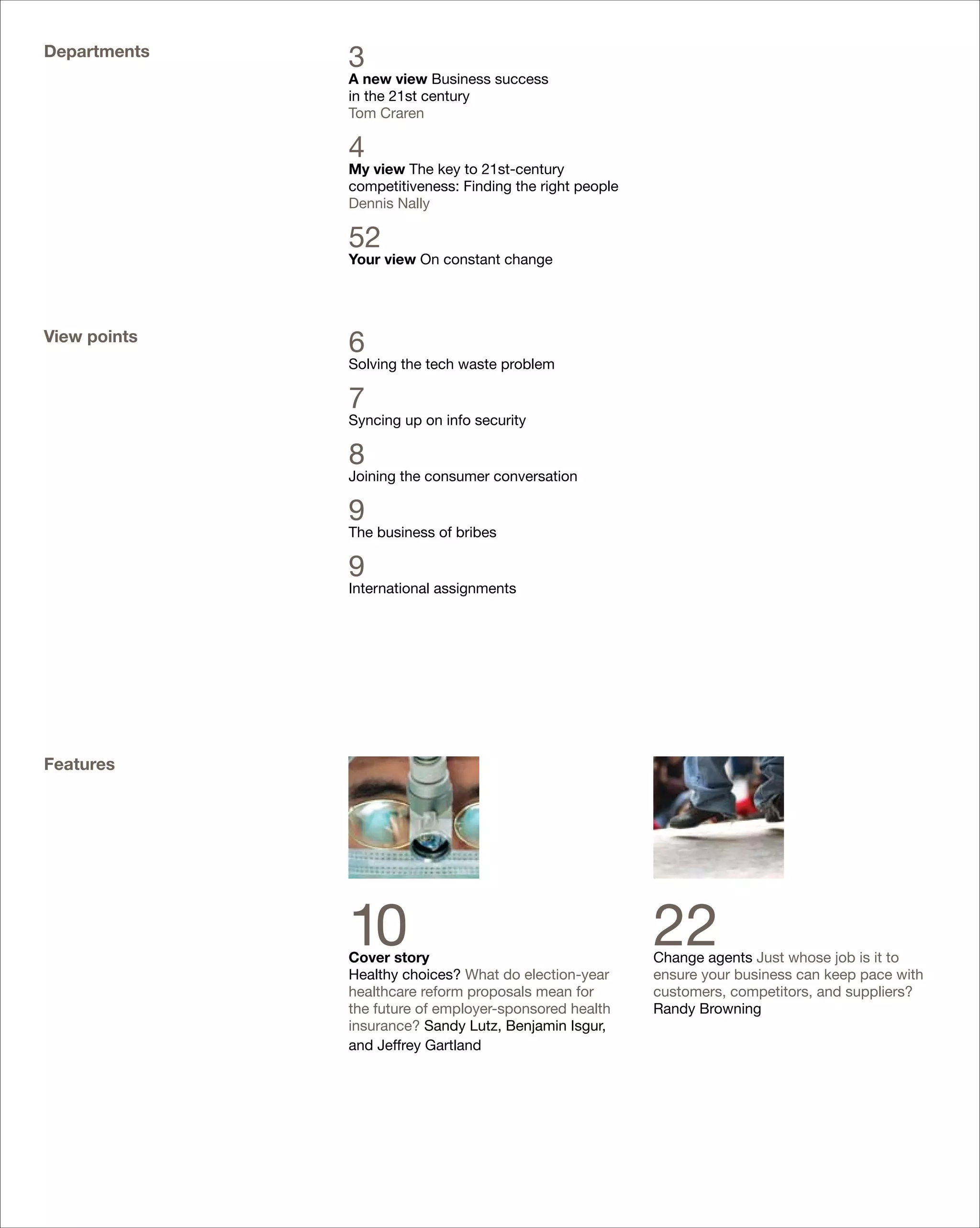
Healthy
choices?
What election-year healthcare reform proposals mean
for the future of employer-sponsored health insurance 10
Departments
              3
              A new view Business success
              in the 21st century
              Tom Craren

              4
              My view The key to 21st-century
              competitiveness: Finding the right people
              Dennis Nally

              52
              Your view On constant change


View points
              6
              Solving the tech waste problem

              7
              Syncing up on info security

              8
              Joining the consumer conversation

              9
              The business of bribes

              9
              International assignments


Features


              10
              Cover story
                                                          22
                                                          Change agents Just whose job is it to
              Healthy choices? What do election-year      ensure your business can keep pace with
              healthcare reform proposals mean for        customers, competitors, and suppliers?
              the future of employer-sponsored health     Randy Browning
              insurance? Sandy Lutz, Benjamin Isgur,
              and Jeffrey Gartland
It’s time to check up on how election-year healthcare reform
will affect employers, page 10.


30
One global flavor A US move to
                                              38
                                              Maximizing talent There are strategies
                                                                                       46
                                                                                       Interview
International Financial Reporting             for making the most of your people       Piercing the veil Andrew Zolli looks
Standards is inevitable. All companies        no matter what tomorrow brings.          at the future of business and of the
should think strategically about this         Steve Rimmer, Karen Vander Linde,        world. Interview by Tom Craren and
change and begin to understand                Dolores Wilverding, and Warren Cinnick   Gene Zasadinski
the impact now. Raymond J. Beier
view
    winter 08


    Editorial                               Contributors
    Editorial Director                      In addition to our authors, we thank the following individuals for their contributions
    Tom Craren                              to this issue of View:
                                            View points
    Managing Editor
                                            Deborah K. Bothun, Principal, Advisory Services, Global Digital Convergence Leader
    Gene Zasadinski
                                            Charles Hacker, Partner, Advisory Services, Investigations
    Assistant Managing Editor
                                            Neil Keenan, Director, Advisory Services, Investigations
    Christine Wendin
                                            Mark Lobel, Partner, Advisory Services, Security
    Assistant Editor
                                            Mitchell Schuckman, Partner, International Assignment Services
    Reena Vadehra
                                            Steven Skalak, Partner, Advisory Services, US and Global Investigations Leader
    Online
                                            Business agility
    Director, Online Marketing              Bo Parker, Managing Director, Center for Technology and Innovation
    Jack Teuber
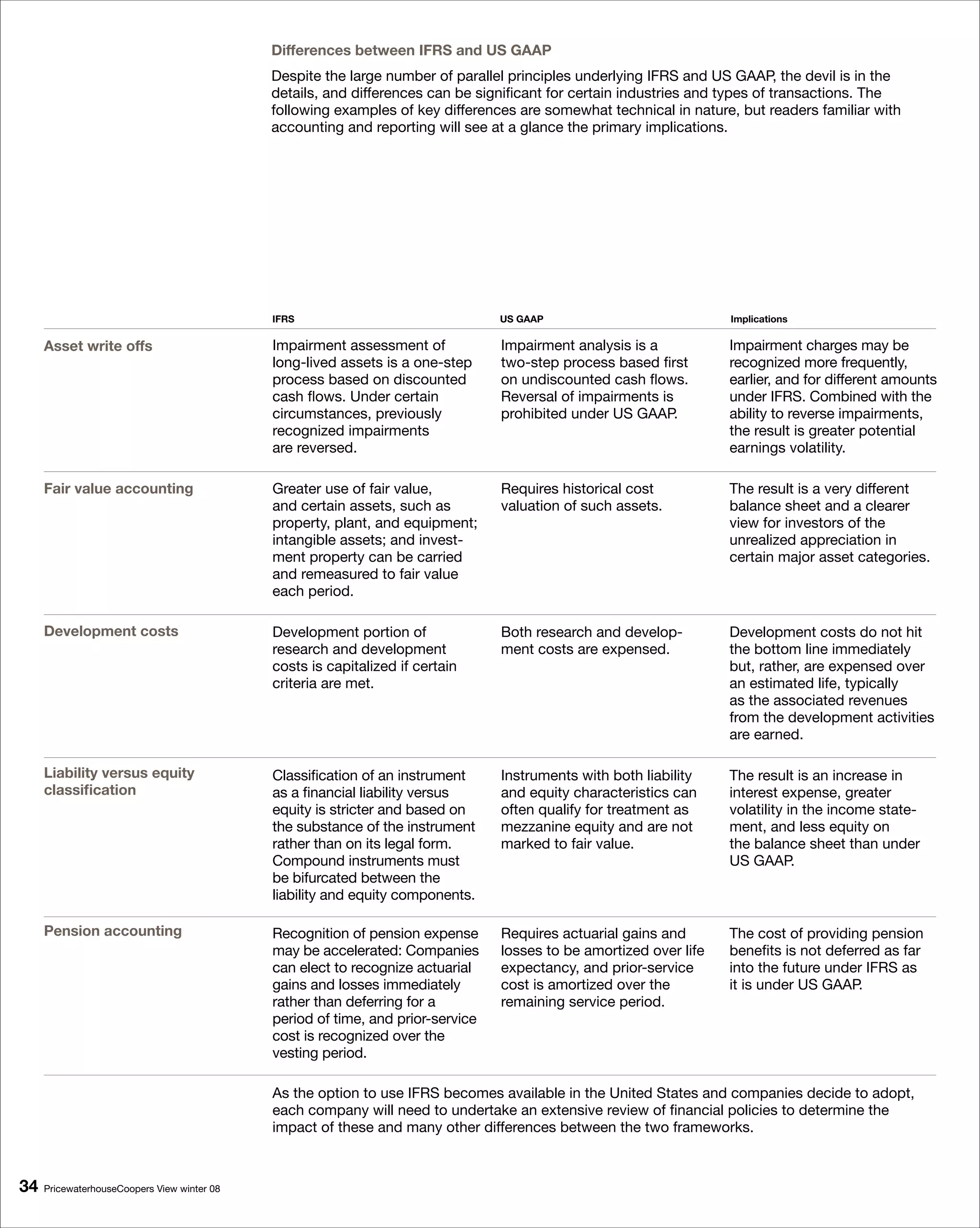
                                            International Financial Reporting Standards
    Designer and Producer                   Sara DeSmith, Partner, National Professional Services Group, Global Accounting
    Joe Breen                               Consulting Services

    Design                                  Photography
    Odgis + Company                         Corbis, David Doubilet, Bill Gallery, Getty Images, Matt Goins, Vance Jacobs,
                                            JupiterImages, Kit Kittle, National Geographic Image Collection, Reuters Pictures,
    Creative Director
                                            and Leonard Rubenstein
    Janet Odgis

    Designers
    Banu Berker
    Rhian Swierat


                                            To request additional copies of View or to comment: www.pwc.com/view.

                                            PricewaterhouseCoopers (www.pwc.com) provides industry-focused assurance, tax and advisory
                                            services to build public trust and enhance value for its clients and their stakeholders. More than 146,000
                                            people in 150 countries across our network share their thinking, experience, and solutions to develop fresh
                                            perspectives and practical advice.

                                            © 2008 PricewaterhouseCoopers LLP. All rights reserved.
                                            “PricewaterhouseCoopers” refers to PricewaterhouseCoopers LLP (a Delaware limited liability partnership)
                                            or, as the context requires, the PricewaterhouseCoopers global network or other member firms of the
                                            network, each of which is a separate and independent legal entity. *connectedthinking is a trademark of
                                            PricewaterhouseCoopers LLP (US).


   PricewaterhouseCoopers View winter 08
Business success
A new view


             in the 1st century
             According to naturalist and evolutionary        As it does to 21st-century business,
             theorist Charles Darwin, “It is not the         change also applies to View. With a new
             strongest of the species that survive, nor      design, a new format, a new editorial
             the most intelligent, but the one most          approach, and an enhanced online pres-
             responsive to change.” Whether his words        ence, View is evolving to keep pace with
             accurately describe biological processes        a changing business environment.
             is still a matter of heated debate. But there
             is no debate about their applicability to       In line with those changes, we intend to
             21st-century business: Complex forces           consistently offer business executives
             of change are at work, and only those           like you straight talk on subjects that
             companies flexible enough to respond            matter. Topics in this issue include health-
             appropriately will survive and prosper.         care policy, agility, International Financial
                                                             Reporting Standards, and strategies for
             Addressing these forces of change is what       finding and maximizing talent. And there’s
             View is all about. In each issue we share       also an interview with noted futurist
             insights into challenges that most concern      Andrew Zolli.
             you and that affect your success—chal-
             lenges such as embedding agility into           We hope you enjoy this issue of View and
             your company and making change stick;           that you’ll come back often. We promise
             discovering opportunities inherent in some      to be a friendly, reliable, informative, and
             risk; attracting and maintaining talent;        entertaining place for you to check in on
             maximizing your corporate social respon-        and track the trends and issues that interest
             sibility efforts; disarming complexity; and     and concern you most, not just today,
             fostering innovation and collaboration.         but over time as well. We know your expec-
                                                             tations are high. We wouldn’t have it any
                                                             other way. You can be sure that we’ll deliver.

                                                             Sincerely,


                                                             Tom Craren
                                                             Partner-in-Charge
                                                             US Thought Leadership


                                                                              PricewaterhouseCoopers View winter 08
The key to 1st-century
    My view
    Dennis Nally


                                            competitiveness
                                            Finding the right people


                                            In today’s knowledge-based economy, talent
                                            will be the defining competitive advantage.
                                            And companies that want to succeed are
                                            dramatically rethinking the way they find,
                                            develop, and hold on to talent.


   PricewaterhouseCoopers View winter 08
In today’s leading organizations, there is no    We can start by increasing the visa cap for        want us. Yes, that’s right, want us. Today’s
question that talent—finding it, developing      international professionals who want to            recruits have expectations about the
it, and retaining it—affects success more        work in the US. This year, for the first time      companies they want to work for. They are
directly than any other single factor. It also   in history, the visa cap was reached on the        looking for commitments to integrity, to
is among the greatest causes of concern.         first day of filing. Applications arriving after   social responsibility, and to flexibility. And
                                                 day-one were denied.                               they are in a position to demand this and
Our 11th Annual Global CEO Survey bears                                                             more. Companies that meet and exceed
this out. While 89 percent of CEOs assert        This and other policies and approaches to          these demands will win. Those that don’t
that their companies’ people agendas             education and to developing talent need to         will fall behind.
are among their top priorities, 61 percent       change. I firmly believe that to maintain its
express concern over the availability of         competitive edge, America must become              Some companies will find that coping with
key skills. In addition, 62 percent maintain     a magnet for talent. But until this happens,       these new realities is difficult. Others will
that their organizations need to change          we can’t just sit on the sidelines. We’ve          pretend they don’t exist and continue on
the way they recruit, motivate, and              got to find and cultivate talent in our own        with the old ways. However, organizations
develop employees.                               backyards. We’ve got to recruit students           that succeed will be those that neither
                                                 at an earlier age. And we’ve got to learn          ignore change nor fear it. Rather, they will
Responses such as these to questions             how to use newer technologies such as              be those that respond to change and turn
about what, a decade ago, was a yawn-            mobile email and text messaging as pow-            it to their advantage.
inducing issue suggest that a fundamental        erful, new recruiting tools. We also need to
shift has occurred. Perhaps more than any        fully exploit rich sources of new talent           And that’s my view.
other aspect of business, the competition        such as virtual online communities and
for talent has changed profoundly.               social networks.                                   Dennis Nally is chairman and senior partner of
                                                                                                    PricewaterhouseCoopers LLP. In the next issue of
The reasons are not difficult to find. They      But most important, we have to find ways           View, he continues to examine this critical issue and
are related directly to globalization and to     of ensuring that the people we want also           offers his insights on developing and retaining talent.
changes in demographics and technology.


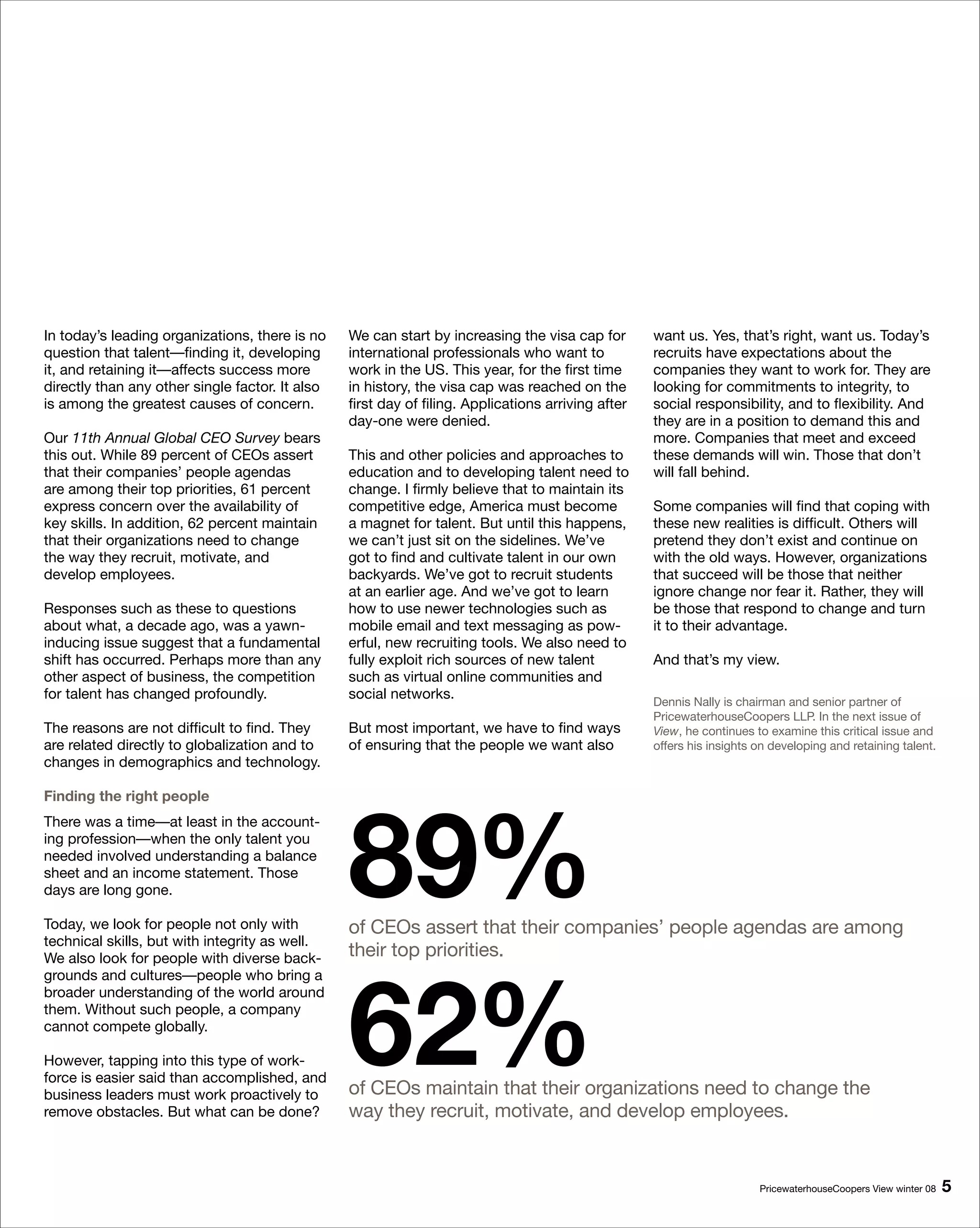
                                                 89%
Finding the right people
There was a time—at least in the account-
ing profession—when the only talent you
needed involved understanding a balance
sheet and an income statement. Those
days are long gone.

Today, we look for people not only with          of CEOs assert that their companies’ people agendas are among
technical skills, but with integrity as well.
We also look for people with diverse back-       their top priorities.


                                                 6%
grounds and cultures—people who bring a
broader understanding of the world around
them. Without such people, a company
cannot compete globally.

However, tapping into this type of work-
force is easier said than accomplished, and
business leaders must work proactively to        of CEOs maintain that their organizations need to change the
remove obstacles. But what can be done?          way they recruit, motivate, and develop employees.


                                                                                                                        PricewaterhouseCoopers View winter 08
View points


    Corporate social responsibility
    Solving the tech waste problem


    For businesses across the United States,                  burden of its products—a burden shoul-                         Research’s November 2007 report titled In
    yesterday’s technology has become                         dered by its corporate customers. A                            Search of Green Technology Consumers—
    tomorrow’s problem. The millions of com-                  recent study by PricewaterhouseCoopers                         which covered American attitudes toward
    puters, printers, and other gadgets that are              surveyed tech industry senior executives                       green technology—only 12 percent of
    commonplace in any office—and that we                     on their companies’ attitudes and policies                     respondents agree that they would pay
    steadfastly rely on to conduct business—                  on environmentalism. When asked which                          extra for consumer electronics that used
    can become threats when we discard them.                  factors were most important in their com-                      less energy or came from a company that
                                                              panies’ environmental decision making,                         was environmentally friendly. Forty-one
    In the United States alone, approximately                 nearly half of the respondents cited “meet-                    percent said that though they are con-
    2 million tons of e-waste is tossed into                  ing customer expectations/requirements,”                       cerned about the environment, they do not
    landfills, poisoning the air and the land and             but energy savings and regulatory compli-                      strongly agree that they would pay more
    exposing people to dangerous toxins. In                   ance had an even greater impact on their                       for environmentally friendly electronics.
    addition, all that hardware—especially data               environmentally focused pursuits.1
    centers that house a company’s informa-                                                                                  Despite this disconnect, many technol-
    tion lifeblood—is eating up a lot of energy.              So, can customers expect more green                            ogy companies have jumped on the green
    In fact, 50 percent of the energy consumed                products when a company’s next                                 bandwagon. For instance, Sony is creating
    in a data center is used just to cool down                upgrade cycle rolls around? According to                       an e-waste drop-off facility where anyone
    the network system.                                       PricewaterhouseCoopers/National Venture                        can recycle unwanted electronics. And
                                                              Capital Association MoneyTree™ Report                          many technology companies are collabo-
    Along with these practical problems, com-                 based on data from Thomson Financial,                          rating with smaller organizations to develop
    panies face the challenge of going green                  venture capitalists invested in 2007 almost                    and promulgate more environmentally
    and reducing their carbon footprints. This                $2.2 billion in companies that make green                      friendly processes.
    is becoming important as public interest in               tech products. That investment is more
    environmentalism increases and as more                    than the amount spent on green technology                      Such initiatives and collaborations are
    organizations want to position themselves                 companies in 2006 and 2005 combined.                           pivotal for making green technology
    as socially responsible businesses.                                                                                      a reality for any business. They reduce
                                                              While such numbers are impressive, a                           energy costs and provide an alternative
    The technology industry is beginning to                   considerable amount of resistance to                           to junking used hardware.
    recognize and address the environmental                   green tech products still exists. In Forrester
                                                                                                                             1 Technology Executive Connections: Going Green: Sustainable
                                                                                                                             Growth Strategies, PricewaterhouseCoopers, 2008.
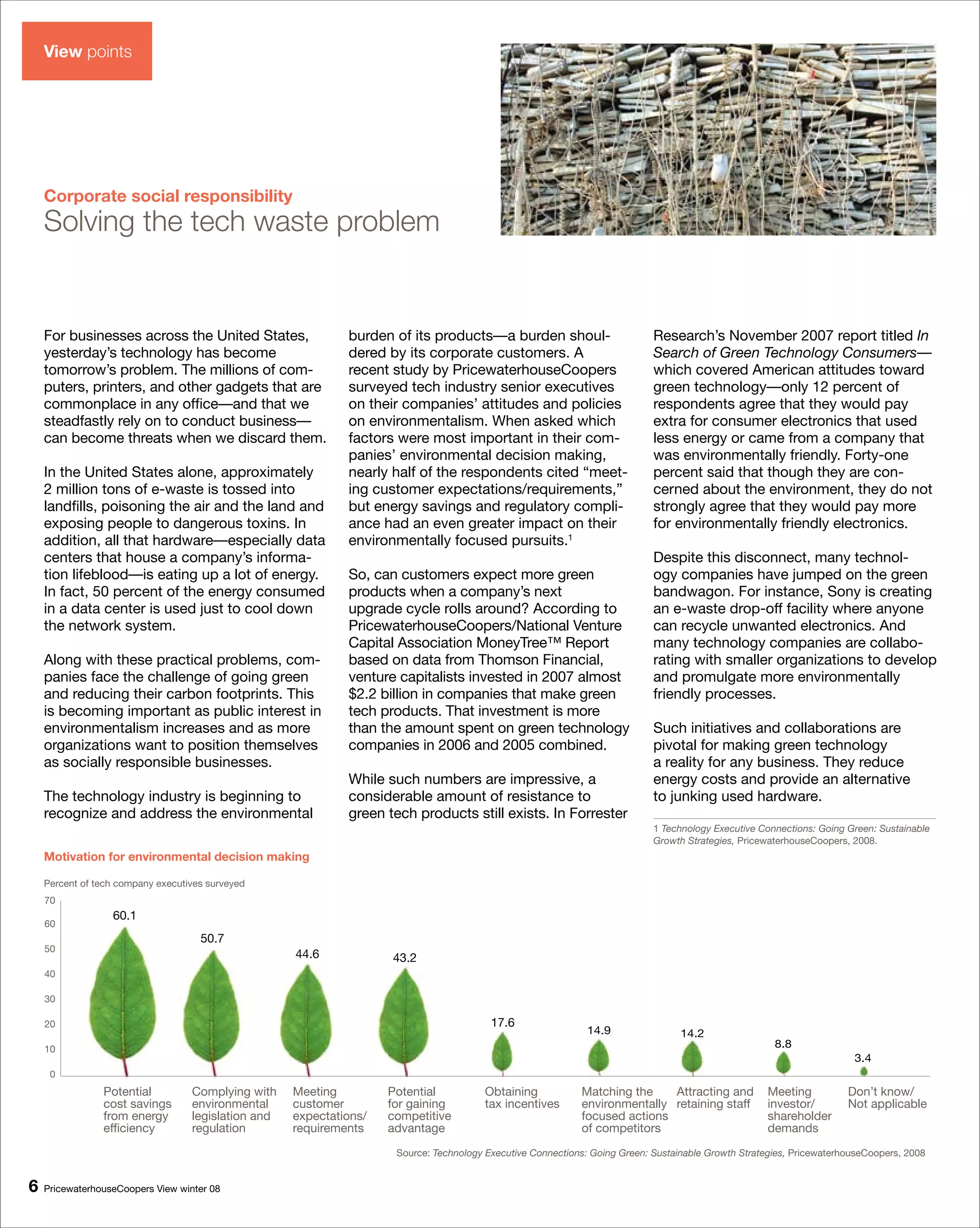
    Motivation for environmental decision making

    Percent of tech company executives surveyed
    70
                  60.1
    60
                                     50.7
    50
                                                     44.6            43.2
    40

    30

    20                                                                                    17.6
                                                                                                               14.9                14.2
    10                                                                                                                                                 8.8
                                                                                                                                                                        3.4
     0
                Potential          Complying with    Meeting         Potential           Obtaining           Matching the    Attracting and          Meeting           Don’t know/
                cost savings       environmental     customer        for gaining         tax incentives      environmentally retaining staff         investor/         Not applicable
                from energy        legislation and   expectations/   competitive                             focused actions                         shareholder
                efficiency         regulation        requirements    advantage                               of competitors                          demands
                                                                      Source: Technology Executive Connections: Going Green: Sustainable Growth Strategies, PricewaterhouseCoopers, 2008


6   PricewaterhouseCoopers View winter 08
CEOs, CIOs, and CSOs differ in their attitudes
                                                 about business security matters.


Managing risk
Syncing up on info security


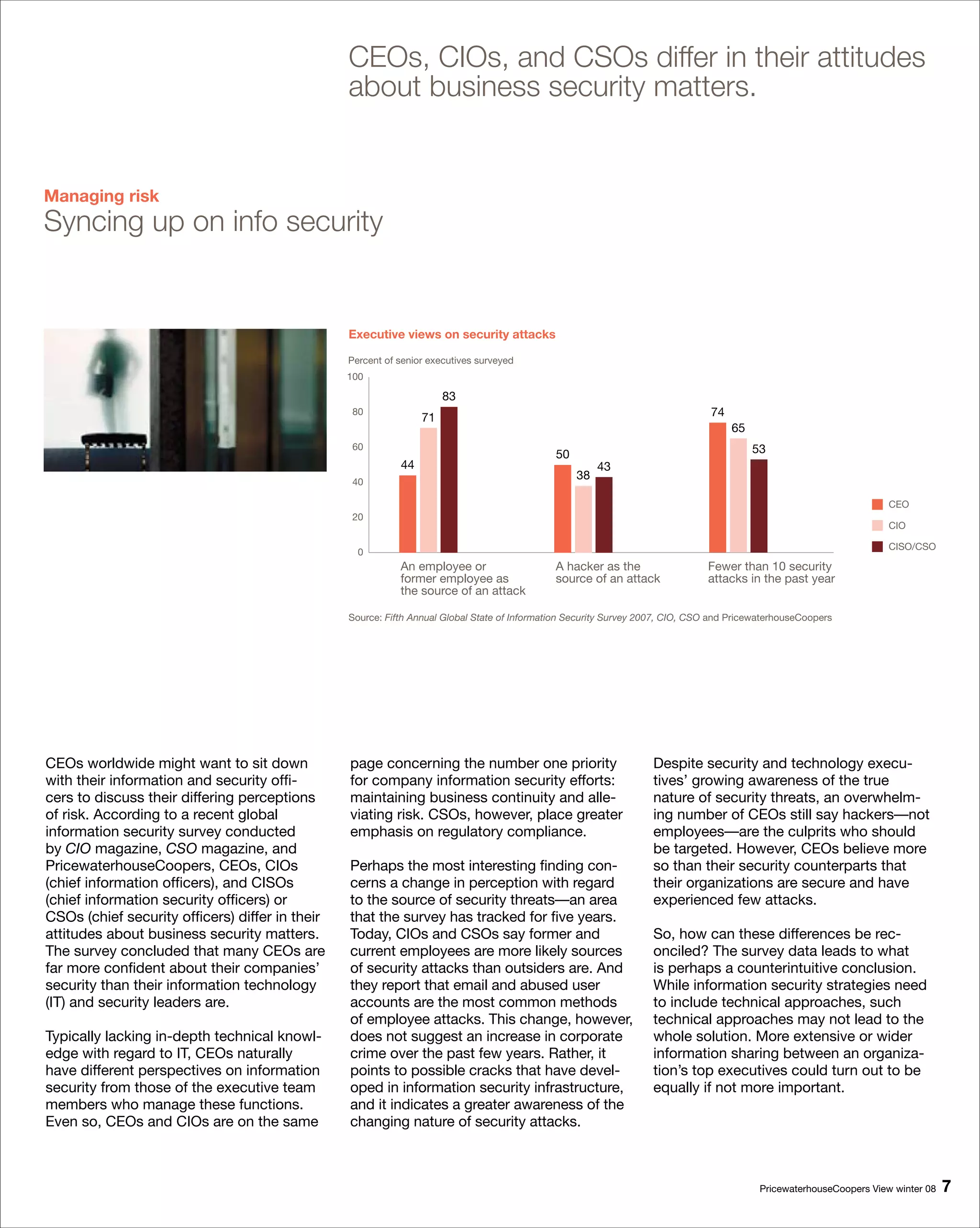
                                                 Executive views on security attacks

                                                 Percent of senior executives surveyed
                                                 100

                                                                      83
                                                 80
                                                                 71                                                             74
                                                                                                                                     65
                                                 60                                                                                       53
                                                                                              50
                                                            44                                          43
                                                 40
                                                                                                   38

                                                                                                                                                                      CEO
                                                 20
                                                                                                                                                                      CIO

                                                                                                                                                                      CISO/CSO
                                                   0
                                                            An employee or                    A hacker as the                  Fewer than 10 security
                                                            former employee as                source of an attack              attacks in the past year
                                                            the source of an attack

                                                 Source: Fifth Annual Global State of Information Security Survey 2007, CIO, CSO and PricewaterhouseCoopers


CEOs worldwide might want to sit down            page concerning the number one priority                           Despite security and technology execu-
with their information and security offi-        for company information security efforts:                         tives’ growing awareness of the true
cers to discuss their differing perceptions      maintaining business continuity and alle-                         nature of security threats, an overwhelm-
of risk. According to a recent global            viating risk. CSOs, however, place greater                        ing number of CEOs still say hackers—not
information security survey conducted            emphasis on regulatory compliance.                                employees—are the culprits who should
by CIO magazine, CSO magazine, and                                                                                 be targeted. However, CEOs believe more
PricewaterhouseCoopers, CEOs, CIOs               Perhaps the most interesting finding con-                         so than their security counterparts that
(chief information officers), and CISOs          cerns a change in perception with regard                          their organizations are secure and have
(chief information security officers) or         to the source of security threats—an area                         experienced few attacks.
CSOs (chief security officers) differ in their   that the survey has tracked for five years.
attitudes about business security matters.       Today, CIOs and CSOs say former and                               So, how can these differences be rec-
The survey concluded that many CEOs are          current employees are more likely sources                         onciled? The survey data leads to what
far more confident about their companies’        of security attacks than outsiders are. And                       is perhaps a counterintuitive conclusion.
security than their information technology       they report that email and abused user                            While information security strategies need
(IT) and security leaders are.                   accounts are the most common methods                              to include technical approaches, such
                                                 of employee attacks. This change, however,                        technical approaches may not lead to the
Typically lacking in-depth technical knowl-      does not suggest an increase in corporate                         whole solution. More extensive or wider
edge with regard to IT, CEOs naturally           crime over the past few years. Rather, it                         information sharing between an organiza-
have different perspectives on information       points to possible cracks that have devel-                        tion’s top executives could turn out to be
security from those of the executive team        oped in information security infrastructure,                      equally if not more important.
members who manage these functions.              and it indicates a greater awareness of the
Even so, CEOs and CIOs are on the same           changing nature of security attacks.


                                                                                                                                           PricewaterhouseCoopers View winter 08
View points


    Operational excellence
    Joining the consumer conversation


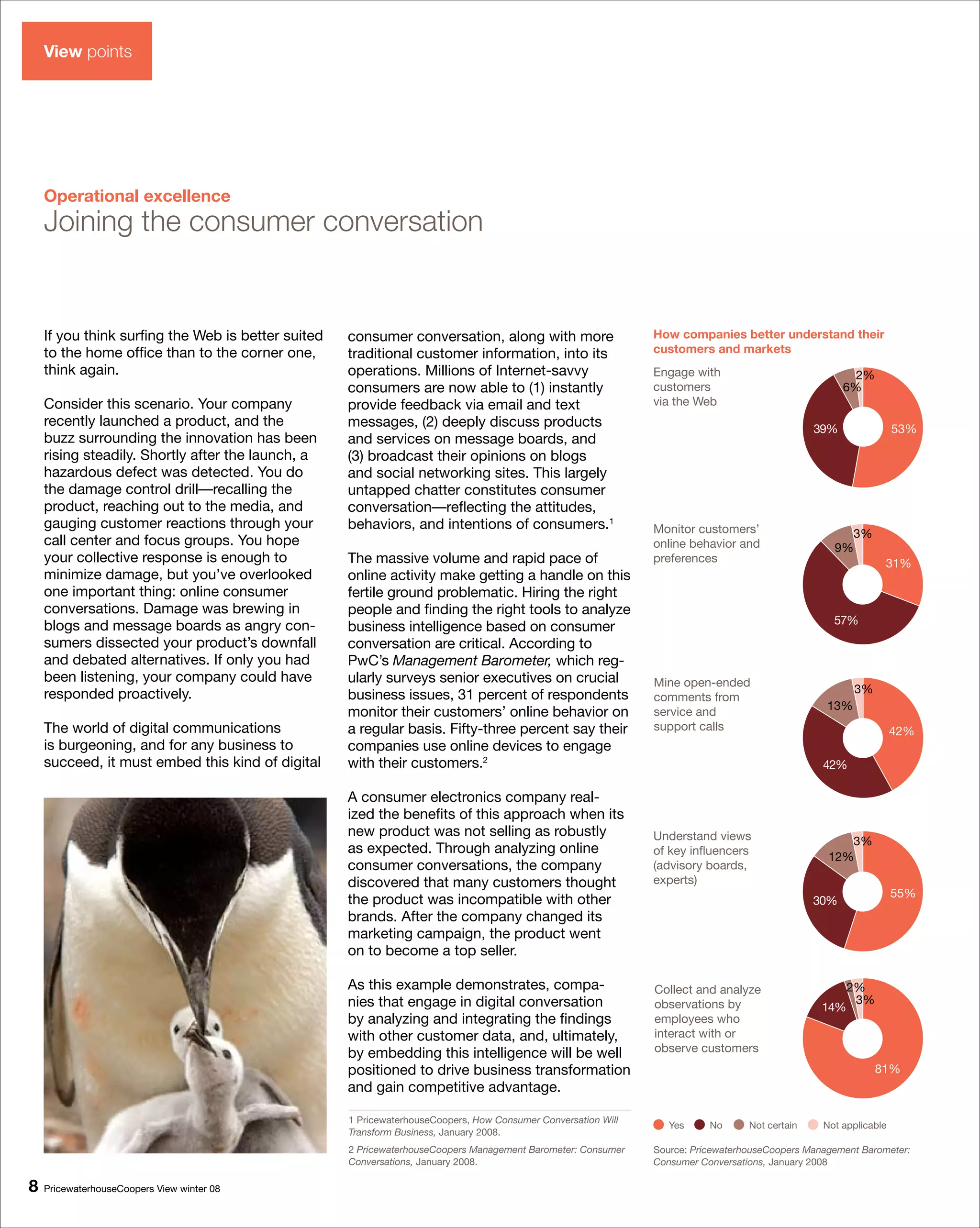
    If you think surfing the Web is better suited   consumer conversation, along with more                     How companies better understand their
    to the home office than to the corner one,      traditional customer information, into its                 customers and markets
    think again.                                    operations. Millions of Internet-savvy                     Engage with                              2%
                                                    consumers are now able to (1) instantly                    customers                              6%
    Consider this scenario. Your company            provide feedback via email and text                        via the Web
    recently launched a product, and the            messages, (2) deeply discuss products                                                       39%               53%
    buzz surrounding the innovation has been        and services on message boards, and
    rising steadily. Shortly after the launch, a    (3) broadcast their opinions on blogs
    hazardous defect was detected. You do           and social networking sites. This largely
    the damage control drill—recalling the          untapped chatter constitutes consumer
    product, reaching out to the media, and         conversation—reflecting the attitudes,
    gauging customer reactions through your         behaviors, and intentions of consumers.1                   Monitor customers’                    3%
    call center and focus groups. You hope                                                                     online behavior and                 9%
    your collective response is enough to           The massive volume and rapid pace of                       preferences                                    31%
    minimize damage, but you’ve overlooked          online activity make getting a handle on this
    one important thing: online consumer            fertile ground problematic. Hiring the right
    conversations. Damage was brewing in            people and finding the right tools to analyze
    blogs and message boards as angry con-                                                                                                         57%
                                                    business intelligence based on consumer
    sumers dissected your product’s downfall        conversation are critical. According to
    and debated alternatives. If only you had       PwC’s Management Barometer, which reg-
    been listening, your company could have         ularly surveys senior executives on crucial                Mine open-ended
    responded proactively.                                                                                                                              3%
                                                    business issues, 31 percent of respondents                 comments from
                                                                                                                                                  13%
                                                    monitor their customers’ online behavior on                service and
    The world of digital communications             a regular basis. Fifty-three percent say their             support calls                                      42%
    is burgeoning, and for any business to          companies use online devices to engage
    succeed, it must embed this kind of digital     with their customers.2                                                                       42%

                                                    A consumer electronics company real-
                                                    ized the benefits of this approach when its
                                                    new product was not selling as robustly                    Understand views                      3%
                                                    as expected. Through analyzing online                      of key influencers
                                                                                                                                                  12%
                                                    consumer conversations, the company                        (advisory boards,
                                                    discovered that many customers thought                     experts)
                                                                                                                                                                  55%
                                                    the product was incompatible with other                                                     30%
                                                    brands. After the company changed its
                                                    marketing campaign, the product went
                                                    on to become a top seller.

                                                    As this example demonstrates, compa-                       Collect and analyze                     2%
                                                    nies that engage in digital conversation                   observations by                          3%
                                                                                                                                                 14%
                                                    by analyzing and integrating the findings                  employees who
                                                    with other customer data, and, ultimately,                 interact with or
                                                    by embedding this intelligence will be well                observe customers
                                                    positioned to drive business transformation                                                              81%
                                                    and gain competitive advantage.

                                                    1 PricewaterhouseCoopers, How Consumer Conversation Will
                                                                                                                  Yes     No      Not certain    Not applicable
                                                    Transform Business, January 2008.
                                                    2 PricewaterhouseCoopers Management Barometer: Consumer    Source: PricewaterhouseCoopers Management Barometer:
                                                    Conversations, January 2008.                               Consumer Conversations, January 2008

8   PricewaterhouseCoopers View winter 08
Global mobility
                                                                                                                       International
                                                                                                                       assignments

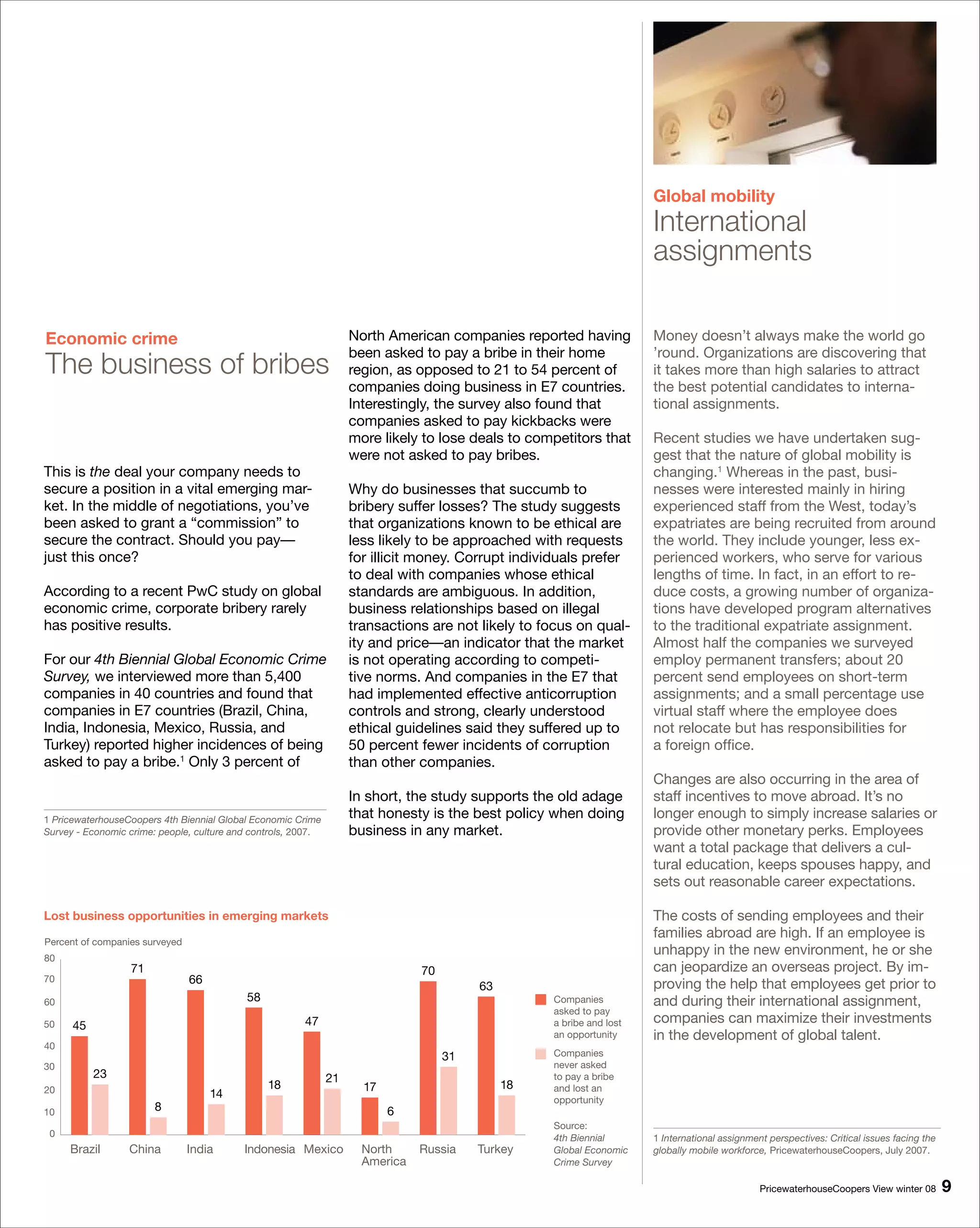
Economic crime                                                      North American companies reported having           Money doesn’t always make the world go
                                                                    been asked to pay a bribe in their home            ’round. Organizations are discovering that
The business of bribes                                              region, as opposed to 21 to 54 percent of          it takes more than high salaries to attract
                                                                    companies doing business in E7 countries.          the best potential candidates to interna-
                                                                    Interestingly, the survey also found that          tional assignments.
                                                                    companies asked to pay kickbacks were
                                                                    more likely to lose deals to competitors that      Recent studies we have undertaken sug-
                                                                    were not asked to pay bribes.                      gest that the nature of global mobility is
This is the deal your company needs to                                                                                 changing.1 Whereas in the past, busi-
secure a position in a vital emerging mar-                          Why do businesses that succumb to                  nesses were interested mainly in hiring
ket. In the middle of negotiations, you’ve                          bribery suffer losses? The study suggests          experienced staff from the West, today’s
been asked to grant a “commission” to                               that organizations known to be ethical are         expatriates are being recruited from around
secure the contract. Should you pay—                                less likely to be approached with requests         the world. They include younger, less ex-
just this once?                                                     for illicit money. Corrupt individuals prefer      perienced workers, who serve for various
                                                                    to deal with companies whose ethical               lengths of time. In fact, in an effort to re-
According to a recent PwC study on global                           standards are ambiguous. In addition,              duce costs, a growing number of organiza-
economic crime, corporate bribery rarely                            business relationships based on illegal            tions have developed program alternatives
has positive results.                                               transactions are not likely to focus on qual-      to the traditional expatriate assignment.
                                                                    ity and price—an indicator that the market         Almost half the companies we surveyed
For our 4th Biennial Global Economic Crime                          is not operating according to competi-             employ permanent transfers; about 20
Survey, we interviewed more than 5,400                              tive norms. And companies in the E7 that           percent send employees on short-term
companies in 40 countries and found that                            had implemented effective anticorruption           assignments; and a small percentage use
companies in E7 countries (Brazil, China,                           controls and strong, clearly understood            virtual staff where the employee does
India, Indonesia, Mexico, Russia, and                               ethical guidelines said they suffered up to        not relocate but has responsibilities for
Turkey) reported higher incidences of being                         50 percent fewer incidents of corruption           a foreign office.
asked to pay a bribe.1 Only 3 percent of                            than other companies.
                                                                                                                       Changes are also occurring in the area of
                                                                    In short, the study supports the old adage         staff incentives to move abroad. It’s no
1 PricewaterhouseCoopers 4th Biennial Global Economic Crime
                                                                    that honesty is the best policy when doing         longer enough to simply increase salaries or
Survey - Economic crime: people, culture and controls, 2007.        business in any market.                            provide other monetary perks. Employees
                                                                                                                       want a total package that delivers a cul-
                                                                                                                       tural education, keeps spouses happy, and
                                                                                                                       sets out reasonable career expectations.

Lost business opportunities in emerging markets                                                                        The costs of sending employees and their
                                                                                                                       families abroad are high. If an employee is
Percent of companies surveyed
80
                                                                                                                       unhappy in the new environment, he or she
                  71                                                            70                                     can jeopardize an overseas project. By im-
70                              66                                                                                     proving the help that employees get prior to
                                                                                          63
60                                         58                                                       Companies          and during their international assignment,
                                                                                                    asked to pay
50    45                                                47                                          a bribe and lost   companies can maximize their investments
                                                                                                    an opportunity     in the development of global talent.
40
                                                                                     31             Companies
30                                                                                                  never asked
           23                                                  21                                   to pay a bribe
20                                              18                    17                       18   and lost an
                                     14                                                             opportunity
10                     8                                                   6
                                                                                                    Source:
 0                                                                                                  4th Biennial       1 International assignment perspectives: Critical issues facing the
     Brazil       China         India      Indonesia Mexico           North     Russia    Turkey    Global Economic    globally mobile workforce, PricewaterhouseCoopers, July 2007.
                                                                      America                       Crime Survey

                                                                                                                                                PricewaterhouseCoopers View winter 08        9
Cover story


Healthy choices?


PricewaterhouseCoopers View winter 08
What election-year
healthcare reform proposals
mean for the future of
employer-sponsored health
insurance
By Sandy Lutz, Benjamin Isgur, and Jeffrey Gartland


                     As the presidential campaign reaches a fever pitch, candidates on
                     both sides of the aisle are promulgating their positions on every-
                     thing from fiscal policy to the war in Iraq. One of the most closely
                     followed public debates centers on healthcare reform. Although
                     all voters have a vested interest in the discussion, voters who are
                     also employers may be most affected by its outcome.

                     If you are an employer, spiraling healthcare costs are eating
                     away at your bottom line. According to the US Census Bureau,
                     177 million Americans rely on employer-sponsored insurance
                     for their health coverage. At 16 percent of the US economy and
                     growing, healthcare is big business—maybe even your business.
                     Moreover, the health plan options companies offer have become
                     key factors in employee recruitment and retention. Current (and
                     prospective) employees are asking a number of questions. How
                     comprehensive is the existing coverage? How many choices
                     do I have? How much is it costing (going to cost) me? Can I do
                     better elsewhere?

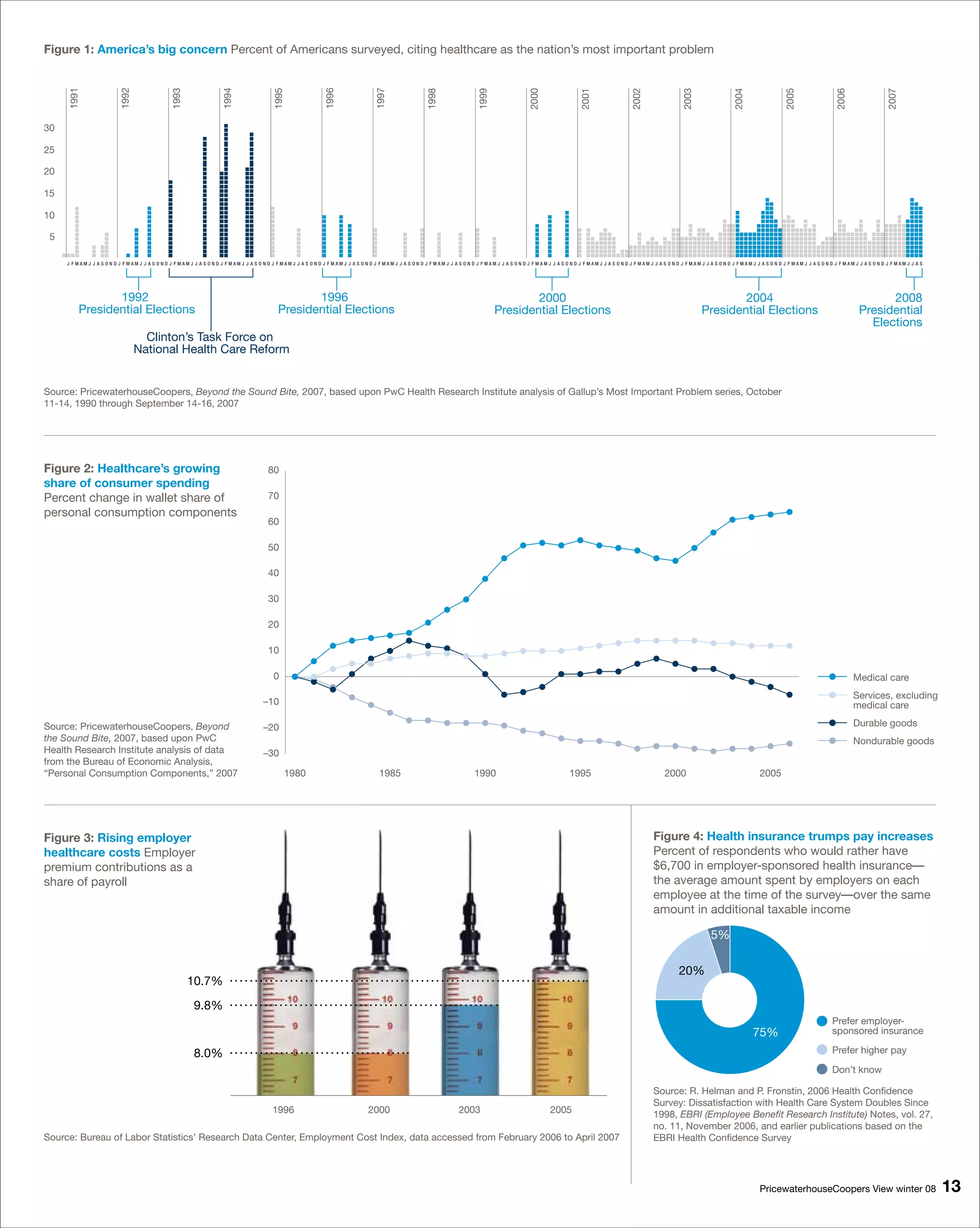
                     It’s no wonder, then, that healthcare consistently ranks as one of
                     the top domestic policy issues on the minds of Americans and
                     that during election years healthcare policy becomes a focal point.
                     (See Figure 1.) Employers, employees, and politicians alike agree
                     that the system is not sustainable and that there is no clear path
                     ahead. As one might expect, Democrats differ from Republicans
                     in their respective approaches to healthcare reform. Generally,
                     Democrats favor broader and more immediate changes through
                     legislation, while their Republican counterparts focus primarily on
                     changes to tax policy as the means of transforming the system.


                                                             PricewaterhouseCoopers View winter 08   11
However, all of the major candidates agree                          For US businesses, too, the significant                             income for tax and payroll purposes. In fact,
     that a single-payer model is not tenable and                        cost of healthcare is a major concern,                              one recent study found that employees
     that going forward, our healthcare system                           particularly when one considers that                                would rather receive thousands of dollars
     will continue to be a public-private partner-                       while just 61 percent of US businesses                              in employer-sponsored insurance benefits
     ship. Just what that partnership will look                          offer health insurance to at least some                             than the same amount in additional salary.
     like is the key question. And top of mind for                       employees, a whopping 98 percent of                                 (See Figure 4.)
     employers is cutting through the election-                          large businesses (those with 200 or more
     year hype and determining what it really                            workers) do the same.3 Employers typically                          The future course for employer-sponsored
     means to the future of their businesses.                            spend upwards of 10 percent of payroll                              insurance may depend largely on the
                                                                         on health insurance for their workers. (See                         policies initiated by the next president of
     Scoping the problem                                                 Figure 3.) Taken in aggregate, that’s a huge                        the United States. A new leader will help
                                                                         number—nearly $600 billion, according to                            decide important policy questions con-
     Healthcare spending has been increasing at
                                                                         the US Department of Commerce’s Bureau                              cerning covering the uninsured, improving
     about twice the rate of inflation, absorbing
                                                                         of Economic Analysis.                                               the quality of care, and using taxes and
     a larger and larger share of both employers’
                                                                                                                                             other mechanisms to fund coverage. Pro-
     profits and workers’ salaries. (See Figure 2.)
                                                                         It wasn’t always that way. Employer-                                posals run the gamut from mandating that
     For employees, healthcare cost is the top
                                                                         sponsored insurance was introduced dur-                             all employers provide coverage to doing
     financial concern facing American fami-
                                                                         ing World War II as a relatively inexpensive                        away with employer responsibility alto-
     lies, ranking higher than home ownership,
                                                                         way to recruit and retain employees in a                            gether. The major differences among the
     energy costs, debt, retirement savings, and
                                                                         tight labor market where wages were frozen                          possible approaches involve the following
     college expenses, according to a recent
                                                                         by the federal government. Americans                                broad categories: employer mandates,
     Gallup Poll.1 The problem is compounded
                                                                         quickly became accustomed to healthcare                             government and worker responsibility,
     because the high cost of healthcare in the
                                                                         coverage as a benefit of employment. They                           retiree coverage, tax policy, market
     United States is directly related to growth in
                                                                         have also gotten used to the favorable tax                          reforms, and cost control. (For a snap-
     the number of uninsured people, especially
                                                                         treatment of employer-sponsored insur-                              shot of the Democratic and Republican
     when premium increases exceed personal
                                                                         ance benefits under current law, in which                           approaches to healthcare, see “Opposing
     income growth, thus making insurance
                                                                         the premiums are excluded from their                                views,” beginning on page 20.)
     less affordable.2

     1 Gallup Organization, What Is the Most Important Financial Problem Facing Your Family Today? Gallup Poll Social Series, July 12–15, 2007.
     2 Todd Gilmer and Richard Kronick, “It’s the Premiums, Stupid: Projections of the Uninsured through 2013,” Health Affairs, vol. 25, no. 6 (2006).
     3 The Kaiser Family Foundation and Health Research and Educational Trust, Employer Health Benefits: 2007 Summary of Findings, September 2007.


1   PricewaterhouseCoopers View winter 08
Figure 1: America’s big concern Percent of Americans surveyed, citing healthcare as the nation’s most important problem
     1991


                       1992


                                                           1994


                                                                                               1996


                                                                                                                 1997
                                         1993


                                                                             1995


                                                                                                                                                                                                                                                                                                     2007
                                                                                                                                   1998


                                                                                                                                                     1999


                                                                                                                                                                       2000


                                                                                                                                                                                         2001


                                                                                                                                                                                                           2002


                                                                                                                                                                                                                             2003


                                                                                                                                                                                                                                               2004


                                                                                                                                                                                                                                                                 2005


                                                                                                                                                                                                                                                                                   2006
30

25

20

15

10

 5

     J FMAMJ J A S OND J FMAMJ J A S OND J FMAMJ J A S OND J FMAMJ J A S OND J FMAMJ J A S OND J FMAMJ J A S OND J FMAMJ J A S OND J FMAMJ J A S OND J FMAMJ J A S OND J FMAMJ J A S OND J FMAMJ J A S OND J FMAMJ J A S OND J FMAMJ J A S OND J FMAMJ J A S OND J FMAMJ J A S OND J FMAMJ J A S OND J FMAMJ J A S


                1992                                                                  1996                                                                          2000                                                                    2004                                                 2008
         Presidential Elections                                                Presidential Elections                                                       Presidential Elections                                                  Presidential Elections                                 Presidential
                                                                                                                                                                                                                                                                                             Elections
                                Clinton’s Task Force on
                              National Health Care Reform


Source: PricewaterhouseCoopers, Beyond the Sound Bite, 2007, based upon PwC Health Research Institute analysis of Gallup’s Most Important Problem series, October
11-14, 1990 through September 14-16, 2007


Figure : Healthcare’s growing                                             80
share of consumer spending
Percent change in wallet share of                                          70
personal consumption components
                                                                           60

                                                                           50

                                                                           40

                                                                           30

                                                                           20

                                                                           10

                                                                             0                                                                                                                                                                                                            Medical care
                                                                                                                                                                                                                                                                                          Services, excluding
                                                                          –10                                                                                                                                                                                                             medical care

Source: PricewaterhouseCoopers, Beyond                                    –20                                                                                                                                                                                                             Durable goods
the Sound Bite, 2007, based upon PwC                                                                                                                                                                                                                                                      Nondurable goods
Health Research Institute analysis of data                                –30
from the Bureau of Economic Analysis,
“Personal Consumption Components,” 2007                                             1980                          1985                              1990                             1995                              2000                             2005


Figure : Rising employer                                                                                                                                                                                          Figure : Health insurance trumps pay increases
healthcare costs Employer                                                                                                                                                                                          Percent of respondents who would rather have
premium contributions as a                                                                                                                                                                                         $6,700 in employer-sponsored health insurance—
share of payroll                                                                                                                                                                                                   the average amount spent by employers on each
                                                                                                                                                                                                                   employee at the time of the survey—over the same
                                                                                                                                                                                                                   amount in additional taxable income

                                                                                                                                                                                                                                       5%

                                                                                                                                                                                                                            20%
                                                10.7%

                                                 9.8%
                                                                                                                                                                                                                                                                                  Prefer employer-
                                                                                                                                                                                                                                                      75%                         sponsored insurance

                                                 8.0%                                                                                                                                                                                                                             Prefer higher pay

                                                                                                                                                                                                                                                                                  Don’t know

                                                                                                                                                                                                                   Source: R. Helman and P. Fronstin, 2006 Health Confidence
                                                                                                                                                                                                                   Survey: Dissatisfaction with Health Care System Doubles Since
                                                                             1996                             2000                            2003                            2005                                 1998, EBRI (Employee Benefit Research Institute) Notes, vol. 27,
                                                                                                                                                                                                                   no. 11, November 2006, and earlier publications based on the
Source: Bureau of Labor Statistics’ Research Data Center, Employment Cost Index, data accessed from February 2006 to April 2007                                                                                    EBRI Health Confidence Survey


                                                                                                                                                                                                                                                        PricewaterhouseCoopers View winter 08                        1
Figure : Employer attitudes changing on providing coverage
     Percent of respondents who say employers should move away from
     providing healthcare coverage for active employees


                  6%
             7%


                                             Disagree
                          87%                Agree

                                             Neither


     PricewaterhouseCoopers Health Research Institute, Tailoring the approach: Employer attitudes
     and healthcare strategies address distinct issues, 2007


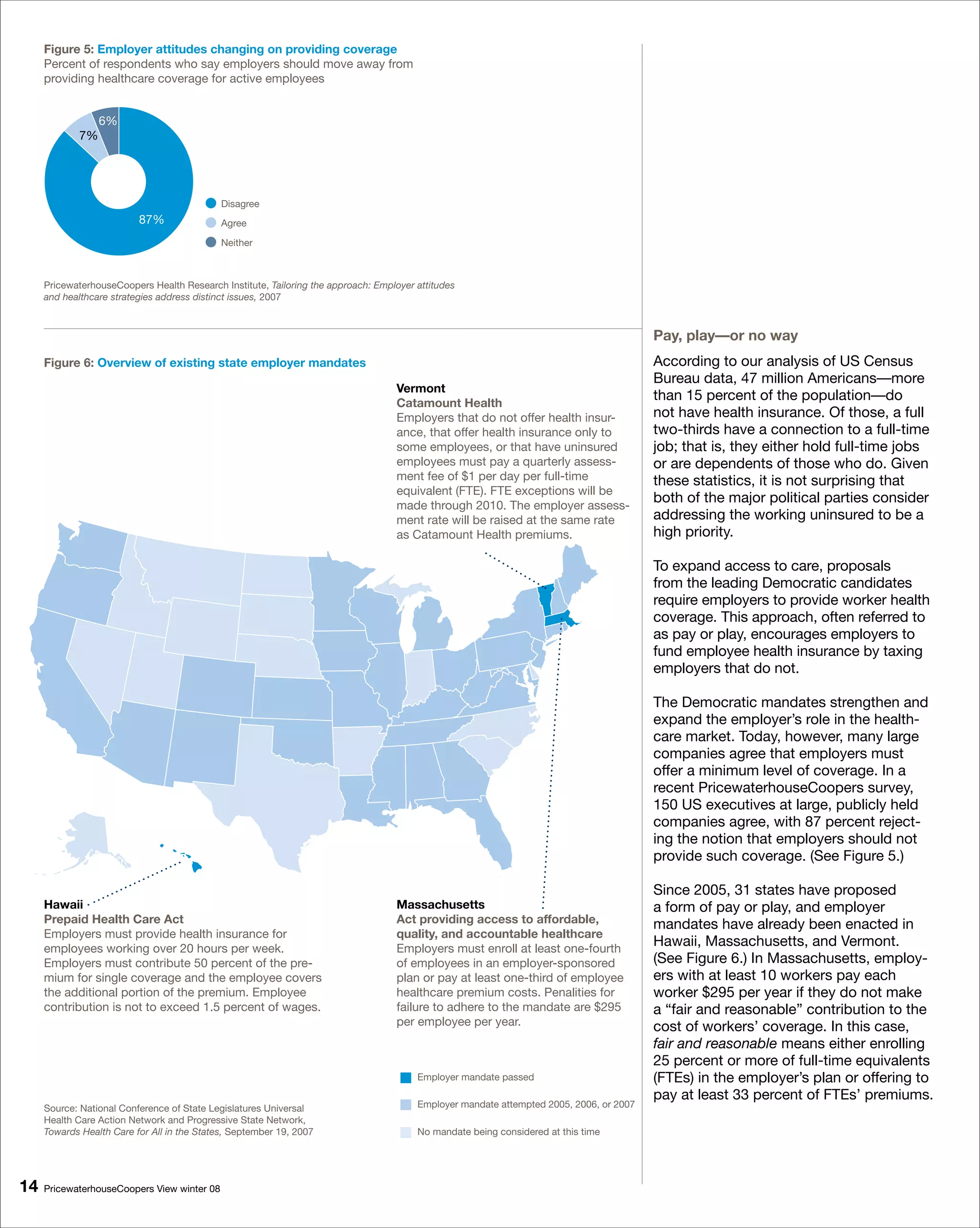
                                                                                                                                         Pay, play—or no way
     Figure 6: Overview of existing state employer mandates                                                                              According to our analysis of US Census
                                                                                                                                         Bureau data, 47 million Americans—more
                                                                                   Vermont
                                                                                   Catamount Health
                                                                                                                                         than 15 percent of the population—do
                                                                                   Employers that do not offer health insur-             not have health insurance. Of those, a full
                                                                                   ance, that offer health insurance only to             two-thirds have a connection to a full-time
                                                                                   some employees, or that have uninsured                job; that is, they either hold full-time jobs
                                                                                   employees must pay a quarterly assess-                or are dependents of those who do. Given
                                                                                   ment fee of $1 per day per full-time                  these statistics, it is not surprising that
                                                                                   equivalent (FTE). FTE exceptions will be
                                                                                   made through 2010. The employer assess-
                                                                                                                                         both of the major political parties consider
                                                                                   ment rate will be raised at the same rate             addressing the working uninsured to be a
                                                                                   as Catamount Health premiums.                         high priority.

                                                                                                                                         To expand access to care, proposals
                                                                                                                                         from the leading Democratic candidates
                                                                                                                                         require employers to provide worker health
                                                                                                                                         coverage. This approach, often referred to
                                                                                                                                         as pay or play, encourages employers to
                                                                                                                                         fund employee health insurance by taxing
                                                                                                                                         employers that do not.

                                                                                                                                         The Democratic mandates strengthen and
                                                                                                                                         expand the employer’s role in the health-
                                                                                                                                         care market. Today, however, many large
                                                                                                                                         companies agree that employers must
                                                                                                                                         offer a minimum level of coverage. In a
                                                                                                                                         recent PricewaterhouseCoopers survey,
                                                                                                                                         150 US executives at large, publicly held
                                                                                                                                         companies agree, with 87 percent reject-
                                                                                                                                         ing the notion that employers should not
                                                                                                                                         provide such coverage. (See Figure 5.)

                                                                                                                                         Since 2005, 31 states have proposed
     Hawaii                                                                        Massachusetts                                         a form of pay or play, and employer
     Prepaid Health Care Act                                                       Act providing access to affordable,                   mandates have already been enacted in
     Employers must provide health insurance for                                   quality, and accountable healthcare
     employees working over 20 hours per week.                                     Employers must enroll at least one-fourth
                                                                                                                                         Hawaii, Massachusetts, and Vermont.
     Employers must contribute 50 percent of the pre-                              of employees in an employer-sponsored                 (See Figure 6.) In Massachusetts, employ-
     mium for single coverage and the employee covers                              plan or pay at least one-third of employee            ers with at least 10 workers pay each
     the additional portion of the premium. Employee                               healthcare premium costs. Penalities for              worker $295 per year if they do not make
     contribution is not to exceed 1.5 percent of wages.                           failure to adhere to the mandate are $295             a “fair and reasonable” contribution to the
                                                                                   per employee per year.                                cost of workers’ coverage. In this case,
                                                                                                                                         fair and reasonable means either enrolling
                                                                                                                                         25 percent or more of full-time equivalents
                                                                                        Employer mandate passed                          (FTEs) in the employer’s plan or offering to
                                                                                                                                         pay at least 33 percent of FTEs’ premiums.
     Source: National Conference of State Legislatures Universal                        Employer mandate attempted 2005, 2006, or 2007
     Health Care Action Network and Progressive State Network,
     Towards Health Care for All in the States, September 19, 2007                      No mandate being considered at this time


1   PricewaterhouseCoopers View winter 08
An individual mandate could coexist with an
                                                 employer mandate, potentially offering workers
                                                 affordable coverage options both through their
                                                 employers and in the individual market.


The mandate proposals generally estab-           for by the government and administered by     tend to believe that existing government
lish a minimum employer contribution. For        private plans. Other Democratic proposals     programs are underutilized. Rather than
example, if an employer currently pays           include (1) a new government health insur-    expanding government programs, leading
at least 6 percent of payroll costs toward       ance option wherein individuals could         Republicans would prefer that the gov-
employee health insurance, the employer          purchase coverage (the program would          ernment focus on enrolling uninsured
would be exempt from any further contri-         be modeled after Medicare but not funded      Americans who are eligible for Medicaid
bution. If the employer provides no health       through the Medicare trust fund); (2) a new   and for SCHIP but who haven’t signed up.
insurance or pays less than 6 percent of         program that would mirror the Federal
payroll, the employer would have to con-         Employees Health Benefits Program and         Both parties advocate changing the
tribute to a public pool that brings the total   make the same private insurance options       individual’s role in the healthcare system.
contribution up to 6 percent of payroll. The     enjoyed by federal employees available        Democrats would start with an individual
public pool would then subsidize coverage        to all Americans; and (3) the development     mandate—that is, with a requirement that
for the uninsured.                               of a national health insurance exchange       individuals procure health insurance similar
                                                 that would set standards for participating    to the requirement in many states that
Generally speaking, Republicans do not           plans and facilitate the purchasing of        individuals procure automobile insurance.
support this approach. They oppose               individual coverage.                          An individual mandate could coexist with
additional federal regulations on the health                                                   an employer mandate, potentially offer-
industry and specifically reject mandates.       Republicans support proposals that would      ing workers affordable coverage options
They counter that an employer mandate            strengthen the individual insurance market    both through their employers and in the
may not be effective unless the penalty is       by extending to that market some of the       individual market. Individual mandates
high enough to make purchasing coverage          favorable tax treatment that is currently     could be supported by new rules like
attractive. Some critics add that mandates       available only for employer-group cover-      guaranteed insurability and community
might cause employers to hire more part-         age. Strengthening the individual market      rating, which consist of pricing everyone
time or temporary workers who would not          would not only provide tax support            in a given geography the same, thereby
be subject to mandates.                          for people who do not have access to          creating a large pool that spreads the
                                                 employer coverage; it would also offer        risk. Together, guaranteed insurability and
Changing government and worker roles             more insurance-product choices to             community rating facilitate portability of
                                                 employees who currently are limited to just   insurance—something both parties agree
Bolstering or diminishing the employer’s
                                                 one or two health plans. Also, Republicans    on. A variation on this approach involves
role in healthcare is just one lever that is
being used to address healthcare reform.
How the parties see the responsibility of
the federal government and the respon-
sibility of individuals is another key issue
that also gets at the problem—and directly
impacts employers.

Democrats generally favor expanding
government programs such as Medicaid
and the State Children’s Health Insurance
Program (SCHIP). Many support a new
government-sponsored health insurance
program wherein individuals could pur-
chase coverage. This could benefit health
plans if the program were structured like
the Medicare drug benefit, which is paid


                                                                                                               PricewaterhouseCoopers View winter 08   1
Health costs


600 1 
billion USD is the amount
employers spend on health
                                        million Americans rely on
                                        employer-sponsored insurance
                                                                       million Americans, more than
                                                                       15 percent of the population,
insurance for their workers,            for their health coverage.     do not have health insurance.
upwards of 10 percent                                                  Of those, a full two-thirds have
of payroll.                                                            a connection to a full-time job.


PricewaterhouseCoopers View winter 08
Even employers that believe they have a
responsibility to provide health coverage
access for retirees also feel there are limits
to that responsibility.


                                                                    an individual mandate only for children that                  by employers—a level that commonly
                                                                    is supported through expanded govern-                         approaches annual family premiums of
                                                                    ment programs.                                                $15,000 or more.

                                                                    Republicans oppose individual as well as                      Whichever coverage proposals prevail,
                                                                    employer mandates. They argue that an                         they will affect employers. On one hand,
                                                                    individual mandate may not be effective                       public-plan options may crowd out private
                                                                    unless it is coupled with a severe penalty                    insurance if insured individuals drop their
                                                                    for those who do not enroll in a plan. For                    private coverage in favor of less expensive
                                                                    example, in Massachusetts—a state that                        government coverage. Or employers—
                                                                    currently has an individual mandate—the                       especially employers of low-wage
                                                                    penalty is loss of the individual exemp-                      workers—may decide not to offer insur-
                                                                    tion. However, the value of the $3,500                        ance when public alternatives are readily
                                                                    tax exemption ranges from $0 (for lower-                      available. On the other hand, any plan that
                                                                    income individuals not paying taxes) to                       covers more people may have the effect
                                                                    $1,225 (for individuals in the 35 percent                     of lowering overall insurance premiums,
                                                                    tax bracket). Given that the average annual                   a trend that could benefit employers.
                                                                    premium cost of single coverage exceeds
                                                                    $4,000, the penalty might not encour-                         The retiree dilemma
                                                                    age many of the uninsured to purchase
                                                                                                                                  Covering active workers and their depen-
                                                                    insurance. In practice, a mandate would
                                                                                                                                  dents is one thing, but what about the
                                                                    likely be limited to those who can reason-
                                                                                                                                  burden of providing coverage for retirees?
                                                                    ably be expected to afford private health
                                                                                                                                  Even employers that believe they have
                                                                    insurance. Unless significant subsidies
                                                                                                                                  a responsibility to provide health cover-
                                                                    are provided for middle-income uninsured
                                                                                                                                  age access for retirees also feel there are
                                                                    people, such individuals cannot afford to
                                                                                                                                  limits to that responsibility. In a recent PwC
                                                                    purchase the level of insurance provided
                                                                                                                                  survey, employers were less than certain
                                                                                                                                  about their future support for retiree health
                                                                                                                                  coverage. When asked to describe their
                                                                                                                                  views on the topic, nearly three-quarters
                                                                                                                                  said retiree health coverage is placing
Figure : Employer attitudes on retiree health coverage In describing your views about                                            financial pressure on companies and that
retiree health coverage, do you agree at least somewhat with the following statements?                                            such coverage will need to be changed
                                                Percent agreeing                                                                  through reduced employer contributions
                                                                                                                                  and benefit caps. However, employers
Retiree health coverage is placing                                                                                                do show strong support for assisting
financial pressure on companies and
will need to be changed via reduced                                                                                   73          employees in managing their own
employer contributions and benefit caps                                                                                           retirement health and associated costs.
Employers should help provide                                                                                                     For example, nearly 80 percent support
access to affordable retiree health                                                                                    74         providing retirees with savings account
coverage but not necessarily fund it
                                                                                                                                  mechanisms, tax incentives, and access
Employees should set aside money                                                                                                  to coverage even if they do not fund it.
during their active employment years                                                                                        79    (See Figure 7.)
to fund their retirement healthcare needs
                                                                                                                                  The parties’ proposals on retiree healthcare
There should be more tax incentives
for employees to set aside money to                                                                                          80
                                                                                                                                  closely mirror their positions on increasing
fund their retirement healthcare needs                                                                                            healthcare coverage in general. The

Source: PricewaterhouseCoopers Health Research Institute, Tailoring the approach: Employer attitudes and healthcare
strategies address distinct issues, 2007
                                                                                                                                                   PricewaterhouseCoopers View winter 08   1
Democrats would bring retirees into the sys-   their own, affordable policies without help   individual coverage more attractive and
     tem either by expanding existing programs,     from employers. This approach weakens         begin to disentangle health insurance
     by prepurchasing retiree healthcare cover-     the connection between insurance              from employment.
     age, or by using health markets to increase    and employment.
     access. The Republicans favor tax incen-                                                     Under the Republican plan, people
     tives through the expansion or modification    The Republican plans extend the approach      who purchase coverage costing less
     of health savings accounts (HSAs).             that President George W. Bush proposed        than the deduction amounts would still
                                                    in his fiscal year 2008 budget: Contribu-     receive the full value of the deduction,
     Tax reformers and market makers                tions to employer-sponsored insurance are     which could influence individuals to shop
                                                    included in wages and therefore subject       for the most basic coverage. However,
     Instead of employer or individual mandates,
                                                    to income and payroll taxes. In exchange,     the proposal would offer few incentives to
     Republicans generally support changes
                                                    the president’s proposal would provide        low-income earners who have no or little
     to tax policy to stimulate a more robust
                                                    a standard deduction of $7,500 for all        tax income liability. The administration
     individual insurance market. Their theory
                                                    insured individuals and $15,000 for insured   estimated that its proposal would reduce
     is that with attractive rates and policies,
                                                    families. By eliminating the tax advantages   the number of uninsured by 3 million.
     individual consumers—especially those
                                                    associated with employer-sponsored insur-     Critics, however, argue that employer-pur-
     who are currently uninsured—can secure
                                                    ance, the president’s proposal would make     chased insurance might continue to enjoy
                                                                                                  an advantage over individually purchased
                                                                                                  policies because of more favorable pricing
                                                                                                  based on employer purchasing power.

                                                                                                  Republicans favor expanding HSAs,
                                                                                                  which let individuals earmark tax-
                                                                                                  exempt contributions for healthcare.
                                                                                                  By increasing contribution limits, they
                                                                                                  hope to entice more individuals to
                                                                                                  purchase insurance. Some also favor
                                                                                                  doing away with high-deductible
                                                                                                  requirements for HSAs, which would
                                                                                                  also make the plans more attractive.

                                                                                                  Opponents say the impact of such HSA
                                                                                                  changes would likely be modest, based
                                                                                                  on how changes have been received
                                                                                                  since their inception a few years ago.
                                                                                                  The HSA-eligible, high-deductible-health-
                                                                                                  plan option has attracted about 4.5 million
                                                                                                  Americans, about one-fourth of whom
                                                                                                  previously were uninsured.4 However,
                                                                                                  only about half of those with eligible
                                                                                                  plans have actually opened HSAs.5

                                                                                                  4 America’s Health Insurance Plans Center for Policy and
                                                                                                  Research: “January 2007 Census Shows 4.5 Million People
                                                                                                  Covered by HSA/High-Deductible Health Plans,” April 2007.
                                                                                                  5 US Government Accountability Office, Consumer-Directed
                                                                                                  Health Plans, Early Enrollee Experiences with Health Savings
                                                                                                  Accounts and Eligible Health Plans, report to the Hon. Max
                                                                                                  Baucus (D-Mont.), August 9, 2006. http://www.gao.gov/new.
                                                                                                  items/d06798.pdf.


18   PricewaterhouseCoopers View winter 08
The individual market for health insurance        There is emerging evidence to support            regulations concerning employers—rules
has not grown during the past three years,        this push, and some of the employers that        and regulations designed to help expand
and the percent of Americans in high-             have instituted wellness and prevention          coverage for working Americans. Repub-
deductible health plans dropped in 2006,          programs have seen a clear return on their       lican candidates will frame the discussion
according to the Commonwealth Fund.               investment in terms of improved worker           around modifications to the tax code and
                                                  productivity or reduced absenteeism.             reduced regulation of the insurance indus-
In keeping with the vision of expanded            Employers are encouraged to create incen-        try to de-emphasize the employer’s role in
individual markets, Republicans also favor        tives for healthy behavior that may prevent      favor of market forces.
permitting cross-state selling of insurance.      chronic disease. That means programs to
The reduced regulations would create              promote screenings, smoking cessation,           Both parties are likely to promote wellness
national health insurance markets in which        weight loss, and regular exercise. But there     strategies designed to encourage healthy
individuals could purchase insurance plans        are no quick fixes: Even the best employer       lifestyles and to manage the epidemic
from anywhere in the nation. Under current        programs are ineffective unless people           of chronic disease. In the end, however,
regulations, insurance products may be            commit to changing their behavior.               commitment by business leaders and col-
sold within a state only if the product is                                                         laborative public-private partnerships most
approved by that state’s insurance com-           The debate continues                             likely will help enhance productivity, reduce
missioner and if it abides by the individual                                                       the number of uninsured, quell the growing
                                                  As the presidential campaign season
state’s mandates. The Republicans pro-                                                             burden of healthcare costs, and lead to a
                                                  continues, employers can expect to see
pose replacing 50 different sets of state                                                          more healthy community.
                                                  increased attention paid to the health-
regulations with a single national standard.      care debate and to the employer’s role in        Sandy Lutz is managing director, Benjamin Isgur is
                                                  workers’ health. Democratic candidates,          assistant director, and Jeffrey Gartland is a research
Reining in costs                                  who focus on decreasing the number of            analyst with the PricewaterhouseCoopers Health
Proposed mandates and tax policy changes          uninsured, will speak about new rules and        Research Institute.
focus principally on the issue of expanding
coverage for the uninsured. But controlling
skyrocketing healthcare costs is another
important priority—particularly for employ-       Employer impacts
ers. To help control costs, Republicans and
Democrats alike urge an increased focus on
                                                  The good, the bad, the unknown
the twin pillars of wellness and prevention,
                                                  At this stage of the election, it’s still too early to assess the bottom-line impact of health-
yet the parties have yet to outline significant
                                                  care reform on employers. However, no matter who is elected, employers will be affected.
policies promoting this agenda and the
                                                  Here are a few of the potential benefits and risks associated with healthcare reform that
employer’s expanded role.
                                                  you might want to keep on your radar screen.
The consensus is that while tradition-
                                                  Potentially positive outcomes                    Potentially negative outcomes
ally, governments—not employers—have
been held responsible for a population’s          • Fewer uninsured people in the health-          • Coverage mandates could lead to
health, government alone cannot pre-                care system may reduce both cost shift-          higher costs and/or penalties.
vent the spread of chronic disease. The             ing and overall premium costs.
                                                                                                   • Tax credits and deductions that encour-
workplace is seen as an important focal
                                                  • Tax credits to purchase insurance may            age workers to buy individual policies
point for successful prevention strategies,
                                                    increase attractiveness for recruitment          may take away what some employers
and employers are seen as being able to
                                                    and retention at smaller firms.                  consider to be a key retention tool.
influence individual behavior by providing
a supportive environment and leveraging           • More government spending on wellness
existing infrastructure to offer low-cost but       and prevention could benefit employee
effective interventions.                            productivity.


                                                                                                                       PricewaterhouseCoopers View winter 08   19
Opposing views                                                You’ve heard all the election rhetoric about how each candidate
                                                                   will reform the healthcare system. While it’s still too early to call
                                                                   the contest, here’s the quick party rundown on what employers
                                                                   can expect once a new presidential term begins. One thing is
                                                                   certain: There will be plenty of changes that affect employees,
                                                                   employers’ obligations, and company profits.


                                                                   Democrats

                                                                   Strengthen the employer’s role
                                                                   through mandates

     No surprise that it’s                   How big businesses In reality, an employer mandate likely won’t have the crucial
                                             will be affected   implications the word mandate implies, because nearly all large
     all about change                                           employers already provide health coverage. Initially, businesses
                                                                could see higher benefits costs overall with more workers to cover,
     for the Democrats.                                         but lower premiums for current workers and retirees could result

     Expect broad, more                                         from fewer uninsured in the US healthcare system.

     immediate reform                        How small             The mandate to provide coverage for employees could hurt small
     across the board,                       businesses will       businesses—whether in the form of higher benefits costs or in
     with new mandates,                      be affected           the form of penalties. This change may result in the use of new
                                                                   staffing models to replace expensive workers—including hiring
     government pro-                                               more part-time or temporary help—but increased government
                                                                   spending on wellness and prevention programs could enhance
     grams, and funding                                            worker productivity.

     mechanisms.
                                             How workers           Employees can potentially breathe a sigh of relief, knowing that
                                             will be affected      they will be eligible for coverage through employers or through
                                                                   new government programs. And if more US families are insured,
                                                                   they may see lower out-of-pocket costs for their share of the bur-
                                                                   den. In an environment where health insurance benefits are a given,
                                                                   workers may look at other criteria when evaluating job offers.


                                             How retirees          Retired workers without employer benefits would have more
                                             will be affected      coverage options through new government programs.


0   PricewaterhouseCoopers View winter 08
Republicans

Give workers the choice through
market options

Taking employers off the hook and creating a more robust
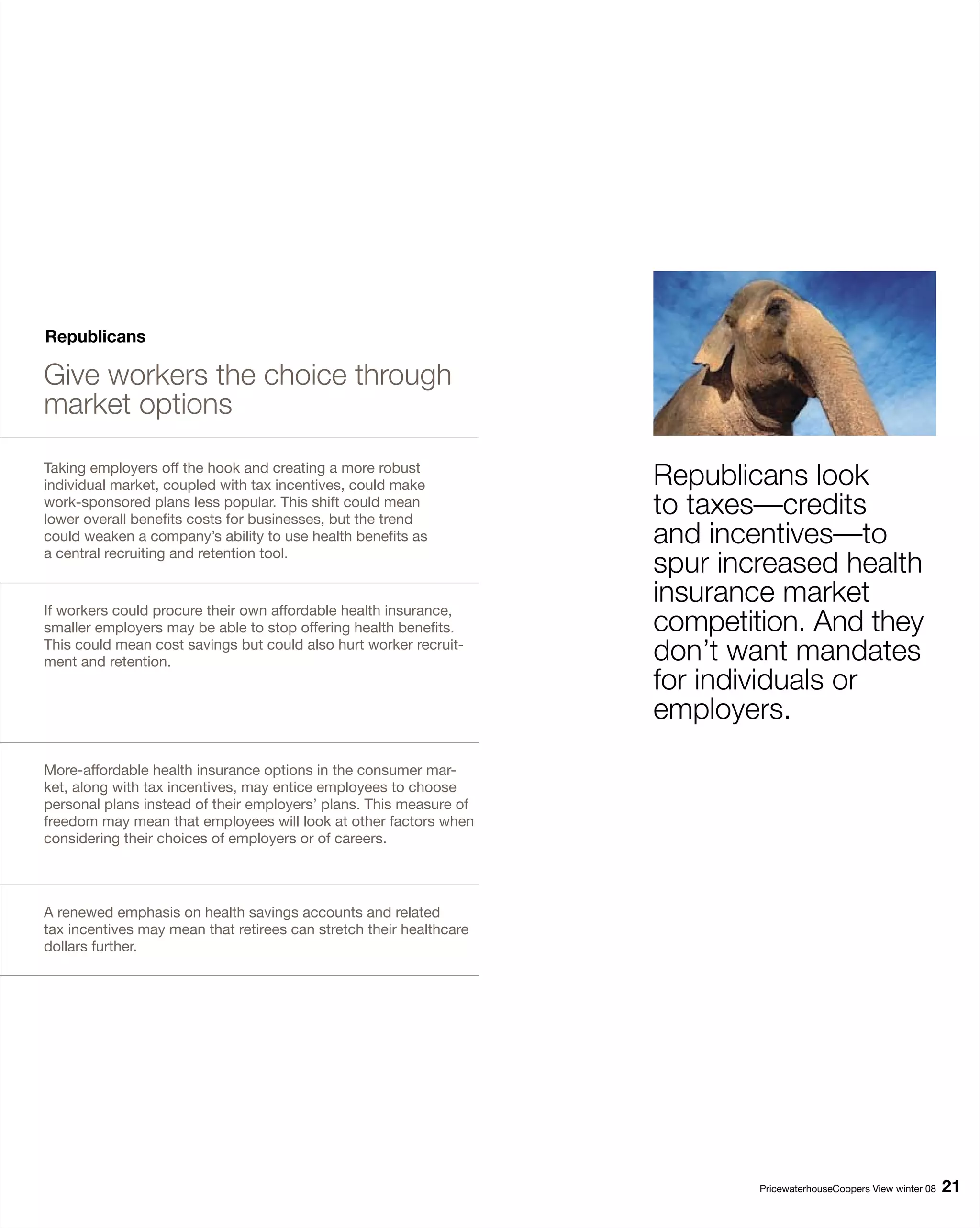
individual market, coupled with tax incentives, could make           Republicans look
work-sponsored plans less popular. This shift could mean
lower overall benefits costs for businesses, but the trend
                                                                     to taxes—credits
could weaken a company’s ability to use health benefits as           and incentives—to
a central recruiting and retention tool.
                                                                     spur increased health
If workers could procure their own affordable health insurance,
                                                                     insurance market
smaller employers may be able to stop offering health benefits.      competition. And they
This could mean cost savings but could also hurt worker recruit-
ment and retention.                                                  don’t want mandates
                                                                     for individuals or
                                                                     employers.
More-affordable health insurance options in the consumer mar-
ket, along with tax incentives, may entice employees to choose
personal plans instead of their employers’ plans. This measure of
freedom may mean that employees will look at other factors when
considering their choices of employers or of careers.


A renewed emphasis on health savings accounts and related
tax incentives may mean that retirees can stretch their healthcare
dollars further.


                                                                             PricewaterhouseCoopers View winter 08   1
Operational excellence


          Designing
Change agents agility
          into your
          corporate
          DNA
                                        By Randy Browning


PricewaterhouseCoopers View winter 08
Just whose job is it to ensure your business
can keep pace with customers, competitors,
and suppliers?


                                                     Markets aren’t what they used to be. The                        So, what exactly is agility, and under
                                                     Internet’s global reach and ability to supply                   whose job description does it fall? Agility
                                                     a near-instantaneous flow of information                        is infusion of your processes and decision
                                                     have forced businesses to sustain an                            making—your corporate DNA really—with
                                                     unprecedented scale and pace. Customers                         the ability to effect strategic change. It
                                                     and suppliers are acting accordingly, and                       involves everything you, your manage-
                                                     they’re changing their demands quickly.                         ment team, and your employees choose
                                                     For every company that can’t keep up,                           to do. This emphasis on selectivity is key
                                                     there’s one or more that can and will.                          because true agility requires establish-
                                                                                                                     ing a fine balance between flexibility and
                                                     Simply put, you need cultural and                               standardization. You must determine where
                                                     operational agility. There’s that word                          it makes sense to create and anticipate
                                                     again—agility. It’s been permeating the                         change and where it is more prudent to
                                                     corporate lexicon. But agility is more                          require a fixed approach. This balancing
                                                     than a buzzword; it’s a survival skill. In an                   act is necessary: While your customers
                                                     environment where global reach, techni-                         expect unique products and services, you
                                                     cal prowess, and optimal efficiency are                         have to provide those custom solutions
                                                     requirements, agility is a key differentiator.                  from a common, standardized supply chain
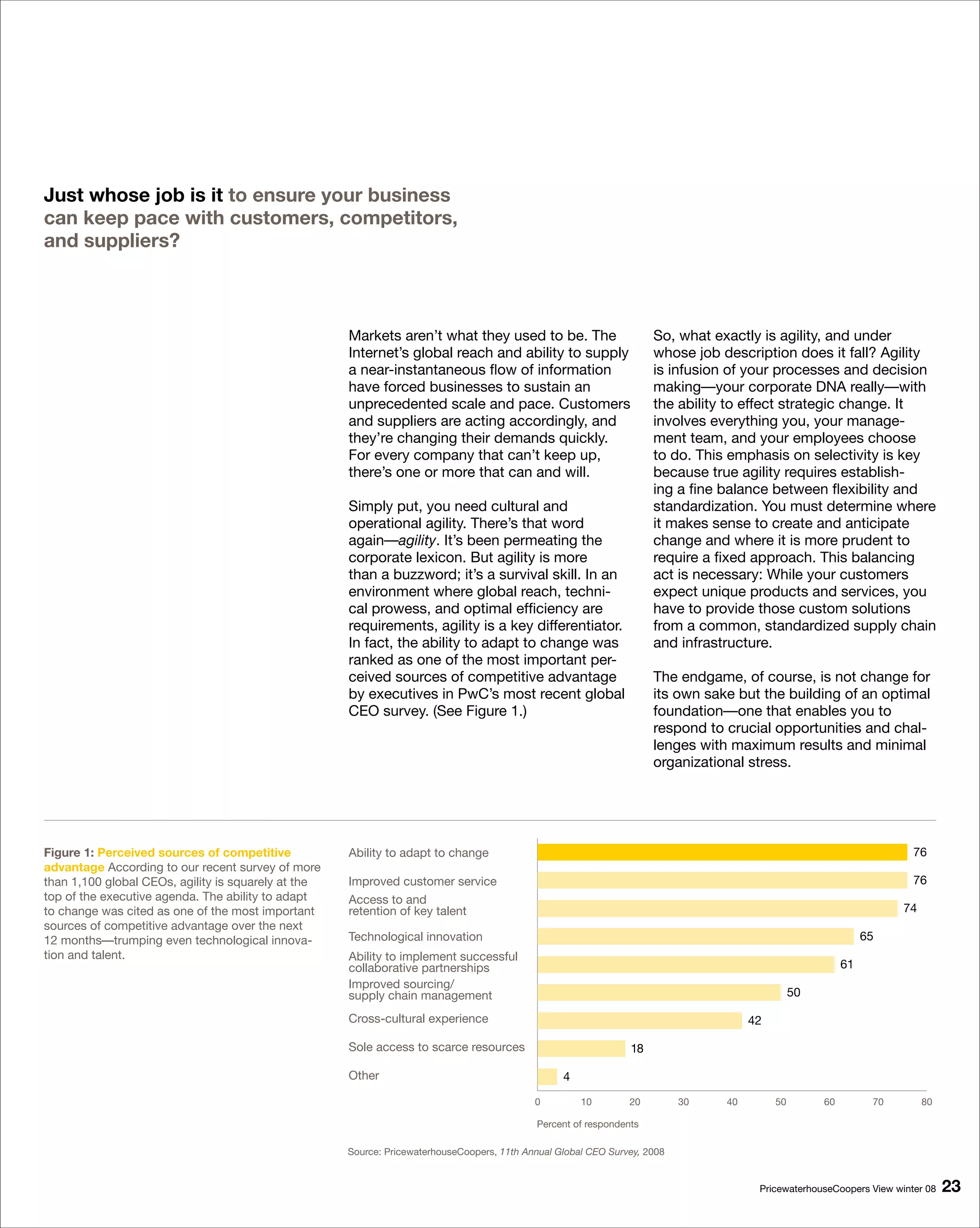
                                                     In fact, the ability to adapt to change was                     and infrastructure.
                                                     ranked as one of the most important per-
                                                     ceived sources of competitive advantage                         The endgame, of course, is not change for
                                                     by executives in PwC’s most recent global                       its own sake but the building of an optimal
                                                     CEO survey. (See Figure 1.)                                     foundation—one that enables you to
                                                                                                                     respond to crucial opportunities and chal-
                                                                                                                     lenges with maximum results and minimal
                                                                                                                     organizational stress.


Figure 1: Perceived sources of competitive           Ability to adapt to change                                                                                       76
advantage According to our recent survey of more
than 1,100 global CEOs, agility is squarely at the   Improved customer service                                                                                        76
top of the executive agenda. The ability to adapt    Access to and
to change was cited as one of the most important     retention of key talent                                                                                        74
sources of competitive advantage over the next
12 months—trumping even technological innova-        Technological innovation                                                                                 65
tion and talent.                                     Ability to implement successful
                                                     collaborative partnerships                                                                          61
                                                     Improved sourcing/
                                                     supply chain management                                                                   50

                                                     Cross-cultural experience                                                       42

                                                     Sole access to scarce resources                            18

                                                     Other                                        4

                                                                                            0         10        20         30   40        50        60         70        80

                                                                                            Percent of respondents

                                                     Source: PricewaterhouseCoopers, 11th Annual Global CEO Survey, 2008


                                                                                                                                      PricewaterhouseCoopers View winter 08
Payback                                         Getting to agility                                are organized around specialties, thereby

     Benefits of agility                             It’s no surprise, then, that achieving
                                                     agility is not easy. It’s especially difficult
                                                                                                       creating operational silos. And each is
                                                                                                       optimized for a specific task, such as
                                                                                                       sales or engineering.
                                                     because businesses have spent the past
                                                     few decades optimizing for efficiency—an
                                                                                                       In today’s market, the Model T–era
                                                     approach that typically squeezes out
                                                                                                       approach whereby each group does its
                                                     flexibility. Henry Ford famously noted this
                                                                                                       own thing and then hands off the result
                                                     contradiction when he said his assembly-
     Building agility into your business prepares                                                      to the next in the chain just doesn’t work.
                                                     line-produced Model Ts were available in
     you to respond quickly and efficiently when                                                       Being agile requires working across mul-
                                                     any color a customer wanted—as long as
     new challenges or opportunities arise. But                                                        tiple silos simultaneously. Marketing and
                                                     it was black!
     it also brings other benefits:                                                                    production, for example, need to collabo-
                                                                                                       rate at all stages of a product’s life cycle to
     Improved ability to incorporate new             As a result, most businesses are efficient at
                                                                                                       ensure that changing customer needs get
     business capabilities Acquisitions, alli-       what they need to do today, but they can’t
                                                                                                       incorporated rapidly into a product that is
     ances, and dispositions often result in         adapt themselves quickly or affordably to
                                                                                                       cost-effective to produce.
     the need to incorporate new capabilities.       what they need to do tomorrow. This lack
     An agile company can do so quickly and          of flexibility isn’t limited to a company’s
                                                                                                       Yet most executives lack such an inte-
     cost-efficiently. It can also divest business   static systems or production processes;
                                                                                                       grated view of their organizations. Because
     activities rapidly without losing any key       it’s also embedded in the organization’s
                                                                                                       they have no idea how all the pieces fit
     competencies.                                   human processes, such as workflow and
                                                                                                       together, there’s no way to orchestrate all
                                                     decision making.
     Reduced operation costs Taking stock                                                              the silos operationally. And there’s even
     of all your business processes and                                                                less ability to execute on new or changed
                                                     Worse, there’s an organizational bias that
     analyzing them for cost and value contribu-                                                       business strategies. Instead, executives
                                                     actively inhibits agility. Businesses typically
     tion provides the opportunity to rationalize                                                      are reactive, scrambling as changes occur.
     or to consolidate those processes that
     are redundant.
     Better reporting capabilities By reducing the
     complexity of business and IT operations,
     you can define common metrics that will
     enable you to better evaluate performance.
     Prioritized innovation Based on a clear
     understanding of which business activity
     or core processes contribute the most           Most companies lock on to a singular business
     value, you can focus innovation on those
     specific areas.
                                                     strategy based on a set of assumptions about
     Enhanced predictability of operations With      what’s driving markets, customers, and suppli-
     an end-to-end view of the business, you
     can more easily collect information across
                                                     ers, but what if something unanticipated alters
     the enterprise and the supply chain and         the landscape?
     feed it into predictive models for analysis.


   PricewaterhouseCoopers View winter 08
The business agility blueprint will articulate the
set of requirements and expected outcomes
needed for a company to respond to future
market demands or opportunities.


Planning for what-if                           creating the blueprint requires companies        Pitfalls
Businesses greatly improve their long-term
success by anticipating key opportunities
                                               to take a hard look at how they conduct
                                               their businesses today, how they hope to         Barriers to agility
                                               in the near-term future, and ultimately, how
and challenges before they occur and then
                                               they might prepare for bigger disruptions in
preparing their organizations to be ready
                                               the longer term.
to make the needed changes quickly. That
may sound like Business Strategy 101,
                                               The blueprint provides a singular corporate
but it isn’t. Most companies lock on to
                                               view that is often missing, and it helps         Why is agility so hard to achieve? Here are
a singular business strategy based on a
                                               make an unknown future easier to predict.        some of the biggest culprits:
set of assumptions about what’s driving
                                               First, it provides a complete picture of
markets, customers, and suppliers, but                                                          Lack of understanding of business
                                               current business processes—where value
what if something unanticipated alters the                                                      processes You can’t begin making
                                               gets created, where there are redundan-
landscape, such as a new data privacy                                                           changes to what you don’t understand.
                                               cies, who owns which processes, and
regulation, a supplier’s public relations                                                       Many companies have poorly documented
                                               where there are connection points. Then—
misstep, or a competitive merger?                                                               and inconsistent processes that need
                                               through high-level scenario analysis—the
                                               blueprint facilitates thinking about potential   to be addressed before thinking about
What’s needed is a way for companies to                                                         agility efforts can begin.
                                               changes and about how to operationalize
collectively assess such potential scenarios
                                               responses to those changes.                      Business silos Agility requires an integrated
in order to determine which are worth
considering and then to build in the ability                                                    view of your business. But today that view
                                               When it’s done, the blueprint will articulate    is often missing because the company
to execute them. To determine where to
                                               the set of requirements and expected out-        operates in silos, each one optimized for
start and how to get there, most companies
                                               comes needed to respond to future market         specific functions.
could use a high-level map of present and
                                               demands or opportunities. The blueprint
future value creation. We call this map a                                                       Limitations of supporting systems There
                                               might reveal that it’s more cost-effective to
business agility blueprint. The process of                                                      was a time when technology investments
                                                                                                like enterprise resource planning systems
                                                                                                once created competitive advantage by
                                                                                                helping enterprises increase their scale
                                                                                                and efficiency through standardization.
                                                                                                Yet it’s that same standardization that
                                                                                                makes change so hard. The systems
                                                                                                are designed to handle discrete business
                                                                                                activity and can’t easily be adapted to
                                                                                                support changes in such activity.
                                                                                                Little investment in people and process
                                                                                                Widespread efforts to gain efficiencies
                                                                                                through technology platforms have had the
                                                                                                unintended consequence of shifting vital
                                                                                                attention away from people and process
                                                                                                improvements.


                                                                                                                PricewaterhouseCoopers View winter 08
Agility must be embedded into the overall
     management structure rather than treated
     as yet another specialty function.


     implement a change today—as part of            would an operational excellence effort           • Current business architecture: a com-
     a greater operational excellence effort—       such as Six Sigma or Balanced Scorecard.           plete view of the organization’s business
     than to ramp up later. In other cases,                                                            processes and their connection points
     the approach may be to ensure that             The business agility blueprint is at the heart
                                                                                                     • Current enterprise architecture: your
     processes and technologies are open            of your company’s quest to be ready—
                                                                                                       company’s technical blueprint that shows
     and changeable so that they can accom-         really ready—for whatever the future brings.
                                                                                                       how and where the supporting informa-
     modate future capabilities.                    As with construction of a house or other
                                                                                                       tion technology (IT) systems are used
                                                    building, the blueprint is the focal point
     Creating a business agility blueprint          of all of your efforts. To create the final      • Senior management’s beliefs about pos-
                                                    blueprint—a process that may take several          sible strategic opportunities and poten-
     Many executives focus on onetime or
                                                    months and that involves your entire execu-        tially disruptive market changes that will
     short-term activities that achieve agility
                                                    tive team—you will need to synthesize              require alteration of your business model
     through force of will, but once the initia-
                                                    from a number of internal constituents their
     tive is over, the agility dissipates and the                                                    • Input from customer-facing departments
                                                    information and input, including:
     original processes and behaviors reas-                                                            such as marketing and sales, describing
     sert themselves. That’s why it’s critical to   • Current business strategy                        the ways current operations limit flex-
     approach agility as a foundational effort                                                         ibility in delivering additional value
                                                    • Mapping of your discrete business
     that you execute with the same planning,                                                          to customers.
                                                      processes
     broad reach, and accountability as you


6   PricewaterhouseCoopers View winter 08
You can begin to get a glimpse of the                           Taking a team approach                       Perhaps a new C-level executive is
potential of the business agility blueprint                                                                  required—a chief agility officer (CAO),
                                                                Managing change is difficult even under
when you consider the example of tele-                                                                       who would oversee the initiative much as
                                                                the best of circumstances, when all the
communications company BT. Realizing                                                                         a chief financial officer ensures financial
                                                                factors and requirements are known. It’s
that the British telecommunications market                                                                   efficiencies and standards across the
                                                                even harder to manage for the possibility
and the regulatory rules governing it were                                                                   business. But as tempting as it is to name
                                                                of future change.
likely to undergo profound change, BT                                                                        an agility czar who can manage such
decided to rethink its business. Facing the                                                                  efforts, doing so is not the whole answer.
                                                                Is it the chief marketing officer’s job to
prospect of having to open up its busi-                                                                      Agility must be embedded into the overall
                                                                determine potential customer demands
ness to competitive service providers, the                                                                   management structure rather than treated
                                                                that should be anticipated? Should the
company consolidated its business pro-                                                                       as yet another specialty function. In other
                                                                chief operating officer expand the pro-
cesses into 14 platforms to ensure there                                                                     words, agility should be an integral part of
                                                                curement system to ensure it can source
was only one version of each process, no                                                                     all aspects of a company’s strategic and
                                                                products and services not currently
matter where in the company it was used.                                                                     operational efforts. Agility is a responsibil-
                                                                needed? Does the chief information officer
Next, it aligned its functional groups with                                                                  ity of every executive team member and
                                                                need to upgrade the company’s Web
those process platforms. For instance,                                                                       should be part of each one’s mandate and
                                                                platform so it can better analyze customer
BT standardized the process of validating                                                                    mission. These executives will need to
                                                                data? Maybe—but all of these discrete
service availability for its current and future                                                              act both as a team and as individuals to
                                                                activities miss the point. Acting alone,
offerings, such as landline, cellular, DSL,                                                                  develop an agility plan and ensure that it
                                                                each of these executives has little chance
or any other future product. Before the                                                                      gets implemented.
                                                                of preparing the organization as a whole
reorganization, each functional group at
                                                                for agility.
the company had its own ways of meeting
this very common requirement. Now, when
BT wants to bring a new service online,
this piece of the offering can be dropped
into place easily.1

1 PricewaterhouseCoopers, Business Agility white paper, 2008.


Agility should be an
integral part of all aspects
of a company’s strategic and
operational efforts.
                                                                                                                              PricewaterhouseCoopers View winter 08
Staff and management
         alike need to value agility
         as much as they do
         performance and efficiency.


     As a team, the officers’ responsibilities      incentives—for the desired actions—that         blueprint, however, is not the CEO’s job.
     are twofold: First, using the business         are consistently applied no matter what         That responsibility rests with a person or
     agility blueprint, they must define where      department is involved. This can be tricky      an entity responsible for coordination and
     agility should be designed into the busi-      in culturally siloed organizations, but it is   oversight and might fall to the chief strategy
     ness. Second, they must ensure that the        fundamental to success.                         officer or to an agility program office.
     requisite changes get implemented and are
     maintained. Much of the detail work will be    A CEO who delegates agility solely to           The CEO also bears the ultimate respon-
     delegated to appropriate staff, under the      operational experts sends a clear mes-          sibility for ensuring success. While much
     officers’ direction and review.                sage: Agility is not important. And with        of the work for facilitating agility falls to
                                                    that kind of tone from the top, the results     other executives, the CEO must ensure the
     The executive officer team should be pre-      from any agility initiatives will likely be     desired outcome by periodically assessing
     pared to make changes in pursuing agility.     disappointing.                                  whether the goals set forth in the business
     Many processes that used to be self-                                                           agility blueprint are being met. While a
     contained would, under an agility mindset,     In essence, the CEO owns the business           monitoring group, such as a program
     span multiple departments, requiring           agility blueprint. Because the CEO ulti-        office, can help provide the information
     greater alignment across business units.       mately sets business strategy, he or she        to determine compliance, only the CEO
     Such efforts may require reworking depart-     also bears final responsibility for deter-      can decisively act on that information.
     ments to bring together processes that are     mining which future scenarios the business
     now closely related, or they may require       should support through agility. Of course,      Sustaining success
     coordinating entities to ensure that their     the rest of the executive team and other key
                                                                                                    Achieving agility is not a one-off set of
     efforts are mutually supportive. At the very   staff will help identify and evaluate poten-
                                                                                                    activities. While the executive team’s
     least, the executive team needs to set         tial scenarios. Managing the details of the
                                                                                                    continual focus on agility is critical,


8   PricewaterhouseCoopers View winter 08
ultimately, achieving and sustaining agility
are everyone’s responsibilities. Staff and
management alike need to value agility
as much as they do performance and
efficiency. They need to support the
business agility blueprint and its goals
in their individual actions and decisions.
Executive management can make such
buy-in the path of least resistance by
offering appropriate incentives and by
fostering the right culture. And execu-
tive management has to practice what it
preaches. Only then will a company be
well positioned to cope with the business
reality of constant change.


Randy Browning is the clients and industries leader
of our US Advisory services practice.
For a more detailed discussion on how to achieve
business agility, read the new white paper at
www.pwc.com/view.


                                                      PricewaterhouseCoopers View winter 08   9
Compliance


     One global flavor
                                             Thinking about International
                                             Financial Reporting
                                             Standards and how leading
                                             US companies are getting
                                             ready for them
                                             By Raymond J. Beier


     A US move to IFRS is inevitable. All companies should think   Globalization has changed nearly every
                                                                   aspect of how companies manage their
     strategically about this change and begin to understand the   business—sourcing, distribution, consumer
     impact now.                                                   pricing, raising of capital, and so much
                                                                   else. Financial reporting has also been
                                                                   greatly influenced by globalization. In fact,
                                                                   it is not an overstatement to say that a
                                                                   financial reporting revolution is now under
                                                                   way. Increasingly, International Financial
                                                                   Reporting Standards (IFRS) is how most
                                                                   of the world talks to investors and other
                                                                   stakeholders about corporate performance.
                                                                   Changing to IFRS alters how companies
                                                                   prepare and report their financial results
                                                                   and necessitates that investors understand
                                                                   any forthcoming changes. Anticipating that
                                                                   the US will soon join the rest of the world
                                                                   by allowing or mandating a move to IFRS,
                                                                   some leading US companies are already
                                                                   beginning to prepare for IFRS adoption.
                                                                   Even if your company is not yet ready to
                                                                   embrace IFRS, it makes sense for senior


0   PricewaterhouseCoopers View winter 08
management to take action so they can          International Accounting Standards Board       and Exchange Commission (SEC) has
understand how a move to IFRS will impact      (IASB) and with IFRS since their incep-        already taken preliminary steps that history
reporting of financial performance, opera-     tion in 2001. In the past five years, the      will almost certainly show to have been
tions, and communications with investors.      IASB and FASB have worked to improve           tipping points in the course of events:
                                               and converge both US GAAP (Generally
                                                                                              • The SEC no longer requires foreign
IFRS: The world’s new reporting                Accepted Accounting Principles) and IFRS,
                                                                                                private issuers to reconcile their IFRS
framework                                      with an increasing focus on the end goal of
                                                                                                filings to US GAAP so long as they use
                                               achieving high-quality, globally understood
The message is clear: IFRS is becoming                                                          IFRS as issued by the IASB.
                                               reporting standards.
the global accounting language. Virtually
                                                                                              • The Commission is studying whether
all major territories other than the US use
                                               The year 2007 brought a new perspective          US companies should have the option
or are moving to IFRS. Approximately
                                               to that goal for US constituents. Would          of reporting under IFRS rather than
12,000 public companies around the world
                                               adoption of IFRS in the US make sense?           under US GAAP.
already use IFRS in territories such as the
                                               In a global economy, do the reasons for
European Union, Australia, Singapore,
                                               adoption outweigh the reasons for retain-      As early as spring 2008, the SEC may
and Hong Kong. China, Canada, Japan,
                                               ing our own US standards? And then this        issue proposed rules that designate a date
and South Korea have announced their
                                               intriguing question: Would adoption of         for optional and/or mandatory adoption
intention to convert to IFRS in the not-too-
                                               IFRS help to eliminate many of the difficul-   of IFRS by US public companies. The
distant future. Although IFRS only recently
                                               ties in US GAAP, which in certain respects     speed with which a move to IFRS has
has made headlines in the US, the US
                                               has come under increasing and well-taken       progressed—from a mere possibility to
standard setter, the Financial Account-
                                               criticism? The answers to these questions      inevitability—has landed this topic squarely
ing Standards Board (FASB), has been
                                               are now being weighed. The US Securities       on the radar screen of many multinational
deeply involved with the London-based


                                                                                                              PricewaterhouseCoopers View winter 08   1
capital markets to IFRS is relatively young,
                                                                                                     it is too soon to tell whether the anticipated
                                                                                                     decrease in cost of capital will prove out.
                                                                                                     However, due to the sheer size of most cap-
                                                                                                     ital-raising efforts and the long-term nature
                                                                                                     of the payoff, even slight improvements in
                                                                                                     transaction terms such as interest rates can
                                                                                                     translate into significant dollar savings.

                                                                                                     Within individual companies, the ability
                                                                                                     to centralize and streamline accounting
                                                                                                     functions and move financial personnel
                                                                                                     freely around the world will lower costs
                                                                                                     and strengthen internal controls. Today,
                                                                                                     multinational corporations with numerous
                                                                                                     statutory filing requirements around the
                                                                                                     world need to employ staff with expertise in
                                                                                                     each national GAAP to prepare filings and
                                                                                                     then translate financial statements from
                                                                                                     national GAAPs to the parent-company
                                                                                                     reporting GAAP. Use of IFRS globally will
                                                                                                     reduce these reporting efforts and related
                                                                                                     costs and decrease the risk of errors.

                                                                                                     Challenges of many kinds
     companies and their boards. However,            options, fewer barriers of entry to non-US      Although the benefits at both the macro
     some pioneering US companies that rec-          markets, and, potentially, a lower cost of      and micro levels are attainable, the associ-
     ognize the inevitability of IFRS are not just   capital. Moving to a single global account-     ated challenges are meaningful and need
     talking about it— they are actively begin-      ing and reporting language also will reduce     to be addressed. Key for companies is
     ning the conversion process.                    complexity—a welcome improvement                understanding how their financial report-
                                                     for the companies that prepare financial        ing will change under IFRS and what
     This article looks in broad terms at the        reports and for the investors and other         those changes will mean to investors and
     shift from US GAAP to IFRS and at the           stakeholders who rely on them.                  other financial statement users. Managing
     emerging best practices of leading US                                                           and communicating the impact of these
     companies that view IFRS reporting as not       From a capital markets perspective, many        changes appropriately are defining points
     only inevitable, but also beneficial. These     multinational companies believe IFRS            in a successful conversion plan.
     companies are aware of the challenging          offers an opportunity to lower their cost of
     scope of implementation. They want to be        capital. Widespread acceptance of IFRS          Perhaps the most immediate hurdle US
     ready to seize the advantages and make a        financial statements allows companies to        companies will face in a conversion to IFRS
     smooth transition. And they want to control     seek capital across a broad base of global      is a limited pool of IFRS-knowledgeable
     the costs of doing so.                          funding without having to incur additional      resources. Companies need to determine
                                                     financial-reporting costs based on the          if they already have the right skill sets in-
     Benefits of IFRS                                source of funding. Anticipating increased       house to manage the change, and, if not,
                                                     competition among global investors and
     From a macroeconomic perspective,                                                               whether individuals who possess those
                                                     financiers for attractive investments, strong
     the benefits of using one global financial                                                      skills should be hired. Learning IFRS is
                                                     companies expect their cost of capital to
     reporting language are evident: increased                                                       a challenge for the US at all levels, from
                                                     decrease. Because the conversion of major
     comparability across global investment                                                          colleges and universities educating future


   PricewaterhouseCoopers View winter 08
accounting professionals to retraining for         This point is dramatically illustrated by      and other detail over the years that
current financial executives, auditors,            comparing the modest number of IFRS            the process of applying it has become
analysts, and professional investors.              accounting standards that address the          cumbersome and complex.
                                                   accounting for financial instruments with
Beyond learning the principles of IFRS,            the mass of US GAAP literature on the          Conversions to IFRS by companies in other
preparers, users of financial reporting, and       same topic. (See Figure 1.) The IFRS lit-      countries, particularly in the European
educators will need to change how they             erature isn’t weak or incomplete. It clearly   Union and Australia, lay excellent ground-
think about and practice their disciplines.        states the principles, avoids unnecessary      work for US companies to follow. With
The needed changes are broad in scope:             rule-making, and relies on preparers—          different national GAAPs as starting points,
cultural, behavioral, and institutional. Unlike    CFOs, controllers, and others—to exercise      it’s true that each country’s conversion to
US GAAP, IFRS is intentionally light on inter-     professional judgment. Undoubtedly, many       IFRS varied in its challenges and level of
pretive guidance. Principles and a minimum         Americans will initially find it challenging   difficulty. Due to the long-standing global
of necessary rules require accountants to          and uncomfortable to navigate without          influence of US GAAP and the conver-
make more professional judgments about             prescriptive guidance and to set aside         gence agenda between the FASB and
the nature of transactions when determining        time-honored practices.                        the IASB, many IFRS standards issued in
how to account for them. The principles are                                                       recent years are based on principles that
generally consistent with those in US GAAP         Here is an issue worth considering more        are fairly consistent with existing US GAAP
or closely similar, but much greater exercise      closely. The principles underlying IFRS are    standards. This should translate into fewer
of judgment is needed in a framework that          in fact designed to narrow the acceptable      accounting differences for US companies
deliberately doesn’t carry the same weight         alternatives. US GAAP is similarly based       that are converting to IFRS as compared
of detailed rules, bright lines, safe harbors,     on fundamental accounting principles, but      with many of the other countries that have
and exceptions.                                    it has become laden with so many rules         already done so.


Figure 1: Financial instruments Key differences between US GAAP and IFRS


                                                                               US GAAP                                      IFRS
                                                                               FAS 5                                        IAS 32
                                                                               FAS 91                                       IAS 39
                                                                               FAS 107
                                                                               FAS 114
                                                                               FAS 115
                                                                               FAS 133
                                                                               FAS 138
                                                                               FAS 140
                                                                               FAS 149
                                                                               FAS 150
                                                                               DIGs
                                                                               EITFs
                                                                               Industry guides


                                                                                                                  PricewaterhouseCoopers View winter 08
Differences between IFRS and US GAAP
                                             Despite the large number of parallel principles underlying IFRS and US GAAP, the devil is in the
                                             details, and differences can be significant for certain industries and types of transactions. The
                                             following examples of key differences are somewhat technical in nature, but readers familiar with
                                             accounting and reporting will see at a glance the primary implications.


                                             IFRS                                US GAAP                            Implications

     Asset write offs                        Impairment assessment of            Impairment analysis is a           Impairment charges may be
                                             long-lived assets is a one-step     two-step process based first       recognized more frequently,
                                             process based on discounted         on undiscounted cash flows.        earlier, and for different amounts
                                             cash flows. Under certain           Reversal of impairments is         under IFRS. Combined with the
                                             circumstances, previously           prohibited under US GAAP.          ability to reverse impairments,
                                             recognized impairments                                                 the result is greater potential
                                             are reversed.                                                          earnings volatility.

     Fair value accounting                   Greater use of fair value,          Requires historical cost           The result is a very different
                                             and certain assets, such as         valuation of such assets.          balance sheet and a clearer
                                             property, plant, and equipment;                                        view for investors of the
                                             intangible assets; and invest-                                         unrealized appreciation in
                                             ment property can be carried                                           certain major asset categories.
                                             and remeasured to fair value
                                             each period.

     Development costs                       Development portion of              Both research and develop-         Development costs do not hit
                                             research and development            ment costs are expensed.           the bottom line immediately
                                             costs is capitalized if certain                                        but, rather, are expensed over
                                             criteria are met.                                                      an estimated life, typically
                                                                                                                    as the associated revenues
                                                                                                                    from the development activities
                                                                                                                    are earned.

     Liability versus equity                 Classification of an instrument     Instruments with both liability    The result is an increase in
     classification                          as a financial liability versus     and equity characteristics can     interest expense, greater
                                             equity is stricter and based on     often qualify for treatment as     volatility in the income state-
                                             the substance of the instrument     mezzanine equity and are not       ment, and less equity on
                                             rather than on its legal form.      marked to fair value.              the balance sheet than under
                                             Compound instruments must                                              US GAAP.
                                             be bifurcated between the
                                             liability and equity components.

     Pension accounting                      Recognition of pension expense      Requires actuarial gains and       The cost of providing pension
                                             may be accelerated: Companies       losses to be amortized over life   benefits is not deferred as far
                                             can elect to recognize actuarial    expectancy, and prior-service      into the future under IFRS as
                                             gains and losses immediately        cost is amortized over the         it is under US GAAP.
                                             rather than deferring for a         remaining service period.
                                             period of time, and prior-service
                                             cost is recognized over the
                                             vesting period.

                                             As the option to use IFRS becomes available in the United States and companies decide to adopt,
                                             each company will need to undertake an extensive review of financial policies to determine the
                                             impact of these and many other differences between the two frameworks.


   PricewaterhouseCoopers View winter 08
A clean-sheet-of-paper approach will
be beneficial for many companies;
some may be tempted to try to force
their historical US GAAP policies to
fit into IFRS as a means of simplifying
the conversion process.


Preparing for the move to IFRS               Other key lessons learned include:             customer and vendor contracts and
                                                                                            employee compensation arrangements to
Because IFRS appears inevitable, compa-      Selecting new IFRS accounting policies
                                                                                            planning for MA activity and income tax
nies need to begin actively assessing what   A clean-sheet-of-paper approach will be
                                                                                            structures. The involvement of key company
such a move will mean to their operations,   beneficial for many companies; some may
                                                                                            expertise—legal and risk management,
financial statements, and stakeholders.      be tempted to try to force their histori-
                                                                                            treasury, sales, tax, human resources and
The European conversion to IFRS taught       cal US GAAP policies to fit into IFRS as
                                                                                            investor relations—at the right stage is
us that companies that take the initiative   a means of simplifying the conversion
                                                                                            essential to a successful conversion.
now will benefit by enjoying a smoother      process. But conversion to IFRS is a rare,
transition with fewer fire drills.           onetime opportunity to comprehensively         Planning the IFRS conversion project
                                             reassess all accounting policies. IFRS         Conversion projects can vary in length,
                                             may offer alternatives that US GAAP did        difficulty, and cost depending on the level
                                             not—alternatives that may better reflect       of complexity in a company’s transactions,
                                             the economic substance of transactions         operational structure, and regulatory
                                             and positions. Benchmarking against            environment. Another lesson to be learned
                                             global peers and competitors that have         from Europe’s mass adoption in 2005
                                             already adopted IFRS will provide valu-        is that conversion will take longer than
                                             able insight into what is acceptable in the    expected. US companies that have started
                                             marketplace.                                   the process—mostly large multinational
                                                                                            companies—estimate that it will take at
                                             Involving the whole company New financial-
                                                                                            least two to three years and significant
                                             reporting principles can impact nearly every
                                                                                            resources—both internal and external—
                                             aspect of a company’s operations—from
                                                                                            to complete a quality conversion project.


                                                                                                            PricewaterhouseCoopers View winter 08
Integrating the change Integrating IFRS         Impact analysis                               A company’s legal contracts represent
     principles into operations from the ground                                                    another layer of impact for consideration.
                                                     To scope a conversion project effec-
     up is a necessity. Companies that left their                                                  A change to IFRS may result in a dramati-
                                                     tively, companies need to understand the
     IFRS conversions to the last minute often                                                     cally different balance sheet and changes
                                                     multiple moving parts and wide-ranging
     tried to complete the transition by making                                                    in earnings projections, key performance
                                                     impacts that a move to IFRS will bring. An
     top-side adjustments to their existing prac-                                                  indicators, and financial ratios. In response,
                                                     impact analysis helps identify the depth
     tices. IFRS is not a bolt-on solution to be                                                   debt agreements and specific covenants
                                                     and breadth of necessary changes, how
     layered on top of old conventions. Compa-                                                     may need to be modified. Changes in
                                                     long they could take to implement, what
     nies that do so will strain internal controls                                                 accounting policies and disclosure require-
                                                     resources are needed to bring them to frui-
     over financial reporting and increase their                                                   ments may necessitate new information
                                                     tion, and what impact they could have on
     risk of reporting errors.                                                                     needs. Customer and vendor contracts
                                                     the companies’ stakeholders. Some facets
                                                                                                   may need to be revised and compensation
                                                     of an impact analysis include:
     Each company’s road map to IFRS will be                                                       agreements restructured.
     unique, but the following steps provide
                                                     Understanding what is affected Conver-
     an approach and key considerations for                                                        The impact on accounting and reporting
                                                     sion to IFRS will change the way certain
     a well-orchestrated conversion plan.                                                          processes, controls, and IT systems needs
                                                     transactions are accounted for. A thor-
                                                                                                   to be considered. A move to IFRS can cre-
                                                     ough review of the financial statements,
                                                                                                   ate new information needs and impact how
                                                     with detailed identification of differences
                                                                                                   controls are designed or implemented, how
                                                     between current accounting and IFRS, will
                                                                                                   consolidations are achieved, and how finan-
                                                     help a company assess the dimensions of
                                                                                                   cial systems record and report information.
                                                     the conversion and the scope of the infor-
                                                                                                   Changes in these areas need to be vetted
                                                     mation needs.
                                                                                                   and will eventually need to be documented
                                                                                                   and tested.

6   PricewaterhouseCoopers View winter 08
A change to IFRS may result in a dramatically
different balance sheet and changes in
earnings projections, key performance
indicators, and financial ratios.


Understanding resource needs and               Although milestones and timelines at this     Final thoughts
timelines Assessment of the quantitative       early stage of a conversion project are
                                                                                             As the move to International Financial
and qualitative levels of resources needed,    tentative, having them in place is key to
                                                                                             Reporting Standards gains momentum,
coupled with decisions on whether to           scoping the project, assessing the cor-
                                                                                             more and more forward-thinking compa-
train internal resources (and what amount      rect level of urgency of various tasks, and
                                                                                             nies are preparing for a move to IFRS. They
of training is necessary) or hire external     keeping all participants focused on the
                                                                                             are identifying the benefits they expect to
resources, is critical and frequently under-   many moving pieces of the project.
                                                                                             realize and the challenges they will face
estimated. Decisions on resources also
                                                                                             along the way. At a minimum, all companies
play a key role in budgeting the cost of       Project management reminder: A formally
                                                                                             should consider undertaking an impact
a conversion project.                          established and executive-sponsored
                                                                                             analysis now so that they have an accurate
                                               project with a dedicated project team is
                                                                                             appreciation of what IFRS will mean to their
                                               needed in most cases to manage success-
                                                                                             business when it arrives on US shores.
                                               fully through completion.


                                                                                             Raymond J. Beier is the partner responsible for
                                                                                             strategic policy and analysis within PwC’s National
                                                                                             Professional Services Group.


                                                                                                                PricewaterhouseCoopers View winter 08
People management


                                Maximizing
                                    talent Strategies for
                                             making the most
                                             of your people
                                             no matter what
                                             tomorrow brings


PricewaterhouseCoopers View winter 08
By Steve Rimmer, Karen Vander Linde,     Why should executives worry about the next talent crisis
Dolores Wilverding, and Warren Cinnick
                                         when they have their hands full with current people
                                         challenges? Times are changing, and they’re changing fast.
                                         The battle for talent—always fierce—is escalating.


                                         According to the US Department of Labor,         surveyed by PricewaterhouseCoopers indi-
                                         by 2014, more than one out of every three        cated they will actively seek out employers
                                         US workers will be 50 years of age or older.     whose corporate social responsibility
                                         The exodus of baby boomers from the              behavior reflects their own.1
                                         workforce will leave vacancies in critical
                                         leadership and other pivotal roles. This         However, as many companies are
                                         raises a crucial question: How does a busi-      discovering, reacting and adapting to
                                         ness make the most of the talent it has to       current talent trends will not be enough.
                                         ensure the right skills are in the right place   Thinking about talent like a long-term asset
                                         at the right time—no matter how often its        and viewing talent as a distinctive competi-
                                         needs change? Businesses that build their        tive attribute are significant shifts away
                                         talent pipeline internally, evaluate alterna-    from thinking about talent as a discrete
                                         tive work pools, and explore ways to meet        war that can be won. Anticipating and
                                         their future employee needs will be better       preparing for future organizational, societal,
                                         positioned than their competitors to face        and marketplace changes—and then
                                         these kinds of challenges.                       weighing their implications on how to
                                                                                          secure talent—are aspects of an organiza-
                                         Today, companies are already beginning to        tional sustainability mindset. In an effort
                                         see the profound need for a new approach         to gain insight into how businesses
                                         to maximizing talent—companies like the          can accomplish this talent objective, a
                                         international technology manufacturer that       PricewaterhouseCoopers team conducted
                                         determines it must address the gap left by       a scenario planning exercise to envision
                                         the retirement of some 50,000 managers           ways that businesses could evolve to
                                         and leaders over the next decade and the         meet future workforce challenges.
                                         successful midsize financial services firm
                                         that enters expanding markets and must           The resulting report—Managing Tomorrow’s
                                         learn to supplement internal talent with key     People: The Future of Work to 2020—
                                         contractor relationships so that the company     presented three business scenarios.
                                         does not risk derailing its rapid growth. Or     In one, big companies reign supreme
                                         consider that most of the nearly 3,000 new
                                         graduates from China (87 percent), the           1 PricewaterhouseCoopers, Managing Tomorrow’s People:
                                         UK (71 percent), and the US (90 percent)         The Future of Work to 2020, 2008.


                                                                                                                PricewaterhouseCoopers View winter 08   9
Key considerations
     Organizational talent levers
     The following are questions to consider when integrating key levers to maximize talent:
     Talent lever                            Key considerations

     Strategy                                How do we align and integrate talent              in attracting top talent and treat social
                                             strategies into business planning?                responsibility as optional; in a green model,
                                                                                               social responsibility is paramount, and
                                                                                               consumers and employees together drive
                                                                                               corporate accountability and responsibility;
                                                                                               and in the third scenario, localism prevails,
     Planning                                What will help us anticipate and proactively      and a global network of linked but separate
                                             create talent plans for the future?               small businesses prospers under entre-
                                                                                               preneurial leaders while larger companies
                                                                                               flounder.

     Assessment                              What is the best way to assess talent             Applying the lessons
                                             strengths and gaps?                               Though these scenarios are extreme, they
                                                                                               raise important considerations for real
                                                                                               businesses today. Fundamentally, all sce-
                                                                                               narios or types of organizations begin with
     Development                             What tools and processes will help us build       the key talent levers: strategy, planning,
                                             our talent bench at multiple levels?              assessment, development, succession
                                                                                               management, rewards and recognition, and
                                                                                               measurement. The actions related to these
                                                                                               levers will shape the future of the work-
                                                                                               place and, ultimately, the business itself.
     Succession management What processes should we put in place to
                           plan to fill every key job whether it is open                       As a practical exercise, we will consider
                           or not?                                                             how the levers are used in prototypical
                                                                                               organizations of our future scenarios: large,
                                                                                               corporate entities; midsize, highly networked
                                                                                               companies;2 and, where appropriate,
     Rewards and recognition What will energize our culture, encourage                         companies driven by social responsibility.
                             individual excellence, and help us retain the
                             best talent?                                                      We present these examples to show how
                                                                                               different kinds of companies are tailoring
                                                                                               core talent maximization principles to meet
     Measurement                             What metrics and gauges can we visibly            their specific needs. However, these levers
                                             display about our organizational and              apply to any business. In fact, we have
                                             individual performance?
                                                                                               2 A highly networked organization is one in which specialized
                                                                                               skills or intellectual property is central. Examples would be
                                                                                               technology companies and professional services firms.


0   PricewaterhouseCoopers View winter 08
found that companies of all sizes               understand the need for a systematic             future, however, organizations will need
and types can and do benefit from               approach to assessing, planning, devel-          to find ways to increase the frequency of
integrating the following key principles        oping, and deploying talent to leverage          assessment and their ability to develop
into their talent planning.                     resources. They are using mechanisms             talent rapidly; ultimately, they will need to
                                                to control the process of identifying            build agile workforces that can adapt to
Creating a strategic workforce plan             strengths and gaps regarding talent built        changing market needs.
                                                into service-level agreements with vendors.
In our experience, we have found that suc-
                                                Likewise, some larger companies that are         Assessment processes are even more
cessful companies align and integrate their
                                                seeking to build up strength in key areas        important in companies that are growing
talent strategies around future business
                                                are also attempting to leverage unique           through acquisitions. Such companies are
plans and review those strategies regularly.
                                                talents from alternative sources.                discovering that it is critical to assess their
For example, a forward-thinking global
                                                                                                 people resources throughout the process,
conglomerate we know of currently inte-
                                                Identifying talent strengths and gaps            not just during due diligence. For example,
grates its talent strategy and planning into
                                                                                                 we know an electronics manufacturer that
its annual three-year business-planning         To remain ahead of competitors, businesses
                                                                                                 seemed to have lost its entrepreneurial
process. As part of key business strategies     must regularly assess their existing work-
                                                                                                 edge after successfully growing more
to sell or acquire divisions, part of the due   force to better leverage strengths and fill
                                                                                                 than 20 times larger through a series of
diligence process involves assessing cur-       gaps through developing, recruiting, or
                                                                                                 international mergers and acquisitions.
rent and future talent requirements. Given      acquiring the skills they need. Unless dealt
                                                                                                 Management recognized that leading a
the rapid pace of change, even corpora-         with effectively, small gaps almost always
                                                                                                 company of that size and complexity would
tions that have already embedded the            grow larger, but merely understanding the
                                                                                                 require different skills and so established
talent-planning process into their strategic    gaps won’t move a business ahead as much
                                                                                                 a set of critical competencies tied to its
planning must be prepared to do it more         as will making the most of its strengths. For
                                                                                                 future strategy. The existing leadership
frequently—even quarterly for economi-          example, successful organizations where
                                                                                                 team was assessed against those new
cally vibrant regions—in order to anticipate    recruitment has always been strong have
                                                                                                 competencies in order to identify leadership
emerging changes and to be able to              typically built upon that competency in a
                                                                                                 gaps to fill and develop. Looking ahead, this
modify strategies quickly.                      competitive market, and attracting talent
                                                                                                 large, flexible company plans to continue
                                                with speed and a passion for quality are
                                                                                                 to conduct assessments regularly and has
Unlike large corporate entities, smaller,       differentiators for successful growth.
                                                                                                 developed systems for providing feedback
more highly networked organizations rely
                                                                                                 on the set of skills it needs for specific
on the talent that is resident in their orga-   Increasingly, successful large corporations
                                                                                                 growth and improvement projects.
nizations and in their networked alliances.     are implementing continuous assess-
Their ability to change direction and grow      ment processes. Today, a global financial
                                                                                                 Developing talent that is strong
depends on their ability to maintain these      services company might get away with
                                                                                                 and deep
alliances in order to anticipate and secure     annually assessing all managers and
the right kind of talent. For a networked       above to identify strengths and gaps—at          The cycle of workforce expansion and
organization, acquiring new talent often        both the organizational and the individual       retrenchment that prevailed in the 1990s
means entering into an alliance or a joint      levels—and then incorporating the results        is simply not a viable approach in today’s
venture. Savvy networked organizations          in its overall talent-planning process. In the   talent-lean environment. Instead, building


                                                                                                                  PricewaterhouseCoopers View winter 08   1
talent needs a broad skill set to be able to
                                                                                                        adapt quickly to changing needs and to
                                                                                                        provide support for one another. In these
                                                                                                        companies, frequent job rotations and mul-
                                                                                                        tifunctional career paths are expected and
                                                                                                        required aspects of leadership develop-
                                                                                                        ment. For unique skill sets or highly refined
                                                                                                        technical skills, they maintain alliances
                                                                                                        and alternative talent pools to ensure that
                                                                                                        they are flexible enough to respond and
     With most companies facing changing talent                                                         are able to expand capability as the market
                                                                                                        changes its requirements.
     demands and a shrinking talent pool, large
     organizations are placing more focus on                                                            Achieving these objectives poses a prob-
                                                                                                        lem. Integrating outside talent into the
     identifying emerging leaders throughout an                                                         organization requires a level of transparency
                                                                                                        about skills and capabilities and a level of
     enterprise.                                                                                        candid dialogue about talent that typically
                                                                                                        does not exist today between organizations
                                                                                                        linked by service and partnership agree-
                                                                                                        ments. However, successful networked
                                                                                                        organizations of the future will build ongoing
                                                                                                        development of talent into provisions in
                                                                                                        their service-level agreements with alliance
                                                                                                        partners or outsourcing providers.
     a nimble workforce through training,               selected a group of pivotal employees
     coaching, and mentoring will define                from a variety of functions. The team
     success—and even survival.                         focused one-third of its efforts for
                                                        120 days on a critical product issue.
     Large corporations that focus only on              The team uncovered, tested, and solicited
     developing a targeted group of high-poten-         management’s approval for a solution to
     tial individuals to fill positions at the top of   the problem that resulted in an annual
     the organization are at risk. More and more,       increase in profitability of $6 million. You
     executives are finding that they need to           can bet that team members learned more
     develop talent at all levels because pivotal       than a bit about business strategy and
     roles and employees exist in all functions.        planning in the process.
     Given the rapid pace of change, success-
     ful, large organizations are looking beyond        Unlike their larger counterparts, highly
     traditional classroom and online training.         networked organizations tend to be lean.
     They are also providing individuals with           Therefore, when it comes to talent, their
     embedded learning and on-the-job experi-           key challenge lies in the availability of
     ence that will continue their development          sufficient talent alternatives. The compa-
     and increase their readiness to step up to         nies we have studied typically meet that
     broader roles or expand their expertise.           challenge through outsourcing, alliances,
                                                        and joint ventures. However, they have
     For example, rather than training employ-          also discovered the need to develop talent
     ees about business strategy and planning,          for key leadership positions and pivotal
     one global consumer products company               roles. In fact, they have found that internal


   PricewaterhouseCoopers View winter 08
In addition, we have noted that to facilitate    Saratoga research group noted that the                     important, that they must continuously
ongoing development, enterprises of many         percentage of key roles for which orga-                    assess how to deploy people to broaden
shapes and sizes have relied on coach-           nizations have either one or two unique                    their skills through experience. For
ing and mentoring for every employee.            succession candidates identified per key                   example, if a large US organization needs
Many organizations assign a coach or             role has been increasing dramatically. In                  to send talent to oversee a manufacturing
mentor who is not the same person as the         2006, the median company over a two-                       facility in China, it would benefit by choos-
employee’s manager. By so doing, they are        year period had nearly doubled the number                  ing an individual whose future career role
expanding access to key resources that           of roles that have at least one successor.3                will require significant exposure to Chinese
will help individuals broaden their perspec-                                                                culture and China’s economy. In most
tives and skills.                                While developing a pipeline to fill leader-                companies with multinational footprints,
                                                 ship roles in the top two or three tiers                   the opportunity to deploy talent returning
An organization seeking to become more           is critically important, large integrated                  from international assignments to positions
green might have key top talent work on a        corporations with foresight are also build-                that make use of the experience and skills
strategy to develop talent via activities that   ing talent pipelines at multiple levels. With              acquired there is an underdeveloped area.
demonstrate social responsibility, such as       most companies facing changing talent
assisting with an environmental organiza-        demands and a shrinking talent pool, these                 Highly networked organizations approach
tion or foreign aid program.                     organizations are placing more focus on                    succession planning differently. They focus
                                                 identifying emerging leaders throughout                    on cross-functional development to ensure
Managing succession                              an enterprise and preparing them not only                  that talent is ready to step into new roles
                                                 to step into higher roles but also to take                 and to rapidly assimilate new responsibili-
Organizations that manage succession well
                                                 on broader responsibilities for helping the                ties. Such companies have recognized the
do so by building a deep pipeline of talent
                                                 organization fulfill its strategic plans. To be            need to broaden the boundaries of suc-
and by planning proactively with regard to
                                                 effective, organizations are realizing that                cession management to include alliances
developing and deploying these resources.
                                                 they have to better anticipate the need                    and alternative work pools and thus ensure
In its most recent annual report, PwC’s
                                                 for new skills and knowledge and, equally                  they have the talent expertise they need
                                                 3 PricewaterhouseCoopers, US Human Capital Effectiveness
                                                 Report 2007/2008, 2007.


The cycle of workforce expansion and retrenchment that prevailed
in the 1990s is simply not a viable approach in today’s talent-lean
environment. Instead, building a nimble workforce through training,
coaching, and mentoring will define success—and even survival.

                                                                                                                            PricewaterhouseCoopers View winter 08
Executives at many organizations are realizing
                                             that placing talent on the business agenda is
                                             not enough. Going forward, measures around
                                             talent need to be part of a corporation’s overall
                                             performance metrics.


                                             to meet market demand. Companies that            bonuses and high salaries. A prime parking
                                             use talent development–related criteria          spot, tickets to a sporting event, or a gift
                                             when selecting members of their networks         certificate to a day spa could go a long
                                             are increasingly addressing standards            way in promoting short-term job satisfac-
                                             for development and succession in their          tion and attracting talent. Similarly, on
                                             service-level agreements. They are also          the other end of the demographic spec-
                                             utilizing methods for trading talent in order    trum, employees approaching retirement
                                             to best service projects. Highly networked       have views different from those of their
                                             organizations are also considering exploit-      predecessors regarding how to leave the
                                             ing the portability of benefits and defined      workforce. No company has yet mastered
                                             contribution plans within their networks         the concept of phased retirement as a
                                             of business partners and turning this            means of managing knowledge and of col-
                                             potential liability into an advantage in the     laboratively extending the working lives of
                                             job market.                                      highly valued employees. This is a frontier
                                                                                              where the reward, recognition, benefits,
                                             Rewarding and recognizing                        and policy tools will need to come together
                                             performance                                      to help close the knowledge gap that is
                                                                                              part of the current retirement process.
                                             In the current talent environment, organi-
                                             zations of all sizes are inspiring both
                                                                                              Large corporate organizations traditionally
                                             individuals and teams with flexible and
                                                                                              have had well-defined reward systems
                                             targeted forms of reward and recognition.
                                                                                              that include annual raises and bonuses.
                                             As the rising generation of Millennials enters
                                                                                              To facilitate teamwork across organi-
                                             the workforce, organizations recognize the
                                                                                              zational and geographic boundaries,
                                             importance of understanding what kinds
                                                                                              some large, integrated organizations are
                                             of rewards and recognition motivate these
                                                                                              considering offering more incremental
                                             individuals. And it’s not always about big
                                                                                              team-based rewards and individual peer
                                                                                              recognition. A number of highly networked
                                                                                              organizations are starting to associate
                                                                                              flexible cash and noncash reward and
                                                                                              recognition programs with individual
                                                                                              projects. Vesting individuals in a project’s
                                                                                              success offers great incentive for the
                                                                                              contractors on which highly networked
                                                                                              organizations depend.

                                                                                              Looking ahead, businesses of all types
                                                                                              are rethinking their reward and recognition
                                                                                              systems to accommodate and motivate
                                                                                              workforces with diverse attitudes about job
                                                                                              satisfaction. For example, there is rising
                                                                                              evidence to suggest that employees are
                                                                                              more focused on environmental issues
                                                                                              and are making good corporate citizenship
                                                                                              a part of the reason they choose to join
                                                                                              or stay with an organization. Under such


   PricewaterhouseCoopers View winter 08
circumstances, socially conscious orga-
nizations are rewarding talent for leaving
a more gentle carbon footprint on Earth
by traveling less, carpooling to work, or
participating in community service oppor-
tunities. To develop new approaches to
social issues, some organizations are tak-
ing a forward-looking approach by offering
employees opportunities for increased
community, external organization, and
workplace involvement. Ultimately, this
part of the public talent-attraction profile
for your company will be measured by
what actions occur, not by what aspira-
tions are stated.

Measuring individual and organizational
talent attributes                                        Executives at many organizations are            In the future, organizations that uphold
                                                         realizing that placing talent on the busi-      socially responsible ideals will have
If talent issues are to be taken seriously,              ness agenda is not enough. Going forward,       organizational and individual performance
measurement is essential. A PwC report                   measures around talent need to be part          metrics in place to balance corporate
covering more than 15,000 organizations                  of a corporation’s overall performance          results with the public good. To accomplish
in the US and Europe found that few orga-                metrics. For example, an annual report          this, an organization might measure and
nizations have achieved truly global and                 discussing business performance might           report the number of hours spent by its
real-time people measurement capabilities                include how the company is performing           employees on community service projects.
or have quantified the financial value of                on its talent metrics.
their talent, even when it is possible to do                                                             Looking ahead
so.4 The continued adoption of enterprise                Large corporations rely on the promotion
resource planning systems is actually a                                                                  No matter which path a business takes,
                                                         of corporate culture attributes and behav-
boon to the measurement and tracking                                                                     there is one clear constant: More than
                                                         iors as a means of engaging employees.
of talent. With a properly configured                                                                    ever, it must manage talent resources as
                                                         Today’s employees are looking to see
system, the year-over-year and long-term                                                                 carefully as it does business operations.
                                                         these attributes and behaviors represented
views of individuals as measurable and                                                                   Businesses seeking to practice talent
                                                         in how people are measured, rewarded,
valuable resources can be well served by                                                                 maximization and sustainability are culti-
                                                         and promoted. Clearly, how metrics are
enterprise systems.                                                                                      vating talent in their organizations today
                                                         applied will have an impact on attracting,
                                                                                                         in order to prepare for the future.
                                                         acquiring, and keeping talent.
This will change. In the future, leaders
of both large companies and networked                    To continuously improve, highly networked
organizations will be held accountable for               organizations are integrating talent metrics
developing and coaching people. Talent                   at the project level to evaluate talent and     Steve Rimmer is a principal in PwC’s Human
will be a core part of their responsibility. As          its relevant impact. Among the challenges       Resource Solutions practice and the HR
large corporations move toward engaging                  networked organizations face are partners       Transaction Services leader. Karen Vander Linde
talent across organizational boundar-                                                                    is a principal in and the global leader of PwC’s
                                                         whose systems of measuring contributions        People and Change practice. Dolores Wilverding
ies, others—in addition to an individual’s               are completely different from their own.        is a managing director in the People and Change
immediate manager—will participate in the                Thus, it is important to align talent metrics   practice, and Warren Cinnick is a director in the
performance management process.                          to the goals currently at hand.                 People and Change practice.
4 PricewaterhouseCoopers, Key Trends in Human Capital:
A Global Perspective, 2006.


                                                                                                                            PricewaterhouseCoopers View winter 08
Interview


     Piercing the veil
     Does your
     Andrew Zolli looks at
     organization
     the future of business
     need the world
     and of
             a
     chief agility
     Interview by Tom Craren and Gene Zasadinski


     officer?

6   PricewaterhouseCoopers View winter 08
Back to the Future is the name of a movie, but it also                              Andrew Zolli is an expert in global foresight and
                                                                                    innovation, studying the complex trends at the
describes Andrew Zolli’s professional landscape. Zolli is a                         intersection of technology, sustainability, and
futurist, and—at least imaginatively—the future is where he                         global society that are shaping our future. His firm,
                                                                                    Z + Partners, helps senior leaders at some of the
spends most of his time. A century ago, the word futurist                           world’s preeminent companies, institutions, and
                                                                                    governments see, understand, and respond to
conjured up images of crystal balls, tarot cards, and Ouija                         complex change.
boards. While modern-day prognosticators depend on other
tools, all futurists—past and present—rely on the rare ability
to predict drivers and trends with some degree of accuracy.
As his clients affirm, Andrew Zolli has a generous measure
of that ability. In our interview, he applies his gift of foresight
to the world of business and to the world at large.


                                    PwC: You are often referred to as a futur-      PwC: So how should companies be en-
                                    ist. What does that term mean to you, and       gaging a foresight researcher like you, and
                                    is that how you define yourself?                how far out should they be looking?
                                    AZ: I actually prefer foresight researcher or   AZ: First, companies should work with
                                    global trends analyst. A lot of what I do is    foresight researchers to perform what I like
                                    about looking at critical places—where you      to call environmental scanning—that is,
                                    can see future trends emerging that are         scanning within such defining driving areas
                                    going to be definitive for the whole planet     as demographics, emerging technologies,
                                    or for a culture or an industry—and then        and economics to get a sense of how
                                    thinking through with senior leaders about      those environments are unfolding. Com-
                                    how those trends might shape the global         panies should then develop scenarios that
                                    operating environment.                          look specifically at how the individual data
                                                                                    points in each one of those areas might
                                    PwC: You refer to these as intersections.
                                                                                    unfold. I think organizations should do en-
                                    AZ: That’s right. The big ones that I pay       vironmental scanning every year. And they
                                    attention to are demographics, globaliza-       might want to do scenarios every three to
                                    tion, environmental issues, some global         five years.
                                    policy—especially global business is-
                                                                                    PwC: Can you describe a typical scenario-
                                    sues—and emerging technologies. But the
                                                                                    building process?
                                    most fruitful terrain lies between those ver-
                                    tical areas of focus. For example, it’s not     AZ: The process begins by identifying key
                                    so much demographics as it is the effect of     uncertainties. For example, a current key
                                    demographics on healthcare, public policy,      uncertainty right now involves the American
                                    or the environment. What I do is develop        economy. Will it go into recession, and—
                                    visions of the future that share key themes     more important—will it drag down the
                                    and that help senior leadership teams look      global economy in the process? Another
                                    just a little bit further out. Sometimes you    key uncertainty is about the price of oil.
                                    should act on great opportunities while         If you place just those fundamental macro
                                    they’re still over the horizon.                 drivers on a two-by-two grid, you can


                                                                                                        PricewaterhouseCoopers View winter 08
Drivers and trends: Zolli looks ahead First, there are the fundamental long-term trends that you and
     I can’t do anything about, such as demographics. The second would be large structural forces like
     long-term climate change. The third would involve big global economic forces. But you also have to
     look at what we think of as the accidents and incidents. These are wild cards—low-probability but
     high-impact events, such as terrorist plots or, for that matter, breakthrough technology inventions.


        Long-term trends
                                      +
                                                   Structural forces
                                                                            +
                                                                                              Economic forces
                                                                                                                    +              ?    Wild cards


     envision four different worlds that suggest         number of old and young people who have            PwC: You mentioned healthcare. These
     a number of future policy implications.             ever coexisted in our society’s history. This      demographic changes must have a pro-
     What you’re really after when you’re                will result in some interesting paradoxes.         found impact on the future structure of
     developing scenarios are data rich stories          Let’s take the workforce, for example. Many        healthcare, right?
     that are expressed in a number of ways.             boomers soon will be retiring, but many will
                                                                                                            AZ: Of course, and I think it’s a combination
     A scenario that draws on only the left              stay on the job. That creates a paradox for
                                                                                                            of really complicated issues. You’ve got the
     hemisphere of the brain—the one that’s all          Generation Xers. Many will move up the
                                                                                                            general frame of the traditional healthcare
     charts and numbers—misses the nuances.              management chain much sooner than their
                                                                                                            system—as we understand it—pushing us
     The reality is, we’re not exclusively rational      predecessors did. Others will get trapped
                                                                                                            toward new political circumstances. You’ve
     creatures. We’re semirational creatures             behind a new glass ceiling created by
                                                                                                            got the rise of network consumers acting in
     who make decisions based on our emo-                boomers who won’t or can’t retire.
                                                                                                            their own interests in healthcare for the first
     tions and our own experience. Our visions
                                                         PwC: Beyond the workforce, what else will          time. But most interesting will be the rise of
     of the future need to reflect that.
                                                         change?                                            healthcare innovations.
     PwC: You mentioned a number of powerful
                                                         AZ: I think we’ll also be seeing some very         PwC: Can you give an example?
     drivers. What should companies focus on
                                                         interesting changes in the structure of
     in terms of some of the major trends that                                                              AZ: Yes. Take pharmacogenomics. The
                                                         families. For instance, because of advances
     you see?                                                                                               pharmacogenomics revolution is the
                                                         in healthcare, many people are outliving
                                                                                                            intersection of drug targeting and genetics.
     AZ: First of all, demographics are criti-           their incomes and in a sense, moving back
                                                                                                            For example, in today’s healthcare environ-
     cal. Historically, the American population          home to live with or close to their children.
                                                                                                            ment, if three people get sick, it’s very likely
     architecture has looked like a pyramid—with
                                                         PwC: What’s the impact of this change?             that within a certain set of parameters,
     young people significantly outnumbering
                                                                                                            they’ll each be given the same medicine—
     older people—but the baby boomers are               AZ: When you change the family, you
                                                                                                            often in the same doses. Unfortunately,
     creating a big bulge in the middle. Over the        change the basic unit of consumption.
                                                                                                            because of genetic factors, the same
     course of the next two decades, we’re going         For instance, who makes healthcare
                                                                                                            medicine that heals one does nothing for
     to see a new population structure emerge in         decisions? Who makes entertainment deci-
                                                                                                            or kills the others. We’re only just beginning
     the United States. Instead of a pyramid, that       sions? Everything is affected. Take product
                                                                                                            to understand the intersection between
     structure will resemble an hourglass, the           design, for example. Designing for three
                                                                                                            genetic triggers and medical effectiveness.
     two ends of which will represent the largest        generations as opposed to two involves
                                                         very different sets of issues.


8   PricewaterhouseCoopers View winter 08
PwC: That explains innovation, but where
                                                                                                   does foresight fit in?
                                                                                                   AZ: Foresight is a core cognitive skill—just
                                                                                                   like playing, having a think tank, doing
                                                                                                   ethnography, or building networks. It’s also
                                                                                                   a core leadership skill, and in my research,
                                                                                                   the organizations that have proved to be
                                                                                                   the best sustained innovators are also the
                                                                                                   best at foresight.
                                                                                                   PwC: It must be incredibly difficult to
                                                                                                   embed these types of thinking into an
                                                                                                   organization.
                                                                                                   AZ: It is. Thinking about the future and
                                                                                                   thinking about innovation are whole-brain
                                                                                                   exercises, and big companies typically are
                                                                                                   not whole-brain organizations. But in making
                                                                                                   decisions, leaders of whole-brain organiza-
                                                                                                   tions draw on both rational—left brain—and
                                                                                                   intuitive—right brain—mental resources.
                                                                                                   PwC: Should companies be taking this
                                                                                                   whole-brain approach to today’s hot-
                                                                                                   button issues like climate change and
                                                                                                   sustainability—especially in the US, which
PwC: We’ve talked a lot about demo-             AZ: Yes. What we’ve discovered about or-           some perceive as being behind the rest of
graphics. What else should companies            ganizations that are very good at becoming         the world in its response to these areas?
look at?                                        sustained innovators is that they share com-       AZ: Yes, but let’s separate the two issues.
AZ: Three things: First, there are the          mon characteristics. First, they spend a lot       They’re related, but they’re not the same.
fundamental long-term trends that you           of time paying attention to weak signals as        Climate change is a critical, fundamental
and I can’t do anything about, such as          part of their culture, and they’re very good       challenge for the planet. Sustainability is a
demographics. The second would be               at identifying what they don’t know. Sec-          business issue. The first thing to say about
large structural forces like long-term          ond, sustained innovators use a portfolio of       climate change is that it will continue to
climate change. The third would involve         five cognitive styles simultaneously. The first    accelerate. There is a 30-year lag between
big global economic forces. But you also        is the classic think-tank model: You take a        when we put carbon and greenhouse gases
have to look at what we think of as the         group of experts, lock them in a closet, and       into the atmosphere and when they have
accidents and incidents. These are wild         hope you get a solution to your problem.           a measurable effect. So we’re dealing this
cards—low-probability but high-impact           Eighty-five percent of the time, you don’t. A      year with 1978’s carbon, and that’s a real
events, such as terrorist plots or, for that    second style of thinking and style of prob-        issue for us. Long before we have to deal
matter, breakthrough technology inven-          lem solving is about ethnography: sending          with the full effects of climate change, we’ll
tions. Will understanding all of these things   people out into the field to see what people       have run out of oil. That’s an absolutely
lead to perfectly accurate predictions all of   are doing. Using this method, about 70 per-        done deal. So we’re going to have to learn
the time? Of course not. It’s not so much       cent of the time you get real but incremental      how to live in a postcarbon economy. The
that you turn to experts to give you all the    innovation. The third style is what I call the     good news is that this is an opportunity
answers all the time but that you develop       play category, in which you put a problem          for tremendous wealth creation. The green
a culture of constant investigation—con-        through thousands of iterations until you          energy revolution is going to make the IT
stantly scanning the weak signals that are      either solve it or redefine it. The fourth one     revolution look minuscule in comparison.
going to be definitive in the years to come.    is about scenario planning, where you ask
                                                yourself what your organization would look         PwC: But what’s the bad news?
PwC: Companies that are good at fore-           like under a certain set of circumstances          AZ: The bad news is that climate change
sight also seem to be the best innovators.      and then work backward from there. And             is going to adversely affect poor countries
Is there a connection between foresight         finally, the fifth style involves leveraging the
and innovation?                                 power of networks.


                                                                                                                    PricewaterhouseCoopers View winter 08   9
There will always be superpowers, but what
     will be most important over the next 20 years
     is the gentle, continuous expansion of what
     I call the dominant global superconduit.


     much more than wealthy countries. Dis-           PwC: And what’s the other side of                 75 percent of global GDP was generated
     ease will spread faster, and catastrophic        sustainability?                                   by two countries: India and China. In
     climate-related events will increase and                                                           search of more-efficient routes to that
                                                      AZ: The other side is really about a cluster
     disproportionately affect such areas as                                                            wealth, Europe discovered North and
                                                      of business issues, chief of which is talent.
     coastal Africa and coastal Asia.                                                                   South America: resource-rich places that
                                                      Young people—those we label as Millen-
                                                                                                        could be mined and could be absorbed
     PwC: What about sustainability?                  nials—have an abundance of choices.
                                                                                                        and could be exploited. So you’ve got this
                                                      They’re looking for meaning and purpose.
     AZ: There are two sides to sustainability.                                                         500-year delta of Western preeminence
                                                      They’re more likely than their seniors to
     The first involves an eco-industrial revolu-                                                       based on the compounding value of this
                                                      say, “I’d rather have a meaningless job at
     tion that we are in the midst of. We’ve had                                                        enormous, extraordinary wealth reserve,
                                                      a meaningful company than a meaningful
     three waves of environmental thinking in                                                           and now we’re seeing the return to histori-
                                                      job at a meaningless company.” Does that
     the post–World War II period. In the 1960s                                                         cal norms. While this will bring with it the
                                                      make sense?
     and 1970s, we saw the rise of conserva-                                                            inevitable decline of single currencies, it
     tion—preserving parks and so on. This led        PwC: Yes, it does.                                will also create a more multipolar planet.
     in the 1980s and 1990s to a second great
                                                      AZ: And that is a deep psychographic and          PwC: So are you saying it’s likely that there
     revolution: the sustainability revolution. But
                                                      generational shift that’s propelling the green    won’t be superpowers at some point?
     there’s a problem with sustainability. The
                                                      movement and the issues around sustain-
     markets do not uniformly reward sustain-                                                           AZ: No. There will always be superpowers,
                                                      ability. It’s also driving the brand inside the
     able behavior, so there aren’t efficient and                                                       but what will be most important over the
                                                      company. In today’s world, a company’s
     consistent definitions. The third wave that                                                        next 20 years is the gentle, continuous ex-
                                                      essence or brand is as important to the
     we’re starting to see emerge is a post-                                                            pansion of what I call the dominant global
                                                      company’s employees as it is to the
     sustainability era where we’re using new                                                           superconduit.
                                                      company’s customers and shareholders.
     technologies to look at the natural world
                                                                                                        PwC: What’s that?
     as a library of engineering solutions. A         PwC: We mentioned earlier that climate
     great example of this is the lotus leaf. Even    change and sustainability are areas in            AZ: If you look at a GDP-per-square-
     though lotus leaves grow in brown, brack-        which some feel the US needs to catch up.         kilometer map of planet Earth—that is, a
     ish water, they never appear to be dirty.        Are there other aspects of US competitive-        map showing where in the world all the
     The leaf is covered with a special wax in a      ness—or lack thereof—that companies               money is—you’ll see a highway that runs
     series of little bumps and ridges that pre-      should be keeping their eyes on?                  over North America, over the Atlantic
     vent organic material from adhering to the                                                         Ocean, over Europe, down to the Middle
                                                      AZ: You know, I think there’s something
     surface. A group of German engineers used                                                          East, down through India, up through
                                                      really important here. Some business
     this property as the basis of a self-cleaning                                                      China and Japan, back up over the Pacific
                                                      leaders are worried about the decline
     house paint. In other words, we’re start-                                                          Ocean, and then back to North America.
                                                      of American preeminence in the world.
     ing to view the natural world as a library of                                                      Almost 90 percent of all global transac-
                                                      I think the answer is a couple of different
     latent applications and new approaches                                                             tions occur along that highway. The people
                                                      things. First of all, it’s going to happen.
     to solving business issues, resulting in a                                                         situated on the highway are living well
                                                      And it’s going to happen faster than I think
     whole bunch of new technologies.                                                                   beyond the means of their local environ-
                                                      a lot of people know. But this is simply a
                                                                                                        ments. They’re net importers from the rest
                                                      return to historical norms. In the year 1500,


0   PricewaterhouseCoopers View winter 08
of the world. Life in this superconduit is       Connections
going to continue to be fast, consumptive,
and deeply intermingled, and it’s going to       The space shuttle and the Appian Way
continue for the foreseeable future.
PwC: Is that a good thing?
AZ: Not entirely. One problem is that every
major period of massive global integration
has ended in global war. So one of the big       Understanding the future is all about un-       Thousands of years ago, two Roman
questions is, Can we shift from a unipolar       derstanding connections—even those that         legionnaires walking down a road, side by
or a bipolar to a multipolar world and avoid     reach across centuries.                         side, defined the size of the roads in what
real conflict?                                                                                   would become Europe. So the means by
                                                 Only the most avid space shuttle enthusi-       which the material used for building the
PwC: Can we?
                                                 asts may know that by federal mandate,          international space station was transported
AZ: There’s reason for hope. It used to          the payload of the shuttle has to be able       to the space shuttle is directly connected
be that two places that had large stand-         to fit on a railcar. Why? Under President       to a standard of measurement that goes
ing armies pointed at each other were not        Lyndon Johnson, the fledgling space pro-        back thousands of years.
going to go to war. Then it was two places       gram received a big boost, and it became
that both had significant densities of           necessary to be able to move large quanti-      In the same way, much of the world of the
fast-food restaurants would not go to war.       ties of materials around the country quickly    future will be predicated on standards be-
And now I think, arguably, the situation         and efficiently.                                ing developed today. You could say that in
is that any two countries that exchange                                                          almost everything we do—from designing
at least 15 petabytes of email a week are        But here’s where the connections come           cars to building skyscrapers—we are in
probably not going to go to war. The level       in. The size of a railcar is based on the       fact measuring our future.—AZ
of economic, cultural, and technological         width of its axles. Because vehicles
exchange between them is so great.               occasionally have to intersect with railcars,
                                                 the width of a railcar’s axles is defined by
PwC: In 50 years, will the world be a
                                                 the size of the road—a size determined by
better place?
                                                 the European standard.
AZ: I think so. We tend to envision the
future as a blank slate, but that’s really not
the case. In many ways, the future is now.
Much about the world we currently live
in—the good and the bad—will follow us
into the future. If the past 50 years have
taught us anything, it’s that with advances
in technology and science, we can tilt that
equation toward the good. So, yes, I’m
quite optimistic about the future.


                                                                                                                 PricewaterhouseCoopers View winter 08   1
Your view

     Constant change has become a given in today’s business
     environment. And you know how crucial it is to adjust your
     organization to this new imperative. But what is top of mind for
     a business leader who is considering organizational change?
     In our 11th Annual Global CEO Survey, we asked senior
     executives worldwide to give us their candid views on change.
     Do their sentiments echo your thoughts, or is there something
     else on your mind? Let us know at www.pwc.com/view.


     “I would like to change the mindset of people about change itself.      “A vision of continuous improvement and capacity for adaptation.”
     Even when they agree to the process of change, they tend to lose        Argentina
     sight of long-term objectives and do not implement change posi-
     tively enough.” Belgium                                                 “People’s attitude to change.” Hungary

     “To be more patient about driving change.” Canada                       “The ability to identify the changes that are coming about and to
                                                                             adapt quickly. Must anticipate the changes ahead and prepare.”
     “To create even more willingness to change among executives.”           United Kingdom
     Germany
                                                                             “I think people have to be more open to change, collaboration,
     “I would like to change the internal processes and decision mak-        and innovation in this competitive business environment. Business
     ing processes. We also need to look at people issues—the middle         as usual is not acceptable; we need an open architecture to be
     and senior management needs to have strong leadership skills.           successful in this competitive environment.” United States
     The recruitment process would need an extensive review.” China
                                                                             “Our responsiveness to the changing market needs. Basically
     “Space for creativity and innovation in the rigid structure of the      we are not able to anticipate or address the problem practically.”
     company.” Argentina                                                     India

     “Lack of willingness to meet/make change.” Finland                      “Work-life balance.” South Africa

     “Not to see change as a threat but as an opportunity.”                  “Develop more collaboration among senior management.”
     the Netherlands                                                         Australia

     “More effort has to be taken to make sure that people really            “Support by staff for a change.” Japan
     understand the reason for and benefit of the change.” Indonesia
                                                                             “Creating an organization that’s strong and flexible to react to an
     “The ability of the whole team to carry out changes, integrate          increasingly volatile external market.” United States
     themselves in the different functions, and react quickly to changes.”
     Italy


   PricewaterhouseCoopers View winter 08
“Internally there is a need for the ability to absorb new ideas and            “People’s attitude to change.” Hungary
accept the changes in business models.” Hong Kong
                                                                               “To know what customers really want.” Japan
“Change-management clarity related to response to change in my
organization.” Thailand                                                        “The possibility to take a longer term view of the business.
                                                                               Short-term business pressure is overwhelming. We focus so
“The ability to adapt quickly and cope with the change.”                       much on a 12-month horizon. I’d like to be looking out three
South Korea                                                                    to five years.” Poland

“Explaining the benefits of change to employees.” United States                “Make decisions more quickly.” Mexico

“To be able to better transmit the necessities of the change of                “My own attention to the quality of collaboration at the highest
business.” Portugal                                                            executive level and my own engagement to effect changes.”
                                                                               United States
“I would like to improve the ability to address cross-cultural
differences and make people understand each other easier.”                     “I wish I had more time for my staff.” Germany
Turkey
                                                                               “To change the culture of the organization so it becomes more
“Getting everyone to row in one boat in the same direction.”                   powerful and entrepreneurial.” United States
Canada
                                                                               “Better coherence between the corporate goals and individual
“Get people across the company to always think positive and also               tasks for each department.” Ukraine
have the conviction to achieve what they dream.” India


View magazine is printed at an ISO 14001:2004 certified plant with Forest       By using postconsumer recycled fiber in lieu of virgin fiber:
Stewardship Council (FSC) Chain of Custody and Green-e certifications.
It was printed with the use of renewable wind power resulting in nearly zero           22.54 trees preserved for the future
volatile organic compound (VOC) emissions. The paper used is 10 percent
recycled with postconsumer waste.                                                      65.09 lbs of waterborne waste not created

By printing at a facility that uses wind-generated electricity:                        9,574 gallons of wastewater flow saved

       6,798 lbs of greenhouse gases prevented                                         1,059 lbs of solid waste not generated

       equivalent to 5,845 miles driven in an automobile eliminated                    2,086 lbs net of greenhouse gases prevented

       equivalent to the planting of 458 trees                                         15,974,870 of BTUs energy not consumed
Rear view


www.pwc.com/view     Are you maximizing talent in your organization?

                     ° Have I integrated a talent strategy as part of my business plan?
                     ° Do I treat the talent process like the quarterly sales review,
                       operations review, or quarterly financial close?
                     ° Does our annual report review how well we are maximizing
                       our talent assets?
                     ° Do our executives and managers at all levels dedicate time to
                       being actively involved in training, coaching, and mentoring?
                     ° How do we develop the people who report to us?
                     ° Are we creating a learning culture where continuous
                       development and coaching are the norms?
                     ° What are we doing to build a strong leadership pipeline to
                       ensure our leaders are prepared to lead in the future?
                     ° What are we doing to develop emerging leaders? Do
                       they have clearly defined development plans to help their
                       career progression?
                     ° Are our organization’s leaders held accountable for
                       modeling our values and leadership behaviors?
                     ° What types of flexible rewards and recognition am
                       I implementing to motivate a diverse workforce?
                     ° What metrics do we report on and monitor that help
                       us anticipate key talent trends?
                     ° How does our talent compare to the talent at our
                       fiercest competitors?


*connectedthinking

Pwc view-winter08

  • 1.
    view In this issue 22 Achieving business agility 38 Maximizing talent winter 08 46 Interview with Andrew Zolli and more... Healthy choices? What election-year healthcare reform proposals mean for the future of employer-sponsored health insurance 10
  • 2.
    Departments 3 A new view Business success in the 21st century Tom Craren 4 My view The key to 21st-century competitiveness: Finding the right people Dennis Nally 52 Your view On constant change View points 6 Solving the tech waste problem 7 Syncing up on info security 8 Joining the consumer conversation 9 The business of bribes 9 International assignments Features 10 Cover story 22 Change agents Just whose job is it to Healthy choices? What do election-year ensure your business can keep pace with healthcare reform proposals mean for customers, competitors, and suppliers? the future of employer-sponsored health Randy Browning insurance? Sandy Lutz, Benjamin Isgur, and Jeffrey Gartland
  • 3.
    It’s time tocheck up on how election-year healthcare reform will affect employers, page 10. 30 One global flavor A US move to 38 Maximizing talent There are strategies 46 Interview International Financial Reporting for making the most of your people Piercing the veil Andrew Zolli looks Standards is inevitable. All companies no matter what tomorrow brings. at the future of business and of the should think strategically about this Steve Rimmer, Karen Vander Linde, world. Interview by Tom Craren and change and begin to understand Dolores Wilverding, and Warren Cinnick Gene Zasadinski the impact now. Raymond J. Beier
  • 4.
    view winter 08 Editorial Contributors Editorial Director In addition to our authors, we thank the following individuals for their contributions Tom Craren to this issue of View: View points Managing Editor Deborah K. Bothun, Principal, Advisory Services, Global Digital Convergence Leader Gene Zasadinski Charles Hacker, Partner, Advisory Services, Investigations Assistant Managing Editor Neil Keenan, Director, Advisory Services, Investigations Christine Wendin Mark Lobel, Partner, Advisory Services, Security Assistant Editor Mitchell Schuckman, Partner, International Assignment Services Reena Vadehra Steven Skalak, Partner, Advisory Services, US and Global Investigations Leader Online Business agility Director, Online Marketing Bo Parker, Managing Director, Center for Technology and Innovation Jack Teuber International Financial Reporting Standards Designer and Producer Sara DeSmith, Partner, National Professional Services Group, Global Accounting Joe Breen Consulting Services Design Photography Odgis + Company Corbis, David Doubilet, Bill Gallery, Getty Images, Matt Goins, Vance Jacobs, JupiterImages, Kit Kittle, National Geographic Image Collection, Reuters Pictures, Creative Director and Leonard Rubenstein Janet Odgis Designers Banu Berker Rhian Swierat To request additional copies of View or to comment: www.pwc.com/view. PricewaterhouseCoopers (www.pwc.com) provides industry-focused assurance, tax and advisory services to build public trust and enhance value for its clients and their stakeholders. More than 146,000 people in 150 countries across our network share their thinking, experience, and solutions to develop fresh perspectives and practical advice. © 2008 PricewaterhouseCoopers LLP. All rights reserved. “PricewaterhouseCoopers” refers to PricewaterhouseCoopers LLP (a Delaware limited liability partnership) or, as the context requires, the PricewaterhouseCoopers global network or other member firms of the network, each of which is a separate and independent legal entity. *connectedthinking is a trademark of PricewaterhouseCoopers LLP (US). PricewaterhouseCoopers View winter 08
  • 5.
    Business success A newview in the 1st century According to naturalist and evolutionary As it does to 21st-century business, theorist Charles Darwin, “It is not the change also applies to View. With a new strongest of the species that survive, nor design, a new format, a new editorial the most intelligent, but the one most approach, and an enhanced online pres- responsive to change.” Whether his words ence, View is evolving to keep pace with accurately describe biological processes a changing business environment. is still a matter of heated debate. But there is no debate about their applicability to In line with those changes, we intend to 21st-century business: Complex forces consistently offer business executives of change are at work, and only those like you straight talk on subjects that companies flexible enough to respond matter. Topics in this issue include health- appropriately will survive and prosper. care policy, agility, International Financial Reporting Standards, and strategies for Addressing these forces of change is what finding and maximizing talent. And there’s View is all about. In each issue we share also an interview with noted futurist insights into challenges that most concern Andrew Zolli. you and that affect your success—chal- lenges such as embedding agility into We hope you enjoy this issue of View and your company and making change stick; that you’ll come back often. We promise discovering opportunities inherent in some to be a friendly, reliable, informative, and risk; attracting and maintaining talent; entertaining place for you to check in on maximizing your corporate social respon- and track the trends and issues that interest sibility efforts; disarming complexity; and and concern you most, not just today, fostering innovation and collaboration. but over time as well. We know your expec- tations are high. We wouldn’t have it any other way. You can be sure that we’ll deliver. Sincerely, Tom Craren Partner-in-Charge US Thought Leadership PricewaterhouseCoopers View winter 08
  • 6.
    The key to1st-century My view Dennis Nally competitiveness Finding the right people In today’s knowledge-based economy, talent will be the defining competitive advantage. And companies that want to succeed are dramatically rethinking the way they find, develop, and hold on to talent. PricewaterhouseCoopers View winter 08
  • 7.
    In today’s leadingorganizations, there is no We can start by increasing the visa cap for want us. Yes, that’s right, want us. Today’s question that talent—finding it, developing international professionals who want to recruits have expectations about the it, and retaining it—affects success more work in the US. This year, for the first time companies they want to work for. They are directly than any other single factor. It also in history, the visa cap was reached on the looking for commitments to integrity, to is among the greatest causes of concern. first day of filing. Applications arriving after social responsibility, and to flexibility. And day-one were denied. they are in a position to demand this and Our 11th Annual Global CEO Survey bears more. Companies that meet and exceed this out. While 89 percent of CEOs assert This and other policies and approaches to these demands will win. Those that don’t that their companies’ people agendas education and to developing talent need to will fall behind. are among their top priorities, 61 percent change. I firmly believe that to maintain its express concern over the availability of competitive edge, America must become Some companies will find that coping with key skills. In addition, 62 percent maintain a magnet for talent. But until this happens, these new realities is difficult. Others will that their organizations need to change we can’t just sit on the sidelines. We’ve pretend they don’t exist and continue on the way they recruit, motivate, and got to find and cultivate talent in our own with the old ways. However, organizations develop employees. backyards. We’ve got to recruit students that succeed will be those that neither at an earlier age. And we’ve got to learn ignore change nor fear it. Rather, they will Responses such as these to questions how to use newer technologies such as be those that respond to change and turn about what, a decade ago, was a yawn- mobile email and text messaging as pow- it to their advantage. inducing issue suggest that a fundamental erful, new recruiting tools. We also need to shift has occurred. Perhaps more than any fully exploit rich sources of new talent And that’s my view. other aspect of business, the competition such as virtual online communities and for talent has changed profoundly. social networks. Dennis Nally is chairman and senior partner of PricewaterhouseCoopers LLP. In the next issue of The reasons are not difficult to find. They But most important, we have to find ways View, he continues to examine this critical issue and are related directly to globalization and to of ensuring that the people we want also offers his insights on developing and retaining talent. changes in demographics and technology. 89% Finding the right people There was a time—at least in the account- ing profession—when the only talent you needed involved understanding a balance sheet and an income statement. Those days are long gone. Today, we look for people not only with of CEOs assert that their companies’ people agendas are among technical skills, but with integrity as well. We also look for people with diverse back- their top priorities. 6% grounds and cultures—people who bring a broader understanding of the world around them. Without such people, a company cannot compete globally. However, tapping into this type of work- force is easier said than accomplished, and business leaders must work proactively to of CEOs maintain that their organizations need to change the remove obstacles. But what can be done? way they recruit, motivate, and develop employees. PricewaterhouseCoopers View winter 08
  • 8.
    View points Corporate social responsibility Solving the tech waste problem For businesses across the United States, burden of its products—a burden shoul- Research’s November 2007 report titled In yesterday’s technology has become dered by its corporate customers. A Search of Green Technology Consumers— tomorrow’s problem. The millions of com- recent study by PricewaterhouseCoopers which covered American attitudes toward puters, printers, and other gadgets that are surveyed tech industry senior executives green technology—only 12 percent of commonplace in any office—and that we on their companies’ attitudes and policies respondents agree that they would pay steadfastly rely on to conduct business— on environmentalism. When asked which extra for consumer electronics that used can become threats when we discard them. factors were most important in their com- less energy or came from a company that panies’ environmental decision making, was environmentally friendly. Forty-one In the United States alone, approximately nearly half of the respondents cited “meet- percent said that though they are con- 2 million tons of e-waste is tossed into ing customer expectations/requirements,” cerned about the environment, they do not landfills, poisoning the air and the land and but energy savings and regulatory compli- strongly agree that they would pay more exposing people to dangerous toxins. In ance had an even greater impact on their for environmentally friendly electronics. addition, all that hardware—especially data environmentally focused pursuits.1 centers that house a company’s informa- Despite this disconnect, many technol- tion lifeblood—is eating up a lot of energy. So, can customers expect more green ogy companies have jumped on the green In fact, 50 percent of the energy consumed products when a company’s next bandwagon. For instance, Sony is creating in a data center is used just to cool down upgrade cycle rolls around? According to an e-waste drop-off facility where anyone the network system. PricewaterhouseCoopers/National Venture can recycle unwanted electronics. And Capital Association MoneyTree™ Report many technology companies are collabo- Along with these practical problems, com- based on data from Thomson Financial, rating with smaller organizations to develop panies face the challenge of going green venture capitalists invested in 2007 almost and promulgate more environmentally and reducing their carbon footprints. This $2.2 billion in companies that make green friendly processes. is becoming important as public interest in tech products. That investment is more environmentalism increases and as more than the amount spent on green technology Such initiatives and collaborations are organizations want to position themselves companies in 2006 and 2005 combined. pivotal for making green technology as socially responsible businesses. a reality for any business. They reduce While such numbers are impressive, a energy costs and provide an alternative The technology industry is beginning to considerable amount of resistance to to junking used hardware. recognize and address the environmental green tech products still exists. In Forrester 1 Technology Executive Connections: Going Green: Sustainable Growth Strategies, PricewaterhouseCoopers, 2008. Motivation for environmental decision making Percent of tech company executives surveyed 70 60.1 60 50.7 50 44.6 43.2 40 30 20 17.6 14.9 14.2 10 8.8 3.4 0 Potential Complying with Meeting Potential Obtaining Matching the Attracting and Meeting Don’t know/ cost savings environmental customer for gaining tax incentives environmentally retaining staff investor/ Not applicable from energy legislation and expectations/ competitive focused actions shareholder efficiency regulation requirements advantage of competitors demands Source: Technology Executive Connections: Going Green: Sustainable Growth Strategies, PricewaterhouseCoopers, 2008 6 PricewaterhouseCoopers View winter 08
  • 9.
    CEOs, CIOs, andCSOs differ in their attitudes about business security matters. Managing risk Syncing up on info security Executive views on security attacks Percent of senior executives surveyed 100 83 80 71 74 65 60 53 50 44 43 40 38 CEO 20 CIO CISO/CSO 0 An employee or A hacker as the Fewer than 10 security former employee as source of an attack attacks in the past year the source of an attack Source: Fifth Annual Global State of Information Security Survey 2007, CIO, CSO and PricewaterhouseCoopers CEOs worldwide might want to sit down page concerning the number one priority Despite security and technology execu- with their information and security offi- for company information security efforts: tives’ growing awareness of the true cers to discuss their differing perceptions maintaining business continuity and alle- nature of security threats, an overwhelm- of risk. According to a recent global viating risk. CSOs, however, place greater ing number of CEOs still say hackers—not information security survey conducted emphasis on regulatory compliance. employees—are the culprits who should by CIO magazine, CSO magazine, and be targeted. However, CEOs believe more PricewaterhouseCoopers, CEOs, CIOs Perhaps the most interesting finding con- so than their security counterparts that (chief information officers), and CISOs cerns a change in perception with regard their organizations are secure and have (chief information security officers) or to the source of security threats—an area experienced few attacks. CSOs (chief security officers) differ in their that the survey has tracked for five years. attitudes about business security matters. Today, CIOs and CSOs say former and So, how can these differences be rec- The survey concluded that many CEOs are current employees are more likely sources onciled? The survey data leads to what far more confident about their companies’ of security attacks than outsiders are. And is perhaps a counterintuitive conclusion. security than their information technology they report that email and abused user While information security strategies need (IT) and security leaders are. accounts are the most common methods to include technical approaches, such of employee attacks. This change, however, technical approaches may not lead to the Typically lacking in-depth technical knowl- does not suggest an increase in corporate whole solution. More extensive or wider edge with regard to IT, CEOs naturally crime over the past few years. Rather, it information sharing between an organiza- have different perspectives on information points to possible cracks that have devel- tion’s top executives could turn out to be security from those of the executive team oped in information security infrastructure, equally if not more important. members who manage these functions. and it indicates a greater awareness of the Even so, CEOs and CIOs are on the same changing nature of security attacks. PricewaterhouseCoopers View winter 08
  • 10.
    View points Operational excellence Joining the consumer conversation If you think surfing the Web is better suited consumer conversation, along with more How companies better understand their to the home office than to the corner one, traditional customer information, into its customers and markets think again. operations. Millions of Internet-savvy Engage with 2% consumers are now able to (1) instantly customers 6% Consider this scenario. Your company provide feedback via email and text via the Web recently launched a product, and the messages, (2) deeply discuss products 39% 53% buzz surrounding the innovation has been and services on message boards, and rising steadily. Shortly after the launch, a (3) broadcast their opinions on blogs hazardous defect was detected. You do and social networking sites. This largely the damage control drill—recalling the untapped chatter constitutes consumer product, reaching out to the media, and conversation—reflecting the attitudes, gauging customer reactions through your behaviors, and intentions of consumers.1 Monitor customers’ 3% call center and focus groups. You hope online behavior and 9% your collective response is enough to The massive volume and rapid pace of preferences 31% minimize damage, but you’ve overlooked online activity make getting a handle on this one important thing: online consumer fertile ground problematic. Hiring the right conversations. Damage was brewing in people and finding the right tools to analyze blogs and message boards as angry con- 57% business intelligence based on consumer sumers dissected your product’s downfall conversation are critical. According to and debated alternatives. If only you had PwC’s Management Barometer, which reg- been listening, your company could have ularly surveys senior executives on crucial Mine open-ended responded proactively. 3% business issues, 31 percent of respondents comments from 13% monitor their customers’ online behavior on service and The world of digital communications a regular basis. Fifty-three percent say their support calls 42% is burgeoning, and for any business to companies use online devices to engage succeed, it must embed this kind of digital with their customers.2 42% A consumer electronics company real- ized the benefits of this approach when its new product was not selling as robustly Understand views 3% as expected. Through analyzing online of key influencers 12% consumer conversations, the company (advisory boards, discovered that many customers thought experts) 55% the product was incompatible with other 30% brands. After the company changed its marketing campaign, the product went on to become a top seller. As this example demonstrates, compa- Collect and analyze 2% nies that engage in digital conversation observations by 3% 14% by analyzing and integrating the findings employees who with other customer data, and, ultimately, interact with or by embedding this intelligence will be well observe customers positioned to drive business transformation 81% and gain competitive advantage. 1 PricewaterhouseCoopers, How Consumer Conversation Will Yes No Not certain Not applicable Transform Business, January 2008. 2 PricewaterhouseCoopers Management Barometer: Consumer Source: PricewaterhouseCoopers Management Barometer: Conversations, January 2008. Consumer Conversations, January 2008 8 PricewaterhouseCoopers View winter 08
  • 11.
    Global mobility International assignments Economic crime North American companies reported having Money doesn’t always make the world go been asked to pay a bribe in their home ’round. Organizations are discovering that The business of bribes region, as opposed to 21 to 54 percent of it takes more than high salaries to attract companies doing business in E7 countries. the best potential candidates to interna- Interestingly, the survey also found that tional assignments. companies asked to pay kickbacks were more likely to lose deals to competitors that Recent studies we have undertaken sug- were not asked to pay bribes. gest that the nature of global mobility is This is the deal your company needs to changing.1 Whereas in the past, busi- secure a position in a vital emerging mar- Why do businesses that succumb to nesses were interested mainly in hiring ket. In the middle of negotiations, you’ve bribery suffer losses? The study suggests experienced staff from the West, today’s been asked to grant a “commission” to that organizations known to be ethical are expatriates are being recruited from around secure the contract. Should you pay— less likely to be approached with requests the world. They include younger, less ex- just this once? for illicit money. Corrupt individuals prefer perienced workers, who serve for various to deal with companies whose ethical lengths of time. In fact, in an effort to re- According to a recent PwC study on global standards are ambiguous. In addition, duce costs, a growing number of organiza- economic crime, corporate bribery rarely business relationships based on illegal tions have developed program alternatives has positive results. transactions are not likely to focus on qual- to the traditional expatriate assignment. ity and price—an indicator that the market Almost half the companies we surveyed For our 4th Biennial Global Economic Crime is not operating according to competi- employ permanent transfers; about 20 Survey, we interviewed more than 5,400 tive norms. And companies in the E7 that percent send employees on short-term companies in 40 countries and found that had implemented effective anticorruption assignments; and a small percentage use companies in E7 countries (Brazil, China, controls and strong, clearly understood virtual staff where the employee does India, Indonesia, Mexico, Russia, and ethical guidelines said they suffered up to not relocate but has responsibilities for Turkey) reported higher incidences of being 50 percent fewer incidents of corruption a foreign office. asked to pay a bribe.1 Only 3 percent of than other companies. Changes are also occurring in the area of In short, the study supports the old adage staff incentives to move abroad. It’s no 1 PricewaterhouseCoopers 4th Biennial Global Economic Crime that honesty is the best policy when doing longer enough to simply increase salaries or Survey - Economic crime: people, culture and controls, 2007. business in any market. provide other monetary perks. Employees want a total package that delivers a cul- tural education, keeps spouses happy, and sets out reasonable career expectations. Lost business opportunities in emerging markets The costs of sending employees and their families abroad are high. If an employee is Percent of companies surveyed 80 unhappy in the new environment, he or she 71 70 can jeopardize an overseas project. By im- 70 66 proving the help that employees get prior to 63 60 58 Companies and during their international assignment, asked to pay 50 45 47 a bribe and lost companies can maximize their investments an opportunity in the development of global talent. 40 31 Companies 30 never asked 23 21 to pay a bribe 20 18 17 18 and lost an 14 opportunity 10 8 6 Source: 0 4th Biennial 1 International assignment perspectives: Critical issues facing the Brazil China India Indonesia Mexico North Russia Turkey Global Economic globally mobile workforce, PricewaterhouseCoopers, July 2007. America Crime Survey PricewaterhouseCoopers View winter 08 9
  • 12.
  • 13.
    What election-year healthcare reformproposals mean for the future of employer-sponsored health insurance By Sandy Lutz, Benjamin Isgur, and Jeffrey Gartland As the presidential campaign reaches a fever pitch, candidates on both sides of the aisle are promulgating their positions on every- thing from fiscal policy to the war in Iraq. One of the most closely followed public debates centers on healthcare reform. Although all voters have a vested interest in the discussion, voters who are also employers may be most affected by its outcome. If you are an employer, spiraling healthcare costs are eating away at your bottom line. According to the US Census Bureau, 177 million Americans rely on employer-sponsored insurance for their health coverage. At 16 percent of the US economy and growing, healthcare is big business—maybe even your business. Moreover, the health plan options companies offer have become key factors in employee recruitment and retention. Current (and prospective) employees are asking a number of questions. How comprehensive is the existing coverage? How many choices do I have? How much is it costing (going to cost) me? Can I do better elsewhere? It’s no wonder, then, that healthcare consistently ranks as one of the top domestic policy issues on the minds of Americans and that during election years healthcare policy becomes a focal point. (See Figure 1.) Employers, employees, and politicians alike agree that the system is not sustainable and that there is no clear path ahead. As one might expect, Democrats differ from Republicans in their respective approaches to healthcare reform. Generally, Democrats favor broader and more immediate changes through legislation, while their Republican counterparts focus primarily on changes to tax policy as the means of transforming the system. PricewaterhouseCoopers View winter 08 11
  • 14.
    However, all ofthe major candidates agree For US businesses, too, the significant income for tax and payroll purposes. In fact, that a single-payer model is not tenable and cost of healthcare is a major concern, one recent study found that employees that going forward, our healthcare system particularly when one considers that would rather receive thousands of dollars will continue to be a public-private partner- while just 61 percent of US businesses in employer-sponsored insurance benefits ship. Just what that partnership will look offer health insurance to at least some than the same amount in additional salary. like is the key question. And top of mind for employees, a whopping 98 percent of (See Figure 4.) employers is cutting through the election- large businesses (those with 200 or more year hype and determining what it really workers) do the same.3 Employers typically The future course for employer-sponsored means to the future of their businesses. spend upwards of 10 percent of payroll insurance may depend largely on the on health insurance for their workers. (See policies initiated by the next president of Scoping the problem Figure 3.) Taken in aggregate, that’s a huge the United States. A new leader will help number—nearly $600 billion, according to decide important policy questions con- Healthcare spending has been increasing at the US Department of Commerce’s Bureau cerning covering the uninsured, improving about twice the rate of inflation, absorbing of Economic Analysis. the quality of care, and using taxes and a larger and larger share of both employers’ other mechanisms to fund coverage. Pro- profits and workers’ salaries. (See Figure 2.) It wasn’t always that way. Employer- posals run the gamut from mandating that For employees, healthcare cost is the top sponsored insurance was introduced dur- all employers provide coverage to doing financial concern facing American fami- ing World War II as a relatively inexpensive away with employer responsibility alto- lies, ranking higher than home ownership, way to recruit and retain employees in a gether. The major differences among the energy costs, debt, retirement savings, and tight labor market where wages were frozen possible approaches involve the following college expenses, according to a recent by the federal government. Americans broad categories: employer mandates, Gallup Poll.1 The problem is compounded quickly became accustomed to healthcare government and worker responsibility, because the high cost of healthcare in the coverage as a benefit of employment. They retiree coverage, tax policy, market United States is directly related to growth in have also gotten used to the favorable tax reforms, and cost control. (For a snap- the number of uninsured people, especially treatment of employer-sponsored insur- shot of the Democratic and Republican when premium increases exceed personal ance benefits under current law, in which approaches to healthcare, see “Opposing income growth, thus making insurance the premiums are excluded from their views,” beginning on page 20.) less affordable.2 1 Gallup Organization, What Is the Most Important Financial Problem Facing Your Family Today? Gallup Poll Social Series, July 12–15, 2007. 2 Todd Gilmer and Richard Kronick, “It’s the Premiums, Stupid: Projections of the Uninsured through 2013,” Health Affairs, vol. 25, no. 6 (2006). 3 The Kaiser Family Foundation and Health Research and Educational Trust, Employer Health Benefits: 2007 Summary of Findings, September 2007. 1 PricewaterhouseCoopers View winter 08
  • 15.
    Figure 1: America’sbig concern Percent of Americans surveyed, citing healthcare as the nation’s most important problem 1991 1992 1994 1996 1997 1993 1995 2007 1998 1999 2000 2001 2002 2003 2004 2005 2006 30 25 20 15 10 5 J FMAMJ J A S OND J FMAMJ J A S OND J FMAMJ J A S OND J FMAMJ J A S OND J FMAMJ J A S OND J FMAMJ J A S OND J FMAMJ J A S OND J FMAMJ J A S OND J FMAMJ J A S OND J FMAMJ J A S OND J FMAMJ J A S OND J FMAMJ J A S OND J FMAMJ J A S OND J FMAMJ J A S OND J FMAMJ J A S OND J FMAMJ J A S OND J FMAMJ J A S 1992 1996 2000 2004 2008 Presidential Elections Presidential Elections Presidential Elections Presidential Elections Presidential Elections Clinton’s Task Force on National Health Care Reform Source: PricewaterhouseCoopers, Beyond the Sound Bite, 2007, based upon PwC Health Research Institute analysis of Gallup’s Most Important Problem series, October 11-14, 1990 through September 14-16, 2007 Figure : Healthcare’s growing 80 share of consumer spending Percent change in wallet share of 70 personal consumption components 60 50 40 30 20 10 0 Medical care Services, excluding –10 medical care Source: PricewaterhouseCoopers, Beyond –20 Durable goods the Sound Bite, 2007, based upon PwC Nondurable goods Health Research Institute analysis of data –30 from the Bureau of Economic Analysis, “Personal Consumption Components,” 2007 1980 1985 1990 1995 2000 2005 Figure : Rising employer Figure : Health insurance trumps pay increases healthcare costs Employer Percent of respondents who would rather have premium contributions as a $6,700 in employer-sponsored health insurance— share of payroll the average amount spent by employers on each employee at the time of the survey—over the same amount in additional taxable income 5% 20% 10.7% 9.8% Prefer employer- 75% sponsored insurance 8.0% Prefer higher pay Don’t know Source: R. Helman and P. Fronstin, 2006 Health Confidence Survey: Dissatisfaction with Health Care System Doubles Since 1996 2000 2003 2005 1998, EBRI (Employee Benefit Research Institute) Notes, vol. 27, no. 11, November 2006, and earlier publications based on the Source: Bureau of Labor Statistics’ Research Data Center, Employment Cost Index, data accessed from February 2006 to April 2007 EBRI Health Confidence Survey PricewaterhouseCoopers View winter 08 1
  • 16.
    Figure : Employerattitudes changing on providing coverage Percent of respondents who say employers should move away from providing healthcare coverage for active employees 6% 7% Disagree 87% Agree Neither PricewaterhouseCoopers Health Research Institute, Tailoring the approach: Employer attitudes and healthcare strategies address distinct issues, 2007 Pay, play—or no way Figure 6: Overview of existing state employer mandates According to our analysis of US Census Bureau data, 47 million Americans—more Vermont Catamount Health than 15 percent of the population—do Employers that do not offer health insur- not have health insurance. Of those, a full ance, that offer health insurance only to two-thirds have a connection to a full-time some employees, or that have uninsured job; that is, they either hold full-time jobs employees must pay a quarterly assess- or are dependents of those who do. Given ment fee of $1 per day per full-time these statistics, it is not surprising that equivalent (FTE). FTE exceptions will be made through 2010. The employer assess- both of the major political parties consider ment rate will be raised at the same rate addressing the working uninsured to be a as Catamount Health premiums. high priority. To expand access to care, proposals from the leading Democratic candidates require employers to provide worker health coverage. This approach, often referred to as pay or play, encourages employers to fund employee health insurance by taxing employers that do not. The Democratic mandates strengthen and expand the employer’s role in the health- care market. Today, however, many large companies agree that employers must offer a minimum level of coverage. In a recent PricewaterhouseCoopers survey, 150 US executives at large, publicly held companies agree, with 87 percent reject- ing the notion that employers should not provide such coverage. (See Figure 5.) Since 2005, 31 states have proposed Hawaii Massachusetts a form of pay or play, and employer Prepaid Health Care Act Act providing access to affordable, mandates have already been enacted in Employers must provide health insurance for quality, and accountable healthcare employees working over 20 hours per week. Employers must enroll at least one-fourth Hawaii, Massachusetts, and Vermont. Employers must contribute 50 percent of the pre- of employees in an employer-sponsored (See Figure 6.) In Massachusetts, employ- mium for single coverage and the employee covers plan or pay at least one-third of employee ers with at least 10 workers pay each the additional portion of the premium. Employee healthcare premium costs. Penalities for worker $295 per year if they do not make contribution is not to exceed 1.5 percent of wages. failure to adhere to the mandate are $295 a “fair and reasonable” contribution to the per employee per year. cost of workers’ coverage. In this case, fair and reasonable means either enrolling 25 percent or more of full-time equivalents Employer mandate passed (FTEs) in the employer’s plan or offering to pay at least 33 percent of FTEs’ premiums. Source: National Conference of State Legislatures Universal Employer mandate attempted 2005, 2006, or 2007 Health Care Action Network and Progressive State Network, Towards Health Care for All in the States, September 19, 2007 No mandate being considered at this time 1 PricewaterhouseCoopers View winter 08
  • 17.
    An individual mandatecould coexist with an employer mandate, potentially offering workers affordable coverage options both through their employers and in the individual market. The mandate proposals generally estab- for by the government and administered by tend to believe that existing government lish a minimum employer contribution. For private plans. Other Democratic proposals programs are underutilized. Rather than example, if an employer currently pays include (1) a new government health insur- expanding government programs, leading at least 6 percent of payroll costs toward ance option wherein individuals could Republicans would prefer that the gov- employee health insurance, the employer purchase coverage (the program would ernment focus on enrolling uninsured would be exempt from any further contri- be modeled after Medicare but not funded Americans who are eligible for Medicaid bution. If the employer provides no health through the Medicare trust fund); (2) a new and for SCHIP but who haven’t signed up. insurance or pays less than 6 percent of program that would mirror the Federal payroll, the employer would have to con- Employees Health Benefits Program and Both parties advocate changing the tribute to a public pool that brings the total make the same private insurance options individual’s role in the healthcare system. contribution up to 6 percent of payroll. The enjoyed by federal employees available Democrats would start with an individual public pool would then subsidize coverage to all Americans; and (3) the development mandate—that is, with a requirement that for the uninsured. of a national health insurance exchange individuals procure health insurance similar that would set standards for participating to the requirement in many states that Generally speaking, Republicans do not plans and facilitate the purchasing of individuals procure automobile insurance. support this approach. They oppose individual coverage. An individual mandate could coexist with additional federal regulations on the health an employer mandate, potentially offer- industry and specifically reject mandates. Republicans support proposals that would ing workers affordable coverage options They counter that an employer mandate strengthen the individual insurance market both through their employers and in the may not be effective unless the penalty is by extending to that market some of the individual market. Individual mandates high enough to make purchasing coverage favorable tax treatment that is currently could be supported by new rules like attractive. Some critics add that mandates available only for employer-group cover- guaranteed insurability and community might cause employers to hire more part- age. Strengthening the individual market rating, which consist of pricing everyone time or temporary workers who would not would not only provide tax support in a given geography the same, thereby be subject to mandates. for people who do not have access to creating a large pool that spreads the employer coverage; it would also offer risk. Together, guaranteed insurability and Changing government and worker roles more insurance-product choices to community rating facilitate portability of employees who currently are limited to just insurance—something both parties agree Bolstering or diminishing the employer’s one or two health plans. Also, Republicans on. A variation on this approach involves role in healthcare is just one lever that is being used to address healthcare reform. How the parties see the responsibility of the federal government and the respon- sibility of individuals is another key issue that also gets at the problem—and directly impacts employers. Democrats generally favor expanding government programs such as Medicaid and the State Children’s Health Insurance Program (SCHIP). Many support a new government-sponsored health insurance program wherein individuals could pur- chase coverage. This could benefit health plans if the program were structured like the Medicare drug benefit, which is paid PricewaterhouseCoopers View winter 08 1
  • 18.
    Health costs 600 1 billion USD is the amount employers spend on health million Americans rely on employer-sponsored insurance million Americans, more than 15 percent of the population, insurance for their workers, for their health coverage. do not have health insurance. upwards of 10 percent Of those, a full two-thirds have of payroll. a connection to a full-time job. PricewaterhouseCoopers View winter 08
  • 19.
    Even employers thatbelieve they have a responsibility to provide health coverage access for retirees also feel there are limits to that responsibility. an individual mandate only for children that by employers—a level that commonly is supported through expanded govern- approaches annual family premiums of ment programs. $15,000 or more. Republicans oppose individual as well as Whichever coverage proposals prevail, employer mandates. They argue that an they will affect employers. On one hand, individual mandate may not be effective public-plan options may crowd out private unless it is coupled with a severe penalty insurance if insured individuals drop their for those who do not enroll in a plan. For private coverage in favor of less expensive example, in Massachusetts—a state that government coverage. Or employers— currently has an individual mandate—the especially employers of low-wage penalty is loss of the individual exemp- workers—may decide not to offer insur- tion. However, the value of the $3,500 ance when public alternatives are readily tax exemption ranges from $0 (for lower- available. On the other hand, any plan that income individuals not paying taxes) to covers more people may have the effect $1,225 (for individuals in the 35 percent of lowering overall insurance premiums, tax bracket). Given that the average annual a trend that could benefit employers. premium cost of single coverage exceeds $4,000, the penalty might not encour- The retiree dilemma age many of the uninsured to purchase Covering active workers and their depen- insurance. In practice, a mandate would dents is one thing, but what about the likely be limited to those who can reason- burden of providing coverage for retirees? ably be expected to afford private health Even employers that believe they have insurance. Unless significant subsidies a responsibility to provide health cover- are provided for middle-income uninsured age access for retirees also feel there are people, such individuals cannot afford to limits to that responsibility. In a recent PwC purchase the level of insurance provided survey, employers were less than certain about their future support for retiree health coverage. When asked to describe their views on the topic, nearly three-quarters said retiree health coverage is placing Figure : Employer attitudes on retiree health coverage In describing your views about financial pressure on companies and that retiree health coverage, do you agree at least somewhat with the following statements? such coverage will need to be changed Percent agreeing through reduced employer contributions and benefit caps. However, employers Retiree health coverage is placing do show strong support for assisting financial pressure on companies and will need to be changed via reduced 73 employees in managing their own employer contributions and benefit caps retirement health and associated costs. Employers should help provide For example, nearly 80 percent support access to affordable retiree health 74 providing retirees with savings account coverage but not necessarily fund it mechanisms, tax incentives, and access Employees should set aside money to coverage even if they do not fund it. during their active employment years 79 (See Figure 7.) to fund their retirement healthcare needs The parties’ proposals on retiree healthcare There should be more tax incentives for employees to set aside money to 80 closely mirror their positions on increasing fund their retirement healthcare needs healthcare coverage in general. The Source: PricewaterhouseCoopers Health Research Institute, Tailoring the approach: Employer attitudes and healthcare strategies address distinct issues, 2007 PricewaterhouseCoopers View winter 08 1
  • 20.
    Democrats would bringretirees into the sys- their own, affordable policies without help individual coverage more attractive and tem either by expanding existing programs, from employers. This approach weakens begin to disentangle health insurance by prepurchasing retiree healthcare cover- the connection between insurance from employment. age, or by using health markets to increase and employment. access. The Republicans favor tax incen- Under the Republican plan, people tives through the expansion or modification The Republican plans extend the approach who purchase coverage costing less of health savings accounts (HSAs). that President George W. Bush proposed than the deduction amounts would still in his fiscal year 2008 budget: Contribu- receive the full value of the deduction, Tax reformers and market makers tions to employer-sponsored insurance are which could influence individuals to shop included in wages and therefore subject for the most basic coverage. However, Instead of employer or individual mandates, to income and payroll taxes. In exchange, the proposal would offer few incentives to Republicans generally support changes the president’s proposal would provide low-income earners who have no or little to tax policy to stimulate a more robust a standard deduction of $7,500 for all tax income liability. The administration individual insurance market. Their theory insured individuals and $15,000 for insured estimated that its proposal would reduce is that with attractive rates and policies, families. By eliminating the tax advantages the number of uninsured by 3 million. individual consumers—especially those associated with employer-sponsored insur- Critics, however, argue that employer-pur- who are currently uninsured—can secure ance, the president’s proposal would make chased insurance might continue to enjoy an advantage over individually purchased policies because of more favorable pricing based on employer purchasing power. Republicans favor expanding HSAs, which let individuals earmark tax- exempt contributions for healthcare. By increasing contribution limits, they hope to entice more individuals to purchase insurance. Some also favor doing away with high-deductible requirements for HSAs, which would also make the plans more attractive. Opponents say the impact of such HSA changes would likely be modest, based on how changes have been received since their inception a few years ago. The HSA-eligible, high-deductible-health- plan option has attracted about 4.5 million Americans, about one-fourth of whom previously were uninsured.4 However, only about half of those with eligible plans have actually opened HSAs.5 4 America’s Health Insurance Plans Center for Policy and Research: “January 2007 Census Shows 4.5 Million People Covered by HSA/High-Deductible Health Plans,” April 2007. 5 US Government Accountability Office, Consumer-Directed Health Plans, Early Enrollee Experiences with Health Savings Accounts and Eligible Health Plans, report to the Hon. Max Baucus (D-Mont.), August 9, 2006. http://www.gao.gov/new. items/d06798.pdf. 18 PricewaterhouseCoopers View winter 08
  • 21.
    The individual marketfor health insurance There is emerging evidence to support regulations concerning employers—rules has not grown during the past three years, this push, and some of the employers that and regulations designed to help expand and the percent of Americans in high- have instituted wellness and prevention coverage for working Americans. Repub- deductible health plans dropped in 2006, programs have seen a clear return on their lican candidates will frame the discussion according to the Commonwealth Fund. investment in terms of improved worker around modifications to the tax code and productivity or reduced absenteeism. reduced regulation of the insurance indus- In keeping with the vision of expanded Employers are encouraged to create incen- try to de-emphasize the employer’s role in individual markets, Republicans also favor tives for healthy behavior that may prevent favor of market forces. permitting cross-state selling of insurance. chronic disease. That means programs to The reduced regulations would create promote screenings, smoking cessation, Both parties are likely to promote wellness national health insurance markets in which weight loss, and regular exercise. But there strategies designed to encourage healthy individuals could purchase insurance plans are no quick fixes: Even the best employer lifestyles and to manage the epidemic from anywhere in the nation. Under current programs are ineffective unless people of chronic disease. In the end, however, regulations, insurance products may be commit to changing their behavior. commitment by business leaders and col- sold within a state only if the product is laborative public-private partnerships most approved by that state’s insurance com- The debate continues likely will help enhance productivity, reduce missioner and if it abides by the individual the number of uninsured, quell the growing As the presidential campaign season state’s mandates. The Republicans pro- burden of healthcare costs, and lead to a continues, employers can expect to see pose replacing 50 different sets of state more healthy community. increased attention paid to the health- regulations with a single national standard. care debate and to the employer’s role in Sandy Lutz is managing director, Benjamin Isgur is workers’ health. Democratic candidates, assistant director, and Jeffrey Gartland is a research Reining in costs who focus on decreasing the number of analyst with the PricewaterhouseCoopers Health Proposed mandates and tax policy changes uninsured, will speak about new rules and Research Institute. focus principally on the issue of expanding coverage for the uninsured. But controlling skyrocketing healthcare costs is another important priority—particularly for employ- Employer impacts ers. To help control costs, Republicans and Democrats alike urge an increased focus on The good, the bad, the unknown the twin pillars of wellness and prevention, At this stage of the election, it’s still too early to assess the bottom-line impact of health- yet the parties have yet to outline significant care reform on employers. However, no matter who is elected, employers will be affected. policies promoting this agenda and the Here are a few of the potential benefits and risks associated with healthcare reform that employer’s expanded role. you might want to keep on your radar screen. The consensus is that while tradition- Potentially positive outcomes Potentially negative outcomes ally, governments—not employers—have been held responsible for a population’s • Fewer uninsured people in the health- • Coverage mandates could lead to health, government alone cannot pre- care system may reduce both cost shift- higher costs and/or penalties. vent the spread of chronic disease. The ing and overall premium costs. • Tax credits and deductions that encour- workplace is seen as an important focal • Tax credits to purchase insurance may age workers to buy individual policies point for successful prevention strategies, increase attractiveness for recruitment may take away what some employers and employers are seen as being able to and retention at smaller firms. consider to be a key retention tool. influence individual behavior by providing a supportive environment and leveraging • More government spending on wellness existing infrastructure to offer low-cost but and prevention could benefit employee effective interventions. productivity. PricewaterhouseCoopers View winter 08 19
  • 22.
    Opposing views You’ve heard all the election rhetoric about how each candidate will reform the healthcare system. While it’s still too early to call the contest, here’s the quick party rundown on what employers can expect once a new presidential term begins. One thing is certain: There will be plenty of changes that affect employees, employers’ obligations, and company profits. Democrats Strengthen the employer’s role through mandates No surprise that it’s How big businesses In reality, an employer mandate likely won’t have the crucial will be affected implications the word mandate implies, because nearly all large all about change employers already provide health coverage. Initially, businesses could see higher benefits costs overall with more workers to cover, for the Democrats. but lower premiums for current workers and retirees could result Expect broad, more from fewer uninsured in the US healthcare system. immediate reform How small The mandate to provide coverage for employees could hurt small across the board, businesses will businesses—whether in the form of higher benefits costs or in with new mandates, be affected the form of penalties. This change may result in the use of new staffing models to replace expensive workers—including hiring government pro- more part-time or temporary help—but increased government spending on wellness and prevention programs could enhance grams, and funding worker productivity. mechanisms. How workers Employees can potentially breathe a sigh of relief, knowing that will be affected they will be eligible for coverage through employers or through new government programs. And if more US families are insured, they may see lower out-of-pocket costs for their share of the bur- den. In an environment where health insurance benefits are a given, workers may look at other criteria when evaluating job offers. How retirees Retired workers without employer benefits would have more will be affected coverage options through new government programs. 0 PricewaterhouseCoopers View winter 08
  • 23.
    Republicans Give workers thechoice through market options Taking employers off the hook and creating a more robust individual market, coupled with tax incentives, could make Republicans look work-sponsored plans less popular. This shift could mean lower overall benefits costs for businesses, but the trend to taxes—credits could weaken a company’s ability to use health benefits as and incentives—to a central recruiting and retention tool. spur increased health If workers could procure their own affordable health insurance, insurance market smaller employers may be able to stop offering health benefits. competition. And they This could mean cost savings but could also hurt worker recruit- ment and retention. don’t want mandates for individuals or employers. More-affordable health insurance options in the consumer mar- ket, along with tax incentives, may entice employees to choose personal plans instead of their employers’ plans. This measure of freedom may mean that employees will look at other factors when considering their choices of employers or of careers. A renewed emphasis on health savings accounts and related tax incentives may mean that retirees can stretch their healthcare dollars further. PricewaterhouseCoopers View winter 08 1
  • 24.
    Operational excellence Designing Change agents agility into your corporate DNA By Randy Browning PricewaterhouseCoopers View winter 08
  • 25.
    Just whose jobis it to ensure your business can keep pace with customers, competitors, and suppliers? Markets aren’t what they used to be. The So, what exactly is agility, and under Internet’s global reach and ability to supply whose job description does it fall? Agility a near-instantaneous flow of information is infusion of your processes and decision have forced businesses to sustain an making—your corporate DNA really—with unprecedented scale and pace. Customers the ability to effect strategic change. It and suppliers are acting accordingly, and involves everything you, your manage- they’re changing their demands quickly. ment team, and your employees choose For every company that can’t keep up, to do. This emphasis on selectivity is key there’s one or more that can and will. because true agility requires establish- ing a fine balance between flexibility and Simply put, you need cultural and standardization. You must determine where operational agility. There’s that word it makes sense to create and anticipate again—agility. It’s been permeating the change and where it is more prudent to corporate lexicon. But agility is more require a fixed approach. This balancing than a buzzword; it’s a survival skill. In an act is necessary: While your customers environment where global reach, techni- expect unique products and services, you cal prowess, and optimal efficiency are have to provide those custom solutions requirements, agility is a key differentiator. from a common, standardized supply chain In fact, the ability to adapt to change was and infrastructure. ranked as one of the most important per- ceived sources of competitive advantage The endgame, of course, is not change for by executives in PwC’s most recent global its own sake but the building of an optimal CEO survey. (See Figure 1.) foundation—one that enables you to respond to crucial opportunities and chal- lenges with maximum results and minimal organizational stress. Figure 1: Perceived sources of competitive Ability to adapt to change 76 advantage According to our recent survey of more than 1,100 global CEOs, agility is squarely at the Improved customer service 76 top of the executive agenda. The ability to adapt Access to and to change was cited as one of the most important retention of key talent 74 sources of competitive advantage over the next 12 months—trumping even technological innova- Technological innovation 65 tion and talent. Ability to implement successful collaborative partnerships 61 Improved sourcing/ supply chain management 50 Cross-cultural experience 42 Sole access to scarce resources 18 Other 4 0 10 20 30 40 50 60 70 80 Percent of respondents Source: PricewaterhouseCoopers, 11th Annual Global CEO Survey, 2008 PricewaterhouseCoopers View winter 08
  • 26.
    Payback Getting to agility are organized around specialties, thereby Benefits of agility It’s no surprise, then, that achieving agility is not easy. It’s especially difficult creating operational silos. And each is optimized for a specific task, such as sales or engineering. because businesses have spent the past few decades optimizing for efficiency—an In today’s market, the Model T–era approach that typically squeezes out approach whereby each group does its flexibility. Henry Ford famously noted this own thing and then hands off the result contradiction when he said his assembly- Building agility into your business prepares to the next in the chain just doesn’t work. line-produced Model Ts were available in you to respond quickly and efficiently when Being agile requires working across mul- any color a customer wanted—as long as new challenges or opportunities arise. But tiple silos simultaneously. Marketing and it was black! it also brings other benefits: production, for example, need to collabo- rate at all stages of a product’s life cycle to Improved ability to incorporate new As a result, most businesses are efficient at ensure that changing customer needs get business capabilities Acquisitions, alli- what they need to do today, but they can’t incorporated rapidly into a product that is ances, and dispositions often result in adapt themselves quickly or affordably to cost-effective to produce. the need to incorporate new capabilities. what they need to do tomorrow. This lack An agile company can do so quickly and of flexibility isn’t limited to a company’s Yet most executives lack such an inte- cost-efficiently. It can also divest business static systems or production processes; grated view of their organizations. Because activities rapidly without losing any key it’s also embedded in the organization’s they have no idea how all the pieces fit competencies. human processes, such as workflow and together, there’s no way to orchestrate all decision making. Reduced operation costs Taking stock the silos operationally. And there’s even of all your business processes and less ability to execute on new or changed Worse, there’s an organizational bias that analyzing them for cost and value contribu- business strategies. Instead, executives actively inhibits agility. Businesses typically tion provides the opportunity to rationalize are reactive, scrambling as changes occur. or to consolidate those processes that are redundant. Better reporting capabilities By reducing the complexity of business and IT operations, you can define common metrics that will enable you to better evaluate performance. Prioritized innovation Based on a clear understanding of which business activity or core processes contribute the most Most companies lock on to a singular business value, you can focus innovation on those specific areas. strategy based on a set of assumptions about Enhanced predictability of operations With what’s driving markets, customers, and suppli- an end-to-end view of the business, you can more easily collect information across ers, but what if something unanticipated alters the enterprise and the supply chain and the landscape? feed it into predictive models for analysis. PricewaterhouseCoopers View winter 08
  • 27.
    The business agilityblueprint will articulate the set of requirements and expected outcomes needed for a company to respond to future market demands or opportunities. Planning for what-if creating the blueprint requires companies Pitfalls Businesses greatly improve their long-term success by anticipating key opportunities to take a hard look at how they conduct their businesses today, how they hope to Barriers to agility in the near-term future, and ultimately, how and challenges before they occur and then they might prepare for bigger disruptions in preparing their organizations to be ready the longer term. to make the needed changes quickly. That may sound like Business Strategy 101, The blueprint provides a singular corporate but it isn’t. Most companies lock on to view that is often missing, and it helps Why is agility so hard to achieve? Here are a singular business strategy based on a make an unknown future easier to predict. some of the biggest culprits: set of assumptions about what’s driving First, it provides a complete picture of markets, customers, and suppliers, but Lack of understanding of business current business processes—where value what if something unanticipated alters the processes You can’t begin making gets created, where there are redundan- landscape, such as a new data privacy changes to what you don’t understand. cies, who owns which processes, and regulation, a supplier’s public relations Many companies have poorly documented where there are connection points. Then— misstep, or a competitive merger? and inconsistent processes that need through high-level scenario analysis—the blueprint facilitates thinking about potential to be addressed before thinking about What’s needed is a way for companies to agility efforts can begin. changes and about how to operationalize collectively assess such potential scenarios responses to those changes. Business silos Agility requires an integrated in order to determine which are worth considering and then to build in the ability view of your business. But today that view When it’s done, the blueprint will articulate is often missing because the company to execute them. To determine where to the set of requirements and expected out- operates in silos, each one optimized for start and how to get there, most companies comes needed to respond to future market specific functions. could use a high-level map of present and demands or opportunities. The blueprint future value creation. We call this map a Limitations of supporting systems There might reveal that it’s more cost-effective to business agility blueprint. The process of was a time when technology investments like enterprise resource planning systems once created competitive advantage by helping enterprises increase their scale and efficiency through standardization. Yet it’s that same standardization that makes change so hard. The systems are designed to handle discrete business activity and can’t easily be adapted to support changes in such activity. Little investment in people and process Widespread efforts to gain efficiencies through technology platforms have had the unintended consequence of shifting vital attention away from people and process improvements. PricewaterhouseCoopers View winter 08
  • 28.
    Agility must beembedded into the overall management structure rather than treated as yet another specialty function. implement a change today—as part of would an operational excellence effort • Current business architecture: a com- a greater operational excellence effort— such as Six Sigma or Balanced Scorecard. plete view of the organization’s business than to ramp up later. In other cases, processes and their connection points the approach may be to ensure that The business agility blueprint is at the heart • Current enterprise architecture: your processes and technologies are open of your company’s quest to be ready— company’s technical blueprint that shows and changeable so that they can accom- really ready—for whatever the future brings. how and where the supporting informa- modate future capabilities. As with construction of a house or other tion technology (IT) systems are used building, the blueprint is the focal point Creating a business agility blueprint of all of your efforts. To create the final • Senior management’s beliefs about pos- blueprint—a process that may take several sible strategic opportunities and poten- Many executives focus on onetime or months and that involves your entire execu- tially disruptive market changes that will short-term activities that achieve agility tive team—you will need to synthesize require alteration of your business model through force of will, but once the initia- from a number of internal constituents their tive is over, the agility dissipates and the • Input from customer-facing departments information and input, including: original processes and behaviors reas- such as marketing and sales, describing sert themselves. That’s why it’s critical to • Current business strategy the ways current operations limit flex- approach agility as a foundational effort ibility in delivering additional value • Mapping of your discrete business that you execute with the same planning, to customers. processes broad reach, and accountability as you 6 PricewaterhouseCoopers View winter 08
  • 29.
    You can beginto get a glimpse of the Taking a team approach Perhaps a new C-level executive is potential of the business agility blueprint required—a chief agility officer (CAO), Managing change is difficult even under when you consider the example of tele- who would oversee the initiative much as the best of circumstances, when all the communications company BT. Realizing a chief financial officer ensures financial factors and requirements are known. It’s that the British telecommunications market efficiencies and standards across the even harder to manage for the possibility and the regulatory rules governing it were business. But as tempting as it is to name of future change. likely to undergo profound change, BT an agility czar who can manage such decided to rethink its business. Facing the efforts, doing so is not the whole answer. Is it the chief marketing officer’s job to prospect of having to open up its busi- Agility must be embedded into the overall determine potential customer demands ness to competitive service providers, the management structure rather than treated that should be anticipated? Should the company consolidated its business pro- as yet another specialty function. In other chief operating officer expand the pro- cesses into 14 platforms to ensure there words, agility should be an integral part of curement system to ensure it can source was only one version of each process, no all aspects of a company’s strategic and products and services not currently matter where in the company it was used. operational efforts. Agility is a responsibil- needed? Does the chief information officer Next, it aligned its functional groups with ity of every executive team member and need to upgrade the company’s Web those process platforms. For instance, should be part of each one’s mandate and platform so it can better analyze customer BT standardized the process of validating mission. These executives will need to data? Maybe—but all of these discrete service availability for its current and future act both as a team and as individuals to activities miss the point. Acting alone, offerings, such as landline, cellular, DSL, develop an agility plan and ensure that it each of these executives has little chance or any other future product. Before the gets implemented. of preparing the organization as a whole reorganization, each functional group at for agility. the company had its own ways of meeting this very common requirement. Now, when BT wants to bring a new service online, this piece of the offering can be dropped into place easily.1 1 PricewaterhouseCoopers, Business Agility white paper, 2008. Agility should be an integral part of all aspects of a company’s strategic and operational efforts. PricewaterhouseCoopers View winter 08
  • 30.
    Staff and management alike need to value agility as much as they do performance and efficiency. As a team, the officers’ responsibilities incentives—for the desired actions—that blueprint, however, is not the CEO’s job. are twofold: First, using the business are consistently applied no matter what That responsibility rests with a person or agility blueprint, they must define where department is involved. This can be tricky an entity responsible for coordination and agility should be designed into the busi- in culturally siloed organizations, but it is oversight and might fall to the chief strategy ness. Second, they must ensure that the fundamental to success. officer or to an agility program office. requisite changes get implemented and are maintained. Much of the detail work will be A CEO who delegates agility solely to The CEO also bears the ultimate respon- delegated to appropriate staff, under the operational experts sends a clear mes- sibility for ensuring success. While much officers’ direction and review. sage: Agility is not important. And with of the work for facilitating agility falls to that kind of tone from the top, the results other executives, the CEO must ensure the The executive officer team should be pre- from any agility initiatives will likely be desired outcome by periodically assessing pared to make changes in pursuing agility. disappointing. whether the goals set forth in the business Many processes that used to be self- agility blueprint are being met. While a contained would, under an agility mindset, In essence, the CEO owns the business monitoring group, such as a program span multiple departments, requiring agility blueprint. Because the CEO ulti- office, can help provide the information greater alignment across business units. mately sets business strategy, he or she to determine compliance, only the CEO Such efforts may require reworking depart- also bears final responsibility for deter- can decisively act on that information. ments to bring together processes that are mining which future scenarios the business now closely related, or they may require should support through agility. Of course, Sustaining success coordinating entities to ensure that their the rest of the executive team and other key Achieving agility is not a one-off set of efforts are mutually supportive. At the very staff will help identify and evaluate poten- activities. While the executive team’s least, the executive team needs to set tial scenarios. Managing the details of the continual focus on agility is critical, 8 PricewaterhouseCoopers View winter 08
  • 31.
    ultimately, achieving andsustaining agility are everyone’s responsibilities. Staff and management alike need to value agility as much as they do performance and efficiency. They need to support the business agility blueprint and its goals in their individual actions and decisions. Executive management can make such buy-in the path of least resistance by offering appropriate incentives and by fostering the right culture. And execu- tive management has to practice what it preaches. Only then will a company be well positioned to cope with the business reality of constant change. Randy Browning is the clients and industries leader of our US Advisory services practice. For a more detailed discussion on how to achieve business agility, read the new white paper at www.pwc.com/view. PricewaterhouseCoopers View winter 08 9
  • 32.
    Compliance One global flavor Thinking about International Financial Reporting Standards and how leading US companies are getting ready for them By Raymond J. Beier A US move to IFRS is inevitable. All companies should think Globalization has changed nearly every aspect of how companies manage their strategically about this change and begin to understand the business—sourcing, distribution, consumer impact now. pricing, raising of capital, and so much else. Financial reporting has also been greatly influenced by globalization. In fact, it is not an overstatement to say that a financial reporting revolution is now under way. Increasingly, International Financial Reporting Standards (IFRS) is how most of the world talks to investors and other stakeholders about corporate performance. Changing to IFRS alters how companies prepare and report their financial results and necessitates that investors understand any forthcoming changes. Anticipating that the US will soon join the rest of the world by allowing or mandating a move to IFRS, some leading US companies are already beginning to prepare for IFRS adoption. Even if your company is not yet ready to embrace IFRS, it makes sense for senior 0 PricewaterhouseCoopers View winter 08
  • 33.
    management to takeaction so they can International Accounting Standards Board and Exchange Commission (SEC) has understand how a move to IFRS will impact (IASB) and with IFRS since their incep- already taken preliminary steps that history reporting of financial performance, opera- tion in 2001. In the past five years, the will almost certainly show to have been tions, and communications with investors. IASB and FASB have worked to improve tipping points in the course of events: and converge both US GAAP (Generally • The SEC no longer requires foreign IFRS: The world’s new reporting Accepted Accounting Principles) and IFRS, private issuers to reconcile their IFRS framework with an increasing focus on the end goal of filings to US GAAP so long as they use achieving high-quality, globally understood The message is clear: IFRS is becoming IFRS as issued by the IASB. reporting standards. the global accounting language. Virtually • The Commission is studying whether all major territories other than the US use The year 2007 brought a new perspective US companies should have the option or are moving to IFRS. Approximately to that goal for US constituents. Would of reporting under IFRS rather than 12,000 public companies around the world adoption of IFRS in the US make sense? under US GAAP. already use IFRS in territories such as the In a global economy, do the reasons for European Union, Australia, Singapore, adoption outweigh the reasons for retain- As early as spring 2008, the SEC may and Hong Kong. China, Canada, Japan, ing our own US standards? And then this issue proposed rules that designate a date and South Korea have announced their intriguing question: Would adoption of for optional and/or mandatory adoption intention to convert to IFRS in the not-too- IFRS help to eliminate many of the difficul- of IFRS by US public companies. The distant future. Although IFRS only recently ties in US GAAP, which in certain respects speed with which a move to IFRS has has made headlines in the US, the US has come under increasing and well-taken progressed—from a mere possibility to standard setter, the Financial Account- criticism? The answers to these questions inevitability—has landed this topic squarely ing Standards Board (FASB), has been are now being weighed. The US Securities on the radar screen of many multinational deeply involved with the London-based PricewaterhouseCoopers View winter 08 1
  • 34.
    capital markets toIFRS is relatively young, it is too soon to tell whether the anticipated decrease in cost of capital will prove out. However, due to the sheer size of most cap- ital-raising efforts and the long-term nature of the payoff, even slight improvements in transaction terms such as interest rates can translate into significant dollar savings. Within individual companies, the ability to centralize and streamline accounting functions and move financial personnel freely around the world will lower costs and strengthen internal controls. Today, multinational corporations with numerous statutory filing requirements around the world need to employ staff with expertise in each national GAAP to prepare filings and then translate financial statements from national GAAPs to the parent-company reporting GAAP. Use of IFRS globally will reduce these reporting efforts and related costs and decrease the risk of errors. Challenges of many kinds companies and their boards. However, options, fewer barriers of entry to non-US Although the benefits at both the macro some pioneering US companies that rec- markets, and, potentially, a lower cost of and micro levels are attainable, the associ- ognize the inevitability of IFRS are not just capital. Moving to a single global account- ated challenges are meaningful and need talking about it— they are actively begin- ing and reporting language also will reduce to be addressed. Key for companies is ning the conversion process. complexity—a welcome improvement understanding how their financial report- for the companies that prepare financial ing will change under IFRS and what This article looks in broad terms at the reports and for the investors and other those changes will mean to investors and shift from US GAAP to IFRS and at the stakeholders who rely on them. other financial statement users. Managing emerging best practices of leading US and communicating the impact of these companies that view IFRS reporting as not From a capital markets perspective, many changes appropriately are defining points only inevitable, but also beneficial. These multinational companies believe IFRS in a successful conversion plan. companies are aware of the challenging offers an opportunity to lower their cost of scope of implementation. They want to be capital. Widespread acceptance of IFRS Perhaps the most immediate hurdle US ready to seize the advantages and make a financial statements allows companies to companies will face in a conversion to IFRS smooth transition. And they want to control seek capital across a broad base of global is a limited pool of IFRS-knowledgeable the costs of doing so. funding without having to incur additional resources. Companies need to determine financial-reporting costs based on the if they already have the right skill sets in- Benefits of IFRS source of funding. Anticipating increased house to manage the change, and, if not, competition among global investors and From a macroeconomic perspective, whether individuals who possess those financiers for attractive investments, strong the benefits of using one global financial skills should be hired. Learning IFRS is companies expect their cost of capital to reporting language are evident: increased a challenge for the US at all levels, from decrease. Because the conversion of major comparability across global investment colleges and universities educating future PricewaterhouseCoopers View winter 08
  • 35.
    accounting professionals toretraining for This point is dramatically illustrated by and other detail over the years that current financial executives, auditors, comparing the modest number of IFRS the process of applying it has become analysts, and professional investors. accounting standards that address the cumbersome and complex. accounting for financial instruments with Beyond learning the principles of IFRS, the mass of US GAAP literature on the Conversions to IFRS by companies in other preparers, users of financial reporting, and same topic. (See Figure 1.) The IFRS lit- countries, particularly in the European educators will need to change how they erature isn’t weak or incomplete. It clearly Union and Australia, lay excellent ground- think about and practice their disciplines. states the principles, avoids unnecessary work for US companies to follow. With The needed changes are broad in scope: rule-making, and relies on preparers— different national GAAPs as starting points, cultural, behavioral, and institutional. Unlike CFOs, controllers, and others—to exercise it’s true that each country’s conversion to US GAAP, IFRS is intentionally light on inter- professional judgment. Undoubtedly, many IFRS varied in its challenges and level of pretive guidance. Principles and a minimum Americans will initially find it challenging difficulty. Due to the long-standing global of necessary rules require accountants to and uncomfortable to navigate without influence of US GAAP and the conver- make more professional judgments about prescriptive guidance and to set aside gence agenda between the FASB and the nature of transactions when determining time-honored practices. the IASB, many IFRS standards issued in how to account for them. The principles are recent years are based on principles that generally consistent with those in US GAAP Here is an issue worth considering more are fairly consistent with existing US GAAP or closely similar, but much greater exercise closely. The principles underlying IFRS are standards. This should translate into fewer of judgment is needed in a framework that in fact designed to narrow the acceptable accounting differences for US companies deliberately doesn’t carry the same weight alternatives. US GAAP is similarly based that are converting to IFRS as compared of detailed rules, bright lines, safe harbors, on fundamental accounting principles, but with many of the other countries that have and exceptions. it has become laden with so many rules already done so. Figure 1: Financial instruments Key differences between US GAAP and IFRS US GAAP IFRS FAS 5 IAS 32 FAS 91 IAS 39 FAS 107 FAS 114 FAS 115 FAS 133 FAS 138 FAS 140 FAS 149 FAS 150 DIGs EITFs Industry guides PricewaterhouseCoopers View winter 08
  • 36.
    Differences between IFRSand US GAAP Despite the large number of parallel principles underlying IFRS and US GAAP, the devil is in the details, and differences can be significant for certain industries and types of transactions. The following examples of key differences are somewhat technical in nature, but readers familiar with accounting and reporting will see at a glance the primary implications. IFRS US GAAP Implications Asset write offs Impairment assessment of Impairment analysis is a Impairment charges may be long-lived assets is a one-step two-step process based first recognized more frequently, process based on discounted on undiscounted cash flows. earlier, and for different amounts cash flows. Under certain Reversal of impairments is under IFRS. Combined with the circumstances, previously prohibited under US GAAP. ability to reverse impairments, recognized impairments the result is greater potential are reversed. earnings volatility. Fair value accounting Greater use of fair value, Requires historical cost The result is a very different and certain assets, such as valuation of such assets. balance sheet and a clearer property, plant, and equipment; view for investors of the intangible assets; and invest- unrealized appreciation in ment property can be carried certain major asset categories. and remeasured to fair value each period. Development costs Development portion of Both research and develop- Development costs do not hit research and development ment costs are expensed. the bottom line immediately costs is capitalized if certain but, rather, are expensed over criteria are met. an estimated life, typically as the associated revenues from the development activities are earned. Liability versus equity Classification of an instrument Instruments with both liability The result is an increase in classification as a financial liability versus and equity characteristics can interest expense, greater equity is stricter and based on often qualify for treatment as volatility in the income state- the substance of the instrument mezzanine equity and are not ment, and less equity on rather than on its legal form. marked to fair value. the balance sheet than under Compound instruments must US GAAP. be bifurcated between the liability and equity components. Pension accounting Recognition of pension expense Requires actuarial gains and The cost of providing pension may be accelerated: Companies losses to be amortized over life benefits is not deferred as far can elect to recognize actuarial expectancy, and prior-service into the future under IFRS as gains and losses immediately cost is amortized over the it is under US GAAP. rather than deferring for a remaining service period. period of time, and prior-service cost is recognized over the vesting period. As the option to use IFRS becomes available in the United States and companies decide to adopt, each company will need to undertake an extensive review of financial policies to determine the impact of these and many other differences between the two frameworks. PricewaterhouseCoopers View winter 08
  • 37.
    A clean-sheet-of-paper approachwill be beneficial for many companies; some may be tempted to try to force their historical US GAAP policies to fit into IFRS as a means of simplifying the conversion process. Preparing for the move to IFRS Other key lessons learned include: customer and vendor contracts and employee compensation arrangements to Because IFRS appears inevitable, compa- Selecting new IFRS accounting policies planning for MA activity and income tax nies need to begin actively assessing what A clean-sheet-of-paper approach will be structures. The involvement of key company such a move will mean to their operations, beneficial for many companies; some may expertise—legal and risk management, financial statements, and stakeholders. be tempted to try to force their histori- treasury, sales, tax, human resources and The European conversion to IFRS taught cal US GAAP policies to fit into IFRS as investor relations—at the right stage is us that companies that take the initiative a means of simplifying the conversion essential to a successful conversion. now will benefit by enjoying a smoother process. But conversion to IFRS is a rare, transition with fewer fire drills. onetime opportunity to comprehensively Planning the IFRS conversion project reassess all accounting policies. IFRS Conversion projects can vary in length, may offer alternatives that US GAAP did difficulty, and cost depending on the level not—alternatives that may better reflect of complexity in a company’s transactions, the economic substance of transactions operational structure, and regulatory and positions. Benchmarking against environment. Another lesson to be learned global peers and competitors that have from Europe’s mass adoption in 2005 already adopted IFRS will provide valu- is that conversion will take longer than able insight into what is acceptable in the expected. US companies that have started marketplace. the process—mostly large multinational companies—estimate that it will take at Involving the whole company New financial- least two to three years and significant reporting principles can impact nearly every resources—both internal and external— aspect of a company’s operations—from to complete a quality conversion project. PricewaterhouseCoopers View winter 08
  • 38.
    Integrating the changeIntegrating IFRS Impact analysis A company’s legal contracts represent principles into operations from the ground another layer of impact for consideration. To scope a conversion project effec- up is a necessity. Companies that left their A change to IFRS may result in a dramati- tively, companies need to understand the IFRS conversions to the last minute often cally different balance sheet and changes multiple moving parts and wide-ranging tried to complete the transition by making in earnings projections, key performance impacts that a move to IFRS will bring. An top-side adjustments to their existing prac- indicators, and financial ratios. In response, impact analysis helps identify the depth tices. IFRS is not a bolt-on solution to be debt agreements and specific covenants and breadth of necessary changes, how layered on top of old conventions. Compa- may need to be modified. Changes in long they could take to implement, what nies that do so will strain internal controls accounting policies and disclosure require- resources are needed to bring them to frui- over financial reporting and increase their ments may necessitate new information tion, and what impact they could have on risk of reporting errors. needs. Customer and vendor contracts the companies’ stakeholders. Some facets may need to be revised and compensation of an impact analysis include: Each company’s road map to IFRS will be agreements restructured. unique, but the following steps provide Understanding what is affected Conver- an approach and key considerations for The impact on accounting and reporting sion to IFRS will change the way certain a well-orchestrated conversion plan. processes, controls, and IT systems needs transactions are accounted for. A thor- to be considered. A move to IFRS can cre- ough review of the financial statements, ate new information needs and impact how with detailed identification of differences controls are designed or implemented, how between current accounting and IFRS, will consolidations are achieved, and how finan- help a company assess the dimensions of cial systems record and report information. the conversion and the scope of the infor- Changes in these areas need to be vetted mation needs. and will eventually need to be documented and tested. 6 PricewaterhouseCoopers View winter 08
  • 39.
    A change toIFRS may result in a dramatically different balance sheet and changes in earnings projections, key performance indicators, and financial ratios. Understanding resource needs and Although milestones and timelines at this Final thoughts timelines Assessment of the quantitative early stage of a conversion project are As the move to International Financial and qualitative levels of resources needed, tentative, having them in place is key to Reporting Standards gains momentum, coupled with decisions on whether to scoping the project, assessing the cor- more and more forward-thinking compa- train internal resources (and what amount rect level of urgency of various tasks, and nies are preparing for a move to IFRS. They of training is necessary) or hire external keeping all participants focused on the are identifying the benefits they expect to resources, is critical and frequently under- many moving pieces of the project. realize and the challenges they will face estimated. Decisions on resources also along the way. At a minimum, all companies play a key role in budgeting the cost of Project management reminder: A formally should consider undertaking an impact a conversion project. established and executive-sponsored analysis now so that they have an accurate project with a dedicated project team is appreciation of what IFRS will mean to their needed in most cases to manage success- business when it arrives on US shores. fully through completion. Raymond J. Beier is the partner responsible for strategic policy and analysis within PwC’s National Professional Services Group. PricewaterhouseCoopers View winter 08
  • 40.
    People management Maximizing talent Strategies for making the most of your people no matter what tomorrow brings PricewaterhouseCoopers View winter 08
  • 41.
    By Steve Rimmer,Karen Vander Linde, Why should executives worry about the next talent crisis Dolores Wilverding, and Warren Cinnick when they have their hands full with current people challenges? Times are changing, and they’re changing fast. The battle for talent—always fierce—is escalating. According to the US Department of Labor, surveyed by PricewaterhouseCoopers indi- by 2014, more than one out of every three cated they will actively seek out employers US workers will be 50 years of age or older. whose corporate social responsibility The exodus of baby boomers from the behavior reflects their own.1 workforce will leave vacancies in critical leadership and other pivotal roles. This However, as many companies are raises a crucial question: How does a busi- discovering, reacting and adapting to ness make the most of the talent it has to current talent trends will not be enough. ensure the right skills are in the right place Thinking about talent like a long-term asset at the right time—no matter how often its and viewing talent as a distinctive competi- needs change? Businesses that build their tive attribute are significant shifts away talent pipeline internally, evaluate alterna- from thinking about talent as a discrete tive work pools, and explore ways to meet war that can be won. Anticipating and their future employee needs will be better preparing for future organizational, societal, positioned than their competitors to face and marketplace changes—and then these kinds of challenges. weighing their implications on how to secure talent—are aspects of an organiza- Today, companies are already beginning to tional sustainability mindset. In an effort see the profound need for a new approach to gain insight into how businesses to maximizing talent—companies like the can accomplish this talent objective, a international technology manufacturer that PricewaterhouseCoopers team conducted determines it must address the gap left by a scenario planning exercise to envision the retirement of some 50,000 managers ways that businesses could evolve to and leaders over the next decade and the meet future workforce challenges. successful midsize financial services firm that enters expanding markets and must The resulting report—Managing Tomorrow’s learn to supplement internal talent with key People: The Future of Work to 2020— contractor relationships so that the company presented three business scenarios. does not risk derailing its rapid growth. Or In one, big companies reign supreme consider that most of the nearly 3,000 new graduates from China (87 percent), the 1 PricewaterhouseCoopers, Managing Tomorrow’s People: UK (71 percent), and the US (90 percent) The Future of Work to 2020, 2008. PricewaterhouseCoopers View winter 08 9
  • 42.
    Key considerations Organizational talent levers The following are questions to consider when integrating key levers to maximize talent: Talent lever Key considerations Strategy How do we align and integrate talent in attracting top talent and treat social strategies into business planning? responsibility as optional; in a green model, social responsibility is paramount, and consumers and employees together drive corporate accountability and responsibility; and in the third scenario, localism prevails, Planning What will help us anticipate and proactively and a global network of linked but separate create talent plans for the future? small businesses prospers under entre- preneurial leaders while larger companies flounder. Assessment What is the best way to assess talent Applying the lessons strengths and gaps? Though these scenarios are extreme, they raise important considerations for real businesses today. Fundamentally, all sce- narios or types of organizations begin with Development What tools and processes will help us build the key talent levers: strategy, planning, our talent bench at multiple levels? assessment, development, succession management, rewards and recognition, and measurement. The actions related to these levers will shape the future of the work- place and, ultimately, the business itself. Succession management What processes should we put in place to plan to fill every key job whether it is open As a practical exercise, we will consider or not? how the levers are used in prototypical organizations of our future scenarios: large, corporate entities; midsize, highly networked companies;2 and, where appropriate, Rewards and recognition What will energize our culture, encourage companies driven by social responsibility. individual excellence, and help us retain the best talent? We present these examples to show how different kinds of companies are tailoring core talent maximization principles to meet Measurement What metrics and gauges can we visibly their specific needs. However, these levers display about our organizational and apply to any business. In fact, we have individual performance? 2 A highly networked organization is one in which specialized skills or intellectual property is central. Examples would be technology companies and professional services firms. 0 PricewaterhouseCoopers View winter 08
  • 43.
    found that companiesof all sizes understand the need for a systematic future, however, organizations will need and types can and do benefit from approach to assessing, planning, devel- to find ways to increase the frequency of integrating the following key principles oping, and deploying talent to leverage assessment and their ability to develop into their talent planning. resources. They are using mechanisms talent rapidly; ultimately, they will need to to control the process of identifying build agile workforces that can adapt to Creating a strategic workforce plan strengths and gaps regarding talent built changing market needs. into service-level agreements with vendors. In our experience, we have found that suc- Likewise, some larger companies that are Assessment processes are even more cessful companies align and integrate their seeking to build up strength in key areas important in companies that are growing talent strategies around future business are also attempting to leverage unique through acquisitions. Such companies are plans and review those strategies regularly. talents from alternative sources. discovering that it is critical to assess their For example, a forward-thinking global people resources throughout the process, conglomerate we know of currently inte- Identifying talent strengths and gaps not just during due diligence. For example, grates its talent strategy and planning into we know an electronics manufacturer that its annual three-year business-planning To remain ahead of competitors, businesses seemed to have lost its entrepreneurial process. As part of key business strategies must regularly assess their existing work- edge after successfully growing more to sell or acquire divisions, part of the due force to better leverage strengths and fill than 20 times larger through a series of diligence process involves assessing cur- gaps through developing, recruiting, or international mergers and acquisitions. rent and future talent requirements. Given acquiring the skills they need. Unless dealt Management recognized that leading a the rapid pace of change, even corpora- with effectively, small gaps almost always company of that size and complexity would tions that have already embedded the grow larger, but merely understanding the require different skills and so established talent-planning process into their strategic gaps won’t move a business ahead as much a set of critical competencies tied to its planning must be prepared to do it more as will making the most of its strengths. For future strategy. The existing leadership frequently—even quarterly for economi- example, successful organizations where team was assessed against those new cally vibrant regions—in order to anticipate recruitment has always been strong have competencies in order to identify leadership emerging changes and to be able to typically built upon that competency in a gaps to fill and develop. Looking ahead, this modify strategies quickly. competitive market, and attracting talent large, flexible company plans to continue with speed and a passion for quality are to conduct assessments regularly and has Unlike large corporate entities, smaller, differentiators for successful growth. developed systems for providing feedback more highly networked organizations rely on the set of skills it needs for specific on the talent that is resident in their orga- Increasingly, successful large corporations growth and improvement projects. nizations and in their networked alliances. are implementing continuous assess- Their ability to change direction and grow ment processes. Today, a global financial Developing talent that is strong depends on their ability to maintain these services company might get away with and deep alliances in order to anticipate and secure annually assessing all managers and the right kind of talent. For a networked above to identify strengths and gaps—at The cycle of workforce expansion and organization, acquiring new talent often both the organizational and the individual retrenchment that prevailed in the 1990s means entering into an alliance or a joint levels—and then incorporating the results is simply not a viable approach in today’s venture. Savvy networked organizations in its overall talent-planning process. In the talent-lean environment. Instead, building PricewaterhouseCoopers View winter 08 1
  • 44.
    talent needs abroad skill set to be able to adapt quickly to changing needs and to provide support for one another. In these companies, frequent job rotations and mul- tifunctional career paths are expected and required aspects of leadership develop- ment. For unique skill sets or highly refined technical skills, they maintain alliances and alternative talent pools to ensure that they are flexible enough to respond and With most companies facing changing talent are able to expand capability as the market changes its requirements. demands and a shrinking talent pool, large organizations are placing more focus on Achieving these objectives poses a prob- lem. Integrating outside talent into the identifying emerging leaders throughout an organization requires a level of transparency about skills and capabilities and a level of enterprise. candid dialogue about talent that typically does not exist today between organizations linked by service and partnership agree- ments. However, successful networked organizations of the future will build ongoing development of talent into provisions in their service-level agreements with alliance partners or outsourcing providers. a nimble workforce through training, selected a group of pivotal employees coaching, and mentoring will define from a variety of functions. The team success—and even survival. focused one-third of its efforts for 120 days on a critical product issue. Large corporations that focus only on The team uncovered, tested, and solicited developing a targeted group of high-poten- management’s approval for a solution to tial individuals to fill positions at the top of the problem that resulted in an annual the organization are at risk. More and more, increase in profitability of $6 million. You executives are finding that they need to can bet that team members learned more develop talent at all levels because pivotal than a bit about business strategy and roles and employees exist in all functions. planning in the process. Given the rapid pace of change, success- ful, large organizations are looking beyond Unlike their larger counterparts, highly traditional classroom and online training. networked organizations tend to be lean. They are also providing individuals with Therefore, when it comes to talent, their embedded learning and on-the-job experi- key challenge lies in the availability of ence that will continue their development sufficient talent alternatives. The compa- and increase their readiness to step up to nies we have studied typically meet that broader roles or expand their expertise. challenge through outsourcing, alliances, and joint ventures. However, they have For example, rather than training employ- also discovered the need to develop talent ees about business strategy and planning, for key leadership positions and pivotal one global consumer products company roles. In fact, they have found that internal PricewaterhouseCoopers View winter 08
  • 45.
    In addition, wehave noted that to facilitate Saratoga research group noted that the important, that they must continuously ongoing development, enterprises of many percentage of key roles for which orga- assess how to deploy people to broaden shapes and sizes have relied on coach- nizations have either one or two unique their skills through experience. For ing and mentoring for every employee. succession candidates identified per key example, if a large US organization needs Many organizations assign a coach or role has been increasing dramatically. In to send talent to oversee a manufacturing mentor who is not the same person as the 2006, the median company over a two- facility in China, it would benefit by choos- employee’s manager. By so doing, they are year period had nearly doubled the number ing an individual whose future career role expanding access to key resources that of roles that have at least one successor.3 will require significant exposure to Chinese will help individuals broaden their perspec- culture and China’s economy. In most tives and skills. While developing a pipeline to fill leader- companies with multinational footprints, ship roles in the top two or three tiers the opportunity to deploy talent returning An organization seeking to become more is critically important, large integrated from international assignments to positions green might have key top talent work on a corporations with foresight are also build- that make use of the experience and skills strategy to develop talent via activities that ing talent pipelines at multiple levels. With acquired there is an underdeveloped area. demonstrate social responsibility, such as most companies facing changing talent assisting with an environmental organiza- demands and a shrinking talent pool, these Highly networked organizations approach tion or foreign aid program. organizations are placing more focus on succession planning differently. They focus identifying emerging leaders throughout on cross-functional development to ensure Managing succession an enterprise and preparing them not only that talent is ready to step into new roles to step into higher roles but also to take and to rapidly assimilate new responsibili- Organizations that manage succession well on broader responsibilities for helping the ties. Such companies have recognized the do so by building a deep pipeline of talent organization fulfill its strategic plans. To be need to broaden the boundaries of suc- and by planning proactively with regard to effective, organizations are realizing that cession management to include alliances developing and deploying these resources. they have to better anticipate the need and alternative work pools and thus ensure In its most recent annual report, PwC’s for new skills and knowledge and, equally they have the talent expertise they need 3 PricewaterhouseCoopers, US Human Capital Effectiveness Report 2007/2008, 2007. The cycle of workforce expansion and retrenchment that prevailed in the 1990s is simply not a viable approach in today’s talent-lean environment. Instead, building a nimble workforce through training, coaching, and mentoring will define success—and even survival. PricewaterhouseCoopers View winter 08
  • 46.
    Executives at manyorganizations are realizing that placing talent on the business agenda is not enough. Going forward, measures around talent need to be part of a corporation’s overall performance metrics. to meet market demand. Companies that bonuses and high salaries. A prime parking use talent development–related criteria spot, tickets to a sporting event, or a gift when selecting members of their networks certificate to a day spa could go a long are increasingly addressing standards way in promoting short-term job satisfac- for development and succession in their tion and attracting talent. Similarly, on service-level agreements. They are also the other end of the demographic spec- utilizing methods for trading talent in order trum, employees approaching retirement to best service projects. Highly networked have views different from those of their organizations are also considering exploit- predecessors regarding how to leave the ing the portability of benefits and defined workforce. No company has yet mastered contribution plans within their networks the concept of phased retirement as a of business partners and turning this means of managing knowledge and of col- potential liability into an advantage in the laboratively extending the working lives of job market. highly valued employees. This is a frontier where the reward, recognition, benefits, Rewarding and recognizing and policy tools will need to come together performance to help close the knowledge gap that is part of the current retirement process. In the current talent environment, organi- zations of all sizes are inspiring both Large corporate organizations traditionally individuals and teams with flexible and have had well-defined reward systems targeted forms of reward and recognition. that include annual raises and bonuses. As the rising generation of Millennials enters To facilitate teamwork across organi- the workforce, organizations recognize the zational and geographic boundaries, importance of understanding what kinds some large, integrated organizations are of rewards and recognition motivate these considering offering more incremental individuals. And it’s not always about big team-based rewards and individual peer recognition. A number of highly networked organizations are starting to associate flexible cash and noncash reward and recognition programs with individual projects. Vesting individuals in a project’s success offers great incentive for the contractors on which highly networked organizations depend. Looking ahead, businesses of all types are rethinking their reward and recognition systems to accommodate and motivate workforces with diverse attitudes about job satisfaction. For example, there is rising evidence to suggest that employees are more focused on environmental issues and are making good corporate citizenship a part of the reason they choose to join or stay with an organization. Under such PricewaterhouseCoopers View winter 08
  • 47.
    circumstances, socially consciousorga- nizations are rewarding talent for leaving a more gentle carbon footprint on Earth by traveling less, carpooling to work, or participating in community service oppor- tunities. To develop new approaches to social issues, some organizations are tak- ing a forward-looking approach by offering employees opportunities for increased community, external organization, and workplace involvement. Ultimately, this part of the public talent-attraction profile for your company will be measured by what actions occur, not by what aspira- tions are stated. Measuring individual and organizational talent attributes Executives at many organizations are In the future, organizations that uphold realizing that placing talent on the busi- socially responsible ideals will have If talent issues are to be taken seriously, ness agenda is not enough. Going forward, organizational and individual performance measurement is essential. A PwC report measures around talent need to be part metrics in place to balance corporate covering more than 15,000 organizations of a corporation’s overall performance results with the public good. To accomplish in the US and Europe found that few orga- metrics. For example, an annual report this, an organization might measure and nizations have achieved truly global and discussing business performance might report the number of hours spent by its real-time people measurement capabilities include how the company is performing employees on community service projects. or have quantified the financial value of on its talent metrics. their talent, even when it is possible to do Looking ahead so.4 The continued adoption of enterprise Large corporations rely on the promotion resource planning systems is actually a No matter which path a business takes, of corporate culture attributes and behav- boon to the measurement and tracking there is one clear constant: More than iors as a means of engaging employees. of talent. With a properly configured ever, it must manage talent resources as Today’s employees are looking to see system, the year-over-year and long-term carefully as it does business operations. these attributes and behaviors represented views of individuals as measurable and Businesses seeking to practice talent in how people are measured, rewarded, valuable resources can be well served by maximization and sustainability are culti- and promoted. Clearly, how metrics are enterprise systems. vating talent in their organizations today applied will have an impact on attracting, in order to prepare for the future. acquiring, and keeping talent. This will change. In the future, leaders of both large companies and networked To continuously improve, highly networked organizations will be held accountable for organizations are integrating talent metrics developing and coaching people. Talent at the project level to evaluate talent and Steve Rimmer is a principal in PwC’s Human will be a core part of their responsibility. As its relevant impact. Among the challenges Resource Solutions practice and the HR large corporations move toward engaging networked organizations face are partners Transaction Services leader. Karen Vander Linde talent across organizational boundar- is a principal in and the global leader of PwC’s whose systems of measuring contributions People and Change practice. Dolores Wilverding ies, others—in addition to an individual’s are completely different from their own. is a managing director in the People and Change immediate manager—will participate in the Thus, it is important to align talent metrics practice, and Warren Cinnick is a director in the performance management process. to the goals currently at hand. People and Change practice. 4 PricewaterhouseCoopers, Key Trends in Human Capital: A Global Perspective, 2006. PricewaterhouseCoopers View winter 08
  • 48.
    Interview Piercing the veil Does your Andrew Zolli looks at organization the future of business need the world and of a chief agility Interview by Tom Craren and Gene Zasadinski officer? 6 PricewaterhouseCoopers View winter 08
  • 49.
    Back to theFuture is the name of a movie, but it also Andrew Zolli is an expert in global foresight and innovation, studying the complex trends at the describes Andrew Zolli’s professional landscape. Zolli is a intersection of technology, sustainability, and futurist, and—at least imaginatively—the future is where he global society that are shaping our future. His firm, Z + Partners, helps senior leaders at some of the spends most of his time. A century ago, the word futurist world’s preeminent companies, institutions, and governments see, understand, and respond to conjured up images of crystal balls, tarot cards, and Ouija complex change. boards. While modern-day prognosticators depend on other tools, all futurists—past and present—rely on the rare ability to predict drivers and trends with some degree of accuracy. As his clients affirm, Andrew Zolli has a generous measure of that ability. In our interview, he applies his gift of foresight to the world of business and to the world at large. PwC: You are often referred to as a futur- PwC: So how should companies be en- ist. What does that term mean to you, and gaging a foresight researcher like you, and is that how you define yourself? how far out should they be looking? AZ: I actually prefer foresight researcher or AZ: First, companies should work with global trends analyst. A lot of what I do is foresight researchers to perform what I like about looking at critical places—where you to call environmental scanning—that is, can see future trends emerging that are scanning within such defining driving areas going to be definitive for the whole planet as demographics, emerging technologies, or for a culture or an industry—and then and economics to get a sense of how thinking through with senior leaders about those environments are unfolding. Com- how those trends might shape the global panies should then develop scenarios that operating environment. look specifically at how the individual data points in each one of those areas might PwC: You refer to these as intersections. unfold. I think organizations should do en- AZ: That’s right. The big ones that I pay vironmental scanning every year. And they attention to are demographics, globaliza- might want to do scenarios every three to tion, environmental issues, some global five years. policy—especially global business is- PwC: Can you describe a typical scenario- sues—and emerging technologies. But the building process? most fruitful terrain lies between those ver- tical areas of focus. For example, it’s not AZ: The process begins by identifying key so much demographics as it is the effect of uncertainties. For example, a current key demographics on healthcare, public policy, uncertainty right now involves the American or the environment. What I do is develop economy. Will it go into recession, and— visions of the future that share key themes more important—will it drag down the and that help senior leadership teams look global economy in the process? Another just a little bit further out. Sometimes you key uncertainty is about the price of oil. should act on great opportunities while If you place just those fundamental macro they’re still over the horizon. drivers on a two-by-two grid, you can PricewaterhouseCoopers View winter 08
  • 50.
    Drivers and trends:Zolli looks ahead First, there are the fundamental long-term trends that you and I can’t do anything about, such as demographics. The second would be large structural forces like long-term climate change. The third would involve big global economic forces. But you also have to look at what we think of as the accidents and incidents. These are wild cards—low-probability but high-impact events, such as terrorist plots or, for that matter, breakthrough technology inventions. Long-term trends + Structural forces + Economic forces + ? Wild cards envision four different worlds that suggest number of old and young people who have PwC: You mentioned healthcare. These a number of future policy implications. ever coexisted in our society’s history. This demographic changes must have a pro- What you’re really after when you’re will result in some interesting paradoxes. found impact on the future structure of developing scenarios are data rich stories Let’s take the workforce, for example. Many healthcare, right? that are expressed in a number of ways. boomers soon will be retiring, but many will AZ: Of course, and I think it’s a combination A scenario that draws on only the left stay on the job. That creates a paradox for of really complicated issues. You’ve got the hemisphere of the brain—the one that’s all Generation Xers. Many will move up the general frame of the traditional healthcare charts and numbers—misses the nuances. management chain much sooner than their system—as we understand it—pushing us The reality is, we’re not exclusively rational predecessors did. Others will get trapped toward new political circumstances. You’ve creatures. We’re semirational creatures behind a new glass ceiling created by got the rise of network consumers acting in who make decisions based on our emo- boomers who won’t or can’t retire. their own interests in healthcare for the first tions and our own experience. Our visions PwC: Beyond the workforce, what else will time. But most interesting will be the rise of of the future need to reflect that. change? healthcare innovations. PwC: You mentioned a number of powerful AZ: I think we’ll also be seeing some very PwC: Can you give an example? drivers. What should companies focus on interesting changes in the structure of in terms of some of the major trends that AZ: Yes. Take pharmacogenomics. The families. For instance, because of advances you see? pharmacogenomics revolution is the in healthcare, many people are outliving intersection of drug targeting and genetics. AZ: First of all, demographics are criti- their incomes and in a sense, moving back For example, in today’s healthcare environ- cal. Historically, the American population home to live with or close to their children. ment, if three people get sick, it’s very likely architecture has looked like a pyramid—with PwC: What’s the impact of this change? that within a certain set of parameters, young people significantly outnumbering they’ll each be given the same medicine— older people—but the baby boomers are AZ: When you change the family, you often in the same doses. Unfortunately, creating a big bulge in the middle. Over the change the basic unit of consumption. because of genetic factors, the same course of the next two decades, we’re going For instance, who makes healthcare medicine that heals one does nothing for to see a new population structure emerge in decisions? Who makes entertainment deci- or kills the others. We’re only just beginning the United States. Instead of a pyramid, that sions? Everything is affected. Take product to understand the intersection between structure will resemble an hourglass, the design, for example. Designing for three genetic triggers and medical effectiveness. two ends of which will represent the largest generations as opposed to two involves very different sets of issues. 8 PricewaterhouseCoopers View winter 08
  • 51.
    PwC: That explainsinnovation, but where does foresight fit in? AZ: Foresight is a core cognitive skill—just like playing, having a think tank, doing ethnography, or building networks. It’s also a core leadership skill, and in my research, the organizations that have proved to be the best sustained innovators are also the best at foresight. PwC: It must be incredibly difficult to embed these types of thinking into an organization. AZ: It is. Thinking about the future and thinking about innovation are whole-brain exercises, and big companies typically are not whole-brain organizations. But in making decisions, leaders of whole-brain organiza- tions draw on both rational—left brain—and intuitive—right brain—mental resources. PwC: Should companies be taking this whole-brain approach to today’s hot- button issues like climate change and sustainability—especially in the US, which PwC: We’ve talked a lot about demo- AZ: Yes. What we’ve discovered about or- some perceive as being behind the rest of graphics. What else should companies ganizations that are very good at becoming the world in its response to these areas? look at? sustained innovators is that they share com- AZ: Yes, but let’s separate the two issues. AZ: Three things: First, there are the mon characteristics. First, they spend a lot They’re related, but they’re not the same. fundamental long-term trends that you of time paying attention to weak signals as Climate change is a critical, fundamental and I can’t do anything about, such as part of their culture, and they’re very good challenge for the planet. Sustainability is a demographics. The second would be at identifying what they don’t know. Sec- business issue. The first thing to say about large structural forces like long-term ond, sustained innovators use a portfolio of climate change is that it will continue to climate change. The third would involve five cognitive styles simultaneously. The first accelerate. There is a 30-year lag between big global economic forces. But you also is the classic think-tank model: You take a when we put carbon and greenhouse gases have to look at what we think of as the group of experts, lock them in a closet, and into the atmosphere and when they have accidents and incidents. These are wild hope you get a solution to your problem. a measurable effect. So we’re dealing this cards—low-probability but high-impact Eighty-five percent of the time, you don’t. A year with 1978’s carbon, and that’s a real events, such as terrorist plots or, for that second style of thinking and style of prob- issue for us. Long before we have to deal matter, breakthrough technology inven- lem solving is about ethnography: sending with the full effects of climate change, we’ll tions. Will understanding all of these things people out into the field to see what people have run out of oil. That’s an absolutely lead to perfectly accurate predictions all of are doing. Using this method, about 70 per- done deal. So we’re going to have to learn the time? Of course not. It’s not so much cent of the time you get real but incremental how to live in a postcarbon economy. The that you turn to experts to give you all the innovation. The third style is what I call the good news is that this is an opportunity answers all the time but that you develop play category, in which you put a problem for tremendous wealth creation. The green a culture of constant investigation—con- through thousands of iterations until you energy revolution is going to make the IT stantly scanning the weak signals that are either solve it or redefine it. The fourth one revolution look minuscule in comparison. going to be definitive in the years to come. is about scenario planning, where you ask yourself what your organization would look PwC: But what’s the bad news? PwC: Companies that are good at fore- like under a certain set of circumstances AZ: The bad news is that climate change sight also seem to be the best innovators. and then work backward from there. And is going to adversely affect poor countries Is there a connection between foresight finally, the fifth style involves leveraging the and innovation? power of networks. PricewaterhouseCoopers View winter 08 9
  • 52.
    There will alwaysbe superpowers, but what will be most important over the next 20 years is the gentle, continuous expansion of what I call the dominant global superconduit. much more than wealthy countries. Dis- PwC: And what’s the other side of 75 percent of global GDP was generated ease will spread faster, and catastrophic sustainability? by two countries: India and China. In climate-related events will increase and search of more-efficient routes to that AZ: The other side is really about a cluster disproportionately affect such areas as wealth, Europe discovered North and of business issues, chief of which is talent. coastal Africa and coastal Asia. South America: resource-rich places that Young people—those we label as Millen- could be mined and could be absorbed PwC: What about sustainability? nials—have an abundance of choices. and could be exploited. So you’ve got this They’re looking for meaning and purpose. AZ: There are two sides to sustainability. 500-year delta of Western preeminence They’re more likely than their seniors to The first involves an eco-industrial revolu- based on the compounding value of this say, “I’d rather have a meaningless job at tion that we are in the midst of. We’ve had enormous, extraordinary wealth reserve, a meaningful company than a meaningful three waves of environmental thinking in and now we’re seeing the return to histori- job at a meaningless company.” Does that the post–World War II period. In the 1960s cal norms. While this will bring with it the make sense? and 1970s, we saw the rise of conserva- inevitable decline of single currencies, it tion—preserving parks and so on. This led PwC: Yes, it does. will also create a more multipolar planet. in the 1980s and 1990s to a second great AZ: And that is a deep psychographic and PwC: So are you saying it’s likely that there revolution: the sustainability revolution. But generational shift that’s propelling the green won’t be superpowers at some point? there’s a problem with sustainability. The movement and the issues around sustain- markets do not uniformly reward sustain- AZ: No. There will always be superpowers, ability. It’s also driving the brand inside the able behavior, so there aren’t efficient and but what will be most important over the company. In today’s world, a company’s consistent definitions. The third wave that next 20 years is the gentle, continuous ex- essence or brand is as important to the we’re starting to see emerge is a post- pansion of what I call the dominant global company’s employees as it is to the sustainability era where we’re using new superconduit. company’s customers and shareholders. technologies to look at the natural world PwC: What’s that? as a library of engineering solutions. A PwC: We mentioned earlier that climate great example of this is the lotus leaf. Even change and sustainability are areas in AZ: If you look at a GDP-per-square- though lotus leaves grow in brown, brack- which some feel the US needs to catch up. kilometer map of planet Earth—that is, a ish water, they never appear to be dirty. Are there other aspects of US competitive- map showing where in the world all the The leaf is covered with a special wax in a ness—or lack thereof—that companies money is—you’ll see a highway that runs series of little bumps and ridges that pre- should be keeping their eyes on? over North America, over the Atlantic vent organic material from adhering to the Ocean, over Europe, down to the Middle AZ: You know, I think there’s something surface. A group of German engineers used East, down through India, up through really important here. Some business this property as the basis of a self-cleaning China and Japan, back up over the Pacific leaders are worried about the decline house paint. In other words, we’re start- Ocean, and then back to North America. of American preeminence in the world. ing to view the natural world as a library of Almost 90 percent of all global transac- I think the answer is a couple of different latent applications and new approaches tions occur along that highway. The people things. First of all, it’s going to happen. to solving business issues, resulting in a situated on the highway are living well And it’s going to happen faster than I think whole bunch of new technologies. beyond the means of their local environ- a lot of people know. But this is simply a ments. They’re net importers from the rest return to historical norms. In the year 1500, 0 PricewaterhouseCoopers View winter 08
  • 53.
    of the world.Life in this superconduit is Connections going to continue to be fast, consumptive, and deeply intermingled, and it’s going to The space shuttle and the Appian Way continue for the foreseeable future. PwC: Is that a good thing? AZ: Not entirely. One problem is that every major period of massive global integration has ended in global war. So one of the big Understanding the future is all about un- Thousands of years ago, two Roman questions is, Can we shift from a unipolar derstanding connections—even those that legionnaires walking down a road, side by or a bipolar to a multipolar world and avoid reach across centuries. side, defined the size of the roads in what real conflict? would become Europe. So the means by Only the most avid space shuttle enthusi- which the material used for building the PwC: Can we? asts may know that by federal mandate, international space station was transported AZ: There’s reason for hope. It used to the payload of the shuttle has to be able to the space shuttle is directly connected be that two places that had large stand- to fit on a railcar. Why? Under President to a standard of measurement that goes ing armies pointed at each other were not Lyndon Johnson, the fledgling space pro- back thousands of years. going to go to war. Then it was two places gram received a big boost, and it became that both had significant densities of necessary to be able to move large quanti- In the same way, much of the world of the fast-food restaurants would not go to war. ties of materials around the country quickly future will be predicated on standards be- And now I think, arguably, the situation and efficiently. ing developed today. You could say that in is that any two countries that exchange almost everything we do—from designing at least 15 petabytes of email a week are But here’s where the connections come cars to building skyscrapers—we are in probably not going to go to war. The level in. The size of a railcar is based on the fact measuring our future.—AZ of economic, cultural, and technological width of its axles. Because vehicles exchange between them is so great. occasionally have to intersect with railcars, the width of a railcar’s axles is defined by PwC: In 50 years, will the world be a the size of the road—a size determined by better place? the European standard. AZ: I think so. We tend to envision the future as a blank slate, but that’s really not the case. In many ways, the future is now. Much about the world we currently live in—the good and the bad—will follow us into the future. If the past 50 years have taught us anything, it’s that with advances in technology and science, we can tilt that equation toward the good. So, yes, I’m quite optimistic about the future. PricewaterhouseCoopers View winter 08 1
  • 54.
    Your view Constant change has become a given in today’s business environment. And you know how crucial it is to adjust your organization to this new imperative. But what is top of mind for a business leader who is considering organizational change? In our 11th Annual Global CEO Survey, we asked senior executives worldwide to give us their candid views on change. Do their sentiments echo your thoughts, or is there something else on your mind? Let us know at www.pwc.com/view. “I would like to change the mindset of people about change itself. “A vision of continuous improvement and capacity for adaptation.” Even when they agree to the process of change, they tend to lose Argentina sight of long-term objectives and do not implement change posi- tively enough.” Belgium “People’s attitude to change.” Hungary “To be more patient about driving change.” Canada “The ability to identify the changes that are coming about and to adapt quickly. Must anticipate the changes ahead and prepare.” “To create even more willingness to change among executives.” United Kingdom Germany “I think people have to be more open to change, collaboration, “I would like to change the internal processes and decision mak- and innovation in this competitive business environment. Business ing processes. We also need to look at people issues—the middle as usual is not acceptable; we need an open architecture to be and senior management needs to have strong leadership skills. successful in this competitive environment.” United States The recruitment process would need an extensive review.” China “Our responsiveness to the changing market needs. Basically “Space for creativity and innovation in the rigid structure of the we are not able to anticipate or address the problem practically.” company.” Argentina India “Lack of willingness to meet/make change.” Finland “Work-life balance.” South Africa “Not to see change as a threat but as an opportunity.” “Develop more collaboration among senior management.” the Netherlands Australia “More effort has to be taken to make sure that people really “Support by staff for a change.” Japan understand the reason for and benefit of the change.” Indonesia “Creating an organization that’s strong and flexible to react to an “The ability of the whole team to carry out changes, integrate increasingly volatile external market.” United States themselves in the different functions, and react quickly to changes.” Italy PricewaterhouseCoopers View winter 08
  • 55.
    “Internally there isa need for the ability to absorb new ideas and “People’s attitude to change.” Hungary accept the changes in business models.” Hong Kong “To know what customers really want.” Japan “Change-management clarity related to response to change in my organization.” Thailand “The possibility to take a longer term view of the business. Short-term business pressure is overwhelming. We focus so “The ability to adapt quickly and cope with the change.” much on a 12-month horizon. I’d like to be looking out three South Korea to five years.” Poland “Explaining the benefits of change to employees.” United States “Make decisions more quickly.” Mexico “To be able to better transmit the necessities of the change of “My own attention to the quality of collaboration at the highest business.” Portugal executive level and my own engagement to effect changes.” United States “I would like to improve the ability to address cross-cultural differences and make people understand each other easier.” “I wish I had more time for my staff.” Germany Turkey “To change the culture of the organization so it becomes more “Getting everyone to row in one boat in the same direction.” powerful and entrepreneurial.” United States Canada “Better coherence between the corporate goals and individual “Get people across the company to always think positive and also tasks for each department.” Ukraine have the conviction to achieve what they dream.” India View magazine is printed at an ISO 14001:2004 certified plant with Forest By using postconsumer recycled fiber in lieu of virgin fiber: Stewardship Council (FSC) Chain of Custody and Green-e certifications. It was printed with the use of renewable wind power resulting in nearly zero 22.54 trees preserved for the future volatile organic compound (VOC) emissions. The paper used is 10 percent recycled with postconsumer waste. 65.09 lbs of waterborne waste not created By printing at a facility that uses wind-generated electricity: 9,574 gallons of wastewater flow saved 6,798 lbs of greenhouse gases prevented 1,059 lbs of solid waste not generated equivalent to 5,845 miles driven in an automobile eliminated 2,086 lbs net of greenhouse gases prevented equivalent to the planting of 458 trees 15,974,870 of BTUs energy not consumed
  • 56.
    Rear view www.pwc.com/view Are you maximizing talent in your organization? ° Have I integrated a talent strategy as part of my business plan? ° Do I treat the talent process like the quarterly sales review, operations review, or quarterly financial close? ° Does our annual report review how well we are maximizing our talent assets? ° Do our executives and managers at all levels dedicate time to being actively involved in training, coaching, and mentoring? ° How do we develop the people who report to us? ° Are we creating a learning culture where continuous development and coaching are the norms? ° What are we doing to build a strong leadership pipeline to ensure our leaders are prepared to lead in the future? ° What are we doing to develop emerging leaders? Do they have clearly defined development plans to help their career progression? ° Are our organization’s leaders held accountable for modeling our values and leadership behaviors? ° What types of flexible rewards and recognition am I implementing to motivate a diverse workforce? ° What metrics do we report on and monitor that help us anticipate key talent trends? ° How does our talent compare to the talent at our fiercest competitors? *connectedthinking