Matters Financial
An insight into DPM 2009
PREVIEW
• Part 1. Basic Issues.
• Part 2. DPM.
Session on ToB etc merged
No Qs & As?
v
PART 1 – BASIC ISSUES
How The Fin Plg Works
• GoI estimates.
• MoD estimates.
• FP Dte/FP-2.
• Psn by dtes and brs.
• Receipt and distr.
• GS res.
• Pace of expdr.
• Budgetary calendar.
Budgetary Calendar
May
Jun
Jul
Aug
Feb
Mar
Apr
Sep
Oct
Nov
Dec
Aug
Jan
Feb
Mar
Budget Pn
VoA
Budget Passed
/ BE Allocations
PR/3
PRE/6
RE
MA
BE
FE
Closure of
Accts
Booking of Expdr
• Pre and Post Audit.
• Meaning of Booking.
• Pace of expdr
– By 30 Jun – 25%.
– By 30 Sep – 50%.
– By 31 Dec – 75%.
– By 15 Mar – 100%
• Note:-
– Not more than 35% in last qr.
– Not more than 15% in Mar.
Recent Devps
• e-Proc.
– e-Pub.
– Status today.
• DFPDS.
– New fin powers.
– PC system.
Lets Talk About the Way we Spend
• Generation of funds vis-à-vis defining the needs.
• Day to day expenses.
– Running of the house.
– Experience and Convenience.
– Maids and handymen.
• Big ticket expenses.
– Elaborate survey – Availability vs need; fin angle.
– Consultations.
– High stakes.
– Addn to day to day expenses.
Types of Def Proc
Capital Revenue
Significant expdr towards acqn of tangible
assets of permt nature
Expdr towards acqn of assets that may not be
permt in nature; includes expdr on
consumables (ACG, ATG etc) as well as eqpt
(SAG, IT etc) or assets of non-permt nature.
Also for enhancing the utility of the existing
assets
All renewals, replacements etc.
First constr and instl as also for intermediate
maint pre-commissioning
All subsequent charges for maint /wkg
expenses.
Further addns and improvements to enhance
useful life of assets
Addns and improvements as debitable to
Revenue acct.
Covered by DPP 2013 DPM 2009
Booking Concept of 10 Yrs + 07 Lacs (and vice versa).
PART 2
DPM
Applicability of DPM
• All wgs, orgs and ests of MoD.
• Coast Guards.
• JAK LI.
• Purchases by Def Services out of grants
from other ministries.
• Revenue.
• CBRP.
• Med eqpt – both kinds.
Gen
• 2009 vintage; under revision.
• 15 Chapters, 11 Appces and 29 Formats.
• Focus Reqd:-
– 1. Intro.
– 2. Proc Objs and Policy.
– 3. Sourcing and Quality.
– 4. Tendering.
– 5. Appvl Process and Conclusion of Contract.
– 6. Contract.
– 7. Conditions of Contract.
– 8. Rate Contracts.
Chapter 1 – Intro & Imp Terms
• Proc.
– Scaled/non-scaled.
– Goods – stores, eqpt, spares, tech lit.
– Services – packing, preservation, tn, insurance,
del, spl services, consultancy, leasing, SW devp,
maint, updates, conservancy etc.
• CFA & Higher CFA.
• IFA.
• Paying Auths – PCDA/AH Cash Assignment.
Chapter 2 – Proc Obj & Policy
• Fundamental Principles of Public Buying.
– Various auths delegated with fin powers for proc
goods and services in public interest.
– Such auths have the resp and accountability to
bring efficiency, economy and transparency in
matters relating to public proc.
– Also to ensure fair and equitable treatment of
suppliers.
– Promotion of competition.
– As if own money is being spent.
Procedural Propriety : Yardsticks
• QRs to address basic needs; avoid superfluous add-ons.
• Right qty.
• Spell out specifications, quality, type, qty etc.
• Offer invited following a fair, transparent and
reasonable procedure.
• Satisfaction with the selected offer.
• Satisfaction with the price.
• Record precise terms and considerations which
weighed in favour of the decisions taken at every stg.
Policy Guidelines
• Economy.
• Scales.
• Splitting.
• Open competitive tendering.
Channels of Proc
• DG OS.
• Other ministries of GoI/ factories of state govts.
• Industries/Factories – wholly or partially state fin.
• Indigenous trade- direct or through DGS&D.
• LP if NA under Central proc.
• DPSUs/PSUs.
• Foreign OEMS and Vendors.
2Ds
• Decentralized.
– Decision making by GoI to three services.
– DGS&D for RC.
• Delegated.
– Fin powers by GoI to three services.
– To back up the process of decision making.
– Powers also imply accountability.
Types of Proc
• Indigenous.
• Foreign.
• CP – Annual Provisioning Review, Refit Plg, Obsolence plg.
• LP – normal and ST.
• Proc through OFs- Direct/ NAC based.
• DPSUs - RFP but if exclusive, no competition.
• OF + DPSUs.
– Not STE/PAC.
– No Tender Fee/EMD/PBG.
• Petty Purchases.
• Minor Purchases.
• RC.
• Cash n Carry.
• Emergency proc.
Product Res, Purchase/Price Pref
• KVIC/ACASH.
• MSMEs regd with NSIC –
358- No fee/EMD/ Price pref
up to 15% over LI from large
industry.
• CPSEs – pharma stores.
• KB/NCCF – no quotes for up
to 01 Lac/LTE- match L1 if
within 10%/No EMD.
• Other CPSEs – No PP.
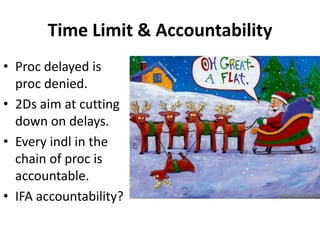
Time Limit & Accountability
• Proc delayed is
proc denied.
• 2Ds aim at cutting
down on delays.
• Every indl in the
chain of proc is
accountable.
• IFA accountability?
Chapter 3 – Sourcing & Quality
• Iden of Suitable Suppliers.
– Source knowledge.
– Source capability.
– Equal opportunities.
– Selection, regn, performance appraisal and cl must be
clearly spelt out.
• E-proc.
• Rations.
• CHTs.
• ACG/ATG etc.
Regn of Firms
• CP agencies.
• Comd HQ/Depots/Workshops.
• Unit level.
• Inter-Services and Inter-Departmental Acceptance.
• Criteria- Quality, Del, Price, Response, Product sp.
• Assessment of Tech and Fin capabilities through
BsOO.
• Removal of obsolete and under performers.
• Ban – misconduct or poor performance- Committee
of Economic Secys (only).
Performance Assessment
• Periodic review; DG MT vendors.
• Criteria:-
– Quality.
– Del.
– Price.
– Response.
– Product sp.
• Fin Assessment – BOO to incl IFA rep (CFA’s call).
Specifications
• Def or Mil specs– GSQR/JSQR/AFSQR/NSQR.
• PAC – IP/ Firm’s cert/Insp parameters.
• Branded products- NA for commercial/guarantee.
• Industrial specifications- IS/BS.
• Indigenized items- substitutes for imported ones.
• Adhoc specifications- Broad for fair competition.
• Samples-When PAC products NA.
• Common Use items-broad.
FLOW
CHART OF
REV PROC
A Tac Pause
Approval of AoN
Floating of RFP
TOB
Tech Evaluation
BM/COB/TPC
CNC
Placing of SO
Appvl of QRs
Appvl of DTE
Appvl of TEC
04 Weeks
06-08 Weeks
08-10 Weeks
02 Weeks
Chapter 4 - Tendering
• Proc (G&S) through Bids.
– ATE/OTE.
– LTE.
– STE.
• ATE/OTE.
– Gen 25 Lacs + (non-lethal/non-
sensitive).
– Common use.
– GTE.
– IJT and DAVP.
– NIT.
– Websites – MoD/IHQ……now CPPP.
– Time frame.
– Unregd firms claiming compliance.
Prep of NIT
• Carefully drafted- all salient features.
• Cost matters.
• Contents.
– Description and specification of G&S; qty.
– Pd and terms of del.
– Cost of tender docu.
– Place and timings of sale.
– Web address to download the docu.
– Place and deadline for receipt of tenders.
– Place and time for opening of tenders.
– Amt and form of bid security/EMD.
– Any other imp info.
Tendering (Contd)
• LTE.
– Up to 25 Lacs.
– As little as 2 or 3 also OK.
– When above 25 Lacs (IFA+CFA)
• Urgency.
• Not in public interest to go for OTE.
• Known sources of sup.
• Nature of item necessitates pre-verification.
– Tender docu only to ltd entities ….CPPP.
– Less than one to three weeks.
– Unsolicited .
• 2 bid – open tech first if no trials reqd; then proceed.
• If tech non compliant- reject and advise to register.
• Single bid tender – may be considered if no trials involved.
Tendering (Contd)
• STE.
– IFA+CFA prior appvl.
– Urgency or any op
reqmt to be recorded
in writing.
– Gen only to OEMs and
Regd firms.
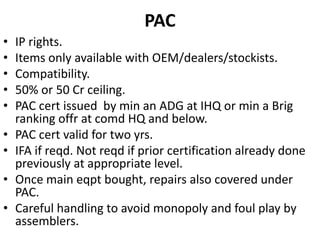
PAC
• IP rights.
• Items only available with OEM/dealers/stockists.
• Compatibility.
• 50% or 50 Cr ceiling.
• PAC cert issued by min an ADG at IHQ or min a Brig
ranking offr at comd HQ and below.
• PAC cert valid for two yrs.
• IFA if reqd. Not reqd if prior certification already done
previously at appropriate level.
• Once main eqpt bought, repairs also covered under
PAC.
• Careful handling to avoid monopoly and foul play by
assemblers.
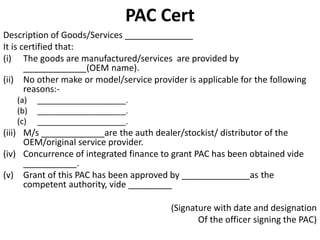
PAC Cert
Description of Goods/Services ______________
It is certified that:
(i) The goods are manufactured/services are provided by
_____________(OEM name).
(ii) No other make or model/service provider is applicable for the following
reasons:-
(a) ____________________.
(b) ____________________.
(c) ____________________.
(iii) M/s _____________are the auth dealer/stockist/ distributor of the
OEM/original service provider.
(iv) Concurrence of integrated finance to grant PAC has been obtained vide
___________.
(v) Grant of this PAC has been approved by ______________as the
competent authority, vide _________
(Signature with date and designation
Of the officer signing the PAC)
Bid Systems
• Single and Two bid sys.
• Single Bid Sys.
– COTS and LP items.
– Non complex nature.
– No samples called for at RFP stg.
• Two Bid Sys.
– High value/complex/tech/turn key.
– Indeterminable parameters like feel and
finish/tone/shade.
– Tech Bid and Commercial or fin bid.
– Bid submission method – phy and e proc.
Cost of Tenders
Ser
No
Est Value of the Tender Price
1. Up to 50 Lacs 100
2. 50 Lacs to 01 Cr 250
3. 01 Cr to 05 Cr 500
4. More than 05 Cr 1000
e-Proc
Bid Security or EMD
• 2 to 5%.
• Ac payee DD/FDR/Banker’s cheque or bank guarantee; no
cheques.
• 45 days beyond final bid validity pd.
• Returned to unsuccessful ones; exch for PBG for successful
one.
• Not taken from CPO regd (DGS&D/NSIC/GoI deptts or
ministries).
• Forfeited for default between last date for submission of
bids and expiry of bid validity pd.
• Nil for tender value below INR 2 Lacs.
• e-proc - RBI.
Tendering Process…..
• EoI.
– Specs or sources not clear.
– Pre-qual of vendors desired.
– and pre-bid conf prior to RFP.
• RFP/TE (e-pub).
• Tender box (e-proc).
• Amdt to RFP.
– Suo-moto or when pointed out by bidders.
– Imdt issue of amdt to purchasers/addn as slips.
– With or w/o extn of last date for submission.
– IFA and CFA.
– PC sys.
….Tendering Process…..
• Extn of Tender Opening Date.
– Requested by vendors ie if not due to amdt.
– Max two months extn by CFA w/o IFA
concurrence even if in consultation.
– Beyond that, with IFA concurrence but not
beyond total del pd envisaged in the RFP.
• Extn of Tendering opening date after due
date of opening.
– Reasons in writing in exceptional circumstances.
– Firms can withdraw w/o penalty.
Receipt of Tenders
• By Hand.
– Justified.
– Two offrs nominated in RFP.
– Names and info displayed at entrance/rxn.
• Tender box.
– Easily accessible.
– Clearly marked.
– Secured place.
– Locked and sealed.
– “Tender Box”.
….Tendering Process…..
• Opening of Tenders in Single Bid Sys.
– In presence of auth reps of bidders.
– TOB pre-nominated by CFA.
– No IFA involvement unless so desired by CFA.
– All tenders and sp docu checked, first pages and fin docu signed
with date; imp items like price circled and blanks as well as
alterations initialed.
– Rep details and attendance.
– On-spot report made and read out.
– All docu handed over to proc offr.
• Opening of Tenders in Two Bid Sys.
– Same as above but only tech bids are opened first by TEC.
– TEC declares successful bidders and then Commercial bids are
opened.
– Non compliant bids will not be returned.
• e-proc- ToB, EMD, Tech lit, Tech bids.
Tech Eval Committee (TEC)
• CFA nominated.
• Reps of user, insp agency, maint agency, proc
agency, CFA and bidders; No IFA.
• To prep tech compliance matrix, showing tech
parameters and compliance/deviation.
• Tech pn.
• Demo or samples – RFP.
• No conditional 'R'.
• e-proc : Sys generated; provnl acceptance.
• PC – mandate.
• No tech bids returned but filed.
TEC Proceedins
• Tech bids opened first and evaluated by TEC.
• Aim is to prep a tech compliance matrix.
• Vendors, mtg essential parameter, may be invited to
clarify issues.
• Testing/trial/demo if so specified.
• TEC report format as given in DPM.
• Acceptance of eligible bidders ‘R’.
• Not auth to discuss commercial aspects.
• IFA.
• Appvl of proceedings.
• Revised commercial bids from eligible vendors –
IFA/CFA/ Before opening of commercial bids.
• e-proc.
TEC : Imp Pts
• Basic profile/character of tech offer must not be
permitted to be changed.
• Opportunity for revision of minor tech details should be
accorded to all vendors in equal mx to ensure fair play.
• No extra time to be given to any vendor to mod his
offer to make it QR compliant.
• No loading/unloading of price (in the commercial bids)
be permitted during TEC dscns.
• No conditional offer should be accepted if not in
conformity with the specs mentioned in the RFP.
CoB/TPC/CNC
• Nominated by the CFA.
• Benchmarking first- IFA.
• Opening of bids and prep of CST in r/o
vendors qualified at TEC stg (only)….. e-proc.
• Arr at L1.
• CNC.
• Appvl of TPC/CNC proceedings.
• Vetting of SO.
Bench Marking/Price Est/RR
• Vital.
• Initial Stg.
l AoN – determines CFA.
l LPP/Quotes/Mkt svy/Net search.
l BOO.
• CoB Stg.
l Criteria as per RFP – basic cost+ins+AMC.
l LPP & Final cost of three yrs/Add escalation/Cost
analysis/Data base/NPV or DCF techniques.
l IFA.
CNC/PNC
CNC/PNC
• Not must….CVC guidelines.
• Done for STE/PAC and if bid too high
irrespective of type of tendering.
• CFA apptd…..Staff wk during TEC appvl.
• Chairman, reps of user, IFA, inspecting agency,
maint agency, CFA and any other member as
desired by the CFA.
• Chairman – one rk lower…...PC (rk/levels)….
Why not CFA himself?
• Only with L1.
• Retendering.
• IFA-CFA…….PC Report.
RFP
l -Should lay down user reqmts in comprehensive,
structured and concrete manner.
l -Broad based.
l -User reqmts expressed in terms of
characteristics.
l -Formulation must not prejudice the technical
choices by being narrow and tailor-made.
l -Specific quality assurance reqmts, if any, should
be incl in the RFP.
l -The performance parameters should be verifiable.
l -Essential parameters be mentioned for being
considered by TEC.
l -Contract docu; signed on all pages/ e-proc.
Format of RFP
l *Five Parts.
I – Gen info and instrs for the bidders, such as time,
place of submission and opening of tenders, validity
pd etc.
II – Essential details of G/S reqd, eg Schedule of
Reqmts (SoR), tech specs, Del pd, Mode of del,
Consignee details etc.
III – Std conditions of RFP.
IV – Spl conditions of RFP.
V – Eval criteria and format for price bids.
l *Issued with no fin commitment and buyer reserves
the right to change any part at any stg while bidder
reserves the right to withdraw at any stg.
Part I- Gen Info
l -Last date and time for depositing the bids.
l -Manner of depositing bids.
l -Time and date of opening bids.
l -Loc of tender box.
l -Place of opening bids.
l -Clarification regarding contents of RFP.
l -Mod and withdrawal of bids.
l -Clarifications by buyer during bid eval.
l -Rejection of bids.
l -Unwillingness to quote; delisting.
l -Validity of bids.
l -EMD- 45 days beyond final bid pd.
l
Part II- Gen Info
l -Tech details.
l -Two-bid sys – clause by clause compliance (TEC).
l -Del pd.
l -Terms of del.
l -Consignee details.
l
Part III- Std Conditions
l -Law.
l -Eff date of Contract.
l -Arbitration.
l -Penalty for undue influence.
l -Agents commission.
l -Access to book of accts.
l -Non-disclosure of Contract docu.
l -LD.
l -Termination of Contract.
l -Notice.
l -Transfer and sub-letting.
l -Patents and IP rights.
l -Amdts.
l -Taxes and Duties incl Customs,Excise, ST/VAT,LT.
l -Pre-integrity clause.
Part IV- Spl Conditions
l -PBG – 10% within 30 days; validity – 60 days beyond wty.
l -Option clause.
l -Repeat order clause.
l -Tolerance clause.
l -Payment terms.
l -Paying auth.
l -Fall clause.
l -Risk & Expense clause.
l -Force Majeure clause.
l -Buy-Back offer.
l -Specification clause.
l -OEM cert.
l -Packing and mkg.
l -Quality and Insp.
l -Warranty/AMC/Product sp.
l -Tech lit/trials/demo/
Part V- Eval Criteria and Price Bid
l *Eval criteria.
l *Price bid format.
-Item, unit price, qty, total.
-Accessories.
-Installation/commissioning.
-Trg.
-Tech literature.
-Tools.
-AMC.
-Any other issue.
-L1 determined based on basic prices excl taxes and duties.
l *Addl info in Price Bid.
-Is Excise duty extra?…. How much?
-Is Excise/custom duty exemption reqd.
-Is VAT/Service tax/Octroi/any other tax extra…. How much.
Misc Issues
Lack of Competition
• When
– Less than two acceptable offers.
– Cartel fmn and unreasonable price.
– All bidders offering one brand/product from one
source.
– Always short in supply and offers never more than
two.
RSV
• Only one valid quote before or after TEC or
otherwise.
• Indicates lack of competition.
• Need to examine:-
– Wide publicity/industry friendly specs/time.
– Desp and receipt of RFP.
– Whether QRs can be re-formulated.
– Whether time criticality permits fresh QRs.
• Next course of action.
Re-tendering
• CFA/IFA, if applicable. When:-
– Lack of compliance.
– Unreasonable prices.
– Maj changes in specs and or qty.
– Lack of competition.
– Withdrawal of L1 – EMD/no offer.
– BMQ clause – negotiate with L1 if price is the only
issue.
Cartel/Pool Rates
• Gp of tenderers quoting
iden rates.
• Against the spirit of
competitive bidding.
• Rejection/reporting to
RoC/MRTP Commission.
• Encourage more
participation by
registering wherever
reqd.
Placing of SO/Signing of
Contract
• SO placed/contract signed.
• Pre vetted by IFA.
• Copies sent to all concerned, incl IFA, the
audit auth and paying auth.
Sup Order or Contract?
• One time vs long term; offer vs two ways; low
value vs high value.
• Guidelines.
– SO/PO containing basic T&C – up to 01 Lac.
– Single bid and COTS – SO/PO up to 10 Lacs.
– All other cases up to 10 Lacs, SO+ Acceptance
letter.
– Contract docu for above 10 Lacs.
– SO/PO alright for RC centrally concluded.
– Contract docu for all turn key projs, AMCs and
provn of services.
Contract Signing
• All def contracts in the name and on behalf of
the President of India.
• Signed by a SO once cleared by CFA.
• Any contract when signed by both parties is
deemed to come into force with acceptance of
tender as per mut agreed T&Cs given in RFP
and firm's offer.
• In case of sup orders, firm must convey
acceptance within 07 days of receipt of such
order …… deemed.
• No stamp duty for MoU and contracts.
Pts for Purchase Offrs
• Prelim exams – completeness, computational
error, sureties, lit, signed and so on.
• Discrepancy in quoted price – unit over total;
words over figs – if bidder does not agree, reject.
• Trivial errors – omission to enter rates in words/
initial any alteration/ sign both tenders and
schedule etc may be corrected, initialed and dated
both by ToB and tenderer.
• Responsiveness of bid- OK if it conforms w/o devn.
• Eval of bids on price excl taxes and duties.
• Award if L1 OK or after counter offer.
• Waiver of QR post RFP not allowed.
• Pre-bid conf is alright if justified.
Gen Principles of Contracting
• Concise terms w/o any ambiguity.
• Use std forms for ease of scrutiny.
• If devn from std, seek legal and fin advice.
• No change in clauses while signing w/o consent
and only if contract specifically provides for it.
• After conclusion of contract, changes only if mut
acceptable but rarely so.
• All amdts with fin implications with IFA consent.
• Minor non-fin amdts by auth one step below CFA,
if so auth.
• No uncertain liability acceptable.
• Provn for safeguarding Govt property.
• Contract eff date when signed or clearly indicated.
Chapter 5 – Appvl Process &
Conclusion of Contract
• Proc of Goods.
– Defi vs scales.
– Stocking.
– Non-scaled/NIV items.
• Proc of Services.
– Maint of assets.
– Outsourcing of task being performed in-house.
– Consultations.
– Any fn on grounds of economy.
Approval of AoN
Floating of RFP
TOB
Tech Evaluation
BM/COB/TPC
CNC
Placing of SO
Appvl of QRs
Appvl of DTE
Appvl of TEC
Processing of Proc
Proposals
Processing of Proc Proposals…
• SoC .
– Justification.
– Qty.
– Costing - Deliberate/Docu/CFA determination (all incl)..
– Sources.
– Mode of tendering.
• QRs.
• Draft RFP……..PC.
• IFA.
• CFA.
….Processing of Proc Proposals
• Fund availability.
• Processing without linking with fund availability.
• Ex-post facto IFA (higher) and CFA (himself).
• Disagreement with IFA….higher CFA; DFPDS.
• AoN
– Scaled/Non-scaled.
– APP/PPP – Only for items and not qty.
• Qty vetting – scaled (in-out)/non and NIV (bare min).
• GSQR prerogative.
• Combining stgs – all and LP.
Propriety of Proc Process
• Transparency, competitiveness and fairness.
• Mxs.
– No ambiguity in bid docu – eligibilty and qual criteria, legal
restns, dates and time and venues, terms of del and spl
terms if any.
– Provn to enable questioning by bidder about the process or
when bid is rejected.
– Provn for settlement of disputes.
– Law governing.
– Time to bid.
– Public scrutiny while opening bids.
– Broad based specifications.
Resp of CFA in Purchase Decision
• Transparency.
• No favours to accommodate.
• If prior IFA concurrence mandated, same must
be taken.
• All procedures followed and GoI policies
adhered to.
• Authority with accountability – latter
unconditional and absolute.
Time Frame
• Proc must be
responsive to
needs.
• Expeditious
handling.
Approval of AoN
Floating of RFP
TOB
Tech Evaluation
BM/COB/TPC
CNC
Placing of SO
Appvl of QRs
Appvl of DTE
Appvl of TEC
04 Weeks
06-08 Weeks
08-10 Weeks
02 Weeks
Chapter 6 - CONTRACT
• ICA 1872 – both govt and private contracts.
• The proposal or offer when accepted is a
promise.
• A promise and every set of promises forming the
consideration for each other is an agreement.
• An agreement ,if made with free consent of
parties competent to contract, for a lawful
consideration and with lawful object, is a
contract.
Proposal or Offer
• When one person signifies to another his willingness to
do or to abstain from doing anything, with a view to
obtaining the assent of the other to such an act or
abstinence, he is said to make a proposal or offer.
• In a sale or purchase by tender, the tender signed by
the tenderer is the proposal.
• The invitation to tender and instructions to tenderers
do not constitute a proposal.
• When the person to whom the proposal is made
signifies his assent thereto, the proposal is said to be
accepted (promise).
Agreement & Contract
• An agreement is a contract enforceable by law
when:-
– Competency of parties is correct.
– Free consent.
– Lawful consideration.
– Lawful object.
• All contracts and agreements must be issued
bilingually.
Competency of Parties
• Major person.
• Sound mind.
• Not debarred by law.
• Not insolvent.
• Could be:-
– Indls/business.
– Partnerships/firms.
– Ltd companies/artificial legal person under Company
Act…..MoA.
– Corporations/Asso under TUA, Coop Societies Act.
• Def Contracts – President of UoI and the supplier.
Consent….
• Two or more persons are said to consent when they
agree upon same thing in the same sense.
• If minds are directed to different objects or attach
different meanings to language being used, there is
no agreement.
• Misunderstanding which is incompatible with
agreement may occur in the cases:-
– When the misunderstanding relates to iden of the other
party to the agreement.
– When it relates to the nature or terms of the
transactions.
– When it relates to subject matter of the agreement.
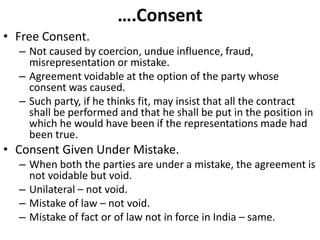
….Consent
• Free Consent.
– Not caused by coercion, undue influence, fraud,
misrepresentation or mistake.
– Agreement voidable at the option of the party whose
consent was caused.
– Such party, if he thinks fit, may insist that all the contract
shall be performed and that he shall be put in the position in
which he would have been if the representations made had
been true.
• Consent Given Under Mistake.
– When both the parties are under a mistake, the agreement is
not voidable but void.
– Unilateral – not void.
– Mistake of law – not void.
– Mistake of fact or of law not in force in India – same.
Comn of Offer/Proposal
• Considered complete when it comes to the
knowledge of the person to whom it is made.
Timely response is the key.
• Comn of acceptance must within time limit.
• If terms are mod or revised and not accepted
as such, the acceptance remains a counter
offer and there is no conclusion of contract.
Withdrawal
• An offer or proposal can be
withdrawn by a bidder any
time before date and time of
opening of offers/tenders.
• An acceptance can be
withdrawn before it comes to
the knowledge of the bidder,
eg, telegram to overtake
letter of acceptance.
Types of Contracts
• DPM does not apply to wks and proj contracts.
• Types of contracts.
– PO/SO.
– RC.
– Price agreement.
– Service contract.
– AMC/CMC.
– Consultancy contract.
– Devp contract.
– Wks/Proj contract.
Termination of Contract
• When.
– Sup fails to honour any part of contract incl failure to del
in time.
– When the contractor is found to have made any false or
fraudulent declaration or statement to get the contract.
– Unethical or unfair trade practices.
– Mut agreement.
– Repeated failure to pass insp and/or sup’s inability to
rectify the defects.
– Any spl circumstances (to be recorded).
Chapter 7 – Conditions of Contract
• A legal docu governed by certain T&Cs to protect
interests of both parties.
• Familiarity and ways to safeguard must.
• SCoC – gen applicable to all; ease of
understanding.
• SplCoc- supplementary ones, spec to particular
ones.
• Both CoCs applicable to SOs.
• RFP and Contract – similar clauses.
Payment of Adv
• Ordinarily, no adv; so mentioned in RFP too.
• Adv gen given.
– AMC/CMC contracts.
– Fabrication and turn key projects.
• Qtm. Max 15% or amt payable for six months
in case of maint contracts.
• Part/Stg Payments- milestones based;
specified in RFP.
• Securing of adv by obtaining BG.
PV/Price Adjustment Clause
• Normally contracts entered on a fixed price.
• Some long term contracts, more than 18 months,
such a clause is necessitated.
• A formula and govt indices are used.
• Cut off dates for lab and mtrl specified and not del
date.
• Ceilings incorporated.
• Min varian necessitated such an appln also specified.
• Not applied on adv paid.
• Only within original del pd unless mod.
Exch Rate Varian
• Only when DPSUs contracted.
• Del pd more than one yr.
• Import content involved.
• If DP is extended, no ERV except Force
Majeure.
• Other conditions as applicable to PV clause.
Performance Security/BG
• 5-10% of contract value.
• All successful bidders; Indemnity bond from
DPSUs and case to case for other PSUs. No
exemptions.
• In form of a PBG – public + ICICI, Axis and HDFC.
• Valid throughout the duration of contract and till
all contractual obligations are met.
• If DP is extended, PBG may have to be extended if
getting expired.
• No PBG if value less than 02 Lacs.
Payment Terms
• Gen 95% on receipt of stores along with insp
note and other docu.
• 5% once stores thoroughly checked and
accounted for.
• 100% on receipt also possible if so reqd.
• e-payment mandatory.
Del
• DP mentioned in contract/SO and is crucial.
• Considered del only when handed over along with insp
note.
• If not door del, del deemed to have been made on
receipt of RR and Insp note.
• Consignee checks stores on receipt for qty, quality and
docu; can reject even if Insp note in favour of sup.
• Beyond DP. Buyer has options.
– Extn with DP and Denial (incr in prices/taxes/duties) clause.
– Re-fix del date.
– Canceling te contract and repurchasing the non-sup qty.
Failure of Sup
• Decision based on bal between time reqd to
repurchase and whether sups can be arng from
alternate sources at cheaper rates and sup can make
extra money by delaying.
• Extn gtd only if assured that sup will del now.
• Max extn that can be gtd must ensure that total pd, ie
original DP+ extn, does not exceed twice the original
DP. Higher CFA beyond that.
• Refixation of DP. Only if:-
– Appvl of adv samples delayed by buyer.
– Omission on part of buyer to enforce DP.
– Where entire production is controlled by the Govt.
LD
• Compensation of loss on acct of delayed del.
• RFP guiding docu.
• No need to est actual loss. Legal posn:-
– Claim cannot exceed the sum stipulated.
– Only reasonable sum, may be less than one stipulated.
– Facts will dictate what is reasonable.
– No distinction between LD and penalty.
• Qtm. A sum = 0.5% of bal stores per week or part
thereof, subject to ceiling of 10% of outstanding sups.
• Waived if beyond sup’s control or no monetary
loss/inconvenience caused – IFA and CFA.
• Consequential Damages (CD) – Over and above LD in
case of time critical turn-key projs but if in RFP.
Option and Repeat Clauses….
• Option clause. If in RFP:-
– Buyer retains the right to place addl qty (max 50% of
original qty) at the same rate and T&C.
– With in DP only.
– After DP, 50% of bal qty during extended DP.
– OK for single vendor/OEM and when prices not floating
downwards.
– Care needed for multi-vendor situation.
– Saves time and effort.
• Repeat clause. If in RFP:-
– A rpt order against a previous order may be placed at
the same price and T&C.
…. Option and Repeat Clauses
– Once original order has been del successfully.
– Original order was not to cover urgent demands.
– Rpt order does not split CFA’s powers.
– The original order to L1 after CNC and not on any other
preference.
– No downward trend in prices.
– Within six months of completion of original order.
– PAC/single vendor OK but be careful in muti-vendor situaion.
• These clauses should not be incl as a matter of routine
since these have effects on prices.
• Either or both can be incl if deemed fit, ie when
consumption pattern is not predictable.
• Both can be ex more than once but total cumulative
ceiling would be 50%.
Risk & Expense Purchase
• Incl in RFP and contract.
• Underatken by buyer in event of the sup failing to
honour the contractual obligations within DP and
where extn of DP is not appvd.
• At the cost and expense of the sup.
• Adequate notice should have been given.
• xtra expdr borne by the sup.
• Not always feasible though.
• In case of PAC or one qualified firm or import, it is
better to cover such a default through a PBG.
• Other options.
– Deduct cost from outstanding payments.
– No further RFP.
– Have adequate PBG.
Apportionment of Qty
• In global and LTE.
• If there is an apprehension that L1 may not
have the capacity to sup the entire qty.
• Mandated in RFP that the order may be placed
on L2, L3, ….Ln for bal qty @ L1.
• f exact qtm not anticipated initially, the first offer
is made to L2 and if there is a spill, then to L3
and so on.
• If decided in adv to have it from more than one
source of sup, the ratio of splitting must be
mentioned in the RFP.
Short or Excess Dels
• At times, stores are such
that exact multiples or
exact wt can not be del
(eg steel plates).
• RFP would have a clause
to accept the varians up to
+/- 5% of original value of
the contract.
• CFA appvl reqd.
Buy Back Offer
• When decided to replace
an existing old item(s)
with new ones.
• Clause incorporated in
the RFP to help bidders
formulate their bids
accordingly.
• Option to trade or not
must preferably lie with
the buyer.
Fall Clause
• While contracting with firms with whom a
RC existed earlier but not renewed as on
date.
• Fall clause incorporated in the SO/contract
to the effect that during the currency of the
contract, in case rates are found to be lower
on conclusion of the RC, the lower rates as
in new RC, will apply.
• A slightly different connotation in RC.
Chapter 8 - RC
• Aim of any proc agency – right I, right Q, right Q, right P
and right P.
• One way is to conclude the RC for common use items
whose prices are likely to be stable and not subject to
considerable fluctuations during the currency of the
contract.
• Prompt and use of economies of scale help.
• A RC is an agreement between the proc agency and the
sup for sup of G&S at specific prices and T&Cs during
the pd covered by the RC.
• No qty is mentioned nor any min drawal guaranteed in
the RC.
• It is a kind of a standing offer from the sup.
• 30 days to terminate but SOs in place are honoured.
Price Agreement
• While proc G&S, gen a PA/FPQ (Fixed
Price Quotation) is entered into with the
OEMs.
• Due mkt svy and negotiations are
undertaken to arr at these figs.
• Such rates are gen valid for pds up to
three yrs and may be extended further
with higher CFA's sanction.
Types of Items
• Items reqd by many users on recurring basis.
• Clear specs.
• Fast mov items with short shelf life or storage
shortage.
• Items expected to experience min fluctuations.
• Items that take long to manufacture and for
which only one source for manufacturing exists.
• Any item at the list of DGS&D RC will gen not
be picked up for another RC.
Who All & For How Long?
• Only by auth central and local proc agencies.
• Value of anticipated drawal over one yr is
taken to determine CFA.
• Normally concluded for one yr.
• Shorter or longer pds up to three yrs also
possible.
• Any extn of an existing one or conclusion for
more than three yrs would need MoD's appvl.
• All DDOs can operate the RCs.
Spl Conditions
• EMD was not reqd earlier; now same as nml
contracts.
• No qty mentioned in the schedule of reqmts; only
anticipated drawal mentioned but w/o any
commitment.
• Buyer can conclude more than one RCs for same
item.
• 30 days’ notice.
• Re-negotiation possible.
• During an emergency, adhoc purchases can be
made from other sources.
• Guided by Fall Clause.
• No tendering reqd; SO placed after AoN.
Payment
• Up to 95% on receipt along
with Insp note.
• 90% against proof of
dispatch.
• Bal on checking and acctg.
• Within 21 days from receipt
of bill if everything else is
OK.
• Obsns, if any, must be
raised within 10 days by
paying auth to the CFA.
Conclusion
• DPM has enough flexibility built in.
• Wise interpretation is reqd.
• IFAs can differ but cases can mov on if there is a
valid reason.
• In FM/FP matters, files only speak and are believed
when reqd; good intent offers no saving grace.
• Domain knowledge is a must; same comes with
exposures…..this being one such event.
DPM.pptx

DPM.pptx

  • 2.
  • 3.
    PREVIEW • Part 1.Basic Issues. • Part 2. DPM. Session on ToB etc merged No Qs & As? v
  • 4.
    PART 1 –BASIC ISSUES
  • 5.
    How The FinPlg Works • GoI estimates. • MoD estimates. • FP Dte/FP-2. • Psn by dtes and brs. • Receipt and distr. • GS res. • Pace of expdr. • Budgetary calendar.
  • 6.
  • 7.
    Booking of Expdr •Pre and Post Audit. • Meaning of Booking. • Pace of expdr – By 30 Jun – 25%. – By 30 Sep – 50%. – By 31 Dec – 75%. – By 15 Mar – 100% • Note:- – Not more than 35% in last qr. – Not more than 15% in Mar.
  • 8.
    Recent Devps • e-Proc. –e-Pub. – Status today. • DFPDS. – New fin powers. – PC system.
  • 9.
    Lets Talk Aboutthe Way we Spend • Generation of funds vis-à-vis defining the needs. • Day to day expenses. – Running of the house. – Experience and Convenience. – Maids and handymen. • Big ticket expenses. – Elaborate survey – Availability vs need; fin angle. – Consultations. – High stakes. – Addn to day to day expenses.
  • 10.
    Types of DefProc Capital Revenue Significant expdr towards acqn of tangible assets of permt nature Expdr towards acqn of assets that may not be permt in nature; includes expdr on consumables (ACG, ATG etc) as well as eqpt (SAG, IT etc) or assets of non-permt nature. Also for enhancing the utility of the existing assets All renewals, replacements etc. First constr and instl as also for intermediate maint pre-commissioning All subsequent charges for maint /wkg expenses. Further addns and improvements to enhance useful life of assets Addns and improvements as debitable to Revenue acct. Covered by DPP 2013 DPM 2009 Booking Concept of 10 Yrs + 07 Lacs (and vice versa).
  • 11.
  • 12.
    Applicability of DPM •All wgs, orgs and ests of MoD. • Coast Guards. • JAK LI. • Purchases by Def Services out of grants from other ministries. • Revenue. • CBRP. • Med eqpt – both kinds.
  • 13.
    Gen • 2009 vintage;under revision. • 15 Chapters, 11 Appces and 29 Formats. • Focus Reqd:- – 1. Intro. – 2. Proc Objs and Policy. – 3. Sourcing and Quality. – 4. Tendering. – 5. Appvl Process and Conclusion of Contract. – 6. Contract. – 7. Conditions of Contract. – 8. Rate Contracts.
  • 14.
    Chapter 1 –Intro & Imp Terms • Proc. – Scaled/non-scaled. – Goods – stores, eqpt, spares, tech lit. – Services – packing, preservation, tn, insurance, del, spl services, consultancy, leasing, SW devp, maint, updates, conservancy etc. • CFA & Higher CFA. • IFA. • Paying Auths – PCDA/AH Cash Assignment.
  • 15.
    Chapter 2 –Proc Obj & Policy • Fundamental Principles of Public Buying. – Various auths delegated with fin powers for proc goods and services in public interest. – Such auths have the resp and accountability to bring efficiency, economy and transparency in matters relating to public proc. – Also to ensure fair and equitable treatment of suppliers. – Promotion of competition. – As if own money is being spent.
  • 16.
    Procedural Propriety :Yardsticks • QRs to address basic needs; avoid superfluous add-ons. • Right qty. • Spell out specifications, quality, type, qty etc. • Offer invited following a fair, transparent and reasonable procedure. • Satisfaction with the selected offer. • Satisfaction with the price. • Record precise terms and considerations which weighed in favour of the decisions taken at every stg.
  • 17.
    Policy Guidelines • Economy. •Scales. • Splitting. • Open competitive tendering.
  • 18.
    Channels of Proc •DG OS. • Other ministries of GoI/ factories of state govts. • Industries/Factories – wholly or partially state fin. • Indigenous trade- direct or through DGS&D. • LP if NA under Central proc. • DPSUs/PSUs. • Foreign OEMS and Vendors.
  • 19.
    2Ds • Decentralized. – Decisionmaking by GoI to three services. – DGS&D for RC. • Delegated. – Fin powers by GoI to three services. – To back up the process of decision making. – Powers also imply accountability.
  • 20.
    Types of Proc •Indigenous. • Foreign. • CP – Annual Provisioning Review, Refit Plg, Obsolence plg. • LP – normal and ST. • Proc through OFs- Direct/ NAC based. • DPSUs - RFP but if exclusive, no competition. • OF + DPSUs. – Not STE/PAC. – No Tender Fee/EMD/PBG. • Petty Purchases. • Minor Purchases. • RC. • Cash n Carry. • Emergency proc.
  • 21.
    Product Res, Purchase/PricePref • KVIC/ACASH. • MSMEs regd with NSIC – 358- No fee/EMD/ Price pref up to 15% over LI from large industry. • CPSEs – pharma stores. • KB/NCCF – no quotes for up to 01 Lac/LTE- match L1 if within 10%/No EMD. • Other CPSEs – No PP.
  • 22.
    Time Limit &Accountability • Proc delayed is proc denied. • 2Ds aim at cutting down on delays. • Every indl in the chain of proc is accountable. • IFA accountability?
  • 23.
    Chapter 3 –Sourcing & Quality • Iden of Suitable Suppliers. – Source knowledge. – Source capability. – Equal opportunities. – Selection, regn, performance appraisal and cl must be clearly spelt out. • E-proc. • Rations. • CHTs. • ACG/ATG etc.
  • 24.
    Regn of Firms •CP agencies. • Comd HQ/Depots/Workshops. • Unit level. • Inter-Services and Inter-Departmental Acceptance. • Criteria- Quality, Del, Price, Response, Product sp. • Assessment of Tech and Fin capabilities through BsOO. • Removal of obsolete and under performers. • Ban – misconduct or poor performance- Committee of Economic Secys (only).
  • 25.
    Performance Assessment • Periodicreview; DG MT vendors. • Criteria:- – Quality. – Del. – Price. – Response. – Product sp. • Fin Assessment – BOO to incl IFA rep (CFA’s call).
  • 26.
    Specifications • Def orMil specs– GSQR/JSQR/AFSQR/NSQR. • PAC – IP/ Firm’s cert/Insp parameters. • Branded products- NA for commercial/guarantee. • Industrial specifications- IS/BS. • Indigenized items- substitutes for imported ones. • Adhoc specifications- Broad for fair competition. • Samples-When PAC products NA. • Common Use items-broad.
  • 27.
  • 28.
    Approval of AoN Floatingof RFP TOB Tech Evaluation BM/COB/TPC CNC Placing of SO Appvl of QRs Appvl of DTE Appvl of TEC 04 Weeks 06-08 Weeks 08-10 Weeks 02 Weeks
  • 29.
    Chapter 4 -Tendering • Proc (G&S) through Bids. – ATE/OTE. – LTE. – STE. • ATE/OTE. – Gen 25 Lacs + (non-lethal/non- sensitive). – Common use. – GTE. – IJT and DAVP. – NIT. – Websites – MoD/IHQ……now CPPP. – Time frame. – Unregd firms claiming compliance.
  • 30.
    Prep of NIT •Carefully drafted- all salient features. • Cost matters. • Contents. – Description and specification of G&S; qty. – Pd and terms of del. – Cost of tender docu. – Place and timings of sale. – Web address to download the docu. – Place and deadline for receipt of tenders. – Place and time for opening of tenders. – Amt and form of bid security/EMD. – Any other imp info.
  • 31.
    Tendering (Contd) • LTE. –Up to 25 Lacs. – As little as 2 or 3 also OK. – When above 25 Lacs (IFA+CFA) • Urgency. • Not in public interest to go for OTE. • Known sources of sup. • Nature of item necessitates pre-verification. – Tender docu only to ltd entities ….CPPP. – Less than one to three weeks. – Unsolicited . • 2 bid – open tech first if no trials reqd; then proceed. • If tech non compliant- reject and advise to register. • Single bid tender – may be considered if no trials involved.
  • 32.
    Tendering (Contd) • STE. –IFA+CFA prior appvl. – Urgency or any op reqmt to be recorded in writing. – Gen only to OEMs and Regd firms.
  • 33.
    PAC • IP rights. •Items only available with OEM/dealers/stockists. • Compatibility. • 50% or 50 Cr ceiling. • PAC cert issued by min an ADG at IHQ or min a Brig ranking offr at comd HQ and below. • PAC cert valid for two yrs. • IFA if reqd. Not reqd if prior certification already done previously at appropriate level. • Once main eqpt bought, repairs also covered under PAC. • Careful handling to avoid monopoly and foul play by assemblers.
  • 34.
    PAC Cert Description ofGoods/Services ______________ It is certified that: (i) The goods are manufactured/services are provided by _____________(OEM name). (ii) No other make or model/service provider is applicable for the following reasons:- (a) ____________________. (b) ____________________. (c) ____________________. (iii) M/s _____________are the auth dealer/stockist/ distributor of the OEM/original service provider. (iv) Concurrence of integrated finance to grant PAC has been obtained vide ___________. (v) Grant of this PAC has been approved by ______________as the competent authority, vide _________ (Signature with date and designation Of the officer signing the PAC)
  • 35.
    Bid Systems • Singleand Two bid sys. • Single Bid Sys. – COTS and LP items. – Non complex nature. – No samples called for at RFP stg. • Two Bid Sys. – High value/complex/tech/turn key. – Indeterminable parameters like feel and finish/tone/shade. – Tech Bid and Commercial or fin bid. – Bid submission method – phy and e proc.
  • 36.
    Cost of Tenders Ser No EstValue of the Tender Price 1. Up to 50 Lacs 100 2. 50 Lacs to 01 Cr 250 3. 01 Cr to 05 Cr 500 4. More than 05 Cr 1000 e-Proc
  • 37.
    Bid Security orEMD • 2 to 5%. • Ac payee DD/FDR/Banker’s cheque or bank guarantee; no cheques. • 45 days beyond final bid validity pd. • Returned to unsuccessful ones; exch for PBG for successful one. • Not taken from CPO regd (DGS&D/NSIC/GoI deptts or ministries). • Forfeited for default between last date for submission of bids and expiry of bid validity pd. • Nil for tender value below INR 2 Lacs. • e-proc - RBI.
  • 38.
    Tendering Process….. • EoI. –Specs or sources not clear. – Pre-qual of vendors desired. – and pre-bid conf prior to RFP. • RFP/TE (e-pub). • Tender box (e-proc). • Amdt to RFP. – Suo-moto or when pointed out by bidders. – Imdt issue of amdt to purchasers/addn as slips. – With or w/o extn of last date for submission. – IFA and CFA. – PC sys.
  • 39.
    ….Tendering Process….. • Extnof Tender Opening Date. – Requested by vendors ie if not due to amdt. – Max two months extn by CFA w/o IFA concurrence even if in consultation. – Beyond that, with IFA concurrence but not beyond total del pd envisaged in the RFP. • Extn of Tendering opening date after due date of opening. – Reasons in writing in exceptional circumstances. – Firms can withdraw w/o penalty.
  • 40.
    Receipt of Tenders •By Hand. – Justified. – Two offrs nominated in RFP. – Names and info displayed at entrance/rxn. • Tender box. – Easily accessible. – Clearly marked. – Secured place. – Locked and sealed. – “Tender Box”.
  • 41.
    ….Tendering Process….. • Openingof Tenders in Single Bid Sys. – In presence of auth reps of bidders. – TOB pre-nominated by CFA. – No IFA involvement unless so desired by CFA. – All tenders and sp docu checked, first pages and fin docu signed with date; imp items like price circled and blanks as well as alterations initialed. – Rep details and attendance. – On-spot report made and read out. – All docu handed over to proc offr. • Opening of Tenders in Two Bid Sys. – Same as above but only tech bids are opened first by TEC. – TEC declares successful bidders and then Commercial bids are opened. – Non compliant bids will not be returned. • e-proc- ToB, EMD, Tech lit, Tech bids.
  • 42.
    Tech Eval Committee(TEC) • CFA nominated. • Reps of user, insp agency, maint agency, proc agency, CFA and bidders; No IFA. • To prep tech compliance matrix, showing tech parameters and compliance/deviation. • Tech pn. • Demo or samples – RFP. • No conditional 'R'. • e-proc : Sys generated; provnl acceptance. • PC – mandate. • No tech bids returned but filed.
  • 43.
    TEC Proceedins • Techbids opened first and evaluated by TEC. • Aim is to prep a tech compliance matrix. • Vendors, mtg essential parameter, may be invited to clarify issues. • Testing/trial/demo if so specified. • TEC report format as given in DPM. • Acceptance of eligible bidders ‘R’. • Not auth to discuss commercial aspects. • IFA. • Appvl of proceedings. • Revised commercial bids from eligible vendors – IFA/CFA/ Before opening of commercial bids. • e-proc.
  • 44.
    TEC : ImpPts • Basic profile/character of tech offer must not be permitted to be changed. • Opportunity for revision of minor tech details should be accorded to all vendors in equal mx to ensure fair play. • No extra time to be given to any vendor to mod his offer to make it QR compliant. • No loading/unloading of price (in the commercial bids) be permitted during TEC dscns. • No conditional offer should be accepted if not in conformity with the specs mentioned in the RFP.
  • 45.
    CoB/TPC/CNC • Nominated bythe CFA. • Benchmarking first- IFA. • Opening of bids and prep of CST in r/o vendors qualified at TEC stg (only)….. e-proc. • Arr at L1. • CNC. • Appvl of TPC/CNC proceedings. • Vetting of SO.
  • 46.
    Bench Marking/Price Est/RR •Vital. • Initial Stg. l AoN – determines CFA. l LPP/Quotes/Mkt svy/Net search. l BOO. • CoB Stg. l Criteria as per RFP – basic cost+ins+AMC. l LPP & Final cost of three yrs/Add escalation/Cost analysis/Data base/NPV or DCF techniques. l IFA.
  • 47.
  • 48.
    CNC/PNC • Not must….CVCguidelines. • Done for STE/PAC and if bid too high irrespective of type of tendering. • CFA apptd…..Staff wk during TEC appvl. • Chairman, reps of user, IFA, inspecting agency, maint agency, CFA and any other member as desired by the CFA. • Chairman – one rk lower…...PC (rk/levels)…. Why not CFA himself? • Only with L1. • Retendering. • IFA-CFA…….PC Report.
  • 49.
    RFP l -Should laydown user reqmts in comprehensive, structured and concrete manner. l -Broad based. l -User reqmts expressed in terms of characteristics. l -Formulation must not prejudice the technical choices by being narrow and tailor-made. l -Specific quality assurance reqmts, if any, should be incl in the RFP. l -The performance parameters should be verifiable. l -Essential parameters be mentioned for being considered by TEC. l -Contract docu; signed on all pages/ e-proc.
  • 50.
    Format of RFP l*Five Parts. I – Gen info and instrs for the bidders, such as time, place of submission and opening of tenders, validity pd etc. II – Essential details of G/S reqd, eg Schedule of Reqmts (SoR), tech specs, Del pd, Mode of del, Consignee details etc. III – Std conditions of RFP. IV – Spl conditions of RFP. V – Eval criteria and format for price bids. l *Issued with no fin commitment and buyer reserves the right to change any part at any stg while bidder reserves the right to withdraw at any stg.
  • 51.
    Part I- GenInfo l -Last date and time for depositing the bids. l -Manner of depositing bids. l -Time and date of opening bids. l -Loc of tender box. l -Place of opening bids. l -Clarification regarding contents of RFP. l -Mod and withdrawal of bids. l -Clarifications by buyer during bid eval. l -Rejection of bids. l -Unwillingness to quote; delisting. l -Validity of bids. l -EMD- 45 days beyond final bid pd. l
  • 52.
    Part II- GenInfo l -Tech details. l -Two-bid sys – clause by clause compliance (TEC). l -Del pd. l -Terms of del. l -Consignee details. l
  • 53.
    Part III- StdConditions l -Law. l -Eff date of Contract. l -Arbitration. l -Penalty for undue influence. l -Agents commission. l -Access to book of accts. l -Non-disclosure of Contract docu. l -LD. l -Termination of Contract. l -Notice. l -Transfer and sub-letting. l -Patents and IP rights. l -Amdts. l -Taxes and Duties incl Customs,Excise, ST/VAT,LT. l -Pre-integrity clause.
  • 54.
    Part IV- SplConditions l -PBG – 10% within 30 days; validity – 60 days beyond wty. l -Option clause. l -Repeat order clause. l -Tolerance clause. l -Payment terms. l -Paying auth. l -Fall clause. l -Risk & Expense clause. l -Force Majeure clause. l -Buy-Back offer. l -Specification clause. l -OEM cert. l -Packing and mkg. l -Quality and Insp. l -Warranty/AMC/Product sp. l -Tech lit/trials/demo/
  • 55.
    Part V- EvalCriteria and Price Bid l *Eval criteria. l *Price bid format. -Item, unit price, qty, total. -Accessories. -Installation/commissioning. -Trg. -Tech literature. -Tools. -AMC. -Any other issue. -L1 determined based on basic prices excl taxes and duties. l *Addl info in Price Bid. -Is Excise duty extra?…. How much? -Is Excise/custom duty exemption reqd. -Is VAT/Service tax/Octroi/any other tax extra…. How much.
  • 56.
  • 57.
    Lack of Competition •When – Less than two acceptable offers. – Cartel fmn and unreasonable price. – All bidders offering one brand/product from one source. – Always short in supply and offers never more than two.
  • 58.
    RSV • Only onevalid quote before or after TEC or otherwise. • Indicates lack of competition. • Need to examine:- – Wide publicity/industry friendly specs/time. – Desp and receipt of RFP. – Whether QRs can be re-formulated. – Whether time criticality permits fresh QRs. • Next course of action.
  • 59.
    Re-tendering • CFA/IFA, ifapplicable. When:- – Lack of compliance. – Unreasonable prices. – Maj changes in specs and or qty. – Lack of competition. – Withdrawal of L1 – EMD/no offer. – BMQ clause – negotiate with L1 if price is the only issue.
  • 60.
    Cartel/Pool Rates • Gpof tenderers quoting iden rates. • Against the spirit of competitive bidding. • Rejection/reporting to RoC/MRTP Commission. • Encourage more participation by registering wherever reqd.
  • 61.
    Placing of SO/Signingof Contract • SO placed/contract signed. • Pre vetted by IFA. • Copies sent to all concerned, incl IFA, the audit auth and paying auth.
  • 62.
    Sup Order orContract? • One time vs long term; offer vs two ways; low value vs high value. • Guidelines. – SO/PO containing basic T&C – up to 01 Lac. – Single bid and COTS – SO/PO up to 10 Lacs. – All other cases up to 10 Lacs, SO+ Acceptance letter. – Contract docu for above 10 Lacs. – SO/PO alright for RC centrally concluded. – Contract docu for all turn key projs, AMCs and provn of services.
  • 63.
    Contract Signing • Alldef contracts in the name and on behalf of the President of India. • Signed by a SO once cleared by CFA. • Any contract when signed by both parties is deemed to come into force with acceptance of tender as per mut agreed T&Cs given in RFP and firm's offer. • In case of sup orders, firm must convey acceptance within 07 days of receipt of such order …… deemed. • No stamp duty for MoU and contracts.
  • 64.
    Pts for PurchaseOffrs • Prelim exams – completeness, computational error, sureties, lit, signed and so on. • Discrepancy in quoted price – unit over total; words over figs – if bidder does not agree, reject. • Trivial errors – omission to enter rates in words/ initial any alteration/ sign both tenders and schedule etc may be corrected, initialed and dated both by ToB and tenderer. • Responsiveness of bid- OK if it conforms w/o devn. • Eval of bids on price excl taxes and duties. • Award if L1 OK or after counter offer. • Waiver of QR post RFP not allowed. • Pre-bid conf is alright if justified.
  • 65.
    Gen Principles ofContracting • Concise terms w/o any ambiguity. • Use std forms for ease of scrutiny. • If devn from std, seek legal and fin advice. • No change in clauses while signing w/o consent and only if contract specifically provides for it. • After conclusion of contract, changes only if mut acceptable but rarely so. • All amdts with fin implications with IFA consent. • Minor non-fin amdts by auth one step below CFA, if so auth. • No uncertain liability acceptable. • Provn for safeguarding Govt property. • Contract eff date when signed or clearly indicated.
  • 66.
    Chapter 5 –Appvl Process & Conclusion of Contract • Proc of Goods. – Defi vs scales. – Stocking. – Non-scaled/NIV items. • Proc of Services. – Maint of assets. – Outsourcing of task being performed in-house. – Consultations. – Any fn on grounds of economy.
  • 67.
    Approval of AoN Floatingof RFP TOB Tech Evaluation BM/COB/TPC CNC Placing of SO Appvl of QRs Appvl of DTE Appvl of TEC Processing of Proc Proposals
  • 68.
    Processing of ProcProposals… • SoC . – Justification. – Qty. – Costing - Deliberate/Docu/CFA determination (all incl).. – Sources. – Mode of tendering. • QRs. • Draft RFP……..PC. • IFA. • CFA.
  • 69.
    ….Processing of ProcProposals • Fund availability. • Processing without linking with fund availability. • Ex-post facto IFA (higher) and CFA (himself). • Disagreement with IFA….higher CFA; DFPDS. • AoN – Scaled/Non-scaled. – APP/PPP – Only for items and not qty. • Qty vetting – scaled (in-out)/non and NIV (bare min). • GSQR prerogative. • Combining stgs – all and LP.
  • 70.
    Propriety of ProcProcess • Transparency, competitiveness and fairness. • Mxs. – No ambiguity in bid docu – eligibilty and qual criteria, legal restns, dates and time and venues, terms of del and spl terms if any. – Provn to enable questioning by bidder about the process or when bid is rejected. – Provn for settlement of disputes. – Law governing. – Time to bid. – Public scrutiny while opening bids. – Broad based specifications.
  • 71.
    Resp of CFAin Purchase Decision • Transparency. • No favours to accommodate. • If prior IFA concurrence mandated, same must be taken. • All procedures followed and GoI policies adhered to. • Authority with accountability – latter unconditional and absolute.
  • 72.
    Time Frame • Procmust be responsive to needs. • Expeditious handling. Approval of AoN Floating of RFP TOB Tech Evaluation BM/COB/TPC CNC Placing of SO Appvl of QRs Appvl of DTE Appvl of TEC 04 Weeks 06-08 Weeks 08-10 Weeks 02 Weeks
  • 73.
    Chapter 6 -CONTRACT • ICA 1872 – both govt and private contracts. • The proposal or offer when accepted is a promise. • A promise and every set of promises forming the consideration for each other is an agreement. • An agreement ,if made with free consent of parties competent to contract, for a lawful consideration and with lawful object, is a contract.
  • 74.
    Proposal or Offer •When one person signifies to another his willingness to do or to abstain from doing anything, with a view to obtaining the assent of the other to such an act or abstinence, he is said to make a proposal or offer. • In a sale or purchase by tender, the tender signed by the tenderer is the proposal. • The invitation to tender and instructions to tenderers do not constitute a proposal. • When the person to whom the proposal is made signifies his assent thereto, the proposal is said to be accepted (promise).
  • 75.
    Agreement & Contract •An agreement is a contract enforceable by law when:- – Competency of parties is correct. – Free consent. – Lawful consideration. – Lawful object. • All contracts and agreements must be issued bilingually.
  • 76.
    Competency of Parties •Major person. • Sound mind. • Not debarred by law. • Not insolvent. • Could be:- – Indls/business. – Partnerships/firms. – Ltd companies/artificial legal person under Company Act…..MoA. – Corporations/Asso under TUA, Coop Societies Act. • Def Contracts – President of UoI and the supplier.
  • 77.
    Consent…. • Two ormore persons are said to consent when they agree upon same thing in the same sense. • If minds are directed to different objects or attach different meanings to language being used, there is no agreement. • Misunderstanding which is incompatible with agreement may occur in the cases:- – When the misunderstanding relates to iden of the other party to the agreement. – When it relates to the nature or terms of the transactions. – When it relates to subject matter of the agreement.
  • 78.
    ….Consent • Free Consent. –Not caused by coercion, undue influence, fraud, misrepresentation or mistake. – Agreement voidable at the option of the party whose consent was caused. – Such party, if he thinks fit, may insist that all the contract shall be performed and that he shall be put in the position in which he would have been if the representations made had been true. • Consent Given Under Mistake. – When both the parties are under a mistake, the agreement is not voidable but void. – Unilateral – not void. – Mistake of law – not void. – Mistake of fact or of law not in force in India – same.
  • 79.
    Comn of Offer/Proposal •Considered complete when it comes to the knowledge of the person to whom it is made. Timely response is the key. • Comn of acceptance must within time limit. • If terms are mod or revised and not accepted as such, the acceptance remains a counter offer and there is no conclusion of contract.
  • 80.
    Withdrawal • An offeror proposal can be withdrawn by a bidder any time before date and time of opening of offers/tenders. • An acceptance can be withdrawn before it comes to the knowledge of the bidder, eg, telegram to overtake letter of acceptance.
  • 81.
    Types of Contracts •DPM does not apply to wks and proj contracts. • Types of contracts. – PO/SO. – RC. – Price agreement. – Service contract. – AMC/CMC. – Consultancy contract. – Devp contract. – Wks/Proj contract.
  • 82.
    Termination of Contract •When. – Sup fails to honour any part of contract incl failure to del in time. – When the contractor is found to have made any false or fraudulent declaration or statement to get the contract. – Unethical or unfair trade practices. – Mut agreement. – Repeated failure to pass insp and/or sup’s inability to rectify the defects. – Any spl circumstances (to be recorded).
  • 83.
    Chapter 7 –Conditions of Contract • A legal docu governed by certain T&Cs to protect interests of both parties. • Familiarity and ways to safeguard must. • SCoC – gen applicable to all; ease of understanding. • SplCoc- supplementary ones, spec to particular ones. • Both CoCs applicable to SOs. • RFP and Contract – similar clauses.
  • 84.
    Payment of Adv •Ordinarily, no adv; so mentioned in RFP too. • Adv gen given. – AMC/CMC contracts. – Fabrication and turn key projects. • Qtm. Max 15% or amt payable for six months in case of maint contracts. • Part/Stg Payments- milestones based; specified in RFP. • Securing of adv by obtaining BG.
  • 85.
    PV/Price Adjustment Clause •Normally contracts entered on a fixed price. • Some long term contracts, more than 18 months, such a clause is necessitated. • A formula and govt indices are used. • Cut off dates for lab and mtrl specified and not del date. • Ceilings incorporated. • Min varian necessitated such an appln also specified. • Not applied on adv paid. • Only within original del pd unless mod.
  • 86.
    Exch Rate Varian •Only when DPSUs contracted. • Del pd more than one yr. • Import content involved. • If DP is extended, no ERV except Force Majeure. • Other conditions as applicable to PV clause.
  • 87.
    Performance Security/BG • 5-10%of contract value. • All successful bidders; Indemnity bond from DPSUs and case to case for other PSUs. No exemptions. • In form of a PBG – public + ICICI, Axis and HDFC. • Valid throughout the duration of contract and till all contractual obligations are met. • If DP is extended, PBG may have to be extended if getting expired. • No PBG if value less than 02 Lacs.
  • 88.
    Payment Terms • Gen95% on receipt of stores along with insp note and other docu. • 5% once stores thoroughly checked and accounted for. • 100% on receipt also possible if so reqd. • e-payment mandatory.
  • 89.
    Del • DP mentionedin contract/SO and is crucial. • Considered del only when handed over along with insp note. • If not door del, del deemed to have been made on receipt of RR and Insp note. • Consignee checks stores on receipt for qty, quality and docu; can reject even if Insp note in favour of sup. • Beyond DP. Buyer has options. – Extn with DP and Denial (incr in prices/taxes/duties) clause. – Re-fix del date. – Canceling te contract and repurchasing the non-sup qty.
  • 90.
    Failure of Sup •Decision based on bal between time reqd to repurchase and whether sups can be arng from alternate sources at cheaper rates and sup can make extra money by delaying. • Extn gtd only if assured that sup will del now. • Max extn that can be gtd must ensure that total pd, ie original DP+ extn, does not exceed twice the original DP. Higher CFA beyond that. • Refixation of DP. Only if:- – Appvl of adv samples delayed by buyer. – Omission on part of buyer to enforce DP. – Where entire production is controlled by the Govt.
  • 91.
    LD • Compensation ofloss on acct of delayed del. • RFP guiding docu. • No need to est actual loss. Legal posn:- – Claim cannot exceed the sum stipulated. – Only reasonable sum, may be less than one stipulated. – Facts will dictate what is reasonable. – No distinction between LD and penalty. • Qtm. A sum = 0.5% of bal stores per week or part thereof, subject to ceiling of 10% of outstanding sups. • Waived if beyond sup’s control or no monetary loss/inconvenience caused – IFA and CFA. • Consequential Damages (CD) – Over and above LD in case of time critical turn-key projs but if in RFP.
  • 92.
    Option and RepeatClauses…. • Option clause. If in RFP:- – Buyer retains the right to place addl qty (max 50% of original qty) at the same rate and T&C. – With in DP only. – After DP, 50% of bal qty during extended DP. – OK for single vendor/OEM and when prices not floating downwards. – Care needed for multi-vendor situation. – Saves time and effort. • Repeat clause. If in RFP:- – A rpt order against a previous order may be placed at the same price and T&C.
  • 93.
    …. Option andRepeat Clauses – Once original order has been del successfully. – Original order was not to cover urgent demands. – Rpt order does not split CFA’s powers. – The original order to L1 after CNC and not on any other preference. – No downward trend in prices. – Within six months of completion of original order. – PAC/single vendor OK but be careful in muti-vendor situaion. • These clauses should not be incl as a matter of routine since these have effects on prices. • Either or both can be incl if deemed fit, ie when consumption pattern is not predictable. • Both can be ex more than once but total cumulative ceiling would be 50%.
  • 94.
    Risk & ExpensePurchase • Incl in RFP and contract. • Underatken by buyer in event of the sup failing to honour the contractual obligations within DP and where extn of DP is not appvd. • At the cost and expense of the sup. • Adequate notice should have been given. • xtra expdr borne by the sup. • Not always feasible though. • In case of PAC or one qualified firm or import, it is better to cover such a default through a PBG. • Other options. – Deduct cost from outstanding payments. – No further RFP. – Have adequate PBG.
  • 95.
    Apportionment of Qty •In global and LTE. • If there is an apprehension that L1 may not have the capacity to sup the entire qty. • Mandated in RFP that the order may be placed on L2, L3, ….Ln for bal qty @ L1. • f exact qtm not anticipated initially, the first offer is made to L2 and if there is a spill, then to L3 and so on. • If decided in adv to have it from more than one source of sup, the ratio of splitting must be mentioned in the RFP.
  • 96.
    Short or ExcessDels • At times, stores are such that exact multiples or exact wt can not be del (eg steel plates). • RFP would have a clause to accept the varians up to +/- 5% of original value of the contract. • CFA appvl reqd.
  • 97.
    Buy Back Offer •When decided to replace an existing old item(s) with new ones. • Clause incorporated in the RFP to help bidders formulate their bids accordingly. • Option to trade or not must preferably lie with the buyer.
  • 98.
    Fall Clause • Whilecontracting with firms with whom a RC existed earlier but not renewed as on date. • Fall clause incorporated in the SO/contract to the effect that during the currency of the contract, in case rates are found to be lower on conclusion of the RC, the lower rates as in new RC, will apply. • A slightly different connotation in RC.
  • 99.
    Chapter 8 -RC • Aim of any proc agency – right I, right Q, right Q, right P and right P. • One way is to conclude the RC for common use items whose prices are likely to be stable and not subject to considerable fluctuations during the currency of the contract. • Prompt and use of economies of scale help. • A RC is an agreement between the proc agency and the sup for sup of G&S at specific prices and T&Cs during the pd covered by the RC. • No qty is mentioned nor any min drawal guaranteed in the RC. • It is a kind of a standing offer from the sup. • 30 days to terminate but SOs in place are honoured.
  • 100.
    Price Agreement • Whileproc G&S, gen a PA/FPQ (Fixed Price Quotation) is entered into with the OEMs. • Due mkt svy and negotiations are undertaken to arr at these figs. • Such rates are gen valid for pds up to three yrs and may be extended further with higher CFA's sanction.
  • 101.
    Types of Items •Items reqd by many users on recurring basis. • Clear specs. • Fast mov items with short shelf life or storage shortage. • Items expected to experience min fluctuations. • Items that take long to manufacture and for which only one source for manufacturing exists. • Any item at the list of DGS&D RC will gen not be picked up for another RC.
  • 102.
    Who All &For How Long? • Only by auth central and local proc agencies. • Value of anticipated drawal over one yr is taken to determine CFA. • Normally concluded for one yr. • Shorter or longer pds up to three yrs also possible. • Any extn of an existing one or conclusion for more than three yrs would need MoD's appvl. • All DDOs can operate the RCs.
  • 103.
    Spl Conditions • EMDwas not reqd earlier; now same as nml contracts. • No qty mentioned in the schedule of reqmts; only anticipated drawal mentioned but w/o any commitment. • Buyer can conclude more than one RCs for same item. • 30 days’ notice. • Re-negotiation possible. • During an emergency, adhoc purchases can be made from other sources. • Guided by Fall Clause. • No tendering reqd; SO placed after AoN.
  • 104.
    Payment • Up to95% on receipt along with Insp note. • 90% against proof of dispatch. • Bal on checking and acctg. • Within 21 days from receipt of bill if everything else is OK. • Obsns, if any, must be raised within 10 days by paying auth to the CFA.
  • 105.
    Conclusion • DPM hasenough flexibility built in. • Wise interpretation is reqd. • IFAs can differ but cases can mov on if there is a valid reason. • In FM/FP matters, files only speak and are believed when reqd; good intent offers no saving grace. • Domain knowledge is a must; same comes with exposures…..this being one such event.

Editor's Notes

  • #21 Annual provisioning review.
  • #22 Khadi village industries commission/ Asso of corporations and Apex societies of handlooms. National small industries corp.
  • #61 Monopoly and restrictive trade pracs
  • #77 Trade union act
  • #82 Comprehensive maint contract.