Punctuating
Dir ect Speech
Learning Objective:
To understand how to punctuate
direct speech.
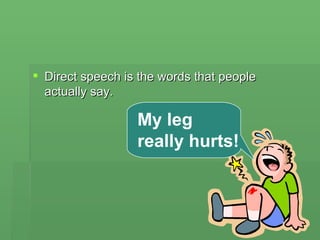
 Direct speech is the words that people
  actually say.

                  My leg
                  really hurts!
Turning Speech
Bubbles to Text.
              My leg
                          really
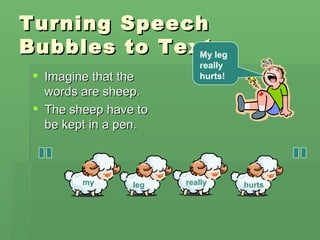
  Imagine that the       hurts!
   words are sheep.
  The sheep have to
   be kept in a pen.


         my      leg   really      hurts
Turning Speech
Bubbles to Text.
              My leg
                               really
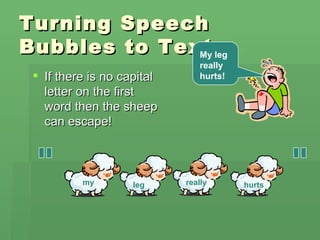
  If there is no capital      hurts!
   letter on the first
   word then the sheep
   can escape!


          my        leg     really      hurts
Turning Speech
Bubbles to Text.
              My leg
                            really
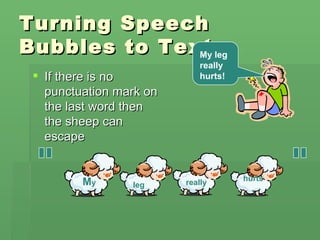
  If there is no           hurts!
   punctuation mark on
   the last word then
   the sheep can
   escape


                                     hurts
         My      leg     really
Turning Speech
Bubbles to Text.
              My leg
                          really
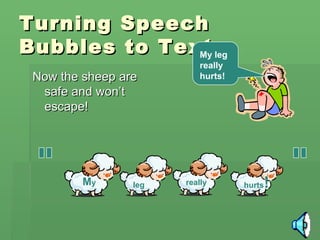
 Now the sheep are        hurts!
  safe and won’t
  escape!


         My      leg   really          !
                                   hurts
Independent Work
   Toes:
Turn speech bubbles into written direct speech, using the correct
    punctuation.
 Knees: with Mrs Rogers
To turn speech bubbles into written speech making sure that a new line is
    started every time that there is a new speaker in the conversation.
 Shoulders:
To turn speech bubbles into written direct speech, and then write their
    own sentences using the speech they have written.
 Heads:
To turn speech bubbles into correctly punctuated direct written speech
    and include an adverb to describe how the speech was spoken. In
    conversation form to ensure practice of ‘new speaker, new line’.
 All: with Mrs Taylor – to stick photos onto newspaper reports during
    the lesson. Mrs Taylor will call you when she is ready.
New Speaker, New
Line
 Now you know how to punctuate speech
  there is one more thing you need to
  remember.
 Every time a new person starts
  speaking you will need a new sheep
  pen on a new line.
New Speaker, New
Line
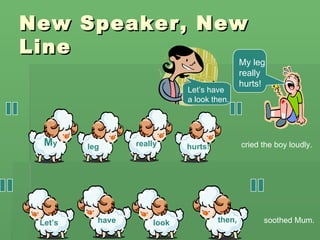
                                              My leg
                                              really
                                              hurts!
                             Let’s have
                             a look then.


  My     leg      really     hurts!           cried the boy loudly.


 Let’s     have       look            then,         soothed Mum.
Speech Punctuation
Checklist
 Speech marks at the beginning of the words
  that are spoken. (66)
 Capital letter on the first word that was spoken.
 Punctuation mark after the last word that was
  spoken.
 Close the speech marks (99).
 New line EVERY TIME there is a new person
  speaking.
 NOW CHECK YOUR WRITING – DOES IT
  HAVE ALL THE ELEMENTS ABOVE?

Punctuating direct speech

  • 1.
    Punctuating Dir ect Speech LearningObjective: To understand how to punctuate direct speech.
  • 2.
     Direct speechis the words that people actually say. My leg really hurts!
  • 3.
    Turning Speech Bubbles toText. My leg really  Imagine that the hurts! words are sheep.  The sheep have to be kept in a pen. my leg really hurts
  • 4.
    Turning Speech Bubbles toText. My leg really  If there is no capital hurts! letter on the first word then the sheep can escape! my leg really hurts
  • 5.
    Turning Speech Bubbles toText. My leg really  If there is no hurts! punctuation mark on the last word then the sheep can escape hurts My leg really
  • 6.
    Turning Speech Bubbles toText. My leg really Now the sheep are hurts! safe and won’t escape! My leg really ! hurts
  • 7.
    Independent Work  Toes: Turn speech bubbles into written direct speech, using the correct punctuation.  Knees: with Mrs Rogers To turn speech bubbles into written speech making sure that a new line is started every time that there is a new speaker in the conversation.  Shoulders: To turn speech bubbles into written direct speech, and then write their own sentences using the speech they have written.  Heads: To turn speech bubbles into correctly punctuated direct written speech and include an adverb to describe how the speech was spoken. In conversation form to ensure practice of ‘new speaker, new line’.  All: with Mrs Taylor – to stick photos onto newspaper reports during the lesson. Mrs Taylor will call you when she is ready.
  • 8.
    New Speaker, New Line Now you know how to punctuate speech there is one more thing you need to remember.  Every time a new person starts speaking you will need a new sheep pen on a new line.
  • 9.
    New Speaker, New Line My leg really hurts! Let’s have a look then. My leg really hurts! cried the boy loudly. Let’s have look then, soothed Mum.
  • 10.
    Speech Punctuation Checklist  Speechmarks at the beginning of the words that are spoken. (66)  Capital letter on the first word that was spoken.  Punctuation mark after the last word that was spoken.  Close the speech marks (99).  New line EVERY TIME there is a new person speaking.  NOW CHECK YOUR WRITING – DOES IT HAVE ALL THE ELEMENTS ABOVE?