PUMA
ABOUT THE COMPANY
 Brothers Rudolf Dassler and Adolf Dassler started making shoes in 1924
and formed a company called Adidas.
 In 1948, Rudolf split from his brother’s company, and started a company
called Puma.
 In 1986, It become a public limited company, and was listed on the
Frankfurt Stock Exchange.
 The company distributes its product in more than 120 countries, employs
more than 14,800 people worldwide and has headquartered in Germany,
Boston, London and Hong Kong.
PUMA TODAY
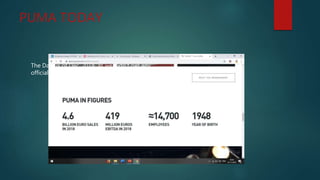
The Data is of Dec. 2018, as we didn’t get any
official data so, this is what we got.
SWOT ANALYSIS
STRENGTHS
 Marketing and Sponsorship: Puma spends heavily in promoting
its brand throughout the world via sponsorship.
 It also sponsors the athletic track champion Usain Bolt. Puma was also one of the
official sponsors of FIFA World Cup 2018 in Russia.
 Research and Development: Puma brand is very innovative and has a very rich
Research and Development team. The screw boots which footballers wear were
first launched by Puma and they received great acceptance in the football world
 Brand equity: PUMA distributes its products in more than 120 countries and
employs around 14,700 people worldwide. Its mission is: “To be the Fastest
Sports Brand in the world”.
WEAKNESSES
 Revenue earned from one product: They have diversified range of sport
but income of the business is heavily depend upon its share of footwear
market.
OPPORTUNITY
 New Product line: Puma can think of moving away from the sporting the
only type of company can also focus to produce apparels in the lifestyle section
and make new customer market.
 More Sponsorships: Although Puma sponsors a lot of sporting events
backs many celebrities and sporting icons it is not enough when compared to
competitors. It needs to increase its presence, even more, to stay in the
competition and gain more market share.
 More Disposable income: People’s income have increased a lot compared to the
last decade. They have also shown a considerable interest in trading up to buy
premium goods across all the sectors. Puma can tap this opportunity and
convert these potential customer base to get more sales.
THREAT
 Fraud Products: There are a lot of people that create fraud products and
copy famous brand and sale at a lower price. This hampers the original
brand and results in decline in their sales. There’s not much one can do to
stop them from copying
 High Competition: This segment is very competitive and Puma is facing
heavy competition from Adidas and Nike.
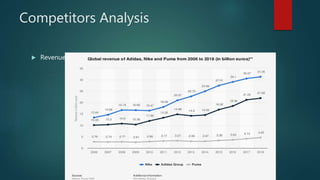
Competitors Analysis
 Revenue
Segments operating in
 Nike concentrates on making basketball, running and soccer shoes
for men, women as well as children.
 Adidas also mainly focuses on basketball, soccer and running.
 Puma mainly focuses on football, running and training, golf and
motorsports. Puma has deep inroads in motorsports.
Number of stores
 Puma has 365 stores all over India
 Nike had about 350 stores in India during its peak around 2015. Now it has
only 150 and is planning on cutting down more stores to concentrate
more on online sales.
 There are about 450 Adidas stores and 220 Reebok stores in the country.
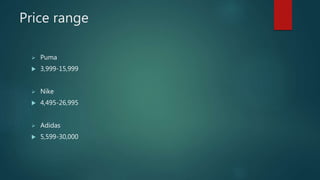
Price range
 Puma
 3,999-15,999
 Nike
 4,495-26,995
 Adidas
 5,599-30,000
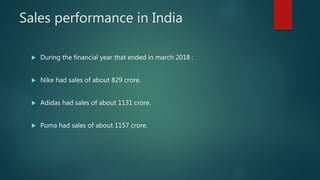
Sales performance in India
 During the financial year that ended in march 2018 :
 Nike had sales of about 829 crore.
 Adidas had sales of about 1131 crore.
 Puma had sales of about 1157 crore.
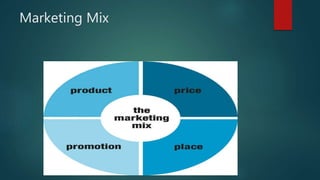
Marketing Mix
Shoes
•PUMA HAS VARIETY OF SHOES FOR DIFFERENT SPORTS
•IT OFFERS SHOES FOR FOOTBALL, BASKETBALL, ATHLETICS, CRICKET, CASUAL.
•IT TARGETS ALL AGE GROUP FROM ITS TRENDY AND COMFORTABLE OFFERINGS.
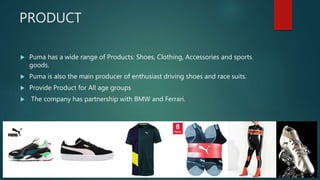
PRODUCT
 Puma has a wide range of Products: Shoes, Clothing, Accessories and sports
goods.
 Puma is also the main producer of enthusiast driving shoes and race suits.
 Provide Product for All age groups
 The company has partnership with BMW and Ferrari.
Source: Puma Website
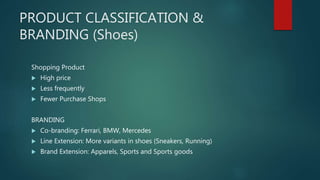
PRODUCT CLASSIFICATION &
BRANDING (Shoes)
Shopping Product
 High price
 Less frequently
 Fewer Purchase Shops
BRANDING
 Co-branding: Ferrari, BMW, Mercedes
 Line Extension: More variants in shoes (Sneakers, Running)
 Brand Extension: Apparels, Sports and Sports goods
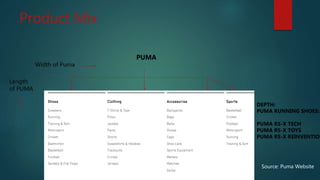
Product Mix
PUMA
Width of Puma
Length
of PUMA
DEPTH:
PUMA RUNNING SHOES:
PUMA RS-X TECH
PUMA RS-X TOYS
PUMA RS-X REINVENTION
Source: Puma Website
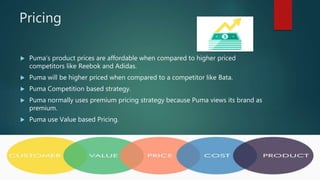
Pricing
 Puma’s product prices are affordable when compared to higher priced
competitors like Reebok and Adidas.
 Puma will be higher priced when compared to a competitor like Bata.
 Puma Competition based strategy.
 Puma normally uses premium pricing strategy because Puma views its brand as
premium.
 Puma use Value based Pricing.
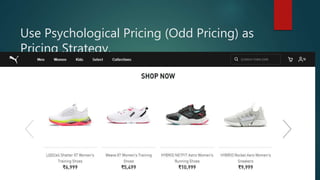
Use Psychological Pricing (Odd Pricing) as
Pricing Strategy.
 Use Psychological Pricing (Odd Pricing) as Pricing Strategy.
Promotion
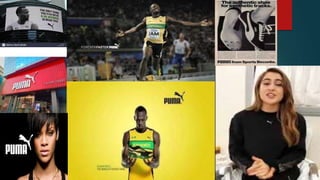
 Puma, being a global brand, has an extensive marketing & advertising strategy.
 International sports stars are appointed brand ambassadors.
 Puma sponsors various clubs, teams and associations across the globe as a part
of its promotional strategy.
 To promote its women product line, Rihanna and Kylie Jenner walked on ramp
flaunting Puma’s designer apparel and shoes
 Puma also launched various interesting and innovative campaigns to engage
customers
 Along with television commercials and print media, Puma is also strongly present
n digital platforms, and social media
 The following celebrities have endorsed puma as a brand
 Badminton- Saina Nehwal
 Tennis Gears- Somdev Devramman
 Cricket Equipment- Virat Kohli
 Health Academy- Shilpa Shetty
 Word of Mouth
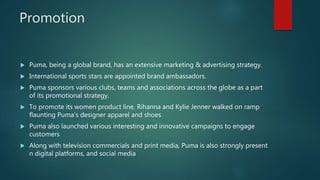
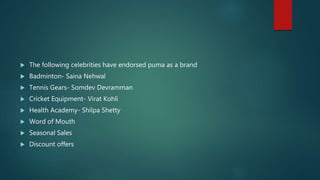
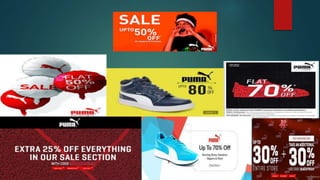
 Seasonal Sales
 Discount offers
Place
 Puma shoes are mostly distributed to multibrand storefronts as well as the
exclusive Puma stores that can be found in major cities in the world
 This necessitates a wider selection of shoes and accessories to customers
than the competition.
 Currently Puma has stores.
Information gathered from Retailer’s
 The company manufacture half of it’s product in India and import half products
from outside India.
 The company warehouse is present in Bangalore
 Recent Collection come in the market are- One8, ignite, Motorsport
 The company gets maximum revenue from Shoes (Specially men shoes)
 The company offers various discounts on products in Winter session, session end
sales.
 The company also offers loyalty program and vouchers for regular customers.
 Unsold products goes to factory outlet and there they sold by giving huge
discount.
 The discount are not apply for all products, they are on selected products.
 The price of Shoes in Venice Mall starts from Rs.3000/- up to Rs. 11000/- and In
Ansal Plaza which is factory outlet it starts from Rs.
 The company did promotion by putting Discount boards in front of Showroom.
 They use psychological pricing like they put price tag as Rs. 4999/-
 The company’s competitors are Reebok, Adidas and Skechers.
Competitors
Reebok
 Product:
 Price:
 Place:
 Promotion
Adidas
 Product:
 Price:
 Place:
 Promotion

Puma India Analysis

  • 1.
  • 2.
    ABOUT THE COMPANY Brothers Rudolf Dassler and Adolf Dassler started making shoes in 1924 and formed a company called Adidas.  In 1948, Rudolf split from his brother’s company, and started a company called Puma.  In 1986, It become a public limited company, and was listed on the Frankfurt Stock Exchange.  The company distributes its product in more than 120 countries, employs more than 14,800 people worldwide and has headquartered in Germany, Boston, London and Hong Kong.
  • 3.
    PUMA TODAY The Datais of Dec. 2018, as we didn’t get any official data so, this is what we got.
  • 4.
    SWOT ANALYSIS STRENGTHS  Marketingand Sponsorship: Puma spends heavily in promoting its brand throughout the world via sponsorship.  It also sponsors the athletic track champion Usain Bolt. Puma was also one of the official sponsors of FIFA World Cup 2018 in Russia.  Research and Development: Puma brand is very innovative and has a very rich Research and Development team. The screw boots which footballers wear were first launched by Puma and they received great acceptance in the football world
  • 5.
     Brand equity:PUMA distributes its products in more than 120 countries and employs around 14,700 people worldwide. Its mission is: “To be the Fastest Sports Brand in the world”.
  • 6.
    WEAKNESSES  Revenue earnedfrom one product: They have diversified range of sport but income of the business is heavily depend upon its share of footwear market.
  • 7.
    OPPORTUNITY  New Productline: Puma can think of moving away from the sporting the only type of company can also focus to produce apparels in the lifestyle section and make new customer market.  More Sponsorships: Although Puma sponsors a lot of sporting events backs many celebrities and sporting icons it is not enough when compared to competitors. It needs to increase its presence, even more, to stay in the competition and gain more market share.
  • 8.
     More Disposableincome: People’s income have increased a lot compared to the last decade. They have also shown a considerable interest in trading up to buy premium goods across all the sectors. Puma can tap this opportunity and convert these potential customer base to get more sales.
  • 9.
    THREAT  Fraud Products:There are a lot of people that create fraud products and copy famous brand and sale at a lower price. This hampers the original brand and results in decline in their sales. There’s not much one can do to stop them from copying  High Competition: This segment is very competitive and Puma is facing heavy competition from Adidas and Nike.
  • 10.
  • 11.
    Segments operating in Nike concentrates on making basketball, running and soccer shoes for men, women as well as children.  Adidas also mainly focuses on basketball, soccer and running.  Puma mainly focuses on football, running and training, golf and motorsports. Puma has deep inroads in motorsports.
  • 12.
    Number of stores Puma has 365 stores all over India  Nike had about 350 stores in India during its peak around 2015. Now it has only 150 and is planning on cutting down more stores to concentrate more on online sales.  There are about 450 Adidas stores and 220 Reebok stores in the country.
  • 13.
    Price range  Puma 3,999-15,999  Nike  4,495-26,995  Adidas  5,599-30,000
  • 14.
    Sales performance inIndia  During the financial year that ended in march 2018 :  Nike had sales of about 829 crore.  Adidas had sales of about 1131 crore.  Puma had sales of about 1157 crore.
  • 15.
  • 16.
    Shoes •PUMA HAS VARIETYOF SHOES FOR DIFFERENT SPORTS •IT OFFERS SHOES FOR FOOTBALL, BASKETBALL, ATHLETICS, CRICKET, CASUAL. •IT TARGETS ALL AGE GROUP FROM ITS TRENDY AND COMFORTABLE OFFERINGS.
  • 17.
    PRODUCT  Puma hasa wide range of Products: Shoes, Clothing, Accessories and sports goods.  Puma is also the main producer of enthusiast driving shoes and race suits.  Provide Product for All age groups  The company has partnership with BMW and Ferrari. Source: Puma Website
  • 18.
    PRODUCT CLASSIFICATION & BRANDING(Shoes) Shopping Product  High price  Less frequently  Fewer Purchase Shops BRANDING  Co-branding: Ferrari, BMW, Mercedes  Line Extension: More variants in shoes (Sneakers, Running)  Brand Extension: Apparels, Sports and Sports goods
  • 19.
    Product Mix PUMA Width ofPuma Length of PUMA DEPTH: PUMA RUNNING SHOES: PUMA RS-X TECH PUMA RS-X TOYS PUMA RS-X REINVENTION Source: Puma Website
  • 20.
    Pricing  Puma’s productprices are affordable when compared to higher priced competitors like Reebok and Adidas.  Puma will be higher priced when compared to a competitor like Bata.  Puma Competition based strategy.  Puma normally uses premium pricing strategy because Puma views its brand as premium.  Puma use Value based Pricing.
  • 21.
    Use Psychological Pricing(Odd Pricing) as Pricing Strategy.  Use Psychological Pricing (Odd Pricing) as Pricing Strategy.
  • 22.
    Promotion  Puma, beinga global brand, has an extensive marketing & advertising strategy.  International sports stars are appointed brand ambassadors.  Puma sponsors various clubs, teams and associations across the globe as a part of its promotional strategy.  To promote its women product line, Rihanna and Kylie Jenner walked on ramp flaunting Puma’s designer apparel and shoes  Puma also launched various interesting and innovative campaigns to engage customers  Along with television commercials and print media, Puma is also strongly present n digital platforms, and social media
  • 23.
     The followingcelebrities have endorsed puma as a brand  Badminton- Saina Nehwal  Tennis Gears- Somdev Devramman  Cricket Equipment- Virat Kohli  Health Academy- Shilpa Shetty  Word of Mouth  Seasonal Sales  Discount offers
  • 26.
    Place  Puma shoesare mostly distributed to multibrand storefronts as well as the exclusive Puma stores that can be found in major cities in the world  This necessitates a wider selection of shoes and accessories to customers than the competition.  Currently Puma has stores.
  • 27.
    Information gathered fromRetailer’s  The company manufacture half of it’s product in India and import half products from outside India.  The company warehouse is present in Bangalore  Recent Collection come in the market are- One8, ignite, Motorsport  The company gets maximum revenue from Shoes (Specially men shoes)  The company offers various discounts on products in Winter session, session end sales.  The company also offers loyalty program and vouchers for regular customers.
  • 28.
     Unsold productsgoes to factory outlet and there they sold by giving huge discount.  The discount are not apply for all products, they are on selected products.  The price of Shoes in Venice Mall starts from Rs.3000/- up to Rs. 11000/- and In Ansal Plaza which is factory outlet it starts from Rs.  The company did promotion by putting Discount boards in front of Showroom.  They use psychological pricing like they put price tag as Rs. 4999/-
  • 29.
     The company’scompetitors are Reebok, Adidas and Skechers.
  • 30.
    Competitors Reebok  Product:  Price: Place:  Promotion Adidas  Product:  Price:  Place:  Promotion