UNIT 2 LEGUMES & PULSES
Introduction
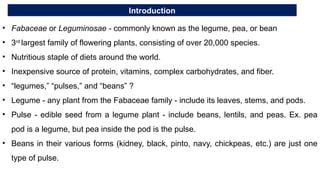
• Fabaceae or Leguminosae - commonly known as the legume, pea, or bean
• 3rd
largest family of flowering plants, consisting of over 20,000 species.
• Nutritious staple of diets around the world.
• Inexpensive source of protein, vitamins, complex carbohydrates, and fiber.
• “legumes,” “pulses,” and “beans” ?
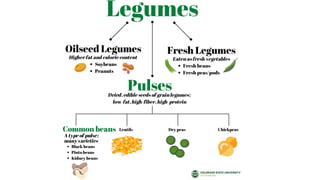
• Legume - any plant from the Fabaceae family - include its leaves, stems, and pods.
• Pulse - edible seed from a legume plant - include beans, lentils, and peas. Ex. pea
pod is a legume, but pea inside the pod is the pulse.
• Beans in their various forms (kidney, black, pinto, navy, chickpeas, etc.) are just one
type of pulse.
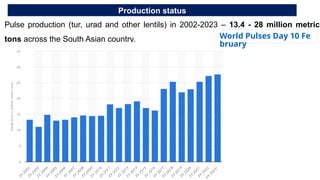
Production status
Pulse production (tur, urad and other lentils) in 2002-2023 – 13.4 - 28 million metric
tons across the South Asian country. World Pulses Day 10 Fe
bruary
Structure of pulses
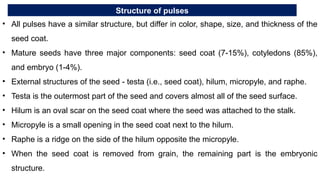
• All pulses have a similar structure, but differ in color, shape, size, and thickness of the
seed coat.
• Mature seeds have three major components: seed coat (7-15%), cotyledons (85%),
and embryo (1-4%).
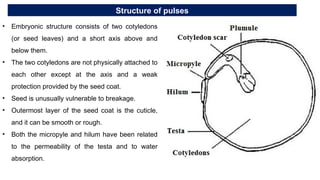
• External structures of the seed - testa (i.e., seed coat), hilum, micropyle, and raphe.
• Testa is the outermost part of the seed and covers almost all of the seed surface.
• Hilum is an oval scar on the seed coat where the seed was attached to the stalk.
• Micropyle is a small opening in the seed coat next to the hilum.
• Raphe is a ridge on the side of the hilum opposite the micropyle.
• When the seed coat is removed from grain, the remaining part is the embryonic
structure.
Structure of pulses
• Embryonic structure consists of two cotyledons
(or seed leaves) and a short axis above and
below them.
• The two cotyledons are not physically attached to
each other except at the axis and a weak
protection provided by the seed coat.
• Seed is unusually vulnerable to breakage.
• Outermost layer of the seed coat is the cuticle,
and it can be smooth or rough.
• Both the micropyle and hilum have been related
to the permeability of the testa and to water
absorption.
Composition of pulses
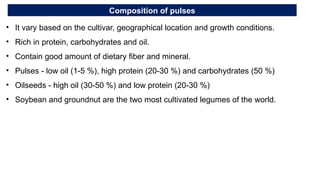
• It vary based on the cultivar, geographical location and growth conditions.
• Rich in protein, carbohydrates and oil.
• Contain good amount of dietary fiber and mineral.
• Pulses - low oil (1-5 %), high protein (20-30 %) and carbohydrates (50 %)
• Oilseeds - high oil (30-50 %) and low protein (20-30 %)
• Soybean and groundnut are the two most cultivated legumes of the world.
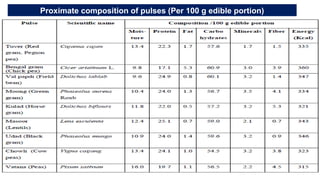
Proximate composition of pulses (Per 100 g edible portion)
Protein in pulses
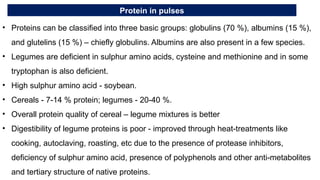
• Proteins can be classified into three basic groups: globulins (70 %), albumins (15 %),
and glutelins (15 %) – chiefly globulins. Albumins are also present in a few species.
• Legumes are deficient in sulphur amino acids, cysteine and methionine and in some
tryptophan is also deficient.
• High sulphur amino acid - soybean.
• Cereals - 7-14 % protein; legumes - 20-40 %.
• Overall protein quality of cereal – legume mixtures is better
• Digestibility of legume proteins is poor - improved through heat-treatments like
cooking, autoclaving, roasting, etc due to the presence of protease inhibitors,
deficiency of sulphur amino acid, presence of polyphenols and other anti-metabolites
and tertiary structure of native proteins.
Carbohydrates in pulses
• Contains -50-60 % of carbohydrate
• Starch is the principal carbohydrate.
• Contains minor amounts of lower molecular weight carbohydrates such as sucrose
and sucrosyl oligosaccharides
• Oligosaccharides - raffinose, stachyose and verbascose and are associated with
flatulence - major hindrance to large-scale acceptance of legumes as food.
• Soybean contains a considerable amount of carbohydrate such as galactans,
pentoses, and hemicelluloses which are poorly utilized.
• Legumes are good sources of dietary fibers.
Other nutrients in pulses
• Most species of legumes contain only small amounts of provitamin A (50 to 300 IU of
vitamin A per 100g).
• Fresh legumes have more vitamin A activity.
• Thiamine content – approx. equivalent to that of whole cereals - 0.3 and 1.0 mg/100 g.
• Legumes contain little riboflavin - 0.1-0.4 mg/100g.
• Dry legumes - devoid of ascorbic acid.
• It is rich in calcium than most cereals - 100 mg/100 g.
• Contain phytic acid - affect the absorption and utilization of their calcium
• Good sources of iron - 2 -10 mg/100 g; niacin - 2.0 mg/100 g; also folic acid
• Undecorticated legumes contain vitamin E in somewhat larger amounts than whole
cereals. For pantothenic acid, the reverse relationship holds.
Antinutritional factors in pulses
• Most of the legumes in raw form contain a wide variety of anti-nutritional factors or
toxic principles like trypsin inhibitor and others.
• Many of the grain legumes cause flatulence.
• Most of anti-nutritional factors are heat labile and are destroyed during cooking.
• ANFs - interfere with the utilization of nutrients.
• ANFs –protease inhibitors, lectins, goitrogens, antivitamins and phytates, saponins,
oestrogens, flatulence factors, allergens, and lysinoalanine.
• Some other anti-nutritional factors are cyanogens, favism factors, lathyrism factors,
amylase inhibitors, tannins, aflatoxins and pressor amines.
Antinutritional factors in pulses
• Heat stable compounds such as polyphenols and phytates - not easily removed by
simple soaking and heating. These could be reduced by germination and/or
fermentation.
• Legumes are rich source of polyphenolic compounds (e.g. tannins - considered as
anti-nutrients due to their adverse effects on protein digestibility and has considerable
interest in the antioxidant activity of these compounds and in their potential health
benefits, especially in the prevention of cancer and cardiovascular disease.
• Dark colored legumes like red kidney beans, black beans, black gram and soybean -
higher amount of these polyphenolic compounds.
Pulse milling
• 3rd
largest food processing industry after rice and flour milling.
• An estimated 75% of pulses produced are processed for making dal in mills of
different capacities.
Milling of pulses involves two major steps:
• Loosening of husk and
• Removal of husk and splitting into cotyledons with the help of suitable machine.
• All kinds of pulses require some pre-milling treatment for ease of husk removal.
• Processes and equipments for loosening of husk, separation of husk from cotyledons
and its splitting differ from crop to crop, cultivar to cultivar and place to place.
• Dehusking is an age-old practice, which originated at home and later developed into a
cottage industry and now has grown into a large-scale organized industry.
Pulse milling
1. Home scale milling
2. Cottage scale milling
3. Commercial scale milling
4. Traditional milling
1. Home scale milling
• It involves pounding of pulses into mortar and pestle.
• Home scale method of pulse milling is different for different pulses and varies from
region to region.
• Husk is loosen either by wet or dry method
• Treating the pulses with water and/or oil.
• Stored overnight and the next day they are sun dried.
• Removal of husk is then carried out in pestle and mortar or by a hand operated stone
mill.
• Husk then is separated by winnowing.
• Adopted when a small quantity i.e., up to 5 kg of pulses is to be dehusked.
• Dal yield - quite low (50-60%) due to breakage & chipping of the edges of cotyledons.
2. Cottage scale milling
• Traditionally, villagers use the hand operated wooden or stone chakki/ sheller
when comparatively large quantities of pulses are to be dehusked.
• Similar to those of the home-scale methods
• Preconditioning of grains before milling is done either by prolonged sun drying until the
hulls are loosened or through the application of water followed by several hours of sun
drying and tempering.
• Heating of the grains in pan with or without sand along with vigorous stirring is also in
practice.
• There are no standard dehusking techniques at the cottage level.
• Different combinations of methods - mechanized shellers and plate mills are used for
custom milling of preconditioned pulses.
• At cottage level milling, often the husk is not completely removed and breakage is also
quite high.
• Reduces the consumer appeal and value of the product.
• Yield of head dal obtained from these techniques may very in the range of 55-70%
depending upon the variety of pulse and pre-treatment used.
3. Commercial scale milling
• It involves processing large quantities of pulses in plants of bigger capacities.
• Basic milling procedure is similar, specifics of dehusking methods vary widely from
one dal mill to another dal mill and region to region.
• Two methods for large scale processing or pulses are in practice.
• Traditional method, most commonly followed by dal millers, is almost similar to cottage
level treatment in principles.
• A modern method of milling has been developed at CFTRI which is independent of
weather conditions.
4. Traditional milling
• Milling process varies from mill to mill and region to region and no standard or
common process is in practice.
• Sequence of operations like pre-milling treatment, conditioning, dehusking, and
splitting is normally common.
• Large variation exists in the steps followed in milling but basic unit operations remain
the same.
Methods of pulse milling
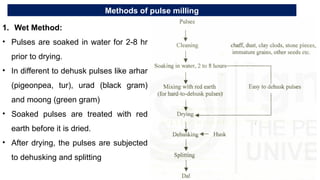
1. Wet Method:
• Pulses are soaked in water for 2-8 hr
prior to drying.
• In different to dehusk pulses like arhar
(pigeonpea, tur), urad (black gram)
and moong (green gram)
• Soaked pulses are treated with red
earth before it is dried.
• After drying, the pulses are subjected
to dehusking and splitting
Methods of pulse milling
2. Dry method:
1. Cleaning and grading: Pulses are cleaned from dust, chaff, grits, etc., and graded
according to size by a reel type or rotating sieve type cleaner.
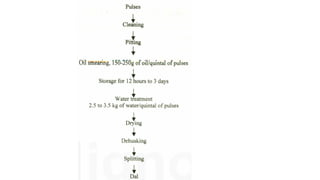
2. Pitting: Clean pulses are passed through an emery roller machine.
• Husk is cracked and scratched. This is to facilitate the subsequent oil penetration
process for the loosening of husk.
• Clearance b/w the emery roller and cage (housing) gradually narrows from inlet to
outlet.
• Mainly cracking and scratching of husk takes place by friction between pulses and
emery. Some of the pulses are dehusked and split during this operation which are then
separated by sieving.
Methods of pulse milling
Pretreatment with oil
• Scratched or pitted pulses are passed through a screw conveyor and mixed with some
edible oil, like linseed oil (1 .5-2.5 kg/tonne of pulses) for 12 hours for diffusion of the oil.
• Pitted pulses are smeared with 150-250/g of oil perquintal of pulses, stored for 12
hours to 3 days.
• During this period, oil diffuses in between the husk and cotyledon which loosens the
husk.
• To further loosen the seed coat, it is treated with 2.5 to 3.5 kg of water per quintal of
pulses and stored overnight.
• Next day, after drying and cooling, it is subjected to dehusking and splitting
Methods of pulse milling
Dehusking and splitting
• Emery roller known as Gota machine are used for the dehusklng of conditioned pulses.
• About 50% pulses are dehusked in a single operation (in one pass).
• Dehusked pulses are split into two parts also.
• The husk is aspirated off and dehusked, split pulses are -separated by sieving.
• The tail pulse and unsplit dehusked pulses are again conditioned and milled as above.
• The whole process is repeated two to three times until the remaining pulses are
dehusked and split.
Polishing
• Polish is given to the dehusked and split pulses by treating them with a small
• quantity of oil and/or water.
Commercial Scale Milling of Pulses
1. Cleaning and Grading: 2 types of cleaners are used: reciprocating air-screen
cleaners and reel-screen cleaners.
Reciprocating air screen cleaners:
• Air is blown through two screens (sieves) which separate out lighter material such as
dust, stalk, dried leaves, husk etc.
• Upper screen has bigger perforations while second screen has smaller perforations.
Reel screen cleaners:
• It consist of 2-4 cylindrical compartments. The frame of the machine is made of
wooden or mild steel sheet.
• Different size perforation screens are fitted on a 5-7.5 mm diameter shaft.
• Machine is fitted at an inclination of 2-3 . Cylindrical screen drum rotates at 5-35 rpm
ᵒ
Commercial Scale Milling of Pulses
2. Loosening of Husk
• Very important step for total recovery and quality of milled dal. Loosening of husk: wet
method and dry method.
3. Dehusking
• Roller dehuskers coated with carborandum are used to dehusk the pulses.
• Two types of rollers viz. cylindrical and tapered are available for dehusking.
• Tapered rollers are placed horizontally and the diameter of roller increase from feeding
side to discharge side.
• Difference in diameter helps to gradually increase the pressure on pulse grains and
helps in gradual dehusking.
• Cylindrical rollers are installed at an angle of 10-15 - enables forward movement of
ᵒ
Commercial Scale Milling of Pulses
• Annular gap between rollers varies depending upon the type of pulses being
dehusked.
• Inlet and outlet of the roller machine can be adjusted for regulation of grain flow and
retention time respectively.
• Small dal mills use under-run disc shellers or burr mills for dehusking operation in
place of Roller mills.
• Conditioned pulse grains subjected to mild abrasion inside the roller machine,
removes 10-25% of husk in one pass.
• Shelled husk, cotyledon powder, brokens and splits are separated out by Air-screen
cleaners after passing the grain lot once or twice through the roller machine.
• Depending upon adherence of husk to grain, the pulse grains are passed through mill
for two to eight times.
• For hard-to-dehusk pulses (arhar, moong, urad), the recovery is between 70-75%
while for easy-to-dehusk pulses (bengal gram, lentil, kesari and peas), it varies in
between 78-85%.
Commercial Scale Milling of Pulses
4. Splitting
• It involves loosening the bond between the cotyledons and splitting.
• For cotyledons loosening, water at the rate of 1-5 kg/quintal is applied to dehusked
pulse grain (gota) and is stored for 2-12 hours and later sun-dried for 4-8 hours.
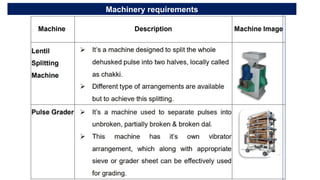
• For splitting, machines like the under-run-disc sheller (URD), impact machine
(Phatphatia), roller mill, and hitting the gota against the metal sheet at discharge side
of bucket elevator are used.
• In this operation the embryo attached to two cotyledons breaks away, thereby, causing
a loss in dal recovery by 1.5 to 2%.
Commercial Scale Milling of Pulses
5. Polishing
• Dal is imparted with a glazing appearance to improve its consumers acceptance and
market value.
• Depending upon the need, different materials like water, oil, soapstone powder and
selkhari powder are applied to dal surface.
• Sometimes removal of sticking powder from dal surface is considered sufficient to
improve its surface glaze.
6. Removal of powder/dust: Cylindrical rollers mounted with the rubber mats, leather
strips, emery rollers are used for the purpose. The dust particles sticking to dal surface
are removed by gentle rubbing action on the roller surface.
Commercial Scale Milling of Pulses
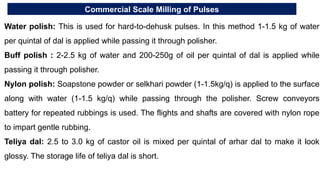
Water polish: This is used for hard-to-dehusk pulses. In this method 1-1.5 kg of water
per quintal of dal is applied while passing it through polisher.
Buff polish : 2-2.5 kg of water and 200-250g of oil per quintal of dal is applied while
passing it through polisher.
Nylon polish: Soapstone powder or selkhari powder (1-1.5kg/q) is applied to the surface
along with water (1-1.5 kg/q) while passing through the polisher. Screw conveyors
battery for repeated rubbings is used. The flights and shafts are covered with nylon rope
to impart gentle rubbing.
Teliya dal: 2.5 to 3.0 kg of castor oil is mixed per quintal of arhar dal to make it look
glossy. The storage life of teliya dal is short.
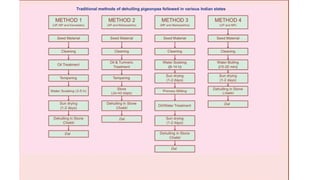
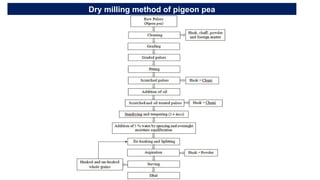
Dry milling method of pigeon pea
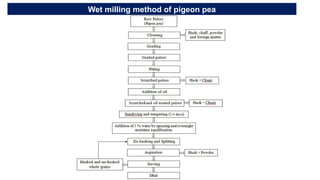
Wet milling method of pigeon pea
Advances in milling technology
• As pulses are most difficult-to-mill, most of the researches about pre-milling
treatments and pulse milling
• Pre-milling treatments viz., heat, chemical, enzyme etc., are tried at various research
organizations for milling.
• Oil and water treatment is most prevalent in modern dal mills.
• Water soaking followed by sun drying is commonly adopted at rural level pigeonpea
processing.
• Traditionally water/oil treatments are given for loosening of husk.
• Pre-milling techniques are labour intensive, wasteful and weather dependent.
• Attempts have been made by various Research and Development institutions to
develop improved processes for pre-treatment of pigeonpea in order to achieve
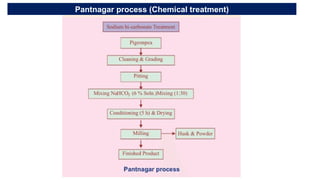
Pantnagar process (Chemical treatment)
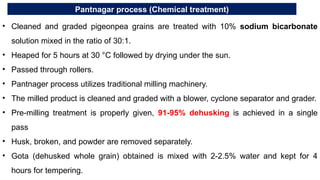
• Cleaned and graded pigeonpea grains are treated with 10% sodium bicarbonate
solution mixed in the ratio of 30:1.
• Heaped for 5 hours at 30 °C followed by drying under the sun.
• Passed through rollers.
• Pantnager process utilizes traditional milling machinery.
• The milled product is cleaned and graded with a blower, cyclone separator and grader.
• Pre-milling treatment is properly given, 91-95% dehusking is achieved in a single
pass
• Husk, broken, and powder are removed separately.
• Gota (dehusked whole grain) obtained is mixed with 2-2.5% water and kept for 4
hours for tempering.
Pantnagar process (Chemical treatment)
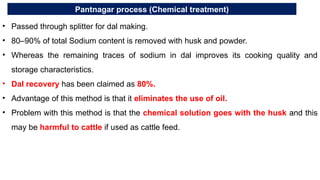
• Passed through splitter for dal making.
• 80–90% of total Sodium content is removed with husk and powder.
• Whereas the remaining traces of sodium in dal improves its cooking quality and
storage characteristics.
• Dal recovery has been claimed as 80%.
• Advantage of this method is that it eliminates the use of oil.
• Problem with this method is that the chemical solution goes with the husk and this
may be harmful to cattle if used as cattle feed.
Pantnagar process (Chemical treatment)
Pantnagar process (Enzymatic treatment)
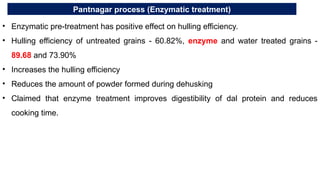
• Enzymatic pre-treatment has positive effect on hulling efficiency.
• Hulling efficiency of untreated grains - 60.82%, enzyme and water treated grains -
89.68 and 73.90%
• Increases the hulling efficiency
• Reduces the amount of powder formed during dehusking
• Claimed that enzyme treatment improves digestibility of dal protein and reduces
cooking time.
Central Institute of Agricultural Engineering (CIAE) process
• Cleaned and graded pigeonpea grains are fed in a roller mill for scratching.
• Scratching by abrasive rollers
• Grains are cleaned to separate the husk and split grains.
• Whole and split grains are soaked in water at ambient temperature for 25-30 minutes
to produce moisture content of about 35 (%, w.b.) and then dried to 10% moisture
content.
• Milled in a cylindrical abrasive mill to produce dehusked split dal, which is separated
from other constituents with an air-screen grain cleaner.
• Average recovery for pigeonpea is claimed to be 75%.
• Eliminates the use of edible oil in the milling process
CFTRI process
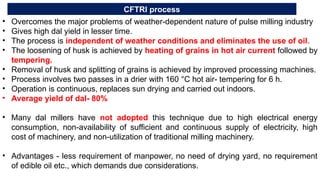
• Overcomes the major problems of weather-dependent nature of pulse milling industry
• Gives high dal yield in lesser time.
• The process is independent of weather conditions and eliminates the use of oil.
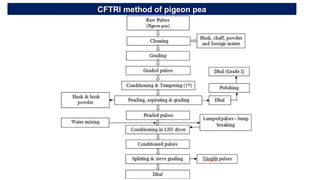
• The loosening of husk is achieved by heating of grains in hot air current followed by
tempering.
• Removal of husk and splitting of grains is achieved by improved processing machines.
• Process involves two passes in a drier with 160 °C hot air- tempering for 6 h.
• Operation is continuous, replaces sun drying and carried out indoors.
• Average yield of dal- 80%
• Many dal millers have not adopted this technique due to high electrical energy
consumption, non-availability of sufficient and continuous supply of electricity, high
cost of machinery, and non-utilization of traditional milling machinery.
• Advantages - less requirement of manpower, no need of drying yard, no requirement
of edible oil etc., which demands due considerations.
CFTRI method of pigeon pea
Milling of individual pulses
1. Pigeon pea
• Most difficult kind of pulse to mill - tight attachment of husk to the seed coat.
• Clean and graded grains are pitted (scratched over the seed surface), oil smeared
(0.2-0.5%), tempered for half to one day in bins, treated with water (in the ratio 1:20-
25), stored overnight and sundried for 2-3 days before passing through the emery roll.
• Husk loosening and dehusking operations are repeated 2-4 times till more than 90%
grains are dehusked.
• Dal obtained during this method is termed as Grade-II dal as edges of most of the
dal gets rounded off during milling.
• Mixture of dehusked and unhusked whole grain is further sprinkled with water and
tempered for few hours, sundried and splitted in horizontal or vertical chakkies or by
using patka machine.
• Dal thus obtained is considered as Grade-I dal since it has no chipped edges dal
and has better customer acceptability.
• Recovery of pigeonpea varies from 68-75%, depending upon variety milled and
method followed.
2. Chickpea
• It falls in easy-to-mill category of pulse.
• Dehusking after cleaning and grading can be done in roller mills.
• Splitting of ‘gota' (dehusked whole grain) is carried out by treating the grain with water
in ratio 1: 2.5 to 3.0, followed by tempering for 12 hours and splitting in disk sheller.
• Not require oil application for loosening of husk.
• Process is repeated till all the grains are dehusked.; Dal recovery - 78–82%.
• Chana dal and broken can further be processed to produce besan.
• At household level, the burr mill is used to obtain besan.
• Hammer mills - cottage and large scale for besan making.
• Recovery of besan from plants - 98% and only 2% of dal is lost due to burning &
are lost in form of unrecoverable dust.
3. Urdbean
• The process involves cleaning, grading and pitting in emery roller mills.
• Two or three passes will be required to complete dehusking and pitting operation.
• Husk and powder produced in each pass must be removed after every pass.
• 0.5% oil is applied to the pitted grains, which are then stored for 12 hours.
• Grains are then sundried for about 2-3 days followed by water spraying in the ratio of
1:25-30 and tempered overnight.
• These grains are passed through rollers for dehusking.
• The dal splits obtained is called Grade-II dal.
• The ‘gota' obtained is passed through burr mill to make Grade-I quality dal. To give
luster and enhance market value, dals are polished using soapstone powder.
4. Mungbean
• It is difficult-to-mill because husk have the high degree of adherence to cotyledons.
• Husk is thin, soft and slippery in texture.
• Bond between the two cotyledons is weak, therefore, splitting occurs prior to
dehusking.
• In order to achieve proper dehusking of mungbean grains, oil treatment is applied.
• Pitting, oil smearing and sun drying are followed by dehusking and splitting in roller
machines.
• The loss in form of broken and powder is large in case of mungbean due to its thin
seed coat and rubbing operation during dehusking.
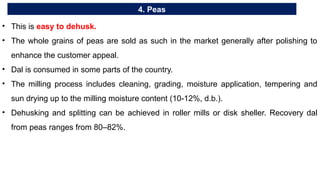
4. Peas
• This is easy to dehusk.
• The whole grains of peas are sold as such in the market generally after polishing to
enhance the customer appeal.
• Dal is consumed in some parts of the country.
• The milling process includes cleaning, grading, moisture application, tempering and
sun drying up to the milling moisture content (10-12%, d.b.).
• Dehusking and splitting can be achieved in roller mills or disk sheller. Recovery dal
from peas ranges from 80–82%.
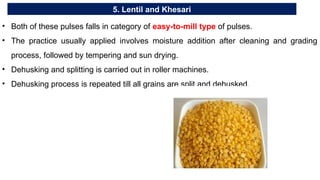
5. Lentil and Khesari
• Both of these pulses falls in category of easy-to-mill type of pulses.
• The practice usually applied involves moisture addition after cleaning and grading
process, followed by tempering and sun drying.
• Dehusking and splitting is carried out in roller machines.
• Dehusking process is repeated till all grains are split and dehusked.
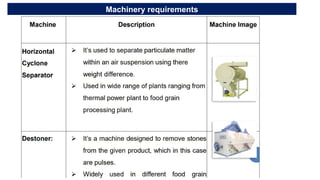
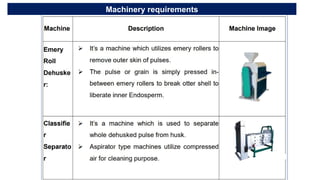
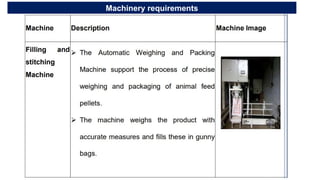
Machinery requirements

Pulses technology, classification, and processing.pptx

  • 1.
  • 2.
    Introduction • Fabaceae orLeguminosae - commonly known as the legume, pea, or bean • 3rd largest family of flowering plants, consisting of over 20,000 species. • Nutritious staple of diets around the world. • Inexpensive source of protein, vitamins, complex carbohydrates, and fiber. • “legumes,” “pulses,” and “beans” ? • Legume - any plant from the Fabaceae family - include its leaves, stems, and pods. • Pulse - edible seed from a legume plant - include beans, lentils, and peas. Ex. pea pod is a legume, but pea inside the pod is the pulse. • Beans in their various forms (kidney, black, pinto, navy, chickpeas, etc.) are just one type of pulse.
  • 4.
    Production status Pulse production(tur, urad and other lentils) in 2002-2023 – 13.4 - 28 million metric tons across the South Asian country. World Pulses Day 10 Fe bruary
  • 5.
    Structure of pulses •All pulses have a similar structure, but differ in color, shape, size, and thickness of the seed coat. • Mature seeds have three major components: seed coat (7-15%), cotyledons (85%), and embryo (1-4%). • External structures of the seed - testa (i.e., seed coat), hilum, micropyle, and raphe. • Testa is the outermost part of the seed and covers almost all of the seed surface. • Hilum is an oval scar on the seed coat where the seed was attached to the stalk. • Micropyle is a small opening in the seed coat next to the hilum. • Raphe is a ridge on the side of the hilum opposite the micropyle. • When the seed coat is removed from grain, the remaining part is the embryonic structure.
  • 6.
    Structure of pulses •Embryonic structure consists of two cotyledons (or seed leaves) and a short axis above and below them. • The two cotyledons are not physically attached to each other except at the axis and a weak protection provided by the seed coat. • Seed is unusually vulnerable to breakage. • Outermost layer of the seed coat is the cuticle, and it can be smooth or rough. • Both the micropyle and hilum have been related to the permeability of the testa and to water absorption.
  • 7.
    Composition of pulses •It vary based on the cultivar, geographical location and growth conditions. • Rich in protein, carbohydrates and oil. • Contain good amount of dietary fiber and mineral. • Pulses - low oil (1-5 %), high protein (20-30 %) and carbohydrates (50 %) • Oilseeds - high oil (30-50 %) and low protein (20-30 %) • Soybean and groundnut are the two most cultivated legumes of the world.
  • 8.
    Proximate composition ofpulses (Per 100 g edible portion)
  • 9.
    Protein in pulses •Proteins can be classified into three basic groups: globulins (70 %), albumins (15 %), and glutelins (15 %) – chiefly globulins. Albumins are also present in a few species. • Legumes are deficient in sulphur amino acids, cysteine and methionine and in some tryptophan is also deficient. • High sulphur amino acid - soybean. • Cereals - 7-14 % protein; legumes - 20-40 %. • Overall protein quality of cereal – legume mixtures is better • Digestibility of legume proteins is poor - improved through heat-treatments like cooking, autoclaving, roasting, etc due to the presence of protease inhibitors, deficiency of sulphur amino acid, presence of polyphenols and other anti-metabolites and tertiary structure of native proteins.
  • 10.
    Carbohydrates in pulses •Contains -50-60 % of carbohydrate • Starch is the principal carbohydrate. • Contains minor amounts of lower molecular weight carbohydrates such as sucrose and sucrosyl oligosaccharides • Oligosaccharides - raffinose, stachyose and verbascose and are associated with flatulence - major hindrance to large-scale acceptance of legumes as food. • Soybean contains a considerable amount of carbohydrate such as galactans, pentoses, and hemicelluloses which are poorly utilized. • Legumes are good sources of dietary fibers.
  • 11.
    Other nutrients inpulses • Most species of legumes contain only small amounts of provitamin A (50 to 300 IU of vitamin A per 100g). • Fresh legumes have more vitamin A activity. • Thiamine content – approx. equivalent to that of whole cereals - 0.3 and 1.0 mg/100 g. • Legumes contain little riboflavin - 0.1-0.4 mg/100g. • Dry legumes - devoid of ascorbic acid. • It is rich in calcium than most cereals - 100 mg/100 g. • Contain phytic acid - affect the absorption and utilization of their calcium • Good sources of iron - 2 -10 mg/100 g; niacin - 2.0 mg/100 g; also folic acid • Undecorticated legumes contain vitamin E in somewhat larger amounts than whole cereals. For pantothenic acid, the reverse relationship holds.
  • 12.
    Antinutritional factors inpulses • Most of the legumes in raw form contain a wide variety of anti-nutritional factors or toxic principles like trypsin inhibitor and others. • Many of the grain legumes cause flatulence. • Most of anti-nutritional factors are heat labile and are destroyed during cooking. • ANFs - interfere with the utilization of nutrients. • ANFs –protease inhibitors, lectins, goitrogens, antivitamins and phytates, saponins, oestrogens, flatulence factors, allergens, and lysinoalanine. • Some other anti-nutritional factors are cyanogens, favism factors, lathyrism factors, amylase inhibitors, tannins, aflatoxins and pressor amines.
  • 13.
    Antinutritional factors inpulses • Heat stable compounds such as polyphenols and phytates - not easily removed by simple soaking and heating. These could be reduced by germination and/or fermentation. • Legumes are rich source of polyphenolic compounds (e.g. tannins - considered as anti-nutrients due to their adverse effects on protein digestibility and has considerable interest in the antioxidant activity of these compounds and in their potential health benefits, especially in the prevention of cancer and cardiovascular disease. • Dark colored legumes like red kidney beans, black beans, black gram and soybean - higher amount of these polyphenolic compounds.
  • 14.
    Pulse milling • 3rd largestfood processing industry after rice and flour milling. • An estimated 75% of pulses produced are processed for making dal in mills of different capacities. Milling of pulses involves two major steps: • Loosening of husk and • Removal of husk and splitting into cotyledons with the help of suitable machine. • All kinds of pulses require some pre-milling treatment for ease of husk removal. • Processes and equipments for loosening of husk, separation of husk from cotyledons and its splitting differ from crop to crop, cultivar to cultivar and place to place. • Dehusking is an age-old practice, which originated at home and later developed into a cottage industry and now has grown into a large-scale organized industry.
  • 15.
    Pulse milling 1. Homescale milling 2. Cottage scale milling 3. Commercial scale milling 4. Traditional milling
  • 16.
    1. Home scalemilling • It involves pounding of pulses into mortar and pestle. • Home scale method of pulse milling is different for different pulses and varies from region to region. • Husk is loosen either by wet or dry method • Treating the pulses with water and/or oil. • Stored overnight and the next day they are sun dried. • Removal of husk is then carried out in pestle and mortar or by a hand operated stone mill. • Husk then is separated by winnowing. • Adopted when a small quantity i.e., up to 5 kg of pulses is to be dehusked. • Dal yield - quite low (50-60%) due to breakage & chipping of the edges of cotyledons.
  • 17.
    2. Cottage scalemilling • Traditionally, villagers use the hand operated wooden or stone chakki/ sheller when comparatively large quantities of pulses are to be dehusked. • Similar to those of the home-scale methods • Preconditioning of grains before milling is done either by prolonged sun drying until the hulls are loosened or through the application of water followed by several hours of sun drying and tempering. • Heating of the grains in pan with or without sand along with vigorous stirring is also in practice. • There are no standard dehusking techniques at the cottage level. • Different combinations of methods - mechanized shellers and plate mills are used for custom milling of preconditioned pulses. • At cottage level milling, often the husk is not completely removed and breakage is also quite high. • Reduces the consumer appeal and value of the product. • Yield of head dal obtained from these techniques may very in the range of 55-70% depending upon the variety of pulse and pre-treatment used.
  • 18.
    3. Commercial scalemilling • It involves processing large quantities of pulses in plants of bigger capacities. • Basic milling procedure is similar, specifics of dehusking methods vary widely from one dal mill to another dal mill and region to region. • Two methods for large scale processing or pulses are in practice. • Traditional method, most commonly followed by dal millers, is almost similar to cottage level treatment in principles. • A modern method of milling has been developed at CFTRI which is independent of weather conditions.
  • 19.
    4. Traditional milling •Milling process varies from mill to mill and region to region and no standard or common process is in practice. • Sequence of operations like pre-milling treatment, conditioning, dehusking, and splitting is normally common. • Large variation exists in the steps followed in milling but basic unit operations remain the same.
  • 21.
    Methods of pulsemilling 1. Wet Method: • Pulses are soaked in water for 2-8 hr prior to drying. • In different to dehusk pulses like arhar (pigeonpea, tur), urad (black gram) and moong (green gram) • Soaked pulses are treated with red earth before it is dried. • After drying, the pulses are subjected to dehusking and splitting
  • 22.
    Methods of pulsemilling 2. Dry method: 1. Cleaning and grading: Pulses are cleaned from dust, chaff, grits, etc., and graded according to size by a reel type or rotating sieve type cleaner. 2. Pitting: Clean pulses are passed through an emery roller machine. • Husk is cracked and scratched. This is to facilitate the subsequent oil penetration process for the loosening of husk. • Clearance b/w the emery roller and cage (housing) gradually narrows from inlet to outlet. • Mainly cracking and scratching of husk takes place by friction between pulses and emery. Some of the pulses are dehusked and split during this operation which are then separated by sieving.
  • 23.
    Methods of pulsemilling Pretreatment with oil • Scratched or pitted pulses are passed through a screw conveyor and mixed with some edible oil, like linseed oil (1 .5-2.5 kg/tonne of pulses) for 12 hours for diffusion of the oil. • Pitted pulses are smeared with 150-250/g of oil perquintal of pulses, stored for 12 hours to 3 days. • During this period, oil diffuses in between the husk and cotyledon which loosens the husk. • To further loosen the seed coat, it is treated with 2.5 to 3.5 kg of water per quintal of pulses and stored overnight. • Next day, after drying and cooling, it is subjected to dehusking and splitting
  • 24.
    Methods of pulsemilling Dehusking and splitting • Emery roller known as Gota machine are used for the dehusklng of conditioned pulses. • About 50% pulses are dehusked in a single operation (in one pass). • Dehusked pulses are split into two parts also. • The husk is aspirated off and dehusked, split pulses are -separated by sieving. • The tail pulse and unsplit dehusked pulses are again conditioned and milled as above. • The whole process is repeated two to three times until the remaining pulses are dehusked and split. Polishing • Polish is given to the dehusked and split pulses by treating them with a small • quantity of oil and/or water.
  • 26.
    Commercial Scale Millingof Pulses 1. Cleaning and Grading: 2 types of cleaners are used: reciprocating air-screen cleaners and reel-screen cleaners. Reciprocating air screen cleaners: • Air is blown through two screens (sieves) which separate out lighter material such as dust, stalk, dried leaves, husk etc. • Upper screen has bigger perforations while second screen has smaller perforations. Reel screen cleaners: • It consist of 2-4 cylindrical compartments. The frame of the machine is made of wooden or mild steel sheet. • Different size perforation screens are fitted on a 5-7.5 mm diameter shaft. • Machine is fitted at an inclination of 2-3 . Cylindrical screen drum rotates at 5-35 rpm ᵒ
  • 27.
    Commercial Scale Millingof Pulses 2. Loosening of Husk • Very important step for total recovery and quality of milled dal. Loosening of husk: wet method and dry method. 3. Dehusking • Roller dehuskers coated with carborandum are used to dehusk the pulses. • Two types of rollers viz. cylindrical and tapered are available for dehusking. • Tapered rollers are placed horizontally and the diameter of roller increase from feeding side to discharge side. • Difference in diameter helps to gradually increase the pressure on pulse grains and helps in gradual dehusking. • Cylindrical rollers are installed at an angle of 10-15 - enables forward movement of ᵒ
  • 28.
    Commercial Scale Millingof Pulses • Annular gap between rollers varies depending upon the type of pulses being dehusked. • Inlet and outlet of the roller machine can be adjusted for regulation of grain flow and retention time respectively. • Small dal mills use under-run disc shellers or burr mills for dehusking operation in place of Roller mills. • Conditioned pulse grains subjected to mild abrasion inside the roller machine, removes 10-25% of husk in one pass. • Shelled husk, cotyledon powder, brokens and splits are separated out by Air-screen cleaners after passing the grain lot once or twice through the roller machine. • Depending upon adherence of husk to grain, the pulse grains are passed through mill for two to eight times. • For hard-to-dehusk pulses (arhar, moong, urad), the recovery is between 70-75% while for easy-to-dehusk pulses (bengal gram, lentil, kesari and peas), it varies in between 78-85%.
  • 29.
    Commercial Scale Millingof Pulses 4. Splitting • It involves loosening the bond between the cotyledons and splitting. • For cotyledons loosening, water at the rate of 1-5 kg/quintal is applied to dehusked pulse grain (gota) and is stored for 2-12 hours and later sun-dried for 4-8 hours. • For splitting, machines like the under-run-disc sheller (URD), impact machine (Phatphatia), roller mill, and hitting the gota against the metal sheet at discharge side of bucket elevator are used. • In this operation the embryo attached to two cotyledons breaks away, thereby, causing a loss in dal recovery by 1.5 to 2%.
  • 30.
    Commercial Scale Millingof Pulses 5. Polishing • Dal is imparted with a glazing appearance to improve its consumers acceptance and market value. • Depending upon the need, different materials like water, oil, soapstone powder and selkhari powder are applied to dal surface. • Sometimes removal of sticking powder from dal surface is considered sufficient to improve its surface glaze. 6. Removal of powder/dust: Cylindrical rollers mounted with the rubber mats, leather strips, emery rollers are used for the purpose. The dust particles sticking to dal surface are removed by gentle rubbing action on the roller surface.
  • 31.
    Commercial Scale Millingof Pulses Water polish: This is used for hard-to-dehusk pulses. In this method 1-1.5 kg of water per quintal of dal is applied while passing it through polisher. Buff polish : 2-2.5 kg of water and 200-250g of oil per quintal of dal is applied while passing it through polisher. Nylon polish: Soapstone powder or selkhari powder (1-1.5kg/q) is applied to the surface along with water (1-1.5 kg/q) while passing through the polisher. Screw conveyors battery for repeated rubbings is used. The flights and shafts are covered with nylon rope to impart gentle rubbing. Teliya dal: 2.5 to 3.0 kg of castor oil is mixed per quintal of arhar dal to make it look glossy. The storage life of teliya dal is short.
  • 32.
    Dry milling methodof pigeon pea
  • 33.
    Wet milling methodof pigeon pea
  • 34.
    Advances in millingtechnology • As pulses are most difficult-to-mill, most of the researches about pre-milling treatments and pulse milling • Pre-milling treatments viz., heat, chemical, enzyme etc., are tried at various research organizations for milling. • Oil and water treatment is most prevalent in modern dal mills. • Water soaking followed by sun drying is commonly adopted at rural level pigeonpea processing. • Traditionally water/oil treatments are given for loosening of husk. • Pre-milling techniques are labour intensive, wasteful and weather dependent. • Attempts have been made by various Research and Development institutions to develop improved processes for pre-treatment of pigeonpea in order to achieve
  • 35.
    Pantnagar process (Chemicaltreatment) • Cleaned and graded pigeonpea grains are treated with 10% sodium bicarbonate solution mixed in the ratio of 30:1. • Heaped for 5 hours at 30 °C followed by drying under the sun. • Passed through rollers. • Pantnager process utilizes traditional milling machinery. • The milled product is cleaned and graded with a blower, cyclone separator and grader. • Pre-milling treatment is properly given, 91-95% dehusking is achieved in a single pass • Husk, broken, and powder are removed separately. • Gota (dehusked whole grain) obtained is mixed with 2-2.5% water and kept for 4 hours for tempering.
  • 36.
    Pantnagar process (Chemicaltreatment) • Passed through splitter for dal making. • 80–90% of total Sodium content is removed with husk and powder. • Whereas the remaining traces of sodium in dal improves its cooking quality and storage characteristics. • Dal recovery has been claimed as 80%. • Advantage of this method is that it eliminates the use of oil. • Problem with this method is that the chemical solution goes with the husk and this may be harmful to cattle if used as cattle feed.
  • 37.
  • 38.
    Pantnagar process (Enzymatictreatment) • Enzymatic pre-treatment has positive effect on hulling efficiency. • Hulling efficiency of untreated grains - 60.82%, enzyme and water treated grains - 89.68 and 73.90% • Increases the hulling efficiency • Reduces the amount of powder formed during dehusking • Claimed that enzyme treatment improves digestibility of dal protein and reduces cooking time.
  • 39.
    Central Institute ofAgricultural Engineering (CIAE) process • Cleaned and graded pigeonpea grains are fed in a roller mill for scratching. • Scratching by abrasive rollers • Grains are cleaned to separate the husk and split grains. • Whole and split grains are soaked in water at ambient temperature for 25-30 minutes to produce moisture content of about 35 (%, w.b.) and then dried to 10% moisture content. • Milled in a cylindrical abrasive mill to produce dehusked split dal, which is separated from other constituents with an air-screen grain cleaner. • Average recovery for pigeonpea is claimed to be 75%. • Eliminates the use of edible oil in the milling process
  • 40.
    CFTRI process • Overcomesthe major problems of weather-dependent nature of pulse milling industry • Gives high dal yield in lesser time. • The process is independent of weather conditions and eliminates the use of oil. • The loosening of husk is achieved by heating of grains in hot air current followed by tempering. • Removal of husk and splitting of grains is achieved by improved processing machines. • Process involves two passes in a drier with 160 °C hot air- tempering for 6 h. • Operation is continuous, replaces sun drying and carried out indoors. • Average yield of dal- 80% • Many dal millers have not adopted this technique due to high electrical energy consumption, non-availability of sufficient and continuous supply of electricity, high cost of machinery, and non-utilization of traditional milling machinery. • Advantages - less requirement of manpower, no need of drying yard, no requirement of edible oil etc., which demands due considerations.
  • 41.
    CFTRI method ofpigeon pea
  • 42.
  • 43.
    1. Pigeon pea •Most difficult kind of pulse to mill - tight attachment of husk to the seed coat. • Clean and graded grains are pitted (scratched over the seed surface), oil smeared (0.2-0.5%), tempered for half to one day in bins, treated with water (in the ratio 1:20- 25), stored overnight and sundried for 2-3 days before passing through the emery roll. • Husk loosening and dehusking operations are repeated 2-4 times till more than 90% grains are dehusked. • Dal obtained during this method is termed as Grade-II dal as edges of most of the dal gets rounded off during milling. • Mixture of dehusked and unhusked whole grain is further sprinkled with water and tempered for few hours, sundried and splitted in horizontal or vertical chakkies or by using patka machine. • Dal thus obtained is considered as Grade-I dal since it has no chipped edges dal and has better customer acceptability. • Recovery of pigeonpea varies from 68-75%, depending upon variety milled and method followed.
  • 44.
    2. Chickpea • Itfalls in easy-to-mill category of pulse. • Dehusking after cleaning and grading can be done in roller mills. • Splitting of ‘gota' (dehusked whole grain) is carried out by treating the grain with water in ratio 1: 2.5 to 3.0, followed by tempering for 12 hours and splitting in disk sheller. • Not require oil application for loosening of husk. • Process is repeated till all the grains are dehusked.; Dal recovery - 78–82%. • Chana dal and broken can further be processed to produce besan. • At household level, the burr mill is used to obtain besan. • Hammer mills - cottage and large scale for besan making. • Recovery of besan from plants - 98% and only 2% of dal is lost due to burning & are lost in form of unrecoverable dust.
  • 45.
    3. Urdbean • Theprocess involves cleaning, grading and pitting in emery roller mills. • Two or three passes will be required to complete dehusking and pitting operation. • Husk and powder produced in each pass must be removed after every pass. • 0.5% oil is applied to the pitted grains, which are then stored for 12 hours. • Grains are then sundried for about 2-3 days followed by water spraying in the ratio of 1:25-30 and tempered overnight. • These grains are passed through rollers for dehusking. • The dal splits obtained is called Grade-II dal. • The ‘gota' obtained is passed through burr mill to make Grade-I quality dal. To give luster and enhance market value, dals are polished using soapstone powder.
  • 46.
    4. Mungbean • Itis difficult-to-mill because husk have the high degree of adherence to cotyledons. • Husk is thin, soft and slippery in texture. • Bond between the two cotyledons is weak, therefore, splitting occurs prior to dehusking. • In order to achieve proper dehusking of mungbean grains, oil treatment is applied. • Pitting, oil smearing and sun drying are followed by dehusking and splitting in roller machines. • The loss in form of broken and powder is large in case of mungbean due to its thin seed coat and rubbing operation during dehusking.
  • 47.
    4. Peas • Thisis easy to dehusk. • The whole grains of peas are sold as such in the market generally after polishing to enhance the customer appeal. • Dal is consumed in some parts of the country. • The milling process includes cleaning, grading, moisture application, tempering and sun drying up to the milling moisture content (10-12%, d.b.). • Dehusking and splitting can be achieved in roller mills or disk sheller. Recovery dal from peas ranges from 80–82%.
  • 48.
    5. Lentil andKhesari • Both of these pulses falls in category of easy-to-mill type of pulses. • The practice usually applied involves moisture addition after cleaning and grading process, followed by tempering and sun drying. • Dehusking and splitting is carried out in roller machines. • Dehusking process is repeated till all grains are split and dehusked.
  • 49.
  • 50.
  • 51.
  • 52.