Strategy formation and policy
making in government
I am Jan-Erik Johanson
I will walk you through the ideas of public strategic
management.
You can reach me at Jan-Erik.Johanson@tuni.fi
Welcome to the
show!
2
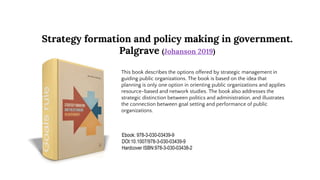
Strategy formation and policy making in government.
Palgrave (Johanson 2019)
This book describes the options offered by strategic management in
guiding public organizations. The book is based on the idea that
planning is only one option in orienting public organizations and applies
resource-based and network studies. The book also addresses the
strategic distinction between politics and administration, and illustrates
the connection between goal setting and performance of public
organizations.
Ebook: 978-3-030-03439-9
DOI:10.1007/978-3-030-03439-9
Hardcover ISBN:978-3-030-03438-2
4
Microstrategies in public agencies
Strategic design, internal strategic scanning, strategic governance
The lieutenant of a small Hungarian unit in the Alps sent a reconnaissance
unit into the icy wilderness. It snowed for two days, and the unit did not
return. The lieutenant feared that he had sent his own people to death,
but on the third day the unit came back. How had they made their way?
They said, “we considered ourselves lost and waited for the end. Then one of
us found a map in his pocket. That calmed us down. We lasted the
snowstorm, and with the map we discovered our bearings.”
The lieutenant had a good look at the map. He discovered that it was not a
map of the Alps, but a map of the Pyrenees (Weick 1995, 54)
6
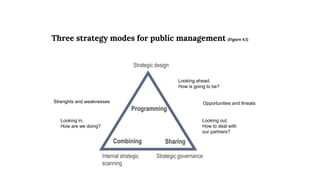
Internal strategic
scanning
Strategic governance
Strategic design
Programming
Combining Sharing
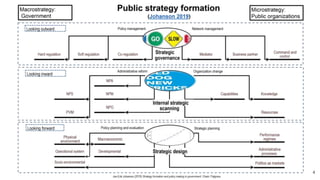
Three strategy modes for public management (Figure 4.1)
Looking ahead.
How is going to be?
Looking in.
How are we doing?
Looking out.
How to deal with
our partners?
Opportunities and threatsStrenghts and weaknesses
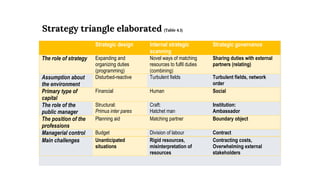
Strategy triangle elaborated (Table 4.1)
Strategic design Internal strategic
scanning
Strategic governance
The role of strategy Expanding and
organizing duties
(programming)
Novel ways of matching
resources to fulfil duties
(combining)
Sharing duties with external
partners (relating)
Assumption about
the environment
Disturbed-reactive Turbulent fields Turbulent fields, network
order
Primary type of
capital
Financial Human Social
The role of the
public manager
Structural:
Primus inter pares
Craft:
Hatchet man
Institution:
Ambassador
The position of the
professions
Planning aid Matching partner Boundary object
Managerial control Budget Division of labour Contract
Main challenges Unanticipated
situations
Rigid resources,
misinterpretation of
resources
Contracting costs,
Overwhelming external
stakeholders
Strategic design in public agencies
Politics, processes, performance
Internal strategic
scanning
Strategic governance
Strategic design
Programming
Combining Sharing
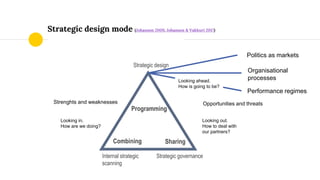
Strategic design mode (Johanson 2009, Johanson & Vakkuri 2017)
Looking in.
How are we doing?
Looking out.
How to deal with
our partners?
Opportunities and threatsStrenghts and weaknesses
Looking ahead.
How is going to be?
Politics as markets
Organisational
processes
Performance regimes
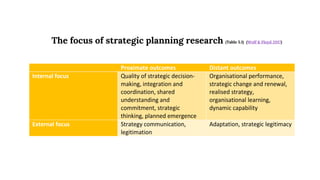
The focus of strategic planning research (Table 5.1) (Wolf & Floyd 2017)
Proximate outcomes Distant outcomes
Internal focus Quality of strategic decision-
making, integration and
coordination, shared
understanding and
commitment, strategic
thinking, planned emergence
Organisational performance,
strategic change and renewal,
realised strategy,
organisational learning,
dynamic capability
External focus Strategy communication,
legitimation
Adaptation, strategic legitimacy
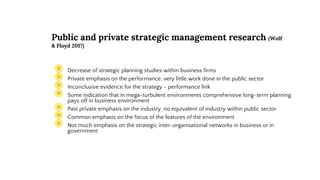
Public and private strategic management research (Wolf
& Floyd 2017)
◉ Decrease of strategic planning studies within business firms
◉ Private emphasis on the performance, very little work done in the public sector
◉ Inconclusive evidence for the strategy - performance link
◉ Some indication that in mega-turbulent environments comprehensive long-term planning
pays off in business environment
◉ Past private emphasis on the industry, no equivalent of industry within public sector
◉ Common emphasis on the focus of the features of the environment
◉ Not much emphasis on the strategic inter-organisational networks in business or in
government
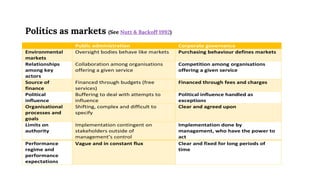
Politics as markets (See Nutt & Backoff 1992)
Public administration Corporate governance
Environmental
markets
Oversight bodies behave like markets Purchasing behaviour defines markets
Relationships
among key
actors
Collaboration among organisations
offering a given service
Competition among organisations
offering a given service
Source of
finance
Financed through budgets (free
services)
Financed through fees and charges
Political
influence
Buffering to deal with attempts to
influence
Political influence handled as
exceptions
Organisational
processes and
goals
Shifting, complex and difficult to
specify
Clear and agreed upon
Limits on
authority
Implementation contingent on
stakeholders outside of
management’s control
Implementation done by
management, who have the power to
act
Performance
regime and
performance
expectations
Vague and in constant flux Clear and fixed for long periods of
time
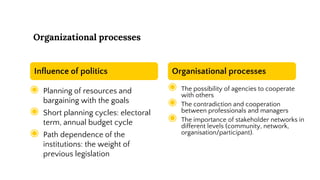
Organizational processes
Influence of politics
◉ Planning of resources and
bargaining with the goals
◉ Short planning cycles: electoral
term, annual budget cycle
◉ Path dependence of the
institutions: the weight of
previous legislation
Organisational processes
◉ The possibility of agencies to cooperate
with others
◉ The contradiction and cooperation
between professionals and managers
◉ The importance of stakeholder networks in
different levels (community, network,
organisation/participant).
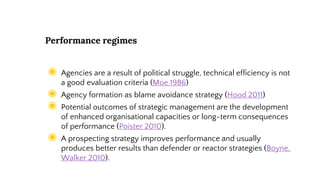
Performance regimes
◉ Agencies are a result of political struggle, technical efficiency is not
a good evaluation criteria (Moe 1986)
◉ Agency formation as blame avoidance strategy (Hood 2011)
◉ Potential outcomes of strategic management are the development
of enhanced organisational capacities or long-term consequences
of performance (Poister 2010).
◉ A prospecting strategy improves performance and usually
produces better results than defender or reactor strategies (Boyne,
Walker 2010).
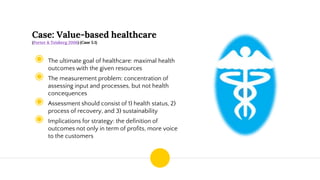
Case: Value-based healthcare
(Porter & Teisberg 2006) (Case 5.1)
◉ The ultimate goal of healthcare: maximal health
outcomes with the given resources
◉ The measurement problem: concentration of
assessing input and processes, but not health
concequences
◉ Assessment should consist of 1) health status, 2)
process of recovery, and 3) sustainability
◉ Implications for strategy: the definition of
outcomes not only in term of profits, more voice
to the customers
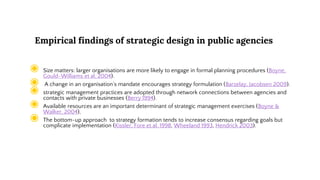
Empirical findings of strategic design in public agencies
◉ Size matters: larger organisations are more likely to engage in formal planning procedures (Boyne,
Gould-Williams et al. 2004).
◉ A change in an organisation’s mandate encourages strategy formulation (Barzelay, Jacobsen 2009).
◉ strategic management practices are adopted through network connections between agencies and
contacts with private businesses (Berry 1994).
◉ Available resources are an important determinant of strategic management exercises (Boyne &
Walker. 2004),
◉ The bottom-up approach to strategy formation tends to increase consensus regarding goals but
complicate implementation (Kissler, Fore et al. 1998, Wheeland 1993, Hendrick 2003).
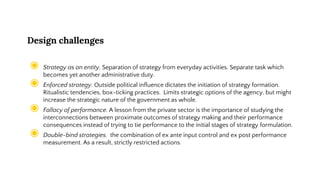
Design challenges
◉ Strategy as an entity. Separation of strategy from everyday activities. Separate task which
becomes yet another administrative duty.
◉ Enforced strategy. Outside political influence dictates the initiation of strategy formation.
Ritualistic tendencies, box-ticking practices. Limits strategic options of the agency, but might
increase the strategic nature of the government as whole.
◉ Fallacy of performance. A lesson from the private sector is the importance of studying the
interconnections between proximate outcomes of strategy making and their performance
consequences instead of trying to tie performance to the initial stages of strategy formulation.
◉ Double-bind strategies. the combination of ex ante input control and ex post performance
measurement. As a result, strictly restricted actions.
Internal strategic scanning in public agencies
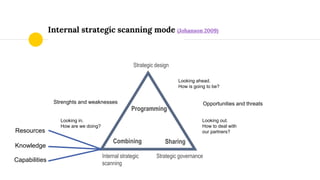
Resources, knowledge and capabilities
Internal strategic
scanning
Strategic governance
Strategic design
Programming
Combining Sharing
Internal strategic scanning mode (Johanson 2009)
Looking ahead.
How is going to be?
Looking in.
How are we doing?
Looking out.
How to deal with
our partners?
Opportunities and threatsStrenghts and weaknesses
Resources
Knowledge
Capabilities
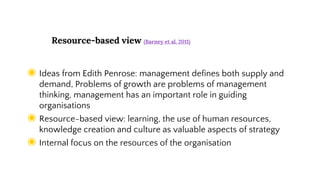
Resource-based view (Barney et al. 2011)
◉ Ideas from Edith Penrose: management defines both supply and
demand, Problems of growth are problems of management
thinking, management has an important role in guiding
organisations
◉ Resource-based view: learning, the use of human resources,
knowledge creation and culture as valuable aspects of strategy
◉ Internal focus on the resources of the organisation
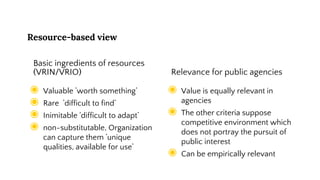
Resource-based view
Basic ingredients of resources
(VRIN/VRIO)
◉ Valuable ’worth something’
◉ Rare ’difficult to find’
◉ Inimitable ’difficult to adapt’
◉ non-substitutable, Organization
can capture them ’unique
qualities, available for use’
Relevance for public agencies
◉ Value is equally relevant in
agencies
◉ The other criteria suppose
competitive environment which
does not portray the pursuit of
public interest
◉ Can be empirically relevant
Resources in government agencies (Klein et al. 2010)
◉ Public agencies possess valuable resources (labour. Buildings, ICT)
○ Some of the resources have market value, some do not
◉ The aim is to create value, not so much to capture it
○ The firm tries to capture value, but often needs to produce some value to capture it
◉ Some value capture is needed for survival and solving of conflicts
◉ If value creation (and not competition) is the aim of the public agency there
is a need for autonomy to be able to find ways to create value and
performance based budgeting system to show success in the value creation
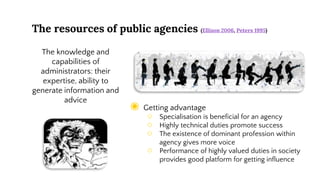
The resources of public agencies (Ellison 2006, Peters 1995)
◉ Getting advantage
○ Specialisation is beneficial for an agency
○ Highly technical duties promote success
○ The existence of dominant profession within
agency gives more voice
○ Performance of highly valued duties in society
provides good platform for getting influence
The knowledge and
capabilities of
administrators: their
expertise, ability to
generate information and
advice
Knowledge assets
◉ Tacit and explicit knowledge
○ In knowledge creation the cirulation between explicit and
implicit knowledge is important (Nonaka & Takeuchi 1995)
◉ Exploitation and exploration
○ Use of the existing knowledge is safe and predictable
○ Search for new knowledge demands time and energy,
results are unpredictable (March 1991)
Empirical knowledge findings within public agencies
◉ Lively interaction within teams combined with leader dominated
external interaction increases performance (Janhonen & Johanson 2011)
◉ Performance-related pay promotes knowledge sharing (Kim & Lee
2006)
◉ Leadership and management practices influence knowledge sharing
(Dawes & Cresswell 2012)
◉ Formality decreases knowledge sharing, trust increases it (Willem &
Buelens 2007)
Dynamic capabilities
(Eisenhardt & Martin 2000)
To build, integrate and reconfigure
internal and external competences to
respond to a rapidly changing
environment
Higher order construct that
encompasses bundles of routines but
also the use of different resources
The shifting character of the
environment; certain strategic responses
are required when timing is critical
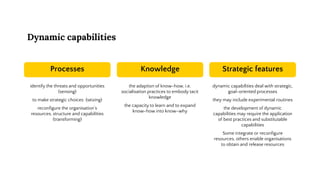
Dynamic capabilities
Processes
identify the threats and opportunities
(sensing)
to make strategic choices (seizing)
reconfigure the organisation’s
resources, structure and capabilities
(transforming)
Knowledge
the adaption of know-how, i.e.
socialisation practices to embody tacit
knowledge
the capacity to learn and to expand
know-how into know-why
Strategic features
dynamic capabilities deal with strategic,
goal-oriented processes
they may include experimental routines
the development of dynamic
capabilities may require the application
of best practices and substitutable
capabilities
Some integrate or reconfigure
resources, others enable organisations
to obtain and release resources
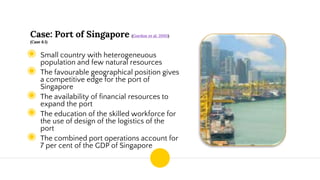
Case: Port of Singapore (Gordon et al. 2005)
(Case 6.1)
◉ Small country with heterogeneuous
population and few natural resources
◉ The favourable geographical position gives
a competitive edge for the port of
Singapore
◉ The availability of financial resources to
expand the port
◉ The education of the skilled workforce for
the use of design of the logistics of the
port
◉ The combined port operations account for
7 per cent of the GDP of Singapore
Empirical findings of dynamic capabilities with public
agencies
◉ The use of dynamic capabilities by experimentation: labour intensive &
time consuming. Balancing employee initiatives with organisational
guidance and control. (Pablo et al. 2007)
◉ Cross-functional teams support capability building (Daniel, Wilson
2003).
◉ Performance problems and slack resources increase the likelihood of
search for innovations (Salge, Vera 2013).
◉ Dynamic capabilities indirectly influence performance (Piening 2011)
Strategic governance in public agencies
Mediator, business partner and antitrust agent
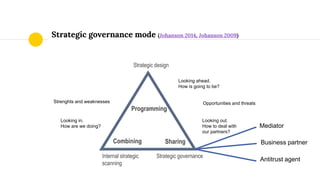
Internal strategic
scanning
Strategic governance
Strategic design
Programming
Combining Sharing
Strategic governance mode (Johanson 2014, Johanson 2009)
Looking ahead.
How is going to be?
Looking in.
How are we doing?
Looking out.
How to deal with
our partners?
Opportunities and threatsStrenghts and weaknesses
Mediator
Business partner
Antitrust agent
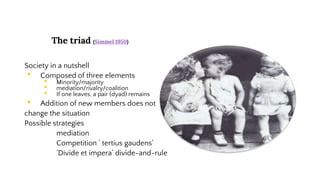
The triad (Simmel 1950)
Society in a nutshell
• Composed of three elements
• Minority/majority
• mediation/rivalry/coalition
• If one leaves, a pair (dyad) remains
• Addition of new members does not
change the situation
Possible strategies
mediation
Competition ’ tertius gaudens’
’Divide et impera’ divide-and-rule
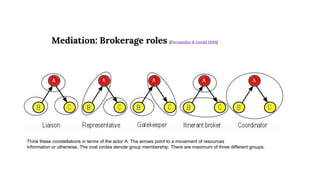
Mediation: Brokerage roles (Fernandez & Gould 1994)
Think these constellations in terms of the actor A. The arrows point to a movement of resources
Information or otherwise. The oval circles denote group membership. There are maximum of three different groups.
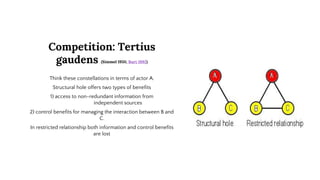
Competition: Tertius
gaudens (Simmel 1950, Burt 1992)
Think these constellations in terms of actor A.
Structural hole offers two types of benefits
1) access to non-redundant information from
independent sources
2) control benefits for managing the interaction between B and
C.
In restricted relationship both information and control benefits
are lost
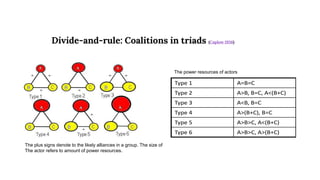
Divide-and-rule: Coalitions in triads (Caplow 1956)
Type 1 A=B=C
Type 2 A>B, B=C, A<(B+C)
Type 3 A<B, B=C
Type 4 A>(B+C), B=C
Type 5 A>B>C, A<(B+C)
Type 6 A>B>C, A>(B+C)
The power resources of actors
The plus signs denote to the likely alliances in a group. The size of
The actor refers to amount of power resources.
Types of public agencies (Dunleavy 1989)
◉ 1) delivery agencies, deliver services
and are labour intensive;
◉ 2) regulatory agencies, regulation of
other agencies or enterprises;
◉ 3) transfer agencies, payment of
government subsidies or entitlements
to individuals or enterprises;
◉ 4) contracts agencies, focus on
developing service and contracting out
to private-sector firms;
◉ 5) control agencies, grant provision to
other public-sector bureaucracies,
and to sub-national government
◉ 6) Taxing agencies, tax collection,
◉ 7) trading agencies, operate
commercially providing services to
other government bodies, full charge
◉ 8) servicing agencies, facilities or
services to other government bodies,
no charge
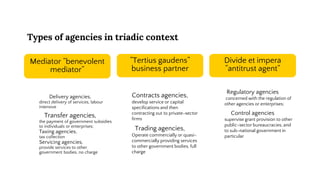
Types of agencies in triadic context
Mediator ”benevolent
mediator”
Delivery agencies,
direct delivery of services, labour
intensive
Transfer agencies,
the payment of government subsidies
to individuals or enterprises;
Taxing agencies,
tax collection
Servicing agencies,
provide services to other
government bodies, no charge
”Tertius gaudens”
business partner
Contracts agencies,
develop service or capital
specifications and then
contracting out to private-sector
firms
Trading agencies,
Operate commercially or quasi-
commercially providing services
to other government bodies, full
charge
Divide et impera
”antitrust agent”
Regulatory agencies
concerned with the regulation of
other agencies or enterprises;
Control agencies
supervise grant provision to other
public-sector bureaucracies, and
to sub-national government in
particular
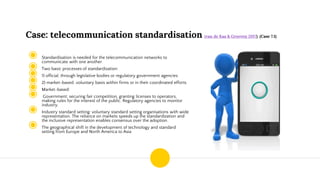
Case: telecommunication standardisation (van de Kaa & Greeven 2017) (Case 7.1)
◉ Standardisation is needed for the telecommunication networks to
communicate with one another
◉ Two basic processes of standardization:
◉ 1) official, through legislative bodies or regulatory government agencies
◉ 2) market-based. voluntary basis within firms or in their coordinated efforts
◉ Market-based:
◉ Government: securing fair competition, granting licenses to operators,
making rules for the interest of the public. Regulatory agencies to monitor
industry.
◉ Industry standard setting: voluntary standard setting organisations with wide
representation. The reliance on markets speeds up the standardization and
the inclusive representation enables consensus over the adoption.
◉ The geographical shift in the development of technology and standard
setting from Europe and North America to Asia
Implications
◉ Network as a result of agency role
◉ Emphasis on the immediate social surrounding
◉ Network rich world might be a relationship
poor world
○ Competition and regulation roles diminish socially
meaningful interaction (but all relationships are
socially embedded)

Public organizations micro strategy formation

  • 1.
    Strategy formation andpolicy making in government
  • 2.
    I am Jan-ErikJohanson I will walk you through the ideas of public strategic management. You can reach me at Jan-Erik.Johanson@tuni.fi Welcome to the show! 2
  • 3.
    Strategy formation andpolicy making in government. Palgrave (Johanson 2019) This book describes the options offered by strategic management in guiding public organizations. The book is based on the idea that planning is only one option in orienting public organizations and applies resource-based and network studies. The book also addresses the strategic distinction between politics and administration, and illustrates the connection between goal setting and performance of public organizations. Ebook: 978-3-030-03439-9 DOI:10.1007/978-3-030-03439-9 Hardcover ISBN:978-3-030-03438-2
  • 4.
  • 5.
    Microstrategies in publicagencies Strategic design, internal strategic scanning, strategic governance
  • 6.
    The lieutenant ofa small Hungarian unit in the Alps sent a reconnaissance unit into the icy wilderness. It snowed for two days, and the unit did not return. The lieutenant feared that he had sent his own people to death, but on the third day the unit came back. How had they made their way? They said, “we considered ourselves lost and waited for the end. Then one of us found a map in his pocket. That calmed us down. We lasted the snowstorm, and with the map we discovered our bearings.” The lieutenant had a good look at the map. He discovered that it was not a map of the Alps, but a map of the Pyrenees (Weick 1995, 54) 6
  • 7.
    Internal strategic scanning Strategic governance Strategicdesign Programming Combining Sharing Three strategy modes for public management (Figure 4.1) Looking ahead. How is going to be? Looking in. How are we doing? Looking out. How to deal with our partners? Opportunities and threatsStrenghts and weaknesses
  • 8.
    Strategy triangle elaborated(Table 4.1) Strategic design Internal strategic scanning Strategic governance The role of strategy Expanding and organizing duties (programming) Novel ways of matching resources to fulfil duties (combining) Sharing duties with external partners (relating) Assumption about the environment Disturbed-reactive Turbulent fields Turbulent fields, network order Primary type of capital Financial Human Social The role of the public manager Structural: Primus inter pares Craft: Hatchet man Institution: Ambassador The position of the professions Planning aid Matching partner Boundary object Managerial control Budget Division of labour Contract Main challenges Unanticipated situations Rigid resources, misinterpretation of resources Contracting costs, Overwhelming external stakeholders
  • 9.
    Strategic design inpublic agencies Politics, processes, performance
  • 10.
    Internal strategic scanning Strategic governance Strategicdesign Programming Combining Sharing Strategic design mode (Johanson 2009, Johanson & Vakkuri 2017) Looking in. How are we doing? Looking out. How to deal with our partners? Opportunities and threatsStrenghts and weaknesses Looking ahead. How is going to be? Politics as markets Organisational processes Performance regimes
  • 11.
    The focus ofstrategic planning research (Table 5.1) (Wolf & Floyd 2017) Proximate outcomes Distant outcomes Internal focus Quality of strategic decision- making, integration and coordination, shared understanding and commitment, strategic thinking, planned emergence Organisational performance, strategic change and renewal, realised strategy, organisational learning, dynamic capability External focus Strategy communication, legitimation Adaptation, strategic legitimacy
  • 12.
    Public and privatestrategic management research (Wolf & Floyd 2017) ◉ Decrease of strategic planning studies within business firms ◉ Private emphasis on the performance, very little work done in the public sector ◉ Inconclusive evidence for the strategy - performance link ◉ Some indication that in mega-turbulent environments comprehensive long-term planning pays off in business environment ◉ Past private emphasis on the industry, no equivalent of industry within public sector ◉ Common emphasis on the focus of the features of the environment ◉ Not much emphasis on the strategic inter-organisational networks in business or in government
  • 13.
    Politics as markets(See Nutt & Backoff 1992) Public administration Corporate governance Environmental markets Oversight bodies behave like markets Purchasing behaviour defines markets Relationships among key actors Collaboration among organisations offering a given service Competition among organisations offering a given service Source of finance Financed through budgets (free services) Financed through fees and charges Political influence Buffering to deal with attempts to influence Political influence handled as exceptions Organisational processes and goals Shifting, complex and difficult to specify Clear and agreed upon Limits on authority Implementation contingent on stakeholders outside of management’s control Implementation done by management, who have the power to act Performance regime and performance expectations Vague and in constant flux Clear and fixed for long periods of time
  • 14.
    Organizational processes Influence ofpolitics ◉ Planning of resources and bargaining with the goals ◉ Short planning cycles: electoral term, annual budget cycle ◉ Path dependence of the institutions: the weight of previous legislation Organisational processes ◉ The possibility of agencies to cooperate with others ◉ The contradiction and cooperation between professionals and managers ◉ The importance of stakeholder networks in different levels (community, network, organisation/participant).
  • 15.
    Performance regimes ◉ Agenciesare a result of political struggle, technical efficiency is not a good evaluation criteria (Moe 1986) ◉ Agency formation as blame avoidance strategy (Hood 2011) ◉ Potential outcomes of strategic management are the development of enhanced organisational capacities or long-term consequences of performance (Poister 2010). ◉ A prospecting strategy improves performance and usually produces better results than defender or reactor strategies (Boyne, Walker 2010).
  • 16.
    Case: Value-based healthcare (Porter& Teisberg 2006) (Case 5.1) ◉ The ultimate goal of healthcare: maximal health outcomes with the given resources ◉ The measurement problem: concentration of assessing input and processes, but not health concequences ◉ Assessment should consist of 1) health status, 2) process of recovery, and 3) sustainability ◉ Implications for strategy: the definition of outcomes not only in term of profits, more voice to the customers
  • 17.
    Empirical findings ofstrategic design in public agencies ◉ Size matters: larger organisations are more likely to engage in formal planning procedures (Boyne, Gould-Williams et al. 2004). ◉ A change in an organisation’s mandate encourages strategy formulation (Barzelay, Jacobsen 2009). ◉ strategic management practices are adopted through network connections between agencies and contacts with private businesses (Berry 1994). ◉ Available resources are an important determinant of strategic management exercises (Boyne & Walker. 2004), ◉ The bottom-up approach to strategy formation tends to increase consensus regarding goals but complicate implementation (Kissler, Fore et al. 1998, Wheeland 1993, Hendrick 2003).
  • 18.
    Design challenges ◉ Strategyas an entity. Separation of strategy from everyday activities. Separate task which becomes yet another administrative duty. ◉ Enforced strategy. Outside political influence dictates the initiation of strategy formation. Ritualistic tendencies, box-ticking practices. Limits strategic options of the agency, but might increase the strategic nature of the government as whole. ◉ Fallacy of performance. A lesson from the private sector is the importance of studying the interconnections between proximate outcomes of strategy making and their performance consequences instead of trying to tie performance to the initial stages of strategy formulation. ◉ Double-bind strategies. the combination of ex ante input control and ex post performance measurement. As a result, strictly restricted actions.
  • 19.
    Internal strategic scanningin public agencies Resources, knowledge and capabilities
  • 20.
    Internal strategic scanning Strategic governance Strategicdesign Programming Combining Sharing Internal strategic scanning mode (Johanson 2009) Looking ahead. How is going to be? Looking in. How are we doing? Looking out. How to deal with our partners? Opportunities and threatsStrenghts and weaknesses Resources Knowledge Capabilities
  • 21.
    Resource-based view (Barneyet al. 2011) ◉ Ideas from Edith Penrose: management defines both supply and demand, Problems of growth are problems of management thinking, management has an important role in guiding organisations ◉ Resource-based view: learning, the use of human resources, knowledge creation and culture as valuable aspects of strategy ◉ Internal focus on the resources of the organisation
  • 22.
    Resource-based view Basic ingredientsof resources (VRIN/VRIO) ◉ Valuable ’worth something’ ◉ Rare ’difficult to find’ ◉ Inimitable ’difficult to adapt’ ◉ non-substitutable, Organization can capture them ’unique qualities, available for use’ Relevance for public agencies ◉ Value is equally relevant in agencies ◉ The other criteria suppose competitive environment which does not portray the pursuit of public interest ◉ Can be empirically relevant
  • 23.
    Resources in governmentagencies (Klein et al. 2010) ◉ Public agencies possess valuable resources (labour. Buildings, ICT) ○ Some of the resources have market value, some do not ◉ The aim is to create value, not so much to capture it ○ The firm tries to capture value, but often needs to produce some value to capture it ◉ Some value capture is needed for survival and solving of conflicts ◉ If value creation (and not competition) is the aim of the public agency there is a need for autonomy to be able to find ways to create value and performance based budgeting system to show success in the value creation
  • 24.
    The resources ofpublic agencies (Ellison 2006, Peters 1995) ◉ Getting advantage ○ Specialisation is beneficial for an agency ○ Highly technical duties promote success ○ The existence of dominant profession within agency gives more voice ○ Performance of highly valued duties in society provides good platform for getting influence The knowledge and capabilities of administrators: their expertise, ability to generate information and advice
  • 25.
    Knowledge assets ◉ Tacitand explicit knowledge ○ In knowledge creation the cirulation between explicit and implicit knowledge is important (Nonaka & Takeuchi 1995) ◉ Exploitation and exploration ○ Use of the existing knowledge is safe and predictable ○ Search for new knowledge demands time and energy, results are unpredictable (March 1991)
  • 26.
    Empirical knowledge findingswithin public agencies ◉ Lively interaction within teams combined with leader dominated external interaction increases performance (Janhonen & Johanson 2011) ◉ Performance-related pay promotes knowledge sharing (Kim & Lee 2006) ◉ Leadership and management practices influence knowledge sharing (Dawes & Cresswell 2012) ◉ Formality decreases knowledge sharing, trust increases it (Willem & Buelens 2007)
  • 27.
    Dynamic capabilities (Eisenhardt &Martin 2000) To build, integrate and reconfigure internal and external competences to respond to a rapidly changing environment Higher order construct that encompasses bundles of routines but also the use of different resources The shifting character of the environment; certain strategic responses are required when timing is critical
  • 28.
    Dynamic capabilities Processes identify thethreats and opportunities (sensing) to make strategic choices (seizing) reconfigure the organisation’s resources, structure and capabilities (transforming) Knowledge the adaption of know-how, i.e. socialisation practices to embody tacit knowledge the capacity to learn and to expand know-how into know-why Strategic features dynamic capabilities deal with strategic, goal-oriented processes they may include experimental routines the development of dynamic capabilities may require the application of best practices and substitutable capabilities Some integrate or reconfigure resources, others enable organisations to obtain and release resources
  • 29.
    Case: Port ofSingapore (Gordon et al. 2005) (Case 6.1) ◉ Small country with heterogeneuous population and few natural resources ◉ The favourable geographical position gives a competitive edge for the port of Singapore ◉ The availability of financial resources to expand the port ◉ The education of the skilled workforce for the use of design of the logistics of the port ◉ The combined port operations account for 7 per cent of the GDP of Singapore
  • 30.
    Empirical findings ofdynamic capabilities with public agencies ◉ The use of dynamic capabilities by experimentation: labour intensive & time consuming. Balancing employee initiatives with organisational guidance and control. (Pablo et al. 2007) ◉ Cross-functional teams support capability building (Daniel, Wilson 2003). ◉ Performance problems and slack resources increase the likelihood of search for innovations (Salge, Vera 2013). ◉ Dynamic capabilities indirectly influence performance (Piening 2011)
  • 31.
    Strategic governance inpublic agencies Mediator, business partner and antitrust agent
  • 32.
    Internal strategic scanning Strategic governance Strategicdesign Programming Combining Sharing Strategic governance mode (Johanson 2014, Johanson 2009) Looking ahead. How is going to be? Looking in. How are we doing? Looking out. How to deal with our partners? Opportunities and threatsStrenghts and weaknesses Mediator Business partner Antitrust agent
  • 33.
    The triad (Simmel1950) Society in a nutshell • Composed of three elements • Minority/majority • mediation/rivalry/coalition • If one leaves, a pair (dyad) remains • Addition of new members does not change the situation Possible strategies mediation Competition ’ tertius gaudens’ ’Divide et impera’ divide-and-rule
  • 34.
    Mediation: Brokerage roles(Fernandez & Gould 1994) Think these constellations in terms of the actor A. The arrows point to a movement of resources Information or otherwise. The oval circles denote group membership. There are maximum of three different groups.
  • 35.
    Competition: Tertius gaudens (Simmel1950, Burt 1992) Think these constellations in terms of actor A. Structural hole offers two types of benefits 1) access to non-redundant information from independent sources 2) control benefits for managing the interaction between B and C. In restricted relationship both information and control benefits are lost
  • 36.
    Divide-and-rule: Coalitions intriads (Caplow 1956) Type 1 A=B=C Type 2 A>B, B=C, A<(B+C) Type 3 A<B, B=C Type 4 A>(B+C), B=C Type 5 A>B>C, A<(B+C) Type 6 A>B>C, A>(B+C) The power resources of actors The plus signs denote to the likely alliances in a group. The size of The actor refers to amount of power resources.
  • 37.
    Types of publicagencies (Dunleavy 1989) ◉ 1) delivery agencies, deliver services and are labour intensive; ◉ 2) regulatory agencies, regulation of other agencies or enterprises; ◉ 3) transfer agencies, payment of government subsidies or entitlements to individuals or enterprises; ◉ 4) contracts agencies, focus on developing service and contracting out to private-sector firms; ◉ 5) control agencies, grant provision to other public-sector bureaucracies, and to sub-national government ◉ 6) Taxing agencies, tax collection, ◉ 7) trading agencies, operate commercially providing services to other government bodies, full charge ◉ 8) servicing agencies, facilities or services to other government bodies, no charge
  • 38.
    Types of agenciesin triadic context Mediator ”benevolent mediator” Delivery agencies, direct delivery of services, labour intensive Transfer agencies, the payment of government subsidies to individuals or enterprises; Taxing agencies, tax collection Servicing agencies, provide services to other government bodies, no charge ”Tertius gaudens” business partner Contracts agencies, develop service or capital specifications and then contracting out to private-sector firms Trading agencies, Operate commercially or quasi- commercially providing services to other government bodies, full charge Divide et impera ”antitrust agent” Regulatory agencies concerned with the regulation of other agencies or enterprises; Control agencies supervise grant provision to other public-sector bureaucracies, and to sub-national government in particular
  • 39.
    Case: telecommunication standardisation(van de Kaa & Greeven 2017) (Case 7.1) ◉ Standardisation is needed for the telecommunication networks to communicate with one another ◉ Two basic processes of standardization: ◉ 1) official, through legislative bodies or regulatory government agencies ◉ 2) market-based. voluntary basis within firms or in their coordinated efforts ◉ Market-based: ◉ Government: securing fair competition, granting licenses to operators, making rules for the interest of the public. Regulatory agencies to monitor industry. ◉ Industry standard setting: voluntary standard setting organisations with wide representation. The reliance on markets speeds up the standardization and the inclusive representation enables consensus over the adoption. ◉ The geographical shift in the development of technology and standard setting from Europe and North America to Asia
  • 40.
    Implications ◉ Network asa result of agency role ◉ Emphasis on the immediate social surrounding ◉ Network rich world might be a relationship poor world ○ Competition and regulation roles diminish socially meaningful interaction (but all relationships are socially embedded)