trESS seminar Oporto, 20 May 2011


    Scope of the Regulations
               and
General Principles of Coordination


         Filip Van Overmeiren
            Ghent University
Overview
Overview of the presentation
• Scope of the Regulations
      •   Personal scope
      •   Material scope
• General principles of coordination
      •   Determination of the applicable legislation (cf. Mr. J.
          Tägger)
      •   Equal treatment (+ Assimilation of facts)
      •   Aggregation of periods
      •   Export of benefits
      •   Administrative cooperation (cf. Mr. A. Soares)
Personal scope
                               Scope of the Regulations
•   “Nationals of a Member State” (+ stateless persons and refugees
    residing in a Member State) “who are or have been subject to the
    legislation of one or more Member States” AND their “family
    members and survivors” (Article 2 Reg. 883/2004)
    •     “MS nationals”: EU citizenship / Result of the continuous
          extension of the personal scope / Substantial simplification
    •     “Subject to the legislation”: insurance for one risk suffices
    •     “Family members”, irrespective of their nationality: national
          legislation under which the benefits are provided or Reg.
          definition (spouse, minor /dependent children)

•   “Third country nationals”
    •    Regulation 1231/2010: Reg. 883/2004 applicable to TCN
         (since 1/1/11)
    •    2 conditions: legally residing in the EU + cross-border element
    •    OUT: UK (still Regulation 1408/71 via Reg. 859/2003) and
         Denmark
    •    EFTA (ISL, LIE, NO, CH): still Reg. 1408/71 and Reg. 574/72
         until concerned Agreements are adapted
Material scope Scope of the Regulations

Only in cross-border situations, not in “purely internal situations”

•Only for schemes based on “legislation”, not for contractual
schemes

•IN:

         sickness benefits, maternity and equivalent paternity
benefits, invalidity benefits, old-age benefits, survivors’ benefits,
benefits in respect of accidents at work and occupational
diseases, death grants, unemployment benefits, pre-retirement
benefits and family benefits (Article 3 Reg. 883/2004)

       •   Classical social security risks (cf. ILO Convention No 102) >< “Open
           material scope” in EC proposal for Reg. 883/2004
       •   New: paternity benefits (><family benefits) and pre-retirement benefits
           (marginal)
Material scope Scope of the Regulations
OUT: “social and medical assistance”, “benefits in relation to
which a MS assumes the liability for damages and provides for
compensation”
    •   No definition of “social assistance”; National qualification irrelevant;
        Difficult distinction
    •   Social security (no individual assessment, legally defined position of
        beneficiary, related to social risk defined in the Regulation) vs. Social
        assistance (minimum means of subsistence, based on need)
    •   “Benefits in relation to which a MS assumes the liability for damages
        and provides for compensation”: Benefits for victims of war, crime,
        assassination or terrorist acts, …
    •   Also out: Advances of maintenance payments (>< ECJ) and special
        childbirth/adoption allowances can be excluded from “family
        benefits” concept by insertion in Annex I
    •   BUT only excluded from 883/2004, not entirely excluded from EU
        law: Reg. 1612/68, TFEU.
Scope of the Regulations
Material scope
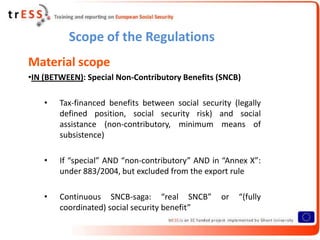
•IN (BETWEEN): Special Non-Contributory Benefits (SNCB)

    •   Tax-financed benefits between social security (legally
        defined position, social security risk) and social
        assistance (non-contributory, minimum means of
        subsistence)

    •   If “special” AND “non-contributory” AND in “Annex X”:
        under 883/2004, but excluded from the export rule

    •   Continuous SNCB-saga: “real SNCB”          or   “(fully
        coordinated) social security benefit”
Principles of Coordination
Goal of EU Social Security
Coordination
What : preventing the loss of social
security rights due to movement
within the EU
How : General principles of
coordination + detailed coordination
rules
Equal treatment
                       Principles of Coordination
General and fundamental principle of EU law - cf. Articles 18, 21,
45, 49 and 56 TFEU

•Article 4 Reg. 883/2004: “enjoy the same benefits” and “subject
to the same obligations” as nationals: equal treatment under the
national social security legislation [irrespective of their place of
residence (EU or not)]

•Broad scope: direct discrimination / indirect discrimination / non-
discriminatory restriction of free movement
Principles of Coordination
Assimilation of facts (events, benefits and
income)
FROM several ECJ cases TO “general principle” (Article 5 Reg.
883/2004) - reinforcement of the equal treatment provision

•Give the same legal effects to:
    •    facts or events occurred in another MS as if they had taken place on its
         own territory
    •    receipt of benefits and other income as if they were received according to
         the legislation of the competent MS
    •    E.g.: child-raising periods, accidents at work, receipt of a pension for SNCB


•(1) No influence on “determination of applicable legislation” or
“aggregration of periods” (2) no overlapping of benefits of the same
kind for the same period and (3) proportionality principle governs
assimilation
Principles of Coordination
               Aggregation of periods

•From several provisions in Reg. 1408/71 to “general principle”
under Reg. 883/2004 (Article 6 Reg. 883/2004)

•Aggregation = competent institution shall, to the extent necessary,
take into account periods completed in another MS

•Periods of: insurance / employment or self-employment /
residence

•For: right to benefits / coverage by legislation / access to or the
exemption from compulsory, optional continued or voluntary
insurance

•Excluded: Pre-retirement benefits
Principles of Coordination
Export of benefits
Waiving of residence clauses for all cash benefits (Article 7 Reg.
883/2004)

•No withdrawal, reduction, amendment or suspension because
the beneficiary or his family resides in another MS than the MS in
which the providing institution is situated: unrestricted payment in
the MS to which the person has moved

•Excluded: SNCB (no export) / Unemployment benefits (limited
exportability)
Information and administrative
       Principles of Coordination
cooperation
No coordination without information and cooperation: “Clear and
more effective cooperation between social security institutions is a
key factor in allowing the persons concerned by Reg. 883/2004 to
access their rights as quickly as possible and under optimum
conditions” (Recital 2 Impl. Reg. 987/2009)

•Duty of mutual information and cooperation for institutions and
citizens – Enhanced cooperation

•Better dialogue between the institutions and competent
authorities in case of disagreement (cf. dialogue and reconciliation
procedure)

•EESSI: social security coordination entered the 21st Century;
towards exclusively electronic exchange
Scope and Principles of Coordination
Conclusion

•   Very broad personal scope: socially insured persons on
    the move in the EU

•   Rather static material scope: “social security benefits”

•   Ingenious mix of coordination principles to preserve
    social security rights
trESS


        Thank you!


Filip.VanOvermeiren@UGent.be

2011 - Scope of the Regulations and General Principles of Coördination

  • 1.
    trESS seminar Oporto,20 May 2011 Scope of the Regulations and General Principles of Coordination Filip Van Overmeiren Ghent University
  • 2.
    Overview Overview of thepresentation • Scope of the Regulations • Personal scope • Material scope • General principles of coordination • Determination of the applicable legislation (cf. Mr. J. Tägger) • Equal treatment (+ Assimilation of facts) • Aggregation of periods • Export of benefits • Administrative cooperation (cf. Mr. A. Soares)
  • 3.
    Personal scope Scope of the Regulations • “Nationals of a Member State” (+ stateless persons and refugees residing in a Member State) “who are or have been subject to the legislation of one or more Member States” AND their “family members and survivors” (Article 2 Reg. 883/2004) • “MS nationals”: EU citizenship / Result of the continuous extension of the personal scope / Substantial simplification • “Subject to the legislation”: insurance for one risk suffices • “Family members”, irrespective of their nationality: national legislation under which the benefits are provided or Reg. definition (spouse, minor /dependent children) • “Third country nationals” • Regulation 1231/2010: Reg. 883/2004 applicable to TCN (since 1/1/11) • 2 conditions: legally residing in the EU + cross-border element • OUT: UK (still Regulation 1408/71 via Reg. 859/2003) and Denmark • EFTA (ISL, LIE, NO, CH): still Reg. 1408/71 and Reg. 574/72 until concerned Agreements are adapted
  • 4.
    Material scope Scopeof the Regulations Only in cross-border situations, not in “purely internal situations” •Only for schemes based on “legislation”, not for contractual schemes •IN: sickness benefits, maternity and equivalent paternity benefits, invalidity benefits, old-age benefits, survivors’ benefits, benefits in respect of accidents at work and occupational diseases, death grants, unemployment benefits, pre-retirement benefits and family benefits (Article 3 Reg. 883/2004) • Classical social security risks (cf. ILO Convention No 102) >< “Open material scope” in EC proposal for Reg. 883/2004 • New: paternity benefits (><family benefits) and pre-retirement benefits (marginal)
  • 5.
    Material scope Scopeof the Regulations OUT: “social and medical assistance”, “benefits in relation to which a MS assumes the liability for damages and provides for compensation” • No definition of “social assistance”; National qualification irrelevant; Difficult distinction • Social security (no individual assessment, legally defined position of beneficiary, related to social risk defined in the Regulation) vs. Social assistance (minimum means of subsistence, based on need) • “Benefits in relation to which a MS assumes the liability for damages and provides for compensation”: Benefits for victims of war, crime, assassination or terrorist acts, … • Also out: Advances of maintenance payments (>< ECJ) and special childbirth/adoption allowances can be excluded from “family benefits” concept by insertion in Annex I • BUT only excluded from 883/2004, not entirely excluded from EU law: Reg. 1612/68, TFEU.
  • 6.
    Scope of theRegulations Material scope •IN (BETWEEN): Special Non-Contributory Benefits (SNCB) • Tax-financed benefits between social security (legally defined position, social security risk) and social assistance (non-contributory, minimum means of subsistence) • If “special” AND “non-contributory” AND in “Annex X”: under 883/2004, but excluded from the export rule • Continuous SNCB-saga: “real SNCB” or “(fully coordinated) social security benefit”
  • 7.
    Principles of Coordination Goalof EU Social Security Coordination What : preventing the loss of social security rights due to movement within the EU How : General principles of coordination + detailed coordination rules
  • 8.
    Equal treatment Principles of Coordination General and fundamental principle of EU law - cf. Articles 18, 21, 45, 49 and 56 TFEU •Article 4 Reg. 883/2004: “enjoy the same benefits” and “subject to the same obligations” as nationals: equal treatment under the national social security legislation [irrespective of their place of residence (EU or not)] •Broad scope: direct discrimination / indirect discrimination / non- discriminatory restriction of free movement
  • 9.
    Principles of Coordination Assimilationof facts (events, benefits and income) FROM several ECJ cases TO “general principle” (Article 5 Reg. 883/2004) - reinforcement of the equal treatment provision •Give the same legal effects to: • facts or events occurred in another MS as if they had taken place on its own territory • receipt of benefits and other income as if they were received according to the legislation of the competent MS • E.g.: child-raising periods, accidents at work, receipt of a pension for SNCB •(1) No influence on “determination of applicable legislation” or “aggregration of periods” (2) no overlapping of benefits of the same kind for the same period and (3) proportionality principle governs assimilation
  • 10.
    Principles of Coordination Aggregation of periods •From several provisions in Reg. 1408/71 to “general principle” under Reg. 883/2004 (Article 6 Reg. 883/2004) •Aggregation = competent institution shall, to the extent necessary, take into account periods completed in another MS •Periods of: insurance / employment or self-employment / residence •For: right to benefits / coverage by legislation / access to or the exemption from compulsory, optional continued or voluntary insurance •Excluded: Pre-retirement benefits
  • 11.
    Principles of Coordination Exportof benefits Waiving of residence clauses for all cash benefits (Article 7 Reg. 883/2004) •No withdrawal, reduction, amendment or suspension because the beneficiary or his family resides in another MS than the MS in which the providing institution is situated: unrestricted payment in the MS to which the person has moved •Excluded: SNCB (no export) / Unemployment benefits (limited exportability)
  • 12.
    Information and administrative Principles of Coordination cooperation No coordination without information and cooperation: “Clear and more effective cooperation between social security institutions is a key factor in allowing the persons concerned by Reg. 883/2004 to access their rights as quickly as possible and under optimum conditions” (Recital 2 Impl. Reg. 987/2009) •Duty of mutual information and cooperation for institutions and citizens – Enhanced cooperation •Better dialogue between the institutions and competent authorities in case of disagreement (cf. dialogue and reconciliation procedure) •EESSI: social security coordination entered the 21st Century; towards exclusively electronic exchange
  • 13.
    Scope and Principlesof Coordination Conclusion • Very broad personal scope: socially insured persons on the move in the EU • Rather static material scope: “social security benefits” • Ingenious mix of coordination principles to preserve social security rights
  • 14.
    trESS Thank you! Filip.VanOvermeiren@UGent.be