Organisation and coordination of a network on the EU
coordination of social security schemes in EU/EEA/CH
training and reporting on
European Social Security
trESS III
 trESS was established in 2005 and is financed by the
European Commission (DG Employment, Social Affairs
and Inclusion)
 It is implemented by Ghent University in collaboration
with independent experts from 32 countries
Objectives
 increase the knowledge base on the coordination
regulations
 build networks between people professionally
involved in social security coordination all over Europe
 report to the EC on the implementation of the EU
Regulations
 undertake legal and statistical analysis with regard to
topics connected with social security coordination
 provide analytical support to the European
Commission in relation to the application of social
security coordination legislation
Main activities
 training & networking
 information-sharing
 reporting & analysis
Highlights trESS III
 National seminars replaced by ‘specialised’
seminars
 trESS also covers the EFTA countries (Norway,
Iceland, Liechtenstein, Switzerland) and, from 1
July 2013 onwards, Croatia
 Some new tasks added
 analytical support to the EC (requests for information,
contribution to studies)
 mapping and analysis of statistics on social security
coordination
 Network extended with specific areas of
expertise
Training & Networking
Target groups
Social security institutions and authorities
Social partners
NGOs
Judges and lawyers
Independent experts confronted with problems of implementation
Activities:
Specialised seminars
E-learning module
Contact database
Regular E-newsletters
Social media
Promotion through other initiatives, notably MISSOC
Specialised seminars
 Ca. 10 seminars per year, determined in accordance with a
procedure of “internal calls for proposals”
 Wide variety of seminars
 Awareness-raising, practically-oriented or analytical
 General or focused on one particular topic/target group
 National, bi-or multilateral, in cooperation with other stakeholders
 Attended by experts from the Commission and trESS
 Reports written by seminar reporters
 Agenda and PPT presentations posted on trESS website
 Participant satisfaction is monitored – Please complete the brief
participant satisfaction survey distributed at the seminar
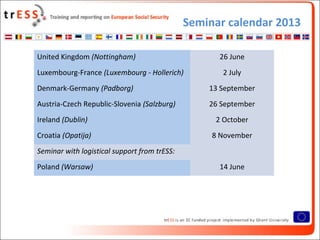
Seminar calendar 2013
• Cases*
United Kingdom (Nottingham) 26 June
Luxembourg-France (Luxembourg - Hollerich) 2 July
Denmark-Germany (Padborg) 13 September
Austria-Czech Republic-Slovenia (Salzburg) 26 September
Ireland (Dublin) 2 October
Croatia (Opatija) 8 November
Seminar with logistical support from trESS:
Poland (Warsaw) 14 June
Networking
How to join?
• By sending a request to join
to tress@ugent.be
• By submitting a request via
the website
Current members are kindly
requested to keep their details
updated
Austria 73 Hungary 58 Slovak Rep. 41
Belgium 126 Ireland 29 Slovenia 72
Bulgaria 73 Italy 71 UK 130
Cyprus 106 Lithuania 45 Switzerland 3
Czech Rep. 72 Luxembourg 37 Norway 1
Germany 51 Latvia 50 Liechtenstein 1
Denmark 51 Malta 110 Iceland 1
Estonia 55 The Netherlands 110 Other 12
Greece 54 Poland 160
Spain 73 Portugal 128
TOTAL 2211
Finland 119 Romania 111 * Status June 2013
France 155 Sweden 45
Networking
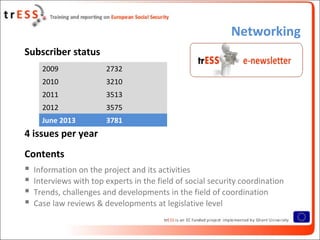
Subscriber status
4 issues per year
Contents
 Information on the project and its activities
 Interviews with top experts in the field of social security coordination
 Trends, challenges and developments in the field of coordination
 Case law reviews & developments at legislative level
2009 2732
2010 3210
2011 3513
2012 3575
June 2013 3781
Information-sharing: www.tress-network.org
Open access
 seminar information
 e-learning
 national resources
 European resources
 e-newsletter
Restricted access
 contact database
 internal project matters
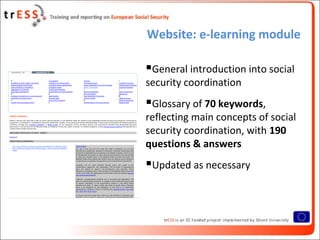
Website: e-learning module
General introduction into social
security coordination
Glossary of 70 keywords,
reflecting main concepts of social
security coordination, with 190
questions & answers
Updated as necessary
Website: national resources
 National case law
 National bibliography
 Seminar information
Website: European resources
 European Reports (2008 -)
 Think Tank Reports (2008 -) & Analytical Reports (2011 -)
 Texts of the main Regulations (in all available languages)
 Regulations database
 Articles of the Regulations linked
with relevant information
 E.g. Articles of Regulation 883/2004
links with implementing rules
links with related ECJ case law
links with Adm.Comm. Decisions
NEW: social media pages
 trESS on LinkedIn (431 members) and Facebook (162
members)
 Regular news updates on EU social security coordination
 Messages, comments and opinions
 How to join?
 Become a member of LinkedIn
and/or Facebook
 Join the trESS pages
 A direct link to the trESS social
media pages is available on the
homepage of the trESS website
Reporting on implementation
Yearly reports on the implementation of the
coordination regulations in 32 countries
 Either a European Report (covering application of the
Regulations as a whole), or
 a Thematic Report, focusing on a specific topic of
coordination
In 2013: European Report (available December)
Based on contributions of national experts
Legal analysis
“Think Tank Study”: Legal research with a long-term
perspective dealing with strategic questions
Conducted by a Think Tank, composed each year
from a pool of analytical experts
In 2013: “Key challenges for the social security
coordination Regulations in the perspective of 2020”
(available December)
Legal analysis
“Analytical study”: legal research based on fact-
finding with relation to ad hoc analytical needs
Conducted by an analytical study group, composed
each year from a pool of analytical experts
In 2013: “Assessment of the impact of the revision of
selected provisions of the Regulations”
Contact trESS
www.tress-network.org
tress@ugent.be

2013 - trESS presentation EN

  • 1.
    Organisation and coordinationof a network on the EU coordination of social security schemes in EU/EEA/CH training and reporting on European Social Security trESS III  trESS was established in 2005 and is financed by the European Commission (DG Employment, Social Affairs and Inclusion)  It is implemented by Ghent University in collaboration with independent experts from 32 countries
  • 2.
    Objectives  increase theknowledge base on the coordination regulations  build networks between people professionally involved in social security coordination all over Europe  report to the EC on the implementation of the EU Regulations  undertake legal and statistical analysis with regard to topics connected with social security coordination  provide analytical support to the European Commission in relation to the application of social security coordination legislation
  • 3.
    Main activities  training& networking  information-sharing  reporting & analysis
  • 4.
    Highlights trESS III National seminars replaced by ‘specialised’ seminars  trESS also covers the EFTA countries (Norway, Iceland, Liechtenstein, Switzerland) and, from 1 July 2013 onwards, Croatia  Some new tasks added  analytical support to the EC (requests for information, contribution to studies)  mapping and analysis of statistics on social security coordination  Network extended with specific areas of expertise
  • 5.
    Training & Networking Targetgroups Social security institutions and authorities Social partners NGOs Judges and lawyers Independent experts confronted with problems of implementation Activities: Specialised seminars E-learning module Contact database Regular E-newsletters Social media Promotion through other initiatives, notably MISSOC
  • 6.
    Specialised seminars  Ca.10 seminars per year, determined in accordance with a procedure of “internal calls for proposals”  Wide variety of seminars  Awareness-raising, practically-oriented or analytical  General or focused on one particular topic/target group  National, bi-or multilateral, in cooperation with other stakeholders  Attended by experts from the Commission and trESS  Reports written by seminar reporters  Agenda and PPT presentations posted on trESS website  Participant satisfaction is monitored – Please complete the brief participant satisfaction survey distributed at the seminar
  • 7.
    Seminar calendar 2013 •Cases* United Kingdom (Nottingham) 26 June Luxembourg-France (Luxembourg - Hollerich) 2 July Denmark-Germany (Padborg) 13 September Austria-Czech Republic-Slovenia (Salzburg) 26 September Ireland (Dublin) 2 October Croatia (Opatija) 8 November Seminar with logistical support from trESS: Poland (Warsaw) 14 June
  • 8.
    Networking How to join? •By sending a request to join to tress@ugent.be • By submitting a request via the website Current members are kindly requested to keep their details updated Austria 73 Hungary 58 Slovak Rep. 41 Belgium 126 Ireland 29 Slovenia 72 Bulgaria 73 Italy 71 UK 130 Cyprus 106 Lithuania 45 Switzerland 3 Czech Rep. 72 Luxembourg 37 Norway 1 Germany 51 Latvia 50 Liechtenstein 1 Denmark 51 Malta 110 Iceland 1 Estonia 55 The Netherlands 110 Other 12 Greece 54 Poland 160 Spain 73 Portugal 128 TOTAL 2211 Finland 119 Romania 111 * Status June 2013 France 155 Sweden 45
  • 9.
    Networking Subscriber status 4 issuesper year Contents  Information on the project and its activities  Interviews with top experts in the field of social security coordination  Trends, challenges and developments in the field of coordination  Case law reviews & developments at legislative level 2009 2732 2010 3210 2011 3513 2012 3575 June 2013 3781
  • 10.
    Information-sharing: www.tress-network.org Open access seminar information  e-learning  national resources  European resources  e-newsletter Restricted access  contact database  internal project matters
  • 11.
    Website: e-learning module Generalintroduction into social security coordination Glossary of 70 keywords, reflecting main concepts of social security coordination, with 190 questions & answers Updated as necessary
  • 12.
    Website: national resources National case law  National bibliography  Seminar information
  • 13.
    Website: European resources European Reports (2008 -)  Think Tank Reports (2008 -) & Analytical Reports (2011 -)  Texts of the main Regulations (in all available languages)  Regulations database  Articles of the Regulations linked with relevant information  E.g. Articles of Regulation 883/2004 links with implementing rules links with related ECJ case law links with Adm.Comm. Decisions
  • 14.
    NEW: social mediapages  trESS on LinkedIn (431 members) and Facebook (162 members)  Regular news updates on EU social security coordination  Messages, comments and opinions  How to join?  Become a member of LinkedIn and/or Facebook  Join the trESS pages  A direct link to the trESS social media pages is available on the homepage of the trESS website
  • 15.
    Reporting on implementation Yearlyreports on the implementation of the coordination regulations in 32 countries  Either a European Report (covering application of the Regulations as a whole), or  a Thematic Report, focusing on a specific topic of coordination In 2013: European Report (available December) Based on contributions of national experts
  • 16.
    Legal analysis “Think TankStudy”: Legal research with a long-term perspective dealing with strategic questions Conducted by a Think Tank, composed each year from a pool of analytical experts In 2013: “Key challenges for the social security coordination Regulations in the perspective of 2020” (available December)
  • 17.
    Legal analysis “Analytical study”:legal research based on fact- finding with relation to ad hoc analytical needs Conducted by an analytical study group, composed each year from a pool of analytical experts In 2013: “Assessment of the impact of the revision of selected provisions of the Regulations”
  • 18.