The organization of social security coordination  Steven Segaert
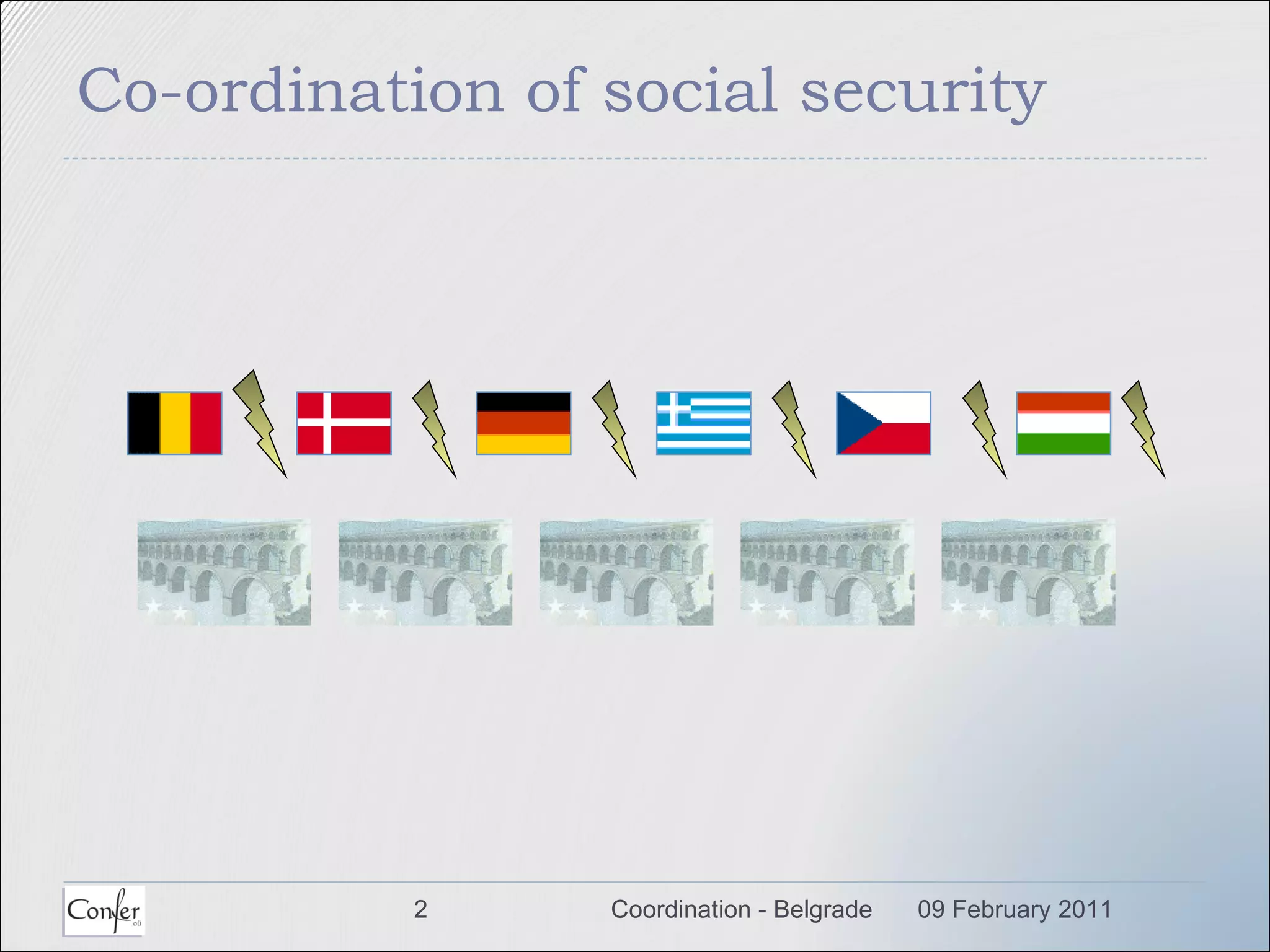
Co-ordination of social security  09 February 2011 Coordination - Belgrade
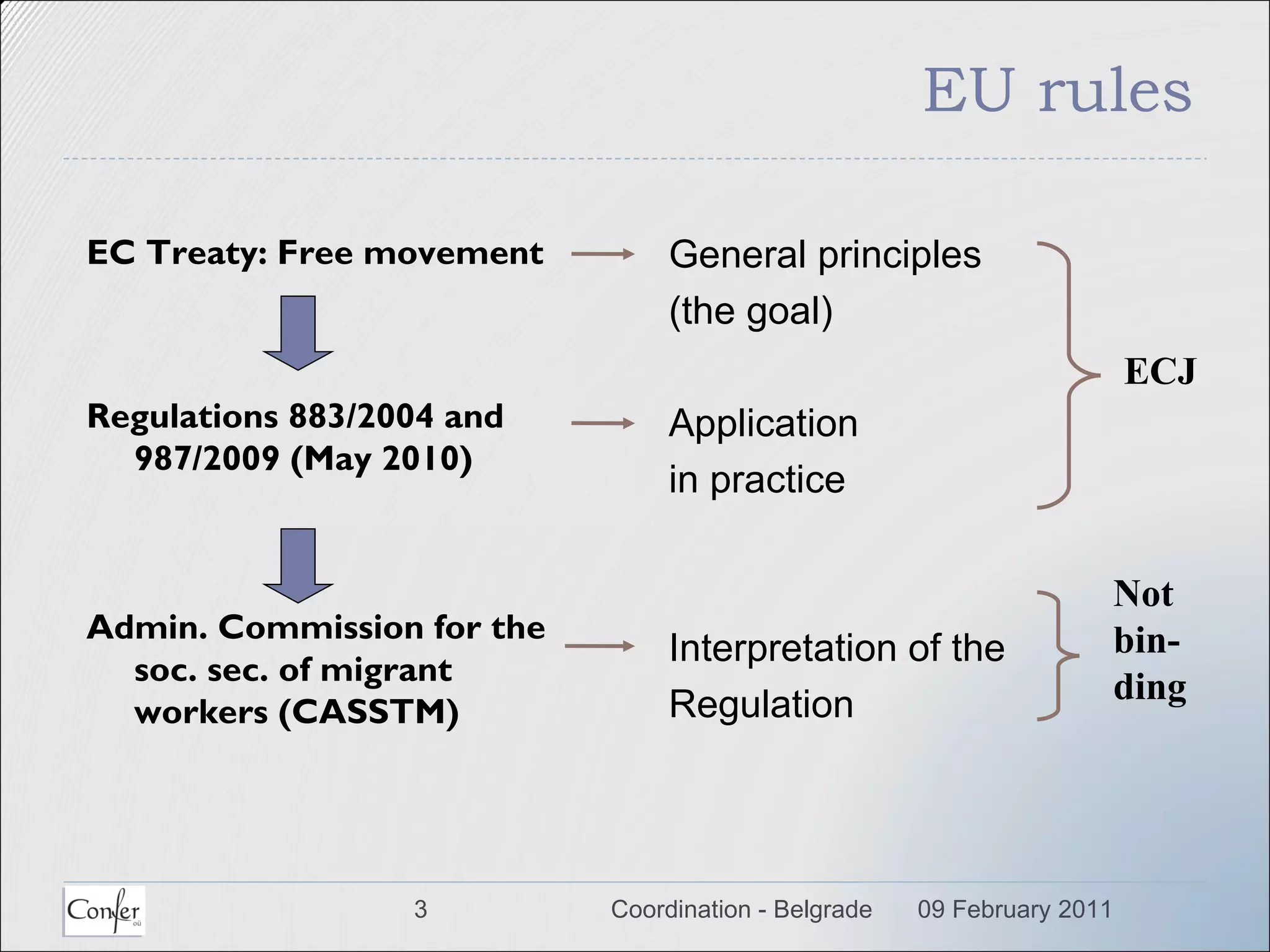
EU rules EC Treaty: Free movement Regulations  883/2004  and  987/2009 (May 2010) Admin. Commission for the soc. sec. of migrant workers (CASSTM) General principles (the goal) Application  in practice Interpretation of the  Regulation ECJ Not bin-ding 09 February 2011 Coordination - Belgrade
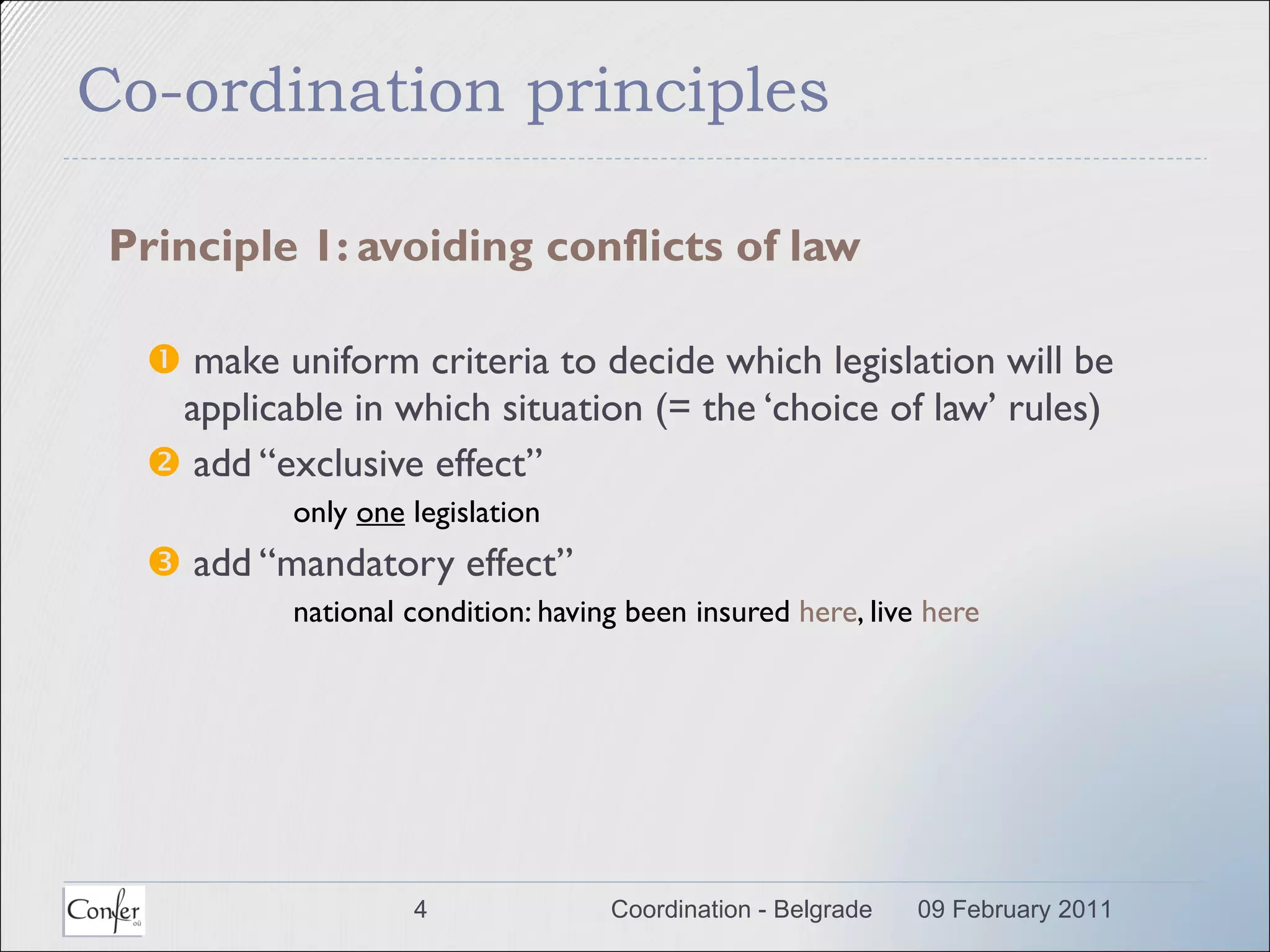
Co-ordination principles Principle 1: avoiding conflicts of law    make uniform criteria to decide which legislation will be applicable in which situation (= the ‘choice of law’ rules)    add “exclusive effect”  only  one  legislation    add “mandatory effect” national condition: having been insured  here , live  here 09 February 2011 Coordination - Belgrade
Co-ordination principles Principle 2: equality of treatment no  direct or indirect  discrimination on the bases of nationality is allowed concerning conditions for affiliation to a social security scheme conditions for entitlement to a benefit conditions for the payment of a benefit …  09 February 2011 Coordination - Belgrade
Co-ordination principles Principle 3: aggregation of periods of insurance = technique to avoid adverse effects of  territorial  criteria when establishing rights    periods of insurance completed in another Member State will be taken into account as if they were completed in the competent Member State  09 February 2011 Coordination - Belgrade
Co-ordination principles Principle 3: aggregation of periods of insurance e.g. one has to be insured  in Italy  during 20 years to be eligible for an Italian old age pension     In any other country of the EER (only for the  right  to benefits, not for the amounts) 09 February 2011 Coordination - Belgrade
Co-ordination principles Principle 4: exportability of benefits = technique to avoid adverse effects of  territorial  criteria when according and paying benefits one does not need to be resident of the country that has to pay the benefit, to receive the benefit only for cash benefits (not in kind or non-contributory), or when the benificiary has to meet certain conditions (e.g. unemployment) 09 February 2011 Coordination - Belgrade
Co-ordination principles Result: the migrant worker is sure to be insured under the system of one Member State which will treat him equal to it’s own nationals which will take into account his career in all Member States and which will grant and pay benefits no matter where the migrant worker lives within the territory of the EU All systems use these principles... 09 February 2011 Coordination - Belgrade
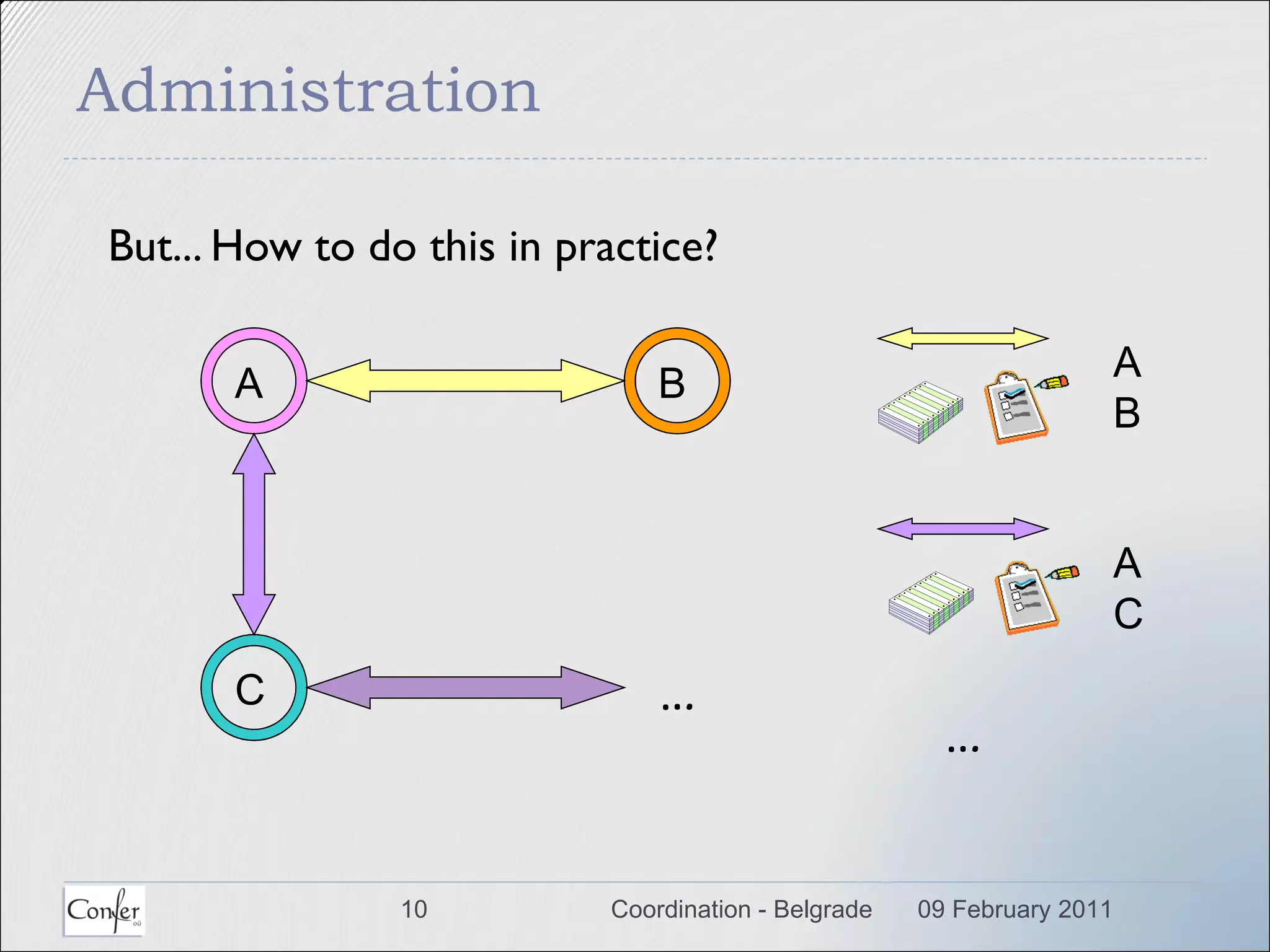
Administration But... How to do this in practice?  09 February 2011 Coordination - Belgrade … A B C … AB AC
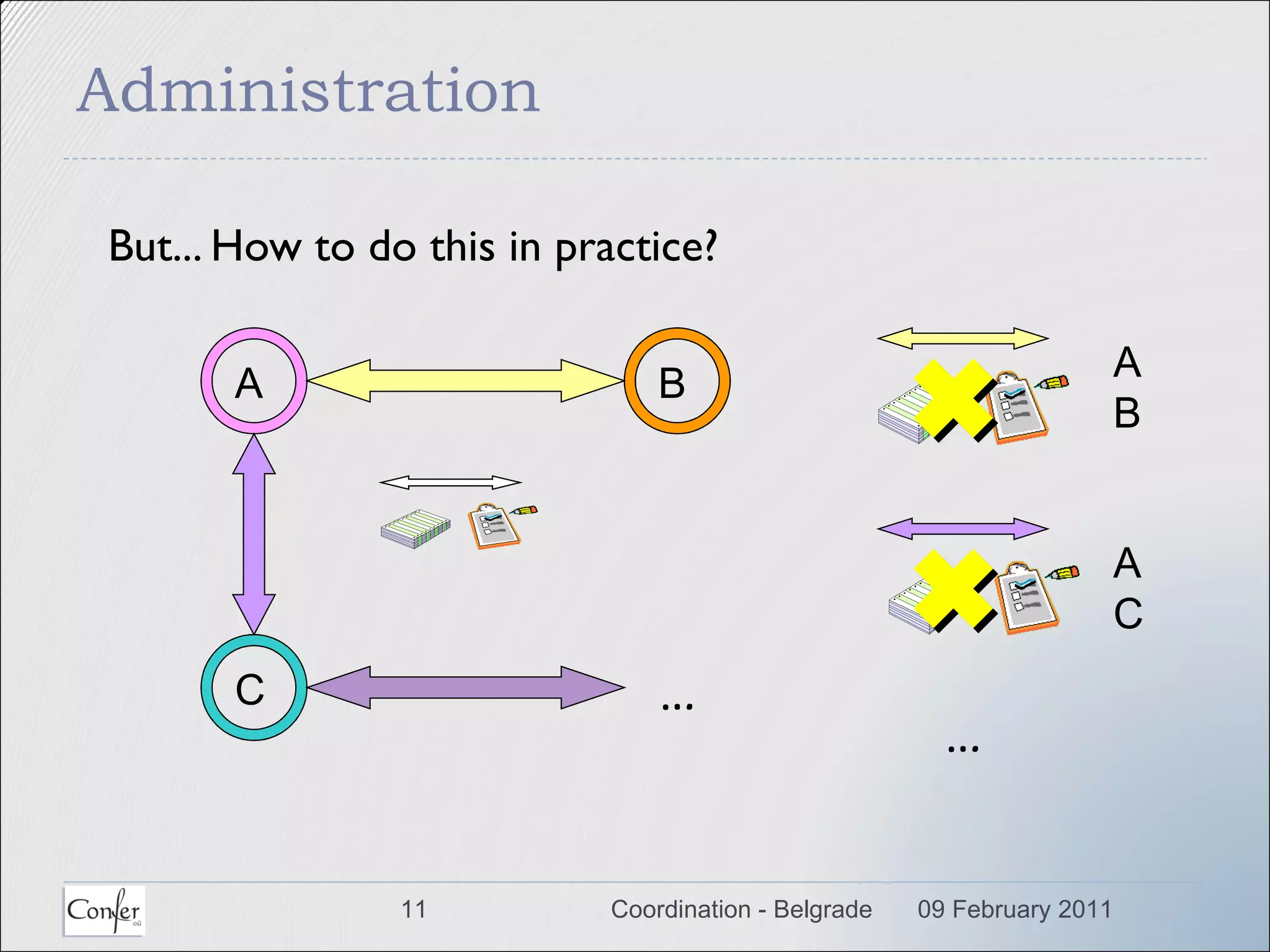
Administration But... How to do this in practice?  09 February 2011 Coordination - Belgrade A B C … … AB AC  
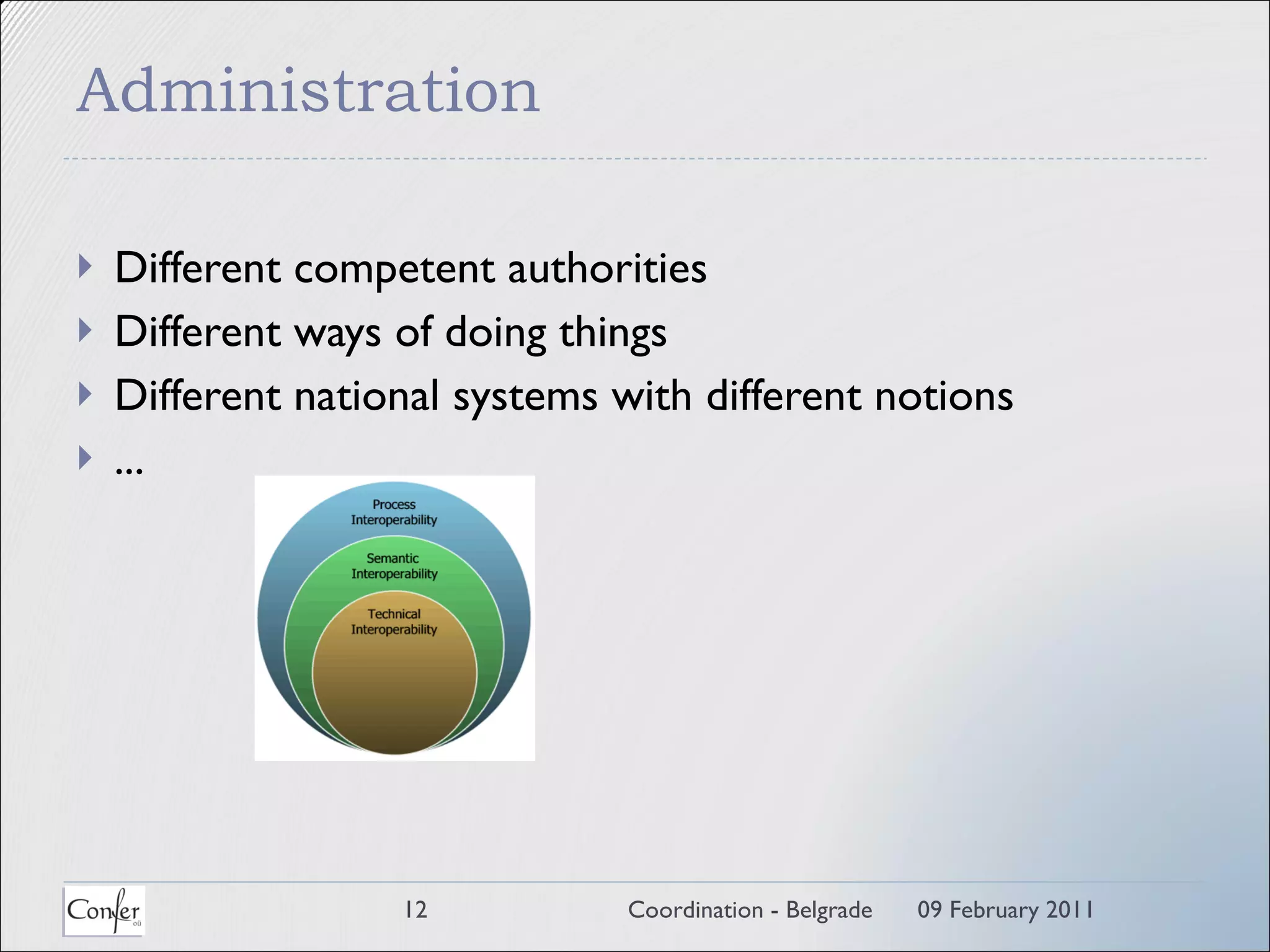
Administration Different competent authorities Different ways of doing things Different national systems with different notions ... 09 February 2011 Coordination - Belgrade
The EESSI project Regulation 883/2004 contains a mandate to exchange information electronically (art. 78) “  The transmission of data between the institutions or the liaison bodies shall be carried out by electronic means either directly or indirectly through the access points under a common secure framework that can guarantee the confidentiality and protection of exchanges of data.”  (art. 4(2) Reg. 987/2009) 09 February 2011 Coordination - Belgrade
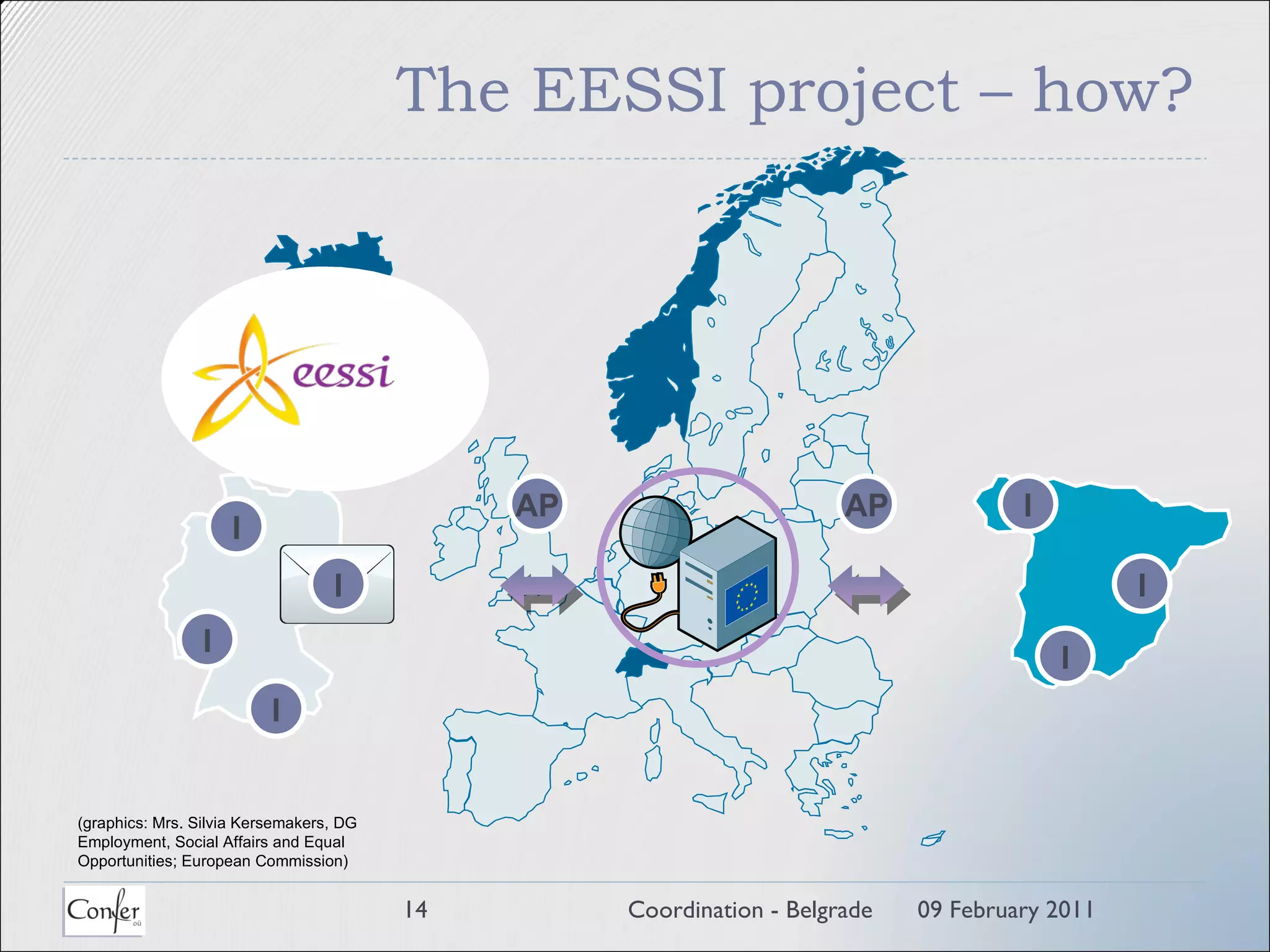
The EESSI project – how? 09 February 2011 Coordination - Belgrade I I I I I I AP AP I (graphics: Mrs. Silvia Kersemakers, DG Employment, Social Affairs and Equal Opportunities; European Commission)
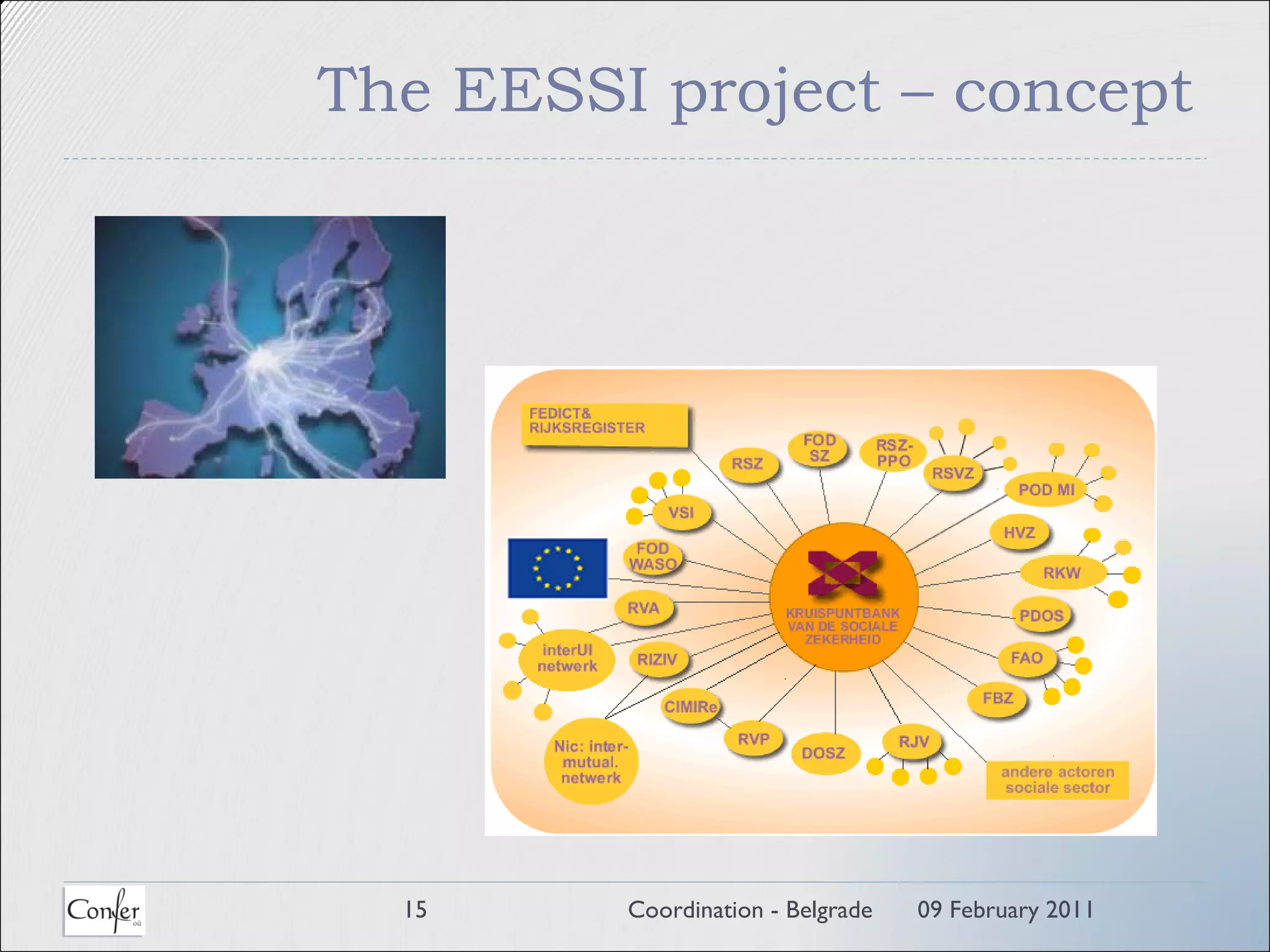
The EESSI project – concept 09 February 2011 Coordination - Belgrade
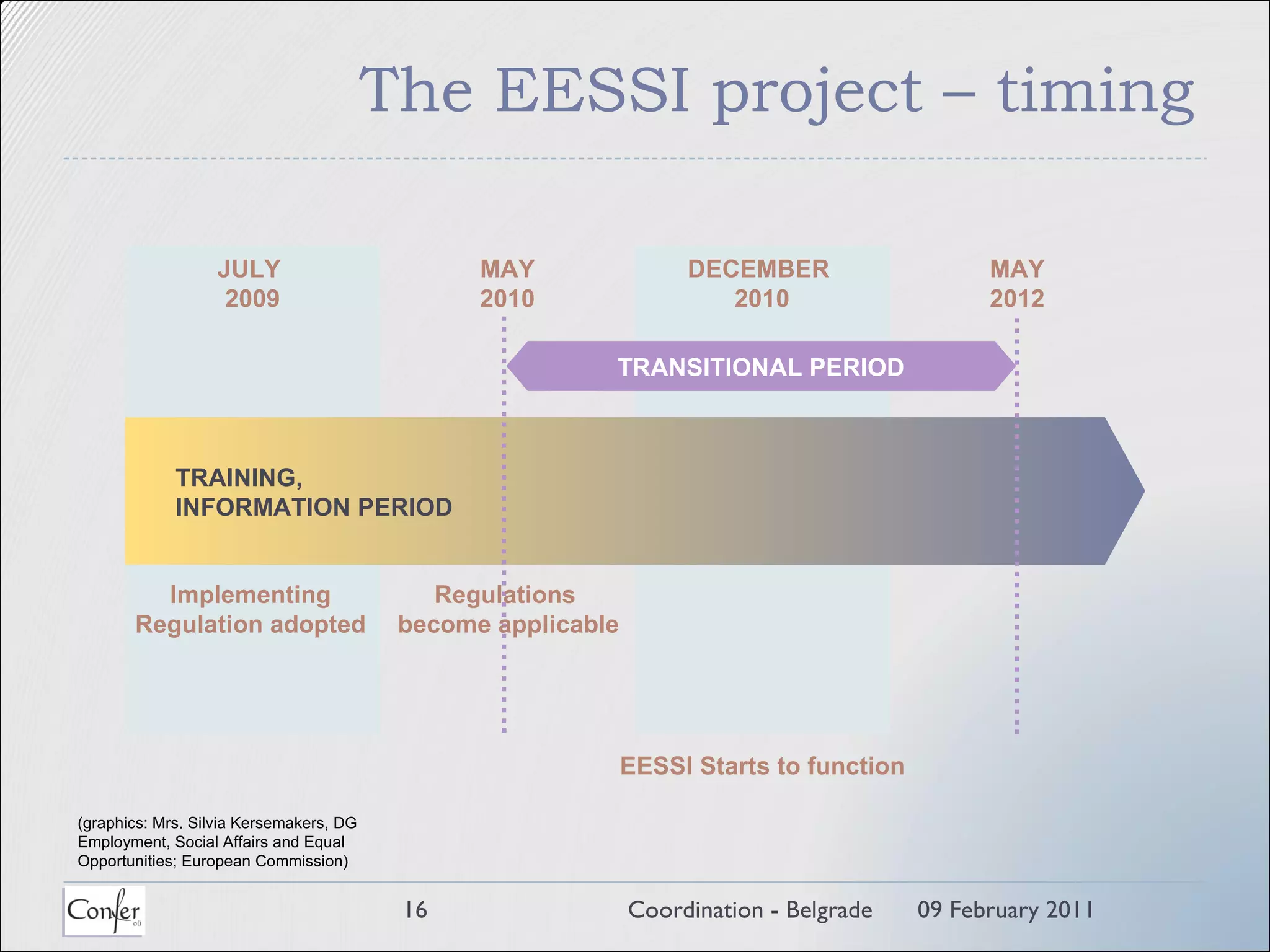
The EESSI project – timing 09 February 2011 Coordination - Belgrade EESSI Starts to function Implementing Regulation adopted Regulations  become applicable (graphics: Mrs. Silvia Kersemakers, DG Employment, Social Affairs and Equal Opportunities; European Commission) JULY  2009 MA Y 2010 DECEMBER  2010 MAY 2012 TRAINING,  INFORMATION PERIOD ………………………………… . ………………………………… . TRANSITIONAL PERIOD
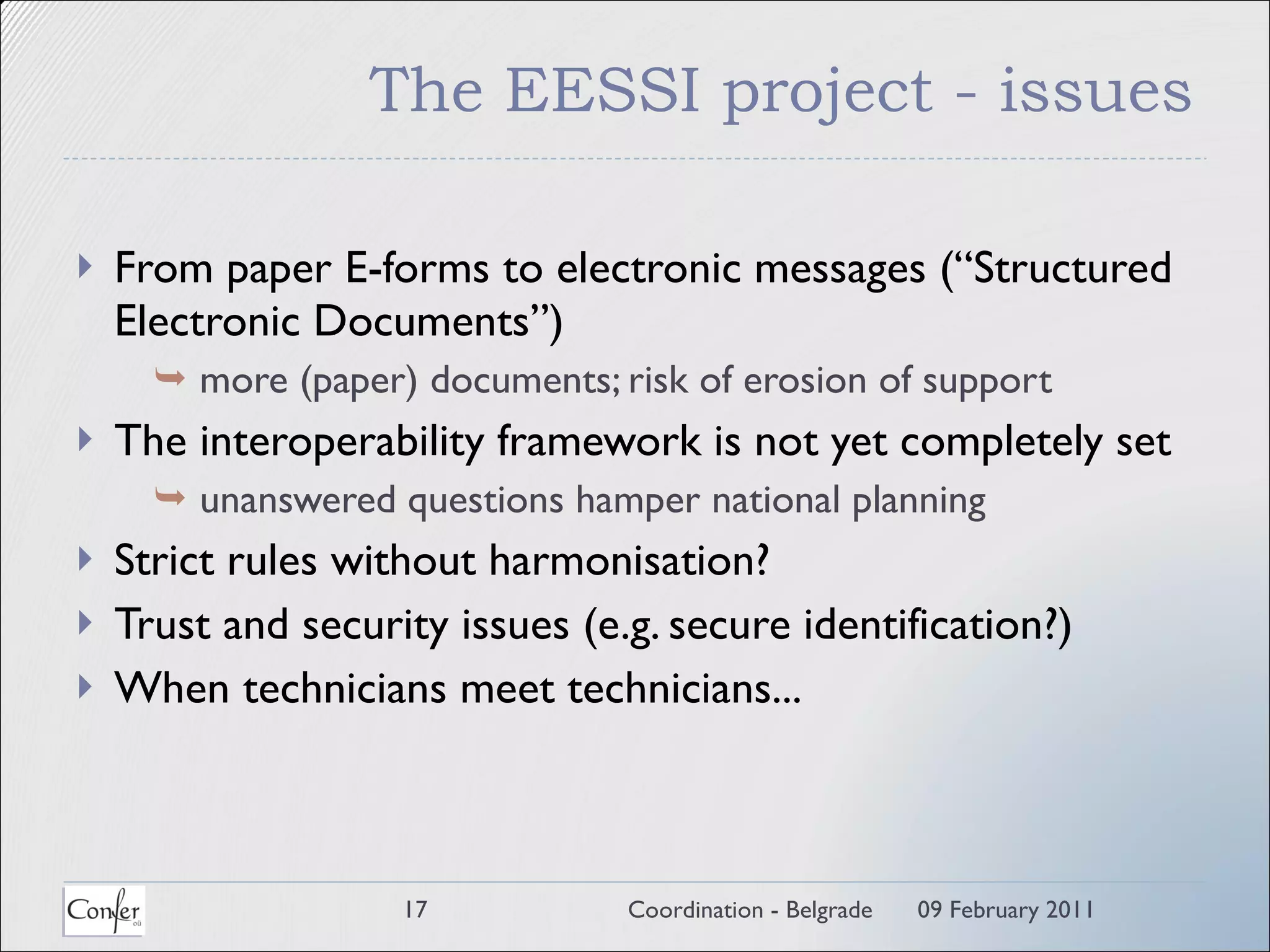
The EESSI project - issues From paper E-forms to electronic messages (“Structured Electronic Documents”)    more (paper) documents; risk of erosion of support  The interoperability framework is not yet completely set     unanswered questions hamper national planning Strict rules without harmonisation? Trust and security issues (e.g. secure identification?) When technicians meet technicians... 09 February 2011 Coordination - Belgrade
Thank you! Time for a round-up, questions and remarks... Steven Segaert  [email_address] 09 February 2011 Coordination - Belgrade

The organisation of social security coordination

  • 1.
    The organization ofsocial security coordination Steven Segaert
  • 2.
    Co-ordination of socialsecurity 09 February 2011 Coordination - Belgrade
  • 3.
    EU rules ECTreaty: Free movement Regulations 883/2004 and 987/2009 (May 2010) Admin. Commission for the soc. sec. of migrant workers (CASSTM) General principles (the goal) Application in practice Interpretation of the Regulation ECJ Not bin-ding 09 February 2011 Coordination - Belgrade
  • 4.
    Co-ordination principles Principle1: avoiding conflicts of law  make uniform criteria to decide which legislation will be applicable in which situation (= the ‘choice of law’ rules)  add “exclusive effect” only one legislation  add “mandatory effect” national condition: having been insured here , live here 09 February 2011 Coordination - Belgrade
  • 5.
    Co-ordination principles Principle2: equality of treatment no direct or indirect discrimination on the bases of nationality is allowed concerning conditions for affiliation to a social security scheme conditions for entitlement to a benefit conditions for the payment of a benefit … 09 February 2011 Coordination - Belgrade
  • 6.
    Co-ordination principles Principle3: aggregation of periods of insurance = technique to avoid adverse effects of territorial criteria when establishing rights  periods of insurance completed in another Member State will be taken into account as if they were completed in the competent Member State 09 February 2011 Coordination - Belgrade
  • 7.
    Co-ordination principles Principle3: aggregation of periods of insurance e.g. one has to be insured in Italy during 20 years to be eligible for an Italian old age pension  In any other country of the EER (only for the right to benefits, not for the amounts) 09 February 2011 Coordination - Belgrade
  • 8.
    Co-ordination principles Principle4: exportability of benefits = technique to avoid adverse effects of territorial criteria when according and paying benefits one does not need to be resident of the country that has to pay the benefit, to receive the benefit only for cash benefits (not in kind or non-contributory), or when the benificiary has to meet certain conditions (e.g. unemployment) 09 February 2011 Coordination - Belgrade
  • 9.
    Co-ordination principles Result:the migrant worker is sure to be insured under the system of one Member State which will treat him equal to it’s own nationals which will take into account his career in all Member States and which will grant and pay benefits no matter where the migrant worker lives within the territory of the EU All systems use these principles... 09 February 2011 Coordination - Belgrade
  • 10.
    Administration But... Howto do this in practice? 09 February 2011 Coordination - Belgrade … A B C … AB AC
  • 11.
    Administration But... Howto do this in practice? 09 February 2011 Coordination - Belgrade A B C … … AB AC  
  • 12.
    Administration Different competentauthorities Different ways of doing things Different national systems with different notions ... 09 February 2011 Coordination - Belgrade
  • 13.
    The EESSI projectRegulation 883/2004 contains a mandate to exchange information electronically (art. 78) “ The transmission of data between the institutions or the liaison bodies shall be carried out by electronic means either directly or indirectly through the access points under a common secure framework that can guarantee the confidentiality and protection of exchanges of data.” (art. 4(2) Reg. 987/2009) 09 February 2011 Coordination - Belgrade
  • 14.
    The EESSI project– how? 09 February 2011 Coordination - Belgrade I I I I I I AP AP I (graphics: Mrs. Silvia Kersemakers, DG Employment, Social Affairs and Equal Opportunities; European Commission)
  • 15.
    The EESSI project– concept 09 February 2011 Coordination - Belgrade
  • 16.
    The EESSI project– timing 09 February 2011 Coordination - Belgrade EESSI Starts to function Implementing Regulation adopted Regulations become applicable (graphics: Mrs. Silvia Kersemakers, DG Employment, Social Affairs and Equal Opportunities; European Commission) JULY 2009 MA Y 2010 DECEMBER 2010 MAY 2012 TRAINING, INFORMATION PERIOD ………………………………… . ………………………………… . TRANSITIONAL PERIOD
  • 17.
    The EESSI project- issues From paper E-forms to electronic messages (“Structured Electronic Documents”)  more (paper) documents; risk of erosion of support The interoperability framework is not yet completely set  unanswered questions hamper national planning Strict rules without harmonisation? Trust and security issues (e.g. secure identification?) When technicians meet technicians... 09 February 2011 Coordination - Belgrade
  • 18.
    Thank you! Timefor a round-up, questions and remarks... Steven Segaert [email_address] 09 February 2011 Coordination - Belgrade