Psychological Maps 2.0:
A web engagement enterprise starting in London
Situation

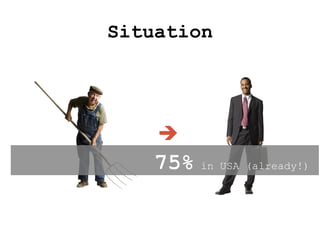
75% in USA (already!)
Situation

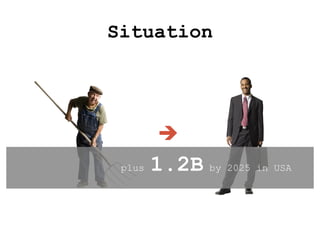
plus 1.2B by 2025 in USA
Situation

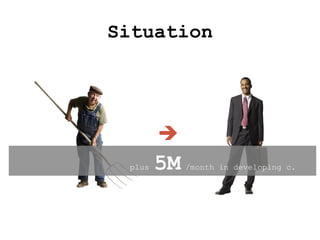
plus 5M /month in developing c.
Problem
Inequality!
Solution
$
Timely allocation of scarce resources
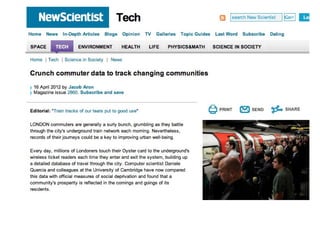
census deprivation + londoners on twitter
r=.350 word count r=.365 MaxEnt
[cscw’12] Tracking Gross Community Happiness from Tweets
social media
environment
sports
health Royal wedding
Spanish/Portuguese
celebrity gossips
Talk of the City [ICWSM’12]
Twitter |o|
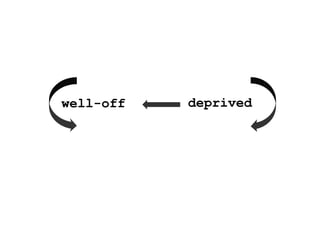
well-off deprived
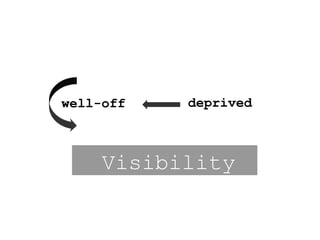
well-off deprived
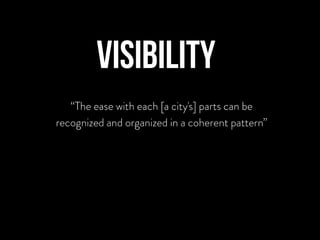
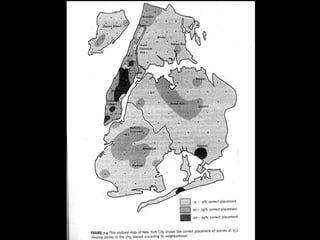
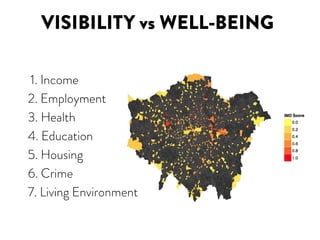
Visibility
visibility & well-being
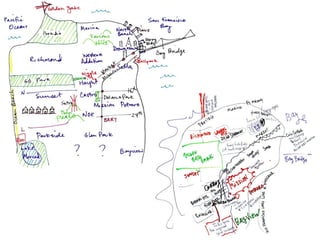
draw a map
WEIRD trap!
Few hundreds of WEIRDos
White,Educated,Industrialized,Rich, and Democratic undergraduates
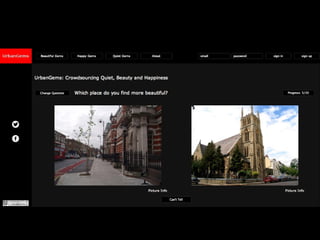
WWW Game!
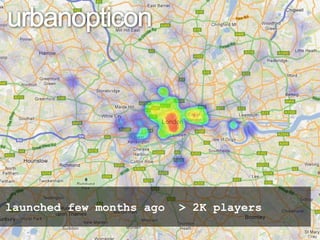
URBANOPTICON.ORG
“I’ve been living in London for the past 35 years and I
felt like a tourist. There were so many places I had no
clue where they were. It is frustrating to get a score
of 200 [out of 1000]!
”
launched few months ago > 2K players
“Yesterday we had few friends over for dinner.
I started to play the game on my laptop, and
that escalated into a ridiculous competition
among all of us that left my husband (the only
Londoner in the room) quite injured, so to
speak ”
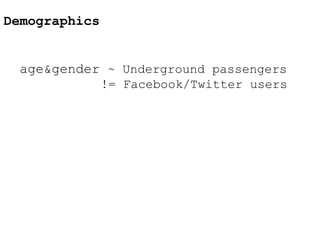
Demographics
age&gender ~ Underground passengers
!= Facebook/Twitter users
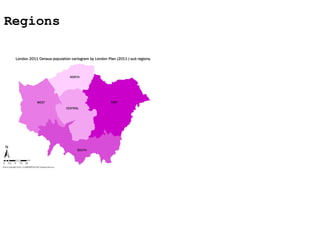
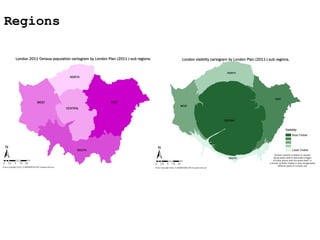
Regions
Regions
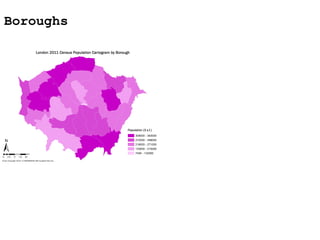
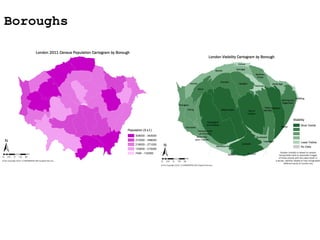
Boroughs
Boroughs
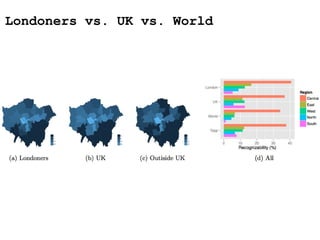
Londoners vs. UK vs. World
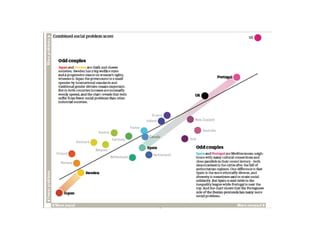
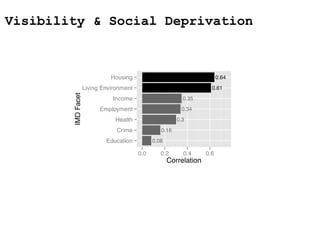
Visibility & Social Deprivation
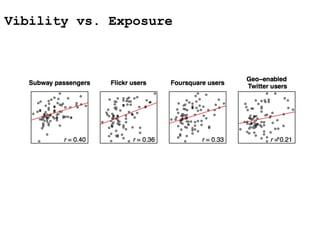
Vibility vs. Exposure
Distinctiveness
(e.g., interesting architecture)
Area more visibile than exposure would suggest
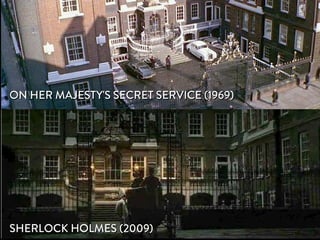
info value of pix? 
pic info = quantitative “fuzzy” concepts
(a) (b) (c) (d)
(e) (f) (g) (h)
Figure 5: Visual Wordsfor Beauty (top row) and Ugly (bottom row).
and guardrails. The red dots on top-ranked pictures
hose on bottom-ranked ones mean two different things
ormer reflect positive(e.g., happy) visual words, while
Picture Quality Bias. Photos might not necessarily
what they aresupposed to show (representativeurban s
in each neighborhood), and somepictures might beof
only london? 
profzero.org/urbanopticon
Psychological Maps 2.0 [www 2013]

Psychological Maps 2.0 [www 2013]

Editor's Notes

  • #4 the world is currently undergoing a massive influx of people into cities. which means that (next slide)
  • #5 the world is currently undergoing a massive influx of people into cities. which means that (next slide)
  • #6 the world is currently undergoing a massive influx of people into cities. which means that (next slide)
  • #7 in particular, transport analysts and planners need to be able to understand and predict passenger flow so far there has been little work on modeling flows on public transport systems in an urban environment, or at the intra- city level. one reason for this may be lack of data, but with adoption of AFC in cities all over the world, this data is now readily available.
  • #8 in particular, transport analysts and planners need to be able to understand and predict passenger flow so far there has been little work on modeling flows on public transport systems in an urban environment, or at the intra- city level. one reason for this may be lack of data, but with adoption of AFC in cities all over the world, this data is now readily available.
  • #9 in particular, transport analysts and planners need to be able to understand and predict passenger flow so far there has been little work on modeling flows on public transport systems in an urban environment, or at the intra- city level. one reason for this may be lack of data, but with adoption of AFC in cities all over the world, this data is now readily available.
  • #10 in particular, transport analysts and planners need to be able to understand and predict passenger flow so far there has been little work on modeling flows on public transport systems in an urban environment, or at the intra- city level. one reason for this may be lack of data, but with adoption of AFC in cities all over the world, this data is now readily available.
  • #11 in particular, transport analysts and planners need to be able to understand and predict passenger flow so far there has been little work on modeling flows on public transport systems in an urban environment, or at the intra- city level. one reason for this may be lack of data, but with adoption of AFC in cities all over the world, this data is now readily available.
  • #55 in particular, transport analysts and planners need to be able to understand and predict passenger flow so far there has been little work on modeling flows on public transport systems in an urban environment, or at the intra- city level. one reason for this may be lack of data, but with adoption of AFC in cities all over the world, this data is now readily available.