General Psychology
Prepared by Humaira Zamani
Chapter 1
What is psychology?
In this presentation, we will learn the definition of
psychology and breakdown its general aspects
1.Definition
Psychology is defined as a scientific study of
mental processes, behavior and experiences
in different context.
➔ Mental processes (Cognitive
processes)
Such as learning, remembering,
perceiving, thinking, knowing, feelings
➔ Behavior
Are reactions we give, they can be
overt or covert
➔ Experiences
Experiences are influenced by internal
and external conditions of the
experiencer
Psychology seeks to
understand how mind works
and how different
mental processes
results in different
behaviors
Upcoming next...
1.) Psychology as
discipline
2.) Psychology as
natural science
3.) Psychology as
social science
.
Psychology as a discipline
has 2 parallel streams in
studying various
psychological and social
phenomena :
1. It makes use of the
method in physical and
biological sciences
2. It makes use of the
method of social and
cultural sciences
Psychology as a natural
sciences:
Uses “Hypothetico-deductive model”
- it consists of a theory and a hypothesis
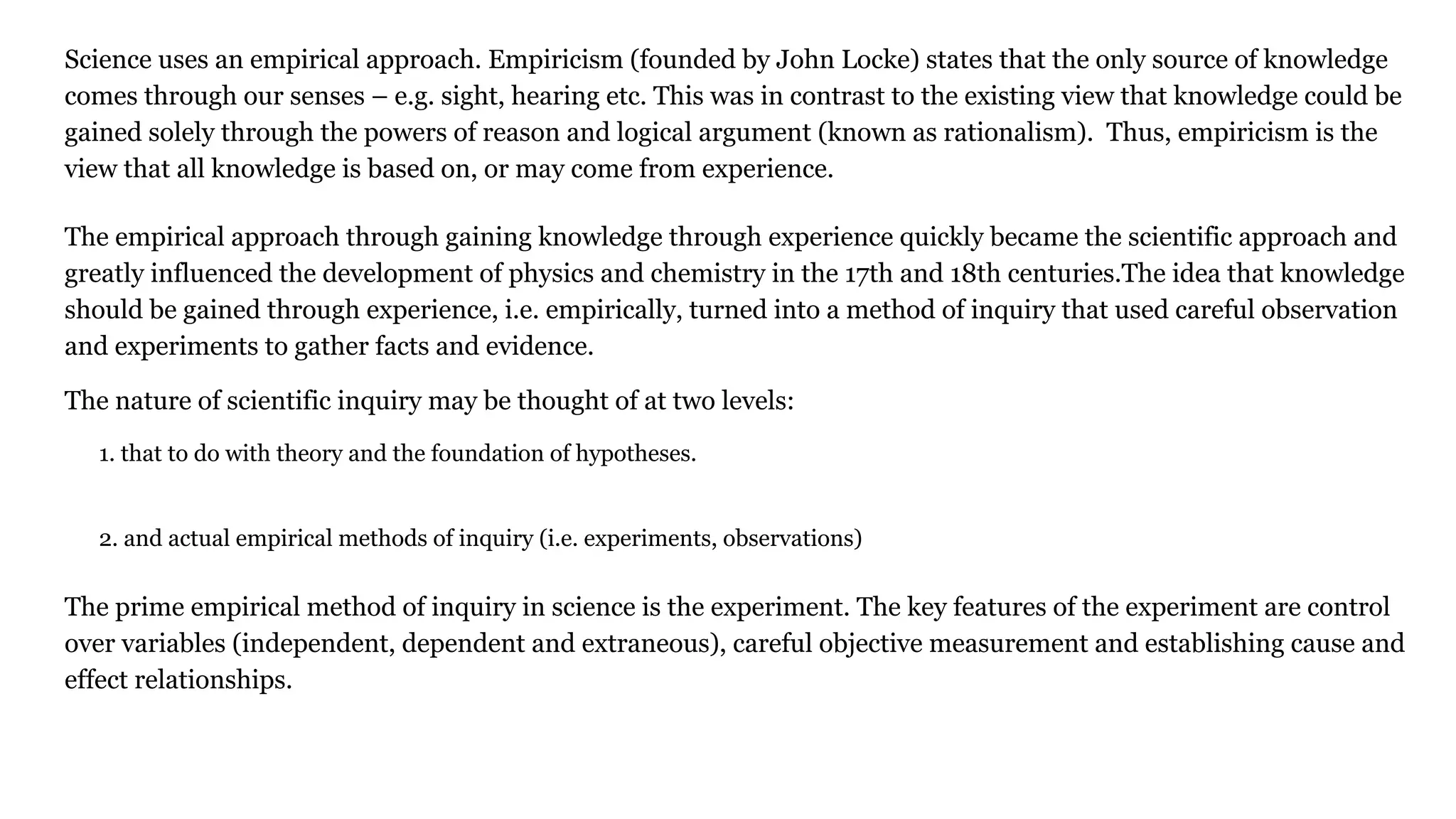
Science uses an empirical approach. Empiricism (founded by John Locke) states that the only source of knowledge
comes through our senses – e.g. sight, hearing etc. This was in contrast to the existing view that knowledge could be
gained solely through the powers of reason and logical argument (known as rationalism). Thus, empiricism is the
view that all knowledge is based on, or may come from experience.
The empirical approach through gaining knowledge through experience quickly became the scientific approach and
greatly influenced the development of physics and chemistry in the 17th and 18th centuries.The idea that knowledge
should be gained through experience, i.e. empirically, turned into a method of inquiry that used careful observation
and experiments to gather facts and evidence.
The nature of scientific inquiry may be thought of at two levels:
1. that to do with theory and the foundation of hypotheses.
2. and actual empirical methods of inquiry (i.e. experiments, observations)
The prime empirical method of inquiry in science is the experiment. The key features of the experiment are control
over variables (independent, dependent and extraneous), careful objective measurement and establishing cause and
effect relationships.
How can we say that
psychology is a scientific
study?
Psychology follows a scientific
methodology which all other
fields of sciences have been
following
This scientific method is a system
of reducing bias and error in the
measurement of data
Psychology uses scientific
approach in all areas
THE KEY FEATURES OF SCIENCE
1. Empirical Evidence
2. Objectivity
3. Control
4. Hypothesis Testing
5. Replication
6. Predictability
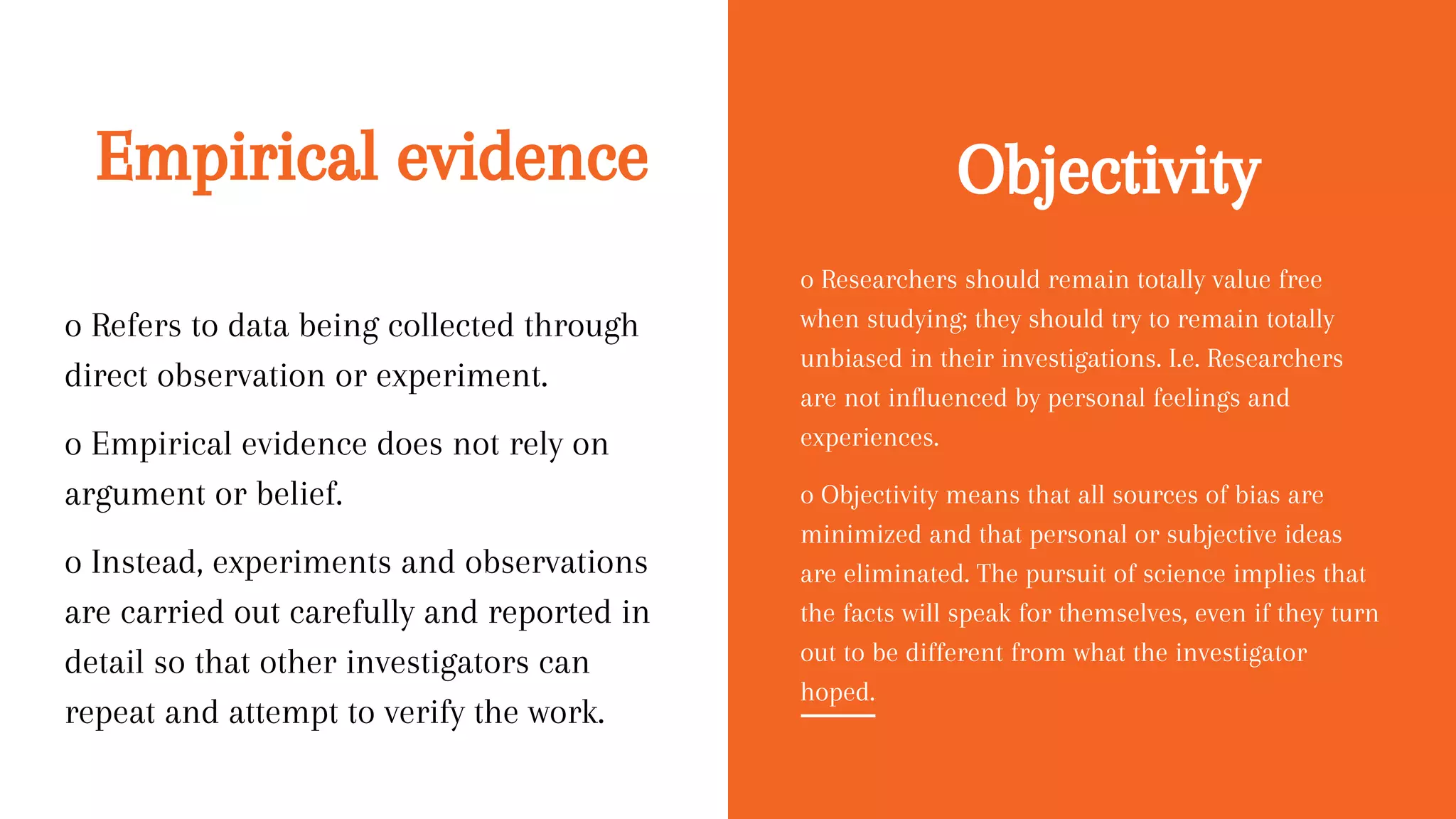
Empirical evidence
o Refers to data being collected through
direct observation or experiment.
o Empirical evidence does not rely on
argument or belief.
o Instead, experiments and observations
are carried out carefully and reported in
detail so that other investigators can
repeat and attempt to verify the work.
o Researchers should remain totally value free
when studying; they should try to remain totally
unbiased in their investigations. I.e. Researchers
are not influenced by personal feelings and
experiences.
o Objectivity means that all sources of bias are
minimized and that personal or subjective ideas
are eliminated. The pursuit of science implies that
the facts will speak for themselves, even if they turn
out to be different from what the investigator
hoped.
Objectivity
Control
o All extraneous
variables need to be
controlled in order to be
able to establish cause
(IV) and effect (DV).
Hypothesis Testing
o E.g. a statement made at the
beginning of an investigation
that serves as a prediction and
is derived from a theory. There
are different types of
hypotheses (null and
alternative), which need to be
stated in a form that can be
tested (i.e. operationalized and
unambiguous).
Replication
o This refers to whether a particular method and
finding can be repeated with different/same people
and/or on different occasions, to see if the results are
similar.
o If a dramatic discovery is reported, but it cannot be
replicated by other scientists it will not be accepted.
o If we get the same results over and over again under
the same conditions, we can be sure of their accuracy
beyond reasonable doubt.
o This gives us confidence that the results are reliable
and can be used to build up a body of knowledge or a
theory: vital in establishing a scientific theory.
Predictability
o We should be aiming to be able to
predict future behavior from the findings
of our research.
Psychology as a social
science focuses on
Humans as social
beings
What is mind? Is it same as
brain?
There is an incredible relationship between
mind and body, it has been shown
that using positive visualisation techniques
And feeling positive emotions, one can
bring significant changes in bodily process
Mind does not exist
without brain and it
is a different or
separate entity. It
cannot be measured
or identified in MRI
scans
A new discipline called
psychoneuroimmunology has
emerged which emphasis the
role played by the mind in
strengthening the immune
system
3. Primary Goals of
psychology
Psychology has a method for studying
phenomena, it has 4 primary goals
➔ DESCRIBE
➔ EXPLAIN
➔ PREDICT
➔ CONTROL
Psychology Then,
William Wundt is the
father of psychology
He established the first psychological
laboratory in Leipzig, Germany. He
studied non physical structure of
human mind.
He used objective introspection to
study processes that were the result of
physical senses
He made his first attempt to bring
objectivity and measurement to
psychology
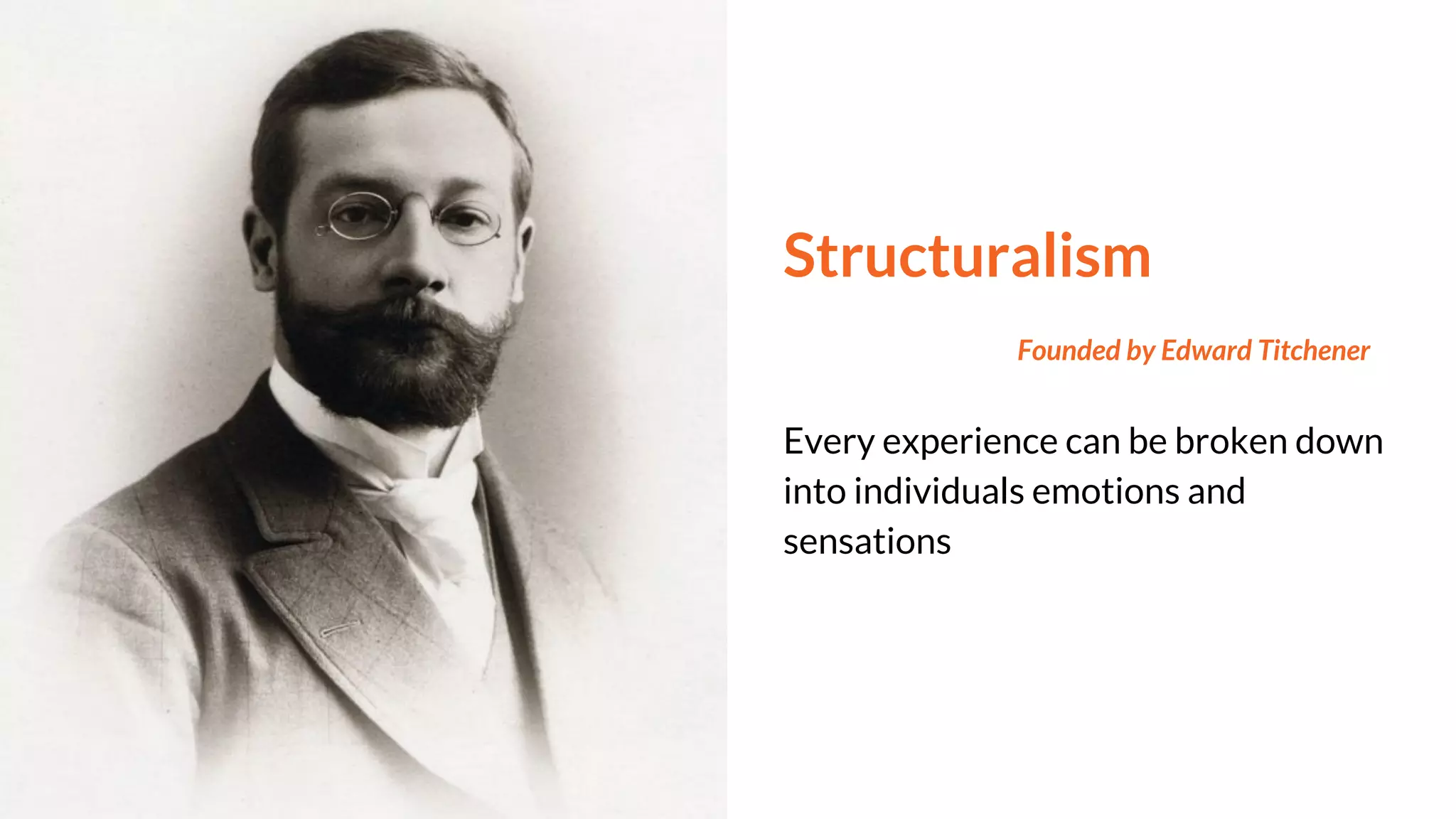
Structuralism
Founded by Edward Titchener
Every experience can be broken down
into individuals emotions and
sensations
Functionalism
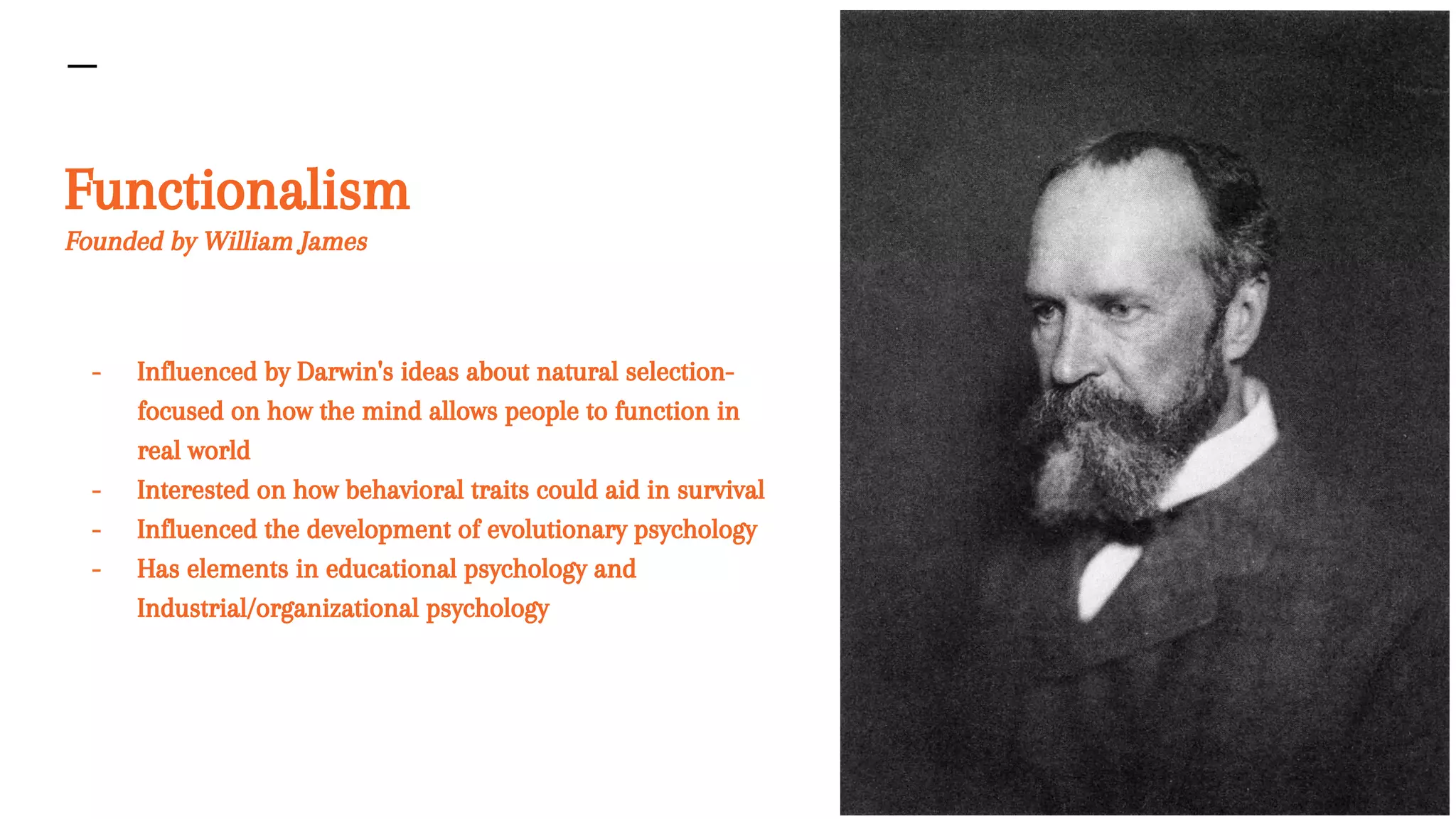
Founded by William James
- Influenced by Darwin's ideas about natural selection-
focused on how the mind allows people to function in
real world
- Interested on how behavioral traits could aid in survival
- Influenced the development of evolutionary psychology
- Has elements in educational psychology and
Industrial/organizational psychology
How was psychology practiced
before?
Psychology got developed through several disciplines, including philosophy, medicine, physiology
1. Gestalt Psychology: “Whole is better than some parts of it” , did not believe that psychological
events could be broken down into smaller elements ( founded by Max Wertheimer)
2. Psychoanalysis: Stressed Importance through early life experiences, the role of unconscious, and
development through stages (sigmund Freud)
3. Behaviorism: Brought focus on scientific enquiry and believed only way to help people was to focus
on observable behaviors and ignore “consciousness” (John. B. Watson)
Few approaches of
psychology were practised
highly which contributes
today in the development
of therapy modules
1. Psychodynamic Approach
2. Behavioral approach
3. Humanistic Approach
4. Cognitive approach
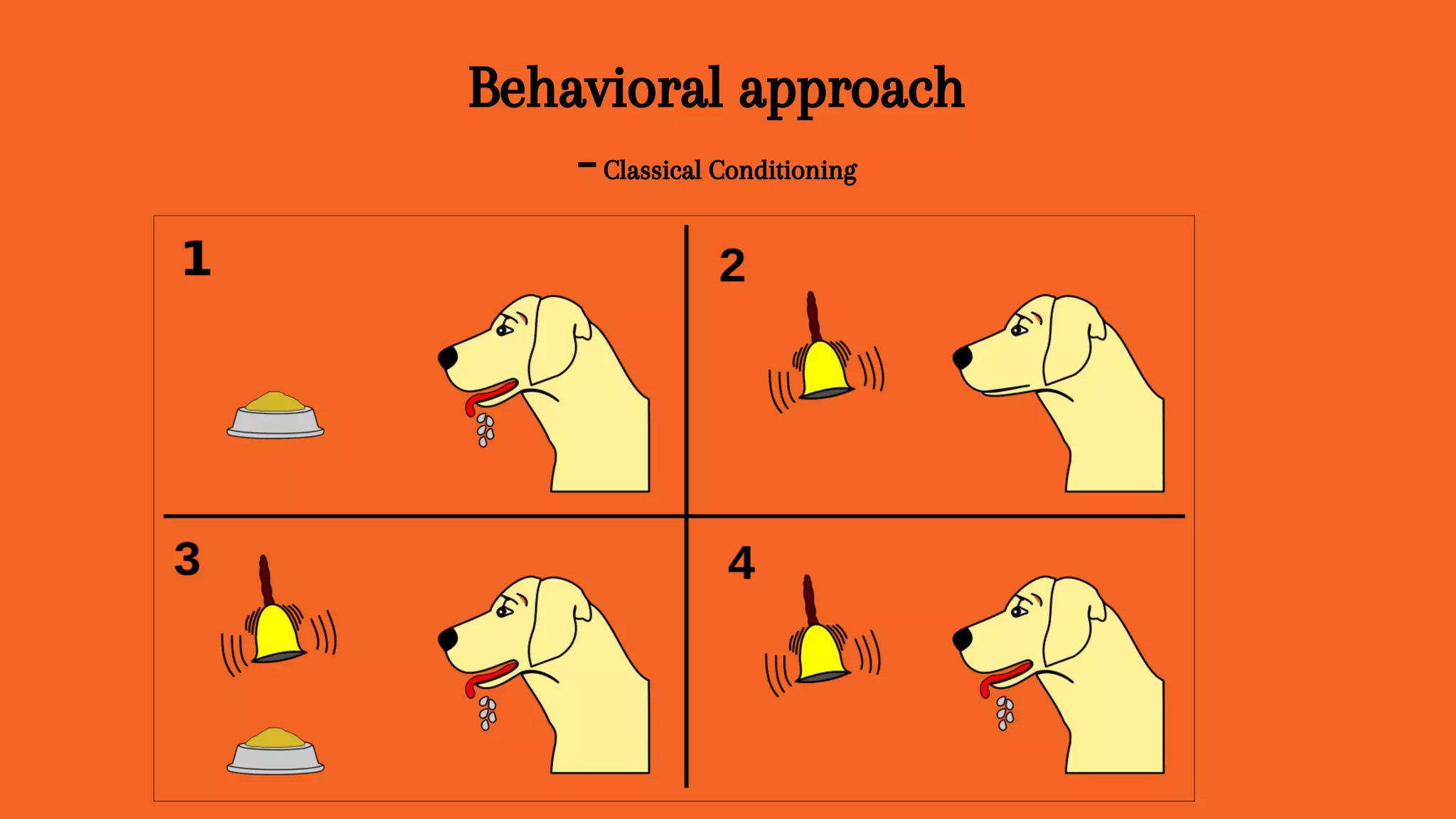
Behavioral approach
-Classical Conditioning
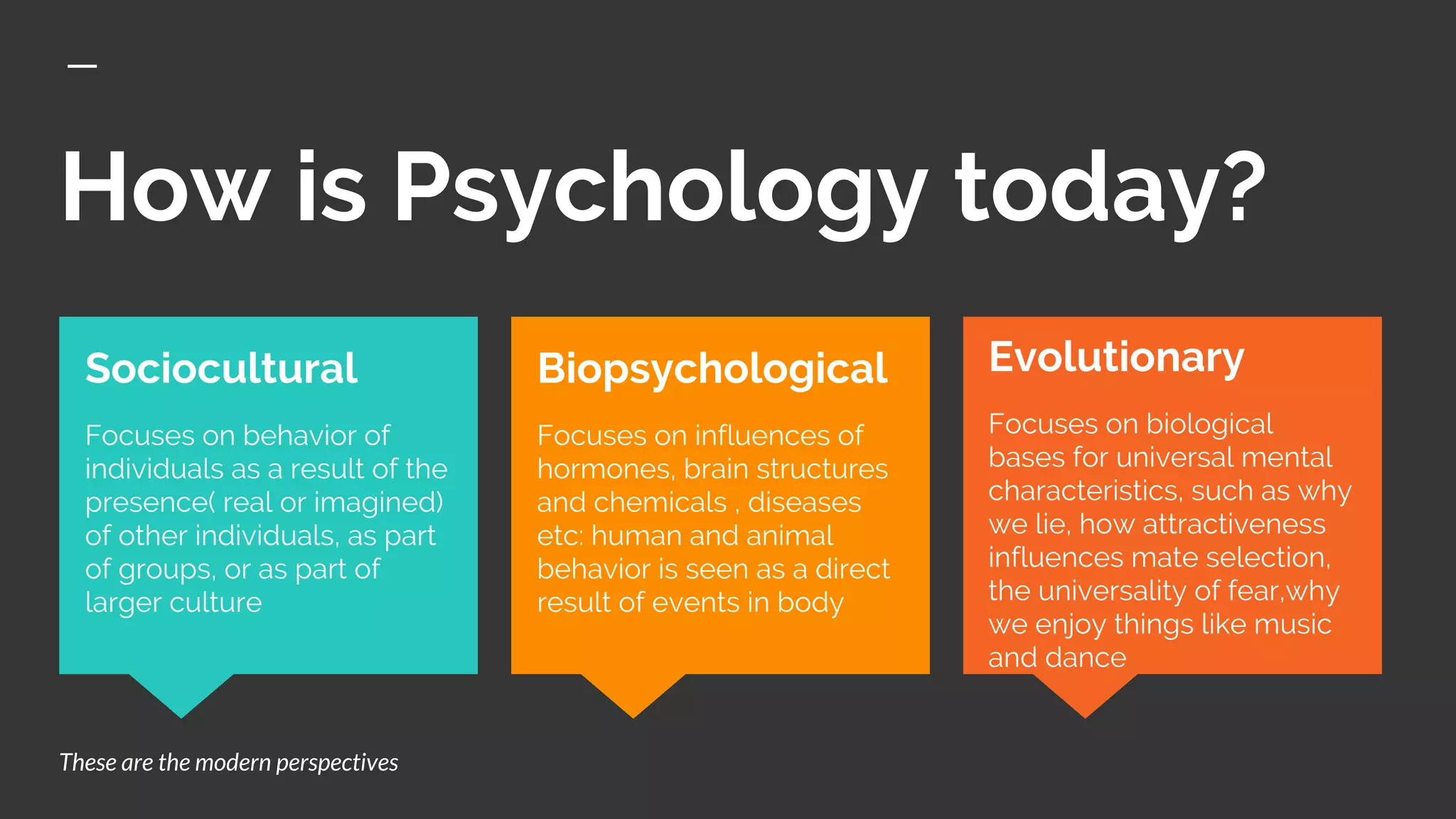
How is Psychology today?
Evolutionary
Focuses on biological
bases for universal mental
characteristics, such as why
we lie, how attractiveness
influences mate selection,
the universality of fear,why
we enjoy things like music
and dance
Sociocultural
Focuses on behavior of
individuals as a result of the
presence( real or imagined)
of other individuals, as part
of groups, or as part of
larger culture
Biopsychological
Focuses on influences of
hormones, brain structures
and chemicals , diseases
etc: human and animal
behavior is seen as a direct
result of events in body
These are the modern perspectives
Thank you!
Links to refer:
https://www.apa.org/action/science/index
https://www.verywellmind.com/pavlovs-dogs-27
94989
https://www.verywellmind.com/operant-conditio
ning-a2-2794863
https://www.verywellmind.com/what-is-maslow
s-hierarchy-of-needs-4136760
http://oer2go.org/mods/en-boundless/www.bo
undless.com/psychology/textbooks/boundless-
psychology-textbook/personality-16/humanistic-
perspectives-on-personality-78/rogers-humanisti
c-theory-of-personality-308-12843/index.html

Psychology class 01

  • 1.
  • 2.
    Chapter 1 What ispsychology? In this presentation, we will learn the definition of psychology and breakdown its general aspects
  • 3.
    1.Definition Psychology is definedas a scientific study of mental processes, behavior and experiences in different context. ➔ Mental processes (Cognitive processes) Such as learning, remembering, perceiving, thinking, knowing, feelings ➔ Behavior Are reactions we give, they can be overt or covert ➔ Experiences Experiences are influenced by internal and external conditions of the experiencer
  • 4.
    Psychology seeks to understandhow mind works and how different mental processes results in different behaviors Upcoming next... 1.) Psychology as discipline 2.) Psychology as natural science 3.) Psychology as social science .
  • 5.
    Psychology as adiscipline has 2 parallel streams in studying various psychological and social phenomena : 1. It makes use of the method in physical and biological sciences 2. It makes use of the method of social and cultural sciences
  • 6.
    Psychology as anatural sciences: Uses “Hypothetico-deductive model” - it consists of a theory and a hypothesis
  • 7.
    Science uses anempirical approach. Empiricism (founded by John Locke) states that the only source of knowledge comes through our senses – e.g. sight, hearing etc. This was in contrast to the existing view that knowledge could be gained solely through the powers of reason and logical argument (known as rationalism). Thus, empiricism is the view that all knowledge is based on, or may come from experience. The empirical approach through gaining knowledge through experience quickly became the scientific approach and greatly influenced the development of physics and chemistry in the 17th and 18th centuries.The idea that knowledge should be gained through experience, i.e. empirically, turned into a method of inquiry that used careful observation and experiments to gather facts and evidence. The nature of scientific inquiry may be thought of at two levels: 1. that to do with theory and the foundation of hypotheses. 2. and actual empirical methods of inquiry (i.e. experiments, observations) The prime empirical method of inquiry in science is the experiment. The key features of the experiment are control over variables (independent, dependent and extraneous), careful objective measurement and establishing cause and effect relationships.
  • 8.
    How can wesay that psychology is a scientific study? Psychology follows a scientific methodology which all other fields of sciences have been following This scientific method is a system of reducing bias and error in the measurement of data Psychology uses scientific approach in all areas THE KEY FEATURES OF SCIENCE 1. Empirical Evidence 2. Objectivity 3. Control 4. Hypothesis Testing 5. Replication 6. Predictability
  • 9.
    Empirical evidence o Refersto data being collected through direct observation or experiment. o Empirical evidence does not rely on argument or belief. o Instead, experiments and observations are carried out carefully and reported in detail so that other investigators can repeat and attempt to verify the work. o Researchers should remain totally value free when studying; they should try to remain totally unbiased in their investigations. I.e. Researchers are not influenced by personal feelings and experiences. o Objectivity means that all sources of bias are minimized and that personal or subjective ideas are eliminated. The pursuit of science implies that the facts will speak for themselves, even if they turn out to be different from what the investigator hoped. Objectivity
  • 10.
    Control o All extraneous variablesneed to be controlled in order to be able to establish cause (IV) and effect (DV). Hypothesis Testing o E.g. a statement made at the beginning of an investigation that serves as a prediction and is derived from a theory. There are different types of hypotheses (null and alternative), which need to be stated in a form that can be tested (i.e. operationalized and unambiguous).
  • 11.
    Replication o This refersto whether a particular method and finding can be repeated with different/same people and/or on different occasions, to see if the results are similar. o If a dramatic discovery is reported, but it cannot be replicated by other scientists it will not be accepted. o If we get the same results over and over again under the same conditions, we can be sure of their accuracy beyond reasonable doubt. o This gives us confidence that the results are reliable and can be used to build up a body of knowledge or a theory: vital in establishing a scientific theory. Predictability o We should be aiming to be able to predict future behavior from the findings of our research.
  • 12.
    Psychology as asocial science focuses on Humans as social beings
  • 13.
    What is mind?Is it same as brain? There is an incredible relationship between mind and body, it has been shown that using positive visualisation techniques And feeling positive emotions, one can bring significant changes in bodily process Mind does not exist without brain and it is a different or separate entity. It cannot be measured or identified in MRI scans
  • 14.
    A new disciplinecalled psychoneuroimmunology has emerged which emphasis the role played by the mind in strengthening the immune system
  • 15.
    3. Primary Goalsof psychology Psychology has a method for studying phenomena, it has 4 primary goals ➔ DESCRIBE ➔ EXPLAIN ➔ PREDICT ➔ CONTROL
  • 16.
    Psychology Then, William Wundtis the father of psychology He established the first psychological laboratory in Leipzig, Germany. He studied non physical structure of human mind. He used objective introspection to study processes that were the result of physical senses He made his first attempt to bring objectivity and measurement to psychology
  • 17.
    Structuralism Founded by EdwardTitchener Every experience can be broken down into individuals emotions and sensations
  • 18.
    Functionalism Founded by WilliamJames - Influenced by Darwin's ideas about natural selection- focused on how the mind allows people to function in real world - Interested on how behavioral traits could aid in survival - Influenced the development of evolutionary psychology - Has elements in educational psychology and Industrial/organizational psychology
  • 19.
    How was psychologypracticed before? Psychology got developed through several disciplines, including philosophy, medicine, physiology 1. Gestalt Psychology: “Whole is better than some parts of it” , did not believe that psychological events could be broken down into smaller elements ( founded by Max Wertheimer) 2. Psychoanalysis: Stressed Importance through early life experiences, the role of unconscious, and development through stages (sigmund Freud) 3. Behaviorism: Brought focus on scientific enquiry and believed only way to help people was to focus on observable behaviors and ignore “consciousness” (John. B. Watson)
  • 20.
    Few approaches of psychologywere practised highly which contributes today in the development of therapy modules
  • 21.
    1. Psychodynamic Approach 2.Behavioral approach 3. Humanistic Approach 4. Cognitive approach
  • 22.
  • 24.
    How is Psychologytoday? Evolutionary Focuses on biological bases for universal mental characteristics, such as why we lie, how attractiveness influences mate selection, the universality of fear,why we enjoy things like music and dance Sociocultural Focuses on behavior of individuals as a result of the presence( real or imagined) of other individuals, as part of groups, or as part of larger culture Biopsychological Focuses on influences of hormones, brain structures and chemicals , diseases etc: human and animal behavior is seen as a direct result of events in body These are the modern perspectives
  • 25.
    Thank you! Links torefer: https://www.apa.org/action/science/index https://www.verywellmind.com/pavlovs-dogs-27 94989 https://www.verywellmind.com/operant-conditio ning-a2-2794863 https://www.verywellmind.com/what-is-maslow s-hierarchy-of-needs-4136760 http://oer2go.org/mods/en-boundless/www.bo undless.com/psychology/textbooks/boundless- psychology-textbook/personality-16/humanistic- perspectives-on-personality-78/rogers-humanisti c-theory-of-personality-308-12843/index.html