Search
Share
Start
Devices
Settings
By Tanveer Altaf (Intellectual Property)
Engineering for Developers
Embedded Systems
Search
Share
Start
Devices
Settings
By Tanveer Altaf (Intellectual Property)
Topics to Explore
1. The Science of Psychology
2. Major Perspectives in Psychology
3. Psychologists & Their Specialties
Search
Share
Start
Devices
Settings
By Tanveer Altaf (Intellectual Property)
Part 1
The Science of Psychology
Search
Share
Start
Devices
Settings
By Tanveer Altaf (Intellectual Property)
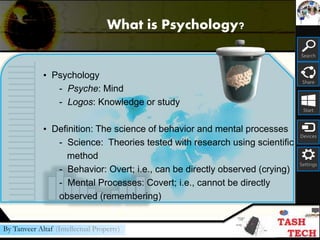
What is Psychology?
• Psychology
- Psyche: Mind
- Logos: Knowledge or study
• Definition: The science of behavior and mental processes
- Science: Theories tested with research using scientific
method
- Behavior: Overt; i.e., can be directly observed (crying)
- Mental Processes: Covert; i.e., cannot be directly
observed (remembering)
Search
Share
Start
Devices
Settings
By Tanveer Altaf (Intellectual Property)
Scientific Theory
• Scientific Theory: A system of ideas that interrelates facts
and concepts, summarizes existing data, and predicts future
observations
• A good theory must be falsifiable; i.e., operationally
defined so that it can be disconfirmed
Search
Share
Start
Devices
Settings
By Tanveer Altaf (Intellectual Property)
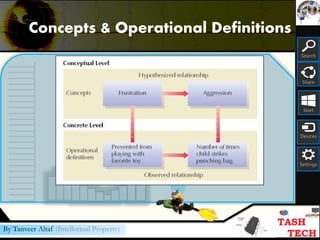
Concepts & Operational Definitions
Search
Share
Start
Devices
Settings
By Tanveer Altaf (Intellectual Property)
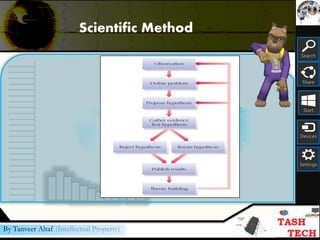
Scientific Method
Search
Share
Start
Devices
Settings
By Tanveer Altaf (Intellectual Property)
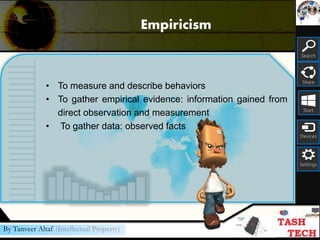
• To measure and describe behaviors
• To gather empirical evidence: information gained from
direct observation and measurement
• To gather data: observed facts
Empiricism
Search
Share
Start
Devices
Settings
By Tanveer Altaf (Intellectual Property)
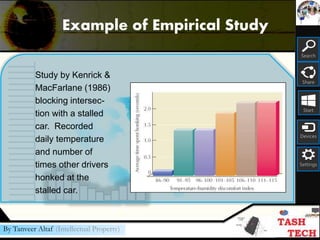
Study by Kenrick &
MacFarlane (1986)
blocking intersec-
tion with a stalled
car. Recorded
daily temperature
and number of
times other drivers
honked at the
stalled car.
Example of Empirical Study
Search
Share
Start
Devices
Settings
By Tanveer Altaf (Intellectual Property)
Part 2
Major Perspectives in Psychology
Search
Share
Start
Devices
Settings
By Tanveer Altaf (Intellectual Property)
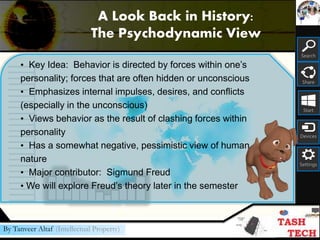
• Key Idea: Behavior is directed by forces within one’s
personality; forces that are often hidden or unconscious
• Emphasizes internal impulses, desires, and conflicts
(especially in the unconscious)
• Views behavior as the result of clashing forces within
personality
• Has a somewhat negative, pessimistic view of human
nature
• Major contributor: Sigmund Freud
• We will explore Freud’s theory later in the semester
A Look Back in History:
The Psychodynamic View
Search
Share
Start
Devices
Settings
By Tanveer Altaf (Intellectual Property)
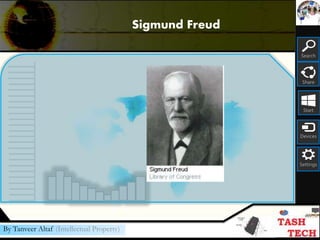
Sigmund Freud
Search
Share
Start
Devices
Settings
By Tanveer Altaf (Intellectual Property)
• Key Idea: Behavior is the result of internal physical,
chemical, and biological processes.
• Seeks to explain behavior through the activity of the brain
and nervous system, physiology, genetics, the endocrine
system, biochemistry, and evolution
• Has a neutral, reductionistic, mechanistic view of human
nature
•Some research methods
- Uses brain scans to gather data (CT, MRI, PET)
- Looks at neurotransmitters
- Treats psychological problems with medications
Perspective 1:
The Biological View
Search
Share
Start
Devices
Settings
By Tanveer Altaf (Intellectual Property)
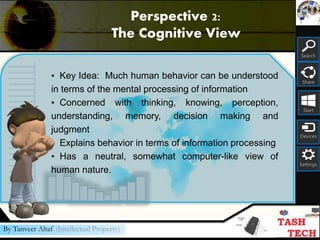
• Key Idea: Much human behavior can be understood
in terms of the mental processing of information
• Concerned with thinking, knowing, perception,
understanding, memory, decision making and
judgment
• Explains behavior in terms of information processing
• Has a neutral, somewhat computer-like view of
human nature.
Perspective 2:
The Cognitive View
Search
Share
Start
Devices
Settings
By Tanveer Altaf (Intellectual Property)
• Key Idea: Behavior is shaped and controlled by the
environment.
• Emphasizes the study of observable behavior and the
effects of learning
• Stresses the influence of external rewards and
punishments
• Has a neutral, scientific, mechanistic view of human nature
• Major contributors to Behaviorism: Watson and Skinner
- Events in environment  Behavior
- Watson studied Little Albert; Skinner studied animals
almost exclusively
Perspective 3:
The Behavioral View
Search
Share
Start
Devices
Settings
By Tanveer Altaf (Intellectual Property)
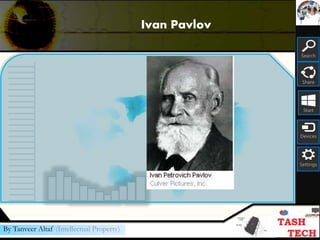
Ivan Pavlov
Search
Share
Start
Devices
Settings
By Tanveer Altaf (Intellectual Property)
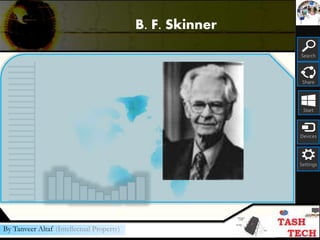
B. F. Skinner
Search
Share
Start
Devices
Settings
By Tanveer Altaf (Intellectual Property)
• Many thoughts and behaviors are influenced by our
culture.
• Psychologists need to be aware of the impact cultural
diversity may have on our behaviors.
• What is acceptable in one culture might be unacceptable in
another.
• Cultural Relativity: Behavior must be judged relative to the
values of the culture in which it occurs.
• Norms: Rules that define acceptable and expected
behavior for members of various groups.
Perspective 4:
Sociocultural Approach
Search
Share
Start
Devices
Settings
By Tanveer Altaf (Intellectual Property)
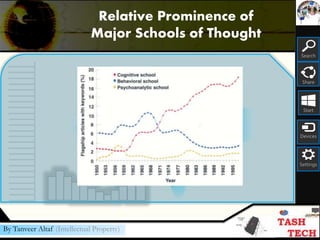
Relative Prominence of
Major Schools of Thought
Search
Share
Start
Devices
Settings
By Tanveer Altaf (Intellectual Property)
Part 3
Psychologists and Their Specialties
Search
Share
Start
Devices
Settings
By Tanveer Altaf (Intellectual Property)
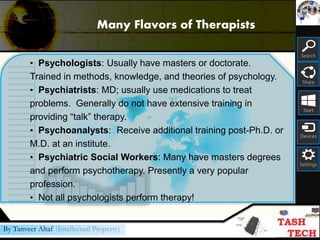
• Psychologists: Usually have masters or doctorate.
Trained in methods, knowledge, and theories of psychology.
• Psychiatrists: MD; usually use medications to treat
problems. Generally do not have extensive training in
providing “talk” therapy.
• Psychoanalysts: Receive additional training post-Ph.D. or
M.D. at an institute.
• Psychiatric Social Workers: Many have masters degrees
and perform psychotherapy. Presently a very popular
profession.
• Not all psychologists perform therapy!
Many Flavors of Therapists
Search
Share
Start
Devices
Settings
By Tanveer Altaf (Intellectual Property)
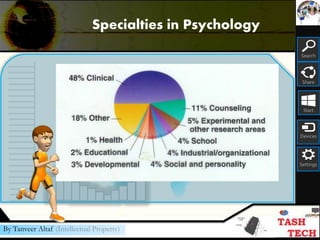
Specialties in Psychology
Search
Share
Start
Devices
Settings
By Tanveer Altaf (Intellectual Property)
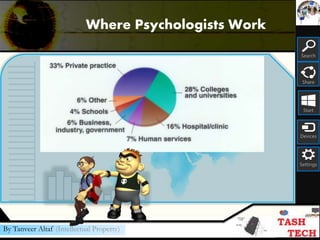
Where Psychologists Work
Search
Share
Start
Devices
Settings
By Tanveer Altaf (Intellectual Property)
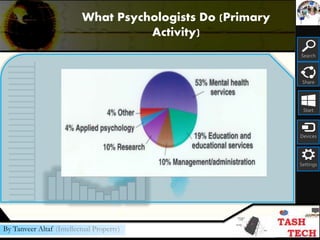
What Psychologists Do (Primary
Activity)
Search
Share
Start
Devices
Settings
By Tanveer Altaf (Intellectual Property)
Thanks a lot for watching and do not
forget to subscribe..

Psychology 01

Editor's Notes

  • #3 Topics to Explore The Science of Psychology Major Perspectives in Psychology Psychologists & Their Specialties
  • #4 Part 1 The Science of Psychology
  • #5  Psychology Psyche: Mind Logos: Knowledge or study Definition: The science of behavior and mental processes Science: Theories tested with research using scientific method Behavior: Overt; i.e., can be directly observed (crying) Mental Processes: Covert; i.e., cannot be directly observed (remembering)
  • #6 Scientific Theory Scientific Theory: A system of ideas that interrelates facts and concepts, summarizes existing data, and predicts future observations A good theory must be falsifiable; i.e., operationally defined so that it can be disconfirmed
  • #7 Concepts & Operational Definitions Conceptual Level Concrete Level
  • #8 Scientific Method
  • #9 Empiricism To measure and describe behaviors To gather empirical evidence: information gained from direct observation and measurement To gather data: observed facts
  • #10 Example of Empirical Study Study by Kenrick & MacFarlane (1986) blocking intersec-tion with a stalled car. Recorded daily temperature and number of times other drivers honked at the stalled car.
  • #11 Part 2 Major Perspectives in Psychology
  • #12 A Look Back in History: The Psychodynamic View Key Idea: Behavior is directed by forces within one’s personality; forces that are often hidden or unconscious Emphasizes internal impulses, desires, and conflicts (especially in the unconscious) Views behavior as the result of clashing forces within personality Has a somewhat negative, pessimistic view of human nature Major contributor: Sigmund Freud We will explore Freud’s theory later in the semester
  • #13 Sigmund Freud
  • #14 Perspective 1: The Biological View Key Idea: Behavior is the result of internal physical, chemical, and biological processes. Seeks to explain behavior through the activity of the brain and nervous system, physiology, genetics, the endocrine system, biochemistry, and evolution Has a neutral, reductionistic, mechanistic view of human nature Some research methods Uses brain scans to gather data (CT, MRI, PET) Looks at neurotransmitters Treats psychological problems with medications
  • #15 Perspective 2: The Cognitive View Key Idea: Much human behavior can be understood in terms of the mental processing of information Concerned with thinking, knowing, perception, understanding, memory, decision making and judgment Explains behavior in terms of information processing Has a neutral, somewhat computer-like view of human nature.
  • #16 Perspective 3: The Behavioral View Key Idea: Behavior is shaped and controlled by the environment. Emphasizes the study of observable behavior and the effects of learning Stresses the influence of external rewards and punishments Has a neutral, scientific, mechanistic view of human nature Major contributors to Behaviorism: Watson and Skinner Events in environment  Behavior Watson studied Little Albert; Skinner studied animals almost exclusively
  • #17 Ivan Pavlov
  • #18 B. F. Skinner
  • #19 Perspective 4: Sociocultural Approach Many thoughts and behaviors are influenced by our culture. Psychologists need to be aware of the impact cultural diversity may have on our behaviors. What is acceptable in one culture might be unacceptable in another. Cultural Relativity: Behavior must be judged relative to the values of the culture in which it occurs. Norms: Rules that define acceptable and expected behavior for members of various groups.
  • #20 Relative Prominence of Major Schools of Thought
  • #21 Part 3 Psychologists and Their Specialties
  • #22 Many Flavors of Therapists Psychologists: Usually have masters or doctorate. Trained in methods, knowledge, and theories of psychology. Psychiatrists: MD; usually use medications to treat problems. Generally do not have extensive training in providing “talk” therapy. Psychoanalysts: Receive additional training post-Ph.D. or M.D. at an institute. Psychiatric Social Workers: Many have masters degrees and perform psychotherapy. Presently a very popular profession. Not all psychologists perform therapy!
  • #23 Specialties in Psychology
  • #24 Where Psychologists Work
  • #25 What Psychologists Do (Primary Activity)
  • #26 Thanks a lot for watching and do not forget to subscribe..