Psychodynamic
Theory
FREUD AND JUNG
1
Sigmund Freud
Born 1865 in Freiberg, Moravia to Jacob, his wool-
merchant father. Mother was Jacob’s third wife.
Moved to Vienna in 1860 until 1938.
Vienna exciting place of opportunity and optimism. In
1867, Jews granted political rights and accepted into
society.
Freud assimilated, identifying as a German.
About the time he was 15, liberal political atmosphere
evaporated and anti-Semitism became virulent,
shattering assimilation
Graduated from University of Vienna medical school
with strong interest in research but quickly married and
realized only private practice would provide needed
financial support.
Published well received scholarly papers on
neurological disorders.
Outbreak of WW II forced him to flee to London,
where he died a year later in 1939.
2
Freud’s theory is complex
because:
He kept modifying it as he went along
He never presented a comprehensive
summary of his final views
His theory is more comprehensive than must
since it has a number of aspects. For
example, he gives us:
◦A theory of motivation
◦A theory of thinking (which includes
dreaming, etc.)
◦A theory of personality development
(psychosexual theory)
◦A theory of mental structures (id, ego,
superego)
◦A theory of psychopathology and symptom
formation
◦A theory of psychotherapy
3
Personality Theory According to
Freud
Personality is defined as follows:
◦ Our characteristic pattern of thinking, feeling,
and acting.
Freud’s psychoanalytic perspective proposed that
childhood sexuality and unconscious
motivations influence personality.
Freud called his theory and associated techniques
psychoanalysis.
Unconscious-large below the surface area which
contains thoughts, wishes, feelings and
memories, of which we are unaware.
Free association-the patient is asked to relax and
say whatever comes to mind, no matter how
embarrassing or trivial.
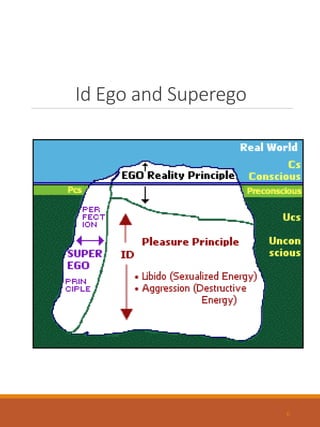
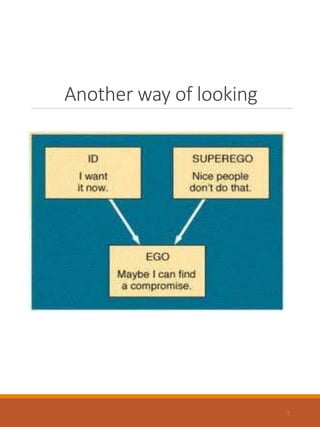
Personality Structure according to Freud
ID-a reservoir of unconscious psychic energy constantly striving to satisfy
basic drives to survive, reproduce, and aggress.
The id operates on the pleasure principle: If not constrained but reality, it
seeks immediate gratification.
Ego-the largely conscious, “executive” part of personality that, according to
Freud, mediates the demands of the id, superego, and reality.
The ego operates on the reality principle, satisfying the id’s desires in
ways that will realistically bring pleasure rather than pain.
Superego-represents internalized ideals and provides standards for
judgment (the conscious) and for future aspirations.
Id Ego and Superego
6
Another way of looking
7
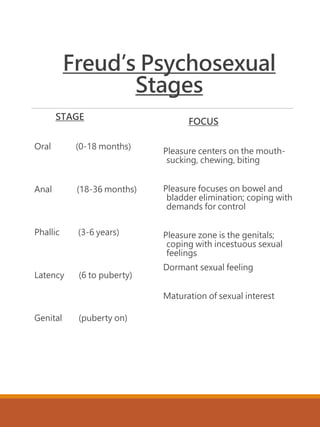
Freud’s Psychosexual
Stages
STAGE
Oral (0-18 months)
Anal (18-36 months)
Phallic (3-6 years)
Latency (6 to puberty)
Genital (puberty on)
FOCUS
Pleasure centers on the mouth-
sucking, chewing, biting
Pleasure focuses on bowel and
bladder elimination; coping with
demands for control
Pleasure zone is the genitals;
coping with incestuous sexual
feelings
Dormant sexual feeling
Maturation of sexual interest
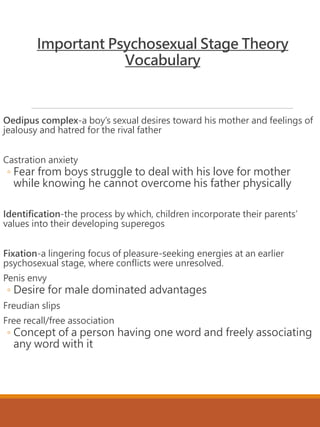
Important Psychosexual Stage Theory
Vocabulary
Oedipus complex-a boy’s sexual desires toward his mother and feelings of
jealousy and hatred for the rival father
Castration anxiety
◦ Fear from boys struggle to deal with his love for mother
while knowing he cannot overcome his father physically
Identification-the process by which, children incorporate their parents’
values into their developing superegos
Fixation-a lingering focus of pleasure-seeking energies at an earlier
psychosexual stage, where conflicts were unresolved.
Penis envy
◦ Desire for male dominated advantages
Freudian slips
Free recall/free association
◦ Concept of a person having one word and freely associating
any word with it
DEFENSE MECHANISM
Tactics that reduce or redirect anxiety in
various ways,
but always by distorting reality
11
Repression
A defense
mechanism
that pushes
threatening
thoughts
into the
unconscious
Reaction formation
A defense
mechanism that
pushes away
threatening impulses
by overemphasizing
the opposite in one’s
thoughts and words
12
Denial
A defense
mechanism in which
one refuses to
acknowledge anxiety
provoking stimuli
13
Projection
Defense mechanism
in which anxiety
arousing impulse are
externalized by
placing onto others
14
Displacement
Defense mechanism
in which the target of
one’s unconscious
fear or desire is
shifted away from
true cause
15
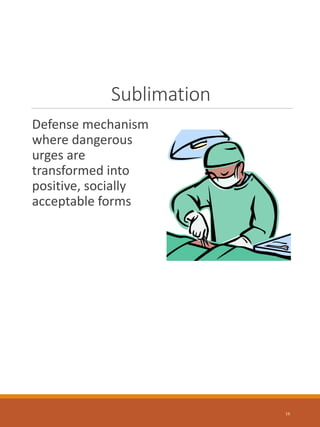
Sublimation
Defense mechanism
where dangerous
urges are
transformed into
positive, socially
acceptable forms
16
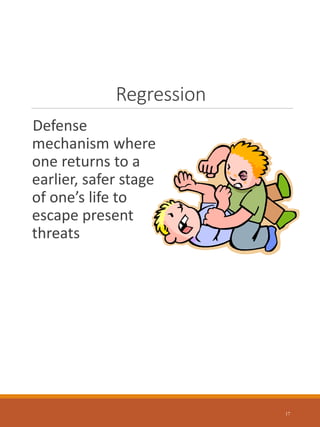
Regression
Defense
mechanism where
one returns to a
earlier, safer stage
of one’s life to
escape present
threats
17
Rationalization
Defense mechanism
where after the fact
(post hoc) logical
explanations for
behaviors that were
actually driven by
internal unconscious
motives
18
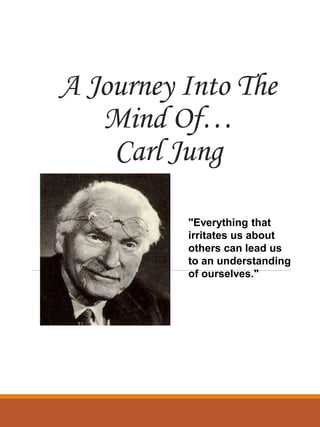
Carl Jung
19
A Journey Into The
Mind Of…
Carl Jung
"Everything that
irritates us about
others can lead us
to an understanding
of ourselves."
Who is Carl Jung?
Carl Jung was born in Kesswill Switzerland
(1875).
As a child he was interested in history,
archaeology, and philosophy.
He studied medicine at the University of
Basel and discovered he had a passion for
psychiatry. He became a psychiatrist as it
gave him the opportunity to study both the
spiritual and factual sides of the world.
For 9 years he was an assistant physician at
a Psychiatric Hospital
He studied Schizophrenia extensively.
His Early Career…
In 1907 Jung went to Vienna to meet Freud where
they studied along side each other for a number of
years. They developed their own theories and
corresponded through letters.
They came to parting ways because Jung disagreed
with Freud’s belief that the sexual component was the
only part of the human personality. Jung also felt
Freud was too narrow-minded about his views on the
unconscious mind and dream interpretation. Freud’s
main theories were that our sexual libido controlled
our unconscious thoughts and when dreaming it was
our sexual thoughts that controlled the content of
these dreams.
His
Early
Career
Cont.
His first ideas were
published in Psychology
of the Unconscious (it
contained much about
mythological content
and listed parallels
between myths and
psychotic fantasies).
He went on to develop
his own theory called
analytic psychology, for
half a century he wrote
religiously about
personality in regards to
symbolic, mythological,
and spiritual views.
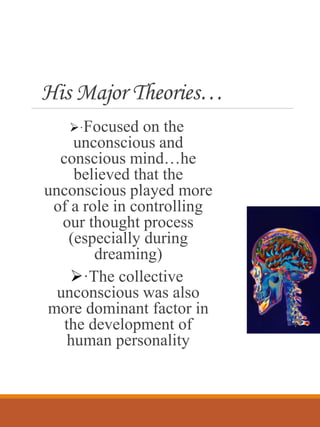
His Major Theories…
·Focused on the
unconscious and
conscious mind…he
believed that the
unconscious played more
of a role in controlling
our thought process
(especially during
dreaming)
·The collective
unconscious was also
more dominant factor in
the development of
human personality
His Major Theories Cont…
·He believed in two personality types
·Introvert – someone who keeps to
themselves and is emotionally self-sufficient
Extrovert- someone who is outgoing and
use their psychological power to draw people
towards them

Psychodynamic Freud and Jung (3).ppt

  • 1.
  • 2.
    Sigmund Freud Born 1865in Freiberg, Moravia to Jacob, his wool- merchant father. Mother was Jacob’s third wife. Moved to Vienna in 1860 until 1938. Vienna exciting place of opportunity and optimism. In 1867, Jews granted political rights and accepted into society. Freud assimilated, identifying as a German. About the time he was 15, liberal political atmosphere evaporated and anti-Semitism became virulent, shattering assimilation Graduated from University of Vienna medical school with strong interest in research but quickly married and realized only private practice would provide needed financial support. Published well received scholarly papers on neurological disorders. Outbreak of WW II forced him to flee to London, where he died a year later in 1939. 2
  • 3.
    Freud’s theory iscomplex because: He kept modifying it as he went along He never presented a comprehensive summary of his final views His theory is more comprehensive than must since it has a number of aspects. For example, he gives us: ◦A theory of motivation ◦A theory of thinking (which includes dreaming, etc.) ◦A theory of personality development (psychosexual theory) ◦A theory of mental structures (id, ego, superego) ◦A theory of psychopathology and symptom formation ◦A theory of psychotherapy 3
  • 4.
    Personality Theory Accordingto Freud Personality is defined as follows: ◦ Our characteristic pattern of thinking, feeling, and acting. Freud’s psychoanalytic perspective proposed that childhood sexuality and unconscious motivations influence personality. Freud called his theory and associated techniques psychoanalysis. Unconscious-large below the surface area which contains thoughts, wishes, feelings and memories, of which we are unaware. Free association-the patient is asked to relax and say whatever comes to mind, no matter how embarrassing or trivial.
  • 5.
    Personality Structure accordingto Freud ID-a reservoir of unconscious psychic energy constantly striving to satisfy basic drives to survive, reproduce, and aggress. The id operates on the pleasure principle: If not constrained but reality, it seeks immediate gratification. Ego-the largely conscious, “executive” part of personality that, according to Freud, mediates the demands of the id, superego, and reality. The ego operates on the reality principle, satisfying the id’s desires in ways that will realistically bring pleasure rather than pain. Superego-represents internalized ideals and provides standards for judgment (the conscious) and for future aspirations.
  • 6.
    Id Ego andSuperego 6
  • 7.
    Another way oflooking 7
  • 8.
    Freud’s Psychosexual Stages STAGE Oral (0-18months) Anal (18-36 months) Phallic (3-6 years) Latency (6 to puberty) Genital (puberty on) FOCUS Pleasure centers on the mouth- sucking, chewing, biting Pleasure focuses on bowel and bladder elimination; coping with demands for control Pleasure zone is the genitals; coping with incestuous sexual feelings Dormant sexual feeling Maturation of sexual interest
  • 9.
    Important Psychosexual StageTheory Vocabulary Oedipus complex-a boy’s sexual desires toward his mother and feelings of jealousy and hatred for the rival father Castration anxiety ◦ Fear from boys struggle to deal with his love for mother while knowing he cannot overcome his father physically Identification-the process by which, children incorporate their parents’ values into their developing superegos Fixation-a lingering focus of pleasure-seeking energies at an earlier psychosexual stage, where conflicts were unresolved. Penis envy ◦ Desire for male dominated advantages Freudian slips Free recall/free association ◦ Concept of a person having one word and freely associating any word with it
  • 10.
    DEFENSE MECHANISM Tactics thatreduce or redirect anxiety in various ways, but always by distorting reality
  • 11.
  • 12.
    Reaction formation A defense mechanismthat pushes away threatening impulses by overemphasizing the opposite in one’s thoughts and words 12
  • 13.
    Denial A defense mechanism inwhich one refuses to acknowledge anxiety provoking stimuli 13
  • 14.
    Projection Defense mechanism in whichanxiety arousing impulse are externalized by placing onto others 14
  • 15.
    Displacement Defense mechanism in whichthe target of one’s unconscious fear or desire is shifted away from true cause 15
  • 16.
    Sublimation Defense mechanism where dangerous urgesare transformed into positive, socially acceptable forms 16
  • 17.
    Regression Defense mechanism where one returnsto a earlier, safer stage of one’s life to escape present threats 17
  • 18.
    Rationalization Defense mechanism where afterthe fact (post hoc) logical explanations for behaviors that were actually driven by internal unconscious motives 18
  • 19.
  • 20.
    A Journey IntoThe Mind Of… Carl Jung "Everything that irritates us about others can lead us to an understanding of ourselves."
  • 21.
    Who is CarlJung? Carl Jung was born in Kesswill Switzerland (1875). As a child he was interested in history, archaeology, and philosophy. He studied medicine at the University of Basel and discovered he had a passion for psychiatry. He became a psychiatrist as it gave him the opportunity to study both the spiritual and factual sides of the world. For 9 years he was an assistant physician at a Psychiatric Hospital He studied Schizophrenia extensively.
  • 22.
    His Early Career… In1907 Jung went to Vienna to meet Freud where they studied along side each other for a number of years. They developed their own theories and corresponded through letters. They came to parting ways because Jung disagreed with Freud’s belief that the sexual component was the only part of the human personality. Jung also felt Freud was too narrow-minded about his views on the unconscious mind and dream interpretation. Freud’s main theories were that our sexual libido controlled our unconscious thoughts and when dreaming it was our sexual thoughts that controlled the content of these dreams.
  • 23.
    His Early Career Cont. His first ideaswere published in Psychology of the Unconscious (it contained much about mythological content and listed parallels between myths and psychotic fantasies). He went on to develop his own theory called analytic psychology, for half a century he wrote religiously about personality in regards to symbolic, mythological, and spiritual views.
  • 24.
    His Major Theories… ·Focusedon the unconscious and conscious mind…he believed that the unconscious played more of a role in controlling our thought process (especially during dreaming) ·The collective unconscious was also more dominant factor in the development of human personality
  • 25.
    His Major TheoriesCont… ·He believed in two personality types ·Introvert – someone who keeps to themselves and is emotionally self-sufficient Extrovert- someone who is outgoing and use their psychological power to draw people towards them