PSYCHOSOCIAL SUPPORT
ACTIVITY
Psychosocial Support (PSS)
It pertains to specific processes and actions that
promote the holistic well-being and resilience of
individuals.
Holistic well-being includes learners' access to learning
opportunities and capacities for learning achievement.
Psychosocial Support (PSS)
Psychosocial support activities bring learners,
teachers, as well as parents or guardians together in
creating a supportive environment that promotes
recovery from the impacts of disasters and/or
emergencies, improved psychosocial well-being, and
successful learning continuity
Psychosocial Support (PSS)
PSS activities support the development of competencies
related to Social and Emotional Learning (SEL). Such core
competencies include recognition and management of
emotions, setting and achieving goals, appreciating the
perspectives of others, establishing and maintaining
positive relationships, making responsible decisions, and
handling interpersonal situations constructively, among
others.
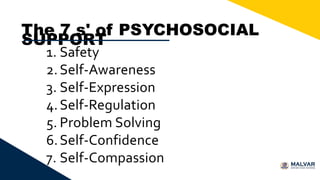
The 7 s' of PSYCHOSOCIAL
SUPPORT
1. Safety
2.Self-Awareness
3. Self-Expression
4.Self-Regulation
5. Problem Solving
6.Self-Confidence
7. Self-Compassion
Making Masks
Psychosocial Competency: Self-awareness and Self-expression
RECOVERY
OBJECTIVE
Develop self-awareness, self-expression, and empathy towards
others
LEARNING
OBJECTIVE
Practice language skills, storytelling and acting skills,
conceptual skills and explore creativity.
MATERIALS NEEDED
 Paper plates or paper
 string or rubber bands
 Glue
 Scissors
 coloring materials and
 other assorted materials (e.g. buttons,
feathers, ribbons, colored paper etc.) to
decorate their masks with
be curious
be respectful
Listen
take turns
avoid judgment
everything shared is confidential
HOW ARE
YOU
FEELING
TODAY?
List down the different emotions you
are feeling today on a piece of
paper.
Then, think about which feelings on
the list you are comfortable sharing
with others. Draw and decorate the
front of your masks to represent
these feelings.
Afterwards, flip your masks and
draw/decorate on its inside to
represent the feelings which you
would rather keep to yourself.
Sometimes, we may choose to hide or
mask some feelings which we consider
as “negative” or “bad.” We might not feel
safe enough to reveal how we truly feel.
Having these hesitations are valid and
normal.
Today, we tried to become more aware of
which emotions we tend to keep to ourselves.
More importantly, we identified what could
make us feel ready and safe enough to share
these feelings to others. When we’re able to
talk about our emotions, we might discover that
others are feeling the same way.

PSS-Making-Mask.pptx

  • 1.
  • 2.
    Psychosocial Support (PSS) Itpertains to specific processes and actions that promote the holistic well-being and resilience of individuals. Holistic well-being includes learners' access to learning opportunities and capacities for learning achievement.
  • 3.
    Psychosocial Support (PSS) Psychosocialsupport activities bring learners, teachers, as well as parents or guardians together in creating a supportive environment that promotes recovery from the impacts of disasters and/or emergencies, improved psychosocial well-being, and successful learning continuity
  • 4.
    Psychosocial Support (PSS) PSSactivities support the development of competencies related to Social and Emotional Learning (SEL). Such core competencies include recognition and management of emotions, setting and achieving goals, appreciating the perspectives of others, establishing and maintaining positive relationships, making responsible decisions, and handling interpersonal situations constructively, among others.
  • 5.
    The 7 s'of PSYCHOSOCIAL SUPPORT 1. Safety 2.Self-Awareness 3. Self-Expression 4.Self-Regulation 5. Problem Solving 6.Self-Confidence 7. Self-Compassion
  • 6.
    Making Masks Psychosocial Competency:Self-awareness and Self-expression
  • 7.
    RECOVERY OBJECTIVE Develop self-awareness, self-expression,and empathy towards others LEARNING OBJECTIVE Practice language skills, storytelling and acting skills, conceptual skills and explore creativity.
  • 8.
    MATERIALS NEEDED  Paperplates or paper  string or rubber bands  Glue  Scissors  coloring materials and  other assorted materials (e.g. buttons, feathers, ribbons, colored paper etc.) to decorate their masks with
  • 9.
    be curious be respectful Listen taketurns avoid judgment everything shared is confidential
  • 10.
  • 11.
    List down thedifferent emotions you are feeling today on a piece of paper. Then, think about which feelings on the list you are comfortable sharing with others. Draw and decorate the front of your masks to represent these feelings.
  • 12.
    Afterwards, flip yourmasks and draw/decorate on its inside to represent the feelings which you would rather keep to yourself.
  • 14.
    Sometimes, we maychoose to hide or mask some feelings which we consider as “negative” or “bad.” We might not feel safe enough to reveal how we truly feel. Having these hesitations are valid and normal.
  • 15.
    Today, we triedto become more aware of which emotions we tend to keep to ourselves. More importantly, we identified what could make us feel ready and safe enough to share these feelings to others. When we’re able to talk about our emotions, we might discover that others are feeling the same way.

Editor's Notes

  • #3 The crises brought by disasters and/or emergencies put individuals temporarily out of balance, if not severely distressed. For some, prolonged disruption of learning, isolation, and interruption of social life within the school community may cause severe stress and psychological consequences, e.g., feeling overwhelmed and anxious, experiencing learning difficulties, becoming distressed or dysfunctional over changes in routine. Others may have experienced violence and neglect, causing trauma. Children coming from low-income families become more vulnerable to risks brought by economic losses due to disasters and/or emergencies. With the complex impacts of disasters and/or emergencies, teachers and school personnel must meet the learners where they are as they work towards learning continuity while prioritizing learners’ recovery towards enhanced well-being. Accordingly, Psychosocial Support (PSS) will be significant in working on these huge tasks.
  • #6 Safety Emotional and physical safety are essential for recovery to take place; this builds trust and creates an environment where self-reflection and self-expression become possible. Self-awareness In school, at various age groups, there is a growing self-awareness of one’s body, separateness from others, and ability to express needs and preferences. Self-expression The process of identifying feelings and sharing this both verbally and non-verbally, in the presence of a caring adult who is attentive to both the learner and the creative process, is fundamentally what psychosocial support work in the classroom is about. Self-regulation This is the ability to manage one’s emotions. Problem Solving. This critical life skill can be learned through any process that involves art making. It can begin with resolving the simple dilemma between choosing blue or green to color, or deciding what colors to mix to make a new color, or deciding on one’s own specific rhythm or beat in a song or a dance sequence. Self-confidence. A strong sense of self-esteem and self-confidence is essential to experiencing success in school, and in finding one’s way through adversity, and art-based activities can help encourage children to reflect on, identify, and express their strengths and values. Self-compassion. These activities that involve the facilitation of a trustworthy adult as well as interactions with others promote the development of empathy and appreciation for differences and unique abilities, talents and ways of coping.
  • #7 This activity will allow learners to identify their feelings, creatively express these in the form of a mask and/or a collective story, and reflect on what they need to feel safe in their self-expression.
  • #9 Before the main activity, distribute the paper plates or paper to your learners. Ask your learners to create masks using the paper plates or paper. They can use any shape for the mask that they want. The mask can be an eye mask, or a full face mask. Remind learners to cut holes for the eyes, and for the mouth if it is a full face mask. Make a small slit on the sides of the masks, and attach a piece of string or rubber bands, so that the mask can be worn. A template for the mask can be provided so that the learners can prepare this at home.
  • #11 Ask the learners to think about all the feelings they have today, recognizing that most people feel multiple feelings at the same time. List down these different emotions on a piece of paper. Ask the learners to think about which feelings on the list they are comfortable sharing with others. Then, ask them to draw and decorate the front of their masks to represent these feelings.
  • #13 Once they finish, invite them to share their mask and why/how it represents their feelings for the day. Give learners the option to choose whether they would like to talk about both sides of the mask or the front side only. An alternative to individual sharing is to divide the learners into groups of 5 or 6 and have them create a story that uses all the masks (to represent characters in the story). Give learners the option to choose whether they would like to portray the front or back side of their mask. Allot 10 to 15 minutes for the groups to practice their story and then have each one perform it.
  • #14 What was it like to draw your feelings on your masks? What do you notice about the feelings on the front and on the inside of your mask? What difference did you feel while you were decorating the front part of your mask, compared to the back part of your mask? What feelings did we see in our masks today? Do you notice any similarities / common emotions? What was it like to see your classmates’ masks? What was it like wearing your mask and acting out your feelings? (if role plays were done) What would help you feel safe to tell others about how you feel?
  • #16 Everyone experiences both pleasant and unpleasant feelings. We might also realize that our feelings are neither good nor bad. We may judge our emotions this way, but today reminded us that all feelings are acknowledged and valid, and are not labeled as good or bad, or positive or negative. Our feelings provide us information so we can better take action.