By: Dustin Miller and Jonathon
Tucker
Environmental Analysis 2014-2015
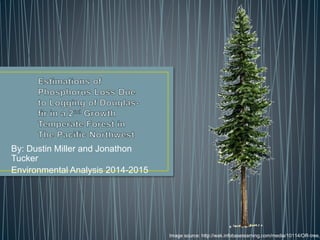
Image source: http://wak.infobaselearning.com/media/10114/OR-tree.j
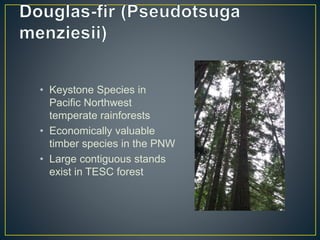
• Keystone Species in
Pacific Northwest
temperate rainforests
• Economically valuable
timber species in the PNW
• Large contiguous stands
exist in TESC forest
• The 1994 Northwest Forest Plan
• Shift from focus on timber output to ecosystem
sustainability on public land
• Clear-cut logging still dominant on private land
• Previous studies have shown that continuous
management of forests can cause nutrient depletion and
reduced productivity (Federer et al. 1989, Blanco 2012)
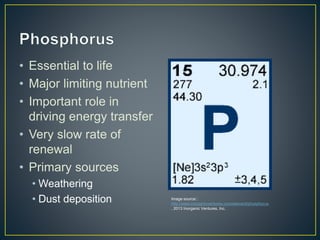
• Essential to life
• Major limiting nutrient
• Important role in
driving energy transfer
• Very slow rate of
renewal
• Primary sources
• Weathering
• Dust deposition Image source::
http://www.inorganicventures.com/element/phosphorus
. 2013 Inorganic Ventures, Inc.
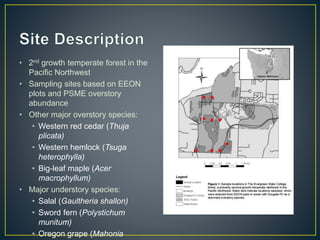
• 2nd growth temperate forest in the
Pacific Northwest
• Sampling sites based on EEON
plots and PSME overstory
abundance
• Other major overstory species:
• Western red cedar (Thuja
plicata)
• Western hemlock (Tsuga
heterophylla)
• Big-leaf maple (Acer
macrophyllum)
• Major understory species:
• Salal (Gaultheria shallon)
• Sword fern (Polystichum
munitum)
• Oregon grape (Mahonia
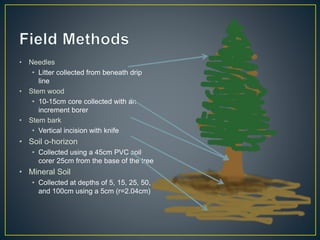
• Needles
• Litter collected from beneath drip
line
• Stem wood
• 10-15cm core collected with an
increment borer
• Stem bark
• Vertical incision with knife
• Soil o-horizon
• Collected using a 45cm PVC soil
corer 25cm from the base of the tree
• Mineral Soil
• Collected at depths of 5, 15, 25, 50,
and 100cm using a 5cm (r=2.04cm)
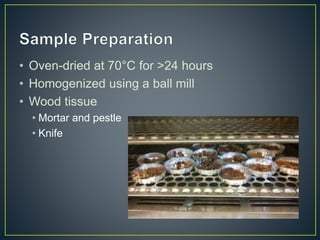
• Oven-dried at 70°C for >24 hours
• Homogenized using a ball mill
• Wood tissue
• Mortar and pestle
• Knife
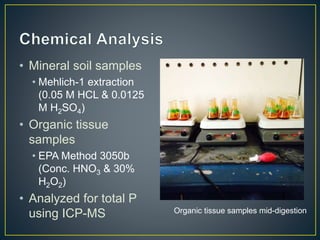
• Mineral soil samples
• Mehlich-1 extraction
(0.05 M HCL & 0.0125
M H2SO4)
• Organic tissue
samples
• EPA Method 3050b
(Conc. HNO3 & 30%
H2O2)
• Analyzed for total P
using ICP-MS Organic tissue samples mid-digestion
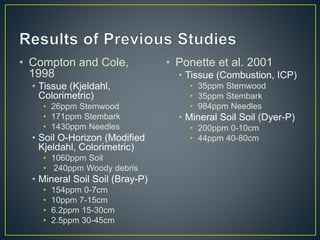
• Compton and Cole,
1998
• Tissue (Kjeldahl,
Colorimetric)
• 26ppm Stemwood
• 171ppm Stembark
• 1430ppm Needles
• Soil O-Horizon (Modified
Kjeldahl, Colorimetric)
• 1060ppm Soil
• 240ppm Woody debris
• Mineral Soil Soil (Bray-P)
• 154ppm 0-7cm
• 10ppm 7-15cm
• 6.2ppm 15-30cm
• 2.5ppm 30-45cm
• Ponette et al. 2001
• Tissue (Combustion, ICP)
• 35ppm Stemwood
• 35ppm Stembark
• 984ppm Needles
• Mineral Soil Soil (Dyer-P)
• 200ppm 0-10cm
• 44ppm 40-80cm
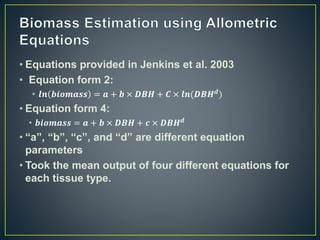
• Equations provided in Jenkins et al. 2003
• Equation form 2:
• 𝒍𝒏 𝒃𝒊𝒐𝒎𝒂𝒔𝒔 = 𝒂 + 𝒃 × 𝑫𝑩𝑯 + 𝑪 × 𝒍𝒏(𝑫𝑩𝑯 𝒅)
• Equation form 4:
• 𝒃𝒊𝒐𝒎𝒂𝒔𝒔 = 𝒂 + 𝒃 × 𝑫𝑩𝑯 + 𝒄 × 𝑫𝑩𝑯 𝒅
• “a”, “b”, “c”, and “d” are different equation
parameters
• Took the mean output of four different equations for
each tissue type.
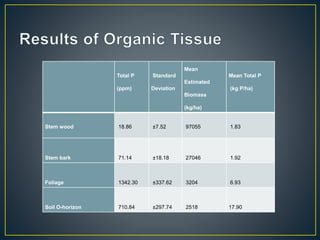
Total P
(ppm)
Standard
Deviation
Mean
Estimated
Biomass
(kg/ha)
Mean Total P
(kg P/ha)
Stem wood 18.86 ±7.52 97055 1.83
Stem bark 71.14 ±18.18 27046 1.92
Foliage 1342.30 ±337.62 3204 6.93
Soil O-horizon 710.84 ±297.74 2518 17.90
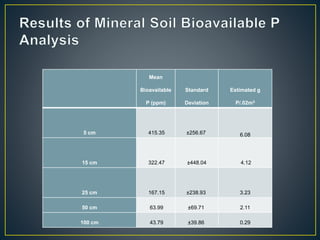
Mean
Bioavailable
P (ppm)
Standard
Deviation
Estimated g
P/.02m3
5 cm 415.35 ±256.67 6.08
15 cm 322.47 ±448.04 4.12
25 cm 167.15 ±238.93 3.23
50 cm 63.99 ±69.71 2.11
100 cm 43.79 ±39.86 0.29
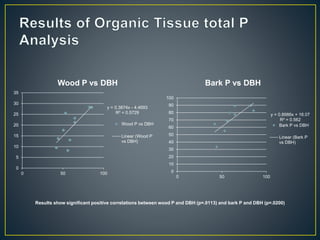
Results show significant positive correlations between wood P and DBH (p=.0113) and bark P and DBH (p=.0200)
y = 0.8986x + 16.07
R² = 0.562
0
10
20
30
40
50
60
70
80
90
100
0 50 100
Bark P vs DBH
Bark P vs DBH
Linear (Bark P
vs DBH)
y = 0.3874x - 4.4693
R² = 0.5729
0
5
10
15
20
25
30
35
0 50 100
Wood P vs DBH
Wood P vs DBH
Linear (Wood P
vs DBH)
y = 154.58x - 97.668
R² = 0.937
-20
0
20
40
60
80
100
120
0 0.5 1 1.5
Depth(cm)
Mean Soil Density (g/cm3)
Mean Soil Density vs Depth
Mean Soil Density
(g/cm^3) vs Depth
(cm)
Linear (Mean Soil
Density (g/cm^3)
vs Depth (cm))
y = -35.92ln(x) + 217.62
R² = 0.8653
y = -0.1977x + 79.052
R² = 0.7137
-20
0
20
40
60
80
100
120
0 200 400 600
MeanPlantAvailableP(ppm)
Depth (cm)
Mean P vs Depth
Mean P vs
Depth
Log. (Mean P
vs Depth)
0
20
40
60
80
100
120
0 100 200 300 400 500 600
Depth(cm)
Estimated Soil Plant AvailableP (ppm)
0
20
40
60
80
100
120
-100 0 100 200 300 400
Depth(cm)
Estimated Soil Plant AvailableP (ppm)
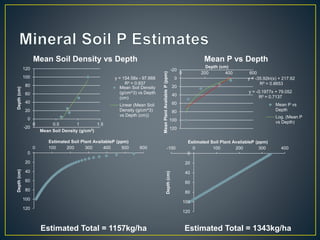
Estimated Total = 1157kg/ha Estimated Total = 1343kg/ha
• Literature comparison
• Bark and needle concentrations very consistent with prior measurements
• O-horizon concentrations lower than expected, possibly due to
methodological differences
• Wood concentrations lower than expected
• Old-growth Douglas-fir forests and P sequestration
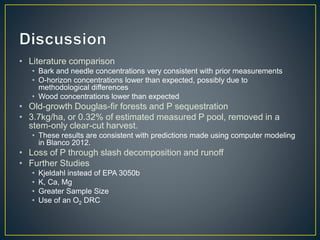
• 3.7kg/ha, or 0.32% of estimated measured P pool, removed in a
stem-only clear-cut harvest.
• These results are consistent with predictions made using computer modeling
in Blanco 2012.
• Loss of P through slash decomposition and runoff
• Further Studies
• Kjeldahl instead of EPA 3050b
• K, Ca, Mg
• Greater Sample Size
• Use of an O2 DRC
• We would like to thank Carri, Abir, and Clyde for their
guidance, feedback, and patience throughout the year.
• Special thanks to Jenna and Sina for all the help with
methods, instrumentation, and equipment
• Kaile and the rest of the SSC staff
• J. Jenkins, D. Chojnacky, L. Heath, R. Birdsey. 2003. Comprehensive Database of Diameter-
based Biomass Regression for North American Tree Species. USDA Forest Service,
Northeastern Research Station. GTR-NE-319
• C. Federer, J. Hornbeck, L. Tritton, C. Martin, R. Pierce. 1989. Long-term depletion of
calcium other nutrients in eastern US forests. Environmental Management 13(5), pp. 593-601
• J. Blanco. 2012. Forests may need centuries to recover their original productivity after
continuous intensive management: An example from Douglas-fir stands. Science of the
Total Environment 437, pp. 91-103
• Q. Ponette, J. Ranger, J. Ottorini, E. Ulrich. 2001. Aboveground biomass and nutrient
content of five Douglas-fir stands in France. Forest Ecology and Management 142, pp. 109-
127
• J. Compton, D. Cole. 1998. Phosphorus Cycling and Soil P Fractions in Douglas-Fir and Red
Alder Stands. Forest Ecology and Management 110, pp. 101-112.

PSME_P_Final_Presentation

  • 1.
    By: Dustin Millerand Jonathon Tucker Environmental Analysis 2014-2015 Image source: http://wak.infobaselearning.com/media/10114/OR-tree.j
  • 2.
    • Keystone Speciesin Pacific Northwest temperate rainforests • Economically valuable timber species in the PNW • Large contiguous stands exist in TESC forest
  • 3.
    • The 1994Northwest Forest Plan • Shift from focus on timber output to ecosystem sustainability on public land • Clear-cut logging still dominant on private land • Previous studies have shown that continuous management of forests can cause nutrient depletion and reduced productivity (Federer et al. 1989, Blanco 2012)
  • 4.
    • Essential tolife • Major limiting nutrient • Important role in driving energy transfer • Very slow rate of renewal • Primary sources • Weathering • Dust deposition Image source:: http://www.inorganicventures.com/element/phosphorus . 2013 Inorganic Ventures, Inc.
  • 5.
    • 2nd growthtemperate forest in the Pacific Northwest • Sampling sites based on EEON plots and PSME overstory abundance • Other major overstory species: • Western red cedar (Thuja plicata) • Western hemlock (Tsuga heterophylla) • Big-leaf maple (Acer macrophyllum) • Major understory species: • Salal (Gaultheria shallon) • Sword fern (Polystichum munitum) • Oregon grape (Mahonia
  • 6.
    • Needles • Littercollected from beneath drip line • Stem wood • 10-15cm core collected with an increment borer • Stem bark • Vertical incision with knife • Soil o-horizon • Collected using a 45cm PVC soil corer 25cm from the base of the tree • Mineral Soil • Collected at depths of 5, 15, 25, 50, and 100cm using a 5cm (r=2.04cm)
  • 7.
    • Oven-dried at70°C for >24 hours • Homogenized using a ball mill • Wood tissue • Mortar and pestle • Knife
  • 8.
    • Mineral soilsamples • Mehlich-1 extraction (0.05 M HCL & 0.0125 M H2SO4) • Organic tissue samples • EPA Method 3050b (Conc. HNO3 & 30% H2O2) • Analyzed for total P using ICP-MS Organic tissue samples mid-digestion
  • 9.
    • Compton andCole, 1998 • Tissue (Kjeldahl, Colorimetric) • 26ppm Stemwood • 171ppm Stembark • 1430ppm Needles • Soil O-Horizon (Modified Kjeldahl, Colorimetric) • 1060ppm Soil • 240ppm Woody debris • Mineral Soil Soil (Bray-P) • 154ppm 0-7cm • 10ppm 7-15cm • 6.2ppm 15-30cm • 2.5ppm 30-45cm • Ponette et al. 2001 • Tissue (Combustion, ICP) • 35ppm Stemwood • 35ppm Stembark • 984ppm Needles • Mineral Soil Soil (Dyer-P) • 200ppm 0-10cm • 44ppm 40-80cm
  • 10.
    • Equations providedin Jenkins et al. 2003 • Equation form 2: • 𝒍𝒏 𝒃𝒊𝒐𝒎𝒂𝒔𝒔 = 𝒂 + 𝒃 × 𝑫𝑩𝑯 + 𝑪 × 𝒍𝒏(𝑫𝑩𝑯 𝒅) • Equation form 4: • 𝒃𝒊𝒐𝒎𝒂𝒔𝒔 = 𝒂 + 𝒃 × 𝑫𝑩𝑯 + 𝒄 × 𝑫𝑩𝑯 𝒅 • “a”, “b”, “c”, and “d” are different equation parameters • Took the mean output of four different equations for each tissue type.
  • 11.
    Total P (ppm) Standard Deviation Mean Estimated Biomass (kg/ha) Mean TotalP (kg P/ha) Stem wood 18.86 ±7.52 97055 1.83 Stem bark 71.14 ±18.18 27046 1.92 Foliage 1342.30 ±337.62 3204 6.93 Soil O-horizon 710.84 ±297.74 2518 17.90
  • 12.
    Mean Bioavailable P (ppm) Standard Deviation Estimated g P/.02m3 5cm 415.35 ±256.67 6.08 15 cm 322.47 ±448.04 4.12 25 cm 167.15 ±238.93 3.23 50 cm 63.99 ±69.71 2.11 100 cm 43.79 ±39.86 0.29
  • 13.
    Results show significantpositive correlations between wood P and DBH (p=.0113) and bark P and DBH (p=.0200) y = 0.8986x + 16.07 R² = 0.562 0 10 20 30 40 50 60 70 80 90 100 0 50 100 Bark P vs DBH Bark P vs DBH Linear (Bark P vs DBH) y = 0.3874x - 4.4693 R² = 0.5729 0 5 10 15 20 25 30 35 0 50 100 Wood P vs DBH Wood P vs DBH Linear (Wood P vs DBH)
  • 14.
    y = 154.58x- 97.668 R² = 0.937 -20 0 20 40 60 80 100 120 0 0.5 1 1.5 Depth(cm) Mean Soil Density (g/cm3) Mean Soil Density vs Depth Mean Soil Density (g/cm^3) vs Depth (cm) Linear (Mean Soil Density (g/cm^3) vs Depth (cm)) y = -35.92ln(x) + 217.62 R² = 0.8653 y = -0.1977x + 79.052 R² = 0.7137 -20 0 20 40 60 80 100 120 0 200 400 600 MeanPlantAvailableP(ppm) Depth (cm) Mean P vs Depth Mean P vs Depth Log. (Mean P vs Depth) 0 20 40 60 80 100 120 0 100 200 300 400 500 600 Depth(cm) Estimated Soil Plant AvailableP (ppm) 0 20 40 60 80 100 120 -100 0 100 200 300 400 Depth(cm) Estimated Soil Plant AvailableP (ppm) Estimated Total = 1157kg/ha Estimated Total = 1343kg/ha
  • 15.
    • Literature comparison •Bark and needle concentrations very consistent with prior measurements • O-horizon concentrations lower than expected, possibly due to methodological differences • Wood concentrations lower than expected • Old-growth Douglas-fir forests and P sequestration • 3.7kg/ha, or 0.32% of estimated measured P pool, removed in a stem-only clear-cut harvest. • These results are consistent with predictions made using computer modeling in Blanco 2012. • Loss of P through slash decomposition and runoff • Further Studies • Kjeldahl instead of EPA 3050b • K, Ca, Mg • Greater Sample Size • Use of an O2 DRC
  • 16.
    • We wouldlike to thank Carri, Abir, and Clyde for their guidance, feedback, and patience throughout the year. • Special thanks to Jenna and Sina for all the help with methods, instrumentation, and equipment • Kaile and the rest of the SSC staff
  • 17.
    • J. Jenkins,D. Chojnacky, L. Heath, R. Birdsey. 2003. Comprehensive Database of Diameter- based Biomass Regression for North American Tree Species. USDA Forest Service, Northeastern Research Station. GTR-NE-319 • C. Federer, J. Hornbeck, L. Tritton, C. Martin, R. Pierce. 1989. Long-term depletion of calcium other nutrients in eastern US forests. Environmental Management 13(5), pp. 593-601 • J. Blanco. 2012. Forests may need centuries to recover their original productivity after continuous intensive management: An example from Douglas-fir stands. Science of the Total Environment 437, pp. 91-103 • Q. Ponette, J. Ranger, J. Ottorini, E. Ulrich. 2001. Aboveground biomass and nutrient content of five Douglas-fir stands in France. Forest Ecology and Management 142, pp. 109- 127 • J. Compton, D. Cole. 1998. Phosphorus Cycling and Soil P Fractions in Douglas-Fir and Red Alder Stands. Forest Ecology and Management 110, pp. 101-112.