Substantive vs. Embellished Coverage: Analysis of the Transformation of News Coverage
Throughout a Campaign
Morgan Cullen
Analysis of the Transformation of News Coverage 1
Abstract: This content analysis examined American news coverage of the 2014 Congressional
campaign to decipher if the information those citizens motivated enough to seek it is sufficient in
leading them to make the best voting decision about which candidate would best suit their
preferences. The coverage was either deemed substantive (coverage that helps voters make
informed decisions) and embellished (coverage that focuses on trivial aspects of the campaign
and does not help voters make informed decisions about which candidate would best serve
them). Analysis of 51 randomly selected articles (17 from each of 3 strata: “early
campaign”,“mid-campaign”, and “late campaign) from July 5, 2013to August 5, 2014 indicates
increasing embellished coverage and decreasing substantive coverage as the campaign
progresses. Although a causal link between the quality of coverage and between this type of
coverage and uninformed voter decision making cannot be drawn as an experiment has not been
done to control third variables, establish time-order, and present a correlation between the
variables, the data below suggests media content may have affected how informed voters are
prior to an election, as the overall quality of coverage decreases as an election approaches.
Introduction
Information seeking can be driven by many things: desire to learn more about issues
relevant to one’s life (issue public theory), seeking information that is consistent with one’s
partisan beliefs (motivated partisan selectivity), or seeking information out of a general interest
in politics (attentive public theory). Beyond the reasons why people decide to seek information is
the concern of the quality of information they are receiving when they do seek to learn more
(Iyengar, 2011, 125-132). The technological advances allow for decreased costs associated with
seeking information, contacting officials, virtually participating in the political sphere, and the
possibility for any citizen to be a creator of media. While the increased ease of interactivity could
Analysis of the Transformation of News Coverage 2
be revitalizing to the political sphere as “optimists” believe, “skeptics” recognize with the
increased possibility for any citizen to be involved through the decreased costs of creating media
sources comes the concern for credibility and reliability of the information available to citizens
(Iyengar, 2011,120). Moreover, citizens may not be receiving information they need to make
informed voting decisions.
Theory of Information
I will contrast what I consider to be “substantive coverage” and “embellished coverage.”
Substantive coverage helps voters make informed decisions and embellished coverage does not.
Substantive coverage can be defined as election coverage that provides information to help
voters make the best decision about which candidate is most aligned with their preferences.
These preferences can include ideological preferences and/or policy preferences. Substantive
coverage presents voters with a discussion of the candidate’s qualifications, goals for their
district, policy stances, and partisanship. While partisanship is often dismissed as a heuristic
voters use to assume all a candidate stands for, this in combination with their policy goals and
intentions for their district can be substantive coverage. Knowing the candidate’s partisanship
can serve as a springboard to conjecture about what candidate will do. While elected political
officials claim to act as delegates adhering to the desires of their constituents, these officials
often act as trustees and make decisions about what is best for the district based on their
expertise—even if it does not align with their constituents’ desires (Mill, 1869). If the voters
know a candidate’s location on the political ideological spectrum, they can better predict what
the candidate’s decisions will be as a trustee. Campaign information that may include the
candidate’s partisan views, elaborates on their more specific plans for the district, and their
Analysis of the Transformation of News Coverage 3
policy stances provides substantive information to help voters make informed decisions on which
candidate will best represent them.
Embellished coverage can be defined as campaign coverage that focuses on trivial
aspects of the campaign that help does not help voters make informed decisions about which
candidate would best serve them. Embellished coverage is a composite term that encompasses
horserace coverage, infotainment, focus on the game schema as opposed to the policy schema,
and interpretive coverage. These components of embellished coverage can lead voters to base
decisions on trivial pieces of information about candidates and voter antipathy toward the media.
Jonathan Ladd explains that public antipathy towards the media results from media coverage
about the “game of politics, such as politicians’ strategies, poll results, and campaign horserace
generally, rather than policy” (Ladd, 2012, 110). As antipathy in the media increases in voters,
the more voters will rely on heuristics and peripheral cues—use of trivial aspects as shortcuts to
decisions—to bypass active consideration of the candidates’ qualifications (Ladd, 2012, 176).
As a result of technological advancements to help spread campaign information to many,
campaign media coverage begins long before the election. As Patterson illustrates, the coverage
begins with more substantive information about candidates’ policy stances and plan for their
district. Due to the extended length on campaigns, the media exhaust coverage of substantive
topics like the candidates’ goals and policy stances long before the end of the campaign. As a
result, embellished coverage—like coverage about the game of politics—becomes more
prominent.
I predict embellished coverage becomes more dominant as the campaign progresses; the
closer to the election, the more embellished coverage. Regina G. Lawrence outlines the contexts
in which the “game frame”—a component of embellished coverage that focuses on the game of
Analysis of the Transformation of News Coverage 4
politics—is more prominent in her article “Game-Framing the Issues: Tracking the Strategy
Frame in Public Policy News.” Lawrence indicates that the game frame is more prevailing in the
news media environment when there is high elite conflict (this is known as indexing) and as the
election approaches (Lawrence, 2000, 93). The game frame is tends to exaggerate the conflict
among elites while emphasizing the emotional tension between political officials instead of
information underlying the dissent. This type of coverage dramatizes elite opposition and usually
fails to provide information about the issue on which they disagree. This coverage does not help
voters learn about current issues and make informed decisions.
Furthermore, I predict the amount of embellished coverage will increase as the campaign
approaches. If this is true, it is troublesome for the democratic process. Since the democratic
process rests in the hands of the voters, most voters tune in to election coverage closer to the
election, the voters are—consequently—making decisions based on the trivial aspects of the
campaign conveyed through embellished coverage. Thus, the outcomes may not be the best
choice for the voters or the district. Although Lupia and McCubbins argue that the public can
make effective decisions based on heuristics and “reasoned choice”, persuasion is necessary in
their model. Lupia and McCubbins explain that peripheral cues such as confidence in the
candidate’s tone are what citizens often base decisions on (Lupia & McCubbins, 1999, 147-156).
While this may sometimes be sufficient for voters to make decisions, the trivial information
conveyed in embellished campaign coverage leads to voters making decisions on whatever
aspect the media decide to focus on. As Patterson illustrates, the media (the primary conveyers of
campaign information to the public) will not do the best job at selecting the most qualified
candidate to run in the general election. He proposes that since party elites (prior to the
McGovern-Frasier reforms of 1968 that allowed the public to be able to decide who wins the
Analysis of the Transformation of News Coverage 5
primary nominations) made thorough selections since their jobs depended on selecting the most
qualified candidate. The media, however, are often motivated by other intentions. Due to the
intense drive for profit in the American privately-owned media system, Patterson claims the
media are not as concerned with helping voters select a qualified candidate as they are with
increasing profit. As a result, embellished coverage prevails (Patterson, 1993, 60-80). Campaign
coverage of events can generate statistically significant changes in voters’ preferences (Shaw,
1999,183-202). Since most voters tune in to election coverage closer to the election, the topics
media focus on prime the audience to make decision based on the most recent coverage they
have seen. Moreover, if the most recent coverage is sensationalized and not based on substantial
policy issues then voters are basing their decisions on trivial aspects the media covered most
recently without comprehensive consideration of potential implications selecting a candidate will
have on their district.
Background on the Election
The race I will analyze is the 2014 democratic primary election for Michigan’s 14th
Congressional District for Gary Peters’ vacated seat in the United States House of
Representatives. There were four candidates on the ballot during the primary election: Brenda
Lawrence, Hansen Clarke, Rudy Hobbs, and Burgess Foster. Brenda Lawrence was the mayor of
Southfield for the past 13 years, Hansen Clarke was a former U.S. congressman, Rudy Hobbs is
a member of the Michigan House of Representatives, and Burgess Foster is a teacher.
In Michigan’s 14th
Congressional district, the democratic primary tends to be the
determinant of the winner of congressional races. A republican has not represented the 14th
Congressional district of Michigan since Harold F. Youngblood’s term from 1947 to 1949. This
district is often described as “a strong Democratic district” (Gray, 2014). Prior to the primary
Analysis of the Transformation of News Coverage 6
election, many sources confidently declared that, “whoever wins will be a Democrat,”
(Lessenberry, 2014). In the 2014 Congressional race, the republican candidate recognized the
strong prevailing democratic force of this district and withdrew from the race (Gray, 2014). Due
to the overwhelming democratic strength of Michigan’s 14th
Congressional District and the fact
that the republican candidate ran unopposed in the primary election before withdrawing from the
general election, I will focus on the democratic primary to analyze news coverage.
Research Methods
The theoretical population will be all news media stories about the 14th
Congressional
District’s Democratic Primary in Michigan within August 10, 2013 to August 10, 2014. My unit
of analysis is the complete news stories in their entirety. To refine my search for this population,
I limited the Google Search results to the previously specified dates. I searched all four
candidate’s names—“Burgess Foster”, “Brenda Lawrence”, “Rudy Hobbs”, and “Hansen
Clarke”—as well as “Michigan Congressional district 14”. I entered the resulting news stories
into an Excel document from least recent to most recent within the previously specified time
frame; these comprised my sampling frame. Since I am looking to examine if the content of the
campaign news coverage shifts from more policy-based substantive coverage to embellished
coverage as the election approaches, I used a stratified sampling method and stratified the search
results. I stratified the search results into three sections by proximity to the election. The first
stratum is what I will refer to as “early campaign” from July 5, 2013 to December 5, 2013. The
“mid-campaign” stratum is from December 6, 2013 to April 6, 2014. The “near election” stratum
is from April 7, 2014 to August 5, 2014. I separated the list of news articles into the three strata
based on the time the articles were released. I then assigned each article a number. I treated each
stratum separately by assigning the least recent article of each section number one. Once the
Analysis of the Transformation of News Coverage 7
strata are divided and each article has been assigned a number, I used a random number
generator to randomly select 17 articles from each section. The random number generator
selected 17 unique numbers. The selected numbers correspond to the numbers assigned to
articles. These 51 randomly selected articles total, 17 from each stratum, will comprise my
sample. I utilized a random number generator to ensure that each unit in my sampling frame had
an equal opportunity to be selected. By only analyzing the randomly selected articles, the results
can be generalized and are understood as representative of the population.
Aspects of substantive coverage and embellished coverage were broken down into
variables examined in the content analysis. Discussion of a candidate’s policy stances in an
article indicates substantive coverage. The inclusion of this information is key in providing
voters the opportunity to compare the preferences of the candidate(s) to their own to decide who
would be best to represent their ideas. The presence of polls, use of an analogy of war, battle, or
a fight, framing a candidate’s action as solely a campaign strategy, focus on endorsement of a
candidate, and interpretive coverage are indicative of embellished coverage and were used to
code the random sample of news articles.
Analysis of Data
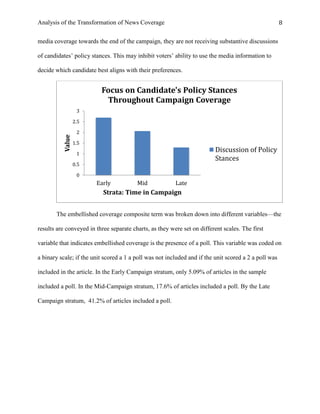
The discussion of candidates’ policy stances, a strong indicator of substantive coverage,
decreased throughout the campaign. In the first stratum, Early Campaign, the average value on
discussion of candidates’ policy stances on of a 1 to 4 scale (1 being the least discussed and 4
being the most discussed), scored an average of 2.69. In the Mid-Campaign stratum, the average
discussion of candidates’ policy stances was 2.06. By the Late Campaign stratum, the average
value was 1.3. This decrease from the Early Campaign stratum to the Late Campaign stratum
indicates a decline in substantive coverage over the course of the campaign. If voters tune into
Analysis of the Transformation of News Coverage 8
media coverage towards the end of the campaign, they are not receiving substantive discussions
of candidates’ policy stances. This may inhibit voters’ ability to use the media information to
decide which candidate best aligns with their preferences.
The embellished coverage composite term was broken down into different variables—the
results are conveyed in three separate charts, as they were set on different scales. The first
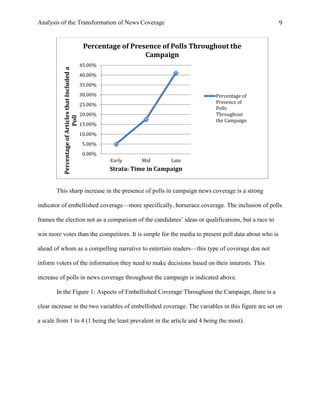
variable that indicates embellished coverage is the presence of a poll. This variable was coded on
a binary scale; if the unit scored a 1 a poll was not included and if the unit scored a 2 a poll was
included in the article. In the Early Campaign stratum, only 5.09% of articles in the sample
included a poll. In the Mid-Campaign stratum, 17.6% of articles included a poll. By the Late
Campaign stratum, 41.2% of articles included a poll.
0
0.5
1
1.5
2
2.5
3
Early Mid Late
Value
Strata: Time in Campaign
Focus on Candidate's Policy Stances
Throughout Campaign Coverage
Discussion of Policy
Stances
Analysis of the Transformation of News Coverage 9
This sharp increase in the presence of polls in campaign news coverage is a strong
indicator of embellished coverage—more specifically, horserace coverage. The inclusion of polls
frames the election not as a comparison of the candidates’ ideas or qualifications, but a race to
win more votes than the competitors. It is simple for the media to present poll data about who is
ahead of whom as a compelling narrative to entertain readers—this type of coverage doe not
inform voters of the information they need to make decisions based on their interests. This
increase of polls in news coverage throughout the campaign is indicated above.
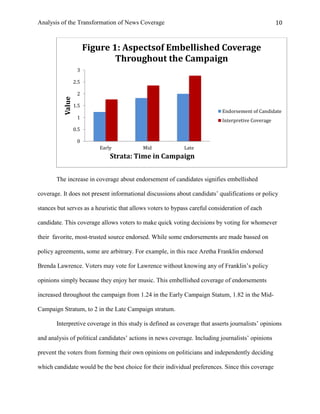
In the Figure 1: Aspects of Embellished Coverage Throughout the Campaign, there is a
clear increase in the two variables of embellished coverage. The variables in this figure are set on
a scale from 1 to 4 (1 being the least prevalent in the article and 4 being the most).
0.00%
5.00%
10.00%
15.00%
20.00%
25.00%
30.00%
35.00%
40.00%
45.00%
Early Mid Late
PercentageofArticlesthatIncludeda
Poll
Strata: Time in Campaign
Percentage of Presence of Polls Throughout the
Campaign
Percentage of
Presence of
Polls
Throughout
the Campaign
Analysis of the Transformation of News Coverage 10
The increase in coverage about endorsement of candidates signifies embellished
coverage. It does not present informational discussions about candidats’ qualifications or policy
stances but serves as a heuristic that allows voters to bypass careful consideration of each
candidate. This coverage allows voters to make quick voting decisions by voting for whomever
their favorite, most-trusted source endorsed. While some endorsements are made bassed on
policy agreements, some are arbitrary. For example, in this race Aretha Franklin endorsed
Brenda Lawrence. Voters may vote for Lawrence without knowing any of Franklin’s policy
opinions simply because they enjoy her music. This embellished coverage of endorsements
increased throughout the campaign from 1.24 in the Early Campaign Statum, 1.82 in the Mid-
Campaign Stratum, to 2 in the Late Campaign stratum.
Interpretive coverage in this study is defined as coverage that asserts journalists’ opinions
and analysis of political candidates’ actions in news coverage. Including journalists’ opinions
prevent the voters from forming their own opinions on politicians and independently deciding
which candidate would be the best choice for their individual preferences. Since this coverage
0
0.5
1
1.5
2
2.5
3
Early Mid Late
Value
Strata: Time in Campaign
Figure 1: Aspectsof Embellished Coverage
Throughout the Campaign
Endorsement of Candidate
Interpretive Coverage
Analysis of the Transformation of News Coverage 11
does not help inform voters to make the best voting decisions, this is classified as embellished
coverage. Interpretive coverage increased throughout the campaign from 1.76 in the Early
Campaign Statum, 2.35 in the Mid-Campaign Stratum, to 2.76 in the Late Campaign stratum.
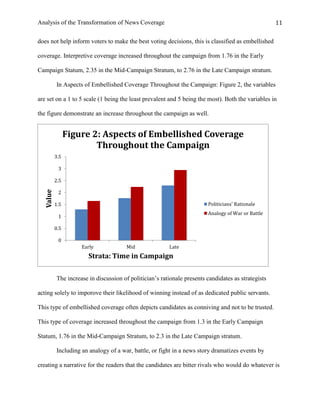
In Aspects of Embellished Coverage Throughout the Campaign: Figure 2, the variables
are set on a 1 to 5 scale (1 being the least prevalent and 5 being the most). Both the variables in
the figure demonstrate an increase throughout the campaign as well.
The increase in discussion of politician’s rationale presents candidates as strategists
acting solely to imporove their likelihood of winning instead of as dedicated public servants.
This type of embellished coverage often depicts candidates as conniving and not to be trusted.
This type of coverage increased throughout the campaign from 1.3 in the Early Campaign
Statum, 1.76 in the Mid-Campaign Stratum, to 2.3 in the Late Campaign stratum.
Including an analogy of a war, battle, or fight in a news story dramatizes events by
creating a narrative for the readers that the candidates are bitter rivals who would do whatever is
0
0.5
1
1.5
2
2.5
3
3.5
Early Mid Late
Value
Strata: Time in Campaign
Figure 2: Aspects of Embellished Coverage
Throughout the Campaign
Politicians' Rationale
Analogy of War or Battle
Analysis of the Transformation of News Coverage 12
necessary to win the election. This is commonly included in news articles through verbs like
“attack” and “face off” or through descriptions of the candidates as “foes” and “enemies.” The
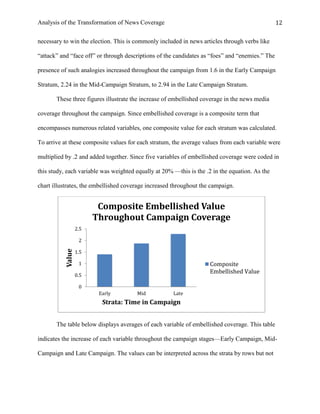
presence of such analogies increased throughout the campaign from 1.6 in the Early Campaign
Stratum, 2.24 in the Mid-Campaign Stratum, to 2.94 in the Late Campaign Stratum.
These three figures illustrate the increase of embellished coverage in the news media
coverage throughout the campaign. Since embellished coverage is a composite term that
encompasses numerous related variables, one composite value for each stratum was calculated.
To arrive at these composite values for each stratum, the average values from each variable were
multiplied by .2 and added together. Since five variables of embellished coverage were coded in
this study, each variable was weighted equally at 20% —this is the .2 in the equation. As the
chart illustrates, the embellished coverage increased throughout the campaign.
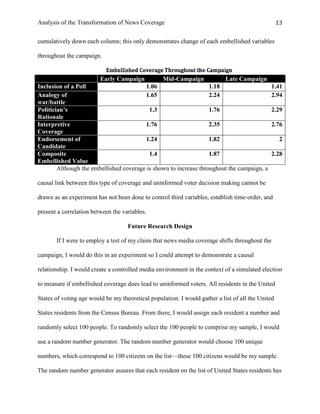
The table below displays averages of each variable of embellished coverage. This table
indicates the increase of each variable throughout the campaign stages—Early Campaign, Mid-
Campaign and Late Campaign. The values can be interpreted across the strata by rows but not
0
0.5
1
1.5
2
2.5
Early Mid Late
Value
Strata: Time in Campaign
Composite Embellished Value
Throughout Campaign Coverage
Composite
Embellished Value
Analysis of the Transformation of News Coverage 13
cumulatively down each column; this only demonstrates change of each embellished variables
throughout the campaign.
Early Campaign Mid-Campaign Late Campaign
Inclusion of a Poll 1.06 1.18 1.41
Analogy of
war/battle
1.65 2.24 2.94
Politician’s
Rationale
1.3 1.76 2.29
Interpretive
Coverage
1.76 2.35 2.76
Endorsement of
Candidate
1.24 1.82 2
Composite
Embellished Value
1.4 1.87 2.28
Although the embellished coverage is shown to increase throughout the campaign, a
causal link between this type of coverage and uninformed voter decision making cannot be
drawn as an experiment has not been done to control third variables, establish time-order, and
present a correlation between the variables.
Future Research Design
If I were to employ a test of my claim that news media coverage shifts throughout the
campaign, I would do this in an experiment so I could attempt to demonstrate a causal
relationship. I would create a controlled media environment in the context of a simulated election
to measure if embellished coverage does lead to uninformed voters. All residents in the United
States of voting age would be my theoretical population. I would gather a list of all the United
States residents from the Census Bureau. From there, I would assign each resident a number and
randomly select 100 people. To randomly select the 100 people to comprise my sample, I would
use a random number generator. The random number generator would choose 100 unique
numbers, which correspond to 100 citizens on the list—these 100 citizens would be my sample.
The random number generator assures that each resident on the list of United States residents has
Analysis of the Transformation of News Coverage 14
an equal opportunity to be selected for the experiment. If the members of the sample are random
and the sample is large enough, the results should be generalizable to the population.
To simulate a campaign media environment, I would create a pseudo campaign and
provide media coverage to the participants over one year. Prior to assigning each group a
treatment, each participant would fill out a survey mapping their partisan preferences, policy
preferences, and goals for an ideal city. This would be given prior to the participants’ exposure to
the campaign articles to capture their preferences without interference from the strategically
written campaign articles provided in the experiment. The survey will have answer choices that
correspond to one of the two candidates in the pseudo campaign. If voter’s specified preferences
prior to exposure to media coverage align with the candidate they selected at the end of the
process, then the campaign coverage was effective at leading voters to selecting a candidate that
is ideal for their preferences.
There would be three treatments in this experiment. The first treatment would be to create
campaign news coverage that mirrors the coverage demonstrated by the content analysis—
substantive coverage in the beginning of the campaign that becomes increasingly embellished as
the campaign progresses. The second treatment would be coverage that is substantive—it
includes discussion of candidates’ policy stances, qualifications, and plans for the district. The
third treatment would be embellished coverage—horserace coverage, focus on trivial aspects of
the candidates’ personal lives unrelated to political goals for the district, prevailing use of the
strategy frame that presents candidates as strategists instead of public servants, and interpretive
coverage that presents the journalists’ opinions of candidates’ actions.
The 100 members of the sample will be randomly assigned to a treatment. Campaign
news articles written to adhere to the specified treatments will be given to the participants
Analysis of the Transformation of News Coverage 15
according to their treatment once a week for a year. In order to control for participant
inattentiveness to the provided articles, a brief quiz will be given every two weeks—the
participants will not be able to revisit the articles to answer the quiz questions. At the end of the
year, each participant would vote for a candidate in the pseudo election. If the candidate a voter
selected corresponds to his or her preferences specified in the initial survey, the coverage is
deemed effective at informing voters and helping them make the decision best for them.
Conclusion
As predicted, embellished coverage—coverage that focuses on trivial aspects of the
campaign instead of informing voters—increased throughout the campaign. Although these
increases are slight, the trends between variables indicative of embellished coverage consistently
increase throughout the campaign. Substantive coverage— coverage that helps voters make
informed decisions about which candidate is most aligned with their preferences—as indicated
by the discussion of policy stances variable, decreased throughout the campaign. Since no
experiment was done on these observed trends, causality between embellished coverage and
voters making uninformed decisions cannot be concluded.
In terms of the research design, a major benefit of the simulated media environment in
context of a pseudo election is the researchers construct all the information participants are
receiving. Since the researchers create the election, external sources will not have information
about candidates. Potential difficulties with this research design would be its execution.
Compiling a list of all United States citizens 18 years of age or older, contacting the randomly
selected participants, and receiving their active participation in the lengthy experiment would be
difficult. However, the design could produce results generalizable results about how the news
Analysis of the Transformation of News Coverage 16
media coverage influences the information voters receive and retain. If an experiment of this
nature were to be done, this causal link could be demonstrated.
Analysis of the Transformation of News Coverage 17
Bibliography
Gray, Kathleen (2014). “Christina Conyers withdraws from 14th Congressional District
Race.” Detroit Free Press.
Iyengar, Shanto. (2011). Media Politics A Citizen’s Guide (2nd
ed.). New York: W.W. Norton &
Company, Inc.
Jonathan Ladd (2012). Why Americans Hate the Media and How it Matters. New Jersey:
Princeton University Press.
Lawrence, Regina G. (2000). “Game-Framing the Issues: Tracking the Strategy Frame in
Public Policy News, Political Communication”, 93-114.
Lessenberry, Jack. (2014). “Michigan’s 14th
Congressional District.” Dome Magazine.
Lupia, Arthur & McCubbins, Mathew D. (1999). “The Democratic Dilemma:
Can Citizens Learn What They Need to Know?” 147-156.
Mill, John S. (1869). “Chapter III: Of Individuality, as One of the Elements of Well-Being.”
On Liberty. Longman, Roberts & Green. New York: Bartleby.com, 1999.
Patterson, Thomas E. (1993). Out of Order. New York: Random House, Inc.
Shaw, Daron R. (1999). "The Impact of News Media Favorability and Candidate Events in
Presidential Campaigns." Political Communication, Vol. 16, No. 2. 183-202.
Analysis of the Transformation of News Coverage 18
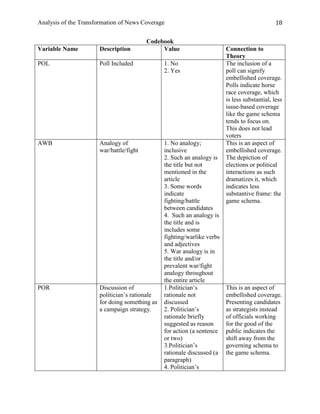
Codebook
Variable Name Description Value Connection to
Theory
POL Poll Included 1. No
2. Yes
The inclusion of a
poll can signify
embellished coverage.
Polls indicate horse
race coverage, which
is less substantial, less
issue-based coverage
like the game schema
tends to focus on.
This does not lead
voters
AWB Analogy of
war/battle/fight
1. No analogy;
inclusive
2. Such an analogy is
the title but not
mentioned in the
article
3. Some words
indicate
fighting/battle
between candidates
4. Such an analogy is
the title and is
includes some
fighting/warlike verbs
and adjectives
5. War analogy is in
the title and/or
prevalent war/fight
analogy throughout
the entire article
This is an aspect of
embellished coverage.
The depiction of
elections or political
interactions as such
dramatizes it, which
indicates less
substantive frame: the
game schema.
POR Discussion of
politician’s rationale
for doing something as
a campaign strategy.
1.Politician’s
rationale not
discussed
2. Politician’s
rationale briefly
suggested as reason
for action (a sentence
or two)
3.Politician’s
rationale discussed (a
paragraph)
4. Politician’s
This is an aspect of
embellished coverage.
Presenting candidates
as strategists instead
of officials working
for the good of the
public indicates the
shift away from the
governing schema to
the game schema.
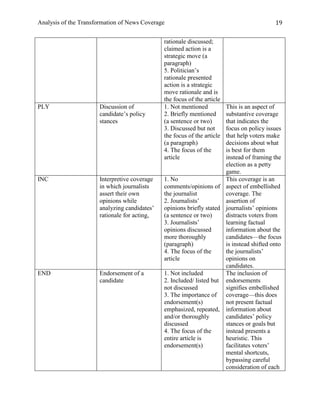
Analysis of the Transformation of News Coverage 19
rationale discussed;
claimed action is a
strategic move (a
paragraph)
5. Politician’s
rationale presented
action is a strategic
move rationale and is
the focus of the article
PLY Discussion of
candidate’s policy
stances
1. Not mentioned
2. Briefly mentioned
(a sentence or two)
3. Discussed but not
the focus of the article
(a paragraph)
4. The focus of the
article
This is an aspect of
substantive coverage
that indicates the
focus on policy issues
that help voters make
decisions about what
is best for them
instead of framing the
election as a petty
game.
INC Interpretive coverage
in which journalists
assert their own
opinions while
analyzing candidates’
rationale for acting,
1. No
comments/opinions of
the journalist
2. Journalists’
opinions briefly stated
(a sentence or two)
3. Journalists’
opinions discussed
more thoroughly
(paragraph)
4. The focus of the
article
This coverage is an
aspect of embellished
coverage. The
assertion of
journalists’ opinions
distracts voters from
learning factual
information about the
candidates—the focus
is instead shifted onto
the journalists’
opinions on
candidates.
END Endorsement of a
candidate
1. Not included
2. Included/ listed but
not discussed
3. The importance of
endorsement(s)
emphasized, repeated,
and/or thoroughly
discussed
4. The focus of the
entire article is
endorsement(s)
The inclusion of
endorsements
signifies embellished
coverage—this does
not present factual
information about
candidates’ policy
stances or goals but
instead presents a
heuristic. This
facilitates voters’
mental shortcuts,
bypassing careful
consideration of each
Analysis of the Transformation of News Coverage 20
candidate.

PSC329 Final Paper

  • 1.
    Substantive vs. EmbellishedCoverage: Analysis of the Transformation of News Coverage Throughout a Campaign Morgan Cullen
  • 2.
    Analysis of theTransformation of News Coverage 1 Abstract: This content analysis examined American news coverage of the 2014 Congressional campaign to decipher if the information those citizens motivated enough to seek it is sufficient in leading them to make the best voting decision about which candidate would best suit their preferences. The coverage was either deemed substantive (coverage that helps voters make informed decisions) and embellished (coverage that focuses on trivial aspects of the campaign and does not help voters make informed decisions about which candidate would best serve them). Analysis of 51 randomly selected articles (17 from each of 3 strata: “early campaign”,“mid-campaign”, and “late campaign) from July 5, 2013to August 5, 2014 indicates increasing embellished coverage and decreasing substantive coverage as the campaign progresses. Although a causal link between the quality of coverage and between this type of coverage and uninformed voter decision making cannot be drawn as an experiment has not been done to control third variables, establish time-order, and present a correlation between the variables, the data below suggests media content may have affected how informed voters are prior to an election, as the overall quality of coverage decreases as an election approaches. Introduction Information seeking can be driven by many things: desire to learn more about issues relevant to one’s life (issue public theory), seeking information that is consistent with one’s partisan beliefs (motivated partisan selectivity), or seeking information out of a general interest in politics (attentive public theory). Beyond the reasons why people decide to seek information is the concern of the quality of information they are receiving when they do seek to learn more (Iyengar, 2011, 125-132). The technological advances allow for decreased costs associated with seeking information, contacting officials, virtually participating in the political sphere, and the possibility for any citizen to be a creator of media. While the increased ease of interactivity could
  • 3.
    Analysis of theTransformation of News Coverage 2 be revitalizing to the political sphere as “optimists” believe, “skeptics” recognize with the increased possibility for any citizen to be involved through the decreased costs of creating media sources comes the concern for credibility and reliability of the information available to citizens (Iyengar, 2011,120). Moreover, citizens may not be receiving information they need to make informed voting decisions. Theory of Information I will contrast what I consider to be “substantive coverage” and “embellished coverage.” Substantive coverage helps voters make informed decisions and embellished coverage does not. Substantive coverage can be defined as election coverage that provides information to help voters make the best decision about which candidate is most aligned with their preferences. These preferences can include ideological preferences and/or policy preferences. Substantive coverage presents voters with a discussion of the candidate’s qualifications, goals for their district, policy stances, and partisanship. While partisanship is often dismissed as a heuristic voters use to assume all a candidate stands for, this in combination with their policy goals and intentions for their district can be substantive coverage. Knowing the candidate’s partisanship can serve as a springboard to conjecture about what candidate will do. While elected political officials claim to act as delegates adhering to the desires of their constituents, these officials often act as trustees and make decisions about what is best for the district based on their expertise—even if it does not align with their constituents’ desires (Mill, 1869). If the voters know a candidate’s location on the political ideological spectrum, they can better predict what the candidate’s decisions will be as a trustee. Campaign information that may include the candidate’s partisan views, elaborates on their more specific plans for the district, and their
  • 4.
    Analysis of theTransformation of News Coverage 3 policy stances provides substantive information to help voters make informed decisions on which candidate will best represent them. Embellished coverage can be defined as campaign coverage that focuses on trivial aspects of the campaign that help does not help voters make informed decisions about which candidate would best serve them. Embellished coverage is a composite term that encompasses horserace coverage, infotainment, focus on the game schema as opposed to the policy schema, and interpretive coverage. These components of embellished coverage can lead voters to base decisions on trivial pieces of information about candidates and voter antipathy toward the media. Jonathan Ladd explains that public antipathy towards the media results from media coverage about the “game of politics, such as politicians’ strategies, poll results, and campaign horserace generally, rather than policy” (Ladd, 2012, 110). As antipathy in the media increases in voters, the more voters will rely on heuristics and peripheral cues—use of trivial aspects as shortcuts to decisions—to bypass active consideration of the candidates’ qualifications (Ladd, 2012, 176). As a result of technological advancements to help spread campaign information to many, campaign media coverage begins long before the election. As Patterson illustrates, the coverage begins with more substantive information about candidates’ policy stances and plan for their district. Due to the extended length on campaigns, the media exhaust coverage of substantive topics like the candidates’ goals and policy stances long before the end of the campaign. As a result, embellished coverage—like coverage about the game of politics—becomes more prominent. I predict embellished coverage becomes more dominant as the campaign progresses; the closer to the election, the more embellished coverage. Regina G. Lawrence outlines the contexts in which the “game frame”—a component of embellished coverage that focuses on the game of
  • 5.
    Analysis of theTransformation of News Coverage 4 politics—is more prominent in her article “Game-Framing the Issues: Tracking the Strategy Frame in Public Policy News.” Lawrence indicates that the game frame is more prevailing in the news media environment when there is high elite conflict (this is known as indexing) and as the election approaches (Lawrence, 2000, 93). The game frame is tends to exaggerate the conflict among elites while emphasizing the emotional tension between political officials instead of information underlying the dissent. This type of coverage dramatizes elite opposition and usually fails to provide information about the issue on which they disagree. This coverage does not help voters learn about current issues and make informed decisions. Furthermore, I predict the amount of embellished coverage will increase as the campaign approaches. If this is true, it is troublesome for the democratic process. Since the democratic process rests in the hands of the voters, most voters tune in to election coverage closer to the election, the voters are—consequently—making decisions based on the trivial aspects of the campaign conveyed through embellished coverage. Thus, the outcomes may not be the best choice for the voters or the district. Although Lupia and McCubbins argue that the public can make effective decisions based on heuristics and “reasoned choice”, persuasion is necessary in their model. Lupia and McCubbins explain that peripheral cues such as confidence in the candidate’s tone are what citizens often base decisions on (Lupia & McCubbins, 1999, 147-156). While this may sometimes be sufficient for voters to make decisions, the trivial information conveyed in embellished campaign coverage leads to voters making decisions on whatever aspect the media decide to focus on. As Patterson illustrates, the media (the primary conveyers of campaign information to the public) will not do the best job at selecting the most qualified candidate to run in the general election. He proposes that since party elites (prior to the McGovern-Frasier reforms of 1968 that allowed the public to be able to decide who wins the
  • 6.
    Analysis of theTransformation of News Coverage 5 primary nominations) made thorough selections since their jobs depended on selecting the most qualified candidate. The media, however, are often motivated by other intentions. Due to the intense drive for profit in the American privately-owned media system, Patterson claims the media are not as concerned with helping voters select a qualified candidate as they are with increasing profit. As a result, embellished coverage prevails (Patterson, 1993, 60-80). Campaign coverage of events can generate statistically significant changes in voters’ preferences (Shaw, 1999,183-202). Since most voters tune in to election coverage closer to the election, the topics media focus on prime the audience to make decision based on the most recent coverage they have seen. Moreover, if the most recent coverage is sensationalized and not based on substantial policy issues then voters are basing their decisions on trivial aspects the media covered most recently without comprehensive consideration of potential implications selecting a candidate will have on their district. Background on the Election The race I will analyze is the 2014 democratic primary election for Michigan’s 14th Congressional District for Gary Peters’ vacated seat in the United States House of Representatives. There were four candidates on the ballot during the primary election: Brenda Lawrence, Hansen Clarke, Rudy Hobbs, and Burgess Foster. Brenda Lawrence was the mayor of Southfield for the past 13 years, Hansen Clarke was a former U.S. congressman, Rudy Hobbs is a member of the Michigan House of Representatives, and Burgess Foster is a teacher. In Michigan’s 14th Congressional district, the democratic primary tends to be the determinant of the winner of congressional races. A republican has not represented the 14th Congressional district of Michigan since Harold F. Youngblood’s term from 1947 to 1949. This district is often described as “a strong Democratic district” (Gray, 2014). Prior to the primary
  • 7.
    Analysis of theTransformation of News Coverage 6 election, many sources confidently declared that, “whoever wins will be a Democrat,” (Lessenberry, 2014). In the 2014 Congressional race, the republican candidate recognized the strong prevailing democratic force of this district and withdrew from the race (Gray, 2014). Due to the overwhelming democratic strength of Michigan’s 14th Congressional District and the fact that the republican candidate ran unopposed in the primary election before withdrawing from the general election, I will focus on the democratic primary to analyze news coverage. Research Methods The theoretical population will be all news media stories about the 14th Congressional District’s Democratic Primary in Michigan within August 10, 2013 to August 10, 2014. My unit of analysis is the complete news stories in their entirety. To refine my search for this population, I limited the Google Search results to the previously specified dates. I searched all four candidate’s names—“Burgess Foster”, “Brenda Lawrence”, “Rudy Hobbs”, and “Hansen Clarke”—as well as “Michigan Congressional district 14”. I entered the resulting news stories into an Excel document from least recent to most recent within the previously specified time frame; these comprised my sampling frame. Since I am looking to examine if the content of the campaign news coverage shifts from more policy-based substantive coverage to embellished coverage as the election approaches, I used a stratified sampling method and stratified the search results. I stratified the search results into three sections by proximity to the election. The first stratum is what I will refer to as “early campaign” from July 5, 2013 to December 5, 2013. The “mid-campaign” stratum is from December 6, 2013 to April 6, 2014. The “near election” stratum is from April 7, 2014 to August 5, 2014. I separated the list of news articles into the three strata based on the time the articles were released. I then assigned each article a number. I treated each stratum separately by assigning the least recent article of each section number one. Once the
  • 8.
    Analysis of theTransformation of News Coverage 7 strata are divided and each article has been assigned a number, I used a random number generator to randomly select 17 articles from each section. The random number generator selected 17 unique numbers. The selected numbers correspond to the numbers assigned to articles. These 51 randomly selected articles total, 17 from each stratum, will comprise my sample. I utilized a random number generator to ensure that each unit in my sampling frame had an equal opportunity to be selected. By only analyzing the randomly selected articles, the results can be generalized and are understood as representative of the population. Aspects of substantive coverage and embellished coverage were broken down into variables examined in the content analysis. Discussion of a candidate’s policy stances in an article indicates substantive coverage. The inclusion of this information is key in providing voters the opportunity to compare the preferences of the candidate(s) to their own to decide who would be best to represent their ideas. The presence of polls, use of an analogy of war, battle, or a fight, framing a candidate’s action as solely a campaign strategy, focus on endorsement of a candidate, and interpretive coverage are indicative of embellished coverage and were used to code the random sample of news articles. Analysis of Data The discussion of candidates’ policy stances, a strong indicator of substantive coverage, decreased throughout the campaign. In the first stratum, Early Campaign, the average value on discussion of candidates’ policy stances on of a 1 to 4 scale (1 being the least discussed and 4 being the most discussed), scored an average of 2.69. In the Mid-Campaign stratum, the average discussion of candidates’ policy stances was 2.06. By the Late Campaign stratum, the average value was 1.3. This decrease from the Early Campaign stratum to the Late Campaign stratum indicates a decline in substantive coverage over the course of the campaign. If voters tune into
  • 9.
    Analysis of theTransformation of News Coverage 8 media coverage towards the end of the campaign, they are not receiving substantive discussions of candidates’ policy stances. This may inhibit voters’ ability to use the media information to decide which candidate best aligns with their preferences. The embellished coverage composite term was broken down into different variables—the results are conveyed in three separate charts, as they were set on different scales. The first variable that indicates embellished coverage is the presence of a poll. This variable was coded on a binary scale; if the unit scored a 1 a poll was not included and if the unit scored a 2 a poll was included in the article. In the Early Campaign stratum, only 5.09% of articles in the sample included a poll. In the Mid-Campaign stratum, 17.6% of articles included a poll. By the Late Campaign stratum, 41.2% of articles included a poll. 0 0.5 1 1.5 2 2.5 3 Early Mid Late Value Strata: Time in Campaign Focus on Candidate's Policy Stances Throughout Campaign Coverage Discussion of Policy Stances
  • 10.
    Analysis of theTransformation of News Coverage 9 This sharp increase in the presence of polls in campaign news coverage is a strong indicator of embellished coverage—more specifically, horserace coverage. The inclusion of polls frames the election not as a comparison of the candidates’ ideas or qualifications, but a race to win more votes than the competitors. It is simple for the media to present poll data about who is ahead of whom as a compelling narrative to entertain readers—this type of coverage doe not inform voters of the information they need to make decisions based on their interests. This increase of polls in news coverage throughout the campaign is indicated above. In the Figure 1: Aspects of Embellished Coverage Throughout the Campaign, there is a clear increase in the two variables of embellished coverage. The variables in this figure are set on a scale from 1 to 4 (1 being the least prevalent in the article and 4 being the most). 0.00% 5.00% 10.00% 15.00% 20.00% 25.00% 30.00% 35.00% 40.00% 45.00% Early Mid Late PercentageofArticlesthatIncludeda Poll Strata: Time in Campaign Percentage of Presence of Polls Throughout the Campaign Percentage of Presence of Polls Throughout the Campaign
  • 11.
    Analysis of theTransformation of News Coverage 10 The increase in coverage about endorsement of candidates signifies embellished coverage. It does not present informational discussions about candidats’ qualifications or policy stances but serves as a heuristic that allows voters to bypass careful consideration of each candidate. This coverage allows voters to make quick voting decisions by voting for whomever their favorite, most-trusted source endorsed. While some endorsements are made bassed on policy agreements, some are arbitrary. For example, in this race Aretha Franklin endorsed Brenda Lawrence. Voters may vote for Lawrence without knowing any of Franklin’s policy opinions simply because they enjoy her music. This embellished coverage of endorsements increased throughout the campaign from 1.24 in the Early Campaign Statum, 1.82 in the Mid- Campaign Stratum, to 2 in the Late Campaign stratum. Interpretive coverage in this study is defined as coverage that asserts journalists’ opinions and analysis of political candidates’ actions in news coverage. Including journalists’ opinions prevent the voters from forming their own opinions on politicians and independently deciding which candidate would be the best choice for their individual preferences. Since this coverage 0 0.5 1 1.5 2 2.5 3 Early Mid Late Value Strata: Time in Campaign Figure 1: Aspectsof Embellished Coverage Throughout the Campaign Endorsement of Candidate Interpretive Coverage
  • 12.
    Analysis of theTransformation of News Coverage 11 does not help inform voters to make the best voting decisions, this is classified as embellished coverage. Interpretive coverage increased throughout the campaign from 1.76 in the Early Campaign Statum, 2.35 in the Mid-Campaign Stratum, to 2.76 in the Late Campaign stratum. In Aspects of Embellished Coverage Throughout the Campaign: Figure 2, the variables are set on a 1 to 5 scale (1 being the least prevalent and 5 being the most). Both the variables in the figure demonstrate an increase throughout the campaign as well. The increase in discussion of politician’s rationale presents candidates as strategists acting solely to imporove their likelihood of winning instead of as dedicated public servants. This type of embellished coverage often depicts candidates as conniving and not to be trusted. This type of coverage increased throughout the campaign from 1.3 in the Early Campaign Statum, 1.76 in the Mid-Campaign Stratum, to 2.3 in the Late Campaign stratum. Including an analogy of a war, battle, or fight in a news story dramatizes events by creating a narrative for the readers that the candidates are bitter rivals who would do whatever is 0 0.5 1 1.5 2 2.5 3 3.5 Early Mid Late Value Strata: Time in Campaign Figure 2: Aspects of Embellished Coverage Throughout the Campaign Politicians' Rationale Analogy of War or Battle
  • 13.
    Analysis of theTransformation of News Coverage 12 necessary to win the election. This is commonly included in news articles through verbs like “attack” and “face off” or through descriptions of the candidates as “foes” and “enemies.” The presence of such analogies increased throughout the campaign from 1.6 in the Early Campaign Stratum, 2.24 in the Mid-Campaign Stratum, to 2.94 in the Late Campaign Stratum. These three figures illustrate the increase of embellished coverage in the news media coverage throughout the campaign. Since embellished coverage is a composite term that encompasses numerous related variables, one composite value for each stratum was calculated. To arrive at these composite values for each stratum, the average values from each variable were multiplied by .2 and added together. Since five variables of embellished coverage were coded in this study, each variable was weighted equally at 20% —this is the .2 in the equation. As the chart illustrates, the embellished coverage increased throughout the campaign. The table below displays averages of each variable of embellished coverage. This table indicates the increase of each variable throughout the campaign stages—Early Campaign, Mid- Campaign and Late Campaign. The values can be interpreted across the strata by rows but not 0 0.5 1 1.5 2 2.5 Early Mid Late Value Strata: Time in Campaign Composite Embellished Value Throughout Campaign Coverage Composite Embellished Value
  • 14.
    Analysis of theTransformation of News Coverage 13 cumulatively down each column; this only demonstrates change of each embellished variables throughout the campaign. Early Campaign Mid-Campaign Late Campaign Inclusion of a Poll 1.06 1.18 1.41 Analogy of war/battle 1.65 2.24 2.94 Politician’s Rationale 1.3 1.76 2.29 Interpretive Coverage 1.76 2.35 2.76 Endorsement of Candidate 1.24 1.82 2 Composite Embellished Value 1.4 1.87 2.28 Although the embellished coverage is shown to increase throughout the campaign, a causal link between this type of coverage and uninformed voter decision making cannot be drawn as an experiment has not been done to control third variables, establish time-order, and present a correlation between the variables. Future Research Design If I were to employ a test of my claim that news media coverage shifts throughout the campaign, I would do this in an experiment so I could attempt to demonstrate a causal relationship. I would create a controlled media environment in the context of a simulated election to measure if embellished coverage does lead to uninformed voters. All residents in the United States of voting age would be my theoretical population. I would gather a list of all the United States residents from the Census Bureau. From there, I would assign each resident a number and randomly select 100 people. To randomly select the 100 people to comprise my sample, I would use a random number generator. The random number generator would choose 100 unique numbers, which correspond to 100 citizens on the list—these 100 citizens would be my sample. The random number generator assures that each resident on the list of United States residents has
  • 15.
    Analysis of theTransformation of News Coverage 14 an equal opportunity to be selected for the experiment. If the members of the sample are random and the sample is large enough, the results should be generalizable to the population. To simulate a campaign media environment, I would create a pseudo campaign and provide media coverage to the participants over one year. Prior to assigning each group a treatment, each participant would fill out a survey mapping their partisan preferences, policy preferences, and goals for an ideal city. This would be given prior to the participants’ exposure to the campaign articles to capture their preferences without interference from the strategically written campaign articles provided in the experiment. The survey will have answer choices that correspond to one of the two candidates in the pseudo campaign. If voter’s specified preferences prior to exposure to media coverage align with the candidate they selected at the end of the process, then the campaign coverage was effective at leading voters to selecting a candidate that is ideal for their preferences. There would be three treatments in this experiment. The first treatment would be to create campaign news coverage that mirrors the coverage demonstrated by the content analysis— substantive coverage in the beginning of the campaign that becomes increasingly embellished as the campaign progresses. The second treatment would be coverage that is substantive—it includes discussion of candidates’ policy stances, qualifications, and plans for the district. The third treatment would be embellished coverage—horserace coverage, focus on trivial aspects of the candidates’ personal lives unrelated to political goals for the district, prevailing use of the strategy frame that presents candidates as strategists instead of public servants, and interpretive coverage that presents the journalists’ opinions of candidates’ actions. The 100 members of the sample will be randomly assigned to a treatment. Campaign news articles written to adhere to the specified treatments will be given to the participants
  • 16.
    Analysis of theTransformation of News Coverage 15 according to their treatment once a week for a year. In order to control for participant inattentiveness to the provided articles, a brief quiz will be given every two weeks—the participants will not be able to revisit the articles to answer the quiz questions. At the end of the year, each participant would vote for a candidate in the pseudo election. If the candidate a voter selected corresponds to his or her preferences specified in the initial survey, the coverage is deemed effective at informing voters and helping them make the decision best for them. Conclusion As predicted, embellished coverage—coverage that focuses on trivial aspects of the campaign instead of informing voters—increased throughout the campaign. Although these increases are slight, the trends between variables indicative of embellished coverage consistently increase throughout the campaign. Substantive coverage— coverage that helps voters make informed decisions about which candidate is most aligned with their preferences—as indicated by the discussion of policy stances variable, decreased throughout the campaign. Since no experiment was done on these observed trends, causality between embellished coverage and voters making uninformed decisions cannot be concluded. In terms of the research design, a major benefit of the simulated media environment in context of a pseudo election is the researchers construct all the information participants are receiving. Since the researchers create the election, external sources will not have information about candidates. Potential difficulties with this research design would be its execution. Compiling a list of all United States citizens 18 years of age or older, contacting the randomly selected participants, and receiving their active participation in the lengthy experiment would be difficult. However, the design could produce results generalizable results about how the news
  • 17.
    Analysis of theTransformation of News Coverage 16 media coverage influences the information voters receive and retain. If an experiment of this nature were to be done, this causal link could be demonstrated.
  • 18.
    Analysis of theTransformation of News Coverage 17 Bibliography Gray, Kathleen (2014). “Christina Conyers withdraws from 14th Congressional District Race.” Detroit Free Press. Iyengar, Shanto. (2011). Media Politics A Citizen’s Guide (2nd ed.). New York: W.W. Norton & Company, Inc. Jonathan Ladd (2012). Why Americans Hate the Media and How it Matters. New Jersey: Princeton University Press. Lawrence, Regina G. (2000). “Game-Framing the Issues: Tracking the Strategy Frame in Public Policy News, Political Communication”, 93-114. Lessenberry, Jack. (2014). “Michigan’s 14th Congressional District.” Dome Magazine. Lupia, Arthur & McCubbins, Mathew D. (1999). “The Democratic Dilemma: Can Citizens Learn What They Need to Know?” 147-156. Mill, John S. (1869). “Chapter III: Of Individuality, as One of the Elements of Well-Being.” On Liberty. Longman, Roberts & Green. New York: Bartleby.com, 1999. Patterson, Thomas E. (1993). Out of Order. New York: Random House, Inc. Shaw, Daron R. (1999). "The Impact of News Media Favorability and Candidate Events in Presidential Campaigns." Political Communication, Vol. 16, No. 2. 183-202.
  • 19.
    Analysis of theTransformation of News Coverage 18 Codebook Variable Name Description Value Connection to Theory POL Poll Included 1. No 2. Yes The inclusion of a poll can signify embellished coverage. Polls indicate horse race coverage, which is less substantial, less issue-based coverage like the game schema tends to focus on. This does not lead voters AWB Analogy of war/battle/fight 1. No analogy; inclusive 2. Such an analogy is the title but not mentioned in the article 3. Some words indicate fighting/battle between candidates 4. Such an analogy is the title and is includes some fighting/warlike verbs and adjectives 5. War analogy is in the title and/or prevalent war/fight analogy throughout the entire article This is an aspect of embellished coverage. The depiction of elections or political interactions as such dramatizes it, which indicates less substantive frame: the game schema. POR Discussion of politician’s rationale for doing something as a campaign strategy. 1.Politician’s rationale not discussed 2. Politician’s rationale briefly suggested as reason for action (a sentence or two) 3.Politician’s rationale discussed (a paragraph) 4. Politician’s This is an aspect of embellished coverage. Presenting candidates as strategists instead of officials working for the good of the public indicates the shift away from the governing schema to the game schema.
  • 20.
    Analysis of theTransformation of News Coverage 19 rationale discussed; claimed action is a strategic move (a paragraph) 5. Politician’s rationale presented action is a strategic move rationale and is the focus of the article PLY Discussion of candidate’s policy stances 1. Not mentioned 2. Briefly mentioned (a sentence or two) 3. Discussed but not the focus of the article (a paragraph) 4. The focus of the article This is an aspect of substantive coverage that indicates the focus on policy issues that help voters make decisions about what is best for them instead of framing the election as a petty game. INC Interpretive coverage in which journalists assert their own opinions while analyzing candidates’ rationale for acting, 1. No comments/opinions of the journalist 2. Journalists’ opinions briefly stated (a sentence or two) 3. Journalists’ opinions discussed more thoroughly (paragraph) 4. The focus of the article This coverage is an aspect of embellished coverage. The assertion of journalists’ opinions distracts voters from learning factual information about the candidates—the focus is instead shifted onto the journalists’ opinions on candidates. END Endorsement of a candidate 1. Not included 2. Included/ listed but not discussed 3. The importance of endorsement(s) emphasized, repeated, and/or thoroughly discussed 4. The focus of the entire article is endorsement(s) The inclusion of endorsements signifies embellished coverage—this does not present factual information about candidates’ policy stances or goals but instead presents a heuristic. This facilitates voters’ mental shortcuts, bypassing careful consideration of each
  • 21.
    Analysis of theTransformation of News Coverage 20 candidate.