Analisidel rischio: ilcasodell’incendiodi strutturecivili 
CORSO DIPROGETTAZIONE STRUTTURALE ANTINCENDIO 
1 
October 28 2014 
www.francobontempi.org 
Konstantinos Gkoumas, Ph.D., P.E. 
Franco Bontempi, Ph.D., P.E. 
Facoltà di Ingegneria 
Sapienza Università di Roma
Index 
•System approach to fire safety design 
•Risk/fire risk/risk analysis 
•Risk assessment process 
•Risk analysis 
•Hazard analysis 
•Risk acceptance 
•Risk reduction 
•References 
www.francobontempi.org 
CORSO DIPROGETTAZIONE STRUTTURALE ANTINCENDIO 
2 
ANALISI DEL RISCHIO: 
IL CASO DELL’INCENDIO DI STRUTTURE CIVILI
www.francobontempi.org 
CORSO DIPROGETTAZIONE STRUTTURALE ANTINCENDIO 
3 
ANALISI DEL RISCHIO: 
IL CASO DELL’INCENDIO DI STRUTTURE CIVILI
•System approach to fire safety design 
•Risk 
-fire risk 
-risk types 
-risk analysis 
www.francobontempi.org 
CORSO DIPROGETTAZIONE STRUTTURALE ANTINCENDIO 
ANALISI DEL RISCHIO: 
IL CASO DELL’INCENDIO DI STRUTTURE CIVILI 
4
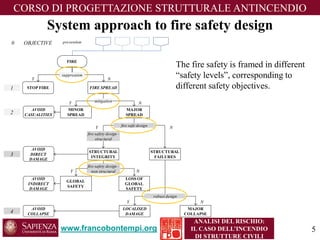
System approach to fire safety design 
www.francobontempi.org 
CORSO DI PROGETTAZIONE STRUTTURALE ANTINCENDIO 
MINOR 
SPREAD 
STOP FIRE FIRE SPREAD 
suppression 
Y 
MAJOR 
SPREAD 
STRUCTURAL 
INTEGRITY 
AVOID 
CASUALITIES 
LOCALISED 
DAMAGE 
STRUCTURAL 
FAILURES 
N 
mitigation 
Y 
N 
fire safe design 
Y 
N 
FIRE 
robust design 
Y 
N 
MAJOR 
COLLAPSE 
AVOID 
DIRECT 
DAMAGE 
AVOID 
COLLAPSE 
1 
2 
3 
4 
0 OBJECTIVE prevention 
fire safety design - 
structural 
fire safety design - 
non structural 
GLOBAL 
SAFETY 
LOSS OF 
GLOBAL 
SAFETY 
AVOID 
INDIRECT 
DAMAGE 
Y N 
The fire safety is framed in different 
“safety levels”, corresponding to 
different safety objectives. 
ANALISI DEL RISCHIO: 
IL CASO DELL’INCENDIO 
DI STRUTTURE CIVILI 
5
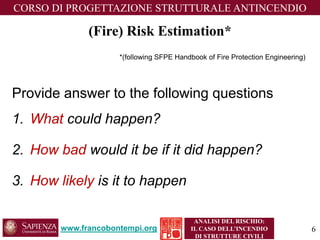
(Fire) RiskEstimation* 
*(following SFPE Handbook of Fire Protection Engineering) 
Provide answer to the following questions 
1.Whatcould happen? 
2.How bad would it be if it did happen? 
3.How likely is it to happen 
www.francobontempi.org 
CORSO DIPROGETTAZIONE STRUTTURALE ANTINCENDIO 
ANALISI DEL RISCHIO: 
IL CASO DELL’INCENDIO DI STRUTTURE CIVILI 
6
Whatisrisk? 
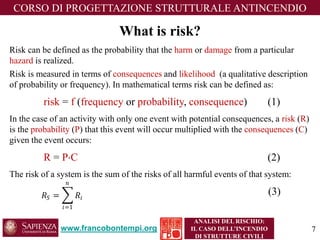
Risk can be defined as the probability that the harmor damagefrom a particular hazardis realized. 
Risk is measured in terms of consequencesand likelihood(a qualitative description of probability or frequency). In mathematical terms risk can be defined as: 
risk= f(frequencyor probability, consequence) (1) 
In the case of an activity with only one event with potential consequences, a risk(R) is the probability(P) that this event will occur multiplied with the consequences(C) given the event occurs: 
R= PC(2) 
The risk of a system is the sum of the risks of all harmful events of that system: 
(3) 
www.francobontempi.org 
CORSO DIPROGETTAZIONE STRUTTURALE ANTINCENDIO 
ANALISI DEL RISCHIO: 
IL CASO DELL’INCENDIO DI STRUTTURE CIVILI 
푅푆= 푅푖 푛 푖=1 7
Risktypes 
•Life safety risks are normally presented in two ways: 
-Individual risk and 
-Societal risk 
•Individualrisk: 
The purpose of the individual risk is to ensure that individuals in the society are not exposed to unacceptably high risks. It can be defined as the risk to any occupant on the scene for the event/hazard scenario i.e. it is the risk to an individual and not to a group of people. 
•Societalrisk: 
Societal risk is not looking at one individual but is concerned with the risk of multiple fatalities. People are treated as a group, there are no considerations taken to the individuals within the group i.e. the definition of the risk is from a societal point of view. 
www.francobontempi.org 
CORSO DIPROGETTAZIONE STRUTTURALE ANTINCENDIO 
ANALISI DEL RISCHIO: 
IL CASO DELL’INCENDIO DI STRUTTURE CIVILI 
Source: Jönsson, 2007 
8
Whatisriskanalysis? 
•A big family of different approaches, methodsand complex modelscombining various methododicalcomponents for specific tasks 
•Systematic analysis of sequencesand interaction effects in potential accidents, thereby identifying weak points in the system and recognizing possible improvement measures 
•Risk analysis makes the quantificationof risks feasible 
www.francobontempi.org 
CORSO DIPROGETTAZIONE STRUTTURALE ANTINCENDIO 
ANALISI DEL RISCHIO: 
IL CASO DELL’INCENDIO DI STRUTTURE CIVILI 
9
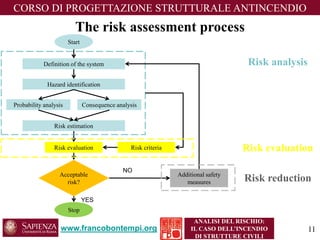
The risk assessment process 
www.francobontempi.org 
CORSO DIPROGETTAZIONE STRUTTURALE ANTINCENDIO 
ANALISI DEL RISCHIO: 
IL CASO DELL’INCENDIO DI STRUTTURE CIVILI 
10
The risk assessment process 
www.francobontempi.org 
CORSO DIPROGETTAZIONE STRUTTURALE ANTINCENDIO 
ANALISI DEL RISCHIO: 
IL CASO DELL’INCENDIO DI STRUTTURE CIVILI 
Start 
Definition of the system 
Hazard identification 
Probability analysis 
Consequence analysis 
Additional safety measures 
Risk estimation 
Risk evaluation 
Risk criteria 
Acceptable risk? 
Stop 
Risk analysis 
Risk evaluation 
YES 
NO 
Risk reduction 
11
Definition of the system (context establishment) 
www.francobontempi.org 
CORSO DIPROGETTAZIONE STRUTTURALE ANTINCENDIO 
ANALISI DEL RISCHIO: 
IL CASO DELL’INCENDIO DI STRUTTURE CIVILI 
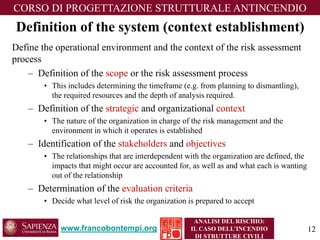
Define the operational environment and the context of the risk assessment process 
–Definition of the scopeor the risk assessment process 
•This includes determining the timeframe (e.g. from planning to dismantling), the required resources and the depth of analysis required. 
–Definition of the strategic and organizational context 
•The nature of the organization in charge of the risk management and the environment in which it operates is established 
–Identification of the stakeholdersand objectives 
•The relationships that are interdependent with the organization are defined, the impacts that might occur are accounted for, as well as and what each is wanting out of the relationship 
–Determination of the evaluation criteria 
•Decide what level of risk the organization is prepared to accept 
12
Hazard identification 
www.francobontempi.org 
CORSO DIPROGETTAZIONE STRUTTURALE ANTINCENDIO 
ANALISI DEL RISCHIO: 
IL CASO DELL’INCENDIO DI STRUTTURE CIVILI 
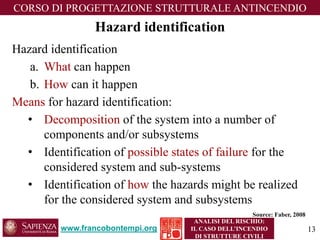
Hazard identification 
a.Whatcan happen 
b.Howcan ithappen 
Means for hazard identification: 
•Decompositionof the system into a number of components and/or subsystems 
•Identification of possible states of failurefor the considered system and sub-systems 
•Identification of howthe hazards might be realized for the considered system and subsystems 
Source: Faber, 2008 
13
www.francobontempi.org 
CORSO DI PROGETTAZIONE STRUTTURALE ANTINCENDIO 
ANALISI DEL RISCHIO: 
IL CASO DELL’INCENDIO 
DI STRUTTURE CIVILI 
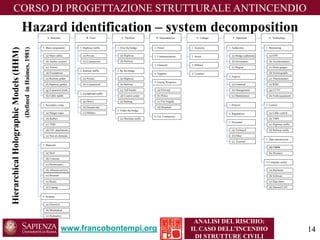
Hazard identification – system decomposition 
A. Structure 
1. Main components 
(d) Foundations 
(c) Towers 
(b) Anchor systems 
(a) Main cables 
(h) Cable saddle 
(e) Railway girder 
(f) Highway girders 
(g) Expansion joints 
(e) Non str.elements 
(a) Steel 
(b) Concrete 
(c) Prestressed c. 
(d) Alluminium/iron 
3. Materials 
(f) Coating 
4. Systems 
(a) Electrical 
(c) Hydraulics 
(b) Mechanical 
(e) Bitumen 
(e) Plastic 
2. Secondary comp. 
(d) H.R. attachments 
(c) TMD 
(b) Buffers 
(a) Hanger ropes 
B. Users 
1. Highway traffic 
(b) Commercial 
(a) Private 
2. Railway traffic 
(b) Commercial 
(a) Private 
(a) Heavy 
(b) Hazard mat. 
(c) Military 
3. Exceptional traffic 
C. Facilities 
1. Over the bridge 
(b) Railway 
(a) Highway 
2. By the bridge 
(a) Highway 
(b) Railway 
(c) Toll booths 
(d) Control center 
(e) Parking 
(a) Maritime traffic 
3. Under the bridge 
D. Dependencies 
1. Power 
3. Financial 
2. Communications 
4. Supplies 
5. Emerg. Responce 
(a) First aid 
(b) Police 
(c) Fire brigade 
(d) Hospitals 
6. Ext. Contractors 
E. Linkage 
1. Economy 
3. Military 
2. Social 
F. Operation 
1. Authorities 
(b) Management 
2. Aspects 
(a) Bridge authorities 
(b) Goverment 
(c) Region 
5. Personnel 
(c) Maintenance 
(a) Financial 
(b) Other 
(a) Technical 
G. Technology 
(a) GPS 
(b) Accelerometers 
(c) Strain gauges 
(e) Thermometers 
(g) CCTV 
(f) WIM 
(d) Seismographs 
(h) Field equipment 
1. Monitoring 
2. Control 
(a) Cable control 
(d) Railway traffic 
(c) Highway traffic 
(b) TMD 
3. Data transmission 
(b) Wireless 
(a) Cable 
4. Computer center 
(b) Software 
(a) Hardware 
(d) Internet/LAN 
(c) Data bases 
4. Regulations 
3. Policies 
4. Location 
(c) External 
Hierarchical Holographic Models (HHM) 
(Defined in Haimes, 1981) 
14
Risk analysis: hazard identification 
www.francobontempi.org 
CORSO DIPROGETTAZIONE STRUTTURALE ANTINCENDIO 
ANALISI DEL RISCHIO: 
IL CASO DELL’INCENDIO DI STRUTTURE CIVILI 
•Qualitative methods 
Studies based on the generic experience of personnel and do not involve mathematical estimations. 
•Quantitative methods 
Mathematical estimations that rely upon historical evidence or estimates of failures to predict the occurrence of an event. 
•Semi-quantitative methods 
Combination of the above (mostly, qualitative methods with applied numerical values). 
Source: Nolan, D. P. Handbook of Fire and Explosion Protection Engineering Principles for Oil, Gas, Chemical, and Related Facilities, 1986 
15
www.francobontempi.org 
CORSO DIPROGETTAZIONE STRUTTURALE ANTINCENDIO 
ANALISI DEL RISCHIO: 
IL CASO DELL’INCENDIO DI STRUTTURE CIVILI 
Source: Aven, T. Risk Analysis: Assessing Uncertainties beyond Expected Values and Probabilities. John Wiley & Sons, 2008 
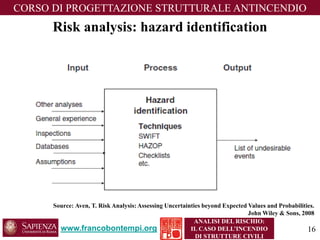
Risk analysis: hazard identification 
16
Hazard identification. Qualitative Methods 
www.francobontempi.org 
CORSO DIPROGETTAZIONE STRUTTURALE ANTINCENDIO 
ANALISI DEL RISCHIO: 
IL CASO DELL’INCENDIO DI STRUTTURE CIVILI 
Checklist or Worksheet 
A standardized listing which identifies common protection features required for typical facilities is compared against the facility design and operation. Risksare expressed by the omission of safety systemsor system features. 
Preliminary Hazard Analysis (PHA) 
Each hazard is identified with potential causes and effects. Recommendations or known protective measures are listed. 
What-If analysis 
A safety study which by which “What-If’ investigative questions (brainstorming approach) are asked by an experienced team of a hydrocarbon system or components under examination. Risks are normally expressed in a qualitative numerical series (e.g., 1 to 5). 
HAZOP -HAZardand OPerabilityanalysis(analisi di pericolo e operabilità) 
A formal systematic critical safety study where deviationsof design intent of each component are formulated and analyzed from a standardized list. Risks are typically expressed in a qualitative numerical series (e.g., 1 to 5) relative to one another. 
Source: Nolan, D.P. 1986. Handbook of Fire and Explosion Protection Engineering Principles for …. Noyes, New Jersey 17
Hazard identification. Qualitative Methods 
www.francobontempi.org 
CORSO DIPROGETTAZIONE STRUTTURALE ANTINCENDIO 
ANALISI DEL RISCHIO: 
IL CASO DELL’INCENDIO DI STRUTTURE CIVILI 
Event Trees (ET) –alberodeglieventi 
A mathematical logic model that mathematically and graphically portrays the combination of events and circumstances in an accident sequence, expressed in an annual estimation. 
Fault Trees (FT) –alberideiguasti 
A mathematical logic model that mathematically and graphically portrays the combination of failures that can lead to a specific main failure or accident of interest, expressed in an annual estimation. 
Failure Modes and Effects Analysis (FMEA) 
A systematic, tabular method of evaluating the causes and effects of known types of component failures, expressed in an annual estimation. 
Source: Nolan, D.P. 1986. Handbook of Fire and Explosion Protection Engineering Principles for …. Noyes, New Jersey 18
•Risk analysis 
•Qualitative risk analysis 
•Quantitative risk analysis 
www.francobontempi.org 
CORSO DIPROGETTAZIONE STRUTTURALE ANTINCENDIO 
ANALISI DEL RISCHIO: 
IL CASO DELL’INCENDIO DI STRUTTURE CIVILI 
19
www.francobontempi.org 
CORSO DIPROGETTAZIONE STRUTTURALE ANTINCENDIO 
ANALISI DEL RISCHIO: 
IL CASO DELL’INCENDIO DI STRUTTURE CIVILI 
Risk analysis 
•Risk analysis 
–Probability-as the likelihood of the risk occurrence 
–Impact -consequences if the risk occurs 
•risk proximity, meant as the point in time during which a risk will impact 
•Risk analysis -methods 
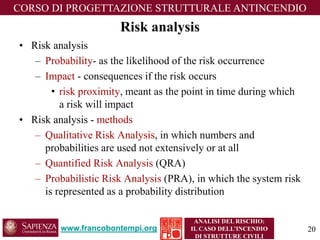
–Qualitative Risk Analysis, in which numbers and probabilities are used not extensively or at all 
–Quantified Risk Analysis(QRA) 
–Probabilistic Risk Analysis(PRA), in which the system risk is represented as a probability distribution 
20
www.francobontempi.org 
CORSO DIPROGETTAZIONE STRUTTURALE ANTINCENDIO 
ANALISI DEL RISCHIO: 
IL CASO DELL’INCENDIO DI STRUTTURE CIVILI 
Risk analysis and system complexity 
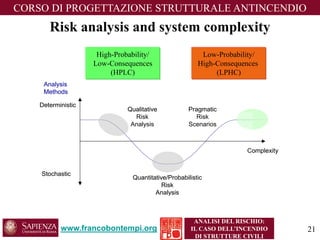
High-Probability/ Low-Consequences(HPLC) Low-Probability/ High-Consequences (LPHC) StochasticComplexityDeterministicAnalysisMethodsQualitativeRiskAnalysisQuantitative/ProbabilisticRiskAnalysisPragmaticRiskScenariosStochasticComplexityDeterministicAnalysisMethodsQualitativeRiskAnalysisQuantitative/ProbabilisticRiskAnalysisPragmaticRiskScenarios 
21
www.francobontempi.org 
CORSO DIPROGETTAZIONE STRUTTURALE ANTINCENDIO 
ANALISI DEL RISCHIO: 
IL CASO DELL’INCENDIO DI STRUTTURE CIVILI 
Qualitative Risk analysis 
•Qualitative Risk Analysis is the simplestmethod of risk analysis, and generally is used during the preliminary analysis phases. 
•It consists in using subjective assessments of risks, and consequently, in ranking them in a subjective manner. 
•Sources for information to be used in the analysis can be drown from previous experiences, history of events and consultation of experts. 
•The rankingof risks is qualitative, e.g. risk (1) > risk (2) > risk (3), while a description can be added. Eventually, a likelihood-consequence matrix can be constructed. 
•The biggest drawback of QRA is that there is neither a clear indication of the risk’s magnitude nor an absolute scale of how serious the risk might be, so, for a comprehensive risk analysis of more complex systems, quantitative methods should be preferred. 
22
www.francobontempi.org 
CORSO DIPROGETTAZIONE STRUTTURALE ANTINCENDIO 
ANALISI DEL RISCHIO: 
IL CASO DELL’INCENDIO DI STRUTTURE CIVILI 
Qualitative risk analysis methods: risk matrix 
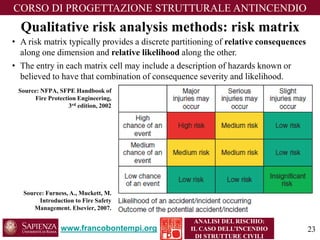
•A risk matrix typically provides a discrete partitioning of relative consequences along one dimension and relative likelihood along the other. 
•The entry in each matrix cell may include a description of hazards known or believed to have that combination of consequence severity and likelihood. 
Source: NFPA, SFPE Handbook of Fire Protection Engineering, 3rdedition, 2002 
Source: Furness, A., Muckett, M. Introduction to Fire Safety Management. Elsevier, 2007. 
23
www.francobontempi.org 
CORSO DIPROGETTAZIONE STRUTTURALE ANTINCENDIO 
ANALISI DEL RISCHIO: 
IL CASO DELL’INCENDIO DI STRUTTURE CIVILI 
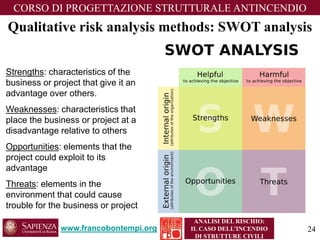
Qualitative risk analysis methods: SWOT analysis 
24 
Strengths: characteristics of the business or project that give it an advantage over others. 
Weaknesses: characteristics that place the business or project at a disadvantage relative to others 
Opportunities: elements that the project could exploit to its advantage 
Threats: elements in the environment that could cause trouble for the business or project
www.francobontempi.org 
CORSO DIPROGETTAZIONE STRUTTURALE ANTINCENDIO 
ANALISI DEL RISCHIO: 
IL CASO DELL’INCENDIO DI STRUTTURE CIVILI 
Quantitative Risk analysis 
•Quantified (or quantitative) Risk Analysis (QRA) combines the consequences and frequencies of accident scenarios to estimate the level of risk. 
•In respect to the Qualitative method, QRA implicates the acquaintance of probabilities that describe the likelihoodof the outcomes and their consequences. 
•QRA started with the chemical industries from the 70s and the offshore industry from the 80s. 
•QRA is traditionally expressed through the decompositionof the system. This frequently is done by the use of event trees and fault trees. 
25
www.francobontempi.org 
CORSO DIPROGETTAZIONE STRUTTURALE ANTINCENDIO 
ANALISI DEL RISCHIO: 
IL CASO DELL’INCENDIO DI STRUTTURE CIVILI 
FTA and ETA 
•ETA (event tree analysis) provides a structure for postulating an initiating event and analyzing the potential outcomes 
•FTA (fault tree analysis) begins with a failure and provides a structure to look for potential causes 
26
www.francobontempi.org 
CORSO DIPROGETTAZIONE STRUTTURALE ANTINCENDIO 
ANALISI DEL RISCHIO: 
IL CASO DELL’INCENDIO DI STRUTTURE CIVILI 
Event tree analysis 
•Event trees pictorially represent the logical order in which events in a system can occur. Event trees begin with an initiating event, and then the consequences of the event are followed through a series of possible paths. 
•Each path is assigned a probability of occurrence. Therefore, the probability of the various possible outcomes can be calculated. 
•Event tree analysis is based on binary logic, in which an event has either happened or not, or a component has failed or has not. 
•It is valuable to analyze the consequences arising from a failure or undesired event. 
27
www.francobontempi.org 
CORSO DIPROGETTAZIONE STRUTTURALE ANTINCENDIO 
ANALISI DEL RISCHIO: 
IL CASO DELL’INCENDIO DI STRUTTURE CIVILI 
Event tree analysis: illustration (1) 
28 
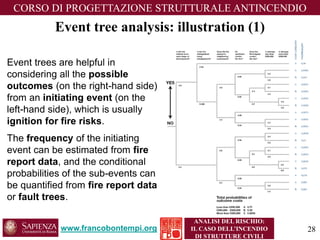
Event trees are helpful in considering all the possible outcomes (on the right-hand side) from an initiating event(on the left-hand side), which is usually ignition for fire risks. 
The frequencyof the initiating event can be estimated from fire report data, and the conditional probabilities of the sub-events can be quantified from fire report data or fault trees.
www.francobontempi.org 
CORSO DIPROGETTAZIONE STRUTTURALE ANTINCENDIO 
ANALISI DEL RISCHIO: 
IL CASO DELL’INCENDIO DI STRUTTURE CIVILI 
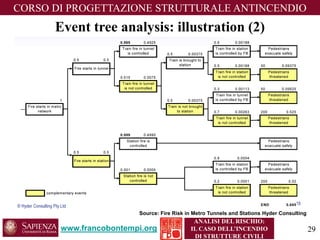
Event tree analysis: illustration (2) 
Source: Fire Risk in Metro Tunnels and Stations HyderConsulting 
29
www.francobontempi.org 
CORSO DIPROGETTAZIONE STRUTTURALE ANTINCENDIO 
ANALISI DEL RISCHIO: 
IL CASO DELL’INCENDIO DI STRUTTURE CIVILI 
Fault tree analysis 
30 
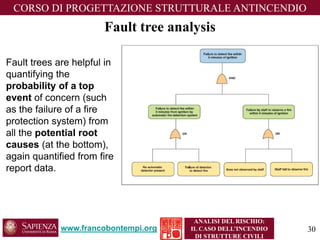
Fault trees are helpful in quantifying the probability of a top eventof concern (such as the failure of a fire protection system) from all the potential root causes (at the bottom), again quantified from fire report data.
www.francobontempi.org 
CORSO DIPROGETTAZIONE STRUTTURALE ANTINCENDIO 
ANALISI DEL RISCHIO: 
IL CASO DELL’INCENDIO DI STRUTTURE CIVILI 
Fault tree analysis 
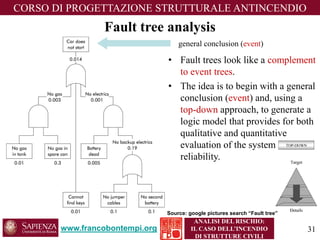
general conclusion (event) 
•Fault trees look like a complement to event trees. 
•The idea is to begin with a general conclusion (event) and, using a top-downapproach, to generate a logic model that provides for both qualitative and quantitative evaluation of the system reliability. 
Source: googlepictures search “Fault tree” 
31
www.francobontempi.org 
CORSO DIPROGETTAZIONE STRUTTURALE ANTINCENDIO 
ANALISI DEL RISCHIO: 
IL CASO DELL’INCENDIO DI STRUTTURE CIVILI 
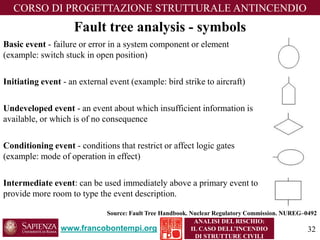
Fault tree analysis -symbols 
Basic event-failure or error in a system component or element (example: switch stuck in open position) 
Initiating event-an external event (example: bird strike to aircraft) 
Undeveloped event-an event about which insufficient information is available, or which is of no consequence 
Conditioning event-conditions that restrict or affect logic gates (example: mode of operation in effect) 
Intermediate event: can be used immediately above a primary event to provide more room to type the event description. 
Source: Fault Tree Handbook. Nuclear Regulatory Commission. NUREG–0492 
32
www.francobontempi.org 
CORSO DIPROGETTAZIONE STRUTTURALE ANTINCENDIO 
ANALISI DEL RISCHIO: 
IL CASO DELL’INCENDIO DI STRUTTURE CIVILI 
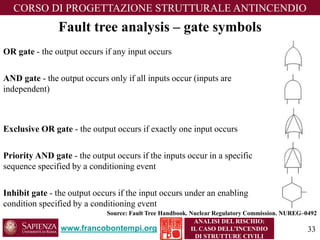
Fault tree analysis –gate symbols 
OR gate -the output occurs if any input occurs 
AND gate -the output occurs only if all inputs occur (inputs are independent) 
Exclusive OR gate -the output occurs if exactly one input occurs 
Priority AND gate -the output occurs if the inputs occur in a specific sequence specified by a conditioning event 
Inhibit gate -the output occurs if the input occurs under an enabling condition specified by a conditioning event 
Source: Fault Tree Handbook. Nuclear Regulatory Commission. NUREG–0492 
33
www.francobontempi.org 
CORSO DIPROGETTAZIONE STRUTTURALE ANTINCENDIO 
ANALISI DEL RISCHIO: 
IL CASO DELL’INCENDIO DI STRUTTURE CIVILI 
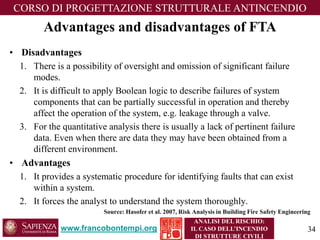
Advantages and disadvantages of FTA 
•Disadvantages 
1.There is a possibility of oversight and omission of significant failure modes. 
2.It is difficult to apply Boolean logic to describe failures of system components that can be partially successful in operation and thereby affect the operation of the system, e.g. leakage through a valve. 
3.For the quantitative analysis there is usually a lack of pertinent failure data. Even when there are data they may have been obtained from a different environment. 
•Advantages 
1.It provides a systematic procedure for identifying faults that can exist within a system. 
2.It forces the analyst to understand the system thoroughly. 
Source: Hasoferet al. 2007, Risk Analysis in Building Fire Safety Engineering 
34
www.francobontempi.org 
CORSO DIPROGETTAZIONE STRUTTURALE ANTINCENDIO 
ANALISI DEL RISCHIO: 
IL CASO DELL’INCENDIO DI STRUTTURE CIVILI 
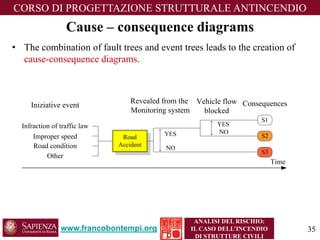
Cause –consequence diagrams 
•The combination of fault trees and event trees leads to the creation of cause-consequence diagrams. 
TimeRevealed from the Monitoring systemS3S2S1ConsequencesInfraction of traffic lawImproper speedRoad conditionVehicle flowblockedYESYESNONOOtherIniziative eventRoadAccident 
35
www.francobontempi.org 
CORSO DI PROGETTAZIONE STRUTTURALE ANTINCENDIO 
ANALISI DEL RISCHIO: 
IL CASO DELL’INCENDIO 
DI STRUTTURE CIVILI 
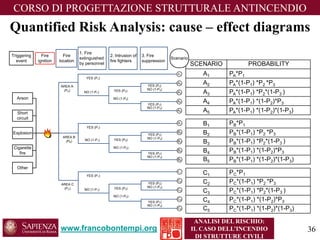
SCENARIO PROBABILITY 
A1 PA*P1 
A2 PA*(1-P1) *P2 *P3 
A3 PA*(1-P1) *P2*(1-P3 ) 
A4 PA*(1-P1) *(1-P2)*P3 
A5 PA*(1-P1) *(1-P2)*(1-P3) 
B1 PB*P1 
B2 PB*(1-P1) *P2 *P3 
B3 PB*(1-P1) *P2*(1-P3 ) 
B4 PB*(1-P1) *(1-P2)*P3 
B5 PB*(1-P1) *(1-P2)*(1-P3) 
C1 PC*P1 
C2 PC*(1-P1) *P2 *P3 
C3 PC*(1-P1) *P2*(1-P3 ) 
C4 PC*(1-P1) *(1-P2)*P3 
C5 PC*(1-P1) *(1-P2)*(1-P3) 
Triggering 
event 
Fire 
ignition 
1. Fire 
extinguished 
by personnel 
2. Intrusion of 
fire fighters 
Arson 
Explosion 
Short 
circuit 
Cigarette 
fire 
YES (P1) 
NO (1-P1) YES (P2) 
NO (1-P2) 
Scenario 
Other 
A1 
A2 
A3 
A4 
A5 
3. Fire 
suppression 
YES (P3) 
NO (1-P3) 
YES (P3) 
NO (1-P3) 
Fire 
location 
AREA A 
(PA) 
YES (P1) 
NO (1-P1) YES (P2) 
NO (1-P2) 
B1 
B2 
B3 
B4 
B5 
YES (P3) 
NO (1-P3) 
YES (P3) 
NO (1-P3) 
AREA B 
(PB) 
YES (P1) 
NO (1-P1) YES (P2) 
NO (1-P2) 
C1 
C2 
C3 
C4 
C5 
YES (P3) 
NO (1-P3) 
YES (P3) 
NO (1-P3) 
AREA C 
(PC) 
Quantified Risk Analysis: cause – effect diagrams 
36
www.francobontempi.org 
CORSO DIPROGETTAZIONE STRUTTURALE ANTINCENDIO 
ANALISI DEL RISCHIO: 
IL CASO DELL’INCENDIO DI STRUTTURE CIVILI 
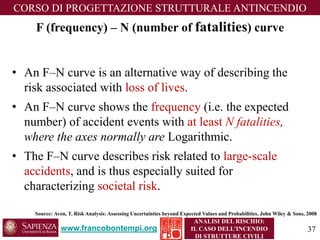
F (frequency) –N (numberoffatalities) curve 
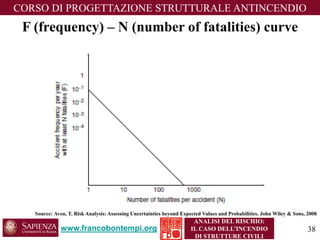
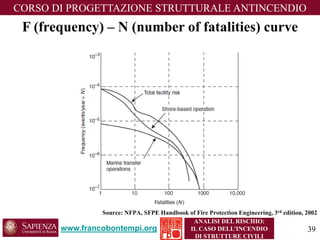
•An F–N curve is an alternative way of describing the risk associated with loss of lives. 
•An F–N curve shows the frequency (i.e. the expected number) of accident events with at least N fatalities, where the axes normally are Logarithmic. 
•The F–N curve describes risk related to large-scale accidents, and is thus especially suited for characterizing societal risk. 
Source: Aven, T. Risk Analysis: Assessing Uncertainties beyond Expected Values and Probabilities. John Wiley & Sons, 2008 
37
www.francobontempi.org 
CORSO DIPROGETTAZIONE STRUTTURALE ANTINCENDIO 
ANALISI DEL RISCHIO: 
IL CASO DELL’INCENDIO DI STRUTTURE CIVILI 
F (frequency) –N (numberoffatalities) curve 
Source: Aven, T. Risk Analysis: Assessing Uncertainties beyond Expected Values and Probabilities. John Wiley & Sons, 2008 
38
www.francobontempi.org 
CORSO DIPROGETTAZIONE STRUTTURALE ANTINCENDIO 
ANALISI DEL RISCHIO: 
IL CASO DELL’INCENDIO DI STRUTTURE CIVILI 
F (frequency) –N (numberoffatalities) curve 
Source: NFPA, SFPE Handbook of Fire Protection Engineering, 3rdedition, 2002 
39
Index 
•Risk acceptance 
-ALARP 
-Human life (!) 
www.francobontempi.org 
CORSO DIPROGETTAZIONE STRUTTURALE ANTINCENDIO 
ANALISI DEL RISCHIO: 
IL CASO DELL’INCENDIO DI STRUTTURE CIVILI 
40
www.francobontempi.org 
CORSO DIPROGETTAZIONE STRUTTURALE ANTINCENDIO 
ANALISI DEL RISCHIO: 
IL CASO DELL’INCENDIO DI STRUTTURE CIVILI 
Risk acceptance 
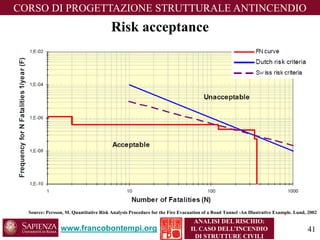
Source: Persson, M. Quantitative Risk Analysis Procedure for the Fire Evacuation of a Road Tunnel -An Illustrative Example. Lund, 2002 
41
www.francobontempi.org 
CORSO DIPROGETTAZIONE STRUTTURALE ANTINCENDIO 
ANALISI DEL RISCHIO: 
IL CASO DELL’INCENDIO DI STRUTTURE CIVILI 
Risk acceptance –ALARP (1) 
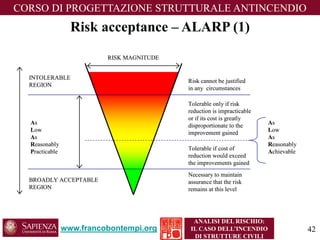
RISK MAGNITUDEINTOLERABLEREGIONAsLowAsReasonablyPracticableBROADLY ACCEPTABLEREGIONRisk cannot be justified in any circumstancesTolerable only if risk reduction is impracticable or if its cost is greatly disproportionate to the improvement gainedTolerable if cost of reduction would exceed the improvements gainedNecessary to maintain assurance that the risk remains at this levelAsLowAsReasonablyAchievableRISK levelAsLowAsReasonablyAchievable 
42
www.francobontempi.org 
CORSO DIPROGETTAZIONE STRUTTURALE ANTINCENDIO 
ANALISI DEL RISCHIO: 
IL CASO DELL’INCENDIO DI STRUTTURE CIVILI 
Risk acceptance –ALARP (2) 
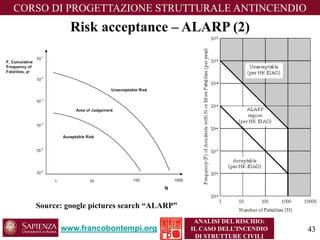
Source: googlepictures search “ALARP” 
43
CORSO DIPROGETTAZIONE STRUTTURALE ANTINCENDIO 
ANALISI DEL RISCHIO: 
IL CASO DELL’INCENDIO DI STRUTTURE CIVILI 
Monetary values –cost of human life (!) 
•What is the maximum amount the society (or the decision-maker) is willing to pay to reduce the expected number of fatalities by 1? 
•Typical numbers for the value of a statistical life used in cost-benefit analysis are 1–10 million euros. The Ministry of Finance in Norway has arrived at a value at approximately 2 million euros. 
www.francobontempi.org 
Guideline values for the cost to avert a statistical life (euros), used by an oil company 
Source: Aven, T. Risk Analysis: Assessing Uncertainties beyond Expected Values and Probabilities. John Wiley & Sons, 2008 
44
CORSO DIPROGETTAZIONE STRUTTURALE ANTINCENDIO 
ANALISI DEL RISCHIO: 
IL CASO DELL’INCENDIO DI STRUTTURE CIVILI 
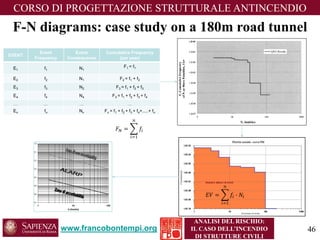
F-N diagrams: case study on a 180m road tunnel 
www.francobontempi.org 45 
120MW Fire[fat+inj/year]0.00E+002100MW Fire[fat+inj/year]0.00E+003Bleve of 50kg propane cylinder[fat+inj/year]0.00E+004Motor spirit pool fire[fat+inj/year]0.00E+005VCE of motor spirit[fat+inj/year]0.00E+006Chlorine release[fat+inj/year]0.00E+007BLEVE of 18t propane tank[fat+inj/year]0.00E+008VCE of propane[fat+inj/year]0.00E+009Propane torch fire[fat+inj/year]0.00E+0010Ammonia Release[fat+inj/year]0.00E+0011Acrolein in bulk release[fat+inj/year]0.00E+0012Acrolein in cylinder release[fat+inj/year]0.00E+0013BLEVE of a 20t CO2 tank[fat+inj/year]0.00E+00All scenarios[fat+inj/year]0.00E+001+220MW - 100MW FIRES [fat+inj/year]0.00E+003+13BLEVE (except propane in bulk) [fat+inj/year]0.00E+004+5Flammable liquids [fat+inj/year]0.00E+006+10+11+12Toxic products [fat+inj/year]0.00E+007+8+9Propane in bulk [fat+inj/year]0.00E+00
CORSO DI PROGETTAZIONE STRUTTURALE ANTINCENDIO 
ANALISI DEL RISCHIO: 
IL CASO DELL’INCENDIO 
DI STRUTTURE CIVILI 
www.francobontempi.org 46 
퐹푁 = 
푖=1 
푛 
푓푖 
퐸푉 = 
푖=1 
푛 
푓푖 ∙ 푁푖 
EVENT 
Event 
Frequency 
Event 
Consequence 
Cumulative Frequency 
(per year) 
E1 f1 N1 
F1 = f1 
E2 f2 N1 F2 = f1 + f2 
E3 f3 N2 F3 = f1 + f2 + f3 
E4 f4 N4 F3 = f1 + f2 + f3 + f4 
..... ..... ..... ..... 
En fn Nn Fn = f1 + f2 + f3 + f4+.....+ fn 
F-N diagrams: case study on a 180m road tunnel
CORSO DI PROGETTAZIONE STRUTTURALE ANTINCENDIO 
ANALISI DEL RISCHIO: 
IL CASO DELL’INCENDIO 
DI STRUTTURE CIVILI 
Case study: 180m road tunnel 
www.francobontempi.org 47 
Trial 1 BASIS calculation 
Trial 2 Total traffic [veh/h] 7200 72000 
HGV ratio [-] 0.01 0.99 
TrDen (traffic density) [-] 0.78 3.79 
Bus/Coaches ratio [-] 0.01 0.99 
TrDen (traffic density) [-] 0.78 3.79 
HGV ratio [-] 0.01 0.99 
Bus/Coaches ratio [-] 0.01 0.99 
TrDen (traffic density) [-] 0.78 3.79 
Trial 6 Light vehicles average speed [km/h] 80 179 
Trial 7 HGV/Bus average speed [km/h] 60 119 
Trial 8 Delay for stopping approaching traffic [s] 9000 1 
Trial 9 Area (Urban/Rural) [-] urban rural 
Trial 10 Average density of population [hab/km2] 0.01 999000 
Trial 11 DG-HGV traffic [veh/h] 5 10000 
Trial 12 Average number of people in a light vehicle [-] 2 10 
Trial 13 W (effective width) [m] 10 5 
Trial 14 H (effective height) [m] 6 3 
Trial 15 VnN (volume flow rate along tunnel at nodes) [m3/s] 120 0 
Trial 16 VnE (volume flow rate along tunnel at nodes) [m3/s] 210 0 
Trial 17 tE (Time taken to activate emergency ventilation) [mins] 0.2 60 
Trial 18 Xe (average spacing between emergency exits) [m] 90 1000 
Trial 19 Cam (camber) [%] 0 100 
Trial 20 Ad (open area of discrete drains) [m2] 0.075 0 
Trial 21 Ecom (emergency coms) → 1, 2 o 3 [-] 3 1 
Type of construction → 1 o 2 [-] 2 1 
trad (internal radius) [m] - 6 
dlin (lining thickness) [m] - 0.3 
trad (wall thickness) [m] 0.2 - 
dlin (roof slab thickness) [m] 0.2 - 
Ns (Number of segments) [-] 6 15 
Xs (Segment lengths) [m] 30 12 
Nsub (number of sub-segments per segment) [-] 3 2 
total number of sub-segments [-] 18 30 
Xsub (actual sub-segment lengths) [m] 10 6 
Trial 24 Number of lanes [-] 2 5 
Trial 4 
Trial 3 
Trial 22 
Trial 5 
Trial 23 
1 20MW Fire [fat+inj/year] 
2 100MW Fire [fat+inj/year] 
3 Bleve of 50kg propane cylinder [fat+inj/year] 
4 Motor spirit pool fire [fat+inj/year] 
5 VCE of motor spirit [fat+inj/year] 
6 Chlorine release [fat+inj/year] 
7 BLEVE of 18t propane tank [fat+inj/year] 
8 VCE of propane [fat+inj/year] 
9 Propane torch fire [fat+inj/year] 
10 Ammonia Release [fat+inj/year] 
11 Acrolein in bulk release [fat+inj/year] 
12 Acrolein in cylinder release [fat+inj/year] 
13 BLEVE of a 20t CO2 tank [fat+inj/year] 
All scenarios [fat+inj/year] 
1+2 20MW - 100MW FIRES [fat+inj/year] 
3+13 BLEVE (except propane in bulk) [fat+inj/year] 
4+5 Flammable liquids [fat+inj/year] 
6+10+11+12 Toxic products [fat+inj/year] 
7+8+9 Propane in bulk [fat+inj/year] 
Societal Risk 
EV (Expected Value of the dead) 
Societal Risk 
30m (distance from the route) [fat+inj/year] 
80m [fat+inj/year] 
200m [fat+inj/year] 
500m [fat+inj/year] 
30m [fat+inj/year] 
80m [fat+inj/year] 
200m [fat+inj/year] 
500m [fat+inj/year] 
Individual Risk 
Direction A 
Direction B 
Individual Risk 
4 analysis for every trial 
Grouping
Risk reduction 
www.francobontempi.org 
CORSO DIPROGETTAZIONE STRUTTURALE ANTINCENDIO 
ANALISI DEL RISCHIO: 
IL CASO DELL’INCENDIO DI STRUTTURE CIVILI 
48
www.francobontempi.org 
CORSO DIPROGETTAZIONE STRUTTURALE ANTINCENDIO 
ANALISI DEL RISCHIO: 
IL CASO DELL’INCENDIO DI STRUTTURE CIVILI 
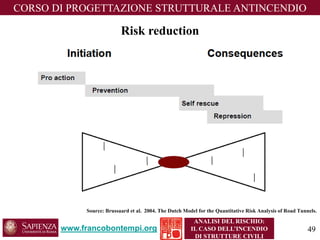
Riskreduction 
Source: Brussaardet al. 2004. The Dutch Model for the Quantitative Risk Analysis of Road Tunnels. 49
www.francobontempi.org 
CORSO DIPROGETTAZIONE STRUTTURALE ANTINCENDIO 
ANALISI DEL RISCHIO: 
IL CASO DELL’INCENDIO DI STRUTTURE CIVILI 
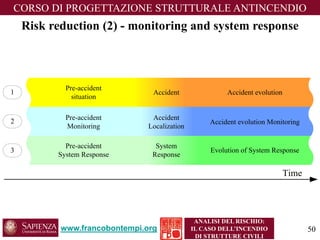
Risk reduction (2) -monitoring and system response 
Time132AccidentAccident evolutionPre-accidentsituationPre-accidentMonitoringPre-accidentSystem ResponseAccidentLocalizationEvolution of System ResponseAccident evolution MonitoringSystemResponse 
50
www.francobontempi.org 
CORSO DIPROGETTAZIONE STRUTTURALE ANTINCENDIO 
ANALISI DEL RISCHIO: 
IL CASO DELL’INCENDIO DI STRUTTURE CIVILI 
•NFPA, SFPE Handbook of Fire Protection Engineering, 3rdedition, 2002 
•Jönsson, J. Combined Qualitative and Quantitative Fire Risk Analysis –Complex Urban Road Tunnel. Arup partners, 2007. 
•Faber, M.H. (2008) Risk and Safety in Civil, Environmental and GeomaticEngineering. ETH Zürich, lecture notes, available online on 01/2011 at: http://www.ibk.ethz.ch/fa 
•Haimes, Y. Y. (1981). Hierarchical holographic modeling. IEEE Transactions on Systems, Man, and Cybernetics, 11(9), pp. 606–617. 
•Nolan, D.P. 1986. Handbook of Fire and Explosion Protection Engineering Principles for Oil, Gas, Chemical, and Related Facilities. Noyes, New Jersey 
•Aven, T. Risk Analysis: Assessing Uncertainties beyond Expected Values and Probabilities. John Wiley & Sons, 2008 
•Furness, A. , Muckett, M. Introduction to Fire Safety Management. Elsevier, 2007. 
•Fire Risk in Metro Tunnels and Stations, HyderConsulting, available on 05.2011 at http://hkarms.myftp.org/web_resources/Conference_Presentation/Fire_Risk_Metro_Tunnels_Stations.pdf 
•Fault Tree Handbook. Nuclear Regulatory Commission. NUREG–0492 
•Hasoferet al. 2007, Risk Analysis in Building Fire Safety Engineering 
•Persson, M. Quantitative Risk Analysis Procedure for the Fire Evacuation of a Road Tunnel -An Illustrative Example. Lund, 2002 
•Brussaardet al. 2004. The Dutch Model for the Quantitative Risk Analysis of Road Tunnels. Available on 05.2011 at http://www.rws.nl/rws/bwd/home/Tunnelveiligheid/dutch%20model.pdf 
•Gkoumas, K. 2008. Basic aspects of risk-analysis for civil engineering structures. Handling Exceptions in Structural Engineering: RobustezzaStrutturale, ScenariAccidentali, ComplessitàdiProgetto, Roma, 13-14 novembre. http://www.francobontempi.org/handling_papers.php 
References 
51

PSA - Lezione 28 ottobre 2014 - RISK

  • 1.
    Analisidel rischio: ilcasodell’incendiodistrutturecivili CORSO DIPROGETTAZIONE STRUTTURALE ANTINCENDIO 1 October 28 2014 www.francobontempi.org Konstantinos Gkoumas, Ph.D., P.E. Franco Bontempi, Ph.D., P.E. Facoltà di Ingegneria Sapienza Università di Roma
  • 2.
    Index •System approachto fire safety design •Risk/fire risk/risk analysis •Risk assessment process •Risk analysis •Hazard analysis •Risk acceptance •Risk reduction •References www.francobontempi.org CORSO DIPROGETTAZIONE STRUTTURALE ANTINCENDIO 2 ANALISI DEL RISCHIO: IL CASO DELL’INCENDIO DI STRUTTURE CIVILI
  • 3.
    www.francobontempi.org CORSO DIPROGETTAZIONESTRUTTURALE ANTINCENDIO 3 ANALISI DEL RISCHIO: IL CASO DELL’INCENDIO DI STRUTTURE CIVILI
  • 4.
    •System approach tofire safety design •Risk -fire risk -risk types -risk analysis www.francobontempi.org CORSO DIPROGETTAZIONE STRUTTURALE ANTINCENDIO ANALISI DEL RISCHIO: IL CASO DELL’INCENDIO DI STRUTTURE CIVILI 4
  • 5.
    System approach tofire safety design www.francobontempi.org CORSO DI PROGETTAZIONE STRUTTURALE ANTINCENDIO MINOR SPREAD STOP FIRE FIRE SPREAD suppression Y MAJOR SPREAD STRUCTURAL INTEGRITY AVOID CASUALITIES LOCALISED DAMAGE STRUCTURAL FAILURES N mitigation Y N fire safe design Y N FIRE robust design Y N MAJOR COLLAPSE AVOID DIRECT DAMAGE AVOID COLLAPSE 1 2 3 4 0 OBJECTIVE prevention fire safety design - structural fire safety design - non structural GLOBAL SAFETY LOSS OF GLOBAL SAFETY AVOID INDIRECT DAMAGE Y N The fire safety is framed in different “safety levels”, corresponding to different safety objectives. ANALISI DEL RISCHIO: IL CASO DELL’INCENDIO DI STRUTTURE CIVILI 5
  • 6.
    (Fire) RiskEstimation* *(followingSFPE Handbook of Fire Protection Engineering) Provide answer to the following questions 1.Whatcould happen? 2.How bad would it be if it did happen? 3.How likely is it to happen www.francobontempi.org CORSO DIPROGETTAZIONE STRUTTURALE ANTINCENDIO ANALISI DEL RISCHIO: IL CASO DELL’INCENDIO DI STRUTTURE CIVILI 6
  • 7.
    Whatisrisk? Risk canbe defined as the probability that the harmor damagefrom a particular hazardis realized. Risk is measured in terms of consequencesand likelihood(a qualitative description of probability or frequency). In mathematical terms risk can be defined as: risk= f(frequencyor probability, consequence) (1) In the case of an activity with only one event with potential consequences, a risk(R) is the probability(P) that this event will occur multiplied with the consequences(C) given the event occurs: R= PC(2) The risk of a system is the sum of the risks of all harmful events of that system: (3) www.francobontempi.org CORSO DIPROGETTAZIONE STRUTTURALE ANTINCENDIO ANALISI DEL RISCHIO: IL CASO DELL’INCENDIO DI STRUTTURE CIVILI 푅푆= 푅푖 푛 푖=1 7
  • 8.
    Risktypes •Life safetyrisks are normally presented in two ways: -Individual risk and -Societal risk •Individualrisk: The purpose of the individual risk is to ensure that individuals in the society are not exposed to unacceptably high risks. It can be defined as the risk to any occupant on the scene for the event/hazard scenario i.e. it is the risk to an individual and not to a group of people. •Societalrisk: Societal risk is not looking at one individual but is concerned with the risk of multiple fatalities. People are treated as a group, there are no considerations taken to the individuals within the group i.e. the definition of the risk is from a societal point of view. www.francobontempi.org CORSO DIPROGETTAZIONE STRUTTURALE ANTINCENDIO ANALISI DEL RISCHIO: IL CASO DELL’INCENDIO DI STRUTTURE CIVILI Source: Jönsson, 2007 8
  • 9.
    Whatisriskanalysis? •A bigfamily of different approaches, methodsand complex modelscombining various methododicalcomponents for specific tasks •Systematic analysis of sequencesand interaction effects in potential accidents, thereby identifying weak points in the system and recognizing possible improvement measures •Risk analysis makes the quantificationof risks feasible www.francobontempi.org CORSO DIPROGETTAZIONE STRUTTURALE ANTINCENDIO ANALISI DEL RISCHIO: IL CASO DELL’INCENDIO DI STRUTTURE CIVILI 9
  • 10.
    The risk assessmentprocess www.francobontempi.org CORSO DIPROGETTAZIONE STRUTTURALE ANTINCENDIO ANALISI DEL RISCHIO: IL CASO DELL’INCENDIO DI STRUTTURE CIVILI 10
  • 11.
    The risk assessmentprocess www.francobontempi.org CORSO DIPROGETTAZIONE STRUTTURALE ANTINCENDIO ANALISI DEL RISCHIO: IL CASO DELL’INCENDIO DI STRUTTURE CIVILI Start Definition of the system Hazard identification Probability analysis Consequence analysis Additional safety measures Risk estimation Risk evaluation Risk criteria Acceptable risk? Stop Risk analysis Risk evaluation YES NO Risk reduction 11
  • 12.
    Definition of thesystem (context establishment) www.francobontempi.org CORSO DIPROGETTAZIONE STRUTTURALE ANTINCENDIO ANALISI DEL RISCHIO: IL CASO DELL’INCENDIO DI STRUTTURE CIVILI Define the operational environment and the context of the risk assessment process –Definition of the scopeor the risk assessment process •This includes determining the timeframe (e.g. from planning to dismantling), the required resources and the depth of analysis required. –Definition of the strategic and organizational context •The nature of the organization in charge of the risk management and the environment in which it operates is established –Identification of the stakeholdersand objectives •The relationships that are interdependent with the organization are defined, the impacts that might occur are accounted for, as well as and what each is wanting out of the relationship –Determination of the evaluation criteria •Decide what level of risk the organization is prepared to accept 12
  • 13.
    Hazard identification www.francobontempi.org CORSO DIPROGETTAZIONE STRUTTURALE ANTINCENDIO ANALISI DEL RISCHIO: IL CASO DELL’INCENDIO DI STRUTTURE CIVILI Hazard identification a.Whatcan happen b.Howcan ithappen Means for hazard identification: •Decompositionof the system into a number of components and/or subsystems •Identification of possible states of failurefor the considered system and sub-systems •Identification of howthe hazards might be realized for the considered system and subsystems Source: Faber, 2008 13
  • 14.
    www.francobontempi.org CORSO DIPROGETTAZIONE STRUTTURALE ANTINCENDIO ANALISI DEL RISCHIO: IL CASO DELL’INCENDIO DI STRUTTURE CIVILI Hazard identification – system decomposition A. Structure 1. Main components (d) Foundations (c) Towers (b) Anchor systems (a) Main cables (h) Cable saddle (e) Railway girder (f) Highway girders (g) Expansion joints (e) Non str.elements (a) Steel (b) Concrete (c) Prestressed c. (d) Alluminium/iron 3. Materials (f) Coating 4. Systems (a) Electrical (c) Hydraulics (b) Mechanical (e) Bitumen (e) Plastic 2. Secondary comp. (d) H.R. attachments (c) TMD (b) Buffers (a) Hanger ropes B. Users 1. Highway traffic (b) Commercial (a) Private 2. Railway traffic (b) Commercial (a) Private (a) Heavy (b) Hazard mat. (c) Military 3. Exceptional traffic C. Facilities 1. Over the bridge (b) Railway (a) Highway 2. By the bridge (a) Highway (b) Railway (c) Toll booths (d) Control center (e) Parking (a) Maritime traffic 3. Under the bridge D. Dependencies 1. Power 3. Financial 2. Communications 4. Supplies 5. Emerg. Responce (a) First aid (b) Police (c) Fire brigade (d) Hospitals 6. Ext. Contractors E. Linkage 1. Economy 3. Military 2. Social F. Operation 1. Authorities (b) Management 2. Aspects (a) Bridge authorities (b) Goverment (c) Region 5. Personnel (c) Maintenance (a) Financial (b) Other (a) Technical G. Technology (a) GPS (b) Accelerometers (c) Strain gauges (e) Thermometers (g) CCTV (f) WIM (d) Seismographs (h) Field equipment 1. Monitoring 2. Control (a) Cable control (d) Railway traffic (c) Highway traffic (b) TMD 3. Data transmission (b) Wireless (a) Cable 4. Computer center (b) Software (a) Hardware (d) Internet/LAN (c) Data bases 4. Regulations 3. Policies 4. Location (c) External Hierarchical Holographic Models (HHM) (Defined in Haimes, 1981) 14
  • 15.
    Risk analysis: hazardidentification www.francobontempi.org CORSO DIPROGETTAZIONE STRUTTURALE ANTINCENDIO ANALISI DEL RISCHIO: IL CASO DELL’INCENDIO DI STRUTTURE CIVILI •Qualitative methods Studies based on the generic experience of personnel and do not involve mathematical estimations. •Quantitative methods Mathematical estimations that rely upon historical evidence or estimates of failures to predict the occurrence of an event. •Semi-quantitative methods Combination of the above (mostly, qualitative methods with applied numerical values). Source: Nolan, D. P. Handbook of Fire and Explosion Protection Engineering Principles for Oil, Gas, Chemical, and Related Facilities, 1986 15
  • 16.
    www.francobontempi.org CORSO DIPROGETTAZIONESTRUTTURALE ANTINCENDIO ANALISI DEL RISCHIO: IL CASO DELL’INCENDIO DI STRUTTURE CIVILI Source: Aven, T. Risk Analysis: Assessing Uncertainties beyond Expected Values and Probabilities. John Wiley & Sons, 2008 Risk analysis: hazard identification 16
  • 17.
    Hazard identification. QualitativeMethods www.francobontempi.org CORSO DIPROGETTAZIONE STRUTTURALE ANTINCENDIO ANALISI DEL RISCHIO: IL CASO DELL’INCENDIO DI STRUTTURE CIVILI Checklist or Worksheet A standardized listing which identifies common protection features required for typical facilities is compared against the facility design and operation. Risksare expressed by the omission of safety systemsor system features. Preliminary Hazard Analysis (PHA) Each hazard is identified with potential causes and effects. Recommendations or known protective measures are listed. What-If analysis A safety study which by which “What-If’ investigative questions (brainstorming approach) are asked by an experienced team of a hydrocarbon system or components under examination. Risks are normally expressed in a qualitative numerical series (e.g., 1 to 5). HAZOP -HAZardand OPerabilityanalysis(analisi di pericolo e operabilità) A formal systematic critical safety study where deviationsof design intent of each component are formulated and analyzed from a standardized list. Risks are typically expressed in a qualitative numerical series (e.g., 1 to 5) relative to one another. Source: Nolan, D.P. 1986. Handbook of Fire and Explosion Protection Engineering Principles for …. Noyes, New Jersey 17
  • 18.
    Hazard identification. QualitativeMethods www.francobontempi.org CORSO DIPROGETTAZIONE STRUTTURALE ANTINCENDIO ANALISI DEL RISCHIO: IL CASO DELL’INCENDIO DI STRUTTURE CIVILI Event Trees (ET) –alberodeglieventi A mathematical logic model that mathematically and graphically portrays the combination of events and circumstances in an accident sequence, expressed in an annual estimation. Fault Trees (FT) –alberideiguasti A mathematical logic model that mathematically and graphically portrays the combination of failures that can lead to a specific main failure or accident of interest, expressed in an annual estimation. Failure Modes and Effects Analysis (FMEA) A systematic, tabular method of evaluating the causes and effects of known types of component failures, expressed in an annual estimation. Source: Nolan, D.P. 1986. Handbook of Fire and Explosion Protection Engineering Principles for …. Noyes, New Jersey 18
  • 19.
    •Risk analysis •Qualitativerisk analysis •Quantitative risk analysis www.francobontempi.org CORSO DIPROGETTAZIONE STRUTTURALE ANTINCENDIO ANALISI DEL RISCHIO: IL CASO DELL’INCENDIO DI STRUTTURE CIVILI 19
  • 20.
    www.francobontempi.org CORSO DIPROGETTAZIONESTRUTTURALE ANTINCENDIO ANALISI DEL RISCHIO: IL CASO DELL’INCENDIO DI STRUTTURE CIVILI Risk analysis •Risk analysis –Probability-as the likelihood of the risk occurrence –Impact -consequences if the risk occurs •risk proximity, meant as the point in time during which a risk will impact •Risk analysis -methods –Qualitative Risk Analysis, in which numbers and probabilities are used not extensively or at all –Quantified Risk Analysis(QRA) –Probabilistic Risk Analysis(PRA), in which the system risk is represented as a probability distribution 20
  • 21.
    www.francobontempi.org CORSO DIPROGETTAZIONESTRUTTURALE ANTINCENDIO ANALISI DEL RISCHIO: IL CASO DELL’INCENDIO DI STRUTTURE CIVILI Risk analysis and system complexity High-Probability/ Low-Consequences(HPLC) Low-Probability/ High-Consequences (LPHC) StochasticComplexityDeterministicAnalysisMethodsQualitativeRiskAnalysisQuantitative/ProbabilisticRiskAnalysisPragmaticRiskScenariosStochasticComplexityDeterministicAnalysisMethodsQualitativeRiskAnalysisQuantitative/ProbabilisticRiskAnalysisPragmaticRiskScenarios 21
  • 22.
    www.francobontempi.org CORSO DIPROGETTAZIONESTRUTTURALE ANTINCENDIO ANALISI DEL RISCHIO: IL CASO DELL’INCENDIO DI STRUTTURE CIVILI Qualitative Risk analysis •Qualitative Risk Analysis is the simplestmethod of risk analysis, and generally is used during the preliminary analysis phases. •It consists in using subjective assessments of risks, and consequently, in ranking them in a subjective manner. •Sources for information to be used in the analysis can be drown from previous experiences, history of events and consultation of experts. •The rankingof risks is qualitative, e.g. risk (1) > risk (2) > risk (3), while a description can be added. Eventually, a likelihood-consequence matrix can be constructed. •The biggest drawback of QRA is that there is neither a clear indication of the risk’s magnitude nor an absolute scale of how serious the risk might be, so, for a comprehensive risk analysis of more complex systems, quantitative methods should be preferred. 22
  • 23.
    www.francobontempi.org CORSO DIPROGETTAZIONESTRUTTURALE ANTINCENDIO ANALISI DEL RISCHIO: IL CASO DELL’INCENDIO DI STRUTTURE CIVILI Qualitative risk analysis methods: risk matrix •A risk matrix typically provides a discrete partitioning of relative consequences along one dimension and relative likelihood along the other. •The entry in each matrix cell may include a description of hazards known or believed to have that combination of consequence severity and likelihood. Source: NFPA, SFPE Handbook of Fire Protection Engineering, 3rdedition, 2002 Source: Furness, A., Muckett, M. Introduction to Fire Safety Management. Elsevier, 2007. 23
  • 24.
    www.francobontempi.org CORSO DIPROGETTAZIONESTRUTTURALE ANTINCENDIO ANALISI DEL RISCHIO: IL CASO DELL’INCENDIO DI STRUTTURE CIVILI Qualitative risk analysis methods: SWOT analysis 24 Strengths: characteristics of the business or project that give it an advantage over others. Weaknesses: characteristics that place the business or project at a disadvantage relative to others Opportunities: elements that the project could exploit to its advantage Threats: elements in the environment that could cause trouble for the business or project
  • 25.
    www.francobontempi.org CORSO DIPROGETTAZIONESTRUTTURALE ANTINCENDIO ANALISI DEL RISCHIO: IL CASO DELL’INCENDIO DI STRUTTURE CIVILI Quantitative Risk analysis •Quantified (or quantitative) Risk Analysis (QRA) combines the consequences and frequencies of accident scenarios to estimate the level of risk. •In respect to the Qualitative method, QRA implicates the acquaintance of probabilities that describe the likelihoodof the outcomes and their consequences. •QRA started with the chemical industries from the 70s and the offshore industry from the 80s. •QRA is traditionally expressed through the decompositionof the system. This frequently is done by the use of event trees and fault trees. 25
  • 26.
    www.francobontempi.org CORSO DIPROGETTAZIONESTRUTTURALE ANTINCENDIO ANALISI DEL RISCHIO: IL CASO DELL’INCENDIO DI STRUTTURE CIVILI FTA and ETA •ETA (event tree analysis) provides a structure for postulating an initiating event and analyzing the potential outcomes •FTA (fault tree analysis) begins with a failure and provides a structure to look for potential causes 26
  • 27.
    www.francobontempi.org CORSO DIPROGETTAZIONESTRUTTURALE ANTINCENDIO ANALISI DEL RISCHIO: IL CASO DELL’INCENDIO DI STRUTTURE CIVILI Event tree analysis •Event trees pictorially represent the logical order in which events in a system can occur. Event trees begin with an initiating event, and then the consequences of the event are followed through a series of possible paths. •Each path is assigned a probability of occurrence. Therefore, the probability of the various possible outcomes can be calculated. •Event tree analysis is based on binary logic, in which an event has either happened or not, or a component has failed or has not. •It is valuable to analyze the consequences arising from a failure or undesired event. 27
  • 28.
    www.francobontempi.org CORSO DIPROGETTAZIONESTRUTTURALE ANTINCENDIO ANALISI DEL RISCHIO: IL CASO DELL’INCENDIO DI STRUTTURE CIVILI Event tree analysis: illustration (1) 28 Event trees are helpful in considering all the possible outcomes (on the right-hand side) from an initiating event(on the left-hand side), which is usually ignition for fire risks. The frequencyof the initiating event can be estimated from fire report data, and the conditional probabilities of the sub-events can be quantified from fire report data or fault trees.
  • 29.
    www.francobontempi.org CORSO DIPROGETTAZIONESTRUTTURALE ANTINCENDIO ANALISI DEL RISCHIO: IL CASO DELL’INCENDIO DI STRUTTURE CIVILI Event tree analysis: illustration (2) Source: Fire Risk in Metro Tunnels and Stations HyderConsulting 29
  • 30.
    www.francobontempi.org CORSO DIPROGETTAZIONESTRUTTURALE ANTINCENDIO ANALISI DEL RISCHIO: IL CASO DELL’INCENDIO DI STRUTTURE CIVILI Fault tree analysis 30 Fault trees are helpful in quantifying the probability of a top eventof concern (such as the failure of a fire protection system) from all the potential root causes (at the bottom), again quantified from fire report data.
  • 31.
    www.francobontempi.org CORSO DIPROGETTAZIONESTRUTTURALE ANTINCENDIO ANALISI DEL RISCHIO: IL CASO DELL’INCENDIO DI STRUTTURE CIVILI Fault tree analysis general conclusion (event) •Fault trees look like a complement to event trees. •The idea is to begin with a general conclusion (event) and, using a top-downapproach, to generate a logic model that provides for both qualitative and quantitative evaluation of the system reliability. Source: googlepictures search “Fault tree” 31
  • 32.
    www.francobontempi.org CORSO DIPROGETTAZIONESTRUTTURALE ANTINCENDIO ANALISI DEL RISCHIO: IL CASO DELL’INCENDIO DI STRUTTURE CIVILI Fault tree analysis -symbols Basic event-failure or error in a system component or element (example: switch stuck in open position) Initiating event-an external event (example: bird strike to aircraft) Undeveloped event-an event about which insufficient information is available, or which is of no consequence Conditioning event-conditions that restrict or affect logic gates (example: mode of operation in effect) Intermediate event: can be used immediately above a primary event to provide more room to type the event description. Source: Fault Tree Handbook. Nuclear Regulatory Commission. NUREG–0492 32
  • 33.
    www.francobontempi.org CORSO DIPROGETTAZIONESTRUTTURALE ANTINCENDIO ANALISI DEL RISCHIO: IL CASO DELL’INCENDIO DI STRUTTURE CIVILI Fault tree analysis –gate symbols OR gate -the output occurs if any input occurs AND gate -the output occurs only if all inputs occur (inputs are independent) Exclusive OR gate -the output occurs if exactly one input occurs Priority AND gate -the output occurs if the inputs occur in a specific sequence specified by a conditioning event Inhibit gate -the output occurs if the input occurs under an enabling condition specified by a conditioning event Source: Fault Tree Handbook. Nuclear Regulatory Commission. NUREG–0492 33
  • 34.
    www.francobontempi.org CORSO DIPROGETTAZIONESTRUTTURALE ANTINCENDIO ANALISI DEL RISCHIO: IL CASO DELL’INCENDIO DI STRUTTURE CIVILI Advantages and disadvantages of FTA •Disadvantages 1.There is a possibility of oversight and omission of significant failure modes. 2.It is difficult to apply Boolean logic to describe failures of system components that can be partially successful in operation and thereby affect the operation of the system, e.g. leakage through a valve. 3.For the quantitative analysis there is usually a lack of pertinent failure data. Even when there are data they may have been obtained from a different environment. •Advantages 1.It provides a systematic procedure for identifying faults that can exist within a system. 2.It forces the analyst to understand the system thoroughly. Source: Hasoferet al. 2007, Risk Analysis in Building Fire Safety Engineering 34
  • 35.
    www.francobontempi.org CORSO DIPROGETTAZIONESTRUTTURALE ANTINCENDIO ANALISI DEL RISCHIO: IL CASO DELL’INCENDIO DI STRUTTURE CIVILI Cause –consequence diagrams •The combination of fault trees and event trees leads to the creation of cause-consequence diagrams. TimeRevealed from the Monitoring systemS3S2S1ConsequencesInfraction of traffic lawImproper speedRoad conditionVehicle flowblockedYESYESNONOOtherIniziative eventRoadAccident 35
  • 36.
    www.francobontempi.org CORSO DIPROGETTAZIONE STRUTTURALE ANTINCENDIO ANALISI DEL RISCHIO: IL CASO DELL’INCENDIO DI STRUTTURE CIVILI SCENARIO PROBABILITY A1 PA*P1 A2 PA*(1-P1) *P2 *P3 A3 PA*(1-P1) *P2*(1-P3 ) A4 PA*(1-P1) *(1-P2)*P3 A5 PA*(1-P1) *(1-P2)*(1-P3) B1 PB*P1 B2 PB*(1-P1) *P2 *P3 B3 PB*(1-P1) *P2*(1-P3 ) B4 PB*(1-P1) *(1-P2)*P3 B5 PB*(1-P1) *(1-P2)*(1-P3) C1 PC*P1 C2 PC*(1-P1) *P2 *P3 C3 PC*(1-P1) *P2*(1-P3 ) C4 PC*(1-P1) *(1-P2)*P3 C5 PC*(1-P1) *(1-P2)*(1-P3) Triggering event Fire ignition 1. Fire extinguished by personnel 2. Intrusion of fire fighters Arson Explosion Short circuit Cigarette fire YES (P1) NO (1-P1) YES (P2) NO (1-P2) Scenario Other A1 A2 A3 A4 A5 3. Fire suppression YES (P3) NO (1-P3) YES (P3) NO (1-P3) Fire location AREA A (PA) YES (P1) NO (1-P1) YES (P2) NO (1-P2) B1 B2 B3 B4 B5 YES (P3) NO (1-P3) YES (P3) NO (1-P3) AREA B (PB) YES (P1) NO (1-P1) YES (P2) NO (1-P2) C1 C2 C3 C4 C5 YES (P3) NO (1-P3) YES (P3) NO (1-P3) AREA C (PC) Quantified Risk Analysis: cause – effect diagrams 36
  • 37.
    www.francobontempi.org CORSO DIPROGETTAZIONESTRUTTURALE ANTINCENDIO ANALISI DEL RISCHIO: IL CASO DELL’INCENDIO DI STRUTTURE CIVILI F (frequency) –N (numberoffatalities) curve •An F–N curve is an alternative way of describing the risk associated with loss of lives. •An F–N curve shows the frequency (i.e. the expected number) of accident events with at least N fatalities, where the axes normally are Logarithmic. •The F–N curve describes risk related to large-scale accidents, and is thus especially suited for characterizing societal risk. Source: Aven, T. Risk Analysis: Assessing Uncertainties beyond Expected Values and Probabilities. John Wiley & Sons, 2008 37
  • 38.
    www.francobontempi.org CORSO DIPROGETTAZIONESTRUTTURALE ANTINCENDIO ANALISI DEL RISCHIO: IL CASO DELL’INCENDIO DI STRUTTURE CIVILI F (frequency) –N (numberoffatalities) curve Source: Aven, T. Risk Analysis: Assessing Uncertainties beyond Expected Values and Probabilities. John Wiley & Sons, 2008 38
  • 39.
    www.francobontempi.org CORSO DIPROGETTAZIONESTRUTTURALE ANTINCENDIO ANALISI DEL RISCHIO: IL CASO DELL’INCENDIO DI STRUTTURE CIVILI F (frequency) –N (numberoffatalities) curve Source: NFPA, SFPE Handbook of Fire Protection Engineering, 3rdedition, 2002 39
  • 40.
    Index •Risk acceptance -ALARP -Human life (!) www.francobontempi.org CORSO DIPROGETTAZIONE STRUTTURALE ANTINCENDIO ANALISI DEL RISCHIO: IL CASO DELL’INCENDIO DI STRUTTURE CIVILI 40
  • 41.
    www.francobontempi.org CORSO DIPROGETTAZIONESTRUTTURALE ANTINCENDIO ANALISI DEL RISCHIO: IL CASO DELL’INCENDIO DI STRUTTURE CIVILI Risk acceptance Source: Persson, M. Quantitative Risk Analysis Procedure for the Fire Evacuation of a Road Tunnel -An Illustrative Example. Lund, 2002 41
  • 42.
    www.francobontempi.org CORSO DIPROGETTAZIONESTRUTTURALE ANTINCENDIO ANALISI DEL RISCHIO: IL CASO DELL’INCENDIO DI STRUTTURE CIVILI Risk acceptance –ALARP (1) RISK MAGNITUDEINTOLERABLEREGIONAsLowAsReasonablyPracticableBROADLY ACCEPTABLEREGIONRisk cannot be justified in any circumstancesTolerable only if risk reduction is impracticable or if its cost is greatly disproportionate to the improvement gainedTolerable if cost of reduction would exceed the improvements gainedNecessary to maintain assurance that the risk remains at this levelAsLowAsReasonablyAchievableRISK levelAsLowAsReasonablyAchievable 42
  • 43.
    www.francobontempi.org CORSO DIPROGETTAZIONESTRUTTURALE ANTINCENDIO ANALISI DEL RISCHIO: IL CASO DELL’INCENDIO DI STRUTTURE CIVILI Risk acceptance –ALARP (2) Source: googlepictures search “ALARP” 43
  • 44.
    CORSO DIPROGETTAZIONE STRUTTURALEANTINCENDIO ANALISI DEL RISCHIO: IL CASO DELL’INCENDIO DI STRUTTURE CIVILI Monetary values –cost of human life (!) •What is the maximum amount the society (or the decision-maker) is willing to pay to reduce the expected number of fatalities by 1? •Typical numbers for the value of a statistical life used in cost-benefit analysis are 1–10 million euros. The Ministry of Finance in Norway has arrived at a value at approximately 2 million euros. www.francobontempi.org Guideline values for the cost to avert a statistical life (euros), used by an oil company Source: Aven, T. Risk Analysis: Assessing Uncertainties beyond Expected Values and Probabilities. John Wiley & Sons, 2008 44
  • 45.
    CORSO DIPROGETTAZIONE STRUTTURALEANTINCENDIO ANALISI DEL RISCHIO: IL CASO DELL’INCENDIO DI STRUTTURE CIVILI F-N diagrams: case study on a 180m road tunnel www.francobontempi.org 45 120MW Fire[fat+inj/year]0.00E+002100MW Fire[fat+inj/year]0.00E+003Bleve of 50kg propane cylinder[fat+inj/year]0.00E+004Motor spirit pool fire[fat+inj/year]0.00E+005VCE of motor spirit[fat+inj/year]0.00E+006Chlorine release[fat+inj/year]0.00E+007BLEVE of 18t propane tank[fat+inj/year]0.00E+008VCE of propane[fat+inj/year]0.00E+009Propane torch fire[fat+inj/year]0.00E+0010Ammonia Release[fat+inj/year]0.00E+0011Acrolein in bulk release[fat+inj/year]0.00E+0012Acrolein in cylinder release[fat+inj/year]0.00E+0013BLEVE of a 20t CO2 tank[fat+inj/year]0.00E+00All scenarios[fat+inj/year]0.00E+001+220MW - 100MW FIRES [fat+inj/year]0.00E+003+13BLEVE (except propane in bulk) [fat+inj/year]0.00E+004+5Flammable liquids [fat+inj/year]0.00E+006+10+11+12Toxic products [fat+inj/year]0.00E+007+8+9Propane in bulk [fat+inj/year]0.00E+00
  • 46.
    CORSO DI PROGETTAZIONESTRUTTURALE ANTINCENDIO ANALISI DEL RISCHIO: IL CASO DELL’INCENDIO DI STRUTTURE CIVILI www.francobontempi.org 46 퐹푁 = 푖=1 푛 푓푖 퐸푉 = 푖=1 푛 푓푖 ∙ 푁푖 EVENT Event Frequency Event Consequence Cumulative Frequency (per year) E1 f1 N1 F1 = f1 E2 f2 N1 F2 = f1 + f2 E3 f3 N2 F3 = f1 + f2 + f3 E4 f4 N4 F3 = f1 + f2 + f3 + f4 ..... ..... ..... ..... En fn Nn Fn = f1 + f2 + f3 + f4+.....+ fn F-N diagrams: case study on a 180m road tunnel
  • 47.
    CORSO DI PROGETTAZIONESTRUTTURALE ANTINCENDIO ANALISI DEL RISCHIO: IL CASO DELL’INCENDIO DI STRUTTURE CIVILI Case study: 180m road tunnel www.francobontempi.org 47 Trial 1 BASIS calculation Trial 2 Total traffic [veh/h] 7200 72000 HGV ratio [-] 0.01 0.99 TrDen (traffic density) [-] 0.78 3.79 Bus/Coaches ratio [-] 0.01 0.99 TrDen (traffic density) [-] 0.78 3.79 HGV ratio [-] 0.01 0.99 Bus/Coaches ratio [-] 0.01 0.99 TrDen (traffic density) [-] 0.78 3.79 Trial 6 Light vehicles average speed [km/h] 80 179 Trial 7 HGV/Bus average speed [km/h] 60 119 Trial 8 Delay for stopping approaching traffic [s] 9000 1 Trial 9 Area (Urban/Rural) [-] urban rural Trial 10 Average density of population [hab/km2] 0.01 999000 Trial 11 DG-HGV traffic [veh/h] 5 10000 Trial 12 Average number of people in a light vehicle [-] 2 10 Trial 13 W (effective width) [m] 10 5 Trial 14 H (effective height) [m] 6 3 Trial 15 VnN (volume flow rate along tunnel at nodes) [m3/s] 120 0 Trial 16 VnE (volume flow rate along tunnel at nodes) [m3/s] 210 0 Trial 17 tE (Time taken to activate emergency ventilation) [mins] 0.2 60 Trial 18 Xe (average spacing between emergency exits) [m] 90 1000 Trial 19 Cam (camber) [%] 0 100 Trial 20 Ad (open area of discrete drains) [m2] 0.075 0 Trial 21 Ecom (emergency coms) → 1, 2 o 3 [-] 3 1 Type of construction → 1 o 2 [-] 2 1 trad (internal radius) [m] - 6 dlin (lining thickness) [m] - 0.3 trad (wall thickness) [m] 0.2 - dlin (roof slab thickness) [m] 0.2 - Ns (Number of segments) [-] 6 15 Xs (Segment lengths) [m] 30 12 Nsub (number of sub-segments per segment) [-] 3 2 total number of sub-segments [-] 18 30 Xsub (actual sub-segment lengths) [m] 10 6 Trial 24 Number of lanes [-] 2 5 Trial 4 Trial 3 Trial 22 Trial 5 Trial 23 1 20MW Fire [fat+inj/year] 2 100MW Fire [fat+inj/year] 3 Bleve of 50kg propane cylinder [fat+inj/year] 4 Motor spirit pool fire [fat+inj/year] 5 VCE of motor spirit [fat+inj/year] 6 Chlorine release [fat+inj/year] 7 BLEVE of 18t propane tank [fat+inj/year] 8 VCE of propane [fat+inj/year] 9 Propane torch fire [fat+inj/year] 10 Ammonia Release [fat+inj/year] 11 Acrolein in bulk release [fat+inj/year] 12 Acrolein in cylinder release [fat+inj/year] 13 BLEVE of a 20t CO2 tank [fat+inj/year] All scenarios [fat+inj/year] 1+2 20MW - 100MW FIRES [fat+inj/year] 3+13 BLEVE (except propane in bulk) [fat+inj/year] 4+5 Flammable liquids [fat+inj/year] 6+10+11+12 Toxic products [fat+inj/year] 7+8+9 Propane in bulk [fat+inj/year] Societal Risk EV (Expected Value of the dead) Societal Risk 30m (distance from the route) [fat+inj/year] 80m [fat+inj/year] 200m [fat+inj/year] 500m [fat+inj/year] 30m [fat+inj/year] 80m [fat+inj/year] 200m [fat+inj/year] 500m [fat+inj/year] Individual Risk Direction A Direction B Individual Risk 4 analysis for every trial Grouping
  • 48.
    Risk reduction www.francobontempi.org CORSO DIPROGETTAZIONE STRUTTURALE ANTINCENDIO ANALISI DEL RISCHIO: IL CASO DELL’INCENDIO DI STRUTTURE CIVILI 48
  • 49.
    www.francobontempi.org CORSO DIPROGETTAZIONESTRUTTURALE ANTINCENDIO ANALISI DEL RISCHIO: IL CASO DELL’INCENDIO DI STRUTTURE CIVILI Riskreduction Source: Brussaardet al. 2004. The Dutch Model for the Quantitative Risk Analysis of Road Tunnels. 49
  • 50.
    www.francobontempi.org CORSO DIPROGETTAZIONESTRUTTURALE ANTINCENDIO ANALISI DEL RISCHIO: IL CASO DELL’INCENDIO DI STRUTTURE CIVILI Risk reduction (2) -monitoring and system response Time132AccidentAccident evolutionPre-accidentsituationPre-accidentMonitoringPre-accidentSystem ResponseAccidentLocalizationEvolution of System ResponseAccident evolution MonitoringSystemResponse 50
  • 51.
    www.francobontempi.org CORSO DIPROGETTAZIONESTRUTTURALE ANTINCENDIO ANALISI DEL RISCHIO: IL CASO DELL’INCENDIO DI STRUTTURE CIVILI •NFPA, SFPE Handbook of Fire Protection Engineering, 3rdedition, 2002 •Jönsson, J. Combined Qualitative and Quantitative Fire Risk Analysis –Complex Urban Road Tunnel. Arup partners, 2007. •Faber, M.H. (2008) Risk and Safety in Civil, Environmental and GeomaticEngineering. ETH Zürich, lecture notes, available online on 01/2011 at: http://www.ibk.ethz.ch/fa •Haimes, Y. Y. (1981). Hierarchical holographic modeling. IEEE Transactions on Systems, Man, and Cybernetics, 11(9), pp. 606–617. •Nolan, D.P. 1986. Handbook of Fire and Explosion Protection Engineering Principles for Oil, Gas, Chemical, and Related Facilities. Noyes, New Jersey •Aven, T. Risk Analysis: Assessing Uncertainties beyond Expected Values and Probabilities. John Wiley & Sons, 2008 •Furness, A. , Muckett, M. Introduction to Fire Safety Management. Elsevier, 2007. •Fire Risk in Metro Tunnels and Stations, HyderConsulting, available on 05.2011 at http://hkarms.myftp.org/web_resources/Conference_Presentation/Fire_Risk_Metro_Tunnels_Stations.pdf •Fault Tree Handbook. Nuclear Regulatory Commission. NUREG–0492 •Hasoferet al. 2007, Risk Analysis in Building Fire Safety Engineering •Persson, M. Quantitative Risk Analysis Procedure for the Fire Evacuation of a Road Tunnel -An Illustrative Example. Lund, 2002 •Brussaardet al. 2004. The Dutch Model for the Quantitative Risk Analysis of Road Tunnels. Available on 05.2011 at http://www.rws.nl/rws/bwd/home/Tunnelveiligheid/dutch%20model.pdf •Gkoumas, K. 2008. Basic aspects of risk-analysis for civil engineering structures. Handling Exceptions in Structural Engineering: RobustezzaStrutturale, ScenariAccidentali, ComplessitàdiProgetto, Roma, 13-14 novembre. http://www.francobontempi.org/handling_papers.php References 51