Coupling between human behaviourand combustion: multi –agent and CFD simulations for road tunnel fires 
Candidata: 
Giordana Gai 
Relatore: 
Prof. Ing. Franco Bontempi 
Correlatore: 
Ing. Filippo Gentili 
Facoltàdi Ingegneria Civile e Industriale 
Corso di laurea magistrale in Ingegneria Civile
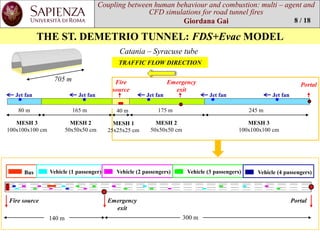
Coupling between human behaviourand combustion: multi –agent and CFD simulations for road tunnel fires 
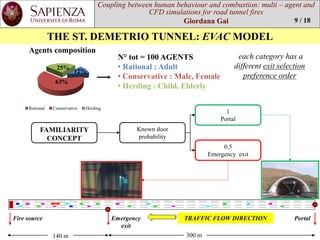
Giordana Gai 
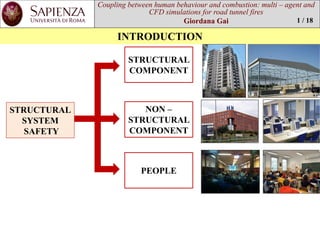
STRUCTURAL 
SYSTEM 
SAFETY 
NON – STRUCTURAL COMPONENT 
STRUCTURAL COMPONENT 
PEOPLE 
1 / 18 
INTRODUCTION
Coupling between human behaviourand combustion: multi –agent and CFD simulations for road tunnel fires 
Giordana Gai 
NON – STRUCTURAL COMPONENT 
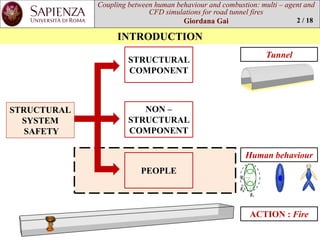
Tunnel 
INTRODUCTION 
Human behaviour 
2 / 18 
STRUCTURAL 
SYSTEM 
SAFETY 
STRUCTURAL COMPONENT 
PEOPLE 
ACTION : Fire
Coupling between human behaviourand combustion: multi –agent and CFD simulations for road tunnel fires 
Giordana Gai 
INTRODUCTION 
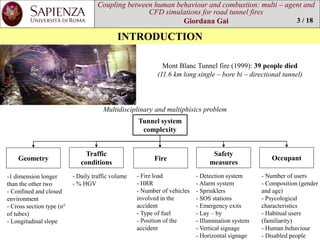
Mont BlancTunnel fire(1999): 39 people died 
(11.6 km long single –bore bi –directionaltunnel) 
3 / 18 
Tunnel system complexity 
Fire 
Trafficconditions 
Geometry 
Safetymeasures 
Occupant 
-1 dimensionlongerthanthe othertwo 
-Confinedand closedenvironment 
-Cross sectiontype(n° oftubes) 
-Longitudinalslope 
-Dailytrafficvolume 
-% HGV 
-Detection system 
-Alarmsystem 
-Sprinklers 
-SOS stations 
-Emergencyexits 
-Lay–by 
-Illuminationsystem 
-Vertical signage 
-Horizontalsignage 
-Numberofusers 
-Composition(gender and age) 
-Psycologicalcharacteristics 
-Habitualusers(familiarity) 
-Humanbehaviour 
-Disabledpeople 
-Fireload 
-HRR 
-Numberofvehiclesinvolvedin the accident 
-Typeoffuel 
-Position ofthe accident 
Multidisciplinaryand multiphisicsproblem
Coupling between human behaviourand combustion: multi –agent and CFD simulations for road tunnel fires 
Giordana Gai 
Spatialaspects 
1D -aspects 
Temporalaspects 
Codeand computationalcost 
RANS 
ReynoldsAverageNavierStokes 
ANSYS FLUENT 
20 cm –mesh 
8 hoursofsimulation 
LES 
LargeEddy Simulation 
FDS 
20 cm –mesh 
1hourofsimulation 
0 
1 
2 
3 
4 
5 
6 
7 
8 
9 
10 
0 
200 
400 
Y [m] 
Temperature [°C] 
0 
1 
2 
3 
4 
5 
6 
7 
8 
9 
10 
0 
200 
400 
Y [m] 
Temperature [°C] 
0 
50 
100 
150 
200 
250 
300 
0 
5 
10 
15 
20 
Temperature [°C] 
Time [s] 
0 
50 
100 
150 
200 
250 
300 
0 
5 
10 
15 
20 
Temperature [°C] 
Time [s] 
+ Evac 
COMPUTATIONAL FLUID DYNAMICS 
4 / 18
ClassicalApproach 
LPHCActions 
Low ProbabilityHigh Consequences 
Normative 
•Structuraland unstructuralpermanentload 
•Antropicload 
•Snow, wind, seismicaction 
Combination(ULS) G1G1+G2G2+PP+Q1Qk1+ 
+Q202Qk2+… 
Combination(SLS) 
G1+G2+P+11Qk1+22Qk2+… 
A –Firecharacteristicsandsafetymeasures 
•Positionofthe accident 
•Fireload(HRR) 
•Ventilationconditions 
•Presenceand position ofsafetymeasures(by–passes, signage, illumination, sprinklers, detection systems, etc) 
B –Trafficcharacteristics 
•Trafficflow conditions 
•PresenceofHGV 
C –People 
•Numberofpeople 
•People composition(physicsand psycologicalcharacteristics) 
•Humanbehaviour 
•Panicand familiaritywiththe structure 
•Presenceofdisabledpeople 
ANAS Circular2009 (basedon D.Lgs264/2006 and Directive2004/54/EC) 
Coupling between human behaviourand combustion: multi –agent and CFD simulations for road tunnel fires 
Giordana Gai 
SCENARIO –BASED APPROACH 
5 / 18 
Fixeddata 
Variablesdata 
Scenarioanalysisisaprocessofanalyzingpossiblefutureeventsbyconsideringalternativepossibleoutcomes,includingthedevelopmentpathsleadingtothem.
Coupling between human behaviourand combustion: multi –agent and CFD simulations for road tunnel fires 
Giordana Gai 
HUMAN BEHAVIOURAL MODEL 
6 / 18 
PEOPLE INSIDE THE TUNNEL 
Situation 
Ideal (theoretical) 
Real 
Tunnel environmentand itsinfrastructures 
Complete knowledge 
Partialknowledge 
Psycologicalfeelings 
No fear 
Panic 
Behaviour 
Perfectlyrational 
Imperfectlyrational 
Forexample, failurein usingthe safetyequipment 
Forexample, uncorrectexitdoorselection 
FDS + Evac 
Partiallybehaviouralmodel 
•Movementalgorithm 
•Social force 
•Panicmodel 
•Reducedvisibilityforsmokeand obstacles 
•Reducedvelocityforsmoke, incapacitationand death 
•FractionalEffectiveDose concept 
•Tendencytoactindependentlyor toformgroup 
•5 categoriesofhumanswithdifferentphysicalcharacteristics 
•3 behaviouraltype(rational, conservative, herding)
Coupling between human behaviourand combustion: multi –agent and CFD simulations for road tunnel fires 
Giordana Gai 
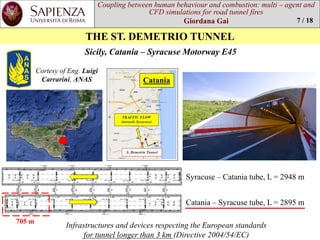
Sicily, Catania –Syracuse Motorway E45 
THE ST. DEMETRIO TUNNEL 
7 / 18 
Syracuse–Cataniatube,L=2948m 
Infrastructures and devices respecting the European standards 
for tunnel longer than 3 km (Directive 2004/54/EC) 
Catania 
Cortesyof Eng. Luigi Carrarini, ANAS 
Catania–Syracusetube,L=2895m 
705 m
Coupling between human behaviourand combustion: multi –agent and CFD simulations for road tunnel fires 
Giordana Gai 
40 m 
165 m 
175 m 
245 m 
80 m 
MESH 1 
25x25x25 cm 
MESH 2 
50x50x50 cm 
MESH 2 
50x50x50 cm 
MESH 3 
100x100x100 cm 
Jet fan 
Jet fan 
Jet fan 
Jet fan 
Jet fan 
Emergency exit 
Portal 
Fire source 
TRAFFIC FLOW DIRECTION 
MESH 3 
100x100x100 cm 
Catania –Syracuse tube 
THE ST. DEMETRIO TUNNEL: FDS+EvacMODEL 
8 / 18 
Emergency exit 
Portal 
140 m 
300 m 
Bus 
Vehicle (1 passenger) 
Vehicle (2 passengers) 
Vehicle (3 passengers) 
Vehicle (4 passengers) 
Fire source 
705 m
Coupling between human behaviourand combustion: multi –agent and CFD simulations for road tunnel fires 
Giordana Gai 
12% 
63% 
25% 
Agents composition 
Rational 
Conservative 
Herding 
N°tot = 100 AGENTS 
•Rational : Adult 
•Conservative : Male, Female 
•Herding : Child, Elderly 
each category has a different exit selection preference order 
THE ST. DEMETRIO TUNNEL: EVACMODEL 
9 / 18 
FAMILIARITY CONCEPT 
Knowndoorprobability 
1 
Portal 
0.5 
Emergencyexit 
Emergency exit 
Portal 
140 m 
300 m 
Fire source 
TRAFFIC FLOW DIRECTION
Coupling between human behaviourand combustion: multi –agent and CFD simulations for road tunnel fires 
Giordana Gai 
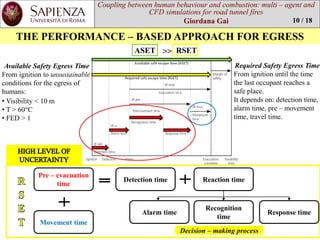
ASET 
AvailableSafetyEgressTime 
Fromignitiontounsustainableconditionsforthe egressofhumans: 
RequiredSafetyEgressTime 
Fromignitionuntil the time the last occupant reaches a safe place. 
It depends on: detection time, alarmtime, pre–movementtime, traveltime. 
THE PERFORMANCE –BASED APPROACH FOR EGRESS 
•Visibility< 10 m 
•T > 60°C 
•FED > 1 
Pre–evacuationtime 
Detection time 
Reactiontime 
Alarmtime 
Recognitiontime 
Responsetime 
Decision–makingprocess 
Movementtime 
RSET 
>> 
10 / 18
Coupling between human behaviourand combustion: multi –agent and CFD simulations for road tunnel fires 
Giordana Gai 
0 
20 
40 
CAR 2 LL - CAR 1 RL 
CAR 4 LL - CAR 3 RL 
CAR 6 LL - CAR 5 RL 
CAR 8 LL - BUS RL 
CAR 10 LL - CAR 7 RL 
CAR 13 LL - CAR 9 RL 
CAR 15 LL - CAR 11 RL 
CAR 16 LL - CAR 12 RL 
CAR 18 LL - CAR 14 RL 
CAR 22 LL - CAR 19 RL 
CAR 20 RL 
CAR 21 RL 
Time [s] 
Formationofthe queueinside the tunnel 
Left lane (LL) 
Right lane (RL) 
THE ST. DEMETRIO TUNNEL: EVACMODEL 
0 
0.005 
0.01 
0.015 
0.02 
0.025 
0.03 
0.035 
0.04 
0.045 
250 
275 
300 
325 
350 
Probability distribution 
Time [s] 
Pre -evacuation time distribution 
Normal distribution 
Truncated normaldistribution 
ANAS ReferenceTime 
ProbabilisticApproach 
DeterministicApproach 
11 / 18
Coupling between human behaviourand combustion: multi –agent and CFD simulations for road tunnel fires 
Giordana Gai 
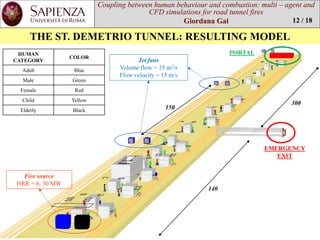
Fire source 
HRR = 6, 30 MW 
Jet fans 
Volume flow = 15 m3/s 
Flow velocity = 15 m/sEMERGENCY EXIT 
PORTAL 
THE ST. DEMETRIO TUNNEL: RESULTING MODEL 
12 / 18 
HUMAN CATEGORY 
COLOR 
Adult 
Blue 
Male 
Green 
Female 
Red 
Child 
Yellow 
Elderly 
Black 
140 
300 
150
Coupling between human behaviourand combustion: multi –agent and CFD simulations for road tunnel fires 
Giordana Gai 
0 
5 
10 
15 
20 
25 
30 
35 
0 
1000 
2000 
3000 
Time [s] 
HRR [MW] 
SCENARIOS 
13 / 18 
Jet fans 
1 Jet fan 
Emergencyexit 
Emergencyexit 
BUS FIRE 
(30 MW) 
2 –CARS FIRE 
(6 MW) 
•Idealbehaviour 
•Realbehaviour 
0 
5 
10 
15 
20 
25 
30 
35 
0 
1000 
2000 
3000 
Time [s] 
HRR [MW] 
Emergencyexit 
Emergencyexit 
•Realbehaviour
Coupling between human behaviourand combustion: multi –agent and CFD simulations for road tunnel fires 
Giordana Gai 
RESULTS (6 MW –fire) 
14 / 18 
0 
20 
40 
60 
80 
100 
0 
500 
1000 
N°agents 
Time [s] 
Ideal egress 
Emergency exit 
Portal 
Total evacuated agents 
0 
20 
40 
60 
80 
100 
0 
500 
1000 
N°agents 
Time [s] 
Real Egress 
Emergency exit 
Portal 
Total evacuated agentsRATIONAL BEHAVIOUR 
PANIC 
Ideal egress 
Real egress 
0 
20 
40 
60 
80 
100 
Emergency exit 
Portal 
90 
10 
51 
49 
Number of agents 
Ideal egress 
Real egress 
0 
20 
40 
60 
80 
100 
0 
200 
400 
600 
800 
1000 
Number of evacuated agents 
Time [s] 
Ideal 
Real
Coupling between human behaviourand combustion: multi –agent and CFD simulations for road tunnel fires 
Giordana Gai 
RESULTS (6 MW –fire) 
0 
10 
20 
30 
40 
50 
60 
70 
80 
90 
100 
0 
200 
400 
600 
800 
1000 
1200 
Number of evacuated agents 
Time [s] 
15 / 18 
0 
200 
400 
600 
800 
1000 
1200 
1,011.0 
939.0 
1,120.0 
1,125.0 
RSET[s] 
Yes Jet Fan - Yes Em. Exit 
No Jet Fan - Yes Em. Exit 
Yes Jet Fan - No Em. Exit 
No Jet Fan - No Em. Exit 
Jet Fans 
1 Jet Fan 
EmergencyExit 
EmergencyExit 
2 –CARS FIRE 
(6 MW) 
Jet Fans 
Em. Exit 
1 Jet Fan 
Em. Exit 
Jet Fans 
Em. Exit 
1 Jet Fan 
Em. Exit 
EmergencyExit 
EmergencyExit
Coupling between human behaviourand combustion: multi –agent and CFD simulations for road tunnel fires 
Giordana Gai 
Human _ speed [m/s]*10-4 
STREAKS 
t = 593 s 
t = 390 s 
Portal 
Emergency exit 
RESULTS (6 MW –fire) 
16 / 18 
Thisisnotageneralresult: FDS+EvacshouldberunusingMonteCarlomethod(repeatedsamplingtodeterminethepropertiesofthephenomenon). 
ThisisonlyonesamplingoftheMonteCarlosimulation.
Coupling between human behaviourand combustion: multi –agent and CFD simulations for road tunnel fires 
Giordana Gai 
RESULTS (6 MW –fire) 
17 / 18 
•Visibility _ soot [m] at z = 1.6 m 
high visibility upstream the fire source during the egress time 
ASET >> RSET considered scenario 
•Humans FED 10-5 
very low value, even for those scenarios with 1 jet fan off (emergency ventilation is so strong that there are no problems of intoxication) 
•Temperature slice [°C] 
low value (< 60°C) next to the emergency exit
Coupling between human behaviourand combustion: multi –agent and CFD simulations for road tunnel fires 
Giordana Gai 
CONCLUSIONS 
18 / 18 
•TheFDS+Evaccodeisagoodtoolfortheassessmentoftheemergencyegressforroadtunnelfires:fireandsmokeinfluencehumanmotionandtheireffectsimplydifferentchoicesoftheescaperoute,intoxication(untilthedeath)andreductionofthewalkingvelocity. 
•ThepossibilityofusingnumericalsimulationsforegressscenariosisfundamentalfortheSafetyEngineering,becauseitispossibletoverifytheefficiencyoftheescaperoutesofmanydifferenttypesofbuilding(civilbuilding,stadium,tunnel,etc)bycontrollingthemaximumcontactforcedevelopedbetweenhumansandthemostproblematicstreaksnexttotheexits. 
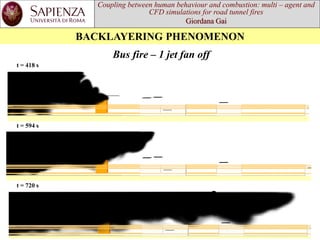
•ForwhatconcernstheS.Demetriotunnel,theresultsoftheanalysisaresatisfactory:forthescenariosexaminedtheemergencyegressiscompletein15–20minutes,withoutproblemsofvisibilityorintoxication.Thebacklayeringphenomenonoccursonlyforthebusfirewith1jetfanoff,butithappenswhenhumanshavealreadygoneout.
THE END 
V –velocity field 
0 
20 
40 
60 
80 
100 
0 
200 
400 
600 
800 
1000 
1200 
Number of evacuated agents 
Time [s] 
Egress_ 6 MW fire 
Ideal and Rational 
Yes Jet Fan - Yes Em. Exit 
No Jet Fan - Yes Em. Exit 
Yes Jen Fan - No Em. Exit 
No Jet Fan - No Em. Exit 
12% 
63% 
25% 
Agents composition 
Rational 
Conservative 
Herding 
Coupling between human behaviourand combustion: multi –agent and CFD simulations for road tunnel fires 
Giordana Gai
Coupling between human behaviourand combustion: multi –agent and CFD simulations for road tunnel firesGiordana Gai 
BACKLAYERING PHENOMENON 
Bus fire–1 jet fan off 
t = 418 s 
t = 594 s 
t = 720 s
Coupling between human behaviourand combustion: multi –agent and CFD simulations for road tunnel firesGiordana Gai 
Human _ force total [N/m] 
t = 300 s 
t = 360 s 
t = 327 s
Coupling between human behaviourand combustion: multi –agent and CFD simulations for road tunnel firesGiordana Gai 
RESULTS (6 MW –fire) 
Human _ force total [N/m] 
Block in the bus

Coupling between human behaviour and combustion

  • 1.
    Coupling between humanbehaviourand combustion: multi –agent and CFD simulations for road tunnel fires Candidata: Giordana Gai Relatore: Prof. Ing. Franco Bontempi Correlatore: Ing. Filippo Gentili Facoltàdi Ingegneria Civile e Industriale Corso di laurea magistrale in Ingegneria Civile
  • 2.
    Coupling between humanbehaviourand combustion: multi –agent and CFD simulations for road tunnel fires Giordana Gai STRUCTURAL SYSTEM SAFETY NON – STRUCTURAL COMPONENT STRUCTURAL COMPONENT PEOPLE 1 / 18 INTRODUCTION
  • 3.
    Coupling between humanbehaviourand combustion: multi –agent and CFD simulations for road tunnel fires Giordana Gai NON – STRUCTURAL COMPONENT Tunnel INTRODUCTION Human behaviour 2 / 18 STRUCTURAL SYSTEM SAFETY STRUCTURAL COMPONENT PEOPLE ACTION : Fire
  • 4.
    Coupling between humanbehaviourand combustion: multi –agent and CFD simulations for road tunnel fires Giordana Gai INTRODUCTION Mont BlancTunnel fire(1999): 39 people died (11.6 km long single –bore bi –directionaltunnel) 3 / 18 Tunnel system complexity Fire Trafficconditions Geometry Safetymeasures Occupant -1 dimensionlongerthanthe othertwo -Confinedand closedenvironment -Cross sectiontype(n° oftubes) -Longitudinalslope -Dailytrafficvolume -% HGV -Detection system -Alarmsystem -Sprinklers -SOS stations -Emergencyexits -Lay–by -Illuminationsystem -Vertical signage -Horizontalsignage -Numberofusers -Composition(gender and age) -Psycologicalcharacteristics -Habitualusers(familiarity) -Humanbehaviour -Disabledpeople -Fireload -HRR -Numberofvehiclesinvolvedin the accident -Typeoffuel -Position ofthe accident Multidisciplinaryand multiphisicsproblem
  • 5.
    Coupling between humanbehaviourand combustion: multi –agent and CFD simulations for road tunnel fires Giordana Gai Spatialaspects 1D -aspects Temporalaspects Codeand computationalcost RANS ReynoldsAverageNavierStokes ANSYS FLUENT 20 cm –mesh 8 hoursofsimulation LES LargeEddy Simulation FDS 20 cm –mesh 1hourofsimulation 0 1 2 3 4 5 6 7 8 9 10 0 200 400 Y [m] Temperature [°C] 0 1 2 3 4 5 6 7 8 9 10 0 200 400 Y [m] Temperature [°C] 0 50 100 150 200 250 300 0 5 10 15 20 Temperature [°C] Time [s] 0 50 100 150 200 250 300 0 5 10 15 20 Temperature [°C] Time [s] + Evac COMPUTATIONAL FLUID DYNAMICS 4 / 18
  • 6.
    ClassicalApproach LPHCActions LowProbabilityHigh Consequences Normative •Structuraland unstructuralpermanentload •Antropicload •Snow, wind, seismicaction Combination(ULS) G1G1+G2G2+PP+Q1Qk1+ +Q202Qk2+… Combination(SLS) G1+G2+P+11Qk1+22Qk2+… A –Firecharacteristicsandsafetymeasures •Positionofthe accident •Fireload(HRR) •Ventilationconditions •Presenceand position ofsafetymeasures(by–passes, signage, illumination, sprinklers, detection systems, etc) B –Trafficcharacteristics •Trafficflow conditions •PresenceofHGV C –People •Numberofpeople •People composition(physicsand psycologicalcharacteristics) •Humanbehaviour •Panicand familiaritywiththe structure •Presenceofdisabledpeople ANAS Circular2009 (basedon D.Lgs264/2006 and Directive2004/54/EC) Coupling between human behaviourand combustion: multi –agent and CFD simulations for road tunnel fires Giordana Gai SCENARIO –BASED APPROACH 5 / 18 Fixeddata Variablesdata Scenarioanalysisisaprocessofanalyzingpossiblefutureeventsbyconsideringalternativepossibleoutcomes,includingthedevelopmentpathsleadingtothem.
  • 7.
    Coupling between humanbehaviourand combustion: multi –agent and CFD simulations for road tunnel fires Giordana Gai HUMAN BEHAVIOURAL MODEL 6 / 18 PEOPLE INSIDE THE TUNNEL Situation Ideal (theoretical) Real Tunnel environmentand itsinfrastructures Complete knowledge Partialknowledge Psycologicalfeelings No fear Panic Behaviour Perfectlyrational Imperfectlyrational Forexample, failurein usingthe safetyequipment Forexample, uncorrectexitdoorselection FDS + Evac Partiallybehaviouralmodel •Movementalgorithm •Social force •Panicmodel •Reducedvisibilityforsmokeand obstacles •Reducedvelocityforsmoke, incapacitationand death •FractionalEffectiveDose concept •Tendencytoactindependentlyor toformgroup •5 categoriesofhumanswithdifferentphysicalcharacteristics •3 behaviouraltype(rational, conservative, herding)
  • 8.
    Coupling between humanbehaviourand combustion: multi –agent and CFD simulations for road tunnel fires Giordana Gai Sicily, Catania –Syracuse Motorway E45 THE ST. DEMETRIO TUNNEL 7 / 18 Syracuse–Cataniatube,L=2948m Infrastructures and devices respecting the European standards for tunnel longer than 3 km (Directive 2004/54/EC) Catania Cortesyof Eng. Luigi Carrarini, ANAS Catania–Syracusetube,L=2895m 705 m
  • 9.
    Coupling between humanbehaviourand combustion: multi –agent and CFD simulations for road tunnel fires Giordana Gai 40 m 165 m 175 m 245 m 80 m MESH 1 25x25x25 cm MESH 2 50x50x50 cm MESH 2 50x50x50 cm MESH 3 100x100x100 cm Jet fan Jet fan Jet fan Jet fan Jet fan Emergency exit Portal Fire source TRAFFIC FLOW DIRECTION MESH 3 100x100x100 cm Catania –Syracuse tube THE ST. DEMETRIO TUNNEL: FDS+EvacMODEL 8 / 18 Emergency exit Portal 140 m 300 m Bus Vehicle (1 passenger) Vehicle (2 passengers) Vehicle (3 passengers) Vehicle (4 passengers) Fire source 705 m
  • 10.
    Coupling between humanbehaviourand combustion: multi –agent and CFD simulations for road tunnel fires Giordana Gai 12% 63% 25% Agents composition Rational Conservative Herding N°tot = 100 AGENTS •Rational : Adult •Conservative : Male, Female •Herding : Child, Elderly each category has a different exit selection preference order THE ST. DEMETRIO TUNNEL: EVACMODEL 9 / 18 FAMILIARITY CONCEPT Knowndoorprobability 1 Portal 0.5 Emergencyexit Emergency exit Portal 140 m 300 m Fire source TRAFFIC FLOW DIRECTION
  • 11.
    Coupling between humanbehaviourand combustion: multi –agent and CFD simulations for road tunnel fires Giordana Gai ASET AvailableSafetyEgressTime Fromignitiontounsustainableconditionsforthe egressofhumans: RequiredSafetyEgressTime Fromignitionuntil the time the last occupant reaches a safe place. It depends on: detection time, alarmtime, pre–movementtime, traveltime. THE PERFORMANCE –BASED APPROACH FOR EGRESS •Visibility< 10 m •T > 60°C •FED > 1 Pre–evacuationtime Detection time Reactiontime Alarmtime Recognitiontime Responsetime Decision–makingprocess Movementtime RSET >> 10 / 18
  • 12.
    Coupling between humanbehaviourand combustion: multi –agent and CFD simulations for road tunnel fires Giordana Gai 0 20 40 CAR 2 LL - CAR 1 RL CAR 4 LL - CAR 3 RL CAR 6 LL - CAR 5 RL CAR 8 LL - BUS RL CAR 10 LL - CAR 7 RL CAR 13 LL - CAR 9 RL CAR 15 LL - CAR 11 RL CAR 16 LL - CAR 12 RL CAR 18 LL - CAR 14 RL CAR 22 LL - CAR 19 RL CAR 20 RL CAR 21 RL Time [s] Formationofthe queueinside the tunnel Left lane (LL) Right lane (RL) THE ST. DEMETRIO TUNNEL: EVACMODEL 0 0.005 0.01 0.015 0.02 0.025 0.03 0.035 0.04 0.045 250 275 300 325 350 Probability distribution Time [s] Pre -evacuation time distribution Normal distribution Truncated normaldistribution ANAS ReferenceTime ProbabilisticApproach DeterministicApproach 11 / 18
  • 13.
    Coupling between humanbehaviourand combustion: multi –agent and CFD simulations for road tunnel fires Giordana Gai Fire source HRR = 6, 30 MW Jet fans Volume flow = 15 m3/s Flow velocity = 15 m/sEMERGENCY EXIT PORTAL THE ST. DEMETRIO TUNNEL: RESULTING MODEL 12 / 18 HUMAN CATEGORY COLOR Adult Blue Male Green Female Red Child Yellow Elderly Black 140 300 150
  • 14.
    Coupling between humanbehaviourand combustion: multi –agent and CFD simulations for road tunnel fires Giordana Gai 0 5 10 15 20 25 30 35 0 1000 2000 3000 Time [s] HRR [MW] SCENARIOS 13 / 18 Jet fans 1 Jet fan Emergencyexit Emergencyexit BUS FIRE (30 MW) 2 –CARS FIRE (6 MW) •Idealbehaviour •Realbehaviour 0 5 10 15 20 25 30 35 0 1000 2000 3000 Time [s] HRR [MW] Emergencyexit Emergencyexit •Realbehaviour
  • 15.
    Coupling between humanbehaviourand combustion: multi –agent and CFD simulations for road tunnel fires Giordana Gai RESULTS (6 MW –fire) 14 / 18 0 20 40 60 80 100 0 500 1000 N°agents Time [s] Ideal egress Emergency exit Portal Total evacuated agents 0 20 40 60 80 100 0 500 1000 N°agents Time [s] Real Egress Emergency exit Portal Total evacuated agentsRATIONAL BEHAVIOUR PANIC Ideal egress Real egress 0 20 40 60 80 100 Emergency exit Portal 90 10 51 49 Number of agents Ideal egress Real egress 0 20 40 60 80 100 0 200 400 600 800 1000 Number of evacuated agents Time [s] Ideal Real
  • 16.
    Coupling between humanbehaviourand combustion: multi –agent and CFD simulations for road tunnel fires Giordana Gai RESULTS (6 MW –fire) 0 10 20 30 40 50 60 70 80 90 100 0 200 400 600 800 1000 1200 Number of evacuated agents Time [s] 15 / 18 0 200 400 600 800 1000 1200 1,011.0 939.0 1,120.0 1,125.0 RSET[s] Yes Jet Fan - Yes Em. Exit No Jet Fan - Yes Em. Exit Yes Jet Fan - No Em. Exit No Jet Fan - No Em. Exit Jet Fans 1 Jet Fan EmergencyExit EmergencyExit 2 –CARS FIRE (6 MW) Jet Fans Em. Exit 1 Jet Fan Em. Exit Jet Fans Em. Exit 1 Jet Fan Em. Exit EmergencyExit EmergencyExit
  • 17.
    Coupling between humanbehaviourand combustion: multi –agent and CFD simulations for road tunnel fires Giordana Gai Human _ speed [m/s]*10-4 STREAKS t = 593 s t = 390 s Portal Emergency exit RESULTS (6 MW –fire) 16 / 18 Thisisnotageneralresult: FDS+EvacshouldberunusingMonteCarlomethod(repeatedsamplingtodeterminethepropertiesofthephenomenon). ThisisonlyonesamplingoftheMonteCarlosimulation.
  • 18.
    Coupling between humanbehaviourand combustion: multi –agent and CFD simulations for road tunnel fires Giordana Gai RESULTS (6 MW –fire) 17 / 18 •Visibility _ soot [m] at z = 1.6 m high visibility upstream the fire source during the egress time ASET >> RSET considered scenario •Humans FED 10-5 very low value, even for those scenarios with 1 jet fan off (emergency ventilation is so strong that there are no problems of intoxication) •Temperature slice [°C] low value (< 60°C) next to the emergency exit
  • 19.
    Coupling between humanbehaviourand combustion: multi –agent and CFD simulations for road tunnel fires Giordana Gai CONCLUSIONS 18 / 18 •TheFDS+Evaccodeisagoodtoolfortheassessmentoftheemergencyegressforroadtunnelfires:fireandsmokeinfluencehumanmotionandtheireffectsimplydifferentchoicesoftheescaperoute,intoxication(untilthedeath)andreductionofthewalkingvelocity. •ThepossibilityofusingnumericalsimulationsforegressscenariosisfundamentalfortheSafetyEngineering,becauseitispossibletoverifytheefficiencyoftheescaperoutesofmanydifferenttypesofbuilding(civilbuilding,stadium,tunnel,etc)bycontrollingthemaximumcontactforcedevelopedbetweenhumansandthemostproblematicstreaksnexttotheexits. •ForwhatconcernstheS.Demetriotunnel,theresultsoftheanalysisaresatisfactory:forthescenariosexaminedtheemergencyegressiscompletein15–20minutes,withoutproblemsofvisibilityorintoxication.Thebacklayeringphenomenonoccursonlyforthebusfirewith1jetfanoff,butithappenswhenhumanshavealreadygoneout.
  • 20.
    THE END V–velocity field 0 20 40 60 80 100 0 200 400 600 800 1000 1200 Number of evacuated agents Time [s] Egress_ 6 MW fire Ideal and Rational Yes Jet Fan - Yes Em. Exit No Jet Fan - Yes Em. Exit Yes Jen Fan - No Em. Exit No Jet Fan - No Em. Exit 12% 63% 25% Agents composition Rational Conservative Herding Coupling between human behaviourand combustion: multi –agent and CFD simulations for road tunnel fires Giordana Gai
  • 21.
    Coupling between humanbehaviourand combustion: multi –agent and CFD simulations for road tunnel firesGiordana Gai BACKLAYERING PHENOMENON Bus fire–1 jet fan off t = 418 s t = 594 s t = 720 s
  • 22.
    Coupling between humanbehaviourand combustion: multi –agent and CFD simulations for road tunnel firesGiordana Gai Human _ force total [N/m] t = 300 s t = 360 s t = 327 s
  • 23.
    Coupling between humanbehaviourand combustion: multi –agent and CFD simulations for road tunnel firesGiordana Gai RESULTS (6 MW –fire) Human _ force total [N/m] Block in the bus