Next Evolutionary Step
of a DB Scanner
Nelson Brito
Senior Security Architect & Advisor 
Introduction
Motivation
Microsoft SQL Server
VSAM and ESAM
Demonstration
Questions and Answers
Agenda
Introduction
Fingerprinting Services
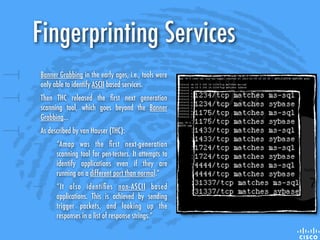
Banner Grabbing in the early ages, i.e., tools were
only able to identify ASCII based services.
Then THC released the first next generation
scanning tool, which goes beyond the Banner
Grabbing...
As described by van Hauser (THC):
“Amap was the first next-generation
scanning tool for pen-testers. It attempts to
identify applications even if they are
running on a different port than normal.”
“It also identifies non-ASCII based
applications. This is achieved by sending
trigger packets, and looking up the
responses in a list of response strings.”
Fingerprinting Services
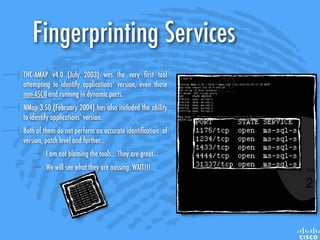
THC-AMAP v4.0 (July 2003) was the very first tool
attempting to identify applications’ version, even those
non-ASCII and running in dynamic ports.
NMap 3.50 (February 2004) has also included the ability
to identify applications’ version.
Both of them do not perform an accurate identification of
version, patch level and further...
I am not blaming the tools... They are great.
We will see what they are missing. WAIT!!!
Motivation
The [IN]s Problems
PCI-DSS
HIPAA
HITECH
Sarbanes-OxleyFISMA
ISO/IEC 27001ISO/IEC 15408
[Vulnerability|Port] Scanners target hosts instead of
the actual databases, i.e., they “usually” do not look
for database instances and/or do not report an
accurate version, as well as patch level.
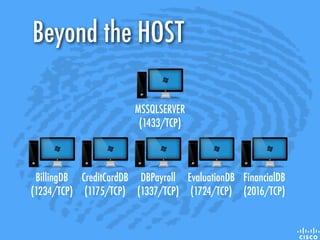
In the real world, one single host may have multiple
databases, with multiple instances, multiple versions
and multiple patch levels Database Scanners often require a valid and
privileged user account to perform such task.
Questions:
Does it work for a penetration test?
Does it work for an audit and
vulnerability assessment?
Would you ask DBA’s password to show
how lame he is?
[V|P|D] Scanners
ISO/IEC 27001
Sarbanes-Oxley
ISO/IEC 15408
FISMA
HITECH
PCI-DSS
HIPAA
[V|P|D] Scanners
MSSQLSERVER
Beyond the HOST
DBPayroll
(1337/TCP)
CreditCardDB
(1175/TCP)
BillingDB
(1234/TCP)
EvaluationDB
(1724/TCP)
FinancialDB
(2016/TCP)
MSSQLSERVER
(1433/TCP)
Beyond the HOST
Microsoft SQL Server version can be gathered
and fingerprinted using:
SQL Server Resolution Protocol (SSRP)
Tabular Data Stream Protocol (TDS)
NOTE: No authentication and valuable
information.
“SQL Server 2000 introduces the ability to host
multiple instances [...] the multiple instances cannot
all use the standard SQL Server session port. While the
default instance listens on TCP port 1433, named
instances listen on any port assigned to them.”
“The SQL Server Resolution Service [...] provides a
way for clients to query for the appropriate network
endpoints to use for a particular instance of SQL
Server.”
Microsoft SQL Server
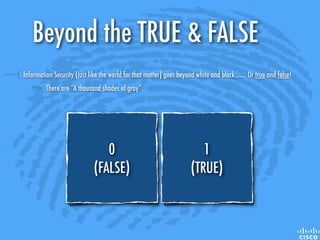
Information Security (just like the world for that matter) goes beyond white and black....... Or true and false!
There are “A thousand shades of gray”.
Beyond the TRUE & FALSE
1
(TRUE)
0
(FALSE)
Information Security (just like the world for that matter) goes beyond white and black....... Or true and false!
There are “A thousand shades of gray”.
Risk is not restricted to true and false.
100%0% 1% 2% [...] 98% 99%
Beyond the TRUE & FALSE
Microsoft SQL Server
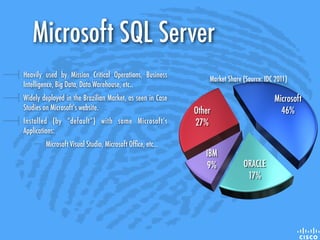
Heavily used by Mission Critical Operations, Business
Intelligence, Big Data, Data Warehouse, etc..
Widely deployed in the Brazilian Market, as seen in Case
Studies on Microsoft’s website.
Installed (by “default”) with some Microsoft’s
Applications:
Microsoft Visual Studio, Microsoft Office, etc...
Microsoft SQL Server
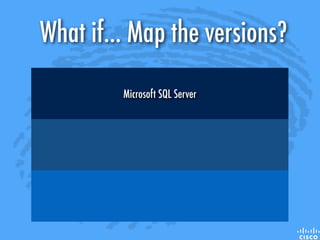
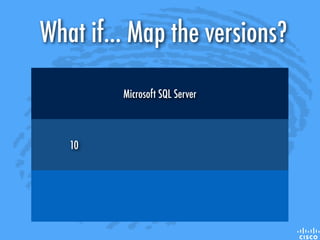
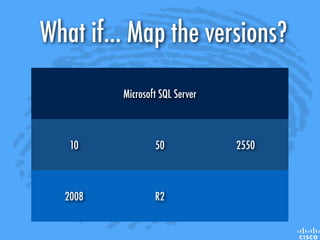
What if... Map the versions?
Microsoft SQL Server
10
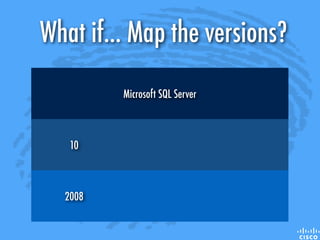
What if... Map the versions?
Microsoft SQL Server
10
2008
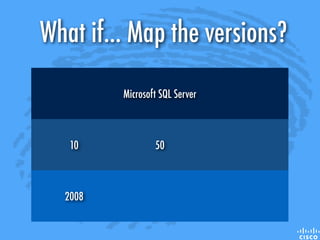
What if... Map the versions?
Microsoft SQL Server
10 50
2008
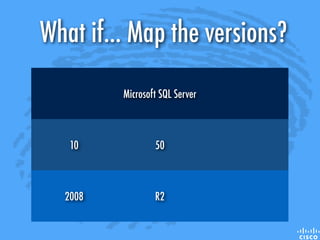
What if... Map the versions?
Microsoft SQL Server
10 50
2008 R2
What if... Map the versions?
Microsoft SQL Server
10 50 2550
2008 R2
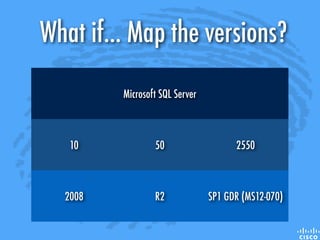
What if... Map the versions?
Microsoft SQL Server
10 50 2550
2008 R2 SP1 GDR (MS12-070)
What if... Map the versions?
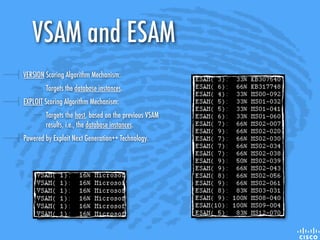
VSAM and ESAM
VERSION Scoring Algorithm Mechanism:
Targets the database instances.
EXPLOIT Scoring Algorithm Mechanism:
Targets the host, based on the previous VSAM
results, i.e., the database instances.
Powered by Exploit Next Generation++ Technology.
VSAM and ESAM
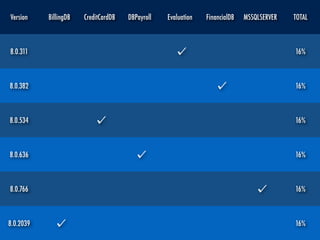
Version BillingDB CreditCardDB DBPayroll Evaluation FinancialDB MSSQLSERVER TOTAL
8.0.311 16%
8.0.382 16%
8.0.534 16%
8.0.636 16%
8.0.766 16%
8.0.2039 16%
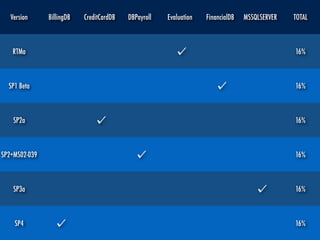
Version BillingDB CreditCardDB DBPayroll Evaluation FinancialDB MSSQLSERVER TOTAL
RTMa 16%
SP1 Beta 16%
SP2a 16%
SP2+MS02-039 16%
SP3a 16%
SP4 16%
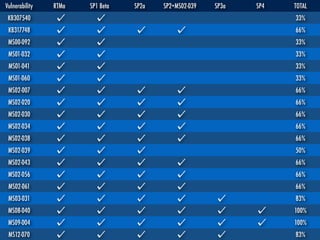
Vulnerability RTMa SP1 Beta SP2a SP2+MS02-039 SP3a SP4 TOTAL
KB307540 33%
KB317748 66%
MS00-092 33%
MS01-032 33%
MS01-041 33%
MS01-060 33%
MS02-007 66%
MS02-020 66%
MS02-030 66%
MS02-034 66%
MS02-038 66%
MS02-039 50%
MS02-043 66%
MS02-056 66%
MS02-061 66%
MS03-031 83%
MS08-040 100%
MS09-004 100%
MS12-070 83%
Vulnerability Evaluation FinancialDB CreditCardDB DBPayroll MSSQLSERVER BillingDB TOTAL
KB307540 33%
KB317748 66%
MS00-092 33%
MS01-032 33%
MS01-041 33%
MS01-060 33%
MS02-007 66%
MS02-020 66%
MS02-030 66%
MS02-034 66%
MS02-038 66%
MS02-039 50%
MS02-043 66%
MS02-056 66%
MS02-061 66%
MS03-031 83%
MS08-040 100%
MS09-004 100%
MS12-070 83%
Demonstration
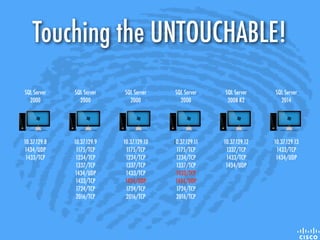
Touching the UNTOUCHABLE!
10.37.129.8
1434/UDP
1433/TCP
10.37.129.9
1175/TCP
1234/TCP
1337/TCP
1434/UDP
1433/TCP
1724/TCP
2016/TCP
10.37.129.10
1175/TCP
1234/TCP
1337/TCP
1433/TCP
1434/UDP
1724/TCP
2016/TCP
10.37.129.11
1175/TCP
1234/TCP
1337/TCP
1433/TCP
1434/UDP
1724/TCP
2016/TCP
10.37.129.12
1337/TCP
1433/TCP
1434/UDP
10.37.129.13
1433/TCP
1434/UDP
SQL Server
2000
SQL Server
2000
SQL Server
2000
SQL Server
2000
SQL Server
2008 R2
SQL Server
2014
Questions and Answers
Questions???
COUNTDOWN
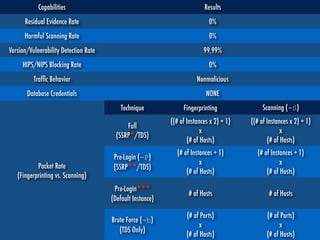
Capabilities Results
Residual Evidence Rate 0%
Harmful Scanning Rate 0%
Version/Vulnerability Detection Rate 99,99%
HIPS/NIPS Blocking Rate 0%
Traffic Behavior Nonmalicious
Database Credentials NONE
Packet Rate
(Fingerprinting vs. Scanning)
Technique Fingerprinting Scanning (-S)
Full
(SSRP*/TDS)
((# of Instances x 2) + 1)
x
(# of Hosts)
((# of Instances x 2) + 1)
x
(# of Hosts)
Pre-Login (-P)
(SSRP**/TDS)
(# of Instances + 1)
x
(# of Hosts)
(# of Instances + 1)
x
(# of Hosts)
Pre-Login***
(Default Instance)
# of Hosts # of Hosts
Brute Force (-b)
(TDS Only)
(# of Ports)
x
(# of Hosts)
(# of Ports)
x
(# of Hosts)
Thank you!
© 2016-2020, Nelson Brito. All rights reserved worldwide.
nbrito@cisco.com
https://gblogs.cisco.com/br/author/nelsonbrito/

Próximo passo evolutivo de um DB Scanner