Cooperation with the
Neighbouring Partner
Countries of the EU

 Youth Exchange

 European Voluntary Service
 Training and networking

1
Neighbouring Partner Countries:
• The countries of South East Europe (SEE):
Albania, Bosnia Herzegovina, Croatia, Former Yugoslav Republic
of Macedonia (FYROM), Kosovo, Serbia and Montenegro
• The countries of Eastern Europe and the Caucasus:
Armenia, Azerbaijan, Belarus, Georgia, Moldova, Russia, Ukraine

• The Mediterranean countries:
Algeria, Palestinian
Authority, Egypt, Israel, Jordan, Lebanon, Morocco, Syria, Tunisi
a.

2
Youth Exchanges
A meeting of people from differents countries around
a theme of common interest











Age: 13-25 years (possible 20% between 25 and 30)
Duration of meeting: 6 to 21 days (excluding travel)
Project duration: up to 15 months (including all phases of the project)
Participating partner countries: 2 and more
Number of young: minimum 16, max 60 - + 1 framing by country for 10 young
Theme: to select with the young participants and to decline in physical activities
Balance of groups: gender and nationality
Balance between geographical area, including at least one EU country
Preparation and follow-up: young people must take an active part in the
preparation, implementation, evaluation and enhancement of trade.
Funding: Planning Visit 100%, transportation costs, fixed price for preparation, plan for
activities, accommodation and food package ...

3
European Voluntary Service

Solidarity among young people
 Individual volunteer projects
 Group volunteer projects (up to 30
volunteers)
 Feeling citizen and to serve a project of
general interest

4
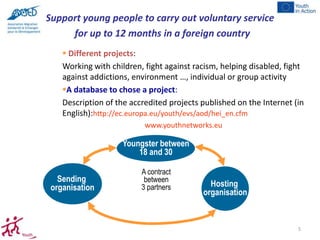
Support young people to carry out voluntary service
for up to 12 months in a foreign country
 Different projects:
Working with children, fight against racism, helping disabled, fight
against addictions, environment …, individual or group activity
A database to chose a project:
Description of the accredited projects published on the Internet (in
English):http://ec.europa.eu/youth/evs/aod/hei_en.cfm
www.youthnetworks.eu

Youngster between
18 and 30

Sending
organisation

A contract
between
3 partners

Hosting
organisation

5


Eligible participant: 18-30 (16-30 if YPWFO) + legally resident in the
country of the Sending Organisation



Duration of EVS: 2 months to 1 year (priority on projects over 6
months) / Exception : 2 weeks minimum for YPWFO and group EVS
activity involving at least 10 volunteers



Eligible countries: Program Countries + Neighbouring Partner countries
+ other Partner countries around the world



Choice of a host project: Contact with an accredited Sending
Organization (SO) published on the data base (Internet)

6
Training and networking

For youth workers and youth organizations
 Job shadowing
 Feasibility Visit
 Evaluation Meeting
 Study visit
 Partnership-Building Activity
 Seminar

 Training

7
1.Job Shadowing (Practical learning experience): A
short stay with a partner organisation in another country
with the aim of exchanging good practices, acquiring skills and
knowledge and/or building long-term partnerships
through participative observation.
2.Feasibility Visit: preparation of projects in a frame of Youth
in Action program or support the projects between partnership
organizations
3.Evaluation Meeting: with partners to evaluate and discuss
potential follow-up after undertaking a common

8
4.Study visit: understanding of the realities of youth work
in a European country
5. Partnership-Building Activity : allow participants to
find partners for transnational co-operation and/or for
project development and facilitates the development of new
projects around a chosen topic and/or an Action of the Youth
in Action Programme.
6. Seminar : An event organised to provide a platform
for discussion and exchange of good practice, based on
theoretical inputs, around a chosen theme or themes which
are relevant to the youth work field.

9
7.Training Course: An educational learning program on
specific topics, aiming to improve participants’
competences, knowledge, skills and attitudes. Training
courses lead to higher quality practice in youth work in
general and/or, specifically, Youth in Action projects.

10
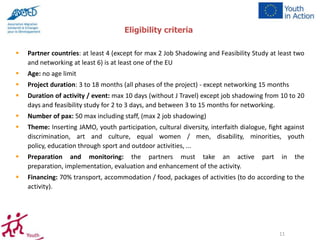
Eligibility criteria


Partner countries: at least 4 (except for max 2 Job Shadowing and Feasibility Study at least two
and networking at least 6) is at least one of the EU



Age: no age limit



Project duration: 3 to 18 months (all phases of the project) - except networking 15 months



Duration of activity / event: max 10 days (without J Travel) except job shadowing from 10 to 20
days and feasibility study for 2 to 3 days, and between 3 to 15 months for networking.



Number of pax: 50 max including staff, (max 2 job shadowing)



Theme: Inserting JAMO, youth participation, cultural diversity, interfaith dialogue, fight against
discrimination, art and culture, equal women / men, disability, minorities, youth
policy, education through sport and outdoor activities, ...



Preparation and monitoring: the partners must take an active
preparation, implementation, evaluation and enhancement of the activity.



Financing: 70% transport, accommodation / food, packages of activities (to do according to the
activity).

part

in

11

the
How to apply ?
•

•

•

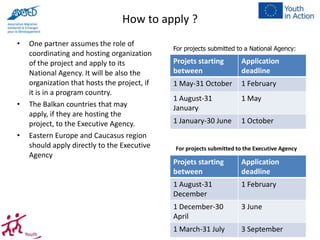
One partner assumes the role of
coordinating and hosting organization
of the project and apply to its
National Agency. It will be also the
organization that hosts the project, if
it is in a program country.
The Balkan countries that may
apply, if they are hosting the
project, to the Executive Agency.
Eastern Europe and Caucasus region
should apply directly to the Executive
Agency

For projects submitted to a National Agency:

Projets starting
between

Application
deadline

1 May-31 October

1 February

1 August-31
January

1 May

1 January-30 June

1 October

For projects submitted to the Executive Agency

Projets starting
between

Application
deadline

1 August-31
December

1 February

1 December-30
April

3 June

1 March-31 July

3 September
For more information, download the
documents, useful links…


The guide of the program (all languages):http://ec.europa.eu/youth/youthin-action-programme/doc443_en.htm



The site of the national agencies Youth in Action (documents ...)
http://ec.europa.eu/youth/youth/doc152_en.htm#sectNAS
The site of the Executive Agency:
http://eacea.ec.europa.eu/youth/index_en.php

 The European Youth Portal:http://europa.eu/youth/
 TheCenters Resources SALTO:www.salto-youth.net
 Educational tools developed with the Council of Europe:
http://youth-partnership-eu.coe.int/youth-partnership/publications/T-kits/T_kits

13

Presentation of Youth in Action Programme

  • 1.
    Cooperation with the NeighbouringPartner Countries of the EU  Youth Exchange  European Voluntary Service  Training and networking 1
  • 2.
    Neighbouring Partner Countries: •The countries of South East Europe (SEE): Albania, Bosnia Herzegovina, Croatia, Former Yugoslav Republic of Macedonia (FYROM), Kosovo, Serbia and Montenegro • The countries of Eastern Europe and the Caucasus: Armenia, Azerbaijan, Belarus, Georgia, Moldova, Russia, Ukraine • The Mediterranean countries: Algeria, Palestinian Authority, Egypt, Israel, Jordan, Lebanon, Morocco, Syria, Tunisi a. 2
  • 3.
    Youth Exchanges A meetingof people from differents countries around a theme of common interest           Age: 13-25 years (possible 20% between 25 and 30) Duration of meeting: 6 to 21 days (excluding travel) Project duration: up to 15 months (including all phases of the project) Participating partner countries: 2 and more Number of young: minimum 16, max 60 - + 1 framing by country for 10 young Theme: to select with the young participants and to decline in physical activities Balance of groups: gender and nationality Balance between geographical area, including at least one EU country Preparation and follow-up: young people must take an active part in the preparation, implementation, evaluation and enhancement of trade. Funding: Planning Visit 100%, transportation costs, fixed price for preparation, plan for activities, accommodation and food package ... 3
  • 4.
    European Voluntary Service Solidarityamong young people  Individual volunteer projects  Group volunteer projects (up to 30 volunteers)  Feeling citizen and to serve a project of general interest 4
  • 5.
    Support young peopleto carry out voluntary service for up to 12 months in a foreign country  Different projects: Working with children, fight against racism, helping disabled, fight against addictions, environment …, individual or group activity A database to chose a project: Description of the accredited projects published on the Internet (in English):http://ec.europa.eu/youth/evs/aod/hei_en.cfm www.youthnetworks.eu Youngster between 18 and 30 Sending organisation A contract between 3 partners Hosting organisation 5
  • 6.
     Eligible participant: 18-30(16-30 if YPWFO) + legally resident in the country of the Sending Organisation  Duration of EVS: 2 months to 1 year (priority on projects over 6 months) / Exception : 2 weeks minimum for YPWFO and group EVS activity involving at least 10 volunteers  Eligible countries: Program Countries + Neighbouring Partner countries + other Partner countries around the world  Choice of a host project: Contact with an accredited Sending Organization (SO) published on the data base (Internet) 6
  • 7.
    Training and networking Foryouth workers and youth organizations  Job shadowing  Feasibility Visit  Evaluation Meeting  Study visit  Partnership-Building Activity  Seminar  Training 7
  • 8.
    1.Job Shadowing (Practicallearning experience): A short stay with a partner organisation in another country with the aim of exchanging good practices, acquiring skills and knowledge and/or building long-term partnerships through participative observation. 2.Feasibility Visit: preparation of projects in a frame of Youth in Action program or support the projects between partnership organizations 3.Evaluation Meeting: with partners to evaluate and discuss potential follow-up after undertaking a common 8
  • 9.
    4.Study visit: understandingof the realities of youth work in a European country 5. Partnership-Building Activity : allow participants to find partners for transnational co-operation and/or for project development and facilitates the development of new projects around a chosen topic and/or an Action of the Youth in Action Programme. 6. Seminar : An event organised to provide a platform for discussion and exchange of good practice, based on theoretical inputs, around a chosen theme or themes which are relevant to the youth work field. 9
  • 10.
    7.Training Course: Aneducational learning program on specific topics, aiming to improve participants’ competences, knowledge, skills and attitudes. Training courses lead to higher quality practice in youth work in general and/or, specifically, Youth in Action projects. 10
  • 11.
    Eligibility criteria  Partner countries:at least 4 (except for max 2 Job Shadowing and Feasibility Study at least two and networking at least 6) is at least one of the EU  Age: no age limit  Project duration: 3 to 18 months (all phases of the project) - except networking 15 months  Duration of activity / event: max 10 days (without J Travel) except job shadowing from 10 to 20 days and feasibility study for 2 to 3 days, and between 3 to 15 months for networking.  Number of pax: 50 max including staff, (max 2 job shadowing)  Theme: Inserting JAMO, youth participation, cultural diversity, interfaith dialogue, fight against discrimination, art and culture, equal women / men, disability, minorities, youth policy, education through sport and outdoor activities, ...  Preparation and monitoring: the partners must take an active preparation, implementation, evaluation and enhancement of the activity.  Financing: 70% transport, accommodation / food, packages of activities (to do according to the activity). part in 11 the
  • 12.
    How to apply? • • • One partner assumes the role of coordinating and hosting organization of the project and apply to its National Agency. It will be also the organization that hosts the project, if it is in a program country. The Balkan countries that may apply, if they are hosting the project, to the Executive Agency. Eastern Europe and Caucasus region should apply directly to the Executive Agency For projects submitted to a National Agency: Projets starting between Application deadline 1 May-31 October 1 February 1 August-31 January 1 May 1 January-30 June 1 October For projects submitted to the Executive Agency Projets starting between Application deadline 1 August-31 December 1 February 1 December-30 April 3 June 1 March-31 July 3 September
  • 13.
    For more information,download the documents, useful links…  The guide of the program (all languages):http://ec.europa.eu/youth/youthin-action-programme/doc443_en.htm  The site of the national agencies Youth in Action (documents ...) http://ec.europa.eu/youth/youth/doc152_en.htm#sectNAS The site of the Executive Agency: http://eacea.ec.europa.eu/youth/index_en.php  The European Youth Portal:http://europa.eu/youth/  TheCenters Resources SALTO:www.salto-youth.net  Educational tools developed with the Council of Europe: http://youth-partnership-eu.coe.int/youth-partnership/publications/T-kits/T_kits 13