Beyond the Digital City
Remediating Space at a Regional Scale
Katharine S. Willis*
Alessandro Aurigi
Pamela Varley
School of Architecture, Plymouth University
*http://www.plymouth.ac.uk/staff/kwillis1
@trolleytweet
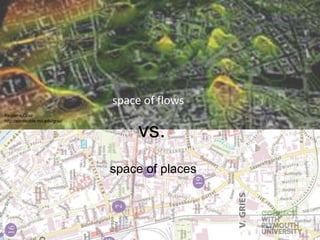
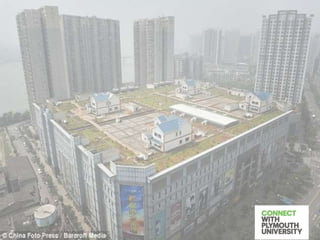
space of flows
space of places
vs.
Realtime Graz
http://senseable.mit.edu/graz/
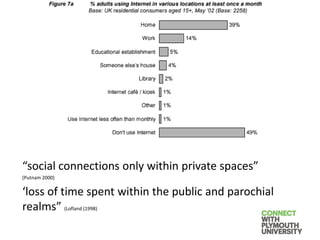
“social connections only within private spaces”
(Putnam 2000)
‘loss of time spent within the public and parochial
realms” (Lofland (1998)
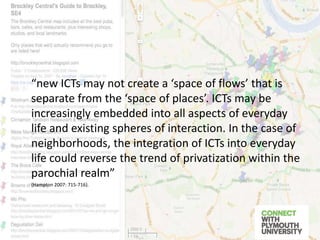
“new ICTs may not create a ‘space of flows’ that is
separate from the ‘space of places’. ICTs may be
increasingly embedded into all aspects of everyday
life and existing spheres of interaction. In the case of
neighborhoods, the integration of ICTs into everyday
life could reverse the trend of privatization within the
parochial realm”
(Hampton 2007: 715-716).
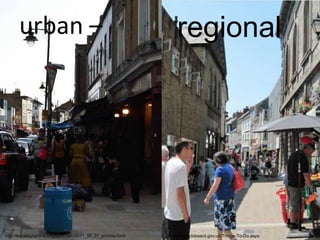
urban – regional
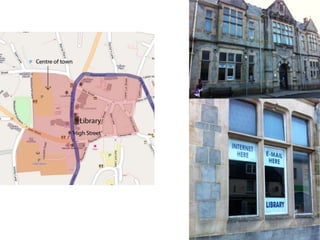
http://brockleycentral.blogspot.com/2011_08_01_archive.html http://www.liskeard.gov.uk/Things-To-Do.aspx
questions
What are the characteristics of place-based
communities and the interplay between the invisible
networks and material world of regional life?
the ‘self’ as someone who is ‘constantly making and
breaking connections, declaring allegiances and
interests and then renouncing them – participating in
a video conference while sorting through email or
word processing at the same time’ (Bolter and Grusin1999: 232).
BUT media are just an extension of the way the self is
reconfigured in different situations “as people reach
out, connect and emphasize different aspects of
themselves” (Rainie and Wellman 2012: 126).
Remediation
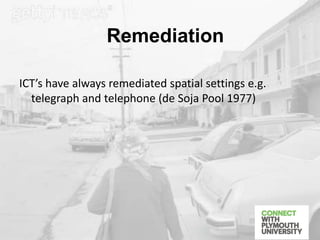
ICT’s have always remediated spatial settings e.g.
telegraph and telephone (de Soja Pool 1977)
Remediation
‘the whole raft of current new media innovations are
not being used in ways that are divorced from the
use of existing media, means of communication and
material practices in places’ (Graham 2004: 18).
‘the reality of the internet is more important than
the dazzle’ (ibid: 4–5).
Remediation
ICTs redefine ‘behaviours in ways we do not
fully know’ (Aurigi and de Cindio 2008: 8)
Need to ‘re-frame our existing spatial
concepts to accommodate this increased
range of possibilities’ (ibid).
Remediation
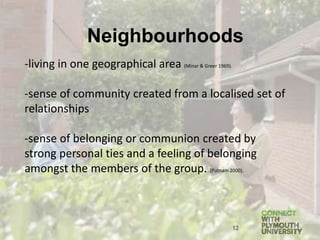
-living in one geographical area (Minar & Greer 1969).
-sense of community created from a localised set of
relationships
-sense of belonging or communion created by
strong personal ties and a feeling of belonging
amongst the members of the group. (Putnam 2000).
12
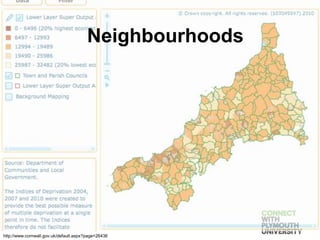
Neighbourhoods
Neighbourhoods
http://www.cornwall.gov.uk/default.aspx?page=26436
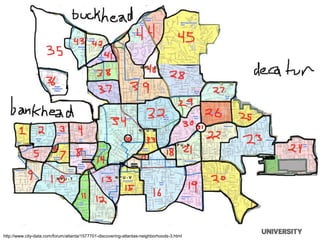
Neighbourhoods
http://www.city-data.com/forum/atlanta/1577701-discovering-atlantas-neighborhoods-3.html
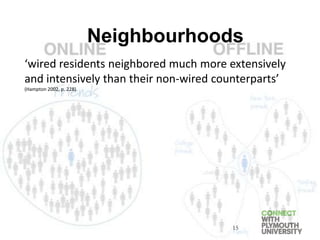
‘wired residents neighbored much more extensively
and intensively than their non-wired counterparts’
(Hampton 2002, p. 228).
15
Neighbourhoods
Presence and use of media in a neighbourhood
offer a new type of localised sociality, that occured
at different temporal and spatial scales
simultaneously (Hampton 2002).
16
Neighbourhoods
17
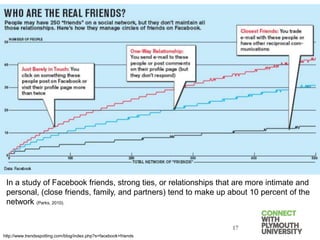
In a study of Facebook friends, strong ties, or relationships that are more intimate and
personal, (close friends, family, and partners) tend to make up about 10 percent of the
network (Parks, 2010).
http://www.trendsspotting.com/blog/index.php?s=facebook+friends
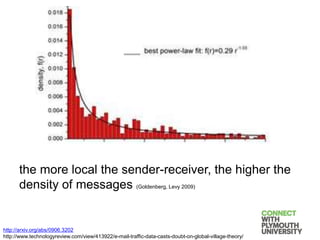
the more local the sender-receiver, the higher the
density of messages (Goldenberg, Levy 2009)
http://arxiv.org/abs/0906.3202
http://www.technologyreview.com/view/413922/e-mail-traffic-data-casts-doubt-on-global-village-theory/
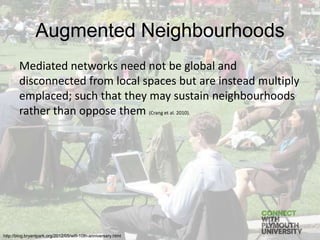
Mediated networks need not be global and
disconnected from local spaces but are instead multiply
emplaced; such that they may sustain neighbourhoods
rather than oppose them (Crang et al. 2010).
Augmented Neighbourhoods
http://blog.bryantpark.org/2012/05/wifi-10th-anniversary.html
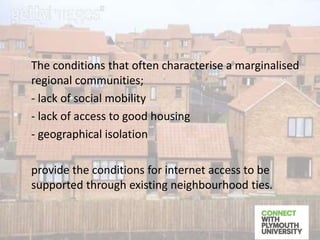
The conditions that often characterise a marginalised
regional communities;
- lack of social mobility
- lack of access to good housing
- geographical isolation
provide the conditions for internet access to be
supported through existing neighbourhood ties.
‘more marginalised neighbourhoods tend to be
characterised by instrumental and episodic ICT usage
patterns which are often collectively organised through
strong neighbourhood ties…. It is those neighbourhood
ties that enable on-line access’ (Crang 2006: 2405).
Method
communities that lack social cohesion have ‘low levels
of social interaction between and within communities
and low levels of place attachment’ (Forrest and Kearns 2001: 2128).
Case Study
Context- the rhetoric
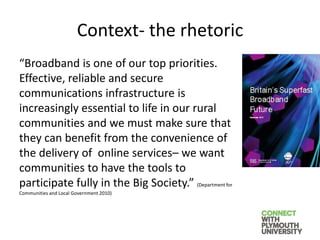
“Broadband is one of our top priorities.
Effective, reliable and secure
communications infrastructure is
increasingly essential to life in our rural
communities and we must make sure that
they can benefit from the convenience of
the delivery of online services– we want
communities to have the tools to
participate fully in the Big Society.” (Department for
Communities and Local Government 2010)
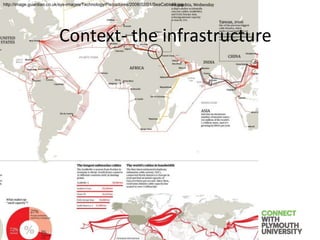
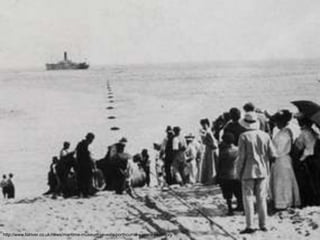
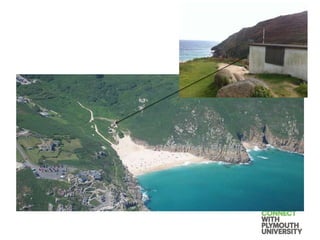
Context- the infrastructure
http://image.guardian.co.uk/sys-images/Technology/Pix/pictures/2008/02/01/SeaCableHi.jpg
http://www.falriver.co.uk/news/maritime-museum-reveals-porthcurno-s-place-in-history
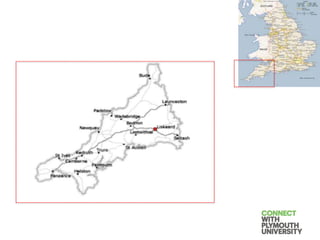
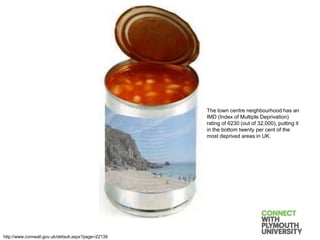
The town centre neighbourhood has an
IMD (Index of Multiple Deprivation)
rating of 6230 (out of 32,000), putting it
in the bottom twenty per cent of the
most deprived areas in UK.
http://www.cornwall.gov.uk/default.aspx?page=22139
methods
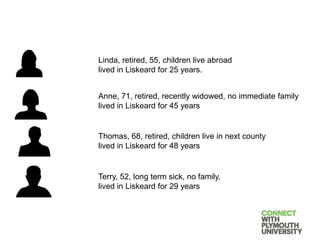
Linda, retired, 55, children live abroad
lived in Liskeard for 25 years.
Anne, 71, retired, recently widowed, no immediate family
lived in Liskeard for 45 years
Terry, 52, long term sick, no family,
lived in Liskeard for 29 years
Thomas, 68, retired, children live in next county
lived in Liskeard for 48 years
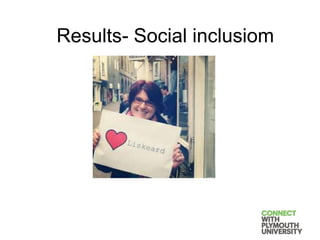
Results- Social inclusiom
“I don't even know what Google is”
“I just want to know how to get out of trouble. I’m
scared it (the computer) will blow up on me”.
“I’m getting fed up with all the family saying “When are
you going to go online?”
Social inclusiom
“because I felt I wasn’t getting connected with
everything that’s going on” (Mary)
“you feel connected if you're on the computer. It’s the
modern times - on the television everything always
links to something online so you feel that everyone’s
online and you’re not“ (Jean).
Social inclusiom
“I just want to be able to surf the net without bothering
junior family members” (Bridget)
Internet and computer skills as social capital.
Social inclusiom
“I used to have to wait for a phone call, but now I log on
every day to not miss anything from the secretary of
the club” (Linda)
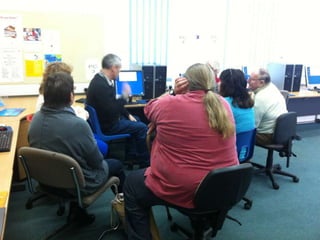
Going online corresponded with many of the
participants feeling less socially excluded in their
neighbourhood.
Social inclusiom
internet skills for the digitally excluded resulted in a re-
localising of community connections.
Social inclusiom
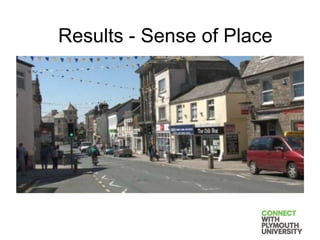
Results - Sense of Place
“we moved here in 1968, and one time we used to
know everyone, but the neighbours have changed
since we first moved and now we are the old
stalwarts” (Tessa)
“we’ve lived here for forty years, but we don’t speak to
our neighbours very much. It’s not that close knit.
People come and go all the time, the houses on both
sides have changed hands several times” (Thomas).
Sense of Place
“I know the library. I haven’t got a computer at home
and if I need to know something it helps. I know all
the staff. I asked about getting some information and
the staff helped me.” (margaret)
‘
Sense of Place
Public places provide everyday opportunities for social
interaction and social inclusion, and can facilitate the
development of community ties.
Small-scale activities, ‘which lead to a feeling of
belonging and an affective connection with place- or
non-place-based social groups” (Doering 2008: 8)
Role of ICTs to support this process
Summary
If, as Wellman claims, ‘most people operate in multiple,
thinly connected, partial communities as they deal
with networks of kin, neighbours, friends, workmates
and organisational ties’ (2001: 227)
key public places such as the central library became
spaces of remediation in that they allowed for the
‘glue’ (Martin 2008) to reconnect with some aspects of
community life.
Summary
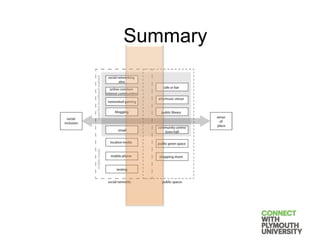
Context: Moving from a digital infrastructure to social
infrastructure (networks)
How can we create the conditions for this process of
remediation of neighbourhood ties at a regional and
rural scale?
How can we support the links between online spaces
and offline spaces and find ways to design the point
at which they overlap becomes a site of
remediation?
Summary
Summary
We would like to thank
Jay Chapman at Citizens Online
Peter Finlay at Cornwall Libraries
Participants in the Get Online computer courses in Liskeard for their
assistance in the case study.
The research presented in this paper is part-funded by the European Regional
Development Fund bringing greater connectivity to Cornwall and the Isles of
Scilly (Superfast Cornwall).
Acknowledgements
Mediacities2013 4 5_12

Mediacities2013 4 5_12

  • 1.
    Beyond the DigitalCity Remediating Space at a Regional Scale Katharine S. Willis* Alessandro Aurigi Pamela Varley School of Architecture, Plymouth University *http://www.plymouth.ac.uk/staff/kwillis1 @trolleytweet
  • 2.
    space of flows spaceof places vs. Realtime Graz http://senseable.mit.edu/graz/
  • 3.
    “social connections onlywithin private spaces” (Putnam 2000) ‘loss of time spent within the public and parochial realms” (Lofland (1998)
  • 4.
    “new ICTs maynot create a ‘space of flows’ that is separate from the ‘space of places’. ICTs may be increasingly embedded into all aspects of everyday life and existing spheres of interaction. In the case of neighborhoods, the integration of ICTs into everyday life could reverse the trend of privatization within the parochial realm” (Hampton 2007: 715-716).
  • 6.
  • 7.
    questions What are thecharacteristics of place-based communities and the interplay between the invisible networks and material world of regional life?
  • 8.
    the ‘self’ assomeone who is ‘constantly making and breaking connections, declaring allegiances and interests and then renouncing them – participating in a video conference while sorting through email or word processing at the same time’ (Bolter and Grusin1999: 232). BUT media are just an extension of the way the self is reconfigured in different situations “as people reach out, connect and emphasize different aspects of themselves” (Rainie and Wellman 2012: 126). Remediation
  • 9.
    ICT’s have alwaysremediated spatial settings e.g. telegraph and telephone (de Soja Pool 1977) Remediation
  • 10.
    ‘the whole raftof current new media innovations are not being used in ways that are divorced from the use of existing media, means of communication and material practices in places’ (Graham 2004: 18). ‘the reality of the internet is more important than the dazzle’ (ibid: 4–5). Remediation
  • 11.
    ICTs redefine ‘behavioursin ways we do not fully know’ (Aurigi and de Cindio 2008: 8) Need to ‘re-frame our existing spatial concepts to accommodate this increased range of possibilities’ (ibid). Remediation
  • 12.
    -living in onegeographical area (Minar & Greer 1969). -sense of community created from a localised set of relationships -sense of belonging or communion created by strong personal ties and a feeling of belonging amongst the members of the group. (Putnam 2000). 12 Neighbourhoods
  • 13.
  • 14.
  • 15.
    ‘wired residents neighboredmuch more extensively and intensively than their non-wired counterparts’ (Hampton 2002, p. 228). 15 Neighbourhoods
  • 16.
    Presence and useof media in a neighbourhood offer a new type of localised sociality, that occured at different temporal and spatial scales simultaneously (Hampton 2002). 16 Neighbourhoods
  • 17.
    17 In a studyof Facebook friends, strong ties, or relationships that are more intimate and personal, (close friends, family, and partners) tend to make up about 10 percent of the network (Parks, 2010). http://www.trendsspotting.com/blog/index.php?s=facebook+friends
  • 18.
    the more localthe sender-receiver, the higher the density of messages (Goldenberg, Levy 2009) http://arxiv.org/abs/0906.3202 http://www.technologyreview.com/view/413922/e-mail-traffic-data-casts-doubt-on-global-village-theory/
  • 19.
    Mediated networks neednot be global and disconnected from local spaces but are instead multiply emplaced; such that they may sustain neighbourhoods rather than oppose them (Crang et al. 2010). Augmented Neighbourhoods http://blog.bryantpark.org/2012/05/wifi-10th-anniversary.html
  • 20.
    The conditions thatoften characterise a marginalised regional communities; - lack of social mobility - lack of access to good housing - geographical isolation provide the conditions for internet access to be supported through existing neighbourhood ties.
  • 21.
    ‘more marginalised neighbourhoodstend to be characterised by instrumental and episodic ICT usage patterns which are often collectively organised through strong neighbourhood ties…. It is those neighbourhood ties that enable on-line access’ (Crang 2006: 2405).
  • 22.
    Method communities that lacksocial cohesion have ‘low levels of social interaction between and within communities and low levels of place attachment’ (Forrest and Kearns 2001: 2128).
  • 24.
  • 25.
    Context- the rhetoric “Broadbandis one of our top priorities. Effective, reliable and secure communications infrastructure is increasingly essential to life in our rural communities and we must make sure that they can benefit from the convenience of the delivery of online services– we want communities to have the tools to participate fully in the Big Society.” (Department for Communities and Local Government 2010)
  • 26.
  • 27.
  • 30.
    The town centreneighbourhood has an IMD (Index of Multiple Deprivation) rating of 6230 (out of 32,000), putting it in the bottom twenty per cent of the most deprived areas in UK. http://www.cornwall.gov.uk/default.aspx?page=22139
  • 31.
  • 34.
    Linda, retired, 55,children live abroad lived in Liskeard for 25 years. Anne, 71, retired, recently widowed, no immediate family lived in Liskeard for 45 years Terry, 52, long term sick, no family, lived in Liskeard for 29 years Thomas, 68, retired, children live in next county lived in Liskeard for 48 years
  • 35.
  • 36.
    “I don't evenknow what Google is” “I just want to know how to get out of trouble. I’m scared it (the computer) will blow up on me”. “I’m getting fed up with all the family saying “When are you going to go online?” Social inclusiom
  • 37.
    “because I feltI wasn’t getting connected with everything that’s going on” (Mary) “you feel connected if you're on the computer. It’s the modern times - on the television everything always links to something online so you feel that everyone’s online and you’re not“ (Jean). Social inclusiom
  • 38.
    “I just wantto be able to surf the net without bothering junior family members” (Bridget) Internet and computer skills as social capital. Social inclusiom
  • 39.
    “I used tohave to wait for a phone call, but now I log on every day to not miss anything from the secretary of the club” (Linda) Going online corresponded with many of the participants feeling less socially excluded in their neighbourhood. Social inclusiom
  • 40.
    internet skills forthe digitally excluded resulted in a re- localising of community connections. Social inclusiom
  • 41.
  • 42.
    “we moved herein 1968, and one time we used to know everyone, but the neighbours have changed since we first moved and now we are the old stalwarts” (Tessa) “we’ve lived here for forty years, but we don’t speak to our neighbours very much. It’s not that close knit. People come and go all the time, the houses on both sides have changed hands several times” (Thomas). Sense of Place
  • 43.
    “I know thelibrary. I haven’t got a computer at home and if I need to know something it helps. I know all the staff. I asked about getting some information and the staff helped me.” (margaret) ‘ Sense of Place
  • 44.
    Public places provideeveryday opportunities for social interaction and social inclusion, and can facilitate the development of community ties. Small-scale activities, ‘which lead to a feeling of belonging and an affective connection with place- or non-place-based social groups” (Doering 2008: 8) Role of ICTs to support this process Summary
  • 45.
    If, as Wellmanclaims, ‘most people operate in multiple, thinly connected, partial communities as they deal with networks of kin, neighbours, friends, workmates and organisational ties’ (2001: 227) key public places such as the central library became spaces of remediation in that they allowed for the ‘glue’ (Martin 2008) to reconnect with some aspects of community life. Summary
  • 46.
    Context: Moving froma digital infrastructure to social infrastructure (networks) How can we create the conditions for this process of remediation of neighbourhood ties at a regional and rural scale? How can we support the links between online spaces and offline spaces and find ways to design the point at which they overlap becomes a site of remediation? Summary
  • 47.
  • 48.
    We would liketo thank Jay Chapman at Citizens Online Peter Finlay at Cornwall Libraries Participants in the Get Online computer courses in Liskeard for their assistance in the case study. The research presented in this paper is part-funded by the European Regional Development Fund bringing greater connectivity to Cornwall and the Isles of Scilly (Superfast Cornwall). Acknowledgements
Editor's Notes

  • #4 very little critique of the complex urban nature of such media. Yet ICT’s and new modes of remote communication are having, and have had significant effects on communities that are not cutting edge high urban settings but rather at regional and rural scales. These settings have different structures and patterns of inhabitation than those of highly urbanised city centres and therefore corresponding different relationships with social and economical issues.
  • #5 very little critique of the complex urban nature of such media. Yet ICT’s and new modes of remote communication are having, and have had significant effects on communities that are not cutting edge high urban settings but rather at regional and rural scales. These settings have different structures and patterns of inhabitation than those of highly urbanised city centres and therefore corresponding different relationships with social and economical issues.
  • #6 very little critique of the complex urban nature of such media. Yet ICT’s and new modes of remote communication are having, and have had significant effects on communities that are not cutting edge high urban settings but rather at regional and rural scales. These settings have different structures and patterns of inhabitation than those of highly urbanised city centres and therefore corresponding different relationships with social and economical issues.
  • #13 1. This refers to settlement based upon close geographical propinquity, but where there is no implication of the quality of the social relationships found in such settlements of intense co-presence.
  • #16 Hampton’s study of a wired neighbouhood found that where people used multiple methods of communication: direct in-person contact, telephone, postal mail, and more recently fax, email, chats, and email discussion groups both locally and globally the consequence was that
  • #19 volume of e-mail traffic as a function of geographical distance follows an inverse power law i.e.
  • #20 The presence and use of media in a neighbourhood offer a new type of localised sociality, where different affordances and opportunities for ties and actions can occur at different temporal and spatial scales simultaneously (Hampton/Wellman 2002).
  • #21 The remediation of the neighbourhood is very much a process embedded within existing social practices and connections.
  • #28 1906