provocative questions:summary and synthesisOCTOBER 29, 4:15 – 5:00 PM
generative discussions about provocative questionsSmall groups explore new horizons in Strengthening Families…
revolutionizing professional developmentMultiple options for learning about SF attitudes and values.Focus on child within family and community across developmental stages.Normative practice: reflective, informal, and formal learning opportunities
protective factors ages 0-25Ensure alignment and collaboration around the PFs across the lifespan among communities, families and organizations.Value and foster authentic engagement of all types of families in developing culturally relevant strategies and solutions for building PFs in families and communities.Maintain existing PFs and incorporate or create research-based, developmentally appropriate strategies and practices for multiple disciplines.
building community assetsIntentionally build the protective factors into Promise Neighborhoods; create Strengthening Families Communities.Make sure financial resources align with research and community action.Ask candidates about their positions on Strengthening Families.
building evidence for strengthening familiesDevelop consistent framework and language around evaluation that matches appropriate evaluative techniques to parts of our theory of change.Create an evaluation consortium to determine what else we need/want to know: (share through webinars, listserves and tools)Create a structured approach to alternative, non-evaluative evidence building.
can strengthening families become a common framework?Develop concrete materials to help educate people across multiple levels including legislators, administrators, and front line. Have a shared message with common language that promotes broad community change.Create policies that ensure parents are full partners at every level.
uncovering informal supportsDevelop community assessment tool and use to promote public awareness. Identify and validate informal supports as part of the SF approach.Engage whole communities through traditional grass roots methods, social marketing and other new techniques.
new partners – who and why?Strengthen and sustain existing network partners.Issue invitations to a range of other partners with similar values about social justice.Develop common language that is appealing and understandable to all potential new partners.
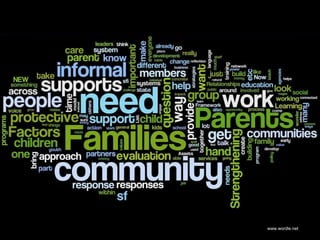
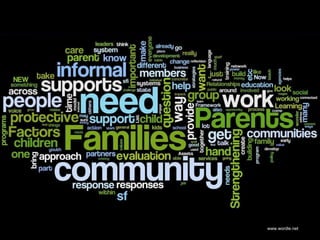
www.wordle.net
trends and themesUse the Protective Factors more broadlyStrengthen and deepen early childhood application
Begin necessary work to expand the protective factors for a broader age span and specific populations (such as early adolescence)trends and themesEnsure that families remain at the center of the SF approach.Focus on policies and practices that require and support family leadership at all levels.
Train professionals to develop, support and maintain full partnerships with families at all levels.
Create multiple opportunities to empower parents, one parent at a time.trends and themesRoot SF more fully into communitiesValidate informal supports as an essential component of SF.
Reach out to non-traditional partners through more effective “common language” communication.

Provocative Questions

  • 1.
    provocative questions:summary andsynthesisOCTOBER 29, 4:15 – 5:00 PM
  • 2.
    generative discussions aboutprovocative questionsSmall groups explore new horizons in Strengthening Families…
  • 3.
    revolutionizing professional developmentMultipleoptions for learning about SF attitudes and values.Focus on child within family and community across developmental stages.Normative practice: reflective, informal, and formal learning opportunities
  • 4.
    protective factors ages0-25Ensure alignment and collaboration around the PFs across the lifespan among communities, families and organizations.Value and foster authentic engagement of all types of families in developing culturally relevant strategies and solutions for building PFs in families and communities.Maintain existing PFs and incorporate or create research-based, developmentally appropriate strategies and practices for multiple disciplines.
  • 5.
    building community assetsIntentionallybuild the protective factors into Promise Neighborhoods; create Strengthening Families Communities.Make sure financial resources align with research and community action.Ask candidates about their positions on Strengthening Families.
  • 6.
    building evidence forstrengthening familiesDevelop consistent framework and language around evaluation that matches appropriate evaluative techniques to parts of our theory of change.Create an evaluation consortium to determine what else we need/want to know: (share through webinars, listserves and tools)Create a structured approach to alternative, non-evaluative evidence building.
  • 7.
    can strengthening familiesbecome a common framework?Develop concrete materials to help educate people across multiple levels including legislators, administrators, and front line. Have a shared message with common language that promotes broad community change.Create policies that ensure parents are full partners at every level.
  • 8.
    uncovering informal supportsDevelopcommunity assessment tool and use to promote public awareness. Identify and validate informal supports as part of the SF approach.Engage whole communities through traditional grass roots methods, social marketing and other new techniques.
  • 9.
    new partners –who and why?Strengthen and sustain existing network partners.Issue invitations to a range of other partners with similar values about social justice.Develop common language that is appealing and understandable to all potential new partners.
  • 10.
  • 11.
    trends and themesUsethe Protective Factors more broadlyStrengthen and deepen early childhood application
  • 12.
    Begin necessary workto expand the protective factors for a broader age span and specific populations (such as early adolescence)trends and themesEnsure that families remain at the center of the SF approach.Focus on policies and practices that require and support family leadership at all levels.
  • 13.
    Train professionals todevelop, support and maintain full partnerships with families at all levels.
  • 14.
    Create multiple opportunitiesto empower parents, one parent at a time.trends and themesRoot SF more fully into communitiesValidate informal supports as an essential component of SF.
  • 15.
    Reach out tonon-traditional partners through more effective “common language” communication.