© 2022, IRJET | Impact Factor value: 7.529 | ISO 9001:2008 Certified Journal | Page 2601
Prosthetic Hand Control Using EMG Sensor
Usman Khan1, Mainak Roy2
B.Tech (ESE) National Institute of Electronics and I.T, Aurangabad (Maharashtra), India
---------------------------------------------------------------------***---------------------------------------------------------------------
Abstract - The idea of this project is to change the
perspective of remote controls to manually operated Robotic-
Hand. In this project we work on the design and development
of a Robotic Hand using an Arduino board, and servo motors.
The design of the hand is based on a simple, easy, flexible, and
minimal controlling strategy. The Robotic Hand has been
assigned independent commands for all the five fingers to
open and close, pick and place, and to get back to home
position. The Arduino based human hand replication system is a
system that can help and avoid the human presence to be put
under harmful situations such as radioactive and bio
hazardous. Thetechnology can also be helpful in very precise
instrumentationworkings like a doctor operating a patient
with a robot without its own hands. The technology has its
many useful applications in the field of robotics, surgical
operations, humanoid robots, etc.
Key Words: Arduino, FFRH, Robotic-Hand, Replication
System
1. INTRODUCTION
The term "prosthetic" comes from a new Latin word
from Greek "prostithenai" meaning "to add to, or to put
in addition", this describes the addition of an artificial
body part, such as a limb, a heart. The human upper limb
is an important part of the body, the partial or complete
loss of which can have a serious effect on a person's
ability on the day to day activities. The human upper
limb has three sections the hand, forearm, and arm. For
the movement of each section, coordination of the
nervous system, musculoskeletal systems, and its
surroundings is necessary. To perform various daily
activities, coordination of different joints (shoulder, elbow,
wrist, and finger joint) is essential, including a broad
range of motions with several degrees of freedom. These
coordinated movements are notalways redundant and can
be beneficial to perform complex tasks. When it comes to
an artificial hand, all the control features of the normal
hand should extensively match, so that the user can
perform their daily needs in a modified and effective way.
The coordinated control of the biological hand is quite
complex, making it highly difficult to replicate it exactly
in any prosthetic hand.
Most of the systems are designed for people who lost
their hand or leg in an accident or who are handicapped
by birth.With 3D printed prosthetics gaining popularity
with the advent of consumer-level 3D printers, practical
applications of these prosthetics have also been
increasing. Online open- source development has allowed
for printable hand modelsto be downloaded for free within
minutes from websites such as Thingiverse, a free, open-
source 3D modeling site. Contrary to traditional
prosthetics, which often cost tens of thousands of dollars
and are usually unaffordable to many, these alternatives
provide a relatively inexpensive option to the public. This
allows for less expensive, yet effective prosthetics to be
available to modern consumers, with increased
personalization for the user at a speed unachievable by
conventional methods.
Objective
 It is helpful for the people who have lost one of their
hands or if it is paralyzed.
 Low cost. The whole hand can be manufactured for
200 USD, which makes it very affordable in
comparisons to its present contemporary robotic
hand proposal.
 Highly effective
 The Light weight 3D printed modules/parts, makesit
very easy for the user to carry it around with them.
 Safe to use
 Easy operate
 It can be further modified. It can be custom made
depending upon how the user wants it to function.It
can even be controlled through cloud or Wi-Fi.
International Research Journal of Engineering and Technology (IRJET) e-ISSN: 2395-0056
Volume: 09 Issue: 07 | July 2022 www.irjet.net p-ISSN: 2395-0072
Need of the Project
In the United States, there are approximately 40,000+
persons who have lost their major upper-limb or have it
paralyzed. Activities that a person could routinely
perform may no longer be possible or may require
additional effort and time due to upper limb amputation.
Upper limb prostheses can assist amputees in activities of
daily living such as feeding, dressing, and hygiene tasks.
These performance capabilities are highly desired by
persons with upper-limb amputation, regardless of their
amputation level or current prosthesis type.
Unfortunately, due to the limitations of clinically available
prosthetics technologies, a substantial proportion of
persons with upper limb amputation (10–25%) do not
use prosthesis. Of those patients that do use prosthesis,
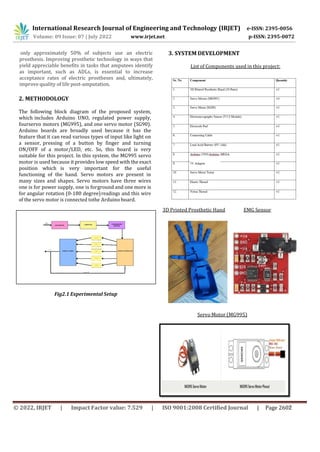
2. METHODOLOGY
The following block diagram of the proposed system,
which includes Arduino UNO, regulated power supply,
fourservo motors (MG995), and one servo motor (SG90).
Arduino boards are broadly used because it has the
feature that it can read various types of input like light on
a sensor, pressing of a button by finger and turning
ON/OFF of a motor/LED, etc. So, this board is very
suitable for this project. In this system, the MG995 servo
motor is used because it provides low speed with the exact
position which is very important for the useful
functioning of the hand. Servo motors are present in
many sizes and shapes. Servo motors have three wires
one is for power supply, one is forground and one more is
for angular rotation (0-180 degree)readings and this wire
of the servo motor is connected tothe Arduino board.
Fig2.1 Experimental Setup
3. SYSTEM DEVELOPMENT
List of Components used in this project:
only approximately 50% of subjects use an electric
prosthesis. Improving prosthetic technology in ways that
yield appreciable benefits in tasks that amputees identify
as important, such as ADLs, is essential to increase
acceptance rates of electric prostheses and, ultimately,
improve quality of life post-amputation.
International Research Journal of Engineering and Technology (IRJET) e-ISSN: 2395-0056
Volume: 09 Issue: 07 | July 2022 www.irjet.net p-ISSN: 2395-0072
3D Printed Prosthetic Hand EMG Sensor
Servo Motor (MG995)
© 2022, IRJET | Impact Factor value: 7.529 | ISO 9001:2008 Certified Journal | Page 2602
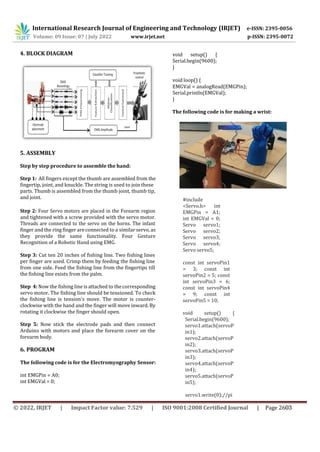
4. BLOCK DIAGRAM
5. ASSEMBLY
Step by step procedure to assemble the hand:
Step 1: All fingers except the thumb are assembled from the
fingertip, joint, and knuckle. The string is used to join these
parts. Thumb is assembled from the thumb joint, thumb tip,
and joint.
Step 2: Four Servo motors are placed in the Forearm region
and tightened with a screw provided with the servo motor.
Threads are connected to the servo on the horns. The infant
finger and the ring finger areconnected to a similar servo,as
they provide the same functionality. Four Gesture
Recognition of a Robotic Hand using EMG.
Step 3: Cut ten 20 inches of fishing line. Two fishing lines
per finger are used. Crimp them by feeding the fishing line
from one side. Feed the fishing line from the fingertips till
the fishing line exists from the palm.
Step 4: Now the fishing line is attached to thecorresponding
servo motor. The fishing line should be tensioned. To check
the fishing line is tension's move. The motor is counter-
clockwise with the hand and the finger will move inward.By
rotating it clockwise the finger should open.
Step 5: Now stick the electrode pads and then connect
Arduino with motors and place the forearm cover on the
forearm body.
The following code is for the Electromyography Sensor:
int EMGPin = A0;
int EMGVal = 0;
void setup() {
Serial.begin(9600);
}
void loop() {
EMGVal = analogRead(EMGPin);
Serial.println(EMGVal);
}
International Research Journal of Engineering and Technology (IRJET) e-ISSN: 2395-0056
Volume: 09 Issue: 07 | July 2022 www.irjet.net p-ISSN: 2395-0072
6. PROGRAM
The following code is for making a wrist:
#include
<Servo.h> int
EMGPin = A1;
int EMGVal = 0;
Servo servo1;
Servo servo2;
Servo servo3;
Servo servo4;
Servo servo5;
const int servoPin1
= 3; const int
servoPin2 = 5; const
int servoPin3 = 6;
const int servoPin4
= 9; const int
servoPin5 = 10;
void setup() {
Serial.begin(9600);
servo1.attach(servoP
in1);
servo2.attach(servoP
in2);
servo3.attach(servoP
in3);
servo4.attach(servoP
in4);
servo5.attach(servoP
in5);
servo1.write(0);//pi
© 2022, IRJET | Impact Factor value: 7.529 | ISO 9001:2008 Certified Journal | Page 2603
International Research Journal of Engineering and Technology (IRJET) e-ISSN: 2395-0056
p-ISSN: 2395-0072
Volume: 09 Issue: 07 | Jul 2022 www.irjet.net
servo3.write(1
80);
servo2.write(0
)
servo4.write(0
);
servo5.write(0
); delay(2000);
servo1.detach(
);
servo3.detach(
);
servo2.detach(
);
servo4.detach(
);
servo5.detach(
); delay(2000);
nky delay(1000);
servo1.detach();
servo2.write(180);//midd
le delay(1000);
servo2.detach();
servo3.write(0);//thumb
delay(1000);
servo3.detach();
servo4.write(180);//4
delay(1000);
servo4.detach();
servo5.write(180);//5
delay(1000);
servo5.detach();
}
void loop() {
//**************** FOR READING OF EMG
**********************EMGVal = analogRead(EMGPin);
Serial.println(EMGVal);
delay(20);
//***********************************************************
**********
if (EMGVal >= 120 && EMGVal <= 200)
{ //**************** FOR CLOSING OF FINGERS
**********************servo1.attach(servoPin1);
servo2.attach(servoPin2);
servo3.attach(servoPin3);
servo4.attach(servoPin4);
servo5.attach(servoPin5);
servo1.write(180);
}
if (EMGVal >= 50 && EMGVal <= 100)
{
//**************** FOR OPNING OF FINGERS
**********************
servo1.attach(s
ervoPin1);
servo2.attach(s
ervoPin2);
servo3.attach(s
ervoPin3);
servo4.attach(s
ervoPin4);
servo5.attach(s
ervoPin5);
servo1.write(0);
servo3.write(0);
servo2.write(18
0);
servo4.write(18
0);
servo5.write(18
0); delay(2000);
servo1.detach();
servo3.detach();
servo2.detach();
servo4.detach();
servo5.detach();
delay(2000);
}
//***** FOR TESTING UNCOMMENT IT AND COMMENT
ALL *****
// servo1.attach(servoPin1);
// servo2.attach(servoPin2);
// servo3.attach(servoPin3);
// servo4.attach(servoPin4);
// servo5.attach(servoPin5);
// servo1.write(130);
// servo3.write(0);
// servo2.write(0);
// servo4.write(0); // servo5.write(160);
// delay(2000);
// servo1.write(0);
// servo3.write(180);
// servo2.write(200);
// servo4.write(180);
// servo5.write(0);
// delay(2000);
// servo1.detach();
// servo3.detach();
// servo2.detach();
// servo4.detach();
// servo5.detach();
// delay(2000);
© 2022, IRJET | Impact Factor value: 7.529 | ISO 9001:2008 Certified Journal | Page 2604
International Research Journal of Engineering and Technology (IRJET) e-ISSN: 2395-0056
p-ISSN: 2395-0072
Volume: 09 Issue: 07 | Jul 2022 www.irjet.net
In this project, we have designed and developed the
lightweight 3D-printedprosthetic robotic hand which works
on Arduino UNO, Servo motor, and EMG sensor. The Arduino
board is programmed in such a way that the whole system is
controlled to perform the daily life activities. This system
helps the disabled person to overcome their obstacles in
daily life and it also have many applications in
manufacturing industries, the medical field, and many
more.The proposed model is of low cost and the hardware
components of the system are easily available.
ACKNOWLEDGEMENT
We would like to express our special thanks to our guide
Scientist/Engineer ‘B’ Prashant Pal and co-guide
Scientist/Engineer ‘C’ Saurabh Kesari for his advice and
encouragement, which has greatly benefited this paper. We
also thank National Institute of Electronics and Information
Technology, Aurangabad for having all the necessary
resources and facilities that significantly enhanced this
manuscript with support and laboratory
[2] Vaibhav Pawar, Sneha Bire, Shubham More, Komal More
and Reshma Mule, “Review on Design and Development of
Robotic Arm Generation-1”, International Journal of
Innovative Science and Research Technology, pp.529, March
2018
[3] Tran Vanhuy, Dao Tuan Minh, Kien Nguyen Phan and Vu
Anh Tran, “Simple Robotic Hand in Motion Using Arduino
Controlled Servos”, International Journal of Science and
Research (IJSR), pp. 972- 974, March 2017.
[4] Kobayashi H, Ishida Y, Suzuki H, “Realization of all motion
for the upper limb by a muscle suit”, IEEE International
Workshop on Robot and Human Interactive Communication,
Japan, September 2004
[5] Iason Batzianoulis, Aude Billard, Nili E. Krausz, Ann M.
Simon & Levi Hargrove, “Decoding the grasping intention
from electromyography during reaching motions”
Batzianoulis et al. Journal of Neuro Engineering and
Rehabilitation 2018 [6] J.B. Gupta, Electronic Devices and
Circuits, S. K. Kataria & Sons, 2009
BIOGRAPHIES
REFERENCES
[1] Sivapong Nilwong, Delowar Hossain, Eneo Petoku, and
Genci Capi “Development of Myoelectric Robotic Hand using
3D Printer“, 1st International Conference on Advances in
Science, Engineering and Robotics Technology 2019
(JCASERT 2019)
Usman Khan ,B.Tech 4th year (ESE)
National Institute of Electronics and
I.T,Aurangabad(Maharashtra), India
Mainak Roy, B.Tech 4th year (ESE)
National Institute of Electronics and
I.T,Aurangabad(Maharashtra), India
Prashant Pal, Scientist/Engineer
‘B’ National Institute of Electronics
and I.T, Aurangabad(Maharashtra),
India
Saurabh Kesari, Scientist/Engineer
‘C’ National Institute of Electronics
and I.T, Aurangabad(Maharashtra),
India
7. CONCLUSION
© 2022, IRJET | Impact Factor value: 7.529 | ISO 9001:2008 Certified Journal | Page 2605

Prosthetic Hand Control Using EMG Sensor

  • 1.
    © 2022, IRJET| Impact Factor value: 7.529 | ISO 9001:2008 Certified Journal | Page 2601 Prosthetic Hand Control Using EMG Sensor Usman Khan1, Mainak Roy2 B.Tech (ESE) National Institute of Electronics and I.T, Aurangabad (Maharashtra), India ---------------------------------------------------------------------***--------------------------------------------------------------------- Abstract - The idea of this project is to change the perspective of remote controls to manually operated Robotic- Hand. In this project we work on the design and development of a Robotic Hand using an Arduino board, and servo motors. The design of the hand is based on a simple, easy, flexible, and minimal controlling strategy. The Robotic Hand has been assigned independent commands for all the five fingers to open and close, pick and place, and to get back to home position. The Arduino based human hand replication system is a system that can help and avoid the human presence to be put under harmful situations such as radioactive and bio hazardous. Thetechnology can also be helpful in very precise instrumentationworkings like a doctor operating a patient with a robot without its own hands. The technology has its many useful applications in the field of robotics, surgical operations, humanoid robots, etc. Key Words: Arduino, FFRH, Robotic-Hand, Replication System 1. INTRODUCTION The term "prosthetic" comes from a new Latin word from Greek "prostithenai" meaning "to add to, or to put in addition", this describes the addition of an artificial body part, such as a limb, a heart. The human upper limb is an important part of the body, the partial or complete loss of which can have a serious effect on a person's ability on the day to day activities. The human upper limb has three sections the hand, forearm, and arm. For the movement of each section, coordination of the nervous system, musculoskeletal systems, and its surroundings is necessary. To perform various daily activities, coordination of different joints (shoulder, elbow, wrist, and finger joint) is essential, including a broad range of motions with several degrees of freedom. These coordinated movements are notalways redundant and can be beneficial to perform complex tasks. When it comes to an artificial hand, all the control features of the normal hand should extensively match, so that the user can perform their daily needs in a modified and effective way. The coordinated control of the biological hand is quite complex, making it highly difficult to replicate it exactly in any prosthetic hand. Most of the systems are designed for people who lost their hand or leg in an accident or who are handicapped by birth.With 3D printed prosthetics gaining popularity with the advent of consumer-level 3D printers, practical applications of these prosthetics have also been increasing. Online open- source development has allowed for printable hand modelsto be downloaded for free within minutes from websites such as Thingiverse, a free, open- source 3D modeling site. Contrary to traditional prosthetics, which often cost tens of thousands of dollars and are usually unaffordable to many, these alternatives provide a relatively inexpensive option to the public. This allows for less expensive, yet effective prosthetics to be available to modern consumers, with increased personalization for the user at a speed unachievable by conventional methods. Objective  It is helpful for the people who have lost one of their hands or if it is paralyzed.  Low cost. The whole hand can be manufactured for 200 USD, which makes it very affordable in comparisons to its present contemporary robotic hand proposal.  Highly effective  The Light weight 3D printed modules/parts, makesit very easy for the user to carry it around with them.  Safe to use  Easy operate  It can be further modified. It can be custom made depending upon how the user wants it to function.It can even be controlled through cloud or Wi-Fi. International Research Journal of Engineering and Technology (IRJET) e-ISSN: 2395-0056 Volume: 09 Issue: 07 | July 2022 www.irjet.net p-ISSN: 2395-0072 Need of the Project In the United States, there are approximately 40,000+ persons who have lost their major upper-limb or have it paralyzed. Activities that a person could routinely perform may no longer be possible or may require additional effort and time due to upper limb amputation. Upper limb prostheses can assist amputees in activities of daily living such as feeding, dressing, and hygiene tasks. These performance capabilities are highly desired by persons with upper-limb amputation, regardless of their amputation level or current prosthesis type. Unfortunately, due to the limitations of clinically available prosthetics technologies, a substantial proportion of persons with upper limb amputation (10–25%) do not use prosthesis. Of those patients that do use prosthesis,
  • 2.
    2. METHODOLOGY The followingblock diagram of the proposed system, which includes Arduino UNO, regulated power supply, fourservo motors (MG995), and one servo motor (SG90). Arduino boards are broadly used because it has the feature that it can read various types of input like light on a sensor, pressing of a button by finger and turning ON/OFF of a motor/LED, etc. So, this board is very suitable for this project. In this system, the MG995 servo motor is used because it provides low speed with the exact position which is very important for the useful functioning of the hand. Servo motors are present in many sizes and shapes. Servo motors have three wires one is for power supply, one is forground and one more is for angular rotation (0-180 degree)readings and this wire of the servo motor is connected tothe Arduino board. Fig2.1 Experimental Setup 3. SYSTEM DEVELOPMENT List of Components used in this project: only approximately 50% of subjects use an electric prosthesis. Improving prosthetic technology in ways that yield appreciable benefits in tasks that amputees identify as important, such as ADLs, is essential to increase acceptance rates of electric prostheses and, ultimately, improve quality of life post-amputation. International Research Journal of Engineering and Technology (IRJET) e-ISSN: 2395-0056 Volume: 09 Issue: 07 | July 2022 www.irjet.net p-ISSN: 2395-0072 3D Printed Prosthetic Hand EMG Sensor Servo Motor (MG995) © 2022, IRJET | Impact Factor value: 7.529 | ISO 9001:2008 Certified Journal | Page 2602
  • 3.
    4. BLOCK DIAGRAM 5.ASSEMBLY Step by step procedure to assemble the hand: Step 1: All fingers except the thumb are assembled from the fingertip, joint, and knuckle. The string is used to join these parts. Thumb is assembled from the thumb joint, thumb tip, and joint. Step 2: Four Servo motors are placed in the Forearm region and tightened with a screw provided with the servo motor. Threads are connected to the servo on the horns. The infant finger and the ring finger areconnected to a similar servo,as they provide the same functionality. Four Gesture Recognition of a Robotic Hand using EMG. Step 3: Cut ten 20 inches of fishing line. Two fishing lines per finger are used. Crimp them by feeding the fishing line from one side. Feed the fishing line from the fingertips till the fishing line exists from the palm. Step 4: Now the fishing line is attached to thecorresponding servo motor. The fishing line should be tensioned. To check the fishing line is tension's move. The motor is counter- clockwise with the hand and the finger will move inward.By rotating it clockwise the finger should open. Step 5: Now stick the electrode pads and then connect Arduino with motors and place the forearm cover on the forearm body. The following code is for the Electromyography Sensor: int EMGPin = A0; int EMGVal = 0; void setup() { Serial.begin(9600); } void loop() { EMGVal = analogRead(EMGPin); Serial.println(EMGVal); } International Research Journal of Engineering and Technology (IRJET) e-ISSN: 2395-0056 Volume: 09 Issue: 07 | July 2022 www.irjet.net p-ISSN: 2395-0072 6. PROGRAM The following code is for making a wrist: #include <Servo.h> int EMGPin = A1; int EMGVal = 0; Servo servo1; Servo servo2; Servo servo3; Servo servo4; Servo servo5; const int servoPin1 = 3; const int servoPin2 = 5; const int servoPin3 = 6; const int servoPin4 = 9; const int servoPin5 = 10; void setup() { Serial.begin(9600); servo1.attach(servoP in1); servo2.attach(servoP in2); servo3.attach(servoP in3); servo4.attach(servoP in4); servo5.attach(servoP in5); servo1.write(0);//pi © 2022, IRJET | Impact Factor value: 7.529 | ISO 9001:2008 Certified Journal | Page 2603
  • 4.
    International Research Journalof Engineering and Technology (IRJET) e-ISSN: 2395-0056 p-ISSN: 2395-0072 Volume: 09 Issue: 07 | Jul 2022 www.irjet.net servo3.write(1 80); servo2.write(0 ) servo4.write(0 ); servo5.write(0 ); delay(2000); servo1.detach( ); servo3.detach( ); servo2.detach( ); servo4.detach( ); servo5.detach( ); delay(2000); nky delay(1000); servo1.detach(); servo2.write(180);//midd le delay(1000); servo2.detach(); servo3.write(0);//thumb delay(1000); servo3.detach(); servo4.write(180);//4 delay(1000); servo4.detach(); servo5.write(180);//5 delay(1000); servo5.detach(); } void loop() { //**************** FOR READING OF EMG **********************EMGVal = analogRead(EMGPin); Serial.println(EMGVal); delay(20); //*********************************************************** ********** if (EMGVal >= 120 && EMGVal <= 200) { //**************** FOR CLOSING OF FINGERS **********************servo1.attach(servoPin1); servo2.attach(servoPin2); servo3.attach(servoPin3); servo4.attach(servoPin4); servo5.attach(servoPin5); servo1.write(180); } if (EMGVal >= 50 && EMGVal <= 100) { //**************** FOR OPNING OF FINGERS ********************** servo1.attach(s ervoPin1); servo2.attach(s ervoPin2); servo3.attach(s ervoPin3); servo4.attach(s ervoPin4); servo5.attach(s ervoPin5); servo1.write(0); servo3.write(0); servo2.write(18 0); servo4.write(18 0); servo5.write(18 0); delay(2000); servo1.detach(); servo3.detach(); servo2.detach(); servo4.detach(); servo5.detach(); delay(2000); } //***** FOR TESTING UNCOMMENT IT AND COMMENT ALL ***** // servo1.attach(servoPin1); // servo2.attach(servoPin2); // servo3.attach(servoPin3); // servo4.attach(servoPin4); // servo5.attach(servoPin5); // servo1.write(130); // servo3.write(0); // servo2.write(0); // servo4.write(0); // servo5.write(160); // delay(2000); // servo1.write(0); // servo3.write(180); // servo2.write(200); // servo4.write(180); // servo5.write(0); // delay(2000); // servo1.detach(); // servo3.detach(); // servo2.detach(); // servo4.detach(); // servo5.detach(); // delay(2000); © 2022, IRJET | Impact Factor value: 7.529 | ISO 9001:2008 Certified Journal | Page 2604
  • 5.
    International Research Journalof Engineering and Technology (IRJET) e-ISSN: 2395-0056 p-ISSN: 2395-0072 Volume: 09 Issue: 07 | Jul 2022 www.irjet.net In this project, we have designed and developed the lightweight 3D-printedprosthetic robotic hand which works on Arduino UNO, Servo motor, and EMG sensor. The Arduino board is programmed in such a way that the whole system is controlled to perform the daily life activities. This system helps the disabled person to overcome their obstacles in daily life and it also have many applications in manufacturing industries, the medical field, and many more.The proposed model is of low cost and the hardware components of the system are easily available. ACKNOWLEDGEMENT We would like to express our special thanks to our guide Scientist/Engineer ‘B’ Prashant Pal and co-guide Scientist/Engineer ‘C’ Saurabh Kesari for his advice and encouragement, which has greatly benefited this paper. We also thank National Institute of Electronics and Information Technology, Aurangabad for having all the necessary resources and facilities that significantly enhanced this manuscript with support and laboratory [2] Vaibhav Pawar, Sneha Bire, Shubham More, Komal More and Reshma Mule, “Review on Design and Development of Robotic Arm Generation-1”, International Journal of Innovative Science and Research Technology, pp.529, March 2018 [3] Tran Vanhuy, Dao Tuan Minh, Kien Nguyen Phan and Vu Anh Tran, “Simple Robotic Hand in Motion Using Arduino Controlled Servos”, International Journal of Science and Research (IJSR), pp. 972- 974, March 2017. [4] Kobayashi H, Ishida Y, Suzuki H, “Realization of all motion for the upper limb by a muscle suit”, IEEE International Workshop on Robot and Human Interactive Communication, Japan, September 2004 [5] Iason Batzianoulis, Aude Billard, Nili E. Krausz, Ann M. Simon & Levi Hargrove, “Decoding the grasping intention from electromyography during reaching motions” Batzianoulis et al. Journal of Neuro Engineering and Rehabilitation 2018 [6] J.B. Gupta, Electronic Devices and Circuits, S. K. Kataria & Sons, 2009 BIOGRAPHIES REFERENCES [1] Sivapong Nilwong, Delowar Hossain, Eneo Petoku, and Genci Capi “Development of Myoelectric Robotic Hand using 3D Printer“, 1st International Conference on Advances in Science, Engineering and Robotics Technology 2019 (JCASERT 2019) Usman Khan ,B.Tech 4th year (ESE) National Institute of Electronics and I.T,Aurangabad(Maharashtra), India Mainak Roy, B.Tech 4th year (ESE) National Institute of Electronics and I.T,Aurangabad(Maharashtra), India Prashant Pal, Scientist/Engineer ‘B’ National Institute of Electronics and I.T, Aurangabad(Maharashtra), India Saurabh Kesari, Scientist/Engineer ‘C’ National Institute of Electronics and I.T, Aurangabad(Maharashtra), India 7. CONCLUSION © 2022, IRJET | Impact Factor value: 7.529 | ISO 9001:2008 Certified Journal | Page 2605