PROSPERITY FROM
PAYCHECK TO PAYCHECK:
MAKE THE MOST OF YOUR
MONEY EACH MONTH
MASTERING THE BASICS
• Recognize the importance of knowing your income, debt
and savings.
• Increase awareness of thoughtless / frivolous spending
and how to decrease and eliminate such spending.
• See how following a budget can benefit you.
MASTERING YOUR MONEY
• Understand the necessity of paying off debt.
• Learn how to use part of your savings to erase debt.
• Stay out of debt.
• Start to invest in your future.
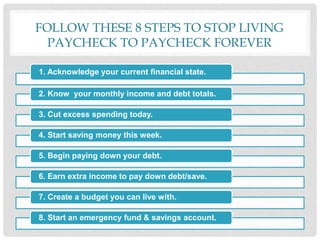
FOLLOW THESE 8 STEPS TO STOP LIVING
PAYCHECK TO PAYCHECK FOREVER
1. Acknowledge your current financial state.
2. Know your monthly income and debt totals.
3. Cut excess spending today.
4. Start saving money this week.
5. Begin paying down your debt.
6. Earn extra income to pay down debt/save.
7. Create a budget you can live with.
8. Start an emergency fund & savings account.
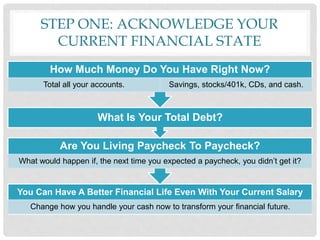
STEP ONE: ACKNOWLEDGE YOUR
CURRENT FINANCIAL STATE
You Can Have A Better Financial Life Even With Your Current Salary
Change how you handle your cash now to transform your financial future.
Are You Living Paycheck To Paycheck?
What would happen if, the next time you expected a paycheck, you didn’t get it?
What Is Your Total Debt?
How Much Money Do You Have Right Now?
Total all your accounts. Savings, stocks/401k, CDs, and cash.
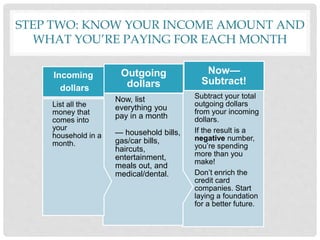
STEP TWO: KNOW YOUR INCOME AMOUNT AND
WHAT YOU’RE PAYING FOR EACH MONTH
Subtract your total
outgoing dollars
from your incoming
dollars.
If the result is a
negative number,
you’re spending
more than you
make!
Don’t enrich the
credit card
companies. Start
laying a foundation
for a better future.
Now—
Subtract!
Now, list
everything you
pay in a month
— household bills,
gas/car bills,
haircuts,
entertainment,
meals out, and
medical/dental.
Outgoing
dollars
List all the
money that
comes into
your
household in a
month.
Incoming
dollars
“MANY PEOPLE ARE IN THE DARK WHEN IT
COMES TO MONEY, AND I’M GOING TO TURN ON
THE LIGHTS.”
SUZE ORMAN
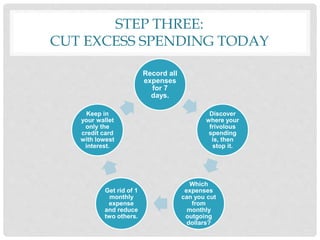
STEP THREE:
CUT EXCESS SPENDING TODAY
Record all
expenses
for 7
days.
Discover
where your
frivolous
spending
is, then
stop it.
Which
expenses
can you cut
from
monthly
outgoing
dollars?
Get rid of 1
monthly
expense
and reduce
two others.
Keep in
your wallet
only the
credit card
with lowest
interest.
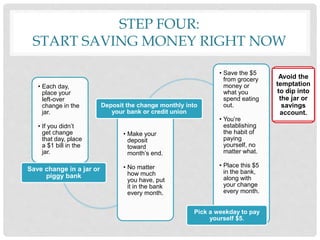
STEP FOUR:
START SAVING MONEY RIGHT NOW
• Each day,
place your
left-over
change in the
jar.
• If you didn’t
get change
that day, place
a $1 bill in the
jar.
Save change in a jar or
piggy bank
• Make your
deposit
toward
month’s end.
• No matter
how much
you have, put
it in the bank
every month.
Deposit the change monthly into
your bank or credit union
• Save the $5
from grocery
money or
what you
spend eating
out.
• You’re
establishing
the habit of
paying
yourself, no
matter what.
• Place this $5
in the bank,
along with
your change
every month.
Pick a weekday to pay
yourself $5.
Avoid the
temptation
to dip into
the jar or
savings
account.
STEP FIVE: BEGIN PAYING
OFF YOUR DEBT
A SECRET TO STOP LIVING PAYCHECK TO PAYCHECK IS
TO REDUCE YOUR DEBT SO YOU’LL HAVE CASH IF YOU
NEED IT
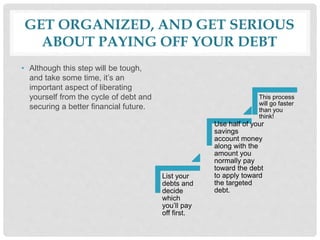
GET ORGANIZED, AND GET SERIOUS
ABOUT PAYING OFF YOUR DEBT
List your
debts and
decide
which
you’ll pay
off first.
Use half of your
savings
account money
along with the
amount you
normally pay
toward the debt
to apply toward
the targeted
debt.
This process
will go faster
than you
think!
• Although this step will be tough,
and take some time, it’s an
important aspect of liberating
yourself from the cycle of debt and
securing a better financial future.
“IT IS INCUMBENT UPON EACH OF US TO IMPROVE SPENDING
AND SAVINGS PRACTICES TO ENSURE OUR OWN INDIVIDUAL
FINANCIAL SECURITY AND PRESERVE THE COLLECTIVE
ECONOMIC WELL-BEING OF OUR GREAT SOCIETY.”
RON LEWIS
STEP SIX: EARN EXTRA INCOME ANY
(HONEST) WAY YOU CAN
• Examine all your skills and abilities with an open
mind.
• You’ll be pleasantly surprised to learn that
people will pay you to do those services for
them.
• Save part of what you earn and use the rest to
pay down debt.
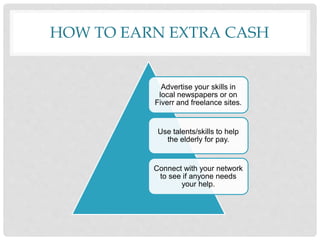
HOW TO EARN EXTRA CASH
Advertise your skills in
local newspapers or on
Fiverr and freelance sites.
Use talents/skills to help
the elderly for pay.
Connect with your network
to see if anyone needs
your help.
“EARLY TO BED AND EARLY TO RISE, MAKES
A MAN HEALTHY, WEALTHY AND WISE.”
BENJAMIN FRANKLIN
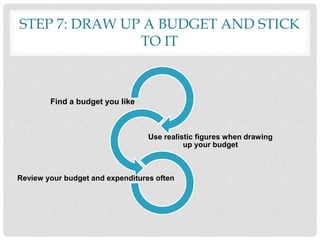
STEP 7: DRAW UP A BUDGET AND STICK
TO IT
Find a budget you like
Use realistic figures when drawing
up your budget
Review your budget and expenditures often
DIFFERENT BUDGETS TO TRY
• The line by line budget-write down all your income and
expenses. Then see what you can cut back on.
• The bucket budget-put all your money into 3 buckets,
such as rent and utilities, food and other important items,
and flexible spending/saving. Divide your paycheck into
3. Whatever is left over in the 3 buckets goes to savings.
STEP EIGHT: USE HALF AND SAVE
THE OTHER HALF OF YOUR SAVINGS
APPLY HALF TOWARD THE DEBT YOU’RE PAYING
OFF
HOW TO MANAGE SAVINGS:
• Apply half of your
total savings toward
the debt you’re
paying off, in addition
to the payment you’d
normally make.
• Hint: Making more than
1 monthly payment will
boost your credit score.
• Leave the other half
of your savings in the
bank to accrue. You’ll
be putting this money
aside as an emergency
fund.
• Hint: Try to find a credit
union that pays
interest. It will not let
you withdraw the
money easily so you
will avoid temptation
and your savings will
keep growing.
CONTINUE SAVING
• Save enough for your 6 month emergency fund
first.
• Next, put aside $500 for a mini-crisis so if
something unforeseen occurs, you’ll be ready.
• Ensure you replace any money you use for a
mini-crisis by continuing to bank your change.
• Later, you can start a New Car Fund or a
Vacation Fund if you like. YOU are in control of
your money and your financial future.
INCREASE THE AMOUNT YOU SAVE
WHENEVER YOU CAN
When you get a raise:
• Boost your savings amount weekly by at least
50% of the amount of the raise.
When you pay off a bill:
• Continue to pay your savings account at least
half of the payment.
• Pay your savings account the whole payment if
you have other debts to pay off so the money
can be applied toward your remaining debt.
"THE ART OF LIVING EASILY AS TO MONEY IS TO
PITCH YOUR SCALE OF LIVING ONE DEGREE
BELOW YOUR MEANS."
SIR HENRY TAYLOR
SUMMARY
HAVE YOU DECIDED TO STOP
LIVING PAYCHECK TO PAYCHECK?
8 SIMPLE STEPS
Acknowledge your financial state
Know incoming and outgoing dollars
Cut excess spending
Start saving money now
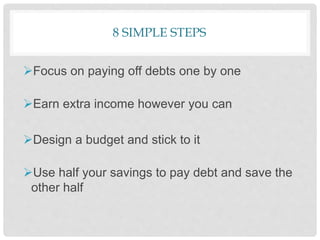
8 SIMPLE STEPS
Focus on paying off debts one by one
Earn extra income however you can
Design a budget and stick to it
Use half your savings to pay debt and save the
other half
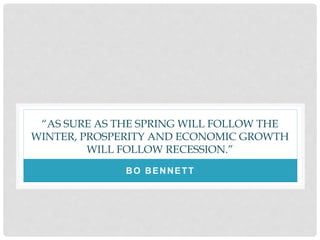
“AS SURE AS THE SPRING WILL FOLLOW THE
WINTER, PROSPERITY AND ECONOMIC GROWTH
WILL FOLLOW RECESSION.”
BO BENNETT
TO YOUR SUCCESS!
NEED MORE HELP? GO TO:
http://eternalspiralbooks.com/prosperity

Prosperity from Paycheck to Paycheck

  • 1.
    PROSPERITY FROM PAYCHECK TOPAYCHECK: MAKE THE MOST OF YOUR MONEY EACH MONTH
  • 2.
    MASTERING THE BASICS •Recognize the importance of knowing your income, debt and savings. • Increase awareness of thoughtless / frivolous spending and how to decrease and eliminate such spending. • See how following a budget can benefit you.
  • 3.
    MASTERING YOUR MONEY •Understand the necessity of paying off debt. • Learn how to use part of your savings to erase debt. • Stay out of debt. • Start to invest in your future.
  • 4.
    FOLLOW THESE 8STEPS TO STOP LIVING PAYCHECK TO PAYCHECK FOREVER 1. Acknowledge your current financial state. 2. Know your monthly income and debt totals. 3. Cut excess spending today. 4. Start saving money this week. 5. Begin paying down your debt. 6. Earn extra income to pay down debt/save. 7. Create a budget you can live with. 8. Start an emergency fund & savings account.
  • 5.
    STEP ONE: ACKNOWLEDGEYOUR CURRENT FINANCIAL STATE You Can Have A Better Financial Life Even With Your Current Salary Change how you handle your cash now to transform your financial future. Are You Living Paycheck To Paycheck? What would happen if, the next time you expected a paycheck, you didn’t get it? What Is Your Total Debt? How Much Money Do You Have Right Now? Total all your accounts. Savings, stocks/401k, CDs, and cash.
  • 6.
    STEP TWO: KNOWYOUR INCOME AMOUNT AND WHAT YOU’RE PAYING FOR EACH MONTH Subtract your total outgoing dollars from your incoming dollars. If the result is a negative number, you’re spending more than you make! Don’t enrich the credit card companies. Start laying a foundation for a better future. Now— Subtract! Now, list everything you pay in a month — household bills, gas/car bills, haircuts, entertainment, meals out, and medical/dental. Outgoing dollars List all the money that comes into your household in a month. Incoming dollars
  • 7.
    “MANY PEOPLE AREIN THE DARK WHEN IT COMES TO MONEY, AND I’M GOING TO TURN ON THE LIGHTS.” SUZE ORMAN
  • 8.
    STEP THREE: CUT EXCESSSPENDING TODAY Record all expenses for 7 days. Discover where your frivolous spending is, then stop it. Which expenses can you cut from monthly outgoing dollars? Get rid of 1 monthly expense and reduce two others. Keep in your wallet only the credit card with lowest interest.
  • 9.
    STEP FOUR: START SAVINGMONEY RIGHT NOW • Each day, place your left-over change in the jar. • If you didn’t get change that day, place a $1 bill in the jar. Save change in a jar or piggy bank • Make your deposit toward month’s end. • No matter how much you have, put it in the bank every month. Deposit the change monthly into your bank or credit union • Save the $5 from grocery money or what you spend eating out. • You’re establishing the habit of paying yourself, no matter what. • Place this $5 in the bank, along with your change every month. Pick a weekday to pay yourself $5. Avoid the temptation to dip into the jar or savings account.
  • 10.
    STEP FIVE: BEGINPAYING OFF YOUR DEBT A SECRET TO STOP LIVING PAYCHECK TO PAYCHECK IS TO REDUCE YOUR DEBT SO YOU’LL HAVE CASH IF YOU NEED IT
  • 11.
    GET ORGANIZED, ANDGET SERIOUS ABOUT PAYING OFF YOUR DEBT List your debts and decide which you’ll pay off first. Use half of your savings account money along with the amount you normally pay toward the debt to apply toward the targeted debt. This process will go faster than you think! • Although this step will be tough, and take some time, it’s an important aspect of liberating yourself from the cycle of debt and securing a better financial future.
  • 12.
    “IT IS INCUMBENTUPON EACH OF US TO IMPROVE SPENDING AND SAVINGS PRACTICES TO ENSURE OUR OWN INDIVIDUAL FINANCIAL SECURITY AND PRESERVE THE COLLECTIVE ECONOMIC WELL-BEING OF OUR GREAT SOCIETY.” RON LEWIS
  • 13.
    STEP SIX: EARNEXTRA INCOME ANY (HONEST) WAY YOU CAN • Examine all your skills and abilities with an open mind. • You’ll be pleasantly surprised to learn that people will pay you to do those services for them. • Save part of what you earn and use the rest to pay down debt.
  • 14.
    HOW TO EARNEXTRA CASH Advertise your skills in local newspapers or on Fiverr and freelance sites. Use talents/skills to help the elderly for pay. Connect with your network to see if anyone needs your help.
  • 15.
    “EARLY TO BEDAND EARLY TO RISE, MAKES A MAN HEALTHY, WEALTHY AND WISE.” BENJAMIN FRANKLIN
  • 16.
    STEP 7: DRAWUP A BUDGET AND STICK TO IT Find a budget you like Use realistic figures when drawing up your budget Review your budget and expenditures often
  • 17.
    DIFFERENT BUDGETS TOTRY • The line by line budget-write down all your income and expenses. Then see what you can cut back on. • The bucket budget-put all your money into 3 buckets, such as rent and utilities, food and other important items, and flexible spending/saving. Divide your paycheck into 3. Whatever is left over in the 3 buckets goes to savings.
  • 18.
    STEP EIGHT: USEHALF AND SAVE THE OTHER HALF OF YOUR SAVINGS APPLY HALF TOWARD THE DEBT YOU’RE PAYING OFF
  • 19.
    HOW TO MANAGESAVINGS: • Apply half of your total savings toward the debt you’re paying off, in addition to the payment you’d normally make. • Hint: Making more than 1 monthly payment will boost your credit score. • Leave the other half of your savings in the bank to accrue. You’ll be putting this money aside as an emergency fund. • Hint: Try to find a credit union that pays interest. It will not let you withdraw the money easily so you will avoid temptation and your savings will keep growing.
  • 20.
    CONTINUE SAVING • Saveenough for your 6 month emergency fund first. • Next, put aside $500 for a mini-crisis so if something unforeseen occurs, you’ll be ready. • Ensure you replace any money you use for a mini-crisis by continuing to bank your change. • Later, you can start a New Car Fund or a Vacation Fund if you like. YOU are in control of your money and your financial future.
  • 21.
    INCREASE THE AMOUNTYOU SAVE WHENEVER YOU CAN When you get a raise: • Boost your savings amount weekly by at least 50% of the amount of the raise. When you pay off a bill: • Continue to pay your savings account at least half of the payment. • Pay your savings account the whole payment if you have other debts to pay off so the money can be applied toward your remaining debt.
  • 22.
    "THE ART OFLIVING EASILY AS TO MONEY IS TO PITCH YOUR SCALE OF LIVING ONE DEGREE BELOW YOUR MEANS." SIR HENRY TAYLOR
  • 23.
    SUMMARY HAVE YOU DECIDEDTO STOP LIVING PAYCHECK TO PAYCHECK?
  • 24.
    8 SIMPLE STEPS Acknowledgeyour financial state Know incoming and outgoing dollars Cut excess spending Start saving money now
  • 25.
    8 SIMPLE STEPS Focuson paying off debts one by one Earn extra income however you can Design a budget and stick to it Use half your savings to pay debt and save the other half
  • 26.
    “AS SURE ASTHE SPRING WILL FOLLOW THE WINTER, PROSPERITY AND ECONOMIC GROWTH WILL FOLLOW RECESSION.” BO BENNETT
  • 27.
    TO YOUR SUCCESS! NEEDMORE HELP? GO TO: http://eternalspiralbooks.com/prosperity