Build a Successful Financial Plan
By Mel Feller, MPA, MHR
Mel Feller Seminars, Coaching For Success 360 Inc. /Mel Feller Coaching
Financial planning is defining your goals in life and realizing that the only way to provide for
them is through disciplined spending, regular saving, and wise investing. It isn’t a blueprint for
life that once drawn never changes. It is flexible and adaptable to your changing needs.
Moreover, best of all, you can accomplish it at any income level.
A sound financial plan includes both short- and long-
term goals. It starts with the realization that, in the
early and even middle years of life, you must
develop the habit of saving. Only by living below
your means can you build a fortress of savings to
pay for the important things that lie ahead.
Here are a few key concepts to power yourplanning:
Look at where you are today. In the black or in the red?
Get your debts under control. Pay them off and turn red intogreen.
Have something to save for – short- and long-term.
Have a spending plan that meets today’s necessities but doesn’t undermine tomorrow’s
goals.
Take advantage of tax-advantaged retirement plans and savings options like
IRAs and 529 college savings plans.
Do not ignore life’s pitfalls. Have insurance that protects you.
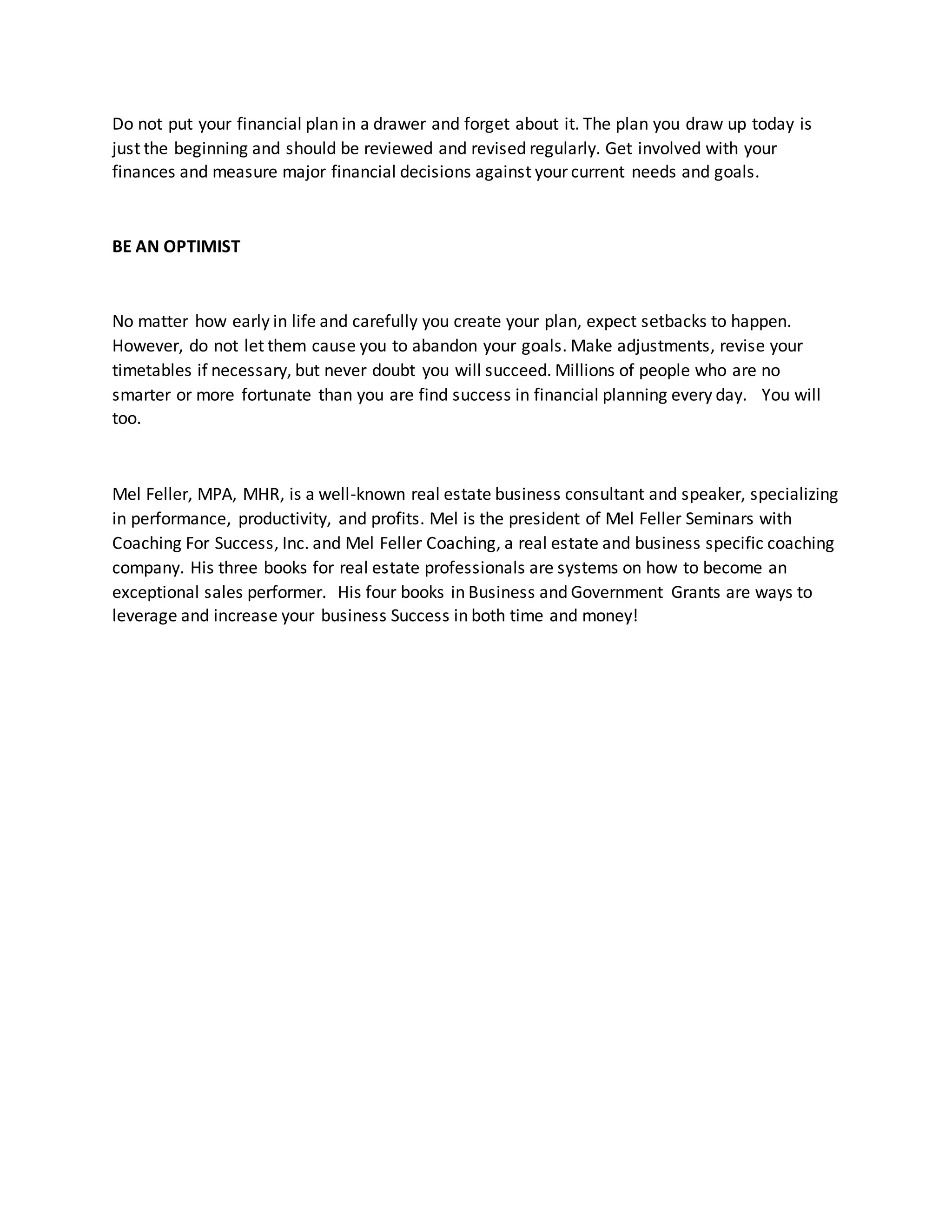
Build a Successful Financial Plan by Mel Feller
Be positive, not negative. Take pride in making your plans come true. Let’s elaborate on these
concepts and see where they take us.
GETTING STARTED
Unless you’re a newborn, you probably have some debt to deal with, maybe more than you
should have. Write down how much you owe, to whom, and at what interest rates you’re
paying. Put high interest credit cards at the top of your list and tell yourself that for many
people plastic is a weapon of mass destruction. Put them in your sock drawer and make more
than the minimum payments until they are paid off. Then only use them in dire emergencies.
Now look at your other debts. Installment loans for things like cars and home appliances may
drain your income each month, but often they are unavoidable and have a fixed payoff time. Do
not sweat home mortgage debt; the interest in tax deductible and the principle is considered
enforced savings.
START WORKING YOUR PLAN
Write down a list of major goals in life, how much they will cost, and when you will need to pay
for them. The cost may seem overwhelming at first, but remember you have a friend on your
side – time. If you start early enough, you will have several years to earn the money you will
need, so there is no need to panic. For college tuition, there are tax-advantaged 529 savings
plans offered by most states.
Just start doing one thing now and do it well: PAY YOURSELF FIRST. That means making regular
contributions to your savings the first item in your budget. If possible, do it with automatic
deposits from you paycheck (or transfers from your checking account) so you never get used to
having those funds available to spend.
Any kind of regular savings program means taking control of yourspending.
Impossible? Of course not. Painful? It may seem so. However, no pain, no gain. Sometimes it is
as simple as keeping track of where your income usually goes and realizing how trivial some of
those expenses really are. A $5 double latte every day adds up to $1,500 a year. Pick some of
your favorite indulgences and do the math.
RETIREMENT
One major casualty of any economic downturn and bear stock market is the rosy retirement
dreams of the 50+ generation. Not only did their assets shrink, but also their plans to stop
working at an early age were shattered. Nevertheless, most of us one day will retire, and
without some early planning, it may not be as idyllic as we thought.
No one can predict the long-term future of Social Security, Medicare, and other government-
assisted programs. However, it seems safe to assume that most of us will have to provide some
of our own income after we stop working. That is why retirement saving and investing should
be part of your financial planning. Make sure you take advantage of sound plans provided by
your employers, even if they require you to contribute while you work. Maximize your 401k
contributions, and make sure the investments are diversified and conservative. Consider tax-
deferred savings plans such as Individual Retirement Accounts (IRAs) as well. Most of these
plans are more flexible today and serve as excellent savings vehicles for other goals such as first
home purchases and college expenses.
DO-IT-YOURSELF OR HIRE A PROFESSIONAL
Building a financial plan is not rocket science, but you donot have to go it alone.
A financial professional has the experience and tools to organize your information and outline a
plan to fit your goals. Make sure you understand how your financial planner is compensated
and be wary of buying financial products you do not really need. Just be certain that you work
with someone who is more interested in your financial wellbeing than her own.
Do not put your financial plan in a drawer and forget about it. The plan you draw up today is
just the beginning and should be reviewed and revised regularly. Get involved with your
finances and measure major financial decisions against your current needs and goals.
BE AN OPTIMIST
No matter how early in life and carefully you create your plan, expect setbacks to happen.
However, do not let them cause you to abandon your goals. Make adjustments, revise your
timetables if necessary, but never doubt you will succeed. Millions of people who are no
smarter or more fortunate than you are find success in financial planning every day. You will
too.
Mel Feller, MPA, MHR, is a well-known real estate business consultant and speaker, specializing
in performance, productivity, and profits. Mel is the president of Mel Feller Seminars with
Coaching For Success, Inc. and Mel Feller Coaching, a real estate and business specific coaching
company. His three books for real estate professionals are systems on how to become an
exceptional sales performer. His four books in Business and Government Grants are ways to
leverage and increase your business Success in both time and money!

Build a successful financial plan

  • 1.
    Build a SuccessfulFinancial Plan By Mel Feller, MPA, MHR Mel Feller Seminars, Coaching For Success 360 Inc. /Mel Feller Coaching Financial planning is defining your goals in life and realizing that the only way to provide for them is through disciplined spending, regular saving, and wise investing. It isn’t a blueprint for life that once drawn never changes. It is flexible and adaptable to your changing needs. Moreover, best of all, you can accomplish it at any income level. A sound financial plan includes both short- and long- term goals. It starts with the realization that, in the early and even middle years of life, you must develop the habit of saving. Only by living below your means can you build a fortress of savings to pay for the important things that lie ahead. Here are a few key concepts to power yourplanning: Look at where you are today. In the black or in the red? Get your debts under control. Pay them off and turn red intogreen. Have something to save for – short- and long-term. Have a spending plan that meets today’s necessities but doesn’t undermine tomorrow’s goals. Take advantage of tax-advantaged retirement plans and savings options like IRAs and 529 college savings plans. Do not ignore life’s pitfalls. Have insurance that protects you. Build a Successful Financial Plan by Mel Feller
  • 2.
    Be positive, notnegative. Take pride in making your plans come true. Let’s elaborate on these concepts and see where they take us. GETTING STARTED Unless you’re a newborn, you probably have some debt to deal with, maybe more than you should have. Write down how much you owe, to whom, and at what interest rates you’re paying. Put high interest credit cards at the top of your list and tell yourself that for many people plastic is a weapon of mass destruction. Put them in your sock drawer and make more than the minimum payments until they are paid off. Then only use them in dire emergencies. Now look at your other debts. Installment loans for things like cars and home appliances may drain your income each month, but often they are unavoidable and have a fixed payoff time. Do not sweat home mortgage debt; the interest in tax deductible and the principle is considered enforced savings. START WORKING YOUR PLAN Write down a list of major goals in life, how much they will cost, and when you will need to pay for them. The cost may seem overwhelming at first, but remember you have a friend on your side – time. If you start early enough, you will have several years to earn the money you will need, so there is no need to panic. For college tuition, there are tax-advantaged 529 savings plans offered by most states. Just start doing one thing now and do it well: PAY YOURSELF FIRST. That means making regular contributions to your savings the first item in your budget. If possible, do it with automatic deposits from you paycheck (or transfers from your checking account) so you never get used to having those funds available to spend. Any kind of regular savings program means taking control of yourspending.
  • 3.
    Impossible? Of coursenot. Painful? It may seem so. However, no pain, no gain. Sometimes it is as simple as keeping track of where your income usually goes and realizing how trivial some of those expenses really are. A $5 double latte every day adds up to $1,500 a year. Pick some of your favorite indulgences and do the math. RETIREMENT One major casualty of any economic downturn and bear stock market is the rosy retirement dreams of the 50+ generation. Not only did their assets shrink, but also their plans to stop working at an early age were shattered. Nevertheless, most of us one day will retire, and without some early planning, it may not be as idyllic as we thought. No one can predict the long-term future of Social Security, Medicare, and other government- assisted programs. However, it seems safe to assume that most of us will have to provide some of our own income after we stop working. That is why retirement saving and investing should be part of your financial planning. Make sure you take advantage of sound plans provided by your employers, even if they require you to contribute while you work. Maximize your 401k contributions, and make sure the investments are diversified and conservative. Consider tax- deferred savings plans such as Individual Retirement Accounts (IRAs) as well. Most of these plans are more flexible today and serve as excellent savings vehicles for other goals such as first home purchases and college expenses. DO-IT-YOURSELF OR HIRE A PROFESSIONAL Building a financial plan is not rocket science, but you donot have to go it alone. A financial professional has the experience and tools to organize your information and outline a plan to fit your goals. Make sure you understand how your financial planner is compensated and be wary of buying financial products you do not really need. Just be certain that you work with someone who is more interested in your financial wellbeing than her own.
  • 4.
    Do not putyour financial plan in a drawer and forget about it. The plan you draw up today is just the beginning and should be reviewed and revised regularly. Get involved with your finances and measure major financial decisions against your current needs and goals. BE AN OPTIMIST No matter how early in life and carefully you create your plan, expect setbacks to happen. However, do not let them cause you to abandon your goals. Make adjustments, revise your timetables if necessary, but never doubt you will succeed. Millions of people who are no smarter or more fortunate than you are find success in financial planning every day. You will too. Mel Feller, MPA, MHR, is a well-known real estate business consultant and speaker, specializing in performance, productivity, and profits. Mel is the president of Mel Feller Seminars with Coaching For Success, Inc. and Mel Feller Coaching, a real estate and business specific coaching company. His three books for real estate professionals are systems on how to become an exceptional sales performer. His four books in Business and Government Grants are ways to leverage and increase your business Success in both time and money!