Propositional Logic for Programmers (or how I learnt to stop over-expressing and love the precedance)
Propositions Functions/Statements which can be resolved to True or False. P – Do you like Sausage Butties? Q – Do you like Bacon Butties[1]? [1] Technically Q is a tautology.
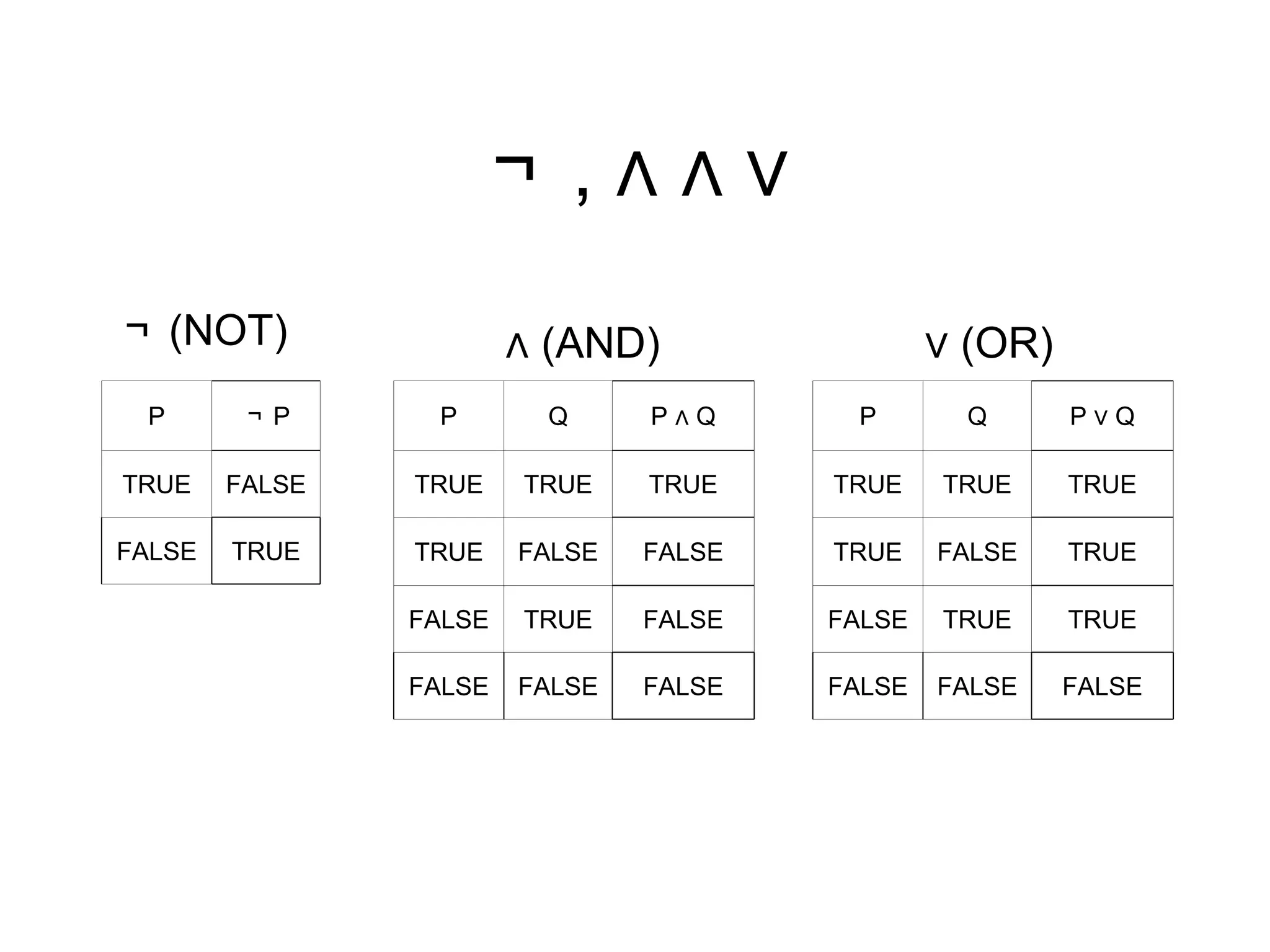
¬ , ∧ ∧ ∨ ¬ (NOT) ∧  (AND) ∨  (OR) P Q P ∧ Q TRUE TRUE TRUE TRUE FALSE FALSE FALSE TRUE FALSE FALSE FALSE FALSE P Q P ∨ Q TRUE TRUE TRUE TRUE FALSE TRUE FALSE TRUE TRUE FALSE FALSE FALSE P ¬ P TRUE FALSE FALSE TRUE
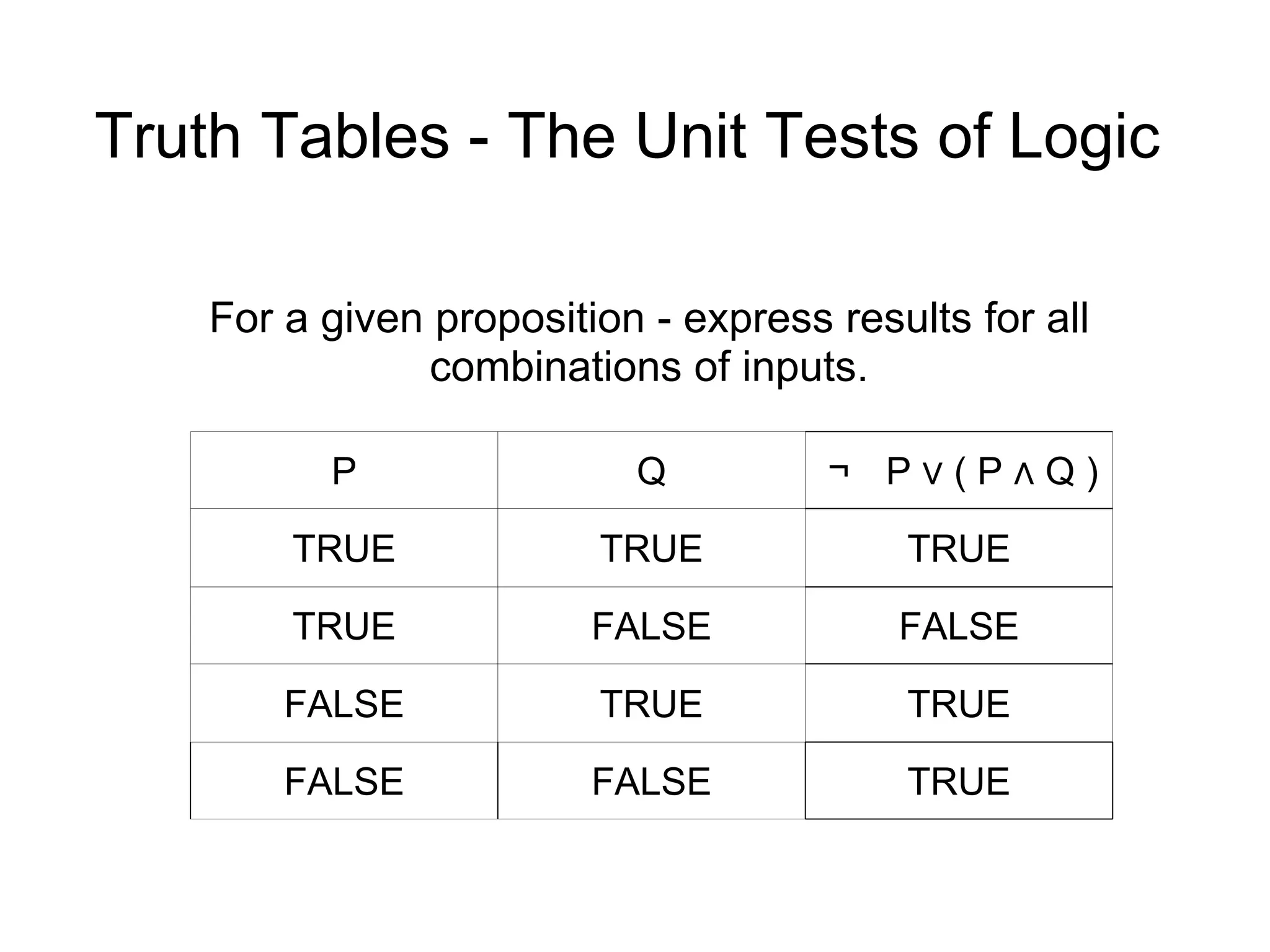
Truth Tables - The Unit Tests of Logic For a given proposition - express results for all combinations of inputs. P Q ¬  P ∨ ( P ∧ Q ) TRUE TRUE TRUE TRUE FALSE FALSE FALSE TRUE TRUE FALSE FALSE TRUE
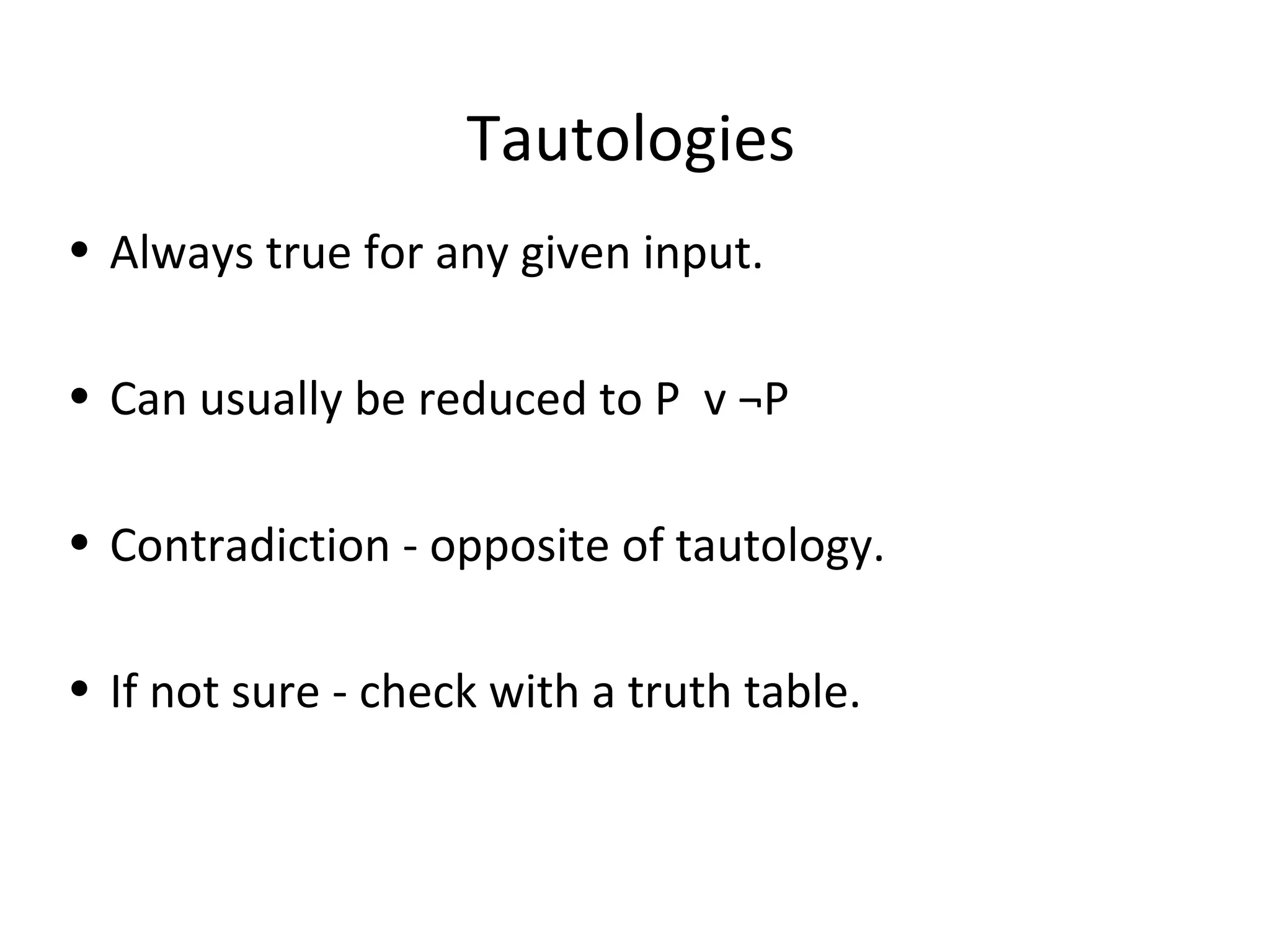
Tautologies Always true for any given input. Can usually be reduced to P  v ¬P Contradiction - opposite of tautology. If not sure - check with a truth table.
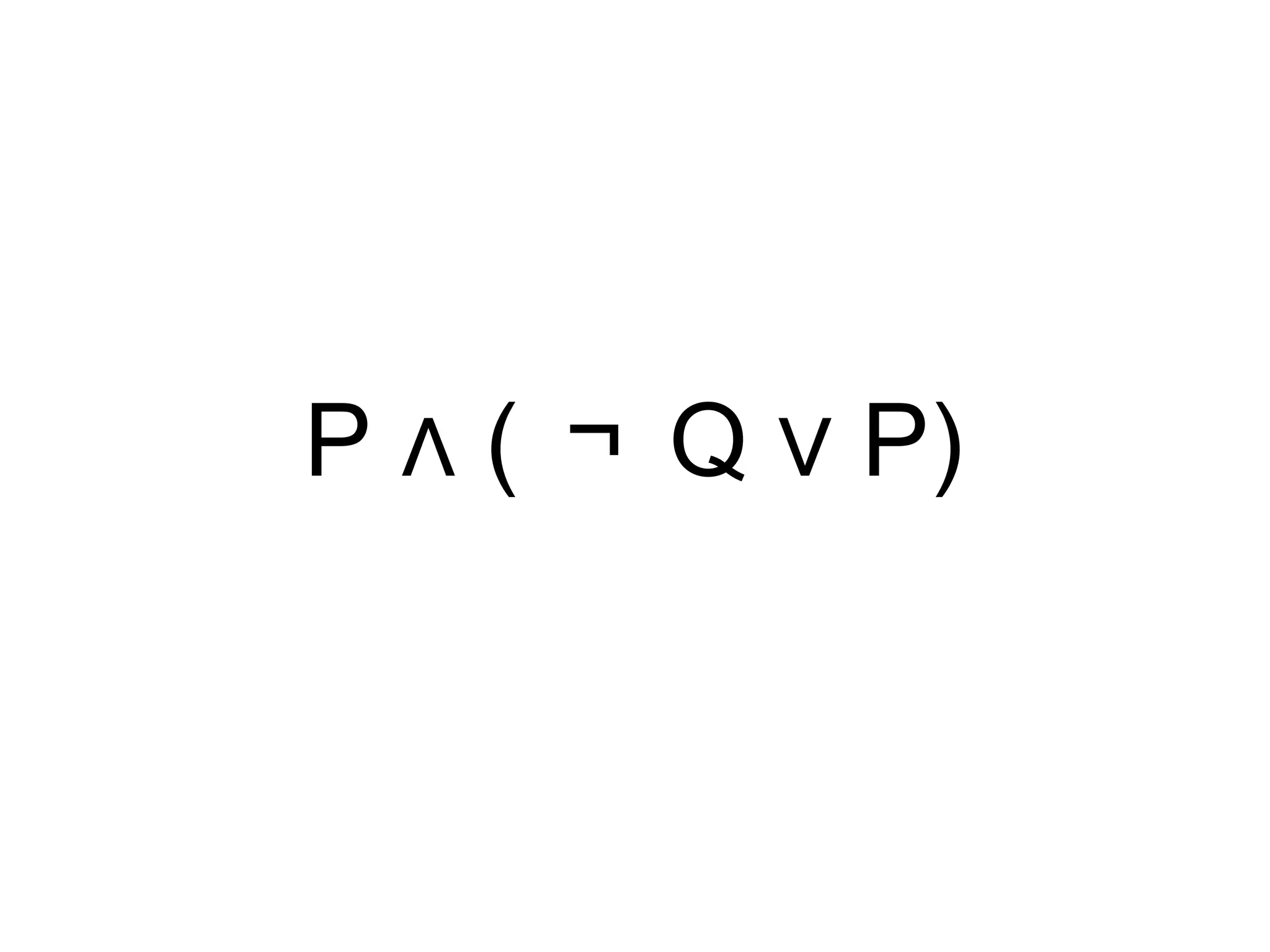
P ∧ ( ¬ Q ∨ P)
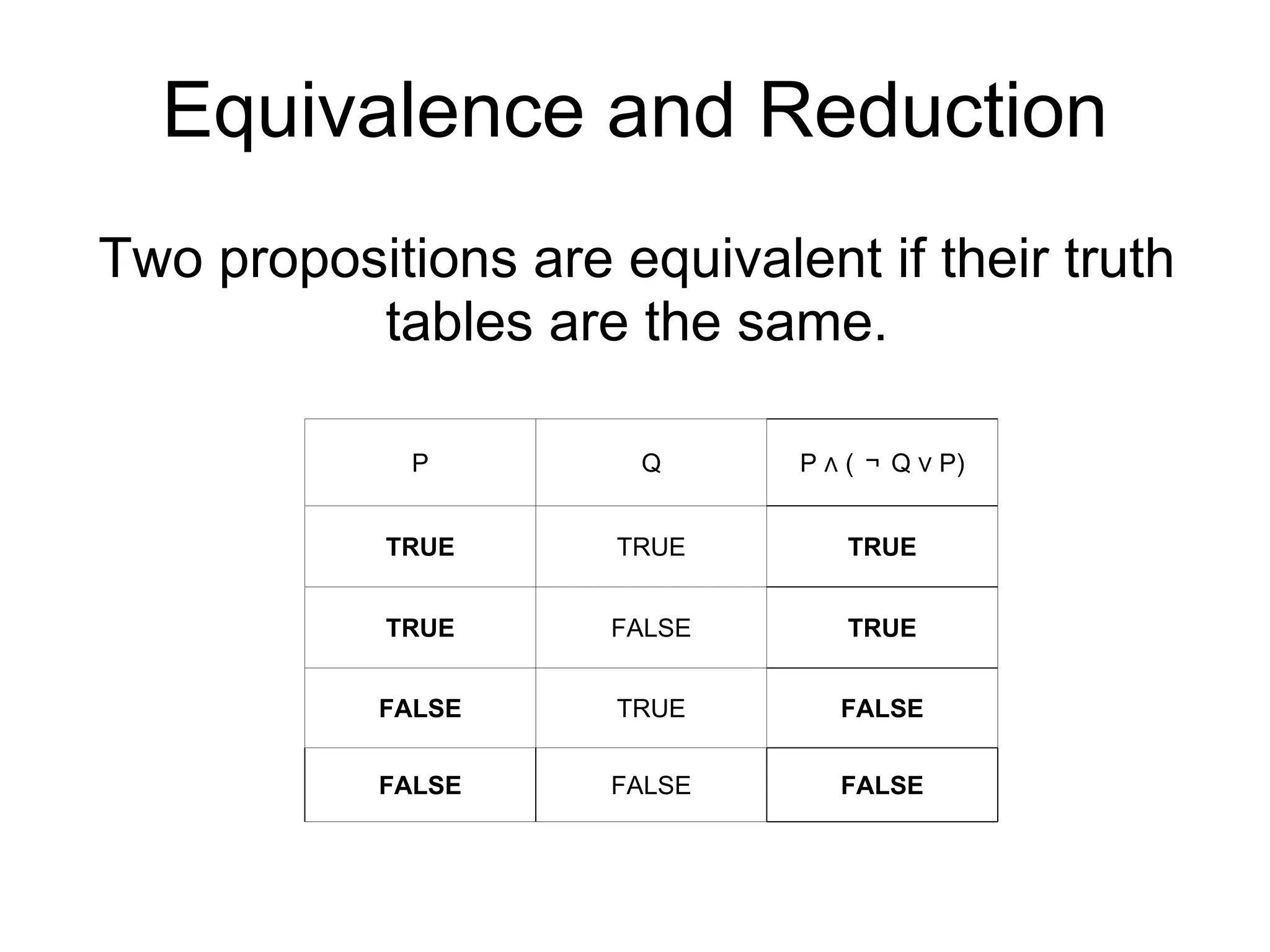
Equivalence and Reduction Two propositions are equivalent if their truth tables are the same. P Q P ∧ ( ¬ Q ∨ P) TRUE TRUE TRUE TRUE FALSE TRUE FALSE TRUE FALSE FALSE FALSE FALSE
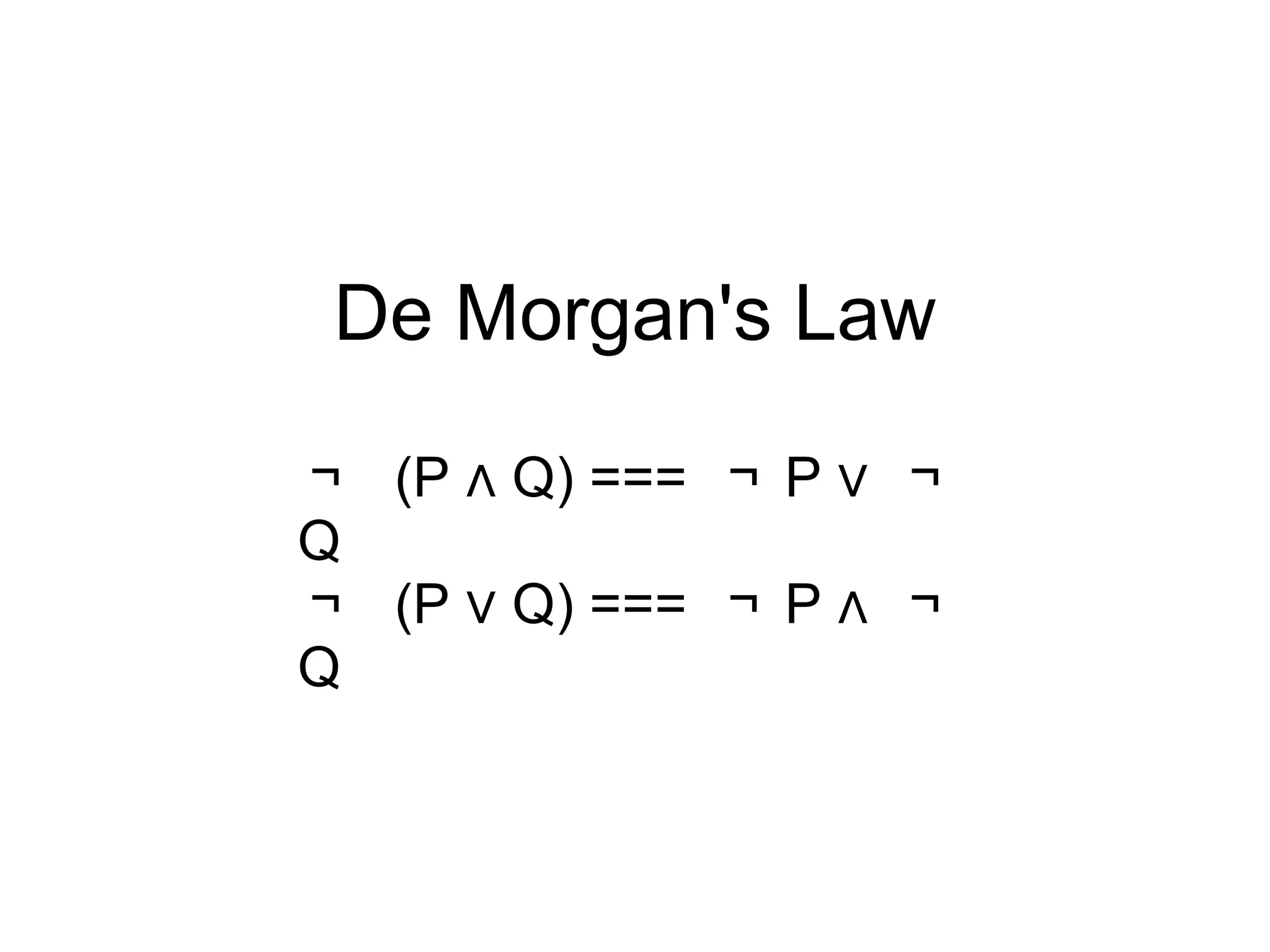
De Morgan's Law ¬  (P ∧ Q) ===  ¬ P ∨  ¬ Q ¬  (P ∨ Q) ===  ¬ P ∧  ¬ Q
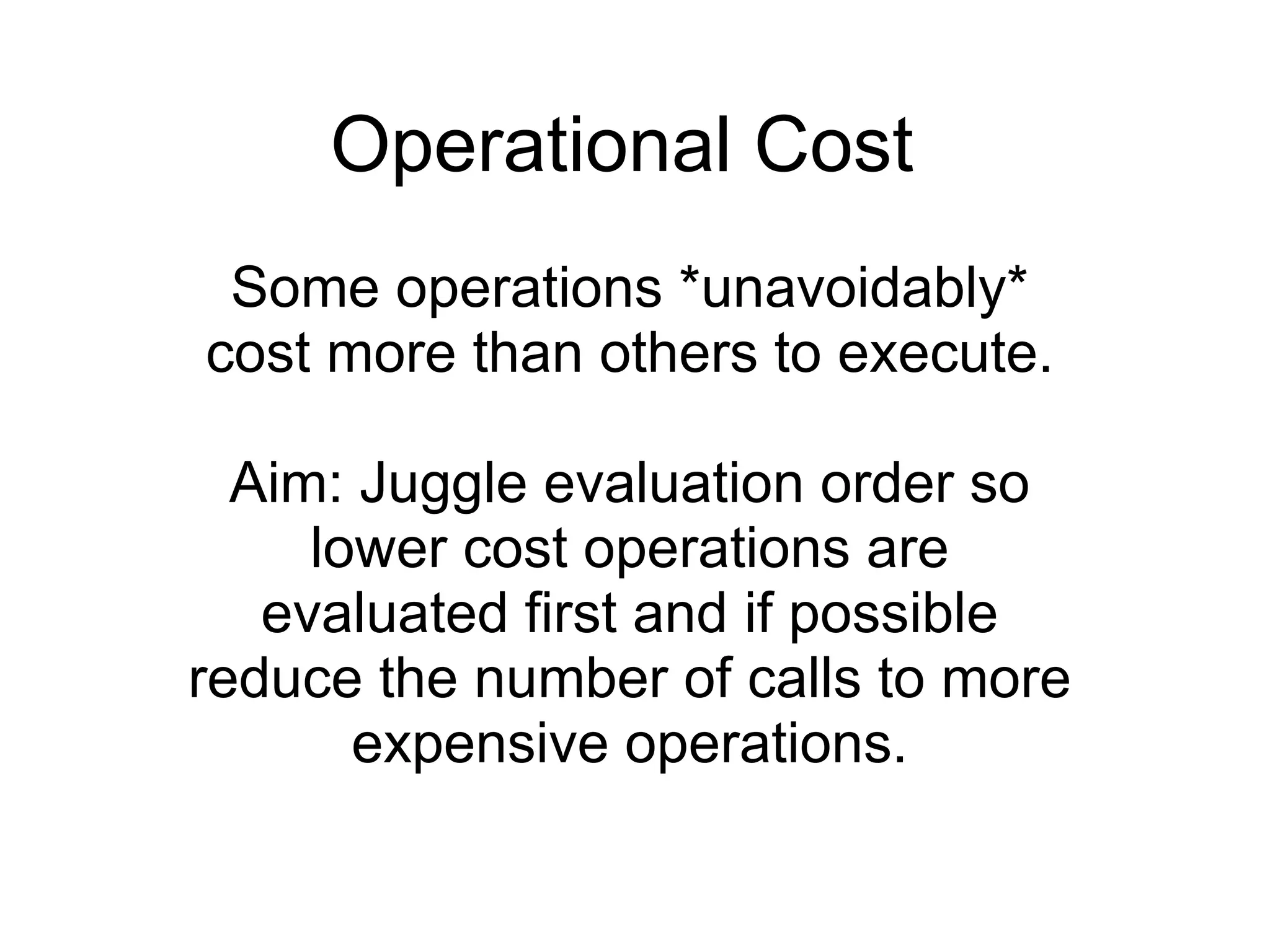
Operational Cost Some operations *unavoidably* cost more than others to execute. Aim: Juggle evaluation order so lower cost operations are evaluated first and if possible reduce the number of calls to more expensive operations.
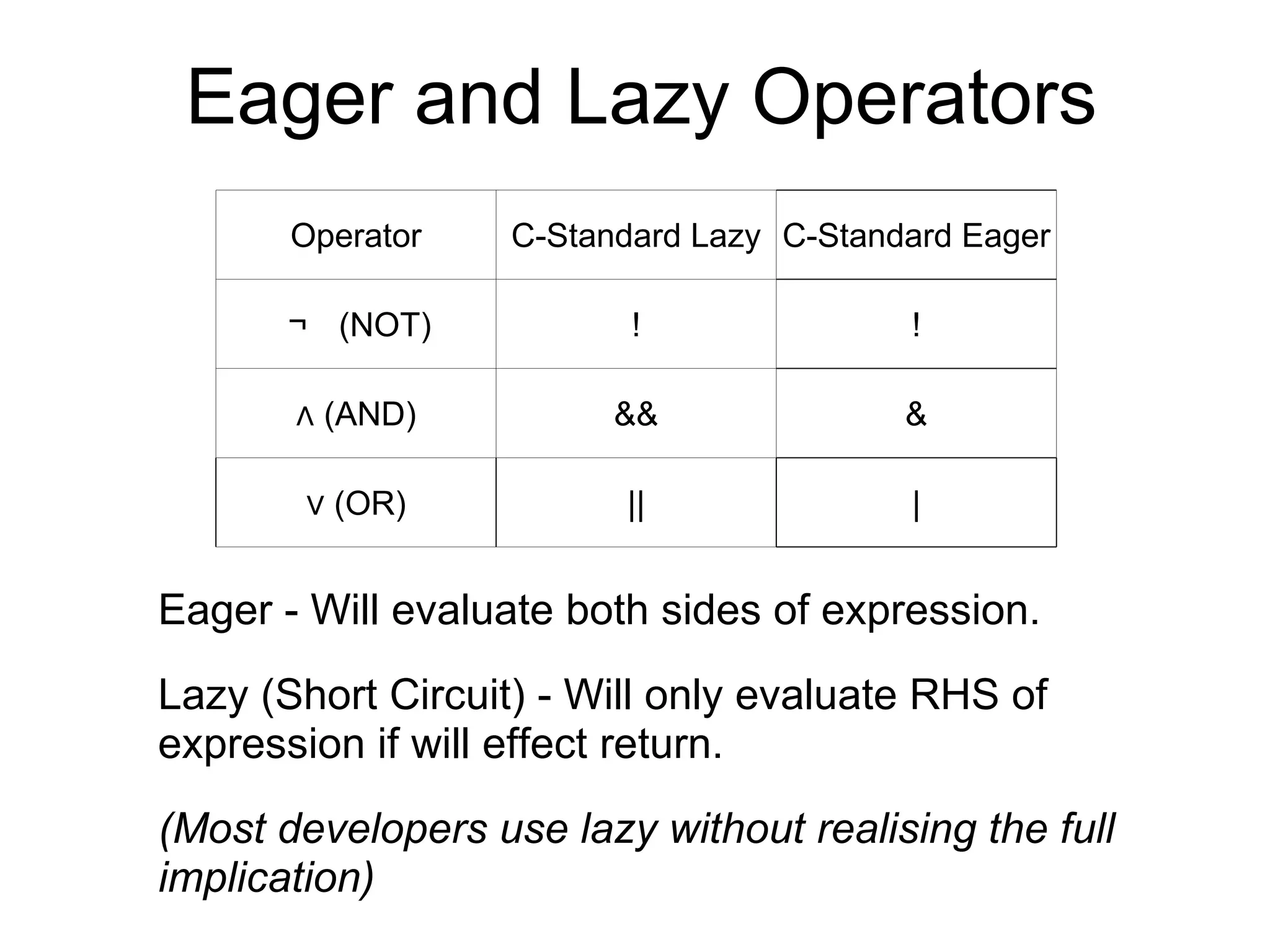
Eager and Lazy Operators Eager - Will evaluate both sides of expression. Lazy (Short Circuit) - Will only evaluate RHS of expression if will effect return. (Most developers use lazy without realising the full implication) Operator C-Standard Lazy C-Standard Eager ¬  (NOT) ! ! ∧  (AND) && & ∨  (OR) || |
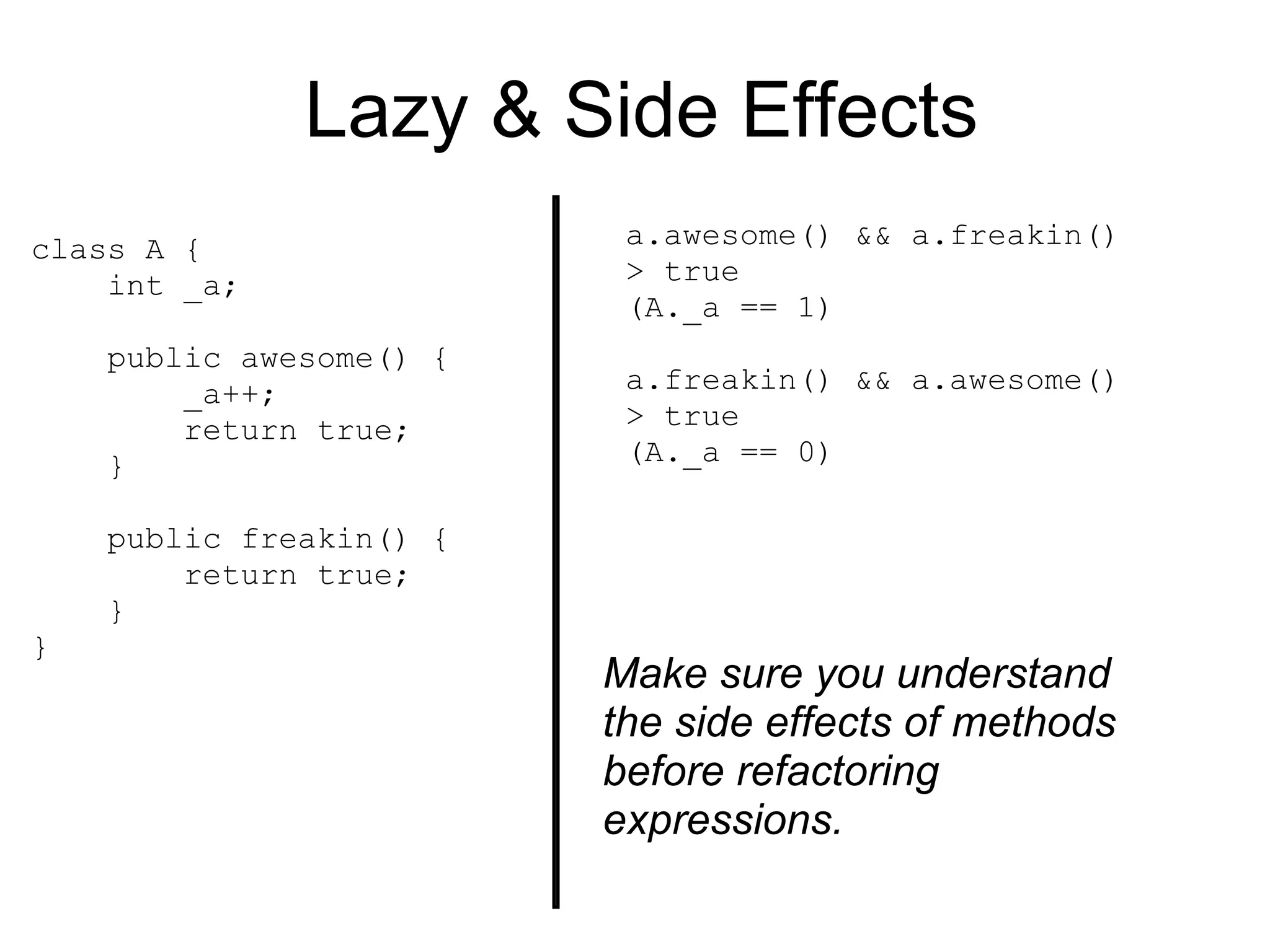
Lazy & Side Effects class A {      int _a;      public awesome() {          _a++;          return true;      }      public freakin() {          return true;      } } a.awesome() && a.freakin() > true (A._a == 1) a.freakin() && a.awesome() > true (A._a == 0) Make sure you understand the side effects of methods before refactoring expressions.
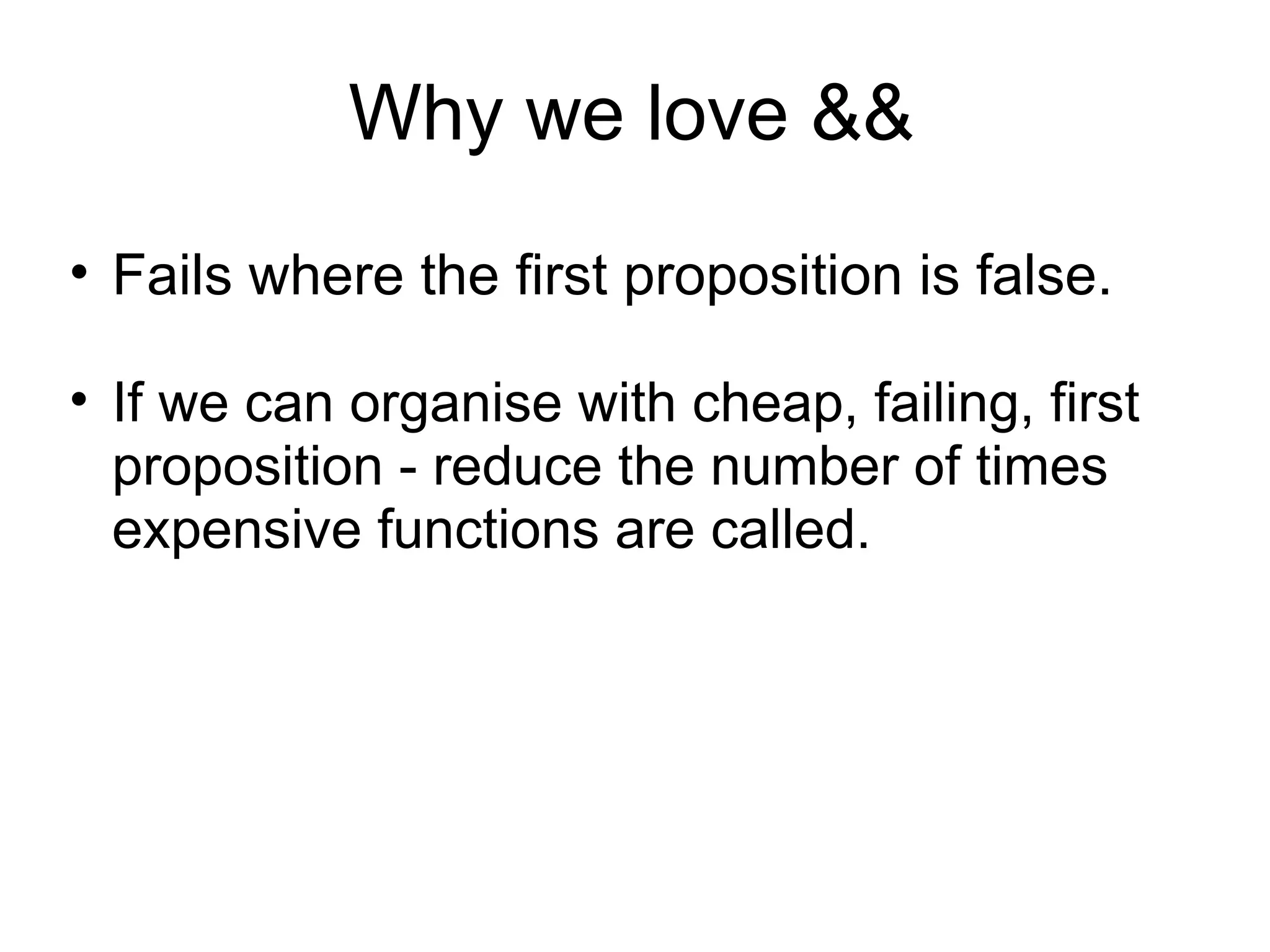
Why we love && Fails where the first proposition is false. If we can organise with cheap, failing, first proposition - reduce the number of times expensive functions are called.
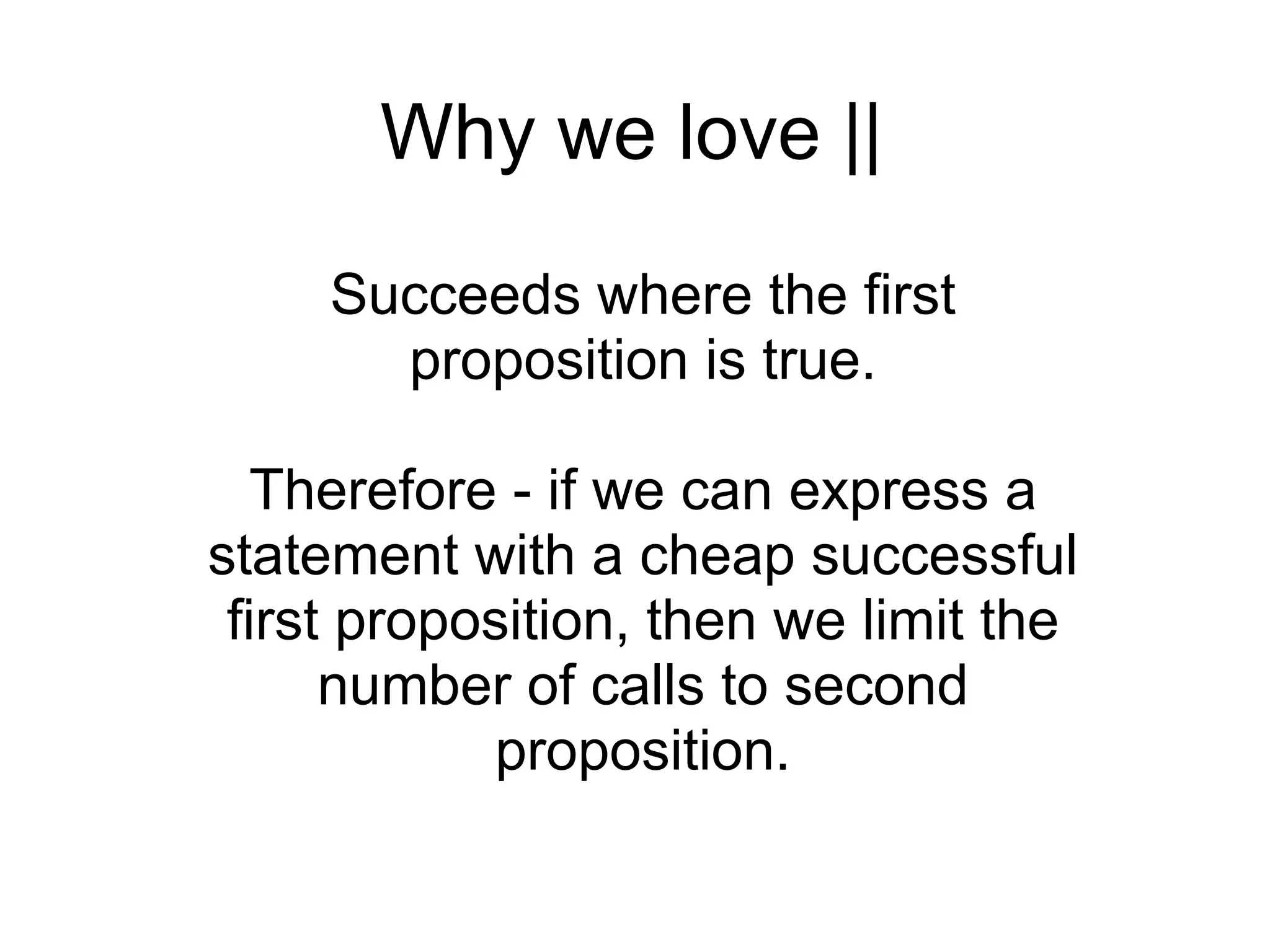
Why we love || Succeeds where the first proposition is true. Therefore - if we can express a statement with a cheap successful first proposition, then we limit the number of calls to second proposition.
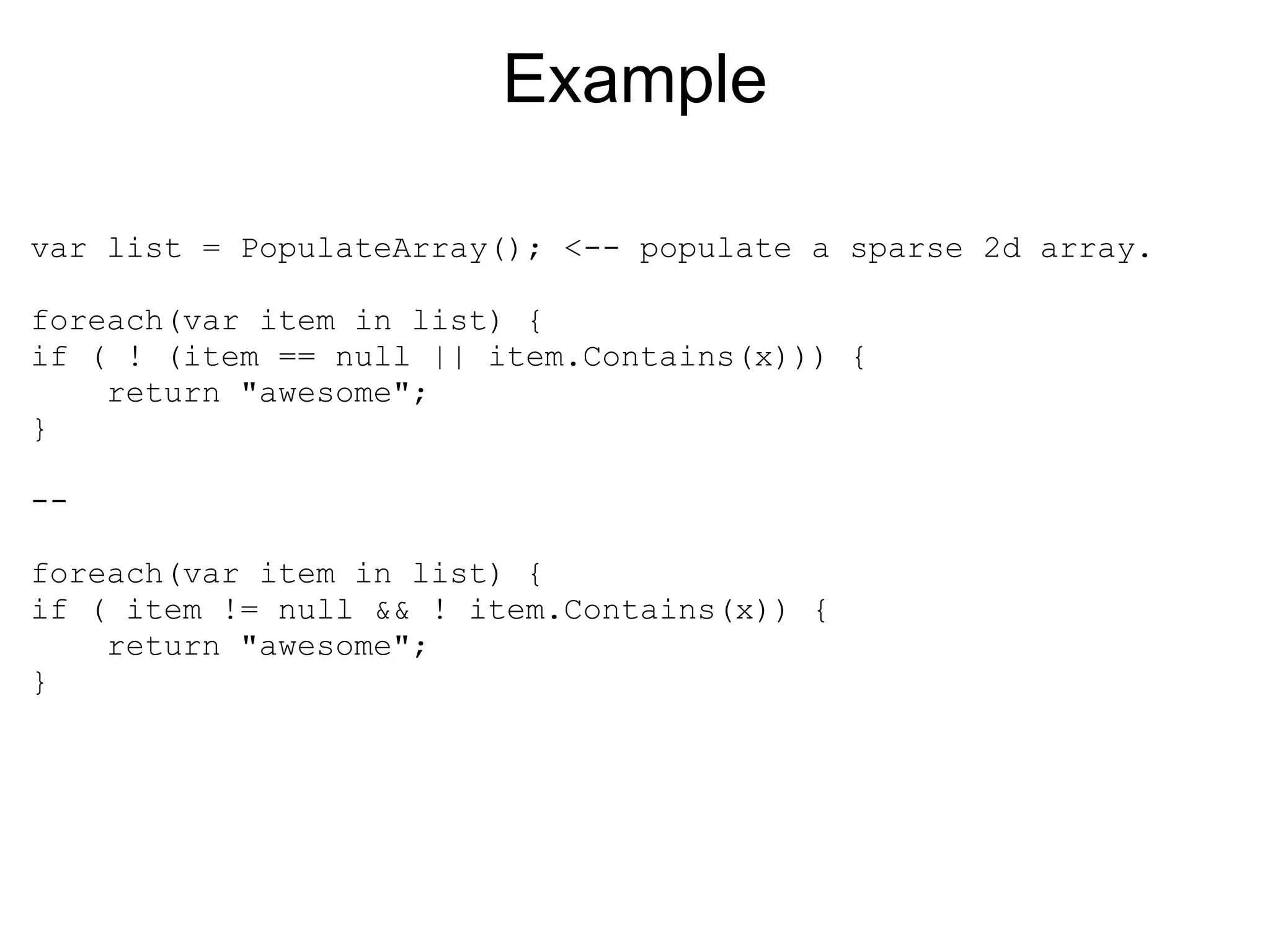
Example var list = PopulateArray(); <-- populate a sparse 2d array. foreach(var item in list) { if ( ! (item == null || item.Contains(x))) {      return &quot;awesome&quot;; } -- foreach(var item in list) { if ( item != null && ! item.Contains(x)) {      return &quot;awesome&quot;; }
Summary The Essence of Discrete Mathematics, Neville Dean, ISBN: 0-13-345943-8 Kian Ryan http://www.kianryan.co.uk/

Propositional logic for Beginners

  • 1.
    Propositional Logic forProgrammers (or how I learnt to stop over-expressing and love the precedance)
  • 2.
    Propositions Functions/Statements whichcan be resolved to True or False. P – Do you like Sausage Butties? Q – Do you like Bacon Butties[1]? [1] Technically Q is a tautology.
  • 3.
    ¬ , ∧∧ ∨ ¬ (NOT) ∧  (AND) ∨  (OR) P Q P ∧ Q TRUE TRUE TRUE TRUE FALSE FALSE FALSE TRUE FALSE FALSE FALSE FALSE P Q P ∨ Q TRUE TRUE TRUE TRUE FALSE TRUE FALSE TRUE TRUE FALSE FALSE FALSE P ¬ P TRUE FALSE FALSE TRUE
  • 4.
    Truth Tables -The Unit Tests of Logic For a given proposition - express results for all combinations of inputs. P Q ¬ P ∨ ( P ∧ Q ) TRUE TRUE TRUE TRUE FALSE FALSE FALSE TRUE TRUE FALSE FALSE TRUE
  • 5.
    Tautologies Always truefor any given input. Can usually be reduced to P v ¬P Contradiction - opposite of tautology. If not sure - check with a truth table.
  • 6.
    P ∧ (¬ Q ∨ P)
  • 7.
    Equivalence and ReductionTwo propositions are equivalent if their truth tables are the same. P Q P ∧ ( ¬ Q ∨ P) TRUE TRUE TRUE TRUE FALSE TRUE FALSE TRUE FALSE FALSE FALSE FALSE
  • 8.
    De Morgan's Law¬ (P ∧ Q) === ¬ P ∨ ¬ Q ¬ (P ∨ Q) === ¬ P ∧ ¬ Q
  • 9.
    Operational Cost Someoperations *unavoidably* cost more than others to execute. Aim: Juggle evaluation order so lower cost operations are evaluated first and if possible reduce the number of calls to more expensive operations.
  • 10.
    Eager and LazyOperators Eager - Will evaluate both sides of expression. Lazy (Short Circuit) - Will only evaluate RHS of expression if will effect return. (Most developers use lazy without realising the full implication) Operator C-Standard Lazy C-Standard Eager ¬ (NOT) ! ! ∧ (AND) && & ∨ (OR) || |
  • 11.
    Lazy & SideEffects class A {     int _a;     public awesome() {         _a++;         return true;      }     public freakin() {         return true;      } } a.awesome() && a.freakin() > true (A._a == 1) a.freakin() && a.awesome() > true (A._a == 0) Make sure you understand the side effects of methods before refactoring expressions.
  • 12.
    Why we love&& Fails where the first proposition is false. If we can organise with cheap, failing, first proposition - reduce the number of times expensive functions are called.
  • 13.
    Why we love|| Succeeds where the first proposition is true. Therefore - if we can express a statement with a cheap successful first proposition, then we limit the number of calls to second proposition.
  • 14.
    Example var list= PopulateArray(); <-- populate a sparse 2d array. foreach(var item in list) { if ( ! (item == null || item.Contains(x))) {     return &quot;awesome&quot;; } -- foreach(var item in list) { if ( item != null && ! item.Contains(x)) {     return &quot;awesome&quot;; }
  • 15.
    Summary The Essenceof Discrete Mathematics, Neville Dean, ISBN: 0-13-345943-8 Kian Ryan http://www.kianryan.co.uk/