The ‘eLearning’ Edge
Enhancing Organizational learning through
elearning.
Executive presentation by
Olufunso Steve Olofinlade
2014
eLearning doesn’t just “happen”! It requires
careful planning and implementation.”
- Anonymous
Overview
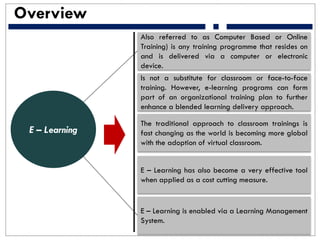
Also referred to as Computer Based or Online
Training) is any training programme that resides on
and is delivered via a computer or electronic
device.
Is not a substitute for classroom or face-to-face
training. However, e-learning programs can form
part of an organizational training plan to further
enhance a blended learning delivery approach.
The traditional approach to classroom trainings is
fast changing as the world is becoming more global
with the adoption of virtual classroom.
E – Learning has also become a very effective tool
when applied as a cost cutting measure.
E – Learning is enabled via a Learning Management
System.
E – Learning
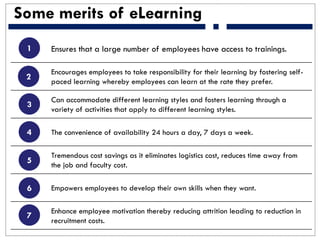
Some merits of eLearning
Ensures that a large number of employees have access to trainings.
Encourages employees to take responsibility for their learning by fostering self-
paced learning whereby employees can learn at the rate they prefer.
Can accommodate different learning styles and fosters learning through a
variety of activities that apply to different learning styles.
The convenience of availability 24 hours a day, 7 days a week.
Tremendous cost savings as it eliminates logistics cost, reduces time away from
the job and faculty cost.
Empowers employees to develop their own skills when they want.
Enhance employee motivation thereby reducing attrition leading to reduction in
recruitment costs.
1
2
3
4
5
6
7
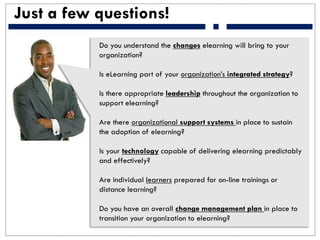
Just a few questions!
Do you understand the changes elearning will bring to your
organization?
Is eLearning part of your organization’s integrated strategy?
Is there appropriate leadership throughout the organization to
support elearning?
Are there organizational support systems in place to sustain
the adoption of elearning?
Is your technology capable of delivering elearning predictably
and effectively?
Are individual learners prepared for on-line trainings or
distance learning?
Do you have an overall change management plan in place to
transition your organization to elearning?
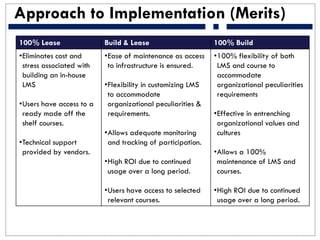
Approach to Implementation (Merits)
100% Lease Build & Lease 100% Build
•Eliminates cost and
stress associated with
building an in-house
LMS
•Users have access to a
ready made off the
shelf courses.
•Technical support
provided by vendors.
•Ease of maintenance as access
to infrastructure is ensured.
•Flexibility in customizing LMS
to accommodate
organizational peculiarities &
requirements.
•Allows adequate monitoring
and tracking of participation.
•High ROI due to continued
usage over a long period.
•Users have access to selected
relevant courses.
•100% flexibility of both
LMS and course to
accommodate
organizational peculiarities
requirements
•Effective in entrenching
organizational values and
cultures
•Allows a 100%
maintenance of LMS and
courses.
•High ROI due to continued
usage over a long period.
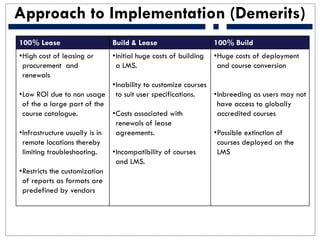
Approach to Implementation (Demerits)
100% Lease Build & Lease 100% Build
•High cost of leasing or
procurement and
renewals
•Low ROI due to non usage
of the a large part of the
course catalogue.
•Infrastructure usually is in
remote locations thereby
limiting troubleshooting.
•Restricts the customization
of reports as formats are
predefined by vendors
•Initial huge costs of building
a LMS.
•Inability to customize courses
to suit user specifications.
•Costs associated with
renewals of lease
agreements.
•Incompatibility of courses
and LMS.
•Huge costs of deployment
and course conversion
•Inbreeding as users may not
have access to globally
accredited courses
•Possible extinction of
courses deployed on the
LMS
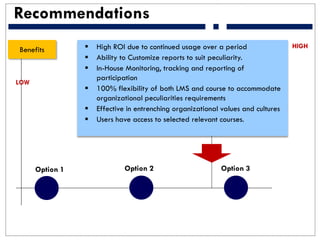
Recommendations
 High ROI due to continued usage over a period
 Ability to Customize reports to suit peculiarity.
 In-House Monitoring, tracking and reporting of
participation
 100% flexibility of both LMS and course to accommodate
organizational peculiarities requirements
 Effective in entrenching organizational values and cultures
 Users have access to selected relevant courses.
Option 1 Option 2 Option 3
Benefits HIGH
LOW
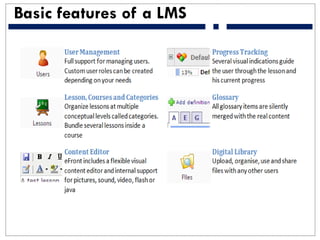
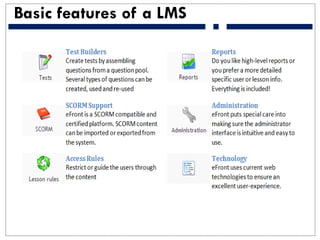
Basic features of a LMS
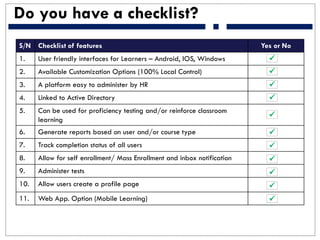
Do you have a checklist?
S/N Checklist of features Yes or No
1. User friendly interfaces for Learners – Android, IOS, Windows
2. Available Customization Options (100% Local Control)
3. A platform easy to administer by HR
4. Linked to Active Directory
5. Can be used for proficiency testing and/or reinforce classroom
learning
6. Generate reports based on user and/or course type
7. Track completion status of all users
8. Allow for self enrollment/ Mass Enrollment and inbox notification
9. Administer tests
10. Allow users create a profile page
11. Web App. Option (Mobile Learning)











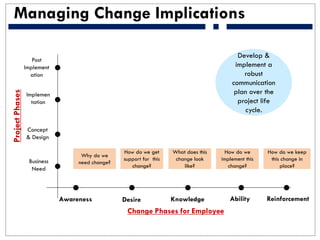
Managing Change Implications
Awareness Desire Knowledge Ability Reinforcement
Business
Need
Concept
& Design
Implemen
tation
Post
Implement
ation
ProjectPhases
Change Phases for Employee
Develop &
implement a
robust
communication
plan over the
project life
cycle.
Why do we
need change?
How do we get
support for this
change?
What does this
change look
like?
How do we
implement this
change?
How do we keep
this change in
place?
Thank You.

Proposing the elearning edge

  • 1.
    The ‘eLearning’ Edge EnhancingOrganizational learning through elearning. Executive presentation by Olufunso Steve Olofinlade 2014
  • 2.
    eLearning doesn’t just“happen”! It requires careful planning and implementation.” - Anonymous
  • 3.
    Overview Also referred toas Computer Based or Online Training) is any training programme that resides on and is delivered via a computer or electronic device. Is not a substitute for classroom or face-to-face training. However, e-learning programs can form part of an organizational training plan to further enhance a blended learning delivery approach. The traditional approach to classroom trainings is fast changing as the world is becoming more global with the adoption of virtual classroom. E – Learning has also become a very effective tool when applied as a cost cutting measure. E – Learning is enabled via a Learning Management System. E – Learning
  • 4.
    Some merits ofeLearning Ensures that a large number of employees have access to trainings. Encourages employees to take responsibility for their learning by fostering self- paced learning whereby employees can learn at the rate they prefer. Can accommodate different learning styles and fosters learning through a variety of activities that apply to different learning styles. The convenience of availability 24 hours a day, 7 days a week. Tremendous cost savings as it eliminates logistics cost, reduces time away from the job and faculty cost. Empowers employees to develop their own skills when they want. Enhance employee motivation thereby reducing attrition leading to reduction in recruitment costs. 1 2 3 4 5 6 7
  • 5.
    Just a fewquestions! Do you understand the changes elearning will bring to your organization? Is eLearning part of your organization’s integrated strategy? Is there appropriate leadership throughout the organization to support elearning? Are there organizational support systems in place to sustain the adoption of elearning? Is your technology capable of delivering elearning predictably and effectively? Are individual learners prepared for on-line trainings or distance learning? Do you have an overall change management plan in place to transition your organization to elearning?
  • 6.
    Approach to Implementation(Merits) 100% Lease Build & Lease 100% Build •Eliminates cost and stress associated with building an in-house LMS •Users have access to a ready made off the shelf courses. •Technical support provided by vendors. •Ease of maintenance as access to infrastructure is ensured. •Flexibility in customizing LMS to accommodate organizational peculiarities & requirements. •Allows adequate monitoring and tracking of participation. •High ROI due to continued usage over a long period. •Users have access to selected relevant courses. •100% flexibility of both LMS and course to accommodate organizational peculiarities requirements •Effective in entrenching organizational values and cultures •Allows a 100% maintenance of LMS and courses. •High ROI due to continued usage over a long period.
  • 7.
    Approach to Implementation(Demerits) 100% Lease Build & Lease 100% Build •High cost of leasing or procurement and renewals •Low ROI due to non usage of the a large part of the course catalogue. •Infrastructure usually is in remote locations thereby limiting troubleshooting. •Restricts the customization of reports as formats are predefined by vendors •Initial huge costs of building a LMS. •Inability to customize courses to suit user specifications. •Costs associated with renewals of lease agreements. •Incompatibility of courses and LMS. •Huge costs of deployment and course conversion •Inbreeding as users may not have access to globally accredited courses •Possible extinction of courses deployed on the LMS
  • 8.
    Recommendations  High ROIdue to continued usage over a period  Ability to Customize reports to suit peculiarity.  In-House Monitoring, tracking and reporting of participation  100% flexibility of both LMS and course to accommodate organizational peculiarities requirements  Effective in entrenching organizational values and cultures  Users have access to selected relevant courses. Option 1 Option 2 Option 3 Benefits HIGH LOW
  • 9.
  • 10.
  • 11.
    Do you havea checklist? S/N Checklist of features Yes or No 1. User friendly interfaces for Learners – Android, IOS, Windows 2. Available Customization Options (100% Local Control) 3. A platform easy to administer by HR 4. Linked to Active Directory 5. Can be used for proficiency testing and/or reinforce classroom learning 6. Generate reports based on user and/or course type 7. Track completion status of all users 8. Allow for self enrollment/ Mass Enrollment and inbox notification 9. Administer tests 10. Allow users create a profile page 11. Web App. Option (Mobile Learning)           
  • 12.
    Managing Change Implications AwarenessDesire Knowledge Ability Reinforcement Business Need Concept & Design Implemen tation Post Implement ation ProjectPhases Change Phases for Employee Develop & implement a robust communication plan over the project life cycle. Why do we need change? How do we get support for this change? What does this change look like? How do we implement this change? How do we keep this change in place?
  • 13.