INTERNATIONAL UNION FOR CONSERVATION OF NATURE
Good practices in public participation
Katharine Cross, IUCN
IW Learn African Regional Workshop
April 4th
, 2012
2
INTERNATIONAL UNION FOR CONSERVATION OF NATUREINTERNATIONAL UNION FOR CONSERVATION OF NATURE
Outline
• Modes of public participation
• Multistakeholder platforms
• Engaging from top down and bottom up
• Case studies – Tanzania, Uganda and Guatemala
• Tools
• Discussion questions
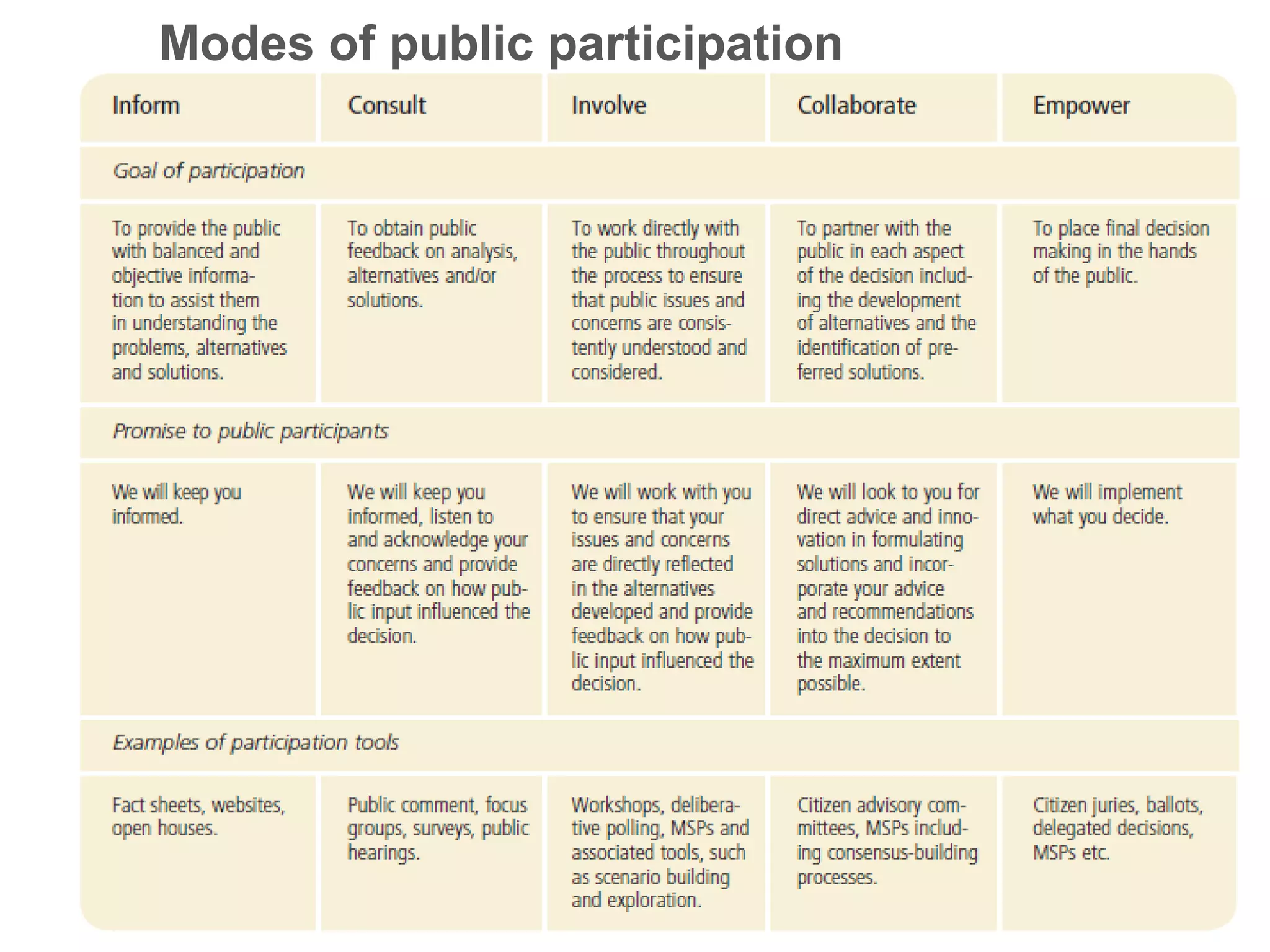
Modes of public participation
4
INTERNATIONAL UNION FOR CONSERVATION OF NATUREINTERNATIONAL UNION FOR CONSERVATION OF NATURE
Multistakeholder platforms
• Stakeholders with interests in water decisions need to work together to
understand their differences and search for solutions that each can accept
• Different stakeholders are identified and, usually through representatives,
invited and assisted to interact in a deliberative forum that focuses on:
– sharing knowledge and perspectives
– generating and examining options
– informing and shaping negotiations and decisions
• The purpose and scope of an MSP must be clear, with appropriate scales
and levels for deliberation and analysis (for example watershed versus river
basin, or local district versus national).
• MSPs expand representation and participation of stakeholders in
governance. They encourage learning and greater understanding of
interdependencies among stakeholders and ways of resolving contested
issues
• By providing a pathway for deliberation, MSPs can lead to better decisions
and water agreements that can be more successfully implemented.
5
INTERNATIONAL UNION FOR CONSERVATION OF NATUREINTERNATIONAL UNION FOR CONSERVATION OF NATURE
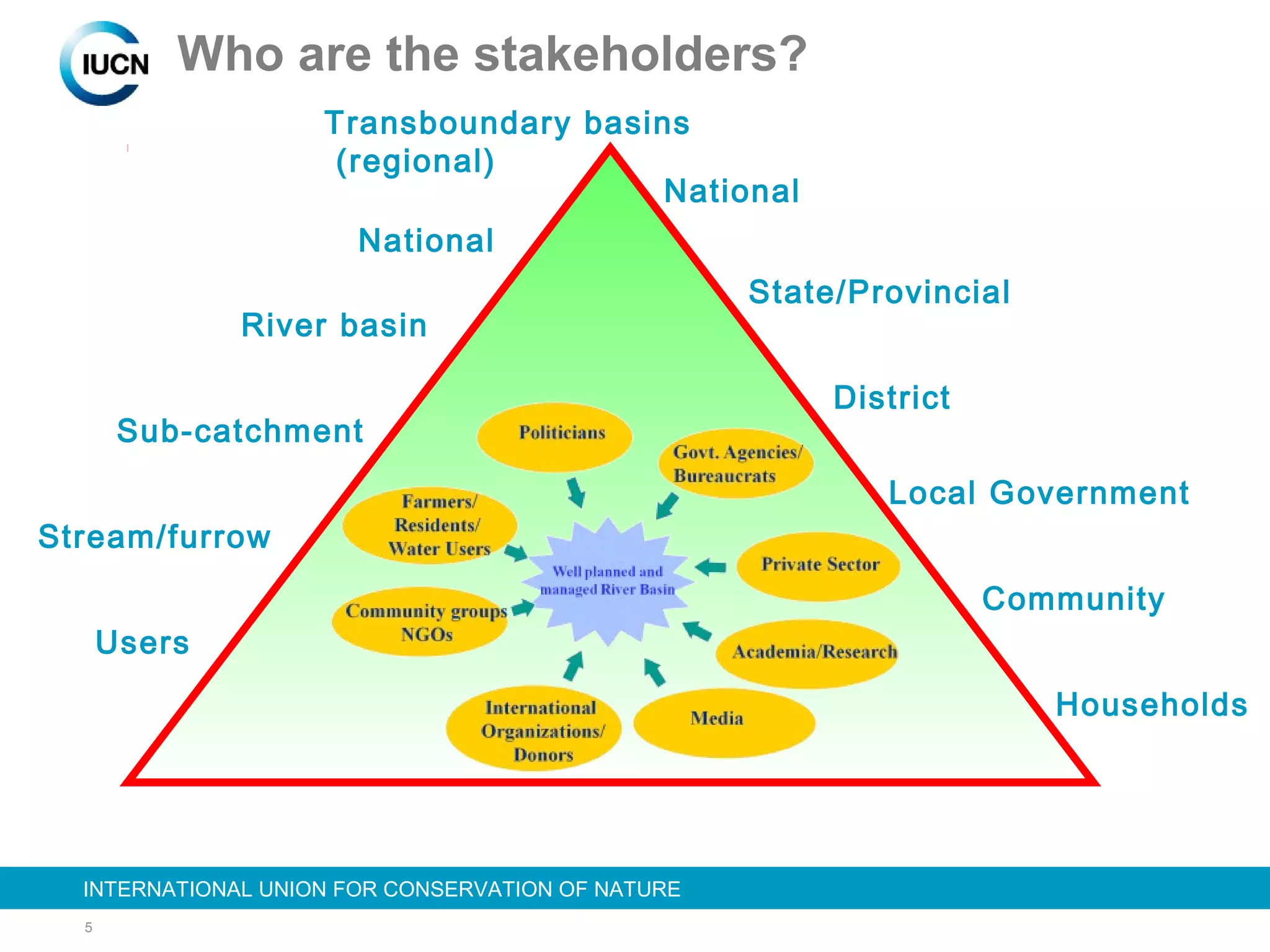
Who are the stakeholders?
National
State/Provincial
District
Local Government
Community
Households
National
River basin
Sub-catchment
Stream/furrow
Users
Transboundary basins
(regional)
6
INTERNATIONAL UNION FOR CONSERVATION OF NATUREINTERNATIONAL UNION FOR CONSERVATION OF NATURE
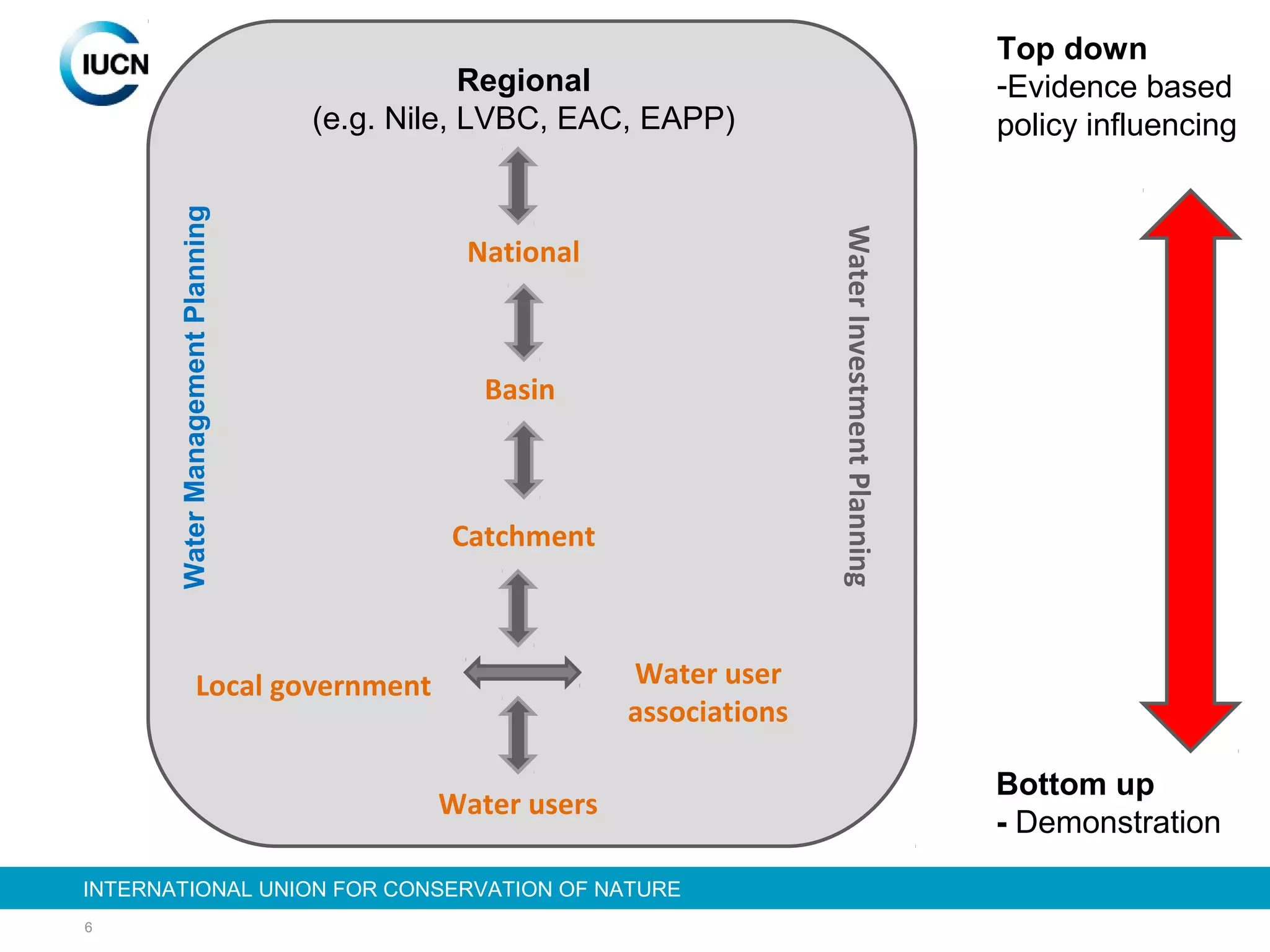
Top down
-Evidence based
policy influencing
Bottom up
- Demonstration
Regional
(e.g. Nile, LVBC, EAC, EAPP)
National
Basin
Catchment
WaterManagementPlanning
WaterInvestmentPlanning
Local government Water user
associations
Water users
7
INTERNATIONAL UNION FOR CONSERVATION OF NATUREINTERNATIONAL UNION FOR CONSERVATION OF NATURE
Case study: Pangani, Tanzania
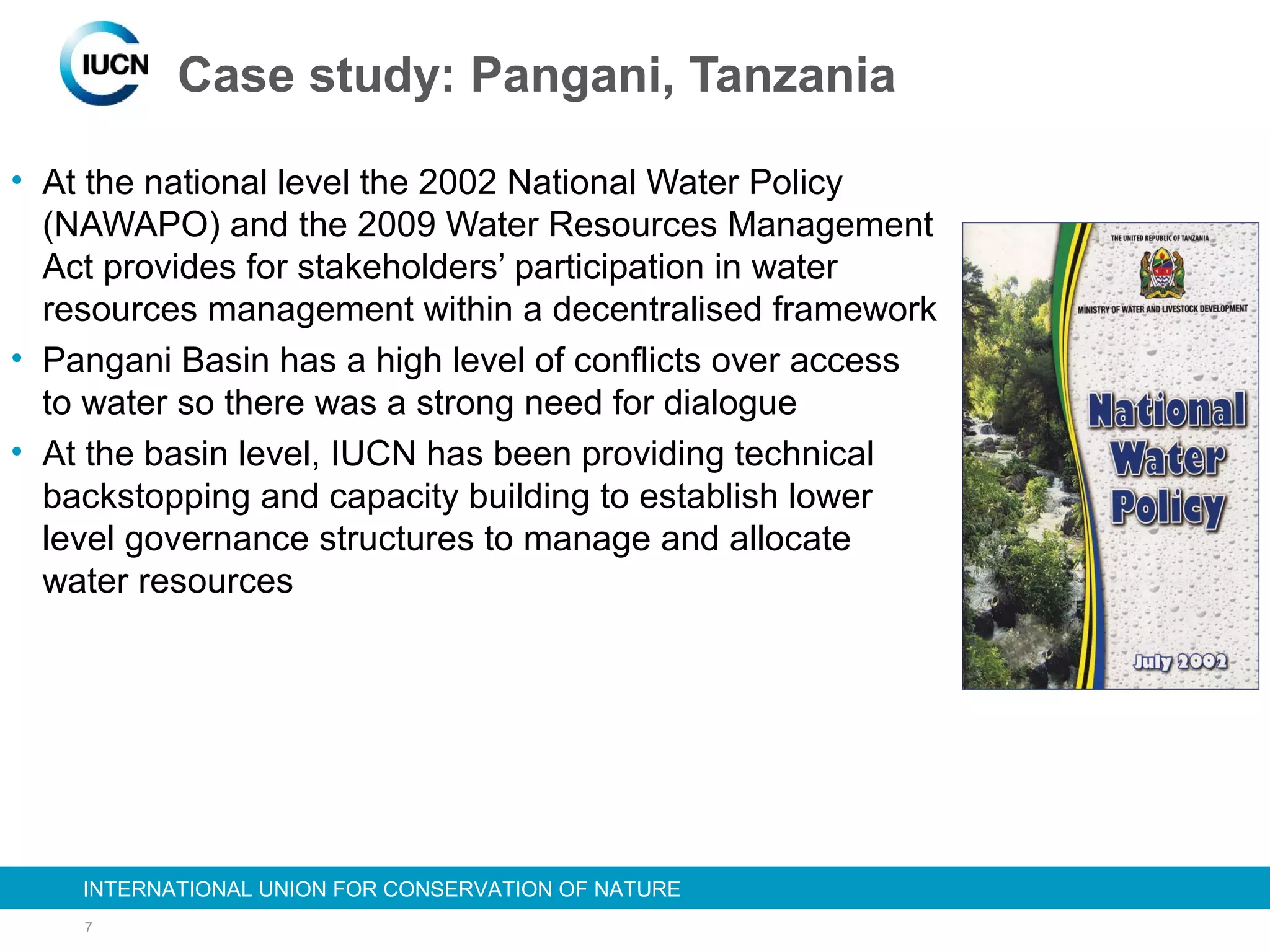
• At the national level the 2002 National Water Policy
(NAWAPO) and the 2009 Water Resources Management
Act provides for stakeholders’ participation in water
resources management within a decentralised framework
• Pangani Basin has a high level of conflicts over access
to water so there was a strong need for dialogue
• At the basin level, IUCN has been providing technical
backstopping and capacity building to establish lower
level governance structures to manage and allocate
water resources
8
INTERNATIONAL UNION FOR CONSERVATION OF NATUREINTERNATIONAL UNION FOR CONSERVATION OF NATURE
• At the local government and community level, IUCN and partners
facilitated the formation of several water user associations (WUAs)
within a subcatchment of the Pangani Basin which bring together
different water users sharing a common water source
– Inventories of water resources, water governance institutions
– Extensive awareness raising and training with local governments,
communities, commercial water users on their rights and responsibilities;
Exchange visits between upstream and downstream users
– Facilitated registration of WUAs (built on existing institutions) so legally
recognized entity
• WUAs are being brought together to form a subcatchment forum
which will facilitate management of water resources. The forum will
interact with basin organizations
• The experiences gained from establishing and strengthening WUAs in
the Pangani Basin are being used by the Ministry of Water in Tanzania
to develop guidelines for WUA establishment and operation in the
whole country
Case study: Pangani, Tanzania
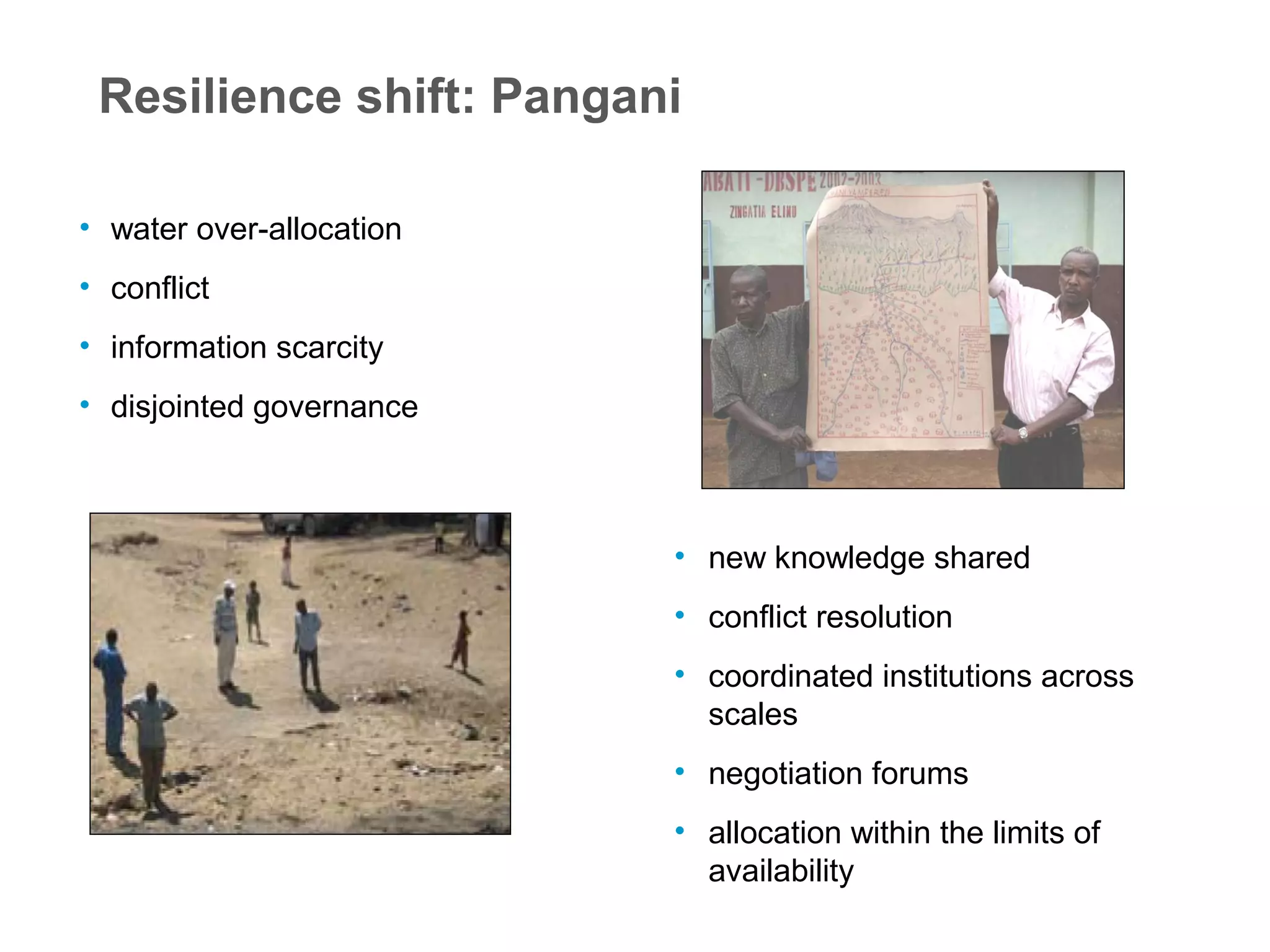
Resilience shift: Pangani
• water over-allocation
• conflict
• information scarcity
• disjointed governance
• new knowledge shared
• conflict resolution
• coordinated institutions across
scales
• negotiation forums
• allocation within the limits of
availability
10
INTERNATIONAL UNION FOR CONSERVATION OF NATUREINTERNATIONAL UNION FOR CONSERVATION OF NATURE
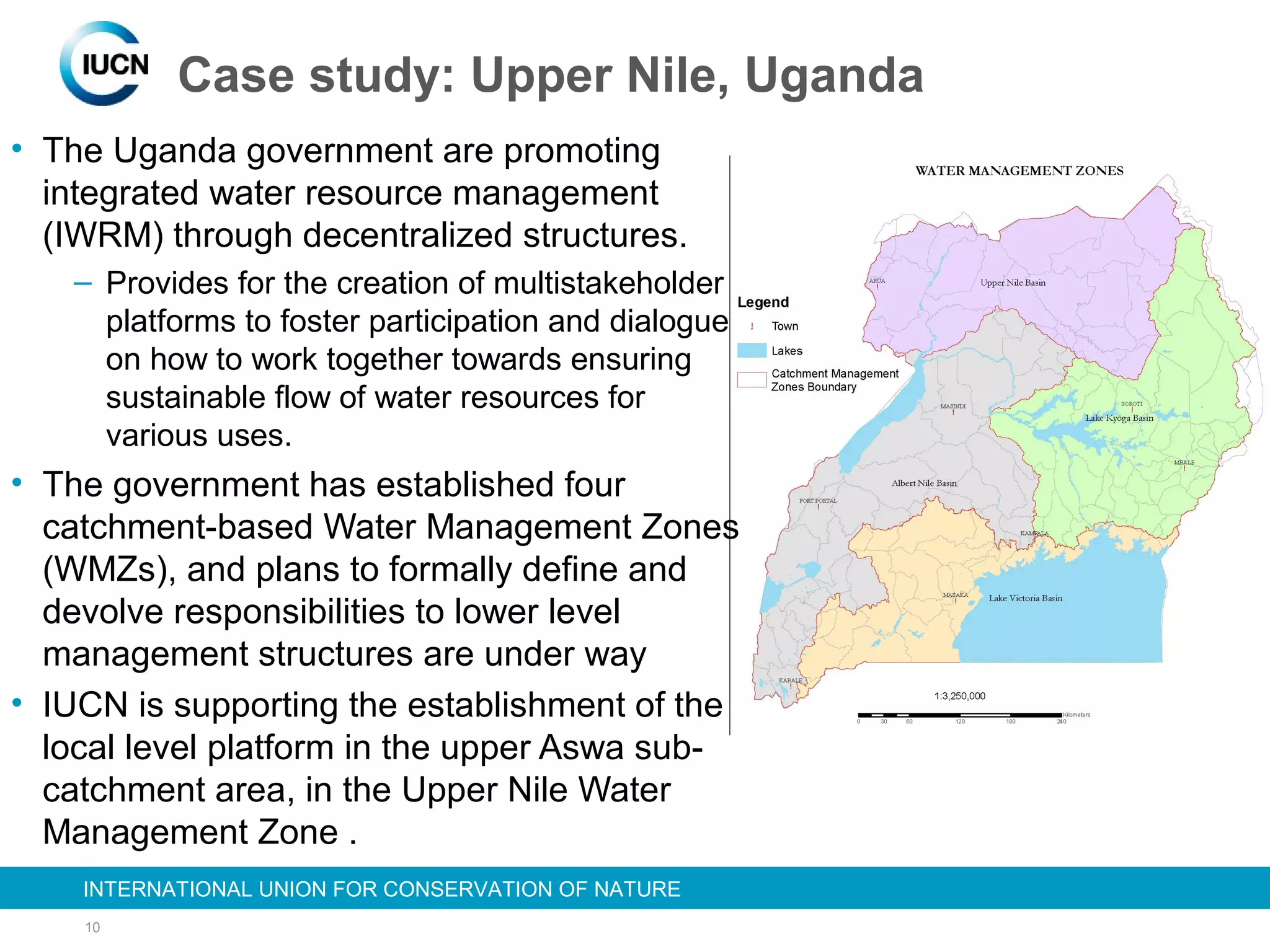
Case study: Upper Nile, Uganda
• The Uganda government are promoting
integrated water resource management
(IWRM) through decentralized structures.
– Provides for the creation of multistakeholder
platforms to foster participation and dialogue
on how to work together towards ensuring
sustainable flow of water resources for
various uses.
• The government has established four
catchment-based Water Management Zones
(WMZs), and plans to formally define and
devolve responsibilities to lower level
management structures are under way
• IUCN is supporting the establishment of the
local level platform in the upper Aswa sub-
catchment area, in the Upper Nile Water
Management Zone .
•
11
INTERNATIONAL UNION FOR CONSERVATION OF NATUREINTERNATIONAL UNION FOR CONSERVATION OF NATURE
• To date – have supported the set-up of a micro-catchment
management structure which includes water user groups
– public awareness of IWRM principles and the new national water
resources management strategy;
– participatory mapping, assessment of catchment status and
stakeholder analysis.
– Creations of Catchment Facilitation Team (CFT) to coordinate
dialogue with water resources user groups (WUGs), through which
communities have mobilized to develop stream-level management
plans.
• WUGs were brought together to form a Water User Association
(WUA)  linking the local level to a wider sub-catchment scale for
water resources management.
• Government is using this demonstration of local level participation
to develop guidelines for establishing WUAs at the local level
• Missing link – connection with regional processes (Nile Basin
Initiative; Nile Basin Discourse)
Case study: Upper Nile, Uganda
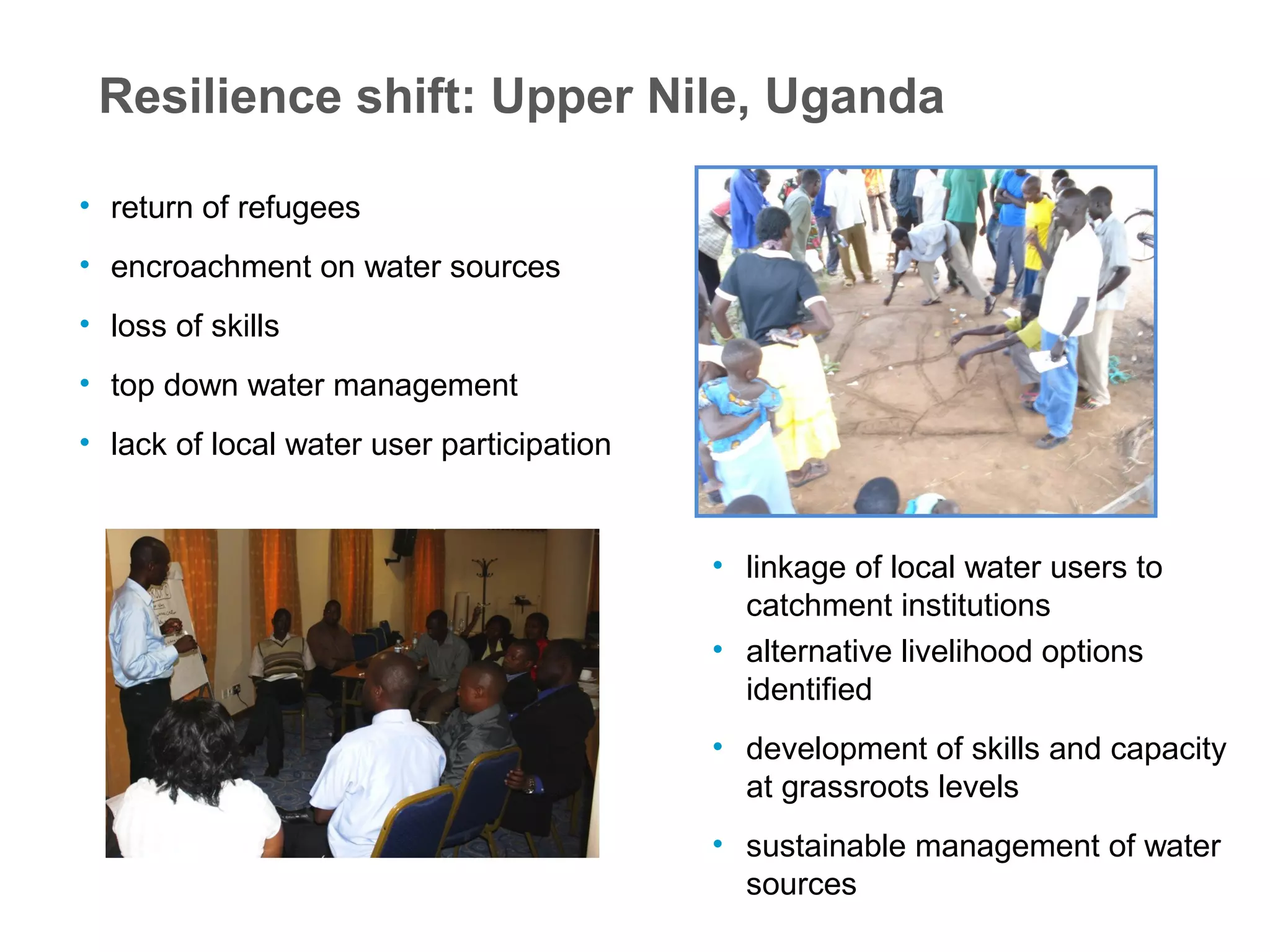
Resilience shift: Upper Nile, Uganda
• return of refugees
• encroachment on water sources
• loss of skills
• top down water management
• lack of local water user participation
• linkage of local water users to
catchment institutions
• alternative livelihood options
identified
• development of skills and capacity
at grassroots levels
• sustainable management of water
sources
13
INTERNATIONAL UNION FOR CONSERVATION OF NATUREINTERNATIONAL UNION FOR CONSERVATION OF NATURE
Case study: Guatemala
• At the community level in Guatemala, IUCN facilitated development of
alliances with community development committees and coordinated with
Municipal and National Development Councils, to enable integration of
micro watershed planning and management with community-led action on
development.
– Project implementation has demonstrated that projects formulated by the
communities rather than institutions translate into responses to the real
demands of communities, not just institutional goals.
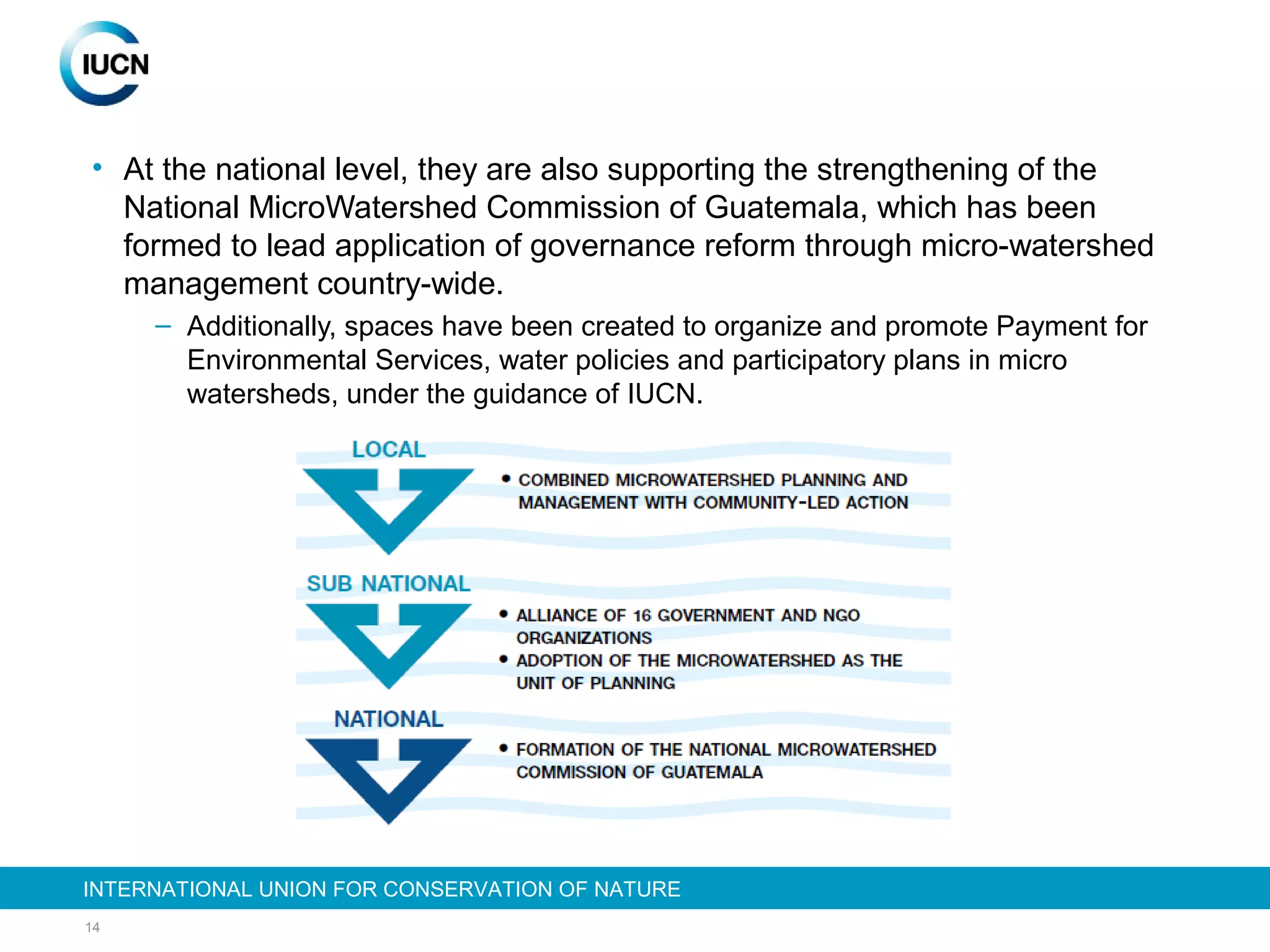
• At the Department (or Sub-national level) of San Marcos, an alliance was
created with 16 government and non-governmental organizations, to form
CORNASAM (the Inter-Institutional Coordinating Body for Natural
Resources and the Environment of San Marcos).
– CORNASAM has adopted the microwatershed as the unit of planning for water
and the environment and, together, these groups have coordinated outreach
and training in the micro-watershed approach.
14
INTERNATIONAL UNION FOR CONSERVATION OF NATUREINTERNATIONAL UNION FOR CONSERVATION OF NATURE
• At the national level, they are also supporting the strengthening of the
National MicroWatershed Commission of Guatemala, which has been
formed to lead application of governance reform through micro-watershed
management country-wide.
– Additionally, spaces have been created to organize and promote Payment for
Environmental Services, water policies and participatory plans in micro
watersheds, under the guidance of IUCN.
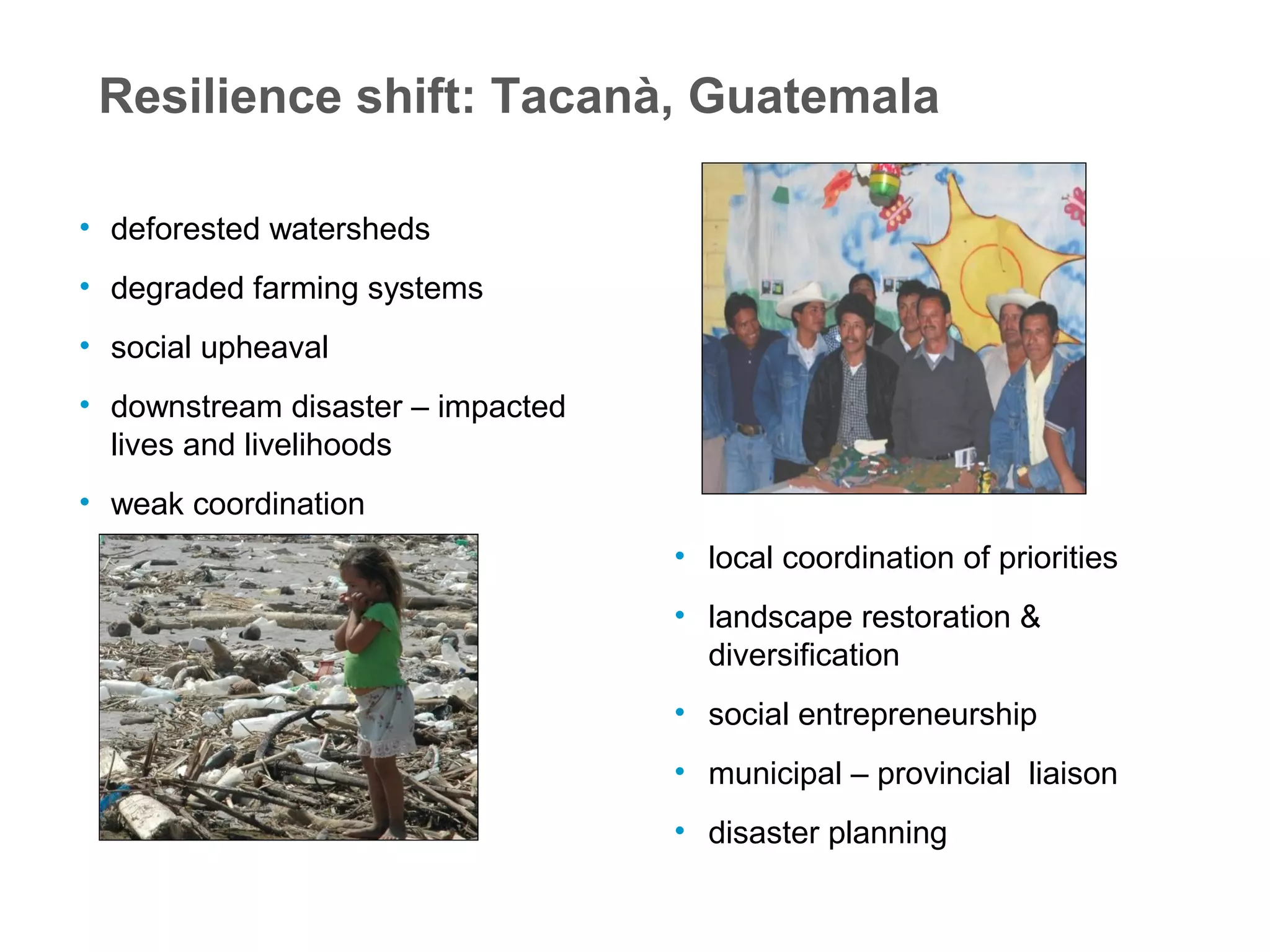
Resilience shift: Tacanà, Guatemala
• deforested watersheds
• degraded farming systems
• social upheaval
• downstream disaster – impacted
lives and livelihoods
• weak coordination
• local coordination of priorities
• landscape restoration &
diversification
• social entrepreneurship
• municipal – provincial liaison
• disaster planning
16
INTERNATIONAL UNION FOR CONSERVATION OF NATUREINTERNATIONAL UNION FOR CONSERVATION OF NATURE
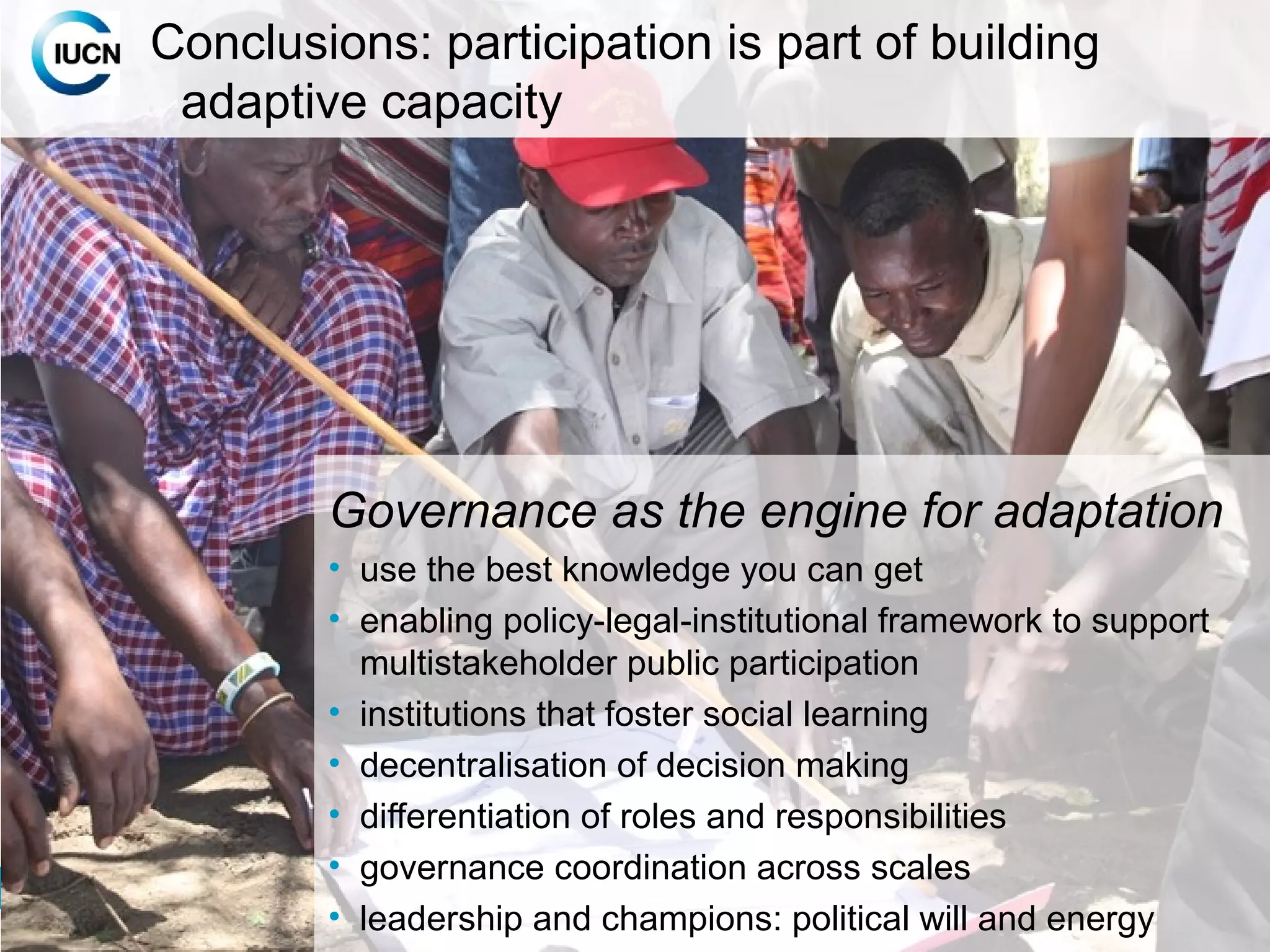
Governance as the engine for adaptation
• use the best knowledge you can get
• enabling policy-legal-institutional framework to support
multistakeholder public participation
• institutions that foster social learning
• decentralisation of decision making
• differentiation of roles and responsibilities
• governance coordination across scales
• leadership and champions: political will and energy
Conclusions: participation is part of building
adaptive capacity
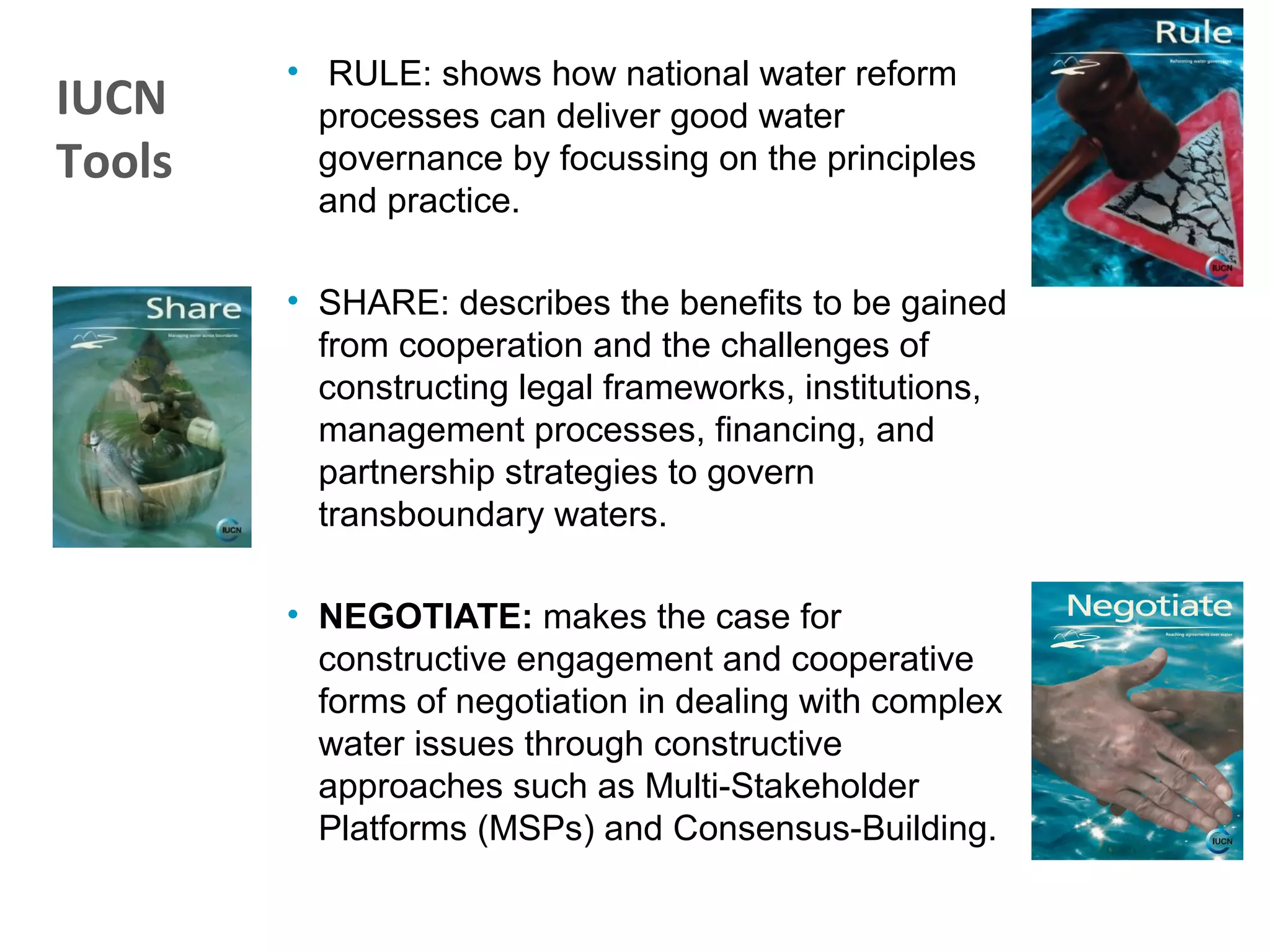
• RULE: shows how national water reform
processes can deliver good water
governance by focussing on the principles
and practice.
• SHARE: describes the benefits to be gained
from cooperation and the challenges of
constructing legal frameworks, institutions,
management processes, financing, and
partnership strategies to govern
transboundary waters.
• NEGOTIATE: makes the case for
constructive engagement and cooperative
forms of negotiation in dealing with complex
water issues through constructive
approaches such as Multi-Stakeholder
Platforms (MSPs) and Consensus-Building.
IUCN
Tools
18
INTERNATIONAL UNION FOR CONSERVATION OF NATUREINTERNATIONAL UNION FOR CONSERVATION OF NATURE
Other tools available
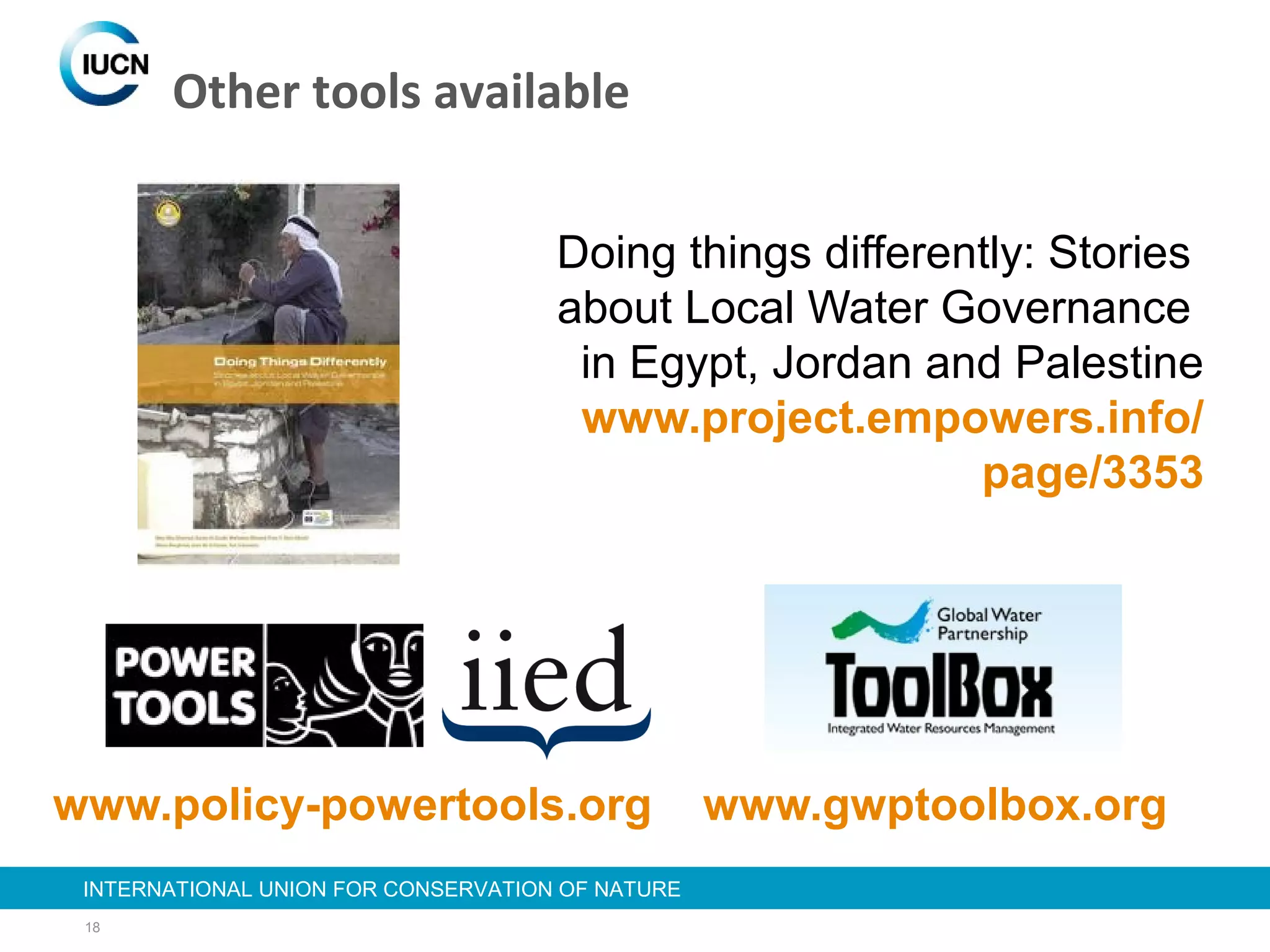
Doing things differently: Stories
about Local Water Governance
in Egypt, Jordan and Palestine
www.project.empowers.info/
page/3353
www.policy-powertools.org www.gwptoolbox.org
19
INTERNATIONAL UNION FOR CONSERVATION OF NATUREINTERNATIONAL UNION FOR CONSERVATION OF NATURE
Discussion questions
• How are you engaging with public participation in your projects? At
which levels?
• How are you able to link local to national and regional levels?
• What are the obstacles?
• What have been the opportunities and successes?
• What resources are needed to improve public participation?

Good practices in public participation

  • 1.
    INTERNATIONAL UNION FORCONSERVATION OF NATURE Good practices in public participation Katharine Cross, IUCN IW Learn African Regional Workshop April 4th , 2012
  • 2.
    2 INTERNATIONAL UNION FORCONSERVATION OF NATUREINTERNATIONAL UNION FOR CONSERVATION OF NATURE Outline • Modes of public participation • Multistakeholder platforms • Engaging from top down and bottom up • Case studies – Tanzania, Uganda and Guatemala • Tools • Discussion questions
  • 3.
    Modes of publicparticipation
  • 4.
    4 INTERNATIONAL UNION FORCONSERVATION OF NATUREINTERNATIONAL UNION FOR CONSERVATION OF NATURE Multistakeholder platforms • Stakeholders with interests in water decisions need to work together to understand their differences and search for solutions that each can accept • Different stakeholders are identified and, usually through representatives, invited and assisted to interact in a deliberative forum that focuses on: – sharing knowledge and perspectives – generating and examining options – informing and shaping negotiations and decisions • The purpose and scope of an MSP must be clear, with appropriate scales and levels for deliberation and analysis (for example watershed versus river basin, or local district versus national). • MSPs expand representation and participation of stakeholders in governance. They encourage learning and greater understanding of interdependencies among stakeholders and ways of resolving contested issues • By providing a pathway for deliberation, MSPs can lead to better decisions and water agreements that can be more successfully implemented.
  • 5.
    5 INTERNATIONAL UNION FORCONSERVATION OF NATUREINTERNATIONAL UNION FOR CONSERVATION OF NATURE Who are the stakeholders? National State/Provincial District Local Government Community Households National River basin Sub-catchment Stream/furrow Users Transboundary basins (regional)
  • 6.
    6 INTERNATIONAL UNION FORCONSERVATION OF NATUREINTERNATIONAL UNION FOR CONSERVATION OF NATURE Top down -Evidence based policy influencing Bottom up - Demonstration Regional (e.g. Nile, LVBC, EAC, EAPP) National Basin Catchment WaterManagementPlanning WaterInvestmentPlanning Local government Water user associations Water users
  • 7.
    7 INTERNATIONAL UNION FORCONSERVATION OF NATUREINTERNATIONAL UNION FOR CONSERVATION OF NATURE Case study: Pangani, Tanzania • At the national level the 2002 National Water Policy (NAWAPO) and the 2009 Water Resources Management Act provides for stakeholders’ participation in water resources management within a decentralised framework • Pangani Basin has a high level of conflicts over access to water so there was a strong need for dialogue • At the basin level, IUCN has been providing technical backstopping and capacity building to establish lower level governance structures to manage and allocate water resources
  • 8.
    8 INTERNATIONAL UNION FORCONSERVATION OF NATUREINTERNATIONAL UNION FOR CONSERVATION OF NATURE • At the local government and community level, IUCN and partners facilitated the formation of several water user associations (WUAs) within a subcatchment of the Pangani Basin which bring together different water users sharing a common water source – Inventories of water resources, water governance institutions – Extensive awareness raising and training with local governments, communities, commercial water users on their rights and responsibilities; Exchange visits between upstream and downstream users – Facilitated registration of WUAs (built on existing institutions) so legally recognized entity • WUAs are being brought together to form a subcatchment forum which will facilitate management of water resources. The forum will interact with basin organizations • The experiences gained from establishing and strengthening WUAs in the Pangani Basin are being used by the Ministry of Water in Tanzania to develop guidelines for WUA establishment and operation in the whole country Case study: Pangani, Tanzania
  • 9.
    Resilience shift: Pangani •water over-allocation • conflict • information scarcity • disjointed governance • new knowledge shared • conflict resolution • coordinated institutions across scales • negotiation forums • allocation within the limits of availability
  • 10.
    10 INTERNATIONAL UNION FORCONSERVATION OF NATUREINTERNATIONAL UNION FOR CONSERVATION OF NATURE Case study: Upper Nile, Uganda • The Uganda government are promoting integrated water resource management (IWRM) through decentralized structures. – Provides for the creation of multistakeholder platforms to foster participation and dialogue on how to work together towards ensuring sustainable flow of water resources for various uses. • The government has established four catchment-based Water Management Zones (WMZs), and plans to formally define and devolve responsibilities to lower level management structures are under way • IUCN is supporting the establishment of the local level platform in the upper Aswa sub- catchment area, in the Upper Nile Water Management Zone . •
  • 11.
    11 INTERNATIONAL UNION FORCONSERVATION OF NATUREINTERNATIONAL UNION FOR CONSERVATION OF NATURE • To date – have supported the set-up of a micro-catchment management structure which includes water user groups – public awareness of IWRM principles and the new national water resources management strategy; – participatory mapping, assessment of catchment status and stakeholder analysis. – Creations of Catchment Facilitation Team (CFT) to coordinate dialogue with water resources user groups (WUGs), through which communities have mobilized to develop stream-level management plans. • WUGs were brought together to form a Water User Association (WUA)  linking the local level to a wider sub-catchment scale for water resources management. • Government is using this demonstration of local level participation to develop guidelines for establishing WUAs at the local level • Missing link – connection with regional processes (Nile Basin Initiative; Nile Basin Discourse) Case study: Upper Nile, Uganda
  • 12.
    Resilience shift: UpperNile, Uganda • return of refugees • encroachment on water sources • loss of skills • top down water management • lack of local water user participation • linkage of local water users to catchment institutions • alternative livelihood options identified • development of skills and capacity at grassroots levels • sustainable management of water sources
  • 13.
    13 INTERNATIONAL UNION FORCONSERVATION OF NATUREINTERNATIONAL UNION FOR CONSERVATION OF NATURE Case study: Guatemala • At the community level in Guatemala, IUCN facilitated development of alliances with community development committees and coordinated with Municipal and National Development Councils, to enable integration of micro watershed planning and management with community-led action on development. – Project implementation has demonstrated that projects formulated by the communities rather than institutions translate into responses to the real demands of communities, not just institutional goals. • At the Department (or Sub-national level) of San Marcos, an alliance was created with 16 government and non-governmental organizations, to form CORNASAM (the Inter-Institutional Coordinating Body for Natural Resources and the Environment of San Marcos). – CORNASAM has adopted the microwatershed as the unit of planning for water and the environment and, together, these groups have coordinated outreach and training in the micro-watershed approach.
  • 14.
    14 INTERNATIONAL UNION FORCONSERVATION OF NATUREINTERNATIONAL UNION FOR CONSERVATION OF NATURE • At the national level, they are also supporting the strengthening of the National MicroWatershed Commission of Guatemala, which has been formed to lead application of governance reform through micro-watershed management country-wide. – Additionally, spaces have been created to organize and promote Payment for Environmental Services, water policies and participatory plans in micro watersheds, under the guidance of IUCN.
  • 15.
    Resilience shift: Tacanà,Guatemala • deforested watersheds • degraded farming systems • social upheaval • downstream disaster – impacted lives and livelihoods • weak coordination • local coordination of priorities • landscape restoration & diversification • social entrepreneurship • municipal – provincial liaison • disaster planning
  • 16.
    16 INTERNATIONAL UNION FORCONSERVATION OF NATUREINTERNATIONAL UNION FOR CONSERVATION OF NATURE Governance as the engine for adaptation • use the best knowledge you can get • enabling policy-legal-institutional framework to support multistakeholder public participation • institutions that foster social learning • decentralisation of decision making • differentiation of roles and responsibilities • governance coordination across scales • leadership and champions: political will and energy Conclusions: participation is part of building adaptive capacity
  • 17.
    • RULE: showshow national water reform processes can deliver good water governance by focussing on the principles and practice. • SHARE: describes the benefits to be gained from cooperation and the challenges of constructing legal frameworks, institutions, management processes, financing, and partnership strategies to govern transboundary waters. • NEGOTIATE: makes the case for constructive engagement and cooperative forms of negotiation in dealing with complex water issues through constructive approaches such as Multi-Stakeholder Platforms (MSPs) and Consensus-Building. IUCN Tools
  • 18.
    18 INTERNATIONAL UNION FORCONSERVATION OF NATUREINTERNATIONAL UNION FOR CONSERVATION OF NATURE Other tools available Doing things differently: Stories about Local Water Governance in Egypt, Jordan and Palestine www.project.empowers.info/ page/3353 www.policy-powertools.org www.gwptoolbox.org
  • 19.
    19 INTERNATIONAL UNION FORCONSERVATION OF NATUREINTERNATIONAL UNION FOR CONSERVATION OF NATURE Discussion questions • How are you engaging with public participation in your projects? At which levels? • How are you able to link local to national and regional levels? • What are the obstacles? • What have been the opportunities and successes? • What resources are needed to improve public participation?

Editor's Notes

  • #4 Modes of public participation
  • #7 Stakeholders interact across levels. Not this simple – but gives an idea of interactions The inherent complexity and diversity of interests in water is a social and political challenge for which top-down ‘command-and-control’ water management does not provide durable solutions. I have a few case studies which describe how public participation is being facilitated in this structure of water management planning across levels
  • #9 Buildins on existing institutions
  • #10 KYB, before and after emphasising: self organisation, natural infrastructure, sustainable management of infrastructure
  • #13 KYB, before and after emphasising: self organisation, natural infrastructure, sustainable management of infrastructure
  • #15 This has been a bottom up process which has secured a voice for local users in the management of their water resources
  • #16 Tacana: before and after emphasising diversification, livelihoods, self organisation
  • #18 The NEGOTIATE publication and its role in the toolkit series on the ecosystem approach The Water And Nature Initiative (WANI) has produced a series of toolkits to support learning on how to mainstream an ecosystems approach in water resource management. Aimed at practitioners, policy-makers and students from NGOs, governments and academia, the toolkits are built on practical case studies to show how key principles of sustainable water management are implemented in river basins. What is the water problem? What ecosystem services are needed to solve this problem? What knowledge and capacities are needed? What actions are needed? What governance is needed to enable action? What incentives and financing are needed?
  • #19 Local water governance is about new policies, platforms, networks and institutions. But making these work is about people. When it works, it is about people challenging the traditional way of how things ‘ought to be’. These are people who do things differently; people with a bit of courage. Some of the stories in this book are success stories that describe how interacting with the EMPOWERS project and using its tools, resulted in better development in many of the villages Another important resource that marginalised people and their allies can use to have a greater positive influence on natural resources policy is IIEE’s Power Tools. This toolkit is comprised of 26 “how-to” ideas based on experience from around the world, discussion of power tools in theory and practice, related research on policy tools in action, and a directory of the many other websites that contain policy tool resources. ‘Tools fro engaging’ section GWP ToolBox is a free and open database with a library of case studies and references that can be used by anyone who is interested in implementing better approaches for the management of water or learning more about improving water management on a local, national, regional or global level.