Propiverine Hydrochloride vs
Previous Anticholinergic
Agents
- Dr. Jonathan D’Souza
PhD (A.M.), MSc. MBA
What is an Overactive Bladder?
Overactive bladder
(also known as
Overactive Bladder
Syndrome) is a
urological condition
related to problems
with urination. [1]
1. Abrams, P; Cardozo, L; Fall, M; Griffiths, D; Rosier, P; Ulmsten, U; Van Kerrebroeck, P; Victor, A; Wein, A;
Standardisation Sub-Committee of the International Continence, Society (January 2003). "The standardisation of
terminology in lower urinary tract function: report from the standardisation sub-committee of the International
Continence Society.". Urology 61 (1): 37–49. PMID 12559262
Causes of Overactive Bladder
Causes of overactive bladder: [1]
 Age
 Diabetes
 Certain Medications (diuretics)
 Lifestyle Choices
 Excessive consumption of Caffeine or
Alcohol
1. "DIAGNOSIS AND TREATMENT OF OVERACTIVE BLADDER (Non-Neurogenic) IN ADULTS: AUA/SUFU GUIDELINE".
American Urological Association. Retrieved 25 Aug 2013
Signs and Symptoms of Overactive
Bladder
 Sudden urge to urinate that's difficult to control.
 Urge incontinence - the involuntary loss of urine immediately
following an urgent need to urinate.
 Urinate frequently, usually 8 or more times in 24 hours.
 Awaken 2 or more times in the night to urinate (nocturia).
Drugs with anticholinergic activity
are the first-line drugs to treat OAB
symptoms.
Drugs used:
• Solifenacin
• Tolterodine
• Imidafenacin
• Propiverine Hydrochloride
First Line of Treatment
Effectiveness of Propiverine
Hydrochloride
DUAL ACTION:
1. Anticholinergic activity
+
2. Calcium antagonist activity (not seen in other
anticholinergic agents such as solifenacin, tolterodine
and imidafenacin)
A. Haruno, Y. Yamasaki, K. Miyoshi et al., “Effects of propiverine and its metabolites on isolated guinea pig urinary bladder,”
Folia Pharmacol Japan, vol. 94, pp. 145–150, 1989
What Is An Anticholinergic Agent?
An anticholinergic agent is a
substance that inhibits the
parasympathetic nerve impulses by
selectively blocking the binding of
the neurotransmitter acetylcholine to
its receptor in nerve cells.
Anticholinergics help treat overactive
bladder by affecting the nerve
function of the bladder muscle
(detrusor) to relax.
Helps reduce urinary urgency.
Calcium- channel blocker
Calcium – channel
blockers inhibit bladder
contraction by
decreasing calcium
available for smooth-
muscle contraction.
Propiverine Hydrochloride vs
Oxybutynin Hydrochloride
A double blind randomized control study
demonstrated that propiverine was superior to
oxybutynin hydrochloride in terms of improvement of
pollakisuria and urinary incontinence associated with
neurogenic bladder and unstable bladder. [1]
1. M. Stohrer, G. Murtz, G. Kramer, F. Schnabel, E. P. Arnold, and J. J. Wyndaele, “Propiverine compared
to oxybutynin in neurogenic detrusor overactivity: results of a randomized, double-blind, multicenter
clinical study,” European Urology, vol. 51, no. 1, pp. 235–242, 2007.
Clinical trial to compare effectiveness
of Propiverine Hydrochloride
Naoya Masumori, Shintaro Miyamoto, Taiji Tsukamoto, et al.,
“The Efficacy and Safety of Propiverine Hydrochloride in
Patients with Overactive Bladder Symptoms Who Poorly
Responded to Previous Anticholinergic Agents,” Advances in
Urology, vol. 2011, Article ID 714978, 4 pages, 2011.
doi:10.1155/2011/714978
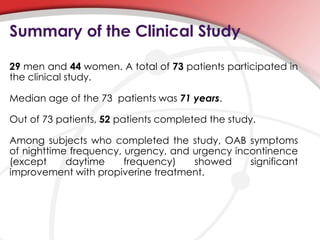
Summary of the Clinical Study
29 men and 44 women. A total of 73 patients participated in
the clinical study.
Median age of the 73 patients was 71 years.
Out of 73 patients, 52 patients completed the study.
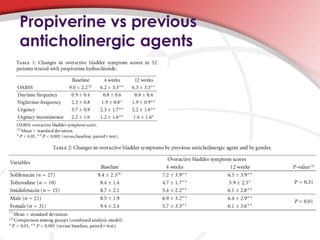
Among subjects who completed the study, OAB symptoms
of nighttime frequency, urgency, and urgency incontinence
(except daytime frequency) showed significant
improvement with propiverine treatment.
Propiverine vs previous
anticholinergic agents
THANK YOU
By
Dr. Jonathan D’Souza
PhD (A.M.), MSc. MBA

Propiverine hydrochloride vs previous anticholinergic agents (For Overactive Bladder)

  • 1.
    Propiverine Hydrochloride vs PreviousAnticholinergic Agents - Dr. Jonathan D’Souza PhD (A.M.), MSc. MBA
  • 2.
    What is anOveractive Bladder? Overactive bladder (also known as Overactive Bladder Syndrome) is a urological condition related to problems with urination. [1] 1. Abrams, P; Cardozo, L; Fall, M; Griffiths, D; Rosier, P; Ulmsten, U; Van Kerrebroeck, P; Victor, A; Wein, A; Standardisation Sub-Committee of the International Continence, Society (January 2003). "The standardisation of terminology in lower urinary tract function: report from the standardisation sub-committee of the International Continence Society.". Urology 61 (1): 37–49. PMID 12559262
  • 3.
    Causes of OveractiveBladder Causes of overactive bladder: [1]  Age  Diabetes  Certain Medications (diuretics)  Lifestyle Choices  Excessive consumption of Caffeine or Alcohol 1. "DIAGNOSIS AND TREATMENT OF OVERACTIVE BLADDER (Non-Neurogenic) IN ADULTS: AUA/SUFU GUIDELINE". American Urological Association. Retrieved 25 Aug 2013
  • 4.
    Signs and Symptomsof Overactive Bladder  Sudden urge to urinate that's difficult to control.  Urge incontinence - the involuntary loss of urine immediately following an urgent need to urinate.  Urinate frequently, usually 8 or more times in 24 hours.  Awaken 2 or more times in the night to urinate (nocturia).
  • 5.
    Drugs with anticholinergicactivity are the first-line drugs to treat OAB symptoms. Drugs used: • Solifenacin • Tolterodine • Imidafenacin • Propiverine Hydrochloride First Line of Treatment
  • 6.
    Effectiveness of Propiverine Hydrochloride DUALACTION: 1. Anticholinergic activity + 2. Calcium antagonist activity (not seen in other anticholinergic agents such as solifenacin, tolterodine and imidafenacin) A. Haruno, Y. Yamasaki, K. Miyoshi et al., “Effects of propiverine and its metabolites on isolated guinea pig urinary bladder,” Folia Pharmacol Japan, vol. 94, pp. 145–150, 1989
  • 7.
    What Is AnAnticholinergic Agent? An anticholinergic agent is a substance that inhibits the parasympathetic nerve impulses by selectively blocking the binding of the neurotransmitter acetylcholine to its receptor in nerve cells. Anticholinergics help treat overactive bladder by affecting the nerve function of the bladder muscle (detrusor) to relax. Helps reduce urinary urgency.
  • 8.
    Calcium- channel blocker Calcium– channel blockers inhibit bladder contraction by decreasing calcium available for smooth- muscle contraction.
  • 9.
    Propiverine Hydrochloride vs OxybutyninHydrochloride A double blind randomized control study demonstrated that propiverine was superior to oxybutynin hydrochloride in terms of improvement of pollakisuria and urinary incontinence associated with neurogenic bladder and unstable bladder. [1] 1. M. Stohrer, G. Murtz, G. Kramer, F. Schnabel, E. P. Arnold, and J. J. Wyndaele, “Propiverine compared to oxybutynin in neurogenic detrusor overactivity: results of a randomized, double-blind, multicenter clinical study,” European Urology, vol. 51, no. 1, pp. 235–242, 2007.
  • 10.
    Clinical trial tocompare effectiveness of Propiverine Hydrochloride Naoya Masumori, Shintaro Miyamoto, Taiji Tsukamoto, et al., “The Efficacy and Safety of Propiverine Hydrochloride in Patients with Overactive Bladder Symptoms Who Poorly Responded to Previous Anticholinergic Agents,” Advances in Urology, vol. 2011, Article ID 714978, 4 pages, 2011. doi:10.1155/2011/714978
  • 11.
    Summary of theClinical Study 29 men and 44 women. A total of 73 patients participated in the clinical study. Median age of the 73 patients was 71 years. Out of 73 patients, 52 patients completed the study. Among subjects who completed the study, OAB symptoms of nighttime frequency, urgency, and urgency incontinence (except daytime frequency) showed significant improvement with propiverine treatment.
  • 12.
  • 13.
    THANK YOU By Dr. JonathanD’Souza PhD (A.M.), MSc. MBA