PROPERTIES OF A SOLUTION
Sameeha Arif
Roll: 09
IX MC
What is Solution
Properties of solution
Example for a solution
01
A homogenous mixture of two or more substances is
called Solution. A solution is sometimes also called True
solution. Lemonade, soda water, salt water, sugar
solution, etc., are all examples of a solution.
In a solution, there is homogeneity at the particle level,
i.e. the particles of dissolved substances are evenly
distributed in the solution and are indistinguishable
from one another.
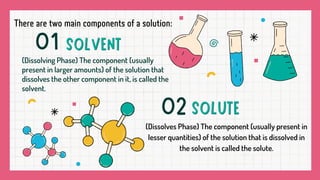
(Dissolving Phase) The component (usually
present in larger amounts) of the solution that
dissolves the other component in it, is called the
solvent.
01
02
There are two main components of a solution:
(Dissolves Phase) The component (usually present in
lesser quantities) of the solution that is dissolved in
the solvent is called the solute.
02
Aerated drinks like
soda water, etc., are gas
in liquid solutions. CO
(gas) as solute and
water (liquid) as
solvent.
A solution of iodine in
alcohol known as tincture
of iodine, has iodine (solid)
as the solute and alcohol
(liquid) as the solvent
2
Solid solutions (alloys) and gaseous
solutions (air)
03
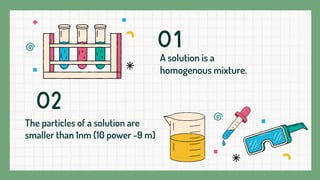
A solution is a
homogenous mixture.
The particles of a solution are
smaller than 1nm (10 power -9 m)
01
02
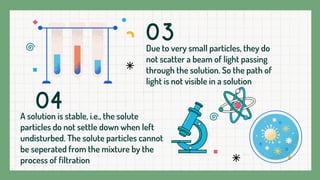
Due to very small particles, they do
not scatter a beam of light passing
through the solution. So the path of
light is not visible in a solution
A solution is stable, i.e., the solute
particles do not settle down when left
undisturbed. The solute particles cannot
be seperated from the mixture by the
process of filtration
03
04
Properties of a solution for a class 10 student

Properties of a solution for a class 10 student

  • 1.
    PROPERTIES OF ASOLUTION Sameeha Arif Roll: 09 IX MC
  • 2.
    What is Solution Propertiesof solution Example for a solution
  • 3.
  • 4.
    A homogenous mixtureof two or more substances is called Solution. A solution is sometimes also called True solution. Lemonade, soda water, salt water, sugar solution, etc., are all examples of a solution. In a solution, there is homogeneity at the particle level, i.e. the particles of dissolved substances are evenly distributed in the solution and are indistinguishable from one another.
  • 5.
    (Dissolving Phase) Thecomponent (usually present in larger amounts) of the solution that dissolves the other component in it, is called the solvent. 01 02 There are two main components of a solution: (Dissolves Phase) The component (usually present in lesser quantities) of the solution that is dissolved in the solvent is called the solute.
  • 6.
  • 7.
    Aerated drinks like sodawater, etc., are gas in liquid solutions. CO (gas) as solute and water (liquid) as solvent. A solution of iodine in alcohol known as tincture of iodine, has iodine (solid) as the solute and alcohol (liquid) as the solvent 2 Solid solutions (alloys) and gaseous solutions (air)
  • 8.
  • 9.
    A solution isa homogenous mixture. The particles of a solution are smaller than 1nm (10 power -9 m) 01 02
  • 10.
    Due to verysmall particles, they do not scatter a beam of light passing through the solution. So the path of light is not visible in a solution A solution is stable, i.e., the solute particles do not settle down when left undisturbed. The solute particles cannot be seperated from the mixture by the process of filtration 03 04