Using Scientific Process
Propagating Trees and
Fruit-Bearing Trees
What will you
learned in this
lesson?
Discover the benefits of using scientific
processes in plant propagation;
Identify the appropriate tools and
equipment and their uses;
Demonstrate scientific ways of
propagating fruit-bearing trees;
Observe healthy and safety measures in
propagating fruit bearing trees.
PLANT PROPAGATION
P R O C E S S O F R E P R O D U C I N G O R C R E A T I N G A N E W
P L A N T O R S E E D L I N G . I T I S A M E T H O D O F
G R O W I N G N E W P L A N T S F R O M S E E D O R F R O M
P A R T S O F E X I S T I N G P L A N T S .
1 2 3 4
2 3 4
LESSON 1
IMPORTANCE AND BENEFITS DERIVED FROM
PLANT PROPAGATION USING SCIENTIFIC
PROCESS
1
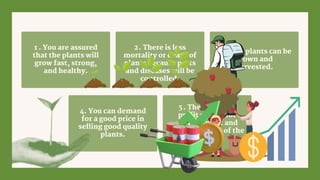
4. You can demand
for a good price in
selling good quality
plants.
1 . You are assured
that the plants will
grow fast, strong,
and healthy.
2. There is less
mortality or death of
plants because pests
and diseases will be
controlled.
3. More plants can be
grown and
harvested.
5. There is more
profit gained for
more harvest and
your plants are of the
best kind.
3 4
LESSON 1
IMPORTANCE AND BENEFITS OF
PLANT PROPAGATION USING
SCIENTIFIC PROCESSES
1
2
Definition of Terms
EQUIPMENT supplies or tools needed for a purpose
PROPAGATION act or action of propagating;
to cause to continue or increase
TOOLS it is a handheld device that aids in accomplishing a task.
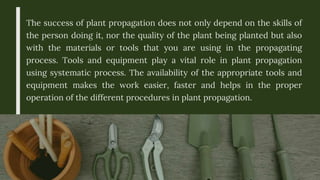
The success of plant propagation does not only depend on the skills of
the person doing it, nor the quality of the plant being planted but also
with the materials or tools that you are using in the propagating
process. Tools and equipment play a vital role in plant propagation
using systematic process. The availability of the appropriate tools and
equipment makes the work easier, faster and helps in the proper
operation of the different procedures in plant propagation.
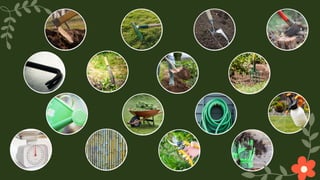
Tools and Equipment
in Plant Propagation
include the following:
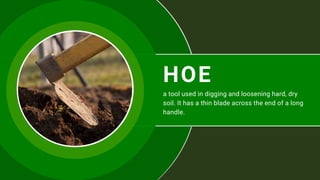
HOE
a tool used in digging and loosening hard, dry
soil. It has a thin blade across the end of a long
handle.
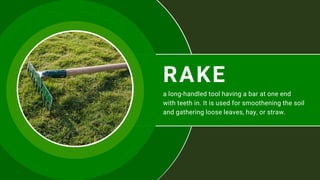
RAKE
a long-handled tool having a bar at one end
with teeth in. It is used for smoothening the soil
and gathering loose leaves, hay, or straw.
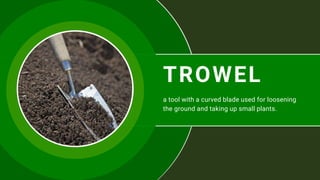
TROWEL
a tool with a curved blade used for loosening
the ground and taking up small plants.
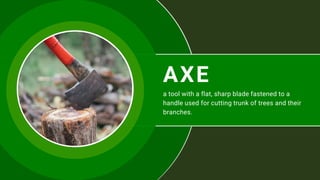
AXE
a tool with a flat, sharp blade fastened to a
handle used for cutting trunk of trees and their
branches.
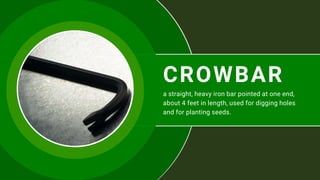
CROWBAR
a straight, heavy iron bar pointed at one end,
about 4 feet in length, used for digging holes
and for planting seeds.
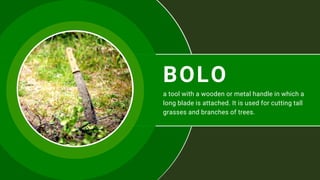
BOLO
a tool with a wooden or metal handle in which a
long blade is attached. It is used for cutting tall
grasses and branches of trees.
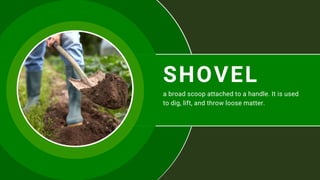
SHOVEL
a broad scoop attached to a handle. It is used
to dig, lift, and throw loose matter.
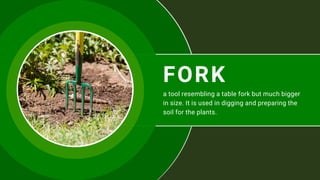
FORK
a tool resembling a table fork but much bigger
in size. It is used in digging and preparing the
soil for the plants.
WATER SPRINKLER
a can or plastic with a spout to sprinkle water
on the plants. Plants should be watered
everyday to make them grow healthier.
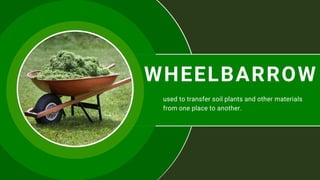
WHEELBARROW
used to transfer soil plants and other materials
from one place to another.
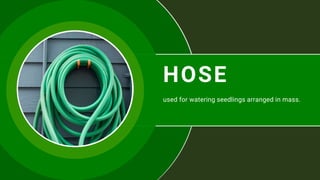
HOSE
used for watering seedlings arranged in mass.
SPRAYER
used for spraying chemicals to eliminate plant
seeds.
WEIGHING SCALE
for weighing plants, seeds, and fertilizers.
PIECES OF WOOD OR
BAMBOO
used as fences of seed boxes and plots to
protect plants from being destroyed by
animals.
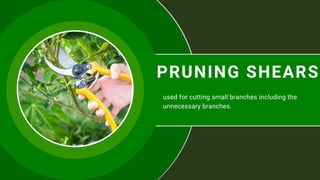
PRUNING SHEARS
used for cutting small branches including the
unnecessary branches.
GARDEN GLOVES
used while working in the garden, made of
strong rubber to protect from thorns and
withstand punctures
4
1 2
LESSON 3
SCIENTIFIC WAYS OF PROPAGATING
TREES AND FRUIT-BEARING TREES
3
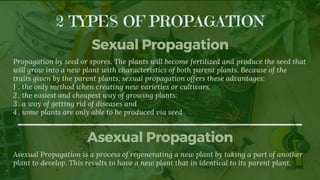
Sexual Propagation
Propagation by seed or spores. The plants will become fertilized and produce the seed that
will grow into a new plant with characteristics of both parent plants. Because of the
traits given by the parent plants, sexual propagation offers these advantages:
1 . the only method when creating new varieties or cultivars,
2 . the easiest and cheapest way of growing plants:
3 . a way of getting rid of diseases and
4 . some plants are only able to be produced via seed
Asexual Propagation
Asexual Propagation is a process of regenerating a new plant by taking a part of another
plant to develop. This results to have a new plant that in identical to its parent plant.
2 TYPES OF PROPAGATION
Different Types of Asexual Propagation
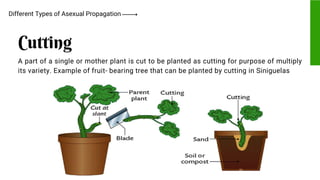
Cutting
A part of a single or mother plant is cut to be planted as cutting for purpose of multiply
its variety. Example of fruit- bearing tree that can be planted by cutting in Siniguelas
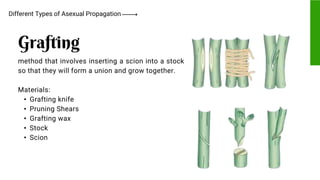
method that involves inserting a scion into a stock
so that they will form a union and grow together.
Materials:
• Grafting knife
• Pruning Shears
• Grafting wax
• Stock
• Scion
Different Types of Asexual Propagation
Grafting
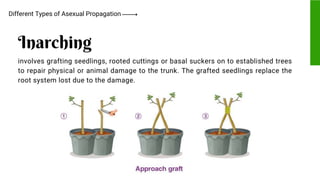
involves grafting seedlings, rooted cuttings or basal suckers on to established trees
to repair physical or animal damage to the trunk. The grafted seedlings replace the
root system lost due to the damage.
Different Types of Asexual Propagation
Inarching
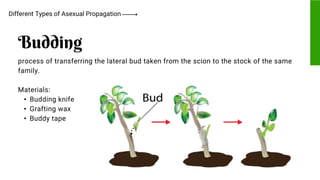
process of transferring the lateral bud taken from the scion to the stock of the same
family.
Materials:
• Budding knife
• Grafting wax
• Buddy tape
Different Types of Asexual Propagation
Budding
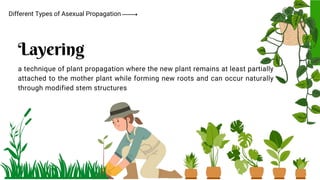
a technique of plant propagation where the new plant remains at least partially
attached to the mother plant while forming new roots and can occur naturally
through modified stem structures
Different Types of Asexual Propagation
Layering
6 types of Layering
includes the following:
air Layering/marcotting
Stimulates the stem or branch of a mother plant to develop
roots while still connected to it
Materials:
Knife or cutter
Plastic (transparent)
Strau
seil or coco husk
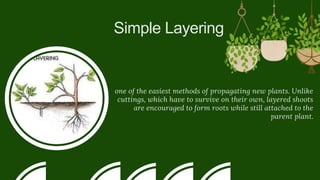
Simple Layering
one of the easiest methods of propagating new plants. Unlike
cuttings, which have to survive on their own, layered shoots
are encouraged to form roots while still attached to the
parent plant.
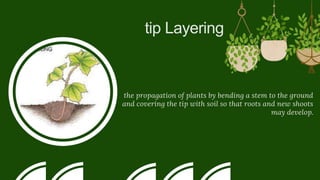
tip Layering
the propagation of plants by bending a stem to the ground
and covering the tip with soil so that roots and new shoots
may develop.
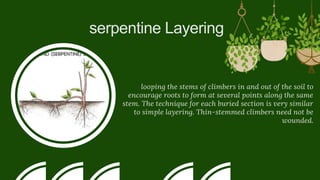
serpentine Layering
looping the stems of climbers in and out of the soil to
encourage roots to form at several points along the same
stem. The technique for each buried section is very similar
to simple layering. Thin-stemmed climbers need not be
wounded.
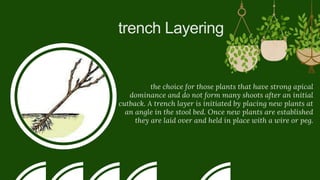
trench Layering
the choice for those plants that have strong apical
dominance and do not form many shoots after an initial
cutback. A trench layer is initiated by placing new plants at
an angle in the stool bed. Once new plants are established
they are laid over and held in place with a wire or peg.
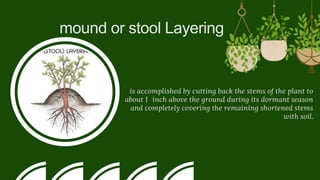
mound or stool Layering
is accomplished by cutting back the stems of the plant to
about 1 inch above the ground during its dormant season
and completely covering the remaining shortened stems
with soil.
1 2
LESSON 4
HEALTHY AND SAFETY MEASURES IN
PROPAGATING FRUIT-BEARING TREES
3 4
1. Have the right tools for planting trees and fruits trees.
2. Use the right tool for the right purpose. This insures efficiency of work and safety for
the user.
3. Read labels of pesticides and insecticides carefully before using. Follow instructions as
indicated.
4. Wear the proper attire when planting. Loose, comfortable, and absorbent clothing gives
freedom of movement and feeling of comfort and freshness. Wearing a hat protects you
from the extreme heat of the sun. Wear mask when spraying insecticides.
5. Use organic fertilizer instead of those commercial ones. It is economical and safer to
use. Commercial fertilizer when used in excess can poison the soil.
6. Get rid of insects and pests that invade the tree or seedlings. Destroy them right away
before they multiply and cause damage to the tree. Aphids, plant hoppers, leaf rollers,
webworms, and ladybugs are some common insects that feed on plants.
7. One preventive measure to avoid tree infections caused by insects is to build a fire and
allow smoke to penetrate the leaves of the tree.
8. Have a place for everything. Tools, equipment, pesticides, fertilizers, compost should be
placed where they should be. They should also be kept away from the reach of children.
9. Before embarking on tree planting, read books and magazines, consult a plant expert.
This will equip you with the needed information on how to deal with the different phases
of gardening and tree planting.
THANK YOU
PREPARED BY: JYRA KHIEZ R. JACOB

Propagating Trees & Fruit-Bearing Trees.pptx

  • 1.
    Using Scientific Process PropagatingTrees and Fruit-Bearing Trees
  • 2.
    What will you learnedin this lesson? Discover the benefits of using scientific processes in plant propagation; Identify the appropriate tools and equipment and their uses; Demonstrate scientific ways of propagating fruit-bearing trees; Observe healthy and safety measures in propagating fruit bearing trees.
  • 3.
    PLANT PROPAGATION P RO C E S S O F R E P R O D U C I N G O R C R E A T I N G A N E W P L A N T O R S E E D L I N G . I T I S A M E T H O D O F G R O W I N G N E W P L A N T S F R O M S E E D O R F R O M P A R T S O F E X I S T I N G P L A N T S .
  • 4.
  • 5.
    2 3 4 LESSON1 IMPORTANCE AND BENEFITS DERIVED FROM PLANT PROPAGATION USING SCIENTIFIC PROCESS 1
  • 6.
    4. You candemand for a good price in selling good quality plants. 1 . You are assured that the plants will grow fast, strong, and healthy. 2. There is less mortality or death of plants because pests and diseases will be controlled. 3. More plants can be grown and harvested. 5. There is more profit gained for more harvest and your plants are of the best kind.
  • 7.
    3 4 LESSON 1 IMPORTANCEAND BENEFITS OF PLANT PROPAGATION USING SCIENTIFIC PROCESSES 1 2
  • 8.
    Definition of Terms EQUIPMENTsupplies or tools needed for a purpose PROPAGATION act or action of propagating; to cause to continue or increase TOOLS it is a handheld device that aids in accomplishing a task.
  • 9.
    The success ofplant propagation does not only depend on the skills of the person doing it, nor the quality of the plant being planted but also with the materials or tools that you are using in the propagating process. Tools and equipment play a vital role in plant propagation using systematic process. The availability of the appropriate tools and equipment makes the work easier, faster and helps in the proper operation of the different procedures in plant propagation.
  • 10.
    Tools and Equipment inPlant Propagation include the following:
  • 12.
    HOE a tool usedin digging and loosening hard, dry soil. It has a thin blade across the end of a long handle.
  • 13.
    RAKE a long-handled toolhaving a bar at one end with teeth in. It is used for smoothening the soil and gathering loose leaves, hay, or straw.
  • 14.
    TROWEL a tool witha curved blade used for loosening the ground and taking up small plants.
  • 15.
    AXE a tool witha flat, sharp blade fastened to a handle used for cutting trunk of trees and their branches.
  • 16.
    CROWBAR a straight, heavyiron bar pointed at one end, about 4 feet in length, used for digging holes and for planting seeds.
  • 17.
    BOLO a tool witha wooden or metal handle in which a long blade is attached. It is used for cutting tall grasses and branches of trees.
  • 18.
    SHOVEL a broad scoopattached to a handle. It is used to dig, lift, and throw loose matter.
  • 19.
    FORK a tool resemblinga table fork but much bigger in size. It is used in digging and preparing the soil for the plants.
  • 20.
    WATER SPRINKLER a canor plastic with a spout to sprinkle water on the plants. Plants should be watered everyday to make them grow healthier.
  • 21.
    WHEELBARROW used to transfersoil plants and other materials from one place to another.
  • 22.
    HOSE used for wateringseedlings arranged in mass.
  • 23.
    SPRAYER used for sprayingchemicals to eliminate plant seeds.
  • 24.
    WEIGHING SCALE for weighingplants, seeds, and fertilizers.
  • 25.
    PIECES OF WOODOR BAMBOO used as fences of seed boxes and plots to protect plants from being destroyed by animals.
  • 26.
    PRUNING SHEARS used forcutting small branches including the unnecessary branches.
  • 27.
    GARDEN GLOVES used whileworking in the garden, made of strong rubber to protect from thorns and withstand punctures
  • 28.
    4 1 2 LESSON 3 SCIENTIFICWAYS OF PROPAGATING TREES AND FRUIT-BEARING TREES 3
  • 29.
    Sexual Propagation Propagation byseed or spores. The plants will become fertilized and produce the seed that will grow into a new plant with characteristics of both parent plants. Because of the traits given by the parent plants, sexual propagation offers these advantages: 1 . the only method when creating new varieties or cultivars, 2 . the easiest and cheapest way of growing plants: 3 . a way of getting rid of diseases and 4 . some plants are only able to be produced via seed Asexual Propagation Asexual Propagation is a process of regenerating a new plant by taking a part of another plant to develop. This results to have a new plant that in identical to its parent plant. 2 TYPES OF PROPAGATION
  • 30.
    Different Types ofAsexual Propagation Cutting A part of a single or mother plant is cut to be planted as cutting for purpose of multiply its variety. Example of fruit- bearing tree that can be planted by cutting in Siniguelas
  • 31.
    method that involvesinserting a scion into a stock so that they will form a union and grow together. Materials: • Grafting knife • Pruning Shears • Grafting wax • Stock • Scion Different Types of Asexual Propagation Grafting
  • 32.
    involves grafting seedlings,rooted cuttings or basal suckers on to established trees to repair physical or animal damage to the trunk. The grafted seedlings replace the root system lost due to the damage. Different Types of Asexual Propagation Inarching
  • 33.
    process of transferringthe lateral bud taken from the scion to the stock of the same family. Materials: • Budding knife • Grafting wax • Buddy tape Different Types of Asexual Propagation Budding
  • 34.
    a technique ofplant propagation where the new plant remains at least partially attached to the mother plant while forming new roots and can occur naturally through modified stem structures Different Types of Asexual Propagation Layering
  • 35.
    6 types ofLayering includes the following:
  • 36.
    air Layering/marcotting Stimulates thestem or branch of a mother plant to develop roots while still connected to it Materials: Knife or cutter Plastic (transparent) Strau seil or coco husk
  • 37.
    Simple Layering one ofthe easiest methods of propagating new plants. Unlike cuttings, which have to survive on their own, layered shoots are encouraged to form roots while still attached to the parent plant.
  • 38.
    tip Layering the propagationof plants by bending a stem to the ground and covering the tip with soil so that roots and new shoots may develop.
  • 39.
    serpentine Layering looping thestems of climbers in and out of the soil to encourage roots to form at several points along the same stem. The technique for each buried section is very similar to simple layering. Thin-stemmed climbers need not be wounded.
  • 40.
    trench Layering the choicefor those plants that have strong apical dominance and do not form many shoots after an initial cutback. A trench layer is initiated by placing new plants at an angle in the stool bed. Once new plants are established they are laid over and held in place with a wire or peg.
  • 41.
    mound or stoolLayering is accomplished by cutting back the stems of the plant to about 1 inch above the ground during its dormant season and completely covering the remaining shortened stems with soil.
  • 42.
    1 2 LESSON 4 HEALTHYAND SAFETY MEASURES IN PROPAGATING FRUIT-BEARING TREES 3 4
  • 43.
    1. Have theright tools for planting trees and fruits trees. 2. Use the right tool for the right purpose. This insures efficiency of work and safety for the user. 3. Read labels of pesticides and insecticides carefully before using. Follow instructions as indicated. 4. Wear the proper attire when planting. Loose, comfortable, and absorbent clothing gives freedom of movement and feeling of comfort and freshness. Wearing a hat protects you from the extreme heat of the sun. Wear mask when spraying insecticides. 5. Use organic fertilizer instead of those commercial ones. It is economical and safer to use. Commercial fertilizer when used in excess can poison the soil.
  • 44.
    6. Get ridof insects and pests that invade the tree or seedlings. Destroy them right away before they multiply and cause damage to the tree. Aphids, plant hoppers, leaf rollers, webworms, and ladybugs are some common insects that feed on plants. 7. One preventive measure to avoid tree infections caused by insects is to build a fire and allow smoke to penetrate the leaves of the tree. 8. Have a place for everything. Tools, equipment, pesticides, fertilizers, compost should be placed where they should be. They should also be kept away from the reach of children. 9. Before embarking on tree planting, read books and magazines, consult a plant expert. This will equip you with the needed information on how to deal with the different phases of gardening and tree planting.
  • 45.
    THANK YOU PREPARED BY:JYRA KHIEZ R. JACOB