Propaganda
What are some of the
different methods of
Propaganda?
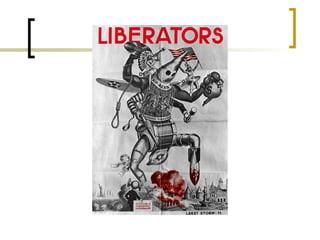
What is Propaganda?
 Propaganda is the deliberate,
systematic attempt to shape
perceptions, manipulate cognitions,
and direct behavior to achieve a
response that furthers the desired
intent of the propagandist.
Garth S. Jowett and Victoria O'Donnell, Propaganda And Persuasion
Classes of Propaganda
 Propaganda is classified by the nature
and source of it. There are three
classes.
 White Propaganda
 Black Propaganda
 Grey Propaganda
White Propaganda
 Generally comes from an openly
identified source, and is characterized
by gentler methods of persuasion,
such as standard public relations
techniques and one-sided presentation
of an argument.
Black Propaganda
 is false material where the source is
disguised. It is propaganda that
purports to be from a source on one
side of a conflict, but is actually from
the opposing side. It is typically used
to vilify, embarrass or misrepresent the
enemy
Grey Propaganda
 is propaganda without any identifiable
source or author. A major application of grey
propaganda is making enemies believe
falsehoods using straw arguments: As
phase one, to make someone believe "A",
one releases as grey propaganda "B", the
opposite of "A". In phase two, "B" is
discredited using some strawman. The
enemy will then assume "A" to be true.
Concerning the Usefulness of
Propaganda
 "Falsehood is a
recognized and
extremely useful
weapon in warfare,
and every country
uses it quite
deliberately to deceive
its own people, to
attract neutrals, and to
mislead the enemy."
Arthur Ponsonby,
Member of Parliment,
England - 1928
 An important
difference between our
"leadership
democracy" and a
totalitarian state is that
we are allowed to raise
questions. However,
history shows that, in
times of political crisis
and social dislocation,
this freedom is one of
the first to disappear.
Tools of Propaganda
 We will be looking at 8 different types
of propaganda. These are also types
of persuasive tools.
 Think about where you have seen
these in today’s world.
Ad Hominem
 A Latin phrase which has come to
mean attacking your opponent, as
opposed to attacking their arguments
 What purpose does this serve?
Appeals to Fear
 Appeals to fear seek to build support
by instilling anxieties and panic in the
general population.
 What purpose does this serve.
Bandwagon
 Appeals attempt to persuade the target audience to join in and
take the course of action that “everyone else is taking.”
 Inevitable Victory: invites those not already on the
bandwagon to join those already on the road to certain victory.
Those already or at least partially on the bandwagon are
reassured that staying aboard is their best course of action.
 Join the crowd: This technique reinforces people's natural
desire to be on the winning side. This technique is used to
convince the audience that a program is an expression of an
irresistible mass movement and that it is in their best interest
to join.
Glittering Generalities
 Glittering generalities are emotionally
appealing words applied to a product
or idea, but which present no concrete
argument or analysis. A famous
example is the campaign slogan "Ford
has a better idea!"
 What purpose does it serve?
Testimonials
 Testimonials are quotations, in or out of context,
especially cited to support or reject a given policy,
action, program, or personality. The reputation or
the role (expert, respected public figure, etc.) of the
individual giving the statement is exploited. The
testimonial places the official sanction of a
respected person or authority on a propaganda
message. This is done in an effort to cause the
target audience to identify itself with the authority or
to accept the authority's opinions and beliefs as its
own.
Stereotyping
 This technique attempts to arouse
prejudices in an audience by labeling the
object of the propaganda campaign as
something the target audience fears, hates,
loathes, or finds undesirable. For instance,
reporting on a foreign country or social
group may focus on the stereotypical traits
that the reader expects, even though they
are far from being representative of the
whole country or group; such reporting often
focuses on the anecdotal.
Black White Fallacy/ Either Or
 Presenting only two choices, with the
product or idea being propagated as
the better choice. (e.g., "You are either
with us, or you are with the enemy")
 Can you think of an example?
Non-sequitur
 This is a diversionary tactic
where a person seems to be
answering a question, but in
fact isn’t.
 Question: “So, where is your homework?”
 Answer: “Mrs. Weir, did you see on page 34
where Orwell introduces the character of
Snowball. I loved how he seamlessly
created the allegory. I was amazed.”

Propaganda

  • 1.
    Propaganda What are someof the different methods of Propaganda?
  • 2.
    What is Propaganda? Propaganda is the deliberate, systematic attempt to shape perceptions, manipulate cognitions, and direct behavior to achieve a response that furthers the desired intent of the propagandist. Garth S. Jowett and Victoria O'Donnell, Propaganda And Persuasion
  • 3.
    Classes of Propaganda Propaganda is classified by the nature and source of it. There are three classes.  White Propaganda  Black Propaganda  Grey Propaganda
  • 4.
    White Propaganda  Generallycomes from an openly identified source, and is characterized by gentler methods of persuasion, such as standard public relations techniques and one-sided presentation of an argument.
  • 5.
    Black Propaganda  isfalse material where the source is disguised. It is propaganda that purports to be from a source on one side of a conflict, but is actually from the opposing side. It is typically used to vilify, embarrass or misrepresent the enemy
  • 6.
    Grey Propaganda  ispropaganda without any identifiable source or author. A major application of grey propaganda is making enemies believe falsehoods using straw arguments: As phase one, to make someone believe "A", one releases as grey propaganda "B", the opposite of "A". In phase two, "B" is discredited using some strawman. The enemy will then assume "A" to be true.
  • 14.
    Concerning the Usefulnessof Propaganda  "Falsehood is a recognized and extremely useful weapon in warfare, and every country uses it quite deliberately to deceive its own people, to attract neutrals, and to mislead the enemy." Arthur Ponsonby, Member of Parliment, England - 1928  An important difference between our "leadership democracy" and a totalitarian state is that we are allowed to raise questions. However, history shows that, in times of political crisis and social dislocation, this freedom is one of the first to disappear.
  • 15.
    Tools of Propaganda We will be looking at 8 different types of propaganda. These are also types of persuasive tools.  Think about where you have seen these in today’s world.
  • 16.
    Ad Hominem  ALatin phrase which has come to mean attacking your opponent, as opposed to attacking their arguments  What purpose does this serve?
  • 17.
    Appeals to Fear Appeals to fear seek to build support by instilling anxieties and panic in the general population.  What purpose does this serve.
  • 18.
    Bandwagon  Appeals attemptto persuade the target audience to join in and take the course of action that “everyone else is taking.”  Inevitable Victory: invites those not already on the bandwagon to join those already on the road to certain victory. Those already or at least partially on the bandwagon are reassured that staying aboard is their best course of action.  Join the crowd: This technique reinforces people's natural desire to be on the winning side. This technique is used to convince the audience that a program is an expression of an irresistible mass movement and that it is in their best interest to join.
  • 19.
    Glittering Generalities  Glitteringgeneralities are emotionally appealing words applied to a product or idea, but which present no concrete argument or analysis. A famous example is the campaign slogan "Ford has a better idea!"  What purpose does it serve?
  • 20.
    Testimonials  Testimonials arequotations, in or out of context, especially cited to support or reject a given policy, action, program, or personality. The reputation or the role (expert, respected public figure, etc.) of the individual giving the statement is exploited. The testimonial places the official sanction of a respected person or authority on a propaganda message. This is done in an effort to cause the target audience to identify itself with the authority or to accept the authority's opinions and beliefs as its own.
  • 21.
    Stereotyping  This techniqueattempts to arouse prejudices in an audience by labeling the object of the propaganda campaign as something the target audience fears, hates, loathes, or finds undesirable. For instance, reporting on a foreign country or social group may focus on the stereotypical traits that the reader expects, even though they are far from being representative of the whole country or group; such reporting often focuses on the anecdotal.
  • 22.
    Black White Fallacy/Either Or  Presenting only two choices, with the product or idea being propagated as the better choice. (e.g., "You are either with us, or you are with the enemy")  Can you think of an example?
  • 23.
    Non-sequitur  This isa diversionary tactic where a person seems to be answering a question, but in fact isn’t.  Question: “So, where is your homework?”  Answer: “Mrs. Weir, did you see on page 34 where Orwell introduces the character of Snowball. I loved how he seamlessly created the allegory. I was amazed.”