Proliferative breast disorders
with atypia
Dr Priyanka Malekar
1st year DNB
Dept of Surgical Oncology
Introduction….
• High-risk breast lesions, which comprise benign lesions and in
situ carcinomas (lobular carcinoma in situ and ductal
carcinoma in situ), are clinically, morphologically, and
biologically heterogeneous and are associated with an
increased risk of invasive breast cancer development, albeit to
varying degrees
Introduction….
• Recognition and proactive management of such lesions can
help to prevent progression to invasive disease, and might,
therefore, reduce breast cancer incidence, morbidity, and
mortality.
• However, this opportunity comes with the possibility of
overdiagnosis and overtreatment, necessitating risk-based
intervention
Introduction…
• Notably, despite the progress in defining the molecular
changes associated with carcinogenesis, alterations
identifying the individuals with high-risk lesions that will
progress to invasive carcinoma remain to be identified.
• Until reproducible clinicopathological or molecular features
predicting an individual’s risk of breast cancer are found,
management strategies must be defined by population-level
risks as determined by models such as the Gail or IBIS models,
as well as patient attitudes toward the risks and benefits of
interventions
Key points
• Atypical ductal hyperplasia (ADH), atypical lobular hyperplasia
(ALH), lobular carcinoma in situ (LCIS), and ductal carcinoma in
situ (DCIS) are high-risk breast lesions; flat epithelial atypia
(FEA) has an uncertain risk level.
• ADH or ALH, and LCIS are associated with relative risk of
breast cancer development, in either breast, of approximately
4 and 10, respectively.
Key points
• The degree of risk associated with ALH, ADH, and LCIS is
sufficient to justify a discussion of chemoprevention in
healthy women, particularly those who are premenopausal at
diagnosis.
• DCIS is considered a precursor lesion and is routinely treated
by surgical excision, sometimes necessitating mastectomy;
radiotherapy and/or endocrine therapy are often added,
although neither modality reduces breast-cancer-specific
mortality.
Key points
• Until predictors of invasive carcinoma are found, management
strategies must be defined by risk at the population level,
rather than individual level, which might result in
undertreatment or overtreatment in individual patients.
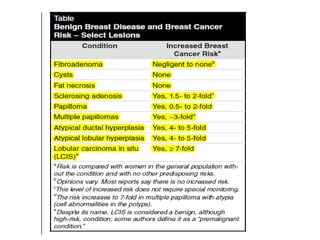
• In a seminal study, Dupont and Page reviewed over 3,000
benign breast biopsies and categorized lesions as
nonproliferative, proliferative without atypia, or atypical
hyperplasia; atypical hyperplasias were the only benign
lesions associated with a substantially elevated risk of breast
cancer development (5.3-fold increased risk)
Dupont, W. D. & Page, D. L. Risk factors for breast cancer in women with proliferative breast disease. N. Engl. J. Med. 312,
146–151 (1985)
• Nonproliferative disease was associated with no increase in
the risk of breast cancer, and proliferative disease without
atypia with a small, 1.9-fold increase in risk of this disease.
• Atypical hyperplasias, which include atypical ductal
hyperplasia (ADH) and atypical lobular hyperplasia (ALH), are
diagnosed more frequently in the current era of
mammographic screening than before the widespread
introduction of this modality.
• Breast biopsies performed in the pre-mammographic era for
palpable lesions, only 3.6% of the biopsy specimens showed
atypia. By contrast, atypical hyperplasia is detected in 12–17%
of biopsies performed for mammographic microcalcifications.
• Recent: flat epithelial atypia (FEA), the level of breast cancer
risk conveyed by this lesion is uncertain at present
Dupont, W. D. & Page, D. L. Risk factors for breast cancer in women with
proliferative breast disease. N. Engl. J. Med. 312, 146–151 (1985)
• Two forms of carcinoma in situ:
1. LCIS and DCIS
• Differ from the breast atypias in that both were initially
considered to be early, favourable forms of carcinoma, rather
than merely breast cancer risk factors.
• DCIS continues to be regarded as a nonobligate precursor
lesion to invasive breast cancer, and is managed in a different
fashion from LCIS, which is most often considered to be a
marker of a generalized increase in breast cancer risk, as are
the atypical hyperplasias.
High-risk breast lesions
Atypical hyperplasias: ADH and ALH
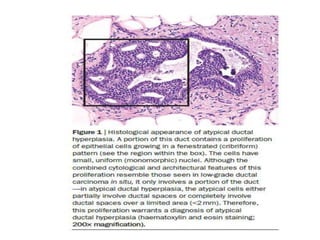
• ADH is either defined as partial involvement of the terminal
ductal-lobular unit by monomorphic, low-grade atypical
ductal epithelia with architectural disturbances such as rigid
bridges or micropapillae but not completely filling the duct or
as an uni- or multifocal lesion that fulfils all criteria of low-
grade DCIS
• In ADH, the atypical cells either partially or completely involve
individual ductal spaces such that the total extent of ductal
involvement is <2 mm.
• The atypical cell population in ADH shows high levels of
oestrogen receptor (ER) expression, a low proliferative rate,
and shares genetic and molecular alterations with those of
low-grade DCIS and low-grade ER-positive (luminal type)
invasive breast cancers.
• These features provide strong evidence that ADH is an early
lesion in the development pathway of low-grade breast
carcinomas.
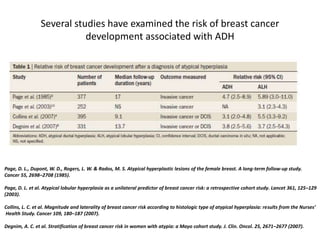
Several studies have examined the risk of breast cancer
development associated with ADH
Page, D. L., Dupont, W. D., Rogers, L. W. & Rados, M. S. Atypical hyperplastic lesions of the female breast. A long-term follow-up study.
Cancer 55, 2698–2708 (1985).
Page, D. L. et al. Atypical lobular hyperplasia as a unilateral predictor of breast cancer risk: a retrospective cohort study. Lancet 361, 125–129
(2003).
Collins, L. C. et al. Magnitude and laterality of breast cancer risk according to histologic type of atypical hyperplasia: results from the Nurses’
Health Study. Cancer 109, 180–187 (2007).
Degnim, A. C. et al. Stratification of breast cancer risk in women with atypia: a Mayo cohort study. J. Clin. Oncol. 25, 2671–2677 (2007).
• The relative risk of breast cancer development was found to
be elevated in all studies, that approximately 80% of women
remained cancer-free during the follow-up period, which
often extended beyond 10 years, is noteworthy.
• Study by Degnim and colleagues,8 the 20-year cumulative risk
of invasive or in situ breast cancer development was 21%
(95% CI 14–28%), and in the study of Page and co-workers,9
the absolute risk of invasive cancer development was 20%
with a median follow-up duration of 17 years.
Molecular pathway for ADH
• Loss of 16q and gain of 1q being the most frequent findings
• The high expression of oestrogen receptors (ER) and
progesterone receptors (PR) indicates a loss of regulative
mechanisms in early precursor lesions and is a common
denominator of these lesions.
Role of ADH in core bx
• Clinically, an excisional biopsy is recommended when ADH is
identified in core needle biopsy or in a vacuum-assisted
biopsy specimen.
• This is because of the relatively high probability of
underestimating a DCIS or invasive cancer on needle biopsy.
• The diameter of the needle biopsy is one of the most
important determinants of the probability of finding a higher-
grade lesion but also the number of ADH foci in the needle
biopsies.
Atypical lobular hyperplasia
• ALH is defined in terms of its morphologic resemblance to
LCIS, but differs from the latter with regard to the extent of
involvement of the lobular units.
• In ALH, the atypical cell population distorts and distends less
than 50% of the acinar spaces in the involved lobules any
greater involvement is categorized as LCIS.
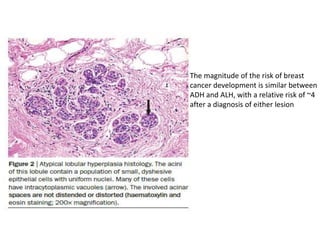
The magnitude of the risk of breast
cancer development is similar between
ADH and ALH, with a relative risk of ~4
after a diagnosis of either lesion
• For a long time, LN was considered to be just a risk indicator
and not a precursor lesion for the subsequent development of
carcinoma.
• now believed that LN indeed is a non-obligatory precursor of
invasive carcinoma, and at the same time a risk lesion for ipsi-
and contralateral disease.
• Page et al. invasive carcinoma was three times more likely in
the same breast that had been diagnosed with LN, than in the
contralateral breast, and that the tumour type was much
more likely to be lobular than ductal.
• LN to be both a low-grade precursor lesion for carcinoma and
an indicator lesion for ipsi and contralateral disease.
• Invasive carcinoma 35 % of patients with 35 yrs after after
initial Bx.
Page, D. L. et al. Atypical lobular hyperplasia as a unilateral predictor of breast cancer risk: a
retrospective cohort study. Lancet 361, 125–129 (2003).
• Types of LCIS:
• Pleomorphic and classic
• LCIS is a benign condition and is not treated as a carcinoma. It
is properly considered a proliferative disease with associated
risk for developing a breast cancer in the future and,
therefore, is no longer included in this cancer staging system.
• One form o f LCIS (often called “pleomorphic” LCIS or high-
grade LCIS) has features overlapping DCIS, including high-
grade nuclei and central necrosis, and some physicians believe
it should be treated similarly to DCIS.
• Evidence is insufficient at present, piimarily due to the low
prevalence of this form o f high-grade LCIS, to establish
definitive recommendations for treatment.
Role of ALH in core bx
• The need for a follow-up surgical excision when LN is the most
significant finding on core needle biopsy is a matter of debate,
because LN has been regarded both a risk factor and a non-
obligatory precursor for invasive carcinoma.
• Detection rates of more significant lesions in excision
specimens vary greatly between 4 and 43%- limited studies
and selection bias.
FLAT epithelial hyperplasia
In 1979, Azzopardi et al. stressed the importance of distinguishing
columnar cell lesions with nuclear atypia from benign changes and
coined the term ‘clinging carcinoma, monomorphic type’ to
describe a lesionknown today as FEA.
Columner cell metaplasia/columner cell change with low grade
neoplasia.
Apical snouts and luminal secretions as well as microcalcifications
Chivukula M, Bhargava R, Tseng G, Dabbs DJ: Clinicopathologic implications of ‘Flat epithelial atypia’ in core
needle biopsy specimens of the breast. Am J Clin Pathol 2009;131:802–808
• Rosen triad: occasional coexistance of FEA+ Lobular
neoplasia+Tubular carcinoma.
• Core Bx:
• Although there is good evidence pointing towards a precursor
role of FEA in the development of tubular (or other lowgrade)
carcinomas, management recommendations also have to
consider the actual risk of progression.
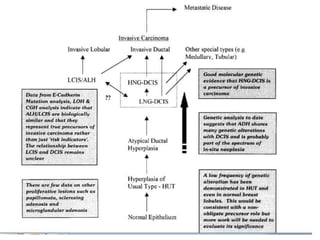
THE TRANSITION FROM HYPERPLASIA TO
INVASIVE CARCINOMA OF THE BREAST
MANAGEMENT
Is excision of all high-risk lesions
required?
• In current clinical practice, the majority of initial diagnoses of
breast lesions are made based on image-guided core needle
biopsy specimens.
• diagnosis of ADH on core biopsy is an indication for surgical
excision and the rationale for this approach is clear, as the
distinction between ADH and DCIS is, in part, quantitative.
• Excision of ALH /LCIS : -matter of debate
• when a core-biopsy-based diagnosis of lobular neoplasia is
made and no other lesions requiring excision (ADH, papilloma,
radial scar) are present and radiological–pathological
concordance is present, upgrade rates are less than 5%.
• The need for surgical excision of pure FEA is even less well
documented. FEA frequently occurs in association with ADH
and/or DCIS, which necessitates excision.
• Reported upgrade rates after a core-biopsy-based diagnosis of
FEA alone are low in many recent series, ranging from 0–3.2%.
• Importantly, the presence of ADH, ALH, or LCIS at the resection margins
when surgical excision is undertaken is not an indication for additional
surgery, as the goal of resection is to exclude the presence of carcinomas.
• In patients with invasive carcinoma, the presence of these high-risk lesions
at the margin of resection is not associated with an increased risk of local
recurrence supporting the safety of this practice
Abner, A. L. et al. The relation between the presence and extent of lobular carcinoma in situ and the risk of
local recurrence for patients with infiltrating carcinoma of the breast treated with conservative surgery and
radiation therapy. Cancer 88, 1072–1077 (2000)
Current options for ADH, ALH and LCIS
1. Active surveillance
2. Chemoprevention
3. Prophylactic mastectomy
Active surveillance
• Screening mammography is the mainstay of active surveillance.
• MRI screening reduces the rate of interval cancers in women at
increased risk of breast cancer due to BRCA1 and BRCA2 mutations
• Increase rate of breast BX
• Current guideline: MRI: 20-25% life time high risk of ca breast
• There is insufficient evidence to recommend for or against MRI
screening in women with atypia or in situ carcinoma.
• Evidence suggests that screening with whole-breast ultrasonography in
addition to mammography increases cancer detection by 3–4 cases per
1,000 screens in women with dense breasts, but at the cost of a marked
decrease in specificity compared with mammographic screening alone
• evidence of benefit/lack thereof of whole breast USG, contrast enhanced
digital MMG, Tomosynthesis in women identified to be at risk of breast
cancer on the basis of atypia or LCIS is currently lacking.
• The importance of physical examination as a component of screening in
high-risk populations is often forgotten.
• NCCN) guidelines for active surveillance of women with ADH,
ALH, and LCIS, in which clinical breast examination every 6–12
months and annual mammography are recommended.
• Life style modification- lack of evidence of its benefit in
ADH,ALH,FEA
chemoprevention
Journal of the National Cancer Institute, Vol. 97, No. 22, November 16, 2005
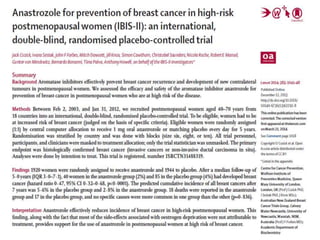
Overall 38% risk reduction in invasive breast cancers
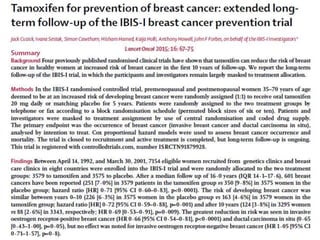
• The NSABP P-1 trial74 randomly assigned women aged ≥60 years
regardless of the presence of breast cancer risk factors and younger
women with a 5-year risk of breast cancer development of 1.66% or
greater to receive tamoxifen (20 mg daily) or placebo for 5 years
• Prior biopsies showing atypical proliferative breast lesions was one of the
factors that put women into the high-risk category.
• At 7 years of follow up, tamoxifen treatment reduced the relative risk of
invasive breast cancer to 0.57, and the relative risk of noninvasive breast
cancer to 0.6
• AH-75%, LCIS-46%
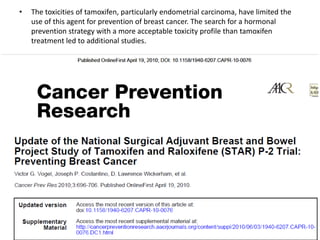
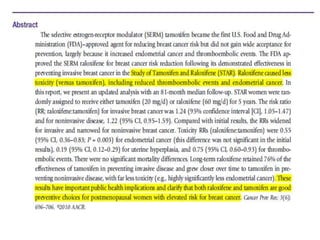
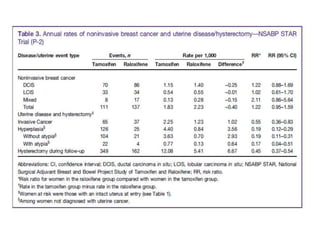
• The toxicities of tamoxifen, particularly endometrial carcinoma, have limited the
use of this agent for prevention of breast cancer. The search for a hormonal
prevention strategy with a more acceptable toxicity profile than tamoxifen
treatment led to additional studies.
Role of prophylactic mastectomy
• Bilateral prophylactic mastectomy is not usually
recommended for atypia or LCIS, and in a contemporary
cohort of women with LCIS treated at the Memorial Sloan
Kettering Cancer Center, only 5% chose to undergo this
procedure.
• It is important to recognize that even the best bilateral
prophylactic mastectomy surgery leaves behind microscopic
breast tissue that can undergo malignant transformation.
• Oppong, B. A. & King, T. A. Recommendations for women with lobular carcinoma in situ (LCIS). Oncology
(Williston Park) 25, 1051–1056 (2011).
• recent trend to perform nipple sparing mastectomy, which
necessitates leaving behind breast tissue to retain the nipple
blood supply, might alter the degree of risk reduction after
bilateral prophylactic mastectomy in high-risk populations is
uncertain at present
• In the absence of other risk factors, bilateral prophylactic
mastectomy is an unnecessarily radical approach to breast
cancer risk reduction for women with atypia or LCIS.
THANK U

Proliferative breast disorders with atypia

  • 1.
    Proliferative breast disorders withatypia Dr Priyanka Malekar 1st year DNB Dept of Surgical Oncology
  • 2.
    Introduction…. • High-risk breastlesions, which comprise benign lesions and in situ carcinomas (lobular carcinoma in situ and ductal carcinoma in situ), are clinically, morphologically, and biologically heterogeneous and are associated with an increased risk of invasive breast cancer development, albeit to varying degrees
  • 3.
    Introduction…. • Recognition andproactive management of such lesions can help to prevent progression to invasive disease, and might, therefore, reduce breast cancer incidence, morbidity, and mortality. • However, this opportunity comes with the possibility of overdiagnosis and overtreatment, necessitating risk-based intervention
  • 4.
    Introduction… • Notably, despitethe progress in defining the molecular changes associated with carcinogenesis, alterations identifying the individuals with high-risk lesions that will progress to invasive carcinoma remain to be identified. • Until reproducible clinicopathological or molecular features predicting an individual’s risk of breast cancer are found, management strategies must be defined by population-level risks as determined by models such as the Gail or IBIS models, as well as patient attitudes toward the risks and benefits of interventions
  • 5.
    Key points • Atypicalductal hyperplasia (ADH), atypical lobular hyperplasia (ALH), lobular carcinoma in situ (LCIS), and ductal carcinoma in situ (DCIS) are high-risk breast lesions; flat epithelial atypia (FEA) has an uncertain risk level. • ADH or ALH, and LCIS are associated with relative risk of breast cancer development, in either breast, of approximately 4 and 10, respectively.
  • 6.
    Key points • Thedegree of risk associated with ALH, ADH, and LCIS is sufficient to justify a discussion of chemoprevention in healthy women, particularly those who are premenopausal at diagnosis. • DCIS is considered a precursor lesion and is routinely treated by surgical excision, sometimes necessitating mastectomy; radiotherapy and/or endocrine therapy are often added, although neither modality reduces breast-cancer-specific mortality.
  • 7.
    Key points • Untilpredictors of invasive carcinoma are found, management strategies must be defined by risk at the population level, rather than individual level, which might result in undertreatment or overtreatment in individual patients.
  • 8.
    • In aseminal study, Dupont and Page reviewed over 3,000 benign breast biopsies and categorized lesions as nonproliferative, proliferative without atypia, or atypical hyperplasia; atypical hyperplasias were the only benign lesions associated with a substantially elevated risk of breast cancer development (5.3-fold increased risk) Dupont, W. D. & Page, D. L. Risk factors for breast cancer in women with proliferative breast disease. N. Engl. J. Med. 312, 146–151 (1985)
  • 9.
    • Nonproliferative diseasewas associated with no increase in the risk of breast cancer, and proliferative disease without atypia with a small, 1.9-fold increase in risk of this disease.
  • 10.
    • Atypical hyperplasias,which include atypical ductal hyperplasia (ADH) and atypical lobular hyperplasia (ALH), are diagnosed more frequently in the current era of mammographic screening than before the widespread introduction of this modality.
  • 11.
    • Breast biopsiesperformed in the pre-mammographic era for palpable lesions, only 3.6% of the biopsy specimens showed atypia. By contrast, atypical hyperplasia is detected in 12–17% of biopsies performed for mammographic microcalcifications. • Recent: flat epithelial atypia (FEA), the level of breast cancer risk conveyed by this lesion is uncertain at present Dupont, W. D. & Page, D. L. Risk factors for breast cancer in women with proliferative breast disease. N. Engl. J. Med. 312, 146–151 (1985)
  • 12.
    • Two formsof carcinoma in situ: 1. LCIS and DCIS • Differ from the breast atypias in that both were initially considered to be early, favourable forms of carcinoma, rather than merely breast cancer risk factors. • DCIS continues to be regarded as a nonobligate precursor lesion to invasive breast cancer, and is managed in a different fashion from LCIS, which is most often considered to be a marker of a generalized increase in breast cancer risk, as are the atypical hyperplasias.
  • 14.
    High-risk breast lesions Atypicalhyperplasias: ADH and ALH • ADH is either defined as partial involvement of the terminal ductal-lobular unit by monomorphic, low-grade atypical ductal epithelia with architectural disturbances such as rigid bridges or micropapillae but not completely filling the duct or as an uni- or multifocal lesion that fulfils all criteria of low- grade DCIS • In ADH, the atypical cells either partially or completely involve individual ductal spaces such that the total extent of ductal involvement is <2 mm.
  • 16.
    • The atypicalcell population in ADH shows high levels of oestrogen receptor (ER) expression, a low proliferative rate, and shares genetic and molecular alterations with those of low-grade DCIS and low-grade ER-positive (luminal type) invasive breast cancers. • These features provide strong evidence that ADH is an early lesion in the development pathway of low-grade breast carcinomas.
  • 17.
    Several studies haveexamined the risk of breast cancer development associated with ADH Page, D. L., Dupont, W. D., Rogers, L. W. & Rados, M. S. Atypical hyperplastic lesions of the female breast. A long-term follow-up study. Cancer 55, 2698–2708 (1985). Page, D. L. et al. Atypical lobular hyperplasia as a unilateral predictor of breast cancer risk: a retrospective cohort study. Lancet 361, 125–129 (2003). Collins, L. C. et al. Magnitude and laterality of breast cancer risk according to histologic type of atypical hyperplasia: results from the Nurses’ Health Study. Cancer 109, 180–187 (2007). Degnim, A. C. et al. Stratification of breast cancer risk in women with atypia: a Mayo cohort study. J. Clin. Oncol. 25, 2671–2677 (2007).
  • 18.
    • The relativerisk of breast cancer development was found to be elevated in all studies, that approximately 80% of women remained cancer-free during the follow-up period, which often extended beyond 10 years, is noteworthy. • Study by Degnim and colleagues,8 the 20-year cumulative risk of invasive or in situ breast cancer development was 21% (95% CI 14–28%), and in the study of Page and co-workers,9 the absolute risk of invasive cancer development was 20% with a median follow-up duration of 17 years.
  • 19.
    Molecular pathway forADH • Loss of 16q and gain of 1q being the most frequent findings • The high expression of oestrogen receptors (ER) and progesterone receptors (PR) indicates a loss of regulative mechanisms in early precursor lesions and is a common denominator of these lesions.
  • 20.
    Role of ADHin core bx • Clinically, an excisional biopsy is recommended when ADH is identified in core needle biopsy or in a vacuum-assisted biopsy specimen. • This is because of the relatively high probability of underestimating a DCIS or invasive cancer on needle biopsy. • The diameter of the needle biopsy is one of the most important determinants of the probability of finding a higher- grade lesion but also the number of ADH foci in the needle biopsies.
  • 21.
    Atypical lobular hyperplasia •ALH is defined in terms of its morphologic resemblance to LCIS, but differs from the latter with regard to the extent of involvement of the lobular units. • In ALH, the atypical cell population distorts and distends less than 50% of the acinar spaces in the involved lobules any greater involvement is categorized as LCIS.
  • 22.
    The magnitude ofthe risk of breast cancer development is similar between ADH and ALH, with a relative risk of ~4 after a diagnosis of either lesion
  • 23.
    • For along time, LN was considered to be just a risk indicator and not a precursor lesion for the subsequent development of carcinoma. • now believed that LN indeed is a non-obligatory precursor of invasive carcinoma, and at the same time a risk lesion for ipsi- and contralateral disease.
  • 24.
    • Page etal. invasive carcinoma was three times more likely in the same breast that had been diagnosed with LN, than in the contralateral breast, and that the tumour type was much more likely to be lobular than ductal. • LN to be both a low-grade precursor lesion for carcinoma and an indicator lesion for ipsi and contralateral disease. • Invasive carcinoma 35 % of patients with 35 yrs after after initial Bx. Page, D. L. et al. Atypical lobular hyperplasia as a unilateral predictor of breast cancer risk: a retrospective cohort study. Lancet 361, 125–129 (2003).
  • 25.
    • Types ofLCIS: • Pleomorphic and classic • LCIS is a benign condition and is not treated as a carcinoma. It is properly considered a proliferative disease with associated risk for developing a breast cancer in the future and, therefore, is no longer included in this cancer staging system.
  • 26.
    • One formo f LCIS (often called “pleomorphic” LCIS or high- grade LCIS) has features overlapping DCIS, including high- grade nuclei and central necrosis, and some physicians believe it should be treated similarly to DCIS. • Evidence is insufficient at present, piimarily due to the low prevalence of this form o f high-grade LCIS, to establish definitive recommendations for treatment.
  • 27.
    Role of ALHin core bx • The need for a follow-up surgical excision when LN is the most significant finding on core needle biopsy is a matter of debate, because LN has been regarded both a risk factor and a non- obligatory precursor for invasive carcinoma. • Detection rates of more significant lesions in excision specimens vary greatly between 4 and 43%- limited studies and selection bias.
  • 28.
    FLAT epithelial hyperplasia In1979, Azzopardi et al. stressed the importance of distinguishing columnar cell lesions with nuclear atypia from benign changes and coined the term ‘clinging carcinoma, monomorphic type’ to describe a lesionknown today as FEA. Columner cell metaplasia/columner cell change with low grade neoplasia. Apical snouts and luminal secretions as well as microcalcifications Chivukula M, Bhargava R, Tseng G, Dabbs DJ: Clinicopathologic implications of ‘Flat epithelial atypia’ in core needle biopsy specimens of the breast. Am J Clin Pathol 2009;131:802–808
  • 29.
    • Rosen triad:occasional coexistance of FEA+ Lobular neoplasia+Tubular carcinoma. • Core Bx: • Although there is good evidence pointing towards a precursor role of FEA in the development of tubular (or other lowgrade) carcinomas, management recommendations also have to consider the actual risk of progression.
  • 30.
    THE TRANSITION FROMHYPERPLASIA TO INVASIVE CARCINOMA OF THE BREAST
  • 32.
  • 33.
    Is excision ofall high-risk lesions required? • In current clinical practice, the majority of initial diagnoses of breast lesions are made based on image-guided core needle biopsy specimens. • diagnosis of ADH on core biopsy is an indication for surgical excision and the rationale for this approach is clear, as the distinction between ADH and DCIS is, in part, quantitative.
  • 34.
    • Excision ofALH /LCIS : -matter of debate • when a core-biopsy-based diagnosis of lobular neoplasia is made and no other lesions requiring excision (ADH, papilloma, radial scar) are present and radiological–pathological concordance is present, upgrade rates are less than 5%.
  • 35.
    • The needfor surgical excision of pure FEA is even less well documented. FEA frequently occurs in association with ADH and/or DCIS, which necessitates excision. • Reported upgrade rates after a core-biopsy-based diagnosis of FEA alone are low in many recent series, ranging from 0–3.2%.
  • 36.
    • Importantly, thepresence of ADH, ALH, or LCIS at the resection margins when surgical excision is undertaken is not an indication for additional surgery, as the goal of resection is to exclude the presence of carcinomas. • In patients with invasive carcinoma, the presence of these high-risk lesions at the margin of resection is not associated with an increased risk of local recurrence supporting the safety of this practice Abner, A. L. et al. The relation between the presence and extent of lobular carcinoma in situ and the risk of local recurrence for patients with infiltrating carcinoma of the breast treated with conservative surgery and radiation therapy. Cancer 88, 1072–1077 (2000)
  • 37.
    Current options forADH, ALH and LCIS 1. Active surveillance 2. Chemoprevention 3. Prophylactic mastectomy
  • 38.
    Active surveillance • Screeningmammography is the mainstay of active surveillance. • MRI screening reduces the rate of interval cancers in women at increased risk of breast cancer due to BRCA1 and BRCA2 mutations • Increase rate of breast BX • Current guideline: MRI: 20-25% life time high risk of ca breast • There is insufficient evidence to recommend for or against MRI screening in women with atypia or in situ carcinoma.
  • 39.
    • Evidence suggeststhat screening with whole-breast ultrasonography in addition to mammography increases cancer detection by 3–4 cases per 1,000 screens in women with dense breasts, but at the cost of a marked decrease in specificity compared with mammographic screening alone • evidence of benefit/lack thereof of whole breast USG, contrast enhanced digital MMG, Tomosynthesis in women identified to be at risk of breast cancer on the basis of atypia or LCIS is currently lacking. • The importance of physical examination as a component of screening in high-risk populations is often forgotten.
  • 40.
    • NCCN) guidelinesfor active surveillance of women with ADH, ALH, and LCIS, in which clinical breast examination every 6–12 months and annual mammography are recommended. • Life style modification- lack of evidence of its benefit in ADH,ALH,FEA
  • 41.
    chemoprevention Journal of theNational Cancer Institute, Vol. 97, No. 22, November 16, 2005 Overall 38% risk reduction in invasive breast cancers
  • 42.
    • The NSABPP-1 trial74 randomly assigned women aged ≥60 years regardless of the presence of breast cancer risk factors and younger women with a 5-year risk of breast cancer development of 1.66% or greater to receive tamoxifen (20 mg daily) or placebo for 5 years • Prior biopsies showing atypical proliferative breast lesions was one of the factors that put women into the high-risk category. • At 7 years of follow up, tamoxifen treatment reduced the relative risk of invasive breast cancer to 0.57, and the relative risk of noninvasive breast cancer to 0.6 • AH-75%, LCIS-46%
  • 44.
    • The toxicitiesof tamoxifen, particularly endometrial carcinoma, have limited the use of this agent for prevention of breast cancer. The search for a hormonal prevention strategy with a more acceptable toxicity profile than tamoxifen treatment led to additional studies.
  • 48.
    Role of prophylacticmastectomy • Bilateral prophylactic mastectomy is not usually recommended for atypia or LCIS, and in a contemporary cohort of women with LCIS treated at the Memorial Sloan Kettering Cancer Center, only 5% chose to undergo this procedure. • It is important to recognize that even the best bilateral prophylactic mastectomy surgery leaves behind microscopic breast tissue that can undergo malignant transformation. • Oppong, B. A. & King, T. A. Recommendations for women with lobular carcinoma in situ (LCIS). Oncology (Williston Park) 25, 1051–1056 (2011).
  • 49.
    • recent trendto perform nipple sparing mastectomy, which necessitates leaving behind breast tissue to retain the nipple blood supply, might alter the degree of risk reduction after bilateral prophylactic mastectomy in high-risk populations is uncertain at present • In the absence of other risk factors, bilateral prophylactic mastectomy is an unnecessarily radical approach to breast cancer risk reduction for women with atypia or LCIS.
  • 50.