Knowing
Thanksgiving
INTRODUCTION
•The name of our project is Knowing
Thanksgiving;
•The purpose of this work is to teach the student
about one of the most famous holidays around
the world: Thanksgiving.
INTRODUCTION
•The implementation of games as a fun tool
at school can help during the learning
process, allowing the student to assimilate
more accurately the taught content.
INTRODUCTION
•The theoretical reference of this
paper was based on HANNA (2012)
and the PCNs (2000).
JUSTIFICATION
• This theme was chosen because it
provides contact with a real situation,
and teaches about a different vocabulary
as well as know a new holiday.
OBJECTIVES
•Promote values such as friendship, solidarity and
respect through a celebration;
•Recognize the vocabulary related to the celebration of
Thanksgiving Day;
•Recognize the importance of culture to which the
language is inserted;
OBJECTIVES
•Learn how to work in groups;
•Motor coordination skills to perform artistic tasks;
•Use the materials provided by the school with
creativity and economy;
•Learn how to use the WH questions.
Methodology
•The students will be taught about the Thanksgiving
Day in a playful manner.
•Appropriate language to their clearly understanding;
the use of images to their deepen interpretation and
also videos and music.
•They are going to learn about how are used the
thanks in English through a lot of activities and plays.
Methodology
•The students will be taught how use the WH-
questions in English. To complete their vocabulary,
words in relation to Thanksgiving Day will be
represented to them as well.
•The result will be an act of Thanksgiving Day with
the children. They are going to say what they are
grateful for.
Methodology
•On the same day, students will take some food dish
made at home to celebrate together.
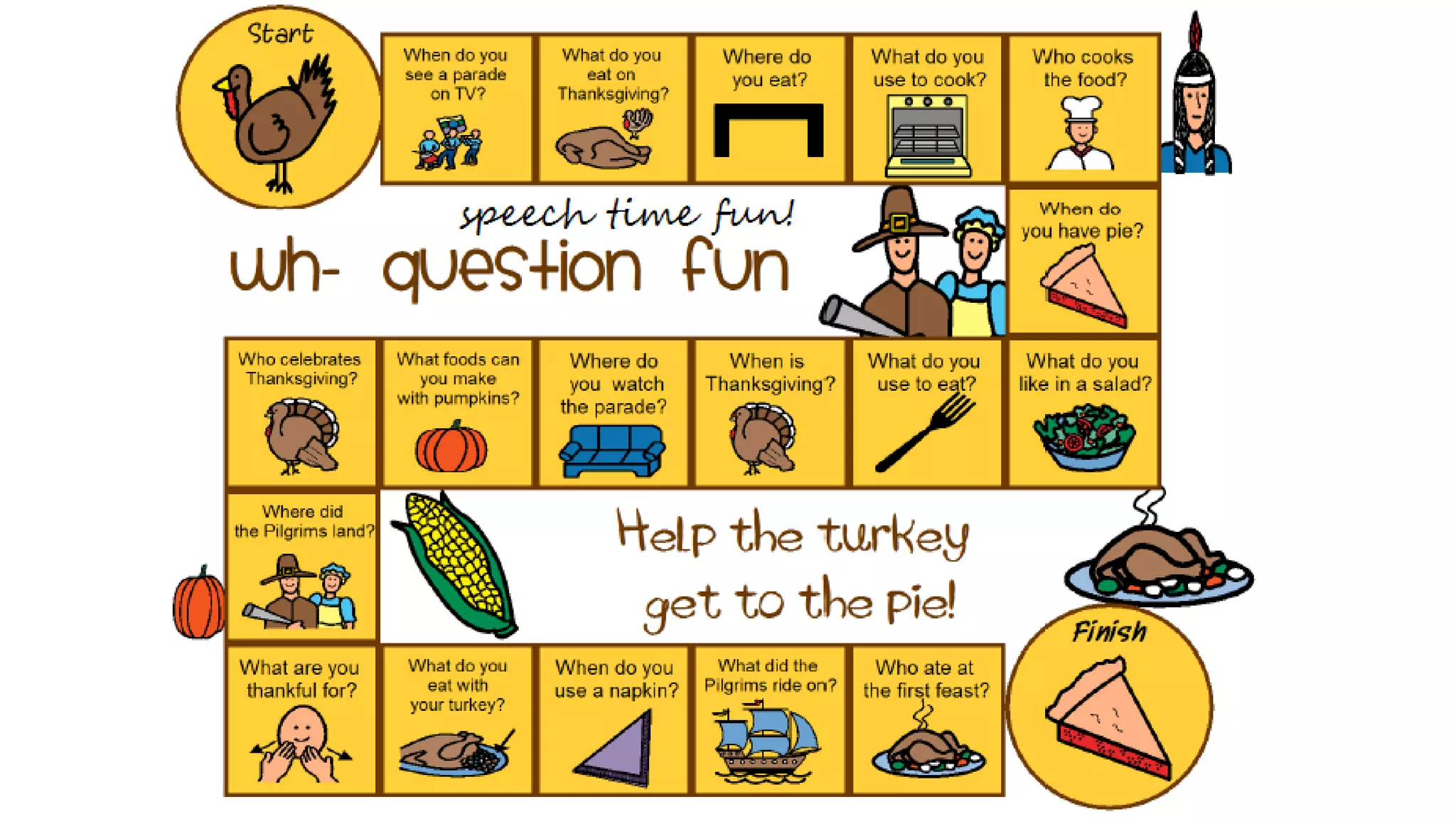
•The last class will be a board game with questions
about the holiday to secure the students' learning. It
is not going to count points or worth a prize at the
end, so the activity will be focused on pure learning
and children's entertainment.
Class 1
Product: Introduce the Project and to show how it is
important for American’s life. Starting the topic examples
for gratitude.
Summary of substance: Showing the Project, explaining
all the steps and the expected result. Sensitizing the
students about the subject from project. Presenting the
first topic: Thanksgiving holiday and why it is important for
the American’s lives. Then, the teacher shows for them
some examples of gratitude.
Class 2
Product: Continue the project. Thanksgiving food.
Summary of substance: Continuing the process about
the project. In this class the teacher will show the food
vocabulary about Thanksgiving. Then, she/he will
propose activity that the students need to name the
foods for improving the new vocabulary and food
pictures for paint.
Class 3
Product: Continue the project. WH- questions.
Summary of substance: Continuing the process
about the project. In this class the teacher will
show the difference between WH- questions
through dialogs. Then, the students need to
practice their speaking in pairs.
Class 4
Product: Continue the project. Simulation of
Thanksgiving Day.
Summary of substance: Continuing the process about
the project. In this class, it will happen the simulation
about Thanksgiving Day, every student needs to sit on
the floor in a semicircle facing the teacher. Then, each
student will say why grateful from their lives is. While
happen this activity, it will have lounge soft songs.
Class 5
Product: Final class of the project. Game.
Summary of substance: Final class of the project.
In this class the teacher will show game about
Thanksgiving holiday. The students need to join
on small groups to play the game.
References
ANTUNES, Celso - Jogos para a estimulação das múltiplas
inteligências. Petrópolis: Vozes, 2003.
BRASIL. Parâmetros Curriculares Nacionais: Ensino
Fundamental. MEC: Brasília, 1997.
HANNA, Vera Lucia Harabagi. Línguas Estrangeiras: O ensino
em um contexto cultural. São Paulo: Editora Mackenzie, 2012.

Projeto Knowing Thanksgiving

  • 1.
  • 2.
    INTRODUCTION •The name ofour project is Knowing Thanksgiving; •The purpose of this work is to teach the student about one of the most famous holidays around the world: Thanksgiving.
  • 3.
    INTRODUCTION •The implementation ofgames as a fun tool at school can help during the learning process, allowing the student to assimilate more accurately the taught content.
  • 4.
    INTRODUCTION •The theoretical referenceof this paper was based on HANNA (2012) and the PCNs (2000).
  • 5.
    JUSTIFICATION • This themewas chosen because it provides contact with a real situation, and teaches about a different vocabulary as well as know a new holiday.
  • 6.
    OBJECTIVES •Promote values suchas friendship, solidarity and respect through a celebration; •Recognize the vocabulary related to the celebration of Thanksgiving Day; •Recognize the importance of culture to which the language is inserted;
  • 7.
    OBJECTIVES •Learn how towork in groups; •Motor coordination skills to perform artistic tasks; •Use the materials provided by the school with creativity and economy; •Learn how to use the WH questions.
  • 8.
    Methodology •The students willbe taught about the Thanksgiving Day in a playful manner. •Appropriate language to their clearly understanding; the use of images to their deepen interpretation and also videos and music. •They are going to learn about how are used the thanks in English through a lot of activities and plays.
  • 9.
    Methodology •The students willbe taught how use the WH- questions in English. To complete their vocabulary, words in relation to Thanksgiving Day will be represented to them as well. •The result will be an act of Thanksgiving Day with the children. They are going to say what they are grateful for.
  • 10.
    Methodology •On the sameday, students will take some food dish made at home to celebrate together. •The last class will be a board game with questions about the holiday to secure the students' learning. It is not going to count points or worth a prize at the end, so the activity will be focused on pure learning and children's entertainment.
  • 11.
    Class 1 Product: Introducethe Project and to show how it is important for American’s life. Starting the topic examples for gratitude. Summary of substance: Showing the Project, explaining all the steps and the expected result. Sensitizing the students about the subject from project. Presenting the first topic: Thanksgiving holiday and why it is important for the American’s lives. Then, the teacher shows for them some examples of gratitude.
  • 12.
    Class 2 Product: Continuethe project. Thanksgiving food. Summary of substance: Continuing the process about the project. In this class the teacher will show the food vocabulary about Thanksgiving. Then, she/he will propose activity that the students need to name the foods for improving the new vocabulary and food pictures for paint.
  • 13.
    Class 3 Product: Continuethe project. WH- questions. Summary of substance: Continuing the process about the project. In this class the teacher will show the difference between WH- questions through dialogs. Then, the students need to practice their speaking in pairs.
  • 14.
    Class 4 Product: Continuethe project. Simulation of Thanksgiving Day. Summary of substance: Continuing the process about the project. In this class, it will happen the simulation about Thanksgiving Day, every student needs to sit on the floor in a semicircle facing the teacher. Then, each student will say why grateful from their lives is. While happen this activity, it will have lounge soft songs.
  • 15.
    Class 5 Product: Finalclass of the project. Game. Summary of substance: Final class of the project. In this class the teacher will show game about Thanksgiving holiday. The students need to join on small groups to play the game.
  • 17.
    References ANTUNES, Celso -Jogos para a estimulação das múltiplas inteligências. Petrópolis: Vozes, 2003. BRASIL. Parâmetros Curriculares Nacionais: Ensino Fundamental. MEC: Brasília, 1997. HANNA, Vera Lucia Harabagi. Línguas Estrangeiras: O ensino em um contexto cultural. São Paulo: Editora Mackenzie, 2012.