PLENARY SESSION
Project Implementation
March 9, 2021 (6:30–7:30pm)
U.S. Department of Education
Presenters: Faith D. George-Boone, Allison Layland, and Emerson Odango
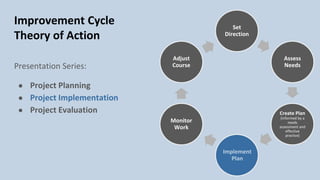
Improvement Cycle
Theory of Action
Presentation Series:
● Project Planning
● Project Implementation
● Project Evaluation
Set
Direction
Assess
Needs
Create Plan
(informed by a
needs
assessment and
effective
practice)
Implement
Plan
Monitor
Work
Adjust
Course
Session Objectives
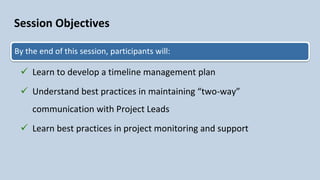
By the end of this session, participants will:
✓ Learn to develop a timeline management plan
✓ Understand best practices in maintaining “two-way”
communication with Project Leads
✓ Learn best practices in project monitoring and support
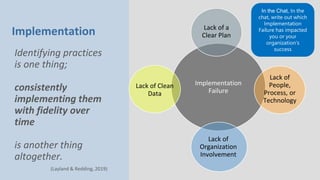
Implementation
Identifying practices
is one thing;
consistently
implementing them
with fidelity over
time
is another thing
altogether.
(Layland & Redding, 2019)
Implementation
Failure
Lack of a
Clear Plan
Lack of
People,
Process, or
Technology
Lack of
Organization
Involvement
Lack of Clean
Data
In the Chat, In the
chat, write out which
Implementation
Failure has impacted
you or your
organization's
success
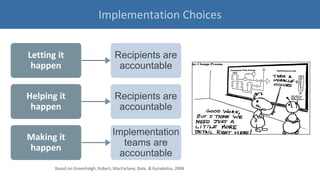
Implementation Choices
Letting it
happen
Recipients are
accountable
Helping it
happen
Recipients are
accountable
Making it
happen
Implementation
teams are
accountable
Based on Greenhalgh, Robert, MacFarlane, Bate, & Kyriakidou, 2004
The project lead and all staff responsible for
actions make up the Project Implementation
Team.
The Team should meet at least monthly to
discuss progress on completing actions.
Challenges are discussed and solutions are
formulated to ensure that the work stays on
track for completion according to the
timelines.
Implementation Team
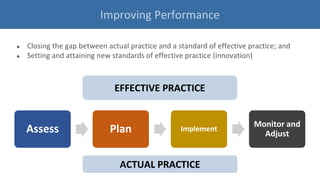
● Closing the gap between actual practice and a standard of effective practice; and
● Setting and attaining new standards of effective practice (innovation)
Improving Performance
Assess Plan Implement
Monitor and
Adjust
EFFECTIVE PRACTICE
ACTUAL PRACTICE
NIRN https://nirn.fpg.unc.edu/module-2/implementation-drivers
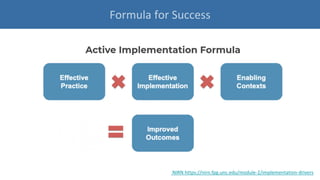
Formula for Success
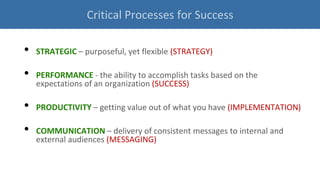
Critical Processes for Success
• STRATEGIC – purposeful, yet flexible (STRATEGY)
• PERFORMANCE - the ability to accomplish tasks based on the
expectations of an organization (SUCCESS)
• PRODUCTIVITY – getting value out of what you have (IMPLEMENTATION)
• COMMUNICATION – delivery of consistent messages to internal and
external audiences (MESSAGING)
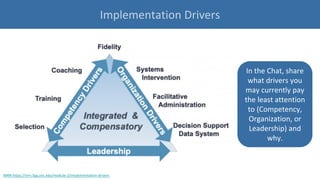
Implementation Drivers
In the Chat, share
what drivers you
may currently pay
the least attention
to (Competency,
Organization, or
Leadership) and
why.
NIRN https://nirn.fpg.unc.edu/module-2/implementation-drivers
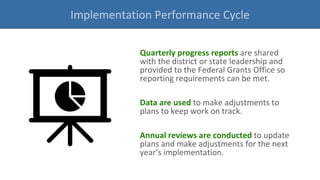
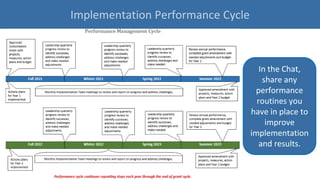
Quarterly progress reports are shared
with the district or state leadership and
provided to the Federal Grants Office so
reporting requirements can be met.
Data are used to make adjustments to
plans to keep work on track.
Annual reviews are conducted to update
plans and make adjustments for the next
year’s implementation.
Implementation Performance Cycle
In the Chat,
share any
performance
routines you
have in place to
improve
implementation
and results.
Oh No! Just as everyone was in the
groove implementing their projects
according to the Performance
Cycle, a pandemic occurs causing
closures, travel stoppages, and a
shift to remote learning.
What adjustments do you need to
make to your Performance Cycle?
In the Chat share the adjustments you have
made during the pandemic.
Keep in Mind…
If a project is being funded through a grant, such
as the Palau Grant or the Consolidated Grant, the
implementation phase not only includes
implementing and monitoring the project, it also
includes managing the grant through effective
internal controls.
An Internal control is
“a process, effected by an entity’s board of directors, management and other
personnel, designed to provide reasonable assurance regarding the achievement of
objectives in the following categories”:
• Effectiveness and efficiency of operations
• Reliability of Financial Reporting
• Compliance with applicable laws and objectives
(Schandl & Foster, 2019)
Grant Implementation
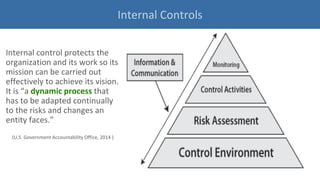
Internal control protects the
organization and its work so its
mission can be carried out
effectively to achieve its vision.
It is “a dynamic process that
has to be adapted continually
to the risks and changes an
entity faces.”
(U.S. Government Accountability Office, 2014 )
Internal Controls
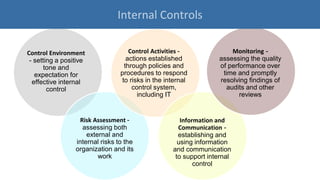
Control Environment
- setting a positive
tone and
expectation for
effective internal
control
Risk Assessment -
assessing both
external and
internal risks to the
organization and its
work
Control Activities -
actions established
through policies and
procedures to respond
to risks in the internal
control system,
including IT
Information and
Communication -
establishing and
using information
and communication
to support internal
control
Monitoring -
assessing the quality
of performance over
time and promptly
resolving findings of
audits and other
reviews
Internal Controls
What are some successes and
challenges with your existing
Communications Plans, specifically
regarding communication among
project leads?
Communication: Prior Experiences
In the Chat,
share
examples of
successes and
challenges.
Lewis (2019) notes that
“organizations are socially constructed largely
through the communicative interactions of
internal and external stakeholders” (p. 6).
Organizational change is accomplished through
formal and informal interactions with
stakeholders through multiple channels and
formats (Layland & Redding, 2021).
The Strategic Communication Lens in SPM
Multilateral &
Multimodal
• The tried and true traditional methods of providing one-way
communication “are not adequate for producing the necessary
awareness and support to implement reforms statewide or at the local
level,” let alone within the organization itself (Matta-Barrera & Nafziger,
2013, p. 1)
• SEAs and LEAs need to move beyond traditional
communication methods to a more strategic, centralized
approach across departments/Divisions that involves internal
and external stakeholders (Layland & Redding, 2021)
“One-Way” Communication
In the Chat, please share
examples of how one-way
communication methods can be
re-mapped as two-way.
Two-Way Communication Among Leads
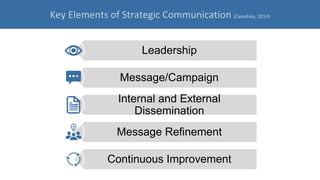
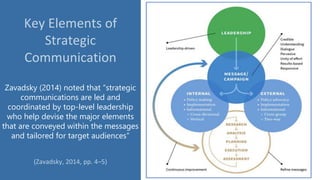
Leadership
Message/Campaign
Internal and External
Dissemination
Message Refinement
Continuous Improvement
Key Elements of Strategic Communication (Zavadsky, 2014)
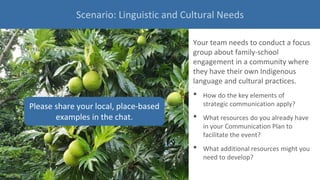
Your team needs to conduct a focus
group about family-school
engagement in a community where
they have their own Indigenous
language and cultural practices.
• How do the key elements of
strategic communication apply?
• What resources do you already have
in your Communication Plan to
facilitate the event?
• What additional resources might you
need to develop?
Please share your local, place-based
examples in the chat.
Scenario: Linguistic and Cultural Needs
Key Elements of
Strategic
Communication
Zavadsky (2014) noted that “strategic
communications are led and
coordinated by top-level leadership
who help devise the major elements
that are conveyed within the messages
and tailored for target audiences”
(Zavadsky, 2014, pp. 4–5)
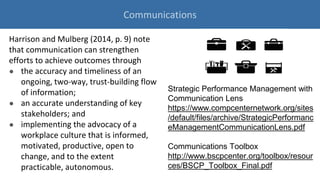
Harrison and Mulberg (2014, p. 9) note
that communication can strengthen
efforts to achieve outcomes through
● the accuracy and timeliness of an
ongoing, two-way, trust-building flow
of information;
● an accurate understanding of key
stakeholders; and
● implementing the advocacy of a
workplace culture that is informed,
motivated, productive, open to
change, and to the extent
practicable, autonomous.
Communications
Strategic Performance Management with
Communication Lens
https://www.compcenternetwork.org/sites
/default/files/archive/StrategicPerformanc
eManagementCommunicationLens.pdf
Communications Toolbox
http://www.bscpcenter.org/toolbox/resour
ces/BSCP_Toolbox_Final.pdf
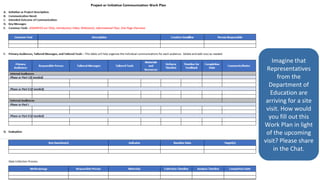
Imagine that
Representatives
from the
Department of
Education are
arriving for a site
visit. How would
you fill out this
Work Plan in light
of the upcoming
visit? Please share
in the Chat.
Just today, it was announced that COVID-
19 vaccines are now being made
available for teachers in your area. Many
are asking about details about the
vaccine, such as eligibility and
distribution.
What adjustments do you need
to make to your
Communications Plan?
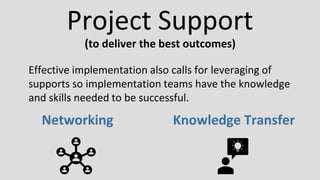
Project Support
(to deliver the best outcomes)
Networking Knowledge Transfer
Effective implementation also calls for leveraging of
supports so implementation teams have the knowledge
and skills needed to be successful.
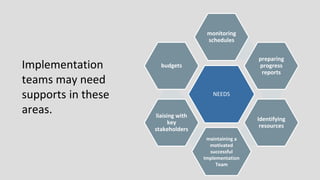
NEEDS
monitoring
schedules
preparing
progress
reports
Identifying
resources
maintaining a
motivated
successful
Implementation
Team
liaising with
key
stakeholders
budgets
Implementation
teams may need
supports in these
areas.
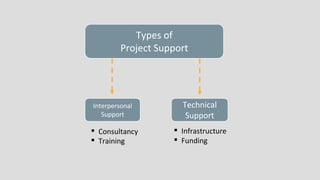
Types of
Project Support
Interpersonal
Support
Technical
Support
▪ Consultancy
▪ Training
▪ Infrastructure
▪ Funding
An 8th strain to the coronavirus
has been detected in the territory,
one that is potentially resistant to
current vaccines, and has begun
to spread. This causes schools and
key agencies to close.
What support has impacted the
successful implementation of your
project in remaining as close as
possible to your project timeline?
▪ Harrison, E. & Muhlberg (2014). Leadership Communication: How Leaders Communicate and How Communicators
Lead in the Today's Global Enterprise. New York, NY: Business Expert Press, LLC.
▪ Greenhalgh, T., Robert, G., MacFarlane, F., Bate, P., & Kyriakidou, O. (2004). Diffusion of innovations in service
organizations: Systematic review and recommendations. Milbank Q. 2004 Dec; 82(4), 581–629.
▪ Layland, A., & Redding, S. (2019). Strategic performance management: A journey in organizational
effectiveness. Rockville, MD: National Comprehensive Center at Westat.
▪ Layland, A., & Redding, S. (2021). Managing performance strategically in education organizations. Information
Age Publishing, Inc.
▪ Lewis, L. (2019). Organizational change: Creating change through strategic communication. Hoboken, NJ: John
Wiley & Sons.
▪ Matta-Barrera, R. & Nafziger, K. (2013). SEA strategic communications: A stakeholder approach to prioritize
communication efforts. Solutions: Building State Capacity and Productivity Center at Edvance Research, No. 5.
▪ Schandl, A. & Foster, P. (2019). COSO internal control-integrated framework: An implementation guide for the
healthcare provider industry. Committee of Sponsoring Organizations of the Treadmill Corporation. Retrieved
from https://www.coso.org/Documents/COSO-CROWE-COSO-Internal-Control-Integrated-Framework.pdf
▪ U.S. Government Accountability Office (2014, September 10). Standards for internal control in the federal
government. GAO-14-704G. Retrieved from https://www.gao.gov/products/GAO-14-704G
▪ Zavadsky, H. (2014). State education agency communications process. Benchmark & Best Practices Project:
Building State Capacity and Productivity Center at Edvance Research, No. 01.
▪ Zavadsky, H., Berry, T., & Savage, T. (2017). BSCP Center Strategic Communications Toolbox. San Antonio, TX:
Building State Capacity and Productivity Center at Westat.
Key Resources
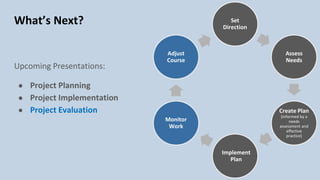
What’s Next?
Upcoming Presentations:
● Project Planning
● Project Implementation
● Project Evaluation
Set
Direction
Assess
Needs
Create Plan
(informed by a
needs
assessment and
effective
practice)
Implement
Plan
Monitor
Work
Adjust
Course
PLENARY SESSION
Project Planning
Thank You!
Need more information? We are here to help. Contact:
The contents of this presentation were developed under a grant from the Department of Education. However, the contents do not necessarily represent the
policy of the Department of Education, and you should not assume endorsement by the Federal government.
Region 3 Comprehensive Center (U.S. Virgin Islands)
Director: Dr. John H. Lockwood (JLockwood@ets.org)
Region 18 Comprehensive Center (CNMI, Guam, and Palau)
Director Dr. Emerson Odango (odangoe@prel.org)
Region 19 Comprehensive Center (American Samoa)
Director: Dr. Melly Wilson (wilsonm@prel.org)

Project-Implementation-PowerPoint.pdf

  • 1.
    PLENARY SESSION Project Implementation March9, 2021 (6:30–7:30pm) U.S. Department of Education Presenters: Faith D. George-Boone, Allison Layland, and Emerson Odango
  • 2.
    Improvement Cycle Theory ofAction Presentation Series: ● Project Planning ● Project Implementation ● Project Evaluation Set Direction Assess Needs Create Plan (informed by a needs assessment and effective practice) Implement Plan Monitor Work Adjust Course
  • 3.
    Session Objectives By theend of this session, participants will: ✓ Learn to develop a timeline management plan ✓ Understand best practices in maintaining “two-way” communication with Project Leads ✓ Learn best practices in project monitoring and support
  • 4.
    Implementation Identifying practices is onething; consistently implementing them with fidelity over time is another thing altogether. (Layland & Redding, 2019) Implementation Failure Lack of a Clear Plan Lack of People, Process, or Technology Lack of Organization Involvement Lack of Clean Data In the Chat, In the chat, write out which Implementation Failure has impacted you or your organization's success
  • 5.
    Implementation Choices Letting it happen Recipientsare accountable Helping it happen Recipients are accountable Making it happen Implementation teams are accountable Based on Greenhalgh, Robert, MacFarlane, Bate, & Kyriakidou, 2004
  • 6.
    The project leadand all staff responsible for actions make up the Project Implementation Team. The Team should meet at least monthly to discuss progress on completing actions. Challenges are discussed and solutions are formulated to ensure that the work stays on track for completion according to the timelines. Implementation Team
  • 7.
    ● Closing thegap between actual practice and a standard of effective practice; and ● Setting and attaining new standards of effective practice (innovation) Improving Performance Assess Plan Implement Monitor and Adjust EFFECTIVE PRACTICE ACTUAL PRACTICE
  • 8.
  • 9.
    Critical Processes forSuccess • STRATEGIC – purposeful, yet flexible (STRATEGY) • PERFORMANCE - the ability to accomplish tasks based on the expectations of an organization (SUCCESS) • PRODUCTIVITY – getting value out of what you have (IMPLEMENTATION) • COMMUNICATION – delivery of consistent messages to internal and external audiences (MESSAGING)
  • 10.
    Implementation Drivers In theChat, share what drivers you may currently pay the least attention to (Competency, Organization, or Leadership) and why. NIRN https://nirn.fpg.unc.edu/module-2/implementation-drivers
  • 11.
    Quarterly progress reportsare shared with the district or state leadership and provided to the Federal Grants Office so reporting requirements can be met. Data are used to make adjustments to plans to keep work on track. Annual reviews are conducted to update plans and make adjustments for the next year’s implementation. Implementation Performance Cycle
  • 12.
    Implementation Performance Cycle Inthe Chat, share any performance routines you have in place to improve implementation and results.
  • 13.
    Oh No! Justas everyone was in the groove implementing their projects according to the Performance Cycle, a pandemic occurs causing closures, travel stoppages, and a shift to remote learning. What adjustments do you need to make to your Performance Cycle? In the Chat share the adjustments you have made during the pandemic.
  • 14.
    Keep in Mind… Ifa project is being funded through a grant, such as the Palau Grant or the Consolidated Grant, the implementation phase not only includes implementing and monitoring the project, it also includes managing the grant through effective internal controls.
  • 15.
    An Internal controlis “a process, effected by an entity’s board of directors, management and other personnel, designed to provide reasonable assurance regarding the achievement of objectives in the following categories”: • Effectiveness and efficiency of operations • Reliability of Financial Reporting • Compliance with applicable laws and objectives (Schandl & Foster, 2019) Grant Implementation
  • 16.
    Internal control protectsthe organization and its work so its mission can be carried out effectively to achieve its vision. It is “a dynamic process that has to be adapted continually to the risks and changes an entity faces.” (U.S. Government Accountability Office, 2014 ) Internal Controls
  • 17.
    Control Environment - settinga positive tone and expectation for effective internal control Risk Assessment - assessing both external and internal risks to the organization and its work Control Activities - actions established through policies and procedures to respond to risks in the internal control system, including IT Information and Communication - establishing and using information and communication to support internal control Monitoring - assessing the quality of performance over time and promptly resolving findings of audits and other reviews Internal Controls
  • 18.
    What are somesuccesses and challenges with your existing Communications Plans, specifically regarding communication among project leads? Communication: Prior Experiences In the Chat, share examples of successes and challenges.
  • 19.
    Lewis (2019) notesthat “organizations are socially constructed largely through the communicative interactions of internal and external stakeholders” (p. 6). Organizational change is accomplished through formal and informal interactions with stakeholders through multiple channels and formats (Layland & Redding, 2021). The Strategic Communication Lens in SPM
  • 20.
  • 21.
    • The triedand true traditional methods of providing one-way communication “are not adequate for producing the necessary awareness and support to implement reforms statewide or at the local level,” let alone within the organization itself (Matta-Barrera & Nafziger, 2013, p. 1) • SEAs and LEAs need to move beyond traditional communication methods to a more strategic, centralized approach across departments/Divisions that involves internal and external stakeholders (Layland & Redding, 2021) “One-Way” Communication
  • 22.
    In the Chat,please share examples of how one-way communication methods can be re-mapped as two-way. Two-Way Communication Among Leads
  • 23.
    Leadership Message/Campaign Internal and External Dissemination MessageRefinement Continuous Improvement Key Elements of Strategic Communication (Zavadsky, 2014)
  • 24.
    Your team needsto conduct a focus group about family-school engagement in a community where they have their own Indigenous language and cultural practices. • How do the key elements of strategic communication apply? • What resources do you already have in your Communication Plan to facilitate the event? • What additional resources might you need to develop? Please share your local, place-based examples in the chat. Scenario: Linguistic and Cultural Needs
  • 25.
    Key Elements of Strategic Communication Zavadsky(2014) noted that “strategic communications are led and coordinated by top-level leadership who help devise the major elements that are conveyed within the messages and tailored for target audiences” (Zavadsky, 2014, pp. 4–5)
  • 26.
    Harrison and Mulberg(2014, p. 9) note that communication can strengthen efforts to achieve outcomes through ● the accuracy and timeliness of an ongoing, two-way, trust-building flow of information; ● an accurate understanding of key stakeholders; and ● implementing the advocacy of a workplace culture that is informed, motivated, productive, open to change, and to the extent practicable, autonomous. Communications Strategic Performance Management with Communication Lens https://www.compcenternetwork.org/sites /default/files/archive/StrategicPerformanc eManagementCommunicationLens.pdf Communications Toolbox http://www.bscpcenter.org/toolbox/resour ces/BSCP_Toolbox_Final.pdf
  • 27.
    Imagine that Representatives from the Departmentof Education are arriving for a site visit. How would you fill out this Work Plan in light of the upcoming visit? Please share in the Chat.
  • 28.
    Just today, itwas announced that COVID- 19 vaccines are now being made available for teachers in your area. Many are asking about details about the vaccine, such as eligibility and distribution. What adjustments do you need to make to your Communications Plan?
  • 29.
    Project Support (to deliverthe best outcomes) Networking Knowledge Transfer Effective implementation also calls for leveraging of supports so implementation teams have the knowledge and skills needed to be successful.
  • 30.
  • 31.
    Types of Project Support Interpersonal Support Technical Support ▪Consultancy ▪ Training ▪ Infrastructure ▪ Funding
  • 32.
    An 8th strainto the coronavirus has been detected in the territory, one that is potentially resistant to current vaccines, and has begun to spread. This causes schools and key agencies to close. What support has impacted the successful implementation of your project in remaining as close as possible to your project timeline?
  • 33.
    ▪ Harrison, E.& Muhlberg (2014). Leadership Communication: How Leaders Communicate and How Communicators Lead in the Today's Global Enterprise. New York, NY: Business Expert Press, LLC. ▪ Greenhalgh, T., Robert, G., MacFarlane, F., Bate, P., & Kyriakidou, O. (2004). Diffusion of innovations in service organizations: Systematic review and recommendations. Milbank Q. 2004 Dec; 82(4), 581–629. ▪ Layland, A., & Redding, S. (2019). Strategic performance management: A journey in organizational effectiveness. Rockville, MD: National Comprehensive Center at Westat. ▪ Layland, A., & Redding, S. (2021). Managing performance strategically in education organizations. Information Age Publishing, Inc. ▪ Lewis, L. (2019). Organizational change: Creating change through strategic communication. Hoboken, NJ: John Wiley & Sons. ▪ Matta-Barrera, R. & Nafziger, K. (2013). SEA strategic communications: A stakeholder approach to prioritize communication efforts. Solutions: Building State Capacity and Productivity Center at Edvance Research, No. 5. ▪ Schandl, A. & Foster, P. (2019). COSO internal control-integrated framework: An implementation guide for the healthcare provider industry. Committee of Sponsoring Organizations of the Treadmill Corporation. Retrieved from https://www.coso.org/Documents/COSO-CROWE-COSO-Internal-Control-Integrated-Framework.pdf ▪ U.S. Government Accountability Office (2014, September 10). Standards for internal control in the federal government. GAO-14-704G. Retrieved from https://www.gao.gov/products/GAO-14-704G ▪ Zavadsky, H. (2014). State education agency communications process. Benchmark & Best Practices Project: Building State Capacity and Productivity Center at Edvance Research, No. 01. ▪ Zavadsky, H., Berry, T., & Savage, T. (2017). BSCP Center Strategic Communications Toolbox. San Antonio, TX: Building State Capacity and Productivity Center at Westat. Key Resources
  • 34.
    What’s Next? Upcoming Presentations: ●Project Planning ● Project Implementation ● Project Evaluation Set Direction Assess Needs Create Plan (informed by a needs assessment and effective practice) Implement Plan Monitor Work Adjust Course
  • 35.
    PLENARY SESSION Project Planning ThankYou! Need more information? We are here to help. Contact: The contents of this presentation were developed under a grant from the Department of Education. However, the contents do not necessarily represent the policy of the Department of Education, and you should not assume endorsement by the Federal government. Region 3 Comprehensive Center (U.S. Virgin Islands) Director: Dr. John H. Lockwood (JLockwood@ets.org) Region 18 Comprehensive Center (CNMI, Guam, and Palau) Director Dr. Emerson Odango (odangoe@prel.org) Region 19 Comprehensive Center (American Samoa) Director: Dr. Melly Wilson (wilsonm@prel.org)