INDUSTRIAL VISIT PROJECT
(AMUL CO.KANPUR)
SUBMITTED TO:
P.P.N P.G College, kanpur
(C.S.J.M University)
As a part of 5th
semester curriculum of
Bachelor of Business Administration
SUBMITTED BY-
PRIYAM TANDON
Enrollment No:- CSJMA19001315360
ROLL NO:-0401182
UNDER GUIDANCE OF :-
Dr.Lavlesh srivastava
(B.B.A Department P.P.N College)
2021-22
Writing this industrial visit report happens to be one of the greatest
achievements in this phase of my life. Express my heartiest thanks to
those
who provided me tremendous support and making it a useful first hand
experience. I am indebted to those who helped me in one way or the
other in heavy indeed. I take the opportunity to thank all of them. I am
very thankfulto our HOD Ma’am Mrs. Pooja Vidyarthee, under guidance
of Dr. Lavlesh srivastava , and all other faculty member of the institute
who gave me the excellent platform of doing something in
management field at Industrial visit.
I am thankful to the all the Amul industries authority for giving us the
opportunity to to learn with the prestigious valuable guidance.
integrated support and perceptive criticism helped me to conceptualize
the precious and unforgettable experience which will help me in my
future Last but not the least I would also like to thanks toward my
parents friends and
benefactors who has help me directly and indirectly through my
industrial nour
Thank you
This is to certify that Priyam tandon student of P.P.N Degree
college bearing university Enrollment no. CSJMA19001315360
has visited the industry and prepared the report. This report has not
formed a basis for awarding any other degree / diploma / certificate by
this university or any other university.
Place:
Date: Signature of the H.O.D.
TABEL OF CONTENTS
CHAPTERS PAGE NO.
CHAPTER 1- Introduction of the study……………..
CHAPTER 2- Objective of the study………………..
CHAPTER 3- Company profile – AMUL………
CHAPTER 4- Organizational structure……….
CHAPTER 5- Strategies of amul…………
CHAPTER 6- Research methodology……………………
CHAPTER 7- SWOT analysis………………………………
CHAPTER 8- Findings from the report………..………
CHAPTER 9- Conclusion………………………………………
CHAPTER 10- Glimpse of the visit……………………
INTRODUCTION OF THE STUDY
1.Benefits of Industry Visits
Industrial visits are the best source to increase the knowledge of
students. It gives students exposure to various functions in an
organization, such as HR, Marketing, Communication, etc.
2.It Gives real-world experience
While college and its syllabus prepare students with theoretical
knowledge, Industry visits can expose them to real-world problems and
give them an idea on how to resolve them.
3.Industry visits make contacts
When students are on an industry visit for their respective specialization
course, they make contacts in the industry. These contacts help them
grow after they graduate and are making their space in their
field.
4.The Certificates
Industry visits not only give them a perspective, but it also gives them
certificates. These certificates come in handy when students are applying
for jobs. The certificates can give them a head start.
5.Industry visits help the student in choosing their field
Industry visits not only give students a clear look at how things work,
but they help students in choosing a career. After the visits, students can
think about how the industry is suitable for them and if they want to
make a career in it.
6.Students meet different work culture
When colleges conduct multiple industry visits for students, students
experience various work cultures. They learn their ethics, their policies
and their protocols. This experience prepares students for the future.
OBJECTIVE OF THE STUDY
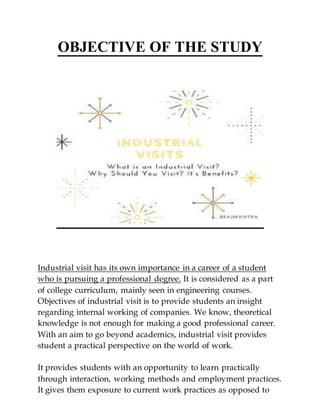
Industrial visit has its own importance in a career of a student
who is pursuing a professional degree. It is considered as a part
of college curriculum, mainly seen in engineering courses.
Objectives of industrial visit is to provide students an insight
regarding internal working of companies. We know, theoretical
knowledge is not enough for making a good professional career.
With an aim to go beyond academics, industrial visit provides
student a practical perspective on the world of work.
It provides students with an opportunity to learn practically
through interaction, working methods and employment practices.
It gives them exposure to current work practices as opposed to
possibly theoretical knowledge being taught at college. Industrial
visits provide an excellent opportunity to interact with industries
and know more about industrial environment. Industrial visits
are arranged by colleges to students with an objective of
providing students functional opportunity in different sectors like
IT, Manufacturing and services, finance and marketing. Industrial
visit helps to combine theoretical knowledge with industrial
knowledge. Industrial realities are opened to the students
through industrial visits.
The college organizes industrial visits to help students
understand about the practical aspects of production, marketing,
labour relations and other activities managed by industrial
sectors.
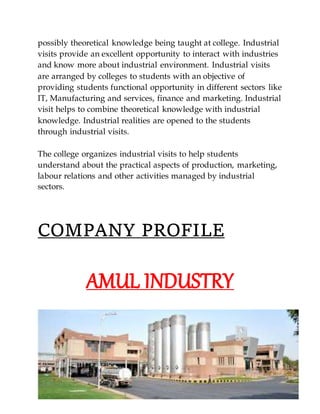
COMPANY PROFILE
AMUL INDUSTRY
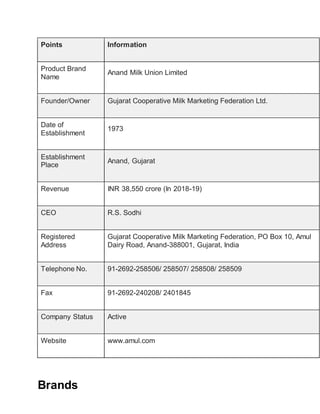
Points Information
Product Brand
Name
Anand Milk Union Limited
Founder/Owner Gujarat Cooperative Milk Marketing Federation Ltd.
Date of
Establishment
1973
Establishment
Place
Anand, Gujarat
Revenue INR 38,550 crore (In 2018-19)
CEO R.S. Sodhi
Registered
Address
Gujarat Cooperative Milk Marketing Federation, PO Box 10, Amul
Dairy Road, Anand-388001, Gujarat, India
Telephone No. 91-2692-258506/ 258507/ 258508/ 258509
Fax 91-2692-240208/ 2401845
Company Status Active
Website www.amul.com
Brands
 Amul Milk
 Dahi
 Paneer
 Fresh Cream
 Chocolates
 Ghee
 Beverage range
 Mithai Mate
 Roti Softner
 Amul sour cream
 Milk Powders
 Bread Spreads
 Cheese
 Amul PRO
 Bakery products
 Panchamrit
Establishment
Anand Milk Union Limited established in 1973. In 1946, the company was
registered to stop the exploitation of middleman. The exploitative trade
practices followed by the local trade cartel triggered off the cooperative
movement. Then, the prime minister, Lal Bahadur Shastri decided that the
same approach should become the basis of a National Dairy Development
policy.
The farmers owned the dairy, their elected representatives managed the
village societies and the district union, they employed professionals to operate
the diary and manage its business. In 1965, the National Diary Development
Board was set up with the basic objective of replicating the Amul model. The
company established a direct linkage between milk producers and consumers
by eliminating middleman. The Amul model has helped India to emerge as the
largest milk producer in the world. More than 16 million milk producers pour
their milk in 185903 dairy cooperative societies across the country.
Awards
 IMC Ramkrishna Bajaj National Quality award- Excellence in Crisis-
Crisis Superheroes Award-30th October 2020
 World Dairy Innovation Award-2020- Finalists
 Amul-Marketer of the year FMCG food-IAA leadership award 2019
 Making of Developed India IT awards for Digital India
 Special Jury citation for Risk Management Award 2018
 GCMMF received the &tv Pitch top 50 brands award-Amul Evergreens-
2007
 BML Munjal Award 2017
 Champions of Excellence Award for brand Amul
 Amul received ET Iconic Brand Award
 Amul wins World dairy Innovation Awards-2014
AMUL MARKET SHARE
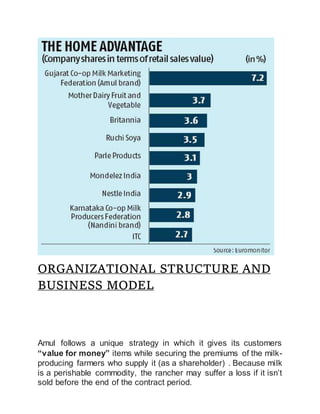
Amul, a brand of dairy cooperative major Gujarat Cooperative Milk Marketing
Federation Ltd (GCMMF), is ranked 8th in the list of top 20 global dairy
processors released by the International Farm Comparison Network (IFCN).
The home-grown dairy giant has moved up one rank since last year's ranking.
In 2018, it emerged as the 9th largest milk processor by IFCN, a global dairy
research network.
Amul was ranked at 18th position in 2012, however, in flat 8 years, it has
moved 10 notches above to the current 8th position.
ORGANIZATIONAL STRUCTURE AND
BUSINESS MODEL
Amul follows a unique strategy in which it gives its customers
“value for money” items while securing the premiums of the milk-
producing farmers who supply it (as a shareholder) . Because milk
is a perishable commodity, the rancher may suffer a loss if it isn’t
sold before the end of the contract period.
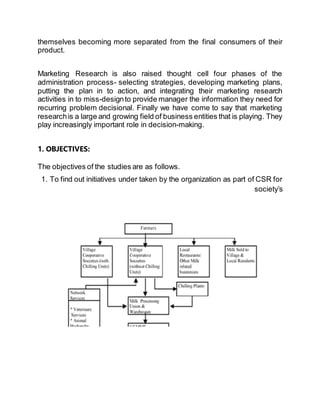
The Organization’s Structure
The “Anand design” cooperative framework was named after
Amul’s cooperative model. It’s a three-tiered system that includes
town social orders, regional dairy associations, and a state-level
entity. Each level is financially independent of the others, and it
employs agents from the level below it. It’s not difficult to
comprehend. When one person does not have enough funds to
generate the required capital for the company, other members who
share the same goal pool their resources to create a large-capital
organisation. The cooperative concept is advantageous since it
ensures brand trust. Even banks prefer to lend money to
cooperatives rather than to individuals. Amul now has 30 lakh
farmers from all over India as members.
The Kaira District Milk Cooperative Union (Amul), based in
Anand, has grown at a rapid pace. It joined together with other
Gujarat milk cooperatives and today represents 2.12 million
farmers, supplying milk to 10,411 towns. It focuses on fourteen
area-level plants (associations) that are overseen by the GCMMF.
From the start, it was assumed that this activity would directly
benefit and change poor farmers, as well as contribute to societal
improvement. Markets at the time, and even now, are rudimentary
and lacking in foundation. Amul and GCMMF realised that
development and improvement could not be left to market forces
alone, and that deliberate intervention was essential.
TYPES OF STRATEGY
1.HR
2.FINANCE
Human Resource Management:
Human Resource Management has come to be
recognized as an inherent part of management, which is
concerned with the human resources of an organization.
Its objective is the maintenance of better human
relations in the organization by the development,
application and evaluation of policies, procedures and
programmers relating to human resources to optimize
their contribution towards the realization of
organizational objectives.
In other words, HRM is concerned with getting better
results with the collaboration of people. It is an integral
but distinctive part of management, concerned with
people at work and their relationships within the
enterprise. HRM helps in attaining maximum individual
development, desirable working relationship between
employees and employers, employees and employees,
and effective modeling of human resources as contrasted
with physical resources. It is the recruitment, selection,
development, utilization, compensation and motivation
of human resources by the organization.
Finance Management
This is a process that involves planning and controlling of
the company’s financial resources. All other departments of
the company strongly depend upon the finance department
to go on with their departmental activities individually.
Objectives of Finance Management
1. Maximize the profit –the main objective is to increase
the profit as much as possible. This has to be done with
keeping in mind the returns for the company.
2. Process –Analysis, Decision Making, Planning,&
Control. These are the steps that are followed to
manage the financial resources of the company
efficiently.
Importance of Finance Management
For the growth of a company like Amul management of
finances is very important. Without this, the business
cannot survive or expand in this competitive market. Here
are some points that make it highly important for an
organization:
 Promoting the business
 Decision Making
 Successful business
 Measuring the Performance
 Helpful for Shareholders & Investors
Sources of Capital for Amul
1. As the products are sold on a daily basis to Gujarat
Co-operative Marketing Federation (GCMMF). An amount
is given by the federation to the union so that it gets paid
for the sale of its products.
2. The societies that are involved in its functioning hold
fixed deposits that act as a major source of capital.
3. As these Fixed deposits release some kind of Interest
when deposited in banks like UTI, BOB etc. These act as
another source of the finance.
4. The share capital is not public hence it is not listed in
the market it is exclusively for the members of the society.
MARKETING
Amul is one of the mostpopular and successfulbrands in India. With its wide
range of dairy products, Amul has now become a household name in the
minds of Indian families.
I’m sure that we all have at least one of Amul’s products in our house. It has
elegantly created its family -friendly and patriotic image with it, “Amul – The
Taste of India” marketing jingle which also evokes empathy towards the
brand.
What also makes Amul so special is that it has constantly managed itself in
staying relevant for all these years in the minds of the customers ever since
its foundation.
Thus, this also makes us wonder about what they are doing to stay relevant
in this increasingly competitive and digitized world.
Industry BasedTargetAudience
Amul has segmented Milk for various industries such as ice-cream
manufacturers, restaurants, coffee shops,and many similar industries.
Further, it has segmented Butter, Ghee, and Cheese forbakeries, pizza,
snack retailers, confectionaries,and many more.
The target audience study tells us that Amul has a strong presence in both
business-to-business (B2B)and Business-to-Customers (B2C).
This is how Amul’s target audience is served, given that it has a decent
concentration in both B2B and B2C segments.
Amul’s DigitalMarketing Strategy
In this increasingly digitized world, every brand needs to revamp its
marketing strategy. Amul too has cut down its expenditure on TV Ads and
Has started focusing more on the online form of advertising just like its
competitors.
1. Amul on Facebook & Integra
In the presentday, the shiftfrom offline to online marketing was fairly an easy
task for Amul. They were already creating content for banners and
newspapers previously and now they just follow the same style for their
creative on Facebook & Integra as well.
Their most popular creative on Facebook and Integra revolve around the
Amul Butter Girl the buzz-worthy happenings all around the world.
Let’s now take a look at some of Amul’s digital marketing campaigns which
were a hit on Facebookas well as Integra. “Eat Milk with Every Meal”
In 2013,Amul hired a digital marketing agency called Draftfcb Ulka to come
up with a campaign for the digital space as well as print.
The objective of this campaign was to educate Indian buyers about the
goodness of milk and its by-products.
2. Amul on Twitter
On Twitter, Amul has a massive fan base of over 335K followers given that
Twitter is a very different platform when compared to other social media
platforms.On various occasions,Amulposts fungraphics featuring the Amul
Butter Girl. Many people connect with those graphics and re tweet them to
show how they feel about the latest happenings in the world.
Twitter is a great platform for a brand to engage with its customers.Taking
advantage of this, Amul tries to conductinteractive activities like contests
and giveaways. A lot of people also use Twitter to express their grievances
for a service or a product. Amul makes sure that it replies to tweets of
customers complaining about its products..3. Amul on YouTube
Amul is also present on YouTube and it enjoys about 4,03,000 subscribers
on its officialYouTube channel called, Amul the Taste of India. However, On
YouTube, it puts out advertisements that are previously aired on television.
Although, during the Covid-19 pandemic when the country was in lockdown,
Amul started a new campaign called Simple Home Made Recipes that was
also promoted as “#SimpleHomeMadeRecipes”.
More about this campaign will be covered in the next section of the case
study. So this is how Amul’s digital marketing strategy has played out.
RESEARCH
METHODOLOGY
Market research is the function which links the consumer & market to the
marketer through information used to identify and define marketing
opportunities and problem, generate refine as evaluate marketing actions
monitor marketing performance and improve understanding of marketing as
a process.
Several characteristics of modern business enough used of marketing
research by business first the suppliers of product and service need to have
information about final consumer in order of market their products and
services more effectivelysecond as a company grows and start distributing
its products in a no of different markets, manager of the company find
themselves becoming more separated from the final consumers of their
product.
Marketing Research is also raised thought cell four phases of the
administration process- selecting strategies, developing marketing plans,
putting the plan in to action, and integrating their marketing research
activities in to miss-designto provide manager the information they need for
recurring problem decisional. Finally we have come to say that marketing
researchis a large and growing field of business entities that is playing. They
play increasingly important role in decision-making.
1. OBJECTIVES:
The objectives of the studies are as follows.
1. To find out initiatives under taken by the organization as part of CSR for
society’s
2. To study the demographicalprofile of various stakeholders involved in
CSR.
3. To explore the level of awareness, utilization & satisfaction of CSR as
perceived by the stakeholders.
4. To study the change in the lives of various stakeholders after the CSR
initiatives.
5. To suggestan intervention plan to enhance the functioning of CSR
RESEARCH DESIGN:-
The research design of the study is descriptive in nature. The study is
descriptive because an effort has been made to study the current status,
prevailing practices, point of view/opinion, processes and the nature of
activities and programme initiated by the organization in the field of CSR and
Employee Perceptions on CSR.
SOURCE OF DATA:-
The study of this reportis based in SECONDARYDATA.They are that which
have already beencollected bysomeone else and which have already been
passed through the statistical process.It is collected from the office records
such as annual reports of the agency, booklets, case studies, newspaper
journals and magazines and other published, non-published sources.
DATA ANALYSIS AND INTERPRETATION
On the basis of the secondary data available, we can analyse the various
trends of the company and conduct a SWOT ANALYSIS. It will clearly
explain all the aspects of the company’s working, environment, growth, and
competition
SWOT ANALYSIS
SWOT Analysis is a strategic analysis framework used to evaluate the
competitive position of the c company for developing strategic plans
SWOT stands for Strengths, Weaknesses, Opportunity and Threats of
the company to assess the internal and external factors, along with present
and future potential.
SWOT Analysis of Amul
Amul is a really strong and dominant brand in its category. The SWOT
Analysis of Amul that I have shared with you below is based on my
understanding and my research of the success story of Amul.
STRENGTH OF AMUL
Strengths are always internal to a company. A strength is something that comes from
within the company, from its people, its process or the resources employed by it. Here
are the strengths from the SWOT Analysis of Amul.
1. Investment in Technology
Amul has experienced exponential growth in the last few decades. The
company is continually investing in adaptive and revolutionary technologies
within the dairy industry. The company is targeting a turnover of Rs. 50,000
crore in the fiscal year 2020.
2. Production Capacity
Amul is one of the largest manufacturers of milk and dairy products in the
world. The company is managed by the Gujarat Co-operative Milk Marketing
Federation Limited, which is a dairy producer’s cooperative which supplies
the company with almost 18 million litters of milk daily.
The company has a large consumer base which spreads across the urban
and rural regions of the country. This wide-reaching consumer base has
allowed the company to maintain distinct leverage over its competitors.
WEAKNESSES OF AMUL
1. High Operational Cost
Amul has a high operational cost due to its massive size and complex
structure. This can become problematic for the company if the company
experiences fallin demand.The company also heavily depends onthe dairy
unions and communities for its supply of milk. As the needs of the dairy
community are changing they are demanding higher prices fortheir produce.
These issues can add up to the operational cost of the company and lower
its profit margins.
2. Lack of Success in Certain Areas of Portfolio Expansion
Amul has expanded its product portfolio to add products such as butter,
ghee, buttermilk, flavoured milk, ice cream, chocolates, cheese, creams,
sweets and more.
However, not every product of Amul within its portfolio has tasted the
same amountof success. For instance, Amul’s chocolates have not been
Able to replicate the success of its ice cream brands. Amul chocolates have
a tiny market share in the chocolates, sweets and confectionery market in
India.
3. Frequent Legal Issues
The company has faced legal issues in the recent past wherein Amul
chose to advertise its products while disparaging the brand and products of
its rivals. This led to Hindustan Unilever filing a lawsuit against Amul in the
Bombay High Court. In 2017, The Bombay High Court passed a verdict in
favour of Hindustan Unilever. This caused the company a lot of
Embarrassmentand has also contributed to tarnishingthe public imageof
the company.
OPPORTUNITIES OF AMUL
1. High per capita Milk consumption
India is a high milk consuming nation with milk and dairy products being
an essential component of the Indian diet. According to research, Indians
consume almost 100 litters of milk per annum. India has a billion plus
population which is only increasing. This growth in population and high milk
consumption opens up opportunities for Amul to expand its production
capacities and acquire new consumers.
2. International Expansion
Amul can serve global markets. The brand can expand into overseas
markets such as the Middle-East and the Asian markets by aggressively
targeting Indian expats living in these countries. Amul can organically
broaden its international presence and consumer base.
3. Expansion of Product Portfolio
Amul can invest in research and development or adopt a mergers and
acquisition strategy to expand its product line. Amul has an extensive
distribution network which can be used to sell its new products into the
market, and the substantial brand value and trust of the consumers will also
enable easier acceptance from the consumers.
THREATS OF AMUL
1. Increasing Competition
Amul is facing increasing competitionin milk and dairy products sectorfrom
brands suchas Mother Dairy, Aavin, Quality Ltd,Nadini Dairy, HUL and other
local players. Amul is also facing increasing competition within the ice
Cream sectorfrom Quality Walls,Baskin Robins,Havmor, London Dairy and
other domestic brands
2. Growing trend of Veganism in India
Many people in India are turning towards veganism, which implies that these
people do not consume dairy or dairy products.This can impact the demand
for Amul’s milk and dairy products if the popularity of veganism increases
and spreads across different parts of the country.
Conclusion
The SWOT Analysis of Amul enables us to understand how Amul has
transformed from a dairy cooperative to one of the mostvaluable and trusted
brands in the country. The brand entices a sense of national pride among
the consumers, and this brand image can be further exploited to enter
overseas markets.
The company can achieve a dominant global position by maintaining its
quality standards, investing in advertising and promotions and localizing
products as perthe taste of the international markets. Amul has the potential
to replicate its success all over the world.
FINDINGS FROM THE REPORT
Having got a chance to visit amul, Kanpur and been able to prepare this industrial report
as art of the curriculum one could find a number of things about the company. Also
learned about:-
a. Several management aspects.
b. History of AMUL
c. The layout of the AMUL
d. What is important to an industry
e. Got to see the production process of dairy industry
f. The most efficient supply chain of India
g. Experienced AMUL as the market giant
h. The use of Production and operation management in the manufacturing industry.
Amul has risen from Indian and despite the fact that today it has become the
mostdairy industry in the world along with its international business ventures,
it will always remain an Indian company.
From the very day amul came into existence it worked effortlessly to serve
the nation and its consumers with the best. Every person associated with
amul has been benefitted from it. Today it holds the largest market share
defeating all of its competition.
Through this visit we learned various reasons due to which amul has today
become agiant in the dairy market. It not only provides serves the nation
but
Also provides employmentto millions of dairy farmers across the nation. Due
to its efficientand smooth management amul also continued its work during
the pandemic.
AMUL IS TRULY THE PRIDE OF INDIA
CONCLUSION
It was a great experience to visit Amul, Banas Dairy situated in
Kanpur, Uttar Pradesh, both for the students as well as the faculty
members. Students were made acquainted of dairy products
manufacturing process. The company staff also showed us the
various departments of the factory where the process takes place.
Although it was restricted to enter the various units we could watch
the entire process through the glass window.
As I now conclude the industrial visit report on Amul company,
Kanpur I would like to express my gratitude towards the college,
our principle, the faculty members of B.B.A. department for making
this visit possible and allowing us to experience the practicality of
the working of an industrial unit. Also making this report was a great
learning opportunity.
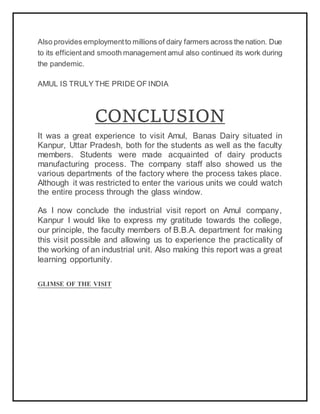
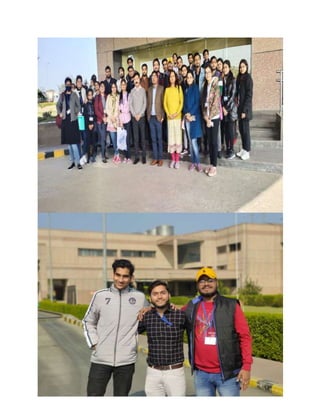
GLIMSE OF THE VISIT
Priyam-project-file.docx

Priyam-project-file.docx

  • 1.
    INDUSTRIAL VISIT PROJECT (AMULCO.KANPUR) SUBMITTED TO: P.P.N P.G College, kanpur (C.S.J.M University) As a part of 5th semester curriculum of Bachelor of Business Administration SUBMITTED BY- PRIYAM TANDON Enrollment No:- CSJMA19001315360 ROLL NO:-0401182 UNDER GUIDANCE OF :- Dr.Lavlesh srivastava (B.B.A Department P.P.N College) 2021-22
  • 2.
    Writing this industrialvisit report happens to be one of the greatest achievements in this phase of my life. Express my heartiest thanks to those who provided me tremendous support and making it a useful first hand experience. I am indebted to those who helped me in one way or the other in heavy indeed. I take the opportunity to thank all of them. I am very thankfulto our HOD Ma’am Mrs. Pooja Vidyarthee, under guidance of Dr. Lavlesh srivastava , and all other faculty member of the institute who gave me the excellent platform of doing something in management field at Industrial visit. I am thankful to the all the Amul industries authority for giving us the opportunity to to learn with the prestigious valuable guidance. integrated support and perceptive criticism helped me to conceptualize the precious and unforgettable experience which will help me in my future Last but not the least I would also like to thanks toward my parents friends and benefactors who has help me directly and indirectly through my industrial nour Thank you
  • 3.
    This is tocertify that Priyam tandon student of P.P.N Degree college bearing university Enrollment no. CSJMA19001315360 has visited the industry and prepared the report. This report has not formed a basis for awarding any other degree / diploma / certificate by this university or any other university. Place: Date: Signature of the H.O.D.
  • 4.
    TABEL OF CONTENTS CHAPTERSPAGE NO. CHAPTER 1- Introduction of the study…………….. CHAPTER 2- Objective of the study……………….. CHAPTER 3- Company profile – AMUL……… CHAPTER 4- Organizational structure………. CHAPTER 5- Strategies of amul………… CHAPTER 6- Research methodology…………………… CHAPTER 7- SWOT analysis……………………………… CHAPTER 8- Findings from the report………..……… CHAPTER 9- Conclusion……………………………………… CHAPTER 10- Glimpse of the visit…………………… INTRODUCTION OF THE STUDY 1.Benefits of Industry Visits
  • 5.
    Industrial visits arethe best source to increase the knowledge of students. It gives students exposure to various functions in an organization, such as HR, Marketing, Communication, etc. 2.It Gives real-world experience While college and its syllabus prepare students with theoretical knowledge, Industry visits can expose them to real-world problems and give them an idea on how to resolve them. 3.Industry visits make contacts When students are on an industry visit for their respective specialization course, they make contacts in the industry. These contacts help them grow after they graduate and are making their space in their field. 4.The Certificates Industry visits not only give them a perspective, but it also gives them certificates. These certificates come in handy when students are applying for jobs. The certificates can give them a head start. 5.Industry visits help the student in choosing their field Industry visits not only give students a clear look at how things work, but they help students in choosing a career. After the visits, students can think about how the industry is suitable for them and if they want to make a career in it. 6.Students meet different work culture When colleges conduct multiple industry visits for students, students experience various work cultures. They learn their ethics, their policies and their protocols. This experience prepares students for the future.
  • 6.
    OBJECTIVE OF THESTUDY Industrial visit has its own importance in a career of a student who is pursuing a professional degree. It is considered as a part of college curriculum, mainly seen in engineering courses. Objectives of industrial visit is to provide students an insight regarding internal working of companies. We know, theoretical knowledge is not enough for making a good professional career. With an aim to go beyond academics, industrial visit provides student a practical perspective on the world of work. It provides students with an opportunity to learn practically through interaction, working methods and employment practices. It gives them exposure to current work practices as opposed to
  • 7.
    possibly theoretical knowledgebeing taught at college. Industrial visits provide an excellent opportunity to interact with industries and know more about industrial environment. Industrial visits are arranged by colleges to students with an objective of providing students functional opportunity in different sectors like IT, Manufacturing and services, finance and marketing. Industrial visit helps to combine theoretical knowledge with industrial knowledge. Industrial realities are opened to the students through industrial visits. The college organizes industrial visits to help students understand about the practical aspects of production, marketing, labour relations and other activities managed by industrial sectors. COMPANY PROFILE AMUL INDUSTRY
  • 8.
    Points Information Product Brand Name AnandMilk Union Limited Founder/Owner Gujarat Cooperative Milk Marketing Federation Ltd. Date of Establishment 1973 Establishment Place Anand, Gujarat Revenue INR 38,550 crore (In 2018-19) CEO R.S. Sodhi Registered Address Gujarat Cooperative Milk Marketing Federation, PO Box 10, Amul Dairy Road, Anand-388001, Gujarat, India Telephone No. 91-2692-258506/ 258507/ 258508/ 258509 Fax 91-2692-240208/ 2401845 Company Status Active Website www.amul.com Brands
  • 9.
     Amul Milk Dahi  Paneer  Fresh Cream  Chocolates  Ghee  Beverage range  Mithai Mate  Roti Softner  Amul sour cream  Milk Powders  Bread Spreads  Cheese  Amul PRO  Bakery products  Panchamrit Establishment Anand Milk Union Limited established in 1973. In 1946, the company was registered to stop the exploitation of middleman. The exploitative trade practices followed by the local trade cartel triggered off the cooperative movement. Then, the prime minister, Lal Bahadur Shastri decided that the same approach should become the basis of a National Dairy Development policy. The farmers owned the dairy, their elected representatives managed the village societies and the district union, they employed professionals to operate the diary and manage its business. In 1965, the National Diary Development Board was set up with the basic objective of replicating the Amul model. The company established a direct linkage between milk producers and consumers by eliminating middleman. The Amul model has helped India to emerge as the largest milk producer in the world. More than 16 million milk producers pour their milk in 185903 dairy cooperative societies across the country. Awards  IMC Ramkrishna Bajaj National Quality award- Excellence in Crisis- Crisis Superheroes Award-30th October 2020  World Dairy Innovation Award-2020- Finalists  Amul-Marketer of the year FMCG food-IAA leadership award 2019  Making of Developed India IT awards for Digital India  Special Jury citation for Risk Management Award 2018
  • 10.
     GCMMF receivedthe &tv Pitch top 50 brands award-Amul Evergreens- 2007  BML Munjal Award 2017  Champions of Excellence Award for brand Amul  Amul received ET Iconic Brand Award  Amul wins World dairy Innovation Awards-2014 AMUL MARKET SHARE Amul, a brand of dairy cooperative major Gujarat Cooperative Milk Marketing Federation Ltd (GCMMF), is ranked 8th in the list of top 20 global dairy processors released by the International Farm Comparison Network (IFCN). The home-grown dairy giant has moved up one rank since last year's ranking. In 2018, it emerged as the 9th largest milk processor by IFCN, a global dairy research network. Amul was ranked at 18th position in 2012, however, in flat 8 years, it has moved 10 notches above to the current 8th position.
  • 11.
    ORGANIZATIONAL STRUCTURE AND BUSINESSMODEL Amul follows a unique strategy in which it gives its customers “value for money” items while securing the premiums of the milk- producing farmers who supply it (as a shareholder) . Because milk is a perishable commodity, the rancher may suffer a loss if it isn’t sold before the end of the contract period.
  • 12.
    The Organization’s Structure The“Anand design” cooperative framework was named after Amul’s cooperative model. It’s a three-tiered system that includes town social orders, regional dairy associations, and a state-level entity. Each level is financially independent of the others, and it employs agents from the level below it. It’s not difficult to comprehend. When one person does not have enough funds to generate the required capital for the company, other members who share the same goal pool their resources to create a large-capital organisation. The cooperative concept is advantageous since it ensures brand trust. Even banks prefer to lend money to cooperatives rather than to individuals. Amul now has 30 lakh farmers from all over India as members. The Kaira District Milk Cooperative Union (Amul), based in Anand, has grown at a rapid pace. It joined together with other Gujarat milk cooperatives and today represents 2.12 million farmers, supplying milk to 10,411 towns. It focuses on fourteen area-level plants (associations) that are overseen by the GCMMF. From the start, it was assumed that this activity would directly benefit and change poor farmers, as well as contribute to societal improvement. Markets at the time, and even now, are rudimentary and lacking in foundation. Amul and GCMMF realised that development and improvement could not be left to market forces alone, and that deliberate intervention was essential. TYPES OF STRATEGY 1.HR
  • 13.
    2.FINANCE Human Resource Management: HumanResource Management has come to be recognized as an inherent part of management, which is concerned with the human resources of an organization. Its objective is the maintenance of better human relations in the organization by the development, application and evaluation of policies, procedures and programmers relating to human resources to optimize their contribution towards the realization of organizational objectives. In other words, HRM is concerned with getting better results with the collaboration of people. It is an integral but distinctive part of management, concerned with people at work and their relationships within the enterprise. HRM helps in attaining maximum individual development, desirable working relationship between employees and employers, employees and employees, and effective modeling of human resources as contrasted with physical resources. It is the recruitment, selection, development, utilization, compensation and motivation of human resources by the organization.
  • 14.
    Finance Management This isa process that involves planning and controlling of the company’s financial resources. All other departments of the company strongly depend upon the finance department to go on with their departmental activities individually. Objectives of Finance Management 1. Maximize the profit –the main objective is to increase the profit as much as possible. This has to be done with keeping in mind the returns for the company. 2. Process –Analysis, Decision Making, Planning,& Control. These are the steps that are followed to manage the financial resources of the company efficiently. Importance of Finance Management For the growth of a company like Amul management of finances is very important. Without this, the business cannot survive or expand in this competitive market. Here are some points that make it highly important for an organization:  Promoting the business  Decision Making  Successful business  Measuring the Performance
  • 15.
     Helpful forShareholders & Investors Sources of Capital for Amul 1. As the products are sold on a daily basis to Gujarat Co-operative Marketing Federation (GCMMF). An amount is given by the federation to the union so that it gets paid for the sale of its products. 2. The societies that are involved in its functioning hold fixed deposits that act as a major source of capital. 3. As these Fixed deposits release some kind of Interest when deposited in banks like UTI, BOB etc. These act as another source of the finance. 4. The share capital is not public hence it is not listed in the market it is exclusively for the members of the society. MARKETING Amul is one of the mostpopular and successfulbrands in India. With its wide range of dairy products, Amul has now become a household name in the minds of Indian families. I’m sure that we all have at least one of Amul’s products in our house. It has elegantly created its family -friendly and patriotic image with it, “Amul – The Taste of India” marketing jingle which also evokes empathy towards the brand. What also makes Amul so special is that it has constantly managed itself in staying relevant for all these years in the minds of the customers ever since its foundation. Thus, this also makes us wonder about what they are doing to stay relevant in this increasingly competitive and digitized world.
  • 16.
    Industry BasedTargetAudience Amul hassegmented Milk for various industries such as ice-cream manufacturers, restaurants, coffee shops,and many similar industries. Further, it has segmented Butter, Ghee, and Cheese forbakeries, pizza, snack retailers, confectionaries,and many more. The target audience study tells us that Amul has a strong presence in both business-to-business (B2B)and Business-to-Customers (B2C). This is how Amul’s target audience is served, given that it has a decent concentration in both B2B and B2C segments. Amul’s DigitalMarketing Strategy In this increasingly digitized world, every brand needs to revamp its marketing strategy. Amul too has cut down its expenditure on TV Ads and Has started focusing more on the online form of advertising just like its competitors. 1. Amul on Facebook & Integra In the presentday, the shiftfrom offline to online marketing was fairly an easy task for Amul. They were already creating content for banners and newspapers previously and now they just follow the same style for their creative on Facebook & Integra as well. Their most popular creative on Facebook and Integra revolve around the Amul Butter Girl the buzz-worthy happenings all around the world. Let’s now take a look at some of Amul’s digital marketing campaigns which were a hit on Facebookas well as Integra. “Eat Milk with Every Meal” In 2013,Amul hired a digital marketing agency called Draftfcb Ulka to come up with a campaign for the digital space as well as print. The objective of this campaign was to educate Indian buyers about the goodness of milk and its by-products. 2. Amul on Twitter
  • 17.
    On Twitter, Amulhas a massive fan base of over 335K followers given that Twitter is a very different platform when compared to other social media platforms.On various occasions,Amulposts fungraphics featuring the Amul Butter Girl. Many people connect with those graphics and re tweet them to show how they feel about the latest happenings in the world. Twitter is a great platform for a brand to engage with its customers.Taking advantage of this, Amul tries to conductinteractive activities like contests and giveaways. A lot of people also use Twitter to express their grievances for a service or a product. Amul makes sure that it replies to tweets of customers complaining about its products..3. Amul on YouTube Amul is also present on YouTube and it enjoys about 4,03,000 subscribers on its officialYouTube channel called, Amul the Taste of India. However, On YouTube, it puts out advertisements that are previously aired on television. Although, during the Covid-19 pandemic when the country was in lockdown, Amul started a new campaign called Simple Home Made Recipes that was also promoted as “#SimpleHomeMadeRecipes”. More about this campaign will be covered in the next section of the case study. So this is how Amul’s digital marketing strategy has played out. RESEARCH METHODOLOGY Market research is the function which links the consumer & market to the marketer through information used to identify and define marketing opportunities and problem, generate refine as evaluate marketing actions monitor marketing performance and improve understanding of marketing as a process. Several characteristics of modern business enough used of marketing research by business first the suppliers of product and service need to have information about final consumer in order of market their products and services more effectivelysecond as a company grows and start distributing its products in a no of different markets, manager of the company find
  • 18.
    themselves becoming moreseparated from the final consumers of their product. Marketing Research is also raised thought cell four phases of the administration process- selecting strategies, developing marketing plans, putting the plan in to action, and integrating their marketing research activities in to miss-designto provide manager the information they need for recurring problem decisional. Finally we have come to say that marketing researchis a large and growing field of business entities that is playing. They play increasingly important role in decision-making. 1. OBJECTIVES: The objectives of the studies are as follows. 1. To find out initiatives under taken by the organization as part of CSR for society’s
  • 19.
    2. To studythe demographicalprofile of various stakeholders involved in CSR. 3. To explore the level of awareness, utilization & satisfaction of CSR as perceived by the stakeholders. 4. To study the change in the lives of various stakeholders after the CSR initiatives. 5. To suggestan intervention plan to enhance the functioning of CSR RESEARCH DESIGN:- The research design of the study is descriptive in nature. The study is descriptive because an effort has been made to study the current status, prevailing practices, point of view/opinion, processes and the nature of activities and programme initiated by the organization in the field of CSR and Employee Perceptions on CSR. SOURCE OF DATA:- The study of this reportis based in SECONDARYDATA.They are that which have already beencollected bysomeone else and which have already been passed through the statistical process.It is collected from the office records such as annual reports of the agency, booklets, case studies, newspaper journals and magazines and other published, non-published sources. DATA ANALYSIS AND INTERPRETATION On the basis of the secondary data available, we can analyse the various trends of the company and conduct a SWOT ANALYSIS. It will clearly explain all the aspects of the company’s working, environment, growth, and competition SWOT ANALYSIS
  • 20.
    SWOT Analysis isa strategic analysis framework used to evaluate the competitive position of the c company for developing strategic plans SWOT stands for Strengths, Weaknesses, Opportunity and Threats of the company to assess the internal and external factors, along with present and future potential. SWOT Analysis of Amul Amul is a really strong and dominant brand in its category. The SWOT Analysis of Amul that I have shared with you below is based on my understanding and my research of the success story of Amul. STRENGTH OF AMUL Strengths are always internal to a company. A strength is something that comes from within the company, from its people, its process or the resources employed by it. Here are the strengths from the SWOT Analysis of Amul. 1. Investment in Technology Amul has experienced exponential growth in the last few decades. The company is continually investing in adaptive and revolutionary technologies within the dairy industry. The company is targeting a turnover of Rs. 50,000 crore in the fiscal year 2020. 2. Production Capacity Amul is one of the largest manufacturers of milk and dairy products in the world. The company is managed by the Gujarat Co-operative Milk Marketing Federation Limited, which is a dairy producer’s cooperative which supplies the company with almost 18 million litters of milk daily.
  • 21.
    The company hasa large consumer base which spreads across the urban and rural regions of the country. This wide-reaching consumer base has allowed the company to maintain distinct leverage over its competitors. WEAKNESSES OF AMUL 1. High Operational Cost Amul has a high operational cost due to its massive size and complex structure. This can become problematic for the company if the company experiences fallin demand.The company also heavily depends onthe dairy unions and communities for its supply of milk. As the needs of the dairy community are changing they are demanding higher prices fortheir produce. These issues can add up to the operational cost of the company and lower its profit margins. 2. Lack of Success in Certain Areas of Portfolio Expansion Amul has expanded its product portfolio to add products such as butter, ghee, buttermilk, flavoured milk, ice cream, chocolates, cheese, creams, sweets and more. However, not every product of Amul within its portfolio has tasted the same amountof success. For instance, Amul’s chocolates have not been Able to replicate the success of its ice cream brands. Amul chocolates have a tiny market share in the chocolates, sweets and confectionery market in India. 3. Frequent Legal Issues The company has faced legal issues in the recent past wherein Amul chose to advertise its products while disparaging the brand and products of its rivals. This led to Hindustan Unilever filing a lawsuit against Amul in the
  • 22.
    Bombay High Court.In 2017, The Bombay High Court passed a verdict in favour of Hindustan Unilever. This caused the company a lot of Embarrassmentand has also contributed to tarnishingthe public imageof the company. OPPORTUNITIES OF AMUL 1. High per capita Milk consumption India is a high milk consuming nation with milk and dairy products being an essential component of the Indian diet. According to research, Indians consume almost 100 litters of milk per annum. India has a billion plus population which is only increasing. This growth in population and high milk consumption opens up opportunities for Amul to expand its production capacities and acquire new consumers. 2. International Expansion Amul can serve global markets. The brand can expand into overseas markets such as the Middle-East and the Asian markets by aggressively targeting Indian expats living in these countries. Amul can organically broaden its international presence and consumer base. 3. Expansion of Product Portfolio Amul can invest in research and development or adopt a mergers and acquisition strategy to expand its product line. Amul has an extensive distribution network which can be used to sell its new products into the market, and the substantial brand value and trust of the consumers will also enable easier acceptance from the consumers. THREATS OF AMUL
  • 23.
    1. Increasing Competition Amulis facing increasing competitionin milk and dairy products sectorfrom brands suchas Mother Dairy, Aavin, Quality Ltd,Nadini Dairy, HUL and other local players. Amul is also facing increasing competition within the ice Cream sectorfrom Quality Walls,Baskin Robins,Havmor, London Dairy and other domestic brands 2. Growing trend of Veganism in India Many people in India are turning towards veganism, which implies that these people do not consume dairy or dairy products.This can impact the demand for Amul’s milk and dairy products if the popularity of veganism increases and spreads across different parts of the country. Conclusion The SWOT Analysis of Amul enables us to understand how Amul has transformed from a dairy cooperative to one of the mostvaluable and trusted brands in the country. The brand entices a sense of national pride among the consumers, and this brand image can be further exploited to enter overseas markets. The company can achieve a dominant global position by maintaining its quality standards, investing in advertising and promotions and localizing products as perthe taste of the international markets. Amul has the potential to replicate its success all over the world.
  • 24.
    FINDINGS FROM THEREPORT Having got a chance to visit amul, Kanpur and been able to prepare this industrial report as art of the curriculum one could find a number of things about the company. Also learned about:- a. Several management aspects. b. History of AMUL c. The layout of the AMUL d. What is important to an industry e. Got to see the production process of dairy industry f. The most efficient supply chain of India g. Experienced AMUL as the market giant h. The use of Production and operation management in the manufacturing industry. Amul has risen from Indian and despite the fact that today it has become the mostdairy industry in the world along with its international business ventures, it will always remain an Indian company. From the very day amul came into existence it worked effortlessly to serve the nation and its consumers with the best. Every person associated with amul has been benefitted from it. Today it holds the largest market share defeating all of its competition. Through this visit we learned various reasons due to which amul has today become agiant in the dairy market. It not only provides serves the nation but
  • 25.
    Also provides employmenttomillions of dairy farmers across the nation. Due to its efficientand smooth management amul also continued its work during the pandemic. AMUL IS TRULY THE PRIDE OF INDIA CONCLUSION It was a great experience to visit Amul, Banas Dairy situated in Kanpur, Uttar Pradesh, both for the students as well as the faculty members. Students were made acquainted of dairy products manufacturing process. The company staff also showed us the various departments of the factory where the process takes place. Although it was restricted to enter the various units we could watch the entire process through the glass window. As I now conclude the industrial visit report on Amul company, Kanpur I would like to express my gratitude towards the college, our principle, the faculty members of B.B.A. department for making this visit possible and allowing us to experience the practicality of the working of an industrial unit. Also making this report was a great learning opportunity. GLIMSE OF THE VISIT