European Cultural
Heritage from a Pinhole
Sultanahmet Suphi Paşa
Ticaret Meslek Lisesi
The Project Introduction of the
Coordinator School
October 2013 – Perugia/İtaly
European Cultural Heritage from a Pinhole
enter
How did our
project idea
come into?
What are the
main
theme/subject
and sub-topics
Where,when
and what will
we do?
How did our project idea
come into?
The process of the project’s coming into
Firstly, the general objectives
of the EU Comenius Projects
were examined
How did our project idea come into?
• The project should increase the
quality of education
• It should give an opportunity to
the students and teachers to study
on a common subject
• The project should fit with all
partner schools’ educational
curriculum
• It should be a different topic ,not
an oft-repeated one
• The active participation of the
students should be provided
• It should improve students’
language and ICT skills.
• The project should include the
themes of cultural heritage, EU
citizenship, fight against racism
and empathy towards
disadvantageous ones
As school centered,
observations and
questionnaires related to
students were held with our
project team
How did our project idea come into ?
•For one thing, we
observed that after
school, our students
were behaving so
timidly to the
tourists who came to
visit our city
How did our project idea come into ?
•The students were
noticed that almost
all of them had a
camera phone with
the latest technology
in their hands and
they only plundered
everything they took
photo of without
making any sense
How did our project idea come into ?
•The students were
ignoring the cultural
heritages-only a few
steps away from our
school- which was
visited by the tourists
all over the world. They
were using them only
for economical
reasons.
How did our project idea come into ?
• Most of our students
were a mad of
consumption as the other
young people at the
same age.
• Aside from historical and
cultural structures
remained behind of the
city, they weren’t even
aware of the World
Cultural Heritage near
them
• Their camera phones and
photo cameras were only
means of consumption.
• They were so inhibited in
communication with
tourists.
• At the same time they
were feeling a great envy
to tourists.
• Our students had some
prejudices against both
tourists and the
disadvantageous ones in
their school.
• They were using the
historical places as an
economic factor out of
First of all, they should be aware of and also
sensitive to the cultural values and environment they
live in
They should empathize to tourists and
disadvantageous students in their school without any
prejudice and estrangement
They should use photographing action more
meaningfully by not being under the influence of
popular culture.
 They should be productive rather than a
continuous consumer
They should have a sensitivity of getting hands on
initially of their own culture and values and then all
European Geography.
However our
students:
“The art of photography both plunders and protects ”
Susan Sontag
“The use of a monument belongs to the owner
but its beauty is everyone’s ”
Victor Hugo
European Cultural Heritage from a Pinhole
European Cultural
Heritage from a
Pinhole
An enjoyable subject...
A topic which can easily attract the attention of
the students..
So why Pinhole?
A suitable one for the creativity…
A common topic to study with the partners in harmony…
A subject in the curriculum to develop a new approach or method …
The one to easily improve language also arts and crafts skills…
what are the main theme
subject and sub-topics ?
Topics to be covered for the project process
Study Fields of Project Main Theme
Reflections of the Culture on
Social Sciences
(Literature, Religion,
Philosophy, History, Law,
Foreign Language)
European
Cultural Heritage
Studies (Cultural
Structures)
Comparison of
modern digital
photo techniques
with pinhole
technique
Expected results…
Comparison of
the
techniques
Fields of the
research
The
production of
new training
materials and
approaches
Increasing the
Quality of
School
Education
The Project Main Themes
European
Cultural
Heritage from
a Pinhole
European
Culture
Photography
(Pinhole)
Social Sciences
( Literature,
History, Law,
Foreign
Language )
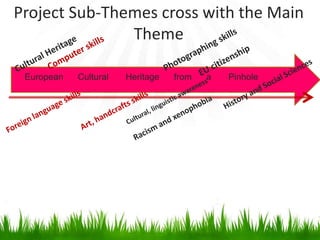
Project Sub-Themes cross with the Main
Theme
European Cultural Heritage from a Pinhole
Where,when and what
will we do ?
the project work schedule
September 2013
• Workshops:
– The effect of the culture
on history, music, art,
literature, language ,
religion and society and
exemplifying
• Workshops in environment
– Search of historical and
cultural heritage in school
environment , exemplifying.
Creating awareness to the topic among the students and school
environment. Creating first documents of the project.
October 2013
• presentation of
students, schools
• countries on common
project platform and
face to face meeting ,
sharing first documents
of the project (e-
twinning,…)
• The students experience their own foreign language and ICT skills /
preparing power point presentation
October 2013
• creation of the project
logo (competition)
• Making clear of the
conditions and calendar
of the competition
• Organization by Ireland.
Students experience their own arts and crafts, computer skills/Designing
of logo and voting - Creativity.
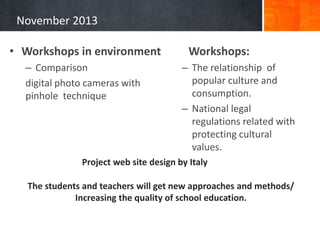
November 2013
• Workshops in environment
– Comparison
digital photo cameras with
pinhole technique
Workshops:
– The relationship of
popular culture and
consumption.
– National legal
regulations related with
protecting cultural
values.
Project web site design by Italy
The students and teachers will get new approaches and methods/
Increasing the quality of school education.
February 2014- Mobility Nothern Ireland
• Sharing environment research results with
the local authorities.
Exhibitions, conferences, presentations / to raise awareness
about the environment /to notify /to draw attention.
March – April 2014
• Arranging workshops in
the historic and cultural
buildings serving for
different purposes now
– Ex: Historic Eminönü Post
Office
- setting sub-themed national
issues.
to provide involvement , support of local organizations /contact-
dialogue / aesthetic perspective /observation/ a critical view/
teamwork
• To develop policies for
the protection of
cultural heritage in that
region with local
organizations.
– The use of problem-
solving techniques .
May 2014 Mobility to Hungary
• Compilation of the
results from the
meetings with local
organizations into one
common product.
Transmission of gained solutions to higher authorities /creation of
legal regulations/ awareness of cultural heritage protection /feeling
of belonging.
• Presentation of the
results of the work.
• loading website.
May 2014 / the mobility of Ireland
• workshops:
– Explanation of Popular
Culture .
• Effects on society.
• Effect on history and
language.
• Effect on Life Style.
• Effect on literary works.
Awareness of cultural and linguistic diversity / Against plunder and
consume, being productive/to develop thinking skills / to develop
language skills.
– Workshops in the
environment:
• to photograph the
reflection of popular
culture with pinhole.
• to conduct cultural
analysis and creative
studies on photos.
• to do research on
literary works.
June 2014 /evaluation of the first project year
The development of students' evaluation skills / Monitoring
/Control and Correction
Development
Questionnaires
and
Implementation
Making
Statistics and
Evaluation
Loading project
website
June - July 2014
exhibitions conferences Projector
September 2014 / Local Society Interviews
Students’ having ability of being a social critic.
with Photographers
Sociologists
Historians….
October 2014 / the mobility to Poland
• Presentation of the
project sub-themed
national studies
– For ex. the status of the
people living in
disadvantaged areas by
using cultural and
historical places as a
living area in Turkey.
Making sense of empathy towards the disadvantaged ones
On March-April 2014, each
country has determined its
own national study
December 2014
• Exchanging
presentation of the
project sub-themed
national studies
/analyzing
• Compilation of the
National studies
On March-April 2014, each
country has determined its
own national study …
January 2015
Workshops related to the
sub-themes
• Racism
• Estrangement
• Prejudice
• European Citizenship
March 2015 / the mobility to Italy
• The presentation of workshops related to
the sub-themes
– to design products- calendars etc.
– to plan the wokshops on the results
– analyzing the contributions of results to
classes, school communication, relationship
among the students.
April 2015
Printing and publication of results of
photos and main theme / sub-theme
• Local newspapers
• Local magazines
• Designing didactic materials
End of April 2015 / Final Meeting- TURKEY
• Designing a photo album with all the taken ones.
• Preparing didactive material.
– Preparing economical materials.
• Audiobook, sightseeing guide etc. ..
• Evaluation of the second project year
(questionnaires, statistics)
• Printing and reproduction of the project products.
June 2015
• Overall evaluation of the results of the project.
• Making the results of the second year into
fasciculus.
• Discussion of project sustainability, planning.
July 2015
• The loading of the project outputs to «EST»
• The finalization of the project web site.

Project presentation

  • 1.
    European Cultural Heritage froma Pinhole Sultanahmet Suphi Paşa Ticaret Meslek Lisesi The Project Introduction of the Coordinator School October 2013 – Perugia/İtaly
  • 2.
    European Cultural Heritagefrom a Pinhole enter How did our project idea come into? What are the main theme/subject and sub-topics Where,when and what will we do?
  • 3.
    How did ourproject idea come into? The process of the project’s coming into
  • 4.
    Firstly, the generalobjectives of the EU Comenius Projects were examined
  • 5.
    How did ourproject idea come into? • The project should increase the quality of education • It should give an opportunity to the students and teachers to study on a common subject • The project should fit with all partner schools’ educational curriculum • It should be a different topic ,not an oft-repeated one • The active participation of the students should be provided • It should improve students’ language and ICT skills. • The project should include the themes of cultural heritage, EU citizenship, fight against racism and empathy towards disadvantageous ones
  • 6.
    As school centered, observationsand questionnaires related to students were held with our project team How did our project idea come into ?
  • 7.
    How did ourproject idea come into ? •For one thing, we observed that after school, our students were behaving so timidly to the tourists who came to visit our city
  • 8.
    How did ourproject idea come into ? •The students were noticed that almost all of them had a camera phone with the latest technology in their hands and they only plundered everything they took photo of without making any sense
  • 9.
    How did ourproject idea come into ? •The students were ignoring the cultural heritages-only a few steps away from our school- which was visited by the tourists all over the world. They were using them only for economical reasons.
  • 10.
    How did ourproject idea come into ? • Most of our students were a mad of consumption as the other young people at the same age. • Aside from historical and cultural structures remained behind of the city, they weren’t even aware of the World Cultural Heritage near them • Their camera phones and photo cameras were only means of consumption. • They were so inhibited in communication with tourists. • At the same time they were feeling a great envy to tourists. • Our students had some prejudices against both tourists and the disadvantageous ones in their school. • They were using the historical places as an economic factor out of
  • 11.
    First of all,they should be aware of and also sensitive to the cultural values and environment they live in They should empathize to tourists and disadvantageous students in their school without any prejudice and estrangement They should use photographing action more meaningfully by not being under the influence of popular culture.  They should be productive rather than a continuous consumer They should have a sensitivity of getting hands on initially of their own culture and values and then all European Geography. However our students:
  • 12.
    “The art ofphotography both plunders and protects ” Susan Sontag
  • 13.
    “The use ofa monument belongs to the owner but its beauty is everyone’s ” Victor Hugo
  • 14.
  • 15.
  • 16.
    An enjoyable subject... Atopic which can easily attract the attention of the students.. So why Pinhole? A suitable one for the creativity… A common topic to study with the partners in harmony… A subject in the curriculum to develop a new approach or method … The one to easily improve language also arts and crafts skills…
  • 17.
    what are themain theme subject and sub-topics ? Topics to be covered for the project process
  • 18.
    Study Fields ofProject Main Theme Reflections of the Culture on Social Sciences (Literature, Religion, Philosophy, History, Law, Foreign Language) European Cultural Heritage Studies (Cultural Structures) Comparison of modern digital photo techniques with pinhole technique
  • 19.
    Expected results… Comparison of the techniques Fieldsof the research The production of new training materials and approaches Increasing the Quality of School Education
  • 20.
    The Project MainThemes European Cultural Heritage from a Pinhole European Culture Photography (Pinhole) Social Sciences ( Literature, History, Law, Foreign Language )
  • 21.
    Project Sub-Themes crosswith the Main Theme European Cultural Heritage from a Pinhole
  • 22.
    Where,when and what willwe do ? the project work schedule
  • 23.
    September 2013 • Workshops: –The effect of the culture on history, music, art, literature, language , religion and society and exemplifying • Workshops in environment – Search of historical and cultural heritage in school environment , exemplifying. Creating awareness to the topic among the students and school environment. Creating first documents of the project.
  • 24.
    October 2013 • presentationof students, schools • countries on common project platform and face to face meeting , sharing first documents of the project (e- twinning,…) • The students experience their own foreign language and ICT skills / preparing power point presentation
  • 25.
    October 2013 • creationof the project logo (competition) • Making clear of the conditions and calendar of the competition • Organization by Ireland. Students experience their own arts and crafts, computer skills/Designing of logo and voting - Creativity.
  • 26.
    November 2013 • Workshopsin environment – Comparison digital photo cameras with pinhole technique Workshops: – The relationship of popular culture and consumption. – National legal regulations related with protecting cultural values. Project web site design by Italy The students and teachers will get new approaches and methods/ Increasing the quality of school education.
  • 27.
    February 2014- MobilityNothern Ireland • Sharing environment research results with the local authorities. Exhibitions, conferences, presentations / to raise awareness about the environment /to notify /to draw attention.
  • 28.
    March – April2014 • Arranging workshops in the historic and cultural buildings serving for different purposes now – Ex: Historic Eminönü Post Office - setting sub-themed national issues. to provide involvement , support of local organizations /contact- dialogue / aesthetic perspective /observation/ a critical view/ teamwork • To develop policies for the protection of cultural heritage in that region with local organizations. – The use of problem- solving techniques .
  • 29.
    May 2014 Mobilityto Hungary • Compilation of the results from the meetings with local organizations into one common product. Transmission of gained solutions to higher authorities /creation of legal regulations/ awareness of cultural heritage protection /feeling of belonging. • Presentation of the results of the work. • loading website.
  • 30.
    May 2014 /the mobility of Ireland • workshops: – Explanation of Popular Culture . • Effects on society. • Effect on history and language. • Effect on Life Style. • Effect on literary works. Awareness of cultural and linguistic diversity / Against plunder and consume, being productive/to develop thinking skills / to develop language skills. – Workshops in the environment: • to photograph the reflection of popular culture with pinhole. • to conduct cultural analysis and creative studies on photos. • to do research on literary works.
  • 31.
    June 2014 /evaluationof the first project year The development of students' evaluation skills / Monitoring /Control and Correction Development Questionnaires and Implementation Making Statistics and Evaluation Loading project website
  • 32.
    June - July2014 exhibitions conferences Projector
  • 33.
    September 2014 /Local Society Interviews Students’ having ability of being a social critic. with Photographers Sociologists Historians….
  • 34.
    October 2014 /the mobility to Poland • Presentation of the project sub-themed national studies – For ex. the status of the people living in disadvantaged areas by using cultural and historical places as a living area in Turkey. Making sense of empathy towards the disadvantaged ones On March-April 2014, each country has determined its own national study
  • 35.
    December 2014 • Exchanging presentationof the project sub-themed national studies /analyzing • Compilation of the National studies On March-April 2014, each country has determined its own national study …
  • 36.
    January 2015 Workshops relatedto the sub-themes • Racism • Estrangement • Prejudice • European Citizenship
  • 37.
    March 2015 /the mobility to Italy • The presentation of workshops related to the sub-themes – to design products- calendars etc. – to plan the wokshops on the results – analyzing the contributions of results to classes, school communication, relationship among the students.
  • 38.
    April 2015 Printing andpublication of results of photos and main theme / sub-theme • Local newspapers • Local magazines • Designing didactic materials
  • 39.
    End of April2015 / Final Meeting- TURKEY • Designing a photo album with all the taken ones. • Preparing didactive material. – Preparing economical materials. • Audiobook, sightseeing guide etc. .. • Evaluation of the second project year (questionnaires, statistics) • Printing and reproduction of the project products.
  • 40.
    June 2015 • Overallevaluation of the results of the project. • Making the results of the second year into fasciculus. • Discussion of project sustainability, planning.
  • 41.
    July 2015 • Theloading of the project outputs to «EST» • The finalization of the project web site.

Editor's Notes

  • #2 This presentation demonstrates the new capabilities of PowerPoint and it is best viewed in Slide Show. These slides are designed to give you great ideas for the presentations you’ll create in PowerPoint 2010! For more sample templates, click the File tab, and then on the New tab, click Sample Templates.