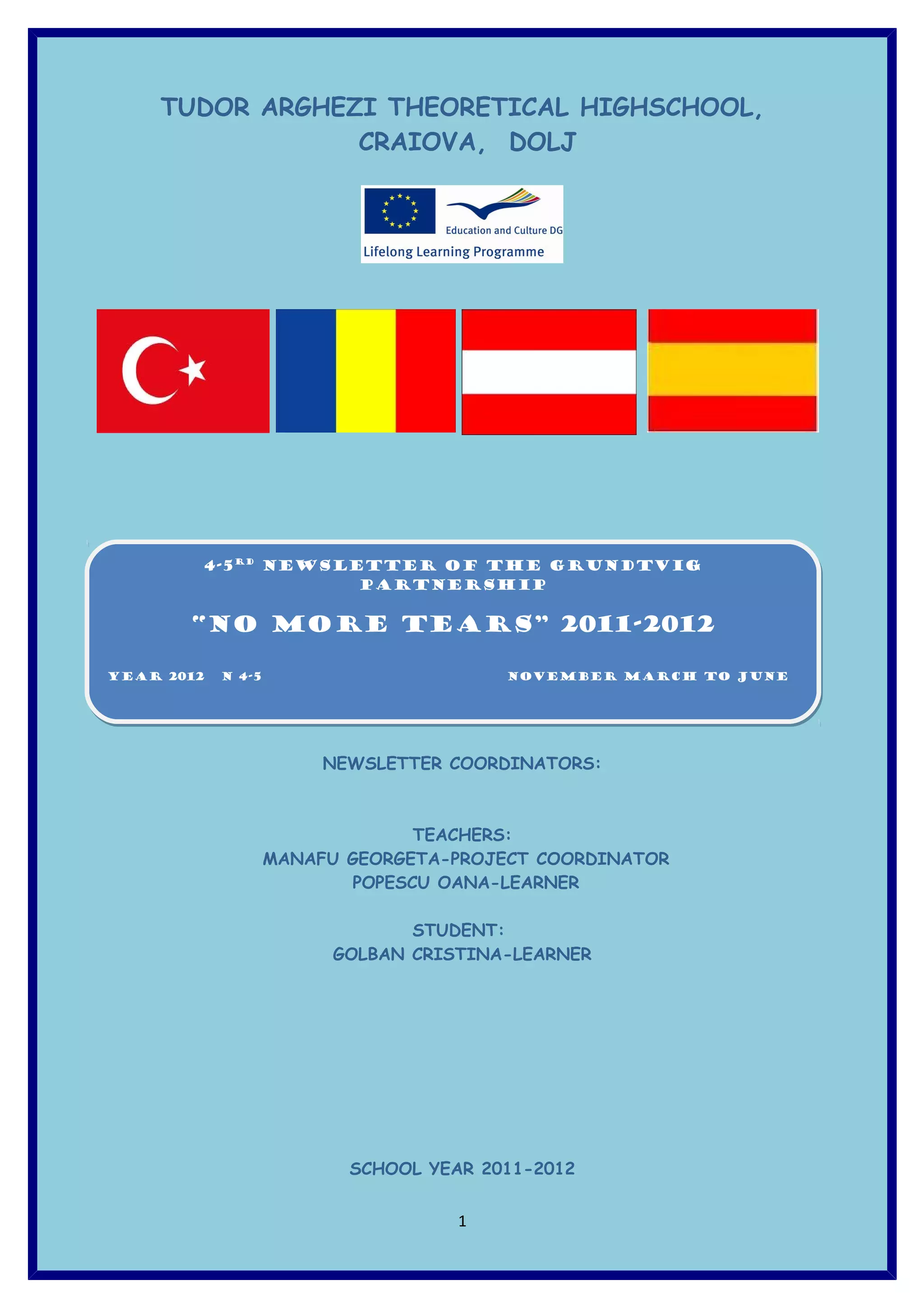
TUDOR ARGHEZI THEORETICAL HIGHSCHOOL,
                CRAIOVA, DOLJ


        4-5RD Newsletter of the Grundtvig
        4-5RD Newsletter of the Grundtvig
                    Partnership
                    Partnership

       “NO MORE TEARS” 2011-2012

YEAR 2012
YEAR 2012   N 4-5
            N 4-5                    NOVEMBER March to June
                                     NOVEMBER March to June


                     NEWSLETTER COORDINATORS:


                             TEACHERS:
                MANAFU GEORGETA-PROJECT COORDINATOR
                       POPESCU OANA-LEARNER

                             STUDENT:
                      GOLBAN CRISTINA-LEARNER


                       SCHOOL YEAR 2011-2012


                                 1
4-5st Newsletter of the Grundtvig Partnership
  4-5st Newsletter of the Grundtvig Partnership

            “NO MORE TEARS” 2010-2012

YEAR 2012
YEAR 2012      N 4-5
               N 4-5                                  NOVEMBER March to June
                                                      NOVEMBER March to June


                        International Grundtvig project "No More Tears"
CONTENTS
                                                        Teacher coordinator Georgeta Manafu
1.THE
1.THE GRUNDTVIG
       GRUNDTVIG
PROJECT
PROJECT
“NO MORE TEARS”
“NO MORE TEARS”                                                         High School "Tudor Arghezi"
2.PROJECT
2.PROJECT
ACTIVITIES
ACTIVITIES
                               An internal decision has been issued appointing Ms. Georgeta
3. Conflicts
3. Conflicts
                       Manafu as the national coordinating teacher of the project on behalf of
4. PEER MEDIATION
4. PEER MEDIATION
                       the “Tudor Arghezi” Theoretical Highschool. She established a set of
                       criteria in order to start the implementation team: the staff and the
                       learners’ group. Each member of the implementation team has been
                       given certain assignments.
                               We have worked with the project partners to determine how it
                       can be disseminated after each project meeting and during the activities
                       we have held at a departmental level.
                               The project activities we have held until now have been in
                       accordance with those mentioned in the application form:
                       • Each institution has designed a project information board;
                       • The members of the implementation teams have been appointed
                       according to different criteria which have been previously agreed upon
                       by the four participants;
                       • Each partner has conceived and applied questionnaires in order to
                       determine the level of violence in their region and interpreted the results;
                       • The participants have made PowerPoint and ProShow slide shows to
                       present their activities, as well as the traditions, customs and culture of
                       their respective region or country;
                       • Ms.      Georgeta     Manafu        deisgned      the   project   blogspot:
                       http://grundtvigprojectnomoretears.blogspot.com/


                                              2
•   We have attended the first transnational meeting in Turkey, organised courtesy
              of Seyhan Ilce Milli Egitim Mudurlugu. The Romanian team, consisting of
              three staff members and a learner, presented the following inputs:
              •   The project blogspot designed by Ms. Georgeta Manafu and teh way slide
                  shows can be posted there;
              •   Multimedia presentations of the „Tudor Arghezi” Theoretical Highschool,
                  Craiova, Romania, our customs and traditions and our educational system;
              •   The results of the questionnaires applied to students, teachers and parents
                  related to the level of violence in the department of Dolj;
              •   The activities we have held between August and October.
              Each of the four participating institutions has sent its own representatives.
          •   The programme of the activities at the meeting included: the presentation of
              each participating institution, a visit to the Seyhan School Inspectorate and to
              a state-funded faculty, multicultural soirées, and workshops related to the
              reduction of school and family violence.
          •   Each partner has been assigned different tasks between November and
              February;
MO


 AR
MO

 TE
RE
RE


 S”


      •        We have disseminated the first transnational meeting in Adana – Turkey;
      •        At a local level we have organised the following activities:
                  o   On the 20th of January – the Inter-county Symposium “Initiation in the
                      ABC of democracy. Social responsibility.”
                  o   On the 17th of February 2011- the County debate “The influence of IT
                      and the media on adults’ education”
      •        Between the 21st and the 28th of February we attended the second
      transnational meeting in Viena, Austria, where we discussed about the following
      presentations designed by the members of the Romanian group:
              •   Peer mediation training sessions and a presentation of the standard
                  mediation system, along with its steps and the monitoring and control
                  activities which have been undertaken so far;
              •   School and family violence;


                                           3
•   The activities we had held between November and February: the
                       symposium, the debate, and the training and monitoring of the peer
                       mediators;
                   •   Tolerance – a European value;
                   •   Measures that can be taken for the reduction of school violence;
               The transnational activity was organised by IFMIC, Vienna, Austria and was
      attended by representatives of all four participating institutions. The Romanian
      team consisted of three staff members and two learners.
               Each partner presented the activities held between October and February, we
      assigned different tasks to be fulfilled between March and September 2011, we
      attended different workshops related to the reduction of school and family violence,
      and had the chance to get an insight of the Austrian culture. The activities the hosts
      organised were of an interactive nature. The work atmosphere was open and
      intercultural. Each partner school shared its difficulties in reducing school and
      family violence and the measures they have taken in order to achieve this goal. We
      talked about ways of posting multimedia presentations, articles and the involvment
      of the learners on the project blogspot. During our common activities, each partner
MO


 AR
MO

 TE
RE
RE


      has had the opportunity to learn about the culture and civilisation of the other three
 S”
O
O


      partners.
      The working environment was very cooperative and flexible despite the
      international, multicultural and multilingual nature of the team. Thus the
      participants have had the opportunity to develop their personal, cultural, social and
      civil skills.
               •         The transnational meeting in Viena was disseminated in March and
      April;
               •         Between April and June we have organized the following activities:
                   •   The county conference – School and family violence, a social issue.
                       Case studies, held on the 7th of April 2011
                   •   The county workshop – Useful techniques for conflict mediation, held
                       on the 12th of May 2011
                   •   The round table - Tolerance, a European value, held on the 2nd of June
                       2011
                   •   The county workshop -“ Violence versus tolerance! ”


                                             4
All activities have been approved by the Teachers’ Body and assessed according to certain quality
 questionnaires.
                   Within our activities we have achieved the following goals:
                      1. During the inter-county symposium “Initiation in the ABC of democracy.
                          Social responsibility” we have fulfilled the following objectives:
                      •   The acknowledgement of the importance of human and cultural diversity;
                      •   The promotion of examples of good practice in diveristy, democracy and
                          social responsibility;
                      •   The acquisition and materialisation of various methods and techniques that
                          can be used in order to improve the quality of all out-of-school activities
                          related to diversity, democracy and social responsibility;
                      •   The identification of ways in which schools can relate to communities in
                          order to ensure successful schooling.
                   The result of this symposium was the first issue of the “No more tears” magazine.
                      2. During the county debate “ The influence of IT and the media on adults’
                          education” we have achieved the following goals:
                      •   Examples of how the activities which have been included in the national
                          curriculum can relate to those which have not;
                      •   The acknowledgement of the importance of IT and the media in adults’
MO


 AR
MO

 TE
RE
RE


                          education;
 S”
O
O


                      •   The presentation of new teaching, learning and evaluation methods based
                          on IT which can be used in adults’ education;
                      •   The emphasis on the role of E-learning in adults’ education;
                   The result of this debate was the second issue of the “No more tears” magazine.
                      3. During the county conference – School and family violence, a social issue.
                          Case studies’’ we have achieved the following goals:
                      •   The identification of the main factors which lead to violent behaviour;
                      •   The analysis of the social consequences of a violent kind of behaviour
                      •   The promotion of a set of measures that can be taken in order to prevent
                          school and family violence
                      •   The consolidation of the relationship between the school, the parents and the
                          local community
                          The result of the conference was the third issue of the “No more tears”
                          magazine
                                                    5
4. During the County Workshop - Useful techniques for conflict mediation we have achieved
        the following goals:
                    •   The promotion of the mediation system as a means of preventing and
                        solving conflicts in an amicable way
                    •   The stimulation of the civic spirit, of the cooperation and of the responsible,
                        non-aggressive behaviour within human relationships in school as well as at
                        home.
                    •   The identification of various mediation techniques and the emphasis on the
                        training of peer mediators
                    •   Role plays to illustrate these techniques
                     5. During the County Round Table - Tolerance, a European value we have
                     achieved the following goals:
                    •   The identification of the main types of tolerance (religious, political, racial,
                        etc) ;
                    •   The understanding of the concept of ‘’freedom of opinion’’;
                    •   The promotion of intercultural communication in order to help us develop
                        as European citizens, and acquire a set of knowledge and skills so as to be
                        able to act within an ever more open, complex environment;
MO


 AR
MO

 TE


                    •   The acknowledgement of the importance of the intercultural approach
RE
RE


 S”
O


                        within the framework of formal and nonformal education in nowadays’
O


                        international context;
                    •   The acknowledgement of the necessity of developing an active European
                        citizenship, based on the respect of cultural diveristy and on common
                        values.
                The result of the round table was the fourth issue of the “No more tears” magazine.
                    6. During the County Workshop -“ Violence versus tolerance! ” we have
                        achieved the following goals:
                    •   The identification of the effects of a violent type of behaviour in school,
                        family and the society as a whole;
                    •   The promotion of tolerance, diversity and assertiveness;
                    •   The legal aspects of the prevention of family violence;
                    •   The identification of the influence of prejudices and stereotypes in
                        intolerant behaviour;

                                                  6
•   The development of social abilities.
                        The project was disseminated in all four issues of the “No more tears”
                  magazine, during the teachers’ meetings, on the http://miedolj.forums-free.com/
                  website,        http://tudorarghezicv.blogspot.com/        and        on        the
                  grundtvigers@yahoogroups.com chat group.
                        The project partners used their emails and yahoo messenger ids in order to
                  communicate between themselves, as well as their own mobile phones before the
                  transnational meetings.
                        In order to ensure transparency we posted on the blogspot pictures taken
                  from the activities we have held, as well as different presentations designed by our
                  learners.
                        Due to the activities we have been undertaking we have managed to reduce
                  school violence this school year.
                  We have designed a newsletter after each transnational activity. We

                  therefore have two newsletters, the first one issued in November, and the

                  latter in March. We have also put together presentation movies, describing

                  the partnership and the activities that have been undertaken till the date.

                  The beneficiaries of this partnership are the 50 learners at Tudor Arghezi
MO


 AR
MO

 TE


                  Theoretical Highschool and the partner schools. An internal decision has been
RE
RE


 S”
O


                  issued to appoint them as learners.
O


                        All activities involved teachers, students and parents, both from our

                  school and from the other partner institutions.

                        During the activities we have shared examples of good practice in the

                  reudcation of school and family violence


                                                      7
Activities which took place between
                       September 2011 and June 2012


          Between the 21st and the 28th of September 2011 we attended the third
      transnational meeting in Monterosso, Spain. The schedule of the meeting
      included a visit to the Adult Centre of Monterroso, a discussion about the
      multimedia presentations made by the learners of this project, a presentation
      of the project newsletters, of the peer mediation system implemented at the
      “Tudor Arghezi” Theoretical Highschool and of the activities each of the four
      partners held between March and September, talks with the inmates, as well as
      a cultural programme. The participants were able to see how the Adult Centre
      of Monterroso was organized, and the way the staff worked and related to the
      inmates. We also talked about the details of the following meetings in Romania
      (March - 2012) and Turkey (June - 2012) during which the partners will organize
      a contest and an international symposium, draw the final report and analyse the
      finite products of the project, the way in which each partner has contributed to
      the finite products of the project and their impact on the beneficiaries.
          Activities which took place between October aand February:
            we wrote the curricula and the training materials for the mediators’
      training course “No more tears”;
             we designed the project for the approval of the ITC and Civil Education
MO


 AR
MO


 TE
RE
RE


      contest “Multimedia presentations Say NO to violence” , which was eventually
 S”


      approved by the Romanian Ministry of Education, Research, Youth and Sports;
      we designed the project for the approval of the International Symposium
      ”Sharing experiences and good practices in the educational process”, which was
      eventually approved by the Teachers’ Body of the Dolj county;
      we held the “No more tears” training course in order to train peer mediators
      (October - November) and their parents (December - February);
      we organised and held the following activities:
      1.The workshop called - "Assertiveness. Social skills"
      2.The round table called - "Examples of good practices in reducing school and
      family violence in the EU"
      3.The ITC and Civil Education contest “Multimedia presentations Say NO to
      violence- the local stage on the 3rd of February 2012, the county stage on the
      28th of February 2012 and the cross-county stage on the 19th of March 2012.
          Between the 18th and the 21st of March the fourth project meeting within
      the “No more tears” Grundtvig Learning Partnership was held at the “Tudor
      Arghezi” Theoretical Highschool in Craiova, Romania.
          The meeting was attended by representatives of Spain, Austria and Turkey.
          The schedule of the meeting included: a visit of the “Tudor Arghezi”
      Theoretical Highschool, a discussion on the multimedia presentations made by
      the learners in each partner institution, an artistic programme coordinated by
                                      8
teachers at the “Tudor Arghezi” Theoretical Highschool involving highschool
      students of 16 years old and more, a cross-county ITC and Civil Education
      contest “Multimedia presentations- Say NO to violence” consisting of the
      following sections: posters, Power Point presentations, spots and educational
      projects, another activity held at the Maximum Security Penitentiary , which
      included a tour of the penitentiary, a movie session including short movies made
      by students at the “Tudor Arghezi” Theoretical Highschool to promote non-
      violence, and talks with the inmates. We also visited the Craiova City Hall, the
      Metropolitan Cathedral, the central churches, we held the International
      Symposium”Sharing experiences and good practices in the educational process”,
       as well as a cultural programme.
          The main objective of the symposium was to exchange opinions, experience
      and examples of good practices in the educational systems in the participating
      countries: Romania, Spain, Turkey and Austria.
          The results of the project are: the project blog, the project website,
      multimedia presentations for the trnsnational meetings and for the
      dissemination of the project, newsletters, the brochure called "Examples of
      good practices in reducing school and family violence in the EU", the six "No
      more tears" magazines, which are guides to promoting the reduction of school
      and family violence, diversity, democracy and social responsability, and the
      English magazine promoting international exchange ”Sharing experiences and
      good practices in the educational process”.
          Between March and April 2012 the third “No more tears” training course for
MO


 AR
MO


      peer mediators was held at the “Tudor Arghezi” Theoretical Highschool.
 TE
RE
RE


 S”


          The fifth meeting in the “No more tears” Grundtvig Learning Partnership
      was held in Adana, Turkey, between the 6th and the 8th of June 2012. At this
      meeting each partner presented the activities held by their respective
      institutions between September 2010 and June 2012, their results, the impact
      of the project on the learners’ group and there have been discussions about the
      final report.
              The project in financially supported by the European Committee through
      the National Agency of Community Programmes in the Field of Education and
      Professional Formation – Grundtvig Sector Programme – Lifelong Learning
      Programme.
              The information given above is the sole responsabilty of the project
      team, the NA and the European Committee cannot be held responsible for the
      use and contents of this information.

                                          Conflicts

                                                              Teacher Georgeta Manafu
                                                            High School Tudor Arghezi
                                                              Teacher Marinela Calangiu
                                                                         C.C.D. Dolj


                                      9
PEACE is a process by means of which we respond to conflicts and diversity with
     tolerance, imagination and flexibility; WAR is a product of our intention to crush diversity
     and intensify conflicts by abandoning the peace process. (George E. Lyon)
                       The aggravation of aggressiveness and violence is one of the most serious
                  problems in today’s society. In order to prevent school violence we need to take
                  a set of measures so as to prevent, monitor and fight it.
                       Our reactions towards conflicts can be divided into three categories:
                       • Delicate reactions: stepping back, ignoring or denying
                       • Harsh reactions: threatening, aggressiveness or anger
                       • Principle-based reactions: understanding, respecting or solving
                       When choosing a way to solve the conflict it is very important to identify its
                  origins.
                       Its origins can be:
                       • Limited resources: time, money or assets
                       • Unfulfilled basic needs: sense of belonging, power, freedom or good
                           mood
                       • Contrasting values: convictions, priorities, principles or beliefs
                       Mediation is a communication process by means of which a group of people
                  find themselves in a situation of peacefully solving their own conflict, by and
                  with the help of a third, neutral party. This neutral person is the mediator.
                  When a conflict is solved within the school area, by another student, the latter
                  is called a peer mediator.
                          It is very difficult, even impossible to open a locked door (if you are not
                  really, really strong). But if you have a key to put in the look, you twist it and
                  the door will open. Sometimes, when friends are fighting, they are like locked
                  doors: they do not listen to anyone and they do not open. If you have the key of
MO


 AR
MO


 TE
RE


                  your friends’ thoughts, you can help them solve their problems. Fortunately,
RE


 S”


                  there are keys which can help you help your friends. You can’t touch them, but
                  you can learn how to use them. They are very important because they make
                  friends and colleagues talk openly about their conflicts. The five keys are:
                   Do not judge. Peer mediators are impartial, even if they think that one of the
                  parts is right or wrong.
                   Do not give advice. Sometimes peer mediators can think of solutions, but they
                  must not suggest anything to those involved, it is their conflict and they have to
                  solve it themselves the way they want to. This is the only way to make them feel
                  responsible.
                          Be equally empathic. An empathetic mediator tries to understand the
                  people who were involved in the conflict putting himself into their respective
                  place. Avoid taking sides, but try to understand the way in which both of them
                  think and see things.
                   Keep the confidentiality. People feel better when they talk about their
                  feelings and problems, if they know that the peer mediators will not tell the
                  story to anyone.
                          Show that you care. Within the mediation process, the mediators also
                  take people into account. They do everything they can in order to help the


                                                   10
others reconcile and solve their conflicts. If the mediators respect the mediation process,
     the others will trust that using it will help them solve their problem.


                                               PEER MEDIATION

                                                                                 Prof. Popescu Oana
                                                              Liceul Teoretic Tudor Arghezi, Craiova
                                                                               Prof. Avram Florenţa
                                                              Liceul Teoretic Tudor Arghezi, Craiova

                            Acknowledging the fact that violence is, unfortunately, present in our

                   day-to-day life, our school is trying to implement a system of peer mediation.

                          It basicly means students solving problems between themselves. When

                 there is a conflict between two students, the peer mediators (always in a team)

                 meet the victim of the aggression (either physical or verbal), then the alleged

                 aggressor, then both sides of the conflict and try to make it end peacefully.

                          There is a standard procedure when meeting the victim, consisting of six

                 steps:

                          1. Introduction (E.g. Hello. My name is ..., I’m a peer mediator, and this

                             is my colleague, .... he’s not going to say anything, only make some
MO


 AR
MO

 TE


                             notes.)
RE
RE


 S”


                          2. Describing the facts (E.g. From what I’ve heard, you were involved in

                             a coflict yesterday. What happened exactly?)

                          3. Determining the emotional impact on the victim (E.g. How did this

                             make you feel?)

                          4. Determining the emotional impact on people close to the victim (E.g.

                             How did this make your mother feel?)

                          5. Finding a solution (E.g. What should your colleague do for you to

                             forgive him?* if the victim cannot or will not suggest a solution, the

                             peer mediators will appeal to the authorised school staff)

                          6. Making an appointment with both sides to actually mediate their

                             conflict.

                             Meeting the aggressor also consists of several stages:

                          1. Introduction (the same as when meeting the victim).
                                                   11
2. Understanding the cause (E.g. What made you do it?)

     3. Detailing the emotional impact on the victim (E.g. Your colleague told me he felt.......)

                   4. Detailing the emotional impact on people close to the victim (E.g.

                      When your colleague got home last night, his mother.......)

                   5. Presenting the victim’s suggestions (E.g. Your colleague agrees to

                      make peace with you, provided that you... * If the aggressor refuses

                      the solutions presented to him on behalf of the victim, the peer

                      mediators report it to the authorises school staff and let them solve

                      the case)

                   6. Making an appointment with both sides to actually mediate their

                      conflict.

                     The restaurative meeting takes place after determining a convenient

            moment for both sides. It is attended by the peer mediators and by those

            involved in the conflict. Should the victim or the aggressor require the

            presence of a parent/ teacher (an adult), an authorised member of the school

            staff will also attend the meeting, since students are not allowed to deal with

            adults directly.

            This meeting normally ends in a reconciliation, provided that the aggression
 AR
MO
MO


 TE
RE
RE


 S”


            should not happen again. The perpetrator is not supposed to have display the

            same negative attitude towards either of his colleagues, not only towards the

            current victim. After a certain number of bad occurences which are only known

            by the peer mediators, the student is registered in a permanently updated

            database, and is subject to gradual sanctions, depending on the gravity and

            repeatedness of their aggressions. Such sanctions range from getting them

            involved in extra curricular activities, to spending an extra amount of time in

            school, or to having them expelled for a given number of days.


                                              12

Newsletter4 5 (1)

  • 1.
    TUDOR ARGHEZI THEORETICALHIGHSCHOOL, CRAIOVA, DOLJ 4-5RD Newsletter of the Grundtvig 4-5RD Newsletter of the Grundtvig Partnership Partnership “NO MORE TEARS” 2011-2012 YEAR 2012 YEAR 2012 N 4-5 N 4-5 NOVEMBER March to June NOVEMBER March to June NEWSLETTER COORDINATORS: TEACHERS: MANAFU GEORGETA-PROJECT COORDINATOR POPESCU OANA-LEARNER STUDENT: GOLBAN CRISTINA-LEARNER SCHOOL YEAR 2011-2012 1
  • 2.
    4-5st Newsletter ofthe Grundtvig Partnership 4-5st Newsletter of the Grundtvig Partnership “NO MORE TEARS” 2010-2012 YEAR 2012 YEAR 2012 N 4-5 N 4-5 NOVEMBER March to June NOVEMBER March to June International Grundtvig project "No More Tears" CONTENTS Teacher coordinator Georgeta Manafu 1.THE 1.THE GRUNDTVIG GRUNDTVIG PROJECT PROJECT “NO MORE TEARS” “NO MORE TEARS” High School "Tudor Arghezi" 2.PROJECT 2.PROJECT ACTIVITIES ACTIVITIES An internal decision has been issued appointing Ms. Georgeta 3. Conflicts 3. Conflicts Manafu as the national coordinating teacher of the project on behalf of 4. PEER MEDIATION 4. PEER MEDIATION the “Tudor Arghezi” Theoretical Highschool. She established a set of criteria in order to start the implementation team: the staff and the learners’ group. Each member of the implementation team has been given certain assignments. We have worked with the project partners to determine how it can be disseminated after each project meeting and during the activities we have held at a departmental level. The project activities we have held until now have been in accordance with those mentioned in the application form: • Each institution has designed a project information board; • The members of the implementation teams have been appointed according to different criteria which have been previously agreed upon by the four participants; • Each partner has conceived and applied questionnaires in order to determine the level of violence in their region and interpreted the results; • The participants have made PowerPoint and ProShow slide shows to present their activities, as well as the traditions, customs and culture of their respective region or country; • Ms. Georgeta Manafu deisgned the project blogspot: http://grundtvigprojectnomoretears.blogspot.com/ 2
  • 3.
    We have attended the first transnational meeting in Turkey, organised courtesy of Seyhan Ilce Milli Egitim Mudurlugu. The Romanian team, consisting of three staff members and a learner, presented the following inputs: • The project blogspot designed by Ms. Georgeta Manafu and teh way slide shows can be posted there; • Multimedia presentations of the „Tudor Arghezi” Theoretical Highschool, Craiova, Romania, our customs and traditions and our educational system; • The results of the questionnaires applied to students, teachers and parents related to the level of violence in the department of Dolj; • The activities we have held between August and October. Each of the four participating institutions has sent its own representatives. • The programme of the activities at the meeting included: the presentation of each participating institution, a visit to the Seyhan School Inspectorate and to a state-funded faculty, multicultural soirées, and workshops related to the reduction of school and family violence. • Each partner has been assigned different tasks between November and February; MO AR MO TE RE RE S” • We have disseminated the first transnational meeting in Adana – Turkey; • At a local level we have organised the following activities: o On the 20th of January – the Inter-county Symposium “Initiation in the ABC of democracy. Social responsibility.” o On the 17th of February 2011- the County debate “The influence of IT and the media on adults’ education” • Between the 21st and the 28th of February we attended the second transnational meeting in Viena, Austria, where we discussed about the following presentations designed by the members of the Romanian group: • Peer mediation training sessions and a presentation of the standard mediation system, along with its steps and the monitoring and control activities which have been undertaken so far; • School and family violence; 3
  • 4.
    The activities we had held between November and February: the symposium, the debate, and the training and monitoring of the peer mediators; • Tolerance – a European value; • Measures that can be taken for the reduction of school violence; The transnational activity was organised by IFMIC, Vienna, Austria and was attended by representatives of all four participating institutions. The Romanian team consisted of three staff members and two learners. Each partner presented the activities held between October and February, we assigned different tasks to be fulfilled between March and September 2011, we attended different workshops related to the reduction of school and family violence, and had the chance to get an insight of the Austrian culture. The activities the hosts organised were of an interactive nature. The work atmosphere was open and intercultural. Each partner school shared its difficulties in reducing school and family violence and the measures they have taken in order to achieve this goal. We talked about ways of posting multimedia presentations, articles and the involvment of the learners on the project blogspot. During our common activities, each partner MO AR MO TE RE RE has had the opportunity to learn about the culture and civilisation of the other three S” O O partners. The working environment was very cooperative and flexible despite the international, multicultural and multilingual nature of the team. Thus the participants have had the opportunity to develop their personal, cultural, social and civil skills. • The transnational meeting in Viena was disseminated in March and April; • Between April and June we have organized the following activities: • The county conference – School and family violence, a social issue. Case studies, held on the 7th of April 2011 • The county workshop – Useful techniques for conflict mediation, held on the 12th of May 2011 • The round table - Tolerance, a European value, held on the 2nd of June 2011 • The county workshop -“ Violence versus tolerance! ” 4
  • 5.
    All activities havebeen approved by the Teachers’ Body and assessed according to certain quality questionnaires. Within our activities we have achieved the following goals: 1. During the inter-county symposium “Initiation in the ABC of democracy. Social responsibility” we have fulfilled the following objectives: • The acknowledgement of the importance of human and cultural diversity; • The promotion of examples of good practice in diveristy, democracy and social responsibility; • The acquisition and materialisation of various methods and techniques that can be used in order to improve the quality of all out-of-school activities related to diversity, democracy and social responsibility; • The identification of ways in which schools can relate to communities in order to ensure successful schooling. The result of this symposium was the first issue of the “No more tears” magazine. 2. During the county debate “ The influence of IT and the media on adults’ education” we have achieved the following goals: • Examples of how the activities which have been included in the national curriculum can relate to those which have not; • The acknowledgement of the importance of IT and the media in adults’ MO AR MO TE RE RE education; S” O O • The presentation of new teaching, learning and evaluation methods based on IT which can be used in adults’ education; • The emphasis on the role of E-learning in adults’ education; The result of this debate was the second issue of the “No more tears” magazine. 3. During the county conference – School and family violence, a social issue. Case studies’’ we have achieved the following goals: • The identification of the main factors which lead to violent behaviour; • The analysis of the social consequences of a violent kind of behaviour • The promotion of a set of measures that can be taken in order to prevent school and family violence • The consolidation of the relationship between the school, the parents and the local community The result of the conference was the third issue of the “No more tears” magazine 5
  • 6.
    4. During theCounty Workshop - Useful techniques for conflict mediation we have achieved the following goals: • The promotion of the mediation system as a means of preventing and solving conflicts in an amicable way • The stimulation of the civic spirit, of the cooperation and of the responsible, non-aggressive behaviour within human relationships in school as well as at home. • The identification of various mediation techniques and the emphasis on the training of peer mediators • Role plays to illustrate these techniques 5. During the County Round Table - Tolerance, a European value we have achieved the following goals: • The identification of the main types of tolerance (religious, political, racial, etc) ; • The understanding of the concept of ‘’freedom of opinion’’; • The promotion of intercultural communication in order to help us develop as European citizens, and acquire a set of knowledge and skills so as to be able to act within an ever more open, complex environment; MO AR MO TE • The acknowledgement of the importance of the intercultural approach RE RE S” O within the framework of formal and nonformal education in nowadays’ O international context; • The acknowledgement of the necessity of developing an active European citizenship, based on the respect of cultural diveristy and on common values. The result of the round table was the fourth issue of the “No more tears” magazine. 6. During the County Workshop -“ Violence versus tolerance! ” we have achieved the following goals: • The identification of the effects of a violent type of behaviour in school, family and the society as a whole; • The promotion of tolerance, diversity and assertiveness; • The legal aspects of the prevention of family violence; • The identification of the influence of prejudices and stereotypes in intolerant behaviour; 6
  • 7.
    The development of social abilities. The project was disseminated in all four issues of the “No more tears” magazine, during the teachers’ meetings, on the http://miedolj.forums-free.com/ website, http://tudorarghezicv.blogspot.com/ and on the grundtvigers@yahoogroups.com chat group. The project partners used their emails and yahoo messenger ids in order to communicate between themselves, as well as their own mobile phones before the transnational meetings. In order to ensure transparency we posted on the blogspot pictures taken from the activities we have held, as well as different presentations designed by our learners. Due to the activities we have been undertaking we have managed to reduce school violence this school year. We have designed a newsletter after each transnational activity. We therefore have two newsletters, the first one issued in November, and the latter in March. We have also put together presentation movies, describing the partnership and the activities that have been undertaken till the date. The beneficiaries of this partnership are the 50 learners at Tudor Arghezi MO AR MO TE Theoretical Highschool and the partner schools. An internal decision has been RE RE S” O issued to appoint them as learners. O All activities involved teachers, students and parents, both from our school and from the other partner institutions. During the activities we have shared examples of good practice in the reudcation of school and family violence 7
  • 8.
    Activities which tookplace between September 2011 and June 2012 Between the 21st and the 28th of September 2011 we attended the third transnational meeting in Monterosso, Spain. The schedule of the meeting included a visit to the Adult Centre of Monterroso, a discussion about the multimedia presentations made by the learners of this project, a presentation of the project newsletters, of the peer mediation system implemented at the “Tudor Arghezi” Theoretical Highschool and of the activities each of the four partners held between March and September, talks with the inmates, as well as a cultural programme. The participants were able to see how the Adult Centre of Monterroso was organized, and the way the staff worked and related to the inmates. We also talked about the details of the following meetings in Romania (March - 2012) and Turkey (June - 2012) during which the partners will organize a contest and an international symposium, draw the final report and analyse the finite products of the project, the way in which each partner has contributed to the finite products of the project and their impact on the beneficiaries. Activities which took place between October aand February:  we wrote the curricula and the training materials for the mediators’ training course “No more tears”;  we designed the project for the approval of the ITC and Civil Education MO AR MO TE RE RE contest “Multimedia presentations Say NO to violence” , which was eventually S” approved by the Romanian Ministry of Education, Research, Youth and Sports; we designed the project for the approval of the International Symposium ”Sharing experiences and good practices in the educational process”, which was eventually approved by the Teachers’ Body of the Dolj county; we held the “No more tears” training course in order to train peer mediators (October - November) and their parents (December - February); we organised and held the following activities: 1.The workshop called - "Assertiveness. Social skills" 2.The round table called - "Examples of good practices in reducing school and family violence in the EU" 3.The ITC and Civil Education contest “Multimedia presentations Say NO to violence- the local stage on the 3rd of February 2012, the county stage on the 28th of February 2012 and the cross-county stage on the 19th of March 2012. Between the 18th and the 21st of March the fourth project meeting within the “No more tears” Grundtvig Learning Partnership was held at the “Tudor Arghezi” Theoretical Highschool in Craiova, Romania. The meeting was attended by representatives of Spain, Austria and Turkey. The schedule of the meeting included: a visit of the “Tudor Arghezi” Theoretical Highschool, a discussion on the multimedia presentations made by the learners in each partner institution, an artistic programme coordinated by 8
  • 9.
    teachers at the“Tudor Arghezi” Theoretical Highschool involving highschool students of 16 years old and more, a cross-county ITC and Civil Education contest “Multimedia presentations- Say NO to violence” consisting of the following sections: posters, Power Point presentations, spots and educational projects, another activity held at the Maximum Security Penitentiary , which included a tour of the penitentiary, a movie session including short movies made by students at the “Tudor Arghezi” Theoretical Highschool to promote non- violence, and talks with the inmates. We also visited the Craiova City Hall, the Metropolitan Cathedral, the central churches, we held the International Symposium”Sharing experiences and good practices in the educational process”, as well as a cultural programme. The main objective of the symposium was to exchange opinions, experience and examples of good practices in the educational systems in the participating countries: Romania, Spain, Turkey and Austria. The results of the project are: the project blog, the project website, multimedia presentations for the trnsnational meetings and for the dissemination of the project, newsletters, the brochure called "Examples of good practices in reducing school and family violence in the EU", the six "No more tears" magazines, which are guides to promoting the reduction of school and family violence, diversity, democracy and social responsability, and the English magazine promoting international exchange ”Sharing experiences and good practices in the educational process”. Between March and April 2012 the third “No more tears” training course for MO AR MO peer mediators was held at the “Tudor Arghezi” Theoretical Highschool. TE RE RE S” The fifth meeting in the “No more tears” Grundtvig Learning Partnership was held in Adana, Turkey, between the 6th and the 8th of June 2012. At this meeting each partner presented the activities held by their respective institutions between September 2010 and June 2012, their results, the impact of the project on the learners’ group and there have been discussions about the final report. The project in financially supported by the European Committee through the National Agency of Community Programmes in the Field of Education and Professional Formation – Grundtvig Sector Programme – Lifelong Learning Programme. The information given above is the sole responsabilty of the project team, the NA and the European Committee cannot be held responsible for the use and contents of this information. Conflicts Teacher Georgeta Manafu High School Tudor Arghezi Teacher Marinela Calangiu C.C.D. Dolj 9
  • 10.
    PEACE is aprocess by means of which we respond to conflicts and diversity with tolerance, imagination and flexibility; WAR is a product of our intention to crush diversity and intensify conflicts by abandoning the peace process. (George E. Lyon) The aggravation of aggressiveness and violence is one of the most serious problems in today’s society. In order to prevent school violence we need to take a set of measures so as to prevent, monitor and fight it. Our reactions towards conflicts can be divided into three categories: • Delicate reactions: stepping back, ignoring or denying • Harsh reactions: threatening, aggressiveness or anger • Principle-based reactions: understanding, respecting or solving When choosing a way to solve the conflict it is very important to identify its origins. Its origins can be: • Limited resources: time, money or assets • Unfulfilled basic needs: sense of belonging, power, freedom or good mood • Contrasting values: convictions, priorities, principles or beliefs Mediation is a communication process by means of which a group of people find themselves in a situation of peacefully solving their own conflict, by and with the help of a third, neutral party. This neutral person is the mediator. When a conflict is solved within the school area, by another student, the latter is called a peer mediator. It is very difficult, even impossible to open a locked door (if you are not really, really strong). But if you have a key to put in the look, you twist it and the door will open. Sometimes, when friends are fighting, they are like locked doors: they do not listen to anyone and they do not open. If you have the key of MO AR MO TE RE your friends’ thoughts, you can help them solve their problems. Fortunately, RE S” there are keys which can help you help your friends. You can’t touch them, but you can learn how to use them. They are very important because they make friends and colleagues talk openly about their conflicts. The five keys are: Do not judge. Peer mediators are impartial, even if they think that one of the parts is right or wrong. Do not give advice. Sometimes peer mediators can think of solutions, but they must not suggest anything to those involved, it is their conflict and they have to solve it themselves the way they want to. This is the only way to make them feel responsible. Be equally empathic. An empathetic mediator tries to understand the people who were involved in the conflict putting himself into their respective place. Avoid taking sides, but try to understand the way in which both of them think and see things. Keep the confidentiality. People feel better when they talk about their feelings and problems, if they know that the peer mediators will not tell the story to anyone. Show that you care. Within the mediation process, the mediators also take people into account. They do everything they can in order to help the 10
  • 11.
    others reconcile andsolve their conflicts. If the mediators respect the mediation process, the others will trust that using it will help them solve their problem. PEER MEDIATION Prof. Popescu Oana Liceul Teoretic Tudor Arghezi, Craiova Prof. Avram Florenţa Liceul Teoretic Tudor Arghezi, Craiova Acknowledging the fact that violence is, unfortunately, present in our day-to-day life, our school is trying to implement a system of peer mediation. It basicly means students solving problems between themselves. When there is a conflict between two students, the peer mediators (always in a team) meet the victim of the aggression (either physical or verbal), then the alleged aggressor, then both sides of the conflict and try to make it end peacefully. There is a standard procedure when meeting the victim, consisting of six steps: 1. Introduction (E.g. Hello. My name is ..., I’m a peer mediator, and this is my colleague, .... he’s not going to say anything, only make some MO AR MO TE notes.) RE RE S” 2. Describing the facts (E.g. From what I’ve heard, you were involved in a coflict yesterday. What happened exactly?) 3. Determining the emotional impact on the victim (E.g. How did this make you feel?) 4. Determining the emotional impact on people close to the victim (E.g. How did this make your mother feel?) 5. Finding a solution (E.g. What should your colleague do for you to forgive him?* if the victim cannot or will not suggest a solution, the peer mediators will appeal to the authorised school staff) 6. Making an appointment with both sides to actually mediate their conflict. Meeting the aggressor also consists of several stages: 1. Introduction (the same as when meeting the victim). 11
  • 12.
    2. Understanding thecause (E.g. What made you do it?) 3. Detailing the emotional impact on the victim (E.g. Your colleague told me he felt.......) 4. Detailing the emotional impact on people close to the victim (E.g. When your colleague got home last night, his mother.......) 5. Presenting the victim’s suggestions (E.g. Your colleague agrees to make peace with you, provided that you... * If the aggressor refuses the solutions presented to him on behalf of the victim, the peer mediators report it to the authorises school staff and let them solve the case) 6. Making an appointment with both sides to actually mediate their conflict. The restaurative meeting takes place after determining a convenient moment for both sides. It is attended by the peer mediators and by those involved in the conflict. Should the victim or the aggressor require the presence of a parent/ teacher (an adult), an authorised member of the school staff will also attend the meeting, since students are not allowed to deal with adults directly. This meeting normally ends in a reconciliation, provided that the aggression AR MO MO TE RE RE S” should not happen again. The perpetrator is not supposed to have display the same negative attitude towards either of his colleagues, not only towards the current victim. After a certain number of bad occurences which are only known by the peer mediators, the student is registered in a permanently updated database, and is subject to gradual sanctions, depending on the gravity and repeatedness of their aggressions. Such sanctions range from getting them involved in extra curricular activities, to spending an extra amount of time in school, or to having them expelled for a given number of days. 12