CONTENT
S. Introduction .Position in the Periodic
Table
. Electronic Configuration . Series of d-Block
Elements
. General Characteristics . Variable Oxidation
States
. Colored Compounds . Magnetic Properties
. Catalytic Properties . Complex Formation . Alloy Formation . Intermetallic
Compounds
. Trends Across the
Series
. Lanthanide
Contraction
. Important Compounds . Biological Importance
. Environmental Aspects . Conclusion . Bibliography
4.
.
Introduction
The d-block elementsare defined as elements that have their last electron entering a
(n− )d orbital. These elements lie between the s and p blocks of the periodic table, often
referred to as "bridge elements." They are also known as transition metals due to their
gradual change in properties from active metals to nonmetals. I mportant industrial
metals in this group include Fe, Cu, Ni, Cr, Mn, Co, and Zn. Notably, % of all known
elements are metals, with most being classified as transition metals.
5.
. Position inthe Periodic
Table
The d-block elements are located in groups to and periods to of the periodic
table. The d-block series includes the d, d, d series, and an incomplete d series.
These elements are separate from the inner transition elements, which belong to the f-
block. The d-block serves as a link between the s-block and p-block elements.
6.
. Electronic Configuration
General
Configuration
(n−)d¹ -¹ ⁰ ns¹ ‒ ².
Example Configurations
· Fe: [Ar] d⁶ s²
· Cu: [Ar] d¹ ⁰ s¹
Exceptions
Chromium and copper showcase half-
filled or fully filled configurations for
stability.
7.
Important
Note:
The (n− )dand ns orbitals exhibit comparable energies, which can lead to irregular
electronic configurations.
8.
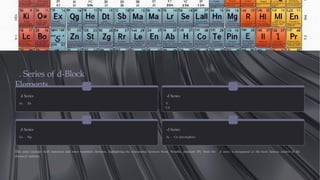
. Series ofd-Block
Elements
d Series
Sc → Zn
d Series
Y →
Cd
d Series
La → Hg
d Series
Ac → Cn (incomplete)
This series includes both transition and inner transition elements, highlighting the relationship between them. Notably, platinum (Pt) from the d series is recognized as the most famous catalyst in the
chemical industry.
9.
. General Characteristics
Themetallic nature is characterized by high tensile strength. Excellent conductivity of heat and electricity.
Possess high melting and boiling points. Exhibit variable oxidation states and are known for forming
colored ions.
Capable of forming paramagnetic complexes.
10.
Fun
Fact:
Tungsten (W), ad element, holds the record for the highest melting point ( °C)
among all metals.
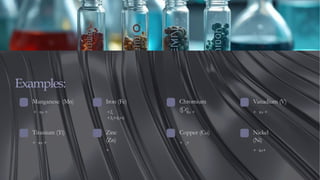
Examples:
Manganese (Mn)
+ to+
Iron (Fe)
+2,
+3,+4,+6
Chromium
(Cr)
+ to +
Vanadium (V)
+ to +
Titanium (Ti)
+ to +
Zinc
(Zn)
+
Copper (Cu)
+ ,+
Nickel
(Ni)
+ to+
13.
Examples:
Key
Insight:
Manganese and Chromiumdisplays the widest range of oxidation states in the periodic
table.due to their ability to exhibit variable oxidation states because their d and s
electrons are close in energy, allowing for the loss or sharing of electrons from both
orbitals to form different compounds. Mn has the configuration d⁵ s², giving it
valence electrons that can be lost to form states from + to + , while Cr has d⁵ s¹
, allowing it to lose electrons to form states from + to + .
14.
. Colored
Compounds
The colorsof certain compounds arise from d-d electronic transitions.A d-d transition is
a process in transition metal compounds where an electron is excited from a lower-
energy d-orbital to a higher-energy d-orbital by absorbing energy, usually in the form of
light. This transition is a primary reason for the color of many transition metal
complexes, as the energy required for the excitation often falls within the visible
spectrum, causing the compound to absorb certain colors and reflect others, which we
perceive as color.
15.
Examples:
Additional Note:
Many gemstones,such as emeralds, sapphires, and rubies, derive their color from transition metal ions.
Cr³⁺
Green (from Cr₂O₃)
Fe³⁺
Yellowish-brown
Cu²⁺
Blue (from CuSO₄· H₂O)
Calculation:
Magnetic moment canbe represented by μ = √(n(n+ )) B.M., where 'n' is the number of unpaired electrons.
Example
· Mn²⁺: unpaired electrons, yielding . B.M.
· Zn²⁺: unpaired electrons, categorized as diamagnetic.
Interesting Fact:
I ron (Fe) serves as the core component of magnetite (Fe₃O₄), recognized as the strongest naturally magnetic
material.
18.
. Catalytic
Properties
Transition metalsprovide active sites essential for various chemical reactions.Transition elements are good catalysts because they can easily
donate or accept electrons, have vacant d-orbitals, exhibit variable oxidation states, and form unstable intermediates and complexes with
reactants. These properties allow them to provide alternative reaction pathways with lower activation energy and to offer large surface areas
in their finely divided forms, which facilitates the binding and weakening of reactant molecules' bonds
19.
Common
Catalysts:
Iron (Fe)
I nvolvedin the Haber process for ammonia synthesis.
Vanadium pentoxide (V₂O₅)
Utilized in the contact process for sulfuric acid production.
Nickel (Ni)
Plays a key role in the hydrogenation of oils.
Noteworthy Fact:
Over % of industrial catalysts are based on transition metals.
Examples:
[Cu(NH₃)₄] ²⁺ (givesa deep blue color)
[Fe(CN)₆] ³⁻ (yellow)
Explanation:
Ligands donate lone pairs, leading to the creation of coordinate bonds.
Application Insight:
Complexes are crucial in bioinorganic chemistry; for instance, hemoglobin is an iron
(Fe²⁺) complex vital for oxygen transport.
Examples
:Copper and zincform brass.
Copper and tin yield bronze.
I ron, chromium, and nickel combine to create stainless steel.
Fact:
Alloys enhance properties such as strength, corrosion resistance, and electrical
conductivity.
24.
. Interstitial
Compounds
I nterstitialcompounds are formed when small atoms like carbon, nitrogen, boron, or
hydrogen occupy the interstitial sites, or voids, in the crystal lattice of a metal. These
compounds, often non-stoichiometric, possess unique properties like extreme hardness,
high melting points, and chemical inertness, with transition metals being particularly
prone to forming them.
25.
Examples:
Fe₃C
TiNi (known forits shape memory properties)
Insights:
These compounds exhibit notable hardness, conductivity, and high melting points.
Remarkable Fact:
TiNi, or Nitinol, can "remember" its shape, making it useful in surgical stents.
26.
. Trends Acrossthe
Series
Atomic Size
I nitially decreases, then increases slightly due to d-block contraction.
Density
I ncreases from left to right.
Ionization Energy
Experiences a moderate and gradual increase.
Melting Point
Exhibits very high values due to potent metallic bonding.
. Lanthanide Contraction
Thepoor shielding of f-electrons results in a gradual decrease in size from lanthanum (La) to lutetium (Lu). This phenomenon leads to similar
chemical properties between d and d elements.
Fact
:
Zirconium (Zr) and hafnium (Hf) show almost identical atomic radii, earning them the title of chemical twins.
29.
. Important
Compounds
KMnO₄
A powerfuloxidizing agent used in
titrations.
K₂Cr₂O₇
Functions as an oxidizing agent in
organic chemistry.
CuSO₄· H₂O
Commonly used for electroplating and
as a fungicide.
30.
Preparation of K₂Cr₂O₇
Step: Mining
Extraction of
chromite ore from
the earth.
Step :
Crushing
Crushing the ore
to release
chromium
content.
Step :
Roasting
Roasting with
sodium carbonate
to form sodium
chromate.
Step :
Acidification
Adding sulfuric
acid to convert
sodium chromate
into potassium
dichromate.
Step :
Crystallizatio
Cooling the
solution to
crystallize
potassium
dichromate.
31.
Preparation of Permanganate
Step: Mixing
Combine manganese dioxide with potassium hydroxide.
Step : Oxidation
Add oxidizing agents to convert manganese compounds.
Step : Filtration
Filter the solution to remove any impurities.
Step : Crystallization
Evaporate the solution to obtain permanganate crystals.
Step : Drying
Dry the crystals for storage and use.
32.
. Biological Importance
Iron(Fe)
I ntegral to hemoglobin for
oxygen transport.
Copper (Cu)
Present in enzymes that facilitate
oxidation reactions.
Zinc
(Zn)
Plays a role in insulin production and
enzyme catalysis.
Cobalt (Co)
Vital for the synthesis of Vitamin B₁₂.
33.
. Environmental Aspects
Heavymetals such as mercury (Hg), lead (Pb), and cadmium (Cd) pose significant pollution and toxicity risks. However, transition metals have
advantageous recycling potential and can be utilized in green chemistry for cleaner catalytic processes.
Environmental Note:
Platinum group metals are particularly effective in automotive catalytic converters that help minimize emissions.
.
Conclusion
The d-block elementsexhibit remarkable chemical versatility, underpinned by their
variable oxidation states and capacity to form complexes. They are extensively used in
various sectors, including industry, medicine, electronics, and environmental science.
36.
Summary
:
These elements actas a "transition bridge" between reactivity and stability within the
periodic table.And also act as a transition bridge between s and p block elements
hence derived the name transition elements
37.
. Bibliography
NCERT ChemistryClass
X
I I
P.L. Soni & Sudha
Dharmarha ‒ I norganic
Chemistry
R.C. Mukherjee ‒
Modern Approach to
I norganic Chemistry
Chemistry LibreTexts,
Royal Society of
Chemistry
NCERT Official
Website: ncert.nic.in





![. Electronic Configuration
General
Configuration
(n− )d¹ -¹ ⁰ ns¹ ‒ ².
Example Configurations
· Fe: [Ar] d⁶ s²
· Cu: [Ar] d¹ ⁰ s¹
Exceptions
Chromium and copper showcase half-
filled or fully filled configurations for
stability.](https://image.slidesharecdn.com/projectonthed-blockeleme-260126053834-cf4194eb/85/Project-on-The-d-Block-Elements-ppt-6-320.jpg)








![Examples:
[Cu(NH₃)₄] ²⁺ (gives a deep blue color)
[Fe(CN)₆] ³⁻ (yellow)
Explanation:
Ligands donate lone pairs, leading to the creation of coordinate bonds.
Application Insight:
Complexes are crucial in bioinorganic chemistry; for instance, hemoglobin is an iron
(Fe²⁺) complex vital for oxygen transport.](https://image.slidesharecdn.com/projectonthed-blockeleme-260126053834-cf4194eb/85/Project-on-The-d-Block-Elements-ppt-21-320.jpg)