Project Management Tools and Techniques
Content
01
Understanding Project Management
02
Essential Project Management Techniques
03
Leveraging Project Management Tools
Understanding Project Management
01
Definition and Importance
Project management involves planning, organizing, and managing resources to
achieve specific goals within a defined scope, time, and budget. It is crucial for
successful project delivery and organizational growth.
02
Key Elements
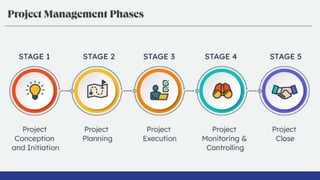
Understanding the project life cycle, defining project objectives, and effective
resource allocation are fundamental to project management success.
03
Role of a Project Manager
The project manager plays a pivotal role in leading the team, managing risks,
and ensuring project alignment with organizational objectives.
Project Management Methodologies
01
Waterfall Approach
This traditional linear approach involves sequential phases of planning, execution,
and delivery. It is suitable for projects with well-defined requirements.
02
Agile Methodology
Agile is a way of managing projects that emphasizes flexibility, collaboration, and
customer satisfaction. It’s about being able to adapt to changes quickly and deliver
small, functional parts of a project regularly.
03
Scrum Framework
Scrum is a specific way to implement Agile. It’s a framework that organizes work
into small, manageable pieces and helps teams work together effectively.
Example : Sprints, Daily Stand Ups, Sprint Review etc.
Essential Project Management Techniques
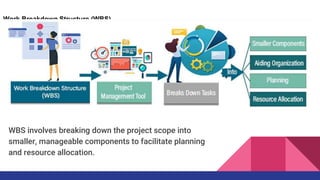
Work Breakdown Structure (WBS)
WBS involves breaking down the project scope into
smaller, manageable components to facilitate planning
and resource allocation.
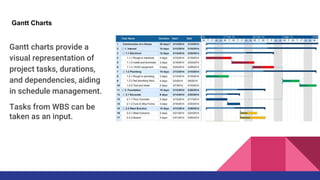
Gantt Charts
Gantt charts provide a
visual representation of
project tasks, durations,
and dependencies, aiding
in schedule management.
Tasks from WBS can be
taken as an input.
Critical Path Method (CPM)
The Critical Path Method (CPM) is a project
management technique used to plan and schedule
complex projects. It helps you determine the most
important tasks that you need to complete on time for
the project to finish on schedule.
Critical Path: It’s like finding the longest route you have
to take to get somewhere. If this route has any delays,
you’ll be late, no matter how fast you go on the other
routes.
Focus: CPM helps you focus on the most important
tasks that will delay the project if they’re not completed
on time.
Example : Allocating multiple resources to have the
work done on time.
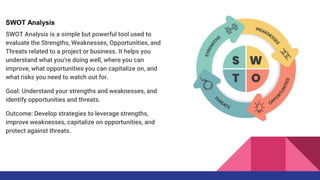
SWOT Analysis
SWOT Analysis is a simple but powerful tool used to
evaluate the Strengths, Weaknesses, Opportunities, and
Threats related to a project or business. It helps you
understand what you’re doing well, where you can
improve, what opportunities you can capitalize on, and
what risks you need to watch out for.
Goal: Understand your strengths and weaknesses, and
identify opportunities and threats.
Outcome: Develop strategies to leverage strengths,
improve weaknesses, capitalize on opportunities, and
protect against threats.
01
Real-time Insights
Accessing project status, key metrics, and performance indicators through intuitive dashboards.
02
Stakeholder Communication
Generating comprehensive reports and visual representations t facilitate transparent
communication with stakeholders.
03
Decision Support
Leveraging data-driven reports to make informed decisions, identify trends, a drive project
improvements.
Project Reporting and Dashboards
Thank You

Project Management Tools and Techniques.pptx

  • 1.
  • 2.
    Content 01 Understanding Project Management 02 EssentialProject Management Techniques 03 Leveraging Project Management Tools
  • 3.
  • 4.
    01 Definition and Importance Projectmanagement involves planning, organizing, and managing resources to achieve specific goals within a defined scope, time, and budget. It is crucial for successful project delivery and organizational growth. 02 Key Elements Understanding the project life cycle, defining project objectives, and effective resource allocation are fundamental to project management success. 03 Role of a Project Manager The project manager plays a pivotal role in leading the team, managing risks, and ensuring project alignment with organizational objectives.
  • 5.
    Project Management Methodologies 01 WaterfallApproach This traditional linear approach involves sequential phases of planning, execution, and delivery. It is suitable for projects with well-defined requirements. 02 Agile Methodology Agile is a way of managing projects that emphasizes flexibility, collaboration, and customer satisfaction. It’s about being able to adapt to changes quickly and deliver small, functional parts of a project regularly. 03 Scrum Framework Scrum is a specific way to implement Agile. It’s a framework that organizes work into small, manageable pieces and helps teams work together effectively. Example : Sprints, Daily Stand Ups, Sprint Review etc.
  • 7.
  • 8.
    Work Breakdown Structure(WBS) WBS involves breaking down the project scope into smaller, manageable components to facilitate planning and resource allocation.
  • 9.
    Gantt Charts Gantt chartsprovide a visual representation of project tasks, durations, and dependencies, aiding in schedule management. Tasks from WBS can be taken as an input.
  • 10.
    Critical Path Method(CPM) The Critical Path Method (CPM) is a project management technique used to plan and schedule complex projects. It helps you determine the most important tasks that you need to complete on time for the project to finish on schedule. Critical Path: It’s like finding the longest route you have to take to get somewhere. If this route has any delays, you’ll be late, no matter how fast you go on the other routes. Focus: CPM helps you focus on the most important tasks that will delay the project if they’re not completed on time. Example : Allocating multiple resources to have the work done on time.
  • 11.
    SWOT Analysis SWOT Analysisis a simple but powerful tool used to evaluate the Strengths, Weaknesses, Opportunities, and Threats related to a project or business. It helps you understand what you’re doing well, where you can improve, what opportunities you can capitalize on, and what risks you need to watch out for. Goal: Understand your strengths and weaknesses, and identify opportunities and threats. Outcome: Develop strategies to leverage strengths, improve weaknesses, capitalize on opportunities, and protect against threats.
  • 12.
    01 Real-time Insights Accessing projectstatus, key metrics, and performance indicators through intuitive dashboards. 02 Stakeholder Communication Generating comprehensive reports and visual representations t facilitate transparent communication with stakeholders. 03 Decision Support Leveraging data-driven reports to make informed decisions, identify trends, a drive project improvements. Project Reporting and Dashboards
  • 13.