Project Management
Sharva Group
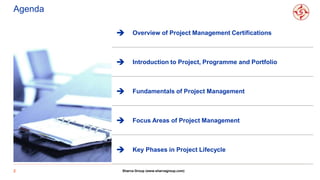
Agenda
Sharva Group (www.sharvagroup.com)2
 Overview of Project Management Certifications
 Introduction to Project, Programme and Portfolio
 Fundamentals of Project Management
 Focus Areas of Project Management
 Key Phases in Project Lifecycle
Updates from PRINCE2 Survey 2017
3
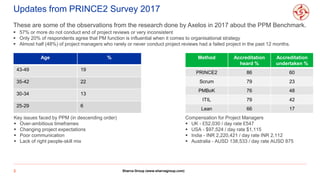
These are some of the observations from the research done by Axelos in 2017 about the PPM Benchmark.
Compensation for Project Managers
 UK - £52,030 / day rate £547
 USA - $97,524 / day rate $1,115
 India - INR 2,220,421 / day rate INR 2,112
 Australia - AUSD 138,533 / day rate AUSD 875
Age %
43-49 19
35-42 22
30-34 13
25-29 6
 57% or more do not conduct end of project reviews or very inconsistent
 Only 20% of respondents agree that PM function is influential when it comes to organisational strategy
 Almost half (48%) of project managers who rarely or never conduct project reviews had a failed project in the past 12 months.
Key issues faced by PPM (in descending order)
 Over-ambitious timeframes
 Changing project expectations
 Poor communication
 Lack of right people-skill mix
Method Accreditation
heard %
Accreditation
undertaken %
PRINCE2 86 60
Scrum 79 23
PMBoK 76 48
ITIL 79 42
Lean 66 17
Sharva Group (www.sharvagroup.com)
Overview of Project Management
Certifications
4
Market Leading Certifications
5
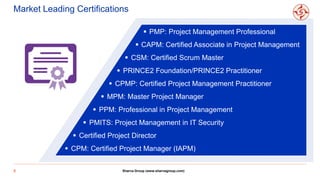
 PMP: Project Management Professional
 CAPM: Certified Associate in Project Management
 CSM: Certified Scrum Master
 PRINCE2 Foundation/PRINCE2 Practitioner
 CPMP: Certified Project Management Practitioner
 MPM: Master Project Manager
 PPM: Professional in Project Management
 PMITS: Project Management in IT Security
 Certified Project Director
 CPM: Certified Project Manager (IAPM)
Sharva Group (www.sharvagroup.com)
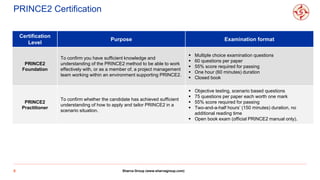
PRINCE2 Certification
6
Certification
Level
Purpose Examination format
PRINCE2
Foundation
To confirm you have sufficient knowledge and
understanding of the PRINCE2 method to be able to work
effectively with, or as a member of, a project management
team working within an environment supporting PRINCE2.
 Multiple choice examination questions
 60 questions per paper
 55% score required for passing
 One hour (60 minutes) duration
 Closed book
PRINCE2
Practitioner
To confirm whether the candidate has achieved sufficient
understanding of how to apply and tailor PRINCE2 in a
scenario situation.
 Objective testing, scenario based questions
 75 questions per paper each worth one mark
 55% score required for passing
 Two-and-a-half hours’ (150 minutes) duration, no
additional reading time
 Open book exam (official PRINCE2 manual only).
Sharva Group (www.sharvagroup.com)
PMP Certification
7
Certification Examination format
Project Management
Professional
 Minimum of 4500 hours of Project Management experience, or 7500 hours for sub
degree holders
 Minimum 35 contact hours of PMP training
 200 multiple choice questions
 175 are scored, 25 are randomly placed pre-test questions
 2 hours to complete the test
 60.6% is passing score ???????
 Recently PMI declares result as
» Passing - “Above Target” and “Target”
» Failing – “Below Target” and “Needs Improvement”
Sharva Group (www.sharvagroup.com)
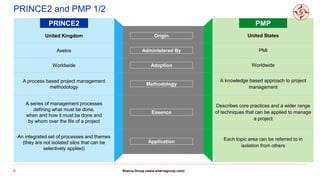
PRINCE2 and PMP 1/2
8
PRINCE2 PMP
OriginUnited Kingdom United States
Administered ByAxelos PMI
AdoptionWorldwide Worldwide
Methodology
A process based project management
methodology
A knowledge based approach to project
management
Essence
A series of management processes
defining what must be done,
when and how it must be done and
by whom over the life of a project
Describes core practices and a wider range
of techniques that can be applied to manage
a project
Application
An integrated set of processes and themes
(they are not isolated silos that can be
selectively applied)
Each topic area can be referred to in
isolation from others
Sharva Group (www.sharvagroup.com)
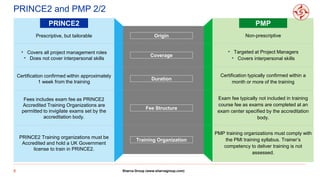
PRINCE2 and PMP 2/2
9
PRINCE2 PMP
OriginPrescriptive, but tailorable Non-prescriptive
Coverage
• Covers all project management roles
• Does not cover interpersonal skills
• Targeted at Project Managers
• Covers interpersonal skills
Fee Structure
Fees includes exam fee as PRINCE2
Accredited Training Organizations are
permitted to invigilate exams set by the
accreditation body.
Exam fee typically not included in training
course fee as exams are completed at an
exam center specified by the accreditation
body.
Training Organization
PRINCE2 Training organizations must be
Accredited and hold a UK Government
license to train in PRINCE2.
PMP training organizations must comply with
the PMI training syllabus. Trainer’s
competency to deliver training is not
assessed.
Duration
Certification confirmed within approximately
1 week from the training
Certification typically confirmed within a
month or more of the training
Sharva Group (www.sharvagroup.com)
Introduction to Project, Programme
and Portfolio
10
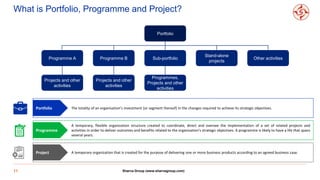
What is Portfolio, Programme and Project?
11
A temporary organization that is created for the purpose of delivering one or more business products according to an agreed business case.Project
A temporary, flexible organization structure created to coordinate, direct and oversee the implementation of a set of related projects and
activities in order to deliver outcomes and benefits related to the organization's strategic objectives. A programme is likely to have a life that spans
several years.
Programme
The totality of an organisation’s investment (or segment thereof) in the changes required to achieve its strategic objectives.Portfolio
Portfolio
Programme A Programme B Sub-portfolio
Stand-alone
projects
Other activities
Projects and other
activities
Projects and other
activities
Programmes,
Projects and other
activities
Sharva Group (www.sharvagroup.com)
Focus Areas of Project Management
12
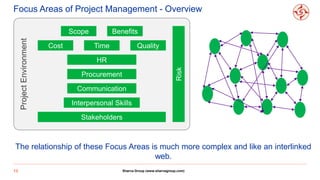
Focus Areas of Project Management - Overview
13
ProjectEnvironment
Scope Benefits
Cost Time Quality
HR
Procurement
Communication
Interpersonal Skills
Stakeholders
Risk
The relationship of these Focus Areas is much more complex and like an interlinked
web.
Sharva Group (www.sharvagroup.com)
Some Fundamentals of Project
Management
14
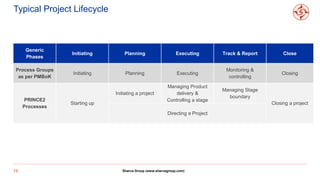
Typical Project Lifecycle
15
Generic
Phases
Initiating Planning Executing Track & Report Close
Process Groups
as per PMBoK
Initiating Planning Executing
Monitoring &
controlling
Closing
PRINCE2
Processes
Starting up
Initiating a project
Managing Product
delivery &
Controlling a stage
Managing Stage
boundary
Closing a project
Directing a Project
Sharva Group (www.sharvagroup.com)
Typical Project Organisation Structure
16
From the customer
From the supplier
Within the project management team
Sponsor Group
Project Board
Senior User(s) Senior Supplier(s)
Team members
Change Authority
Project Support
Project Manager
Team Manager(s)
Business, User and
Supplier Project
Assurance
Executive
Lines of authority
Project Assurance responsibility
Lines of support/advice
According to PMBoK
 Organic or Simple Organization
 Functional or Centralized
Organization
 Multi-divisional Organization
 Matrix Organization
 Project Oriented (Composite or
Hybrid) Organization
 Virtual Organization
 Hybrid
 PMO
According to other sources
 Simple Organization
 Functional Organization
 Divisional Organization
 Matrix Organization
 Team-Based Organization
 Network Based Organization
 Modular Organization
Diagram is from PRINCE2 2017 Manual and used here only for indicative representation; all copyrights of respective governing bodies like Axelos and others
Sharva Group (www.sharvagroup.com)
Key Phases in Project Lifecycle
17
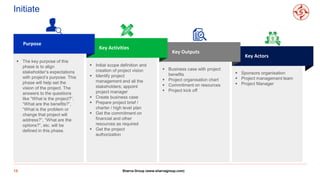
Initiate
18
 Sponsors organisation
 Project management team
 Project Manager
Key Actors
 Business case with project
benefits
 Project organisation chart
 Commitment on resources
 Project kick off
Key Outputs
 Initial scope definition and
creation of project vision
 Identify project
management and all the
stakeholders; appoint
project manager
 Create business case
 Prepare project brief /
charter / high level plan
 Get the commitment on
financial and other
resources as required
 Get the project
authorization
Key Activities
 The key purpose of this
phase is to align
stakeholder’s expectations
with project’s purpose. This
phase will help set the
vision of the project. The
answers to the questions
like “What is the project?”,
“What are the benefits?”,
“What is the problem or
change that project will
address?”, “What are the
options?”, etc. will be
defined in this phase.
Purpose
Sharva Group (www.sharvagroup.com)
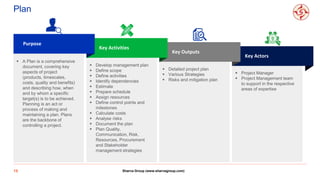
Plan
19
 Project Manager
 Project Management team
to support in the respective
areas of expertise
Key Actors
 Detailed project plan
 Various Strategies
 Risks and mitigation plan
Key Outputs
 Develop management plan
 Define scope
 Define activities
 Identify dependencies
 Estimate
 Prepare schedule
 Assign resources
 Define control points and
milestones
 Calculate costs
 Analyse risks
 Document the plan
 Plan Quality,
Communication, Risk,
Resources, Procurement
and Stakeholder
management strategies
Key Activities
 A Plan is a comprehensive
document, covering key
aspects of project
(products, timescales,
costs, quality and benefits)
and describing how, when
and by whom a specific
target(s) is to be achieved.
Planning is an act or
process of making and
maintaining a plan. Plans
are the backbone of
controlling a project.
Purpose
Sharva Group (www.sharvagroup.com)
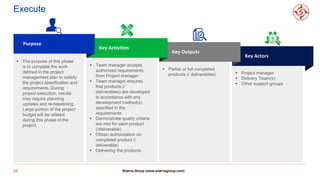
Execute
20
 Project manager
 Delivery Team(s)
 Other support groups
Key Actors
 Partial or full completed
products (/ deliverables)
Key Outputs
 Team manager accepts
authorized requirements
from Project manager
 Team manager ensures
that products (/
deliverables) are developed
in accordance with any
development method(s)
specified in the
requirements
 Demonstrate quality criteria
are met for each product
(/deliverable)
 Obtain authorization on
completed product (/
deliverable)
 Delivering the products
Key Activities
 The purpose of this phase
is to complete the work
defined in the project
management plan to satisfy
the project specification and
requirements. During
project execution, results
may require planning
updates and re-baselining.
Large portion of the project
budget will be utilised
during this phase of the
project.
Purpose
Sharva Group (www.sharvagroup.com)
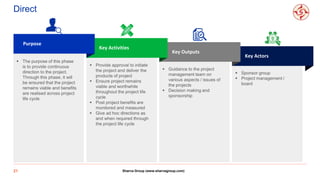
Direct
21
 Sponsor group
 Project management /
board
Key Actors
 Guidance to the project
management team on
various aspects / issues of
the projects
 Decision making and
sponsorship
Key Outputs
 Provide approval to initiate
the project and deliver the
products of project
 Ensure project remains
viable and worthwhile
throughout the project life
cycle
 Post project benefits are
monitored and measured
 Give ad hoc directions as
and when required through
the project life cycle
Key Activities
 The purpose of this phase
is to provide continuous
direction to the project.
Through this phase, it will
be ensured that the project
remains viable and benefits
are realised across project
life cycle.
Purpose
Sharva Group (www.sharvagroup.com)
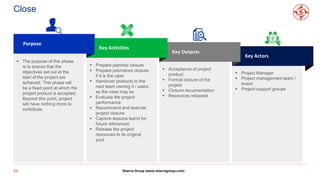
Close
22
 Project Manager
 Project management team /
board
 Project support groups
Key Actors
 Acceptance of project
product
 Formal closure of the
project
 Closure documentation
 Resources released
Key Outputs
 Prepare planned closure
 Prepare premature closure,
if it is the case
 Handover products to the
next team owning it / users,
as the case may be
 Evaluate the project
performance
 Recommend and execute
project closure
 Capture lessons learnt for
future references
 Release the project
resources to its original
pool
Key Activities
 The purpose of this phase
is to ensure that the
objectives set out at the
start of the project are
achieved. This phase will
be a fixed point at which the
project product is accepted.
Beyond this point, project
will have nothing more to
contribute.
Purpose
Sharva Group (www.sharvagroup.com)
Contact
23
For any further queries please write to
maheshmd@sharvagroup.com
Thank You
Sharva Group

Project management - short overview

  • 1.
  • 2.
    Agenda Sharva Group (www.sharvagroup.com)2 Overview of Project Management Certifications  Introduction to Project, Programme and Portfolio  Fundamentals of Project Management  Focus Areas of Project Management  Key Phases in Project Lifecycle
  • 3.
    Updates from PRINCE2Survey 2017 3 These are some of the observations from the research done by Axelos in 2017 about the PPM Benchmark. Compensation for Project Managers  UK - £52,030 / day rate £547  USA - $97,524 / day rate $1,115  India - INR 2,220,421 / day rate INR 2,112  Australia - AUSD 138,533 / day rate AUSD 875 Age % 43-49 19 35-42 22 30-34 13 25-29 6  57% or more do not conduct end of project reviews or very inconsistent  Only 20% of respondents agree that PM function is influential when it comes to organisational strategy  Almost half (48%) of project managers who rarely or never conduct project reviews had a failed project in the past 12 months. Key issues faced by PPM (in descending order)  Over-ambitious timeframes  Changing project expectations  Poor communication  Lack of right people-skill mix Method Accreditation heard % Accreditation undertaken % PRINCE2 86 60 Scrum 79 23 PMBoK 76 48 ITIL 79 42 Lean 66 17 Sharva Group (www.sharvagroup.com)
  • 4.
    Overview of ProjectManagement Certifications 4
  • 5.
    Market Leading Certifications 5 PMP: Project Management Professional  CAPM: Certified Associate in Project Management  CSM: Certified Scrum Master  PRINCE2 Foundation/PRINCE2 Practitioner  CPMP: Certified Project Management Practitioner  MPM: Master Project Manager  PPM: Professional in Project Management  PMITS: Project Management in IT Security  Certified Project Director  CPM: Certified Project Manager (IAPM) Sharva Group (www.sharvagroup.com)
  • 6.
    PRINCE2 Certification 6 Certification Level Purpose Examinationformat PRINCE2 Foundation To confirm you have sufficient knowledge and understanding of the PRINCE2 method to be able to work effectively with, or as a member of, a project management team working within an environment supporting PRINCE2.  Multiple choice examination questions  60 questions per paper  55% score required for passing  One hour (60 minutes) duration  Closed book PRINCE2 Practitioner To confirm whether the candidate has achieved sufficient understanding of how to apply and tailor PRINCE2 in a scenario situation.  Objective testing, scenario based questions  75 questions per paper each worth one mark  55% score required for passing  Two-and-a-half hours’ (150 minutes) duration, no additional reading time  Open book exam (official PRINCE2 manual only). Sharva Group (www.sharvagroup.com)
  • 7.
    PMP Certification 7 Certification Examinationformat Project Management Professional  Minimum of 4500 hours of Project Management experience, or 7500 hours for sub degree holders  Minimum 35 contact hours of PMP training  200 multiple choice questions  175 are scored, 25 are randomly placed pre-test questions  2 hours to complete the test  60.6% is passing score ???????  Recently PMI declares result as » Passing - “Above Target” and “Target” » Failing – “Below Target” and “Needs Improvement” Sharva Group (www.sharvagroup.com)
  • 8.
    PRINCE2 and PMP1/2 8 PRINCE2 PMP OriginUnited Kingdom United States Administered ByAxelos PMI AdoptionWorldwide Worldwide Methodology A process based project management methodology A knowledge based approach to project management Essence A series of management processes defining what must be done, when and how it must be done and by whom over the life of a project Describes core practices and a wider range of techniques that can be applied to manage a project Application An integrated set of processes and themes (they are not isolated silos that can be selectively applied) Each topic area can be referred to in isolation from others Sharva Group (www.sharvagroup.com)
  • 9.
    PRINCE2 and PMP2/2 9 PRINCE2 PMP OriginPrescriptive, but tailorable Non-prescriptive Coverage • Covers all project management roles • Does not cover interpersonal skills • Targeted at Project Managers • Covers interpersonal skills Fee Structure Fees includes exam fee as PRINCE2 Accredited Training Organizations are permitted to invigilate exams set by the accreditation body. Exam fee typically not included in training course fee as exams are completed at an exam center specified by the accreditation body. Training Organization PRINCE2 Training organizations must be Accredited and hold a UK Government license to train in PRINCE2. PMP training organizations must comply with the PMI training syllabus. Trainer’s competency to deliver training is not assessed. Duration Certification confirmed within approximately 1 week from the training Certification typically confirmed within a month or more of the training Sharva Group (www.sharvagroup.com)
  • 10.
    Introduction to Project,Programme and Portfolio 10
  • 11.
    What is Portfolio,Programme and Project? 11 A temporary organization that is created for the purpose of delivering one or more business products according to an agreed business case.Project A temporary, flexible organization structure created to coordinate, direct and oversee the implementation of a set of related projects and activities in order to deliver outcomes and benefits related to the organization's strategic objectives. A programme is likely to have a life that spans several years. Programme The totality of an organisation’s investment (or segment thereof) in the changes required to achieve its strategic objectives.Portfolio Portfolio Programme A Programme B Sub-portfolio Stand-alone projects Other activities Projects and other activities Projects and other activities Programmes, Projects and other activities Sharva Group (www.sharvagroup.com)
  • 12.
    Focus Areas ofProject Management 12
  • 13.
    Focus Areas ofProject Management - Overview 13 ProjectEnvironment Scope Benefits Cost Time Quality HR Procurement Communication Interpersonal Skills Stakeholders Risk The relationship of these Focus Areas is much more complex and like an interlinked web. Sharva Group (www.sharvagroup.com)
  • 14.
    Some Fundamentals ofProject Management 14
  • 15.
    Typical Project Lifecycle 15 Generic Phases InitiatingPlanning Executing Track & Report Close Process Groups as per PMBoK Initiating Planning Executing Monitoring & controlling Closing PRINCE2 Processes Starting up Initiating a project Managing Product delivery & Controlling a stage Managing Stage boundary Closing a project Directing a Project Sharva Group (www.sharvagroup.com)
  • 16.
    Typical Project OrganisationStructure 16 From the customer From the supplier Within the project management team Sponsor Group Project Board Senior User(s) Senior Supplier(s) Team members Change Authority Project Support Project Manager Team Manager(s) Business, User and Supplier Project Assurance Executive Lines of authority Project Assurance responsibility Lines of support/advice According to PMBoK  Organic or Simple Organization  Functional or Centralized Organization  Multi-divisional Organization  Matrix Organization  Project Oriented (Composite or Hybrid) Organization  Virtual Organization  Hybrid  PMO According to other sources  Simple Organization  Functional Organization  Divisional Organization  Matrix Organization  Team-Based Organization  Network Based Organization  Modular Organization Diagram is from PRINCE2 2017 Manual and used here only for indicative representation; all copyrights of respective governing bodies like Axelos and others Sharva Group (www.sharvagroup.com)
  • 17.
    Key Phases inProject Lifecycle 17
  • 18.
    Initiate 18  Sponsors organisation Project management team  Project Manager Key Actors  Business case with project benefits  Project organisation chart  Commitment on resources  Project kick off Key Outputs  Initial scope definition and creation of project vision  Identify project management and all the stakeholders; appoint project manager  Create business case  Prepare project brief / charter / high level plan  Get the commitment on financial and other resources as required  Get the project authorization Key Activities  The key purpose of this phase is to align stakeholder’s expectations with project’s purpose. This phase will help set the vision of the project. The answers to the questions like “What is the project?”, “What are the benefits?”, “What is the problem or change that project will address?”, “What are the options?”, etc. will be defined in this phase. Purpose Sharva Group (www.sharvagroup.com)
  • 19.
    Plan 19  Project Manager Project Management team to support in the respective areas of expertise Key Actors  Detailed project plan  Various Strategies  Risks and mitigation plan Key Outputs  Develop management plan  Define scope  Define activities  Identify dependencies  Estimate  Prepare schedule  Assign resources  Define control points and milestones  Calculate costs  Analyse risks  Document the plan  Plan Quality, Communication, Risk, Resources, Procurement and Stakeholder management strategies Key Activities  A Plan is a comprehensive document, covering key aspects of project (products, timescales, costs, quality and benefits) and describing how, when and by whom a specific target(s) is to be achieved. Planning is an act or process of making and maintaining a plan. Plans are the backbone of controlling a project. Purpose Sharva Group (www.sharvagroup.com)
  • 20.
    Execute 20  Project manager Delivery Team(s)  Other support groups Key Actors  Partial or full completed products (/ deliverables) Key Outputs  Team manager accepts authorized requirements from Project manager  Team manager ensures that products (/ deliverables) are developed in accordance with any development method(s) specified in the requirements  Demonstrate quality criteria are met for each product (/deliverable)  Obtain authorization on completed product (/ deliverable)  Delivering the products Key Activities  The purpose of this phase is to complete the work defined in the project management plan to satisfy the project specification and requirements. During project execution, results may require planning updates and re-baselining. Large portion of the project budget will be utilised during this phase of the project. Purpose Sharva Group (www.sharvagroup.com)
  • 21.
    Direct 21  Sponsor group Project management / board Key Actors  Guidance to the project management team on various aspects / issues of the projects  Decision making and sponsorship Key Outputs  Provide approval to initiate the project and deliver the products of project  Ensure project remains viable and worthwhile throughout the project life cycle  Post project benefits are monitored and measured  Give ad hoc directions as and when required through the project life cycle Key Activities  The purpose of this phase is to provide continuous direction to the project. Through this phase, it will be ensured that the project remains viable and benefits are realised across project life cycle. Purpose Sharva Group (www.sharvagroup.com)
  • 22.
    Close 22  Project Manager Project management team / board  Project support groups Key Actors  Acceptance of project product  Formal closure of the project  Closure documentation  Resources released Key Outputs  Prepare planned closure  Prepare premature closure, if it is the case  Handover products to the next team owning it / users, as the case may be  Evaluate the project performance  Recommend and execute project closure  Capture lessons learnt for future references  Release the project resources to its original pool Key Activities  The purpose of this phase is to ensure that the objectives set out at the start of the project are achieved. This phase will be a fixed point at which the project product is accepted. Beyond this point, project will have nothing more to contribute. Purpose Sharva Group (www.sharvagroup.com)
  • 23.
    Contact 23 For any furtherqueries please write to maheshmd@sharvagroup.com
  • 24.