PROJECT FORMULATION/PREPARATION
1
Prepared by
Dr K.Arun Vidya
1. What is Project Formulation/Preparation (PFP)?
2. Why is PFP important in Project Cycle Management (PCM)?
3. How to ensure obtaining effective PFP?
4. Objectives of the module
5. Contents of the module
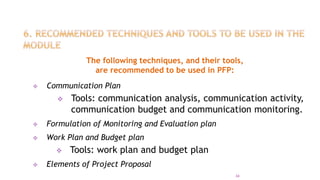
6. Recommended techniques and tools to be used in the module
7. Reviewing summary report and prioritized problems from PPI
8. Module Pre-Test and Post-Test
9. Conclusion
2
1. What is Project Formulation/Preparation (PFP)?
2. Why is PFP important in Project Cycle Management (PCM)?
3. How to ensure obtaining effective PFP?
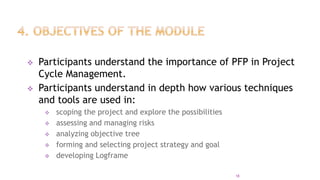
4. Objectives of the module
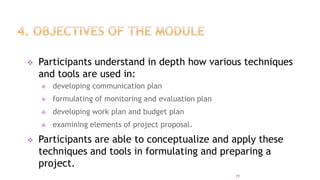
5. Contents of the module
6. Recommended techniques and tools to be used in the module
7. Reviewing summary report and prioritized problems from PPI
8. Module Pre-Test and Post-Test
9. Conclusion
3
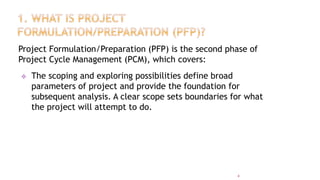
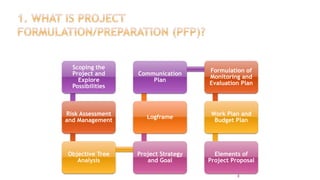
Project Formulation/Preparation (PFP) is the second phase of
Project Cycle Management (PCM), which covers:
 The scoping and exploring possibilities define broad
parameters of project and provide the foundation for
subsequent analysis. A clear scope sets boundaries for what
the project will attempt to do.
4
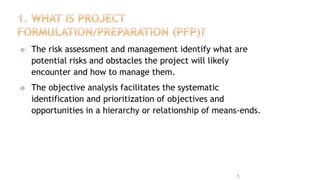
 The risk assessment and management identify what are
potential risks and obstacles the project will likely
encounter and how to manage them.
 The objective analysis facilitates the systematic
identification and prioritization of objectives and
opportunities in a hierarchy or relationship of means-ends.
5
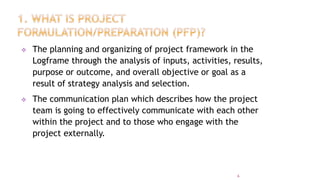
 The planning and organizing of project framework in the
Logframe through the analysis of inputs, activities, results,
purpose or outcome, and overall objective or goal as a
result of strategy analysis and selection.
 The communication plan which describes how the project
team is going to effectively communicate with each other
within the project and to those who engage with the
project externally.
6
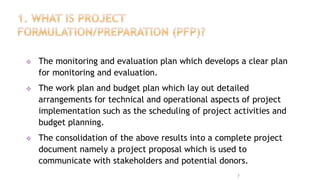
 The monitoring and evaluation plan which develops a clear plan
for monitoring and evaluation.
 The work plan and budget plan which lay out detailed
arrangements for technical and operational aspects of project
implementation such as the scheduling of project activities and
budget planning.
 The consolidation of the above results into a complete project
document namely a project proposal which is used to
communicate with stakeholders and potential donors.
7
Scoping the
Project and
Explore
Possibilities
Risk Assessment
and Management
Objective Tree
Analysis
Project Strategy
and Goal
Logframe
Communication
Plan
Formulation of
Monitoring and
Evaluation Plan
Work Plan and
Budget Plan
Elements of
Project Proposal
8
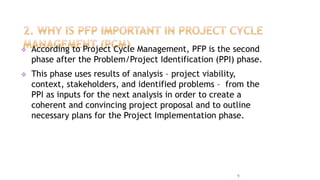
 According to Project Cycle Management, PFP is the second
phase after the Problem/Project Identification (PPI) phase.
 This phase uses results of analysis – project viability,
context, stakeholders, and identified problems – from the
PPI as inputs for the next analysis in order to create a
coherent and convincing project proposal and to outline
necessary plans for the Project Implementation phase.
9
1. What is Project Formulation/Preparation (PFP)?
2. Why is PFP important in Project Cycle Management (PCM)?
3. How to ensure obtaining effective PFP?
4. Objectives of the module
5. Contents of the module
6. Recommended techniques and tools to be used in the module
7. Reviewing summary report and prioritized problems from PPI
8. Module Pre-Test and Post-Test
9. Conclusion
10
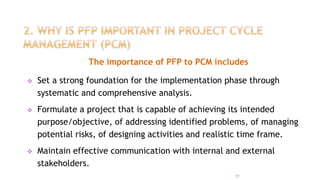
The importance of PFP to PCM includes
 Set a strong foundation for the implementation phase through
systematic and comprehensive analysis.
 Formulate a project that is capable of achieving its intended
purpose/objective, of addressing identified problems, of managing
potential risks, of designing activities and realistic time frame.
 Maintain effective communication with internal and external
stakeholders.
11
The importance of PFP to PCM includes
 Provide an estimate project cost.
 Prepare the project for monitoring and evaluation which is
vital in assessing change or impacts of the project at local
and national level.
 Develop a strong project proposal through incorporating the
principles of relevant techniques, tools and contexts.
12
1. What is Project Formulation/Preparation (PFP)?
2. Why is PFP important in Project Cycle Management (PCM)?
3. How to ensure obtaining effective PFP?
4. Objectives of the module
5. Contents of the module
6. Recommended techniques and tools to be used in the module
7. Reviewing summary report and prioritized problems from PPI
8. Module Pre-Test and Post-Test
9. Conclusion
13
 PFP uses information or analysis results obtained from
Problem/Project Identification (PPI) phase such as project viability,
situation or context, stakeholders, and identified problems.
 In addition to that, majority of information in PFP is generated
from discussion or meetings with project team and stakeholders. It
is important, therefore, to maintain effective and two-way
communication with them in order to obtain necessary information
or ideas or cooperation for relevant analysis of PFP.
14
 A good analysis normally requires enough time and the process is
highly iterative. That is why going back to a previous questioning or
analysis step reveals necessary most of the time.
 Although analysis in PFP can rely a lot on stakeholder consultation
or participation, the analysis should be evidence based – using
observed or documented facts.
15
In some cases, the project team can consult more information, secondary
data, obtained from original and reliable sources in electronic/printing
format:
 Improving the understanding on how to use relevant techniques and
tools.
 Looking for examples on how various techniques or tools are used, in
similar areas, to formulate and prepare their projects.
 Looking for opportunities for funding or calls for proposal or potential
donors.
16
1. What is Project Formulation/Preparation (PFP)?
2. Why is PFP important in Project Cycle Management (PCM)?
3. How to ensure obtaining effective PFP?
4. Objectives of the module
5. Contents of the module
6. Recommended techniques and tools to be used in the module
7. Reviewing summary report and prioritized problems from PPI
8. Module Pre-Test and Post-Test
9. Conclusion
17
 Participants understand the importance of PFP in Project
Cycle Management.
 Participants understand in depth how various techniques
and tools are used in:
 scoping the project and explore the possibilities
 assessing and managing risks
 analyzing objective tree
 forming and selecting project strategy and goal
 developing Logframe
18
 Participants understand in depth how various techniques
and tools are used in:
 developing communication plan
 formulating of monitoring and evaluation plan
 developing work plan and budget plan
 examining elements of project proposal.
 Participants are able to conceptualize and apply these
techniques and tools in formulating and preparing a
project.
19
1. What is Project Formulation/Preparation (PFP)?
2. Why is PFP important in Project Cycle Management (PCM)?
3. How to ensure obtaining effective PFP?
4. Objectives of the module
5. Contents of the module
6. Recommended techniques and tools to be used in the module
7. Reviewing summary report and prioritized problems from PPI
8. Module Pre-Test and Post-Test
9. Conclusion
20
Scoping the Project and Explore the Possibilities
Scoping
 What is project scoping?
 How important is project scoping?
 How to conduct project scoping?
 Recommended tools for project scoping
21
Scoping the Project and Explore the Possibilities
Exploring the possibilities
 What is the exploring possibilities?
 How important is exploring possibilities
 How to conduct exploring possibilities?
 Recommended tools for exploring possibilities
22
Risk Assessment and Management
 What is risk assessment and management?
 Why the risk assessment and management is important in
PFP?
 How to conduct risk assessment & management?
 Recommended tools to be used in risk assessment
23
Objective Tree Analysis
 What is an Objective Tree Analysis?
 Reformulating problem statements into objective
statements
 Steps in formulating an Objective Tree
 Examples of Objective Tree
24
Project Strategy and Goal
 Analysis of project strategy
 Criteria for choosing a project strategy
 Examples of project strategy selection
 SMART goal
25
Logframe
 What is Logframe?
 Why Logframe is important for PFP?
 How to develop Logframe?
 Recommended formats and tools for Logframe
26
Communication Plan
 What is communication plan
 Why communication plan is important?
 How to develop communication plan?
27
Formulation of Monitoring and Evaluation Plan
 What formulating M&E plan is?
 Why is it important for formulating M&E plan?
 How to formulate M&E plan?
28
Work Plan and Budget Plan
 What is a work plan?
 What types of work plan and its elements?
 Benefit of work plan
 Examples of different work plan formats
 What is a budget plan?
 How to develop a budget plan?
29
Elements of Project Proposal
 What are elements of project proposal?
 Why is it important to know about the elements of
project proposal?
 How to develop a project proposal?
 Project proposal checklist
 Planning for project report
30
1. What is Project Formulation/Preparation (PFP)?
2. Why is PFP important in Project Cycle Management (PCM)?
3. How to ensure obtaining effective PFP?
4. Objectives of the module
5. Contents of the module
6. Recommended techniques and tools to be used in the module
7. Reviewing summary report and prioritized problems from PPI
8. Module Pre-Test and Post-Test
9. Conclusion
31
The following techniques, and their tools,
are recommended to be used in PFP:
 Scoping the Project and Explore the Possibilities
 Tools: project scoping framework, expectations and alignment
analysis framework, exploring possibilities framework, possibilities
identification framework
 Risk Assessment and Management
 Tools: risk analysis matrix, risk analysis and management
framework, and risk management plan.
32
The following techniques, and their tools,
are recommended to be used in PFP:
 Objective Tree analysis
 Tool: objective tree
 Project Strategy and Goal
 Tool: objective tree
 Logframe
 Tools: Problem Tree and Objective Tree
33
The following techniques, and their tools,
are recommended to be used in PFP:
 Communication Plan
 Tools: communication analysis, communication activity,
communication budget and communication monitoring.
 Formulation of Monitoring and Evaluation plan
 Work Plan and Budget plan
 Tools: work plan and budget plan
 Elements of Project Proposal
34
1. What is Project Formulation/Preparation (PFP)?
2. Why is PFP important in Project Cycle Management (PCM)?
3. How to ensure obtaining effective PFP?
4. Objectives of the module
5. Contents of the module
6. Recommended techniques and tools to be used in the module
7. Reviewing summary report and prioritized problems from PPI
8. Module Pre-Test and Post-Test
9. Conclusion
35
 The results of analysis in Problem/Project Identification (PPI) allow the project
team to see viability or alternatives of a project, to understand national and
local situation around which a project evolves, to examine involvement or
influences or interests of varying stakeholders, and to appropriately select a
main problem and its sub problems.
 These results are inevitable inputs for subsequent analysis in PFP in which we
will scope and explore possibilities of the project, analyze and manage risks,
turn problems into objectives, select strategy and formulate project goal,
develop a logical framework matrix (Logframe) and other relevant plans in
order to create a coherent and convincing project proposal.
36
The information obtained in PPI that is useful for PFP is:
 Potential geographic areas of a project.
 Understand the context, demography and situation of those geographic
areas.
 Enabling factors that can contribute to the success of a project.
 Existing strengths of a project that can be used to address the problem.
 Opportunities to improve a project.
 Stakeholders who have interests in and influence the project.
 Identified main problem, including its causes and effects.
37
1. What is Project Formulation/Preparation (PFP)?
2. Why is PFP important in Project Cycle Management (PCM)?
3. How to ensure obtaining effective PFP?
4. Objectives of the module
5. Contents of the module
6. Recommended techniques and tools to be used in the module
7. Reviewing summary report and prioritized problems from PPI
8. Module Pre-Test and Post-Test
9. Conclusion
38
 The pre-test is a test that will assess the existing
knowledge of participants at the beginning of the training.
 The post-test is a test that will assess the knowledge that
participants will have acquired after the training.
39
1. What is Project Formulation/Preparation (PFP)?
2. Why is PFP important in Project Cycle Management (PCM)?
3. How to ensure obtaining effective PFP?
4. Objectives of the module
5. Contents of the module
6. Recommended techniques and tools to be used in the module
7. Reviewing summary report and prioritized problems from PPI
8. Module Pre-Test and Post-Test
9. Conclusion
40
 There are different types of project report, depending also on
the time frame of the project, which can be quarterly report,
mid-year report, annual report, mid-term report, and final
project report.
 The common elements to be included in a report, in spite of
different types, are report title, author(s), table of contents,
executive summary, introduction, achievements, operation, and
annexes.
41
 Constantini, G., & Quinti, G. (2004). SARD Project Toolkit: a Resource Guide for Promoting SARD in Projects and
Programmes. Food and Agriculture Organization of the United Nations.
 Artto, K., Kujala, J., Dietrich, P
., & Martinsuo, M. (2008). What is Project Strategy? International Journal of
Project Management(26), 4-12.
42

Project Management - Project formulation

  • 1.
  • 2.
    1. What isProject Formulation/Preparation (PFP)? 2. Why is PFP important in Project Cycle Management (PCM)? 3. How to ensure obtaining effective PFP? 4. Objectives of the module 5. Contents of the module 6. Recommended techniques and tools to be used in the module 7. Reviewing summary report and prioritized problems from PPI 8. Module Pre-Test and Post-Test 9. Conclusion 2
  • 3.
    1. What isProject Formulation/Preparation (PFP)? 2. Why is PFP important in Project Cycle Management (PCM)? 3. How to ensure obtaining effective PFP? 4. Objectives of the module 5. Contents of the module 6. Recommended techniques and tools to be used in the module 7. Reviewing summary report and prioritized problems from PPI 8. Module Pre-Test and Post-Test 9. Conclusion 3
  • 4.
    Project Formulation/Preparation (PFP)is the second phase of Project Cycle Management (PCM), which covers:  The scoping and exploring possibilities define broad parameters of project and provide the foundation for subsequent analysis. A clear scope sets boundaries for what the project will attempt to do. 4
  • 5.
     The riskassessment and management identify what are potential risks and obstacles the project will likely encounter and how to manage them.  The objective analysis facilitates the systematic identification and prioritization of objectives and opportunities in a hierarchy or relationship of means-ends. 5
  • 6.
     The planningand organizing of project framework in the Logframe through the analysis of inputs, activities, results, purpose or outcome, and overall objective or goal as a result of strategy analysis and selection.  The communication plan which describes how the project team is going to effectively communicate with each other within the project and to those who engage with the project externally. 6
  • 7.
     The monitoringand evaluation plan which develops a clear plan for monitoring and evaluation.  The work plan and budget plan which lay out detailed arrangements for technical and operational aspects of project implementation such as the scheduling of project activities and budget planning.  The consolidation of the above results into a complete project document namely a project proposal which is used to communicate with stakeholders and potential donors. 7
  • 8.
    Scoping the Project and Explore Possibilities RiskAssessment and Management Objective Tree Analysis Project Strategy and Goal Logframe Communication Plan Formulation of Monitoring and Evaluation Plan Work Plan and Budget Plan Elements of Project Proposal 8
  • 9.
     According toProject Cycle Management, PFP is the second phase after the Problem/Project Identification (PPI) phase.  This phase uses results of analysis – project viability, context, stakeholders, and identified problems – from the PPI as inputs for the next analysis in order to create a coherent and convincing project proposal and to outline necessary plans for the Project Implementation phase. 9
  • 10.
    1. What isProject Formulation/Preparation (PFP)? 2. Why is PFP important in Project Cycle Management (PCM)? 3. How to ensure obtaining effective PFP? 4. Objectives of the module 5. Contents of the module 6. Recommended techniques and tools to be used in the module 7. Reviewing summary report and prioritized problems from PPI 8. Module Pre-Test and Post-Test 9. Conclusion 10
  • 11.
    The importance ofPFP to PCM includes  Set a strong foundation for the implementation phase through systematic and comprehensive analysis.  Formulate a project that is capable of achieving its intended purpose/objective, of addressing identified problems, of managing potential risks, of designing activities and realistic time frame.  Maintain effective communication with internal and external stakeholders. 11
  • 12.
    The importance ofPFP to PCM includes  Provide an estimate project cost.  Prepare the project for monitoring and evaluation which is vital in assessing change or impacts of the project at local and national level.  Develop a strong project proposal through incorporating the principles of relevant techniques, tools and contexts. 12
  • 13.
    1. What isProject Formulation/Preparation (PFP)? 2. Why is PFP important in Project Cycle Management (PCM)? 3. How to ensure obtaining effective PFP? 4. Objectives of the module 5. Contents of the module 6. Recommended techniques and tools to be used in the module 7. Reviewing summary report and prioritized problems from PPI 8. Module Pre-Test and Post-Test 9. Conclusion 13
  • 14.
     PFP usesinformation or analysis results obtained from Problem/Project Identification (PPI) phase such as project viability, situation or context, stakeholders, and identified problems.  In addition to that, majority of information in PFP is generated from discussion or meetings with project team and stakeholders. It is important, therefore, to maintain effective and two-way communication with them in order to obtain necessary information or ideas or cooperation for relevant analysis of PFP. 14
  • 15.
     A goodanalysis normally requires enough time and the process is highly iterative. That is why going back to a previous questioning or analysis step reveals necessary most of the time.  Although analysis in PFP can rely a lot on stakeholder consultation or participation, the analysis should be evidence based – using observed or documented facts. 15
  • 16.
    In some cases,the project team can consult more information, secondary data, obtained from original and reliable sources in electronic/printing format:  Improving the understanding on how to use relevant techniques and tools.  Looking for examples on how various techniques or tools are used, in similar areas, to formulate and prepare their projects.  Looking for opportunities for funding or calls for proposal or potential donors. 16
  • 17.
    1. What isProject Formulation/Preparation (PFP)? 2. Why is PFP important in Project Cycle Management (PCM)? 3. How to ensure obtaining effective PFP? 4. Objectives of the module 5. Contents of the module 6. Recommended techniques and tools to be used in the module 7. Reviewing summary report and prioritized problems from PPI 8. Module Pre-Test and Post-Test 9. Conclusion 17
  • 18.
     Participants understandthe importance of PFP in Project Cycle Management.  Participants understand in depth how various techniques and tools are used in:  scoping the project and explore the possibilities  assessing and managing risks  analyzing objective tree  forming and selecting project strategy and goal  developing Logframe 18
  • 19.
     Participants understandin depth how various techniques and tools are used in:  developing communication plan  formulating of monitoring and evaluation plan  developing work plan and budget plan  examining elements of project proposal.  Participants are able to conceptualize and apply these techniques and tools in formulating and preparing a project. 19
  • 20.
    1. What isProject Formulation/Preparation (PFP)? 2. Why is PFP important in Project Cycle Management (PCM)? 3. How to ensure obtaining effective PFP? 4. Objectives of the module 5. Contents of the module 6. Recommended techniques and tools to be used in the module 7. Reviewing summary report and prioritized problems from PPI 8. Module Pre-Test and Post-Test 9. Conclusion 20
  • 21.
    Scoping the Projectand Explore the Possibilities Scoping  What is project scoping?  How important is project scoping?  How to conduct project scoping?  Recommended tools for project scoping 21
  • 22.
    Scoping the Projectand Explore the Possibilities Exploring the possibilities  What is the exploring possibilities?  How important is exploring possibilities  How to conduct exploring possibilities?  Recommended tools for exploring possibilities 22
  • 23.
    Risk Assessment andManagement  What is risk assessment and management?  Why the risk assessment and management is important in PFP?  How to conduct risk assessment & management?  Recommended tools to be used in risk assessment 23
  • 24.
    Objective Tree Analysis What is an Objective Tree Analysis?  Reformulating problem statements into objective statements  Steps in formulating an Objective Tree  Examples of Objective Tree 24
  • 25.
    Project Strategy andGoal  Analysis of project strategy  Criteria for choosing a project strategy  Examples of project strategy selection  SMART goal 25
  • 26.
    Logframe  What isLogframe?  Why Logframe is important for PFP?  How to develop Logframe?  Recommended formats and tools for Logframe 26
  • 27.
    Communication Plan  Whatis communication plan  Why communication plan is important?  How to develop communication plan? 27
  • 28.
    Formulation of Monitoringand Evaluation Plan  What formulating M&E plan is?  Why is it important for formulating M&E plan?  How to formulate M&E plan? 28
  • 29.
    Work Plan andBudget Plan  What is a work plan?  What types of work plan and its elements?  Benefit of work plan  Examples of different work plan formats  What is a budget plan?  How to develop a budget plan? 29
  • 30.
    Elements of ProjectProposal  What are elements of project proposal?  Why is it important to know about the elements of project proposal?  How to develop a project proposal?  Project proposal checklist  Planning for project report 30
  • 31.
    1. What isProject Formulation/Preparation (PFP)? 2. Why is PFP important in Project Cycle Management (PCM)? 3. How to ensure obtaining effective PFP? 4. Objectives of the module 5. Contents of the module 6. Recommended techniques and tools to be used in the module 7. Reviewing summary report and prioritized problems from PPI 8. Module Pre-Test and Post-Test 9. Conclusion 31
  • 32.
    The following techniques,and their tools, are recommended to be used in PFP:  Scoping the Project and Explore the Possibilities  Tools: project scoping framework, expectations and alignment analysis framework, exploring possibilities framework, possibilities identification framework  Risk Assessment and Management  Tools: risk analysis matrix, risk analysis and management framework, and risk management plan. 32
  • 33.
    The following techniques,and their tools, are recommended to be used in PFP:  Objective Tree analysis  Tool: objective tree  Project Strategy and Goal  Tool: objective tree  Logframe  Tools: Problem Tree and Objective Tree 33
  • 34.
    The following techniques,and their tools, are recommended to be used in PFP:  Communication Plan  Tools: communication analysis, communication activity, communication budget and communication monitoring.  Formulation of Monitoring and Evaluation plan  Work Plan and Budget plan  Tools: work plan and budget plan  Elements of Project Proposal 34
  • 35.
    1. What isProject Formulation/Preparation (PFP)? 2. Why is PFP important in Project Cycle Management (PCM)? 3. How to ensure obtaining effective PFP? 4. Objectives of the module 5. Contents of the module 6. Recommended techniques and tools to be used in the module 7. Reviewing summary report and prioritized problems from PPI 8. Module Pre-Test and Post-Test 9. Conclusion 35
  • 36.
     The resultsof analysis in Problem/Project Identification (PPI) allow the project team to see viability or alternatives of a project, to understand national and local situation around which a project evolves, to examine involvement or influences or interests of varying stakeholders, and to appropriately select a main problem and its sub problems.  These results are inevitable inputs for subsequent analysis in PFP in which we will scope and explore possibilities of the project, analyze and manage risks, turn problems into objectives, select strategy and formulate project goal, develop a logical framework matrix (Logframe) and other relevant plans in order to create a coherent and convincing project proposal. 36
  • 37.
    The information obtainedin PPI that is useful for PFP is:  Potential geographic areas of a project.  Understand the context, demography and situation of those geographic areas.  Enabling factors that can contribute to the success of a project.  Existing strengths of a project that can be used to address the problem.  Opportunities to improve a project.  Stakeholders who have interests in and influence the project.  Identified main problem, including its causes and effects. 37
  • 38.
    1. What isProject Formulation/Preparation (PFP)? 2. Why is PFP important in Project Cycle Management (PCM)? 3. How to ensure obtaining effective PFP? 4. Objectives of the module 5. Contents of the module 6. Recommended techniques and tools to be used in the module 7. Reviewing summary report and prioritized problems from PPI 8. Module Pre-Test and Post-Test 9. Conclusion 38
  • 39.
     The pre-testis a test that will assess the existing knowledge of participants at the beginning of the training.  The post-test is a test that will assess the knowledge that participants will have acquired after the training. 39
  • 40.
    1. What isProject Formulation/Preparation (PFP)? 2. Why is PFP important in Project Cycle Management (PCM)? 3. How to ensure obtaining effective PFP? 4. Objectives of the module 5. Contents of the module 6. Recommended techniques and tools to be used in the module 7. Reviewing summary report and prioritized problems from PPI 8. Module Pre-Test and Post-Test 9. Conclusion 40
  • 41.
     There aredifferent types of project report, depending also on the time frame of the project, which can be quarterly report, mid-year report, annual report, mid-term report, and final project report.  The common elements to be included in a report, in spite of different types, are report title, author(s), table of contents, executive summary, introduction, achievements, operation, and annexes. 41
  • 42.
     Constantini, G.,& Quinti, G. (2004). SARD Project Toolkit: a Resource Guide for Promoting SARD in Projects and Programmes. Food and Agriculture Organization of the United Nations.  Artto, K., Kujala, J., Dietrich, P ., & Martinsuo, M. (2008). What is Project Strategy? International Journal of Project Management(26), 4-12. 42