PROJECT MANAGEMENT
PROJECT MANAGEMENT
LOGIC AND PMBOK
LOGIC AND PMBOK™
™
STRUCTURE
STRUCTURE
Vladimir Liberzon
Vladimir Liberzon
Spider Management Technologies
Moscow PMI Chapter
Moscow PMI Chapter
E-mail: spider@mail.cnt.ru
V.Liberzon /Spider Manage 2
PMBOK
PMBOK™
™ STRUCTURE
STRUCTURE
People who lack sufficient practical experience
in Project Management meet with difficulties
when they try to get a clear picture of PM
logic from A Guideline to the PMBOK™.
Novice managers often try to divide
responsibilities among PM team members in
accordance with knowledge areas (Time
manager, Cost manager, Quality manager,
etc.).
V.Liberzon /Spider Manage 3
PMBOK
PMBOK™
™ STRUCTURE
STRUCTURE
Most PM knowledge areas are closely
interrelated and can hardly be separated
from each other. For instance, one cannot
change project schedule without affecting
project cost. Besides, it is impossible to
control time or cost (success indicators)
directly but only through resources or
technologies.
V.Liberzon /Spider Manage 4
PMBOK
PMBOK™
™ STRUCTURE
STRUCTURE
Some of knowledge areas are project success
indicators (scope, time, cost and quality),
others are management tools (human
resources, communications, risks,
procurement).
You can analyze time or cost performance and
then make corrective moves using resources
or technologies.
V.Liberzon /Spider Manage 5
PMBOK
PMBOK™
™ STRUCTURE
STRUCTURE
A Guideline to the PMBOK™ can be
successfully applied to projects only at
those levels where details are not
important. But it does not provide
enough fine tools for more precise
practical project management for which
the resource management is the core
issue.
V.Liberzon /Spider Manage 6
PMBOK
PMBOK™
™ STRUCTURE
STRUCTURE
I believe that ideological content of A
Guideline to the PMBOK™ can be reorganized
in a more instructive, process-oriented way.
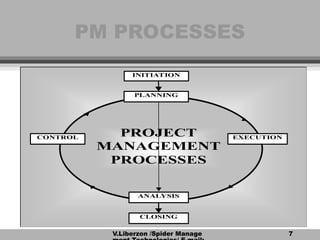
I think that it is necessary to recognize six
main PM processes instead of five described
in a Guideline to the PMBOK™.
The additional process is Analysis.
V.Liberzon /Spider Manage 7
PM PROCESSES
PM PROCESSES
PROJECT
MANAGEMENT
PROCESSES
PLANNING
ANALYSIS
CONTROL
INITIATION
CLOSING
EXECUTION
V.Liberzon /Spider Manage 8
PM KNOWLEDGE AREAS
PM KNOWLEDGE AREAS
& PM LOGIC
& PM LOGIC
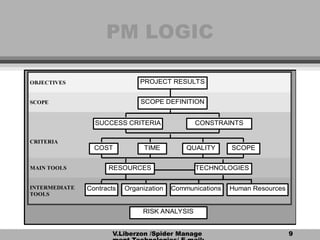
PM functions (knowledge areas) activated in
each of these processes vary significantly.
Description of PM ideology could not be
complete without including Resource
management as a core separate entity.
It is necessary to connect PMBOK™ with the
logic of PM processes.
The PM logic used in the majority of projects is
shown in the next slide.
V.Liberzon /Spider Manage 9
PM LOGIC
PM LOGIC
OBJECTIVES
SCOPE
CRITERIA
MAIN TOOLS
INTERMEDIATE
TOOLS
PROJECT RESULTS
SCOPE DEFINITION
SUCCESS CRITERIA CONSTRAINTS
COST TIME QUALITY SCOPE
RESOURCES TECHNOLOGIES
Contracts Organization Communications Human Resources
RISK ANALYSIS
V.Liberzon /Spider Manage 10
DIFFERENCE BETWEEN
DIFFERENCE BETWEEN
APPROACHES
APPROACHES
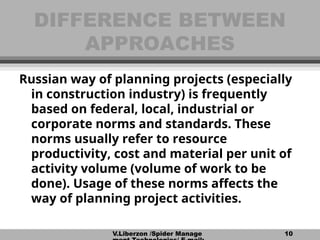
Russian way of planning projects (especially
in construction industry) is frequently
based on federal, local, industrial or
corporate norms and standards. These
norms usually refer to resource
productivity, cost and material per unit of
activity volume (volume of work to be
done). Usage of these norms affects the
way of planning project activities.
V.Liberzon /Spider Manage 11
DIFFERENCE BETWEEN
DIFFERENCE BETWEEN
APPROACHES
APPROACHES
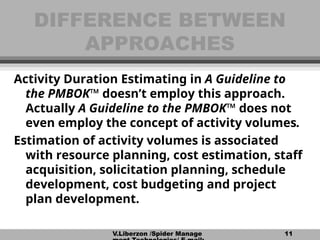
Activity Duration Estimating in A Guideline to
the PMBOK™ doesn’t employ this approach.
Actually A Guideline to the PMBOK™ does not
even employ the concept of activity volumes.
Estimation of activity volumes is associated
with resource planning, cost estimation, staff
acquisition, solicitation planning, schedule
development, cost budgeting and project
plan development.
V.Liberzon /Spider Manage 12
PROJECT SCHEDULE
PROJECT SCHEDULE
DEVELOPMENT
DEVELOPMENT
LIBRARY OF
TYPICAL PROJECT
FRAGNETS
DATABASE A:
ACTIVITY TYPES -
MATERIAL
REQUIREMENTS PER
UNIT OF VOLUME
DATABASE B:
ASSIGNMENT TYPES
- RESOURCE
PRODUCTIVITIES
DATABASE C:
ASSIGNMENT TYPES –
RESOURCE PERCENT
ALLOCATED
PROJECT
SCHEDULE
LIST OF PROJECT
FRAGNETS AND
ACTIVITIES
FRAGNET AND
ACTIVITY VOLUMES
OR DURATIONS
ACTIVITY LINKS
WBS ORGANIZATIONAL
BREAKDOWN
STRUCTURE
LIST AND QUANTITY
OF PROJECT
RESOURCES AND
MATERIALS
RESOURCE
ASSIGNMENTS
DATABASE D:
RESOURCE TYPES –
MATERIAL
REQUIREMENTS PER
WORK HOUR
DATABASE E:
ASSIGNMENT TYPES
- FIXED MATERIAL
REQUIREMENTS PER
UNIT OF VOLUME
FIXED
ACTIVITY
MATERIAL
REQUIREMENTS
FIXED
ASSIGNMENT
MATERIAL
REQUIREMENTS
V.Liberzon /Spider Manage 13
MAIN DIFFERENCE
MAIN DIFFERENCE
BETWEEN APPROACHES
BETWEEN APPROACHES
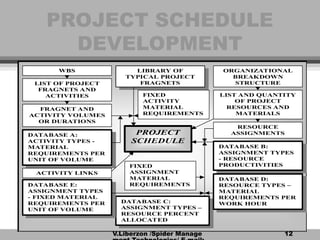
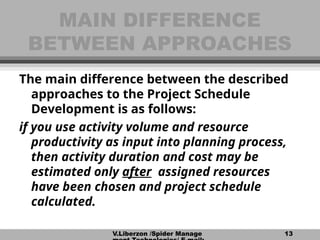
The main difference between the described
approaches to the Project Schedule
Development is as follows:
if you use activity volume and resource
productivity as input into planning process,
then activity duration and cost may be
estimated only after assigned resources
have been chosen and project schedule
calculated.
V.Liberzon /Spider Manage 14
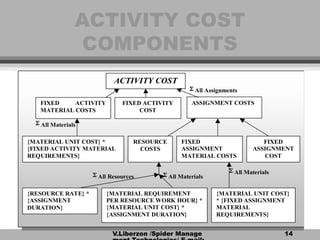
ACTIVITY COST
ACTIVITY COST
COMPONENTS
COMPONENTS
ACTIVITY COST
FIXED ACTIVITY
COST
ASSIGNMENT COSTS
FIXED
ASSIGNMENT
COST
RESOURCE
COSTS
FIXED
ASSIGNMENT
MATERIAL COSTS
{RESOURCE RATE} *
{ASSIGNMENT
DURATION}
{MATERIAL REQUIREMENT
PER RESOURCE WORK HOUR} *
{MATERIAL UNIT COST} *
{ASSIGNMENT DURATION}
 All Resources
{MATERIAL UNIT COST}
* {FIXED ASSIGNMENT
MATERIAL
REQUIREMENTS}
 All Materials
FIXED ACTIVITY
MATERIAL COSTS
{MATERIAL UNIT COST} *
{FIXED ACTIVITY MATERIAL
REQUIREMENTS}
 All Materials
 All Materials
 All Assignments
V.Liberzon /Spider Manage 15
RESOURCE ANALYSIS
RESOURCE ANALYSIS
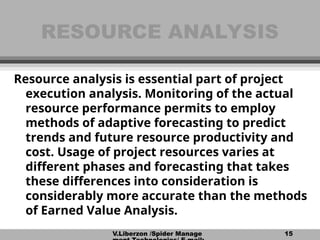
Resource analysis is essential part of project
execution analysis. Monitoring of the actual
resource performance permits to employ
methods of adaptive forecasting to predict
trends and future resource productivity and
cost. Usage of project resources varies at
different phases and forecasting that takes
these differences into consideration is
considerably more accurate than the methods
of Earned Value Analysis.
V.Liberzon /Spider Manage 16
RISK ANALYSIS
RISK ANALYSIS
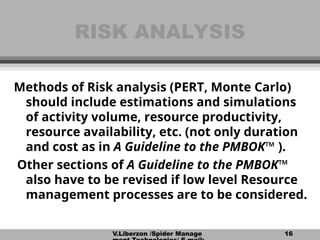
Methods of Risk analysis (PERT, Monte Carlo)
should include estimations and simulations
of activity volume, resource productivity,
resource availability, etc. (not only duration
and cost as in A Guideline to the PMBOK™ ).
Other sections of A Guideline to the PMBOK™
also have to be revised if low level Resource
management processes are to be considered.
V.Liberzon /Spider Manage 17
RECOMMENDATIONS
RECOMMENDATIONS
 Introduction of Resource management into
A Guideline to the PMBOK™ calls for revision
of ideological content and structure of the
latter.
 It is vital to understand that some project
parameters are indicative, while the others
are the tools for project control.
V.Liberzon /Spider Manage 18
RECOMMENDATIONS
RECOMMENDATIONS
 Analyzing project performance we measure
and analyze the indicative components for
making decisions on corrective moves, while
the project control tools are used for
improving project performance. It would be
helpful to divide Control processes into two
process groups - Analysis and Control.
V.Liberzon /Spider Manage 19
BENEFITS
BENEFITS
• Better understanding of PM logic and PM
processes.
• Establishing technological standards for
low level Project Management.
• Developing Project Management
Technological Guideline.

PROJECT MANAGEMENT LOGIC AND PMBOK STRUCTURE 2002.ppt

  • 1.
    PROJECT MANAGEMENT PROJECT MANAGEMENT LOGICAND PMBOK LOGIC AND PMBOK™ ™ STRUCTURE STRUCTURE Vladimir Liberzon Vladimir Liberzon Spider Management Technologies Spider Management Technologies Moscow PMI Chapter Moscow PMI Chapter E-mail: spider@mail.cnt.ru
  • 2.
    V.Liberzon /Spider Manage2 PMBOK PMBOK™ ™ STRUCTURE STRUCTURE People who lack sufficient practical experience in Project Management meet with difficulties when they try to get a clear picture of PM logic from A Guideline to the PMBOK™. Novice managers often try to divide responsibilities among PM team members in accordance with knowledge areas (Time manager, Cost manager, Quality manager, etc.).
  • 3.
    V.Liberzon /Spider Manage3 PMBOK PMBOK™ ™ STRUCTURE STRUCTURE Most PM knowledge areas are closely interrelated and can hardly be separated from each other. For instance, one cannot change project schedule without affecting project cost. Besides, it is impossible to control time or cost (success indicators) directly but only through resources or technologies.
  • 4.
    V.Liberzon /Spider Manage4 PMBOK PMBOK™ ™ STRUCTURE STRUCTURE Some of knowledge areas are project success indicators (scope, time, cost and quality), others are management tools (human resources, communications, risks, procurement). You can analyze time or cost performance and then make corrective moves using resources or technologies.
  • 5.
    V.Liberzon /Spider Manage5 PMBOK PMBOK™ ™ STRUCTURE STRUCTURE A Guideline to the PMBOK™ can be successfully applied to projects only at those levels where details are not important. But it does not provide enough fine tools for more precise practical project management for which the resource management is the core issue.
  • 6.
    V.Liberzon /Spider Manage6 PMBOK PMBOK™ ™ STRUCTURE STRUCTURE I believe that ideological content of A Guideline to the PMBOK™ can be reorganized in a more instructive, process-oriented way. I think that it is necessary to recognize six main PM processes instead of five described in a Guideline to the PMBOK™. The additional process is Analysis.
  • 7.
    V.Liberzon /Spider Manage7 PM PROCESSES PM PROCESSES PROJECT MANAGEMENT PROCESSES PLANNING ANALYSIS CONTROL INITIATION CLOSING EXECUTION
  • 8.
    V.Liberzon /Spider Manage8 PM KNOWLEDGE AREAS PM KNOWLEDGE AREAS & PM LOGIC & PM LOGIC PM functions (knowledge areas) activated in each of these processes vary significantly. Description of PM ideology could not be complete without including Resource management as a core separate entity. It is necessary to connect PMBOK™ with the logic of PM processes. The PM logic used in the majority of projects is shown in the next slide.
  • 9.
    V.Liberzon /Spider Manage9 PM LOGIC PM LOGIC OBJECTIVES SCOPE CRITERIA MAIN TOOLS INTERMEDIATE TOOLS PROJECT RESULTS SCOPE DEFINITION SUCCESS CRITERIA CONSTRAINTS COST TIME QUALITY SCOPE RESOURCES TECHNOLOGIES Contracts Organization Communications Human Resources RISK ANALYSIS
  • 10.
    V.Liberzon /Spider Manage10 DIFFERENCE BETWEEN DIFFERENCE BETWEEN APPROACHES APPROACHES Russian way of planning projects (especially in construction industry) is frequently based on federal, local, industrial or corporate norms and standards. These norms usually refer to resource productivity, cost and material per unit of activity volume (volume of work to be done). Usage of these norms affects the way of planning project activities.
  • 11.
    V.Liberzon /Spider Manage11 DIFFERENCE BETWEEN DIFFERENCE BETWEEN APPROACHES APPROACHES Activity Duration Estimating in A Guideline to the PMBOK™ doesn’t employ this approach. Actually A Guideline to the PMBOK™ does not even employ the concept of activity volumes. Estimation of activity volumes is associated with resource planning, cost estimation, staff acquisition, solicitation planning, schedule development, cost budgeting and project plan development.
  • 12.
    V.Liberzon /Spider Manage12 PROJECT SCHEDULE PROJECT SCHEDULE DEVELOPMENT DEVELOPMENT LIBRARY OF TYPICAL PROJECT FRAGNETS DATABASE A: ACTIVITY TYPES - MATERIAL REQUIREMENTS PER UNIT OF VOLUME DATABASE B: ASSIGNMENT TYPES - RESOURCE PRODUCTIVITIES DATABASE C: ASSIGNMENT TYPES – RESOURCE PERCENT ALLOCATED PROJECT SCHEDULE LIST OF PROJECT FRAGNETS AND ACTIVITIES FRAGNET AND ACTIVITY VOLUMES OR DURATIONS ACTIVITY LINKS WBS ORGANIZATIONAL BREAKDOWN STRUCTURE LIST AND QUANTITY OF PROJECT RESOURCES AND MATERIALS RESOURCE ASSIGNMENTS DATABASE D: RESOURCE TYPES – MATERIAL REQUIREMENTS PER WORK HOUR DATABASE E: ASSIGNMENT TYPES - FIXED MATERIAL REQUIREMENTS PER UNIT OF VOLUME FIXED ACTIVITY MATERIAL REQUIREMENTS FIXED ASSIGNMENT MATERIAL REQUIREMENTS
  • 13.
    V.Liberzon /Spider Manage13 MAIN DIFFERENCE MAIN DIFFERENCE BETWEEN APPROACHES BETWEEN APPROACHES The main difference between the described approaches to the Project Schedule Development is as follows: if you use activity volume and resource productivity as input into planning process, then activity duration and cost may be estimated only after assigned resources have been chosen and project schedule calculated.
  • 14.
    V.Liberzon /Spider Manage14 ACTIVITY COST ACTIVITY COST COMPONENTS COMPONENTS ACTIVITY COST FIXED ACTIVITY COST ASSIGNMENT COSTS FIXED ASSIGNMENT COST RESOURCE COSTS FIXED ASSIGNMENT MATERIAL COSTS {RESOURCE RATE} * {ASSIGNMENT DURATION} {MATERIAL REQUIREMENT PER RESOURCE WORK HOUR} * {MATERIAL UNIT COST} * {ASSIGNMENT DURATION}  All Resources {MATERIAL UNIT COST} * {FIXED ASSIGNMENT MATERIAL REQUIREMENTS}  All Materials FIXED ACTIVITY MATERIAL COSTS {MATERIAL UNIT COST} * {FIXED ACTIVITY MATERIAL REQUIREMENTS}  All Materials  All Materials  All Assignments
  • 15.
    V.Liberzon /Spider Manage15 RESOURCE ANALYSIS RESOURCE ANALYSIS Resource analysis is essential part of project execution analysis. Monitoring of the actual resource performance permits to employ methods of adaptive forecasting to predict trends and future resource productivity and cost. Usage of project resources varies at different phases and forecasting that takes these differences into consideration is considerably more accurate than the methods of Earned Value Analysis.
  • 16.
    V.Liberzon /Spider Manage16 RISK ANALYSIS RISK ANALYSIS Methods of Risk analysis (PERT, Monte Carlo) should include estimations and simulations of activity volume, resource productivity, resource availability, etc. (not only duration and cost as in A Guideline to the PMBOK™ ). Other sections of A Guideline to the PMBOK™ also have to be revised if low level Resource management processes are to be considered.
  • 17.
    V.Liberzon /Spider Manage17 RECOMMENDATIONS RECOMMENDATIONS  Introduction of Resource management into A Guideline to the PMBOK™ calls for revision of ideological content and structure of the latter.  It is vital to understand that some project parameters are indicative, while the others are the tools for project control.
  • 18.
    V.Liberzon /Spider Manage18 RECOMMENDATIONS RECOMMENDATIONS  Analyzing project performance we measure and analyze the indicative components for making decisions on corrective moves, while the project control tools are used for improving project performance. It would be helpful to divide Control processes into two process groups - Analysis and Control.
  • 19.
    V.Liberzon /Spider Manage19 BENEFITS BENEFITS • Better understanding of PM logic and PM processes. • Establishing technological standards for low level Project Management. • Developing Project Management Technological Guideline.