Project Management Life Cycle
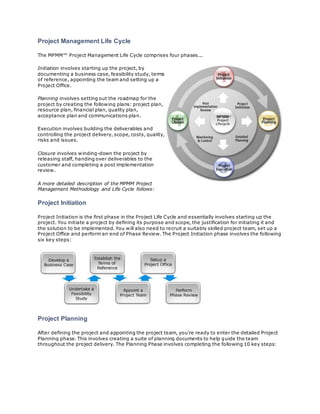
The MPMM™ Project Management Life Cycle comprises four phases...
Initiation involves starting up the project, by
documenting a business case, feasibility study, terms
of reference, appointing the team and setting up a
Project Office.
Planning involves setting out the roadmap for the
project by creating the following plans: project plan,
resource plan, financial plan, quality plan,
acceptance plan and communications plan.
Execution involves building the deliverables and
controlling the project delivery, scope, costs, quality,
risks and issues.
Closure involves winding-down the project by
releasing staff, handing over deliverables to the
customer and completing a post implementation
review.
A more detailed description of the MPMM Project
Management Methodology and Life Cycle follows:
Project Initiation
Project Initiation is the first phase in the Project Life Cycle and essentially involves starting up the
project. You initiate a project by defining its purpose and scope, the justification for initiating it and
the solution to be implemented. You will also need to recruit a suitably skilled project team, set up a
Project Office and perform an end of Phase Review. The Project Initiation phase involves the following
six key steps:
Project Planning
After defining the project and appointing the project team, you're ready to enter the detailed Project
Planning phase. This involves creating a suite of planning documents to help guide the team
throughout the project delivery. The Planning Phase involves completing the following 10 key steps:
Project Execution
With a clear definition of the project and a suite of
detailed project plans, you are now ready to enter
the Execution phase of the project.
This is the phase in which the deliverables are
physically built and presented to the customer for
acceptance.
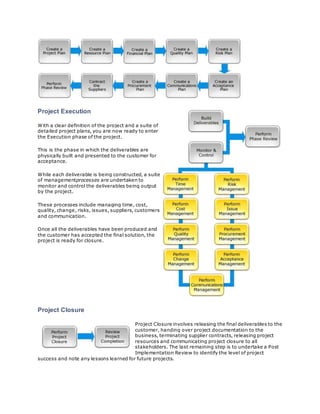
While each deliverable is being constructed, a suite
of managementprocesses are undertaken to
monitor and control the deliverables being output
by the project.
These processes include managing time, cost,
quality, change, risks, issues, suppliers, customers
and communication.
Once all the deliverables have been produced and
the customer has accepted the final solution, the
project is ready for closure.
Project Closure
Project Closure involves releasing the final deliverables to the
customer, handing over project documentation to the
business, terminating supplier contracts, releasing project
resources and communicating project closure to all
stakeholders. The last remaining step is to undertake a Post
Implementation Review to identify the level of project
success and note any lessons learned for future projects.

Project Management Life Cycle

  • 1.
    Project Management LifeCycle The MPMM™ Project Management Life Cycle comprises four phases... Initiation involves starting up the project, by documenting a business case, feasibility study, terms of reference, appointing the team and setting up a Project Office. Planning involves setting out the roadmap for the project by creating the following plans: project plan, resource plan, financial plan, quality plan, acceptance plan and communications plan. Execution involves building the deliverables and controlling the project delivery, scope, costs, quality, risks and issues. Closure involves winding-down the project by releasing staff, handing over deliverables to the customer and completing a post implementation review. A more detailed description of the MPMM Project Management Methodology and Life Cycle follows: Project Initiation Project Initiation is the first phase in the Project Life Cycle and essentially involves starting up the project. You initiate a project by defining its purpose and scope, the justification for initiating it and the solution to be implemented. You will also need to recruit a suitably skilled project team, set up a Project Office and perform an end of Phase Review. The Project Initiation phase involves the following six key steps: Project Planning After defining the project and appointing the project team, you're ready to enter the detailed Project Planning phase. This involves creating a suite of planning documents to help guide the team throughout the project delivery. The Planning Phase involves completing the following 10 key steps:
  • 2.
    Project Execution With aclear definition of the project and a suite of detailed project plans, you are now ready to enter the Execution phase of the project. This is the phase in which the deliverables are physically built and presented to the customer for acceptance. While each deliverable is being constructed, a suite of managementprocesses are undertaken to monitor and control the deliverables being output by the project. These processes include managing time, cost, quality, change, risks, issues, suppliers, customers and communication. Once all the deliverables have been produced and the customer has accepted the final solution, the project is ready for closure. Project Closure Project Closure involves releasing the final deliverables to the customer, handing over project documentation to the business, terminating supplier contracts, releasing project resources and communicating project closure to all stakeholders. The last remaining step is to undertake a Post Implementation Review to identify the level of project success and note any lessons learned for future projects.