: (647) 247-4810
: pmp@uloomtraining.com
 : www.uloomtraining.com
©Hamza Qazi
Project Management Professional (PMP)
Preparation course
Information Seminar
: (647) 247-4810
: pmp@uloomtraining.com
 : www.uloomtraining.com
©Hamza Qazi
Uloom Training
 We are industry professionals with a passion of teaching and sharing our
knowledge and experience with others. Our current team is:
◦ Mr. Hamza Qazi, Chief Instructor, Project Management, BA and IT
◦ Mr. Inam Rehman, Project Management & Business Analysis Instructor
◦ Mr. Alan Martin, Project Management and Business Analysis Instructor
 Major courses we teach:
◦ PMI’s PMP/ CAPM preparation course
◦ PMP/ CAPM Drill-and-Practice course
◦ Scrum Master Certification Prep course
◦ MS Project 2010/2013 hands-on course
◦ MS Excel 2010 Essentials and Advanced
◦ Various PDU courses
 Why you should choose us for your training needs?
1. Complete hands-on training, exercises, practice questions, tips and guidelines
2. Complete support until you pass the certification exam
3. Special weekend classes for busy adults and working professionals
4. Small class size for individual attention
5. Mock Job Interview and Job Search tips
Project Life Cycle & Integration 2
: (647) 247-4810
: pmp@uloomtraining.com
 : www.uloomtraining.com
©Hamza Qazi
Introductions
 Hamza Qazi, MBA, PMP, CSM, SCT, ITIL Foundation
◦ 25 years of IT experience including 12 years of management
◦ Bachelors in Computer Science and MBA from York University
◦ PMP certified project manager with over 8 years experience
◦ Scrum Master certification from Scrum Alliance
◦ Scrum Certified Trainer from ScrumStudy
◦ ITIL v3 Foundation certified
◦ Over 5 years of formal training experience at Uloom and Colleges
◦ Cell (647) 247-4810
◦ pmp@uloomtraining.com
Students Introduction
◦ Name
◦ Background (Industry, Current Job)
◦ Why interested in today’s event
Project Life Cycle & Integration 3
: (647) 247-4810
: pmp@uloomtraining.com
 : www.uloomtraining.com
©Hamza Qazi
Agenda
 Project Management Roles & Certifications
 Introduction to Project Management
 Next Steps
Project Life Cycle & Integration 4
: (647) 247-4810
: pmp@uloomtraining.com
 : www.uloomtraining.com
©Hamza Qazi
Part I
Roles and Certifications
in
Project Management
Project Life Cycle & Integration 5
: (647) 247-4810
: pmp@uloomtraining.com
 : www.uloomtraining.com
©Hamza Qazi
Project Life Cycle & Integration 6
Project Management Roles
 The following are formal roles performed by beginners in the field
of project management:
◦ Project Coordinator/Assistant
◦ Beginner Project Manager
 Experienced project management professionals perform the
following roles:
◦ Project Manager
◦ Senior Project Manager
◦ Program Manager
◦ Project Management Consultant
 The above roles require project management knowledge gained
through formal courses and certifications
: (647) 247-4810
: pmp@uloomtraining.com
 : www.uloomtraining.com
©Hamza Qazi
Project Life Cycle & Integration 7
Project Manager
 Responsible for applying project management knowledge, skills, tools and
techniques in order to produce project deliverables and meet its
objectives.
 Major Responsibilities:
◦ Define project goals, charter, objectives, scope, deliverables and success criteria.
◦ Develop both high and detailed-level plans: scope, schedule, and budget.
◦ Monitor and control project through issues, risks, time and budget management.
◦ Manage and report on project constraints: scope, time, cost, quality & resources.
◦ Manage project changes through formal change and stakeholder management.
 Qualifications:
◦ Business or technical education
◦ Project management experience
◦ Knowledge of project management processes, tools and techniques
◦ Intermediate knowledge of MS Office and MS Project
◦ PMP certified or working towards PMP
: (647) 247-4810
: pmp@uloomtraining.com
 : www.uloomtraining.com
©Hamza Qazi
Project Life Cycle & Integration 8
Project Coordinator/Assistant
 Responsible for coordinating project management activities from
inception to closure. Act as an assistant to project or program
manager.
 Major Responsibilities:
1. Assist in preparation of project management deliverables including project
scope, charter, WBS, schedule, budget, etc.
2. Track and analyze time records, project expenses, and project financials.
3. Assist with preparation of project reports including status and financial reports.
4. Identifies project problems / issues and escalates as appropriate.
5. Create change records and obtain approvals from various stakeholders.
 Qualifications:
◦ Business or technical related diploma
◦ Experience or Knowledge of project management processes and tools
◦ Good written and oral communication skills
◦ Working knowledge of MS Office and MS Project
◦ CAPM certified or working towards CAPM certification
: (647) 247-4810
: pmp@uloomtraining.com
 : www.uloomtraining.com
©Hamza Qazi
Project Life Cycle & Integration 9
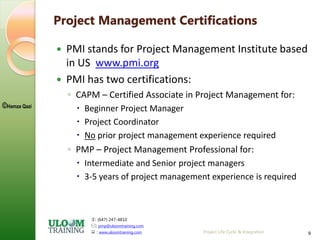
Project Management Certifications
 PMI stands for Project Management Institute based
in US www.pmi.org
 PMI has two certifications:
◦ CAPM – Certified Associate in Project Management for:
 Beginner Project Manager
 Project Coordinator
 No prior project management experience required
◦ PMP – Project Management Professional for:
 Intermediate and Senior project managers
 3-5 years of project management experience is required
: (647) 247-4810
: pmp@uloomtraining.com
 : www.uloomtraining.com
©Hamza Qazi
Project Life Cycle & Integration 10
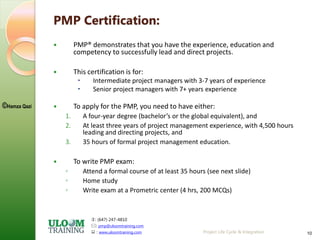
PMP Certification:
 PMP® demonstrates that you have the experience, education and
competency to successfully lead and direct projects.
 This certification is for:
 Intermediate project managers with 3-7 years of experience
 Senior project managers with 7+ years experience
 To apply for the PMP, you need to have either:
1. A four-year degree (bachelor’s or the global equivalent), and
2. At least three years of project management experience, with 4,500 hours
leading and directing projects, and
3. 35 hours of formal project management education.
 To write PMP exam:
◦ Attend a formal course of at least 35 hours (see next slide)
◦ Home study
◦ Write exam at a Prometric center (4 hrs, 200 MCQs)
: (647) 247-4810
: pmp@uloomtraining.com
 : www.uloomtraining.com
©Hamza Qazi
Project Life Cycle & Integration 11
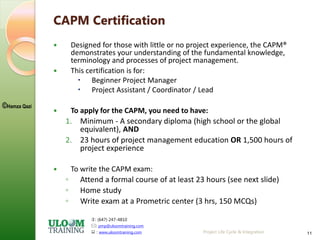
CAPM Certification
 Designed for those with little or no project experience, the CAPM®
demonstrates your understanding of the fundamental knowledge,
terminology and processes of project management.
 This certification is for:
 Beginner Project Manager
 Project Assistant / Coordinator / Lead
 To apply for the CAPM, you need to have:
1. Minimum - A secondary diploma (high school or the global
equivalent), AND
2. 23 hours of project management education OR 1,500 hours of
project experience
 To write the CAPM exam:
◦ Attend a formal course of at least 23 hours (see next slide)
◦ Home study
◦ Write exam at a Prometric center (3 hrs, 150 MCQs)
: (647) 247-4810
: pmp@uloomtraining.com
 : www.uloomtraining.com
©Hamza Qazi
Project Life Cycle & Integration 12
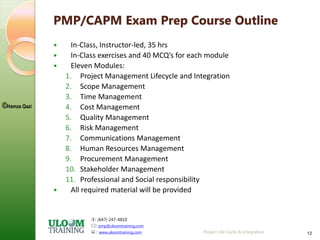
PMP/CAPM Exam Prep Course Outline
 In-Class, Instructor-led, 35 hrs
 In-Class exercises and 40 MCQ’s for each module
 Eleven Modules:
1. Project Management Lifecycle and Integration
2. Scope Management
3. Time Management
4. Cost Management
5. Quality Management
6. Risk Management
7. Communications Management
8. Human Resources Management
9. Procurement Management
10. Stakeholder Management
11. Professional and Social responsibility
 All required material will be provided
: (647) 247-4810
: pmp@uloomtraining.com
 : www.uloomtraining.com
©Hamza Qazi Part II
Project Management
Introduction
Project Life Cycle & Integration 13
: (647) 247-4810
: pmp@uloomtraining.com
 : www.uloomtraining.com
©Hamza Qazi
14
What is a Project?
 A project is a temporary initiative undertaken to create a unique
product, service or result
 Temporary does not mean short-term. It means a definite
beginning and end. The end is reached when the project has met
its objectives or when the project is terminated since its objectives
cannot be met or when the need for project no longer exists
 Unique means that the project product, service or result has some
distinguishing features different from others
 A project can create:
◦ A product than can either be a component or an end item
◦ A service or capability to perform a service
◦ A result such as an outcome or document, e.g. research results
[PMBOK 5th Ed. P/3]
Project Life Cycle & Integration
: (647) 247-4810
: pmp@uloomtraining.com
 : www.uloomtraining.com
©Hamza Qazi
15
Examples of Projects
 A young couple hires a firm to design and build them a new house.
 A retail store manager works with employees to display a new
clothing line.
 A college campus upgrades its technology infrastructure to provide
wireless Internet access.
 A construction company designs and constructs a new office
building for a client.
 A school implements new government standards for tracking
student achievement.
Project Life Cycle & Integration
: (647) 247-4810
: pmp@uloomtraining.com
 : www.uloomtraining.com
©Hamza Qazi
Project Life Cycle & Integration 16
Project Management
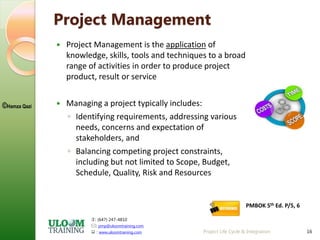
 Project Management is the application of
knowledge, skills, tools and techniques to a broad
range of activities in order to produce project
product, result or service
 Managing a project typically includes:
◦ Identifying requirements, addressing various
needs, concerns and expectation of
stakeholders, and
◦ Balancing competing project constraints,
including but not limited to Scope, Budget,
Schedule, Quality, Risk and Resources
PMBOK 5th Ed. P/5, 6
: (647) 247-4810
: pmp@uloomtraining.com
 : www.uloomtraining.com
©Hamza Qazi
17
A Project Manager (PM)
 Is the person assigned by the performing organization to achieve
project objectives
 May report to a Functional Manager, Program, Portfolio Manager or
PMO
 Possesses project management knowledge and employs many of the
tools and techniques of project management to achieve project
objectives
 Utilizes soft skills such as effective communication, influence without
authority, negotiation, conflict resolution, etc.
 Provides leadership including vision, clear direction, focus, energy,
motivation, guidance and support to team members
 Utilizes management skills including supervision, administration,
resource provision, performance assessment, issues resolution, etc.
 Applies project management skills including scope management,
budget, schedule, quality, risk, procurement and stakeholder
management
Project Life Cycle & Integration
PMBOK 5th Ed. P/16-18
: (647) 247-4810
: pmp@uloomtraining.com
 : www.uloomtraining.com
©Hamza Qazi
Project Life Cycle & Integration 18
Program Management
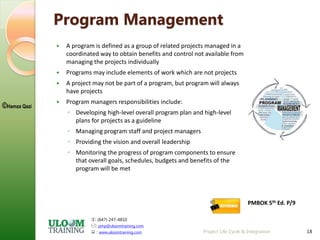
 A program is defined as a group of related projects managed in a
coordinated way to obtain benefits and control not available from
managing the projects individually
 Programs may include elements of work which are not projects
 A project may not be part of a program, but program will always
have projects
 Program managers responsibilities include:
◦ Developing high-level overall program plan and high-level
plans for projects as a guideline
◦ Managing program staff and project managers
◦ Providing the vision and overall leadership
◦ Monitoring the progress of program components to ensure
that overall goals, schedules, budgets and benefits of the
program will be met
PMBOK 5th Ed. P/9
: (647) 247-4810
: pmp@uloomtraining.com
 : www.uloomtraining.com
©Hamza Qazi
19
Portfolio Management
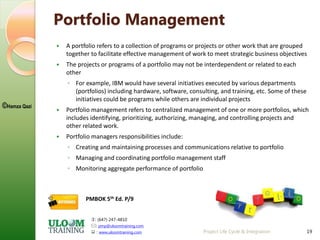
 A portfolio refers to a collection of programs or projects or other work that are grouped
together to facilitate effective management of work to meet strategic business objectives
 The projects or programs of a portfolio may not be interdependent or related to each
other
◦ For example, IBM would have several initiatives executed by various departments
(portfolios) including hardware, software, consulting, and training, etc. Some of these
initiatives could be programs while others are individual projects
 Portfolio management refers to centralized management of one or more portfolios, which
includes identifying, prioritizing, authorizing, managing, and controlling projects and
other related work.
 Portfolio managers responsibilities include:
◦ Creating and maintaining processes and communications relative to portfolio
◦ Managing and coordinating portfolio management staff
◦ Monitoring aggregate performance of portfolio
Project Life Cycle & Integration
PMBOK 5th Ed. P/9
: (647) 247-4810
: pmp@uloomtraining.com
 : www.uloomtraining.com
©Hamza Qazi
Project Life Cycle & Integration 20
Project Management Office (PMO)
 Is an organized body or entity that is assigned various responsibilities
related to coordinated management of unrelated projects under its
domain
 A primary function of PMO is to support project managers, including:
◦ Identifying and developing project management methodology, best
practices, standards and tools
◦ Coaching, mentoring, training and oversight
◦ Developing and managing project policies, procedures, templates, and
other shared documentation
◦ Monitoring compliance with project management standards, policies,
and procedures
◦ Coordinating communication among projects
PMBOK 5th Ed. P/10-12
: (647) 247-4810
: pmp@uloomtraining.com
 : www.uloomtraining.com
©Hamza Qazi
21
PMBOK
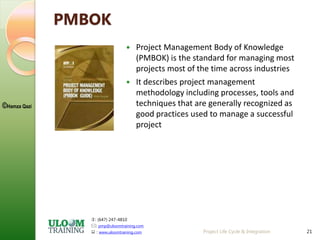
 Project Management Body of Knowledge
(PMBOK) is the standard for managing most
projects most of the time across industries
 It describes project management
methodology including processes, tools and
techniques that are generally recognized as
good practices used to manage a successful
project
Project Life Cycle & Integration
: (647) 247-4810
: pmp@uloomtraining.com
 : www.uloomtraining.com
©Hamza Qazi
22
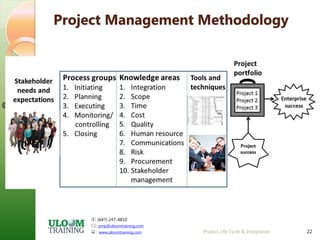
Project Management Methodology
Project Life Cycle & Integration
: (647) 247-4810
: pmp@uloomtraining.com
 : www.uloomtraining.com
©Hamza Qazi
Project Life Cycle & Integration 23
Next Steps:
 Interested in full course:
◦ Option 1: Weekend PMP/CAPM course
 5 Saturdays: June 3, 10, 17, 24, July 1
 5 Sundays: June 4, 11, 18, 25 and July 2
◦ Option 2: Weekdays PMP/CAPM course
 Schedule: TBD
: (647) 247-4810
: pmp@uloomtraining.com
 : www.uloomtraining.com
©Hamza Qazi
Project Life Cycle & Integration 24
PMP/CAPM Prep course outline
 In-Class, Instructor-led, 35 hrs
 In-Class exercises and 40 MCQ’s for each module
 Eleven Modules:
1. Project Management Lifecycle and Integration
2. Scope Management
3. Time Management
4. Cost Management
5. Quality Management
6. Risk Management
7. Communications Management
8. Human Resources Management
9. Procurement Management
10. Stakeholder Management
11. Professional and Social responsibility
 Discounted Fee: $1125 (10% off regular fee of $1250)
 All required material will be provided
: (647) 247-4810
: pmp@uloomtraining.com
 : www.uloomtraining.com
©Hamza Qazi
Questions
Project Quality Management 25

Project Management Career and Information

  • 1.
    : (647) 247-4810 :pmp@uloomtraining.com  : www.uloomtraining.com ©Hamza Qazi Project Management Professional (PMP) Preparation course Information Seminar
  • 2.
    : (647) 247-4810 :pmp@uloomtraining.com  : www.uloomtraining.com ©Hamza Qazi Uloom Training  We are industry professionals with a passion of teaching and sharing our knowledge and experience with others. Our current team is: ◦ Mr. Hamza Qazi, Chief Instructor, Project Management, BA and IT ◦ Mr. Inam Rehman, Project Management & Business Analysis Instructor ◦ Mr. Alan Martin, Project Management and Business Analysis Instructor  Major courses we teach: ◦ PMI’s PMP/ CAPM preparation course ◦ PMP/ CAPM Drill-and-Practice course ◦ Scrum Master Certification Prep course ◦ MS Project 2010/2013 hands-on course ◦ MS Excel 2010 Essentials and Advanced ◦ Various PDU courses  Why you should choose us for your training needs? 1. Complete hands-on training, exercises, practice questions, tips and guidelines 2. Complete support until you pass the certification exam 3. Special weekend classes for busy adults and working professionals 4. Small class size for individual attention 5. Mock Job Interview and Job Search tips Project Life Cycle & Integration 2
  • 3.
    : (647) 247-4810 :pmp@uloomtraining.com  : www.uloomtraining.com ©Hamza Qazi Introductions  Hamza Qazi, MBA, PMP, CSM, SCT, ITIL Foundation ◦ 25 years of IT experience including 12 years of management ◦ Bachelors in Computer Science and MBA from York University ◦ PMP certified project manager with over 8 years experience ◦ Scrum Master certification from Scrum Alliance ◦ Scrum Certified Trainer from ScrumStudy ◦ ITIL v3 Foundation certified ◦ Over 5 years of formal training experience at Uloom and Colleges ◦ Cell (647) 247-4810 ◦ pmp@uloomtraining.com Students Introduction ◦ Name ◦ Background (Industry, Current Job) ◦ Why interested in today’s event Project Life Cycle & Integration 3
  • 4.
    : (647) 247-4810 :pmp@uloomtraining.com  : www.uloomtraining.com ©Hamza Qazi Agenda  Project Management Roles & Certifications  Introduction to Project Management  Next Steps Project Life Cycle & Integration 4
  • 5.
    : (647) 247-4810 :pmp@uloomtraining.com  : www.uloomtraining.com ©Hamza Qazi Part I Roles and Certifications in Project Management Project Life Cycle & Integration 5
  • 6.
    : (647) 247-4810 :pmp@uloomtraining.com  : www.uloomtraining.com ©Hamza Qazi Project Life Cycle & Integration 6 Project Management Roles  The following are formal roles performed by beginners in the field of project management: ◦ Project Coordinator/Assistant ◦ Beginner Project Manager  Experienced project management professionals perform the following roles: ◦ Project Manager ◦ Senior Project Manager ◦ Program Manager ◦ Project Management Consultant  The above roles require project management knowledge gained through formal courses and certifications
  • 7.
    : (647) 247-4810 :pmp@uloomtraining.com  : www.uloomtraining.com ©Hamza Qazi Project Life Cycle & Integration 7 Project Manager  Responsible for applying project management knowledge, skills, tools and techniques in order to produce project deliverables and meet its objectives.  Major Responsibilities: ◦ Define project goals, charter, objectives, scope, deliverables and success criteria. ◦ Develop both high and detailed-level plans: scope, schedule, and budget. ◦ Monitor and control project through issues, risks, time and budget management. ◦ Manage and report on project constraints: scope, time, cost, quality & resources. ◦ Manage project changes through formal change and stakeholder management.  Qualifications: ◦ Business or technical education ◦ Project management experience ◦ Knowledge of project management processes, tools and techniques ◦ Intermediate knowledge of MS Office and MS Project ◦ PMP certified or working towards PMP
  • 8.
    : (647) 247-4810 :pmp@uloomtraining.com  : www.uloomtraining.com ©Hamza Qazi Project Life Cycle & Integration 8 Project Coordinator/Assistant  Responsible for coordinating project management activities from inception to closure. Act as an assistant to project or program manager.  Major Responsibilities: 1. Assist in preparation of project management deliverables including project scope, charter, WBS, schedule, budget, etc. 2. Track and analyze time records, project expenses, and project financials. 3. Assist with preparation of project reports including status and financial reports. 4. Identifies project problems / issues and escalates as appropriate. 5. Create change records and obtain approvals from various stakeholders.  Qualifications: ◦ Business or technical related diploma ◦ Experience or Knowledge of project management processes and tools ◦ Good written and oral communication skills ◦ Working knowledge of MS Office and MS Project ◦ CAPM certified or working towards CAPM certification
  • 9.
    : (647) 247-4810 :pmp@uloomtraining.com  : www.uloomtraining.com ©Hamza Qazi Project Life Cycle & Integration 9 Project Management Certifications  PMI stands for Project Management Institute based in US www.pmi.org  PMI has two certifications: ◦ CAPM – Certified Associate in Project Management for:  Beginner Project Manager  Project Coordinator  No prior project management experience required ◦ PMP – Project Management Professional for:  Intermediate and Senior project managers  3-5 years of project management experience is required
  • 10.
    : (647) 247-4810 :pmp@uloomtraining.com  : www.uloomtraining.com ©Hamza Qazi Project Life Cycle & Integration 10 PMP Certification:  PMP® demonstrates that you have the experience, education and competency to successfully lead and direct projects.  This certification is for:  Intermediate project managers with 3-7 years of experience  Senior project managers with 7+ years experience  To apply for the PMP, you need to have either: 1. A four-year degree (bachelor’s or the global equivalent), and 2. At least three years of project management experience, with 4,500 hours leading and directing projects, and 3. 35 hours of formal project management education.  To write PMP exam: ◦ Attend a formal course of at least 35 hours (see next slide) ◦ Home study ◦ Write exam at a Prometric center (4 hrs, 200 MCQs)
  • 11.
    : (647) 247-4810 :pmp@uloomtraining.com  : www.uloomtraining.com ©Hamza Qazi Project Life Cycle & Integration 11 CAPM Certification  Designed for those with little or no project experience, the CAPM® demonstrates your understanding of the fundamental knowledge, terminology and processes of project management.  This certification is for:  Beginner Project Manager  Project Assistant / Coordinator / Lead  To apply for the CAPM, you need to have: 1. Minimum - A secondary diploma (high school or the global equivalent), AND 2. 23 hours of project management education OR 1,500 hours of project experience  To write the CAPM exam: ◦ Attend a formal course of at least 23 hours (see next slide) ◦ Home study ◦ Write exam at a Prometric center (3 hrs, 150 MCQs)
  • 12.
    : (647) 247-4810 :pmp@uloomtraining.com  : www.uloomtraining.com ©Hamza Qazi Project Life Cycle & Integration 12 PMP/CAPM Exam Prep Course Outline  In-Class, Instructor-led, 35 hrs  In-Class exercises and 40 MCQ’s for each module  Eleven Modules: 1. Project Management Lifecycle and Integration 2. Scope Management 3. Time Management 4. Cost Management 5. Quality Management 6. Risk Management 7. Communications Management 8. Human Resources Management 9. Procurement Management 10. Stakeholder Management 11. Professional and Social responsibility  All required material will be provided
  • 13.
    : (647) 247-4810 :pmp@uloomtraining.com  : www.uloomtraining.com ©Hamza Qazi Part II Project Management Introduction Project Life Cycle & Integration 13
  • 14.
    : (647) 247-4810 :pmp@uloomtraining.com  : www.uloomtraining.com ©Hamza Qazi 14 What is a Project?  A project is a temporary initiative undertaken to create a unique product, service or result  Temporary does not mean short-term. It means a definite beginning and end. The end is reached when the project has met its objectives or when the project is terminated since its objectives cannot be met or when the need for project no longer exists  Unique means that the project product, service or result has some distinguishing features different from others  A project can create: ◦ A product than can either be a component or an end item ◦ A service or capability to perform a service ◦ A result such as an outcome or document, e.g. research results [PMBOK 5th Ed. P/3] Project Life Cycle & Integration
  • 15.
    : (647) 247-4810 :pmp@uloomtraining.com  : www.uloomtraining.com ©Hamza Qazi 15 Examples of Projects  A young couple hires a firm to design and build them a new house.  A retail store manager works with employees to display a new clothing line.  A college campus upgrades its technology infrastructure to provide wireless Internet access.  A construction company designs and constructs a new office building for a client.  A school implements new government standards for tracking student achievement. Project Life Cycle & Integration
  • 16.
    : (647) 247-4810 :pmp@uloomtraining.com  : www.uloomtraining.com ©Hamza Qazi Project Life Cycle & Integration 16 Project Management  Project Management is the application of knowledge, skills, tools and techniques to a broad range of activities in order to produce project product, result or service  Managing a project typically includes: ◦ Identifying requirements, addressing various needs, concerns and expectation of stakeholders, and ◦ Balancing competing project constraints, including but not limited to Scope, Budget, Schedule, Quality, Risk and Resources PMBOK 5th Ed. P/5, 6
  • 17.
    : (647) 247-4810 :pmp@uloomtraining.com  : www.uloomtraining.com ©Hamza Qazi 17 A Project Manager (PM)  Is the person assigned by the performing organization to achieve project objectives  May report to a Functional Manager, Program, Portfolio Manager or PMO  Possesses project management knowledge and employs many of the tools and techniques of project management to achieve project objectives  Utilizes soft skills such as effective communication, influence without authority, negotiation, conflict resolution, etc.  Provides leadership including vision, clear direction, focus, energy, motivation, guidance and support to team members  Utilizes management skills including supervision, administration, resource provision, performance assessment, issues resolution, etc.  Applies project management skills including scope management, budget, schedule, quality, risk, procurement and stakeholder management Project Life Cycle & Integration PMBOK 5th Ed. P/16-18
  • 18.
    : (647) 247-4810 :pmp@uloomtraining.com  : www.uloomtraining.com ©Hamza Qazi Project Life Cycle & Integration 18 Program Management  A program is defined as a group of related projects managed in a coordinated way to obtain benefits and control not available from managing the projects individually  Programs may include elements of work which are not projects  A project may not be part of a program, but program will always have projects  Program managers responsibilities include: ◦ Developing high-level overall program plan and high-level plans for projects as a guideline ◦ Managing program staff and project managers ◦ Providing the vision and overall leadership ◦ Monitoring the progress of program components to ensure that overall goals, schedules, budgets and benefits of the program will be met PMBOK 5th Ed. P/9
  • 19.
    : (647) 247-4810 :pmp@uloomtraining.com  : www.uloomtraining.com ©Hamza Qazi 19 Portfolio Management  A portfolio refers to a collection of programs or projects or other work that are grouped together to facilitate effective management of work to meet strategic business objectives  The projects or programs of a portfolio may not be interdependent or related to each other ◦ For example, IBM would have several initiatives executed by various departments (portfolios) including hardware, software, consulting, and training, etc. Some of these initiatives could be programs while others are individual projects  Portfolio management refers to centralized management of one or more portfolios, which includes identifying, prioritizing, authorizing, managing, and controlling projects and other related work.  Portfolio managers responsibilities include: ◦ Creating and maintaining processes and communications relative to portfolio ◦ Managing and coordinating portfolio management staff ◦ Monitoring aggregate performance of portfolio Project Life Cycle & Integration PMBOK 5th Ed. P/9
  • 20.
    : (647) 247-4810 :pmp@uloomtraining.com  : www.uloomtraining.com ©Hamza Qazi Project Life Cycle & Integration 20 Project Management Office (PMO)  Is an organized body or entity that is assigned various responsibilities related to coordinated management of unrelated projects under its domain  A primary function of PMO is to support project managers, including: ◦ Identifying and developing project management methodology, best practices, standards and tools ◦ Coaching, mentoring, training and oversight ◦ Developing and managing project policies, procedures, templates, and other shared documentation ◦ Monitoring compliance with project management standards, policies, and procedures ◦ Coordinating communication among projects PMBOK 5th Ed. P/10-12
  • 21.
    : (647) 247-4810 :pmp@uloomtraining.com  : www.uloomtraining.com ©Hamza Qazi 21 PMBOK  Project Management Body of Knowledge (PMBOK) is the standard for managing most projects most of the time across industries  It describes project management methodology including processes, tools and techniques that are generally recognized as good practices used to manage a successful project Project Life Cycle & Integration
  • 22.
    : (647) 247-4810 :pmp@uloomtraining.com  : www.uloomtraining.com ©Hamza Qazi 22 Project Management Methodology Project Life Cycle & Integration
  • 23.
    : (647) 247-4810 :pmp@uloomtraining.com  : www.uloomtraining.com ©Hamza Qazi Project Life Cycle & Integration 23 Next Steps:  Interested in full course: ◦ Option 1: Weekend PMP/CAPM course  5 Saturdays: June 3, 10, 17, 24, July 1  5 Sundays: June 4, 11, 18, 25 and July 2 ◦ Option 2: Weekdays PMP/CAPM course  Schedule: TBD
  • 24.
    : (647) 247-4810 :pmp@uloomtraining.com  : www.uloomtraining.com ©Hamza Qazi Project Life Cycle & Integration 24 PMP/CAPM Prep course outline  In-Class, Instructor-led, 35 hrs  In-Class exercises and 40 MCQ’s for each module  Eleven Modules: 1. Project Management Lifecycle and Integration 2. Scope Management 3. Time Management 4. Cost Management 5. Quality Management 6. Risk Management 7. Communications Management 8. Human Resources Management 9. Procurement Management 10. Stakeholder Management 11. Professional and Social responsibility  Discounted Fee: $1125 (10% off regular fee of $1250)  All required material will be provided
  • 25.
    : (647) 247-4810 :pmp@uloomtraining.com  : www.uloomtraining.com ©Hamza Qazi Questions Project Quality Management 25