Get Trained….!     Get Certified….!

Ravi Jangra
Business Strategist
Multisoft Systems
ravi@multisoft-pmp.com
PMP® Certification
  & Beyond…!
Agenda
•   Introduction
•   PMI’s Certification Program Mission
•   PMI History/Information
•   Value of Certification
•   Certification Types
•   Requirements for Certifications
•   Process for Certifications
•   Beyond Certifications
PMI’s Certification Program Mission
Mission

    • Initiate, establish, evaluate, maintain, and administer professional credentialing
      programs to promote and support project management practitioners and the
      project management profession.
Goals

    • Establish, implement and maintain global certification standards, policies and
      procedures for the PM profession
    • Promote and implement professional credentialing and psychometric methods
      and procedures for certifications in the PM profession
    • Initiate and foster cooperation and collaboration with other project management
      organizations to promote and sustain excellence in PM standards and
      methodology
PMI History
• Began in 1969 – 35 years old.

• PMP began in 1984 – 20 years old.

• PMI is acknowledged as a pioneer in the field

• Membership represents a truly global community with over 100,000 professionals
  representing 125 countries.

• Currently, 75,000 PMPs have been certified

• PMI professionals come from virtually every major industry
Value of PM Certification
• Prestige of being the best in the field of PM.
• Professional advantages derived from attaining the Project Management Professional
  (PMP) status.
• Informs current and potential employers that you have a solid foundation of project
  management knowledge that can be readily applied in any workplace.
• PMP certification is the profession’s most globally recognized and respected
  certification credential.
• Finding individuals with this broad range of expertise is challenging, which is why
  expert project management leadership is a highly desirable competency.
Types of Certification
•   Certified Associate in Project Management (CAPM)
•   Project Management Professional (PMP)
•   Masters Certificate in Project Management
•   Masters Degree in Project Management
Why CAPM
• The purpose and goal of which is the development, maintenance, evaluation,
  promotion, and administration of a rigorous, examination‐based, professional
  certification credential – the Certified Associate in Project Management (CAPM™).
• Assisting in evaluating project control plans
• Suggesting performance indicators and limits
• Assisting with refining project requirements, assumptions, and constraints
• Supporting administrative and financial closure
• To be acknowledged for project management skills and contributions and elevate
  professional status.
Definition of  CAPM
• A CAPM is a project management practitioner who has demonstrated fundamental
  project management knowledge and experience by supporting projects using project
  management tools, techniques, and methodologies.

• While participating as a member of a project team the CAPM typically relies on
  experienced project management practitioners for guidance, direction, and approval.
Requirements of  CAPM
• Category 1 Candidate
   • Education – Baccalaureate or global equivalent university degree
   • PM Hours
        • 1500 hours PM experience within 5 years
        • Project dates must represent at least 2 years of non‐overlapping PM
           experience within the 3 yr period prior to the application
        • 23 contact hrs of PM education across the 9 areas of the PMBOK
   • Supporting documentation: Education, PM contact education hours, CAPM
      experience form (Audit Purposes)
Requirements of  CAPM – Cont.
• Category 2 Candidate
   • Education – High School diploma or secondary school equivalent
   • PM Hours
        • 2500 hours PM experience within 5 years
        • Project dates must represent at least 2 years of non‐overlapping PM
           experience within the 3 yr period prior to the application
        • 23 contact hrs of PM education across the 9 areas of the PMBOK
   • Supporting documentation: Education, PM contact education hours, CAPM
      experience form (Audit Purposes)
Process of  CAPM Certification
• Prepare/study for examination
• Complete application and submit
• Cost
    • $225 PMI Member
    • $300 Non‐PMI Member
• Candidates have one year from submittal to complete examination
• CAPMs must retest every 5 years to maintain certification
CAPM Test Format
• The CAPM Certification Examination is computer based and is comprised of 150
  multiple‐choice questions.
• Exam must be completed within 3 hours.
• Preceded by a briefing and 15‐minute computer tutorial and followed by an optional
  candidate satisfaction survey and exam survey report
Suggested CAPM Study Material
• Certified Associate in Project Management (CAPM) Role Delineation Study (PMI)
• Project Management: A Managerial Approach, 4th Edition by Jack Meredith and
  Samuel Mantel John (Wiley & Sons)
• The Fast Forward MBA in Project Management by Eric Verzuh (John Wiley & Sons)
• The New Project Management by J. Davidson Frame (Jossey‐Bass)
• The Project Management Institute Professional Code of Conduct (PMI)
• A Guide to the Project Management Body of Knowledge (PMBOK® Guide), 2000
  Edition by the Project Management Institute (paper back)
• Other readings exist – consult CAPM Handbook
Why PMP
• The purpose and goal is the development, maintenance, evaluation, promotion, and
  administration of a rigorous, examination‐based, professional certification credential
  of the highest caliper – the Project Management Professional (PMP).
• The PMP is by far the project management credential of choice across a vast array of
  industries and companies.
• PMPs are included in the largest and most prestigious group of certified professionals
  in the project management community
• To be acknowledged for project management skills and contributions and elevate
  professional status.
Requirements for PMP
•   Category 1 Candidate
     • Education – Baccalaureate or global equivalent university degree
     • PM Hours
         • 4500 hours PM experience.
         • Project dates must indicate that the candidate has at least 3 yrs of non‐
             overlapping PM experience within the 6 yr period prior to the application.
         • At least 36 unique months of non‐overlapping PM experience to satisfy the 3
             yr requirement
         • 35 contact hrs of PM education across the 9 areas of the PMBOK (regardless
             of when accrued)
     • Supporting documentation: Education, PM contact education hours, PMP
        experience form (Audit Purposes)
Requirements for PMP – Cont.
• Category 2 Candidate
   • Education – High School diploma or secondary school equivalent
   • PM Hours
        • 7500 hours PM experience
        • Project dates must indicate that the candidate has at least 5 yrs of PM
           experience within the 8 yr period prior to the application.
        • At least 60 unique months of non‐overlapping PM experience to satisfy the 5
           yr requirement
        • 35 contact hrs of PM education across the 9 areas of the PMBOK (regardless
           of when accrued)
   • Supporting documentation: Education, PM contact education hours, PMP
      experience form (Audit Purposes)
Process for PMP Certification
• Prepare/study for examination
    • Read suggested materials
    • Utilize Practice Exams
    • Participate in Chapter Study Groups
• Complete application and submit
• Cost
    • $405 PMI Member
    • $555 Non‐PMI Member
• Candidates have six months from submittal to complete examination.
PMP Test Format
• The PMP certification examination is computer based and is comprised of 200
  multiple‐choice questions.
• Exam must be completed within 4 hours.
• Preceded by a briefing and 15‐minute computer tutorial and followed by an optional
  candidate satisfaction survey and exam survey report
PMI REP ‐ Multisoft PMP Study Group
•   Begins ‐ TBD
•   4 consecutive weekend sessions
•   Session day ‐ TBD
•   Session time – Begins at 9:00 AM for 8 hrs per session
•   Maximum number of participants – TBD
•   To register, contact Ravi Jangra at ravi@multisoft‐pmp.com
Suggested PMP Study Material
• Project Management Professional (PMP) Role Delineation Study (PMI)
• A Guide to the Project Management Body of Knowledge (PMBOK® Guide), 4th Edition
  by the Project Management Institute
• The Project Management Institute Professional Code of Conduct (PMI)
• Project Management: A Systems Approach to Planning, Scheduling, and Controlling
  (7th edition) by Harold Kerzner
• PMP Exam Practice Test and Study Guide (4th edition) by J. LeRoy Ward
• PMP Exam Prep (3rd edition) by Rita Mulcahy
Professional Responsibility Ref. List 
• Blake, T., Walker, D., and Walker, T. Doing business internationally: The guide to cross‐
  cultural success. MacGraw‐Hill Professional Book Group (1995).
• Ferraro, G. The cultural dimension of international business. Prentice Hall, 1997.
• Rosen, R., Digh, P. and Phillips, C. Global literacies: lessons on business leadership and
  national cultures. Simon & Schuster, 2000.
Master Certification in PM
• Administered by several PMI Recommended Education Providers
• Usually entails 1 foundational course, 5 advanced courses, 2 electives, and 1 PM
  acumen course.
• Courses must be completed within 3 consecutive years.
• PMI registered education providers can be found on PMI website.
Master Degree in PM
• Being offered by more and more colleges on line.
• Current Colleges offering MS in PM:
   • George Washington University
   • University of Wisconsin
   • Penn State University.
Beyond Certification
Yes, I Have my PMP!!!


                        Now What????
Continuing Certification Requirements (CCR)
• Purpose:
   • Ensures that individuals holding PMP certification demonstrate ongoing
      commitment to professional growth and development, a criterion of all high‐end
      professional organizations.
   • Those who have been granted the PMP credential must demonstrate ongoing
      professional commitment to the field of project management by satisfying PMI’s
      CCR program
Continuing Certification Requirements (CCR) – Cont.
• CAPM
   • Must retest every 5 years
• PMP
   • PMPs must accrue a minimum of sixty (60) professional development units
      (PDUs) during each CCR cycle
   • CCR Cycle
        • Begins on the date of initial certification
        • Expires on December 31st of the third full calendar year after the first year of
          certification.
PDU vs CEU
• PDU is the measuring unit used to quantify approved learning and professional service
  activities.
• One (1) PDU is earned for every one (1) hour spent in a planned, structured learning
  experience or activity.
• One (1) Continuing Education Unit (CEU) equals 10 PDUs
• PDUs are organized into 5 categories for the CCR program
PDU Categories
•   Category 1:   Formal Academic Education
•   Category 2:   Professional Activities and Self‐directed learning
•   Category 3:   PMI Registered Education Providers
•   Category 4:   Other Provider
•   Category 5:   Volunteer services to professional or community organization
Category 1: Formal Academic Education
•   Formal Academic Course work
•   Can be taken for degree credit
•   Must be related to Project Management
•   One (1) hour of degree credit in a 15 week semester earns 15 PDUs.
•   One (1) quarter semester hour earns 10 PDUs.
•   If portion of class is related to PM, PDUs are calculated based a percentage of the
    overall curriculum focused on PM.
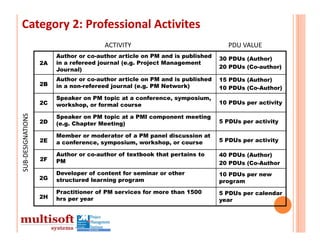
Category 2: Professional Activites
                                       ACTIVITY                                PDU VALUE
                        Author or co-author article on PM and is published   30 PDUs (Author)
                   2A   in a refereed journal (e.g. Project Management
                        Journal)                                             20 PDUs (Co-author)

                        Author or co-author article on PM and is published   15 PDUs (Author)
                   2B   in a non-refereed journal (e.g. PM Network)          10 PDUs (Co-Author)
                        Speaker on PM topic at a conference, symposium,
                   2C   workshop, or formal course                           10 PDUs per activity

                        Speaker on PM topic at a PMI component meeting
SUB‐DESIGNATIONS


                   2D   (e.g. Chapter Meeting)                               5 PDUs per activity

                        Member or moderator of a PM panel discussion at
                   2E   a conference, symposium, workshop, or course         5 PDUs per activity

                        Author or co-author of textbook that pertains to     40 PDUs (Author)
                   2F   PM                                                   20 PDUs (Co-Author
                        Developer of content for seminar or other            10 PDUs per new
                   2G   structured learning program                          program
                        Practitioner of PM services for more than 1500       5 PDUs per calendar
                   2H   hrs per year                                         year
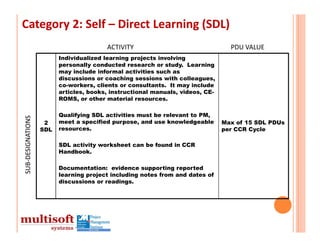
Category 2: Self – Direct Learning (SDL)
                                        ACTIVITY                                 PDU VALUE
                         Individualized learning projects involving
                         personally conducted research or study. Learning
                         may include informal activities such as
                         discussions or coaching sessions with colleagues,
                         co-workers, clients or consultants. It may include
                         articles, books, instructional manuals, videos, CE-
                         ROMS, or other material resources.

                         Qualifying SDL activities must be relevant to PM,
SUB‐DESIGNATIONS


                    2    meet a specified purpose, and use knowledgeable       Max of 15 SDL PDUs
                   SDL   resources.                                            per CCR Cycle

                         SDL activity worksheet can be found in CCR
                         Handbook.

                         Documentation: evidence supporting reported
                         learning project including notes from and dates of
                         discussions or readings.
Category 3: PMI Registered Education Provider
• Attend educational programs offered by REPs.
• REPs must be registered with PMI and designated as a PMI REP
• Examples include schools, consultants, corporate training departments, professional
  associations, government agencies, PMI Chapters and SIGs
• Multisoft is a PMI REP
• Listing can be found on PMI Website
Category 4: Other Provider
• PDUs may be earned by attending relevant education programs offered by
  organizations not registered with PMI.
• One (1) hr of contact hour of learning relevant to PM within a structured activity or
  course equals one (1) PDU.
Category 5: Volunteer Service
• Serve as an officer for a PM organization
    • 3 months = 2 PDUs per calendar year
    • 6 months = 5 PDUs per calendar year
    • 12 months = 10 PDUs per calendar year
• Serve as a committee member for a PM organization
    • 3 months = 1 PDU per calendar year
    • 6 months = 3 PDUs per calendar year
    • 12 months = 5 PDUs per calendar year
• Provide PM services to a community or charitable group = 5 PDUs per calendar year.
Suggestions for CCR
•   Maintain a CCR folder
•   Documentation that supports reported activities
•   Maintain documentation for 12 months after CCR cycle has ended.
•   Audits will be performed at random each year.
Information Location
•   www.pmi.org
•   www.multisoft‐pmp.com
•   Chapter Board Members
•   All Chapter Members
•   PMI Members
•   Testing Locations
If you need any more clarifications or guidelines:


  QUESTIONS
   ANSWERS                                      Ravi Jangra
                                                   Multisoft
                                   info@multisoft-pmp.com
                                    (+91) (120) 2540300/400
                            (+91) 9810306956 / 8130778887
Get Trained….!   Get Certified….!


            Thanks

PMP Certifications And Beyond

  • 1.
    Get Trained….! Get Certified….! Ravi Jangra Business Strategist Multisoft Systems ravi@multisoft-pmp.com
  • 4.
  • 5.
    Agenda • Introduction • PMI’s Certification Program Mission • PMI History/Information • Value of Certification • Certification Types • Requirements for Certifications • Process for Certifications • Beyond Certifications
  • 6.
    PMI’s Certification Program Mission Mission • Initiate, establish, evaluate, maintain, and administer professional credentialing programs to promote and support project management practitioners and the project management profession. Goals • Establish, implement and maintain global certification standards, policies and procedures for the PM profession • Promote and implement professional credentialing and psychometric methods and procedures for certifications in the PM profession • Initiate and foster cooperation and collaboration with other project management organizations to promote and sustain excellence in PM standards and methodology
  • 7.
    PMI History • Began in1969 – 35 years old. • PMP began in 1984 – 20 years old. • PMI is acknowledged as a pioneer in the field • Membership represents a truly global community with over 100,000 professionals representing 125 countries. • Currently, 75,000 PMPs have been certified • PMI professionals come from virtually every major industry
  • 8.
    Value of PM Certification • Prestige ofbeing the best in the field of PM. • Professional advantages derived from attaining the Project Management Professional (PMP) status. • Informs current and potential employers that you have a solid foundation of project management knowledge that can be readily applied in any workplace. • PMP certification is the profession’s most globally recognized and respected certification credential. • Finding individuals with this broad range of expertise is challenging, which is why expert project management leadership is a highly desirable competency.
  • 9.
    Types of Certification • Certified Associate in Project Management (CAPM) • Project Management Professional (PMP) • Masters Certificate in Project Management • Masters Degree in Project Management
  • 10.
    Why CAPM • The purposeand goal of which is the development, maintenance, evaluation, promotion, and administration of a rigorous, examination‐based, professional certification credential – the Certified Associate in Project Management (CAPM™). • Assisting in evaluating project control plans • Suggesting performance indicators and limits • Assisting with refining project requirements, assumptions, and constraints • Supporting administrative and financial closure • To be acknowledged for project management skills and contributions and elevate professional status.
  • 11.
    Definition of  CAPM • A CAPMis a project management practitioner who has demonstrated fundamental project management knowledge and experience by supporting projects using project management tools, techniques, and methodologies. • While participating as a member of a project team the CAPM typically relies on experienced project management practitioners for guidance, direction, and approval.
  • 12.
    Requirements of  CAPM • Category 1Candidate • Education – Baccalaureate or global equivalent university degree • PM Hours • 1500 hours PM experience within 5 years • Project dates must represent at least 2 years of non‐overlapping PM experience within the 3 yr period prior to the application • 23 contact hrs of PM education across the 9 areas of the PMBOK • Supporting documentation: Education, PM contact education hours, CAPM experience form (Audit Purposes)
  • 13.
    Requirements of  CAPM – Cont. •Category 2 Candidate • Education – High School diploma or secondary school equivalent • PM Hours • 2500 hours PM experience within 5 years • Project dates must represent at least 2 years of non‐overlapping PM experience within the 3 yr period prior to the application • 23 contact hrs of PM education across the 9 areas of the PMBOK • Supporting documentation: Education, PM contact education hours, CAPM experience form (Audit Purposes)
  • 14.
    Process of  CAPM Certification • Prepare/study for examination •Complete application and submit • Cost • $225 PMI Member • $300 Non‐PMI Member • Candidates have one year from submittal to complete examination • CAPMs must retest every 5 years to maintain certification
  • 15.
    CAPM Test Format • TheCAPM Certification Examination is computer based and is comprised of 150 multiple‐choice questions. • Exam must be completed within 3 hours. • Preceded by a briefing and 15‐minute computer tutorial and followed by an optional candidate satisfaction survey and exam survey report
  • 16.
    Suggested CAPM Study Material • CertifiedAssociate in Project Management (CAPM) Role Delineation Study (PMI) • Project Management: A Managerial Approach, 4th Edition by Jack Meredith and Samuel Mantel John (Wiley & Sons) • The Fast Forward MBA in Project Management by Eric Verzuh (John Wiley & Sons) • The New Project Management by J. Davidson Frame (Jossey‐Bass) • The Project Management Institute Professional Code of Conduct (PMI) • A Guide to the Project Management Body of Knowledge (PMBOK® Guide), 2000 Edition by the Project Management Institute (paper back) • Other readings exist – consult CAPM Handbook
  • 17.
    Why PMP • The purposeand goal is the development, maintenance, evaluation, promotion, and administration of a rigorous, examination‐based, professional certification credential of the highest caliper – the Project Management Professional (PMP). • The PMP is by far the project management credential of choice across a vast array of industries and companies. • PMPs are included in the largest and most prestigious group of certified professionals in the project management community • To be acknowledged for project management skills and contributions and elevate professional status.
  • 18.
    Requirements for PMP • Category 1 Candidate • Education – Baccalaureate or global equivalent university degree • PM Hours • 4500 hours PM experience. • Project dates must indicate that the candidate has at least 3 yrs of non‐ overlapping PM experience within the 6 yr period prior to the application. • At least 36 unique months of non‐overlapping PM experience to satisfy the 3 yr requirement • 35 contact hrs of PM education across the 9 areas of the PMBOK (regardless of when accrued) • Supporting documentation: Education, PM contact education hours, PMP experience form (Audit Purposes)
  • 19.
    Requirements for PMP – Cont. • Category2 Candidate • Education – High School diploma or secondary school equivalent • PM Hours • 7500 hours PM experience • Project dates must indicate that the candidate has at least 5 yrs of PM experience within the 8 yr period prior to the application. • At least 60 unique months of non‐overlapping PM experience to satisfy the 5 yr requirement • 35 contact hrs of PM education across the 9 areas of the PMBOK (regardless of when accrued) • Supporting documentation: Education, PM contact education hours, PMP experience form (Audit Purposes)
  • 20.
    Process for PMP Certification • Prepare/study forexamination • Read suggested materials • Utilize Practice Exams • Participate in Chapter Study Groups • Complete application and submit • Cost • $405 PMI Member • $555 Non‐PMI Member • Candidates have six months from submittal to complete examination.
  • 21.
    PMP Test Format • The PMPcertification examination is computer based and is comprised of 200 multiple‐choice questions. • Exam must be completed within 4 hours. • Preceded by a briefing and 15‐minute computer tutorial and followed by an optional candidate satisfaction survey and exam survey report
  • 22.
    PMI REP ‐ Multisoft PMP Study Group • Begins ‐ TBD • 4 consecutive weekend sessions • Session day ‐ TBD • Session time – Begins at 9:00 AM for 8 hrs per session • Maximum number of participants – TBD • To register, contact Ravi Jangra at ravi@multisoft‐pmp.com
  • 23.
    Suggested PMP Study Material • Project ManagementProfessional (PMP) Role Delineation Study (PMI) • A Guide to the Project Management Body of Knowledge (PMBOK® Guide), 4th Edition by the Project Management Institute • The Project Management Institute Professional Code of Conduct (PMI) • Project Management: A Systems Approach to Planning, Scheduling, and Controlling (7th edition) by Harold Kerzner • PMP Exam Practice Test and Study Guide (4th edition) by J. LeRoy Ward • PMP Exam Prep (3rd edition) by Rita Mulcahy
  • 24.
    Professional Responsibility Ref. List  • Blake, T.,Walker, D., and Walker, T. Doing business internationally: The guide to cross‐ cultural success. MacGraw‐Hill Professional Book Group (1995). • Ferraro, G. The cultural dimension of international business. Prentice Hall, 1997. • Rosen, R., Digh, P. and Phillips, C. Global literacies: lessons on business leadership and national cultures. Simon & Schuster, 2000.
  • 25.
    Master Certification in PM • Administered byseveral PMI Recommended Education Providers • Usually entails 1 foundational course, 5 advanced courses, 2 electives, and 1 PM acumen course. • Courses must be completed within 3 consecutive years. • PMI registered education providers can be found on PMI website.
  • 26.
    Master Degree in PM • Being offeredby more and more colleges on line. • Current Colleges offering MS in PM: • George Washington University • University of Wisconsin • Penn State University.
  • 27.
    Beyond Certification Yes, I Havemy PMP!!! Now What????
  • 28.
    Continuing Certification Requirements (CCR) • Purpose: • Ensures that individuals holding PMP certification demonstrate ongoing commitment to professional growth and development, a criterion of all high‐end professional organizations. • Those who have been granted the PMP credential must demonstrate ongoing professional commitment to the field of project management by satisfying PMI’s CCR program
  • 29.
    Continuing Certification Requirements (CCR) – Cont. • CAPM • Must retest every 5 years • PMP • PMPs must accrue a minimum of sixty (60) professional development units (PDUs) during each CCR cycle • CCR Cycle • Begins on the date of initial certification • Expires on December 31st of the third full calendar year after the first year of certification.
  • 30.
    PDU vs CEU •PDU is the measuring unit used to quantify approved learning and professional service activities. • One (1) PDU is earned for every one (1) hour spent in a planned, structured learning experience or activity. • One (1) Continuing Education Unit (CEU) equals 10 PDUs • PDUs are organized into 5 categories for the CCR program
  • 31.
    PDU Categories • Category 1: Formal Academic Education • Category 2: Professional Activities and Self‐directed learning • Category 3: PMI Registered Education Providers • Category 4: Other Provider • Category 5: Volunteer services to professional or community organization
  • 32.
    Category 1: Formal Academic Education • Formal Academic Course work • Can be taken for degree credit • Must be related to Project Management • One (1) hour of degree credit in a 15 week semester earns 15 PDUs. • One (1) quarter semester hour earns 10 PDUs. • If portion of class is related to PM, PDUs are calculated based a percentage of the overall curriculum focused on PM.
  • 33.
    Category 2: Professional Activites ACTIVITY PDU VALUE Author or co-author article on PM and is published 30 PDUs (Author) 2A in a refereed journal (e.g. Project Management Journal) 20 PDUs (Co-author) Author or co-author article on PM and is published 15 PDUs (Author) 2B in a non-refereed journal (e.g. PM Network) 10 PDUs (Co-Author) Speaker on PM topic at a conference, symposium, 2C workshop, or formal course 10 PDUs per activity Speaker on PM topic at a PMI component meeting SUB‐DESIGNATIONS 2D (e.g. Chapter Meeting) 5 PDUs per activity Member or moderator of a PM panel discussion at 2E a conference, symposium, workshop, or course 5 PDUs per activity Author or co-author of textbook that pertains to 40 PDUs (Author) 2F PM 20 PDUs (Co-Author Developer of content for seminar or other 10 PDUs per new 2G structured learning program program Practitioner of PM services for more than 1500 5 PDUs per calendar 2H hrs per year year
  • 34.
    Category 2: Self – Direct Learning (SDL) ACTIVITY PDU VALUE Individualized learning projects involving personally conducted research or study. Learning may include informal activities such as discussions or coaching sessions with colleagues, co-workers, clients or consultants. It may include articles, books, instructional manuals, videos, CE- ROMS, or other material resources. Qualifying SDL activities must be relevant to PM, SUB‐DESIGNATIONS 2 meet a specified purpose, and use knowledgeable Max of 15 SDL PDUs SDL resources. per CCR Cycle SDL activity worksheet can be found in CCR Handbook. Documentation: evidence supporting reported learning project including notes from and dates of discussions or readings.
  • 35.
    Category 3: PMI Registered Education Provider • Attend educationalprograms offered by REPs. • REPs must be registered with PMI and designated as a PMI REP • Examples include schools, consultants, corporate training departments, professional associations, government agencies, PMI Chapters and SIGs • Multisoft is a PMI REP • Listing can be found on PMI Website
  • 36.
    Category 4: Other Provider • PDUs maybe earned by attending relevant education programs offered by organizations not registered with PMI. • One (1) hr of contact hour of learning relevant to PM within a structured activity or course equals one (1) PDU.
  • 37.
    Category 5: Volunteer Service • Serve asan officer for a PM organization • 3 months = 2 PDUs per calendar year • 6 months = 5 PDUs per calendar year • 12 months = 10 PDUs per calendar year • Serve as a committee member for a PM organization • 3 months = 1 PDU per calendar year • 6 months = 3 PDUs per calendar year • 12 months = 5 PDUs per calendar year • Provide PM services to a community or charitable group = 5 PDUs per calendar year.
  • 38.
    Suggestions for CCR • Maintain a CCR folder • Documentation that supports reported activities • Maintain documentation for 12 months after CCR cycle has ended. • Audits will be performed at random each year.
  • 39.
    Information Location • www.pmi.org • www.multisoft‐pmp.com • Chapter Board Members • All Chapter Members • PMI Members • Testing Locations
  • 40.
    If you need any more clarifications or guidelines: QUESTIONS ANSWERS Ravi Jangra Multisoft info@multisoft-pmp.com (+91) (120) 2540300/400 (+91) 9810306956 / 8130778887
  • 41.
    Get Trained….! Get Certified….! Thanks