Balneario Hurtado Vía a Patillal. PBX (57) (5) 5736203 EXT. 1020
Valledupar Cesar Colombia
www.unicesar.edu.co
VICERRECTORÌA DE INVESTIGACIÒN Y EXTENSIÒN
1
FICHA RESUMEN DE PROYECTO
1. Información general del proyecto
Título: Teaching English through Drama to Preschoolers at Gimnasio Creciendo Juntos
Investigador principal: Carol Miranda
Total de Investigadores (número): 10
Nombre del Grupo de Investigación: (Asignatura) Intermediate English
Línea de Investigación: Innovative Pedagogy
Facultad: Ciencias Básicas y de la Educación
Programa: Licenciatura en Lengua Castellana e
Inglés
Duración del proyecto (meses): open
Tipo de proyecto: Action Research
Costo estimado: open
Descriptores/Palabras claves: drama, theatre, ludic, role play, English, teaching.
Línea de investigación en el cual se enmarca su proyecto: Innovative Pedagogy
Fecha de presentación del proyecto: open
1. Needs Analysis
The English Program at Gimnasio Creciendo Juntos involves more subjects
to work on instructions from different areas of knowledge: Language Arts
(Reading, Writing, Oral Skills), Science and Pedagogical Project. Those areas
are approached in English by more than one teachers. There is a strong
emphasys on the content. It aims to develop not only language skills but also
thinking and social skills through the use of the English in context.
QUESTION: What is the best strategy to apply so that our classes can be more
dynamic and the students can be more motivated?
Balneario Hurtado Vía a Patillal. PBX (57) (5) 5736203 EXT. 1020
Valledupar Cesar Colombia
www.unicesar.edu.co
VICERRECTORÌA DE INVESTIGACIÒN Y EXTENSIÒN
2
2. Jusification
The teachers have been working with different activities to reinforce the topics
seen: songs, games, tongue twisters, story telling time, role plays, among
others. The one the students enjoy the most is the ROLE PLAY, because it
includes costumes, fantastic characters, new voices and faces, chats, nice
esceneries, etc. No matter what the teacher brings to the class to teach, the
most important thing is the way he/she teaches it through, so that the children
enjoy the activity whithout thinking they are having a class. So it is planned to
implement the ludic or playful work in the everyday classes.
Also it has been chosen a special day on the week, THURSDAY, to work with
role plays and dramas, so that English can be taught in a communicative
context through these educational activities called Magic Adventure Day. But in
theory, the researchers ask theirselves the question: How can drama or role
play be used to teach English as a foreign language? And this is the reserch
question.
3. Rationale
Real communication involves ideas, emotions, feelings, appropriateness and
adaptability. The conventional English class hardly gives the learners an
opportunity to use language in this manner and develop fluency in it. So, as
Wilga Rivers (1983) states, "the drama approach enables learners to use what
they are learning with pragmatic intent, something that is most difficult to learn
through explanation“, the teachers want their students to get an opportunity to
use the language in operation.
4. Objectives
Balneario Hurtado Vía a Patillal. PBX (57) (5) 5736203 EXT. 1020
Valledupar Cesar Colombia
www.unicesar.edu.co
VICERRECTORÌA DE INVESTIGACIÒN Y EXTENSIÒN
3
To teach English through drama/role plays in a Magic Adventure Day on a
week, as an attractive alternative for our students to:
 Develop their skills in communication.
 Use what they are learning with pragmatic intent in a context for listening
and meaningful language production.
 Gain the confidence of using the language embedded in a context and a
situation, in and outside the class.
5. Materials, methods and procedures
 Submit the pedagogical proposal to the General Director of the
Preschool.
 Once accepted, it should be known by the rest of the school community:
teachers, parents and students. Set a meeting in which the school
community is invited to hear about the Project to develop.
 Organize the Magic Adventure Day Program which must consist on the
reinforcement of the topics seen in the whole English Program worked
from the other areas through playful activities such as role plays.
 Prepare each day by following the general structure of a lesson plan, as
follows:
 Warming up (Greeting and welcome)
 Presentation (the moment in which it is instroduced the topic).
 Practice (the moment of the class to work on activities oriented by
the teacher).
 Production or wrapping up (the moment for the students to show
what they have learned).
 Use a lot of creativity, energy, happiness and love. Children will learn
more!
Balneario Hurtado Vía a Patillal. PBX (57) (5) 5736203 EXT. 1020
Valledupar Cesar Colombia
www.unicesar.edu.co
VICERRECTORÌA DE INVESTIGACIÒN Y EXTENSIÒN
4
6. Expected results
It is required that the preschool students improve their English, practice and
reinforce the themes worked from their conventional English classes, but
especially enjoy learning English in a funny and meaningful way by creating
environments, dialogues and characters in a communicative context that can
only be generated by the work through drama and role plays.
7. Costs
Project costs focus on the cost of the materials that dramas and role plays carry
out such as scripts, elements of the scenarios: decoration, lighting and electric
sound, also costumes, advertising, transportation, among others. It has not
been determined yet.
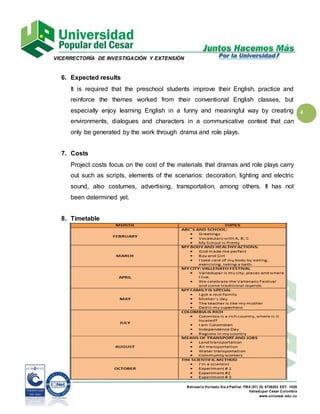
8. Timetable
Balneario Hurtado Vía a Patillal. PBX (57) (5) 5736203 EXT. 1020
Valledupar Cesar Colombia
www.unicesar.edu.co
VICERRECTORÌA DE INVESTIGACIÒN Y EXTENSIÒN
5
9. Bibliografía
American Psychiatric Association. (2009). Introducción al Estilo APA. (6a. ed.).
Washington, DC.
Chauhan, Vani. Drama Techniques for Teaching English. Introduction: Benefits of
using drama in the Language Classroom. The Internet TESL Journal, vol. X, No. 10,
Oxford, October 2004. Consultado en Mayo 2015.
Early Childhood Learning Knowledge Centre. (2006). Let the children play: Nature's
answer to early
learning. Retrieved 1 April 2015 from
www.cclcca.ca/CCL/Reports/LessonsInLearning/LinL20061010
Johnson, K. & Morrow K. [Ed] (1981). Communication in the Classroom. London:
Longman
Lumsden, L.S. (1994). Student motivation to learn. EricDigest 92. Retrieved 2 April
2015 from
www.kidsource.com/kidsource/content2/Student_Motivation.html
Maley, A. & Duff A (1982). Drama Teaching in Language Learning. London: CUP
O' Neill, C. & Lambert, A (1982). Drama Structures: A Practical Handlook for
Teachers. Portsmouth: Heinemann
Peacock, Colin (1990). Classroom Skills in English Teaching: A Self-Appraisal
Framework. London: Routledge
ROLE PLAY. Wikipedia, La enciclopedia Libre. Consultado el: 13-Octubre_2015.

Project english through drama

  • 1.
    Balneario Hurtado Víaa Patillal. PBX (57) (5) 5736203 EXT. 1020 Valledupar Cesar Colombia www.unicesar.edu.co VICERRECTORÌA DE INVESTIGACIÒN Y EXTENSIÒN 1 FICHA RESUMEN DE PROYECTO 1. Información general del proyecto Título: Teaching English through Drama to Preschoolers at Gimnasio Creciendo Juntos Investigador principal: Carol Miranda Total de Investigadores (número): 10 Nombre del Grupo de Investigación: (Asignatura) Intermediate English Línea de Investigación: Innovative Pedagogy Facultad: Ciencias Básicas y de la Educación Programa: Licenciatura en Lengua Castellana e Inglés Duración del proyecto (meses): open Tipo de proyecto: Action Research Costo estimado: open Descriptores/Palabras claves: drama, theatre, ludic, role play, English, teaching. Línea de investigación en el cual se enmarca su proyecto: Innovative Pedagogy Fecha de presentación del proyecto: open 1. Needs Analysis The English Program at Gimnasio Creciendo Juntos involves more subjects to work on instructions from different areas of knowledge: Language Arts (Reading, Writing, Oral Skills), Science and Pedagogical Project. Those areas are approached in English by more than one teachers. There is a strong emphasys on the content. It aims to develop not only language skills but also thinking and social skills through the use of the English in context. QUESTION: What is the best strategy to apply so that our classes can be more dynamic and the students can be more motivated?
  • 2.
    Balneario Hurtado Víaa Patillal. PBX (57) (5) 5736203 EXT. 1020 Valledupar Cesar Colombia www.unicesar.edu.co VICERRECTORÌA DE INVESTIGACIÒN Y EXTENSIÒN 2 2. Jusification The teachers have been working with different activities to reinforce the topics seen: songs, games, tongue twisters, story telling time, role plays, among others. The one the students enjoy the most is the ROLE PLAY, because it includes costumes, fantastic characters, new voices and faces, chats, nice esceneries, etc. No matter what the teacher brings to the class to teach, the most important thing is the way he/she teaches it through, so that the children enjoy the activity whithout thinking they are having a class. So it is planned to implement the ludic or playful work in the everyday classes. Also it has been chosen a special day on the week, THURSDAY, to work with role plays and dramas, so that English can be taught in a communicative context through these educational activities called Magic Adventure Day. But in theory, the researchers ask theirselves the question: How can drama or role play be used to teach English as a foreign language? And this is the reserch question. 3. Rationale Real communication involves ideas, emotions, feelings, appropriateness and adaptability. The conventional English class hardly gives the learners an opportunity to use language in this manner and develop fluency in it. So, as Wilga Rivers (1983) states, "the drama approach enables learners to use what they are learning with pragmatic intent, something that is most difficult to learn through explanation“, the teachers want their students to get an opportunity to use the language in operation. 4. Objectives
  • 3.
    Balneario Hurtado Víaa Patillal. PBX (57) (5) 5736203 EXT. 1020 Valledupar Cesar Colombia www.unicesar.edu.co VICERRECTORÌA DE INVESTIGACIÒN Y EXTENSIÒN 3 To teach English through drama/role plays in a Magic Adventure Day on a week, as an attractive alternative for our students to:  Develop their skills in communication.  Use what they are learning with pragmatic intent in a context for listening and meaningful language production.  Gain the confidence of using the language embedded in a context and a situation, in and outside the class. 5. Materials, methods and procedures  Submit the pedagogical proposal to the General Director of the Preschool.  Once accepted, it should be known by the rest of the school community: teachers, parents and students. Set a meeting in which the school community is invited to hear about the Project to develop.  Organize the Magic Adventure Day Program which must consist on the reinforcement of the topics seen in the whole English Program worked from the other areas through playful activities such as role plays.  Prepare each day by following the general structure of a lesson plan, as follows:  Warming up (Greeting and welcome)  Presentation (the moment in which it is instroduced the topic).  Practice (the moment of the class to work on activities oriented by the teacher).  Production or wrapping up (the moment for the students to show what they have learned).  Use a lot of creativity, energy, happiness and love. Children will learn more!
  • 4.
    Balneario Hurtado Víaa Patillal. PBX (57) (5) 5736203 EXT. 1020 Valledupar Cesar Colombia www.unicesar.edu.co VICERRECTORÌA DE INVESTIGACIÒN Y EXTENSIÒN 4 6. Expected results It is required that the preschool students improve their English, practice and reinforce the themes worked from their conventional English classes, but especially enjoy learning English in a funny and meaningful way by creating environments, dialogues and characters in a communicative context that can only be generated by the work through drama and role plays. 7. Costs Project costs focus on the cost of the materials that dramas and role plays carry out such as scripts, elements of the scenarios: decoration, lighting and electric sound, also costumes, advertising, transportation, among others. It has not been determined yet. 8. Timetable
  • 5.
    Balneario Hurtado Víaa Patillal. PBX (57) (5) 5736203 EXT. 1020 Valledupar Cesar Colombia www.unicesar.edu.co VICERRECTORÌA DE INVESTIGACIÒN Y EXTENSIÒN 5 9. Bibliografía American Psychiatric Association. (2009). Introducción al Estilo APA. (6a. ed.). Washington, DC. Chauhan, Vani. Drama Techniques for Teaching English. Introduction: Benefits of using drama in the Language Classroom. The Internet TESL Journal, vol. X, No. 10, Oxford, October 2004. Consultado en Mayo 2015. Early Childhood Learning Knowledge Centre. (2006). Let the children play: Nature's answer to early learning. Retrieved 1 April 2015 from www.cclcca.ca/CCL/Reports/LessonsInLearning/LinL20061010 Johnson, K. & Morrow K. [Ed] (1981). Communication in the Classroom. London: Longman Lumsden, L.S. (1994). Student motivation to learn. EricDigest 92. Retrieved 2 April 2015 from www.kidsource.com/kidsource/content2/Student_Motivation.html Maley, A. & Duff A (1982). Drama Teaching in Language Learning. London: CUP O' Neill, C. & Lambert, A (1982). Drama Structures: A Practical Handlook for Teachers. Portsmouth: Heinemann Peacock, Colin (1990). Classroom Skills in English Teaching: A Self-Appraisal Framework. London: Routledge ROLE PLAY. Wikipedia, La enciclopedia Libre. Consultado el: 13-Octubre_2015.