‫حجات‬ ‫منير‬ ‫اسامه‬
2020975022
‫عبيدات‬ ‫سليمان‬ ‫ليث‬
2020975327
‫صبيحات‬ ‫مفلح‬ ‫عمار‬
2020975138
Introduction to
Earth Fault
Protection
Earth fault protection is a crucial aspect of electrical
system safety, designed to detect and mitigate ground
faults that can lead to dangerous situations. This
introductory section will provide an overview of the
fundamental concepts and principles behind earth fault
protection.
Importance of Earth
Fault Protection
Earth fault protection is crucial in electrical systems to
mitigate the risks of ground faults, which can lead to
equipment damage, fire hazards, and potential loss of
life. Proper earth fault detection and isolation helps
maintain system stability, reliability, and safety.
Unaddressed earth faults can result in dangerous step
and touch voltages, increased fault current levels, and
cascading failures across the network. Effective earth
fault protection is essential for protecting personnel,
assets, and the continuity of power supply.
Types of Earth Faults
Phase-to-Ground Faults
These occur when a phase
conductor comes into contact
with the ground, creating a
low-impedance path for
current to flow. This is the
most common type of earth
fault.
Double Line-to-Ground
Faults
In this scenario, two phase
conductors make contact with
the ground, forming a low-
impedance path that can
result in high fault currents.
Insulation Failures
Degradation of insulation
material can lead to earth
faults, where a live conductor
touches the grounded
enclosure or equipment,
creating a safety hazard.
Causes of Earth Faults
Lightning Strikes
Direct lightning strikes on power lines or
equipment can create sudden high-voltage
surges, leading to insulation breakdown
and ground faults.
Aging Infrastructure
Over time, cable insulation, transformer
bushings, and other components can
deteriorate, increasing the risk of ground
faults.
Environmental Factors
Moisture, corrosion, tree growth, and
animal activity can all contribute to the
breakdown of electrical insulation and the
occurrence of earth faults.
Human Errors
Improper installation, maintenance, or
operation of electrical equipment can result
in unintended ground connections and
earth faults.
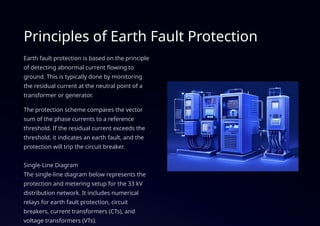
Principles of Earth Fault Protection
Earth fault protection is based on the principle
of detecting abnormal current flowing to
ground. This is typically done by monitoring
the residual current at the neutral point of a
transformer or generator.
The protection scheme compares the vector
sum of the phase currents to a reference
threshold. If the residual current exceeds the
threshold, it indicates an earth fault, and the
protection will trip the circuit breaker.
Single-Line Diagram
The single-line diagram below represents the
protection and metering setup for the 33 kV
distribution network. It includes numerical
relays for earth fault protection, circuit
breakers, current transformers (CTs), and
voltage transformers (VTs).
Earth Fault Detection Techniques
Current Transformers
Measure the current flowing
through the phase conductors
and neutral to detect earth
faults.
Voltage Transformers
Monitor the voltage between
the phase conductors and
ground to identify changes
that indicate earth faults.
Zero-Sequence Current
Analyze the vector sum of the
phase currents to detect
ground fault currents flowing
through the earth.
Earth Fault Protection Devices
Overcurrent
Relays
Overcurrent relays
are a common
device used for
earth fault
protection. They
detect when the
current exceeds a
preset threshold
and trigger a circuit
breaker to isolate
the fault.
Ground Fault
Relays
Ground fault relays
monitor the
imbalance between
phase and neutral
currents, indicating
an earth fault. They
can precisely locate
the fault and trip
the circuit breaker
accordingly.
Residual
Current Devices
(RCDs)
RCDs measure the
difference between
incoming and
outgoing currents,
tripping the circuit
if an earth leakage
is detected. They
provide robust
protection for
personnel and
equipment.
Directional
Earth Fault
Relays
These advanced
relays use the
direction of fault
current flow to
determine the
location of the
earth fault,
enabling more
precise isolation
and faster
restoration of the
system.
Coordination of Earth Fault Protection
Relay Coordination
Ensure proper coordination between the earth fault relays in the system to ensure
selective tripping and minimize disruption.
Time-Current Curves
Analyze time-current characteristics of earth fault relays to set appropriate time delays
and avoid nuisance tripping.
Grounding System
Consider the grounding system design and impedance to optimize earth fault
protection settings and achieve effective coordination.
Backup Protection
Implement backup earth fault protection at higher voltage levels to provide
redundancy and ensure system reliability.
Maintenance and Testing of Earth Fault
Protection
1 Regular Inspections
Conduct periodic inspections of earth
fault protection devices to ensure proper
functioning and identify any potential
issues or degradation.
2 Routine Testing
Perform regular testing of earth fault
protection systems, including injection
testing, trip testing, and verification of
relay settings and coordination.
3 Preventive Maintenance
Implement a preventive maintenance
program to clean, calibrate, and maintain
earth fault protection equipment,
extending its lifespan and reliability.
4 Documentation and Recordkeeping
Maintain detailed records of all
maintenance activities, test results, and
any issues or corrective actions taken to
ensure traceability and informed
decision-making.
Conclusion and
Best Practices
In conclusion, effective earth fault protection is essential
for ensuring grid reliability and safety. By leveraging
advanced microprocessor-based relays, power utilities
can implement robust, flexible, and adaptive earth fault
protection schemes tailored to their specific needs.

Project earth fault in electrical power Engineering .pptx

  • 1.
    ‫حجات‬ ‫منير‬ ‫اسامه‬ 2020975022 ‫عبيدات‬‫سليمان‬ ‫ليث‬ 2020975327 ‫صبيحات‬ ‫مفلح‬ ‫عمار‬ 2020975138
  • 2.
    Introduction to Earth Fault Protection Earthfault protection is a crucial aspect of electrical system safety, designed to detect and mitigate ground faults that can lead to dangerous situations. This introductory section will provide an overview of the fundamental concepts and principles behind earth fault protection.
  • 3.
    Importance of Earth FaultProtection Earth fault protection is crucial in electrical systems to mitigate the risks of ground faults, which can lead to equipment damage, fire hazards, and potential loss of life. Proper earth fault detection and isolation helps maintain system stability, reliability, and safety. Unaddressed earth faults can result in dangerous step and touch voltages, increased fault current levels, and cascading failures across the network. Effective earth fault protection is essential for protecting personnel, assets, and the continuity of power supply.
  • 4.
    Types of EarthFaults Phase-to-Ground Faults These occur when a phase conductor comes into contact with the ground, creating a low-impedance path for current to flow. This is the most common type of earth fault. Double Line-to-Ground Faults In this scenario, two phase conductors make contact with the ground, forming a low- impedance path that can result in high fault currents. Insulation Failures Degradation of insulation material can lead to earth faults, where a live conductor touches the grounded enclosure or equipment, creating a safety hazard.
  • 5.
    Causes of EarthFaults Lightning Strikes Direct lightning strikes on power lines or equipment can create sudden high-voltage surges, leading to insulation breakdown and ground faults. Aging Infrastructure Over time, cable insulation, transformer bushings, and other components can deteriorate, increasing the risk of ground faults. Environmental Factors Moisture, corrosion, tree growth, and animal activity can all contribute to the breakdown of electrical insulation and the occurrence of earth faults. Human Errors Improper installation, maintenance, or operation of electrical equipment can result in unintended ground connections and earth faults.
  • 6.
    Principles of EarthFault Protection Earth fault protection is based on the principle of detecting abnormal current flowing to ground. This is typically done by monitoring the residual current at the neutral point of a transformer or generator. The protection scheme compares the vector sum of the phase currents to a reference threshold. If the residual current exceeds the threshold, it indicates an earth fault, and the protection will trip the circuit breaker. Single-Line Diagram The single-line diagram below represents the protection and metering setup for the 33 kV distribution network. It includes numerical relays for earth fault protection, circuit breakers, current transformers (CTs), and voltage transformers (VTs).
  • 7.
    Earth Fault DetectionTechniques Current Transformers Measure the current flowing through the phase conductors and neutral to detect earth faults. Voltage Transformers Monitor the voltage between the phase conductors and ground to identify changes that indicate earth faults. Zero-Sequence Current Analyze the vector sum of the phase currents to detect ground fault currents flowing through the earth.
  • 8.
    Earth Fault ProtectionDevices Overcurrent Relays Overcurrent relays are a common device used for earth fault protection. They detect when the current exceeds a preset threshold and trigger a circuit breaker to isolate the fault. Ground Fault Relays Ground fault relays monitor the imbalance between phase and neutral currents, indicating an earth fault. They can precisely locate the fault and trip the circuit breaker accordingly. Residual Current Devices (RCDs) RCDs measure the difference between incoming and outgoing currents, tripping the circuit if an earth leakage is detected. They provide robust protection for personnel and equipment. Directional Earth Fault Relays These advanced relays use the direction of fault current flow to determine the location of the earth fault, enabling more precise isolation and faster restoration of the system.
  • 9.
    Coordination of EarthFault Protection Relay Coordination Ensure proper coordination between the earth fault relays in the system to ensure selective tripping and minimize disruption. Time-Current Curves Analyze time-current characteristics of earth fault relays to set appropriate time delays and avoid nuisance tripping. Grounding System Consider the grounding system design and impedance to optimize earth fault protection settings and achieve effective coordination. Backup Protection Implement backup earth fault protection at higher voltage levels to provide redundancy and ensure system reliability.
  • 10.
    Maintenance and Testingof Earth Fault Protection 1 Regular Inspections Conduct periodic inspections of earth fault protection devices to ensure proper functioning and identify any potential issues or degradation. 2 Routine Testing Perform regular testing of earth fault protection systems, including injection testing, trip testing, and verification of relay settings and coordination. 3 Preventive Maintenance Implement a preventive maintenance program to clean, calibrate, and maintain earth fault protection equipment, extending its lifespan and reliability. 4 Documentation and Recordkeeping Maintain detailed records of all maintenance activities, test results, and any issues or corrective actions taken to ensure traceability and informed decision-making.
  • 11.
    Conclusion and Best Practices Inconclusion, effective earth fault protection is essential for ensuring grid reliability and safety. By leveraging advanced microprocessor-based relays, power utilities can implement robust, flexible, and adaptive earth fault protection schemes tailored to their specific needs.